I Am Still Here

Reading Time: 2 minutes

Twenty-five years of the conditional tense. Contract. Sessional. Limited term. Contingent. Words that never quite fit what it actually was, which was showing up every September, as I belonged there. Because I did.

The neoliberal academy has a way of making you feel like a guest in your own house. No nameplate. No permanence. Just the work, and the work, and the work. Metrics where meaning used to be. Outcomes where wonder was.

And yet the students came. And yet the ideas grew. And yet something held.


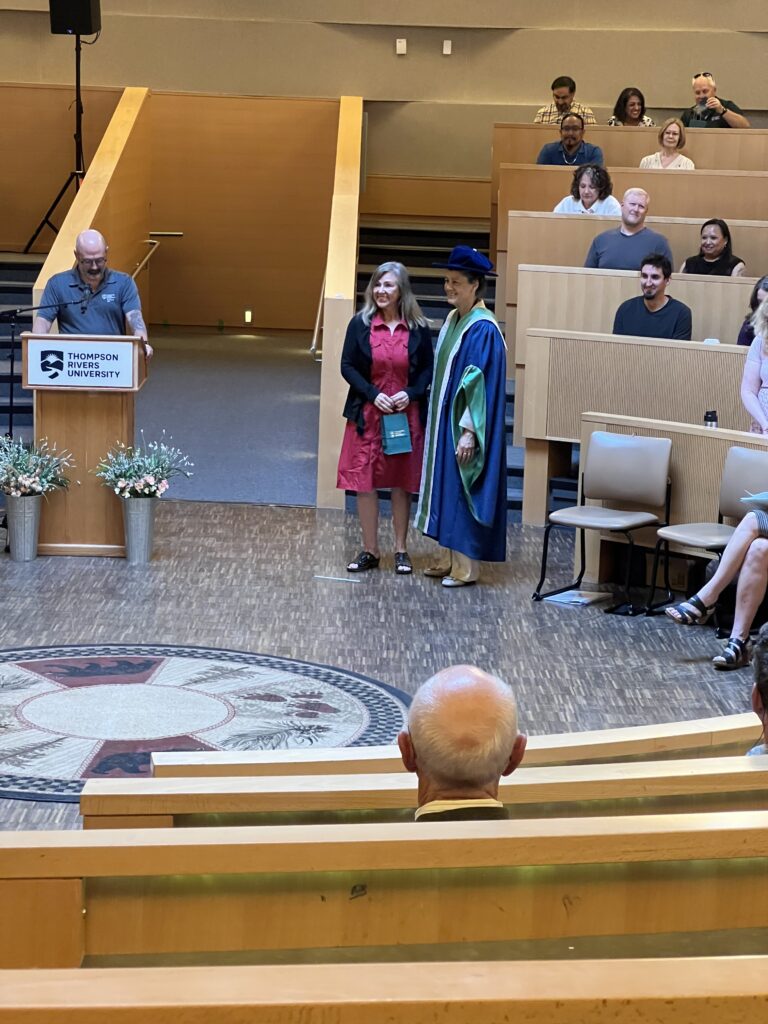
She asked if I wanted to make a speech.

I smiled, looked down, and shyly said no.

Because what would I have said that the twenty-five years had not already said for me.


President Arini stood beside me, beautiful and kind, the way some people just are, like they were made to make others feel that what they did mattered.

And standing there in that hall at Thompson Rivers, in my red dress, holding something small and teal, I felt it.

That it mattered. That I mattered. Not as a line in a budget. Not as a temporary measure. As a person. As a teacher. As someone who stayed.


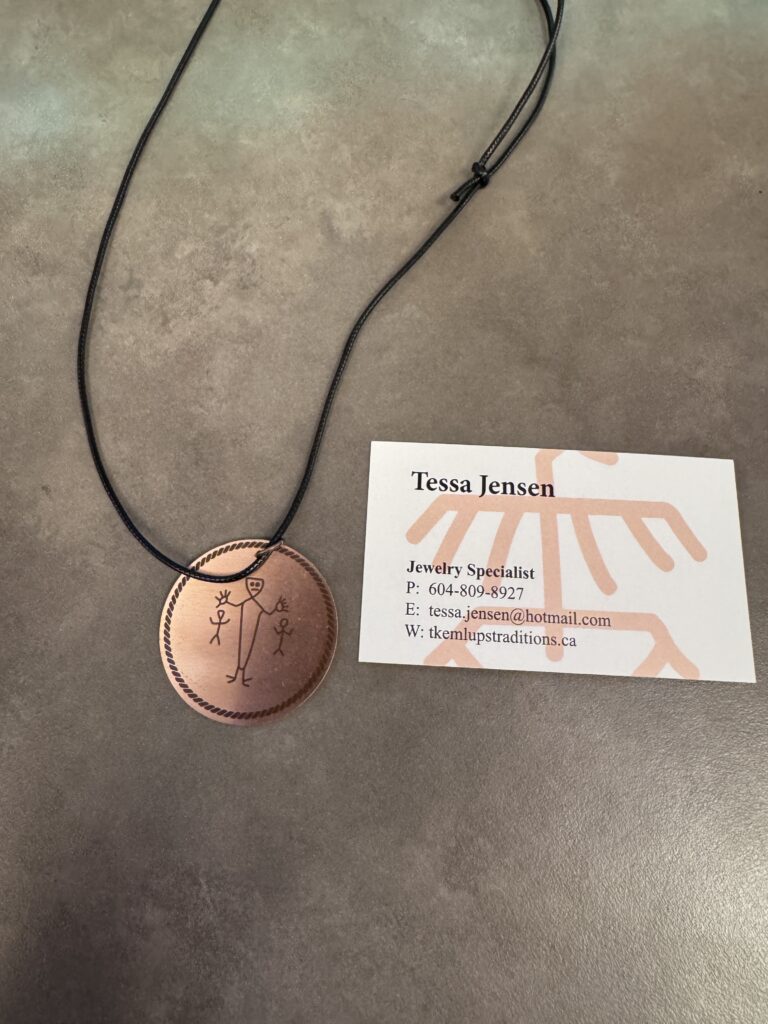
The gift came on a black cord. Copper, round and warm, figures etched into it the way the Secwépemc etched truth into stone long before any institution decided what counted as knowledge.

A tall figure, arms open. A small one beside. Together on the land.

I will wear it against my chest where all of it lives, the hard years and the good ones, the classrooms, the students, the quiet stubbornness of continuing.


They did not make it easy. They did not make it secure. They did not always make it fair.

But here is what I know, standing in that light, beside that woman who looked at me like I was worth celebrating:

I am still here.

Not in spite of it. Through it.

Still here. Still teaching. Still myself.

Amy Tucker. Still here.

You Got the Job

Reading Time: < 1 minuteThe email arrived on a Tuesday.

Subject line:
I got the job.
I wanted you to know.

I have a folder of these.
Not a large folder.
The kind of folder that is large enough.

You got the job.
You finished the degree.
You started the company.
You got into the program.
You named something after what you learned in my class,
which is a sentence I did not know was possible
until you sent it.

I want to tell you what those emails did.

They arrived in the ordinary middle of things,
between the grading and the planning,
between one contract and the hope of another,
in the years when the institution
was busy deciding my value
by metrics that had nothing to do with you.

And they landed like proof.

Not proof I needed from you.
You do not owe me the evidence of your success.
But proof that arrived anyway,
the way some things arrive,
without being asked,
without being required,
just because you wanted me to know
and you remembered
and you took the time to write.

I took the time to answer every one.

The institution will not find those emails
in any report.
They will not appear
in any metric of teaching effectiveness.
They are not countable
in the way the institution counts things.

I am counting them.

I have been counting them for twenty-five years.
That is the only number
that has never felt insufficient.

Para los que volvieron a contarme. Los cuento entre mis mejores cosas.
For the ones who came back to tell me. I count them among my best things.

Who Teaches the Distance Learners

Reading Time: < 1 minuteI want to ask you something.

When you imagine a professor,
what do you see?

The office with the books.
The name on the door.
The CV that fills a page with permanence,
publication stacked on publication,
tenure arrived at,
the slow accretion of institutional belonging.

Now imagine the person
who teaches the ones who cannot come to campus.

The single mother in a town four hours away.
The man finishing his degree at fifty-three
because life finally has a sliver of room for it.
The student with a disability
that makes the physical campus
a place of negotiation rather than welcome.
The worker on shift who studies in the break room.

Someone teaches them.

Someone builds the course,
writes the welcome,
answers the email at ten at night,
reads the submission carefully,
writes the feedback that says:
I see what you are trying to do here.
Let me help you do it.

Someone does that work.

She has a short contract.
She has no office.
She works from wherever the work can happen.
She is reviewed annually.
She is grateful for the renewal.
She does not complain,
or she complains only in the places
where complaining cannot change the weather.

She has been doing this for twenty-five years.

She is not unusual.
She is the norm.

She is how distance education runs.
She is the infrastructure
no one puts on the letterhead.

I am asking you to see her.

La que enseña desde los márgenes merece estar en el centro de la historia.
The one who teaches from the margins deserves to be at the centre of the story.

Twenty-Five

Reading Time: < 1 minuteLet me tell you what twenty-five is.

Twenty-five is the number of times
I signed a document that expired.

Twenty-five is the number of Septembers
I prepared a new cohort
for a course I was not sure
I would still be teaching in January.

Twenty-five is the number of times
I updated a syllabus,
redesigned an assignment,
read the new research,
learned the new framework,
showed up current and ready
for a position that was not prepared
to show up permanently for me.

Twenty-five.

People say: that is a long time.
They mean it as a compliment.
They mean: you must really love the work.

I do.
That is not the point.

The point is that twenty-five years
is long enough to have built something.
Long enough to have tenure.
Long enough to have a pension accumulating,
a name in the institutional memory,
a seat at the table where the decisions
about the courses you built
are being made.

I built something.
For twenty-five years I built something.

The institution holds it now
under someone else’s name
or no name
or the name of a process
that does not remember
whose hands made it.

Twenty-five.

They gave me a certificate.
They gave me a pin.

I gave them twenty-five years.

I am not doing the math out of anger.
I am doing it so the record is accurate.
So that anyone who reads this
understands what twenty-five years
of contingent labour looks like
from the inside of it.

It looks like this.
It always looked like this.

Veinticinco años. Que conste en el registro.
Twenty-five years. Let it be on the record.

They Called It Flexibility

Reading Time: < 1 minuteThey told me it was a benefit.

The flexibility.
The freedom to work from anywhere,
which meant the freedom to work from everywhere,
which meant the kitchen, the car,
the holiday that was not really a holiday
because the grades were due January second
and January second does not care
where you are.

They told me I was lucky.

I understood what they meant.
They meant: you should be grateful
we let you in at all.
They meant: a permanent contract
requires a different kind of person.
They meant: the flexibility is generous
when you consider the alternative.

I considered the alternative.
Every year I considered it.
The alternative had no map and I had children
and the work was work I wanted
so I called the flexibility a gift
and I was not entirely wrong
and I was not entirely honest.

Flexibility is a word that means something different
depending on which side of the contract you are on.

On my side it meant: be available.
On their side it meant: we are not responsible.

I learned the difference
the way you learn most important things,
late, and at some cost,
and in a way that cannot be unlearned.

I am not flexible anymore.
Or rather: I bend toward what is mine now.
Only that.
Only what is mine.

La flexibilidad era mía. El costo también.
The flexibility was mine. So was the cost.

What I Did With the Uncertainty

Reading Time: < 1 minuteI worked.

That is the honest answer.
I filled the uncertainty with work
the way you fill a crack in a wall
to keep the cold out,
the way you stay busy
so the waiting has less room
to become the only thing in the room.

I built new courses.
I revised the old ones.
I researched things no one asked me to research
because the research gave me somewhere to put the energy
that had nowhere else to go.

I sat on committees.
I answered emails I was not required to answer.
I attended the things that were optional
and made them less optional by attending,
which is a way of being useful
that is also a way of being visible,
which is a way of making yourself
harder to remove.

I understand now what I was doing.

I was making myself indispensable
as a substitute for making myself secure.
Those are not the same thing.
I learned that the slow way.

Indispensable means they keep using you.
Secure means you have rights.
I confused them for a long time
because the confusion was useful to the institution
and I did not yet understand
whose interests I was serving.

I understand now.

I am still a person who works.
That has not changed.
But now I work because the work is good,
not because the work is armor.

The distinction is everything.

Trabajé para llenar el vacío. Ahora trabajo para llenar el presente.
I worked to fill the emptiness. Now I work to fill the present.

Twenty-Five Years on a One-Year Contract

Reading Time: 2 minutes

They gave me a certificate today. Paper. Official. My name typed neatly above the number twenty-five, as if the years were something they had kept safe for me, folded in a drawer somewhere, waiting to be handed back.

And a pin. Small enough to sit in a palm. A tiny gold thing, the size of a punctuation mark at the end of a very long sentence.

I held them both and smiled the way I have always smiled in those rooms — carefully, genuinely, with the grief tucked just behind the gratitude where no one needed to see it.

Thank you, I said. And I meant it. I meant every syllable of it.

Because the students were real. Every single one of them was real. The one who came in certain the world was the shape she had already been told it was — I watched her unbutton the certainty, slowly, like a coat she had been wearing too long.

The one who sat in the back row, saying nothing for half a semester, until the day he said something so precisely true that the whole room went quiet in the best possible way.

I was there for that. Twenty-five years of that. No certificate can hold what it was worth.

But here is the other truth, the one that also belongs in the room:

I drove to a building that was never quite sure it wanted to keep me. I parked beyond my official territory. I signed my name on a line that expired just before anything could be called permanent —

every year. Twenty-five times.

I could not plan a garden. I could not lean into the future the way people lean when they know the ground is theirs. I planned the way a guest plans. Carefully. Lightly. Always aware of where the door was.

And they needed me. Not abstractly. Specifically. My courses. My students. My willingness to sit on the committees, fill the gaps, and do the invisible work that held the structure up while they kept searching for the person they actually wanted in the position I was already doing.

They appreciated me. They meant it. They said so every year.

Appreciation and belonging are not the same thing.

I know that now. I have known it for a long time.

So today I hold the paper and the pin no bigger than a comma, and I hold both things at once — the genuine love of this work, the genuine grief of never being let all the way in.

Twenty-five years. Twenty-five contracts. Twenty-five times, I signed my name and made the expiry date mean something other than what it was.

A sheet of paper. A pin you could lose in the carpet.

This is what permanence looks like for a woman who was never offered it.

I do not regret the signing. The work was the work I wanted. The students were always a reason enough.

But I want the record to reflect this: I was never the placeholder they needed me to be. I was never pending. Never provisional.

I was in the classroom. I was the one the question landed differently on. I was the room that made it safe enough for someone to finally say the true thing out loud.

They cannot give me that on paper. They cannot fit it on a pin.

It was already mine. It was always mine.

Aquí estoy. Con veinticinco años. Con grietas, con gracia, con amor. Here I am. With twenty-five years. With cracks, with grace, with love.


The Woman Who Kept Signing

Reading Time: < 1 minuteI want to be honest about this.

I kept signing.

Not because I did not understand.
I understood earlier than I admitted.
I understood the shape of the arrangement,
the way the renewal was not a promise,
the way appreciation was not belonging,
the way the bar kept rising.

I understood.

And I signed anyway.

Because the work was the work I wanted.
Because the students were already there.
Because the alternative had no map
and I had a life organized around this work
and reorganizing a life is its own kind of cost
and I was not ready to pay it.

I am not asking for pity.
I am asking for the record to be full.

The full record includes this:
I was not only a victim of the arrangement.
I was also a participant in it.
I brought my best every year.
I renewed the goodwill that made renewal possible.
I made it easy to keep me contingent
by being so reliably, generously present
that the contingency became invisible.

I did that.

I am naming it not as failure
but as the complicated truth
of a person trying to do good work
inside a system that was not designed for her good.

She did good work.
She also helped the system function.
Both things are true.
She is not ashamed of either one.

She is only finished now.
Finished signing on other people’s terms.
Ready to write her own.

La mujer que siguió firmando ahora firma en sus propios términos.
The woman who kept signing now signs on her own terms.

The Shoulders Never Come Down

Reading Time: < 1 minuteThis is not a metaphor.

I mean the shoulders.
The actual shoulders.
The ones that rose sometime in late March
and did not come back down
until the email arrived
and even then not all the way,
not fully,
because the email said planning to
and planning to is not the same as yes
and the body knows the difference
even when the mind decides to be grateful.

I have spent twenty-five years
with elevated shoulders.

I did not notice for a long time.
That is also what precarity does.
It becomes the baseline.
The tension becomes the normal.
You forget there is another way to carry yourself
because you have not carried yourself any other way
in longer than you can remember.

Someone touched my shoulder once,
a friend,
just a hand resting there,
and said: you are so tight.

I said: I know.
I did not say: I have been waiting
for a decision about my employment
every year for twenty-five years
and the body keeps the record
of every year of waiting.

I said: I know.
I tried to let it go.
The shoulders came down a little.
They came back up by April.

I am learning, now,
to notice the rising.
To put a hand on my own shoulder
and say: it is all right.
The waiting is almost over.
Not because the contract is secured,
but because I am no longer
organizing my body around their decision.

That is a different kind of settling.
The kind that comes from inside.

El cuerpo recuerda lo que la mente aprendió a ignorar.
The body remembers what the mind learned to ignore.

The Precariat

Reading Time: < 1 minuteI am not the only one.

I want to say that clearly
before I say anything else.

I am one of thousands.
Tens of thousands.
The people who teach the courses
the university could not run without,
who do the work the institution needs done
on terms the institution is not willing
to make permanent,
who are grateful for the renewal
because the alternative is nothing
and nothing is not a viable alternative
when you have rent and children
and a life that requires income
to continue being a life.

We are the precariat.

We are the adjuncts and the sessionals,
the limited term and the continuing-without-tenure,
the remote instructors and the contract staff,
the ones who built the open learning systems
and the online infrastructure
and the distance education programs
that expanded access for everyone
while our own access to security
remained carefully, structurally limited.

We are not a footnote.

We are a workforce.
We are a policy decision
dressed as an employment arrangement
dressed as flexibility
dressed as opportunity.

We are the infrastructure that is never on the letterhead.

I am naming us
not because naming changes the contract,
not because this poem reaches a boardroom,
but because the record matters
and the record has mostly been written
by the people whose names are on the doors
and whose tenure was never in question.

This is the other record.

Written by the ones who came back
every September
on terms that did not include
the dignity of certainty.

We came back.
We taught well.
We deserved better.

Somos el precariado. Somos también la razón por la que esto funcionó.
We are the precariat. We are also the reason this worked.