The Researcher as the Instrument
In this Scholarly Personal Narrative, I occupy the dual role of researcher and research subject. My position in this story is shaped by my status as a 60-year-old white settler woman, a mother, and a scholar-practitioner who spent 19 years in the “precariat” of the Canadian academy. I acknowledge that my vantage point is situated on the traditional and unceded territory of the Secwépemc peoples in Kamloops and the ancestral lands of the Cochimí in Loreto. My reflections are filtered through the “literary version of myself,” Amy Tucker, a device that maintains the critical distance necessary to analyze systemic trauma while honouring the raw immediacy of lived experience.
Institutional Precarity and Knowledge-Based Authority
For nearly two decades, my professional identity was defined by the “sessional” contract, a state of permanent temporality. This project is rooted in the belief that the precarious worker’s body is a site of knowledge. I reject the institutional gaslighting that suggests burnout is a personal failing; instead, I position my physical depletion (insomnia, chronic pain, and depression) as body-based evidence of institutional violence. My authority to speak on these subjects is drawn precisely from my exhaustion and from having lived it.
Relational Accountability and Ethical Restraint
Guided by Wilson’s (2008) framework of relational accountability, a methodology I have refined in my own research, I recognize that my story is inextricably linked to the lives of my sisters and my children. My position in this story as the “oldest sister” and “mother-caregiver” grants me a specific, power-laden perspective. I practise ethical restraint by using pseudonyms and omitting “crisis data” that belongs to them alone. I am far from a neutral observer of my family’s struggles with mental health and addiction; I am a participant-observer bound by love and a human right to care.
The Third Shore: A Decolonial Objective
My position in this story is defined by a transition from “vocational hope” to intentional alonetude. My departure from the university was an unpaid sabbatical, chosen on my own terms, an act of knowledge-based justice and a deliberate reclamation of agency from a system that views contract labour as a disposable resource. This narrative is my Third Shore, the space where the scholarly lens and the healing spirit converge to witness the truth of surviving the modern academic machine.
Ancestry: A Heritage of Displacement and Resilience
My lineage is a tapestry of survival, woven from histories of forced migration and the search for belonging. On my maternal side, I am of French Acadian descent, with roots tracing back to the early 1600s in Port Royal. This heritage is defined by a unique historical synthesis; during the 1700s, the Acadians were welcomed by the Mi’kmaq people, leading to a profound era of alliance and intermarriage. This kinship was more than social, it was foundational to Acadian survival, as the Mi’kmaq shared the traditional knowledge necessary to thrive on the land.
My family’s history is marked by the Grand Dérangement, the Expulsion of the Acadians, a systemic act of colonial violence that forced my ancestors from the fertile marshes of Port Royal to the refuge of Memramcook, New Brunswick, in the 1750s. This ancestral memory of being uprooted, of losing “tenure” on the land only to rebuild in the face of erasure, informs my current understanding of institutional precarity. It is a legacy of the “precariat” that predates the modern academy, echoing the resilience required to maintain dignity when systems seek to displace the individual.
Complementing this Atlantic history is the more recent arrival of my grandfather, who emigrated from Austria in the early 1900s. He brought with him the immigrant’s necessity for labour and the hope of settler stability in a new world. This side of my ancestry represents the “New Canadian” drive, the belief that hard work within established institutions leads to security. As I stand at sixty, having navigated nineteen years of sessional contracts, I feel the collision of these two lineages: the Acadian history of surviving systemic expulsion and the Austrian immigrant hope for institutional belonging.
A Note on Intellectual and Ethical Inspiration
In navigating this personal and scholarly journey, I am deeply inspired by Indigenous literature and methodologies. In particular, I draw on the work of scholars such as Shawn Wilson (2008) and his framework of Relational Accountability, as well as on decolonial perspectives found in the literature of the territories I have inhabited.
I wish to be clear: I carry no claim to Indigenous ancestry as a cultural or political identity. That said, DNA ancestry results have indicated Mi’kmaq ancestry in my lineage, a finding that deepened rather than defined my curiosity, and that I hold with care and humility rather than as a claim. My engagement with Indigenous texts and traditions is rooted in curiosity, profound respect, and a desire to align ethically with the lands of the Secwépemc and the Cochimí. While my Acadian ancestors were welcomed into Mi’kmaq kinship through marriage and alliance centuries ago, I recognize my modern position as a settler-scholar of Acadian and Austrian descent. My use of Indigenous frameworks is an act of “witnessing” and a commitment to social justice, an effort to learn from ways of being that prioritize relationality and care over the extractive, violent logic of the modern academic institution. I name these things to keep them visible rather than resolve them. Positionality is a practice, rather than a declaration. I expect this account to require revision as the research deepens.
Intersectionality
My positionality in this project cannot be understood through any single axis of identity. Drawing on Kimberlé Crenshaw’s (1989) framework of intersectionality, I recognize that my experience of institutional precarity is shaped by the interplay of gender, age, class, and settler status, the ways these structures overlap, compound, and mutually constitute one another.
As a 60-year-old white settler woman who spent nineteen years in the precariat of the Canadian academy, I occupy a position of racial and settler privilege while simultaneously experiencing the gendered and class-based violence of chronic precarious labour. These are contradictions to be inhabited, the terrain I occupy.
My ancestry adds further complexity to this intersectional map. I carry the Acadian heritage of displacement and survival, a lineage shaped by colonial expulsion and by the kinship alliances my ancestors formed with Mi’kmaq peoples, alongside the immigrant aspiration of my Austrian grandfather, who arrived seeking institutional stability in a settler-colonial state. These ancestral threads resist cancelling one another; they produce a layered inheritance of precarity and privilege that I bring, consciously, to this inquiry.
I am also a mother and caregiver, a relational role that has shaped both my capacity to rest and my understanding of what is at stake in claiming it. The right to alonetude, to be fully present to oneself without performance, audience, or apology, is unequally available across intersecting systems of gender, class, and care obligation. My thirty days by the sea were made possible by a specific convergence of resources, relationships, and risk; that specificity is itself intersectional data. Crenshaw’s framework asks us to attend to the ways that systems of power produce differentiated experiences, and it is in that spirit that I name the full complexity of what I brought to this shore. Conradson’s (2005) critique of therapeutic landscapes extends this positionality into geography specifically: the restorative properties of Loreto were available to me because of this intersectional position, and that availability was structured by race, class, mobility, and colonial history rather than by any universal quality of the place itself.
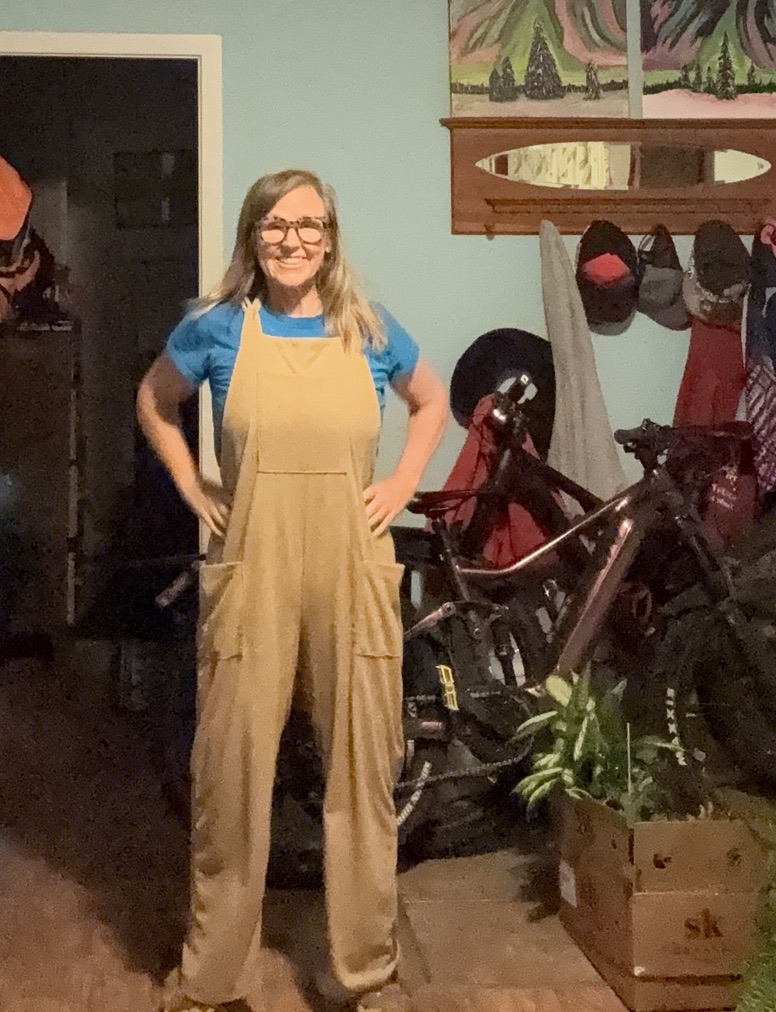
Artist statement: the artist, the cyclist, the plant lover, the gardener, finding Amy has become a true passion for me.
