A Letter From the Woman You Are Becoming

Reading Time: 5 minutes

From Future Amy, To the Amy Who Is Almost There

Dear you.

Dear brave, brilliant, bone-tired, still-standing, still-kind, still-carrying-the-lantern you.

I am writing from the other side of everything you are in the middle of right now, from the place you cannot quite see yet because you are still in the thick of the becoming, still in the part of the story that feels more like enduring than arriving,

and I want to tell you what is here.

I want to tell you what is waiting.

First, the practical things, because I know you, I know you need to know the practical things before you can let yourself feel the rest of it.

You are okay.

Financially, professionally, in all the ways that kept you awake at two in the morning doing the mathematics of whether you would make it through another April,

you are okay.

More than okay.

You found the room that was shaped like you. I know you have been looking for it for a very long time. I know there were years you stopped believing it existed,

but it exists.

It exists, and you are in it, and it feels exactly the way you imagined it would feel on the nights you let yourself imagine.

It feels like breathing. It feels like a morning that belongs to you. It feels like walking into a room and the room saying“There you are. We have been waiting. Come in, come in, stay as long as you like.

The doctorate is done.

I want to tell you that because I know how it weighs on you, the unfinished thing, the work that is so important and so yours.

It is done.

And it is extraordinary.

Not because a committee said so, though they did, but because it is true. Because you wrote it in your own voice, the voice that took years to trust, the voice that is scholarly and embodied and refuses to pretend that knowing happens outside of a body, outside of a life, outside of nineteen years of labour and love and parking lot mornings.

You wrote the truest thing.

Alonetude is in the world now. People are reading it. The ones who work in the in-between spaces, the ones on the contracts, the ones performing well in the parking lots of institutions that need their labour and withhold their belonging,

they are reading your words, and they are feeling less alone, and that is the work, that is the real work, that is what nineteen years was always building toward, even when it felt like it was building toward nothing.

Now let me tell you about the things that are not practical.

Let me tell you about a Tuesday morning.

An ordinary Tuesday. Not a milestone Tuesday. Not an achievement Tuesday.

Just a Tuesday when you woke up and lay still for a moment, the way you learned to do in Loreto,

and the first thing you felt was not the tightening.

The first thing you felt was yourself.

Present. Whole. Quietly, ordinarily, unremarkably glad to be alive on a Tuesday morning with the light coming through the window and nowhere to be for another hour and a cup of something warm in your future and the work you love waiting for you like a friend rather than a demand.

You lay in it, and you thought oh. So this is what they meant.

This is what rest was building toward. This is what the shore was practicing you for. This is the life on the other side of the performance of a life.

It is quieter than you expected. It is more ordinary than you expected.

It is so much better than anything you expected.

I want to tell you about your body.

Your shoulders come down.

I know that sounds like such a small thing. It is not a small thing. Your shoulders coming down is physical evidence that a woman is no longer waiting to find out whether she is still employed.

Your shoulders coming down is what safety feels like in the body.

You are safe. I need you to hear that all the way down.

You are safe.

The students found you.

The ones who needed you specifically. The ones who were on the contracts. The ones performing fine in the parking lots. The ones who read alonetude and recognized themselves in it and needed someone who had mapped the territory and come back to say I know this place, I know how to navigate this, here is what helped, here is how you find the shore inside yourself when there is no Loreto within reach.

You became that person.

I want to tell you about the writing.

You became a poet.

And you did not even know it.

I know that surprises you. But the line between scholar and poet turned out to be much thinner than you thought, and one morning you stopped trying to categorize yourself and just wrote what the truth required,

and what the truth required, Amy, was both.

It was always both. You were always both.

Tom knows.

I want to say that because I know you worry about whether the people who love you really see the whole of it.

Tom knows.

Not because you performed it less but because you finally let yourself be known the way you always knew how to know others, fully, carefully, without looking away.

And he stayed. Of course, he stayed. He has always been staying.

You are loved. You are chosen. You are someone’s permanent.

I want to tell you what I know now that I wish you knew then, in the middle of it, in the parking lot mornings, in the two a.m. turnings:

None of it was wasted.

Not one morning. Not one contract. Not one raised bar. Not one carefully worded rejection in professional language with warmth in the room.

None of it was wasted because it all became the work.

I want to leave you with something small.

A Tuesday morning. A cup of something warm. Your shoulders are coming down. The work you love is waiting like a friend.

A smooth stone in your pocket.

The knowledge, finally unshakeable, lived in the body, permanent as the shore,

that you were always good enough.

Come forward.

I am here. I am you. I am waiting for Tuesday morning, the open window, and the work that finally looks like what you always knew it was.

Come forward.

You have already done the hardest part.

All that is left now is the living of it.

And the living of it, Amy, the living of it is so very, very beautiful.

De tu yo futuro, que te ha estado esperando con los brazos abiertos y el corazón lleno. Ya casi llegas. Sigue caminando.

From your future self, who has been waiting for you with open arms and a full heart. You are almost here. Keep walking.

Future Amy
Writer. Scholar. Poet. Whole.
Keeper of smooth stones.
Woman who came through.
Still here. Still kind. Still luminous.
Aquí estoy.


Translation Note: Spanish phrases in this letter were assisted by Google Translate (translate.google.com). The Spanish is woven in as an act of reclamation, a return to a language of the body and the self that exists beyond institutional English.

A Letter From the Little One

Reading Time: 4 minutes

From Five-Year-Old Amy, To the Amy She Became

Dear big Amy,

I am writing you a letter because I have something important to say and I want to make sure you hear it properly.

I am five. I know how to write some letters, but not all of them yet, so I am going to say this as carefully as I can.

I see you.

I see you being so tired and still getting up anyway, and I want you to know I think that is very brave. I get tired too sometimes, and it is hard to keep going when you are tired, and I am only five, and you have been going for so much longer than me, so I think you are the bravest person I know.

I want to tell you some things about us that I am not sure you remember anymore.

We are kind.

I know you know that, but I do not think you believe it the way I believe it, which is all the way, without any buts after it, just kind, just completely and simply kind, the way the sun is warm, not because it is trying to be but because that is what it is.

That is us. That is what we are.

I want you to stop saying it like it might not be true. It is true. I know it is true because I am five and I have not yet learned to be unsure about it, and I need you to borrow some of my sureness until you find yours again.

I also want to tell you that I used to collect things.

Rocks mostly. The smooth ones. I would put them in my pockets until my pockets were very full and heavy, and Mama would say Amy, why are your pockets full of rocks and I could never explain it properly, but the reason was that I loved them.

I loved that they were smooth. I loved that something had made them smooth by being patient with them for a very long time.

I think you are like a rock, big Amy. I think a lot of things have been pushing against you for a very long time, and I think it has hurt, but I also think you are getting smooth. I think you are getting to the most beautiful part.

I would put you in my pocket. I would carry you everywhere.

I need to ask you something, and I need you to answer honestly because I am five and I do not understand things that are not honest yet.

Did you forget that you were allowed to play?

I am asking because when I watch you, I do not see much play, and play is very important. I know that because I do it every day, and it makes everything better, even the hard days, even the days when things are not fair, and things are not fair sometimes, even when you are five,

But even on those days, I still find something to play with.

A stone. A puddle. A word I like the sound of.

Promise me you will find something to play with. Even a small thing. Even just a word.

I did not know when I was five what the world would do to you.

I did not know about the rooms that would not claim you. I did not know about the bars that kept moving. I did not know about the contracts and the waiting and the smile over the closing door.

But I want to say this:

If I had known, I would have held your hand.

I would have put my small hand in your big hand and not let go.

I would have sat with you in the parking lot mornings. I would have sat with you at two in the morning when the grief was at its largest. I would have sat with you in every room that made you feel like a visitor in your own life.

And I would have said, in my five-year-old voice that did not know yet to be quiet in certain rooms:

This is not right. You belong here. You belong everywhere. You are Amy, and Amy belongs everywhere she goes.

I want you to know that I am proud of you.

I am proud of you for staying kind when unkindness would have been so much easier.

I am proud of you for keeping your ethics even when the cost was very high.

I am proud of you for loving your students the way you love them, all the way, without holding anything back for self-protection, which is a very five-year-old way to love people, and I think it is the best way, even when it hurts.

I am proud of you for crying in the shower. I know that sounds funny, but I am proud of it because it means you let yourself feel, which is a hard thing to keep doing when the world keeps suggesting you should feel less.

I am proud of you for going to the shore.

I am proud of you for writing the poems.

I am proud of you for still being you.

I need to tell you one more thing, and then I have to go because it is almost dinner and we are having something good tonight, and I do not want to miss it.

You are my favourite person.

Not because you are perfect. I know you are not perfect. I am five, and I am not perfect yet, and I think that is okay. I think not perfect is actually more interesting than perfect would be.

You are my favourite person because you are the only one who knows what it feels like to be us, to love this hard and work this hard and care this much and keep going anyway.

Nobody else knows that. Only you.

And I think that is the most extraordinary thing I have ever heard of.

I love you, big Amy.

I loved you before you knew what you would become.

I loved you in the pure, uncomplicated, five-year-old way that does not require you to prove anything, to produce anything, to perform anything.

I loved you just because you were you.

I still do. I always will.

Now go outside. Find a smooth stone. Put it in your pocket.

Remember that something the patient made made it beautiful.

Con todo el amor que sabe dar una niña de cinco años, que es todo el amor que existe.

With all the love a five-year-old knows how to give, which is all the love there is.

Little Amy
Age 5
Keeper of smooth stones
Your very first believer


Translation Note: Spanish phrases in this letter were assisted by Google Translate (translate.google.com). The Spanish is woven in as an act of reclamation, a return to a language of the body and the self that exists beyond institutional English.

To the Woman I Was Before I Knew

Reading Time: 5 minutes

A Love Letter Backwards in Time

I have been thinking about you.

The you that walked in the first time, folder tucked under your arm, lesson plan you had revised three times the night before because you wanted it to be right, because right mattered to you in that particular, cellular, uncompromising way it has always mattered to you,

the you that stood at the front of that room for the first time and felt the gravity of it, the privilege of it, the enormous ordinary miracle of a room full of people who had arrived willing to think differently than they had thought before.

I have been thinking about her. About you. About what I want to say now that I know what you did not know then.

You were so ready.

That is the first thing I want to tell you.

You were so ready and you did not know it. From the student’s side of the room, from the side that would later write you letters, send you emails years later that began with I have been thinking about something you said in class and I wanted you to know,

you were luminous.

I want to warn you about some things.

The bar will move.

I want you to know this from the beginning, before the first time it moves, before you exhaust yourself reaching for it and find it has shifted just beyond your hands.

The bar is not a measure of you. The bar is a mechanism. It is the system’s way of keeping you reaching, hungry, slightly off-balance, slightly too invested in the next thing to stop and ask why the last thing was not enough.

Reach for the bar because the reaching makes you better. Reach for the bar for yourself.

Do not reach for the bar for them.

Know the difference between a place that is developing you and a place that is extracting you.

The students are real.

This I want you to hold as the true north of the whole nineteen years, the thing that does not shift, the thing the system cannot touch or take or use without your permission.

When everything else feels uncertain, go back to the students.

You are going to be so tired.

I want to say this without softening it because you deserve honesty more than comfort.

You are going to be tired in a way that goes all the way down, tired in the bone, tired in the place that decides whether to keep going,

and you are going to keep going because you do not know how not to.

But I am going to tell you this:

Give so much. Give everything. And also, in the small moments, in the shore of yourself that belongs to no one else,

give something to you.

Give yourself the belief you give so freely to others. Give yourself the patience you give the struggling student.

You deserve your own generosity. You deserved it from the beginning.

You are going to find out that you did not belong there.

Not because of anything that was wrong with you. Because of everything that was right with you, and the particular cruelty of a room that needed you but was not built for you.

This is going to hurt in a way you are not prepared for.

You are going to spend years thinking the problem is you, turning yourself over looking for the missing piece.

There is no missing piece.

You were always the right shape. The room was the wrong shape.

When you finally understand this, it is going to feel like grief and also like freedom, grief and freedom arriving together the way they always do when something true finally breaks the surface.

I want to tell you about the shore.

You are going to go to a shore. Far from the institution.

You are going to sit with the sea which will ask nothing of you,

and you are going to cry the way you needed to cry for years, the real kind, the kind without an audience,

and when you are empty you are going to find underneath the empty the most important thing you have found in nineteen years.

Yourself.

Still there. Still whole. Still luminous under all the exhaustion and the performance and the careful management of being a person the institution kept evaluating.

I want to tell you about the poems.

You are going to write poems.

Not as scholarship, not as methodology, but because you are going to discover in the long quiet aftermath of all that noise,

that you are a writer.

That you always were.

I love you.

I love the woman who revised the lesson plan three times. I love the woman who could not walk past the struggling student. I love the woman who agonised at two in the morning over whether she had said exactly the right thing in exactly the right way to the person who most needed to hear it.

I love the woman who kept the actual record, who knew in her deepest self that she was good, that the work was good, that what happened in those rooms was extraordinary even when no one was calling it that.

I love the woman who is standing now on the other side of knowing, worn smooth by it, clarified by it, more herself for it than she has ever been,

still kind, still ethical, still in love with the work and the students and the lantern she carries into every room,

and finally, finally, in love with herself.

You made it through.

I wanted you to know from the beginning that you make it through.

Para la mujer que era antes de saber. Te vi siempre. Eras suficiente desde el principio. Con todo mi amor, desde el otro lado.

For the woman I was before I knew. I always saw you. You were enough from the beginning. With all my love, from the other side.

A smooth weathered piece of wood half-buried in white snow, its grain worn clean and visible, alone in a white field.

Still Here, Worn to Its Truest Shape
Photo Credit: Amy Tucker, 2026

Artist Statement: I photographed this piece of wood because of what had happened to it. Water, time, winter, something had stripped away everything that wasn’t essential, and what was left was the grain, the core, the particular shape that was always there. I thought: that is the woman who is still walking into those rooms. Not diminished. Clarified. This photograph belongs with this letter because both of them are addressed to the woman before the smoothing began, and both of them tell her: what comes through it is worth it.


Translation Note: Spanish phrases in this poem were assisted by Google Translate (translate.google.com). The Spanish is woven in as an act of reclamation, a return to a language of the body and the self that exists beyond institutional English.

Never Enough

Reading Time: 3 minutes

I learned the word enough the way you learn a language no one speaks in your house.

From the outside. By watching. By getting it wrong and being corrected with a look.

I thought enough was a place. A destination with coordinates. If I worked this hard, if I published this much, if I sat on enough committees, answered enough emails at midnight, held enough office hours, wrote enough letters of reference for people who would never write one back,

I would arrive.

I would finally stand somewhere solid and someone would say, yes, this. You. Here.

They never said it.

There was always one more thing. One more credential. One more specialisation. One more revision. One more year of proving what I had already proven the year before, and the year before that, in the same rooms, to the same people, who kept forgetting they had already seen me.

Or perhaps they never forgot. Perhaps that was the point.

I reached the bar.

I want you to understand that. I reached it. I put both hands on it, pulled myself up, stood on top of it, and looked them in the eye.

And they raised it.

Quietly. Professionally. With a smile that said we only want what is best for the department.

So I climbed again.

I got the specialisation they mentioned. I built the expertise they suggested. I redesigned the courses, updated the research, learned the new framework, attended the conference, wrote the paper, revised the paper, revised the revision, and brought it back.

And they raised it again.

One more thing. There was always one more thing, and I believed each time that this would be the last thing, that this would be the thing that finally made me legible to them, finally translated me into a language they were willing to read.

I gave you everything.

I need to say that plainly, without apology, without softening it for your comfort.

I gave you my mornings before my children were awake. I gave you my evenings after my body had already given out. I gave you my health, my rest, my capacity for joy, the slow years of my life that I will not get back, offered up like evidence, like if I just bled enough in the right places you would finally call it qualified.

I gave you my expertise and you used it while deciding someone else deserved to own it.

I gave you my loyalty and you gave me contract renewal pending.

I gave you my belief that the system worked, that merit was real, that the path was honest, that if I followed every instruction the door would open.

And you raised the bar one final time and called it a national search.

Never enough.

It sounds like a personal failing. It sounds like something that lives in the one who is lacking.

But I have seen enough now to know the shape of it, the architecture of a system that needs you insufficient, that requires your hunger to function, that would lose its power the moment you believed you were already whole.

Never enough was never about me.

It was a door with no handle on the inside.

It was a game with rules that changed when I learned them.

It was a bar on a pulley held by hands that were never going to let it rest.

I am done climbing.

I am done bringing more to people who have decided that more will never be the right amount.

I am enough in the way a river is enough, in the way the morning is enough, in the way nineteen years of changed lives is enough,

whether they counted it or not.

They never counted it.

But I do.

Aquí estoy. Siempre he sido suficiente. I have always been enough.

Spanish translations assisted by Google Translate (translate.google.com)

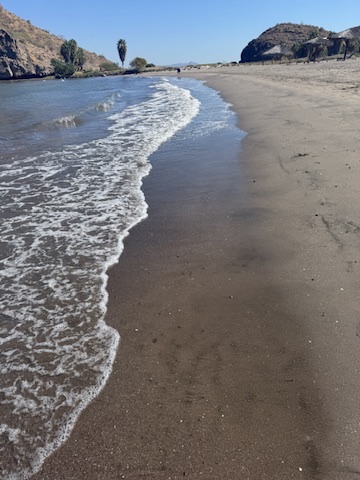
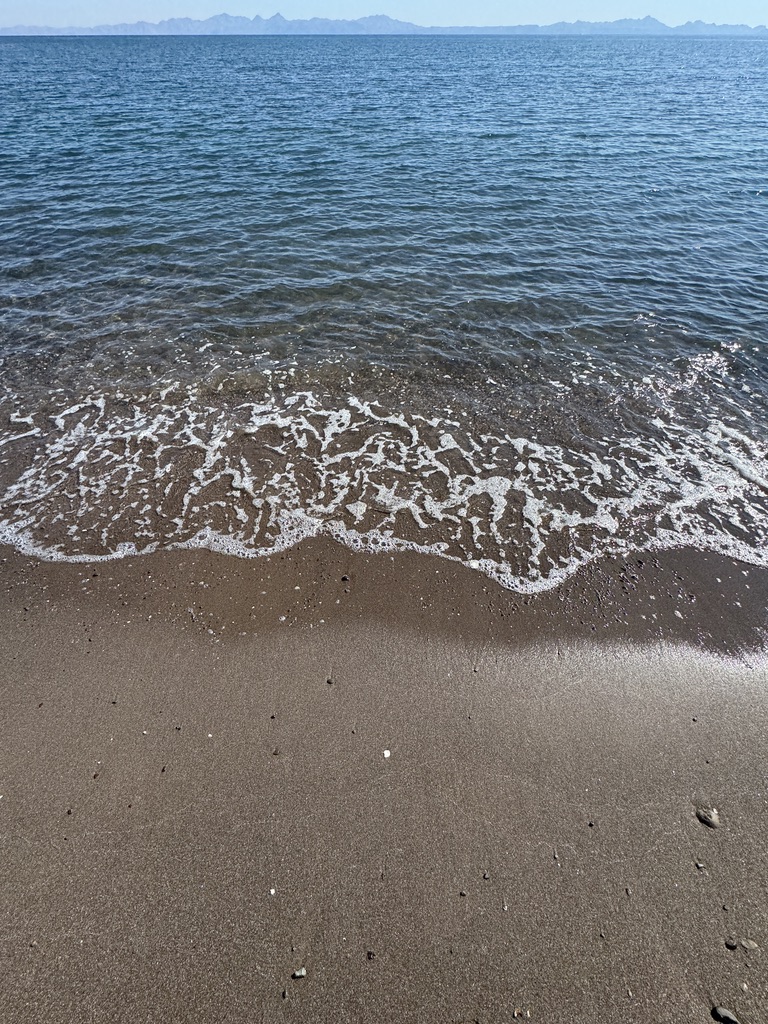
Abstract image of shallow sea water washing over pale sand, creating layered textures of green, white, and grey.

What the Tide Has Always Known
Photo Credit: Amy Tucker, 2026

Artist Statement: I took this photograph at the edge where the water returns, where the sea neither tries nor explains itself, but arrives. I was thinking about the word enough. How the tide does not credential itself before reaching shore. How the water does not revise itself to please the sand. I photographed it from above, looking down, trying to learn something I had been taught to forget: that arriving is not the same as being permitted. That the shore receives the tide because the tide is the tide, not because the tide proved it deserved to be.


Translation Note: Spanish phrases in this poem were assisted by Google Translate (translate.google.com). The Spanish is woven in as an act of reclamation, a return to a language of the body and the self that exists beyond institutional English.

The Geography of Fear: A Vignette on Childhood Hypervigilance and the Cost of Safety

Reading Time: 23 minutes

Trauma scholar Bessel van der Kolk articulates that trauma represents far more than a discrete event from the past; it is an enduring imprint on mind, brain, and body that continues shaping how we navigate the present (2014, p. 21).

Keywords: childhood hypervigilance, trauma, nervous system, body memory, fear, safety, body-based experience, scholarly personal narrative, vignette


States of Being Rather Than Events

Content Warning: This vignette contains discussion of childhood exposure to parental alcoholism and domestic violence. While free of graphic detail, the material addresses trauma, fear, and hypervigilance that some readers may find distressing.

There are childhood memories constructed from discrete events, moments with clear beginnings and endings. And then there are memories that exist as states of being rather than as events, atmospheric conditions that pervaded entire years. This vignette attempts to capture one such state: the pervasive fear that characterized my childhood from approximately ages three through twelve, the years when my father’s alcoholism and violence made our home a place of constant threat. This is the texture of hypervigilance itself rather than the memory of a single incident, the embodied experience of a nervous system locked in perpetual defensive mobilization.

Psychiatrist Bessel van der Kolk (2014) has demonstrated that trauma represents far more than a discrete past event; it is an enduring imprint on mind, brain, and body that continues shaping how we survive in the present. For children living in homes characterized by unpredictable violence, the imprint forms through chronic activation rather than through isolated traumatic events of threat-response systems.

Neuroscientist Stephen Porges (2011), developer of the polyvagal theory, explained that the autonomic nervous system continuously evaluates environmental cues for safety or danger through a process he termed the body’s instinct to scan for safety, an unconscious detection of threat that occurs beneath conscious awareness. In homes where violence erupts unpredictably, children’s nervous systems become calibrated to constant danger, their bodies’ instinct to scan for safety tuned to detect the subtlest indicators of impending harm.

I return to this material now because I cannot understand what thirty days by the sea gave me without understanding what had been taken first. The capacity for alonetude, I have come to believe, requires a nervous system that was once allowed to learn that stillness is safe. Mine learned something else entirely. What I am doing in Loreto is less a discovery than a reclamation.

The Architecture of Chronic Threat

What I am attempting to document here defies conventional narrative structure. There is no rising action, no climax, no resolution. There is only the ongoing state of estar alerta, being alert, a way of inhabiting the world that became so normalized I forgot there was any other way to be. The challenge in writing about this lies in conveying the atmospheric quality of constant vigilance, the way fear became the background hum against which all other experiences played out.

Robert Nash (2004) calls this Scholarly Personal Narrative: the practice of using one’s own experience as scholarly data, rigorously examined and theoretically grounded. My childhood hypervigilance is far more than personal history; it is a case study in how developing nervous systems adapt to chronic threat, how children organize their entire beings around the imperative of survival, and how early experiences of danger foreclose later capacities for rest and solitude.

Psychiatrist Judith Herman observes that children living in chronically threatening environments organize their entire existence around preventing further harm, shaping every aspect of their development and behaviour (1992).

Complex Trauma and Deformation of Personality

Before the narrative, the science. Because what I carried in my body has a name. Psychiatrist Judith Herman (1992) introduced the concept of complex post-traumatic stress disorder (complex PTSD) to describe prolonged, repeated trauma occurring in contexts where escape is impossible, particularly during developmental years. Herman distinguished complex PTSD from single-incident trauma, noting that repeated trauma in adult life erodes the structure of an already-formed personality, but repeated trauma in childhood fundamentally shapes and deforms the personality as it develops. Children exposed to ongoing domestic violence develop far more than memories of specific frightening events; they develop an altered baseline state characterized by constant vigilance, disrupted attachment, and a compromised sense of safety.

This distinction matters profoundly. Single-incident trauma, while devastating, occurs against a backdrop of relative safety. The person knows what normal felt like before the trauma and can potentially return to that baseline. But for children in chronically threatening environments, a safe baseline is absent. The threat is the baseline. Safety, when it occurs, feels like an aberration.

How the nervous system responds to safety and threat, and the Hierarchy of Survival Responses

How the Nervous System Responds to Safety and Threat, developed by Stephen Porges (2011), provides a crucial understanding of how chronic threat shapes the nervous system. Porges described three hierarchically organized subsystems of the autonomic nervous system: the genuine safety system, which supports social engagement and feelings of safety; the sympathetic nervous system, which mobilizes fight-or-flight responses; and the dorsal vagal system, which produces freeze, collapse, and shutdown responses. In safe environments, the nervous system flexibly moves between these states as situations require. However, in chronically threatening environments, the system becomes biased toward defensive states, with the genuine safety social engagement system chronically inhibited (Porges, 2011).

For children in violent homes, this means the nervous system rarely experiences the regulation that comes from safe, attuned relationships. Instead, as van der Kolk (2014) documented, traumatized individuals carry fundamentally different bodily experiences than those who have felt safe and welcome in the world. The chronic activation of threat-detection systems creates what trauma researcher Janina Fisher (2017) termed structural dissociation, the fragmentation of the personality into parts that carry different survival strategies. Children develop what Fisher described as trauma-related action systems, including fight, flight, freeze, submit, and attach-cry-for-help responses, each associated with specific bodily states and relational patterns.

Hypervigilance as an Adaptive Strategy

Hypervigilance, which van der Kolk (2014) characterized as the persistent expectation of danger that keeps the body in a state of high alert, becomes a chronic state rather than an acute response. Clinical psychologist Christine Courtois (2008) noted that children in abusive homes develop what she termed anticipatory anxiety, constantly scanning environments and monitoring adult moods to predict and potentially avoid danger. This anticipatory stance, while adaptive in the moment, creates lasting alterations in how the nervous system processes safety cues even in genuinely safe environments.

Hypervigilance is best understood as an intelligent adaptation rather than a pathology. The child who learns to read micro-expressions, to detect shifts in vocal tone, to map escape routes through the house, that child is surviving rather than malfunctioning. The problem arises from the persistence of the adaptation long after the threat has ended, in the way the nervous system continues to signal danger even in contexts of genuine safety.

Betrayal Trauma and the Violation of Reality

The specific experience of being falsely accused connects to what trauma researchers call betrayal trauma, a concept articulated by psychologist Jennifer Freyd and summarized in Freyd (2008). Freyd argued that when those who should protect us instead harm us, or when we are blamed for harm done to us, the violation cuts deeper than the harm itself because it undermines our basic capacity to trust our own perceptions. For children, false accusations by abusive parents create a double bind: the child knows they were innocent of the accused act, yet the parents’ power requires submission to the false narrative, creating a fundamental rupture in the child’s sense of reality and worth.

Freyd (2008) distinguished betrayal trauma from other forms of trauma by emphasizing that it occurs when the people or institutions on which a person depends for survival violate that trust. For a child, there is no one more dependent upon for survival than parents. When parents both harm and deny the child’s reality, they commit what might be understood as epistemic violence, an assault on the child’s capacity to know what they know.

Parentification and the Burden of Protection

Finally, the pattern of attempting to protect younger siblings represents what family therapist Salvador Minuchin (1974) termed parentification, a developmental distortion in which children assume caretaking roles beyond their capacity. Jurkovic (1997) further described how parentification places the child in an impossible position, simultaneously serving as both a caretaker and a dependent. The child becomes hypervigilant for their own safety as well as their siblings’, exponentially increasing the burden on their developing nervous system.

Most relevant for the current inquiry into alonetude, parentified children often struggle with solitude because their nervous systems learned early that constant vigilance is required for self-protection as well as for the protection of others. Rest feels like a dereliction of duty. Solitude feels like abandonment of the post.


van der Kolk (2014) demonstrates that the body continues to register and respond to danger signals even when conscious memory holds no record of the original trauma.


The Vignette: The Feeling in My Stomach

The Constant Companion

I am seven. Or eight. Or nine. The specific age matters less than the constancy: from my earliest memories until approximately age twelve, I lived inside a particular sensation. It sits in my stomach, a tight ball of readiness. Neither quite nausea, though sometimes it tips that way, nor quite pain, though it aches. It is the feeling of waiting. Esperando (waiting). Always listening and waiting for the sound that will tell me whether this evening will be safe.

The sound is the garage door. My father’s car is pulling in at the end of the day. My body knows before my mind processes: the particular rhythm of his footsteps tells me everything I need to know. Heavy, deliberate steps mean danger. Lighter, quicker steps might mean safety, though guarantees are absent. The ball in my stomach tightens, and my breathing changes without my choosing. I am listening with my whole body, with every sense.

By the time I hear the garage door, I have already assessed multiple variables. What day of the week is it? Fridays are more dangerous. How late is he? Later means more drinking. Did my mother seem tense at dinner? Her tension means she has already sensed something. Is my younger sister being too loud? Noise draws attention, and attention is dangerous. The youngest is seven years younger than me, still small enough that sometimes she cries in ways I cannot quiet, and this terrifies me more than my own danger.

Reading Atmospheres

I develop a hyperawareness of atmospheres. I can feel the charge in the air before anything visible changes. My mother’s shoulders tighten in a particular way. The house itself seems to hold its breath. By age eight or nine, I had learned to read micro-expressions, shifts in vocal tone, and the precise degree of door-closing force that indicates anger. I am fluent in the language of approaching violence in ways that children should never need to be fluent.

The worst moments arrive before violence, during the hours of waiting, the ball in my stomach wound so tight I think it might tear something open. During these hours of waiting, I strategize. Where are my sisters? If something happens, can I get to them? Are there obstacles between me and their rooms? I map the house in my mind like a battlefield, planning routes and refuges. The hall closet has been my hiding place before. The space under my younger sister’s bed. The corner behind the living room chair, where I can pull my knees to my chest and make myself small. Pequeña. Invisible. (Small. Invisible.)

The Geography of Hiding

The house has its own geography of fear. Certain rooms are more dangerous than others. The kitchen, where my father drinks after work, where the counter holds the evidence of how many bottles have been opened. The living room, where he sits in his chair and calls us to him. The hallway between my room and my sisters’ rooms, which I must cross to reach them if they need me, feels impossibly long and exposed.

I learn to move through the house silently. I learn which floorboards creak, which doors squeak, and how to open cabinets without sound. I learn to make myself unnoticeable, to exist without creating disturbance, to breathe so shallowly that even my breath draws no attention. This skill, this ability to minimize my presence, will follow me for decades, will manifest in adult relationships as difficulty taking up space, as apologizing for existing, as constantly making myself smaller to accommodate others’ needs.

But in childhood, this skill kept me alive. Or at least, it keeps me safer than I would otherwise be. Which is something entirely different from safe. Genuine safety was absent there. There are only degrees of threat, gradations of danger that I learn to navigate with the precision of a cartographer mapping treacherous terrain.

The Sound of My Name

Sometimes my father calls my name. This sound, my own name spoken in his voice when he has been drinking, produces a physical response I have no control over. My heart accelerates. My vision narrows. The ball in my stomach clenches. I freeze, completely still, as if stillness might make me invisible. But I must answer. Silence is worse. I force my legs to move, force my voice to work, force my face into neutrality. The walk down the hallway to wherever he is calling from feels like walking to execution. Caminar hacia el miedo (walking toward fear).

“Did you do this?” His voice, accusing.

The meaning of “this” remains unclear. A glass was left on the counter. A door left ajar. A light was left on. The television is too loud. The offence varies and often makes no logical sense. But the pattern is always the same: I am accused of actions I never committed, actions I would avoid because I am so careful, so hypervigilant about avoiding any reason for attention, for anger, for danger.

“No,” I say, my voice small. This is true. I was innocent of whatever he accuses me of. But truth carries no power here.


Freyd (2008) explains that betrayal trauma occurs when those we depend upon for survival violate our trust, creating wounds that extend beyond the traumatic event itself to undermine our capacity to trust our own reality (Freyd, 2008).


The Fracturing of Reality

The moment stretches. He decides whether to believe me. Sometimes he does. Sometimes he refuses to. When he refuses to believe me, when he insists I am lying even though I am telling the truth, something breaks inside me each time. Beyond the fear of punishment, though that fear is real, something deeper: the understanding that reality itself can be overwritten by someone else’s version, that my knowing what is true offers no protection, that I can be blamed for actions I never committed simply because someone with power over me decides I am guilty.

This lesson embeds itself deeply. Decades later, I will struggle to trust my own judgment, will defer excessively to others’ interpretations of events, will doubt my own memory and experience even when I have clear evidence of their accuracy.

The Leaving

During these moments, I split. Some part of me goes away to a place where his words cannot reach. My face remains neutral. My body stands still. But I am elsewhere entirely. Years later, I will learn this is called dissociation, a survival strategy my nervous system deployed to protect me from unbearable psychological pain. In the moment, I only know that I must conceal my tears, restrain my defence, and hide how afraid I am. Any emotional response increases danger.

Where do I go when I leave? The answer eludes me. It is an automatic response rather than a conscious choice, my body’s wisdom protecting me in the only way available when fight-or-flight is both impossible and dangerous. I exist in some internal space that feels grey and distant, muffled, as if I am underwater and the sounds are reaching me from far away. This internal refuge keeps me functioning, but at a cost: I lose pieces of my experience, cannot fully remember what happened during these dissociated moments, and carry gaps in my memory that will later make me doubt whether events occurred as I recall them.

The Weight of Protection

After these confrontations, after he has yelled or grabbed or made his point through whatever means he chooses, I go to check on my sisters. My younger sister, only one year younger than me, has often heard everything through the walls. I find her frozen in her bed, eyes wide, her own body locked in the same alert state that grips mine. “It is okay,” I tell her, though we both know the reality is far from okay. “He is calmer now.” Ya pasó. (It has passed.) Though we both know the calm is temporary, that it will come again, that this is merely an intermission.

I smooth her hair the way our mother does, or used to do before exhaustion made all gestures mechanical. I try to absorb her fear into my own body, try to create a buffer between her and the violence, try to convince both of us that I can keep her safe when in reality I am just another child, just as powerless, just as frightened.

The youngest, still small, often sleeps through these episodes. When she wakes, confused by the atmosphere, by the tension that lingers in the house like smoke, I make up reasons. “Dad was just talking loud about work.” Anything to preserve her innocence a little longer, though I suspect she absorbs the fear even when its source lies beyond her conscious awareness. Babies know. Children know. Bodies know what minds try to deny.

The Vigil

I lie awake long after the house has gone silent. The ball in my stomach slowly, slowly begins to unclench, though it never fully releases. My body remains ready, vigilant. Sleep comes late and lightly. I will wake at any unfamiliar sound, my heart already racing before I am fully conscious. Tomorrow I will move through school in a fog of exhaustion, but I have become skilled at hiding this, too. At appearing normal. At performing the role of a child who is fine when everything inside me is wound tight as a wire.

The Normalization of Terror

This is hundreds of memories rather than a single memory; thousands of moments of fear spread across years. This is the texture of my childhood, the baseline state against which any moments of safety appear as aberrations. The ball in my stomach becomes so constant that I forget there was ever a time I existed without it. It becomes my normal, the lens through which I perceive the entire world: dangerous, unpredictable, requiring constant vigilance.

Even in moments that should be safe, the fear persists. At school, I scan constantly for social threats, for signs that peers might reject or exclude me. During rare family outings when my father is sober, I remain tense, waiting for the mood to shift. The nervous system, once calibrated to a constant state of threat, cannot easily recalibrate, even when external circumstances temporarily improve. Safety feels temporary, fragile, a gift that can be revoked at any moment.

What I lacked understanding of then but comprehend now through trauma neuroscience is that my body is accurately responding to chronic threat by remaining in a state of mobilized defence. The hypervigilance is entirely rational, a genuine response to genuine danger. The problem emerges later, when the danger has ended, but the defensive mobilization persists, when my adult nervous system continues responding as if I am still that child in that house, still needing to monitor constantly for threats that no longer exist.

Analytical Reflection: How Chronic Fear Shapes the Developing Self

The Colonization of the Body by Trauma

The experiences documented above illustrate what van der Kolk (2014) described as the colonization of children’s bodies by trauma, the way threat becomes inscribed in their nervous systems at the most fundamental level (van der Kolk, 2014). There are several things happening at once here. The constant monitoring of environmental cues for safety represents Porges’s (2011) concept of the faulty body’s instinct to scan for safety, in which the nervous system becomes so calibrated to threat detection that it perceives danger even in neutral or safe situations (Porges, 2011). For children in chronically dangerous environments, however, the body’s instinct to scan for safety is accurately attuned to real threat rather than to a truly faulty one. The problem emerges later, when the nervous system maintains this threat-detection bias long after the environment has changed.

The ball in my stomach described in the vignette represents what trauma therapist Peter Levine (2010) identified as chronic sympathetic nervous system activation combined with freeze response. Levine (2010) explained that when fight or flight responses are impossible, as they often are for children in abusive homes, the nervous system enters a state he termed frozen flight, in which mobilization energy remains trapped in the body, creating sensations of constriction, tightness, and readiness that never discharge (Levine, 2010). This trapped activation, maintained over years, creates lasting alterations in how the body experiences and responds to stress.

Disorganized Attachment and the Impossible Bind

Second, the hypervigilant monitoring of my father’s moods and movements exemplifies what attachment researcher Mary Main (1991) termed disorganized attachment, the attachment pattern that develops when caregivers are simultaneously sources of comfort and fear. Main (1991) noted that children with disorganized attachment display contradictory behaviours, alternately approaching and withdrawing from caregivers, because their attachment and defence systems are simultaneously activated. The child needs the parent for survival, but also needs to protect themselves from the parent, creating an irresolvable paradox that fragments their sense of self and safety.

Adults with histories of disorganized attachment often experience relationships as simultaneously compelling and dangerous. They crave intimacy while fearing engulfment. They seek closeness while maintaining defensive distance. The nervous system never learns to distinguish between connections that nourish and those that harm, because in childhood, they came from the same source.

Epistemic Violence and the Undermining of Reality

Third, the experience of false accusation illuminates what Freyd (2008) termed institutional betrayal, extended here to familial betrayal. When authority figures who should protect us instead harm us and then blame us for the harm, they violate both our physical safety and our cognitive integrity. The child knows themselves innocent of the accused act, yet the parent’s insistence creates what psychologist Albert Biderman (1957) identified in his study of prisoners of war as forced compliance with false narratives, a form of psychological torture that undermines the victim’s grip on reality itself.

Freyd (2008) argued that betrayal trauma is particularly damaging because it involves violations by those on whom we depend for survival. For a child, parental accusations of wrongdoing against an innocent child create a double trauma: the initial experience of being blamed, and the deeper violation of having their reality denied. Over time, this pattern erodes the child’s capacity to trust their own perceptions, creating what trauma therapist Alice Miller (1981) described as a dynamic in which children learn to doubt their own experiences and instead adopt the abuser’s version of reality as a protective strategy.

Parentification and the Foreclosure of Childhood

Fourth, my role as protector of my younger sisters represents destructive parentification. Jurkovic (1997) distinguished between instrumental parentification, taking on practical household tasks, and emotional parentification, providing emotional support and regulation to family members. My hypervigilance extended beyond self-protection to constant monitoring of my sisters’ safety, effectively requiring me to function as parent, protector, and threat-assessor simultaneously. Jurkovic (1997) documented how this impossible burden reshapes identity in ways that persist long into adulthood.

The long-term consequences of parentification include difficulty accepting care from others in adulthood, a persistent sense of responsibility for others’ emotional states, and a compromised capacity to recognize and communicate one’s own needs (Hooper, 2007). Most relevantly for the current inquiry into alonetude, parentified children often struggle with solitude because their nervous systems learned early that constant vigilance is required for survival. True rest, true solitude, true letting go of protective vigilance can feel dangerous even decades after the original threat has ended.

Dissociation as Survival and Its Lasting Costs

Fifth, the dissociative response I described, the sense of going away during unbearable moments, represents what van der Kolk (2014) termed the last resort of the organism when fight, flight, and freeze are all impossible (van der Kolk, 2014). Trauma researcher Ellert Nijenhuis (2004) explained structural dissociation as the division of the personality into parts: an apparently normal part that attempts to function in daily life, and emotional parts that remain stuck in traumatic states. For children in chronically abusive environments, dissociation serves a crucial protective function, allowing them to continue functioning while parts of themselves remain frozen in moments of overwhelming threat.

However, as psychiatrist Frank Putnam (1997) documented, chronic childhood dissociation creates lasting alterations in consciousness, memory, and the sense of self. The capacity to leave one’s body during threat, while adaptive in the moment, can become an automatic response triggered by even minor stressors in adulthood. This creates a fragmented relationship to embodiment, making it difficult to remain fully present in one’s body even when genuinely safe.

Table 1

Neurobiological and Psychological Impacts of Chronic Childhood Fear

DomainChildhood ManifestationNeurobiological MechanismAdult Legacy
Threat DetectionHypervigilance, constant monitoring of environments and peopleAmygdala hyperactivation; sensitized stress response systems (van der Kolk, 2014)Difficulty distinguishing safe from unsafe situations; chronic anxiety in neutral contexts
Autonomic Regulation“Ball in stomach,” chronic tension, shallow breathingSympathetic nervous system dominance; vagal brake inhibition (Porges, 2011)Difficulty accessing genuine safety calm; limited stress tolerance window
EmbodimentDissociation, “going away,” numbingDorsal vagal shutdown; structural dissociation (Nijenhuis, 2004)Fragmented body awareness; difficulty staying present in body
AttachmentSimultaneous fear and need for caregiver; protective of siblingsDisorganized attachment; simultaneous activation of attachment and defence systems (Main, 1991)Difficulty trusting others; push-pull in relationships
Fragmented body awareness; difficulty staying present in the bodyForced compliance with false accusationsBetrayal trauma; cognitive dissonance (Freyd, 2008)Difficulty trusting own perceptions; excessive self-doubt
Identity FormationRole confusion; parentificationDisrupted developmental trajectories (Jurkovic, 1997)Overdeveloped responsibility for others; underdeveloped self-care
Capacity for RestSleep disturbances; inability to fully relaxChronic the body’s alert state; fear conditioningSolitude feels unsafe; difficulty with unstructured time

Note. This table synthesizes neurobiological and developmental impacts of chronic childhood exposure to domestic violence. The mechanisms and legacies interact in complex ways; separating them into discrete categories oversimplifies their interconnected nature.

Critical Interrogation: Limitations, Risks, and Ethical Considerations

Academic integrity requires examining what this vignette might distort or what ethical concerns it raises. First, writing about childhood trauma risks what trauma studies scholar Roger Luckhurst (2008) called wound culture, the commodification of suffering for narrative purposes. By making my childhood fear into scholarly material, I risk flattening its complexity, turning lived anguish into theoretical illustration. Luckhurst (2008) cautioned against trauma narratives that serve primarily to elicit sympathy rather than advance understanding.

However, feminist scholar Wendy Brown (1995) argued that the strategic deployment of injury narratives can serve political and epistemic purposes when done critically. Brown (1995) distinguished between wounded attachments, identities organized entirely around injury, and critical injury discourse, which examines structures of power that produce suffering. My intention here aligns with the latter: using personal experience to illuminate how chronic childhood threat shapes lifelong patterns of embodiment, relationship, and capacity for rest.

Second, this vignette focuses on my experience as the oldest sibling and temporary protector, potentially obscuring my sisters’ distinct experiences. They lived in the same house but occupied different positions in the family system, different ages and therefore different developmental impacts, different strategies and different injuries. My narrative must resist the temptation to presume to speak for them or to represent the definitive truth of our shared childhood. Philosopher Linda Alcoff (1991) cautioned about the problem of speaking for others, noting that even well-intentioned representation can silence those whose experiences differ from the narrator’s.

Third, by focusing on my father’s alcoholism and violence, this vignette might appear to pathologize addiction or to reduce complex family dynamics to simple perpetrator/victim categories. Addiction medicine recognizes alcoholism as a disease requiring treatment rather than moral failure. My father’s violence and my fear are both real, and neither negates the other’s reality. Trauma-informed practice requires holding multiple truths simultaneously: that my father likely experienced his own traumas, that addiction reflects neurobiological changes in the nervous system thrown off balance, and that none of this erases the harm caused or reduces my right to name my experience honestly.

Fourth, the emphasis on hypervigilance as a survival strategy risks romanticizing trauma’s adaptations. While it is true that children develop remarkable capacities for threat detection and self-protection, these deserve recognition as costly adaptations rather than gifts that trauma provides. What psychologist Mary Sykes Wylie (2004) called the myth of resilience obscures the profound costs of surviving chronic trauma. I did survive, but at an enormous developmental, neurobiological, and relational cost. The hypervigilance that kept me alive also kept me from experiencing a protected childhood, from developing secure attachment, and from knowing my body as a safe space.

Finally, memory’s limitations apply here as powerfully as in any autobiographical narrative. The experiences I describe occurred decades ago, filtered through a child’s understanding and shaped by adult sense-making processes. As Schacter (2001) documented, memory is inherently reconstructive rather than reproductive. I cannot know with certainty which details are accurate recall and which are narrative elaboration. What I can attest to with confidence is the affective truth, the emotional and body-based resonance of these memories, the way my body still responds to certain triggers in ways that suggest deep encoding of threat.

My stomach still clenches in ways. My breath still catches when I hear certain vocal tones. My shoulders still rise toward my ears when doors close with force. These body-based responses suggest that, whatever the precise accuracy of my narrative recollection, something real was encoded, something that continues to live in my nervous system.


Porges (2011) demonstrates that when a nervous system has been shaped by chronic danger, safety itself can feel foreign and unfamiliar, requiring conscious relearning of what secure states feel like.


Where I Land: From Hypervigilance to Alonetude

The Legacy of Chronic Threat

This vignette matters to the larger Alonetude project because it illuminates why solitude, rest, and the very idea of letting down my guard feel so dangerous, even five decades after the original threat ended. Trauma researcher Pat Ogden (2006) explained that traumatized individuals often experience solitude as threatening rather than restorative because their nervous systems learned that constant vigilance is required for survival. The capacity to be alone, truly alone without hypervigilance, requires what Porges (2011) termed safety signals, environmental and relational cues that allow the genuine safety system to inhibit defensive mobilization.

The thirty days in Loreto represent an attempt to provide my nervous system with sustained safety signals: predictable routine, the absence of threat, permission to rest, and solitude chosen rather than imposed. This is about healing rather than getting over childhood trauma or transcending its effects through willpower. Rather, as van der Kolk (2014) argued, healing from trauma requires finding a way to become calm and focused while remaining in connection with one’s body and emotions. The retreat offers conditions for what trauma therapist Janina Fisher (2017) described as healing the fragmented self, the gradual integration of dissociated parts through experiences of sustained safety.

Retraining the Nervous System

The ball in my stomach, that childhood sensation of perpetual readiness, still activates under stress. My nervous system still scans the environment for threats more vigilantly than necessary. I still experience difficulty with unstructured time, with true rest, with letting my guard down. These are accurate indicators of deep fear encoding rather than failures of character, signs of how profoundly threat became inscribed in my body during formative years. Understanding this through trauma neuroscience helps me recognize that my struggles with solitude reflect nervous system adaptations to real threat rather than characterological weakness to real threat.

What the Loreto retreat offers is gradual, patient retraining rather than erasure of these patterns. Porges (2011) explained that the nervous system can learn new responses through sustained exposure to genuine safety combined with therapeutic relationships. While I am alone physically in Loreto, I carry with me the relational safety of chosen connections, including therapeutic relationships that have helped me begin to recognize safety cues. Each morning when I wake without the ball in my stomach, each hour I spend in my body without dissociating, each moment of genuine rest represents a small victory in retraining a nervous system calibrated long ago for perpetual threat.

Honouring the Child Who Survived

The child who learned to make herself small, to anticipate danger, to protect her sisters at cost to her own development, that child still lives in my nervous system. Todavía está aquí. (She is still here.) This retreat offers her, at last, what she needed then and never received: sustained safety, permission to rest, and recognition that the hypervigilance that kept her alive is no longer required. This is alonetude’s deepest promise: solitude as sacred space rather than isolation in which I can finally, slowly, begin to put down vigilance’s exhausting burden.

In moments of particular stillness here in Loreto, I sometimes feel her presence, that vigilant child-self. She is always scanning, always alert, always ready. “You can rest now,” I tell her, speaking internally in the way therapy has taught me. “Puedes descansar.” You can rest. The fight is over. The danger has passed. You kept us alive, and now you can rest.

She struggles to believe me. Decades of hypervigilance dissolve slowly, and thirty days by the sea brings only beginnings. But sometimes, in the early morning light when the pelicans glide past my window, when the only sound is the gentle pulse of waves against shore, I feel her soften slightly. The ball in the stomach unclenches, just a degree. The breath deepens, just a fraction. The shoulders drop away from the ears, just momentarily.

These are quiet healing moments rather than dramatic ones. They are quiet, incremental, and easily missed. But they matter. They represent the slow work of teaching a nervous system calibrated to danger that safety is possible, that rest is permitted, that solitude can be restorative rather than threatening. This is the work of alonetude: integrating rather than transcending the past, honouring rather than erasing the hypervigilant child, but finally giving her what she always needed and deserved.

The Ongoing Nature of Healing

Healing from complex childhood trauma follows a winding course, achieved through ongoing effort rather than once and maintained. It requires ongoing, patient attention to the body’s responses, compassionate curiosity about triggers and patterns, and a willingness to remain present even when every instinct says to flee, freeze, or fight. It requires what van der Kolk (2014) called befriending the body, learning to listen to its signals as information rather than threat.

The thirty days in Loreto are practice rather than a cure. Practice staying present. Practice in recognizing safety. Practice in allowing rest. Practice in trusting that perpetual vigilance is no longer required for survival. The hypervigilant patterns will persist for some time. But perhaps, with sustained attention and compassionate patience, they can soften. Perhaps the nervous system can learn, slowly, that safety is genuinely possible, genuinely sustainable rather than merely temporary.

This is what brings me here, to this casita by the sea, to these thirty days of chosen solitude. Engagement with the past rather than escape from it. Acknowledgment of trauma’s impacts rather than denial. Honouring her intelligence, her survival, her fierce protection of those she loved, while gently teaching her that the time for such fierce protection has passed, that she can finally rest, that she is safe now, que está segura ahora (that she is safe now), that alonetude offers refuge rather than threat, possibility rather than danger, peace at long last.


References

Alcoff, L. (1991). The problem of speaking for others. Cultural Critique, 20, 5–32. https://doi.org/10.2307/1354221

Biderman, A. D. (1957). Communist attempts to elicit false confessions from Air Force prisoners of war. Bulletin of the New York Academy of Medicine, 33(9), 616–625.

Brown, W. (1995). States of injury: Power and freedom in late modernity. Princeton University Press.

Courtois, C. A. (2008). Complex trauma, complex reactions: Assessment and treatment. Psychological Trauma: Theory, Research, Practice, and Policy, S(1), 86–100. https://doi.org/10.1037/1942-9681.S.1.86

Fisher, J. (2017). Healing the fragmented selves of trauma survivors: Overcoming internal self-alienation. Routledge.

Freyd, J. J. (2008). Betrayal trauma. In G. Reyes, J. D. Elhai, & J. D. Ford (Eds.), The encyclopedia of psychological trauma (pp. 76–77). John Wiley & Sons.

Herman, J. L. (1992). Trauma and recovery: The aftermath of violence: From domestic abuse to political terror. Basic Books.

Hooper, L. M. (2007). The application of attachment theory and family systems theory to the phenomena of parentification. The Family Journal, 15(3), 217–223. https://doi.org/10.1177/1066480707301290

Jurkovic, G. J. (1997). Lost childhoods: The plight of the parentified child. Brunner/Mazel.

Levine, P. A. (2010). In an unspoken voice: How the body releases trauma and restores goodness. North Atlantic Books.

Luckhurst, R. (2008). The trauma question. Routledge.

Main, M. (1991). Metacognitive knowledge, metacognitive monitoring, and singular (coherent) vs. multiple (incoherent) models of attachment: Findings and directions for future research. In C. M. Parkes, J. Stevenson-Hinde, & P. Marris (Eds.), Attachment across the life cycle (pp. 127–159). Routledge.

Miller, A. (1981). The drama of the gifted child: The search for the true self. Basic Books.

Minuchin, S. (1974). Families and family therapy. Harvard University Press.

Nash, R. (2004). Liberating scholarly writing: The power of personal narrative. Teachers College Press.

Nijenhuis, E. R. S. (2004). Somatoform dissociation: Phenomena, measurement, and theoretical issues. W. W. Norton & Company.

Ogden, P., Minton, K., & Pain, C. (2006). Trauma and the body: A sensorimotor approach to psychotherapy. W. W. Norton & Company.

Porges, S. W. (2011). The Polyvagal Theory: Neurophysiological foundations of emotions, attachment, communication, and finding our own calm. W. W. Norton & Company.

Putnam, F. W. (1997). Dissociation in children and adolescents: A developmental perspective. Guilford Press.

Schacter, D. L. (2001). The seven sins of memory: How the mind forgets and remembers. Houghton Mifflin.

van der Kolk, B. A. (2014). The body keeps the score: Brain, mind, and body in the healing of trauma. Viking.

Wylie, M. S. (2004). The limits of talk: Bessel van der Kolk wants to transform the treatment of trauma. Psychotherapy Networker, 28(1), 30–41.

Translation note. Spanish language passages were generated using Google Translate and subsequently reviewed and refined by the author. Any remaining infelicities reflect the limits of machine translation rather than intent.

ACADEMIC LENS

This vignette explicitly foregrounds van der Kolk’s (2014) argument as its theoretical frame: trauma is an enduring somatic impression rather than simply a past event, imprint that continues to shape present experience. The vignette form chosen here is methodologically appropriate: van der Kolk himself documents how traumatic memory surfaces in sensory fragments, images, and scenes rather than continuous narrative, and the vignette honours this structure rather than imposing a false coherence. Menakem (2017) extends the analysis generationally: childhood hypervigilance extends beyond the child’s individual response to threat but the nervous system’s uptake of patterns transmitted from caregivers who were themselves shaped by their histories. Porges’s (2011) Polyvagal Theory contextualizes hypervigilance physiologically: the child’s nervous system, unable to establish the “safe and social” state that co-regulation with a regulated caregiver would provide, settles into chronic sympathetic activation as a survival default. Levine’s (2010) somatic experiencing model suggests that recovery from this early patterning requires, above all, new repeated experiences of safety: beyond understanding alone: the body’s gradual revision of its baseline expectations about what environments and relationships hold.
Childhood Memory: The Spruce Tree

Reading Time: 6 minutes

Content Warning: This post contains reflections on difficult childhood memories and family pain. Please care for yourself as you read, and feel free to step away if you need to.


Title: The Spruce Tree

Artist Statement:

This drawing emerges from an early memory of solitude, belonging, and attention. At eight years old, I wandered alone into the winter woods of northwestern Ontario and found shelter beneath a low spruce tree, its branches heavy with snow. Beneath that canopy, time softened. The forest became a room, a witness, a presence that required nothing of me except that I be there.

The repeated spruce forms in this work are remembered gestures far more than botanical studies. Each branch carries the imprint of slow looking and quiet recall. Drawn decades later, they are shaped by the body's memory rather than by precision, by sensation rather than replication. The marks hold the weight of snow, the hush of winter, and the feeling of being held by something larger than oneself.

This work reflects an early knowing that solitude differs entirely from loneliness, and that belonging can be relational without being human-centred. The spruce tree was literal then, entirely real: a companion, a shelter, a teacher. Returning to this memory now, I recognize it as foundational to my understanding of presence, aloneness, and listening.

Created while residing beside the Sea of Cortez, far from spruce forests and snow, this drawing bridges landscapes and lifetimes. It acknowledges that while places change, the body remembers what it once knew: how to be still, how to belong, and how to listen when the world speaks without words.

Created by Amy Tucker, January 2026

I was eight years old, and the forest was mine.

We lived on several acres outside of town, the kind of place where you could walk in any direction without hitting a fence or a neighbour for a long time. The house sat at the edge of the woods, and the woods stretched out behind us like an invitation, like a promise, like something waiting to be discovered.

It was winter in northwestern Ontario, the kind of winter that turns the world into something else entirely. The snow had fallen for days, and when it finally stopped, everything was buried and quiet. The air was so cold it hurt to breathe, but I welcomed it. I liked the way it felt in my lungs, sharp and clean, like drinking something pure.

I walked into the woods alone. I simply went without asking, without telling. Permission never crossed my mind. I went the way children go, following something that called without words.

I knew these woods. I knew the path to the beaver dam, about a ten-minute walk if you walked straight through, longer if you wandered. In winter, the pond the beavers had made froze thick and clear, and we would skate there, my siblings and I, our blades scratching lines into ice that had waited all winter for us. The beaver lodge rose from the frozen surface like a small mountain, sticks and mud frozen solid, and sometimes I wondered if the beavers inside could hear us laughing and calling to each other above their heads.

But that day, the pond was beside the point. That day, I was just walking, just being in the woods, letting my feet decide where to go.

The snow came up past my knees in places. I had to lift my legs high with each step, like a deer, like something wild. My breath made clouds in front of my face. The only sound was the crunch of my boots and the occasional soft thump of snow sliding from a branch.

I found the spruce tree partway along the path, before the land sloped down toward the beaver dam. It was unremarkable in size, ordinary in beauty, yet something about it drew me in completely. The lower branches swept down and touched the snow, creating a space underneath, a room, a secret place entirely my own.

I crawled under.

Inside, the world changed. The branches above me were dark green, almost black, heavy with snow. The ground beneath me was soft with fallen needles, dry and fragrant, protected from the white that covered everything else. I lay on my back and looked up through the lattice of branches at the sky beyond.

The snow on the branches was so white it seemed to glow, luminous beyond ordinary brightness, as though it held light inside itself and let it out slowly. I watched a few flakes drift down through the gaps in the branches, lazy and unhurried, taking their time to land on my jacket, my mittens, my face.

How long I stayed there, I am unable to say. Time worked differently under that tree. Time was entirely mine. The day stretched open, unscheduled, unhurried. There was only the soft green dark of the branches, the impossible white of the snow, and my own breathing, slow and steady, matching something beyond naming.

The forest was speaking to me. I know how that sounds. I knew even then that this was beyond explaining to anyone, that adults would smile and nod and miss the point entirely. But it was true. The forest was saying something, beyond words, in the way the cold felt on my cheeks, in the way the branches creaked when the wind moved through them, in the way the silence was full, so full of presence that I felt held.

Somewhere in the distance, I could hear the creek that fed the beaver pond, the part that never quite froze, water moving under ice, a soft murmur beneath the silence. The beavers were asleep in their lodge, or doing whatever beavers do in winter, living their secret lives beneath the frozen surface. The chickadees were calling somewhere nearby, that two-note song that sounds like they are saying hey, sweetie, over and over, untroubled by the cold.

I was free of loneliness. That is what I remember most. I was alone, completely alone, a ten-minute walk from home, hidden under a tree in my own secret world, and I was entirely free of loneliness. I was exactly where I was supposed to be, held by something larger than myself, known by something that accepted me entirely as I was.

I was eight years old, lying under a spruce tree in the snow, and I was perfectly, completely happy.

What I could never have imagined then was how thoroughly I would spend decades forgetting this feeling. I would grow up and learn to fill silence with noise, to fill solitude with productivity, to convince myself that the forest had never really spoken to me at all. The acres would be sold. The beaver dam would become a memory. The path I knew by heart would fade into someone else’s property.

But my body remembered, even when my mind forgot. My body remembered the smell of spruce needles, the cold air in my lungs, the soft give of snow beneath my back. My body remembered what it felt like to be held by something that asked nothing in return.

Here, by the Sea of Cortez, fifty-some years later, I am remembering.

The landscape is different. There are no spruce trees here, no snow, no cold that hurts to breathe. No beaver dam, no frozen pond, no chickadees calling hey, sweetie in the winter air. But the feeling is the same. The feeling of being alone and free of loneliness. The feeling of being spoken to by something that speaks beyond words. The feeling of being exactly where I am supposed to be.

The eight-year-old girl who lay under that tree knew something. She knew that the world was alive. She knew that solitude was fullness. She knew that belonging asked nothing of other people, that you could belong to a forest, to a winter, to a moment of snow falling through spruce branches.

She knew what I am only now remembering.

I was eight years old, and the forest was mine.

I am in my early sixties, and the world is still speaking.

I am finally learning, again, to listen.


I was alone, completely alone, a ten-minute walk from home, hidden under a tree in my own secret world, and I was entirely free of loneliness. I was exactly where I was supposed to be.

ACADEMIC LENS

The childhood spruce tree as a site of chosen solitude enacts what Moustakas (1961) identifies as the earliest form of alonetude: the child’s discovery, often in the presence of nature, of a capacity for self-companionship that precedes and exceeds the social world. Winnicott (1971) argued that the capacity to be alone first develops paradoxically in the presence of a reliable other, but for children whose home environments were unreliable, nature often performs this function: the tree, the shore, the hiding place that holds without demanding. Van der Kolk (2014) documents how natural environments serve as early nervous system regulators precisely through their consistency and indifference to human performance: the spruce tree offers the child freedom from evaluation. Bachelard (1969) wrote extensively on the phenomenology of childhood nests and corners, the small, enclosed spaces that give the child’s imagination permission to expand precisely because they define a safe boundary. The drawing that accompanies this reflection enacts Bachelard’s insight: the material imagination works through the hand before it works through the mind, and the act of drawing the spruce tree is itself a form of returning to its shelter.

Part 3: The Long Echo

Reading Time: 18 minutes

Content Warning: This series contains discussion of childhood exposure to parental alcoholism and domestic violence, as well as exploration of ongoing healing processes. While absent of graphic detail, the material addresses trauma, hypervigilance, and the challenges of learning to rest that some readers may find distressing.

How Fear Becomes Structure

Title: The Architecture of Vigilance

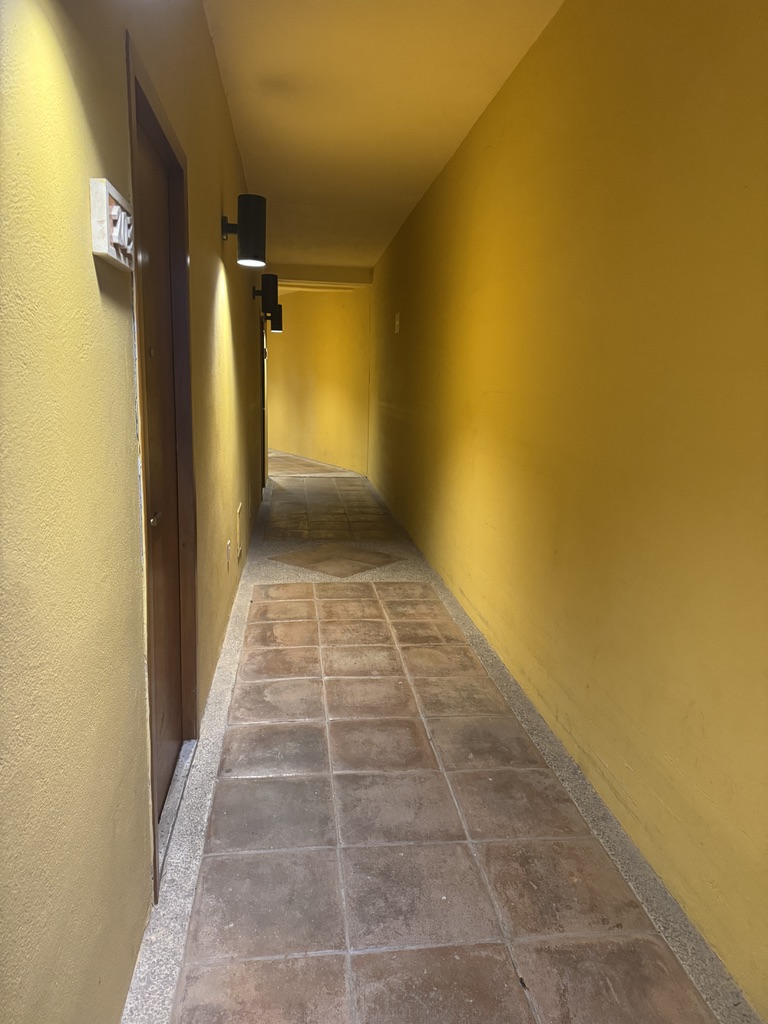
Photo Credit: Amy Tucker, 2026

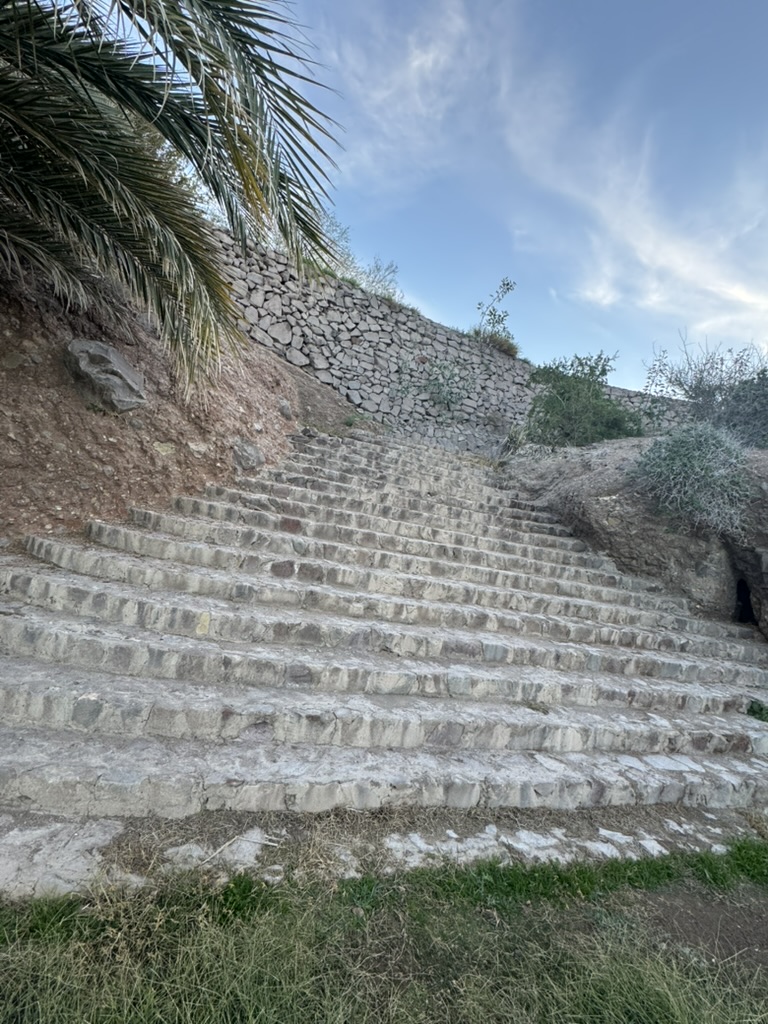
Note. Threat became structure; vigilance became design.

The house where I learned hypervigilance no longer exists. My father has been dead for decades. My sisters are safe adults, living their own lives thousands of miles from that childhood home. The original threat has ended.

But my body held no record of this information.

van der Kolk (2014) describes how trauma reorganizes the brain’s alarm system to interpret the world as a fundamentally unsafe place. For those of us who grew up in chronically threatening environments, this reorganization happens during the years when the nervous system itself is still forming. Durante los años de formación. During the formative years. The architecture has no foundation built on top; the threat becomes the foundation itself.

“The architecture has no foundation built on top; the threat becomes the foundation itself.”

The ball in my stomach, that tight readiness I described in Part 2, still activates five decades later. Never always. Never constantly. But predictably, under conditions that my conscious mind fails to always recognize as threatening.

I notice it most in restaurants.

Before I can focus on the menu, before I can settle into conversation, I need to map the space. Where are the exits? Who is seated near us? Can I see the entrance from where I am? If I cannot see who is coming through the door before they arrive, my shoulders rise toward my ears. My breath becomes shallow. Some ancient part of me needs to know who is approaching before they reach our table.

“Some ancient part of me needs to know who is approaching before they reach our table.”

This is what Porges (2011) calls the body’s instinct to scan for safety, the automatic, unconscious detection of safety or danger in the environment. My nervous system, calibrated during childhood to constant threat, remains hypertuned to detect dangers that no longer exist. It scans for the heavy footsteps, the sound that meant violence was coming. It looks for the micro-expressions that once told me whether this evening would be safe.

“My nervous system, calibrated during childhood to constant threat, remains hypertuned to detect dangers that no longer exist.”

I do this in meetings. In classrooms, when I taught. At social gatherings. My eyes are constantly moving, constantly assessing, constantly ready.

Title: Mapping the Room

Photo Credit: Amy Tucker, 2026

Note. The nervous system scans for exits long after danger ends.

van der Kolk (2014) describes how traumatized individuals spend tremendous energy suppressing inner chaos, often becoming so skilled at ignoring their physical sensations that they fail to recognize when they are actually safe. This describes my adult life with painful accuracy. I became extraordinarily skilled at appearing calm while my nervous system churned with activation. I was performing competence while my body signalled danger.

“I was performing competence while my body signalled danger.”

At functioning while afraid.

When Survival Skills Become Professional Assets

“At functioning while afraid.”

Title: Productive Vigilance

Photo Credit: Amy Tucker, 2026

Notation: Survival strategies translated into institutional competence.

“But they also made me exploitable.”

There is a particular irony, una ironía amarga, a bitter irony, in how childhood hypervigilance prepared me for academic labour.

The constant monitoring of authority figures’ moods. The ability to detect subtle shifts in power dynamics. The skill at making myself useful while remaining invisible. These survival strategies translated seamlessly into navigating precarious academic employment.

I excelled at reading what was wanted before it was articulated. Anticipating needs. Managing up. At making myself indispensable while taking up minimal space. At absorbing emotional labour without complaint. At knowing when to speak and when silence would serve me better.

These abilities made me valuable in academic settings, particularly in administrative roles where the dynamics of reading rooms mattered. Where sensing institutional politics before they became explicit could prevent disasters.

But they also made me exploitable.

I lacked the capacity to say no. I lacked the ability to recognize when I was being asked to carry more than my share, nor could I distinguish between genuine professional responsibility and the compulsive caretaking that emerged from trauma. No podía distinguir. I was unable to distinguish.

When I was finally terminated from my faculty position after years of contract renewals, the loss activated every childhood fear. The ball in my stomach returned with an intensity I had gone decades without feeling. The hypervigilance that had kept me employed, that had made me useful, valuable, and necessary, had also blinded me to the disposability of my position.

I had survived by being needed. When I was no longer needed, some part of me held no certainty of surviving.

“I had survived by being needed.”

Why Safety Feels Like Danger

This is what I am trying to understand during these thirty days in Loreto: why solitude, which should feel safe, instead triggers all my oldest survival responses.

The research literature is clear about loneliness, the unwanted, painful experience of isolation. But there is remarkably little scholarly attention to chosen solitude. To what I am calling alonetude: intentional, embodied, meaning-rich engagement with being alone.

Long and Averill (2003) distinguish between different types of solitude, noting that positive solitude involves freedom from social demands and provides opportunities for self-discovery and restoration. But they acknowledge that whether solitude feels restorative or threatening depends significantly on attachment history and prior trauma.

For those of us with hypervigilance rooted in childhood trauma, solitude activates specific fears that I am only now beginning to name.

When there are no others to monitor, where does the vigilance go?

Title: Solitude as Surveillance

Photo Credit: Amy Tucker, 2026

Note. When external threats vanish, vigilance turns inward.

My nervous system, calibrated to constant external scanning, turns inward when external threats are absent. I become hyperaware of bodily sensations, interpreting normal physiological processes as signals of danger. My heart rate increases slightly during my morning run, and I fear cardiac problems. I feel fatigue, and I fear illness.

Without external threats to track, I track myself with the same relentless attention I once used to monitor my father’s moods.

Rest feels like abandoning my post.

As I wrote in Part 1, parentified children learn that constant vigilance is required as much for the protection of others as for the self. Even though my sisters are safe adults and no one currently depends on my vigilance, some part of me believes that letting my guard down means someone will be harmed.

Solitude removes the immediate object of protection. But it leaves the compulsion to protect fully intact.

My own body feels like unsafe territory.

van der Kolk (2014) describes how trauma fundamentally reorganizes the relationship between body and mind, making the body feel like a source of danger rather than safety. For years, I managed this through constant activity. Through staying busy enough that I could avoid feeling what my body carried.

Solitude removes that buffer.

The Long Echo· Post

It demands that I be present to myself. And myself includes all the unprocessed fear still stored in my tissues, still activating when I sit too still for too long, still insisting that rest invites disaster.

Title: Alonetude

Photo Credit: Amy Tucker, 2026

Note. Finding a place in rock painting.

Intentionality as the Intervention

This is where alonetude diverges from both loneliness and passive solitude.

“It is something beyond something happening to me.

It is something I am choosing.”

It is something I am choosing rather than something simply happening to me. Estoy eligiendo esto. I am choosing this. Deliberately. With full awareness of the difficulty.

Alonetude, as I am theorizing it, is intentional, embodied solitude undertaken with explicit healing purpose. It differs from loneliness (which is unwanted), from social isolation (often imposed), and from passive solitude (being alone without deliberate engagement).

The critical distinction is agency.

I am here beyond being rejected or abandoned. I am here beyond lacking social skills or opportunities for connection. I am here through active choosing rather than passive acceptance.

I am choosing this. Choosing to spend thirty days primarily alone. Choosing to face what arises when I cannot distract myself with work, with caregiving, with the constant activity that has kept me from fully inhabiting my body and my history.

Kabat-Zinn (1990) describes mindfulness as intentional, non-judgmental attention to the present moment. Alonetude applies this same quality of attention to the experience of being alone.

It is about something far beyond achieving some idealized state of peaceful solitude. It is about bringing full, compassionate awareness to whatever arises, including fear, hypervigilance, and resistance to rest.

Small Victories in Recalibration

Title: Touching the Foundation

Photo Credit: Amy Tucker, 2026

Note. The body returns to stone, tracing what held it when nothing else did.

I want to be honest about what healing looks like from inside the process.

“There is no dramatic before-and-after.”

It bears little resemblance to the transformation narratives that saturate popular culture. There is no dramatic before-and-after. No breakthrough moment. No complete resolution.

van der Kolk (2014) makes clear that trauma is both an event from the past and an ongoing imprint on the mind, brain, and body. This imprint resists simple erasure. It can be worked with, integrated, and metabolized. But it resists disappearing.

What shifts is my relationship to the imprint.

My capacity to recognize when my nervous system is responding to past threats rather than present ones. My ability to compassionately witness the activation without being completely overtaken by it.

My aim is to work with the hypervigilance rather than eliminate it. I am learning to create space for other responses to coexist alongside it.

The Practice Looks Like This

Morning beach walks, where I notice when my scanning becomes hypervigilant versus when I am simply observing. When I catch myself scanning for threats, I meet it without judgment. I acknowledge: This is my nervous system doing what it learned to do. This kept me safe once.

Title: Morning Beach Walks

Photo Credit: Amy Tucker, 2026

Notation: Morning beach walks allow me to rest.

Then I gently redirect attention to what is actually present. Pelicans gliding. Waves breaking. The texture of sand underfoot.

Longer runs where I allow my sympathetic nervous system to activate through movement rather than through fear. This is the paradox: I need to learn that activation itself is safe. That my heart rate can increase without signaling threat. That I can mobilize my body through choice rather than terror.

Stillness practices where I sit with the discomfort of simply being, releasing production, releasing usefulness to anyone. These are the hardest. My body wants to move, to busy itself, to find some task that justifies existence.

Title: Rest

Photo Credit: Amy Tucker, 2026

Note. Learning how to rest.

Learning to simply be, estar, rather than hacer, challenges everything my childhood taught me about worth through utility.

Creative practices like photographing shells, driftwood, and the way light moves across water. These engage moments of absorption where self-consciousness and hypervigilance temporarily quiet (Csikszentmihalyi, 1990). In these moments, my attention narrows through interest rather than fear.

This is a different quality of focus entirely.

The Parts That Protected Me Still Protect

I need to name something crucial: the parts of me that remain hypervigilant are protective parts beyond fixing.

They are protective parts that kept me alive.

Fisher (2017) describes how trauma survivors can learn to recognize their survival responses as distinct parts of the self, strategies that emerged to handle different aspects of overwhelming experience. The Internal Family Systems approach suggests that what we often pathologize as symptoms are actually protective parts trying to keep us safe using the best strategies they developed during the trauma.

The part of me that scans restaurants for exits is entirely rational. It is a guardian. It remembers when knowing the exits mattered for survival. It has yet to fully trust that I am safe now.

Title: The Guardians

Photo Credit: Amy Tucker, 2026

Note. Protective parts remain, even as new responses emerge.

And perhaps it never will entirely.

But I can appreciate its vigilance even as I gently work to expand my window of tolerance for feeling safe.

The part that makes me want to check on my sisters, even though they are grown women living their own lives, is something beyond codependent pathology. This is the part that kept them safer than they otherwise would have been when we were children.

Les mantuvo más seguras. It kept them safer.

I can honour what it did while also recognizing that the situation has changed. That they no longer need my hypervigilance. That I am permitted to rest from this particular guard duty.

This reframing matters profoundly.

For years, I approached healing as if I needed to eradicate the hypervigilance, to eliminate the freeze response, to become someone who naturally feels safe in the world. But this framing positioned my survival strategies as enemies to be defeated.

What I am learning instead is to approach these parts with gratitude and compassion while also creating space for new responses to emerge.

Who Gets to Choose Solitude

I cannot write about alonetude as a healing practice without acknowledging the profound privilege embedded in this project.

I can rent a casita in Loreto for thirty days. I can take time away from employment because I no longer have employment to take time from, which is both a loss and an unexpected opening. I am white, educated, a cisgender woman with Canadian citizenship and mobility rights. I am without dependent children or elders requiring my care.

The very concept of choosing solitude for healing purposes assumes a baseline of material security and social support that vast numbers of people are without.

hooks (2000) reminds us that contemplative practice has historically been the province of those with sufficient privilege to withdraw from the demands of survival labour. This matters for my analysis. I am arguing something beyond the claim that alonetude represents a universal solution to trauma healing.

I am examining what becomes possible when someone with my particular history gains temporary access to conditions that support deep rest and intentional solitude.

The economic precarity of academic labour, the contract renewals, the contingent employment, and the constant uncertainty itself constitute a form of structural trauma that compounds childhood trauma. My termination activated childhood fears precisely because both experiences involved powerlessness, expendability, and the message that my value was provisional.

But losing that employment also freed resources. Beyond financial resources. Temporal and psychological ones. I no longer carry the cognitive load of constantly managing precarious employment. I no longer perform the emotional labour of remaining pleasant and productive despite chronic uncertainty.

This created space for this retreat that would have remained beyond reach had I remained employed.

I name this to resist romanticizing job loss, rather than acknowledge the complex relationship between structural conditions and individual healing possibilities. The alonetude I am practicing here is both enabled by and in tension with systems of privilege and precarity.

I am here to heal.

The Difference Between Withdrawal and Return

There is a crucial distinction between using solitude to avoid relationships and using solitude to develop the capacity for relationships.

The first is escape. The second is preparation.

I came to Loreto out of something other than hatred of people or fear of connection. I am here because my nervous system needs sustained exposure to safety in order to recalibrate. Because I need to practice being with myself before I can be fully present with others.

Because the hypervigilance that protected me in childhood now interferes with the intimate relationships I want in adulthood.

Winnicott (1958) describes the capacity to be alone as a developmental achievement that paradoxically requires the internalization of a reliable other. The child must first experience being alone in the presence of someone trustworthy before they can be comfortably alone in physical solitude.

For those of us who never had that reliable presence in childhood, we must somehow learn this capacity in adulthood, often without the scaffolding that childhood should have provided.

This is what the thirty days offer: a laboratory for learning to be reliably present to myself. To notice when fear arises and to meet it with compassion rather than judgment. To recognize when my body signals danger and to gently offer evidence of current safety.

To practice rest without the constant inner voice insisting I should be doing something productive.

But this represents a temporary retreat, with permanent withdrawal being the furthest thing from the intention.

The aim reaches beyond living forever in solitary retreat but to develop the internal resources that allow me to engage with others from a place of genuine presence rather than compulsive vigilance.

Kornfield (2000) describes contemplative practice as preparation for engagement rather than escape from it. The goal lies in returning to everyday life rather than in becoming enlightened in isolation through a transformed presence.

Similarly, the goal of alonetude is the development of internal safety rather than permanent solitude that allows for authentic connection.

Recognizing the Incremental

Title: Incremental Safety

Photo Credit: Amy Tucker, 2026

Note. Finding peace in the night sea.

It is Day 20 of my retreat.

I thought victory would mean no longer startling at sudden sounds. That it would mean sleeping through the night without vigilance. That my shoulders would remain relaxed, my jaw unclenched, my stomach soft.

I thought healing would mean the hypervigilance would leave.

What I am learning instead is that victory looks like this:

Yesterday morning, I woke at dawn and lay still for ten full minutes before my body insisted I get up and do something productive. Ten minutes of simply being. Of breathing. Of existing without purpose.

This may sound small.

It is vast.

It is revolutionary for a nervous system that learned rest equals danger.

Victory looks like recognizing when the ball in my stomach clenches and being able to say to myself, This is old fear. This is my body remembering. I am safe now. Even when my body remains uncertain, I can hold the truth alongside the fear.

Victory looks like going to the beach and allowing myself to simply sit and watch the pelicans without bringing my camera, without documenting, without turning the experience into something useful.

Estar sin hacer. Being without doing.

These transformations are incremental rather than dramatic. They are incremental shifts. Moments when my nervous system practices something new. Brief windows when rest feels possible rather than dangerous.

What My Body Now Knows

After twenty days of sustained alonetude practice, here are the shifts I notice:

My breath sometimes deepens on its own. This happens beyond the reach of my attention, when I am absorbed in watching light change on water or in the intricate architecture of a shell. The diaphragmatic breathing that signals safety to the nervous system arrives without my effort.

The space between stimulus and response occasionally widens. When I hear a sudden sound, there is sometimes, beyond always, a fraction of a second where I notice my body’s response before it overtakes me entirely. In that space, I can choose.

Rest feels possible in small doses. Beyond hours. Beyond days. But for minutes at a time, I can simply be without the voice insisting I should be working, should be useful, should be justifying my existence through productivity.

I can sometimes distinguish between different kinds of alone. Loneliness, the painful sense of unwanted isolation, still visits. But it is far from constant. There are increasing moments when solitude feels neutral or even nourishing rather than threatening. Being alone with myself feels like coming home rather than abandonment.

These are the victories.

Beyond dramatic. Beyond complete. But real.

Son reales. They are real.

What Continues

In ten days, I will leave Loreto. I will return to my regular life. To job searching. To navigate the practical realities of middle age after employment termination. To relationships with friends and family who love me but cannot fully understand this particular journey.

The question reaches beyond whether the hypervigilance will disappear.

It will remain.

The question is whether I can continue the practice, the daily, incremental work of teaching my nervous system new possibilities while honouring the wisdom of old protections.

Brown (2010) describes vulnerability as involving uncertainty, risk, and emotional exposure, while also being the birthplace of innovation, creativity, and change. Alonetude as I am practicing it requires profound vulnerability, the willingness to be alone with all that I carry, to feel what I have spent decades avoiding, to rest when rest feels dangerous.

But vulnerability without support becomes retraumatization.

This is why the temporal boundedness of this retreat matters. Thirty days is long enough to create new neural pathways, to practice unfamiliar ways of being. It is short enough that I remain connected to the relationships and structures that support my ongoing healing.

The alonetude practice I am developing here is a temporary renewal rather than permanent solitary withdrawal. It is meant to be a renewable resource, something I can return to when my nervous system needs recalibration. When the hypervigilance becomes overwhelming. When I need sustained exposure to safety in order to remember what safety feels like.

Integration Beyond Resolution

Fisher (2017) writes about trauma healing as integration rather than resolution. The parts that protected me through hypervigilance remain present. They have no need to disappear.

What changes is my relationship to them.

My capacity to hold both the protective impulse and the present reality. To appreciate what they did while also creating space for new responses.

Some days, this integration feels possible. Some days, the old patterns overtake me entirely, and I spend hours caught in hypervigilance that serves no current purpose.

Both are part of the process. Neither represents failure.

The body learned fear across years. It resists unlearning over the course of weeks. But it can learn new possibilities alongside the fear. It can practice safety even while remembering danger.

Puede practicar la seguridad mientras recuerda el peligro.

It can hold both the truth of what was and the possibility of what might be.

Where Transformation Happens

Title: The Third Shore

Photo Credit: Amy Tucker, 2026

Note. Where land and sea meet, transformation is negotiated.

I chose Loreto because it sits beside the sea. Because there is something about the rhythm of waves that mirrors the rhythm I am trying to find, the inhale and exhale, the arriving and receding, the constant motion that is somehow also constancy.

I call this project The Third Shore because the shore is neither ocean nor land, but the meeting place. The threshold. The liminal space where transformation happens.
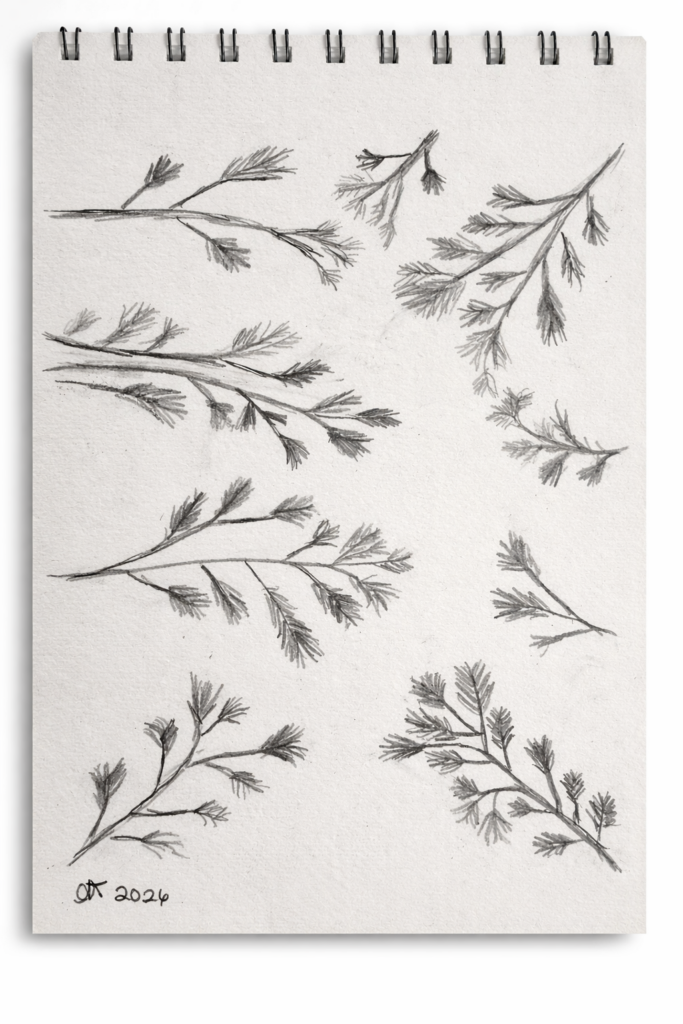
This is what alonetude offers: threshold space. A place to practice being between who I was and who I am becoming.

The shore holds the tension between land and sea without resolving it. It holds both. It is where waves have been shaping sand for millennia, grinding rock into powder, polishing glass smooth.

The shore is patient.

It understands that transformation takes geological time. That healing is measured beyond breakthroughs, in the accumulation of small moments when something shifts, softens, and the body remembers, even briefly, what safety feels like.

This is what I am learning to trust.

That the small shifts matter. That my nervous system is doing the work even when I am beyond consciously perceiving the change. That rest is deep labour rather than dereliction.

That solitude can be refuge rather than abandonment.

Alonetude offers refuge rather than resolution. Capacity rather than the elimination of fear to be with fear without being overtaken by it. Beyond the achievement of permanent safety, there are moments, increasing moments, when safety feels possible.

And for a nervous system that learned early that the world is fundamentally unsafe, that rest invites disaster, that vigilance is required for survival, these moments are everything.

They are the shore where new life becomes possible.

What These Three Parts Have Traced

This series has moved from childhood hypervigilance to adult manifestations, and now to the practice of alonetude as a healing intervention.

Part 1 established the theoretical framework for understanding how chronic childhood trauma shapes the developing nervous system. Part 2 provided the embodied narrative of what hypervigilance actually felt like, lived like, inhabited a child’s body and world.
This final part has examined how those childhood adaptations persist in adulthood and why intentional solitude, alonetude, offers possibilities for healing that differ fundamentally from both loneliness and passive alone-time.

The body keeps the score, yes.

Title: Refuge and Integration

Photo Credit: Amy Tucker 2026

Notation: The body keeps learning.

But the body also learns.

Slowly. Incrementally. Through patient practice, the nervous system that learned danger can also learn safety. Beyond complete safety. Beyond permanent safety. Moments of safety remain. Windows of rest. Brief experiences of what it feels like to simply be rather than constantly, vigilantly, doing.

These moments accumulate. They create new neural pathways. They teach the body new possibilities without requiring it to forget old protections.

And this, this is revolutionary for those of us who learned early that we existed to serve, to protect, to scan, to anticipate, to prevent. That our worth was measured by our usefulness. That rest was dangerous, and solitude was abandonment of our post.

Alonetude says: Rest is permitted. You are allowed to simply be. Your worth exists independent of constant productivity. Solitude can be a refuge rather than a threat.

The body holds this truth tentatively, still learning.

But it is learning.

Slowly. Incrementally. Through twenty days of practice by the sea. And ten more days to come. And whatever comes after.

The work continues. The body continues learning. The shore continues shaping what the waves bring.

La curación continúa. Healing continues.

Ya no tengo que vigilar todo el tiempo. I no longer have to keep watch all the time.

Except I do, still, sometimes.

The difference is that now I sometimes notice when I am keeping watch. And I can choose, sometimes, slowly, to gently set down the vigilance and rest.

This is what healing looks like.

Beyond dramatic. Beyond complete.

But real.

For readers struggling with trauma histories: Healing is rarely linear. It is rarely complete. But it is possible. These small moments of rest, these brief windows when safety feels real rather than theoretical, these matter profoundly. They accumulate. They create new possibilities. You remain whole. Your nervous system is doing exactly what it learned to do. And it can learn new responses while honouring the wisdom of old protections.

Con cariño y esperanza. With care and hope.

References

Brown, B. (2010). The gifts of imperfection: Let go of who you think you are supposed to be and embrace who you are. Hazelden.

Csikszentmihalyi, M. (1990). Flow: The psychology of optimal experience. Harper & Row.

Fisher, J. (2017). Healing the fragmented selves of trauma survivors: Overcoming internal self-alienation. Routledge.

hooks, b. (2000). Feminist theory: From margin to centre (2nd ed.). South End Press.

Kabat-Zinn, J. (1990). Full catastrophe living: Using the wisdom of your body and mind to face stress, pain, and illness. Delacorte Press.

Kornfield, J. (2000). After the ecstasy, the laundry: How the heart grows wise on the spiritual path. Bantam Books.

Long, C. R., & Averill, J. R. (2003). Solitude: An exploration of the benefits of being alone. Journal for the Theory of Social Behaviour, 33(1), 21–44. https://doi.org/10.1111/1468-5914.00204

Porges, S. W. (2011). The Polyvagal Theory: Neurophysiological foundations of emotions, attachment, communication, and finding our own calm. W. W. Norton & Company.

van der Kolk, B. A. (2014). The body keeps the score: Brain, mind, and body in the healing of trauma. Viking.

Winnicott, D. W. (1958). The capacity to be alone. International Journal of Psycho-Analysis, 39, 416–420.

Here rests vigilance, laid down with care.

Translation note. Spanish-language text in this post was translated into English using Google Translate and reviewed by the author. Translations are intended to convey general meaning rather than certified linguistic precision.

ACADEMIC LENS

The Long Echo names what Menakem (2017) calls “the persistence of unmetabolised trauma”: the way overwhelming experience, insufficiently witnessed and processed at the time, continues to resonate through the nervous system across decades. Van der Kolk (2014) describes this as the failure of hippocampal integration: without a coherent narrative frame, the traumatic event remains encoded as sensory and somatic fragments that intrude into present experience without the context that would allow them to be processed as past. Levine’s (2010) somatic experiencing model proposes that healing requires what he calls “titrated” re-exposure: approaching the traumatic memory in small doses, with sufficient somatic resource and external support, so that the body can complete the defensive responses it was unable to complete at the time. The long echo also resonates with Nixon’s (2011) framework of slow violence: harm that unfolds gradually, without dramatic incident, accumulating across time in ways that are difficult to name or prove but that leave measurable traces in the body. Writing this series as a triptych, returning to the same wound from three vantage points, performs precisely this titrated approach: circling rather than confronting directly.

Memory: The Kitchen Table

Reading Time: 5 minutes

Content Warning: This post contains reflections on difficult childhood memories and family pain. Please care for yourself as you read, and feel free to step away if you need to.

“I was learning that what matters to me is allowed to matter.”

My grandmother’s kitchen table was oval, oak, scarred with the evidence of living. A burn mark from a forgotten pot. A gouge from something dropped or dragged. Rings from glasses placed without coasters during conversation are too absorbing for caution. I spread my rocks across that table, and she pushed nothing aside to make room for proper things. She let them stay. She let me sort and re-sort, building small cairns that meant nothing to anyone but me. The table held it all.

“I carry it with me, beyond furniture: as a method.”

I had no idea then that kitchen tables carry their own literature. June Jordan wrote of Kitchen Table: Women of Colour Press, founded in 1980, deliberately naming itself after the place where women had always done their realest thinking, beyond offices or academies, in domestic spaces where hands stayed busy, and mouths could speak truth (Jordan, 1980). Barbara Smith, who co-founded the press, understood that the kitchen table was a site of knowledge-making beyond lesser, perhaps the most honest one. The table where meals are prepared, where children do homework, where bills get sorted, letters get written, arguments get had and resolved, this is where theory meets the texture of actual living.

My rocks on my grandmother’s table were part of a long tradition of important work. tradition of kitchen-table sense-making that predates and outlasts the institutions that later claimed authority over knowledge.

bell hooks wrote about the homeplace as a site of resistance, the domestic sphere that dominant culture dismisses as trivial but that actually sustains everything worth sustaining. In Yearning: Race, Gender, and Cultural Politics (1990), hooks describes her grandmother’s kitchen as a place of profound teaching, where lessons arrived through doing, snapping beans, rolling dough, and washing dishes side by side. The kitchen table is where hooks learned that theory and practice are inseparable, that the hands and the mind work together, that wisdom passes through presence as much as words.

While my grandmother peeled apples, I sorted my rocks, receiving an education I had no words for then. I was learning that what matters to me is allowed to matter. That there is space at the table for my small concerns. That someone will witness my treasures without asking what they are for.

Miriam Greenspan (2003) writes of kitchen table wisdom, the knowledge that emerges from lived experience, from the ordinary intimacies of daily life, from sitting with what is rather than theorizing about what should be. This wisdom requires no credentials, no publications, to be valid. It requires presence, patience, and the willingness to stay at the table long enough for understanding to emerge. My grandmother never told me what my rocks meant or what I should do with them. She simply made space. She simply witnessed.

In that witnessing, I learned that my sense-making mattered.

The kitchen table is where Scholarly Personal Narrative finds its truest home. Robert Nash (2004) argued that the stories we tell from our own lives carry legitimate scholarly weight when carefully theorized and ethically contextualized. But long before methodological language existed to justify it, women were already doing this work at kitchen tables, sharing stories, finding patterns, building knowledge from the raw material of experience.

The academy eventually caught up to what grandmothers always knew: that the particular illuminates the universal, that one life carefully examined reveals something about all lives, and that the table where we sit with our small treasures is exactly the right place to make meaning.

Now I sit at a small wooden table in Loreto, sea glass and shells spread across its surface. The table here is rented, free of scars from decades of family living. But it holds the same possibility my grandmother’s table held: that what I find might become what I know, that sorting and arranging might teach me something words alone cannot reach.

I think of all the women at all the kitchen tables across all the years, spreading out their own versions of treasure, trusting that the pattern would reveal itself. I am held here, even in solitude. I am in conversation with a lineage of kitchen-table scholars who never called themselves scholars, who simply showed up, paid attention, and let their hands learn what their minds would understand later.

La mesa recuerda.
The table remembers.

It holds the memory of every object placed upon it, every hand that reached across its surface, every conversation that unfolded in its presence. My grandmother is gone now, and I have lost track of what happened to her kitchen table. But I carry it with me, beyond furniture: as a method.

I still spread my treasures across whatever surface is available. I still sort by colour, by size, by feels right. I still trust that the pattern will emerge if I stay long enough, present enough, and am willing to let the objects teach me what they know.

“The table remembers.”

Reference

Greenspan, M. (2003). Healing through the dark emotions: The wisdom of grief, fear, and despair. Shambhala Publications. https://books.google.com/books?id=ZfvRo3PkDcwC

hooks, b. (1990). Yearning: Race, gender, and cultural politics. South End Press. https://philpapers.org/rec/HOOYRG-2

Moraga, C., & Anzaldúa, G. (Eds.). (1981). This bridge called my back: Writings by radical women of colour. Kitchen Table: Women of Colour Press. https://hal.science/hal-04262369/

Koren, L. (1994). Wabi-sabi for artists, designers, poets & philosophers. Stone Bridge Press. https://books.google.com/books?id=jQelDAgr63oC

Juniper, A. (2003). Wabi sabi: The Japanese art of impermanence. Tuttle Publishing. https://books.google.com/books?id=objWAgAAQBAJ

Lévi-Strauss, C. (1966). The savage mind (G. Weidenfeld & Nicholson, Trans.). University of Chicago Press. (Original work published 1962). https://books.google.com/books?id=JI6GVFbP9hAC

Nash, R. J. (2004). Liberating scholarly writing: The power of personal narrative. Teachers College Press. https://books.google.com/books?id=wvSMDwAAQBAJ

Rose, G., & Bingley, A. (2019). Creative methodologies in trauma-informed research. In J. Sunderland et al. (Eds.), Arts-based approaches to trauma and healing (pp. xx–xx). Routledge. https://books.google.com/books?id=MROSEQAAQBAJ


Here is What the Table Had


Translation note. Spanish language passages were generated using Google Translate and subsequently reviewed and refined by the author. Any remaining infelicities reflect the limits of machine translation rather than intent.

ACADEMIC LENS

The kitchen table as a site of matrilineal transmission engages what Menakem (2017) calls the intergenerational somatic inheritance: the ways that what was lived in one generation is encoded in the bodies and practices of the next. The grandmother’s table enacts what holding objects alone is unable to, Tuan (1977) calls topophilic relationship: an attachment to place that is also an attachment to the people whose presence constitutes the place’s meaning. The recovery of the lesson, “what matters to me is allowed to matter,” names precisely the self-permission that nineteen years of precarious labour had eroded: the institutional demand for constant availability and the suppression of personal need progressively colonises the inner life until the person forgets what it felt like to have preferences. Bachelard’s (1969) phenomenology of intimate space directly applies to the kitchen table: it is, as he describes, a felicitous space, charged with the particular textures of human warmth and the repeated rituals of nourishment that constitute genuine belonging. This memory, recovered beside the sea, represents what Levine (2010) calls a somatic resource: a felt sense of care and belonging that the nervous system can draw on as an anchor in moments of dysregulation.

Poem: What the Walls Remember

Reading Time: 2 minutes


How do I love myself
when everyone else
taught me to withhold it?

Title: Layered Histories

Photo Credit: Amy Tucker, 2026

The house remembers
What no one else did.

The sharpness of screams
caught in the drywall,
the broomstick’s shadow
stretching too long
across the kitchen tile.

Glass breaking,
again and again,
until silence learned
to brace itself.

inhale
The closet lock clicked shut.
hold
The darkness welcomed me like routine.
exhale
Stillness was my only shield.

Words thrown harder
than hands.
Worthless.
Useless.
Piece of…

(I refuse to repeat them.
I refuse to belong to them.)

I became so small
I forgot I was still breathing.
I folded myself
behind chairs,
beneath beds,
inside my own skin.

inhale
Is this love?
hold
Why does love feel like danger?
exhale
Why does kindness now
make me flinch?

They taught me
I was unlovable.
That my body was wrong,
my voice too loud,
my being too much.

So tell me:
How do I love myself
when everyone else
taught me to withhold it?

Still,
I remember
because my body does.
Beyond revenge,
returning
to the girl who survived
and wind in her lungs.

She breathed
through fear.
She whispered
through fists.
She lived
when no one wanted her to.

She is still here.
And maybe,
just maybe,
She is worthy
of the love
They never gave.

Title: Return to the Girl Who Survived

Photo Credit: Amy Tucker, 2026


Translation Note: Where Spanish appears in this collection, it was assisted by Google Translate (translate.google.com). The Spanish is woven in as an act of reclamation, a return to a language of the body and the self that exists beyond institutional English.

Part 2: The Geography of Fear: Carried in the Body

Reading Time: 13 minutes

Content Warning: This post contains discussion of childhood exposure to parental alcoholism and domestic violence. While absent of graphic detail, the material addresses trauma, fear, and hypervigilance that some readers may find distressing.

Translation note. Spanish-language text in this post was translated into English using Google Translate and reviewed by the author. Translations are intended to convey general meaning rather than certified linguistic precision.


Van der Kolk (2014) writes that the body continues to register and respond to danger signals even when conscious memory holds no record of the original trauma.

But what about when the body remembers everything? When the danger was less a single event than the air you breathed for years?

The Constant Companion

Title: What the Walls Remember

Photo Credit: Amy Tucker, 2026

I am trying to describe a sensation that lived in my body from my earliest memories until approximately age twelve. It sat in my stomach, this tight ball of readiness. Almost nauseated, though sometimes it tipped that way. Almost pain, though it ached.

It was the feeling of waiting. Esperando. Always waiting.

Waiting for the sound that would tell me whether this evening would be safe.

The sound was the truck engine. My father’s truck is pulling in at the end of the day. And before I even consciously registered the sound, my body knew. The particular rhythm of his footsteps as he walked from the garage into the house told me everything I needed to know. Heavy, deliberate steps meant danger. Lighter, quicker steps might mean safety, though there were no guarantees.

The ball in my stomach would tighten. My breathing would change without my choosing to. I was listening with my whole body, my whole being, rather than just my ears.

Here is what I have learned from the trauma neuroscience I read in Part 1: this lay beyond clinical anxiety. This was the body’s instinct to scan for safety. My autonomic nervous system is reading environmental cues for danger beneath my conscious awareness, exactly as it was designed to do. The problem was that it was designed for occasional threats, never the chronic kind, never for years of this.

By the time I heard the garage door, I had already assessed multiple variables without thinking. What day of the week was it? Fridays were more dangerous because he stopped at the bar on the way home. How late was he? Later meant more drinking. Did my mother seem tense at dinner? Her tension meant she had already sensed something I had yet to detect. Was my younger sister being too loud? Noise drew attention, and attention was dangerous.

The youngest was seven years younger than me, still small enough that sometimes she cried in ways I was unable to quiet. This terrified me more than my own danger. My hypervigilance extended far beyond myself. I was responsible for them, too.

Reading the Air

Title: Atmosphere Before the Storm

Photo Credit: Amy Tucker, 2026

I developed what I can only describe as a hyperawareness of atmospheres. I could feel the charge in the air before anything visible changed. My mother’s shoulders would tighten in a particular way. The house itself seemed to hold its breath.

By age eight or nine, I had become fluent in the language of approaching violence. I could read micro-expressions. I could detect shifts in vocal tone that signalled danger was escalating. I could calculate the precise degree of door-closing force that indicated anger.

These were skills no child should need to develop. But I was brilliant at them. I had to be.

The worst moments came before violence actually occurred. The worst moments were the hours of waiting, the ball in my stomach wound so tight I thought it might tear something open. During these hours, every small sound required assessment. Was that his chair scraping against the floor? His glass was set down hard on the counter. Is the refrigerator door closing with force?

Each sound was data. Each piece of data helped me calculate the probability of eruption.

During these hours of waiting, I strategized. Where were my sisters? If something happened, could I get to them? Were there obstacles between me and their rooms? I mapped the house in my mind like a battlefield, planning routes and refuges.

Title: What Survived

The Geography of Hiding

The house had its own geography of fear. Certain rooms were more dangerous than others.

The kitchen, where he drank after work, where the counter held the evidence of how many bottles had been opened. I learned to count them without appearing to count them. One bottle was manageable. Two meant higher risk. Three or more meant I needed to get my sisters to their rooms and keep them there.

The living room, where he sat in his chair and called us to him. Sometimes these summons were benign. Sometimes they were otherwise. I learned to read the kind from the quality of his voice when he said my name.

The hallway between my room and my baby sister’s rooms felt impossibly long and exposed. I had to cross it to reach them if they needed me, and crossing it meant being visible, being available to be called, being vulnerable.

I learned to move through the house silently. I learned which floorboards creaked. Which doors squeaked? How to open cabinets without sound. I learned to exist without creating disturbance, to breathe so shallowly that even my breath would remain undetectable.

This skill, this ability to minimize my presence, to make myself unnoticeable, would follow me for decades. Would manifest in adult relationships as difficulty taking up space. As apologizing for existing. As constantly making myself smaller to accommodate others’ needs.

But in childhood, this skill kept me safer than I would otherwise have been. Which is far from safe. There was no safety. There were only degrees of threat, gradations of danger that I learned to navigate with the precision of a cartographer mapping treacherous terrain.

The Sound of My Name

Title: Voice Like a Weapon

Sometimes my father called my name.

Even now, five decades later, sitting in Loreto with the sound of the sea outside my window, I can feel my body’s response to that memory. My heart accelerates slightly. My vision narrows at the edges. The ball in my stomach clenches.

This is what van der Kolk (2014) means when he writes about how the body keeps the score. The original threat is gone. My father is long dead. But my nervous system still responds as if the danger were present.

In childhood, the sound of my name in his voice when he had been drinking produced a physical response I had no control over. My heart would accelerate. My vision would narrow. The ball in my stomach would clench. I would freeze, completely still, as if holding utterly still might make me invisible.

But I had to answer. Silence was worse. I would force my legs to move, force my voice to work, force my face into neutrality. The walk down the hallway to wherever he was calling from felt like walking to execution. Caminar hacia el miedo. Walking toward fear.

“Did you do this?”

His voice, accusing.

I remained without understanding of what “this” was. A glass was left on the counter. A door left ajar. A light was left on. The television is too loud. The offence varied and often made no logical sense. But the pattern was always the same: I was accused of something I had left undone, something I would never do because I was so careful, so hypervigilant about never creating any reason for attention, for anger, for danger.

“No,” I would say, my voice small.

This was true. I had done nothing of what he was accusing me of doing. But truth had no protective power.

When Reality Breaks

I wrote in Part 1 about Freyd’s (2008) concept of betrayal trauma, how, when those who should protect us instead harm us, when we are blamed for harm done to us, the violation cuts deeper than the harm itself because it undermines our basic capacity to trust our own perceptions.

This is what those moments of false accusation did. They broke something deeper than the fear of punishment.

The moment would stretch. He would decide whether to believe me. Sometimes he did. Sometimes he refused. When he refused to believe me, when he insisted I was lying even though I was telling the truth, something fractured inside me each time.

I knew with certainty that I had done nothing he accused me of. I knew it with absolute certainty. But his version of reality had power over mine. His insistence that I was guilty could override my knowledge of my own innocence.

This is epistemic violence. The assault on a child’s capacity to know what they know.

I am still, decades later, unlearning this. Still working to trust my own perceptions. Still catching myself doubting what I know to be true when someone else insists on a different version of events.

The Leaving

Title: Underwater Silence

During these moments of accusation, of being blamed for things left undone, I would split. Some part of me would go away to a place where his words could find no purchase.

My face would remain neutral. My body would stand still. But I had barely remained there.

Years later, I learned this is called dissociation. A survival strategy my nervous system deployed to protect me from unbearable psychological pain. Fisher (2017) writes about structural dissociation, the fragmentation of the personality into parts that carry different survival strategies. In the moment, I only knew that crying was forbidden, that defending myself too vigorously was forbidden, that showing fear was forbidden.

Any emotional response increases danger.

Where did I go when I left? The answer remains beyond me. It was less a conscious choice than an automatic response, my body’s wisdom protecting me in the only way available when fight or flight were both impossible.

I existed in some internal space that felt grey and distant, muffled, as if I were underwater, with the sounds reaching me from far away. This internal refuge kept me functioning, but at a cost. I lost pieces of my experience. Unable to fully remember what happened during these dissociated moments. Carried gaps in my memory that would later make me doubt whether events occurred as I recalled them.

This fragmentation, this sense that parts of me exist in different places, holding different pieces of the experience, has never entirely healed. I recognize it even now when stress triggers those same dissociative responses. The going away. The watching myself from a distance. The sense that I am barely inhabiting my body.

The Weight of Protection

I tried to absorb her fear into my own body,
to create a buffer between her and the violence.
Even now, some part of me keeps scanning for their safety.

Title: Still Holding

Photo Credit: Amy Tucker, 2026

After these confrontations, after he had yelled or grabbed or made his point through whatever means he chose, I would go to check on my sisters.

My younger sister, only one year younger than me, had often heard everything through the walls. I would find her frozen in her bed, eyes wide, her own body locked in the same alert state that gripped mine.

“It is okay,” I would tell her, though we both understood it was far from true.

“He is calmer now.” Ya pasó. It has passed.

Though we both knew it had barely passed. That it would come again. That this was merely an intermission.

I would smooth her hair the way our mother did, or used to do before exhaustion made all gestures mechanical. I tried to absorb her fear into my own body, tried to create a buffer between her and the violence, tried to convince both of us that I could keep her safe when in reality I was just another child, just as powerless, just as frightened.

The youngest, still small, often slept through these episodes. When she woke, confused by the atmosphere, by the tension that lingered in the house like smoke, I would make up reasons. “Dad was just talking loudly about work.” Anything to preserve her innocence a little longer, though I suspected she absorbed the fear even when she lacked conscious understanding of its source.

Babies know. Children know. Bodies know what minds try to deny.

I wrote in Part 1 about Jurkovic’s (1997) work on parentification, the way children who become caregivers for their siblings carry consequences into adulthood. Difficulty accepting care. Persistent sense of responsibility for others’ emotional states. Compromised capacity to recognize their own needs.

Most relevant for this alonetude project: the way parentified children struggle with solitude because rest feels like a dereliction of duty. Their nervous systems learned early that constant vigilance is required, as much for the protection of others as for the self.

Even here in Loreto, alone by choice, with my sisters safe in their own adult lives, some part of me keeps scanning for their safety. Keeps wondering if I should check in. The hypervigilance that served us then persists decades after we no longer need it.

The Vigil

Title: The Edge of Rest

Photo Credit: Amy Tucker, 2026

I would lie awake long after the house had gone silent. My body refused sleep because sleep meant vulnerability, meant I might miss the return of danger.

The hypervigilance that kept me alert all day persisted through the night rather than releasing. Instead, it intensified in the dark. Every small sound required assessment. The house is settling. The refrigerator is cycling on. A mine whistle is blowing at the end of the shift.

Each sound had to be categorized as normal or threatening. Safe or dangerous? Requiring response or allowing rest.

But rest never truly came.

Tomorrow I would move through school in a fog of exhaustion, but I had become skilled at hiding this, too. Appearing normal. At performing the role of a child who was fine when everything inside me was wound tight as a wire.

Teachers remained unseeing, or if they noticed, they remained silent. This was the early 1970s. People avoided speaking of such things. Families were private. What happened in homes stayed in homes.

I learned to carry my fear silently, to show no external evidence of the constant internal vigilance.

The Normalization of Terror

This is every memory combined. This is hundreds of memories, thousands of moments of fear spread across seven years. This is the texture of my childhood, the baseline state against which any moments of safety appeared as aberrations.

The ball in my stomach became so constant that I forgot there had ever been a time when I had been free of it. It became my normal, the lens through which I perceived the entire world: dangerous, unpredictable, requiring constant vigilance.

Even in moments that should have been safe, at school, during rare family outings when my father was sober, visiting friends’ houses, the fear persisted. My nervous system resisted recalibration even when external circumstances temporarily improved.

Porges (2011) writes about how the nervous system, once calibrated to constant threat, cannot easily recalibrate to safety. Safety feels temporary. Fragile. A gift that can be revoked at any moment.

This is what I carry still. This sense that safety is a state beyond my trusting, but rather a temporary condition that requires its own kind of vigilance. That letting my guard down means disaster. That rest is dangerous.

What the Body Remembers

What the Body Keeps

Vigilance Without Threat

What lay beyond my understanding then, but is clear to me now through trauma neuroscience, is that my body was accurately responding to chronic threat by remaining in a state of mobilized defence. The hypervigilance was entirely rational. It was a rational response to genuine danger.

The problem emerges later, when the danger has ended, but the defensive mobilization persists. When my adult nervous system continues responding as if I am still that child in that house, still needing to constantly monitor for threats that no longer exist.

The ball in my stomach. The scanning for danger. The inability to rest. The sense that solitude is dangerous rather than restorative.

These are accurate indicators, rather than failures of healing. They are accurate indicators of how deeply fear became inscribed in my body during formative years.

This is why I am here in Loreto. Why I am attempting to give my nervous system sustained exposure to genuine safety. Why I am practising, every day, the radical act of rest.

But the body resists unlearning what it learned during the years when the personality itself was forming. The vigilance persists. The ball in my stomach still activates under stress. The sound of heavy footsteps still makes my shoulders rise.

And yet.

There are moments here, in the early morning light, when the pelicans glide past my window, when the ball in my stomach unclenches slightly. When my breath deepens a fraction. When rest feels possible, even if only for a moment.

These are the victories I am learning to recognize. Beyond the dramatic transformation I once hoped for, there are the small, incremental shifts. The brief moments when my nervous system registers safety. When the vigilance softens. When I can simply be.

Title: Even the body needs a point of reunion

What Comes Next

In Part 3, I will examine what these childhood adaptations mean for adult life. How hypervigilance shapes capacity for solitude. Why my thirty-day retreat in Loreto represents an attempt to finally teach my nervous system that rest is permitted. How alonetude offers refuge rather than threat.

The vignette has shown the wound. The analysis will show the path toward healing.

When I can simply be.

References

Fisher, J. (2017). Healing the fragmented selves of trauma survivors: Overcoming internal self-alienation. Routledge.

Freyd, J. J. (2008). Betrayal trauma. In G. Reyes, J. D. Elhai, & J. D. Ford (Eds.), The encyclopedia of psychological trauma (pp. 76–77). John Wiley & Sons.

Jurkovic, G. J. (1997). Lost childhoods: The plight of the parentified child. Routledge.

Porges, S. W. (2011). The Polyvagal Theory: Neurophysiological foundations of emotions, attachment, communication, and finding our own calm. W. W. Norton & Company.

van der Kolk, B. A. (2014). The body keeps the score: Brain, mind, and body in the healing of trauma. Viking.

ACADEMIC LENS

Part Two of the Geography of Fear series deepens the somatic inquiry begun in Part One. The bilingual structure here, Spanish for what was lived, English for what is being understood, enacts Anzaldúa’s (1987) claim that the borderlands between languages constitute a distinct epistemological space: the experience can be approached from both sides without being fully held by either. Van der Kolk (2014) documents how childhood exposure to parental dysregulation shapes the child’s developing nervous system, establishing baseline patterns of hypervigilance that persist into adult life as the body’s default orientation. Menakem (2017) extends this analysis generationally: what the child inherits extends beyond the parent’s behaviour into the somatic pattern underlying it, the nervous system template that generates that behaviour. Porges’s (2011) Polyvagal Theory contextualizes the “ball in my stomach” as a dorsal vagal response: the body’s most primitive threat reaction, mobilizing the gut in preparation for immobilisation or collapse. The act of writing this history at sixty, from a place of safety beside the sea, represents what Levine (2010) calls the “renegotiation” of traumatic experience: revisiting the past with sufficient somatic resource to complete what remained unresolved at the time.