I learned the word “enough” the way you learn a language that no one speaks in your house.
From the outside. By watching. By getting it wrong and being corrected with a look.
I thought enough was a place. A destination with coordinates. If I worked this hard, if I published this much, if I sat on enough committees, answered enough emails at midnight, held enough office hours, wrote enough letters of reference for people who would never write one back,
I would arrive.
I would finally stand on something solid, and someone would say, “Yes, this.” You. Here.
They never said it.
There was always one more thing. One more credential. One more specialization. One more revision. One more year of proving what I had already proven the year before, and the year before that, in the same rooms, to the same people, who kept forgetting they had already seen me.
Or perhaps they never forgot. Perhaps that was the point.
I reached the bar.
I want you to understand that. I reached it. I put both hands on it, pulled myself up, stood on top of it, and looked them in the eye.
And they raised it.
Quietly. Professionally. With a smile that said we only want what is best for the department.
So I climbed again.
I got the specialization they mentioned. I built the expertise they suggested. I redesigned the courses, updated the research, learned the new framework, attended the conference, wrote the paper, revised the paper, revised the revision, and brought it back.
And they raised it again.
One more thing. There was always one more thing, and I believed each time that this would be the last thing, that this would be the thing that finally made me legible to them, finally translated me into a language they were willing to read.
I gave you everything.
I need to say that plainly, without apology, without softening it for your comfort.
I gave you my mornings before my children were awake. I gave you my evenings after my body had already given out. I gave you my health, my rest, my capacity for joy, the slow years of my life that I will not get back, offered up like evidence, as if I just bled enough in the right places, you would finally call it qualified.
I gave you my expertise, and you used it while deciding someone else deserved to own it.
I gave you my loyalty, and you gave me a pending contract renewal.
I gave you my belief that the system worked, that merit was real, that the path was honest, that if I followed every instruction, the door would open.
And you raised the bar one final time, calling it a national search.
Never enough.
It sounds like a personal failing. It sounds like something that lives in the one who is lacking.
But I have seen enough now to know the shape of it, the architecture of a system that needs you insufficiently, that requires your hunger to function, that would lose its power the moment you believed you were already whole.
Never enough was never about me.
It was a door with no handle on the inside.
It was a game with rules that changed when I learned them.
It was a bar on a pulley held by hands that were never going to let it rest.
I am done climbing.
I am done bringing more to people who have decided that more will never be the right amount.
I am enough in the way a river is enough, in the way the morning is enough, in the way nineteen years of changed lives is enough,
whether they counted it or not.
They never counted it.
But I do.
Aquí estoy. Siempre he sido suficiente. I have always been enough.
Translation Note: Spanish phrases in this poem were assisted by Google Translate (translate.google.com). The Spanish is woven in as an act of reclamation, a return to a language of the body and the self that exists beyond institutional English.
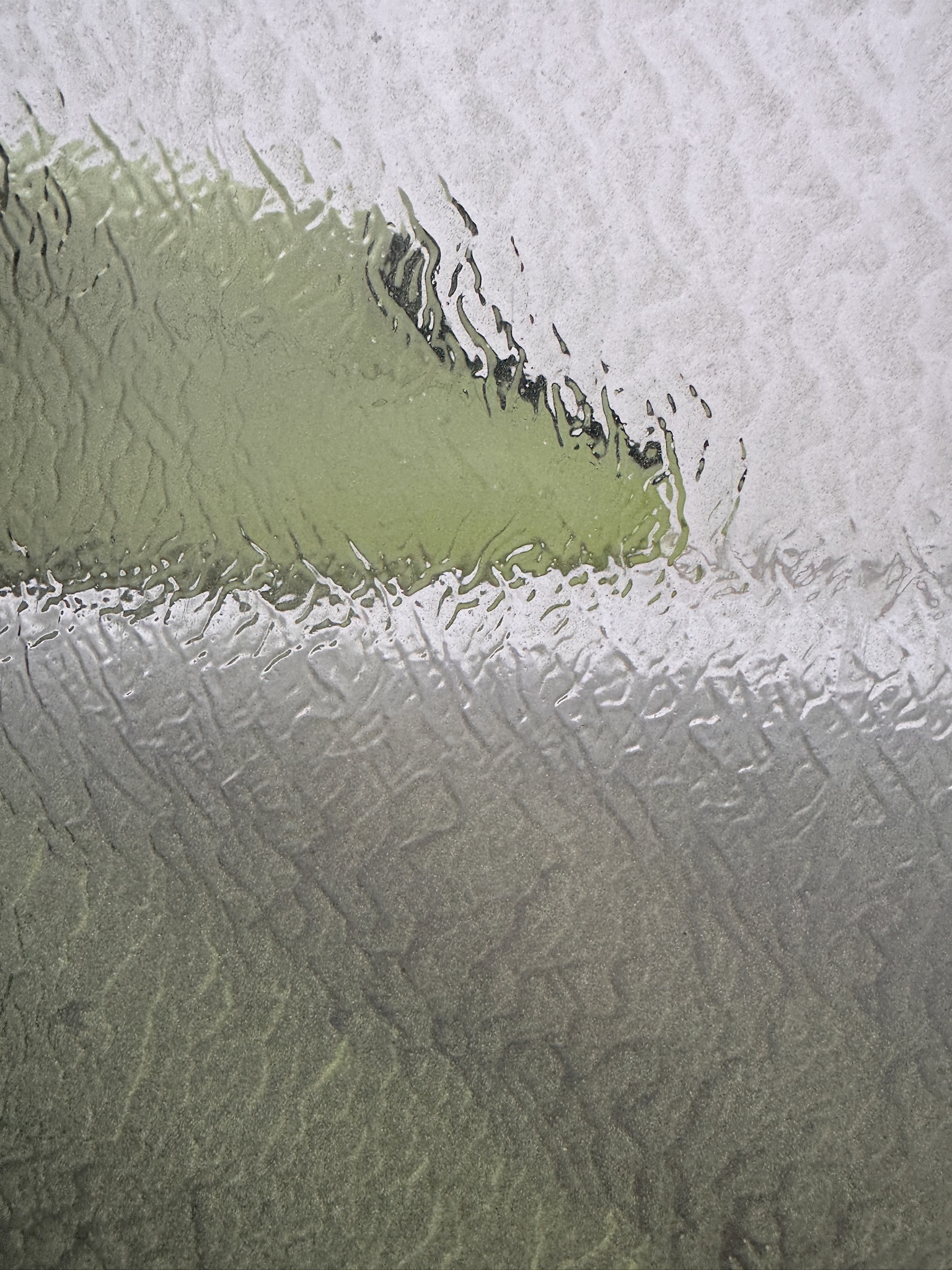
What the Tide Has Always Known
Photo: Amy Tucker, © 2026
Artist Statement: A photograph taken from above, where the water returns to the shore.
Translation Note: Spanish phrases in this poem were assisted by Google Translate (translate.google.com). The Spanish is woven in as an act of reclamation, a return to a language of the body and the self that exists beyond institutional English.

