Where this page fits: This is the canonical home for the disciplinary architecture of the project, naming the fields the inquiry draws on and how they meet. For the conceptual vocabulary itself, see Key Concepts (essay-length) or the Guide to Key Terms (short glossary). For citations, see References.
This project lives at the intersection of several academic disciplines. I came to it as a Master of Arts candidate in Human Rights and Social Justice, but the questions I was carrying required more than one field could hold. What happens to the body after nineteen years of precarious labour? What is owed to a person whose capacity for rest has been slowly taken from them? What does it mean to be alone, intentionally, and to call that scholarship? This page maps those conversations.
Table 1: Disciplinary Map of This Project
| Discipline | Core Contribution to This Project | Key Scholars |
|---|---|---|
| Sociology | Critically examines the gap between wellness policy and the sessional labour reality | Nixon (2011); Hochschild (1983); Sweet (2019) |
| Human Rights & Social Justice | Grounds alonetude as a right; frames erosion of rest as a rights violation | United Nations (1948); Nussbaum (2011) |
| Organizational Behaviour | Traces how institutional membership shapes identity, performance, and belonging | Schein (2010); Maslach & Leiter (1997) |
| Human Resource Management | Critically examines the gap between wellness policy and sessional labour reality | Maslach & Schaufeli (1993); Vosko (2000) |
| Names the structural forces behind individual suffering; frames precarious labour as systemic | Validates the body as a site of evidence and recovery | van der Kolk (2014); Levine (1997) |
| Communications | Theorizes voice, genre, and the political stakes of how stories are told | Nash (2004); Cixous (1976) |
| Geography & Place Studies | Understands the sea as a restorative landscape and site of inquiry | Tuan (1977); Gesler (1992) |
| Critical Pedagogy & Education | Frames academic precarity as a structural and pedagogical problem | Freire (1970); Giroux (1988) |
| Phenomenology | Centers the lived, embodied experience of being alone as primary data | Merleau-Ponty (1945); van Manen (1990) |
| Arts-Based Inquiry | Holds storytelling, photography, and bilingual writing as rigorous research | Nash (2004); Leavy (2015) |
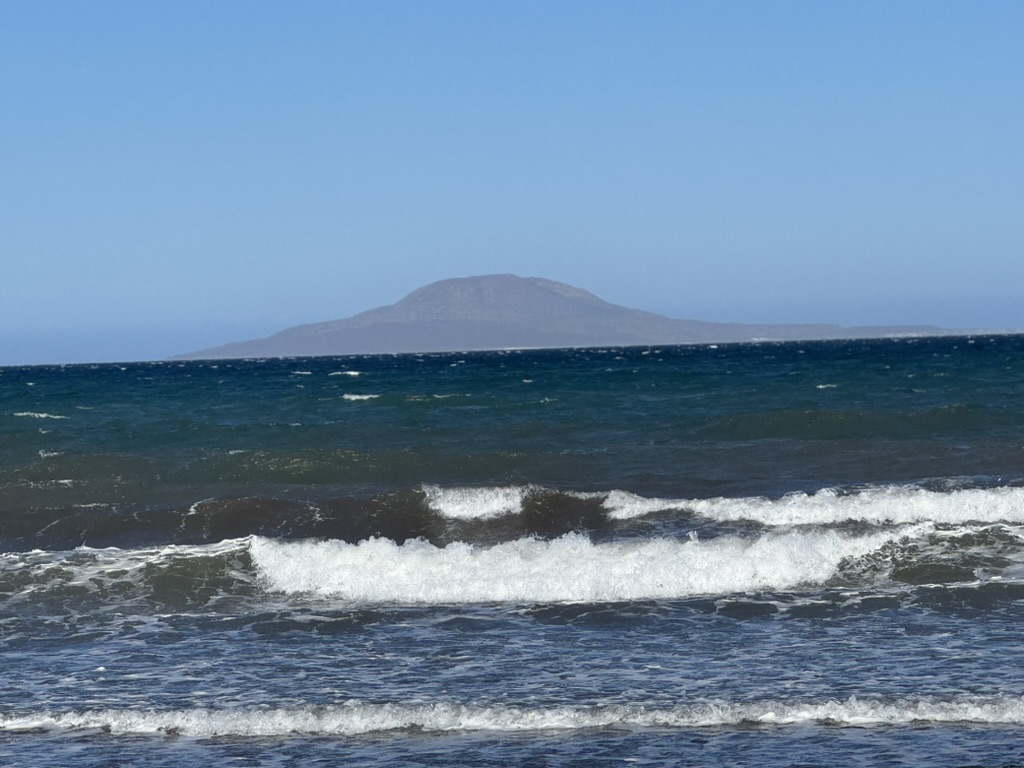
Mar de Cortés, Loreto, Baja California Sur, México. The shoreline that served as the primary site of inquiry for this project, January 2026. Photo credit: Amy Tucker, 2026.
Sociology
Sociology gave me the language for the structures I had been living inside. It asks how institutions, social norms, and systems of power shape individual experience, and it takes seriously the idea that what happens in a person’s body is often the product of forces much larger than that person. Rob Nixon’s (2011) concept of slow violence comes from this tradition: the idea that harm can accumulate gradually, out of sight, across years, in ways that are difficult to name precisely because they are so ordinary. Arlie Hochschild’s (1983) work on emotional labour also belongs here, as does Patricia Sweet’s (2019) analysis of institutional gaslighting, the systematic denial and reframing of a worker’s experience as personal failing rather than structural outcome. Sociology gave me permission to say: this was structural, and the body kept the record.
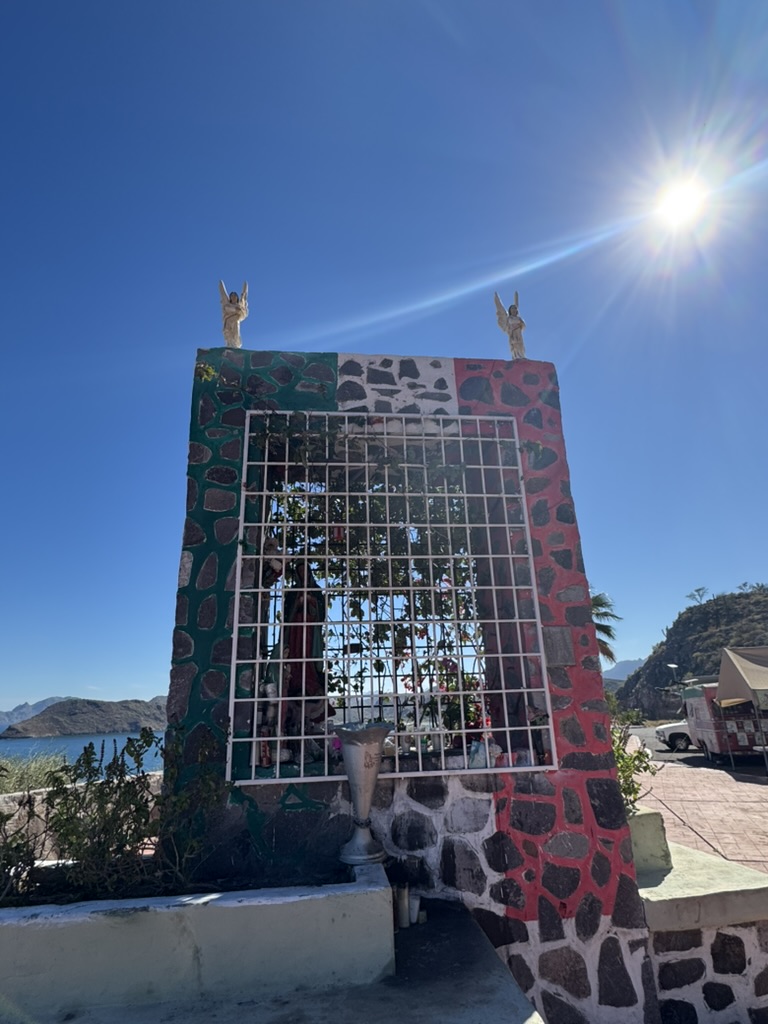
A roadside shrine in Loreto, Baja California Sur, painted in the colours of the Mexican flag. The persistence of public ritual and place-marking in a working landscape offered a counterpoint to the invisibility of institutional harm. Photo credit: Amy Tucker, January 2026.
Human Rights and Social Justice
Human rights and social justice are the degree I am completing, and the framework that holds the ethical core of this inquiry. I argue in this project that alonetude, the capacity to be fully present to oneself without performance, audience, or apology, is a human right. I argue that its systematic erosion through precarious labour constitutes a rights violation. Human rights frameworks ask whose suffering is legible and whose is rendered invisible, whose rest is considered earned and whose is considered indulgent (Nussbaum, 2011; United Nations, 1948). This field insists that the personal is political, and that a woman going alone to the sea to recover what work took from her is a claim, a political act, and an act of knowledge production.
The human rights claim in this project is grounded primarily in Martha Nussbaum’s (2011) capabilities approach, which holds that human rights are substantive freedoms extending beyond mere formal entitlements, the conditions necessary for a fully human life. Among the capabilities Nussbaum identifies as fundamental are bodily integrity, emotional expression, play, and control over one’s environment. I argue that alonetude, the capacity to be fully present to oneself without performance, audience, or apology, is one of these capabilities, and that its systematic erosion through precarious labour constitutes a capabilities deprivation and therefore a rights violation. I am working within a capabilities-based, cosmopolitan tradition rather than a purely legalistic one because the harm I am documenting exceeds what formal rights instruments can adequately capture on their own. Article 24 of the Universal Declaration of Human Rights (1948) establishes the right to rest and leisure, yet it leaves unnamed what precarious labour does to the body’s capacity for rest over time. The capabilities approach holds that gap.
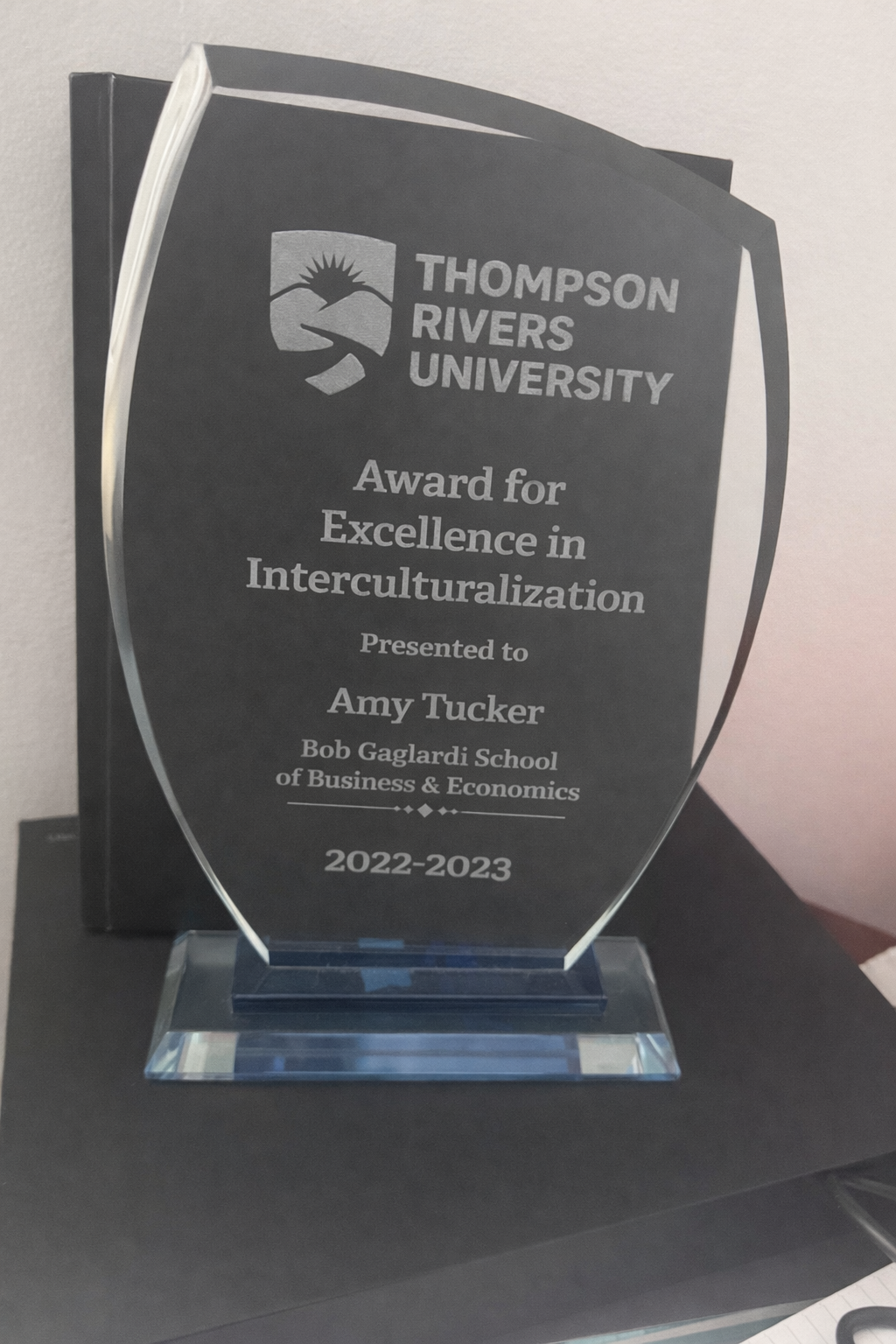
Thompson Rivers University Award for Excellence in Interculturalization. Institutional recognition coexisted with structural precarity; this award was received while working as a contract instructor without job security, benefits, or guaranteed renewal. Photo credit: Amy Tucker, January 2026.
Organizational Behaviour
Organizational behaviour examines how people function within institutions and how institutions affect people over time. I draw on this field to understand the residue of nineteen years inside a particular kind of organization: a Canadian post-secondary institution built on contract labour. Organizational behaviour asks about identity, role, performance, and belonging (Schein & Schein, 2016). When I arrived at the sea, I was carrying all of those. What habits of productivity persisted even in a place with no audience? What did it take to stop performing? Maslach and Leiter’s (1997) research on burnout, the erosion of engagement through chronic organizational stress, named what I had been experiencing. The thirty days in Loreto became a study in what organizational membership leaves behind in the body, and what it takes to begin to set it down.
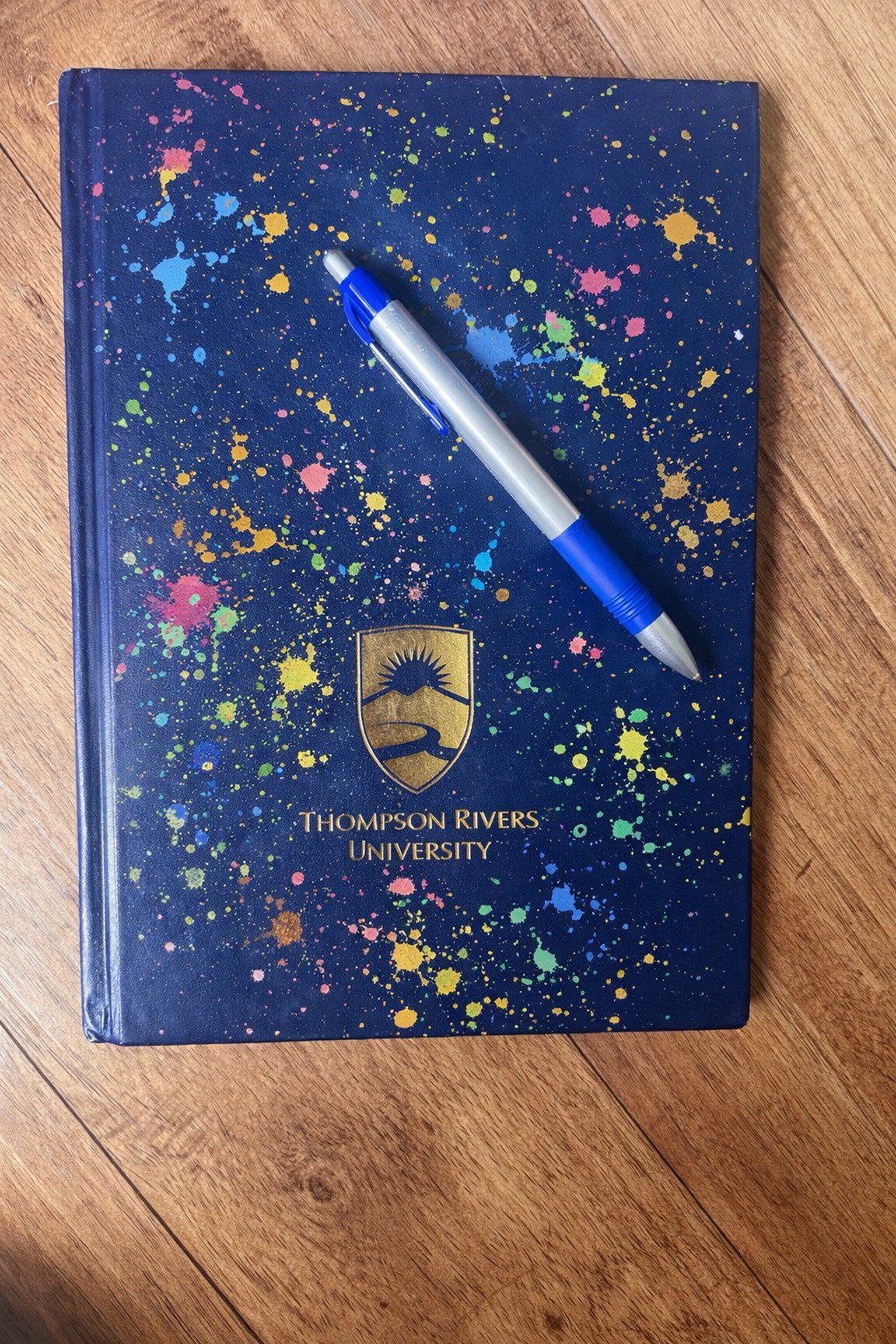
A Thompson Rivers University research journal was used as a field notebook during the thirty-day inquiry. The journal held observations, sketches, and reflections, a record of organizational memory beginning to dissolve. Photo credit: Amy Tucker, January 2026.
Human Resource Management
Human resource management is concerned with the well-being of workers, and I engage with it critically in this project. The institution I worked in for nineteen years had HR frameworks, wellness policies, and employee assistance programmes. And still, the contract workers burned out (Schaufeli et al., 1993). I use it here as a lens for examining the gap between stated commitments to worker wellbeing and the lived reality of sessional labour (Vosko, 2000). I am curious about what it means when the tools designed to support workers are structurally unable to reach the workers who need them most. The body I brought to the sea was, in part, evidence of that gap.
The research journal and art materials used during the inquiry. Creative and somatic practice became the primary means of processing what formal HR systems had left unaddressed. Photo credit: Amy Tucker, January 2026.
Trauma Studies and Somatic Knowledge
This project is also grounded in trauma studies and somatic scholarship. The work of Bessel van der Kolk (2014), particularly his documentation of how traumatic experience is stored and expressed in the body rather than in conscious narrative, helped me understand why nineteen years of institutional precarity exceeded what intellectual reflection alone could process. Peter Levine’s (1997) somatic experiencing framework, which understands recovery as a bodily process of completing interrupted stress responses, gave me a language for what the sea was doing. The thirty days in Loreto constituted a somatic inquiry rather than a vacation. Swimming, walking, drawing, painting, and sitting with the ocean were methodologies rather than recreation. This field gave me permission to treat my own physical experience as data rather than as weakness or complaint.
I experienced this as a contract worker whose exhaustion was repeatedly framed as a personal failing rather than a structural outcome. This project is written in that refusal.
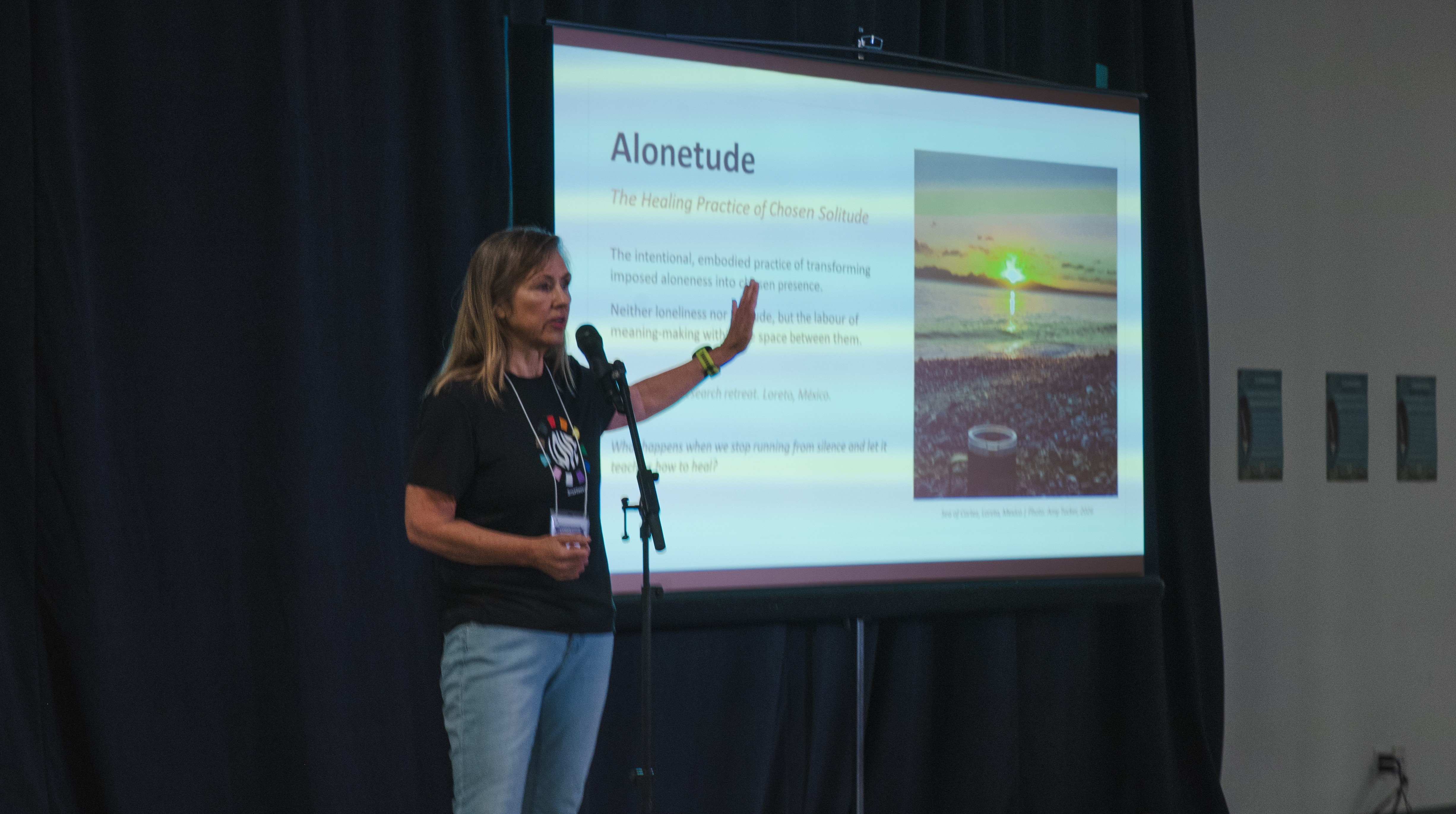
3 Minute Thesis Competition, Thompson Rivers University, March 2026. Photo credit: Deiveek | Thompson Rivers University Photography, March 2026.
Communications
Communications enters this project through the question of how we tell hard stories, and to whom, and in what form. This project is itself a communicative act: it argues that the way something is said is part of what is being said. I write in the first person because it is the most honest register available to me here. I write bilingually because Spanish opened something that English kept closed, a different proximity to feeling, a different relationship to silence. I draw on narrative theory and on what scholars of communication call “voice”: the idea that who gets to speak, in what language, in what genre, and with what authority are political questions as much as stylistic ones (Cixous, 1976; Nash, 2004). Communications gave me the framework to understand that choosing Scholarly Personal Narrative as my form was itself an argument about what counts as knowledge and who is permitted to make it.
A Note on the Spanish: What I Was Reaching For and What Remained Beyond My Claim
I want to name something left unsaid elsewhere in this project, and I want to name it here, in the section on communications, because it is fundamentally a question about language, voice, and the politics of who speaks in what tongue and with what authority.
I am a white Anglophone Canadian woman. Spanish is a language beyond my mother tongue, my cultural inheritance, or a language I came to through a lived relationship with a Spanish-speaking community. I arrived in Loreto as a settler visitor. The Spanish I write in these pages was produced with the assistance of Google Translate and refined to the best of my ability, which is limited. I name this without diminishing what the Spanish opened; it did open something, a different proximity to feeling, a register less saturated with the institutional performance of nineteen years of academic English, but to be honest about what I was doing and where my reach ended.
I was reaching toward a different language, still far from arriving in it. I was borrowing rather than reclaiming Spanish as my own; Spanish belongs to the communities, the histories, the living cultures for whom it is a mother tongue, and Mexico is a living country with a living language whose relationship to that tongue is one of first belonging; mine is secondary. What I was doing, more accurately, was reaching away from the English that had become the language of my professional performance, the language of contracts and evaluations and institutional self-management, and in that reaching, I found a different quality of attention. A loosening. A permission to be less precise, less polished, less managed.
Hélène Cixous (1976) writes about the relationship between language and the body, about how dominant linguistic registers can contain and constrain what can be said and felt. I understand my reaching toward Spanish as a gesture in that direction, an attempt to find a register less colonized by institutional demand. But I hold this alongside the recognition that Spanish is itself a colonial language in the territories where I used it, and that my use of it as a white settler visitor carries its own set of complications that I leave incompletely resolved.
Whether what I did constitutes a genuine linguistic act or a kind of appropriation is a question I hold openly. I am accountable to that question. I leave it unresolved here, as I believe it should remain open. What I can say is that I named the limits of my Spanish consistently throughout the project, in translation notes that appear with every bilingual passage, and that the Spanish was always offered as a reaching rather than a claiming. The imperfection is part of the argument: that reclamation is possible without perfection, and that a body reaching toward a different language, however haltingly, however honestly, is doing something worth naming, even when what it is doing cannot be fully defended.
Geography and Place Studies
Geography enters this project through the body’s relationship to place. Yi-Fu Tuan’s (1977) concept of topophilia, the affective bond between people and their environments, helps explain why the Sea of Cortez was constitutive of this research rather than incidental. The sea was an active participant rather than a mere backdrop in the inquiry. Wil Gesler’s (1992) work on therapeutic landscapes offers a framework for understanding how certain places hold restorative properties, materially and relationally rather than mystically, through their openness, scale, rhythms, and indifference to human performance. Loreto was a therapeutic landscape. The shore, the light, the salt, and the silence worked on the body in ways that a hotel room or a university office could not. Geography helped me understand why it had to be the sea, and why thirty days mattered.
A Critical Note on Therapeutic Landscapes
Gesler’s therapeutic landscape framework has received critique. Scholars, including Williams (1999) and Conradson (2005), have noted that the framework risks romanticizing place and naturalizing healing as something a landscape simply offers, without adequately theorizing the power relations that determine who can access restorative environments, under what conditions, and at whose expense. I take this critique seriously and want to name it directly rather than leave it as a gap in my argument.
My thirty days in Loreto were made possible by a specific convergence of resources, freedom from caregiving obligations, and settler mobility, all of which are unequally distributed. The therapeutic properties of the Sea of Cortez were real, but they were available to me through privilege. They were available within a particular set of intersecting privileges: economic, racial, and colonial. A precarious academic worker without savings, without the freedom to leave family obligations, without the mobility of a Canadian passport, or without the racial unmarkedness that allowed me to move through a Mexican town without friction, that person would have been unable to make this journey. The argument that aloneness is a human right is precisely the argument that these conditions deserve to be available beyond individual privilege. What I was able to recover in Loreto deserves to be available without requiring going to Loreto. That is the structural claim underneath the personal one.
I use Gesler’s framework to avoid naturalizing the sea as a universal healer, and to theorize the material and relational conditions that made this particular place available to this particular body at this particular moment, and to hold honestly that those conditions are unequally distributed across gender, class, race, caregiving obligation, and colonial history. The political argument of this project points beyond individual recovery toward collective and structural change: toward the conditions in which alonetude requires no passport, a sabbatical, or a shore three thousand kilometres from home.
I want to name something about Loreto beyond its colonial history. Mexico is a living country with a living culture, a living language, and living people whose relationship to that land, that sea, and that Spanish language is one of belonging rather than visiting. I arrived as a settler tourist seeking rest and recovery. The people of Loreto, their warmth, their rhythms, their unhurried relationship with the afternoon light, were part of what the sea offered me, and I received that offering as a guest. I am accountable for the difference between arriving as a guest and claiming it as one’s own. The thirty days I spent there produced knowledge that required exactly this place. They also created a debt of gratitude I can only partially repay by being honest about my position.
Critical Pedagogy and Education
Critical pedagogy enters this project through my nineteen years as a contract instructor. Paulo Freire’s (1970) analysis of the relationship between oppression, consciousness, and liberation is foundational here: the recognition that the conditions of one’s labour are politically constructed rather than natural or inevitable and therefore changeable. Henry Giroux’s (1988) work on teachers as transformative intellectuals named the contradiction I lived daily, asked to do the intellectual and relational work of a full-time academic while being denied the institutional protections and recognition that would have made that work sustainable. Critical pedagogy gave me the framework to understand my own burnout as a structural consequence rather than a personal failure of a system that extracts labour without providing the conditions for its reproduction. The project is, in part, an account of what it costs to teach from that position, and what it took to recover.
Phenomenology
Maurice Merleau-Ponty’s (1945) insistence that the body is the subject we are rather than an object we possess shapes how I understand the thirty days in Loreto: as living through rather than observing from a distance, through, as being present to a world that registered in the skin and the breath and the pace of walking. Max van Manen’s (1990) work on hermeneutic phenomenology as a research methodology provided the methodological bridge between phenomenological philosophy and educational inquiry, offering a language for the kind of attentive, reflective description practised by this project. Phenomenology gave me permission to slow down, to stay in experience rather than rush to explain it, and to treat the texture of a thirty-day life by the sea as scholarship in its own right.
Arts-Based Inquiry
Arts-based inquiry is the methodological home of this project. Scholarly Personal Narrative (Nash, 2004), the primary methodology I use, holds storytelling as rigorous research and the researcher’s voice as the primary analytical instrument. Alongside the written narrative, I used photography, painting, drawing, and bilingual writing as research instruments, each capable of holding a register of meaning that prose alone could not reach (Leavy, 2015). Arts-based inquiry gave me permission to bring the whole body to the work, to let the image and the poem carry what the argument was unable to hold, and to treat thirty days of living by the sea as a legitimate form of scholarly inquiry.
How These Fields Come Together
What these fields share is a refusal to separate the personal from the structural, the body from the system, the individual story from the political conditions that shaped it. Sociology names the forces. Human rights insist they have consequences. Organizational behaviour and Human Resource Management trace how those forces operate within institutions and affect the people who work in them. Trauma studies and somatic scholarship document what the body holds. Communications asks how that story gets told, in what voice, and to whom. Geography asks why this place, and what the land and water do to the body and the inquiry. Critical pedagogy names the conditions of academic labour that necessitated recovery. Phenomenology asks what it is to live through something slowly and attentively. Arts-based inquiry finds the forms that can hold it all.
This project belongs to all of these fields. It was built in the space where they overlap, in the place where I could say: the body is the evidence, the sea was the methodology, and the story is the scholarship.
References
Cixous, H. (1976). The laugh of the Medusa. Signs: Journal of Women in Culture and Society, 1(4), 875–893.
Freire, P. (1970/2018). Pedagogy of the oppressed (50th anniversary ed.). Bloomsbury Academic. (Original work published 1970)
Oxford University Press.
Gesler, W. M. (1992). Therapeutic landscapes: Medical issues in light of the new cultural geography. Social Science & Medicine, 34(7), 735–746.
Giroux, H. A. (1988/2024). Teachers as intellectuals: Toward a critical pedagogy of learning (Rev. ed.). Bloomsbury Academic. (Original work published 1988)
Harding, S. (Ed.). (1987). Feminism and methodology: Social science issues. Indiana University Press.
Hochschild, A. R. (1983/2012). The managed heart: Commercialization of human feeling (Updated ed.). University of California Press. (Original work published 1983)
Leavy, P. (2020). Method meets art: Arts-based research practice (3rd ed.). Guilford Press.
Levine, P. A., & Frederick, A. (1997). Waking the tiger: Healing trauma: The innate capacity to transform overwhelming experiences. North Atlantic Books.
Maslach, C., & Leiter, M. P. (1997). The truth about burnout: How organizations cause personal stress and what to do about it. Jossey-Bass. (Reprinted 2013)
Schaufeli, W. B., Maslach, C., & Marek, T. (Eds.). (1993). Professional burnout: Recent developments in theory and research. Taylor & Francis.
Merleau-Ponty, M. (1945). Phénoménologie de la perception [Phenomenology of perception]. Gallimard.
Nash, R. J. (2004). Liberating scholarly writing: The power of personal narrative. Teachers College Press.
Nixon, R. (2011). Slow violence and the environmentalism of the poor. Harvard University Press. (Paperback ed. 2013)
Nussbaum, M. C. (2011). Creating capabilities: The human development approach. Harvard University Press. (Paperback ed. 2013)
Schein, E. H., & Schein, P. A. (2016). Organizational culture and leadership (5th ed.). Jossey-Bass.
Sweet, P. L. (2019). The sociology of gaslighting. American Sociological Review, 84(5), 851–875.
Tuan, Y.-F. (1977). Space and place: The perspective of experience. University of Minnesota Press. (Reprint ed. 2001)
United Nations. (1948). Universal Declaration of Human Rights. United Nations.
van der Kolk, B. A. (2014). The body keeps the score: Brain, mind, and body in the healing of trauma. Viking. (Paperback ed.: Penguin Books, 2015)
van Manen, M. (2016). Researching lived experience: Human science for an action sensitive pedagogy (2nd ed.). Routledge. (Original work published 1990)
Vosko, L. F. (2000). Temporary work: The gendered rise of a precarious employment relationship. University of Toronto Press.
Williams, A. (Ed.). (1999). Therapeutic landscapes: The dynamic between place and wellness. University Press of America.
Colophon: A Note on Method, Materials, and Making
This project was undertaken as a creative thesis in the Master of Arts in Human Rights and Social Justice at Thompson Rivers University, Kamloops, British Columbia. It was written between January and May 2026, drawing on thirty days spent alone in Loreto, Baja California Sur, Mexico, and on nineteen years of contract academic teaching that preceded those thirty days. The work is offered in a spirit of scholarly transparency about the conditions of its making.
Methodological Position
The project uses scholarly personal narrative (Nash, 2004) as its primary method, in dialogue with arts-based inquiry (Leavy, 2015), contemplative photography (Karr & Wood, 2011), and trauma-informed research practice. Where I write from inside experience, I do so as a researcher whose body is part of the data; where I cite, I cite from within the relational autonomy framework (Mackenzie & Stoljar, 2000) that holds the self as constituted by, rather than prior to, its relations.
Positionality
I write as a white settler woman of Acadian and Scottish descent, working on the unceded territory of the Tkʼemlüps te Secwépemc and on the lands of the Indigenous peoples of Baja California Sur. I write from inside the precarious labour I describe; I have not solved it, and the project does not claim to. I write as someone for whom thirty days in Loreto was both a privilege and a survival measure, and I try to hold both of those truths at once. The reader will encounter both the structural critique and the speaker who is implicated in the structure she critiques.
Materials and Photography
All photographs on this site were made by the author during the thirty-day retreat and the months that followed, unless otherwise credited. They are offered as method rather than illustration: each image was made in the moment it documents, and is intended to carry meaning that the prose alone cannot. Photographs are copyright Amy Tucker, 2026.
Language
The project moves between English and Spanish. The daily Loreto journal inhabits Spanish substantively, written in the language of the place and the body. The post-retreat reflective pieces are predominantly in English with Spanish woven through at load-bearing moments. Spanish passages were drafted with the assistance of Google Translate and subsequently reviewed and refined by the author; they are intended as guides to meaning rather than certified linguistic interpretations.
Platform and Composition
The site is hosted on Trubox, Thompson Rivers University’s WordPress publishing platform for open educational and scholarly work. The choice of an open, public-facing platform is itself part of the method: the project is a study of public healing, and is therefore conducted in public. Drafting was undertaken in longhand and in WordPress directly; editing and structural revision were assisted by AI tools used as editorial interlocutors rather than as authors. All scholarly arguments, creative writing, photographs, and final editorial decisions are the author’s own.
Acknowledgement
The project owes debts that exceed its citations: to the students who taught me what teaching is for, to the contract instructors who carried the work alongside me, to the people of Loreto who held space for a stranger, and to the sea that gave me back to myself.
How to Cite This Project
This is a digital thesis that lives at a stable URL. Citations should reference both the whole project and the specific post or page being cited, since individual essays and poems are authored works in their own right.
Citing the whole project
APA (7th edition):
Tucker, A. (2026). 30 days by the sea: A research inquiry into the third shore [Digital Master of Human Rights and Social Justice thesis, Thompson Rivers University]. https://thirdshore.trubox.ca/
MLA (9th edition):
Tucker, Amy. 30 Days by the Sea: A Research Inquiry into the Third Shore. 2026. Thompson Rivers University, digital Master of Human Rights and Social Justice thesis. Third Shore, https://thirdshore.trubox.ca/.
Chicago (17th edition, author-date):
Tucker, Amy. 2026. 30 Days by the Sea: A Research Inquiry into the Third Shore. Digital Master of Human Rights and Social Justice thesis, Thompson Rivers University. https://thirdshore.trubox.ca/.
Citing a specific post or page
When citing an individual essay, poem, or reflection, use the post title, its publication date as it appears on the post, and the post’s permalink. For example, in APA:
Tucker, A. (2026, [Month Day]). [Post title]. In 30 Days by the Sea. [Post URL]
Because this is a living thesis archive, citations should also include an accessed date when the cited text is time-sensitive or when the citing work is published more than six months after the source post.
Persistent identifier
This project is hosted on the Thompson Rivers University TRUBox platform. The canonical URL https://thirdshore.trubox.ca/ is intended to remain stable for the life of the thesis. A snapshot of the project at submission is also available through the Internet Archive Wayback Machine.
Last revised: May 2026.
