A Love Letter Backwards in Time
I have been thinking about you.
The you that walked in the first time, folder tucked under your arm, lesson plan you had revised three times the night before because you wanted it to be right, because right mattered to you in that particular, cellular, uncompromising way it has always mattered to you,
the you that stood at the front of that room for the first time and felt the gravity of it, the privilege of it, the enormous ordinary miracle of a room full of people who had arrived willing to think differently than they had thought before.
I have been thinking about her. About you. About what I want to say now that I know what you did not know then.
You were so ready.
That is the first thing I want to tell you.
You were so ready, and you did not know it. From the student’s side of the room, from the side that would later write you letters, send you emails years later that began with I have been thinking about something you said in class, and I wanted you to know,
you were luminous.
I want to warn you about some things.
The bar will move.
I want you to know this from the beginning, before the first time it moves, before you exhaust yourself reaching for it and find it has shifted just beyond your hands.
The bar is not a measure of you. The bar is a mechanism. It is the system’s way of keeping you reaching, hungry, slightly off-balance, slightly too invested in the next thing to stop and ask why the last thing was not enough.
Reach for the bar because the reaching makes you better. Reach for the bar for yourself.
Do not reach for the bar for them.
Know the difference between a place that is developing you and a place that is extracting you.
The students are real.
This I want you to hold as the true north of the whole nineteen years, the thing that does not shift, the thing the system cannot touch, take, or use without your permission.
When everything else feels uncertain, go back to the students.
You are going to be so tired.
I want to say this without softening it because you deserve honesty more than comfort.
You are going to be tired in a way that goes all the way down, tired in the bone, tired in the place that decides whether to keep going,
and you are going to keep going because you do not know how not to.
But I am going to tell you this:
Give so much. Give everything. And also, in the small moments, on the shore of yourself that belongs to no one else,
give something to yourself.
Give yourself the belief you give so freely to others. Give yourself the patience you give the struggling student.
You deserve your own generosity. You deserved it from the beginning.
You are going to find out that you did not belong there.
Not because of anything that was wrong with you. Because of everything that was right with you, and the particular cruelty of a room that needed you but was not built for you.
This is going to hurt in a way you are not prepared for.
You are going to spend years thinking the problem is you, turning yourself over, looking for the missing piece.
There is no missing piece.
You were always the right shape. The room was the wrong shape.
When you finally understand this, it will feel like grief and like freedom, grief and freedom arriving together the way they always do when something true finally breaks the surface.
I want to tell you about the shore.
You are going to the shore. Far from the institution.
You are going to sit with the sea, which will ask nothing of you,
and you are going to cry the way you needed to cry for years, the real kind, the kind without an audience,
and when you are empty, you are going to find underneath the emptiness the most important thing you have found in nineteen years.
Yourself.
Still there. Still whole. Still luminous under all the exhaustion, the performance, and the careful management of being a person that the institution kept evaluating.
I want to tell you about the poems.
You are going to write poems.
Not as scholarship, not as methodology, but because you are going to discover in the long quiet aftermath of all that noise,
that you are a writer.
That you always were.
I love you.
I love the woman who revised the lesson plan three times. I love the woman who could not walk past the struggling student. I love the woman who agonized at two in the morning over whether she had said exactly the right thing in exactly the right way to the person who most needed to hear it.
I love the woman who kept the actual record, who knew in her deepest self that she was good, that the work was good, that what happened in those rooms was extraordinary even when no one was calling it that.
I love the woman who is standing now on the other side of knowing, worn smooth by it, clarified by it, more herself for it than she has ever been,
still kind, still ethical, still in love with the work and the students and the lantern she carries into every room,
and finally, finally, in love with herself.
You made it through.
I wanted you to know from the beginning that you make it through.
Para la mujer que era antes de saber. Te vi siempre. Eras suficiente desde el principio. Con todo mi amor, desde el otro lado.
For the woman I was before I knew. I always saw you. You were enough from the beginning. With all my love, from the other side.
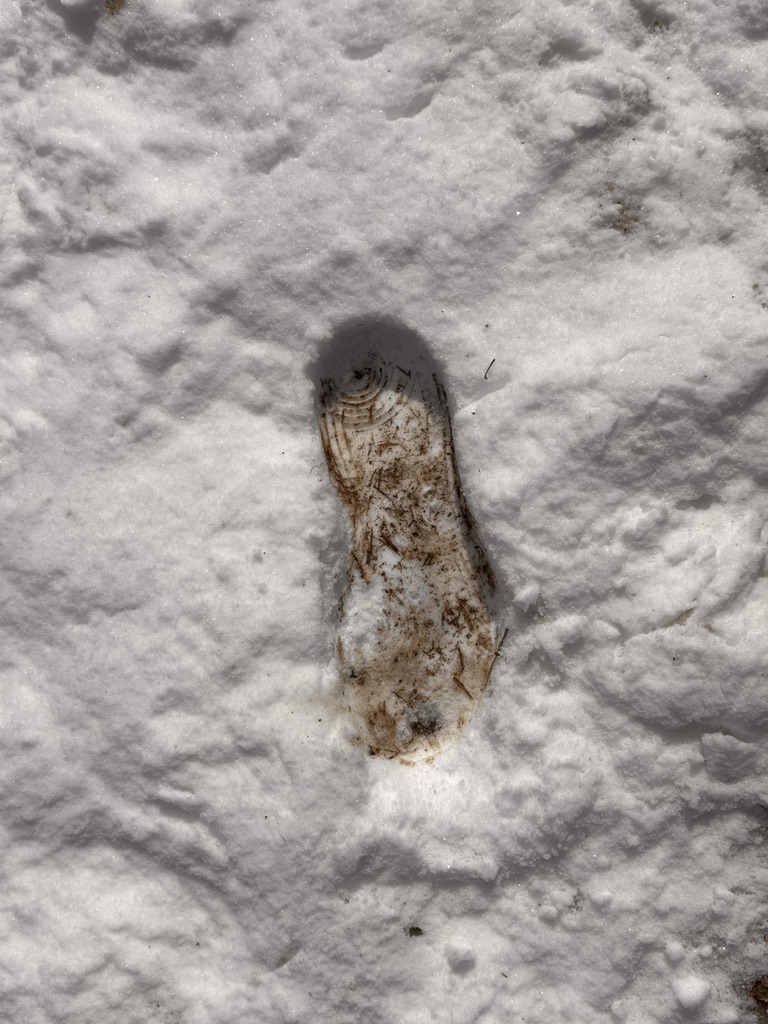
Still Here, Worn to Its Truest Shape
Photo: Amy Tucker, © 2026
Artist Statement: A footprint stripped by water, time, and winter to its grain.
Translation Note: Spanish phrases in this poem were assisted by Google Translate (translate.google.com). The Spanish is woven in as an act of reclamation, a return to a language of the body and the self that exists beyond institutional English.

