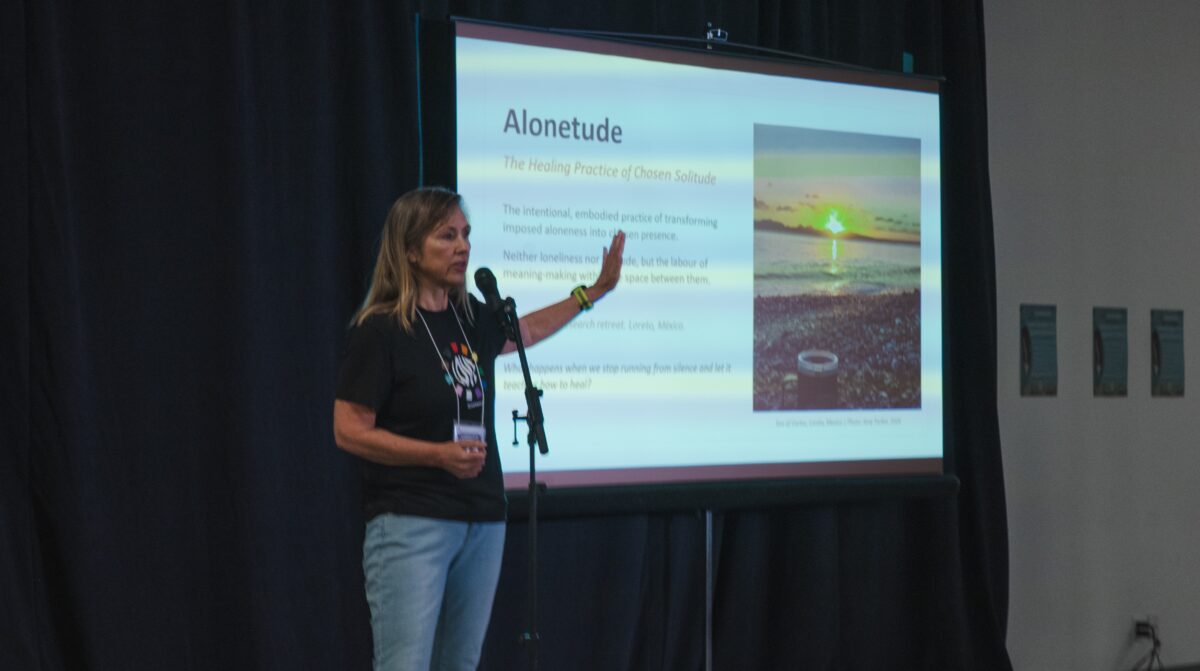
I stood at the podium with three minutes to explain thirty days, nineteen years, and the question that has been living in my body for longer than I can name.
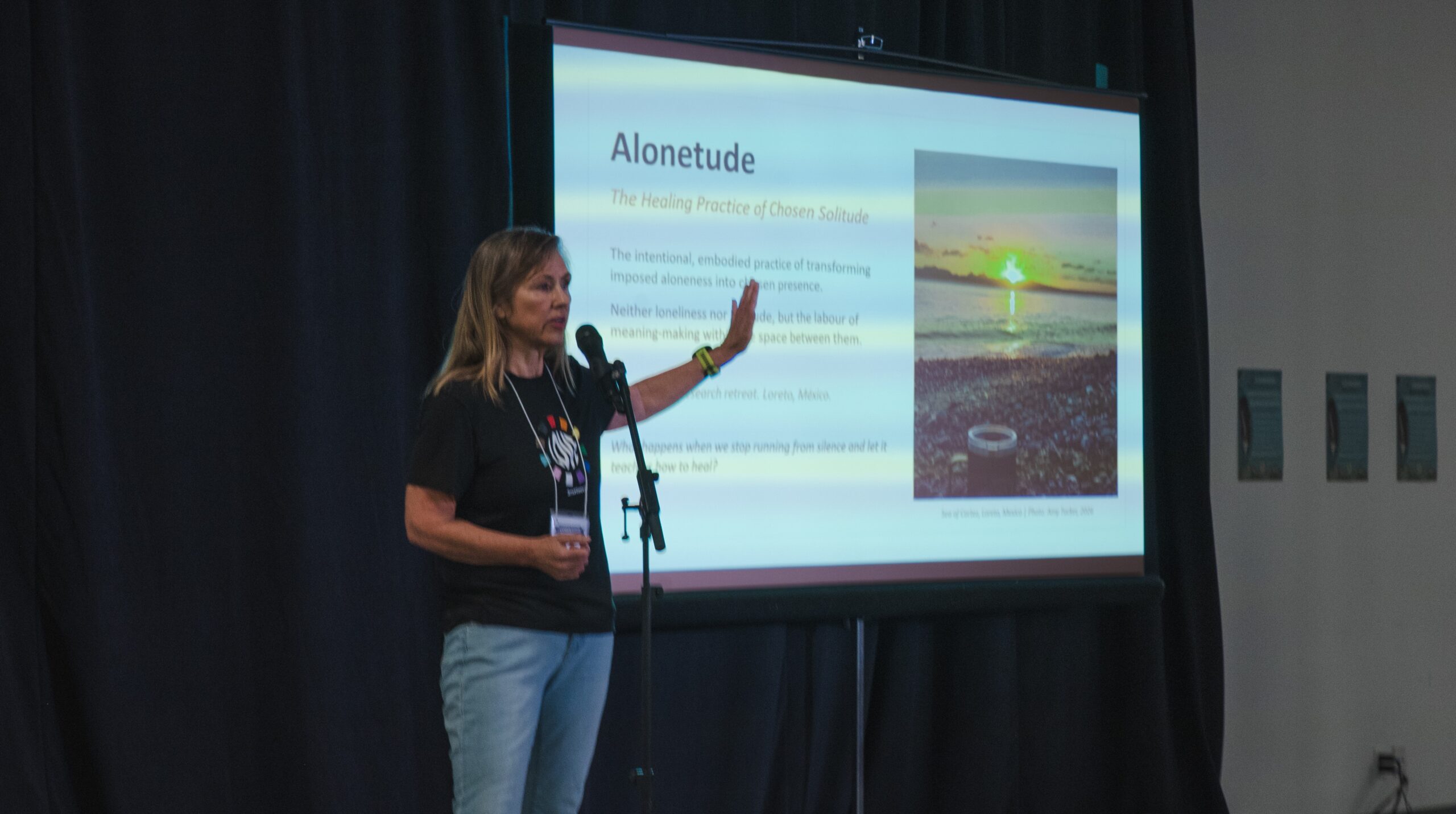
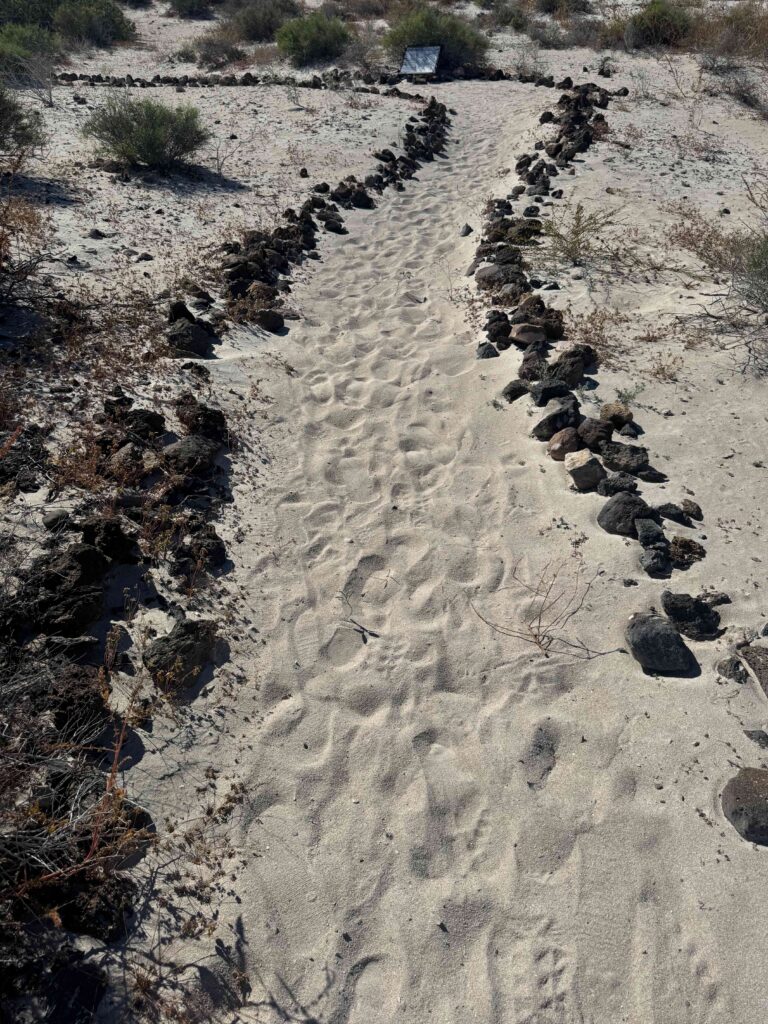
The 3 Minute Thesis competition at Thompson Rivers University, March 2, 2026. Secwépemc territory. One slide. One photograph I took beside the Sea of Cortez. One question on the screen behind me:
What happens when we stop running from silence and let it teach us how to heal?
Photo: Deiveek | Thompson Rivers University Photography | 3MT, March 2, 2026
I had three minutes. I had the whole project behind me: thirty days, eighty-one blog entries, thousands of kilometres of nervous system regulation, grief held and released, stones collected, pelicans watched, tears cried into salt water. I had a methodology grounded in the body. I had a word I invented, alonetude, and the conviction that it names something real.
Three minutes to say: precarious academic labour goes beyond economics. It lives in the body. It reshapes the nervous system. It forecloses the capacity for rest. And rest, genuine rest, embodied and unhurried, is a human right under international law, a matter of human dignity.
Three minutes to say: I went to Loreto, México, for thirty days alone. I brought my research questions, my sixty-year-old body, and one orange suitcase. I stayed until the sea taught me something a desk could never have offered.
I have no distance on exactly how it went. I was inside it. I could feel the room listening. I could feel myself steady in a way I was unsteady a year ago, or six months ago, or even four months ago when I sat alone in the casita watching the sun set over the Sea of Cortez, wondering if any of this would ever be finished.
It is finished. And it is being heard.
Alonetude: The Healing Practice of Chosen Solitude.
Three minutes. Nineteen years. Thirty days by the sea. One breath before I spoke.
Thompson Rivers University | 3 Minute Thesis | March 2, 2026 | Kamloops, BC | Secwépemc Territory
This piece belongs to A Human Geography of the Self, a series that reads my own life through the concepts geographers use to understand how people and places make one another. It draws on my creative doctoral and master’s work, and on nineteen years of teaching.
“A discipline can be used to wound, and a discipline can be turned toward repair. Geography has been both.”
I teach on Secwépemc Territory, and most days I begin a class by saying so. For years, I said the words the way one recites a courtesy, a small formal nod before the real work began. Then I started reading the history of my own adjacent discipline, the history of geographic thought, and the acknowledgement stopped feeling like a courtesy. It started feeling like a reckoning. Because the question underneath those words, the question of who gets to decide what a piece of land means, who lives there, who belongs, what it is for, turns out to be the question geography spent much of its early life answering in the worst possible way. A discipline can be used to wound, and a discipline can be turned toward repair. Geography has been both. I want to tell that story honestly, because it is a human rights story, and because I am standing inside it.
When Geography Ranked the World
There was a long period when geography taught that the land decides. The doctrine was called environmental determinism (the belief that climate and terrain directly shape human character, ability, and the worth of whole peoples). It sounds abstract until you see what it was used to do. Bhagat and Kenis (2026) describe environmental determinism as geography’s contribution to Social Darwinism and the marker of the discipline’s entry into modern science in the late nineteenth century. They trace how its proponents argued that temperate climates produced superior societies, a view, they write, that was used to justify colonial domination and racial hierarchies (Bhagat & Kenis, 2026). The argument ran that Northern European peoples were energetic and provident because of their climate, while peoples of other regions were cast as their lesser opposites, and the supposed science of geography then certified the ranking as a natural fact (Bhagat & Kenis, 2026).
I find this painful to teach, and necessary. The determinist claim was never a neutral error. It was an instrument. It took the brutal arrangements of empire and dressed them as the simple working out of climate, so that conquest could present itself as destiny. Clément (2020), studying early French colonial geography, shows the machinery up close. He demonstrates how colonial geographers used environmental determinism to explain the lives of Indigenous peoples as a heavy dependence on natural conditions, and then classified those peoples according to their supposed ability to overcome the constraints of their environment (Clément, 2020). The result, he argues, was a science of othering, one whose racialised determinants worked to distance, inferiorise, and dispossess Indigenous peoples under the banner of progress (Clément, 2020). Reading him, I understood that deciding what land means and deciding who counts as fully human were, in this history, the very same act.
The Quiet Violence of a Naturalized Map
Here is the part that reaches me most directly, as someone who has lived a precarious working life and written about how systems decide a person’s worth. Determinism’s deepest trick was to make a human arrangement look like a fact of nature. When inequality is presented as the inevitable product of climate or terrain, it stops looking like a choice that someone made and someone benefits from. It starts looking like weather.
I know this move from the inside, in a far smaller key. For nineteen years as a contract academic, I was offered a story in which my insecurity was simply the climate of the profession, the natural order of the academic ecosystem, nobody’s decision and therefore nobody’s responsibility. Determinism in geography did the same thing at the scale of peoples and continents. It turned decisions into destiny. That is why the history matters as a human rights story rather than a dusty disciplinary debate. To refuse the claim that land determines what people are worth is to insist that the arrangements built on that lie can be questioned, named, and changed. The opposite of determinism, in the end, is accountability.
Turning the Discipline Toward Repair
The hopeful half of this story is that geography has spent decades trying to undo its own founding harm. Determinism was discredited within mainstream geography by the middle of the twentieth century, though, as Bhagat and Kenis (2026) carefully note, its reductive habits keep returning in new forms, including in popular bestsellers and in some climate narratives that once again make environment the master variable of human fate (Bhagat & Kenis, 2026). The work of repair, in other words, is ongoing rather than finished. It has a name now: the effort to decolonize geography, to dismantle the colonial assumptions built into the discipline and to centre the knowledge of the peoples it once objectified.
Radcliffe (2017) frames this decolonial turn as an ethical and political project rather than only an intellectual one. Decolonial approaches, she writes, treat Black and Indigenous experiences as rooted in colonial modernity, and they work to make visible the material and epistemic consequences of white supremacy in order to disturb the system that depends on it (Radcliffe, 2017). She is careful, though, and her caution is one I take personally. The enactment of decolonisation, she writes, requires caution, guidance, and humility, and remains always complex and highly contentious (Radcliffe, 2017). This is far from a project a settler scholar gets to declare complete and tidy.
De Leeuw and Hunt (2018) press exactly on that danger, and their warning has reshaped how I understand my own land acknowledgement. They argue that efforts to decolonize geography are inherently limited as long as colonization continues to structure the discipline and the academy, and they caution that decolonization too often proceeds by re-centring settler voices, engaging concepts of Indigeneity rather than Indigenous peoples themselves, their scholarship, and their lived knowledge (de Leeuw & Hunt, 2018). They ask a question I now sit with before every class: what does it mean to teach about decolonization on Indigenous land, through citational practices that still centre settler scholars over Indigenous ones (de Leeuw & Hunt, 2018)? They urge settler academics to politicize their own situated position on colonized land rather than to perform a reflexivity that changes nothing (de Leeuw & Hunt, 2018). That is a far harder and more honest instruction than the courtesy I once recited.
The Limit I Have to Name
There is a boundary I must mark clearly, because the whole integrity of this post depends on it. It would be a quiet act of appropriation to take this human rights story and fold it smoothly into my own narrative of healing, as though my recovery from precarity and fear sat on the same plane as Indigenous peoples’ struggle against dispossession. It sits at a different scale entirely, and the scholarship I am leaning on insists on the difference.
Tuck and Yang (2012) named this with a precision that has stayed with me for years. Decolonization, they argue, is beyond a metaphor; it means the repatriation of Indigenous land and life, and it resists being turned into a comfortable figure of speech for everyone else’s liberation (Tuck & Yang, 2012). They warn against what they call settler moves to innocence, the small manoeuvres by which settlers reach for the feeling of absolution while the material facts of land stay exactly as they were (Tuck & Yang, 2012). I cite them here as a brake on my own writing. This post can advance a human rights understanding of geographic thought. It earns nothing if it lets me feel absolved. The meaning of the land I teach on remains a matter for the Secwépemc people, beyond my gift to confer.
The Acknowledgement, Remade
So I still begin my classes by naming the territory. The words are the same. What has changed is everything underneath them. I understand now that I am standing in the long aftermath of a discipline that once decided, with the full authority of science, what land meant and who its peoples were permitted to be. I understand that the deciding was a weapon, that the weapon was disguised as fact, and that the work of taking the disguise off is unfinished and partly mine to carry.
Who gets to decide what land means? For too long the answer was whoever held the surveying instruments and the textbooks and the power to call their own ranking natural. The better answer, the one geography is still struggling toward, returns that authority to the peoples whose relationships with these lands long precede mine and will long outlast my tenure. I get to stand here as a guest and a witness. I get to teach the history honestly, including the parts that implicate the very ground I teach upon. And I get to say the territory’s name each morning as what it truly is: beyond a courtesy, a reckoning, and a small daily refusal of the old lie that land decides what people are worth.
References
Bhagat, A., & Kenis, A. (2026). The modern slavery-climate change nexus: Resurrecting environmental determinism, reinforcing saviourism and absolving the West. Antipode, 58(1). https://doi.org/10.1111/anti.70125
Clément, V. (2020). Geographical knowledge, Empire, and the Indigenous Other: Engaging a decolonising introspection into early French colonial geography. Area, 52(4), 741-749. https://doi.org/10.1111/area.12617
de Leeuw, S., & Hunt, S. (2018). Unsettling decolonizing geographies. Geography Compass, 12(7), Article e12376. https://doi.org/10.1111/gec3.12376
Radcliffe, S. A. (2017). Decolonising geographical knowledges. Transactions of the Institute of British Geographers, 42(3), 329-333. https://doi.org/10.1111/tran.12195
Tuck, E., & Yang, K. W. (2012). Decolonization is not a metaphor. Decolonization: Indigeneity, Education & Society, 1(1), 1-40.
Academic Lens
This post narrates the history of geographic thought as a human rights story, grounded in peer-reviewed journal scholarship. Bhagat and Kenis (2026) supply the historical arc and the crucial argument that environmental determinism functioned as a justification for colonial domination and racial hierarchy, while also documenting its persistent return in contemporary climate and development narratives. Clément (2020) provides the close historical case, demonstrating how colonial geographers deployed determinism to classify, dehumanize, and dispossess Indigenous peoples under the rhetoric of progress. The post’s pivot from diagnosis to repair draws on the decolonial turn in the discipline: Radcliffe (2017) frames decolonization as an ethico-political project requiring humility, and de Leeuw and Hunt (2018) supply the essential settler-accountability caution, warning that decolonial work too easily re-centres settler voices and engages concepts of Indigeneity rather than Indigenous peoples themselves. Tuck and Yang (2012) anchor the ethical limit through their concept of incommensurability and their critique of settler moves to innocence, which disciplines the writer’s positionality and prevents the appropriation of Indigenous struggle into a settler narrative of healing. Read through Scholarly Personal Narrative (Nash, 2004), the post enacts an accountable settler pedagogy: it uses the land acknowledgement as both frame and subject, modelling the move from recited courtesy to situated reckoning that de Leeuw and Hunt call for, while refusing the absolution that Tuck and Yang foreclose. The brief analogy to academic precarity is deliberately subordinated and explicitly marked as incommensurable, illustrating determinism’s core mechanism, the naturalization of human arrangements, without equating the two scales of harm.
This page lists the verified references for The Places I Have Loved Like People, part of the A Human Geography of the Self series. All citations have been verified against CrossRef DOI records. Corrections from the original post are noted below.
Verified References
Cross, J. E. (2015). Processes of place attachment: An interactional framework. Symbolic Interaction, 38(4), 493–520. https://doi.org/10.1002/symb.198
Dunkley, R. A. (2018). Monitoring ecological change in UK woodlands and rivers: An exploration of the relational geographies of citizen science. Transactions of the Institute of British Geographers, 44(1), 16–31. https://doi.org/10.1111/tran.12258
Larter, P. C. L., Grek-Martin, J., & Silver, A. (2019). Does time heal all wounds? Restoring place attachment in Halifax’s Point Pleasant Park after Hurricane Juan. Canadian Geographies / Géographies canadiennes, 63(3), 494–506. https://doi.org/10.1111/cag.12542
Tuan, Y.-F. (1974). Topophilia: A study of environmental perception, attitudes, and values. Prentice-Hall.
notes
Larter et al. (2019) — journal name corrected. The original post cited the journal as “The Canadian Geographer / Le Geographe canadien.” CrossRef records confirm that this journal was renamed Canadian Geographies / Géographies canadiennes beginning with volume 63 (2019) — the same volume in which this article appears. The corrected citation reflects the current and accurate journal title.
Dunkley (2018) — publication date note. This article was first published online 25 July 2018 and appeared in the print issue vol. 44(1) in March 2019. The post’s citation of 2018 correctly reflects the online-first publication year per APA 7 convention.
All other citations in this post verified correct against CrossRef DOI records.
Verified June 29, 2026 against CrossRef DOI database.
This piece belongs to A Human Geography of the Self, a series that reads my own life through the concepts geographers use to understand how people and places make one another. It draws on my creative doctoral and master’s work, and on my life as an open-water swimmer.
I have grieved shorelines the way other people grieve the departed.
There is a stretch of cold water in the Okanagan that I love the way I love certain people. I know its moods. I know the place where the lake goes suddenly deep and the temperature drops like a held breath, and the place near the reeds where the morning sun arrives first. When I have been away from it too long, I feel the absence as a physical ache, the same ache I feel for a friend I have not seen. I have stood on its shore after a hard season and felt it recognize me. I have grieved shorelines the way other people grieve the departed. For a long time, I thought this was a private eccentricity, a swimmer’s sentimentality. Then I learned that geography has a name for it, and a whole literature, and that the love I feel for water is one of the oldest subjects in the human study of place.
The name is topophilia (the affective bond between a person and a place, the love of a particular piece of the earth). I want to write about what that bond is, why it behaves so much like love for a person, and why naming it has changed how I understand my own attachments to water, to retreat, to the few places that have truly held me.
The word comes from the humanist geographer Yi-Fu Tuan, and the geographers who use it return to his definition again and again. Larter, Grek-Martin, and Silver (2019), studying how the people of Halifax reattached to a beloved park after a hurricane tore it apart, quote Tuan’s phrase directly: topophilia is the affective bond between people and place (Larter et al., 2019). They describe how Tuan’s focus on the love of place introduced a humanistic sensibility to geography, one that treated places as centres of felt value and fields of care rather than as neutral coordinates (Larter et al., 2019). That phrase, fields of care, undid something in me when I first read it. The lake is a field of care. I tend it in my attention, and it tends me in return.
What moved me most in their study was the concept they used for the loss of such a place. They describe solastalgia (the distress a person feels when a beloved place is damaged or changed, a kind of homesickness felt without leaving home) as the grief that park users carried when the storm altered the landscape they loved (Larter et al., 2019). I have felt exactly this, watching a shoreline change, watching a low-water year expose the bones of a lake I love. Solastalgia gave a name to a grief I had carried without permission to call it grief. The geography validated the feeling.
Loved Like a Person
The heart of this post is a claim that sounds sentimental until a geographer says it plainly: the bond with a place can resemble the bond with a person, even the deepest such bond. Pascual-de-Sans (2004), writing about how people carry their attachments to place across migrations and lifetimes, openly draws the comparison. The bond between a person and their place, she suggests, can be compared to the bond between a mother and her child, specific and unique to them, even as they remain aware that countless other such bonds exist in the world (Pascual-de-Sans, 2004). The awareness of other people’s loves, she argues, deepens rather than diminishes one’s own (Pascual-de-Sans, 2004).
I have read that passage many times now. It tells me my love for the cold lake is far from a metaphor stretched too thin. It is a recognized form of human attachment, structured like the love between kin, particular and irreplaceable. When I say the lake knows me, I am describing what Pascual-de-Sans calls a relationship between a person and a place that becomes part of who that person is. The water has helped raise me. That is beyond poetry. It is geography.
Cross (2015), mapping the distinct processes through which people grow attached to places, helps me understand how such a bond is actually built. She identifies several interacting processes, among them the sensory (in which we come to know a place through the body and the five senses) and the narrative (in which we tell and retell the stories that bind us to it) (Cross, 2015). My attachment to the lake is sensory in the most literal way a bond can be. I have taken that water into my mouth and onto my skin ten thousand times. I have stories about it that I tell and retell until they have become part of my own history. Cross shows me that love of place is far from a single feeling. It is a set of practices, repeated over years, until the place is woven through the self.
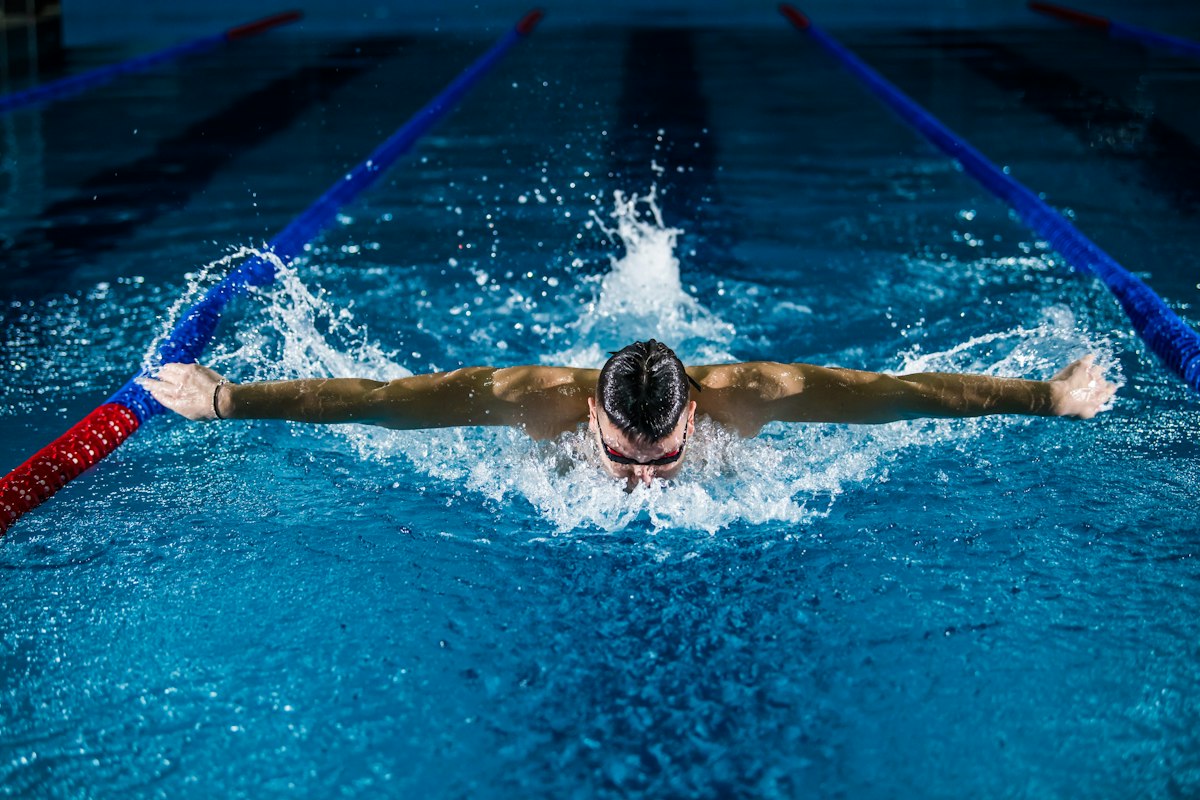
Open-water swimming as sensory knowledge: the body learning a place from the inside out.
The Bonds That Endure
One of the quiet gifts of this literature is its insistence that these bonds last. Dunkley (2018), studying why people volunteer to monitor the health of woodlands and rivers, found that the early affective bonds people form with ecological and water spaces endure throughout the life course, and that staying connected to those places becomes a way of remaining oneself (Dunkley, 2018). Her participants returned to their waters and woods across decades, drawn by a love that had taken root early and refused to fade (Dunkley, 2018).
I am one of her participants in spirit. The bond I formed with water as a young person, in the years when so much else was unsafe, has lasted through every season of my life. Water was the one place that never frightened me. It still is. Dunkley’s finding (that these affective bonds endure and that we organize our lives partly around keeping them) describes the shape of my whole swimming life. I have arranged decades around staying close to water. I understand now that this was attachment doing what attachment does, holding me to the places that hold me.
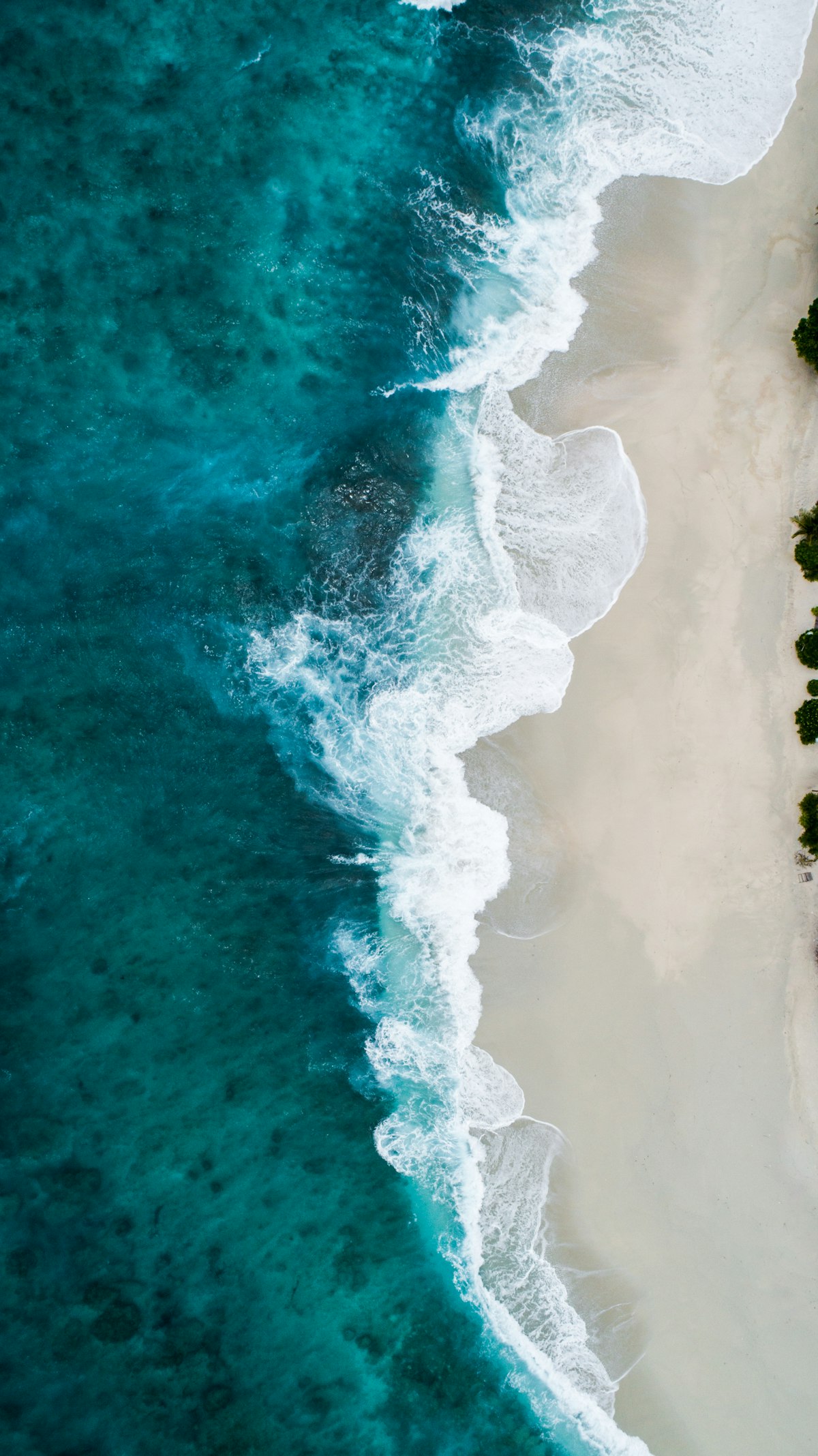
Water at dusk: the kind of scene that calls a person back, decade after decade.
What the Lake Taught Me About Love
So I have stopped apologizing for loving places like people. The geography gives me permission, and more than permission, a vocabulary precise enough to honour the feeling. Topophilia is real. Solastalgia is real. The bond can be structured like kinship, built through the senses and through story, and it can last a lifetime. None of this is a swimmer’s sentimentality. It is one of the most thoroughly studied truths about how human beings live in the world.
I will go down to the cold lake again this week, the way you visit someone you love. I will feel the deep place where the temperature drops, and the warm shallows by the reeds, and I will feel the lake recognize me. I used to think I was projecting my need onto indifferent water. Now I think I was practising one of the oldest forms of belonging there is. The places I have loved like people loved me back, in the only language places speak, which is the language of holding. I have been held by that water for most of my life. To love it in return is the most natural geography in the world.
References
Cross, J. E. (2015). Processes of place attachment: An interactional framework. Symbolic Interaction, 38(4), 493-520. https://doi.org/10.1002/symb.198
Dunkley, R. A. (2018). Monitoring ecological change in UK woodlands and rivers: An exploration of the relational geographies of citizen science. Transactions of the Institute of British Geographers, 44(1), 16-31. https://doi.org/10.1111/tran.12258
Larter, P. C. L., Grek-Martin, J., & Silver, A. (2019). Does time heal all wounds? Restoring place attachment in Halifax’s Point Pleasant Park after Hurricane Juan. Canadian Geographies / Géographies canadiennes, 63(3), 494-506. https://doi.org/10.1111/cag.12542
Pascual-de-Sans, A. (2004). Sense of place and migration histories: Idiotopy and idiotope. Area, 36(4), 348-357. https://doi.org/10.1111/j.0004-0894.2004.00236.x
Tuan, Y.-F. (1974). Topophilia: A study of environmental perception, attitudes, and values. Prentice-Hall.
Academic Lens
This post translates topophilia into a Scholarly Personal Narrative account of an open-water swimmer’s love of place, grounded in peer-reviewed scholarship with one foundational anchor. Tuan (1974) originates the concept, and Larter, Grek-Martin, and Silver (2019) supply both the working definition (the affective bond between people and place) and the crucial concept of solastalgia, the grief attending a damaged beloved place, which the post uses to legitimize a previously unnamed form of loss. Pascual-de-Sans (2004) provides the post’s structural claim through her explicit comparison of the person-place bond to the parent-child bond, establishing that attachment to place is a recognized form of kinship-like attachment rather than mere sentiment. Cross (2015) supplies the mechanism, decomposing place attachment into interacting processes (notably the sensory and narrative) that explain how a bond with water is built through embodied repetition and storytelling. Dunkley (2018) anchors the claim of endurance, demonstrating that early affective bonds with ecological and water spaces persist across the life course and organize ongoing behaviour. Read through Scholarly Personal Narrative (Nash, 2004), the post enacts a move characteristic of the series: it takes an emotional experience the writer had treated as idiosyncratic (loving a lake like a person) and reframes it, through verified geographic scholarship, as a well-theorized and widely shared dimension of human dwelling, converting private feeling into legible knowledge.
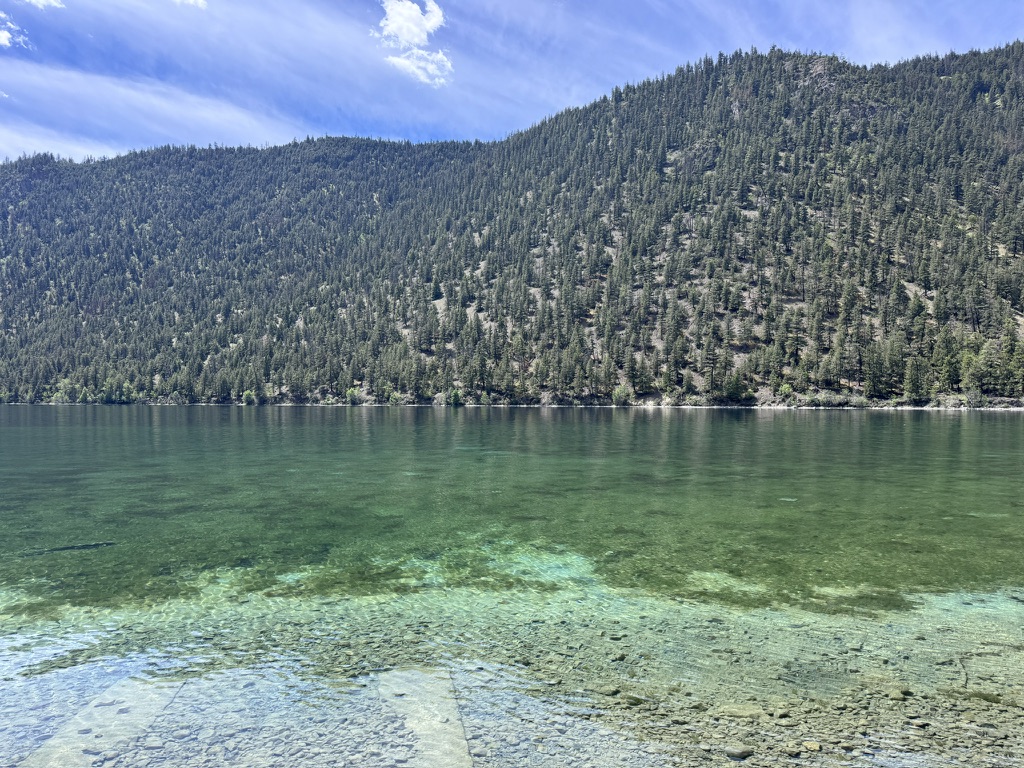
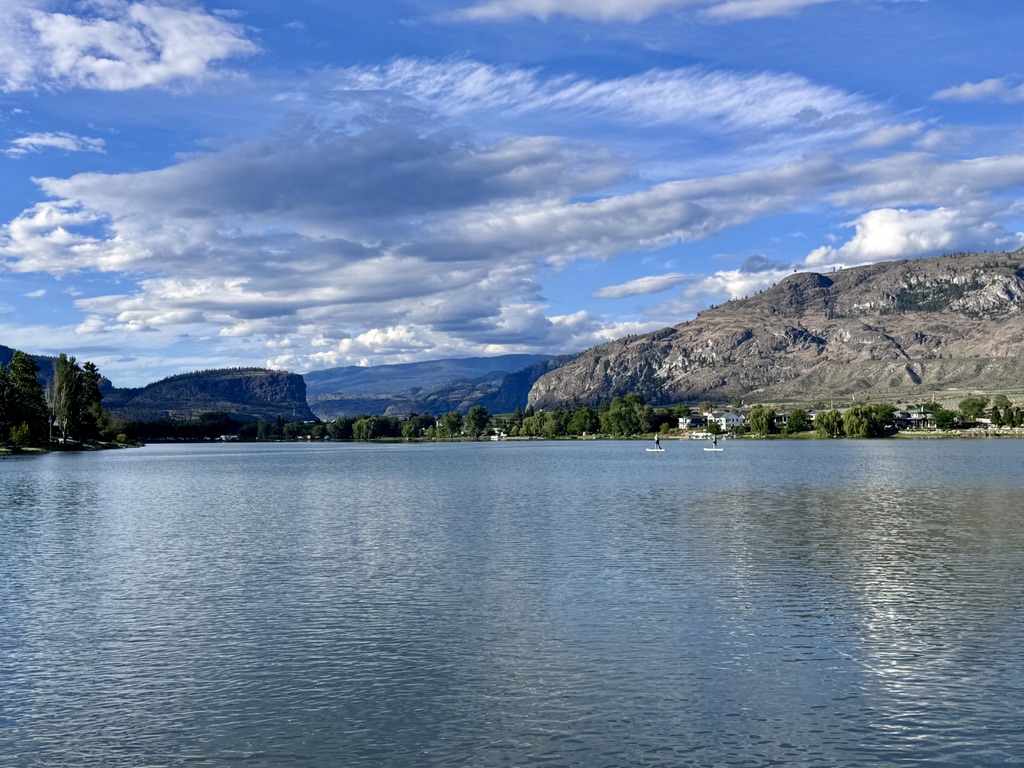
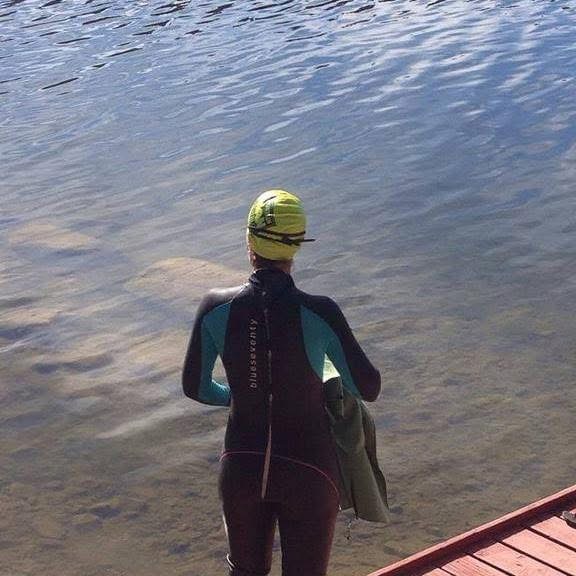
Clear Water. The transparent emerald waters of an alpine lake, pine-covered mountains rising beyond the far shore. Photo: Amy Tucker, 2026.After the Rain. A rainbow arcs over a wooded landscape seen through a rain-specked window. Photo: Amy Tucker, 2026.On the Lake. Paddleboarders on a calm lake beneath cloud-streaked skies, with rocky mountain peaks and valley communities stretching beyond. Photo: Amy Tucker, 2026.Ready to Enter. Open-water swimmer at the lake’s edge, preparing to enter the water. Photo: Amy Tucker, 2026.
🔍 Verified References The citations in this post have been verified against CrossRef DOI records. View the verified reference list with notes for this post.
Content Warning: This piece discusses childhood exposure to parental alcoholism and violence. The material avoids graphic detail, yet it addresses fear and hypervigilance that some readers may find difficult.
This piece belongs to A Human Geography of the Self, a series that reads my own life through the concepts geographers use to understand how people and places make one another. It draws on my creative doctoral and master’s work on alonetude: intentional, embodied solitude as a healing practice.
“I knew the house the way a sailor knows a coast: where the safe water was, and where the rocks waited.”
I am eight years old, lying very still in my bed, and I am reading the house. The furnace clicks. A floorboard settles in the hall. Somewhere below me a cupboard closes, and from the exact weight of that sound I can tell you what kind of evening this will be. I have a map in my head, drawn in a child’s careful hand, and on it every room carries a colour. The kitchen after a certain hour is red. The space behind the couch is green. The route from my bedroom to the back door, the one that avoids the third stair because the third stair speaks, is a thin safe line I could walk in the dark. I knew the house the way a sailor knows a coast: where the safe water was, and where the rocks waited.
I have spent a good part of my adult life trying to understand that map, and why I have never quite been able to put it down. The vocabulary I needed, it turns out, was waiting in human geography all along. Geographers have a name for the inner picture each of us carries of the places we move through. They call it a mental map or a cognitive map (an internal, personal representation of an environment that we build from experience and then use to find our way and to decide where it is safe to go). The map I drew of my childhood house was a cognitive map of the most urgent kind. I want to tell you about the field that studies such maps, and about what it has helped me understand.
The Maps We Carry Inside
For a while in the middle of the last century, a current within the discipline called behavioural geography set out to study exactly this: how people come to know the environments they live in, and how that knowledge shapes what they do next. Argent and Walmsley (2009), reviewing the rise and quiet fall of this approach, describe its central conviction plainly. Behavioural geography rested on the idea that we could understand people and places better by attending to the psychological processes through which individuals come to know the world around them (Argent & Walmsley, 2009). It held that human beings construct images of the environment in their minds while they move through it, and that these images go on to influence their behaviour (Argent & Walmsley, 2009). My eight-year-old self was doing fieldwork in precisely this sense, building an image of my home and letting that image govern every step I took.
What strikes me, reading Argent and Walmsley (2009), is their insistence that behavioural geography was far from a crude stimulus-and-response model. They take care to separate it from any mechanical account that would reduce a person to a switch tripped by the world. Behaviour, they argue, emerges from a dense weave of attitudes, beliefs, values, perceptions, and images, and from the way people make decisions within the constraints their society imposes (Argent & Walmsley, 2009). I find that distinction tender and true. My vigilance was beyond a reflex. It was an interpretation, a child reading meaning into footsteps and shadows, building a theory of where harm lived and acting on it. That is cognition, beyond instinct. It was the work of a small geographer doing her best to survive her terrain.
The maps people carry are seldom neutral. Thompson (2020), writing about how migrants imagine the places they might move to, describes mental maps as something other than fixed cartographic representations. They are, she writes, the imaginative ways individuals and groups understand spatial meaning in the world (Thompson, 2020). Everyone, she notes, carries around imperfect mental images of place, and recalls them when a decision must be made, using their spatial information to choose, though seldom in a purely rational way (Thompson, 2020). My map was imperfect in exactly her sense. It was saturated with feeling, weighted toward danger, drawn by a nervous system that preferred a hundred false alarms to a single missed one. It was the imaginative work of a child making spatial meaning out of fear.
When Home Is the Place You Map for Danger
Here I have to say the hard thing plainly, because the whole point of this map is that I drew it inside the one place that is supposed to need no map at all. We are taught that home is refuge. The geographers who study this have spent decades showing how often that teaching conceals the opposite.
Warrington (2001), in a study that has stayed with me, describes the geographies of domestic violence as a series of enlarging yet restricted spaces. Although the social construction of home is as a place of safety and support, she writes, in reality it can be a place of violence, where those who live in fear become spatially restricted to the home itself or to its immediate environs (Warrington, 2001). She found that even those who break free and reach a place of refuge continue to live spatially restricted lives, still mapping their world around a danger that follows them (Warrington, 2001). When I read Warrington, I understood that the thin safe line I walked to the back door was geography in her exact sense: a life narrowed and organized by the need to stay out of harm’s way inside my own home.
The philosopher Joshua Price (2002) sharpens this further, and his words gave me language for a feeling I had carried wordlessly for decades. The home, he argues, is ideologically understood as a place of safety and refuge, and that very ideology cloaks the violence that happens within it (Price, 2002). He writes about how a person living with the threat of violence works constantly to arrange the domestic space so as to avoid setting off the one who might harm them, living, as one woman in his study put it, as though walking a tightrope where one small slip brings danger (Price, 2002). That tightrope is a map. It is the same map I drew. To live in such a home is to become a cartographer of another person’s moods, charting the daily weather of a house so that you might survive it.
This is why I name my childhood vigilance as intelligence rather than as damage. I was reading my environment with great accuracy under conditions that demanded it. The map I carried was a rational instrument, a means of moving through dangerous terrain, and giving it that dignity is the beginning of being able, slowly, to set it down.
The Geography Closest In
There is one more turn I want to make, because the map I carried lived beyond my mind. It lived in my body. My shoulders still rise toward my ears at the sound of heavy footsteps. My breath still catches when a door closes hard. The cognitive map of threat was written into a startle, a scanning gaze, a tightened stomach, long before I had any words for it.
Geographers have come to take this seriously too. Bondi (2005), writing on what she and others call emotional geographies (the study of how feeling shapes, and is shaped by, our experience of space and place), traces how feminist geographers challenged the old assumption that women’s fear was irrational, and showed instead that fear is generated by and expressive of wider social relations rather than being merely a private interior state (Bondi, 2005). Fear, in this work, permeates environments as much as it fills a single frightened mind (Bondi, 2005). My map was emotional geography in exactly this sense. The feeling and the floor plan were one thing. The danger I charted was real, structural, and located, beyond a flaw in my imagination.
I went to Loreto, decades later, to begin redrawing this map. Thirty days alone by the Sea of Cortez, learning to let a room be only a room, to let silence be safety rather than the held breath before a storm. The old map has yet to fully fade, and I have made a kind of peace with its persistence. It kept a child alive. I can honour it for that and still, morning by morning, sketch the lighter map beside it, the one where the safe water spreads wider every year, and the rocks draw back toward the far edge of the chart.
I knew the house the way a sailor knows a coast. I am learning, now, to know safety the same way.
References
Argent, N., & Walmsley, D. J. (2009). From the inside looking out and the outside looking in: Whatever happened to “behavioural geography”? Geographical Research, 47(2), 192-203. https://doi.org/10.1111/j.1745-5871.2009.00571.x
Bondi, L. (2005). Making connections and thinking through emotions: Between geography and psychotherapy. Transactions of the Institute of British Geographers, 30(4), 433-448. https://doi.org/10.1111/j.1475-5661.2005.00183.x
Price, J. M. (2002). The apotheosis of home and the maintenance of spaces of violence. Hypatia, 17(4), 39-70. https://doi.org/10.1111/j.1527-2001.2002.tb01073.x
Thompson, M. (2020). Mental mapping and multinational migrations: A geographical imaginations approach. Geographical Research, 58(4), 388-402. https://doi.org/10.1111/1745-5871.12435
Warrington, M. (2001). “I must get out”: The geographies of domestic violence. Transactions of the Institute of British Geographers, 26(3), 365-382. https://doi.org/10.1111/1475-5661.00028
Academic Lens
This post translates the concept of the cognitive map from behavioural geography into a Scholarly Personal Narrative account of childhood hypervigilance, grounding the personal in peer-reviewed journal scholarship rather than a survey textbook. Argent and Walmsley’s (2009) retrospective supplies the disciplinary foundation, defining behavioural geography as the study of how people build mental images of their environment and act upon them, and crucially distinguishing it from reductive stimulus-response behaviourism, which licenses the reading of childhood vigilance as interpretation rather than mere reflex. Thompson’s (2020) account of mental maps as imaginative, affectively weighted, and imperfect representations extends the concept beyond wayfinding toward the emotionally saturated map this post describes. The argumentative centre draws on feminist geographies of the home: Warrington (2001) reframes domestic violence as a spatial condition of enlarging yet restricted space, and Price (2002) exposes the ideological cloaking by which the home’s reputation as refuge conceals the violence within it, together giving scholarly form to the experience of mapping one’s own house for danger. Bondi (2005) supplies the emotional-geographies frame, situating fear as a spatial and relational phenomenon rather than a private irrationality, which connects this post to the wider Geography of Fear series and to the feminist insistence that the body is the nearest scale at which space is lived. Read through Scholarly Personal Narrative (Nash, 2004), the cartographic metaphor operates as both lived memory and analytic claim: the map is the argument.
This piece belongs to A Human Geography of the Self, a series that reads my own life through the concepts geographers use to understand how people and places make one another. It draws on my creative doctoral and master’s work on alonetude: intentional, embodied solitude as a healing practice.
“The environment confines, and yet it leaves me room to act. That narrow room is where a life gets made.”
I am standing at the edge of the Sea of Cortez on my third morning in Loreto, ankle deep, watching the light come up pink over the Sierra de la Giganta. The water is colder than it looks. There is a wind from the north that I had no part in choosing, a tide that arrived on its own schedule, a stretch of rocky shore that decides where I can enter and where I cannot. I have come here alone for thirty days, and the sea in front of me is utterly indifferent to my plans. It will be what it is. The question I carried into the water that morning, the question that became this whole essay, was simple and very old: how much of what happens to me here will the sea decide, and how much will I?
That question has a long history in geography. For a discipline that spends its days studying the relationship between people and the earth, the oldest argument of all is about who holds the power in that relationship. Does the environment shape us, set our limits, write our fate? Or do we shape it, choosing our lives from within whatever the land offers? I want to tell you about that argument, because I have come to believe that the small, private practice I named alonetude (the intentional transformation of imposed aloneness into chosen solitude) is one quiet answer to it.
The Oldest Argument in Geography
For a long stretch of the discipline’s history, the dominant answer was that the environment decides. This view came to be called environmental determinism (the belief that climate and terrain directly govern human character, culture, and capacity). Judkins, Smith, and Keys (2008) trace its high point to roughly 1890 to 1920, when geographers asserted that environmental factors were the determinative cause of cultural practices, moral values, and the ultimate capabilities of any given population. It was, they show, a logic that ranked peoples by their climates and lent a scientific gloss to colonial hierarchy. Determinism was never merely a flawed idea. It was a tool that decided what land and its peoples were permitted to mean.
The reaction against it gave us a second answer. Judkins and colleagues (2008) describe the arrival, after 1920, of what they call cultural possibilism, a framework that reduced the environment from a dictate to a force of constraint and enablement, preserving only a muted sense of influence. Possibilism holds that the environment sets limits and offers materials, while human beings choose among the possibilities those materials allow. The founder of the view, Paul Vidal de la Blache, put it plainly in a line that Kriesel preserves: nature provides materials that have their limitations, and that “lend themselves to certain uses rather than to others. To this extent nature does make suggestions, and at times restrictions” (as cited in Kriesel, 1968, p. 562). The sea makes suggestions. The sea imposes restrictions. Within them, I act.
I love that Vidal de la Blache used the word suggestions. Standing in that cold water, I could feel the truth of it in my own body. The sea was suggesting. The wind was restricting. Neither was commanding. The space between suggestion and command is exactly the space where a self lives.
Confining, and Yet Not Determining
The phrase that has stayed closest to me through the writing of this piece comes from a presidential address that the geographer Risa Palm delivered to the Association of American Geographers in the mid-1980s. Human geographers, she argued, should understand the interactions between people and environment as “neither random nor law-given but rather the combination of historical circumstance of both long and short duration, confining and yet not determining human behavior” (Palm, 1986, p. 469). I have read that line more times than I can count. Confining, and yet not determining. Six words that hold the whole of what I went to Loreto to learn.
Palm reached this through a study of how Californians responded to the risk of earthquakes, a hazard that confines a life absolutely and yet leaves people with real and varied choices about how to live alongside it. Her insistence on holding agency (the human capacity to act and to produce effects in the world) together with structure (the durable conditions that constrain and enable that action) is what geographers call the structure and agency relationship. She refused to let either pole win. The earth confines us. We are far from helpless within the confinement. Both truths hold at once, and the honest work is to live inside their tension rather than collapsing it toward fate or toward fantasy.
This is the geography of my own history, and I want to be careful and truthful here. For nineteen years I have worked as a contract academic, semester to semester, never certain whether the next term would hold a place for me. Precarity is a confining structure. It is real, it is external, and it would be a lie to pretend that wanting my situation otherwise could dissolve it. The determinist temptation, in a precarious life, is to let the structure narrate everything, to conclude that the system has already decided my worth and my exhaustion. Palm’s six words are my refusal of that conclusion. The contract confines me. It has never fully determined me. Alonetude is the name I give to what I do in the room that confinement leaves open.
From Constraint to Possibility
If Palm taught me to hold confinement and freedom together, the sociologists Richard York and Jordan Fox Besek gave me a way to feel the difference between a condition and a sentence. Writing in Sociological Inquiry, they distinguish determinism from what they call potentiality. A determinist account looks for the single cause that dictates an outcome. A potentiality account, by contrast, “recognizes biology as intertwined with other factors, leading to alternatives and options as much as to constraints” (York & Besek, 2019, p. 326). Conditions, on this view, are “part of what makes human history, but they are not the master influence. They interact with many other forces, providing potential pathways for societies” (York & Besek, 2019, p. 327).
Potential pathways. When I read those words, I understood what my thirty days by the sea had been for. I had gone to Loreto carrying a determinist story about myself, the story that a childhood organized around fear and a working life organized around insecurity had simply fixed me as a certain kind of anxious, over-functioning person. York and Besek let me see that story for what it was: a monocausal explanation, the very thing potentiality refuses. My history was real. It was a condition rather than a master. It opened pathways as much as it closed them. The thirty days were a long walk down a pathway my conditions had left open all along, one I had been too depleted to see.
This is the heart of why I call alonetude a kind of possibilism. The sea imposed cold, wind, tide, and rock. Precarity imposed insecurity and a thinned-out sense of welcome in my own profession. My early life imposed a nervous system trained toward threat. These were my milieu, in Vidal de la Blache’s sense, the given conditions of my situation. And the daily practice of alonetude, the morning swim, the slow walk along the malecón, the writing done before the heat arrived, was the work of choosing a life from within them. I had no power to choose the sea. I could choose to turn it into a place that held me.
What the Water Gave Back
There is a danger in this kind of essay, and I want to name it so I avoid it. To celebrate human agency too loudly is to drift back toward the romantic illusion that we can conquer any circumstance through sheer will, an illusion that is just determinism wearing the opposite mask. Palm guards against this. So do York and Besek. Conditions are real. Some confinements stay confining no matter how I narrate them. A contract that ends still ends. A cold sea is still cold. The point of possibilism is never that constraint dissolves. The point is that constraint and choice arrive together, braided, and that a life is made in the braiding.
I think this is why open water has taught me more about possibilism than any book. When I swim out past where I can stand, I enter an environment that confines me utterly. The water sets the temperature, the swell, the limit of how far and how long. And yet within that confinement I am intensely, gloriously free: free in my stroke, my breath, my pace, my decision to turn back or to go on. The swimmer’s body knows what the geographers argued about for a century. The water suggests. The water restricts. Within the suggestion and the restriction, I am the one who swims.
On my last morning in Loreto I went into the Sea of Cortez one more time, into the same cold that had asked me the question on my third day. The sea had decided nothing about me in thirty days. It had only offered conditions, a milieu of salt and light and solitude, and left me to make of them what I could. What I made was a self a little more able to rest, a little more able to believe that being alone could be a chosen good rather than a sentence served. That is alonetude. That is possibilism, lived in the first person, at the edge of a sea that confined me and, in confining me, set me free to choose.
References
Judkins, G., Smith, M., & Keys, E. (2008). Determinism within human-environment research and the rediscovery of environmental causation. The Geographical Journal, 174(1), 17-29. https://doi.org/10.1111/j.1475-4959.2008.00265.x
Kriesel, K. M. (1968). Montesquieu: Possibilistic political geographer. Annals of the Association of American Geographers, 58(3), 557-574. https://doi.org/10.1111/j.1467-8306.1968.tb01652.x
Palm, R. (1986). Coming home. Annals of the Association of American Geographers, 76(4), 469-479. https://doi.org/10.1111/j.1467-8306.1986.tb00130.x
York, R., & Besek, J. F. (2019). Social evolution and environmental context: Explanative pluralism and potentiality. Sociological Inquiry, 89(2), 317-338. https://doi.org/10.1111/soin.12267
Academic Lens
This post grounds the concept of alonetude in the classical determinism and possibilism debate within human geography, drawing on peer-reviewed journal scholarship rather than a survey textbook. Judkins, Smith, and Keys (2008) supply the historical arc from environmental determinism to cultural possibilism, while Kriesel (1968) preserves Vidal de la Blache’s founding articulation of possibilism in the geographer’s own translated words. The argumentative spine comes from two complementary sources. Palm’s (1986) presidential address models the structure and agency synthesis that refuses both environmental fate and voluntarist fantasy, captured in her phrase “confining and yet not determining.” York and Besek’s (2019) distinction between determinism and potentiality reframes conditions as opening “potential pathways” rather than dictating outcomes, which provides the conceptual hinge by which a personal history becomes a milieu rather than a sentence. Read through Scholarly Personal Narrative (Nash, 2004), the post enacts its own argument: the first-person account of a thirty-day retreat performs the possibilist claim that a self is made through chosen action within given constraint. The open-water swimming passages extend the argument into embodied, more-than-textual knowledge, positioning the swimmer’s negotiated relationship with water as possibilism felt in the body.
Content Warning: This post contains reflections on body shame, institutional harm, and the experience of exhaustion. Please care for yourself as you read, and feel free to step away if you need to.
I am taking my body back from systems that treat endurance as a virtue and exhaustion as a personal flaw.
I gave years to work without limits, to teaching, care, and constant availability, to building futures while postponing my own. I called this commitment. My body called it extraction.
When my body withdrew consent, It was information, never weakness. It was a boundary where dignity begins.
Burnout is structural evidence, never individual failure.
I am taking my body back from productivity as worth, from unpaid labour dressed as passion, from the idea that rest must be earned.
This is reclamation, rather than withdrawal.
My body carries the record that policies ignore. It remembers what institutions forget.
Taking my body back is a human rights practice. The right to health. The right to rest. The right to work without erasure.
I move more slowly now. I listen longer. I stop when stopping is required.
This is alonetude. This is consent. This is a refusal.
Note. A single running shoe rests on volcanic sand, emptied of the body that once relied on it for endurance and escape. The shoe functions as an embodied artifact rather than a symbol, registering a moment of refusal. Its stillness marks the point at which movement ceased to be restorative and became extractive. In this inquiry, the object is treated as data within a Scholarly Personal Narrative methodology, documenting how prolonged institutional demands inscribe themselves onto the body and how withdrawal becomes a protective, rights-bearing response. The absence of motion here is evidence, never failure.
Shoe as Witness
I had no plan to photograph meaning. I noticed the shoe because it felt familiar.
It was worn, emptied, left behind without ceremony. No drama. No collapse staged for recognition. Just an object that had reached the end of what it could give. Standing there, I felt a quiet recognition settle in my body. This is what it looks like when consent is withdrawn.
There is vulnerability in admitting that stopping arrived beyond my choosing. For years, I believed endurance was a moral good. I learned to equate commitment with overextension, capacity with worth. That belief was reinforced daily by academic life, where staying available, absorbing uncertainty, and carrying invisible labour were treated as evidence of professionalism. When my body finally refused, I read it as failure. I had yet to understand that collapse can be a form of protection.
With some distance, perspective begins to shift. Burnout is never solitary in its emergence. It accumulates. It settles into muscle, breath, and gait. What I once framed as personal weakness now appears as a predictable response to prolonged insecurity and unrelenting demand. The shoe holds this point without argument. It records stopping as fact, without apology.
The action, small as it seems, was noticed. Pausing long enough to see the shoe as more than debris. Photographing it. Allowing it to stand as data rather than decoration. This is how my research is unfolding now, through attention rather than acceleration. Objects speak when I stop trying to outrun them.
Scholarly engagement lives quietly inside this moment. Trauma-informed scholarship reminds us that the body remembers what environments require us to override. Labour research names how systems normalize depletion while individualizing its consequences. Human rights frameworks affirm the right to rest, to health, to work that requires no self-erasure. No summoning of those texts was needed while standing there. They were already present, carried in my body, waiting to be acknowledged.
This image belongs to the same counter-archive as the stones, the shadows, the painted surfaces, the early mornings by the water. Together, they document something institutions rarely record: the moment a body stops agreeing to conditions that diminish it. They track fatigue, refusal, and the slow work of recovery.
In this work, taking the body back is understood as a human rights practice.
I am no longer interested in proving resilience. I am interested in listening to what the body says when it is finally allowed to speak.
This shoe tells that story better than I ever could.
ACADEMIC LENS
The declarative act of “taking my body back” names what van der Kolk (2014) identifies as the central task of trauma recovery: re-establishing the embodied self’s sovereignty over its own experience, after prolonged periods in which institutional demands have overridden the body’s own signals of need, limit, and preference. Hochschild’s (2012) concept of emotional labour provides the structural analysis: the body was instrumentalized rather than simply used, its endurance treated as a renewable resource rather than a finite one with real costs. Nixon’s (2011) framework of slow violence names the mechanism: each individual demand seemed reasonable in isolation, while their cumulative effect constituted a sustained violation of the right to bodily integrity and rest. Menakem (2017) argues that recovery requires the intellectual understanding of harm alongside but the somatic reclamation of the body’s authority: learning to listen to, trust, and act on the body’s signals rather than overriding them in service of institutional legibility. The statement “I am taking my body back” is thus both personal and political: it refuses the institutional definition of the body as a tool for productivity and insists on its dignity as a site of knowledge, feeling, and inherent worth.
This page lists the verified references for Listening to Stone, part of the A Human Geography of the Self series. All citations have been verified against CrossRef DOI records.
Verified References
Bennett, J. (2010). Vibrant matter: A political ecology of things. Duke University Press.
Edensor, T. (2011). Entangled agencies, material networks and repair in a building assemblage: The mutable stone of St Ann’s Church, Manchester. Transactions of the Institute of British Geographers, 36(2), 238–252. https://doi.org/10.1111/j.1475-5661.2010.00421.x
Griffiths, M. (2025). Geopower, geos and the colonisation of Palestine. Transactions of the Institute of British Geographers, 51(2), Article e70049. https://doi.org/10.1111/tran.70049
All five citations in this post have been verified correct against CrossRef DOI records. Authors, publication years, journal titles, volume and issue numbers, and page numbers all match the CrossRef database entries. The two books (Bennett, 2010; and the foundational work of Jane Bennett cited throughout) are standard references confirmed via publisher records.
Verified June 29, 2026 against CrossRef DOI database.
This piece belongs to A Human Geography of the Self, a series that reads my own life through the concepts geographers use to understand how people and places make one another. It draws on my doctoral and master’s work and on my thirty days alone by the Sea of Cortez.
“The rock had been there for ten thousand years before me, and it knew how to wait.”
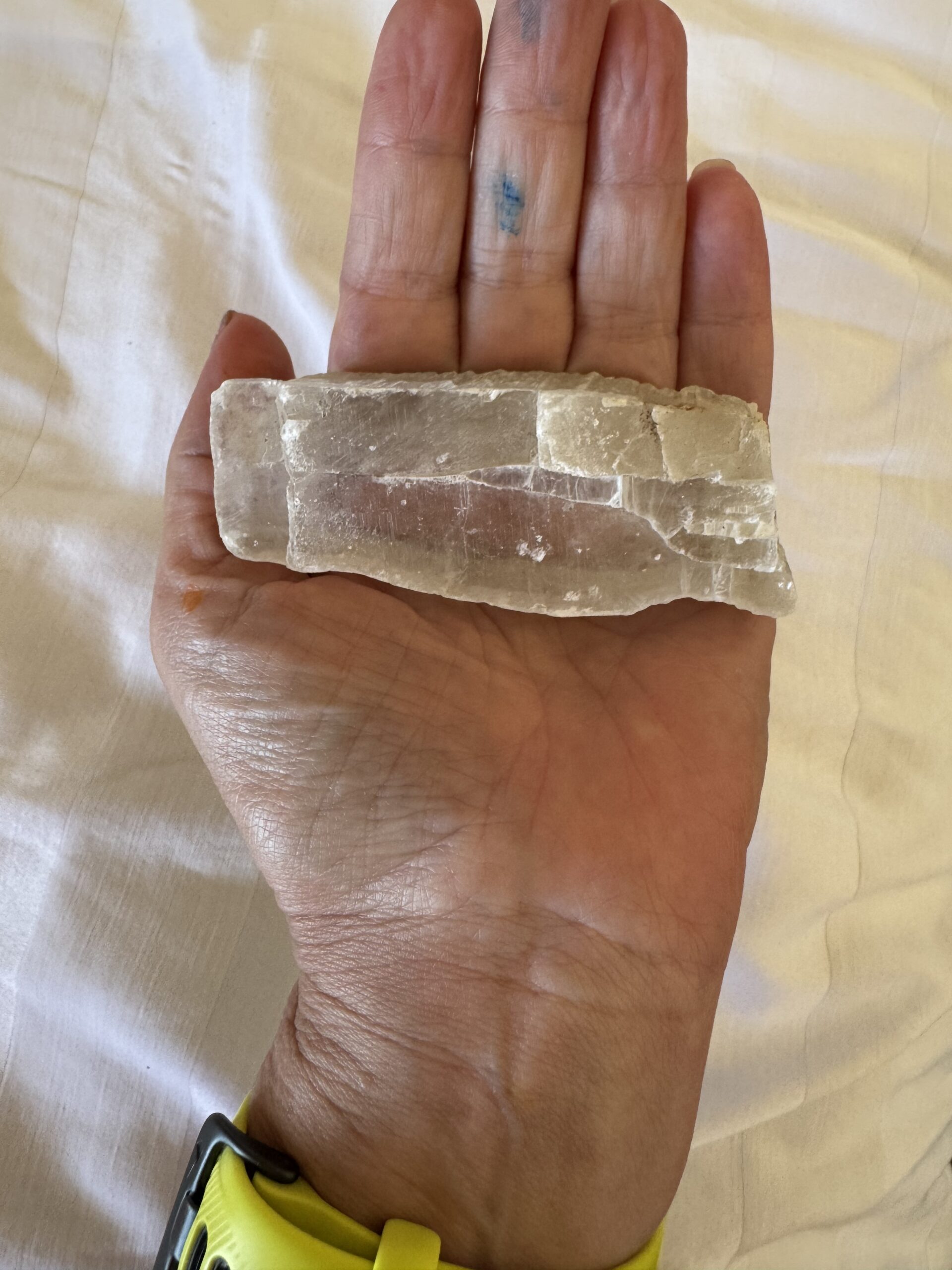
There was a rock in Loreto that became my friend. I am aware of how that sounds. It was a low shelf of pale stone near the water where I sat each evening of my thirty days alone, and somewhere in the second week I stopped thinking of it as scenery and started thinking of it as a presence. It held the day’s heat into the dark. It had a worn place that fit my body. When I left it each night I found myself saying a quiet goodbye, and when I returned each evening something in me settled, the way it settles when you reach a person you trust. The rock had been there for ten thousand years before me, and it knew how to wait. I felt, sitting on it, that it was teaching me something about waiting too.
For most of my life I would have dismissed this as a lonely woman projecting feeling onto an inert object. Then I found that geography takes the liveliness of matter seriously, stone included, and that a whole field has formed around the idea that the nonhuman world acts upon us in ways we have been trained to overlook. This post is about listening to stone, and about why that phrase names something real, demanding, and finally a matter of justice.
The thinker who opened this door for many of us is the political theorist Jane Bennett, whose idea of vibrant matter (the proposal that physical matter is lively and active, with a capacity to affect the world, rather than being dead, passive stuff) reshaped how geographers regard the material world. Bennett (2010) argues that things we treat as inert, including metals and minerals, possess their own vitality and their own small powers, and that what we call agency arises from the interplay of many human and nonhuman forces rather than belonging to humans alone. Reading her, I understood that my rock was not a backdrop to my retreat. It was a participant in it.
Geographers took this conviction and tested it against the most stubbornly solid thing they could find, which is stone itself. Edensor (2011), studying the weathering and repair of a three-hundred-year-old church in Manchester, demonstrates that even building stone is mutable and continuously emergent, worked upon by water, frost, pollution, and time, so that the apparently fixed fabric of the church is forever changing through the agency of nonhuman forces (Edensor, 2011). His argument undid my assumption that solidity means stillness. The stone of that church, he shows, is an ongoing event rather than a finished fact, held in being only through constant relation and repair (Edensor, 2011). My rock, too, was an event in slow motion, not a thing.
Deep Time and the Constant Wobbling
What I felt on that warm shelf of stone, the sense of being in the presence of something vastly patient, has a name in this literature as well. Valtonen and Pullen (2021), writing about their bodily encounters with rocks across the world, describe stone as lively and agentic, holding the capacity to affect us, to stop us, to slow our hurried movements and invite us to sit and feel the ground (Valtonen & Pullen, 2021). They draw on the idea that what looks like permanence is really a constant wobbling, the slow, ceaseless geological movement that surpasses human perception because it unfolds across billions of years, so that the contrast between geological time and our own busy hours becomes almost unbearable to hold (Valtonen & Pullen, 2021).
Their most startling move reaches into the body, and it carries forward something I wrote in an earlier post in this series about the body as an ecosystem. Valtonen and Pullen (2021) remind us, through the deep history of mineralization that first made bone, that the human skeleton is itself a geological achievement, so that we might think of ourselves as creatures partly made of stone, with no clean separation of flesh from earth (Valtonen & Pullen, 2021). I sat on that rock in Loreto carrying a skeleton that was, in the longest view, kin to it. The geos was inside me as much as beneath me. Listening to stone, it turns out, is partly listening to myself.
What a Stone Can Do
The anthropologist Hugh Raffles offers the question that has stayed with me longest. Rather than asking what a stone is, he asks what a stone can do, and the asking changes everything. Raffles (2012) answers that a stone can endure and can change, can wound and can heal, can hold a person’s memories, and can serve, in its long silence, as a kind of teacher (Raffles, 2012). He found that swapping the nouns we pin on stones for verbs let the stones step out of their supposed deadness and into the light as active, protean things (Raffles, 2012).
This is exactly what my rock did. It endured, holding its place against the sea. It changed, warming and cooling with the day. It healed, in the plain sense that sitting on it each evening mended something in me. And it taught, without a word, the patience of a thing that measures time in epochs. Raffles gave me permission to take my own experience at face value. The rock was doing something. I was right to listen.
The Politics Underneath the Stone
I want to be careful here, because listening to stone can curdle into a gentle mysticism that ignores how the earth has been used as a weapon. Geographers have insisted on the harder edge. Griffiths (2025), writing on the colonisation of Palestine, develops the idea of the geos (the domain of the geological, the soil and rock and mineral, treated in Western thought as lifeless and therefore available for extraction). Drawing on the work of Kathryn Yusoff and others, he shows how the very category of nonlife has been used to render both land and certain human lives as inert, commodifiable, and expendable, so that geology and colonial violence have advanced together (Griffiths, 2025). Yusoff’s argument, which he builds upon, is that every account of a shared human geological age erases the Black and Indigenous death that extraction has always required (Griffiths, 2025).
This stops me, and it should. To treat stone as dead is not a metaphysical error alone. It has been a license for dispossession, the same logic that treats land as empty and peoples as obstacles. And I have to add a note of humility that my own position demands. The recognition that stone and land are alive and relational, which Western theory now presents as a discovery, is knowledge that Indigenous peoples have carried for millennia. As a settler scholar sitting on a rock by the Sea of Cortez, I am arriving late to something others have always known, and the honest posture is to listen rather than to claim. Listening to stone, done well, includes listening to who was already listening.
What the Rock Taught Me
So I have stopped apologizing for my friendship with a shelf of pale stone in Loreto. The geography gives me language for it, and more than language, a responsibility. Matter is lively. Stone acts, endures, and teaches. The earth is not the dead backdrop I was raised to see, and the habit of calling it dead has done real harm to land and to people alike. To listen to stone is to practise an attention that refuses the lie of inertness, the lie that anything, earthly or human, is mere material to be used and discarded.
On my last evening I sat on the rock for a long time and said goodbye properly. I pressed my hand to the worn place that fit my body and felt the day’s heat moving back out of the stone and into me, an exchange between two slow and patient things. The rock had waited ten thousand years and would wait ten thousand more, indifferent to my small visit and somehow generous within it. It taught me that I am not separate from the world, that my bones are its cousins, and that the practice of listening, to stone, to land, to one another, is the beginning of treating the living world as the living thing it has always been. I came home from the desert knowing how to wait a little better. A rock taught me that. I am still grateful.
References
Bennett, J. (2010). Vibrant matter: A political ecology of things. Duke University Press.
Edensor, T. (2011). Entangled agencies, material networks and repair in a building assemblage: The mutable stone of St Ann’s Church, Manchester. Transactions of the Institute of British Geographers, 36(2), 238–252. https://doi.org/10.1111/j.1475-5661.2010.00421.x
Griffiths, M. (2025). Geopower, geos and the colonisation of Palestine. Transactions of the Institute of British Geographers, 51(2), Article e70049. https://doi.org/10.1111/tran.70049
Raffles, H. (2012). Twenty-five years is a long time. Cultural Anthropology, 27(3), 526–534. https://doi.org/10.1111/j.1548-1360.2012.01158.x
Valtonen, A., & Pullen, A. (2021). Writing with rocks. Gender, Work & Organization, 28(2), 506–522. https://doi.org/10.1111/gwao.12579
🔍 Verified References The citations in this post have been verified against CrossRef DOI records. View the verified reference list with notes for this post.
Las piedras hablan. The stones speak. A bilingual scholarly reflection on trauma, alonetude, and what it means to learn through geological time beside the shore of Loreto, Baja California Sur.
Reading Time: 8minutes
Las piedras no tienen prisa. Tampoco el dolor. Stones know no hurry. Neither is grief.
A Bilingual Scholarly Reflection on Geological Time, Trauma, and Alonetude
Las piedras hablan / The Stones Speak
I have been collecting stones since my first walk along this shore.
Gathering without purpose. Without cataloguing or arranging. Simply bending down, picking something up, turning it over in my palm, feeling its weight, its smoothness, its particular refusal to be hurried. Some I carry back to my room. Some I return to the water. Most I hold for a moment and set back down exactly where I found them.
This practice arrived unexpectedly. But here I am, two weeks into thirty days beside the Sea of Cortez, and the stones are teaching me something available through no other path.
Las piedras hablan. Pero no con palabras.
The stones speak. In a language beyond words.
Tiempo profundo / Deep Time
The stones on this shore are old in a way that rearranges something in the mind.
Geologists use the term deep time to describe the vast timescale of Earth’s history, a scale so large that human life occupies only a tiny fraction of it. The volcanic stone of the Sierra de la Giganta, rising at the edge of this bay, formed over millions of years. What I am holding in my hand has been shaped by water, wind, and heat across timescales I cannot fully imagine. And yet here it is. Smooth. Patient. Present.
Geographer Yi-Fu Tuan (1977) writes about the relationship between place and time, arguing that our sense of place deepens with duration, that the body learns a place slowly, through repeated contact and accumulating familiarity. The shore is teaching me this. Each morning, I walk the same stretch of beach, and it is never quite the same beach. The tide has rearranged it. The light falls differently. A stone I noticed yesterday has been turned over by water, offering me a different face.
El lugar me enseña paciencia. / The place teaches me patience.
This feels important. I have spent nineteen years in precarious employment, living inside what Rob Nixon (2011) calls slow violence: harm that unfolds gradually, accumulating across time without announcement. Slow violence has its own temporal logic. It teaches the body urgency. It teaches the nervous system that time is always running out, that the next contract may fail to arrive, and that rest is a risk. The body learns to treat duration as a threat.
The stones are teaching the opposite. They are evidence that time can accumulate as beauty rather than damage. That something can be shaped by forces larger than itself and emerge refined rather than broken.
I have been thinking about what stones and bodies have in common.
Both are shaped by what they have been through. Both carry the evidence of their history on their surfaces and in their structures. A stone makes no decision toward smoothness. Smoothness is what the water makes of it, over time, through persistent contact. And a body makes no decision to brace. Bracing is what survival is made of, over the years, through persistent exposure to uncertainty.
Resmaa Menakem (2017) writes that trauma is stored in the body rather than only in the mind, passed between generations through nervous system inheritance. What the body learned to survive, it continues to enact, even when the original threat has passed. The stone cannot stop being smooth simply because the water has receded. And for a long time, stopping the bracing was beyond my reach simply because the contracts had stopped.
El trauma vive en el cuerpo. La curación también.
Trauma lives in the body. So does healing.
Bessel van der Kolk (2014) describes how the body keeps its own score, maintaining a somatic record of experiences the conscious mind may have rationalized or set aside. Healing extends beyond intellectual understanding of what happened. It is to give the body new experiences that gradually teach the nervous system a different story. New evidence. Repeated contact with safety. The slow accumulation of something other than harm.
Holding a stone, I notice something release in my shoulders.
Gaston Bachelard (1969) argues that we think with our hands as much as with our minds, that the imagination is deeply material rather than purely visual or verbal, rooted in touch, weight, and texture. There is a kind of knowing that arrives only through the hands. Picking up a stone, I feel it rather than think about it, receiving what it has to offer through the sensory channels that precede language.
There is a kind of thinking that happens only in the hands. The stone offers no argument. It simply offers itself, and the body receives it.
The practice of picking up stones is a practice of alonetude.
Alonetude, as I am developing it, differs from both loneliness and the performed solitude of the retreat or the meditation app. It is a quality of presence, a willingness to be fully here with what is here, without an audience, without a purpose beyond the presence itself. It is the opposite of the hypervigilance that precarious labour instilled in me, the constant scanning, the waiting for the next demand, the inability to fully arrive in any moment because the next moment always carries a threat.
Estar sola, completamente presente. / To be alone, completely present.
When I pick up a stone, my full attention belongs to the stone. The stone requires my full attention, because presence itself requires it; once is simply what the encounter asks. I turn it over. I feel its weight shift. I notice the colour change where my warm hand has touched it. For these seconds, the sessional instructor waits for a contract to fall away. The researcher is anxious about the output falling away. I am a body in relation to a stone, and the stone is indifferent to all the rest.
This indifference is, strangely, a relief.
Philosopher Martin Buber (1970) distinguishes between I-Thou and I-It relationships, where genuine encounter requires full presence and mutuality. Most of my institutional life has been I-It: instrumental, transactional, surveilled. The stone cannot evaluate my performance. It cannot renew or decline to renew my contract. Its indifference holds no unkindness. It is entirely outside the economy of institutional assessment, and in that outside-ness, I find something I had almost forgotten how to feel.
La piedra no me juzga. / La piedra no me juzga. The stone withholds all judgment.
I know this intellectually, in the way geologists know it: that the smoothness of a river stone records the duration and force of the water that shaped it, that the colour of volcanic rock carries information about the temperature at which it formed, that the weight in my hand is a compressed record of pressures and processes that unfolded across scales of time I cannot inhabit.
But I also know it in another way. The way the body knows things.
Menakem (2017) writes about the concept of the somatic narrative: the story the body tells through tension, posture, gesture, and breath. The body’s story lives beyond words. It is told in holding patterns, in the places breath has learned to avoid, in the flinch that arrives before the threat is even named. To heal is to learn to read this narrative, to listen to what the body has been trying to say.
The stones, in their patient silence, are teaching me to practise this listening.
Clark Moustakas (1961) writes about loneliness as an inescapable dimension of human experience, one that contains within it the possibility of deep self-knowledge. Genuine solitude, for Moustakas, transcends the absence of others: it is the presence of oneself, a turning toward rather than a turning away. Picking up stones alone on a shore in Mexico, I am practising this turning. Meeting myself in the quiet that forms between me and the geological world.
Las historias de vida de las piedras son también las mías.
I have been choosing them carefully over the past two weeks. Neither the most beautiful nor the most dramatic. Three ordinary stones that fit together in my hand, that have become familiar to me through repeated handling, that carry now the warmth of my attention.
Robert Levine (2010) writes about the body’s capacity to complete interrupted experiences, the way trauma keeps a process alive that was never allowed to finish. Healing, in this framing, is completion: returning to something left unfinished and allowing it to resolve. I think of the past nineteen years as an interrupted experience. A process that never reached resolution because the conditions for resolution, security, time, witness, and safety, were never present.
These thirty days are the beginning of completion.
The stones will come with me as witnesses. Evidence that I was here. That something in me held still long enough to be shaped by something other than urgency. That the body can learn, slowly, the way stone is learned by water: through patient and repeated contact with what is real.
Estas piedras son testigos. / These stones are witnesses.
References
Bachelard, G. (1969). The poetics of space (M. Jolas, Trans.). Beacon Press. (Original work published 1958)
Buber, M. (1970). I and Thou (W. Kaufmann, Trans.). Charles Scribner’s Sons. (Original work published 1923)
Levine, P. (2010). In an unspoken voice: How the body releases trauma and restores goodness. North Atlantic Books.
Menakem, R. (2017). My grandmother’s hands: Racialized trauma and the pathway to mending our hearts and bodies. Central Recovery Press.
Moustakas, C. (1961). Loneliness. Prentice-Hall.
Nixon, R. (2011). Slow violence and the environmentalism of the poor. Harvard University Press.
Tuan, Y-F. (1977). Space and place: The perspective of experience. University of Minnesota Press.
van der Kolk, B. A. (2014). The body keeps the score: Brain, mind, and body in the healing of trauma. Viking.
Academic Lens
This reflection engages what Richardson and St. Pierre (2005) describe as the essential function of Scholarly Personal Narrative: using the first-person account as a site of rigorous inquiry, where the researcher’s lived experience becomes both data and analysis. The stones function here as what Tuan (1977) calls place objects: material things that anchor us to a place and through that anchoring, to ourselves. The somatic learning described is aligned with Menakem's (2017) argument that healing must reach the body level beyond the cognitive, and with Bachelard's (1969) phenomenology of material imagination, the insight that we think with the substances of the world, and that stone in the hand is already a kind of knowing.
Translation note. Spanish language passages were generated using Google Translate and subsequently reviewed and refined by the author. Any remaining infelicities reflect the limits of machine translation rather than intent.
For a full list of all sources cited throughout this project, see the References page.