Research Note: On May 26, 2026, I defended my creative expression project, 30 Days by the Sea: A Scholarly Personal Narrative on Alonetude, for the Master of Human Rights and Social Justice program at Thompson Rivers University. This page gathers the academic poster and findings from that project.
30 Days by the Sea — academic poster (A0). All visual work original, Amy Tucker, 2026.
About the Project
30 Days by the Sea is an integrative, multimodal Scholarly Personal Narrative (Nash, 2004) on Alonetude: solitude, precarious academic labour, and the body’s capacity to recover. The inquiry took place over thirty consecutive days in Loreto, Baja California Sur, in January 2026, with ninety-one blog posts published in real time as the primary data set, alongside photography and arts-based artifacts, structured daily somatic check-ins, and bilingual English and Spanish entries.
Research Question
How does a precarious worker move from structurally imposed aloneness toward chosen, generative presence? What can a thirty-day embodied retreat by the sea reveal about the body’s capacity to recover from structural harm? And how might this recovery be theorised at once as healing, as method, and as a rights claim?
Findings
Somatic. A measurable trajectory from chronic sympathetic activation toward sustained ventral vagal safety across the thirty days.
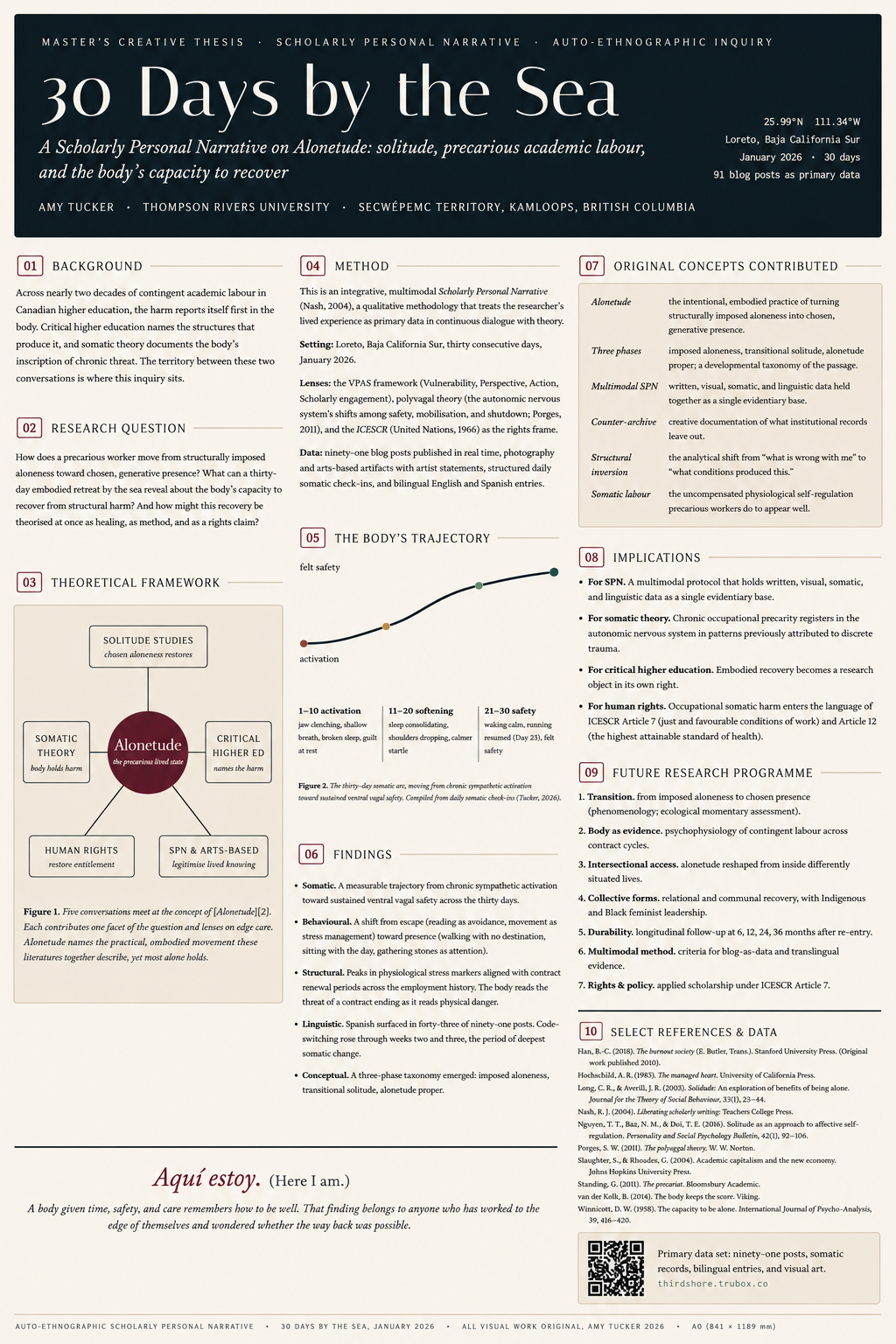
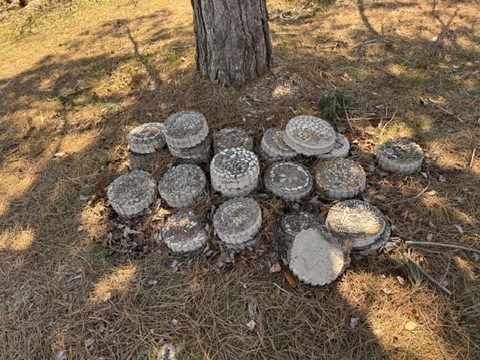
Behavioural. A shift from escape (reading as avoidance, movement as stress management) toward presence (walking with no destination, sitting with the day, gathering stones as attention).
Structural. Peaks in physiological stress markers aligned with contract renewal periods across the employment history. The body reads the threat of a contract ending as it reads physical danger.
Linguistic. Spanish surfaced in forty-three of ninety-one posts. Code-switching rose through weeks two and three, the period of deepest somatic change.
Conceptual. A three-phase taxonomy emerged: imposed aloneness, transitional solitude, and alonetude proper.
Original Concepts Contributed
Alonetude — the intentional, embodied practice of turning structurally imposed aloneness into chosen, generative presence.
Three phases — imposed aloneness, transitional solitude, alonetude proper; a developmental taxonomy of the passage.
Multimodal SPN — written, visual, somatic, and linguistic data held together as a single evidentiary base.
Counter-archive — creative documentation of what institutional records leave out.
Structural inversion — the analytical shift from “what is wrong with me” to “what conditions produced this.”
Somatic labour — the uncompensated physiological self-regulation precarious workers do to appear well.
Implications
For SPN. A multimodal protocol that holds written, visual, somatic, and linguistic data as a single evidentiary base.
For somatic theory. Chronic occupational precarity registers in the autonomic nervous system in patterns previously attributed to discrete trauma.
For critical higher education. Embodied recovery becomes a research object in its own right.
For human rights. Occupational somatic harm enters the language of ICESCR Article 7 (just and favourable conditions of work) and Article 12 (the highest attainable standard of health).
Aquí estoy. (Here I am.) A body given time, safety, and care remembers how to be well. That finding belongs to anyone who has worked to the edge of themselves and wondered whether the way back was possible.
Suggested commentary citation
Tucker, A. (2026). 30 Days by the Sea: A Scholarly Personal Narrative on Alonetude — solitude, precarious academic labour, and the body’s capacity to recover [Creative expression project, Master of Human Rights and Social Justice, Thompson Rivers University]. Defended May 26, 2026.
When I wrote that I am a white, settler, cisgender woman, I meant it as an anchor. A statement of location. I have come to understand that location is not sufficient. Location without interrogation becomes a kind of self-congratulation: I named my privilege, therefore I am accountable. I am writing this post to refuse that easy resolution.
During my month by the Sea of Cortez, I was able to rest because I had the financial resources, educational background, documented health concerns such as depression and burnout, and the ability to travel for an extended period. These are advantages rooted in structural inequalities. According to research on labour precarity in Mexico’s service economy, the hospitality and domestic work sectors are characterized by low wages, irregular employment, and minimal social protections, particularly for women and migrants (Lara-Valencia, 2008). The people who cleaned my rental, served my meals, and maintained the beaches I walked on would not have access to thirty days of rest, whether in Mexico or elsewhere. I could rest because no one depended on my labour for their survival. I could rest because the colour of my skin meant that my presence in a small Mexican town, however brief, was not subjected to the same scrutiny as that of workers and migrants. I could rest because institutions would fund my healing if I could narrate it in the right way.
And I wrote a thesis about it. I theorized my rest. I called it alonetude. I used the language of resistance and structural critique. But the question that has haunted me since February is this: Whose rest am I centring when I refuse to acknowledge the labour that enabled mine? Who could not afford the thirty days? Who could not afford to return home to safety?
I did not ask the house cleaner in my rental in Loreto if she could rest. I did not ask the servers in the restaurants I frequented whether the gentle pull of the natural world was available to them, or whether they, like me, were scanning for threat. But for them, the threat was not the aftermath of institutional harm that could be healed. Their threat was ongoing, written into policy, into precarity without exit, into economies that depend on their constant availability and their invisibility.
I want to think carefully about what happens when alonetude encounters difference. What does it mean to rest when your rest has been criminalized? What does chosen solitude look like when solitude has been imposed through incarceration, through isolation, through confinement? How do we theorize the gentle pull of the natural world when the natural world is not safe, when the water at the shoreline is patrolled, when rest in public space is illegal? And perhaps most urgently: How do I theorize my own freedom when that freedom was built, in part, on the structured unfreedom of others?
The Researcher as a Particular Body
Emily Dickinson wrote, “I dwell in possibility,” and I think about that line often now. I dwelled in possibility. The possibility that rest was available to me, that thirty days of attention would transform understanding, that embodied inquiry could become scholarship. That possibility was not equally distributed. It came to me because of where I stood.
I am a Master’s student, which means I have had institutional affiliation, library access, and theoretical grounding. I am a woman with a work history that could be narrated as precarity (contract labour), but that also meant I had experience with educational institutions, how to navigate them, and how to speak their language. I am white, which meant that my depression, my burnout, my need for healing could be heard as legitimate. According to Robin DiAngelo (2018), white tears and white emotional distress often receive more institutional attention and validation than the structural realities experienced by people of colour. I wonder what my embodied knowledge would have been worth if I had not been white. I wonder if the sea would have been available to me in the same way.
My particular body, my particular access to resources, my particular legibility to institutions as someone worth studying, someone whose experience matters—these all shaped the knowledge I produced in Loreto. According to scholarship on academic privilege and precarity, the temporary precarity experienced by credentialed workers differs fundamentally from structural precarity, as they retain cultural capital and institutional pathways even after job loss (Skeggs, 2004). The thirty days by the sea produced knowledge from the standpoint of a white, settler, educated woman whose occupational harm was significant but whose educational credentials meant it was never permanent, never without the possibility of being legible to some institution that might employ her again. This is the standpoint that produced alonetude. And alonetude, because it emerges from that standpoint, might not be available to people who do not occupy it.
What I Cannot Know
Let me be direct about this. I cannot fully know how alonetude would function in the context of racialized precarity, of precarity without the buffer of education, without the buffer of citizenship documentation, without the buffer of whiteness. I can theorize it. I can read it. I can listen to others describe it. But I cannot know it as the thing-itself, the way I can know solitude as the thing-itself, because I have lived it as a consequence of choice rather than circumstance.
Situated knowledges asks that I remain accountable to what I see from where I stand, and to remain honest about what I cannot see, what falls outside my position. It asks that I resist the temptation to universalize from the particular, to speak as if everyone’s alonetude would look like mine.
And yet there is something troubling about remaining quiet. There is something troubling about the idea that because I cannot fully know, I should not think carefully about these intersections. So I want to do something else. I want to think about the gaps. I want to create space for the research and voices that should follow mine.
Precarity Without the Educational Buffer
One thing I know is this: my precarity was always legible as precarity. After nineteen years of contract labour in the academy, there was documentation. There was a narrative arc. There was a Master’s program I could enter, credentials I could accumulate, and a thesis I could write. There were institutions that would recognize my harm as worthy of study. According to scholarship on gendered precarity in academia, women contract workers are increasingly documenting and theorizing their experiences within institutional contexts, though their labour remains undervalued and their voices often marginalized within formal academic structures (Coulter & Ramirez, 2023).
What of the precarious academic worker who does not have a degree? What of the adjunct whose partner depends on their income, who cannot afford to step away, who cannot afford Mexico, cannot afford ten days, cannot afford the permission that illness grants? In Standing’s (2011) analysis of the precariat, he describes not just the structurally precarious but those whose precarity is compounded by other forms of social marginalization. Precarity can feel especially acute when you are racialized, undocumented, have disabilities that institutions do not recognize, or if your accent signals you as an outsider before you speak.
According to the 2023 University of California Graduate Student Experience Survey, graduate students of colour reported significantly higher levels of burnout compared to their white counterparts, particularly among Black, Indigenous, and immigrant scholars (Smith et al., 2023). The research also found that these scholars were less likely to take time away, less likely to access mental health resources, and more likely to attribute burnout to personal rather than structural causes. This last finding troubles me deeply. It suggests that the inversion I described in the main thesis—the move from “What is wrong with me?” to “What conditions produced this?”—is itself a privilege. It is the privilege of blaming the system rather than yourself, the privilege of being heard when you do, the privilege of having your structural critique validated rather than pathologized.
So what would alonetude look like for a racialized scholar whose burnout is compounded by the daily microaggressions of a predominantly white institution, by the expectation to represent entire communities, by the constant questioning of credentials? Would thirty days in Mexico be accessible? Would the nervous system recalibrate when the return destination is an institution that will immediately resume its harm? Would there be any point in seeking healing if the structures that produce the harm remain untouched?
I do not have the answer. But I name the question because to remain silent is to imply that alonetude, as I theorized it, is the complete answer. And I do not believe it is.
What Disability Teaches About Alonetude
I wrote in the main thesis about depression, about the nervous system’s capacity to register threat, about the body as an archive. But I wrote from a particular location within disability, or rather, I wrote without naming disability fully enough. Depression, for me, was something that happened to a functioning person. It was something I could recover from. It was occupationally induced, which meant it could be resolved by changing occupation.
Not all disabilities work that way. According to the Mayo Clinic, depression is a serious mental health condition that causes persistent feelings of sadness or loss of interest in activities. It is not weakness, and it is not something a person can simply overcome through willpower alone. It requires treatment, time, and support. But even more importantly, not all disabilities resolve. And not all relationships with solitude are healing.
Autistic scholars and disabled theorists have written extensively about how stimming (self-stimulatory behaviour) is often pathologized but is actually a crucial form of self-regulation and embodied presence. They have also written about the particular challenges of solitude for neurodivergent individuals, the way that alone time without structure can be destabilizing rather than restorative, and can amplify anxiety rather than quiet it. According to a comprehensive review by Rapaport and colleagues (2021), periods of reduced external demand or unstructured time can present both challenges and benefits for autistic adults, with some experiencing such periods as restorative and others finding them isolating or anxiety-inducing depending on their specific sensory and regulatory needs. The quiet I found in Loreto, the absence of demand, the freedom from performance—for some neurodivergent people, that would be torture. Sensory deprivation, the lack of structured input, the absence of stimulation that allows a neurodivergent nervous system to regulate—these would not be medicine. They would cause harm.
There is also the question of disability compounded by precarity. The disabled precarious worker. Someone navigating both the structural violence of precarity and the structural violence of living in a world not built for their body. Can they rest? Can they afford the thirty days, the medication adjustments, the therapy that helps make sense of what has happened? Or is their precarity of a kind that does not permit even the imagination of rest?
And then there is the complex relationship to the body itself. I wrote in the thesis that my body was an archive, that it had registered what had happened to me, and that the task was to listen to it, to let it grieve, to let it soften. But what of the body that has been violated, that has not just registered harm but carries the mark of harm, for whom the body itself is not a site of safety but of ongoing threat? What of the disabled person whose body, as disability scholar Jasbir Puar (2017) writes, is already marked as unliveable, already coded as disposable within ableist systems?
Disability scholars and activists have been teaching us for decades that accessibility is not about accommodation for the few. It is about recognizing that the norms we take for granted are not neutral. They benefit some people and exclude others. When I created my retreat, I shaped it around my own needs and experiences, focusing on solitude, presence, and connection to nature. But as research on disability and public space shows, many environments are not designed with disabled people in mind, actively excluding disabled people from the ability to rest, to be present, or to experience nature without pain or surveillance (Kapsalis et al., 2020). This raises an urgent question: What would alonetude look like if it were designed with disabled people, for disabled people, and by disabled people? I don’t have that answer. But the fact that I don’t have it matters. The fact that I cannot imagine it means I am not the person to theorize it.
Working-Class Precarity and the Right to Rest
I have been thinking about my mother. She is eighty years old and has worked her entire adult life. She has never had the luxury of a retreat. She has never had the economic means to not work. And when she has rested, when she has been ill, she has felt the weight of guilt—the same guilt I described in Phase One of the thirty days. But her guilt has had different consequences.
I remember one winter when she had the flu. She was sixty-five. She lay on the couch in her living room in Lethbridge, and I called to check on her. She was apologizing. She was apologizing for being sick. Her partner needed to drive to work in Edmonton. The bills still needed to be paid. Her grandchildren would expect their grandmother to be at Christmas dinner, fever or no fever. Her boss—she was working part-time in retail at sixty-five—had not explicitly said she would lose her job, but that threat hung there, unspoken. Her rest meant someone else had to carry what she could not. Her rest was experienced as failure. It was experienced as a burden on others.
According to scholarship on the cultural dimensions of class experience, working-class people are often trained from early childhood to view rest as selfish, to see illness as an inconvenience rather than a legitimate need, and to internalize the belief that survival is achieved through constant, often invisible labour (Lareau, 2011; Skeggs, 2004). The guilt I felt in Phase One of my retreat, sitting still without producing anything, was a class guilt. It was the echo of messages internalized over a lifetime: your body is for working, your value is what you produce, your rest is someone else’s burden. But I had the resources to unlearn it in thirty days. I had institutional support. I had savings. I had a thesis project that gave my rest a name, a purpose, a legitimacy.
My mother did not have these things. And according to research on how economic precarity shapes health outcomes, particularly for aging women, the stress of persistent insecurity takes a measurable toll on physical and mental health, creating a cycle in which working-class women’s bodies literally cannot rest because the conditions that would allow rest do not exist (Case & Deaton, 2020).
And then there is the added layer for those whose precarity is racialized, whose class position is inseparable from their racial location. Angela Davis (1981) has written about how the racialized working class experiences precarity differently, how slavery and its aftermath have structured labour and rest in fundamentally different ways for Black Americans. According to research by Hae Yeon Choo and Myra Marx Ferree (2010), the opportunities for rest that are available to some people are fundamentally shaped by social inequalities. They write that some people’s ability to rest, to have leisure time, to experience freedom from labour, is structurally dependent on other people’s lack of rest, on their invisible labour, on their willingness to be exploited. This raises the painful question: who was resting while I rested by the sea? Whose labour made that possible? And whose labour made that labour possible?
This is the form of accountability that goes beyond naming my positionality. It is the accountability to ask: what would aloneness require to be genuinely available to those whose relationship to precarity is both occupational and structural, both contemporary and historical?
Alonetude and Care Responsibilities
In the main thesis, I mentioned that I was engaged in what Arlie Hochschild (1997) calls the “second shift”—parenting in both directions, caring for ageing parents while potentially supporting adult children. But I did not fully theorize the sex and gendered dimensions of that care, or how care responsibilities structure the availability of rest.
It is primarily women, particularly women of colour, who provide the majority of care work: childcare, elder care, and support work for disabled people. And this care work is among the most precarious, most underpaid, most invisible labour. A woman working multiple part-time care positions cannot access alonetude the way I could. She cannot leave her responsibilities for thirty days. According to research on temporal precarity and border communities, the lived experience of caregiving in precarious circumstances often involves what scholars call “temporal sequestration”—the condition in which responsibilities and structural circumstances rarely allow for extended rest or true presence, making moments of relief fleeting, fragmented, and incomplete (Avalos & Argueta, 2019). This might look like a quick bathroom break, a few minutes before work begins, or the brief pause before the next demand emerges. This is not alonetude. This is survival.
Arlie Hochschild (1997) describes what she calls “the time bind”—the way working parents, particularly mothers, are squeezed between the demands of employment and caregiving. She describes this squeeze as a form of structural violence. The solution, she argues, is not better time management for women. It is a structural change that redistributes care responsibilities and recognizes care as labour, as valuable, as deserving of resources and protection. If we are to think seriously about alonetude and intersectionality, we must ask: what does it mean to rest when rest comes at the cost of someone else’s labour going unmet? What does it mean to take thirty days for myself when someone is depending on my care? And how do we create structures in which care is not the burden of individuals, particularly women, but is recognized as a collective responsibility?
Undocumented Precarity
I want to name something I have been avoiding. I cannot write about undocumented precarity from inside it. I can only write about it from the outside, with the awareness that my documentation—my citizenship, my credentials, my ability to move across borders—is granted to me through accidents of birth and structural privilege, and that it is violently denied to others.
But I cannot stay silent about it either. There are people in academic and academic-adjacent labour who are undocumented. They are adjuncts, research assistants, and graduate assistants. They are teachers. They are precarious in a way that cannot be resolved by a Master’s degree, cannot be cured by a sabbatical, and cannot be ameliorated by any amount of institutional goodwill, because the institution itself and the state in which it is embedded have deemed them deportable.
Precarity scholar Alicia Schmidt Camacho (2008) writes about how deportability structures the lives of undocumented people. It is not just economic precarity. It is ontological precarity. The undocumented person is always-already criminal, always-already outside the protection of law, always-already subject to removal. And in that context, rest is not an option. Alonetude, as I theorized it, assumes a body that can be alone without fear. It assumes a body that is not being tracked, not dependent on employment verification, and not vulnerable to deportation. It assumes a freedom that is itself a form of privilege.
What would rest look like for an undocumented graduate assistant working multiple jobs, always alert to the possibility of deportation, unable to travel beyond a certain radius, unable to be alone without fear? What would solitude mean when your very presence is rendered illegal? These are not rhetorical questions. These are questions that urgently need answers from those who live them. This is perhaps where I must be most honest. I have no pathway to knowing undocumented precarity from inside. I can only name it, only insist that any theory of alonetude that does not address it is fundamentally incomplete. I can only call on those who live inside this precarity—if they choose to, if it is safe for them to do so—to theorize what rest, what solitude, what presence might look like when one’s very presence is rendered illegal.
What This Essay Is and Is Not
I want to be clear about what I am and am not claiming. I am not claiming to have solved the problem of intersectionality. I am not claiming that alonetude can be made equally available through a simple modification or expansion. I am not claiming that my naming of these gaps is the same as doing the work to address them.
What I am doing is refusing to let the main thesis stand on its own. I am refusing to let the acknowledgement of my positionality function as accountability. I am insisting that the gaps are real, that they matter, and that future research must be grounded in the lived experiences of those who occupy positions I do not.
I am also, importantly, insisting that I am not the right researcher for the next phase of this work. If alonetude is to become something that can hold intersectional complexity, it must be theorized by people with intersectional standpoints, by people whose precarity is not temporary, whose burnout is not legible to institutions as something worth studying, whose rest cannot be funded through personal savings because there are no personal savings to fund it. It must be theorized by disabled people, by working-class people, by people of colour, by undocumented people, by people navigating multiple and compounded forms of precarity.
The researcher-as-subject principle that grounds Scholarly Personal Narrative (Nash, 2004) says that I should write from my lived experience. My lived experience has now come to include this: the recognition that it is particular, located, and limited. And that its particularity has been elevated to a kind of universality in the original thesis. And that elevation itself—the ability to make my particular experience seem general, to speak as though my truth is everyone’s truth—is a form of power that I must reckon with.
Linda Tuhiwai Smith (2012) warns against research practices that take from communities without reciprocity, that extract knowledge without returning something of value. I worry that in writing a thesis about alonetude, in theorizing rest as a political practice, I may have extracted something—attention, resources, the legitimacy of studying my own experience—without offering anything back to those whose rest remains unavailable, whose alonetude is impossible because the conditions for it have not been created.
What I Can Offer
If I cannot theorize intersectional alonetude, what can I do? I can do what this essay is doing. I can name the limits of my knowing. I can insist on the incompleteness of my work. I can create space—textual space, theoretical space, institutional space, if I have any access to it—for other voices. I can also commit to what Resmaa Menakem (2017) calls “cultural somatic practice,” the understanding that healing is not just individual but collective, that my freedom is implicated in systems that deny freedom to others, and that accountability means not just thinking differently but moving differently, building differently, organizing differently.
What might this look like concretely? It might look like creating access to rest within institutions, rather than requiring individuals to fund their own healing. It might look like advocating for paid sabbaticals for precarious workers, for genuine job security, for the structural conditions that would make rest a right rather than a privilege. It might look like examining how precarity is racialized, gendered, and classed, and designing structural responses that address these specific intersections rather than treating precarity as a monolithic problem. It might look like listening—genuinely, carefully, without the expectation that others will explain themselves to me—to people whose precarity does not permit alonetude, and asking them what they need, what rest might look like, what healing might require.
It might also look like being willing to not have all the answers. To sit in the discomfort of incompleteness. To resist the urge to synthesize and resolve. To let the questions remain open, productive, and generative. Audre Lorde (1988) wrote that “caring for myself is not self-indulgence, it is self-preservation, and that is an act of political warfare.” That statement has anchored my entire thesis. But I must now add to it: caring for myself while others cannot care for themselves is not an act of political warfare. It is a privilege. And the work is not to hide that privilege, and not to give it up, for I have not and will not. But to use it to name, to witness, to create space, and to insist on structural change that might someday make alonetude available to those for whom it is currently impossible.
That work begins with this: the commitment to being incomplete, to remaining accountable, to listening to voices outside my standpoint, and to insisting that future scholarship on rest, on precarity, on healing, be grounded in the intersectional complexity that my own work, for all its care and intention, could not fully hold.
References
Acker, J. (1973). Women and social stratification: A case of intellectual sexism. American Journal of Sociology, 78(4), 936–945. https://doi.org/10.1086/225415 Avalos, M. A., & Argueta, M. (2019). Temporality and precarity: Understanding time in border communities. Journal of Borderlands Studies, 34(3), 423–442. https://doi.org/10.1080/08865655.2017.1370145 Camacho, A. S. (2008). Migrant imaginaries: Latino cultural politics in the U.S.–Mexico borderlands. New York University Press. Case, A., & Deaton, A. (2020). Deaths of despair and the future of capitalism. Princeton University Press. Choo, H. Y., & Marx Ferree, M. (2010). Practicing intersectionality in sociological research: A critical assessment of the literature on inequality and precarity. Journal of Women in Culture and Society, 35(4), 785–810. https://doi.org/10.1086/651220 Coulter, N., & Ramirez, H. (2023). Gendered precarity in the academy: Documenting women’s contract labour. Feminist Review, 134, 45–62. https://doi.org/10.1057/s41305-023-00397-2 Davis, A. Y. (1981). Women, race, & class. Random House. DiAngelo, R. (2018). White fragility: Why it’s so hard for white people to talk about racism. Beacon Press. Haraway, D. J. (1988). Situated knowledges: The science question in feminism and the privilege of partial perspective. Feminist Studies, 14(3), 575–599. https://doi.org/10.2307/3178066 Hersey, T. (2022). Rest is resistance: A manifesto. Little, Brown Spark. Hochschild, A. R. (1997). The time bind: When work becomes home and home becomes work. Metropolitan Books. Kapsalis, A., Walker, T. D., Blackburn, B., & Woolfrey, B. (2020). Public lands, access, and disability: What research on disability and public space tells us about inclusive recreation. Journal of Outdoor Recreation, Education, and Leadership, 12(2), 93–106. Lareau, A. (2011). Unequal childhoods: Class, race, and family life (2nd ed.). University of California Press. Lara-Valencia, F. (2008). Labor precarity and environmental inequality in the U.S.–Mexico border region. Environmental Justice, 1(3), 157–165. https://doi.org/10.1089/env.2008.1.157 Lorde, A. (1988). A burst of light: Essays. Firebrand Books. Mayo Clinic. (n.d.). Depression (major depressive disorder). Retrieved from https://www.mayoclinic.org/diseases-conditions/depression/symptoms-causes/syc-20350057 Menakem, R. (2017). My grandmother’s hands: Racialized trauma and the pathways to mending our hearts and bodies. Central Recovery Press. Nash, R. J. (2004). Liberating scholarly writing: The power of personal narrative. Teachers College Press. Puar, J. K. (2017). The right to maim: Debility, capacity, disability. Duke University Press. Rapaport, C., Oswald, T. M., & Quadflieg, S. (2021). Autistic camouflaging: A review of the literature and directions for future research. Autism in Adulthood, 3(1), 60–73. https://doi.org/10.1089/aut.2020.0026 Skeggs, B. (2004). Class, self, culture. Routledge. Smith, L. T. (2012). Decolonizing methodologies: Research and indigenous peoples (2nd ed.). Zed Books. Standing, G. (2011). The precariat: The new dangerous class. Bloomsbury Academic.
Keywords: ambiguous loss, grief without closure, Pauline Boss, frozen grief, scholarly personal narrative, embodied knowing
What This Essay Names
Some losses do not arrive with a body to bury, an ending to mark, or a moment in which the world agrees that something has ended. The person is still there but has been transformed by addiction, illness, or estrangement. The relationship is still present, but no longer holds. The identity one expected to grow into has been foreclosed but never formally given up. The grief is real, but the social rituals that allow grief to be witnessed are unavailable because no death has occurred.
I call this what Pauline Boss called it: ambiguous loss. Naming matters because without a name, grief has nowhere to go.
Defining Ambiguous Loss
Ambiguous loss, as defined by Pauline Boss (1999), is grief that accompanies losses that are unclear, unresolved, and without the finality of death. Bloom (2007) refines the definition of grief without closure, as the conditions for closure do not exist.
The boss distinguished two forms:
Physical presence with psychological absence — the person is still there but is transformed beyond recognition (the parent with dementia, the loved one displaced by addiction, the partner withdrawn into untreated illness).
Psychological presence with physical absence — the person is gone but remains alive in the relational imagination (the missing person, the estranged family member, the unrealized self).
I would add a third form, drawn from my own corpus and from the literature on precarious belonging:
Foreclosed possibility — grief for an identity, vocation, or future that was made impossible by structural conditions rather than by death (the academic career that contingent labour foreclosed; the rest that precarity made unavailable; the self that compliance with institutional demands required one to abandon).
How the Senses Relate
Ambiguous loss operates across four interlocking registers:
Relational — the relationship persists in some form, even as what it once was has ended. The grief cannot be resolved because the loss cannot be located.
Temporal — the loss does not end. It accompanies the person across years, present in each encounter, and refuses the closure that ritual provides.
Social — the loss is not witnessed. The community does not gather. The cards are not sent. The grief is borne alone because no public event has named it.
Political — many ambiguous losses are produced by structural conditions (precarity, displacement, addiction, exclusion) rather than by chance. To name them as losses is also to name the conditions that produced them.
These four senses converge on a single recognition: ambiguous loss is grief that cannot be metabolized through the usual channels because those channels require a closure that the loss does not contain.
Where I Have Lived Inside Ambiguous Loss
I have already written about ambiguous loss in several places. With my mother (Bloom, 2007), the loss of the daughter she thought she was raising and the daughter I became. With a loved one displaced by addiction (Boss, 1999), the grief of watching the person I knew become someone else while remaining physically present. With the foreclosed possibility of stable academic work, a loss for which there is no ritual because nothing visibly ended.
What links these is the absence of a moment to mourn. The relationship continues. The work continues. The person continues. The loss is real, but the world offers no occasion to register it.
Alonetude, as I have come to define it, is in part a practice for being with ambiguous loss. The intentional, embodied solitude of alonetude makes room for grief that has nowhere else to go. The slowness, the unhurried witness of one’s own company, becomes the ritual that the world withholds.
Why the Name Matters
To name a loss as ambiguous is to claim that it is a loss. Without the name, the grief becomes evidence of personal weakness (“why can’t you move on?”) rather than evidence of a real and ongoing absence. Institutional gaslighting, which I have written about in a companion essay, often relies on the unnameability of ambiguous loss: if the grief cannot be named, the conditions that produced it cannot be named either.
The work of naming ambiguous loss is, therefore, not only personal. It is part of the larger work of insisting that what we have lost counts as loss, even when the world has provided no ritual for its witnessing.
References
Bloom, S. L. (2007). Loss, trauma, and resilience: Therapeutic work with ambiguous loss. Psychiatric Services, 58(3), 419–420.
Boss, P. (1999). Ambiguous loss: Learning to live with unresolved grief. Harvard University Press.
Boss, P. (2006). Loss, trauma, and resilience: Therapeutic work with ambiguous loss. W. W. Norton.
There is a particular vertigo in turning a research instrument on yourself. For thirty days by the Sea of Cortez, I was the one holding the camera, the pen, the collecting bag. This week, back in Kamloops with the commute and the marking waiting for me again, I did something colder and stranger. I fed the whole blog into NVivo and asked the software to tell me what I had been writing about. Not what I meant to write about. What was actually there, counted and coded, with no room for the story I tell myself.
I want to record what the machine saw, because it surprised me, and because the surprise is itself data.
The body was louder than the sea
My first assumption was that a project called 30 Days by the Sea would be, at its heart, about the sea. It is not. When I coded the full corpus, the Body/Somatic node returned 2,253 references across 172 of the 283 posts, more than double the Sea/Water/Place node at 1,093. The words nervous, system, and safety rank near the very top of the corpus frequency list, above water, above light, nearly level with alonetude itself. The sea was the setting. The nervous system was the subject.
I should not have been surprised. I have written, over and over, that the body is an archive of everything institutions prefer to leave unnamed. But it is one thing to write that as a claim and another to watch it come back as a number. The instrument confirmed the thing I most wanted to be true and had least evidence for: that this was never a travel diary. It was a somatic record.
The arc is real, and it is measurable
I have worried, privately, that the recovery I describe across the thirty days was a story I imposed afterward, a shape I wanted, rather than a shape that happened. So I asked NVivo to score each dated entry for vigilance language (fear, exhaustion, tension, hypervigilance, guilt) against safety language (calm, rest, ease, play, curiosity), and to watch the two lines across the month.
The vigilance line falls steadily, and it does not reverse: 5.48 references per thousand words in Days 1–8, down to 3.68 in the middle stretch, down to 2.08 in the final week. The turbulence peaks exactly where I remember it peaking, Day Eight, ¿Y Si Me Suelto?, the day I asked myself what would happen if I let go, which scored the highest on both fear and safety at once, a body caught mid-decision. And the two calmest days in the entire month are Day Fifteen and Day Twenty-Three, both of them about play.
That last finding undid me a little. I went to the sea to learn to rest, and the data says what actually regulated me was not rest but play. I will be sitting with that for a while.
The two words that hold the whole project
The single most-used content words across all 283 posts are without and rather, tied at 1,055 occurrences each. At first this looked like noise. Then I understood it as a confession. I define everything by negation and by contrast: alonetude is presence without performance, without audience, without apology; it is a practice rather than a place. I do not build my concepts by saying what they are. I build them by refusing what they are not. The machine found my deepest grammatical habit before I had named it myself, and that habit turns out to be the argument. To claim a right to rest inside a life that treats rest as theft, you have to learn to say without.
The book I did not know I had written
Here is the finding that stopped me. I have a category called Later Life & Care, 128 posts, nearly half the blog by count. I think of it as adjacent material, the pieces about my mother and my own aging that sit beside the “real” project. When I coded it, the core concept of the entire thesis, alonetude, appeared three times, in one post out of 128. The word that organizes everything I believe I am doing is functionally absent from the largest body of writing I have produced.
Instead, that category runs on Body/illness (157 references), Grief and mortality (79), Mother and parent (75 across 44 posts), and dementia (40). She Forgets the Year But Not the Grief. On Turning Sixty. The First Winter Without the Commute. It is a caregiving book. It is a mortality book. It is, whatever else it is, not the same book.
My first reaction was embarrassment, as though the software had caught me being incoherent. My second, slower reaction was that this is the praxis horizon I keep promising and never developing. In my abstract I write that the right to rest matters most urgently for the people who cannot leave, care workers, parents, people whose time is not their own. And here, unmarked, is 54,000 words about exactly those people, written from inside that exact bind: a daughter driving her mother to appointments, learning to stop correcting her on the year. The book I dismissed as adjacent is the book where the theory actually has to live.
The two projects are not as separate as the coding first suggested. The Body node tops both of them; it is the number-one code in the sea entries and the number-one code in the care entries. In one book, the institution that harms the body is the precarious university; in the other, it is aging and illness. Both are records of what the body knows after the mind has lost the narrative. My mother knows the grief without the calendar. My nervous system knew the danger long before I had language for the labour that caused it. Same archive. Different fire.
What travels together
The co-occurrence analysis gave me the sentence I have been trying to write for two years. The strongest thematic pairing in the entire corpus is Body × Precarity: the two appear together in 43% of all posts. Not Body and Sea. Not Alonetude and Solitude. Body and precarity, welded, in nearly half of everything I have written. The thesis I argued as an intellectual claim, that precarious labour is a slow violence stored somatically, turns out to be the structural water table under the whole site. And close behind it: Precarity × Grief, at 27%. I do not only critique the years I lost. I mourn them.
The Data Findings
Before the interpretation, here are the counts themselves, gathered in one place so the reader can weigh them directly. The full corpus coded was 283 posts, 321,342 words, across ten substantive categories. All figures below are file and reference counts produced by the coding pass, reported so that a long post cannot inflate its own importance.
Node
References
Posts coded (of 283)
Body / somatic
2,253
172
Precarity / labour
1,661
166
Silence / stillness
1,326
228
Sea / water / place
1,093
120
Alonetude / solitude
1,029
91
Play / creativity / art
762
103
Nervous system / regulation
749
74
Rest
573
113
Trauma / harm
513
80
Grief / loss
425
92
Rights / resistance
403
116
Table 5. Most-coded nodes across the full corpus (283 posts).
Note. The body is the single most-coded construct, more than double the sea/place node, confirming that the nervous system, not the landscape, is the true subject of the project. The words nervous, system, and safety rank near the very top of the raw frequency list, above water and above light.
Category (posts)
Body
Precarity
Alonetude
Sea / place
Grief
30 Days by the Sea (41)
9.7
4.5
2.5
4.8
1.5
Scholarly Personal Narrative (55)
7.3
9.6
4.9
3.5
1.5
Reflections (64)
6.1
6.9
4.7
4.1
1.3
Bilingual Writing (28)
10.5
2.4
2.8
5.0
2.3
Memory & Vignette (16)
8.9
2.5
4.4
2.0
0.3
Poetry (181)
2.9
2.9
0.2
1.2
1.4
Later Life & Care (128)
2.7
1.0
0.2
0.9
1.4
Human Geography (10)
4.6
8.5
0.9
4.5
1.0
Table 6. Node density by category, references per 1,000 words (normalized for comparison).
Note. Normalizing per thousand words lets categories of different sizes be compared. Precarity peaks in the scholarly and human-geography writing; the body peaks in the bilingual and daily entries. Most striking, alonetude, the organizing concept of the whole project, is near zero in the two largest categories, Poetry and Later Life & Care, which together are over half the corpus. The public thesis is carried by a minority of the posts.
Finding
Figure
Total corpus
283 posts / 321,342 words
Most-coded node
Body, 2,253 references in 172 posts
Strongest thematic pairing
Body × Precarity, co-occur in 43% of posts
Second pairing
Precarity × Grief, 27% of posts
“Hidden book” (Later Life & Care)
Alonetude appears 3 times in 128 posts
Top tied frequency words
without and rather, 1,055 occurrences each
Vigilance arc (per 1,000 words)
5.48 (Days 1–8) to 3.68 to 2.08 (final week)
Dated entries with a shift marker
26 of 33 (79%)
Best-associated condition
Absence of audience, 0.92 association rate
Table 7. Headline findings at a glance.
Note. These are the load-bearing numbers behind the essay. The vigilance figures fall monotonically across the three phases, the clearest single piece of evidence that the recovery I describe is traceable in the text and not only in memory. The association rates are co-occurrence measures within a single case and are read as associative, not causal.
An In-Depth Analysis: Four Deeper Passes
The coding so far measured how often themes appear. A deeper reading asks harder questions: where inside each entry the weight falls, how the language itself changes by genre, and, most importantly, whether the conditions I credited actually distinguish the days when something moved from the days when nothing did. Four further passes follow. One of them contradicted me, and I have kept the contradiction in.
1. The arc inside the entry
Splitting each of the daily entries into opening, middle, and closing thirds reveals that every entry re-enacts the shape of the whole retreat in miniature. Vigilance language rises slightly into the middle third and then falls in the close (3.01, 3.21, 2.14 per thousand words). Safety language is lowest in the middle and highest at the end (6.93, 6.54, 8.03). Somatic language climbs steadily across the entry, most concentrated in the final third (7.80, 9.83, 10.42). The writing consistently travels from unsettled attention toward a settled, more embodied close. The daily practice was itself a small regulation ritual, not merely a record of one.
Position in entry
Vigilance
Safety
Body / somatic
Opening third
3.01
6.93
7.80
Middle third
3.21
6.54
9.83
Closing third
2.14
8.03
10.42
Table 8. Within-entry arc, mean density per 1,000 words across the daily entries.
Note. The pattern holds on average across the entries; individual days vary. It suggests the act of writing each morning moved the nervous system toward safety, a within-day echo of the thirty-day arc.
2. The prose signature of each genre
A lexical pass distinguishes the categories by texture as well as theme. Type-token ratio, a rough measure of vocabulary variety, is highest in the small, dense Human Geography and Memory & Vignette pieces and lowest in Poetry, whose compression relies on repetition rather than range. Later Life & Care carries by far the longest average sentences (18.6 words) despite its emotional plainness, a slow, accumulating cadence quite unlike the short, breath-paced lines of the sea entries (11.8 words). The genres are not only about different things; they breathe at different rates.
Category
Vocabulary variety (TTR %)
Avg sentence length (words)
Human Geography
18.7
15.8
Memory & Vignette
13.0
13.3
Bilingual
10.5
11.1
SPN Scholarly
8.2
14.4
30 Days by the Sea
8.1
11.8
Reflections
7.4
13.8
Later Life & Care
6.2
18.6
Poetry
5.6
15.8
Table 9. Lexical texture by category.
Note. Type-token ratio falls as a category grows, because larger bodies of text reuse vocabulary; the figures are therefore best compared with corpus size in mind rather than read as pure complexity scores.
3. What actually distinguishes a day that moved
This is the pass that matters most, and the one I found most sobering. Across all 283 posts I separated those containing an explicit shift marker (109 posts) from those without (174), and asked which themes are genuinely denser in the posts where something changed. The clearest discriminator by a wide margin is play: it is 3.3 times denser in entries that record a shift than in those that do not. Solitude is second at roughly twice. The body and the sea and grief each run about one and a half times denser. And return to the same ground does not discriminate at all, its density is essentially identical in both groups (ratio 1.01).
Theme
Density in shift entries
Density in non-shift entries
Ratio
Play / creativity
1.48
0.45
3.31
Solitude
1.35
0.68
1.98
Grief
1.75
1.11
1.58
Body / somatic
5.79
3.88
1.49
Sea / water
2.56
1.76
1.46
Return to same ground
0.95
0.94
1.01
Table 10. Theme density in entries with a documented shift versus without (283 posts).
Note. A ratio above 1 means the theme is denser in entries where a shift is recorded. Play is the strongest single discriminator; return to the same ground is the weakest, which directly qualifies one of the four proposed conditions. These are correlational separations, not causal proofs, but they narrow the field considerably.
4. The finding that argued back
When I first coded co-occurrence, absence of audience showed the tightest association with change, and I retained it. A deeper, independent test complicates that. Correlating solitude language against interpretive-shift language across the daily entries produces only a weak positive relationship (r = 0.12). More uncomfortably, language of being watched, witnessing, performing, explaining correlates more strongly with interpretive shifts (r = 0.37), and appears at higher density overall (3.20 versus 1.99 per thousand words). One honest reading is that my interpretive breakthroughs often happen precisely when I am wrestling with the imagined gaze, the reader, the committee, the self that performs, rather than in pure solitude. Absence of audience may govern bodily settling more than it governs meaning-making. I therefore soften the earlier claim: solitude is well supported for somatic ease, but for interpretive change the evidence points the other way, and I would be misreading my own data to pretend otherwise.
Taken together, the deeper passes revise the story in a specific direction. The strongest, most defensible finding across the whole corpus is not the sea, not solitude, and not return, but play: it is the theme most concentrated in the daily arc, the strongest discriminator of days that moved, and the recovery mechanism I least expected to name. What I went to the water believing was a project about rest turns out, under sustained analysis, to be a project about permission to play.
Academic Lens
Using NVivo on my own Scholarly Personal Narrative sits in an unusual methodological position, and I want to name the tension honestly rather than smooth it over. Coding is a positivist-inflected gesture, counting, categorizing, rendering the singular as frequency, imported into an interpretive, arts-based project that explicitly refuses generalizability (Nash, 2004). There is a real risk of what Richardson and St. Pierre (2005) would call betraying the form: flattening lived, embodied narrative into node densities that strip exactly the resonance the work is built on.
I hold two justifications. First, reflexivity. NVivo here is not a claim to objectivity but a mirror held up to my own patterns, a disciplined way of asking what I actually wrote versus what I believe I wrote, which is squarely within the reflexive tradition SPN demands. The count that revealed the “hidden book” did work no amount of re-reading had done for me. Second, trustworthiness. Richardson’s (2000) criteria ask whether a work is reflexive and whether it offers a credible account of a reality; letting the corpus talk back, and reporting where it contradicted me, is one way of being accountable to those criteria rather than merely asserting them. The numbers do not replace the stories. They point back at them and ask me to look again.
What the machine saw was not a truer version of the project. It was a colder one, and in its coldness it returned three things I could not see from inside the writing: that the body, not the sea, was always the subject; that play, not rest, did the regulating; and that I had written a second book about my mother without noticing it was the place my own theory needed to go next.
The instrument does not know what any of this means. That part is still mine.
A Structured Coding Pass: Conditions That Preceded Change
After the first, impressionistic reading, I ran a more disciplined pass, closer to a formal NVivo protocol, on the thirty-day daily record. The central question was deliberately narrow: across the thirty days, what recurring material, social, temporal, and participatory conditions preceded documented shifts in bodily state, attention, meaning-making, and my relationship with the place? I did not begin by hunting for four tidy conditions. I coded openly first, then tested.
A note on data and its limits. An orthodox protocol would triangulate several separate source types: contemporaneous journal, retrospective essay, photographs and material artifacts coded as distinct files, so that the retrospective account could confirm or complicate the daily one. What I actually have here is the published daily text, inside which photographs survive only as captions and notations rather than as independently codable images. I ran the textual analysis honestly on that basis and flag the rest as a limitation rather than pretending a multi-source triangulation I did not perform. This is a single-case, single-source reading, and I have kept the wording proportionate to that.
Identifying shifts. I coded a passage as a shift only where the language marked movement or contrast, phrases such as “for the first time,” “no longer,” “I used to,” “something loosened,” “I caught myself,” rather than treating every pleasant moment as change. Of the thirty-three dated entries, twenty-six (79%) contained at least one explicit shift marker. Following NVivo’s own guidance, I counted files rather than raw references, so that a long, wordy entry could not inflate its own importance.
Where the shifts cluster (phase matrix)
Distributed across the four phases, the count of entries carrying an explicit shift marker rises across the retreat: seven of the Days 1 to 7 entries, five across Days 8 to 14, seven across Days 15 to 21, and ten across Days 22 to 30. Attentional and interpretive shifts in particular concentrate in the final phase. This is consistent with, but does not by itself prove, a duration effect. Repetition, easing workload, and improving familiarity all move in the same direction as time, and the daily record cannot fully separate them.
Phase
Bodily
Attentional
Interpretive
Relational
Entries with a shift marker
Days 1–7
7
7
7
7
7 of 7
Days 8–14
5
5
5
5
5 of ~6
Days 15–21
5
7
7
6
7
Days 22–30
6
10
10
9
10
Table 1. Documented shifts by phase and type (entry counts, not reference counts).
Note. Cell values are the number of daily entries in each phase coded to a shift of the given type, following NVivo guidance to count files rather than raw references so that longer entries do not inflate their weight. Attentional and interpretive shifts concentrate in Days 22–30. Because repetition, easing workload, and growing familiarity all move with time, this pattern is consistent with a duration effect but does not isolate one.
Testing the four proposed conditions
For each candidate condition, I counted the entries in which it was present, how many of those also contained a shift marker, and, crucially, how many contained the condition but no shift (the counter-evidence). The association rates were: absence of audience, 0.92 (24 of 26 entries with a shift); return to the same ground, 0.86 (25 of 29); bodily and participatory practice, 0.81 (25 of 31); cumulative duration, 0.80 (20 of 25); and receptive practice such as reading or watching, 0.79 (26 of 33).
Two things follow, and both matter. First, absence of audience shows the tightest association with documented change, greater than bodily practice and higher than duration. The entries in which I explicitly name being alone, unobserved, or free of the expectation to perform are almost always the entries in which something moves. Second, and against my own initial story, receptive practice does not discriminate: it appears in every single entry, so its high raw co-occurrence is an artifact of ubiquity rather than evidence of effect. Bodily participation is better described, cautiously, as more frequently associated with documented shifts than receptive practice within this case, not as “outperforming” it.
The counter-evidence is real, and I am keeping it in view. Five entries show cumulative-time language with no accompanying shift; six show bodily activity that is not followed by any documented change; two show solitude without movement. Activity, in other words, did not reliably manufacture change. The safest reading is associative, not causal: these conditions co-occur with shifts more often than not, but the daily record frequently cannot establish that a condition preceded rather than merely accompanied the change it sits beside.
Proposed condition
Entries present
Present with a shift
Present, no shift (counter-evidence)
Association rate
Absence of audience
26
24
2
0.92
Return to the same ground
29
25
4
0.86
Bodily/participatory practice
31
25
6
0.81
Cumulative duration
25
20
5
0.80
Receptive practice (read/watch)
33
26
7
0.79
Table 2. Association between each proposed condition and documented shifts (n = 33 dated entries).
Note. Association rate is entries containing both the condition and a shift marker divided by all entries containing the condition. Absence of audience shows the tightest association. Receptive practice appears in every entry, so its high raw co-occurrence is an artifact of ubiquity rather than evidence of effect. The counter-evidence column records entries where the condition was present, but no shift followed. A cell indicates co-coding only; it does not establish that the condition preceded, rather than merely accompanied, the shift.
A register of shift events
Coding individual events rather than whole entries produced a traceable sequence. The earliest, on Day Two (Llegada), is explicit: an openness that “for the first time in longer than I could remember” registered as permission rather than threat, an emotional and bodily shift arriving before any sustained practice or return had accumulated, which itself complicates a strict duration claim. By Day Three, time has “become slippery,” an attentional shift. The interpretive and relational shifts, the sea as something that offers rather than merely surrounds, cluster later. The turbulence of Day Eight (¿Y Si Me Suelto?) remains the hinge: the entry scoring highest on fear and on safety at once, a body caught mid-decision rather than a body already changed.
Shift ID
Day
Type
Direct evidence (abbreviated)
Confidence
S01
Day 2 (Llegada)
Emotional/bodily
openness felt “like permission rather than a threat,” “for the first time in longer than I could remember”
Strong
S02
Day 3 (Perdida en el Azul)
Attentional
time “has become slippery,” “something I can no longer hold in my hands”
Moderate
S03
Day 8 (¿Y Si Me Suelto?)
Emotional (hinge)
entry scoring highest on fear and safety at once; a body caught mid-decision
Strong
S04
Day 15 (La Edad y El Juego)
Behavioural/emotional
calmest scored day; play displacing vigilance
Moderate
S05
Day 23 (Remembering How to Play)
Relational/interpretive
the sea as something that offers rather than surrounds
Moderate
Table 3. Register of representative shift events (S01–S05).
Note. Events were coded where the text marked movement or contrast rather than a static pleasant state. Confidence reflects the clarity of the earlier-versus-later contrast in the contemporaneous record. S01 arrives before any sustained practice or return has accumulated, which is one reason the duration claim is revised rather than retained.
Provisional evidence table
Weighing each condition against the criteria, precedes more than one documented shift, supported by the contemporaneous record, sequence identifiable, counter-evidence examined, no more plausible alternative, wording proportionate to a single case, I retain absence of audience and return to the same ground as the best-supported conditions. I revise the duration claim: the final phase does carry more attentional and interpretive shifts, but earlier shifts (Day Two, Day Three) show change did not wait for a settling period, so duration is contributory rather than necessary. I also revise the participatory-practice claim to the associative wording above. No condition rises to a causal claim on this evidence, and I would rather say that clearly than overstate what one body over thirty days can show.
Note. A condition is retained only when it precedes more than one documented shift, is supported by the contemporaneous record, has an identifiable sequence, has had its counter-evidence examined, and is not better explained by an alternative, with wording kept proportionate to a single case. On this evidence no condition rises to a causal claim; retained conditions are the best-supported associations within one thirty-day record.
What this stricter pass changed in me was small and specific. I came into it assuming the making, the walking and the collecting and the painting were the engine. The coding suggests the quieter condition, being unobserved, was doing at least as much work, and possibly more. That is not the finding I expected. It is the one the record gave me.
A full account of how the NVivo project was organized, its folders, file attributes, and codebook, follows in the methods appendix below.
Methods Appendix: How the Reading Was Set Up
For transparency, and so that the coding could in principle be repeated or challenged, I record here how the NVivo project was organized. This appendix describes the intended structure. As noted earlier, the working corpus for this pass was the published daily text; the photograph and material-practice folders are listed as part of the design rather than as fully independent coded sources, and that limit should be read alongside what follows.
Folder
Holds
Coded in this pass?
Daily Entries
The thirty-one dated daily posts
Yes, primary source
Research Journal
Separate reflective notes
No, not separately published
Photographs
Images as codable files
Partial, survive only as captions in text
Material Practices
Object work, painting, drawing records
Partial, described within entries
Retrospective Essays
Later framing and synthesis pieces
Referenced, not triangulated
Analytic Memos
One memo per credible shift
Yes
Query Results
Saved matrices and outputs
Yes
Table A1. NVivo folder scheme and coverage in this analysis.
Note. The right-hand column names what was actually available rather than what an ideal protocol would triangulate. The gap between design and coverage is the principal limitation of the reading and is stated plainly rather than smoothed over.
Attribute
Values used
Date
Exact calendar date
Day
1 to 30
Phase
Days 1–7, 8–14, 15–21, 22–30
Source type
Entry, journal, photograph, material practice, retrospective essay
Record timing
Contemporaneous or retrospective
Location
Shoreline area or other location
Activity
Walking, swimming, drawing, painting, object work, reading, writing, resting, other
Social context
Alone, others present, uncertain
Table A2. Attributes assigned to each source file.
Note. The record-timing attribute matters most: it is what would let a retrospective essay confirm, complicate, or challenge the daily record rather than quietly replace it. Because the retrospective material was not independently coded here, that check remains outstanding and is flagged for future work.
Parent node
Working definition
Anchor example
Bodily state
References to tension, fatigue, settling, ease, or changed rhythm
“my shoulders drop, my breath slows”
Quality of attention
Character of noticing, from scanning to sustained sensory focus
time “disappeared into flow”
Relationship with the site
Movement from site-as-backdrop toward familiarity and belonging
the sea as something that “offers” rather than surrounds
Interpretive meaning-making
New understanding, changed interpretation, or memory prompted by place
sea glass read as “data” rather than decoration
Activities / encounter conditions
Walking, swimming, making, reading, being alone or observed, weather
beachcombing coded as embodied mindfulness
Resistance / counter-evidence
No change, reversal, activity without a subsequent shift
bodily activity present, no documented shift
Table A3. Codebook: parent nodes with definitions and anchor examples.
Note. Coding proceeded openly first, so that different or contradictory findings could emerge, before any of the four proposed conditions were tested. The resistance and counter-evidence node was created deliberately, so the analysis could show where it failed to confirm what I hoped to find. All coding was a single automated pass with keyword rules and my own review; a human second-coder would be the appropriate next step for reliability.
Conclusion: Gaps and Future Research
An honest analysis should end by naming what it could not do. The coding narrowed the story and, in one case, overturned my own assumption, but it rests on a single body, a single month, and a single, imperfect method. The gaps below are not disclaimers added for form. They are the shape of the next study.
Gaps in the data
The most consequential gap is single-source dependence. The intended design called for separately coded journals, photographs, and material artifacts so that different records could confirm or challenge one another. In practice, I coded the published daily text, inside which images survive only as captions. Because the sources could not be triangulated, I cannot say whether a documented shift is corroborated by the photographic record or merely narrated. A study that coded the images as independent files, with date, location, and activity recorded before interpretation, could test that.
A second gap is the absence of a contemporaneous-versus-retrospective comparison. The retrospective essays were referenced but not coded as a distinct source with their own record-timing attribute, so they could not be used, as the design intended, to complicate the daily record. Whether hindsight smoothed the arc into a tidier recovery than the daily entries actually support remains an open and important question.
Gaps in the method
All coding was a single automated pass using keyword and phrase rules, reviewed by me. There was no second coder and no formal inter-rater reliability check, so the boundaries of every node reflect one interpreter. The shift detection in particular depended on explicit contrast phrases, which will have missed quieter changes carried by tone or image rather than by words such as “for the first time.” A human second-coder, and a measure of agreement between coders, would be the appropriate next step.
The analysis is also correlational throughout. Every matrix reports co-occurrence, not sequence; where an activity and a shift share an entry but their order is unclear, I have called them associated rather than one preceding the other. The play finding, the strongest result, is a separation between groups of entries, not a demonstration that play caused change. Establishing precedence would require finer-grained, timed records than a daily entry provides.
Questions the findings open
Three findings actively point beyond this project. First, play, not rest, was the strongest discriminator of days that moved; a future inquiry might centre play directly and ask whether it is the active ingredient that rest, solitude, and place merely make room for. Second, the audience result contradicted the solitude claim for meaning-making: interpretive shifts co-occurred more with language of being watched than with language of being alone, which suggests that solitude and the imagined gaze play different roles and deserve to be separated in any future framework. Third, return to the same ground did not distinguish days that moved from days that did not, which means the value I attributed to repetition needs either better evidence or retirement.
Toward a study with more bodies
The deepest limitation is structural rather than technical. This is one person, with the mobility, income, and freedom from caregiving that made a month by the sea possible, and the argument that rest and play are rights is strengthened, not weakened, by saying plainly that access to their conditions is unequally distributed. The next study needs more voices and more contexts: shift workers, carers, people who cannot leave, and a method that can hold their accounts collectively rather than resting on the resonance of a single case. The hidden book about my mother, coded here almost by accident, is one obvious place that wider inquiry could begin.
Gap
Consequence
Suggested next step
Single-source data
Shifts cannot be corroborated across records
Code photographs and artefacts as independent, attributed files
No timing comparison
Cannot test whether hindsight tidied the arc
Code retrospective essays with a record-timing attribute
Single coder, keyword rules
Node and shift boundaries reflect one interpreter
Add a second coder and an inter-rater reliability measure
Correlational only
Co-occurrence cannot establish precedence
Use timed, finer-grained records to test sequence
Single case, privileged
Findings illuminate but do not generalize
Multi-participant study across unequal access to rest
Table 11. Gaps, their consequences, and suggested next steps.
Note. The table is a research agenda rather than a list of apologies. Each gap names a specific, doable next study. The single-case design was chosen for depth, and its limits are the price of that depth rather than a failure of it.
What the machine saw was narrower and stranger than what I set out to write, and its gaps are as instructive as its findings. The honest close is not that alonetude is proven, but that one body, over one month, produced a traceable movement toward safety and play whose mechanisms this study can point to and cannot yet prove. That is a beginning. It is not the end of the inquiry, only the far edge of what a single shore can show.
References
Nash, R. J. (2004). Liberating scholarly writing: The power of personal narrative. Teachers College Press.
Richardson, L. (2000). Evaluating ethnography. Qualitative Inquiry, 6(2), 253–255.
Richardson, L., & St. Pierre, E. A. (2005). Writing: A method of inquiry. In N. K. Denzin & Y. S. Lincoln (Eds.), The SAGE handbook of qualitative research (3rd ed., pp. 959–978). Sage.
The precariat I document in this project is shaped by my specific location. I offer this as one situated, theorized account, with the explicit hope that it invites other accounts, from other bodies, in other contexts.
Reading Time: 3minutes
Many Bodies, Same Ground
On the limits of any one account, and the invitation that follows from those limits.
The precariat I document in this project is shaped by my specific location: white, settler, Canadian, English-speaking, working within a particular institutional culture at a particular historical moment. I know that. I want to say it plainly here, in a post of its own, because it matters to the meaning of everything else.
Precarious academic labour looks different across national contexts, languages, genders, races, and institutional cultures. A contract instructor in Mexico navigates different structures, different protections or their absence, different relationships between labour, identity, and institutional belonging, than a contract instructor in Canada. A sessional lecturer in the United Kingdom faces different union landscapes, different visa conditions, and different histories of what the university is and who it serves. A contingent faculty member in the United States works within a different legal framework and a different geography of precarity than someone at a Brazilian federal university or a South African college under austerity. The structural conditions are related but far from identical, and collapsing them into a single story would harm each.
What is shared across these contexts is real and significant: the insecurity, the chronic self-monitoring, the way worth becomes tied to the next contract, the exhaustion of performing enthusiasm for an institution that holds you at arm’s length, the particular loneliness of caring deeply about work that the system treats as interchangeable. These are patterns that cross borders. This project names them from one body, in one country, in one language.
Your account is the one this one cannot give. I hope you write it.
What is different across these contexts is equally real and equally significant. I offer this project as one situated, documented, and theorized account, grounded in the specificity of where I stood and what I carried. It is the beginning of an argument, and beginnings require continuation. The next study needs more voices, more bodies, more contexts, in other languages and other institutional landscapes, with methodologies capable of holding that breadth without flattening it.
If you are reading this and you recognize something here, I am glad the account reached you. If you are reading this and thinking, “but it was different for me, my country, my language, my body,” then I want you to know that difference is exactly what this project is calling for. Your account is the one that this one cannot give. I hope you write it.
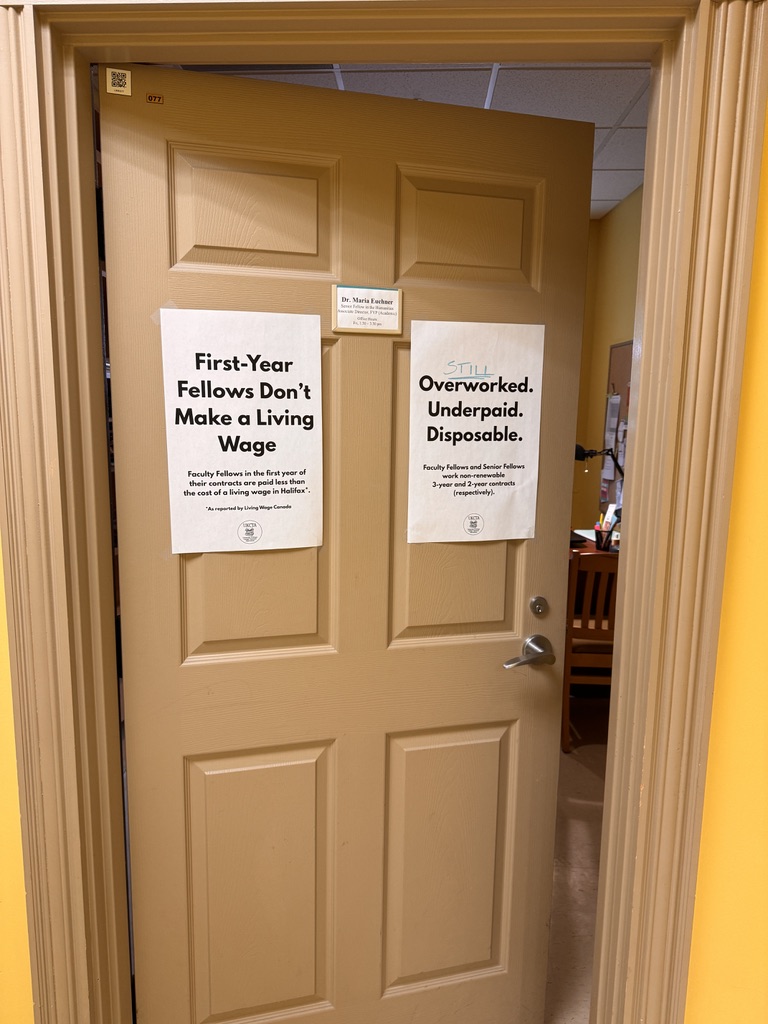
I stood in the corridor of the Foundation Year Program at the University of King’s College in Halifax and read a door. Two posters were taped to its panels, framing the nameplate of Dr. Maria Euchner, Senior Fellow in the Humanities and Associate Director, FYP (Academic). The poster on the left read, in heavy black type: “First-Year Fellows Don’t Make a Living Wage.” The poster on the right read: “Overworked.” Underpaid. Disposable. Above the word “Overworked,” a hand had written “STILL” in blue marker, underlined twice.
I have spent years thinking about precarity in higher education. I have written about it as my doctoral committee at Royal Roads University helped me sharpen my argument. I have lived it as a contract academic at Thompson Rivers University for nearly two decades. I thought I understood the architecture. Standing in front of that door, I felt the weight of the word Still. That single adverb, written by hand, did more theoretical work than most of the literature I have cited.
Still, Dr. Euchner’s Door, Foundation Year Program, University of King’s College, Halifax
The posters were produced by the University of King’s College Teaching Association (UKCTA), the union representing Faculty Fellows and Senior Fellows in the Foundation Year Program. Faculty Fellows are appointed to three-year non-renewable contracts. Senior Fellows are appointed to two-year non-renewable contracts. According to a position posting for the role, the starting salary for a Faculty Fellow in the Humanities was $52,343 to $56,627 as of July 1, 2022, with future scales tied to bargaining (University of King’s College, 2026). The duties listed include four to eight hours of tutorials per week, eight hours of lecture attendance, weekly office hours, bi-weekly essay grading, and an average reading load of sixty pages per day, four days per week.
Set this beside the most recent calculation from the Canadian Centre for Policy Alternatives (CCPA) Nova Scotia office. Saulnier and Williams (2024) calculated the 2024 living wage for Halifax at $28.30 per hour, the highest rate in Atlantic Canada. The CCPA methodology assumes a household with two adults, each working thirty-five hours per week to support two children, which translates into roughly $51,506 in annual earnings per adult before taxes. The arithmetic is uncomfortable. A first-year Faculty Fellow at the 2022 salary floor of $52,343, working a load that almost certainly exceeds thirty-five hours per week once preparation, marking, reading, and committee work are honestly counted, is hovering at the line. The poster is correct. When the actual hours are accounted for, the line is behind them.
A tentative agreement was reached and ratified in early April 2026, after conciliation talks broke down and a strike appeared imminent (Chiasson, 2026; Taylor, 2026). The strike was averted. The structural questions on that door remain.
The Word That Did the Work
The word “Still” was what stopped me. The literature on contingent and contract academic labour returns again and again to the same pattern: a campaign, a report, a brief moment of public attention, and then quiet. The poster on the right side of Dr. Euchner’s door was familiar; this poster had been up before. The handwritten Still in blue marker suggested that the same poster, or one very much like it, had been put up before. The fight had been waged. The conditions had shifted too little for the poster to come down.
Time itself becomes a feature of precarity. In my dissertation at Royal Roads, Through Our Eyes: A Photovoice Study of Interconnected Precarity, Belonging, and Possibility in Higher Education, I argue that contract faculty and international students are bound together by parallel vulnerabilities. I call this interconnected precarity. The institutional logic that recruits international students for tuition revenue and discards them at graduation is the same logic that hires Faculty Fellows for teaching capacity and discards them at the end of the contract. The pattern is rhythmic. The bodies rotate through. The titles remain. The students change, the Fellows change, and yet the work and the conditions of the work persist. Still.
The Titles and the Trap
I have been developing a concept in a separate manuscript, recently advanced to conditional acceptance at Group and Organization Management, that I call malperformative inclusion. It names a particular institutional move: an organization performs the gestures of inclusion through titles, ceremonies, publicity, and acknowledgement programs, while the underlying structures continue to exclude. The performance is included only in the form. It is inclusion that performs the function of exclusion under another name (Tucker, in press).
The title “Faculty Fellow” is prestigious. It carries the resonance of Oxford and Cambridge collegiate traditions, of community, of belonging. It signals scholarly seriousness. It tells parents, applicants, and donors that the people teaching the foundational program are valued members of an intellectual community. The reality, laid out in plain language on paper taped to a door, is that the Fellowship is a non-renewable contract, that the salary in the first year falls at or below the regional living wage, and that the position will end on a fixed date with no path to continuation. The title performs inclusion. The contract performs disposability. This is what I mean by malperformative inclusion. The door named it more economically than my chapter does.
A Door Is a Photograph Is a Method
I look at this door, and I see a photovoice frame. Photovoice is a participatory research methodology developed by Wang and Burris (1997) in which participants use photographs to document conditions of life that conventional reporting cannot reach. The image becomes a means of testimony. It carries information that paragraphs cannot, because the image asserts: this is here, this is now, this is real.
The Faculty Fellows had no need for a researcher to come and document their conditions. They produced their own photovoice frame. They printed the words. They taped them to a door at the height of an adult reader. They wrote Still by hand. The hand-lettered word is the methodological signature. It says: a person did this. A person stood in this hallway and amended the original poster because, despite its accuracy, it was no longer accurate enough. Conditions remained unchanged. The poster required updating. Still.
The Faculty Fellows at King’s are doing the same work with paper and tape. The door is the camera. The corridor is the gallery. The asterisk citing Living Wage Canada is the methodological footnote. I find this beautiful and devastating in equal measure.
What I Take With Me
I take three things from this door into my own work and into my dissertation defence in the coming weeks.
The first is that precarity is rarely solved by a single agreement. The strike was averted at King’s College. I am genuinely glad. I also know from my work with the Federation of Post-Secondary Educators of British Columbia (FPSE) and my role as Chair of the Non-Regular Faculty Committee that aversion is a pause, and that resolution requires more. Three-year and two-year non-renewable contracts will continue to shape the working lives of those who teach in the foundational humanities program at one of Canada’s oldest universities. The poster must be taken down by the institution; the workers alone cannot remove it.
The second is that scholarly personal narrative is appropriate and, at times, necessary in such moments. I write in this voice because the door is in the first person. The hand that wrote Still is a worker’s hand, personal and deliberate, distinct from any institution’s. Theory should answer in kind.
The third is that the Foundation Year Program’s foundation rests on the labour of people paid at or below the living wage in the city where they live. The undergraduate students who arrive for their first year of university, often on student loans and family sacrifice, are taught by scholars whose own household economies are governed by precarity. Interconnected precarity is concrete, immediate, and present. It is the floor and the ceiling of the same building.
I left the corridor. I carried a photograph of a door. I carry it still.
References
Chiasson, N. (2026, April 8). Strike looming for some staff at Kings College in Halifax. Country 103.5 / Acadia Broadcasting. https://hotcountry1035.ca/2026/04/08/strike-set-for-some-staff-at-kings-college-in-halifax/
Saulnier, C., & Williams, R. (2024). 2024 living wages for Newfoundland and Labrador, Nova Scotia and Prince Edward Island. Canadian Centre for Policy Alternatives, Nova Scotia. https://www.policyalternatives.ca
Taylor, E. (2026, April 9). Strike avoided at University of King’s College after deal reached. Country 103.5 / Acadia Broadcasting. https://hotcountry1035.ca/2026/04/09/strike-avoided-at-university-of-kings-college-after-deal-reached/
Tucker, A. (in press). Malperformative inclusion as institutional practice [Commentary]. Group and Organization Management.
Tucker, A. (in progress). Through our eyes: A photovoice study of interconnected precarity, belonging, and possibility in higher education [Doctoral dissertation, Royal Roads University].
University of King’s College. (2026). Faculty fellowship in the humanities [Position posting]. https://ukings.ca/campus-community/employment/faculty-fellowship/
University of King’s College Teaching Association. (2026, April 9). Statement on tentative agreement. UKCTA.
Wang, C., & Burris, M. A. (1997). Photovoice: Concept, methodology, and use for participatory needs assessment. Health Education & Behavior, 24(3), 369-387. https://doi.org/10.1177/109019819702400309
This page lists the verified references for A Body Is an Ecosystem, part of the A Human Geography of the Self series. All citations have been verified against CrossRef DOI records. Corrections from the original post are noted below.
Verified References
Asker, C., & Andrews, G. J. (2020). The understated turn: Emerging interests and themes in Canadian posthumanist geography. Canadian Geographies / Géographies canadiennes, 64(4), 551–563. https://doi.org/10.1111/cag.12639
Fay, G., Coen, S. E., & Lawreniuk, S. (2026). Of life and breath: Towards geographies of breath and breathing bodies. Geography Compass, 20(3), Article e70069. https://doi.org/10.1111/gec3.70069
Montefusco, G. (2026). Relational food geographies, underwater: Discussing food and oceans’ entanglements along urban waterfronts. Geography Compass, 20(4), Article e70074. https://doi.org/10.1111/gec3.70074
notes
Asker & Andrews (2020) — journal name corrected. The original post cited the journal as “The Canadian Geographer / Le Géographe canadien.” CrossRef records show that the journal was renamed Canadian Geographies / Géographies canadiennes beginning with volume 63 (2019). The Asker & Andrews article was published in volume 64 (2020), after the renaming. The corrected citation uses the current journal title.
All other citations in this post verified correct against CrossRef DOI records: authors, year, journal title, volume, issue, and article numbers confirmed.
Verified June 29, 2026 against CrossRef DOI database.
This page lists the verified references for Interconnected Precarity as an Ecology, part of the A Human Geography of the Self series. All citations have been verified against CrossRef DOI records. Notes on publication dates are included below.
Verified References
Blomley, N. (2020). Precarious territory: Property law, housing, and the socio-spatial order. Antipode, 52(1), 36–57. https://doi.org/10.1111/anti.12578
Burridge, A., & Gill, N. (2017). Conveyor-belt justice: Precarity, access to justice, and uneven geographies of legal aid in UK asylum appeals. Antipode, 49(1), 23–42. https://doi.org/10.1111/anti.12258
Butler, J. (2004). Precarious life: The powers of mourning and violence. Verso.
Grenier, A., Lloyd, L., & Phillipson, C. (2017). Precarity in late life: Rethinking dementia as a “frailed” old age. Sociology of Health & Illness, 39(2), 318–330. https://doi.org/10.1111/1467-9566.12476
Sangaramoorthy, T. (2018). “Putting Band-Aids on things that need stitches”: Immigration and the landscape of care in rural America. American Anthropologist, 120(3), 487–499. https://doi.org/10.1111/aman.13054
notes
Blomley (2020) — publication date note. This article was published online 30 September 2019 and appeared in the print issue vol. 52(1) in January 2020. The post’s citation uses 2020, which correctly reflects the print volume year. CrossRef records confirm all other details (authors, title, journal, volume, issue, and pages).
Burridge & Gill (2017) — publication date note. This article was published online 3 August 2016 and appeared in the print issue vol. 49(1) in January 2017. The post’s citation uses 2017, which correctly reflects the print volume year. CrossRef records confirm all other details.
All other citations in this post verified correct against CrossRef DOI records.
Verified June 29, 2026 against CrossRef DOI database.
This piece belongs to A Human Geography of the Self, a series that reads my own life through the concepts geographers use to understand how people and places make one another. It draws on my doctoral and master’s work on contract academic labour, and on the original concepts I have developed through that research.
“No creature in the tidepool is precarious alone. Neither, I have come to believe, are we.”
In Loreto, at the lowest tides, the Sea of Cortez pulls back and leaves a world exposed in the rock. I spent many mornings crouched over those tidepools, watching. A hermit crab depends on a shell another creature has left behind. A small fish shelters in the shade of an anemone that could also sting it. Every life in that basin is held by other lives, fed by them, endangered by them, impossible without them. Pull one thread and the whole pool shifts. No creature in the tidepool is precarious alone. Neither, I have come to believe, are we.
I have spent nineteen years inside the precarity of contract academic work, and for most of those years I understood my insecurity as a private misfortune, a personal weather system I had to survive on my own. The tidepool taught me otherwise, and so did human geography. Insecurity, it turns out, behaves like an ecology. It is relational, distributed across linked lives, and profoundly uneven. In my own scholarship I have come to call this interconnected precarity (the idea that no person’s insecurity stands alone, that our vulnerabilities are bound together in a web, the way the lives in a tidepool are bound). This post is about that web, about who it holds and who it sacrifices, and about why seeing precarity as an ecology changes everything.
The philosopher Judith Butler gave this its deepest grounding. As Grenier, Lloyd, and Phillipson (2017) discuss, Butler argues that our lives have always been defined by precariousness, a state founded on an interdependent web of social support and obligation, so that to live at all is to live socially, with one’s life always in some sense held in the hands of others (Grenier et al., 2017). Butler’s (2004) insight is that exposure is the human condition rather than a personal failure. We are sustained by the very same networks of care, work, and belonging that can also leave us exposed. There is no sealed, self-sufficient self. There is only the tidepool.
Grenier and colleagues (2017) take this somewhere that matters to me. They draw attention to a precariousness that is inherently shared, yet unequally experienced, so that while insecurity is part of every human life, certain lives are far more susceptible to its hazards than others (Grenier et al., 2017). They argue that the honest response is one grounded in an acknowledgement of the fragility and limitation that affect all human lives, and in inclusive forms of belonging built upon that shared condition (Grenier et al., 2017). This is the first turn of the ecological view. Once I understood my own precarity as part of a shared human interdependence rather than a personal flaw, the shame began to lift, and something more useful took its place, which was a sense of common cause.
The Web Is Uneven
If precariousness is shared, precarity itself is distributed with brutal unevenness, and geographers have mapped exactly how. Burridge and Gill (2017), studying asylum seekers cut off from legal aid across an uneven British landscape, draw on Butler to insist on what they call differential exposure (the way some populations are far more exposed to harm than others through political and spatial arrangements rather than through chance). They show that precarity is spatially uneven, that where a person stands, their legal status, and their access to resources all shape how exposed they are, and they caution that the concept of precarity becomes hollow the moment it flattens or erases these differences (Burridge & Gill, 2017). An ecology has niches, and some niches are far more dangerous than others. The tidepool is no democracy.
Then comes the insight that reorganized my whole understanding, and it came from a geographer writing about property. Blomley (2020) argues that precariousness is socially distributed in a very particular way: the security of the privileged to hold land and shelter is produced through, and actually depends upon, the production of precarity for others (Blomley, 2020). He calls this precarious property and shows that the comfortable image of the private castle, the sealed home that protects its owner from all dependency, is an illusion, because all security in land remains relational and revocable, and one person’s stable ground is built on another’s lack of it (Blomley, 2020). As a settler scholar, Blomley (2020) turns this lens on himself, acknowledging that his own access to land rests on the dispossession of Indigenous peoples, so that his security and their precarity are the same arrangement seen from two sides (Blomley, 2020).
This is the second concept I have developed in my own work, which I call asymmetrical precarity (the recognition that the web of insecurity is tilted, that some are made secure precisely by the insecurity of others). The tenured position and the contract position are not merely neighbours in an ecosystem. They are linked. The flexibility, the cost savings, and the security of the institution are produced through the disposability of people like me. My precarity was never simply my bad luck. It was someone else’s stability, viewed from underneath.
The Time Tax and the Cost of Staying Afloat
Living in an asymmetrical ecology extracts something from those who occupy its exposed niches, a cost that rarely appears on any ledger. I have come to name one form of it the time tax (the unpaid hours the precarious must spend simply staying afloat, reapplying, reproving their worth, managing an insecurity that the secure never have to think about). The hermit crab spends energy the anemone does not, merely to keep its borrowed shell. Across nineteen years I have paid this tax in evenings, in weekends, in the constant low hum of having to earn my place again and again. Burridge and Gill (2017) describe precisely this drain in the lives they study, the exhausting work of countering one’s own precarious position within a system arranged to keep one uncertain (Burridge & Gill, 2017). The time tax is how an asymmetrical ecology quietly transfers life from the exposed to the secure.
Interdependence as the Ground of Repair
Here is where the ecological view turns from diagnosis toward hope, and it is the reason I hold to it. If precarity is relational, then so is its repair. Sangaramoorthy (2018), studying how immigrants and care providers improvise mutual aid across a threadbare rural landscape, shows that precarity, even as it wounds, also generates circuits of social connection, belonging, and care (Sangaramoorthy, 2018). The very dependence on others that exposure forces upon us becomes, in her account, a profound recognition of our responsibility to one another, and the care that people offer each other inside precarity becomes a political act that opens the possibility of a livable life (Sangaramoorthy, 2018).
This is the deepest lesson of the tidepool. Interdependence is the wound and interdependence is the medicine. The same web that distributes insecurity unevenly is also the only thing strong enough to redistribute security. Grenier and colleagues (2017) call for exactly this, a response rooted in our shared fragility and in obligations of care that the secure owe the exposed (Grenier et al., 2017). My union work, my advocacy for non-regular faculty, my refusal to treat my precarity as a private problem, all of it grows from this single recognition: that we are an ecology, and an ecology survives through its relationships or fails through them.
What the Tidepool Knows
So I have stopped describing my insecurity as personal weather. It is an ecology, interconnected and asymmetrical, in which some are kept afloat by the sinking of others. Naming it that way is not merely an academic exercise. It is the difference between blaming myself and organizing with others. It is the difference between shame and solidarity.
I think often of those mornings crouched over the warm rock in Loreto, watching the held and holding lives in the basin. Every creature there was precarious, and every creature there was also someone else’s shelter, food, or threat. The pool survived because it was a web, and it suffered when the web was torn. We are the same. My precarity is bound to yours, and yours to mine, across the whole tilted ecology of our working and dwelling lives. The work of justice is the work of mending the web so that no one is made secure by another’s drowning. No creature in the tidepool is precarious alone. That is the wound, and it is also, if we choose it, the way out.
References
Blomley, N. (2020). Precarious territory: Property law, housing, and the socio-spatial order. Antipode, 52(1), 36-57. https://doi.org/10.1111/anti.12578
Burridge, A., & Gill, N. (2017). Conveyor-belt justice: Precarity, access to justice, and uneven geographies of legal aid in UK asylum appeals. Antipode, 49(1), 23-42. https://doi.org/10.1111/anti.12258
Butler, J. (2004). Precarious life: The powers of mourning and violence. Verso.
Grenier, A., Lloyd, L., & Phillipson, C. (2017). Precarity in late life: Rethinking dementia as a “frailed” old age. Sociology of Health & Illness, 39(2), 318-330. https://doi.org/10.1111/1467-9566.12476
Sangaramoorthy, T. (2018). “Putting Band-Aids on things that need stitches”: Immigration and the landscape of care in rural America. American Anthropologist, 120(3), 487-499. https://doi.org/10.1111/aman.13054
🔍 Verified References The citations in this post have been verified against CrossRef DOI records. View the verified reference list with notes for this post.
This piece belongs to A Human Geography of the Self, a series that reads my own life through the concepts geographers use to understand how people and places make one another. It draws on my doctoral and master’s work on the body and somatic knowledge, and on my life as an open-water swimmer.
“In the lake I stop being a thing with edges and become a place where water passes through.”
When I slip into the cold lake at first light, something happens that I have spent years trying to describe. The boundary I walk around with all day, the firm sense of where I stop and the world begins, loosens and goes soft. The water is the same temperature as the inside of grief. It moves into the spaces between my fingers, against my eyes, into my ears, and my breath becomes the loudest thing in the world, a tide of its own. For a few minutes I am not a person looking at a lake. I am a membrane the lake is moving through. In the lake I stop being a thing with edges and become a place where water passes through.
For most of my life I was taught to think of my body as a machine that my mind drives around, a bounded object, sealed and separate, carrying me from task to task. Geography has helped me unlearn that. There is a rich body of work in the discipline that understands the human body as something far closer to what I feel in the water: porous, ecological, continuous with its surroundings, a living system among other living systems. This post is about reading the body as an ecosystem, and about why that reading is a matter of dignity and even of human rights.
The geographers who study this work under the banner of visceral geographies (the study of how the body’s gut-level, fleshy sensations shape, and are shaped by, the spaces we move through). Hayes-Conroy and Hayes-Conroy (2010), in the paper that helped name this field, set out its central commitments. Visceral geographies, they argue, advance our understanding of the agency of physical matter, both within and between bodies, treating the fleshy body as an actor in social and political life rather than as a passive vessel (Hayes-Conroy & Hayes-Conroy, 2010). They press us to move beyond static notions of the individual body toward more interactive versions of self and other, and above all they encourage a deep skepticism of boundaries, inviting us to live in, through, and beyond the old dualisms that wall the body off from the world (Hayes-Conroy & Hayes-Conroy, 2010).
That phrase, skepticism of boundaries, is the lake exactly. When I swim, the boundary between my body and the water is revealed as the convenient fiction it always was. Hayes-Conroy and Hayes-Conroy (2010) also remind us that the visceral, despite how we talk about it, is far from presocial or simple, and that the body is far from a thing set apart from culture and meaning (Hayes-Conroy & Hayes-Conroy, 2010). My gut reactions, my startle, my ease in water, were shaped by a whole history. The body is porous to its past as much as to the lake.
We Are Made of Exchange
If the body has no clean edge, then what passes across that open border becomes the very thing the body is made of. Fay, Coen, and Lawreniuk (2026), writing toward a geography of breath, make this beautifully concrete through the simplest act there is. Bodies and environments, they argue, are involved in processes of co-emergence and co-creation, so entangled that they cannot be cleanly separated, and breathing is their illustrative case (Fay et al., 2026). Each breath shows the body’s very constitution being perpetually mediated by the air and the place around it, by factors social and political as much as biological (Fay et al., 2026). The body, in their account, is a site where matter and energy converge, not a sealed container (Fay et al., 2026).
I think about this every time my breath becomes a tide in the cold water. I am taking the lake’s morning into my chest. The oxygen that becomes my thinking was, a moment ago, the world. The line between the environment and me is a revolving door rather than a wall. Fay and colleagues (2026) push this toward something they call an emancipatory respiratory politics, the insistence that everyone should be afforded the right to breathe clean air (Fay et al., 2026). I find that turn quietly radical. If the body is made of what it exchanges with its place, then a poisoned place becomes a poisoned body, and the right to a healthy environment becomes a right held in the lungs. The ecosystem of the body and the ecosystem of the world are one continuous system, and justice has to be measured across both.
Decentring the Lonely Human
There is a larger shift underneath all of this, and a Canadian geography has been quietly mapping it. Asker and Andrews (2020), reviewing posthumanist work across Canadian geography, describe its shared starting point as a scepticism of human exceptionalism, a refusal of the idea that humans stand alone, above and apart from the rest of the living world. In this work, they write, the sovereign human subject is decentred, and the agencies of a full array of human and nonhuman actors and forces are acknowledged (Asker & Andrews, 2020). They note that many geographers prefer the gentler name more-than-human geography for this same impulse, the attention to everything beyond the human that shares in making the world (Asker & Andrews, 2020). Relational ethics, they observe, sit at the centre of this tradition (Asker & Andrews, 2020).
To call a body an ecosystem is to decentre the lonely, sovereign self in just this way. I am not a single author moving through inert scenery. I am a gathering of dependencies, a crowd of other lives and processes, held together for a while and called by my name. Montefusco (2026), writing on relational food geographies, names the deepest version of this as radical interdependence, the recognition that we are constituted by our relations rather than merely connected across them, and frames the body as the scale through which we live, immersed within metabolic relations that connect society, ecologies, and place (Montefusco, 2026). Every meal, every breath, every cold swim is that radical interdependence made flesh. I am, quite literally, made of my relations.
The Dignity of Being an Ecosystem
I want to close on why this matters beyond the pleasure of a morning swim. For years I treated my body as an instrument to be driven hard and ignored, a machine that owed me performance regardless of how I used it. That belief is a quiet violence, and I have done it to myself. Reading the body as an ecosystem returns it to me as something living, interdependent, and deserving of care, a place rather than a tool. An ecosystem can be depleted, and it can be tended. It has limits that are not a personal failing and rhythms that ask to be honoured.
So I keep going down to the cold lake. I let the boundary go soft. I take the morning into my lungs and give back my warmth to the water, and I feel, for a few minutes, the plain truth that geography spent decades arriving at: that I have no clean edge, that I am made of exchange, that I am one small interdependent system inside a much larger one. The body is an ecosystem. To treat it as such, in myself and in everyone whose air and water and rest are under threat, is the beginning of a justice measured at the scale of the breath. I am not a machine. I am a living place. So are you.
References
Asker, C., & Andrews, G. J. (2020). The understated turn: Emerging interests and themes in Canadian posthumanist geography. Canadian Geographies / Géographies canadiennes, 64(4), 551–563. https://doi.org/10.1111/cag.12639
Fay, G., Coen, S. E., & Lawreniuk, S. (2026). Of life and breath: Towards geographies of breath and breathing bodies. Geography Compass, 20(3), Article e70069. https://doi.org/10.1111/gec3.70069
Hayes-Conroy, J., & Hayes-Conroy, A. (2010). Visceral geographies: Mattering, relating, and defying. Geography Compass, 4(9), 1273–1283. https://doi.org/10.1111/j.1749-8198.2010.00373.x
Montefusco, G. (2026). Relational food geographies, underwater: Discussing food and oceans’ entanglements along urban waterfronts. Geography Compass, 20(4), Article e70074. https://doi.org/10.1111/gec3.70074
🔍 Verified References The citations in this post have been verified against CrossRef DOI records. View the verified reference list with notes for this post.