SPN works in layers. I came to this project already carrying the question, which Nash (2004) calls the pre-search: the internal motivation that precedes and shapes the inquiry. Mine was specific: I needed to know whether the capacity for stillness had survived nineteen years of precarious academic labour, or whether it had been quietly extracted along with everything else. I arrived in Loreto with that question in my body before I could put it into words.
The thirty days that followed were the me-search, in Nash’s terms: the structured excavation of lived experience as field text. I wrote every day. I photographed every day. I read, and I let what I was reading land in my body rather than filing it away as information. The daily journal entries, the photographs, the artist statements, the vignettes that surfaced unbidden: these were the data. The researcher was also the researched.
The re-search moved through those materials in conversation with the scholarship: Porges on the nervous system, hooks on engaged pedagogy, Standing on precarity, Hersey on rest as resistance. Theory arrived as recognition rather than as framework imposed from outside. And the we-search, the translation from personal to collective, is what this piece attempts: to take what happened to one body by the sea and ask what it might mean for anyone who has spent years forgetting how to stop.
Core Principles
The SPN methodology is made real through four principles that Nash (2004) names: vulnerability, perspective, action, and scholarly engagement. Each element informed my cultivation of alonetude.
Perspective transforms personal disclosure into something intelligible for an audience by embedding it in conceptual contexts. I framed my experiences against the “capacity to be alone,” a concept from Donald Winnicott (1958) that suggests aloneness is safe when one feels held by something larger. This interpretive layer ensures the narrative remains grounded in a broader human experience.
Vulnerability functions as a tool for honest knowing, enabling the writer to critically reinterpret moments of personal significance. In Loreto, this meant practicing self-interrogation and confronting the internal noise that surfaced when external distractions subsided. Vulnerability is selective; it serves the thread running through rather than standing as an isolated anecdote.
Action represents the translational moment where insights inform choices and behaviours. Cultivating alonetude required intentional shifts in practice, such as “mornings without performance” and “watching without comment.” These actions were enactments of sense-making that altered my daily routines.
Scholarly engagement ensures that narrative sense-making extends beyond this experience to reach the broader community. I integrated research on learning to settle the nervous system to explain how chosen time alone supports well-being. This embeddedness means that one person’s lived experience can open up questions for everyone.
Title: The Circle of Witness
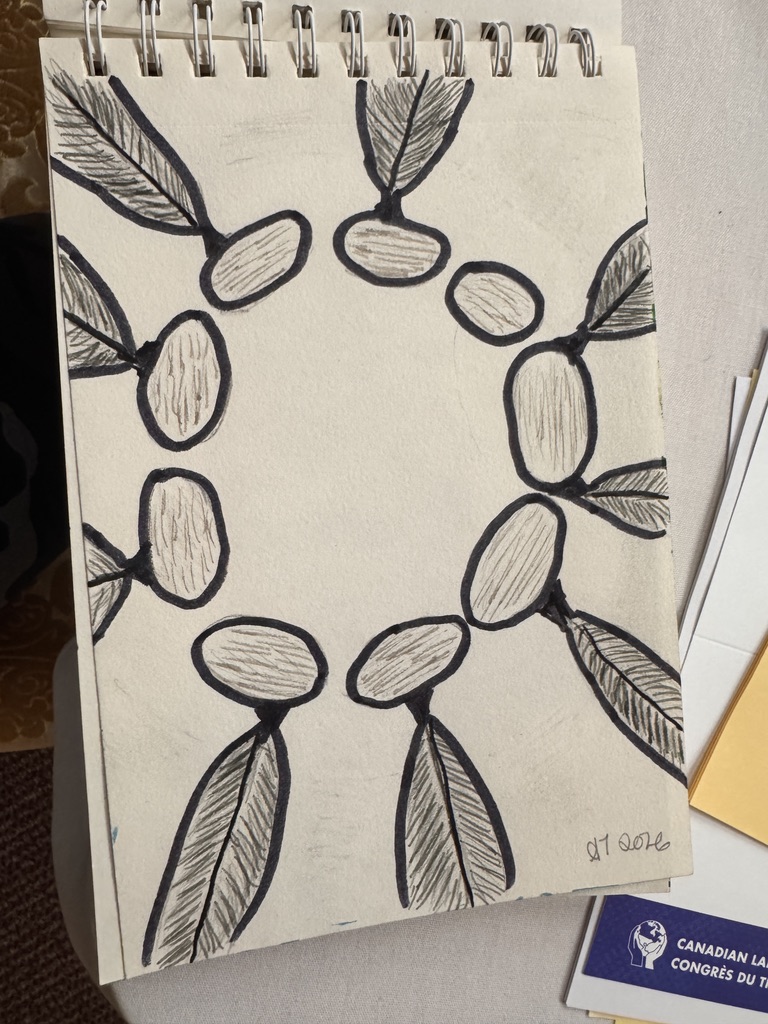
Artist Statement

This drawing emerges from my inquiry into relationality, witnessing, and the ethics of presence within alonetude. While solitude often carries connotations of separation, my work continues to reveal the opposite. Even in moments of intentional aloneness, I am held within circles of relation.

The figures in this piece are simplified, almost archetypal. Bodies reduced to gesture. Heads bowed or turned inward. Leaves extending from each form as though each figure is both human and ecological, person and landscape simultaneously. I am interested in how identity is always a relational project.

The circle has no leader. No one at the head. Everyone equal, the centre empty and open. That is what I was trying to draw: a space where listening is possible.

In my practice, drawing functions as a form of thinking. Each line is a small act of settling. Something loosens when I draw slowly. Ideas surface that hurrying would foreclose.

What this captures is being surrounded by quiet forms of support that speak beyond language.

Photo: Amy Tucker, © 2026
Reading the Body as Archive: A different way of holding memory
A central pillar of my methodology involves reading the body as an archive. This concept positions the body as a repository of lived experience, challenging traditional, conventional ways of keeping records that privilege textual documentation (Derrida, 1996).
By treating the body as a site of knowledge, I engaged in a different way of holding memory. This approach recognizes that bodies retain past experiences, particularly traumatic or transformative ones, as implicit body-based memories (van der Kolk, 2014). My methodology utilized several tools to document what the body carries:
- body journal: Documenting physiological and sensory shifts during the 30-day retreat.
- Visual Witnesses: Using photography to capture the “the gentle pull of the natural world” of the environment, which facilitates the quiet way nature restores us (Kaplan, 1995).
- reading journal: Connecting scholarly reading to lived, felt experiences in real-time.
This framework is supported by Porges’s (2022) polyvagal theory, which suggests that a state of felt safety, a state of genuine safety and connection, is required to access these deep body-based archives (Porges, 2022). In the quiet of the Sea of Cortez, the absence of threat triggered the body’s sense of safety, enabling a downregulation of defensive states and an opening to what the body holds.
The Portability of Alonetude
The ultimate goal of this methodology is the capacity to reach others: the capacity for a narrative to evoke recognition across contexts. Alonetude is a portable internal posture that remains available regardless of external circumstances. By employing the SPN and reading the body as an archive, researchers can bridge the gap between inner truth-telling and public knowledge-making. This process reveals that the home we seek is often found within ourselves, preserved in the very tissues of our being.
Title: Hydration, Paused

Artist Statement

This image sits within my visual inquiry into alonetude, embodiment, and the quiet rituals that sustain attention. Spectacle holds no interest for me. Ordinary moments where the body registers care before language has time to intervene.

A glass of mineral water, a slice of lime, condensation gathering along the surface. These are small events. Yet within them lives a form of restoration that is both sensory and relational. The body cools. The hand steadies. Time slows.

In my broader research, I examine how identity, labour, and precarity shape the nervous system’s orientation to rest. Here, relief is tactile. Visible. Measurable through droplets, temperature, and light.

This photograph is an act of noticing. It asks what becomes possible when attention is returned to the micro-gestures of care that make endurance sustainable.

Photo: Amy Tucker, © 2026
References
Derrida, J. (1996). Archive fever: A Freudian impression. University of Chicago Press.
Kaplan, S. (1995). The restorative benefits of nature: Toward an integrative framework. Journal of Environmental Psychology, 15(3), 169–182. https://doi.org/10.1016/0272-4944(95)90001-2
Nash, R. J. (2004). Liberating scholarly writing: The power of personal narrative. Teachers College Press.
Porges, S. W. (2022). How the nervous system responds to safety and threat: A science of safety. Frontiers in Integrative Neuroscience, 16, Article 871227. https://doi.org/10.3389/fnint.2022.871227
van der Kolk, B. A. (2014). The body keeps the score: Brain, mind, and body in the healing of trauma. Viking.
Winnicott, D. W. (1958). The capacity to be alone. The International Journal of Psycho-Analysis, 39, 416–420.
ACADEMIC LENS
This piece functions as the methodological statement of the project, grounding the thirty-day inquiry in Nash’s (2004) Scholarly Personal Narrative as a recognized form of educational research. SPN insists that the researcher’s own story, told with intellectual rigour and self-awareness, constitutes legitimate scholarship rather than mere anecdote. The “third shore” as metaphor draws on Turner’s (1969) liminal space, the territory between departure and arrival where transformation becomes possible. Richardson and St. Pierre (2005) argue that writing is itself a method of inquiry rather than merely a way to represent research, a method of inquiry, and this entire project proceeds on that premise. The concept of alonetude, developed as the research question and the research site simultaneously, positions embodied experience as epistemologically valid, aligning with Moustakas’s (1961) heuristic inquiry, which centres the researcher’s direct, personal engagement with the phenomenon under investigation. The image of “sediment of memory” in this post also gestures toward Bachelard’s (1969) phenomenology of material imagination, where physical substance becomes a vehicle for layered knowing.

