Reading Time: 2minutesA coda to thirty days by the sea: a photograph of a suitcase open on a bed, holding the material weight of departure. The pause before leaving, and the grief that comes with knowing you are becoming someone different than the person who arrived.
Reading Time: 2minutes
Title: The Pause Before Departure
Artist Statement I attend to moments where the body recognizes transition before the mind has found language for it. Here, departure is already present, even though no taxi has arrived and no door has closed. The suitcase becomes a proxy for intention, carrying the weight of decisions alongside belongings, attachments, and unfinished conversations with place. It waits as I wait. This image speaks to my inquiry into alonetude and what the body knows. I was alone when I took the photograph, yet held within a sense of belonging. The stillness was chosen.
The pause was deliberate. In that pause, I could sense how places enter the body and remain there, long after one has left. The railing frames the view without enclosing it, suggesting care rather than constraint. What lies ahead is visible, waiting to be entered. I have come to understand transition as a form of learning. Leaving teaches us what mattered. Waiting teaches us how to listen. This photograph holds that lesson gently. It holds the moment without rushing it. It allows departure to arrive in its own time. Photo Credit: Amy Tucker, 2026
Me voy, pero no me voy vacía. Me llevo el mar en el cuerpo y la calma que aprendí a sentir sin miedo.
Aquí lloré. Aquí soñé. Aquí descansé por primera vez en mucho tiempo.
Entendí que no estaba rota, solo cansada, solo esperando permiso para soltar.
Gracias por sostenerme cuando no sabía cómo sostenerme yo.
Adiós, Baja. La tercera orilla vive en mí ahora. Donde vaya, la llevo conmigo.
Amy Tucker, 2026
I am still here.
Translation note. Spanish language passages were generated using Google Translate and subsequently reviewed and refined by the author. Any remaining infelicities reflect the limits of machine translation rather than intent.
Goodbye, Baja. Me voy, y me duele. I am leaving, and it hurts.
Title: Between Departure and Return: The Material Weight of Becoming
Artist Statement
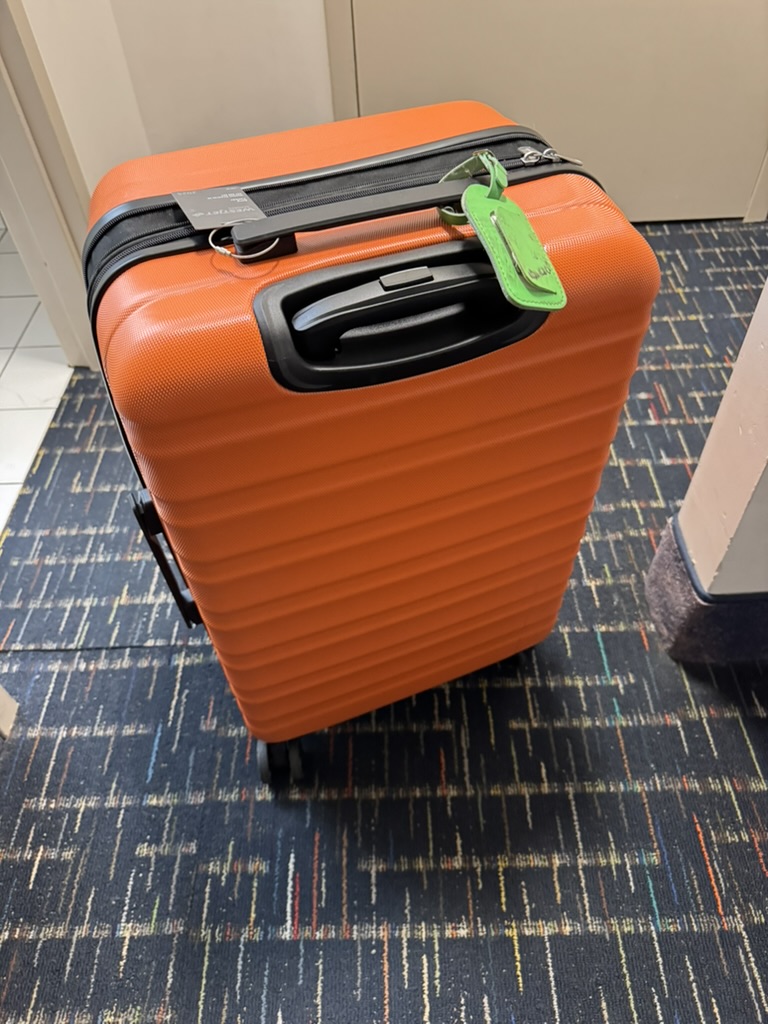
This photograph holds a quiet moment between departures. The open suitcase sits on the bed, overfilled and only partially closed, revealing the lived reality of constant movement. Books, journals, clothing, conference materials, and personal items spill outward. What appears at first glance to be simple travel preparation begins to feel more like an inventory of a life in motion. Packing becomes reflective work. I find myself asking what is essential, what supports my thinking, and what emotional weight I continue to carry from place to place.
I had only just arrived home and was already preparing to leave again. The suitcase became a temporary resting place where solitude, scholarship, advocacy, and embodiment intersected. Its bright orange shell, stretched and resistant to closing, felt symbolic of the inner tension of living between spaces. Between rest and responsibility. Between reflection and action. Between the need for solitude and the call to remain engaged with others.
There is no attempt in this image to tidy the moment or create order. The disorder feels honest. Intellectual life and emotional life rarely fold neatly into compartments. They expand, they press outward, and they reveal the fullness of what we carry forward as we continue moving through the world.
Photo Credit: Amy Tucker, January 2026
I understood that I was never broken.
You met me gently, and then you undid me. Slowly, the way the sea works on stone. Each morning, you loosened something I had been holding too tightly. Each night, you gave me dreams I had yet to know I was ready to have.
I cried here in ways I had forgotten how to cry. Beyond the sharp, panicked kind, but the kind that comes when the body finally believes it is safe. Tears warmed my eyes and spilled without apology. A release. Un permiso. A permission I had yet to recognize was awaiting me.
I dreamed deeply in Baja. Dreams filled with water and doorways and people I had long ceased thinking about. Dreams where I was walking without hurry. Dreams where I was simply present without explaining. I would wake with my heart open and think, ah… esto es. This is it. This is what it feels like when the nervous system exhales.
There were moments of sudden clarity, pequeños relámpagos de verdad. Standing at the sink with morning light on the tiles. Walking the shoreline and realizing I was no longer scanning for danger. Lying down in the afternoon and discovering that rest carried no punishment. Ah-ha moments that arrived quietly rather than shouting, but settled quietly into my bones.
I realized here that I have spent years surviving what I was never meant to endure. That exhaustion exists beyond personal failure. That my body has been keeping score even when my mind tried to move on. Entendí que no estaba rota. I understood that I was never broken. Only tired. Only braced. Only waiting for warmth long enough to soften.
Baja, you gave me that warmth. You gave me days without urgency and nights that felt held. You taught me that solitude can be chosen, inhabited, even loved. That I can sit with myself without flinching. That I can listen inward and trust what I hear.
I am leaving you now, but I am anything but empty-handed. I carry the dreams. I carry the tears. I carry the quiet knowing that arrived when I finally stopped running. Llevo el mar en el pecho. I carry the sea in my chest.
Gracias por sostenerme. Gracias por devolverme a mí misma. Thank you for holding me while I remembered how to stay.
Adiós, Baja. No te dejo atrás. I take you with me.
I carry the sea in my chest.
Title: Ascending What Cannot Be Rushed
Artist Statement
This photograph was taken during a morning walk when the path revealed itself as a gradual climb rather than an open horizon. The stone steps were uneven and worn, asking for care with every step. I was unable to move quickly, and there was little room for distraction. Each placement of my foot required attention. As I moved upward, I felt something similar happening within me. The climb felt like endurance rather than achievement. It felt like endurance.
Stairs are often used as symbols of progress, but this moment felt quieter than that. The stones were rough beneath my feet, and the incline asked for patience rather than momentum. Growth, in this space, felt slow and intentional. The walls on either side created a narrow passage that held me in the experience. There was guidance in that containment, a sense of being gently directed forward.
I came to experience the climb as a conversation between my body and the land. Effort became a way of listening. The photograph holds something beyond arrival. Instead, it holds the steady work of continuing upward, even when the destination remains out of sight.
Photo Credit: Amy Tucker, January 2026
I left to find quiet. I returned with myself.
In Baja, aloneness arrived first. It was unfamiliar, and at times it was heavy. But place matters. The sea, the light, the daily repetition of shoreline and breath created the conditions for something else to emerge.
Aloneness softened into solitude. Solitude became alonetude: a practised way of being with myself, chosen rather than endured, held by place and carried beyond it.
What began as absence became presence. What was imposed became intentional.
This is a beginning held within what looks like an ending. It is a way of living I will continue to practise.
Translation note. Spanish language passages were generated using Google Translate and subsequently reviewed and refined by the author. Any remaining infelicities reflect the limits of machine translation rather than intent.
ACADEMIC LENS
The “material weight of becoming” named in this post’s artwork title engages Bachelard’s (1969) phenomenology of intimate objects: the overfilled suitcase holds the accumulated somatic experience of the month, the changed nervous system state, the recovered creative capacity, the grief and relief and wonder that thirty days of embodied inquiry have generated. Van Gennep’s (1960) rites of passage framework describes departure as the first phase of transition: the separation from the liminal space that has made transformation possible. The bilingual grief of “me voy, y me duele” is performed in both languages because neither alone holds the full weight of what is being left: Anzaldúa’s (1987) borderlands methodology suggests that the emotions that live in the space between languages are among the most honest available to the bilingual self. Tuan’s (1977) concept of topophilia, place-love, is at its most acute in departure: we know how much we love a place most fully in the moment of leaving it. What Turner (1969) would note is that this departure marks a passage beyond the pre-liminal condition, a carrying-forward of the transformation: the suitcase that was packed on January 1 and is now being packed again holds a different person than the one who first filled it.
On Carrying Alonetude Into the Crowded Room, Hot Springs After Seawater, and the Question I Cannot Yet Answer
Winnicott (1958) observed that the genuine capacity to be alone, without anxiety or compulsive distraction, is a mark of emotional maturity, one that develops only through specific relational conditions and requires a kind of inner security that cannot be forced.
Title: Holding Light – Just a Sign
Artist Statement
This image drew my attention because of its simplicity and its steadiness. A single sun, rendered in clean lines and bold contrast, rests within a diamond frame of deep blue. There is no landscape, no horizon, no surrounding context. Only light held in shape.
I found myself pausing with it longer than expected. The symbol felt less decorative and more grounding. The sun held back its blaze, asking nothing of attention. Instead, it radiated a quiet constancy. In a period of movement, reflection, and internal sorting, this form of contained brightness felt meaningful. Light arrives in many ways beyond revelation. Sometimes it appears as steadiness. As presence. As something that remains even when the surrounding environment feels uncertain.
The geometric framing also held significance for me. The diamond shape created both structure and protection, as though the light was being safeguarded rather than exposed. I experienced this visually as a reminder that illumination requires no expansion outward at all times. There are seasons where light is held inward, tended quietly, allowed to gather strength before it moves beyond its frame.
This photograph, for me, became less about a symbol on a wall and more about recognizing the ways light continues to exist within periods of transition. It is rarely dramatic. Often, it is simply there. Steady. Contained. Waiting to be noticed.
Photo Credit: Amy Tucker, 2026
I am learning that intention is something I practise rather than declare once. It is something I practise, quietly, in the smallest choices of the day.
The Morning After
I have been home for less than twenty-four hours. The fragments from Loreto sit on the windowsill where I placed them last night: blue tile, amber stone, smoothed glass, each one catching the pale light of a Kamloops February morning. Outside, snow. Inside, the particular silence of a house that held itself while I was gone.
And already I am packing again.
Tomorrow I leave for Harrison Hot Springs. Two weeks of labour school. Hundreds of people. Workshops and lectures and shared meals and hallway conversations and the particular intensity of being in a room full of workers who have come to learn how to organize, how to resist, how to hold each other up against systems that would grind them down. It is important work. It is work I believe in.
But this morning, standing at the window with tea going cold in my hands, I feel the question settle into my chest like a stone: Can I carry what I learned in solitude into a room full of people? Can alonetude survive the crowd?
¿Puedo llevar esta quietud conmigo? Can I carry this quiet with me?
What I Learned Alone
Learning begins to change shape when I stop asking what I must produce and start asking what I am ready to understand.”
Title: Where Water Teaches the Land to Breathe
Artist Statement
This piece emerged slowly, through colour rather than intention. I began with the water. Layer upon layer of blue moved across the page in waves that felt less like representation and more like rhythm. The repetition became calming. Each line carried the sensation of breathing, of returning to the body through motion of the hand.
As the water settled, the land began to form almost instinctively. Mountains rose in the distance, edged in pink and earth tones, held gently beneath a wide sky. Their shape arrived without my planning. They appeared as memory does, familiar but softened. The tree line that followed felt like a boundary and a bridge at once, marking the meeting place between groundedness and movement.
What I notice most, looking back at the work, is the layering. Water. Land. Sky. Each occupies its own space yet remains in relationship with the others. The composition reflects an inner landscape more than a geographic one. There is calm in the horizontal lines, steadiness in the repetition, and reassurance in the way the elements hold one another without collapse.
Creating this drawing felt like returning to a quieter frequency. A reminder that reflection rarely requires language alone. Sometimes colour carries what words cannot. Sometimes the body understands balance before the mind is able to name it.
Photo Credit: Amy Tucker, 2026
Thirty days beside the Sea of Cortez taught me how to be with myself. I learned slow attention, the discipline of looking at one thing long enough for it to reveal what it held. I learned that rest is recalibration rather than laziness, repair rather than withdrawal. I learned that my body carries wisdom my mind has spent decades trying to override. I learned to cry without apology, to dream without interpretation, to sit with difficulty and let it transform rather than destroy.
But all of this I learned alone. In a casita with no one watching. On a shoreline with no one waiting. In the spacious quiet of days with nothing demanded of me. The practice of alonetude grew in conditions of extraordinary gentleness, and I am deeply grateful for those conditions.
Now I am about to test the practice in its opposite environment. Beyond the quiet casita, the conference hotel. Beyond the empty shoreline, the crowded workshop room. Beyond the solitary walk, the shared meal table. Beyond the Sea of Cortez, the hot springs of Harrison Lake, on the traditional territory of the Sts’ailes people, whose name means “the beating heart.”
The beating heart. That meaning arrived unexpectedly, but it lands in me with force. After thirty days of learning to hear my own heartbeat in the quiet, I am going to a place named for the beat of collective life.
Title: Threshold Guardian: On Humour, Boundary, and the Wild Edges of Belonging
Artist Statement
Meeting him there was unexpected.
A small yellow sign, fixed to a chain-link gate, announcing Sasquatch Crossing with quiet certainty, as though the boundary between the domestic and the mythical required no explanation. Behind it, the ordinariness of human life: a raised garden bed, a porch, blinds drawn against the afternoon light. Nothing spectacular. Nothing staged. And yet the sign altered the entire landscape. It suggested that the familiar world was porous, that something ancient and unscripted might pass through at any moment.
What struck me most was the gentleness of the warning. No danger. No fear. Crossing. Movement. Passage. An invitation to imagine that wilderness lives far beyond distant forests but walks the edges of our constructed lives, occasionally stepping across the thresholds we build to contain ourselves. I stood there longer than I expected, smiling at the playfulness of it, but also aware that humour often guards something deeper: a recognition that we coexist with forces we cannot fully domesticate, including the wildness within ourselves.
The image became, for me, less about folklore and more about boundary. Who gets to cross? What parts of ourselves remain fenced out? What mythic selves linger just beyond the gate, waiting for permission we never quite grant?
I took this photograph while walking, simply open rather than searching, simply letting my attention move where it wished. This has become part of my practice since returning from Loreto, the discipline of slow looking, of allowing small encounters to surface meaning rather than forcing insight through analysis. The sign appeared suddenly along the path, its bright yellow interrupting the muted winter palette of wood, wire, and fallen leaves.
I felt an immediate recognition that surprised me. For years, my professional life required a careful containment of self. Competence performed. Emotions moderated. Exhaustion hidden behind productivity. There were parts of me that crossed freely into institutional spaces, and parts that remained outside the fence, watching, waiting, unacknowledged. Creativity. Vulnerability. Playfulness. Even rest. These were treated as indulgences rather than necessities, as though the wild interior life needed to be regulated before it could be allowed into the workplace or the classroom.
Standing in front of the sign, I found myself thinking about what it means to warn others of wild crossings while ignoring our own.
Sasquatch, in Pacific Northwest lore, is elusive, rarely seen, often doubted, yet persistently present in collective imagination. I began to see the figure as metaphor rather than creature: the uncontained self, the part that refuses domestication, the presence that leaves traces even when unseen. My own “crossings” had been subtle over the years. Moments when exhaustion broke through composure. Moments when grief surfaced unexpectedly. Moments when my scholarly voice refused neutrality and spoke instead from lived experience.
The fence in the photograph feels important.
Chain link: transparent but restrictive. You can see through it, but you cannot easily pass. It mirrors institutional boundaries that appear permeable yet hold firm. The gate is chained, though loosely, suggesting both security and improvisation, as though the barrier exists more from habit than necessity. The sign leaves the gate open; it simply acknowledges what might cross it.
In that way, the image mirrors my current threshold. After thirty days of intentional solitude, of meeting parts of myself long held at the margins, I am returning to communal and institutional spaces with a different awareness. I am less interested in perfect containment and more willing to acknowledge the crossings: emotion into scholarship, body into research, humour into theory, vulnerability into leadership.
The wild self is no longer something I wish to fence out. It is something I am learning to let pass through the gate, in recognition rather than chaos, as presence rather than threat. The sign, playful as it is, becomes a guardian of that truth: that what is wild will cross eventually, whether we name it or leave it unnamed.
Photo Credit: Amy Tucker, February 2026
Winnicott’s Paradox: Alone in the Presence of Others
To learn with intention is to move slowly enough to notice what is asking for my attention.
Donald Winnicott (1958) understood something about aloneness that I am only now beginning to grasp. In his paper “The Capacity to Be Alone,” published in the International Journal of Psycho-Analysis, the British pediatrician and psychoanalyst proposed what sounds like a contradiction: the capacity to be truly alone develops through the experience of being alone in the presence of another. Winnicott first observed this in infants and young children, who learn to play contentedly, absorbed in their own world, when a reliable caregiver is nearby. The child needs nothing from the caregiver in that moment. The caregiver simply stays. What matters is the experience of a quiet, non-intrusive, dependable presence that allows the child to settle into their own interior life.
Winnicott argued that this early experience forms the foundation for all later experiences of creative solitude. Without it, being alone feels threatening. With it, solitude becomes spacious, generative, even companionable. The mature adult who can sit in a café writing in a notebook, present to their own thoughts while surrounded by conversation, is drawing on this early developmental achievement.
Winnicott (1958) observed the paradoxical truth that a child learns to be alone through the secure presence of a trusted person who requires nothing from them, it is that quiet, undemanding companionship that first teaches the infant that solitude is safe.
I read this sentence now, on the morning before I leave for two weeks among hundreds, and it reframes everything. What if the thirty days in Loreto were the necessary foundation, but the real test, the mature expression, is what comes next? What if alonetude is more than the practice of being alone: it is the practice of being alone inside yourself, even when you are surrounded by others?
This is the inversion that arrived beyond my anticipation. I thought alonetude required physical solitude. Winnicott suggests the opposite: the deepest form of being alone happens in relationship. The practice holds firm in the presence of others. It is completed by it.
Title:Small Sun, Sidewalk Shrine
Artist Statement
I almost missed it.
Arranged quietly in the cracks of an ordinary sidewalk, a circle of stones held its shape with care. Dark shards extended outward like rays, forming a small sun pressed gently into the pavement. There was no signature. No explanation. Just the evidence of someone pausing long enough to make something temporary and whole.
What stayed with me was the tenderness of the gesture. A sun where winter still lingered. Warmth imagined into being. It felt less like decoration and more like offering, a reminder that light can be assembled even on the ground we walk past without noticing.
Since returning from solitude, I have been attentive to these small, unannounced interventions, moments where human hands leave quiet traces of meaning in public space. This piece felt participatory even before I touched it. I stood at its edge, aware of how easily it could be scattered, how intentional its balance was. It mirrored my own practice of reassembly.
After months of exhaustion, I have been gathering myself in similar ways, piece by piece, fragment by fragment, creating small circles of coherence where there had been only dispersal. The sun on the sidewalk reminded me that wholeness arrives in fragments, placed one at a time. Sometimes it is placed gently into the cracks of daily life, held together by attention, by care, by the simple act of choosing to arrange what remains into something that can still give light.
Photo Credit: Amy Tucker, February 2026
The Nervous System in the Crowded Room
I am no longer collecting knowledge. I am listening for what knowledge is trying to teach me about myself.
I will be honest about what I am afraid of. After thirty days of near-silence, the thought of a room full of voices makes my shoulders rise toward my ears. I can feel the bracing in my body even as I write this, the anticipatory tightening that Stephen Porges (2011) would recognize as a shift in autonomic state. Porges’ how the nervous system responds to safety and threat describes how the nervous system evaluates environmental cues, a process he calls the body’s instinct to scan for safety, and responds with one of three broad patterns: the ventral vagal state of safety and social engagement, the sympathetic state of mobilization and defence, or the dorsal vagal state of shutdown and withdrawal.
For thirty days in Loreto, my nervous system lived primarily in the ventral vagal state of genuine safety and connection. Warmth, quiet, rhythmic sound, consistent routine, the absence of institutional demand: all of these cues signalled safety, and the body responded by softening, opening, becoming available. Now I am about to walk into an environment of high stimulation: new people, loud dining halls, competing conversations, fluorescent-lit conference rooms, shared accommodations, the social labour of introductions and small talk.
Porges would recognize my anxiety. The transition from low stimulation to high stimulation requires autonomic adjustment. The nervous system needs time to recalibrate, to learn that this new environment, though louder and more populated, is also safe. He describes a process he calls how we steady one another: the way nervous systems influence one another through facial expressions, vocal tones, gestures, and timing. In a room full of people, the nervous system does more than regulate itself. It is in constant dialogue with the nervous systems of everyone present.
Here is what I notice as I think about this: the anxiety I feel concerns the energy rather than the people themselves. It is about the energy required to be in constant social dialogue after a month of quiet. It is the fear that the softness I gained in Loreto will be overwritten by the demands of social performance. Tengo miedo de perderme otra vez. I am afraid of losing myself again.
But Porges also describes something hopeful. He explains that a well-regulated nervous system, one that has had sufficient experience of safety, develops what he calls a broader window of tolerance. The range of stimulation the system can absorb without tipping into defence or shutdown expands. The thirty days in Loreto were far beyond merely pleasant. They were regulatory. They widened my window. The question is whether the window is wide enough to hold a labour school.
Title:Circle of Returning
Artist Statement
Inspired by the sunshine circle, I created my own version of sunshine. In my practice, circles often surface when I am trying to understand where I am in relation to what I have lived. This drawing came during a period of transition, when I was moving between solitude and re entry, between interior work and collective presence. The repeated forms felt like versions of the self, each shaped by different seasons yet held within a shared perimeter.
The open centre matters. It suggests that wholeness is spaciousness rather than density, balance rather than completion. I see in this piece an evolving understanding that returning to oneself is never a solitary act. It is relational, cyclical, and ongoing. Each iteration brings me closer to a steadier way of standing within my own life.
Photo Credit: Amy Tucker, February 2026
Table 1
Conditions of Practice: Alonetude in Solitude Versus Alonetude in Community
High stimulation; the nervous system is in constant how we steady one another with others
Loreto: Alonetude in Solitude
Harrison: Alonetude in Community
Social Environment
Near-total solitude; days without conversation; self as primary companion
Hundreds of people; constant interaction; shared meals, workshops, corridors
Autonomic Demand
Low stimulation; the nervous system regulated by rhythm, warmth, silence
High stimulation; the nervous system in constant how we steady one another with others
Temporal Structure
Low stimulation; the nervous system is regulated by rhythm, warmth, and silence
Externally structured; workshops, lectures, meals at set times; time belonging to the group
Water
The Sea of Cortez; salt water; tidal rhythm; walked beside each morning
Harrison Lake and hot springs; mineral water; geothermal warmth; soaked in rather than walked beside
Practice Mode
The Sea of Cortez; salt water, tidal rhythm; walked beside each morning
Core Challenge
Befriending aloneness; staying with difficulty; allowing the body to soften
Maintaining interior quiet amid external demand; choosing presence over performance
Note. This table maps the shift from solitary alonetude to communal alonetude as a transition in conditions rather than a change in practice. The core intention remains the same: chosen, embodied, intentional presence with oneself. What changes is the environment in which that presence must be held. Winnicott (1958) would argue that the communal setting represents the maturation of the practice rather than a threat to it. The capacity to be alone develops in physical solitude; it is tested and deepened in the presence of others.
Each day of intentional learning becomes less about progress and more about presence.
Title: Holding Quiet Inside the Noise
Artist Statement
The world around me is loud.
Workshops unfolding. Chairs shifting. Papers moving. Conversations layering over one another in waves of sound. Labour school carries an important energy, collective, urgent, alive. But inside that vitality, I feel the volume rise in my body faster than it rises in the room.
So I draw. The colours come first. Bright, insistent, unapologetic. They create a boundary, a visual rhythm that steadies my breathing while everything around me moves quickly. The lines hold the colour in place. The repetition gives my hands something to do so my nervous system can soften rather than brace. This is my space.
Doodling, drawing, and colouring have become portable practices of alonetude for me, ways of staying present without becoming overwhelmed. In high-stimulation environments like labour school, where learning is collective and constant, the body sometimes needs a parallel activity to regulate attention. The movement of pen across paper becomes a form of grounding, adaptive focus rather than disengagement.
What I notice is that the louder the external world becomes, the more vivid my internal palette grows. Colour holds what words cannot in those moments. It absorbs excess noise, translates it into form, gives shape to what might otherwise feel like overwhelm. Through drawing, I remain in the room, listening, learning, participating, while also maintaining a quiet interior space that allows me to stay open rather than shut down.
I am still here.
Photo Credit: Amy Tucker, February 2026
Hot Springs After Seawater
There is something I cannot ignore: I am going from one body of water to another. From the Sea of Cortez to the hot springs that the Sts’ailes people have known as Kwals, meaning boiling water, a place revered as a site of healing since time immemorial. The hot springs at Harrison have been a place of care and restoration long before any settler named them, long before any resort was built around them. The Sts’ailes, a sovereign Coast Salish First Nation whose name means “the beating heart,” have lived on these traditional lands, including the entirety of Harrison Lake and the Harrison River, for thousands of years.
I sit with this knowledge carefully. I am a settler going to soak in waters that carry Indigenous stories of healing far older and deeper than my own. My practice of alonetude, my thirty days of personal recovery, my thesis about intentional solitude: all of this exists within a colonial context where land and water were taken, where Indigenous practices of healing were suppressed, where the very hot springs I will visit were “discovered” by settlers who capsized their boat in 1858 and were surprised to find the water warm. The Sts’ailes already knew. They had always known.
Any practice of presence I carry into that water must include awareness of whose healing place I am entering. This is far from a footnote. It is a condition of ethical practice.
And yet. The water. I feel its pull completely. After thirty days walking beside salt water, my body now understands something about what water offers: rhythm, buoyancy, the sensation of being held by something larger than yourself. Roger Ulrich (1983), in his foundational research on restorative environments, demonstrated that natural settings, and water in particular, facilitate physiological recovery from stress. The body already knows water is healing. The body already knows. El cuerpo ya sabe. El agua siempre sana.
Title:Steam Between Worlds
Artist Statement
The blue water held that familiar invitation I had come to recognize, warmth rising in soft spirals, dissolving the sharpness of the winter air. Steam hovered between surface and sky, blurring the boundary between forest and pool, between body and landscape. After weeks beside salt water, I found myself before mineral water, different in composition yet similar in promise: buoyancy, release, the possibility of being held.
What struck me most was the meeting of elements. Cold rain on my face. Heat on my skin. Evergreen stillness rising behind the pool like a wall of quiet witness. The mountains held their silence, yet their presence shaped the experience of immersion. This was an enclosed cradle rather than the open horizon of the sea of forest, a contained space of restoration. I entered slowly, aware that the body recognizes water as language long before the mind understands the setting.
Soaking here, I felt the transition I am living move through my nervous system in real time. From solitary retreat to collective learning. From the wide, tidal rhythm of the Sea of Cortez to the geothermal pulse of Harrison’s springs. Water, in both places, offered regulation, a sensory environment that softened vigilance and invited physiological repair. Environmental psychology has long documented water’s restorative capacity, yet what I felt was more than theory. It was embodied recognition.
In the steam, I realized that alonetude shifts form in community settings rather than disappearing. Even surrounded by others entering and leaving the pool, conversation rising and falling at the edges, I could feel a quiet interior basin remain intact. The practice I cultivated in solitude travelled with me, held by attention rather than geography. Immersion, in this sense, was both literal and methodological: the body soaking while the self observed how healing adapts across environments.
Photo Credit: Amy Tucker, February 2026
The Solidarity of Shared Space
Victor Turner (1969), the anthropologist of ritual and liminality, described a particular quality of human connection that emerges when people move through threshold experiences together. He called it communitas: a deep, unstructured, egalitarian bond that forms between individuals who share a liminal state. Communitas differs from ordinary social interaction. It strips away hierarchy, role, and performance. It creates what Turner described as a direct encounter between human beings, unmediated by the structures that normally organize social life.
Labour school, I think, is a site of communitas. Workers from different sectors, cities, and unions come together for two weeks to learn about their rights, their history, and their collective power. They leave behind the structures that normally separate them, the hierarchies of workplaces and institutions, and enter a liminal space where they are simply workers learning together. There is something tender about this. Something that echoes what I experienced in Loreto, though the form is entirely different.
In Loreto, I was liminal alone. Between identities, between chapters, between the person who was terminated and the person I was becoming. At Harrison, I will be liminal in the company. Surrounded by others who are also between: between frustration and hope, between isolation and solidarity, between the workplace they left and the understanding they will carry back.
Turner would recognize both as threshold spaces. The difference is that communitas generates bonds that solitude cannot. It produces what the labour movement has always known: that individual suffering becomes political understanding when it is shared. That the exhaustion I carried for nineteen years in precarious academic positions was never only mine. That structural harm is structural precisely because it happens to many.
Title:Holding Focus in Fracture
Artist Statement
Voices moved in overlapping waves, microphones cracking, chairs shifting, the constant hum of collective learning unfolding around me. The page became the one surface I could steady. Colour first, then line, then shape. Neither planned nor measured. Simply a quiet assembling of fragments that helped me stay present without becoming overwhelmed by the volume of the environment.
Deep focus. Deep flow.
Each shape holds its own boundary, thick black lines separating intensity so that colour can exist without bleeding into chaos. The composition mirrors the way I regulate myself in crowded spaces, creating interior compartments where sensation can settle. Drawing becomes a form of portable alonetude, a way of remaining engaged while protecting a small, necessary quiet within.
The world is louder, faster, more socially demanding than the solitary rhythm I had grown used to beside the sea. Rather than withdraw, I create visual anchors. The repetitive motion of marker on paper steadies my nervous system, offering tactile regulation amid cognitive overload. Arts-based methodologies recognize this gesture as embodied processing rather than distraction, a way of metabolizing environmental intensity through form and colour.
In this sense, the drawing documents adaptation. It shows how alonetude travels, reshaping itself to meet the conditions of collective space. I am still listening, still learning, still present to the shared purpose of the room. But I am also tending to the interior field that allows that presence to remain sustainable. The fractured geometry on the page reflects the fractured attention of crowded environments, yet it also reveals something hopeful: even in fragmentation, coherence can be created, one line, one colour, one breath at a time.
I am trying...
Photo Credit: Amy Tucker, February 2026
Five Intentions I Carry With Me
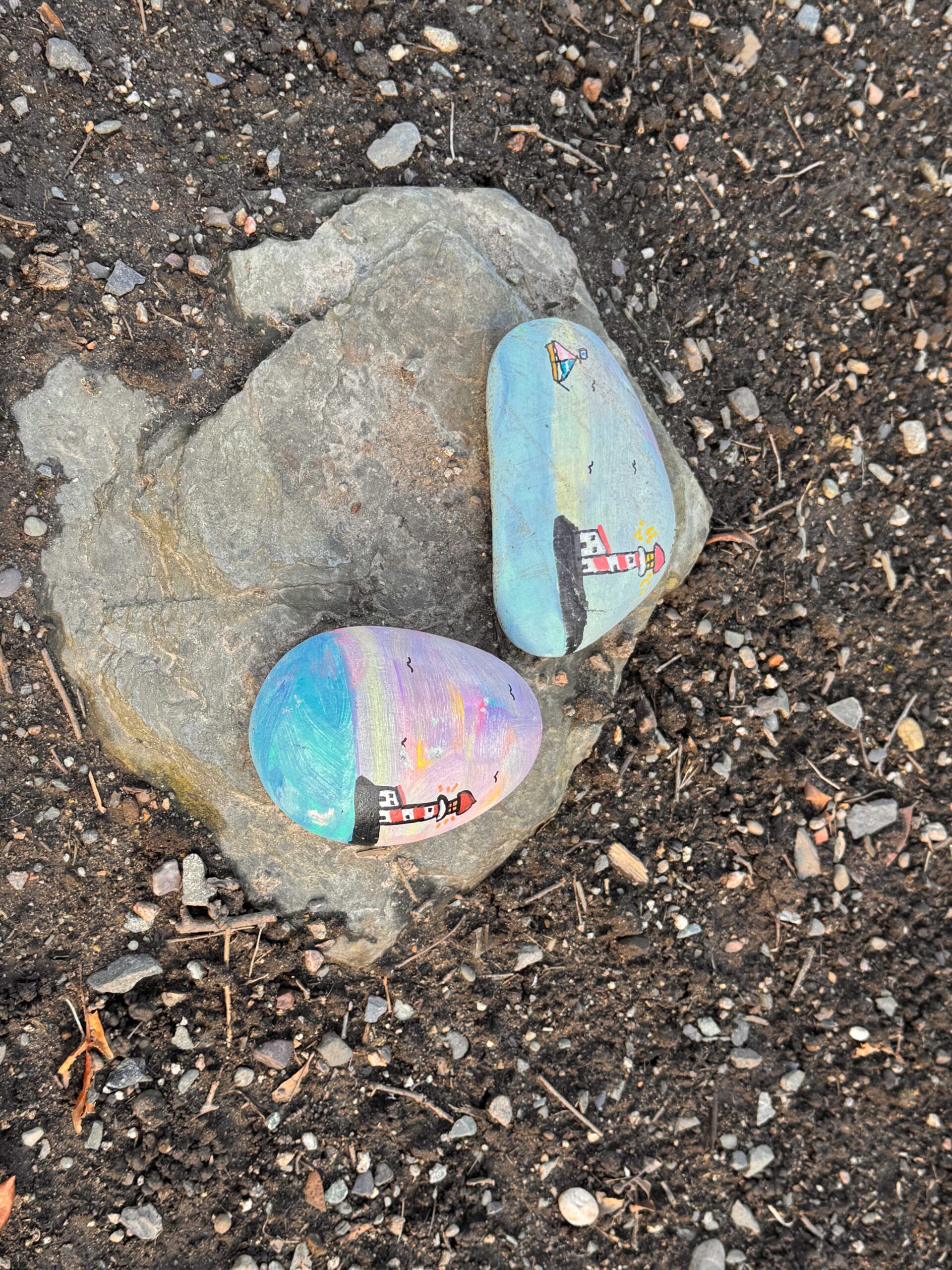
I will arrive at Harrison open to what emerges. I will arrive with intentions, held lightly, the way I learned to hold the painted stones in Loreto: with care rather than grip.
First: I will protect small moments of solitude within the collective schedule. A morning walk before the first session. Ten minutes alone with my journal over coffee. A breath at the doorway before entering the workshop room. Jon Kabat-Zinn (1994) writes that mindfulness requires no meditation cushion or retreat centre. It requires the willingness to pay attention, on purpose, in the present moment, without judgment. These small pauses are alonetude in its most portable form.
Second: I will notice what my body tells me without overriding it. If my shoulders rise in a crowded room, I will acknowledge the signal rather than pushing through it. If I need to leave a conversation, I will leave. If I need silence, I will seek it. The practice of alonetude includes the practice of boundaries, and boundaries are acts of care rather than withdrawal.
Third: I will let the hot springs hold me the way the sea held me. Different water. Different temperature. Different territory. But the same invitation: to let the body be buoyed, to let the warmth work on what is still tight, to be held without holding on.
Fourth: I will listen more than I speak. Alonetude taught me the discipline of slow attention. In a room of workers sharing their experiences of precarity, exhaustion, and resistance, that attention becomes an offering. There is no need to demonstrate knowledge or present expertise. I need to be present. I need to hear.
Fifth: I will let people in without losing myself. This is the one that frightens me most. Nineteen years of precarious labour taught me that institutions take what they need and discard the rest. I learned to guard myself, to engage while protecting something small and essential within. Alonetude softened that guarding. Winnicott would say the practice gave me back the capacity to be alone even in a relationship, to hold my own interior life while remaining open to others. I want to trust that. I want to believe the practice is strong enough. Quiero confiar. Quiero creer que lo que encontré en mí es mío para siempre.
Title: Writing Beside the Fire
Artist Statement
How can I pretend I am invisible when everyone can see me?
At labour school, the days are dense with dialogue, learning, and collective analysis. The intellectual stimulation is rich, but it is also demanding. By evening, I find myself seeking spaces where reflection can unfold at a different pace. Sitting beside the fire with my traveller’s notebook becomes a transitional practice, a bridge between communal engagement and interior integration. The act of writing in this setting is methodological. It is deliberate. Within
This place matters. Environment shapes what is remembered, how it is processed, and what meaning emerges.
As I write, I am deepening into the collective experience of labour school. I am extending it inward, allowing the day’s conversations about justice, rights, and solidarity to move through personal narrative before they settle into intellectual analysis. In this way, the notebook becomes both archive and companion, holding the small, immediate truths that formal discourse often leaves behind.
Humans exhaust me.
Photo Credit: Amy Tucker, February 2026
The Question I Cannot Yet Answer
The question of whether alonetude can survive a crowded room stays open. I believe it can. The literature suggests it can. Winnicott says the mature form of aloneness is aloneness in the presence of another. Long and Averill (2003), in their exploration of the benefits of being alone, describe what they call inner solitude: the capacity to maintain a state of solitary awareness even amid social interaction, to be simultaneously connected to others and grounded in oneself. Anthony Storr (1988) argued that the capacity for solitude enriches, rather than diminishes, relational life; those who learn to be alone bring greater depth and less guardedness to their encounters with others.
But knowing something in theory and living it in the body are different things. My body learned to be soft in the quiet of Baja. Now it must learn to stay soft in the noise of collective life. My nervous system found its rhythm beside the sea. Now it must find rhythm in the dining hall, the workshop room, the late-night conversation, the shared bathroom, and the hallway encounter with a stranger.
I think of what I wrote yesterday: Llevo el mar en el pecho. I carry the sea in my chest. If that is true, truly true, then the sea comes with me to Harrison. The rhythm is internal now. The practice is mine. It travels with me.
But I am honest enough to admit that I am nervous. That the ball in my stomach is back, smaller than it was before Loreto, but present. That I am about to walk into a building full of people and find out whether thirty days of healing can hold against the oldest pattern I know: performing competence while slowly disappearing.
No voy a desaparecer esta vez. Llevo mi voz. La verdadera.
I carry myself forward this time. I carry my voice. The real one.
Table 2
Alonetude as Inner Practice: Theoretical Foundations for Solitude Within Community
Storr (1988): Solitude enriches relationships
Core Argument
Application to Alonetude in Community
Winnicott (1958): Capacity to be alone
The ability to be alone is a developmental achievement rooted in the experience of being alone in the reliable presence of another; it is a sign of emotional maturity rather than withdrawal
Labour school as the “reliable other” whose presence allows interior solitude; alonetude deepens in safe community rather than diminishing
The nervous system is shaped by social context; safety is communicated through how we steady one another; a state of genuine safety and connection supports both social engagement and calm self-presence
The nervous system is shaped by social context; safety is communicated through how we steady one another; the ventral vagal state of genuine safety and connection supports both social engagement and calm self-presence
The nervous system that learned safety in solitude must now learn to maintain that state amid the social signals of a crowded environment
Turner (1969): Communitas
Labour school as a liminal site where workers shed institutional roles; communitas may support rather than threaten alonetude
Labour school as liminal site where workers shed institutional roles; communitas may support rather than threaten alonetude
Long & Averill (2003): Inner solitude
Solitude includes an inner dimension: the capacity to maintain solitary awareness even in social settings; positive solitude requires choice, creativity, and self-connection
Alonetude in community as inner solitude: grounded self-awareness maintained while engaging with others
Storr (1988): Solitude enriches relationships
Those who develop rich inner lives through solitude bring greater depth and authenticity to their relationships; solitude and connection are complementary, mutually reinforcing
The depth gained in Loreto becomes a resource for genuine connection at labour school rather than a barrier
Kabat-Zinn (1994): Portable mindfulness
Mindfulness is available in every moment of daily life, beyond formal practice or retreat; attention is the practice, and attention goes wherever the person goes
Alonetude as portable attention: ten-minute pauses, doorway breaths, slow listening in the workshop room
Note. These six frameworks collectively support the argument that alonetude extends beyond physical isolation but represents an internal orientation that can be practised in any environment. Each framework contributes a distinct dimension: developmental (Winnicott), neurophysiological (Porges), anthropological (Turner), psychological (Long & Averill), biographical (Storr), and contemplative (Kabat-Zinn). Together, they suggest that the transition from solitary alonetude to communal alonetude represents a deepening rather than a loss of the practice.
Setting Out Again
Title: Layered Horizons
This piece emerged through colour before it emerged through form. I was working quickly, allowing the markers to move without overthinking the outcome. What surfaced was a landscape, though one that extends beyond any specific place. It feels more like an interior geography, layered with emotion, memory, and sensation.
The mountains hold warmth and tension at the same time. Their edges are uneven, alive, almost vibrating. Above them, the sky carries movement rather than stillness, while below, the water unfolds in bands of saturated colour. I notice how the repetition of lines creates rhythm, like breath or waves, steadying the intensity that sits in the upper half of the image.
This drawing reflects a state of processing rather than resolution. The colours sit beside one another without needing to blend or agree. They hold their differences. In that way, the work mirrors my own effort to let multiple emotional states exist at once without forcing coherence too quickly.
I see this piece as an exploration of emotional topography. Beyond destination, a mapping. Beyond clarity, expression. A reminder that landscapes, like inner lives, are built through layers that take time to understand.
Photo Credit: Amy Tucker, 2026
The suitcase is packed. The journal is on top, where I can reach it. The amber stone stays on the windowsill beside the fragments from Loreto. It will be here when I come back.
I am going to Harrison Hot Springs to learn about labour rights and collective resistance. I am also going to learn whether alonetude can hold me in a room full of voices. Whether the third shore is truly portable. Whether the sea I carry in my chest can sustain its rhythm against the press of schedule and social demand.
I think of Winnicott’s infant, playing contentedly on the floor while the caregiver sits nearby. The caregiver does nothing. The child keeps playing. But the child knows the presence is there, and that knowing makes the solitude possible.
Perhaps I am going to Harrison to discover that the practice itself has become the caregiver. That is what I built in thirty days of solitude is now reliable enough to sit beside me in any room, any crowd, any workshop. That I can be alone inside myself while being fully present with others.
Perhaps. I will find out.
Title: Holding the Horizon: Harrison Hot Springs
Artist Statement
While sitting in the mineral warmth of Harrison Hot Springs, I found myself watching the horizon rather than the people around me. Steam moved across the water in slow veils. Mountains held their quiet line in the distance. The lake carried its steady, rhythmic breath. I wanted to capture that layered stillness, water, land, and sky, each resting within the other.
The bold lines and saturated colours reflect how the body remembers landscape when it is finally at ease. Beyond exactness, beyond the photographic, but felt. The drawing becomes less about geographic accuracy and more about emotional cartography, mapping where calm settles in the nervous system.
In the context of labour school, immersion in collective dialogue is in my thinking energizing yet in the body demanding. Spaces like Harrison Hot Springs offer a counterbalance, a site where the body can recalibrate after extended periods of cognitive and relational engagement.
As I moved between classroom intensity and mineral water stillness, I began to notice how landscape participates in learning. Reflection unfolded beyond note-taking or discussion; it unfolded through sensory grounding: heat on skin, mist in air, the visual continuity of mountain to water.
Creating this drawing became an extension of that integrative process. Through colour and line, I translated the embodied experience of rest into visual form. In this way, such artistic practices function as analytic tools, ways of processing experience that exceed text alone. The horizon line, repeated and reinforced across the page, mirrors the internal settling that occurs when the nervous system recognizes safety. In this way, the artwork is both memory and method, holding the quiet pedagogies of water, steam, and distance.
I am here.
Photo Credit: Amy Tucker, February 2026
Salgo otra vez. Pero esta vez, no me voy de mí misma. Me llevo conmigo.
I set out again. But this time, I carry myself forward. I take myself with me.
The research continues…
References
Kabat-Zinn, J. (1994). Wherever you go, there you are: Mindfulness meditation in everyday life. Hyperion.
Long, C. R., & Averill, J. R. (2003). Solitude: An exploration of benefits of being alone. Journal for the Theory of Social Behaviour, 33(1), 21–44. https://doi.org/10.1111/1468-5914.00204
Porges, S. W. (2011). The Polyvagal Theory: Neurophysiological foundations of emotions, attachment, communication, and finding our own calm. W. W. Norton.
Storr, A. (1988). Solitude: A return to the self. Free Press.
Turner, V. (1969). The ritual process: Structure and anti-structure. Aldine Publishing.
Ulrich, R. S. (1983). Aesthetic and affective response to natural environment. In I. Altman & J. F. Wohlwill (Eds.), Behaviour and the natural environment (pp. 85–125). Plenum Press.
Winnicott, D. W. (1958). The capacity to be alone. The International Journal of Psycho-Analysis, 39, 416–420.
Translation note. Spanish language passages were generated using Google Translate and subsequently reviewed and refined by the author. Any remaining infelicities reflect the limits of machine translation rather than intent.
ACADEMIC LENS
Winnicott’s (1958) observation that the genuine capacity to be alone is a developmental achievement grounds the inquiry of this post-return reflection: the question is whether alonetude, cultivated on the Third Shore, can survive reintroduction to “the crowded room.” Turner’s (1969) analysis of post-liminal reincorporation identifies this as the critical phase of transformation: the liminal change must be integrated into the social body’s demands or it will gradually erode. Van der Kolk (2014) describes the somatic equivalent: the newly regulated nervous system is vulnerable to re-traumatisation if the environment that originally generated dysregulation remains unchanged. The “practice of learning with intention” thus describes what Levine (2010) calls building somatic resources: the deliberate cultivation of experiences and practices that reinforce the nervous system’s capacity for regulation under social pressure. Nash’s (2004) Scholarly Personal Narrative methodology suggests that this ongoing reflection, continuing beyond the formal research period, is itself part of the inquiry: the question of whether a different way of being is sustainable is a research question, and daily life is the research site.
Reading Time: 2minutesPlaced and holding, a short poem and photograph from Loreto, Baja California Sur. On what it means to belong to a place you have only just arrived in, and to feel, briefly, as though the ground remembers you.
Reading Time: 2minutes
Title: What Lies Beneath
Artist Statement
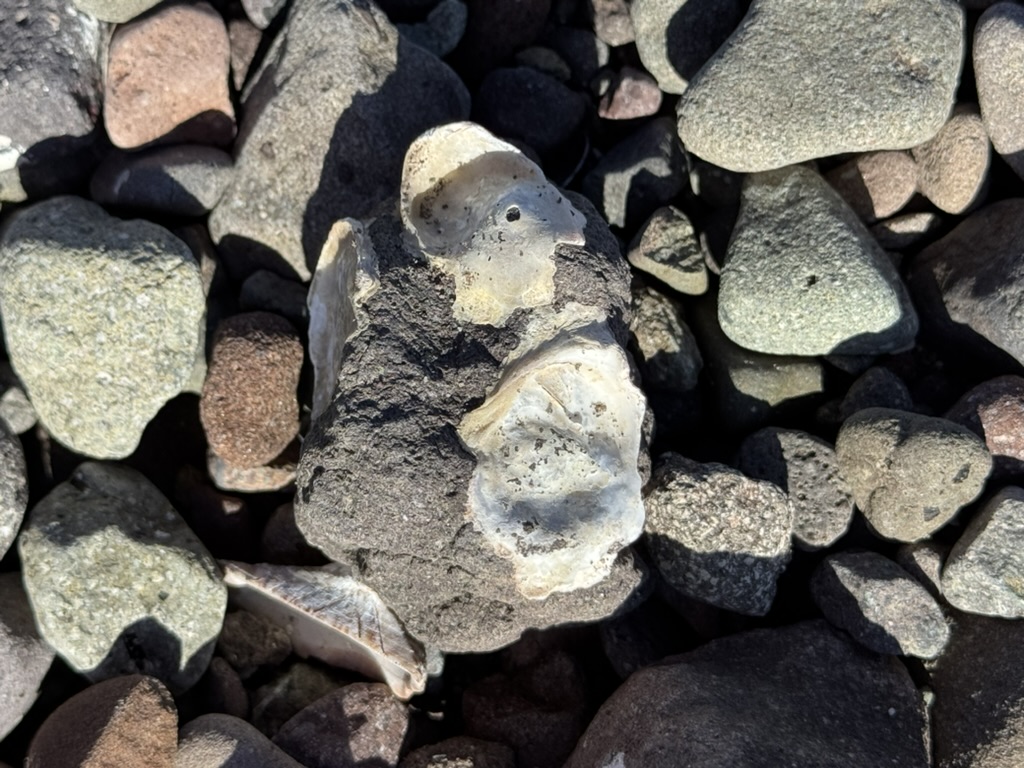
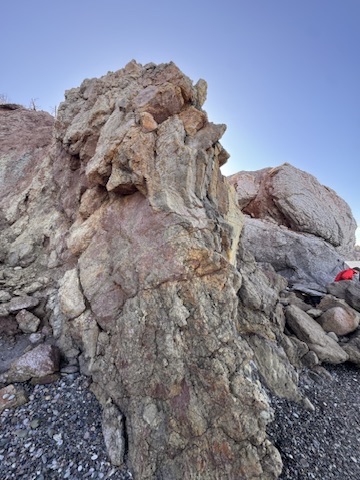
I took this photograph in a landscaped courtyard in Loreto, where volcanic rock had been arranged around the base of a cactus. The large red stone in the foreground drew my attention first. Its surface was rough and pitted, marked with white mineral deposits that traced the contours of its form like veins beneath skin. It rested on a bed of dark grey and black stones, smooth and rounded, clearly gathered and placed by human hands. Behind it, the green ridges of the cactus rose toward a doorway just beyond my view.
This is one of the photographs I have kept in colour. The red of the volcanic rock carries meaning that greyscale would flatten. The mineral white, the muted rose, the dark charcoal of the surrounding stones, these colours speak to origin and transformation. Volcanic rock remembers heat. It holds the shape of pressure and release, of matter that was once liquid and is now solid, porous, still.
I am drawn to stones that have been moved. Gathered from one place and set down in another, arranged to create order or beauty or simply to mark a boundary. These stones arrived here with intention. Someone chose them, carried them, positioned them around the cactus with intention. The red stone was placed to be seen. It holds its position like a body that knows it belongs, even if belonging required relocation.
In my scholarly and personal life, I think often about placement. Who decides where things go. Who arranges the landscape and for whom. The courtyard is designed, curated, maintained. The stones perform their role in a composition meant to welcome or impress. Yet the red rock carries its own history, its own memory of fire and cooling, its own slow accumulation of mineral and dust. It participates in the design without being reducible to it.
This image holds the tension between the natural and the arranged, between what the land offers and what human hands choose to do with it. The stone is both decoration and witness. It holds its ground amid the grey, asking nothing, offering only its texture and colour and the quiet fact of its presence.
On Airports, Winter, and the Body’s Memory of Warmth
Title: Holding the Line
Artist Statement
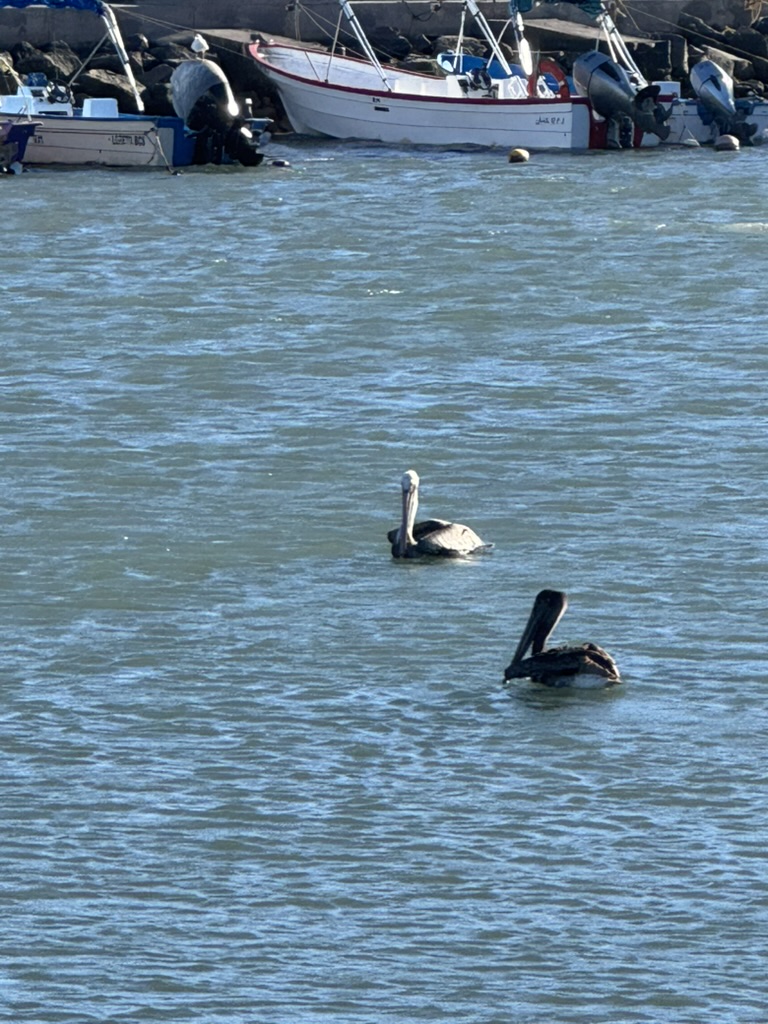
I took this image for reasons beyond the pelicans being unusual. I took it because they felt immediately familiar.
They stood together on the dark rock at the edge of the water, each angled slightly differently, each absorbed in their own posture of rest or watchfulness. Some faced the sea. Some turned inward. All of them belonged to the moment they were in. As I watched, I felt a recognition settle in my body. This was a scene about presence rather than action.
What this moment stirred in me was an understanding I have been carrying for some time. Togetherness can exist without closeness, and connection can take shape without conversation. The pelicans shared space with ease. There was no tension in their spacing, no urgency in their stance. They seemed to know when stillness was enough.
Standing there, I felt accompanied without being required. That feeling matters to me. It reflects a way of being I am learning to honour in my own life and work, especially during periods of transition. There is care in remaining where you are. There is wisdom in pausing at the edge of things.
This reminds me that some forms of belonging are quiet. They rest on attentiveness, patience, and a shared horizon rather than exchange. The shoreline held us all, and for a while, that was sufficient.
Photo Credit: Amy Tucker, 2026
Leaving in Full Light
The taxi arrived at 12:30 in the afternoon, and I was ready. Or I thought I was ready. I had spent the morning doing the things a body does when it is preparing to leave a place it has loved: walking the shoreline one last time, sitting on the bench behind the building with my journal, drinking coffee slowly in the small kitchen while the midday sun poured through the window and lay itself across the tile floor like an offering.
Loreto was wide awake around me. This was the difference I had never anticipated: leaving in full daylight, in the bright, unforgiving visibility of a Baja California afternoon. There was no cover of darkness, no pre-dawn mercy. Everything I was leaving was illuminated. The Sea of Cortez held the afternoon light in a thousand shifting planes of blue and silver. The Sierra de la Giganta stood sharp against a sky so clear it looked painted. The bougainvillea at the entrance of the casita blazed fuchsia, as if insisting I remember this colour, this exact shade, this intensity.
Me voy. I am leaving. And everything I am leaving is visible.
I had promised myself I would pause at the doorway. I did. I let my hand rest against the warm stucco of the casita doorframe and said thank you, silently, to the walls that had held me. To the small kitchen where I had made simple meals. To the bed where I had slept and woken and slept again, learning that rest could be trusted rather than feared. The stucco was warm under my palm, sun-heated, alive with the stored warmth of a January day in the desert. I held my hand there for a long moment, letting the warmth transfer. Then I lifted my hand. Then I turned away.
The driver loaded my bags into the trunk. I got into the car, and we pulled away from the casita, from the shoreline, from the thirty days that had changed everything about how I understood myself. The road to the airport wound through town, and I watched it all pass with the acute attention of someone who knows she is seeing something for the last time: the misión whose bells I had learned to anticipate, the malécon where I had walked each evening watching pelicans fold themselves into darkening water, the small tiendas with their hand-painted signs, the dogs sleeping in the shade.
The sea appeared and disappeared between buildings as we drove, a flash of blue, then gone, then blue again. Each glimpse felt like a small goodbye.
A warmth rose in my eyes as tears formed. It was time to say goodbye.
Title: Last Look at the Beach
Artist Statement
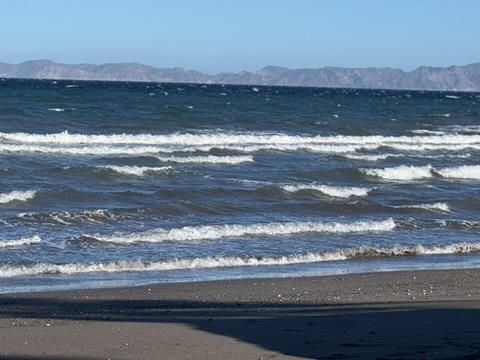
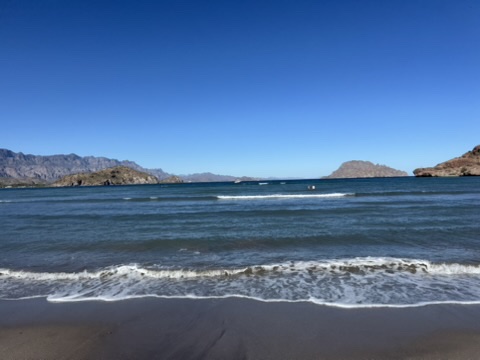
Memories of my final walk along the shoreline. The tide was retreating, leaving a mirrored gloss across the sand that blurred the boundary between land and sea. To the left, the rocky outcrop remains immovable, ancient, as the surf rolls in rhythm against it. The houses along the right edge of the frame glow in late morning sun, silent witnesses to thousands of arrivals and departures. This image captures the tension between permanence and passing, how the landscape stays while we move through it.
I was standing in the shallow surf when I framed this shot, already carrying the weight of leaving. The scene is too beautiful to take casually, and too bright to leave unnoticed. There is a particular cruelty to leaving in daylight, when everything is still illuminated, when the sea gleams and the sky is faultless, when no shadow shelters you from the ache of goodbye. The stillness of the scene is a kind of defiance. It says: you are going, and we stay.
As part of my visual inquiry, this photograph explores the aesthetics of impermanence. The tide will rise again. The footprints will fade. The mountains will remain. And in their quiet endurance, they remind us: we pass through, and remain in the places that held us.
Photo Credit: Amy Tucker, January 2026
There is a particular cruelty to leaving in daylight.
What I Take With Me
The inventory that matters is the one I carry in my body.
I want to name what I carry. I want to be precise about it, because precision is itself a practice, and because the things we carry deserve to be acknowledged rather than assumed.
In my luggage: fragments of blue tile gathered from construction sites and empty lots. Smoothed glass worn by the sea into something translucent and soft. An amber stone that caught the afternoon light in a field and made me stop walking and bend down. Painted rocks marked with colour during the quiet hours. Shells. A notebook filled with thirty days of writing. A camera full of images. These are the material artifacts, the physical evidence that I was here and that here changed me.
But the inventory that matters is the one I carry within me. This is what I take with me:
I practice slow attention. Thirty mornings of walking the same shoreline taught me that looking at the same thing again and again produces depth rather than boredom. I learned to see what the first glance misses: the shift in light between 7:15 and 7:45, the different textures of sand at different tides, the way a pelican adjusts its wings a fraction of a second before it dives. I carry this attention home. I will apply it to the Thompson River, to the winter light on snow, to the faces of people I have missed.
I take the capacity to rest without guilt. This was perhaps the hardest lesson. After nineteen years of precarious academic labour, my nervous system had been trained to associate rest with danger, stillness with failure, any moment of unproductivity with the threat of termination. In Loreto, I practised lying down in the middle of the afternoon, practised closing my eyes, practised doing nothing and letting nothing be enough. The guilt softened gradually. But it softened. And the softening is something I carry.
I take the knowledge that solitude can be chosen rather than only endured. Alonetude, the concept at the heart of this inquiry, names the labour of transforming imposed aloneness into intentional presence. What was structurally produced by institutional harm, by termination, by the sudden loss of professional identity, became, through daily practice, something generative. I learned to be with myself the way one learns any skill: through repetition, through patience, through the willingness to fail and begin again.
I take the sea inside me. This is harder to articulate, because it lives below language, in the body rather than the mind. Thirty days of waking to waves, of walking beside water, of falling asleep to the rhythm of the tide: all of this has inscribed itself into my nervous system. Stephen Porges (2011) would call it a recalibration of the autonomic baseline. I would call it the sea becoming a presence I carry, a felt sense of rhythm and constancy that lives in my chest even when the nearest water is the Thompson River, frozen and silent.
What fits in a bag is never everything. The rest I carry in my body.
I take my own voice. Beyond the performing voice, the one that learned to sound confident in meetings, competent in classrooms and grateful for every short-term contract. I take the voice that speaks in this blog, the one that thinks on the page, that allows itself uncertainty, that moves between English and Spanish because some truths require more than one language. Llevo mi voz. La verdadera.I carry my voice. The real one.
Title: What Fits in a Bag
Artist Statement
I am holding a sealed plastic bag filled with small, weathered fragments, ceramic tile, bone, glass, coral, and stone, collected over thirty days of walking. These are something beyond souvenirs in the traditional sense. They are artifacts of care: every object chosen, lifted, kept. Each one once discarded or forgotten by the world, now gathered in the palm as something worth holding.
This belongs to a larger inquiry into attention, memory, and material culture. The bag is light, yet carries the weight of presence, of showing up every day, of noticing what is overlooked, of witnessing small beauty in the ordinary. These fragments are records of practice rather than productivity. They resist metrics and outcomes. They say: someone was here, and they were paying attention.
As a counter-archive, this collection honours the slow, daily labour of healing. These objects hold no monetary value, but they testify to the worth of lived experience outside systems of valuation. I gathered them with the same hands that once typed reports, scrubbed dishes, comforted others. Now, they hold proof of my own return to self. What I could carry, I did. The rest remains, in the land, in the light, and in me.
Photo Credit: Amy Tucker, January 2026
The Anthropology of Transit
Perhaps non-places become places when we carry enough presence into them.
The flight to Calgary departed at 3:20 in the afternoon, and as the small plane lifted off, I pressed my face to the window. There it was below me: the water I had walked beside every morning, the shoreline I had photographed in all its moods, the town that had held me without asking anything in return. From above, Loreto looked so small. A scatter of white buildings between brown mountains and blue water. A place that barely registered on any map of significant things.
Adiós, Loreto. Gracias por todo.Goodbye, Loreto. Thank you for everything.
Marc Augé (1995), the French anthropologist, coined the term non-places to describe the spaces of transit that define contemporary life: airports, highways, hotel chains, and shopping centres. These are locations designed for movement rather than dwelling, for anonymity rather than relationship. Augé argues that non-places have proliferated in what he calls “supermodernity,” creating environments where individuals exist in solitary contractuality: bound by the same rules, sharing the same trajectory, yet fundamentally alone.
For Augé (1995), what distinguishes a place from a non-place is the presence of relational, historical, and identity-forming qualities. Where these are absent, the space remains anonymous and transient, a non-place.
I moved through the sequence of non-places that would carry me from Loreto to Los Cabos to Calgary, and I found myself attending to them differently than I might have before this month of practice. Alonetude had trained my attention. Even in spaces designed for anonymity, I noticed: the quality of light in the Loreto terminal, warmer than expected; the way strangers arranged themselves in waiting areas, maintaining careful distances, each person an island of private attention; the particular hum of airports, mechanical and constant, so different from the organic rhythms of the sea.
Something had shifted in me. Where I might once have experienced airport solitude as emptiness, I found myself settling into it as familiar territory. I knew how to be alone now. I knew how to let silence hold me rather than threaten me. The skills I had practised beside the sea were portable. They travelled with me into the non-place. Perhaps non-places become places when we carry enough presence into them.
Title: In Transit
Artist Statement
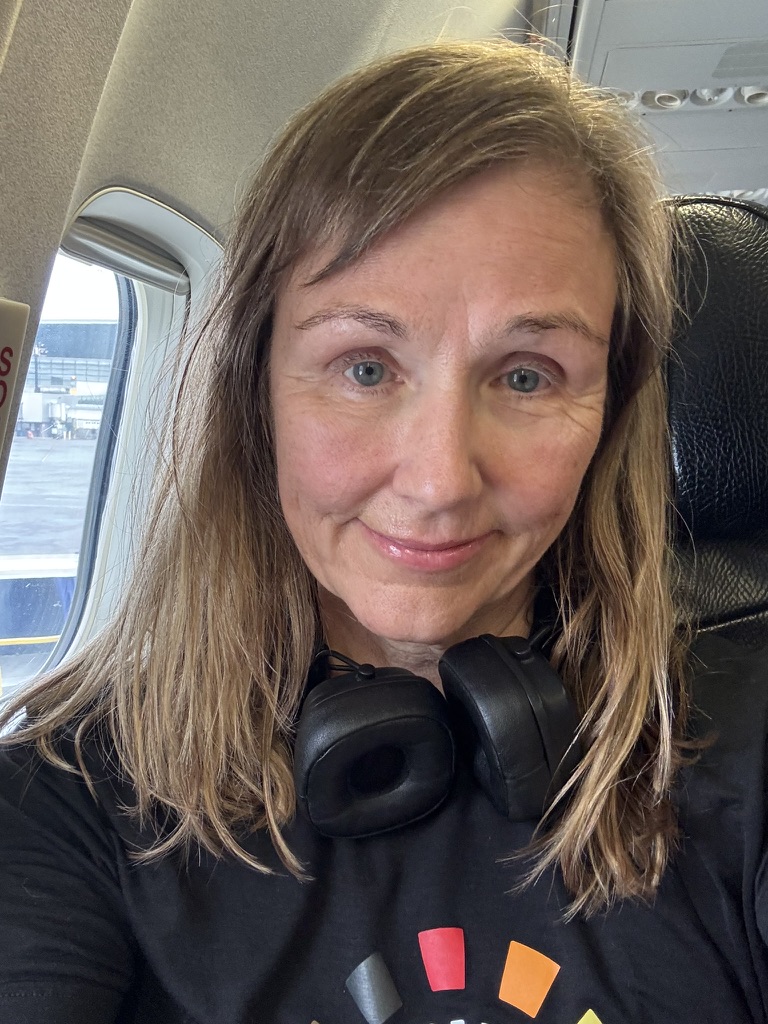
I took this photograph to mark the threshold. Beyond leaving or arriving, the suspended moment in between, where the place I have been is behind me, and the place I am going remains still ahead. Within this inquiry of self and place, this image holds a different kind of evidence: that transitions are worth documenting, that identity travels with us, stitched into our clothing, packed in carry-ons, held in our posture and our gaze.
The act of returning is never only about geography. It is also about re-entering stories, roles, and routines, with new insight quietly folded into the familiar. This is a quiet picture. But it is real. It says: I was in motion, I was between places, and I was awake to all of it.
Photo Credit: Amy Tucker, 2026
Calgary: The Shock of Winter
The plane descended through grey cloud cover, and when it broke through, I saw snow. Miles of it, stretching to every horizon, white and pale grey and the dark lines of bare trees. The Rocky Mountains rose to the west, their peaks lost in cloud. The screen on the seatback told me the temperature outside was minus eighteen degrees Celsius.
My body knew before my mind caught up. As the plane touched down, I felt a contraction in my shoulders, a tightening across my chest, a bracing I had forgotten I knew how to do. Stephen Porges (2011) describes this process as the body’s instinct to scan for safety: the nervous system’s capacity to evaluate risk and safety below the level of conscious awareness. Environmental cues, including temperature, light quality, and sensory familiarity, activate autonomic responses before thought can intervene. Cold is a cue the body reads as a potential threat: resources must be conserved, vigilance must increase, and the system must prepare.
I felt this reading happen in real time as I walked through the jetway into the Calgary terminal. The air was different. The light was different. Everything my body had learned to associate with safety over thirty days of warmth and sea air was suddenly absent.
Hace frío. Hace mucho frío.It is cold. It is so cold.
Yet there was recognition in the cold as well. Yi-Fu Tuan (1974), the geographer who coined the term topophilia, describes the deep, often unspoken bonds that form between humans and their environments through accumulated bodily experience. Topophilia is the affective tie between a person and a place: a love of place that lives in the muscles and the memory rather than in conscious thought. I had topophilia for Loreto now, new and tender, formed over thirty days of deliberate attention. But I also had topophilia for the Canadian winter, older and deeper, woven into my earliest memories of belonging. The cold that made me gasp was also the cold I had grown up in. My body remembered, even as it protested.
I stood in the customs line and reminded myself that I had skills now. I had practised holding difficult sensations. I had learned to breathe through discomfort rather than brace against it. I could meet this cold the way I had learned to meet loneliness: by acknowledging it, by staying present with it, by trusting that I could tolerate what was happening without being destroyed by it. The practice travelled. The practice was held.
Kamloops: The Final Descent
The connecting flight from Calgary to Kamloops took barely an hour, but it crossed a threshold more significant than distance. Kamloops is where I live. Kamloops is where integration happens, where the practice must prove itself portable, where everything I learned beside the sea meets the demands of ordinary life.
The plane descended over the Thompson River valley, and I pressed my face to the window. The landscape below was brown and white, sagebrush and snow, the particular semi-arid terrain of the British Columbia Interior that looks nothing like Baja California yet shares something essential: a spare beauty, a refusal of lushness, a landscape that asks you to look closely before it reveals what it offers.
Secwépemc Territory. I was returning to land that holds stories far older than my own, land that has been home to the Secwépemc people since time immemorial. The university where I worked and was terminated sits on this territory. My home sits on this territory. Any practice of presence I develop here must include awareness of whose land I am on, whose histories the ground holds, whose presence preceded and surrounds my own. The privilege of retreat, of choosing to leave and choosing to return, is itself a position that requires acknowledgment.
Estoy en casa. I am home. But “home” has become more complicated than it was thirty-one days ago.
The Threshold of Home
And then I was standing at my own front door, key in hand, luggage at my feet. The moment stretched. Arnold van Gennep (1909/1960) would have recognized this pause: the final threshold, the limen between journey and arrival, the last crossing before what he called incorporation is complete.
I had left this door thirty-one days ago, carrying exhaustion, grief, and the residue of nineteen years of precarious academic labour. I was returning through it now carrying fragments of blue tile, an amber stone, painted rocks, and something less visible but more important: the knowledge that I could hold myself. That I could sit with difficulty and let it transform rather than destroy. That I could choose solitude and find it generous.
Gaston Bachelard (1964) writes in The Poetics of Space that the house is our first universe, the original container of human beings. We carry our earliest houses inside us; they shape how we understand shelter and belonging forever after. The house protects the daydreamer, Bachelard argues. It allows us to dream in peace. I had spent thirty days in a temporary shelter, a casita that held me while I learned to dream again. Now I was returning to the permanent shelter, the one that holds my books and my art supplies and the accumulated objects of a life.
I turned the key. I pushed open the door. I stepped across.
Title: The Door I Return Through
Artist Statement
This photo marks the entrance to the Copper Room in Harrison Hot Springs, BC, where I began a two-week professional development retreat. The stone pillars and long corridor felt symbolic as I stood there on arrival. It was a passageway in every sense, architectural, emotional, and professional.
The towering trees framed the entry like quiet sentinels. I noticed how the stillness of the place contrasted with the nervous energy I carried. I had come here to stretch professionally, to learn new frameworks, to step into spaces of collaboration and growth. But I also brought with me questions about capacity, identity, and balance. What does it mean to keep learning while already carrying so much?
I often reflect on how informal experiences become sites of learning. This training retreat, though formally structured, also offered informal knowledge. Conversations over meals, silent walks between sessions, and the internal dialogue that surfaced while away from home all became part of the learning process.
This image reminds me that thresholds are everywhere. Sometimes they look like grand beginnings. Other times they appear as covered walkways leading toward something still ahead and uncharted. Here, I stepped forward again. I made the choice to enter, to participate, to allow professional learning to unfold alongside personal discovery. The path was both literal and metaphorical, and I walked it willingly.
Photo Credit: Amy Tucker, January 2026
What the House Holds
I came home for one day. Just long enough to open the windows, let fresh air move through the rooms, and wash the scent of sea salt and desert dust from my clothes. The house felt unfamiliar at first, like it had paused in my absence. The fridge was nearly empty. My bed, though familiar, felt heavy with winter blankets. Still, I moved through it with quiet purpose. I unpacked the pieces I had carried back, blue tiles, shells, and a single amber stone, and set them gently around the room, small anchors from another place. Then I turned to packing again.
This time, I prepared for something entirely different: a two-week professional development training at Harrison Hot Springs. I swapped beachwear for layers and packed my laptop, notebooks, and practical shoes. The shift from stillness to structure felt abrupt. I wondered if the clarity I had found walking the shoreline each morning could follow me into a hotel conference room. Would I still be able to hold space for reflection, for writing, for the quiet internal work that rarely fits inside a schedule?
The question that rose for me was this: Can I practice my alonetude here?
Alonetude, beyond loneliness, as a cultivated way of being, an intentional solitude shaped by curiosity and care. The kind of solitude that made me sit still in Loreto rather than rush. Will I find moments in Harrison to pause, to observe, to be present with myself? Or will the structure of professional training, the social expectations, the busy schedule, begin to blur those internal edges I worked so hard to sharpen?
I am curious how my learning will shift when placed in a new setting. Will the outer learning complement the inner? Can they sit side by side without one erasing the other? I pack these questions along with my belongings, unsure of the answers, but committed to paying attention. That, too, is part of the practice.
Estoy aquí. Estoy presente.I am here. I am present.
Title: Threshold, With Steam
Artist Statement
This image captures the thermal pools at Harrison Hot Springs, mist rising into cedar-scented air, soft steam blurring the line between water and sky. Twinkle lights wrap the bare branches of the tree in the foreground, glowing quietly against the grey. People soak, talk, float. The water is warm, the air cool, the mood liminal.
I took this photo from the edge, standing at the edge, watching. I wanted to notice what it means to arrive somewhere new with a body still adjusting to movement, with a mind that is used to solitude. I am in a shared space now, one designed for restoration but also for community. I wonder if there is room here for alonetude. Can solitude be practised within public space? Can I still observe without retreating, still hold the boundary between reflection and performance?
This photograph sits within a personal inquiry of movement, arrival, and inner continuity. It documents the tension I carry into this next phase: how to stay present in myself while stepping into structure and social expectation. I offer the image as a moment of threshold. The warmth invites me in. The mist allows me to remain a little hidden. For now.
Photo Credit: Amy Tucker, 2026
The First Night Back
I woke at three in the morning, disoriented, reaching for the sound of the sea and finding silence. A silence so complete it felt physical. The waves that had accompanied every one of the thirty nights were gone, replaced by the hush of a Canadian winter night: the occasional creak of the house settling in cold, the distant rumble of a snowplough on a far street.
I reached for the amber stone beside my bed. Its smoothness in my palm was an anchor, a tangible link to everything I had learned. I held it and breathed, practising the attention I had cultivated, bringing myself into this present moment rather than grieving the moments that had passed.
Jon Kabat-Zinn (1994), in Wherever You Go, There You Are, writes that mindfulness is available in every moment we choose to be present. It requires no particular location, no special equipment, no retreat from ordinary life. The breath is always here. The body is always now. I breathed in the Canadian winter air, dry and cold even inside the house, and let it pass through my lungs. I breathed out and felt my shoulders soften against the pillow.
I thought about Donald Winnicott’s (1958) concept of the capacity to be alone: the foundational psychological ability that develops, he argued, through the experience of being alone in the presence of a reliable other. A child learns to be with herself while a caregiver remains nearby, available without intruding. Gradually, the child internalizes this supportive presence and can tolerate aloneness without anxiety.
Something like this had happened in Loreto. The sea’s constancy, the practice of walking each morning, the permission to be with myself without performance: all of it had become a kind of inner presence, a reliable support I now carried within. I was alone in Kamloops at three in the morning, but I had company. The company was the practice itself, the capacity I had cultivated, the self that knew how to hold itself with tenderness rather than judgment.
Aquí estoy. Aquí sigo.Here I am. Here I continue.
Table 2
Bridges’ Transition Framework Applied to the Alonetude Return
Transition Phase
Description
Application to Day 31
Leaving the casita in full light, the hand on the warm doorframe; final glimpse of the sea between buildings; the taxi pulling away from the shoreline
Letting go of the old situation; acknowledging what is being lost; grieving the identity or structure that is ending
Leaving the casita in full light; the hand on the warm doorframe; final glimpse of the sea between buildings; the taxi pulling away from the shoreline
the in-between
The in-between time when the old is gone but the new has yet to fully arrive; disorientation; confusion; creative possibility
Leaving the casita in full light, the hand on the warm doorframe; final glimpse of the sea between buildings; the taxi pulling away from the shoreline
New Beginning
Integrating the new identity or situation; finding meaning in the changed reality; committing to moving forward
Crossing the threshold of home; placing Loreto fragments on the windowsill; practising presence at 3 a.m. in the cold; trusting that alonetude is portable and the third shore lives within
Note. Adapted from Bridges (2004). William Bridges distinguishes transitions from changes: change is situational (the new city, the new role, the end of the retreat), while transition is the psychological process of adapting to change. The in-between, often the most difficult phase, is where transformation actually occurs. Day 31 compresses all three phases into a single day of travel and arrival, requiring the body to move through ending, disorientation, and beginning in rapid succession. This compression may explain the particular exhaustion of return: the body is doing the work of three phases simultaneously.
Carrying the Practice Forward
The next morning, I walked to the window, the same way I had each morning in the casita, to see the sea. There was no sea. There was frost on glass, snow on trees, the particular quality of light that belongs to the Canadian Interior in February. I made tea, stood at the window, and practised presence. The same discipline of attention, applied to a different landscape. The same self, learning that the capacity for alonetude travels with her wherever she goes.
The third shore, I realized, had never been only about Loreto. The third shore is wherever we practise the intentional transformation of imposed aloneness into chosen solitude, wherever we attend to our own presence with care rather than judgment, wherever we resist the extractive demands of systems that would value us only for what we produce. The third shore is portable. I had carried it home with the fragments and the stone and the sea I now held inside my chest.
I will walk in Kamloops the way I walked in Loreto: with attention and without haste. I will protect time for alonetude within the press of obligations that will soon reassert themselves. I will remember what the retreat taught me: that I am more than what I produce. That rest is resistance. That slow attention is a discipline worth practising. That the body holds wisdom the mind cannot access alone. That solitude, chosen and inhabited with care, carries its own kind of company.
The fragments on the windowsill catch the morning light. The amber stone waits beside the bed. The practice continues.
Title: Amber, Carried
Artist Statement
I held this fragment in my hand, less for rarity or value than because it had weight and warmth. Found among scattered rocks near the sea, its honeyed glow caught the light like memory. This piece of amber, or perhaps just sea-worn glass, I never asked it to declare itself, became something I returned to again and again. Its edges are uneven. It fits nowhere perfectly. And yet, in the palm, it rests as if made to be held. I brought it home as proof rather than treasure. Of seeing. Of choosing. Of finding beauty in what washes loose. This shard was never fully mine, really. But for a time, I was the one who carried it.
Photo Credit: Amy Tucker, January 2026
The journey from Loreto to Calgary to Kamloops took hours, tracing a line across time zones, climates, and the subtle thresholds between who I was there and who I must be here.
But the journey home is longer. It will take the rest of my life.
La tercera orilla vive en mí ahora. Adondequiera que vaya, la llevo conmigo.
The third shore lives in me now. Wherever I go, I carry it with me.
References
Augé, M. (1995). Non-places: An introduction to supermodernity (J. Howe, Trans.). Verso. (Original work published 1992)
Bachelard, G. (1964). The poetics of space (M. Jolas, Trans.). Orion Press. (Original work published 1958)
Bridges, W. (2004). Transitions: Making sense of life’s changes(2nd ed.). Da Capo Press.
Kabat-Zinn, J. (1994). Wherever you go, there you are: Mindfulness meditation in everyday life. Hyperion.
Porges, S. W. (2011). The Polyvagal Theory: Neurophysiological foundations of emotions, attachment, communication, and finding our own calm. W. W. Norton.
Tuan, Y.-F. (1974). Topophilia: A study of environmental perception, attitudes, and values. Prentice-Hall.
van Gennep, A. (1960). The rites of passage(M. B. Vizedom & G. L. Caffee, Trans.). University of Chicago Press. (Original work published 1909)
Winnicott, D. W. (1958). The capacity to be alone. The International Journal of Psycho-Analysis, 39, 416–420.
Translation note. Spanish language passages were generated using Google Translate and subsequently reviewed and refined by the author. Any remaining infelicities reflect the limits of machine translation rather than intent.
ACADEMIC LENS
The airport as a site of somatic renegotiation marks this post as a direct continuation of the Day Two Clinical Layover entry: the same liminal non-place, but now occupied by a different nervous system. Van der Kolk’s (2014) central argument is that healing is measurable in the body’s changed response to environments that previously triggered dysregulation, and the comparison between the outbound and homebound airports provides exactly this somatic measurement. The “body’s memory of warmth” also engages what Bachelard (1969) calls the phenomenology of heat: the way warmth registers as both temperature and safety, nurturance, and welcome in the somatic imagination. Levine’s (2010) concept of the “felt sense” applies directly: the warmth of the Sea of Cortez has been encoded as a somatic resource, a memory the nervous system can access to orient toward safety even in unfamiliar or demanding environments. The pelicans holding the line together also perform what Porges (2011) calls co-regulation through proximity: the nervous systems of others, human or animal, can support one’s own regulation when genuine presence rather than performance characterizes the contact.
I bent down to collect them. Three fragments of blue tile, scattered across the grey concrete where something had broken and no one had swept up. They were cool in my palm, smooth on one side and rough on the other where the adhesive had once held them to a surface I would never see. I gathered them without knowing why, only that they asked to be picked up.
This is one of the photographs I have kept in colour. The blue is too insistent to mute. Against the grey of the pavement and the pink of my open hand, the tile fragments glow like something rescued. They are small, irregular, each one shaped by the break that freed it from the whole. The largest is no bigger than my thumb. The smallest could disappear between my fingers. Together, they form a collection that makes sense only to me.
I am drawn to fragments. To what remains after something larger has come apart. These tiles were once part of a pattern, a wall or a floor or a decorative edge designed to hold together. Now they exist as pieces, separated from their original purpose, available for reinterpretation. I witnessed none of the breaking. I only arrived in time to gather what was left.
In my scholarly and personal life, I have come to understand that wholeness is rarely the goal. Sometimes what matters is the willingness to collect what has scattered, to hold the pieces in an open hand without demanding they reassemble into what they were. The tile fragments have no need to become a wall again. They are enough as they are: blue, broken, held.
The photograph situates my body in the encounter. My hand is visible, open, cradling rather than grasping. The lines of my palm map a different kind of history, one written in skin rather than clay. The fragments rest where I placed them, trusting the hand that gathered them. I kept them. I carried them home. They sit now on my desk, small witnesses to the practice of noticing what others leave behind.
I almost walked past it. An orange, vivid and whole, resting on the dry earth as if it had been placed there by intention rather than chance. The ground around it was grey and brown, scattered with stones, dried grass, and brittle leaves. The orange held its colour like a small act of defiance. It was unexpected here, and yet here it was.
How the orange arrived is a mystery to me. Perhaps it fell from a bag. Perhaps it rolled from a table and was never retrieved. Perhaps someone left it as an offering, though to whom or what I cannot say. The fruit showed no sign of decay. Its skin was smooth, its form intact. The slow return to earth had yet to begin. For now, it simply rested, bright and round, waiting for what would come next.
I am drawn to moments of incongruity. Objects that appear in the wrong place, disrupting the visual grammar of a place. The orange interrupts the palette of the desert floor the way unexpected kindness interrupts a difficult day. It simply arrives and asks to be noticed, without explaining itself.
In my broader practice, I attend to what the land holds and what passes through it. Most of what I photograph is grey, weathered, marked by time and use. This orange offered something else. A reminder that colour still exists even when I have chosen to look without it. A small brightness that insisted on its own terms. I photographed it because it held my eye, and I kept it in colour because some things ask to be seen exactly as they are. Photo Credit: Amy Tucker, January 2026
I almost missed it.
A small sun resting on the ground, unapologetic in its brightness.
The earth around it spoke in quieter tones grey stone dried grass the brittle vocabulary of endings.
And then this round insistence of colour.
An orange whole unbruised holding its sweetness as if it had been placed there by a careful hand rather than by accident.
I stood longer than I expected. Long enough to feel how disruption works.
How colour interrupts fatigue. How kindness arrives without introduction.
In a landscape, I have been rendering in black and white reducing the world to shadow and structure This fruit refused translation.
It stayed vivid. It held its colour against my preference for restraint.
It asked to remain exactly as it was.
How it came to rest there is beyond my knowing. Fallen from a bag rolled from a table left as offering to no one and to everyone.
Its surface was unbroken. No softening no collapse no return yet to the soil that waited beneath it.
It was still fully itself.
I photographed it because it interrupted the grammar of the ground.
Because it reminded me that brightness persists even where dust gathers.
Because sometimes what arrives unexpected saves the moment from monotony.
I left it where I found it. A small act of colour resting in a field of restraint holding sweetness against the pull of time.
Title: What the Sweetness Leaves Behind
ACADEMIC LENS
The fallen orange as a site of phenomenological inquiry enacts what Moustakas (1961) describes as the heuristic researcher’s quality of attention: the capacity to pause before what has been overlooked and find, in the seemingly unremarkable, the grounds for genuine insight. Bachelard’s (1969) phenomenology of material imagination applies precisely: the orange’s colour, its wholeness against the grey and brown of the dry earth, its having-been-placed quality despite the absence of a deliberate placer, all constitute an encounter with material reality that invites the imagination into larger territories of meaning. The “vivid and whole” quality of the orange also resonates with Levine’s (2010) somatic concept of resilience: the capacity to remain intact, complete in one’s essential nature, despite having fallen from one’s context of origin. For the precarious academic who has spent nineteen years falling from contract to contract, the orange’s stubborn wholeness offers what van der Kolk (2014) calls a somatic corrective: a material image of survival that asks no compromise of the essential self. Tuan (1977) might note that this unremarkable stretch of dry earth has become, through this moment of attention, a genuine place: ordinary ground transformed by the act of pausing to look.
Reading Time: 8minutesAllowing space, what it looks like when a body begins to trust that rest is permitted. A reflective essay and photograph on the practice of giving yourself room to be without performance, without justification.
Reading Time: 8minutes
Title: The Walk
Artist Statement
I took this photograph because it shows what allowing looks like. The crosswalk is structured, measured, painted in precise intervals, the way institutions measure time in semesters and syllabi and contract renewals.
But beyond it, the path becomes something else: stone fitted by hand, plants growing without permission, shade falling where it will. This is the crossing I am learning to make. From the arithmetic of productivity to the organic unfolding of creative time. From the lie that my worth equals my usefulness to the truth that my hours belong to me.
Transition theorist William Bridges (2019) writes that all transitions begin with an ending and move through a disorienting middle before arriving somewhere new. This photograph captures that middle space, the threshold where one way of being has ended and another has yet to fully form. I stand at the edge of the stripes, looking toward the garden, deciding to cross. The crossing is the allowing. The path beyond is what waits when I stop measuring and start living.
Photo Credit: Amy Tucker, January 2026
For nineteen years, I gave my hours away, parcelled them into syllabi and semesters, measured them in student emails answered past midnight, in committee meetings that stole Sunday afternoons, in the endless performance of being enough.
I had never been told my time belonged to me.
I thought it belonged to the institution, to the students who needed me, to the colleagues who counted on me, to the phantom promise of a contract renewed.
I thought rest was something I would earn later, after the grading was done, after the course was redesigned, after I had proven, finally and forever, that I deserved to stay.
Later never came.
Title: What the Ground Holds
Artist Statement
I came across this mark without looking for it. A dark stain on pale gravel, irregular, almost bodily in its shape. It looked as though something had been set down and then lifted away, leaving evidence behind. I stopped because my body recognized it before my mind did.
What this image reminds me of is how much is carried quietly by the ground beneath us. Loss, spillover, residue. The moments that arrive without announcing their importance, yet remain. I thought about how often I have moved through days leaving parts of myself behind in small, unnoticed ways. Fatigue. Grief. Effort. Care. None of it dramatic. All of it real.
There is a tendency to tidy meaning, to clean up what feels uncomfortable or ambiguous. This mark resists that impulse. It is uneven. It resists easy resolution into a symbol. It simply exists. That matters to me. It mirrors the way experience often lands in the body and in memory, less as a story with a clear beginning and end than as something that seeps in and stays.
Standing there, I felt a quiet permission to acknowledge what lingers after long periods of giving, striving, and holding things together. The ground accepts without judgment what falls onto it. It absorbs. It remembers. It carries on. I find comfort in that. It suggests that presence leaves traces, even when there is no witness.
This image stays with me because it affirms a truth I am learning to trust. That what is left behind still counts. That marks of passage, effort, and release require no interpretation to be valid. Sometimes they only need to be seen.
Photo Credit: Amy Tucker, 2026
Now I am learning a different arithmetic.
An hour spent painting stones is an hour spent fully. An afternoon watching light move across water is an afternoon found. A morning with no agenda, no output, no proof of productivity: a morning given, never stolen from something more important.
This is the hardest math I have ever done: subtracting the lie that my worth equals my usefulness, adding back the hours that belong to no one but me.
Title: Being Received
Artist Statement
I remember arriving here without urgency. The body had already slowed before the mind caught up. Morning light moved through the trees and settled across the stones, touching everything gently, as if to say there was time.
What this place brought back to me was the feeling of being received rather than evaluated. The ground was uneven beneath my feet, rounded stones fitted together by hand, asking me to pay attention to how I walked. The light did the same. It filtered rather than flooded, offering warmth without demand. I felt myself soften in response.
I have spent many years arriving in spaces that asked me to explain myself quickly, to justify my presence, to prove my value. This moment asked for something different. It invited stillness. It invited noticing. It allowed me to arrive as a body first, before arriving as a role or a set of credentials.
Standing there, I felt the quiet relief of entering a place where time moved differently. Where welcome was expressed through shade, texture, and light rather than expectation. It reminded me that arrival can be gentle. That being present requires no performance. That some places meet us exactly where we are.
This image holds that memory for me. A reminder that arrival can feel like exhale. That there are spaces in the world where nothing is required beyond paying attention and letting oneself be held by the moment.
Photo Credit: Amy Tucker, 2026
Creative space arrives only when allowed.
It must be protected from the voices that say you should be working, from the guilt that rises when the hands are still, from the old habit of filling every silence with effort, with striving, with the desperate attempt to outrun my own disposability.
Allowing is an act of will. Allowing is an act of faith. Allowing is an act of resistance against every system that taught me my time belonged to others.
I am learning to say: This hour is for colour. This hour is for stillness. This hour is for the part of me that wants to make something, simply for the making, beyond grading or publishing or praise, but because making is what humans do when they are allowed to be human.
I am learning to say: This needs no justification. I owe no explanation. Creativity requires no proof through outcomes, impacts, and metrics.
The counting was the problem. The measuring was the cage.
Creative space is full. It is full of everything I pushed aside while I was busy surviving: the colours I wanted to play with, the shapes I wanted to explore, the questions I wanted to follow without knowing where they led.
Creative space is necessary, rather than indulgent. It is medicine. It is the room where the soul remembers what it came here to do.
I am learning that allowing is wisdom, never laziness. I am learning that rest is strength, never weakness. I am learning that the hours I give to creativity belong here, taken from nothing more important.
They are the important things. They have always been important. I had simply been unable to see it through the fog of exhaustion, through the fear of inadequacy, through the relentless demand to produce, to prove, to perform.
Today I allow.
I allow the paintbrush in my hand. I allow the stone on the table. I allow the afternoon to unfold without a plan, without a product, without anything to show for it except a quiet body and a heart that remembers it is allowed to want what it wants.
This is everything. The scope is vast.
This is the revolution that happens when a woman who was taught to give herself away finally decides to keep a little something for herself.
Title: What Endures
Artist Statement
I stopped here because the rock felt steady in a way I needed to witness. It rose from the ground with a quiet confidence, fractured yet held together, shaped by pressure, weather, and time. Shrubs and branches reached across it, adapting themselves to its presence rather than overcoming it. Nothing here appeared polished or resolved. Everything felt honest.
This place reminded me that endurance rarely looks graceful. It looks layered. It carries cracks, weight, and evidence of strain. I thought about how often strength is imagined as smoothness or clarity, when lived experience tells a different story. What lasts is usually shaped by friction, shaped by remaining when retreat would have been easier.
Standing before this formation, I felt my own history reflected back to me. Years of pressure. Years of holding. Years of adapting to structures that asked for more than they offered. And still, something essential remained. Grounded. Present. Capable of bearing weight without breaking.
I am drawn to the way the shrubs have grown around and alongside the rock, finding their own lines through what was already there. That relationship feels important to me, the way endurance and growth can coexist, each shaping the other over time. The rock holds its ground beside the plant. The plant finds its way around the rock. They persist together, finding whatever space allows itself to be found.
I return to this image as a reminder that persistence leaves a form. That survival reshapes the body and the land in similar ways. That remaining is itself a kind of quiet courage.
Photo Credit: Amy Tucker, 2026
Title: Learning the Water’s Pace
Artist Statement
I made this without knowing what it would become. I was following colour rather than outcome, letting blue settle where it wanted, allowing darker tones to drift and pool. The paper absorbed more slowly than I expected. Small fibres caught pigment and held it, creating marks that felt almost like rain or memory or breath moving through water.
What this work reminds me of is how different it feels to create without direction. There was no plan here, no sketch to guide my hand. I stayed with the movement instead. I watched how one layer changed the next. I waited for the surface to respond before adding anything more. Time stretched. My body softened. I felt myself listening rather than deciding.
I have spent years working in systems that reward speed, clarity, and completion. This piece lives outside that rhythm. It belongs to a slower register, one that allows uncertainty to remain present. The marks are uneven. The edges wander. Nothing is corrected. That feels important. It mirrors a way of being I am learning to trust, where meaning emerges through patience rather than force.
As I worked, I thought about water as teacher. Water rushes nowhere. It shapes through repetition, through staying, through contact. This piece holds that lesson for me. It reminds me that creativity requires no justification, and that stillness can be active, generative, and alive.
This is what it feels like to let the work arrive on its own terms. To remain with it. To allow.
Photo Credit: Amy Tucker, 2026
References
Bridges, W., & Bridges, S. (2019). Transitions: Making sense of life’s changes (40th anniversary ed.). Balance.
ACADEMIC LENS
The crosswalk as a visual metaphor for institutional measurement, measured, painted in precise intervals like “semesters and syllabi and contract renewals,” places this reflection within Nixon’s (2011) analysis of slow violence: the way institutional structures impose their temporal logic on the body, scheduling its attention, availability, and output according to institutional rather than biological or human need. The path beyond the crosswalk that “allows” without prescribing enacts what Levine (2010) calls somatic freedom: the experience of movement without predetermination that the institutionalised body has been denied. Van der Kolk (2014) argues that one of trauma’s most pervasive effects is the foreclosure of spontaneity: the hypervigilant nervous system is always already prepared for what comes next, leaving no space for genuine openness. Winnicott’s (1971) concept of potential space is also relevant: allowing space, both physical and psychological, is the precondition for play, creativity, and the discovery of genuine desire. The practice of “allowing” described here is actively counter-cultural rather than passive: it refuses the institutional demand for constant purposeful motion and insists on the right to open, undetermined movement as a form of human dignity.
Content Warning: This post contains reflections on body shame, institutional harm, and the experience of exhaustion. Please care for yourself as you read, and feel free to step away if you need to.
I am taking my body back from systems that treat endurance as a virtue and exhaustion as a personal flaw.
I gave years to work without limits, to teaching, care, and constant availability, to building futures while postponing my own. I called this commitment. My body called it extraction.
When my body withdrew consent, It was information, never weakness. It was a boundary where dignity begins.
Burnout is structural evidence, never individual failure.
I am taking my body back from productivity as worth, from unpaid labour dressed as passion, from the idea that rest must be earned.
This is reclamation, rather than withdrawal.
My body carries the record that policies ignore. It remembers what institutions forget.
Taking my body back is a human rights practice. The right to health. The right to rest. The right to work without erasure.
I move more slowly now. I listen longer. I stop when stopping is required.
This is alonetude. This is consent. This is a refusal.
My body is no longer extractable.
Image: When the Body Withdraws Consent
Photo Credit: Amy Tucker, 2026
Note. A single running shoe rests on volcanic sand, emptied of the body that once relied on it for endurance and escape. The shoe functions as an embodied artifact rather than a symbol, registering a moment of refusal. Its stillness marks the point at which movement ceased to be restorative and became extractive. In this inquiry, the object is treated as data within a Scholarly Personal Narrative methodology, documenting how prolonged institutional demands inscribe themselves onto the body and how withdrawal becomes a protective, rights-bearing response. The absence of motion here is evidence, never failure.
Shoe as Witness
I had no plan to photograph meaning. I noticed the shoe because it felt familiar.
It was worn, emptied, left behind without ceremony. No drama. No collapse staged for recognition. Just an object that had reached the end of what it could give. Standing there, I felt a quiet recognition settle in my body. This is what it looks like when consent is withdrawn.
There is vulnerability in admitting that stopping arrived beyond my choosing. For years, I believed endurance was a moral good. I learned to equate commitment with overextension, capacity with worth. That belief was reinforced daily by academic life, where staying available, absorbing uncertainty, and carrying invisible labour were treated as evidence of professionalism. When my body finally refused, I read it as failure. I had yet to understand that collapse can be a form of protection.
With some distance, perspective begins to shift. Burnout is never solitary in its emergence. It accumulates. It settles into muscle, breath, gait. What I once framed as personal weakness now appears as a predictable response to prolonged insecurity and unrelenting demand. The shoe holds this point without argument. It records stopping as fact, without apology.
The action, small as it seems, was noticing. Pausing long enough to see the shoe as more than debris. Photographing it. Allowing it to stand as data rather than decoration. This is how my research is unfolding now, through attention rather than acceleration. Objects speak when I stop trying to outrun them.
Scholarly engagement lives quietly inside this moment. Trauma-informed scholarship reminds us that the body remembers what environments require us to override. Labour research names how systems normalize depletion while individualizing its consequences. Human rights frameworks affirm the right to rest, to health, to work that requires no self-erasure. No summoning of those texts was needed while standing there. They were already present, carried in my body, waiting to be acknowledged.
This image belongs to the same counter-archive as the stones, the shadows, the painted surfaces, the early mornings by the water. Together, they document something institutions rarely record: the moment a body stops agreeing to conditions that diminish it. They track fatigue, refusal, and the slow work of recovery.
In this work, taking the body back is understood as a human rights practice.
I am no longer interested in proving resilience. I am interested in listening to what the body says when it is finally allowed to speak.
This shoe tells that story better than I ever could.
ACADEMIC LENS
The declarative act of “taking my body back” names what van der Kolk (2014) identifies as the central task of trauma recovery: re-establishing the embodied self’s sovereignty over its own experience, after prolonged periods in which institutional demands have overridden the body’s own signals of need, limit, and preference. Hochschild’s (2012) concept of emotional labour provides the structural analysis: the body was instrumentalized rather than simply used, its endurance treated as a renewable resource rather than a finite one with real costs. Nixon’s (2011) framework of slow violence names the mechanism: each individual demand seemed reasonable in isolation, while their cumulative effect constituted a sustained violation of the right to bodily integrity and rest. Menakem (2017) argues that recovery requires the intellectual understanding of harm alongside but the somatic reclamation of the body’s authority: learning to listen to, trust, and act on the body’s signals rather than overriding them in service of institutional legibility. The statement “I am taking my body back” is thus both personal and political: it refuses the institutional definition of the body as a tool for productivity and insists on its dignity as a site of knowledge, feeling, and inherent worth.
Keywords: alonetude, human right to rest, solitude, social justice, loneliness epidemic, scholarly personal narrative, precarious labour, embodied rest
If loneliness is a public health crisis, is the capacity for solitude a human right?
Title: Finding Space to be Alone
Photo Credit: Amy Tucker, 2026
An empty chair. I kept looking at it, how different it felt from a chair that has been left, or a chair waiting for someone. This one felt like a choice.
Loneliness, Solitude, and the Philosophical Distinction
Tillich extended this distinction beyond description to practice, arguing that loneliness can only be transformed by those who learn to bear solitude. He wrote that humans seek to feel their aloneness “not in pain and horror, but with joy and courage,” and that solitude itself can be understood as a form of spiritual or existential practice (Tillich, 1963). This idea points toward contemporary understandings of solitude as an active practice of meaning-making rather than a passive state, and provides a philosophical grounding for the concept of alonetude as the labour of transforming imposed isolation into chosen presence
There is a difference between loneliness and solitude. Philosophers have known this for centuries.
Title: The Liminal Threshold
Photo Credit: Amy Tucker, 2026
Note. A shoreline marking the in-between space where loneliness becomes alonetude.
Paul Tillich (1963) named it simply: loneliness expresses the pain of being alone, while solitude expresses its glory. Psychologist Anthony Storr (1988) challenged the assumption that intimate relationships are the only source of human happiness, arguing that solitude ranks alongside connection in sustaining well-being. Contemporary research confirms what contemplatives long understood: loneliness arises from perceived inadequacy of connection, while solitude emerges through chosen, meaningful engagement with oneself (Perlman & Peplau, 1981; Nguyen et al., 2018).
Loneliness is inflicted; solitude is chosen. Loneliness is the pain of being alone; solitude is the peace of it. To be lonely is to desire an absent want, to feel an emptiness that remains unsatisfied. To be solitary is to retreat into oneself and find, there, good company.
This framing resonates with, yet extends, existing scholarship on solitude (Storr, 1988), relational autonomy (Mackenzie & Stoljar, 2000), and affective infrastructures of belonging (Ahmed, 2017). However, alonetude departs from romanticized accounts of solitude by foregrounding structural constraint and political economy. It insists that the capacity to be alone generatively is unevenly distributed and socially produced. This study extends Tillich’s existential framing by situating being-alone within colonial, institutional, and political-economic architectures that unevenly distribute the capacity for solitude.
Tillich’s existential theology offers an early philosophical distinction between loneliness, the suffering of being alone, and solitude, a generative form of being alone, situating solitude as an existential practice rather than a passive condition. His work frames solitude as a site of encounter, creativity, and ethical reflection, providing a conceptual genealogy for understanding being-alone as both refuge and critique. Building on this lineage, aloneness is theorized here as the labour of transforming imposed isolation into chosen presence within structurally produced conditions of separation (Tillich, 1963).
Tillich’s distinction provides a philosophical grounding for alonetude as the labour of transforming imposed isolation into chosen presence. By defining loneliness as the pain of being alone and solitude as its glory, Tillich establishes solitude as an existential achievement rather than a passive state. His framing implies that solitude must be borne, cultivated, and enacted, thereby opening conceptual space for alonetude as the intentional work of sense-making within structurally imposed aloneness. While Tillich locates this transformation within existential theology, this study extends his genealogy into political economy and human rights, conceptualising aloneness as both refuge and critique within institutional architectures that produce separation.
But what happens in between?
Alonetude: The Space Between Loneliness and Solitude
Paul Tillich (1963) drew a defining distinction between loneliness and solitude: where loneliness names the suffering of unwanted isolation, solitude describes the enriching quality that chosen aloneness can carry.
What do we call the space where loneliness has been imposed by circumstance, yet something in us begins to transform it into something generative? Where isolation, uninvited, slowly becomes a place we learn to inhabit?
I have started calling this alonetude: the liminal space between loneliness and solitude, where we do the quiet work of reclaiming our being-alone from the systems that made it a punishment.
I think of alonetude as what happens when imposed aloneness meets the refusal to disappear into it. Unlike loneliness, which is the pain of unwanted isolation, and solitude, which implies the luxury of choice, alonetude is the active labour of sense-making from within circumstances of your own choosing. It is relational. It is political. And it begins in the body.
Alonetude is the active, intentional work of sense-making within imposed aloneness.
Epidemic Loneliness and Institutional Responsibility
In May 2023, United States Surgeon General Dr. Vivek Murthy declared loneliness an epidemic, issuing an 82-page advisory on the healing effects of social connection and community (Office of the Surgeon General, 2023). By November of that year, the World Health Organization had launched a Commission on Social Connection, naming loneliness a pressing global health priority requiring urgent intervention (World Health Organization, 2023). The Commission’s 2025 flagship report revealed that loneliness accounts for approximately 871,000 deaths annually, equivalent to 100 deaths per hour (World Health Organization, 2025).
We are beginning to understand that chronic loneliness carries health risks comparable to smoking fifteen cigarettes daily (Holt-Lunstad et al., 2010). Social isolation increases the risk of premature death by nearly thirty percent, elevates stroke risk by thirty-two percent, and raises heart disease risk by twenty-nine percent (Office of the Surgeon General, 2023).
Yet the harder question remains unasked.
If loneliness is a public health crisis, is the capacity for solitude a human right?
I think it might be. And I think the distinction matters enormously for how we understand social justice.
Belonging, Solitude, and the Politics of Human Rights
Consider who has access to solitude and who is forced into loneliness.
Image: The Privilege of Passage
Photo Credit: Amy Tucker, 2026
This walkway, shaded and fragrant, made me think about who gets to walk somewhere like this. Solitude is a protected, beautiful thing that remains unavailable to everyone.
The elite retreat to cabins in the woods, meditation centres, and silent spas. They pay for the privilege of being beautifully alone. Meanwhile, the precarious are isolated by design: by shift work that fails to align with anyone else’s schedule, by housing too expensive to afford near community, by immigration policies that separate families across oceans, by institutions that count bodies yet fail to learn names.
Their aloneness is uninvited. It is inflicted.
And then I wonder why I struggle.
I write this from a bench behind an institutional building, between meetings that require presence and systems that rarely offer belonging. My solitude is partially chosen and partially imposed, shaped by precarity, digital tethering, and institutional expectations of constant availability. Alonetude becomes both a refuge and a critique, a way of surviving while refusing to normalize the conditions that make refuge necessary.
Belonging, Isolation, and Rights-Based Frameworks
Contemplative teachers have long pointed toward this transformative potential.
Pema Chödrön (2000) teaches that we must learn to befriend our loneliness rather than flee it, to sit with discomfort until it reveals what it has to teach. Wendell Berry (2012) writes that in wild places, where we are without human obligation, our inner voices become audible, and the more coherent we become within ourselves, the more fully we enter into communion with all creatures. Robin Wall Kimmerer (2013) braids Indigenous wisdom with scientific attention, showing how presence to place can root us even when we have been displaced.
Viktor Frankl (1959), writing from the concentration camps, insisted that meaning could be made even in extremity, that the last human freedom is the ability to choose one’s attitude toward suffering.
Title: Learning to Be With
Photo Credit: Amy Tucker, 2026
Note. Paths and landscapes evoke contemplative traditions and relational presence to land. These teachers point toward alonetude as a practice of survival.
When loneliness is imposed, solitude must be cultivated. When isolation is structural, transforming it into something generative becomes an act of resistance.
I know what makes solitude impossible, because I lived it for nineteen years. The learning management system that logged when I last responded to a student. The email that arrived at 11 p.m. on a Friday with the implicit expectation of an answer before Monday. The performance review that measured visibility, presence, and throughput. These are systems that colonise the threshold between working and resting, making withdrawal feel like abandonment and stillness feel like failure. A right to solitude is, among other things, a right to be unreachable without consequence.
Should We Have to Be So Resilient?
This is what troubles me.
Should the capacity to transmute loneliness into solitude be a survival skill that the marginalized must develop because institutions refuse to stop producing isolation?
A human rights framework asks different questions.
It asks what conditions would make the choice between loneliness and solitude genuinely available, rather than asking how individuals can cope with loneliness after it has been inflicted. It asks what structures produce isolation and who benefits from that production. It asks whether belonging is offered as a right or withheld as a privilege. It asks whether the architecture of our institutions is designed to connect or to extract.
The Political Economy of Being Alone
The right to solitude would mean the right to be alone without being abandoned.
The right to withdraw without being punished.
The right to rest without being surveilled.
The right to enough economic security so that being alone carries no threat of danger.
The right to enough social infrastructure means that being with others remains possible when we want it.
These are human rights claims, even if they rarely appear in declarations. While international human rights instruments rarely articulate a right to solitude, related protections appear in rights to privacy, dignity, rest, housing, social security, and family life (Universal Declaration of Human Rights, 1948; International Covenant on Economic, Social and Cultural Rights, 1966). A right to solitude without abandonment can be understood as an emergent synthesis of these rights, grounded in the principle that human dignity requires both connection and the capacity for withdrawal without harm.
Solitude Without Abandonment: Toward a Human Rights Framework for Alonetude
Alonetude names the in-between.
The place where we do the work of turning imposed isolation into chosen presence. It honours the agency of those who find ways to be well even when systems are designed to make them unwell.
Yet it also refuses to let those systems escape accountability.
The goal is to become so skilled at alonetude that we forget we deserve justice. The goal is a world where solitude is available to everyone, and loneliness is inflicted on no one.
Until then, we practise.
We find our benches behind old buildings. We learn the names of the birds outside our windows. We sit with what is, until it becomes bearable, and then, sometimes, beautiful.
This is survival while we work to end what makes survival necessary.
If alonetude is a human right, then its conditions are a matter of structural justice. The woman working three part-time jobs cannot lie under a spruce tree in the snow. The contract instructor whose rent depends on this semester’s enrolment cannot put her phone away. The immigrant living in a single room cannot choose solitude; it is imposed on her, severed from belonging. What I had in Loreto was thirty days that I could afford, in a body that could manage the travel, in a life that had, finally, space to be still. I am aware of that. The question alonetude asks is what would need to change for that stillness to be available to everyone, as a baseline condition rather than a luxury of a dignified life.
Alonetude is both a practice and a demand.
A way of being and a horizon of justice.
The quiet place where, alone, we remember that we deserve to be.
Title: The Quiet Place Where We Deserve to Be
Photo Credit: Amy Tucker, 2026
Note. Bare feet at the water’s edge, where land meets sea, mark a moment of grounded presence. The image evokes solitude as an embodied encounter rather than absence, being alone while held by place, rhythm, and movement. It gestures toward alonetude as a practice of standing with oneself at the threshold between isolation and connection, presence and belonging, survival and becoming.
Alonetude thus operates as both method and mandate: a practice of surviving within unjust architectures and a theoretical lens for imagining their transformation.
References
Berry, W. (2012). It all turns on affection: The Jefferson lecture and other essays. Counterpoint.
Chödrön, P. (2000). When things fall apart: Heart advice for difficult times. Shambhala.
Frankl, V. E. (1959). Man’s search for meaning. Beacon Press.
Holt-Lunstad, J., Smith, T. B., & Layton, J. B. (2010). Social relationships and mortality risk: A meta-analytic review. PLOS Medicine, 7(7), Article e1000316. https://doi.org/10.1371/journal.pmed.1000316
Kimmerer, R. W. (2013). Braiding sweetgrass: Indigenous wisdom, scientific knowledge, and the teachings of plants. Milkweed Editions.
World Health Organization. (2025). From loneliness to social connection: Charting a path to healthier societies. Report of the WHO Commission on Social Connection. https://www.who.int/publications/i/item/978240112360
The quiet place where, alone, we remember that we deserve to be.
Note: Tillich’s distinction between loneliness and solitude emerges from Western Christian existential theology and reflects Euro-American philosophical traditions that centre individual subjectivity and spiritual interiority. While this study draws on Tillich to establish a conceptual genealogy for being-alone, the concept of alonetude extends beyond this tradition by foregrounding colonial, institutional, and political-economic structures that differentially produce isolation. Rather than treating solitude as a universal existential condition, alonetude situates being-alone within histories of dispossession, migration, academic precarity, and governance, aligning with decolonial and relational epistemologies that understand solitude as socially and materially mediated.1
Translation note. Spanish language passages in this post were generated using Google Translate and subsequently reviewed and refined by the author. Translations are intended to convey general meaning and are intended as guides to meaning rather than certified linguistic interpretations.
ACADEMIC LENS
This essay makes an explicitly normative claim: that the capacity for alonetude, for a positive, integrated relationship with one’s own company, constitutes a human right in the tradition of the United Nations Declaration of Human Rights (1948). Cacioppo and Patrick’s (2008) documentation of the loneliness epidemic, and Murthy’s (2023) designation of loneliness as a public health crisis, provide the epidemiological foundation for taking solitude seriously as a social justice concern. Tillich’s (1963) philosophical distinction between loneliness, which is suffered, and solitude, which is chosen and practised, establishes the conceptual ground on which alonetude is defined: as a third state, neither isolation nor withdrawal, but a cultivated capacity for presence-with-oneself. Nixon’s (2011) framework of slow violence is relevant here in an unexpected direction: just as environmental harm accumulates gradually on vulnerable communities, so does the chronic understimulation of the self-in-relation that hyper-connected, performative cultures impose. The right to alonetude is therefore inseparable from broader rights to rest, to interiority, and to freedom from the demand for constant availability that precarious labour conditions enforce.