Artist Statement

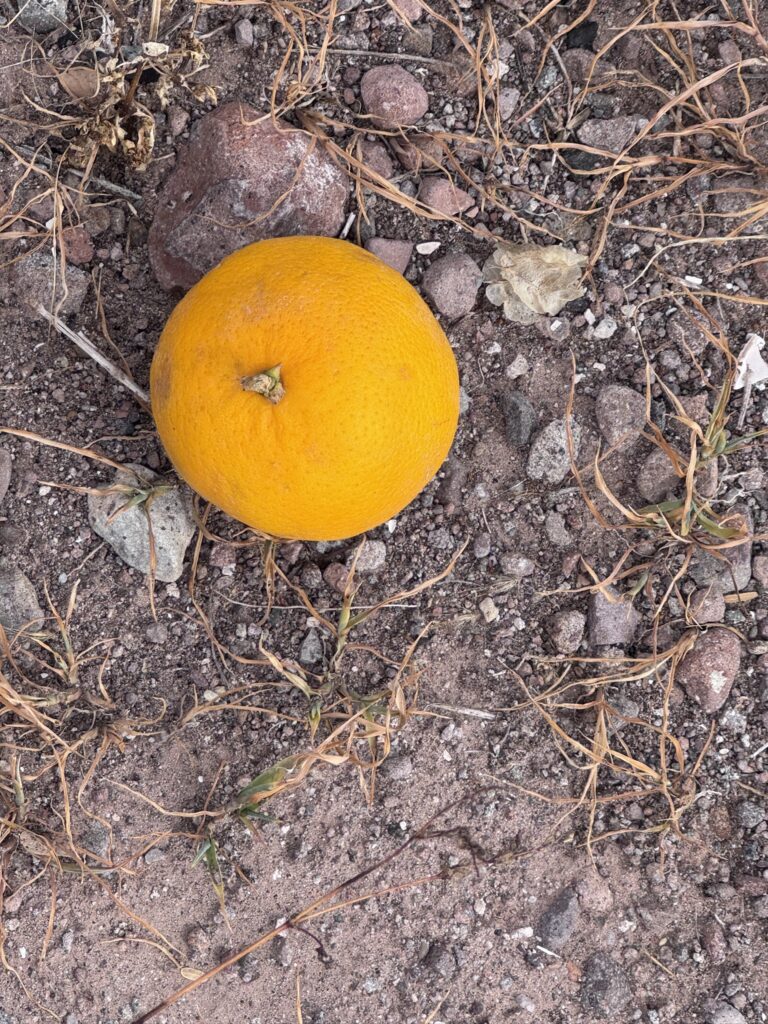
I almost walked past it. An orange, vivid and whole, resting on the dry earth as if it had been placed there by intention rather than chance. The ground around it was grey and brown, scattered with stones, dried grass, and brittle leaves. The orange held its colour like a small act of defiance. It was unexpected here, and yet here it was.


How the orange arrived is a mystery to me. Perhaps it fell from a bag. Perhaps it rolled from a table and was never retrieved. Perhaps someone left it as an offering, though to whom or what I cannot say. The fruit showed no sign of decay. Its skin was smooth, its form intact. The slow return to earth had yet to begin. For now, it simply rested, bright and round, waiting for what would come next.

I am drawn to moments of incongruity. Objects that appear in the wrong place, disrupting the visual grammar of a place. The orange interrupts the palette of the desert floor the way unexpected kindness interrupts a difficult day. It simply arrives and asks to be noticed, without explaining itself.

In my broader practice, I attend to what the land holds and what passes through it. Most of what I photograph is grey, weathered, marked by time and use. This orange offered something else. A reminder that colour still exists even when I have chosen to look without it. A small brightness that insisted on its own terms. I photographed it because it held my eye, and I kept it in colour because some things ask to be seen exactly as they are.
Photo: Amy Tucker, © 2026
I almost missed it.
A small sun
resting on the ground,
unapologetic in its brightness.
The earth around it
spoke in quieter tones
grey stone
dried grass
the brittle vocabulary of endings.
And then this
round insistence of colour.
An orange
whole
unbruised
holding its sweetness
as if it had been placed there
by a careful hand
rather than by accident.
I stood longer than I expected.
Long enough to feel
how disruption works.
How colour interrupts fatigue.
How kindness arrives
without introduction.
In a landscape, I have been rendering
in black and white
reducing the world
to shadow and structure
This fruit refused translation.
It stayed vivid.
It held its colour
against my preference for restraint.
It was asked to remain
exactly as it was.
How it came to rest there
is beyond my knowing.
Fallen from a bag
rolled from a table
left as an offering
to no one
and to everyone.
Its surface was unbroken.
No softening
no collapse
no return yet
to the soil that waited beneath it.
It was still
fully itself.
I photographed it
because it interrupted
the grammar of the ground.
Because it reminded me
that brightness persists
even where dust gathers.
Because sometimes
what arrives unexpected
saves the moment
from monotony.
I left it where I found it.
A small act of colour
resting in a field of restraint
holding sweetness
against the pull of time.
Title: What the Sweetness Leaves Behind
ACADEMIC LENS
The fallen orange as a site of phenomenological inquiry enacts what Moustakas (1961) describes as the heuristic researcher’s quality of attention: the capacity to pause before what has been overlooked and find, in the seemingly unremarkable, the grounds for genuine insight. Bachelard’s (1969) phenomenology of material imagination applies precisely: the orange’s colour, its wholeness against the grey and brown of the dry earth, its having-been-placed quality despite the absence of a deliberate placer, all constitute an encounter with material reality that invites the imagination into larger territories of meaning. The “vivid and whole” quality of the orange also resonates with Levine’s (2010) somatic concept of resilience: the capacity to remain intact, complete in one’s essential nature, despite having fallen from one’s context of origin. For the precarious academic who has spent nineteen years falling from contract to contract, the orange’s stubborn wholeness offers what van der Kolk (2014) calls a somatic corrective: a material image of survival that asks no compromise of the essential self. Tuan (1977) might note that this unremarkable stretch of dry earth has become, through this moment of attention, a genuine place: ordinary ground transformed by the act of pausing to look.

