References: What the Camera Knew Before I Did

Reading Time: < 1 minute

This page lists the verified references for What the Camera Knew Before I Did, part of the A Human Geography of the Self series. All citations have been fact-checked against CrossRef DOI records. Corrections from the original post are noted below.

Verified References

Barron, A. (2025). Photo go-alongs for researching the relations between people and place. Area, 58(1), Article e70050. https://doi.org/10.1111/area.70050

Klingorová, K., & Gökarıksel, B. (2019). Auto-photographic study of everyday emotional geographies. Area, 51(4), 752–762. https://doi.org/10.1111/area.12537

Lombard, M. (2012). Using auto-photography to understand place: Reflections from research in urban informal settlements in Mexico. Area, 45(1), 23–32. https://doi.org/10.1111/j.1475-4762.2012.01115.x

Maclean, K., & Woodward, E. (2012). Photovoice evaluated: An appropriate visual methodology for Aboriginal water resource research. Geographical Research, 51(1), 94–105. https://doi.org/10.1111/j.1745-5871.2012.00782.x

Tuck, E., & Habtom, S. (2019). Unforgetting place in urban education through creative participatory visual methods. Educational Theory, 69(2), 241–256. https://doi.org/10.1111/edth.12366

Wang, C., & Burris, M. A. (1997). Photovoice: Concept, methodology, and use for participatory needs assessment. Health Education & Behavior, 24(3), 369–387. https://doi.org/10.1177/109019819702400309

Fact-Check Notes

Klingorová & Gökarıksel — author name spelling corrected. The original post rendered the surnames without diacritics as “Klingorova” and “Gokariksel.” The verified spellings from CrossRef records are Klingorová, K., and Gökarıksel, B. This is a common transcription issue with non-ASCII characters in academic databases.

All other citations in this post verified correct against CrossRef DOI records: authors, year, journal title, volume, issue, and page numbers confirmed.

Verified June 29, 2026 against CrossRef DOI database.

References: Placelessness and the Contract

Reading Time: < 1 minute

This page lists the verified references for Placelessness and the Contract, part of the A Human Geography of the Self series. All citations have been fact-checked against CrossRef DOI records. Corrections from the original post are noted below.

Verified References

Ferreri, M., Dawson, G., & Vasudevan, A. (2016). Living precariously: Property guardianship and the flexible city. Transactions of the Institute of British Geographers, 42(2), 246–259. https://doi.org/10.1111/tran.12162

Merriman, P. (2024). Places as refrains: A non-constructive alternative to assemblage thinking. Transactions of the Institute of British Geographers, 50(3), Article e12735. https://doi.org/10.1111/tran.12735

Relph, E. (1976). Place and placelessness. Pion.

Simpson, R., Morgan, R., Lewis, P., & Rumens, N. (2021). Living and working on the edge: “Place precarity” and the experiences of male manual workers in a U.K. seaside town. Population, Space and Place, 27(8), Article e2447. https://doi.org/10.1002/psp.2447

Waite, L. (2009). A place and space for a critical geography of precarity? Geography Compass, 3(1), 412–433. https://doi.org/10.1111/j.1749-8198.2008.00184.x

Fact-Check Notes

Simpson et al. (2021) — author corrected. The original post listed three authors: Simpson, R., Morgan, R., & Lewis, P. CrossRef records show a fourth author: Rumens, N. The corrected citation includes all four authors.

All other citations in this post verified correct against CrossRef DOI records: authors, year, journal title, volume, issue, and page numbers confirmed.

Verified June 29, 2026 against CrossRef DOI database.

Placelessness and the Contract

Reading Time: 6 minutes

Reading Time: 6 minutes

Reading Time: 6 minutes

Reading Time: 9 minutes

This piece belongs to A Human Geography of the Self, a series that reads my own life through the concepts geographers use to understand how people and places make one another. It draws on my doctoral and master’s work on contract academic labour, and on nineteen years of teaching on contract.

“For nineteen years I taught from inside an institution that never quite let me have a place in it.”

I have taught for a long time without an office. There were years when I graded a stack of papers at a kitchen table, joined a department meeting from a car, and answered student emails from a borrowed corner. I have been a faculty member who had to ask where the photocopier was, because by the time I learned a building I was teaching somewhere else. I belonged to the institution the way a guest belongs to a hotel. For nineteen years I taught from inside an institution that never quite let me have a place in it. I used to feel this as a personal failure of belonging. I understand it now as geography, and as a question about who is permitted a place at all.

Human geography has a precise language for the thinning out of place, for the spaces that refuse to become anyone’s, and for the working lives that are arranged to keep a person loose, mobile, and replaceable. This post sets two of those ideas side by side: the geographic concept of placelessness, and the geography of precarious work. Together they explain something I felt for two decades before I had the words for it.

The Thinning of Place

The foundational idea here belongs to the geographer Edward Relph. Merriman (2024), revisiting Relph’s 1976 book Place and Placelessness, explains its central worry. Relph argued that places matter because they have attracted and concentrated our intentions, becoming set apart from the surrounding space while still belonging to it, and that we form an essential relationship to places through the embodied practice of dwelling (Merriman, 2024). His fear was that the modern world was undergoing a gradual erasure of variety and localism under what he called the forces of placelessness (the thinning out of distinct, meaningful places into interchangeable, characterless space), leaving a weakened sense of place behind (Merriman, 2024).

Merriman (2024) then connects Relph to the anthropologist Marc Auge and his idea of the non-place (spaces of pure transit and circulation, such as airports, motorways, and malls, designed for passing through rather than dwelling in). In Auge’s account, the traditional place is familiar, historical, and relational, a space where identities and stories can be made, while the non-place is a space of circulation and consumption where, as Merriman quotes, solitudes coexist without creating any social bond (Merriman, 2024). I have worked in non-places. The borrowed corners and the between-class hallways were spaces I moved through without ever being permitted to dwell. The institution offered me circulation rather than belonging. I passed through it for nineteen years.

The Working Life Built to Keep You Loose

Why was I kept moving? Here the second body of scholarship answers, and it answers structurally rather than personally. Waite (2009), in the paper that helped open a critical geography of precarity (the condition of life and work organized around chronic uncertainty and insecurity), describes precarity as referring to life-worlds characterized by uncertainty and insecurity, and notes that the term is double-edged, naming both a damaging condition and a possible rallying point for resistance (Waite, 2009). That double edge matters to me. My precarity was a wound, and it became the ground of my advocacy. Both things are true, and Waite gives me the vocabulary to hold them together.

What strikes me most is how the geographers locate precarity in space itself. Ferreri, Dawson, and Vasudevan (2016), studying insecure dwelling in the flexible city, return to the very root of the word. The etymology of precarious, they note, comes from a Latin term meaning property held at the favour and pleasure of another person, a tenancy held at will (Ferreri et al., 2016). To be precarious, at the level of language, is to occupy a place only by someone else’s permission, a place that can be withdrawn. That is the most exact description of contract academic life I have ever read. I held my place in the university at the institution’s pleasure, semester by semester, always revocable. The word for my working life and the word for a place held on sufferance are the same word.

Ferreri and colleagues (2016) also dismantle the comforting idea that this insecurity belongs only to the low-waged or the unskilled. The shift toward casualization, they show, has spread to include graduate and highly skilled work, producing a precarious subjectivity that has become normalized across the cities of the global North (Ferreri et al., 2016). I am a doctor of social science who taught for nineteen years without a permanent place. I am exactly the figure they describe, the credentialed worker for whom security never arrived.

When Place Itself Becomes the Trap

There is a turn in this literature that complicated my own story in a way I needed. Simpson, Morgan, Lewis, and Rumens (2021), studying manual workers in a struggling seaside town, develop the idea of place precarity (the way a particular place, through its narrowed opportunities, can itself produce and deepen insecurity). They show that precarity is far from only a condition of those forced to move; it can also root a person in one constrained place where the opportunities have thinned, producing what they call a geographical constriction (Simpson et al., 2021). Insecurity, in their account, is fundamentally rooted in the spatial context rather than floating free of it (Simpson et al., 2021).

This reframed my own situation honestly. I live in Oliver, a place I love, in a region I have chosen. My precarity was never the rootlessness of the migrant worker, and I will not borrow that experience. Mine was closer to what Simpson and colleagues describe: a deep attachment to a place I refused to leave, set against a profession that offered me no secure foothold within reach of it. The constriction was real, and it was spatial. I stayed near the water I loved and paid for that loyalty in insecurity. The geography names this exactly.

The Right to a Place

So I have stopped reading my long placelessness as a personal failure. It was a structure, and structures can be named, contested, and changed. This is why the work matters as a human rights story and not only as a personal lament. Relph showed that a meaningful place is something humans need, a field of dwelling rather than mere circulation. Waite, Ferreri, and Simpson and their colleagues show that precarious systems work by denying people exactly that, by keeping workers loose, revocable, and held only at another’s pleasure. To insist on the right to a place, an office, a contract, a foothold secure enough to dwell in, is to insist on something the geography confirms is a genuine human need.

I have an office now, in the sense that matters most. I have built a place to stand in my writing, my advocacy, and my union work, a place no semester can revoke. I think often of the years at the kitchen table, the meetings from the car, the buildings I never learned because I was always leaving them. I used to think the problem was me, that I had failed to belong. The geography taught me otherwise. I was a person of deep attachments held inside a system designed to deny me a place. Naming that was the beginning of claiming one. Everyone who works deserves more than circulation. Everyone who works deserves somewhere to dwell.


References

Ferreri, M., Dawson, G., & Vasudevan, A. (2016). Living precariously: Property guardianship and the flexible city. Transactions of the Institute of British Geographers, 42(2), 246-259. https://doi.org/10.1111/tran.12162

Merriman, P. (2024). Places as refrains: A non-constructive alternative to assemblage thinking. Transactions of the Institute of British Geographers, 50(3), Article e12735. https://doi.org/10.1111/tran.12735

Relph, E. (1976). Place and placelessness. Pion.

Simpson, R., Morgan, R., Lewis, P., & Rumens, N. (2021). Living and working on the edge: “Place precarity” and the experiences of male manual workers in a U.K. seaside town. Population, Space and Place, 27(8), Article e2447. https://doi.org/10.1002/psp.2447

Waite, L. (2009). A place and space for a critical geography of precarity? Geography Compass, 3(1), 412-433. https://doi.org/10.1111/j.1749-8198.2008.00184.x


ACADEMIC LENS

This post braids the geographic concept of placelessness with the critical geography of precarity to reframe academic contract labour as a spatial condition, grounded in peer-reviewed scholarship with one foundational book. Merriman (2024) supplies the authoritative recent account of Relph’s (1976) placelessness and Auge’s non-place, furnishing the post’s central image of an institution offering circulation rather than dwelling. Waite (2009) anchors the concept of precarity and its double character as both wound and rallying point, which legitimizes the writer’s movement from precarity to advocacy. Ferreri, Dawson, and Vasudevan (2016) provide two pivotal moves: the spatial etymology of precarious as property held at another’s pleasure, which fuses the post’s two concepts, and the documented spread of casualization to highly skilled and graduate work, which situates the credentialed contract academic precisely within the literature. Simpson, Morgan, Lewis, and Rumens (2021) supply place precarity and geographical constriction, allowing the writer to distinguish her own rooted, place-attached precarity from the mobility-based precarity of migrant labour, an important ethical calibration that avoids appropriating a different population’s experience. Read through Scholarly Personal Narrative (Nash, 2004), the post converts two decades of felt institutional non-belonging into a structurally legible human rights claim, arguing that the need for a dwellable place is a genuine human requirement that precarious systems are designed to deny, while carefully bounding the analogy to the writer’s own situated experience.


🔍 Verified References
The citations in this post have been fact-checked against CrossRef DOI records. View the verified reference list with fact-check notes for this post.

What the Camera Knew Before I Did

Reading Time: 6 minutes

Reading Time: 6 minutes

Reading Time: 6 minutes

Reading Time: 9 minutes

This piece belongs to A Human Geography of the Self, a series that reads my own life through the concepts geographers use to understand how people and places make one another. It draws on my creative doctoral and master’s work, and on my use of photovoice as a research method.

“The camera kept seeing what I was working so hard to look past.”


About two weeks into my thirty days in Loreto, I looked back through the photographs I had been taking each morning and felt something turn over in my chest. I had thought I was photographing the sea. Light on water, a pelican, the long bar of the Sierra de la Giganta going pink at dawn. But laid out together, the images were saying something I had refused to say out loud. Again and again I had framed thresholds: a doorway half open, the gap between two rocks, the narrow channel where the bay met the open water. I had photographed edges and openings for two weeks while telling myself I was at peace. The camera kept seeing what I was working so hard to look past. It knew, before I did, that I had come to Loreto to find a way through.

I am a researcher who uses photovoice (a method in which people make photographs of their own world and then interpret them, so that their way of seeing becomes the data). I have spent years trusting that a participant’s photograph carries knowledge that words alone would miss. What surprised me in Loreto was having the method turn around and work on me. This post is about why that happened, and about a quiet idea at the root of both human geography and photovoice: that perception is a form of knowing, and that the way a person sees a place is itself a kind of evidence.

The Perceived Environment

Geographers have long been interested in something more than the measured, objective landscape. They have been interested in the perceived environment (the world as a person actually senses, feels, and interprets it, which can differ sharply from the world a survey would record). This is the tradition that takes seriously how a place is lived from the inside. My morning photographs were perceived environment in its purest form. The bay held no literal doorways. The thresholds were in me, and the camera was the instrument that made my perception visible enough to read.

Photovoice grew directly out of this conviction that perception is knowledge. Maclean and Woodward (2012), evaluating photovoice in research with Aboriginal communities in northern Australia, describe how visual methods that use photography have become powerful participatory tools precisely because, when people take and interpret their own images, the process reveals values, beliefs, and understandings that other methods leave buried (Maclean & Woodward, 2012). They emphasize that participants become collaborators who add their own knowledge to the inquiry rather than serving as subjects to be studied by an expert (Maclean & Woodward, 2012). The photograph, in this account, is far from a neutral record. It is a way of knowing that belongs to the person who made it.

Lombard (2012), reflecting on her use of auto-photography in informal neighbourhoods in Mexico, sharpens the point in a way that speaks to my own days by the sea. She argues that the method offers rich access to participants’ perceptual observations, the things that are harder to reach through conventional interviews, and that it is especially suited to showing how the less powerful see their place in the world (Lombard, 2012). Reading her, I recognize what my camera was doing. It was reaching the perceptual observations I could not yet put into an interview answer, even an interview with myself.

When the Image Knows More Than the Words

The strange gift of photography as a method is that it can outrun the stories we tell about ourselves. Klingorová and Gökarıksel (2019), in a study where young women photographed the everyday places tied to their emotions, found that ordinary settings with no obvious significance, a door, a staircase, could turn out to be sites of strong emotional intensity once the photograph brought them into view (Klingorová & Gökarıksel, 2019). They argue that pairing the image with the photographer’s own narration reveals the anxieties and desires of place-making that would otherwise stay hidden (Klingorová & Gökarıksel, 2019). A door. A staircase. A threshold between two rocks. The resonance with my own images was almost uncanny when I read them.

There is good reason the image can know more than the words. Barron (2025), writing about photographic methods for studying people and place, describes how visual materials work as facilitators of thinking rather than as factual mirrors of the world, prompting reflection and surfacing feelings and memories that a direct question would miss (Barron, 2025). My photographs were doing exactly that. They were thinking on my behalf, holding up a pattern I was too defended to assemble myself, until the day I spread them out and the pattern assembled me.

This is why I trust perception as evidence, in my research and now in my own life. The morning I understood what my camera had been saying was the morning my retreat actually began. The images had done the knowing first. I only had to catch up to them.

Seeing as a Practice of Dignity

There is one more dimension I want to honour, because it is the ethical centre of photovoice and the reason I am careful with it. To treat a person’s way of seeing as knowledge is to grant that person authority over their own story. Tuck and Habtom (2019), describing a photovoice project with Black and Indigenous youth in Toronto, show how the method can centre participants as the experts on their own relationships to place, and they build into their design a respect for refusal, the right of a participant to decide which photographs to take, which to share, and which stories to keep (Tuck & Habtom, 2019). Seeing, in their hands, becomes a practice of dignity and self-determination rather than extraction.

I hold this close because it disciplines how I read even my own images. The camera’s authority to know me belongs to me, and the choosing of what to make visible is itself the point. In my teaching and my research, when I introduce photovoice to students, this is the heart of what I want them to carry: that asking someone how they see their world, and then believing the answer, is a profound act of respect. The perceived environment is never a lesser, softer version of the real one. It is the real one, as lived, and it deserves to be treated as true.

What I Brought Home

The foundational work behind all of this belongs to Wang and Burris (1997), who created photovoice as a way for people to record and reflect their own communities’ strengths and concerns through the images they choose to make. I have cited them for years in my scholarship. In Loreto I finally understood their method from the other side of the lens, as a participant whose photographs knew the truth before the participant did.

I came home to Oliver with a camera full of thresholds and a clearer sense of why I make images at all. Perception is knowledge. The way I see a place is evidence of where I am and where I am trying to go. My camera kept faith with that truth through two weeks when I could not, framing the openings I was too frightened to name until I was ready to walk through one. That is what the perceived environment means to me now. It is the world as my seeing knows it, often a step ahead of my words, always worth believing.


References

Barron, A. (2025). Photo go-alongs for researching the relations between people and place. Area, 58(1), Article e70050. https://doi.org/10.1111/area.70050

Klingorová, K., & Gökarıksel, B. (2019). Auto-photographic study of everyday emotional geographies. Area, 51(4), 752-762. https://doi.org/10.1111/area.12537

Lombard, M. (2012). Using auto-photography to understand place: Reflections from research in urban informal settlements in Mexico. Area, 45(1), 23-32. https://doi.org/10.1111/j.1475-4762.2012.01115.x

Maclean, K., & Woodward, E. (2012). Photovoice evaluated: An appropriate visual methodology for Aboriginal water resource research. Geographical Research, 51(1), 94-105. https://doi.org/10.1111/j.1745-5871.2012.00782.x

Tuck, E., & Habtom, S. (2019). Unforgetting place in urban education through creative participatory visual methods. Educational Theory, 69(2), 241-256. https://doi.org/10.1111/edth.12366

Wang, C., & Burris, M. A. (1997). Photovoice: Concept, methodology, and use for participatory needs assessment. Health Education & Behavior, 24(3), 369-387. https://doi.org/10.1177/109019819702400309


ACADEMIC LENS

This post grounds the concept of the perceived environment in peer-reviewed scholarship on photovoice and auto-photography, framing perception as a legitimate form of geographic knowledge. Wang and Burris (1997) anchor the methodological lineage as the originators of photovoice. Maclean and Woodward (2012) establish the core epistemological claim that participant-made photographs reveal values and understandings other methods miss, and that photography repositions people as collaborators rather than subjects. Lombard (2012), working in Mexico, supplies the argument that auto-photography accesses perceptual observations beyond the reach of interviews and foregrounds how the less powerful see their world, which resonates with the writer’s own retreat setting. Klingorová and Gökarıksel (2019) provide the striking finding that ordinary thresholds can hold intense emotional meaning surfaced only through image and narration together, mirroring the post’s central scene. Barron (2025) theorizes images as facilitators of thinking rather than factual mirrors, explaining why the photograph can precede conscious articulation. Tuck and Habtom (2019) supply the ethical core, linking photovoice to refusal and self-determination, which connects the post to the writer’s Indigenous-studies touchstones and disciplines the interpretation of even her own images. Read through Scholarly Personal Narrative (Nash, 2004), the post performs a reversal of the photovoice gaze: the researcher becomes the participant whose perception, captured photographically, constitutes knowledge in advance of language, enacting the very claim the literature makes.


🔍 Verified References
The citations in this post have been fact-checked against CrossRef DOI records. View the verified reference list with fact-check notes for this post.

References: A Body Is an Ecosystem

Reading Time: < 1 minute

This page lists the verified references for A Body Is an Ecosystem, part of the A Human Geography of the Self series. All citations have been fact-checked against CrossRef DOI records. Corrections from the original post are noted below.

Verified References

Asker, C., & Andrews, G. J. (2020). The understated turn: Emerging interests and themes in Canadian posthumanist geography. Canadian Geographies / Géographies canadiennes, 64(4), 551–563. https://doi.org/10.1111/cag.12639

Fay, G., Coen, S. E., & Lawreniuk, S. (2026). Of life and breath: Towards geographies of breath and breathing bodies. Geography Compass, 20(3), Article e70069. https://doi.org/10.1111/gec3.70069

Hayes-Conroy, J., & Hayes-Conroy, A. (2010). Visceral geographies: Mattering, relating, and defying. Geography Compass, 4(9), 1273–1283. https://doi.org/10.1111/j.1749-8198.2010.00373.x

Montefusco, G. (2026). Relational food geographies, underwater: Discussing food and oceans’ entanglements along urban waterfronts. Geography Compass, 20(4), Article e70074. https://doi.org/10.1111/gec3.70074

Fact-Check Notes

Asker & Andrews (2020) — journal name corrected. The original post cited the journal as “The Canadian Geographer / Le Géographe canadien.” CrossRef records show that the journal was renamed Canadian Geographies / Géographies canadiennes beginning with volume 63 (2019). The Asker & Andrews article was published in volume 64 (2020), after the renaming. The corrected citation uses the current journal title.

All other citations in this post verified correct against CrossRef DOI records: authors, year, journal title, volume, issue, and article numbers confirmed.

Verified June 29, 2026 against CrossRef DOI database.

References: Interconnected Precarity as an Ecology

Reading Time: < 1 minute

This page lists the verified references for Interconnected Precarity as an Ecology, part of the A Human Geography of the Self series. All citations have been fact-checked against CrossRef DOI records. Notes on publication dates are included below.

Verified References

Blomley, N. (2020). Precarious territory: Property law, housing, and the socio-spatial order. Antipode, 52(1), 36–57. https://doi.org/10.1111/anti.12578

Burridge, A., & Gill, N. (2017). Conveyor-belt justice: Precarity, access to justice, and uneven geographies of legal aid in UK asylum appeals. Antipode, 49(1), 23–42. https://doi.org/10.1111/anti.12258

Butler, J. (2004). Precarious life: The powers of mourning and violence. Verso.

Grenier, A., Lloyd, L., & Phillipson, C. (2017). Precarity in late life: Rethinking dementia as a “frailed” old age. Sociology of Health & Illness, 39(2), 318–330. https://doi.org/10.1111/1467-9566.12476

Sangaramoorthy, T. (2018). “Putting Band-Aids on things that need stitches”: Immigration and the landscape of care in rural America. American Anthropologist, 120(3), 487–499. https://doi.org/10.1111/aman.13054

Fact-Check Notes

Blomley (2020) — publication date note. This article was published online 30 September 2019 and appeared in the print issue vol. 52(1) in January 2020. The post’s citation uses 2020, which correctly reflects the print volume year. CrossRef records confirm all other details (authors, title, journal, volume, issue, and pages).

Burridge & Gill (2017) — publication date note. This article was published online 3 August 2016 and appeared in the print issue vol. 49(1) in January 2017. The post’s citation uses 2017, which correctly reflects the print volume year. CrossRef records confirm all other details.

All other citations in this post verified correct against CrossRef DOI records.

Verified June 29, 2026 against CrossRef DOI database.

Interconnected Precarity as an Ecology

Reading Time: 6 minutes

Reading Time: 6 minutes

Reading Time: 10 minutes

This piece belongs to A Human Geography of the Self, a series that reads my own life through the concepts geographers use to understand how people and places make one another. It draws on my doctoral and master’s work on contract academic labour, and on the original concepts I have developed through that research.

“No creature in the tidepool is precarious alone. Neither, I have come to believe, are we.”

In Loreto, at the lowest tides, the Sea of Cortez pulls back and leaves a world exposed in the rock. I spent many mornings crouched over those tidepools, watching. A hermit crab depends on a shell another creature has left behind. A small fish shelters in the shade of an anemone that could also sting it. Every life in that basin is held by other lives, fed by them, endangered by them, impossible without them. Pull one thread and the whole pool shifts. No creature in the tidepool is precarious alone. Neither, I have come to believe, are we.

I have spent nineteen years inside the precarity of contract academic work, and for most of those years I understood my insecurity as a private misfortune, a personal weather system I had to survive on my own. The tidepool taught me otherwise, and so did human geography. Insecurity, it turns out, behaves like an ecology. It is relational, distributed across linked lives, and profoundly uneven. In my own scholarship I have come to call this interconnected precarity (the idea that no person’s insecurity stands alone, that our vulnerabilities are bound together in a web, the way the lives in a tidepool are bound). This post is about that web, about who it holds and who it sacrifices, and about why seeing precarity as an ecology changes everything.

Precariousness Is the Water We Live In

The philosopher Judith Butler gave this its deepest grounding. As Grenier, Lloyd, and Phillipson (2017) discuss, Butler argues that our lives have always been defined by precariousness, a state founded on an interdependent web of social support and obligation, so that to live at all is to live socially, with one’s life always in some sense held in the hands of others (Grenier et al., 2017). Butler’s (2004) insight is that exposure is the human condition rather than a personal failure. We are sustained by the very same networks of care, work, and belonging that can also leave us exposed. There is no sealed, self-sufficient self. There is only the tidepool.

Grenier and colleagues (2017) take this somewhere that matters to me. They draw attention to a precariousness that is inherently shared, yet unequally experienced, so that while insecurity is part of every human life, certain lives are far more susceptible to its hazards than others (Grenier et al., 2017). They argue that the honest response is one grounded in an acknowledgement of the fragility and limitation that affect all human lives, and in inclusive forms of belonging built upon that shared condition (Grenier et al., 2017). This is the first turn of the ecological view. Once I understood my own precarity as part of a shared human interdependence rather than a personal flaw, the shame began to lift, and something more useful took its place, which was a sense of common cause.

The Web Is Uneven

If precariousness is shared, precarity itself is distributed with brutal unevenness, and geographers have mapped exactly how. Burridge and Gill (2017), studying asylum seekers cut off from legal aid across an uneven British landscape, draw on Butler to insist on what they call differential exposure (the way some populations are far more exposed to harm than others through political and spatial arrangements rather than through chance). They show that precarity is spatially uneven, that where a person stands, their legal status, and their access to resources all shape how exposed they are, and they caution that the concept of precarity becomes hollow the moment it flattens or erases these differences (Burridge & Gill, 2017). An ecology has niches, and some niches are far more dangerous than others. The tidepool is no democracy.

Then comes the insight that reorganized my whole understanding, and it came from a geographer writing about property. Blomley (2020) argues that precariousness is socially distributed in a very particular way: the security of the privileged to hold land and shelter is produced through, and actually depends upon, the production of precarity for others (Blomley, 2020). He calls this precarious property and shows that the comfortable image of the private castle, the sealed home that protects its owner from all dependency, is an illusion, because all security in land remains relational and revocable, and one person’s stable ground is built on another’s lack of it (Blomley, 2020). As a settler scholar, Blomley (2020) turns this lens on himself, acknowledging that his own access to land rests on the dispossession of Indigenous peoples, so that his security and their precarity are the same arrangement seen from two sides (Blomley, 2020).

This is the second concept I have developed in my own work, which I call asymmetrical precarity (the recognition that the web of insecurity is tilted, that some are made secure precisely by the insecurity of others). The tenured position and the contract position are not merely neighbours in an ecosystem. They are linked. The flexibility, the cost savings, and the security of the institution are produced through the disposability of people like me. My precarity was never simply my bad luck. It was someone else’s stability, viewed from underneath.

The Time Tax and the Cost of Staying Afloat

Living in an asymmetrical ecology extracts something from those who occupy its exposed niches, a cost that rarely appears on any ledger. I have come to name one form of it the time tax (the unpaid hours the precarious must spend simply staying afloat, reapplying, reproving their worth, managing an insecurity that the secure never have to think about). The hermit crab spends energy the anemone does not, merely to keep its borrowed shell. Across nineteen years I have paid this tax in evenings, in weekends, in the constant low hum of having to earn my place again and again. Burridge and Gill (2017) describe precisely this drain in the lives they study, the exhausting work of countering one’s own precarious position within a system arranged to keep one uncertain (Burridge & Gill, 2017). The time tax is how an asymmetrical ecology quietly transfers life from the exposed to the secure.

Interdependence as the Ground of Repair

Here is where the ecological view turns from diagnosis toward hope, and it is the reason I hold to it. If precarity is relational, then so is its repair. Sangaramoorthy (2018), studying how immigrants and care providers improvise mutual aid across a threadbare rural landscape, shows that precarity, even as it wounds, also generates circuits of social connection, belonging, and care (Sangaramoorthy, 2018). The very dependence on others that exposure forces upon us becomes, in her account, a profound recognition of our responsibility to one another, and the care that people offer each other inside precarity becomes a political act that opens the possibility of a livable life (Sangaramoorthy, 2018).

This is the deepest lesson of the tidepool. Interdependence is the wound and interdependence is the medicine. The same web that distributes insecurity unevenly is also the only thing strong enough to redistribute security. Grenier and colleagues (2017) call for exactly this, a response rooted in our shared fragility and in obligations of care that the secure owe the exposed (Grenier et al., 2017). My union work, my advocacy for non-regular faculty, my refusal to treat my precarity as a private problem, all of it grows from this single recognition: that we are an ecology, and an ecology survives through its relationships or fails through them.

What the Tidepool Knows

So I have stopped describing my insecurity as personal weather. It is an ecology, interconnected and asymmetrical, in which some are kept afloat by the sinking of others. Naming it that way is not merely an academic exercise. It is the difference between blaming myself and organizing with others. It is the difference between shame and solidarity.

I think often of those mornings crouched over the warm rock in Loreto, watching the held and holding lives in the basin. Every creature there was precarious, and every creature there was also someone else’s shelter, food, or threat. The pool survived because it was a web, and it suffered when the web was torn. We are the same. My precarity is bound to yours, and yours to mine, across the whole tilted ecology of our working and dwelling lives. The work of justice is the work of mending the web so that no one is made secure by another’s drowning. No creature in the tidepool is precarious alone. That is the wound, and it is also, if we choose it, the way out.


References

Blomley, N. (2020). Precarious territory: Property law, housing, and the socio-spatial order. Antipode, 52(1), 36-57. https://doi.org/10.1111/anti.12578

Burridge, A., & Gill, N. (2017). Conveyor-belt justice: Precarity, access to justice, and uneven geographies of legal aid in UK asylum appeals. Antipode, 49(1), 23-42. https://doi.org/10.1111/anti.12258

Butler, J. (2004). Precarious life: The powers of mourning and violence. Verso.

Grenier, A., Lloyd, L., & Phillipson, C. (2017). Precarity in late life: Rethinking dementia as a “frailed” old age. Sociology of Health & Illness, 39(2), 318-330. https://doi.org/10.1111/1467-9566.12476

Sangaramoorthy, T. (2018). “Putting Band-Aids on things that need stitches”: Immigration and the landscape of care in rural America. American Anthropologist, 120(3), 487-499. https://doi.org/10.1111/aman.13054


🔍 Verified References
The citations in this post have been fact-checked against CrossRef DOI records. View the verified reference list with fact-check notes for this post.

A Body Is an Ecosystem

Reading Time: 5 minutes

Reading Time: 5 minutes

Reading Time: 5 minutes

This piece belongs to A Human Geography of the Self, a series that reads my own life through the concepts geographers use to understand how people and places make one another. It draws on my doctoral and master’s work on the body and somatic knowledge, and on my life as an open-water swimmer.

“In the lake I stop being a thing with edges and become a place where water passes through.”

When I slip into the cold lake at first light, something happens that I have spent years trying to describe. The boundary I walk around with all day, the firm sense of where I stop and the world begins, loosens and goes soft. The water is the same temperature as the inside of grief. It moves into the spaces between my fingers, against my eyes, into my ears, and my breath becomes the loudest thing in the world, a tide of its own. For a few minutes I am not a person looking at a lake. I am a membrane the lake is moving through. In the lake I stop being a thing with edges and become a place where water passes through.

For most of my life I was taught to think of my body as a machine that my mind drives around, a bounded object, sealed and separate, carrying me from task to task. Geography has helped me unlearn that. There is a rich body of work in the discipline that understands the human body as something far closer to what I feel in the water: porous, ecological, continuous with its surroundings, a living system among other living systems. This post is about reading the body as an ecosystem, and about why that reading is a matter of dignity and even of human rights.

The Body That Has No Clean Edge

The geographers who study this work under the banner of visceral geographies (the study of how the body’s gut-level, fleshy sensations shape, and are shaped by, the spaces we move through). Hayes-Conroy and Hayes-Conroy (2010), in the paper that helped name this field, set out its central commitments. Visceral geographies, they argue, advance our understanding of the agency of physical matter, both within and between bodies, treating the fleshy body as an actor in social and political life rather than as a passive vessel (Hayes-Conroy & Hayes-Conroy, 2010). They press us to move beyond static notions of the individual body toward more interactive versions of self and other, and above all they encourage a deep skepticism of boundaries, inviting us to live in, through, and beyond the old dualisms that wall the body off from the world (Hayes-Conroy & Hayes-Conroy, 2010).

That phrase, skepticism of boundaries, is the lake exactly. When I swim, the boundary between my body and the water is revealed as the convenient fiction it always was. Hayes-Conroy and Hayes-Conroy (2010) also remind us that the visceral, despite how we talk about it, is far from presocial or simple, and that the body is far from a thing set apart from culture and meaning (Hayes-Conroy & Hayes-Conroy, 2010). My gut reactions, my startle, my ease in water, were shaped by a whole history. The body is porous to its past as much as to the lake.

We Are Made of Exchange

If the body has no clean edge, then what passes across that open border becomes the very thing the body is made of. Fay, Coen, and Lawreniuk (2026), writing toward a geography of breath, make this beautifully concrete through the simplest act there is. Bodies and environments, they argue, are involved in processes of co-emergence and co-creation, so entangled that they cannot be cleanly separated, and breathing is their illustrative case (Fay et al., 2026). Each breath shows the body’s very constitution being perpetually mediated by the air and the place around it, by factors social and political as much as biological (Fay et al., 2026). The body, in their account, is a site where matter and energy converge, not a sealed container (Fay et al., 2026).

I think about this every time my breath becomes a tide in the cold water. I am taking the lake’s morning into my chest. The oxygen that becomes my thinking was, a moment ago, the world. The line between the environment and me is a revolving door rather than a wall. Fay and colleagues (2026) push this toward something they call an emancipatory respiratory politics, the insistence that everyone should be afforded the right to breathe clean air (Fay et al., 2026). I find that turn quietly radical. If the body is made of what it exchanges with its place, then a poisoned place becomes a poisoned body, and the right to a healthy environment becomes a right held in the lungs. The ecosystem of the body and the ecosystem of the world are one continuous system, and justice has to be measured across both.

Decentring the Lonely Human

There is a larger shift underneath all of this, and a Canadian geography has been quietly mapping it. Asker and Andrews (2020), reviewing posthumanist work across Canadian geography, describe its shared starting point as a scepticism of human exceptionalism, a refusal of the idea that humans stand alone, above and apart from the rest of the living world. In this work, they write, the sovereign human subject is decentred, and the agencies of a full array of human and nonhuman actors and forces are acknowledged (Asker & Andrews, 2020). They note that many geographers prefer the gentler name more-than-human geography for this same impulse, the attention to everything beyond the human that shares in making the world (Asker & Andrews, 2020). Relational ethics, they observe, sit at the centre of this tradition (Asker & Andrews, 2020).

To call a body an ecosystem is to decentre the lonely, sovereign self in just this way. I am not a single author moving through inert scenery. I am a gathering of dependencies, a crowd of other lives and processes, held together for a while and called by my name. Montefusco (2026), writing on relational food geographies, names the deepest version of this as radical interdependence, the recognition that we are constituted by our relations rather than merely connected across them, and frames the body as the scale through which we live, immersed within metabolic relations that connect society, ecologies, and place (Montefusco, 2026). Every meal, every breath, every cold swim is that radical interdependence made flesh. I am, quite literally, made of my relations.

The Dignity of Being an Ecosystem

I want to close on why this matters beyond the pleasure of a morning swim. For years I treated my body as an instrument to be driven hard and ignored, a machine that owed me performance regardless of how I used it. That belief is a quiet violence, and I have done it to myself. Reading the body as an ecosystem returns it to me as something living, interdependent, and deserving of care, a place rather than a tool. An ecosystem can be depleted, and it can be tended. It has limits that are not a personal failing and rhythms that ask to be honoured.

So I keep going down to the cold lake. I let the boundary go soft. I take the morning into my lungs and give back my warmth to the water, and I feel, for a few minutes, the plain truth that geography spent decades arriving at: that I have no clean edge, that I am made of exchange, that I am one small interdependent system inside a much larger one. The body is an ecosystem. To treat it as such, in myself and in everyone whose air and water and rest are under threat, is the beginning of a justice measured at the scale of the breath. I am not a machine. I am a living place. So are you.

References

Asker, C., & Andrews, G. J. (2020). The understated turn: Emerging interests and themes in Canadian posthumanist geography. Canadian Geographies / Géographies canadiennes, 64(4), 551–563. https://doi.org/10.1111/cag.12639

Fay, G., Coen, S. E., & Lawreniuk, S. (2026). Of life and breath: Towards geographies of breath and breathing bodies. Geography Compass, 20(3), Article e70069. https://doi.org/10.1111/gec3.70069

Hayes-Conroy, J., & Hayes-Conroy, A. (2010). Visceral geographies: Mattering, relating, and defying. Geography Compass, 4(9), 1273–1283. https://doi.org/10.1111/j.1749-8198.2010.00373.x

Montefusco, G. (2026). Relational food geographies, underwater: Discussing food and oceans’ entanglements along urban waterfronts. Geography Compass, 20(4), Article e70074. https://doi.org/10.1111/gec3.70074


🔍 Verified References
The citations in this post have been fact-checked against CrossRef DOI records. View the verified reference list with fact-check notes for this post.

References: The Places I Have Loved Like People

Reading Time: < 1 minute

This page lists the verified references for The Places I Have Loved Like People, part of the A Human Geography of the Self series. All citations have been fact-checked against CrossRef DOI records. Corrections from the original post are noted below.

Verified References

Cross, J. E. (2015). Processes of place attachment: An interactional framework. Symbolic Interaction, 38(4), 493–520. https://doi.org/10.1002/symb.198

Dunkley, R. A. (2018). Monitoring ecological change in UK woodlands and rivers: An exploration of the relational geographies of citizen science. Transactions of the Institute of British Geographers, 44(1), 16–31. https://doi.org/10.1111/tran.12258

Larter, P. C. L., Grek-Martin, J., & Silver, A. (2019). Does time heal all wounds? Restoring place attachment in Halifax’s Point Pleasant Park after Hurricane Juan. Canadian Geographies / Géographies canadiennes, 63(3), 494–506. https://doi.org/10.1111/cag.12542

Pascual-de-Sans, A. (2004). Sense of place and migration histories: Idiotopy and idiotope. Area, 36(4), 348–357. https://doi.org/10.1111/j.0004-0894.2004.00236.x

Tuan, Y.-F. (1974). Topophilia: A study of environmental perception, attitudes, and values. Prentice-Hall.

Fact-Check Notes

Larter et al. (2019) — journal name corrected. The original post cited the journal as “The Canadian Geographer / Le Geographe canadien.” CrossRef records confirm that this journal was renamed Canadian Geographies / Géographies canadiennes beginning with volume 63 (2019) — the same volume in which this article appears. The corrected citation reflects the current and accurate journal title.

Dunkley (2018) — publication date note. This article was first published online 25 July 2018 and appeared in the print issue vol. 44(1) in March 2019. The post’s citation of 2018 correctly reflects the online-first publication year per APA 7 convention.

All other citations in this post verified correct against CrossRef DOI records.

Verified June 29, 2026 against CrossRef DOI database.

The Places I Have Loved Like People

Reading Time: 7 minutes

Reading Time: 7 minutes

Reading Time: 7 minutes

Reading Time: 9 minutes

This piece belongs to A Human Geography of the Self, a series that reads my own life through the concepts geographers use to understand how people and places make one another. It draws on my creative doctoral and master’s work, and on my life as an open-water swimmer.

I have grieved shorelines the way other people grieve the departed.

There is a stretch of cold water in the Okanagan that I love the way I love certain people. I know its moods. I know the place where the lake goes suddenly deep and the temperature drops like a held breath, and the place near the reeds where the morning sun arrives first. When I have been away from it too long, I feel the absence as a physical ache, the same ache I feel for a friend I have not seen. I have stood on its shore after a hard season and felt it recognize me. I have grieved shorelines the way other people grieve the departed. For a long time, I thought this was a private eccentricity, a swimmer’s sentimentality. Then I learned that geography has a name for it, and a whole literature, and that the love I feel for water is one of the oldest subjects in the human study of place.

The name is topophilia (the affective bond between a person and a place, the love of a particular piece of the earth). I want to write about what that bond is, why it behaves so much like love for a person, and why naming it has changed how I understand my own attachments to water, to retreat, to the few places that have truly held me.

The Love of Place

The word comes from the humanist geographer Yi-Fu Tuan, and the geographers who use it return to his definition again and again. Larter, Grek-Martin, and Silver (2019), studying how the people of Halifax reattached to a beloved park after a hurricane tore it apart, quote Tuan’s phrase directly: topophilia is the affective bond between people and place (Larter et al., 2019). They describe how Tuan’s focus on the love of place introduced a humanistic sensibility to geography, one that treated places as centres of felt value and fields of care rather than as neutral coordinates (Larter et al., 2019). That phrase, fields of care, undid something in me when I first read it. The lake is a field of care. I tend it in my attention, and it tends me in return.

What moved me most in their study was the concept they used for the loss of such a place. They describe solastalgia (the distress a person feels when a beloved place is damaged or changed, a kind of homesickness felt without leaving home) as the grief that park users carried when the storm altered the landscape they loved (Larter et al., 2019). I have felt exactly this, watching a shoreline change, watching a low-water year expose the bones of a lake I love. Solastalgia gave a name to a grief I had carried without permission to call it grief. The geography validated the feeling.

Loved Like a Person

The heart of this post is a claim that sounds sentimental until a geographer says it plainly: the bond with a place can resemble the bond with a person, even the deepest such bond. Pascual-de-Sans (2004), writing about how people carry their attachments to place across migrations and lifetimes, openly draws the comparison. The bond between a person and their place, she suggests, can be compared to the bond between a mother and her child, specific and unique to them, even as they remain aware that countless other such bonds exist in the world (Pascual-de-Sans, 2004). The awareness of other people’s loves, she argues, deepens rather than diminishes one’s own (Pascual-de-Sans, 2004).

I have read that passage many times now. It tells me my love for the cold lake is far from a metaphor stretched too thin. It is a recognized form of human attachment, structured like the love between kin, particular and irreplaceable. When I say the lake knows me, I am describing what Pascual-de-Sans calls a relationship between a person and a place that becomes part of who that person is. The water has helped raise me. That is beyond poetry. It is geography.

Cross (2015), mapping the distinct processes through which people grow attached to places, helps me understand how such a bond is actually built. She identifies several interacting processes, among them the sensory (in which we come to know a place through the body and the five senses) and the narrative (in which we tell and retell the stories that bind us to it) (Cross, 2015). My attachment to the lake is sensory in the most literal way a bond can be. I have taken that water into my mouth and onto my skin ten thousand times. I have stories about it that I tell and retell until they have become part of my own history. Cross shows me that love of place is far from a single feeling. It is a set of practices, repeated over years, until the place is woven through the self.

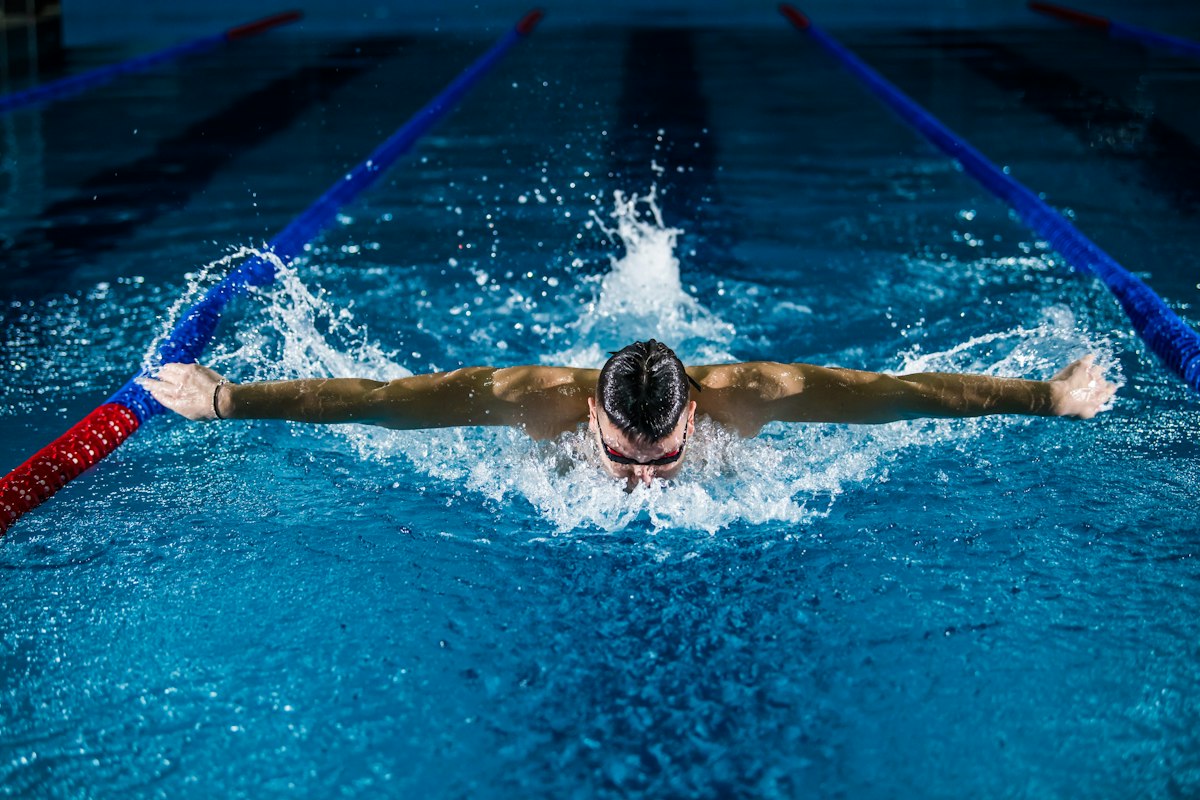
Open water swimmer in a cold lake, arms outstretched, surrounded by calm blue water
Open-water swimming as sensory knowledge: the body learning a place from the inside out.

The Bonds That Endure

One of the quiet gifts of this literature is its insistence that these bonds last. Dunkley (2018), studying why people volunteer to monitor the health of woodlands and rivers, found that the early affective bonds people form with ecological and water spaces endure throughout the life course, and that staying connected to those places becomes a way of remaining oneself (Dunkley, 2018). Her participants returned to their waters and woods across decades, drawn by a love that had taken root early and refused to fade (Dunkley, 2018).

I am one of her participants in spirit. The bond I formed with water as a young person, in the years when so much else was unsafe, has lasted through every season of my life. Water was the one place that never frightened me. It still is. Dunkley’s finding (that these affective bonds endure and that we organize our lives partly around keeping them) describes the shape of my whole swimming life. I have arranged decades around staying close to water. I understand now that this was attachment doing what attachment does, holding me to the places that hold me.

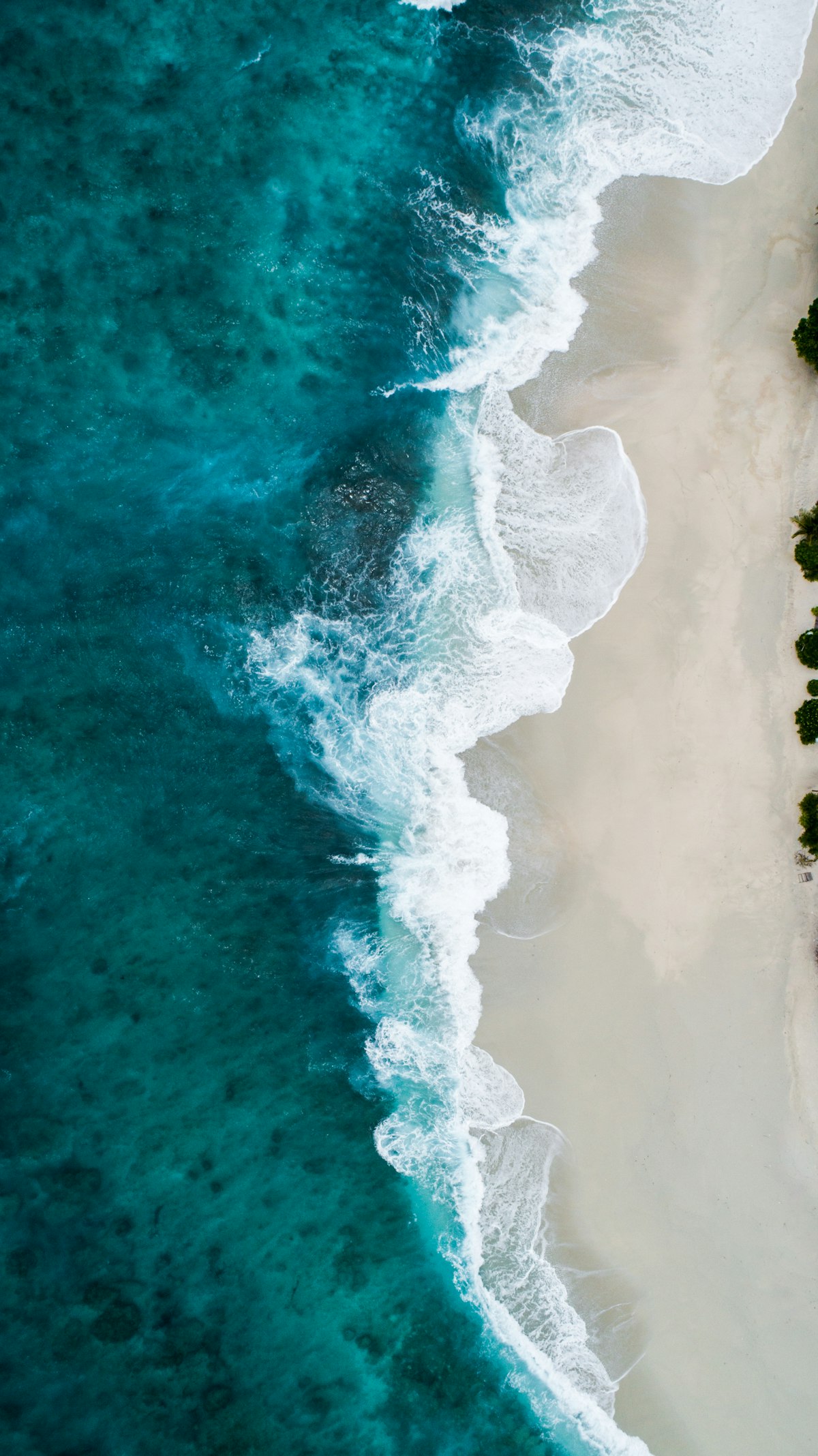
Calm lake at dusk with still reflections and soft light on the water surface
Water at dusk: the kind of scene that calls a person back, decade after decade.

What the Lake Taught Me About Love

So I have stopped apologizing for loving places like people. The geography gives me permission, and more than permission, a vocabulary precise enough to honour the feeling. Topophilia is real. Solastalgia is real. The bond can be structured like kinship, built through the senses and through story, and it can last a lifetime. None of this is a swimmer’s sentimentality. It is one of the most thoroughly studied truths about how human beings live in the world.

I will go down to the cold lake again this week, the way you visit someone you love. I will feel the deep place where the temperature drops, and the warm shallows by the reeds, and I will feel the lake recognize me. I used to think I was projecting my need onto indifferent water. Now I think I was practising one of the oldest forms of belonging there is. The places I have loved like people loved me back, in the only language places speak, which is the language of holding. I have been held by that water for most of my life. To love it in return is the most natural geography in the world.


References

Cross, J. E. (2015). Processes of place attachment: An interactional framework. Symbolic Interaction, 38(4), 493-520. https://doi.org/10.1002/symb.198

Dunkley, R. A. (2018). Monitoring ecological change in UK woodlands and rivers: An exploration of the relational geographies of citizen science. Transactions of the Institute of British Geographers, 44(1), 16-31. https://doi.org/10.1111/tran.12258

Larter, P. C. L., Grek-Martin, J., & Silver, A. (2019). Does time heal all wounds? Restoring place attachment in Halifax’s Point Pleasant Park after Hurricane Juan. Canadian Geographies / Géographies canadiennes, 63(3), 494-506. https://doi.org/10.1111/cag.12542

Pascual-de-Sans, A. (2004). Sense of place and migration histories: Idiotopy and idiotope. Area, 36(4), 348-357. https://doi.org/10.1111/j.0004-0894.2004.00236.x

Tuan, Y.-F. (1974). Topophilia: A study of environmental perception, attitudes, and values. Prentice-Hall.


Academic Lens

This post translates topophilia into a Scholarly Personal Narrative account of an open-water swimmer’s love of place, grounded in peer-reviewed scholarship with one foundational anchor. Tuan (1974) originates the concept, and Larter, Grek-Martin, and Silver (2019) supply both the working definition (the affective bond between people and place) and the crucial concept of solastalgia, the grief attending a damaged beloved place, which the post uses to legitimize a previously unnamed form of loss. Pascual-de-Sans (2004) provides the post’s structural claim through her explicit comparison of the person-place bond to the parent-child bond, establishing that attachment to place is a recognized form of kinship-like attachment rather than mere sentiment. Cross (2015) supplies the mechanism, decomposing place attachment into interacting processes (notably the sensory and narrative) that explain how a bond with water is built through embodied repetition and storytelling. Dunkley (2018) anchors the claim of endurance, demonstrating that early affective bonds with ecological and water spaces persist across the life course and organize ongoing behaviour. Read through Scholarly Personal Narrative (Nash, 2004), the post enacts a move characteristic of the series: it takes an emotional experience the writer had treated as idiosyncratic (loving a lake like a person) and reframes it, through verified geographic scholarship, as a well-theorized and widely shared dimension of human dwelling, converting private feeling into legible knowledge.

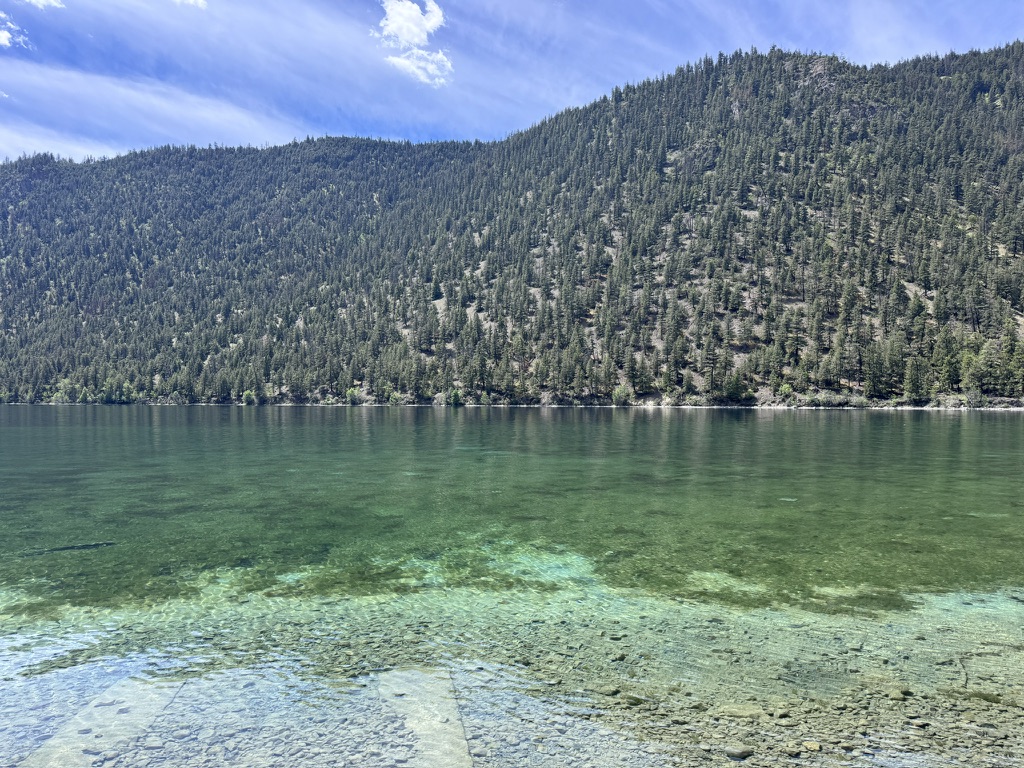
Clear Water - Transparent emerald alpine lake with pine-covered mountains
Clear Water. The transparent emerald waters of an alpine lake, pine-covered mountains rising beyond the far shore. Photo: Amy Tucker, 2026.
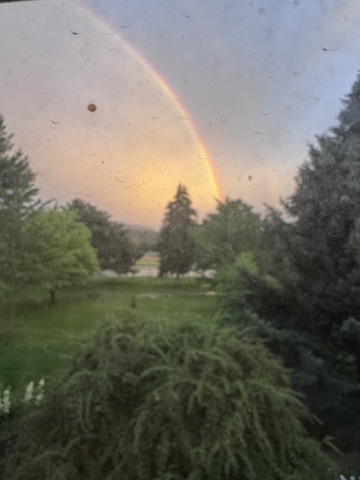
After the Rain - A rainbow over wooded landscape viewed through rain-specked window
After the Rain. A rainbow arcs over a wooded landscape seen through a rain-specked window. Photo: Amy Tucker, 2026.
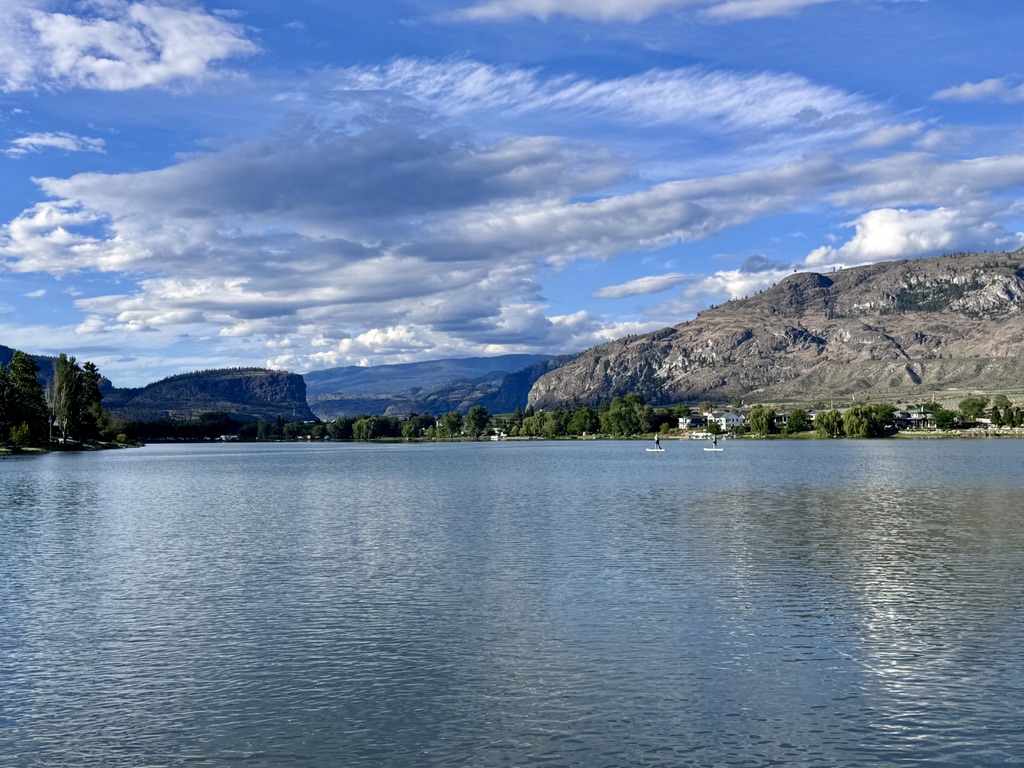
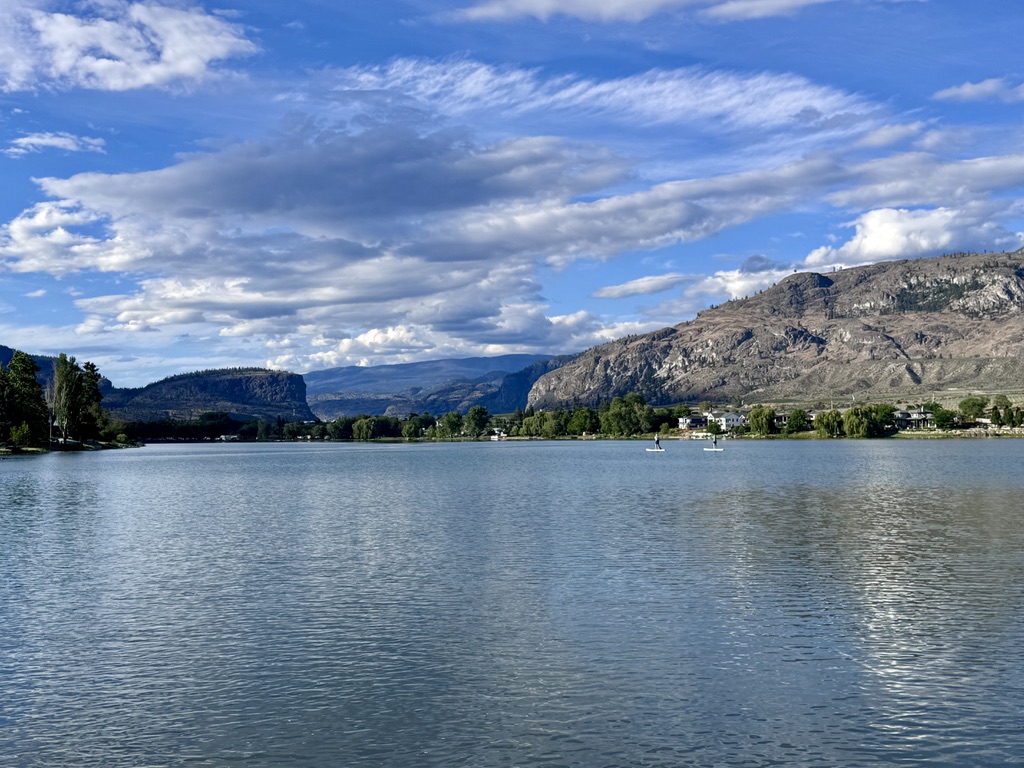
On the Lake - Paddleboarders on a calm lake with mountain peaks and valley communities
On the Lake. Paddleboarders on a calm lake beneath cloud-streaked skies, with rocky mountain peaks and valley communities stretching beyond. Photo: Amy Tucker, 2026.
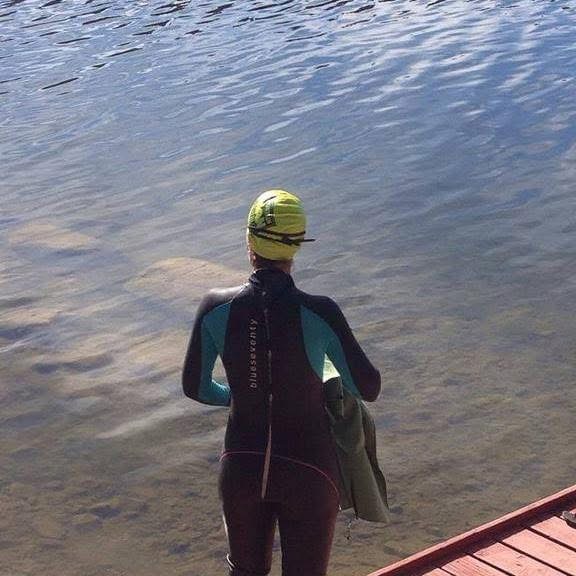
Ready to Enter - Open-water swimmer preparing to enter the lake
Ready to Enter. Open-water swimmer at the lake’s edge, preparing to enter the water. Photo: Amy Tucker, 2026.


🔍 Verified References
The citations in this post have been fact-checked against CrossRef DOI records. View the verified reference list with fact-check notes for this post.