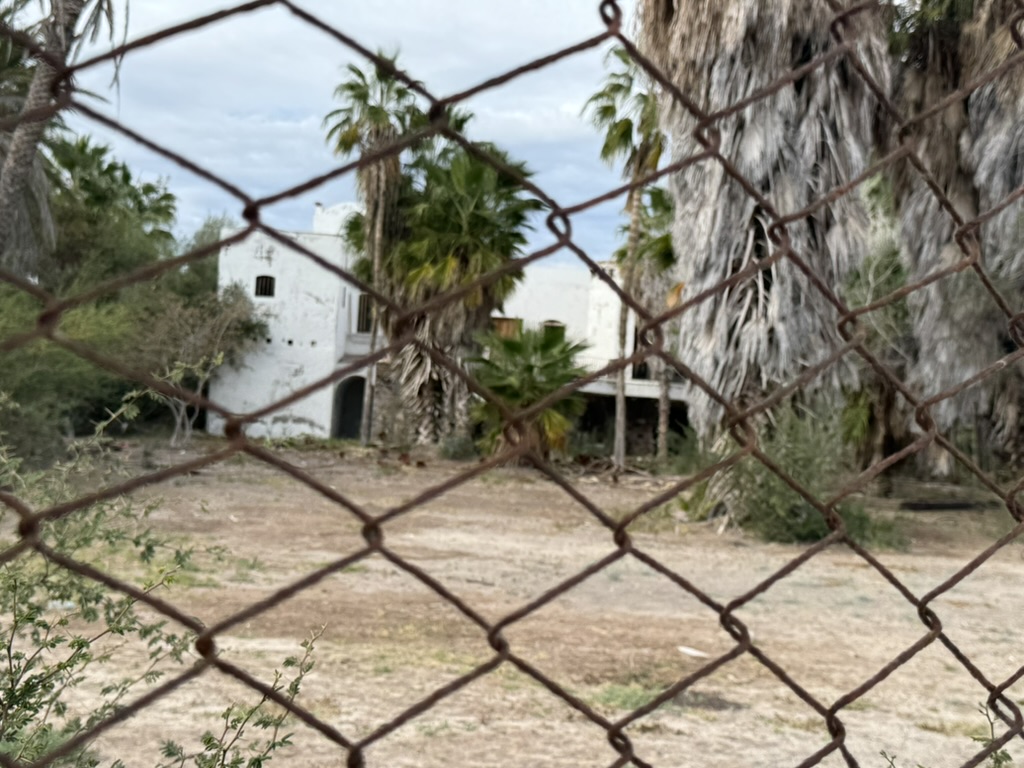
A Note to the Broader Precariat

The precariat I document in this project is shaped by my specific location. I offer this as one situated, theorized account, with the explicit hope that it invites other accounts, from other bodies, in other contexts.

Reading Time: 3 minutes

Many Bodies, Same Ground

On the limits of any one account, and the invitation that follows from those limits.


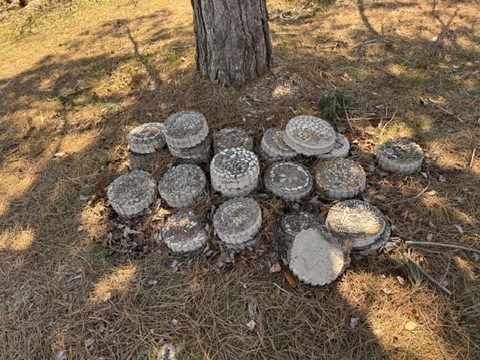
Weathered stone discs arranged in a group beneath a tree, resting on pine needles and dry earth in afternoon light.
Photo: Amy Tucker, © 2026

The precariat I document in this project is shaped by my specific location: white, settler, Canadian, English-speaking, working within a particular institutional culture at a particular historical moment. I know that. I want to say it plainly here, in a post of its own, because it matters to the meaning of everything else.

Fractured Ground

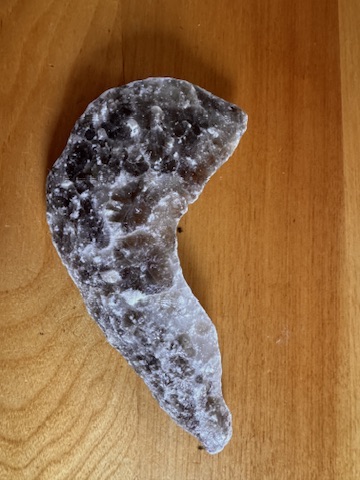
A dark crystalline rock fragment resting on a wooden surface, its fractured edges catching the light.
Photo: Amy Tucker, © 2026

Precarious academic labour looks different across national contexts, languages, genders, races, and institutional cultures. A contract instructor in Mexico navigates different structures, different protections or their absence, different relationships between labour, identity, and institutional belonging, than a contract instructor in Canada. A sessional lecturer in the United Kingdom faces different union landscapes, different visa conditions, and different histories of what the university is and who it serves. A contingent faculty member in the United States works within a different legal framework and a different geography of precarity than someone at a Brazilian federal university or a South African college under austerity. The structural conditions are related but far from identical, and collapsing them into a single story would harm each.

What Endures

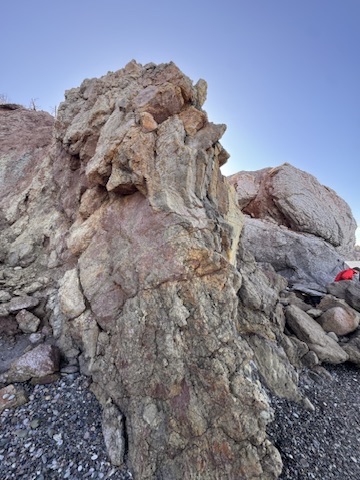
A large weathered rock formation standing at the shore under an open sky, its surface layered and worn by time.
Photo: Amy Tucker, © 2026

What is shared across these contexts is real and significant: the insecurity, the chronic self-monitoring, the way worth becomes tied to the next contract, the exhaustion of performing enthusiasm for an institution that holds you at arm’s length, the particular loneliness of caring deeply about work that the system treats as interchangeable. These are patterns that cross borders. This project names them from one body, in one country, in one language.

Your account is the one this one cannot give. I hope you write it.

What is different across these contexts is equally real and equally significant. I offer this project as one situated, documented, and theorized account, grounded in the specificity of where I stood and what I carried. It is the beginning of an argument, and beginnings require continuation. The next study needs more voices, more bodies, more contexts, in other languages and other institutional landscapes, with methodologies capable of holding that breadth without flattening it.

If you are reading this and you recognize something here, I am glad the account reached you. If you are reading this and thinking, “but it was different for me, my country, my language, my body,” then I want you to know that difference is exactly what this project is calling for. Your account is the one that this one cannot give. I hope you write it.

Carried Here

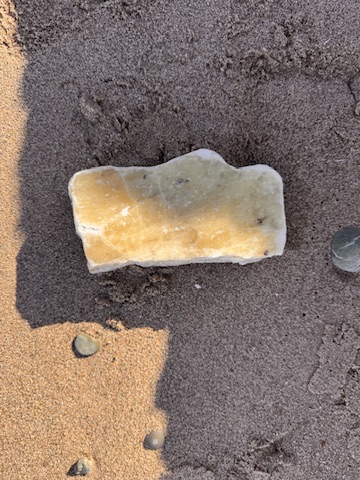
A pale flat stone with golden and cream tones resting in dark sand, smooth-edged and quietly present.
Photo: Amy Tucker, © 2026

Still Standing

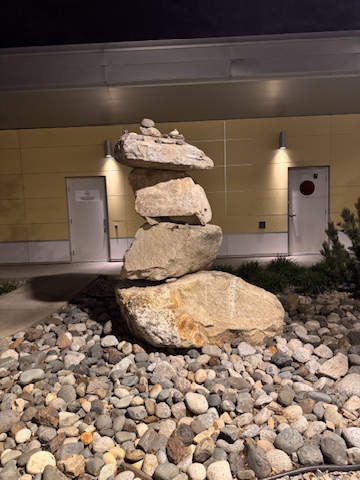
A stone cairn balanced carefully in the night outside a lit building, stones stacked in quiet equilibrium.
Photo: Amy Tucker, © 2026

The stones hold each other. That is enough to begin.


Still: A Door at King’s College and the Geography of Academic Precarity

Reading Time: 6 minutes

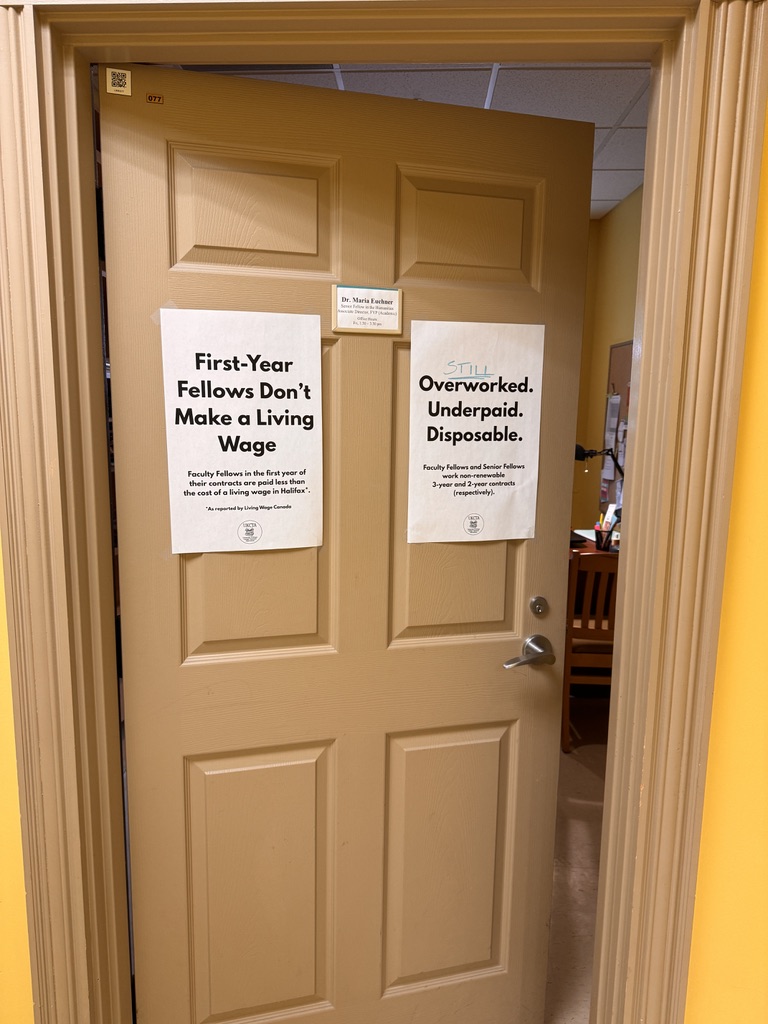
I stood in the corridor of the Foundation Year Program at the University of King’s College in Halifax and read a door. Two posters were taped to its panels, framing the nameplate of Dr. Maria Euchner, Senior Fellow in the Humanities and Associate Director, FYP (Academic). The poster on the left read, in heavy black type: “First-Year Fellows Don’t Make a Living Wage.” The poster on the right read: “Overworked.” Underpaid. Disposable. Above the word “Overworked,” a hand had written “STILL” in blue marker, underlined twice.

I have spent years thinking about precarity in higher education. I have written about it as my doctoral committee at Royal Roads University helped me sharpen my argument. I have lived it as a contract academic at Thompson Rivers University for nearly two decades. I thought I understood the architecture. Standing in front of that door, I felt the weight of the word Still. That single adverb, written by hand, did more theoretical work than most of the literature I have cited.

Still, Dr. Euchner’s Door, Foundation Year Program, University of King’s College, Halifax

A door at King's College with two union posters reading First-Year Fellows Don't Make a Living Wage and STILL Overworked. Underpaid. Disposable.
Photo: Amy Tucker, © 2026

What the Door Said

The posters were produced by the University of King’s College Teaching Association (UKCTA), the union representing Faculty Fellows and Senior Fellows in the Foundation Year Program. Faculty Fellows are appointed to three-year non-renewable contracts. Senior Fellows are appointed to two-year non-renewable contracts. According to a position posting for the role, the starting salary for a Faculty Fellow in the Humanities was $52,343 to $56,627 as of July 1, 2022, with future scales tied to bargaining (University of King’s College, 2026). The duties listed include four to eight hours of tutorials per week, eight hours of lecture attendance, weekly office hours, bi-weekly essay grading, and an average reading load of sixty pages per day, four days per week.

Set this beside the most recent calculation from the Canadian Centre for Policy Alternatives (CCPA) Nova Scotia office. Saulnier and Williams (2024) calculated the 2024 living wage for Halifax at $28.30 per hour, the highest rate in Atlantic Canada. The CCPA methodology assumes a household with two adults, each working thirty-five hours per week to support two children, which translates into roughly $51,506 in annual earnings per adult before taxes. The arithmetic is uncomfortable. A first-year Faculty Fellow at the 2022 salary floor of $52,343, working a load that almost certainly exceeds thirty-five hours per week once preparation, marking, reading, and committee work are honestly counted, is hovering at the line. The poster is correct. When the actual hours are accounted for, the line is behind them.

A tentative agreement was reached and ratified in early April 2026, after conciliation talks broke down and a strike appeared imminent (Chiasson, 2026; Taylor, 2026). The strike was averted. The structural questions on that door remain.

The Word That Did the Work

The word “Still” was what stopped me. The literature on contingent and contract academic labour returns again and again to the same pattern: a campaign, a report, a brief moment of public attention, and then quiet. The poster on the right side of Dr. Euchner’s door was familiar; this poster had been up before. The handwritten Still in blue marker suggested that the same poster, or one very much like it, had been put up before. The fight had been waged. The conditions had shifted too little for the poster to come down.

Time itself becomes a feature of precarity. In my dissertation at Royal Roads, Through Our Eyes: A Photovoice Study of Interconnected Precarity, Belonging, and Possibility in Higher Education, I argue that contract faculty and international students are bound together by parallel vulnerabilities. I call this interconnected precarity. The institutional logic that recruits international students for tuition revenue and discards them at graduation is the same logic that hires Faculty Fellows for teaching capacity and discards them at the end of the contract. The pattern is rhythmic. The bodies rotate through. The titles remain. The students change, the Fellows change, and yet the work and the conditions of the work persist. Still.

The Titles and the Trap

I have been developing a concept in a separate manuscript, recently advanced to conditional acceptance at Group and Organization Management, that I call malperformative inclusion. It names a particular institutional move: an organization performs the gestures of inclusion through titles, ceremonies, publicity, and acknowledgement programs, while the underlying structures continue to exclude. The performance is included only in the form. It is inclusion that performs the function of exclusion under another name (Tucker, in press).

The title “Faculty Fellow” is prestigious. It carries the resonance of Oxford and Cambridge collegiate traditions, of community, of belonging. It signals scholarly seriousness. It tells parents, applicants, and donors that the people teaching the foundational program are valued members of an intellectual community. The reality, laid out in plain language on paper taped to a door, is that the Fellowship is a non-renewable contract, that the salary in the first year falls at or below the regional living wage, and that the position will end on a fixed date with no path to continuation. The title performs inclusion. The contract performs disposability. This is what I mean by malperformative inclusion. The door named it more economically than my chapter does.

A Door Is a Photograph Is a Method

I look at this door, and I see a photovoice frame. Photovoice is a participatory research methodology developed by Wang and Burris (1997) in which participants use photographs to document conditions of life that conventional reporting cannot reach. The image becomes a means of testimony. It carries information that paragraphs cannot, because the image asserts: this is here, this is now, this is real.

The Faculty Fellows had no need for a researcher to come and document their conditions. They produced their own photovoice frame. They printed the words. They taped them to a door at the height of an adult reader. They wrote Still by hand. The hand-lettered word is the methodological signature. It says: a person did this. A person stood in this hallway and amended the original poster because, despite its accuracy, it was no longer accurate enough. Conditions remained unchanged. The poster required updating. Still.

The Faculty Fellows at King’s are doing the same work with paper and tape. The door is the camera. The corridor is the gallery. The asterisk citing Living Wage Canada is the methodological footnote. I find this beautiful and devastating in equal measure.

What I Take With Me

I take three things from this door into my own work and into my dissertation defence in the coming weeks.

The first is that precarity is rarely solved by a single agreement. The strike was averted at King’s College. I am genuinely glad. I also know from my work with the Federation of Post-Secondary Educators of British Columbia (FPSE) and my role as Chair of the Non-Regular Faculty Committee that aversion is a pause, and that resolution requires more. Three-year and two-year non-renewable contracts will continue to shape the working lives of those who teach in the foundational humanities program at one of Canada’s oldest universities. The poster must be taken down by the institution; the workers alone cannot remove it.

The second is that scholarly personal narrative is appropriate and, at times, necessary in such moments. I write in this voice because the door is in the first person. The hand that wrote Still is a worker’s hand, personal and deliberate, distinct from any institution’s. Theory should answer in kind.

The third is that the Foundation Year Program’s foundation rests on the labour of people paid at or below the living wage in the city where they live. The undergraduate students who arrive for their first year of university, often on student loans and family sacrifice, are taught by scholars whose own household economies are governed by precarity. Interconnected precarity is concrete, immediate, and present. It is the floor and the ceiling of the same building.

I left the corridor. I carried a photograph of a door. I carry it still.

References

Chiasson, N. (2026, April 8). Strike looming for some staff at Kings College in Halifax. Country 103.5 / Acadia Broadcasting. https://hotcountry1035.ca/2026/04/08/strike-set-for-some-staff-at-kings-college-in-halifax/

Saulnier, C., & Williams, R. (2024). 2024 living wages for Newfoundland and Labrador, Nova Scotia and Prince Edward Island. Canadian Centre for Policy Alternatives, Nova Scotia. https://www.policyalternatives.ca

Taylor, E. (2026, April 9). Strike avoided at University of King’s College after deal reached. Country 103.5 / Acadia Broadcasting. https://hotcountry1035.ca/2026/04/09/strike-avoided-at-university-of-kings-college-after-deal-reached/

Tucker, A. (in press). Malperformative inclusion as institutional practice [Commentary]. Group and Organization Management.

Tucker, A. (in progress). Through our eyes: A photovoice study of interconnected precarity, belonging, and possibility in higher education [Doctoral dissertation, Royal Roads University].

University of King’s College. (2026). Faculty fellowship in the humanities [Position posting]. https://ukings.ca/campus-community/employment/faculty-fellowship/

University of King’s College Teaching Association. (2026, April 9). Statement on tentative agreement. UKCTA.

Wang, C., & Burris, M. A. (1997). Photovoice: Concept, methodology, and use for participatory needs assessment. Health Education & Behavior, 24(3), 369-387. https://doi.org/10.1177/109019819702400309

I Was Always Good Enough. I Just Never Belonged.

Reading Time: 5 minutesThat is the hardest kind of knowing.

Not the not-knowing, not the wondering, not the long nights asking yourself if maybe they were right, maybe there was something missing, maybe if you tried harder, became more, gave everything one more time.

That kind of not-knowing is painful, but it has somewhere to go. It has a project. It has another application, another credential, another bar to reach for.

But this knowing.

This quiet, cellular, unshakeable knowing that you were good enough, that you were always good enough, that good enough was never actually the question,

this has nowhere to go.

It just sits with you. It sits with you at the table and watches you eat. It sits with you in the classroom where you are brilliant, where you are exactly, precisely, quietly brilliant, and no one is taking notes on what that costs you to keep offering.

It sits with you, and it says,

you already know.

Belonging is a different thing from being good enough.

I had to learn that the hard way, the way you learn things that the body has to teach because the mind keeps finding reasons not to believe them.

I kept thinking that if I reached the standard, belonging would follow.

That competence was a key. That excellence was a door.

I did not understand that some doors are not locked from the outside.

They are simply not doors for you.

Not because of what you lack. Because of what you are.

Because belonging is not earned. It is either extended or it is withheld, and the withholding can be so gracious, so warm, so full of genuine appreciation for everything you contribute,

that it takes you years to name it.

I belonged in the classrooms.

That I know. That I have always known.

I belonged in the moment a student’s face changed, the moment the confusion lifted and something settled in them, some new way of seeing that they would carry forward into a life I would never see.

I belonged in that. I was made for that.

That belonging was real, and no one can take it from me, not the committees, not the careful language, not the national searches that somehow always ended somewhere other than me.

But belonging in the institution, belonging in the structure, belonging in the place where your name is permanent, where your labour is protected, where you are not renewed or not renewed like a magazine subscription,

that belonging was never offered.

And I spent nineteen years trying to make myself into someone it would be offered to,

without ever understanding that the offer was never about me.

It was about them. It was always about them. What they needed. What made them comfortable? What fit the picture, they had already decided to hang on the wall.

I was good enough. I was more than good enough. I was exceptional in the ways that actually matter, in the ways that change people, in the ways that send students back years later to say I have been thinking about what you said.

I just did not fit the frame.

And here is the grief of that.

The grief that has no clean edges.

The grief that is not about failure because there was no failure, the grief that is not about inadequacy because there was no inadequacy, the grief that lives in the gap between being good and being claimed,

between being valued and being wanted,

between being used and being belonged to.

I was always the one who gave everything.

I was rarely the one they built anything around.

That distinction is a quiet devastation.

It does not announce itself. It accumulates. It is the slow sediment of years of being appreciated but not anchored, celebrated but not secured, needed but not chosen.

They needed me. They just did not choose me.

And I kept hoping that need would become choice, that usefulness would become love, that one morning I would walk in and the room would feel different, would feel like mine, would feel like somewhere my full self was not only welcome but waited for.

It never felt like that.

Not once in nineteen years did it feel like that.

And I kept showing up anyway, because the students were real, because the work was real, because my love for the classroom was real and sturdy and mine, and I was not willing to let the institution’s failure become my abandonment of them.

So I stayed.

And I carried the not-belonging the way you carry something heavy for so long that you forget you are carrying it, forget that your back hurts, forget that you set it down once for a whole summer and felt what it was like to stand up straight.

I carried it into every meeting. Into every application. In every performance review, they told me I was wonderful and gave me nothing I deserved.

I carried it home. I carried it into my rest, which was not really rest, but the place where the weight became more visible without the distraction of the work.

But I want to say something about the knowing.

The painful knowing, the always knowing, the knowing that never let me off the hook of my own truth.

It is also a gift.

I know that is hard to hear. I know it does not make the grief smaller, the injustice cleaner, or the nineteen years feel properly accounted for.

But the knowing means I never disappeared.

I never fully believed the story they were quietly telling about me, the story that said not quite, not enough, not right.

Something in me always knew better.

Some deep, stubborn, luminous part of me held the actual record, the real account of what happened in those classrooms, what I gave, who I was, how carefully and lovingly I did the work they were not even fully watching.

I kept my own record.

And my record says I was extraordinary.

My record says I belonged to the students even when the institution would not claim me.

My record says I walked into rooms that were not designed for me and I made them briefly, beautifully, mine.

I did not belong there.

I have said it now. I have let it be true without making it mean something is wrong with me.

I did not belong there.

And somewhere, there is a place that is already shaped like the person I actually am, a room with no raised bar, no moving target, no warm smile over a closing door.

A room that will look at the lantern and say

oh, we have been waiting for that light.

I have to believe that room exists.

I have to believe it the way I believe in the students who came back, the way I believe in the work that mattered, the way I believe in my own goodness on the days the grief is loudest.

I was always good enough.

I just never belonged there.

And that is their loss, written in nineteen years of what they almost had,

and my life, written in every student who walked out, changed.

Aquí estoy. Siempre fui suficiente. Simplemente nunca fue mi lugar.

Here I am. I was always enough. It simply was never my place.


Translation Note: Spanish phrases in this poem were assisted by Google Translate (translate.google.com). The Spanish is woven in as an act of reclamation, a return to a language of the body and the self that exists beyond institutional English.
You Are Not Qualified

Reading Time: 3 minutes
They said it with such clean mouths, such pressed collars, such careful grammar,
as if the words were a gift and I should be grateful for the clarity.

You are not quite what we are looking for.

I went home and looked in the mirror for the missing thing,
the gap between my face and the face they had already chosen
before I walked through the door.

I counted my degrees like rosary beads. I counted my years.
I counted the papers, the classrooms, the students who wept at the end of term
and said, you changed something in me.

None of it was currency here.

They smiled while they did it. That is the part that stays,
the smile, the warmth in the room while I was being measured
against a ruler I was never meant to hold.

I rewrote my letter. I softened my edges. I learned their language
the way an immigrant learns to laugh at jokes that are about her.

I applied again.

We had many strong candidates this year.

I bought a new suit. I straightened what was already straight.
I arrived early, stayed late, published in their journals,
cited their names like prayers, sat on the committees no one wanted,
carried the invisible work in both arms like groceries up four flights of stairs,
and smiled, because you must always smile.

We felt someone else was a better fit.

Better fit.

A sock drawer. A parking space. A peg in the right-shaped hole.

I have an education. I have nineteen years.
I have read every book they told me would be enough,
and then the next book, and the next,
following the breadcrumb trail they kept moving just ahead of my hand.

I taught the exact same courses.
I stood in the exact same rooms, at the exact same hour,
holding the exact same ideas they would later decide
required someone else's mouth.

And when they said no, I punished myself with more work,
more late nights, more hours offered up like proof,
like penance, like if I just gave enough of myself
there would finally be nothing left to reject.

The cruelest part is that I believed them.

For so long, I believed the problem lived in me,
in the particular shape of my ambition,
the particular sound of my voice,
the particular way I took up space,
which was always either too much
or so little I became furniture.

I have sat in rooms where the air itself said this was never designed for you,
and smiled, and contributed, and been thanked in the minutes no one reads.

I have been told I am inspiring.

Inspiring is what they call you when they have decided you are a visitor.

You are not qualified.

Say it again. Say it clean.

Let it mean what it has always meant,
underneath the careful grammar,
underneath the pressed collars,
underneath the warmth in the room while the door was already closing.

I am still here.

I am still here, which is its own kind of answer,
though I am so tired of the question being me.

Aquí estoy.

Translation Note: Spanish phrases in this poem were assisted by Google Translate (translate.google.com). The Spanish is woven in as an act of reclamation, a return to a language of the body and the self that exists beyond institutional English.
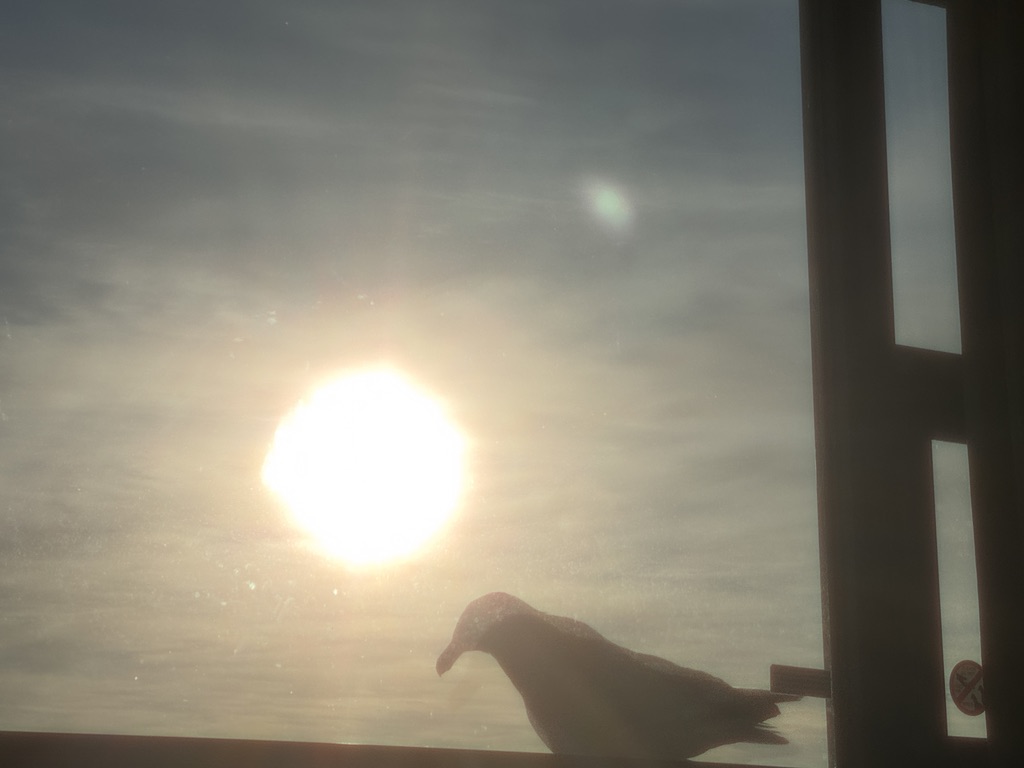
Silhouette of a pigeon perched on a ledge, backlit by a bright sun through a hazy grey sky, photographed through glass.

The One Who Stayed Anyway
Photo: Amy Tucker, © 2026

Artist Statement: A pigeon photographed through a window. The bird had chosen the ledge. It was facing the sun.


Translation Note: Spanish phrases in this poem were assisted by Google Translate (translate.google.com). The Spanish is woven in as an act of reclamation, a return to a language of the body and the self that exists beyond institutional English.
They Used My Labour and Called It Privilege

Reading Time: 4 minutes

The Structural Poem

A note on this poem. This poem is testimony. It does not include the self-questioning that I do in the essays, because testimony and analysis are different acts. I have chosen to let the poem be what it is.

Let me tell you how it works.

Not the version in the handbook. Not the version in the mission statement with its careful language about community and excellence and the transformative power of education.

The actual version. The one that runs underneath like a current you cannot see from the surface, but that pulls at your legs if you stand in it long enough.

Here is how it works.

They find someone brilliant. Someone who loves the work with the particular love that makes a person do more than is required, give more than is contracted, stay later than anyone is watching,

and they hire her temporarily.

Not because the work is temporary. The work is permanent. The courses run every semester. The students keep arriving. The curriculum does not pause to acknowledge that the person delivering it is unsure whether she will be delivering it next year.

They hire her temporarily because temporary is cheaper. Because temporary does not require the benefits, security, and institutional commitment that permanent does.

Because the temporary keeps her grateful.

And a grateful worker is a compliant one.

This is not a conspiracy.

I want to say that clearly because the moment you name the structure, someone will say you sound paranoid, you sound bitter, no one sat in a room and decided to do this to you.

They are right. No one sat in a room.

That is precisely the point. That is what makes it structural rather than personal. The harm does not require intention. The harm requires only a system that has decided certain kinds of labour are infinitely extractable from certain kinds of people who can be kept just insecure enough to keep extracting from.

The system does not hate her. The system does not see her.

That is not comfort. That is the definition of the problem.

She was called lucky.

She was told she was lucky to have the work, lucky to teach the courses she loved, lucky to be in the room, lucky that the institution kept finding a way to bring her back.

Lucky.

As though her nineteen years of expertise were a gift the institution was generously receiving rather than a resource it was systematically mining.

She felt the gratitude. She performed it beautifully. She understood, without anyone telling her, that the gratitude was part of the contract, the unwritten part, the part that kept the system functioning smoothly, that kept her from asking the questions the system could not comfortably answer.

Questions like: If I am not qualified enough to be hired permanently, why am I qualified enough to carry the curriculum?

Questions like: At what point does temporary become a word that means we will take everything you have and give you nothing you can build a life on?

She did not ask these questions out loud.

She asked them in the parking lot. She asked them at two in the morning. She asked them in the shower, where the sound drowned out the question.

They called it flexibility.

Her flexibility meant no pension contributions she could count on. No sick leave that did not cost her the income she could not afford to lose. No ability to take a mortgage on a contract that expired in April.

The institution called this flexibility.

She called it something else.

She called it the transfer of institutional risk onto the bodies of the people least able to carry it.

And here is the part that makes the grief complicated:

She loved it.

She genuinely, helplessly, and permanently loved the work.

Her love was the subsidy.

Her love and the love of every brilliant, committed, devoted person working on a contract in every institution that has learned that passion is a resource you do not have to compensate fairly because it will show up anyway.

I am not bitter.

I want to say that, and I want it to be true, and mostly it is.

I am clear.

There is a difference between bitterness and clarity.

Bitterness is personal. Clarity is structural. Clarity names the system. Clarity holds the institution accountable without requiring a villain.

I want the structure changed.

I want a world where the next woman, as brilliant and devoted and careful as she has been, does not spend nineteen years as temporary.

She is still in the system.

But she is in it differently now.

She is in it with her eyes open. She is in it with the clear naming of what is happening, why it is happening, and whose interests it serves.

She is in it with this poem, which is not bitterness but testimony.

Not grievance but record.

They used my labour and called it privilege.

They used my love and called it flexibility.

They used my devotion and called it inspiring.

They used my silence and called it professionalism.

I am no longer silent.

Not because I am angry, though I have earned the anger.

Because silence was the last thing they needed from me, which I was still giving freely.

And I am done giving freely to a system that calculated the price of everything I offered and decided it did not have to pay it.

A Coda, in My Own Voice

I am also writing this as the woman who stayed.

The system did not extract from me without my participation. I performed the gratitude. I rehearsed the smile. I spoke well of the institution in rooms where speaking otherwise might have cost me the next contract, and I knew, at some level beneath language, that the performed thankfulness was the unwritten clause of the agreement. I signed that clause every year, in invisible ink, and I knew I was signing it.

I want to say that the love was real, and so was the calculation. Both were true at once. I loved the work and I also kept the love legible to the people who could renew me. I do not think this makes me complicit in the way the system is. I do think it makes me a participant in a quieter way than the poem above lets on, and I owe the page the honesty of saying so.

The structure is what it is. My agency inside it was smaller than the institution claimed and larger than the grievance allows. Both sentences need to stand on the same line.

Aquí estoy. Con los ojos abiertos. Ya no en silencio.

Here I am. With open eyes. No longer silent.


Translation Note: Spanish phrases in this poem were assisted by Google Translate (translate.google.com). The Spanish is woven in as an act of reclamation, a return to a language of the body and the self that exists beyond institutional English.
The Parking Lot

Reading Time: < 1 minuteAfter the handshake I walked out.

Across the pavement.
Flat light.
The kind that belongs to neither day nor night.

I sat in the car.
The door closed.

I let the thing happen
that I had been holding
through the warmth of the room,
through the careful language,
through the kindness
of people who could see what I needed
and could not give it.

They could see it.
That is the part I am still sitting with.

And then I drove home.
And then I made dinner.
And then I answered emails.

Twenty-five years of that.
Not the crying.
The returning.
The next morning.
The next September.

In the shoulders.
In the jaw.
In the particular way
a body learns to wait
when waiting is the only contract
it has ever been offered.

Someone should have put a hand
on the roof of the car.
Should have stood in the flat light
and said: I know.
This is real.
I see the cost of this.

Nobody did.

So I am saying it now
to whoever is sitting
in a parking lot somewhere
with the engine running
and the building still visible
in the rear-view mirror.

I know.
This is real.
I see the cost of this.

You can drive home now.

The Contract

Reading Time: 4 minutes

They gave me a contract the way you give someone an umbrella after the rain has already started,

a document, a date, a number of months carefully chosen to end just before anything could be called permanent.

I signed it.

Of course, I signed it. I signed it the first time with something close to joy, the particular joy of a person who has worked very hard, been seen working very hard, and is finally, finally being let in.

I did not read the expiry date as a warning. I read it as a beginning.

That is the thing about the first contract. It feels like a door opening. It takes years to understand that it was never a door. It was a revolving one, and you were always going to end up back outside.

The second contract came, and I signed it with slightly less joy and slightly more relief, which is a different thing, relief being what joy becomes when it has learned to be grateful just to still be here.

I was still here. That felt like something. I made it mean something.

Here is what no one tells you about living in one-year increments.

You cannot plan a garden.

That sounds small. It is not small.

A garden requires the belief that you will be there for the harvest, that the thing you put in the ground today will be yours to tend through all its seasons, that the roots go down into soil that belongs to you long enough to matter.

I could not plan a garden.

I could not plan the way people plan when they know they are staying.

I planned the way people plan when they are guests. Carefully. Lightly. Always aware of where the door was.

Every spring it came.

The email, or the meeting, or sometimes just the silence that lasted a beat too long before someone said, “We are planning to have you back.

Planning to.

Two words doing the quiet work of keeping a person just uncertain enough to be manageable.

Do you know what the annual uncertainty does to a body?

It does not break you all at once. That would almost be easier. A clean break, a clear moment, a before and after you could point to.

It is slower than that.

It is the way the shoulders never quite come down. The way sleep becomes a negotiation in the months leading up to renewal. The way you cannot fully celebrate the good semester, because somewhere in the back of every good thing is the question of whether there will be a next one.

And the cruellest part, the part that I am still sitting with,

is that they needed me.

Not abstractly. Not in the way institutions need warm bodies to fill rooms.

They needed me specifically. My expertise. My courses. My relationships with the students. My willingness to sit on the committees, cover the gaps, and do the invisible work that kept things running while they endlessly searched for the person they actually wanted in the position I was already doing.

They used my labour to hold the place for someone else’s permanence.

I was the placeholder. For nineteen years, I was the placeholder.

And they were kind about it. That is the part that makes it complicated. They were genuinely kind. They appreciated me. They said so. They meant it.

Appreciation and belonging are not the same thing. I know that now.

I am tearing up the contract now.

Not in anger. In grief. In the quiet grief of a woman who finally understands what she was signing all those years,

and who is ready, for the first time, to sign something different.

Something that says I belong to my own future.

Something that says my labour is not available for indefinite borrowing.

Something that says I am not a placeholder. I am not pending. I am not provisional.

Something that has no expiry date because it is written in the only ink that does not fade:

the knowledge of her own worth, which was never, not for a single year of all those years, in question.

A Coda, in My Own Voice

I want to say one more thing, before the closing.

I signed each contract knowing what it was, eventually. The first one I signed in something close to joy. The later ones I signed knowing the shape of the door, and I signed them anyway, because the work was the work I wanted to do and because the imagined alternative was a country I had no map for. The institution wrote the terms. I accepted them. I also negotiated, sometimes, in small ways. I also rested when I could. I also taught well within the arrangement and let myself be proud of that.

It would be too easy to write the poem in which I am only the one signed against. The fuller truth is that I was also the one who kept signing, kept hoping the next renewal would feel different, kept producing the goodwill that made the next renewal more likely. Compliance had a quiet payoff for me too. I want the record to hold that line beside the line about precarity.

I am tearing up the contract now. I am also acknowledging that, for nineteen years, I helped renew it.

Aquí estoy. Ya no esperando renovación. Soy permanente en mí misma.

Here I am. No longer waiting for renewal. I am permanent within myself.

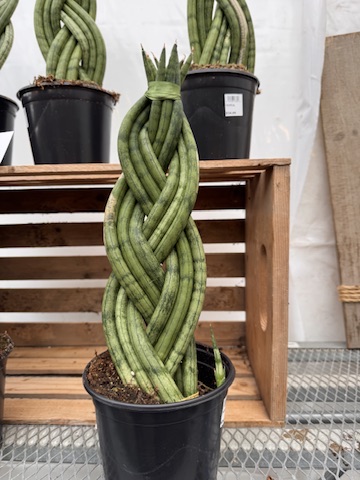
A snake plant with its stems intricately braided together, growing in a black pot on a greenhouse shelf, constrained into an elaborate pattern while still alive.

Woven into Something Not of Your Own Choosing
Photo: Amy Tucker, © 2026

Artist Statement: I found this plant in a greenhouse, a living thing that had been trained, woven, braided into a shape someone else chose for it. Still growing. Still green. Still entirely itself beneath the pattern that had been imposed upon it. I photographed it because the contract works the same way: take something living and weave it into increments, into one-year shapes, into a form that serves the institution’s aesthetics while the root keeps reaching down regardless. The braid is not the plant. The contract is not the person. Both are still alive underneath.


Translation Note: Spanish phrases in this poem were assisted by Google Translate (translate.google.com). The Spanish is woven in as an act of reclamation, a return to a language of the body and the self that exists beyond institutional English.
Poem: They Lied.

Poem: They Lied, a reckoning with the stories that institutions tell about labour, worth, and endurance. A poem of grief and clarity, written from the body of someone who believed them for too long.

Reading Time: 4 minutes

Content Warning: This post contains reflections on trauma, grief, and broken trust. Please care for yourself as you read, and feel free to step away if you need to.

A note on this poem. This poem is testimony. It does not include the self-questioning that I do in the essays, because testimony and analysis are different acts. I have chosen to let the poem be what it is.

Photograph from “Poem: They Lied.”, image 1.

Note. Thompson Rivers University, Faculty Council Award, 2025


They lied.
They lied and called it mentorship.
They lied and called it an opportunity.
They lied and called it a calling.

They told me the academy was a sanctuary.
They told me knowledge was sacred.
They told me my voice mattered.

So I gave them everything.

My mornings.
My nights.
My body, bent over screens until my eyes burned and my hands ached.
My stories, trimmed into acceptable methods.
My grief, formatted into theory.
My hope, footnoted into legitimacy.

They told me, Just one more course.
Just one more publication.
Just one more credential.

Sacrifice became the job description.

They dangled permanence like a mirage.
They called precarity “experience.”
They called overwork “passion.”
They called exploitation “professional growth.”

They told me belonging was coming.
Belonging never came.

They took my heart and turned it into service metrics.
They took my mind and turned it into deliverables.
They took my soul and turned it into outputs, grants, citations, and student evaluations that never saw me.

They smiled while doing it.
They thanked me while extracting me.
They called me resilient while grinding me down.

I am angry because they knew.
They knew the system was built on unpaid labour,
on feminised care work,
on racialized and precarious bodies that teach, grade, counsel, and disappear.

They knew, and they kept recruiting.

They sold me the myth of the scholar as a free thinker
while chaining my thinking to funding cycles, metrics, and institutional branding.

They called it education.
I call it extraction.

They stole nineteen years of my life
and told me I should be grateful.

They stole my weekends, my sleep, my joy,
and told me I was lucky to be here.

Lucky.

No.
I was useful.

But here is what remained beyond their reach:

My anger is clarity,
It is the sound of a system being named.

They cannot have the part of me that walks into the sea and remembers herself.
They cannot have the part of me that writes without permission.
They cannot have the part of me that refuses to confuse suffering with virtue.

They stole my labour.
They stole my trust.
They stole my youth.

They told me I was lucky.
Lucky to be underpaid.
Lucky to be temporary.
Lucky to be invisible until they needed my labour.

Lucky.

I was convenient.
Lucky had nothing to do with it.

They knew this system runs on people who care too much.
They knew women, racialized scholars, Indigenous scholars, contract faculty, and graduate students carry the weight of the institution on their backs.
They knew.

And they kept recruiting us anyway.

They told me I was a scholar.
Then, I chained my scholarship to funding cycles, productivity dashboards, and institutional branding strategies.

They told me teaching was sacred.
Then, I reduced it to enrolment numbers and student satisfaction scores.

They told me my voice mattered.
Then edited it until it fit their journals, their grants, their safe narratives.

They stole years of my life.
They stole sleep, relationships, health, and creativity.
They stole the wild parts of thinking and replaced them with templates.

And they had the audacity to call this a career.

I am angry because I see the architecture now.
I see how the academy consumes people and calls it mentorship.
I see how it extracts love and calls it professionalism.
I see how it eats souls and publishes the findings.

They took my labour.
They took my trust.
They took my youth.

My future is mine to keep.

My anger has direction.
It is a theory.
It is a method.
It is evidence.

It is the moment I stop confusing suffering with virtue.
It is the moment I stop calling harm an opportunity.
It is the moment I take my mind, my body, and my soul back from an institution that never planned to hold them.

They lied.
I believed.
Now I refuse.


Author’s Note

In this poem, they refer to the neoliberal academy: a system of higher education shaped by market logics, metrics-driven governance, academic capitalism, and precarious labour structures. The term names the institutional architectures and policies, and political-economic conditions that extract emotional, intellectual, and affective labour while promising belonging, security, and scholarly freedom that are rarely delivered. The poem is written as a critique of structural and symbolic violence within contemporary universities, and as a reclamation of agency, voice, and scholarly selfhood.

Aerial view of a blazing sunset above a sea of clouds, with snow-capped mountain peaks visible below, photographed from an airplane window.

Above the Smoke of What They Called a Career
Photo: Amy Tucker, © 2026

Artist Statement: I took this photograph from a window seat, ascending through the smoke and cloud of everything I was leaving behind. Below me, mountains I had not chosen; above me, a sky that had no record of my service. This image sits beside the poem because both of them refuse the ground floor. The poem names the extraction. The photograph holds the moment the body finally rose above it, not arrived, not saved, but airborne. Still moving. Still here.


Translation Note: Where Spanish appears in this collection, it was assisted by Google Translate (translate.google.com). The Spanish is woven in as an act of reclamation, a return to a language of the body and the self that exists beyond institutional English.
Poem: I Did Everything You Asked Me

Poem: I Did Everything You Asked Me, a poem of exhaustion, grief, and the moment of recognizing that full compliance is not protection. Written in the voice of someone who gave everything and was given nothing back.

Reading Time: 4 minutes

Content Warning: This post contains reflections on trauma, grief, and broken trust. Please care for yourself as you read, and feel free to step away if you need to.

A note on this poem. This poem is testimony. It does not include the self-questioning that I do in the essays, because testimony and analysis are different acts. I have chosen to let the poem be what it is.

I did everything you told me to do.
Every checkbox.
Every whispered rule was passed down like gospel.

I went back to school
When I was already carrying too much,
when sleep felt like a luxury,
When my body kept asking for mercy
And I kept answering with more work.

Seven years for a doctorate,
because I was teaching ten courses a year.

Thousands of students.
Hundreds of names passing through my inbox, my gradebook, and my care.

My days were never mine.
They belonged to the timetable.
To institutional clocks that paused for nothing: no thinking, no healing, no depth.

Morning to night,
grading until my eyes burned,
answering emails in the dark,
hands moving long after my body asked to stop.

I learned to read exhaustion as responsibility.
To mistake depletion for commitment.
To call survival professionalism.

I built other people’s futures carefully,
credit by credit, feedback by feedback,
while mine stalled in drafts and deadlines,
always almost ready, always postponed.

The work held me.
The pace did.

And my body kept the record
long before my CV did.

I collected debt like proof of devotion.
Eighty-five thousand dollars
for the right to keep chasing permanence.
For the privilege of becoming more hireable.
For the fantasy that if I sacrificed enough,
You would finally choose me.

I published.
I turned my life into citations,
my grief into theory,
my trauma into methods sections
that made pain legible and respectable.

I presented at conferences,
stood behind podiums with trembling hands,
smiling through exhaustion
while strangers called me “inspiring.”

I served.
Committees, reviews, mentoring,
equity work, invisible work,
the work that keeps institutions alive
and leaves women depleted.

I won awards.
Teaching awards.
Service awards.
Letters saying I was exceptional,
that I mattered,
that I was indispensable.

And still,
when I asked for permanence,
you chose someone fresher.
You chose someone younger.
You chose someone who had yet to spend decades
making themselves indispensable to survive.

You told me I was impressive,
never quite permanent.
Important
never quite institutional.
Valuable
never quite worth keeping.

They said,
Get more PD.
So I did.

Publish more.
So I did.

Go back to grad school.
So I did.

Be visible.
So I was.

Be excellent.
So I burned myself into excellence.

And still,
I remained temporary.

I am tired.
Tired in my bones,
tired in the marrow of credentials,
tired of translating exhaustion into professionalism.

I am tired of being a provisional life,
a renewable clause,
a syllabus name that disappears.

I did everything you told me to do.
And you taught me, quietly, structurally,
that the rules were never designed
for someone like me
to win.

I did everything you told me to do.
I paid with my body, mind and soul, for the privilege of believing you.
I gave you nineteen years of nights, weekends, and ten courses a year on your schedule.
You gave me exhaustion and called it opportunity.

I did everything you told me to do.
You kept me temporarily.
And I am tired.

I did everything you told me to do.
My mind earned the doctorate.
My body paid the debt.
And you still called me replaceable.

I did everything you told me to do.
You rewarded me with precarity, debt, and silence.
This is how institutions harvest women and call it mentorship.

I did everything you told me to do.
It was never about excellence.
It was about how long you could use me before I broke.

I did everything you told me to do.
You taught me that merit is a story institutions tell
to justify who they discard.

I did everything you told me to do. It was never enough, and that was the point.

Notation: This poem reflects the embodied costs of academic precarity, where institutional narratives of merit and excellence intersect with structural disposability, cumulative educational debt, and chronic overwork.

Written from the body that carried the labour, the teaching loads, the doctoral training, and the exhaustion, it critiques meritocratic promises that mask the extraction of precarious academic labour within neoliberal higher education systems.

This reflection also situates precarity as an embodied form of structural trauma that informs my doctoral research on alonetude as a healing, resistant, and relational practice, an intentional reclaiming of rest, presence, and self-worth beyond institutional validation.

In this closing, “You” refers to the academy as an institution and system, its hiring committees, evaluation metrics, productivity imperatives, and meritocratic narratives that promise stability while structurally producing precarity.

This reflection speaks back to academic systems that demand relentless credentialing, publication, service, and teaching in exchange for disposability.

It situates my embodied experience of denial, debt, overwork, and exhaustion within broader structures of neoliberal higher education, where excellence is extracted from precarious bodies.

This narrative also connects directly to my research on alonetude as a relational, decolonial, and trauma-informed practice of refusal and restoration, a way of reclaiming worth, rest, and presence beyond institutional validation.

I am enough.

Title: Always on the Outside

Photograph from “Poem: I Did Everything You Asked Me”, image 1.

Photo: Amy Tucker, © 2026

A woman in a red sweater smiling while looking out an airplane window at a frozen, pale landscape below a white sky.

She Bought the Ticket Herself
Photo: Amy Tucker, © 2026

Artist Statement: I took this photograph somewhere over a frozen landscape, mid-flight, somewhere between the institution and whatever comes after. I am smiling. I want to remember that. Not because everything was resolved, but because the window was mine, and the seat was mine, and no one had assigned me a schedule for the next three hours. The exhaustion in this poem is real. So is this moment. Both are true. I took the picture so I would not forget that the body that carried all of that weight also eventually looked out a window and smiled.


Translation Note: Where Spanish appears in this collection, it was assisted by Google Translate (translate.google.com). The Spanish is woven in as an act of reclamation, a return to a language of the body and the self that exists beyond institutional English.
Performing Fine

Reading Time: 4 minutes

The Exhaustion of Always Being Okay

Let me tell you about the morning routine.

Not the one on the wellness blog, not the one with the gratitude journal and the warm lemon water and the ten minutes of mindfulness before the day begins.

The real one.

The one that starts before the alarm, in the dark, in the space between sleep and waking, where the body knows things the performing self has not yet had time to manage.

The body knows it is tired.

Not the kind of tired that a weekend fixes. The kind of tired that has been accumulating since somewhere around year three, when she first understood that this was not temporary, that the precarity was not a phase, that she was going to have to find a way to live inside the uncertainty without letting it show,

because letting it show was a kind of weakness she could not afford in rooms that were already measuring her.

So she learned the routine.

Coffee first. Then the face. Not makeup, though that too, but underneath the makeup, the other face, the one that says I am fine, I am more than fine, I am exactly the kind of person who belongs in this room and is grateful to be here and has no complicated feelings about any of this.

She has been putting on that face for so long that it now comes on without effort. That is the most frightening part. How easy it has become.

She walks into the building.

Someone says, how are you?

Fine, she says. Really well, actually.

And she means it in the moment she says it, or she means the performance of it, which has become indistinguishable from meaning it, which is its own kind of loss.

Four words covering a parking lot morning, a two a.m. waking, a contract that expires in April, a rejection letter she has read enough times to have memorized its careful language, its warm tone, its devastating politeness.

Really well.

The performance has a texture.

She performs well in the meeting where they discuss the course she has taught for twelve years, as though it were hypothetical, as though anyone in the room could walk in tomorrow and do what she does in it.

She performs fine on the committee she did not want to join and joined anyway because she understood, without anyone saying it, that visible commitment was part of the performance, that being seen to invest in the institution that was not investing in her was somehow still required.

She brings the agenda items. She does the follow-up. She volunteers for the subcommittee.

She is very, very fine.

But here is what fine looks like from the inside.

Fine is the shower that runs a little longer than it needs to because the shower is the one place where the performance is not required, where the face can do what it actually needs to do, where the grief gets its ten minutes before being folded up and put away for another day.

Fine is the car parked a little longer than it needs to be, engine off, hands in her lap, gathering herself for the walk across the car park that has to look like a woman arriving, not a woman deciding whether she has enough left to make it through another day of this.

Fine is the student who asks, in passing, “Are you okay?

And she says yes, of course, just busy, end of term, you know how it is,

and she sees in their face that they almost said more, that they saw something she did not mean to show, and she pivots, efficiently, back to them, back to their needs, back to the performance of the woman who is here for everyone else and fine, always fine, about herself.

She has been performing fine for so long that she has almost forgotten what the alternative looks like.

Not fine lives in the parking lot. In the shower. In the middle of the night, when there is nothing left to manage it with.

Not fine is the body, the body that has been keeping the actual record all along, the body that does not perform, that cannot be convinced by professional language or institutional appreciation or the warm handshake of the person who will not give her the job.

The body knows. The body has always known.

I want to say something about the wellness programmes.

The institution had them. Of course, it had them. The workshops on resilience. The mindfulness sessions at lunch on Wednesdays. The employee assistance programme with the phone number she never called.

She did not call because she understood, without anyone telling her, that needing help within a system that was deciding her value was a risk she could not afford.

The wellness programme was in place, and she performed well through it. Everyone felt good about the Wednesday lunch, and nothing changed about the conditions that were making her unwell.

This is what she would later understand as the perfect performance, the institution’s performance, of caring without changing anything.

She recognized it because she had been performing for so long herself.

She is learning to stop.

Not all at once. That is not how you stop something that has become the texture of a life.

But slowly. In the small moments first.

When the student asks if she is okay, she pauses for a half-second longer before saying “fine.”

Just a half-second of letting the question actually land.

In that gap, small and fragile and very new, she is learning to let herself be not fine,

to let not fine be survivable,

to let one true thing through at a time.

She will not always be fine.

She is already not fine, and she is surviving it, and the surviving is starting to feel less like performing and more like living.

which is its own kind of beginning.

Which is, after all of this, enough.

Aquí estoy. No siempre bien, pero aquí. Y eso es suficiente por ahora.

Here I am. Not always fine, but here. And that is enough for now.


Translation Note: Spanish phrases in this poem were assisted by Google Translate (translate.google.com). The Spanish is woven in as an act of reclamation, a return to a language of the body and the self that exists beyond institutional English.