A Love Letter to the Students
I want to start with the truth of it, the whole truth, beyond the professional version, beyond the version that fits neatly into a teaching philosophy statement or a curriculum vitae or a course outline with measurable learning outcomes.
The truth is this:
You were the reason.
Every morning, I drove to a building with uncertain commitment to keeping me, parked in a lot beyond my official territory, and walked into an office that remained mine only in temporary tenure.
And you were the reason I walked in anyway.
You were always the reason.
I taught you how to think.
Rather, I taught you how to think. I taught you to consider, to question, to hold complexity. That was the one thing I was most careful about, most deliberate about, most awake to the responsibility of, because I knew, I always knew, that the person standing at the front of the room holds a particular kind of power, the power of the first voice that names a thing, the power of the framing, the power of what gets put on the board and what gets left off,
and I was deliberate about using that power carefully.
Always. Every time.
I remember the ones who came in certain.
Certain they already knew. Certainly, the world was the shape they had been told it was.
I loved those ones especially.
Rather, I wanted to help them grow beyond certainty. Because I could see what was underneath the certainty, the bright, hungry, slightly frightened person who had learned that confidence was safer than curiosity,
and I wanted to show them that curiosity was the braver thing, the more useful thing, the thing that would serve them in every room they ever walked into for the rest of their lives.
I watched it happen. The slow unbuttoning of certainty. The moment a question landed differently than they expected, the moment they looked up from their notes and something in their face said wait.
I lived for that moment. I built entire lessons around creating the conditions for that moment.
I remember the ones who came in broken.
Invisibly. They were deeply broken on the inside. They had learned, as we all learn, to dress the breaking in something presentable.
But I could see it. I was always able to see it: the weight they were carrying into the room alongside their laptop bags, their coffee cups, and their careful normalcy.
I honoured their privacy. I created space for their pain rather than making them perform it for the curriculum.
I simply made the room safe enough that they could release the pretence, could let themselves be authentically themselves.
I taught you organizational behaviour, and what I was really teaching you was how power moves through a room and what to do when it moves over you.
I taught you business ethics, and what I was really teaching you was that ethics stands as a living practice, a daily commitment, lived in the small decision at the moment when no one is watching, the moment when the easier path and the right path diverge.
I taught you how to lead, and what I was really teaching you was that leadership resides in the voice that creates safety for others to speak, the voice that holds space for the full humanity of those around the table.
I want to tell you what you gave me.
Because this is a love letter, and love letters flow in all directions at once.
You gave me the email I opened on a Tuesday that said I got the job, and I kept thinking about what you said about integrity, and I wanted you to know.
You gave me the student who came back three years later to tell me she had started her own company and named one of her values after something she learned in my classroom.
You gave me the young man who sat in the back row for half a semester, saying nothing, and then one day said something so precise, so careful, so full of original thought, that the room went quiet in the best way, the way rooms go quiet when something true has just been said out loud for the first time.
I watched him realize what he had done. I watched him realize he could do that.
They withheld the job from me.
I need to say that here, in the middle of this love letter, because it belongs here, because you are the reason it hurt the way it hurt.
It was about the institution’s decision, and my response to it. I understand that now. And yet it felt personal because you were personal, because what we built in those rooms together was real and particular and mine, and to be told that I lacked the qualities they were seeking meant losing what felt like my own creation.
But it was real.
I know it was real because I carry you with me.
The institution’s decision about my contract cannot erase what happened in those rooms.
They lack that authority.
Thank you for trusting me with your uncertainty. Thank you for the questions that pushed me to become a better thinker. Thank you for changing. That sounds like a small thing. It is the largest thing.
To watch a person change, to be even a small part of a person coming into themselves more fully, that is the privilege of a lifetime.
I had it for nineteen years.
They can keep the title. They can keep the permanent office and the name on the door, and the security I was never offered.
They cannot keep what happened between us in those rooms.
That belongs to me. That belongs to you.
I taught you how to think.
You taught me why it was worth it.
Para mis estudiantes. Siempre fueron suficiente razón.
For my students. You were always reason enough.
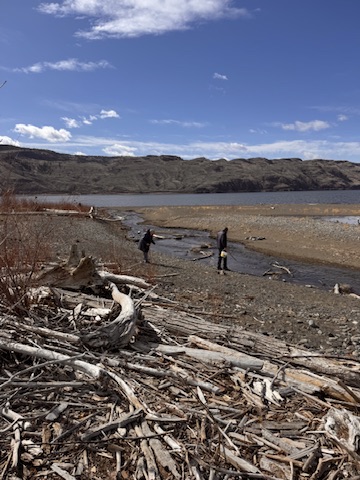
What We Made Together at the Edge of the Water
Photo: Amy Tucker, © 2026
Artist Statement: Two people at the river’s edge, surrounded by what the water had brought and left behind.
Translation Note: Spanish phrases in this poem were assisted by Google Translate (translate.google.com). The Spanish is woven in as an act of reclamation, a return to a language of the body and the self that exists beyond institutional English.