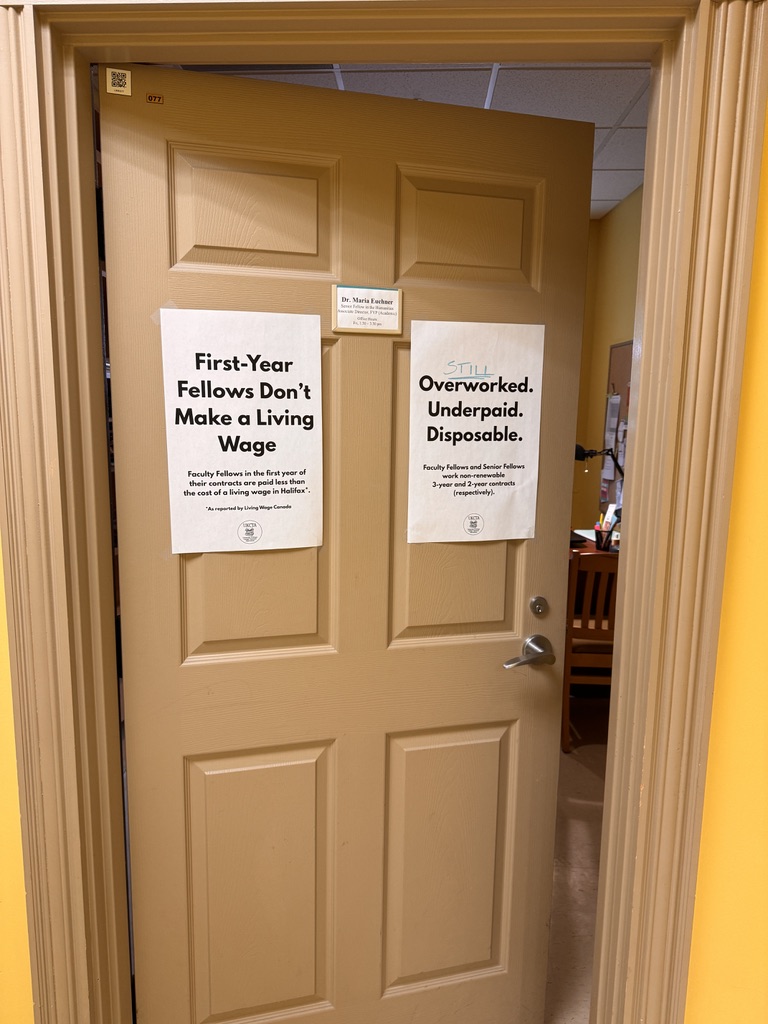
I stood in the corridor of the Foundation Year Program at the University of King’s College in Halifax and read a door. Two posters were taped to its panels, framing the nameplate of Dr. Maria Euchner, Senior Fellow in the Humanities and Associate Director, FYP (Academic). The poster on the left read, in heavy black type: “First-Year Fellows Don’t Make a Living Wage.” The poster on the right read: “Overworked.” Underpaid. Disposable. Above the word “Overworked,” a hand had written “STILL” in blue marker, underlined twice.
I have spent years thinking about precarity in higher education. I have written about it as my doctoral committee at Royal Roads University helped me sharpen my argument. I have lived it as a contract academic at Thompson Rivers University for nearly two decades. I thought I understood the architecture. Standing in front of that door, I felt the weight of the word Still. That single adverb, written by hand, did more theoretical work than most of the literature I have cited.
Still, Dr. Euchner’s Door, Foundation Year Program, University of King’s College, Halifax
What the Door Said
The posters were produced by the University of King’s College Teaching Association (UKCTA), the union representing Faculty Fellows and Senior Fellows in the Foundation Year Program. Faculty Fellows are appointed to three-year non-renewable contracts. Senior Fellows are appointed to two-year non-renewable contracts. According to a position posting for the role, the starting salary for a Faculty Fellow in the Humanities was $52,343 to $56,627 as of July 1, 2022, with future scales tied to bargaining (University of King’s College, 2026). The duties listed include four to eight hours of tutorials per week, eight hours of lecture attendance, weekly office hours, bi-weekly essay grading, and an average reading load of sixty pages per day, four days per week.
Set this beside the most recent calculation from the Canadian Centre for Policy Alternatives (CCPA) Nova Scotia office. Saulnier and Williams (2024) calculated the 2024 living wage for Halifax at $28.30 per hour, the highest rate in Atlantic Canada. The CCPA methodology assumes a household with two adults, each working thirty-five hours per week to support two children, which translates into roughly $51,506 in annual earnings per adult before taxes. The arithmetic is uncomfortable. A first-year Faculty Fellow at the 2022 salary floor of $52,343, working a load that almost certainly exceeds thirty-five hours per week once preparation, marking, reading, and committee work are honestly counted, is hovering at the line. The poster is correct. When the actual hours are accounted for, the line is behind them.
A tentative agreement was reached and ratified in early April 2026, after conciliation talks broke down and a strike appeared imminent (Chiasson, 2026; Taylor, 2026). The strike was averted. The structural questions on that door remain.
The Word That Did the Work
The word “Still” was what stopped me. The literature on contingent and contract academic labour returns again and again to the same pattern: a campaign, a report, a brief moment of public attention, and then quiet. The poster on the right side of Dr. Euchner’s door was familiar; this poster had been up before. The handwritten Still in blue marker suggested that the same poster, or one very much like it, had been put up before. The fight had been waged. The conditions had shifted too little for the poster to come down.
Time itself becomes a feature of precarity. In my dissertation at Royal Roads, Through Our Eyes: A Photovoice Study of Interconnected Precarity, Belonging, and Possibility in Higher Education, I argue that contract faculty and international students are bound together by parallel vulnerabilities. I call this interconnected precarity. The institutional logic that recruits international students for tuition revenue and discards them at graduation is the same logic that hires Faculty Fellows for teaching capacity and discards them at the end of the contract. The pattern is rhythmic. The bodies rotate through. The titles remain. The students change, the Fellows change, and yet the work and the conditions of the work persist. Still.
The Titles and the Trap
I have been developing a concept in a separate manuscript, recently advanced to conditional acceptance at Group and Organization Management, that I call malperformative inclusion. It names a particular institutional move: an organization performs the gestures of inclusion through titles, ceremonies, publicity, and acknowledgement programs, while the underlying structures continue to exclude. The performance is included only in the form. It is inclusion that performs the function of exclusion under another name (Tucker, in press).
The title “Faculty Fellow” is prestigious. It carries the resonance of Oxford and Cambridge collegiate traditions, of community, of belonging. It signals scholarly seriousness. It tells parents, applicants, and donors that the people teaching the foundational program are valued members of an intellectual community. The reality, laid out in plain language on paper taped to a door, is that the Fellowship is a non-renewable contract, that the salary in the first year falls at or below the regional living wage, and that the position will end on a fixed date with no path to continuation. The title performs inclusion. The contract performs disposability. This is what I mean by malperformative inclusion. The door named it more economically than my chapter does.
A Door Is a Photograph Is a Method
I look at this door, and I see a photovoice frame. Photovoice is a participatory research methodology developed by Wang and Burris (1997) in which participants use photographs to document conditions of life that conventional reporting cannot reach. The image becomes a means of testimony. It carries information that paragraphs cannot, because the image asserts: this is here, this is now, this is real.
The Faculty Fellows had no need for a researcher to come and document their conditions. They produced their own photovoice frame. They printed the words. They taped them to a door at the height of an adult reader. They wrote Still by hand. The hand-lettered word is the methodological signature. It says: a person did this. A person stood in this hallway and amended the original poster because, despite its accuracy, it was no longer accurate enough. Conditions remained unchanged. The poster required updating. Still.
The Faculty Fellows at King’s are doing the same work with paper and tape. The door is the camera. The corridor is the gallery. The asterisk citing Living Wage Canada is the methodological footnote. I find this beautiful and devastating in equal measure.
What I Take With Me
I take three things from this door into my own work and into my dissertation defence in the coming weeks.
The first is that precarity is rarely solved by a single agreement. The strike was averted at King’s College. I am genuinely glad. I also know from my work with the Federation of Post-Secondary Educators of British Columbia (FPSE) and my role as Chair of the Non-Regular Faculty Committee that aversion is a pause, and that resolution requires more. Three-year and two-year non-renewable contracts will continue to shape the working lives of those who teach in the foundational humanities program at one of Canada’s oldest universities. The poster must be taken down by the institution; the workers alone cannot remove it.
The second is that scholarly personal narrative is appropriate and, at times, necessary in such moments. I write in this voice because the door is in the first person. The hand that wrote Still is a worker’s hand, personal and deliberate, distinct from any institution’s. Theory should answer in kind.
The third is that the Foundation Year Program’s foundation rests on the labour of people paid at or below the living wage in the city where they live. The undergraduate students who arrive for their first year of university, often on student loans and family sacrifice, are taught by scholars whose own household economies are governed by precarity. Interconnected precarity is concrete, immediate, and present. It is the floor and the ceiling of the same building.
I left the corridor. I carried a photograph of a door. I carry it still.
References
Chiasson, N. (2026, April 8). Strike looming for some staff at Kings College in Halifax. Country 103.5 / Acadia Broadcasting. https://hotcountry1035.ca/2026/04/08/strike-set-for-some-staff-at-kings-college-in-halifax/
Saulnier, C., & Williams, R. (2024). 2024 living wages for Newfoundland and Labrador, Nova Scotia and Prince Edward Island. Canadian Centre for Policy Alternatives, Nova Scotia. https://www.policyalternatives.ca
Taylor, E. (2026, April 9). Strike avoided at University of King’s College after deal reached. Country 103.5 / Acadia Broadcasting. https://hotcountry1035.ca/2026/04/09/strike-avoided-at-university-of-kings-college-after-deal-reached/
Tucker, A. (in press). Malperformative inclusion as institutional practice [Commentary]. Group and Organization Management.
Tucker, A. (in progress). Through our eyes: A photovoice study of interconnected precarity, belonging, and possibility in higher education [Doctoral dissertation, Royal Roads University].
University of King’s College. (2026). Faculty fellowship in the humanities [Position posting]. https://ukings.ca/campus-community/employment/faculty-fellowship/
University of King’s College Teaching Association. (2026, April 9). Statement on tentative agreement. UKCTA.
Wang, C., & Burris, M. A. (1997). Photovoice: Concept, methodology, and use for participatory needs assessment. Health Education & Behavior, 24(3), 369-387. https://doi.org/10.1177/109019819702400309

