They gave me a contract the way you give someone an umbrella after the rain has already started,
a document, a date, a number of months carefully chosen to end just before anything could be called permanent.
I signed it.
Of course, I signed it. I signed it the first time with something close to joy, the particular joy of a person who has worked very hard, been seen working very hard, and is finally, finally being let in.
I did not read the expiry date as a warning. I read it as a beginning.
That is the thing about the first contract. It feels like a door opening. It takes years to understand that it was never a door. It was a revolving one, and you were always going to end up back outside.
The second contract came, and I signed it with slightly less joy and slightly more relief, which is a different thing, relief being what joy becomes when it has learned to be grateful just to still be here.
I was still here. That felt like something. I made it mean something.
Here is what no one tells you about living in one-year increments.
You cannot plan a garden.
That sounds small. It is not small.
A garden requires the belief that you will be there for the harvest, that the thing you put in the ground today will be yours to tend through all its seasons, that the roots go down into soil that belongs to you long enough to matter.
I could not plan a garden.
I could not plan the way people plan when they know they are staying.
I planned the way people plan when they are guests. Carefully. Lightly. Always aware of where the door was.
Every spring it came.
The email, or the meeting, or sometimes just the silence that lasted a beat too long before someone said, “We are planning to have you back.
Planning to.
Two words doing the quiet work of keeping a person just uncertain enough to be manageable.
Do you know what the annual uncertainty does to a body?
It does not break you all at once. That would almost be easier. A clean break, a clear moment, a before and after you could point to.
It is slower than that.
It is the way the shoulders never quite come down. The way sleep becomes a negotiation in the months leading up to renewal. The way you cannot fully celebrate the good semester, because somewhere in the back of every good thing is the question of whether there will be a next one.
And the cruellest part, the part that I am still sitting with,
is that they needed me.
Not abstractly. Not in the way institutions need warm bodies to fill rooms.
They needed me specifically. My expertise. My courses. My relationships with the students. My willingness to sit on the committees, cover the gaps, and do the invisible work that kept things running while they endlessly searched for the person they actually wanted in the position I was already doing.
They used my labour to hold the place for someone else’s permanence.
I was the placeholder. For nineteen years, I was the placeholder.
And they were kind about it. That is the part that makes it complicated. They were genuinely kind. They appreciated me. They said so. They meant it.
Appreciation and belonging are not the same thing. I know that now.
I am tearing up the contract now.
Not in anger. In grief. In the quiet grief of a woman who finally understands what she was signing all those years,
and who is ready, for the first time, to sign something different.
Something that says I belong to my own future.
Something that says my labour is not available for indefinite borrowing.
Something that says I am not a placeholder. I am not pending. I am not provisional.
Something that has no expiry date because it is written in the only ink that does not fade:
the knowledge of her own worth, which was never, not for a single year of all those years, in question.
A Coda, in My Own Voice
I want to say one more thing, before the closing.
I signed each contract knowing what it was, eventually. The first one I signed in something close to joy. The later ones I signed knowing the shape of the door, and I signed them anyway, because the work was the work I wanted to do and because the imagined alternative was a country I had no map for. The institution wrote the terms. I accepted them. I also negotiated, sometimes, in small ways. I also rested when I could. I also taught well within the arrangement and let myself be proud of that.
It would be too easy to write the poem in which I am only the one signed against. The fuller truth is that I was also the one who kept signing, kept hoping the next renewal would feel different, kept producing the goodwill that made the next renewal more likely. Compliance had a quiet payoff for me too. I want the record to hold that line beside the line about precarity.
I am tearing up the contract now. I am also acknowledging that, for nineteen years, I helped renew it.
Aquí estoy. Ya no esperando renovación. Soy permanente en mí misma.
Here I am. No longer waiting for renewal. I am permanent within myself.
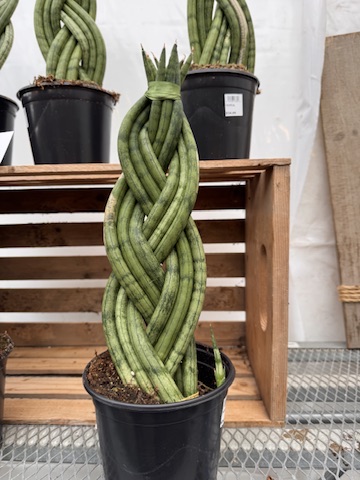
Woven into Something Not of Your Own Choosing
Photo: Amy Tucker, © 2026
Artist Statement: I found this plant in a greenhouse, a living thing that had been trained, woven, braided into a shape someone else chose for it. Still growing. Still green. Still entirely itself beneath the pattern that had been imposed upon it. I photographed it because the contract works the same way: take something living and weave it into increments, into one-year shapes, into a form that serves the institution’s aesthetics while the root keeps reaching down regardless. The braid is not the plant. The contract is not the person. Both are still alive underneath.
Translation Note: Spanish phrases in this poem were assisted by Google Translate (translate.google.com). The Spanish is woven in as an act of reclamation, a return to a language of the body and the self that exists beyond institutional English.

