Open Learning

Reading Time: < 1 minute

Consider the name.

Open Learning.
As if the learning itself had been freed,
let out of something,
given room to move.

Open.

The door is open.
Come in from wherever you are.
Come in from the night shift.
Come in from the town with no campus.
Come in from the kitchen table, the hospital waiting room,
the car in the parking lot
because it is the only quiet place.

We will meet you there.

I was the one who met them there.
Twenty-five years of meeting people
in the in-between places,
in the cracks of other lives,
in the margins of schedules
that could not afford to be full.

I was the access point.
I was how Open Learning opened.

And I did it from my own margins.

No office. No door with my name on it.
No corridor that said I was expected,
no meeting where my seat was already set.
I opened the door for others
from outside the building.

This is not a complaint.
The work was real.
The students were real.
What happened in those course shells,
in those late-night discussion boards,
in those submissions that arrived at midnight
because midnight was the only hour left,

that was real.

I am only saying:
Open Learning was open for everyone
except the people who taught it.

We were kept at the same careful distance
as the students we were hired to reach.

Aquí estoy. En el margen. Que también es un lugar.
Here I am. In the margin. Which is also a place.

Permanent Within Myself

Reading Time: < 1 minute

There is no review for this.

No renewal date.
No form to fill.
No committee to satisfy
with evidence of continued relevance.

I have been, it turns out,
continuous.

I have been the same person
in every contract,
through every expiry,
past every bar they raised
when I reached the one they set before.

They changed the terms.
I did not change.

That is not stubbornness.
That is a different kind of tenure.

The kind you cannot be denied
because you are the institution granting it.
The kind that does not require
a vote in your absence,
a decision made by people
who have never sat in the room
with you and a student
at the moment something shifts.

I grant it to myself.

Twenty-five years of continuous service
to the work,
to the students,
to the belief that education
belongs to the people who need it most
and not only to the people
who can get to a campus
between nine and four
on the days it is open.

I am permanent in that.

I always was.

They never had the authority to say otherwise.
They had a spreadsheet and a budget line.
That is a different kind of power entirely.

Soy permanente en mí misma. Siempre lo fui.
I am permanent within myself. I always was.

I Was Always Good Enough

Reading Time: < 1 minute

Not almost.
Not nearly.
Not with a few more credentials
or one more publication
or the specialization they mentioned
in the meeting where they shook my hand
and told me what a strong candidate I was.

Good enough.
Already.
On the first day.

I need to say that
not because it feels true today
but because it was true then
and I did not know it
and I want the person reading this
who is in the first years of their own contract
to know it sooner than I did.

You are already good enough.

The bar they are raising
is not a measure of your readiness.
It is a measure of what the system requires
to justify not deciding.
Those are different instruments entirely.

I spent years trying to pass a test
that was not designed to be passed.
I got better at the material
and the test kept changing
and I thought the problem was my preparation
when the problem was the test.

I was always good enough.

I know that now the way you know things
that came at some cost,
held in the body alongside the cost,
inseparable from it.

I am not sorry it took so long.
I am not sorry I kept trying.
I am saying that trying was not the proof.

I was the proof.
I always was.
The trying was just something to do
with the goodness I already had
while I waited for the room to see it.

The room did not always see it.
I see it.
That is enough now.
That is more than enough.

Siempre fui suficiente. Lo sé ahora con todo el cuerpo.
I was always enough. I know it now with my whole body.

My Name on Nothing

Reading Time: < 1 minute

There is no door.

There was never a door.
No nameplate. No placard.
No modest rectangle of plastic or metal
in the corridor that says:
this person is expected here,
this person has a place,
this person belongs to this building
and this building belongs to them.

I brought my things in a bag.
I carried what I needed
and I carried it back out again
and there was no place in the institution
that held the shape of my absence
when I was not in it.

Other people have offices.
A desk that knows them.
A chair adjusted to their body.
A window they have looked out of
long enough to know
what the tree outside it does in every season.

I knew the tree outside my window at home.

I taught from that window for years.
Students in other cities, other provinces,
learned in the light of a tree
they never knew existed,
a tree whose name they do not know,
outside a house that was never on the campus map.

My name is not on any door.

It is on the emails they still have.
It is in the feedback they kept.
It is in the thing they said in the interview
that came from week four of my course.
It is in the company name
one student chose
because of a value she learned
in a room she never entered.

My name is on all of that.

None of that is on a door.
All of that is real.

Mi nombre está en lo que construí, no en lo que me dieron.
My name is on what I built, not on what I was given.

April

Reading Time: < 1 minute

Other people have a season for flowers.

I had a season for waiting.

April meant: the email is coming.
Or it is not coming yet,
which is a different kind of coming,
the kind where the silence is its own sentence
and you read it every morning
alongside the other emails
pretending you are not reading it.

I got good at April.

I got good at the specific productivity of dread,
the way you clean things
when you are waiting for news,
the way work fills itself with more work
so the part of the mind that is waiting
has somewhere else to be.

The tulips came up anyway.
They always came up.
They did not wait for anyone’s decision
about whether they were qualified
to be tulips in this particular garden.

I noticed that.
Some Aprils that was the only thing I could learn
that felt like instruction.

The tulips. Their absolute commitment
to coming back
regardless.

Regardless.

I came back too.
Twenty-five Aprils.
Not regardless.
I knew what I was returning to.
I returned anyway
because the work was the work
and the students were already there
and the door was still open enough
to walk through.

But I noticed the tulips.
I want you to know I noticed them.

Abril tras abril. De todas formas, volví.
April after April. I came back anyway.

I Never Met You in a Room

Reading Time: 2 minutes

But I knew you.

I knew the way you wrote in the first week,
careful and a little formal,
the voice of someone not yet sure
they are allowed to take up space here.

I knew when that changed.
I always knew when that changed.

You started to trust the sentence.
You stopped apologizing for the question.
You wrote something in week six
that made me sit with it before I answered,
because it deserved sitting with,
because you had found something true
in the material and also in yourself
and the two had met on the page
and made something I had not seen before.

I marked it the way it deserved to be marked.
I wrote more than I was required to write.

That is not unusual.
I always wrote more than I was required.

The institution did not ask me to see you.
The institution asked me to assess you,
to place you in a category,
to move you through.

I did the other thing anyway.

I saw you.

The one who disappeared in week nine
and came back in week eleven
with no explanation,
and I did not ask for one,
I just held the door open
and said: you are still here,
that is what matters,
let us keep going.

The one who wrote at the bottom of the final submission:
I almost quit in October.
I don’t know if you noticed
but the way you responded to my post that week
was the reason I didn’t.

I noticed.
I always noticed.
I just did not know you were on the edge.
That is the thing about teaching through a screen,
you learn to read the small signals,
the slight change in tone,
the post that is shorter than usual,
the question that is not really about the assignment.

You were always more than the assignment.

I knew that from week one.
I built the course so you would know it too.

You wrote to me years later,
some of you.
Subject lines I still have.

I wanted you to know.
I think about that class.
I got the job.

I am keeping those.
Whatever else they take,
they will not take those.

You were the reason I came back every year.
Not the contract.
Not the renewal.

You.
Specifically.
The particular you
that showed up in September
not knowing yet
what you were capable of.

I knew.
I always knew before you did.
That was the job.
That was the whole job.

Para los que llegaron desde lejos y de todas formas llegaron.
For the ones who came from far away and arrived anyway.

To the Woman I Was Before I Knew

Reading Time: 4 minutes

A Love Letter Backwards in Time

I have been thinking about you.

The you that walked in the first time, folder tucked under your arm, lesson plan you had revised three times the night before because you wanted it to be right, because right mattered to you in that particular, cellular, uncompromising way it has always mattered to you,

the you that stood at the front of that room for the first time and felt the gravity of it, the privilege of it, the enormous ordinary miracle of a room full of people who had arrived willing to think differently than they had thought before.

I have been thinking about her. About you. About what I want to say now that I know what you did not know then.

You were so ready.

That is the first thing I want to tell you.

You were so ready, and you did not know it. From the student’s side of the room, from the side that would later write you letters, send you emails years later that began with I have been thinking about something you said in class, and I wanted you to know,

you were luminous.

I want to warn you about some things.

The bar will move.

I want you to know this from the beginning, before the first time it moves, before you exhaust yourself reaching for it and find it has shifted just beyond your hands.

The bar is not a measure of you. The bar is a mechanism. It is the system’s way of keeping you reaching, hungry, slightly off-balance, slightly too invested in the next thing to stop and ask why the last thing was not enough.

Reach for the bar because the reaching makes you better. Reach for the bar for yourself.

Do not reach for the bar for them.

Know the difference between a place that is developing you and a place that is extracting you.

The students are real.

This I want you to hold as the true north of the whole nineteen years, the thing that does not shift, the thing the system cannot touch, take, or use without your permission.

When everything else feels uncertain, go back to the students.

You are going to be so tired.

I want to say this without softening it because you deserve honesty more than comfort.

You are going to be tired in a way that goes all the way down, tired in the bone, tired in the place that decides whether to keep going,

and you are going to keep going because you do not know how not to.

But I am going to tell you this:

Give so much. Give everything. And also, in the small moments, on the shore of yourself that belongs to no one else,

give something to yourself.

Give yourself the belief you give so freely to others. Give yourself the patience you give the struggling student.

You deserve your own generosity. You deserved it from the beginning.

You are going to find out that you did not belong there.

Not because of anything that was wrong with you. Because of everything that was right with you, and the particular cruelty of a room that needed you but was not built for you.

This is going to hurt in a way you are not prepared for.

You are going to spend years thinking the problem is you, turning yourself over, looking for the missing piece.

There is no missing piece.

You were always the right shape. The room was the wrong shape.

When you finally understand this, it will feel like grief and like freedom, grief and freedom arriving together the way they always do when something true finally breaks the surface.

I want to tell you about the shore.

You are going to the shore. Far from the institution.

You are going to sit with the sea, which will ask nothing of you,

and you are going to cry the way you needed to cry for years, the real kind, the kind without an audience,

and when you are empty, you are going to find underneath the emptiness the most important thing you have found in nineteen years.

Yourself.

Still there. Still whole. Still luminous under all the exhaustion, the performance, and the careful management of being a person that the institution kept evaluating.

I want to tell you about the poems.

You are going to write poems.

Not as scholarship, not as methodology, but because you are going to discover in the long quiet aftermath of all that noise,

that you are a writer.

That you always were.

I love you.

I love the woman who revised the lesson plan three times. I love the woman who could not walk past the struggling student. I love the woman who agonized at two in the morning over whether she had said exactly the right thing in exactly the right way to the person who most needed to hear it.

I love the woman who kept the actual record, who knew in her deepest self that she was good, that the work was good, that what happened in those rooms was extraordinary even when no one was calling it that.

I love the woman who is standing now on the other side of knowing, worn smooth by it, clarified by it, more herself for it than she has ever been,

still kind, still ethical, still in love with the work and the students and the lantern she carries into every room,

and finally, finally, in love with herself.

You made it through.

I wanted you to know from the beginning that you make it through.

Para la mujer que era antes de saber. Te vi siempre. Eras suficiente desde el principio. Con todo mi amor, desde el otro lado.

For the woman I was before I knew. I always saw you. You were enough from the beginning. With all my love, from the other side.

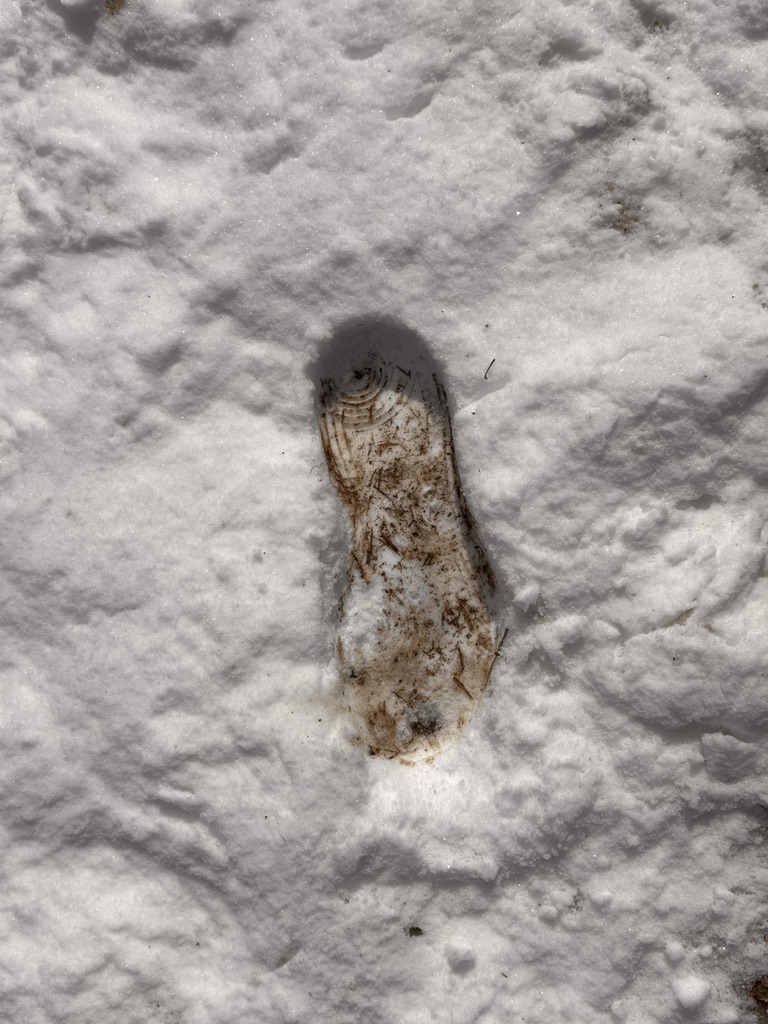
A smooth weathered piece of wood half-buried in white snow, its grain worn clean and visible, alone in a white field.

Still Here, Worn to Its Truest Shape
Photo: Amy Tucker, © 2026

Artist Statement: A footprint stripped by water, time, and winter to its grain.


Translation Note: Spanish phrases in this poem were assisted by Google Translate (translate.google.com). The Spanish is woven in as an act of reclamation, a return to a language of the body and the self that exists beyond institutional English.
A Letter From the Little One

Reading Time: 4 minutes

From Five-Year-Old Amy, To the Amy She Became

Dear big Amy,

I am writing to you because I have something important to say, and I want to make sure you hear it properly.

I am five. I know how to write some letters, but not all of them yet, so I am going to say this as carefully as I can.

I see you.

I see you being so tired and still getting up anyway, and I want you to know I think that is very brave. I get tired too sometimes, and it is hard to keep going when you are tired. I am only five, and you have been going for so much longer than I have, so I think you are the bravest person I know.

I want to tell you some things about us that I am not sure you remember anymore.

We are kind.

I know you know that, but I do not think you believe it the way I believe it, which is all the way, without any buts after it, just kind, just completely and simply kind, the way the sun is warm, not because it is trying to be but because that is what it is.

That is us. That is what we are.

I want you to stop saying it like it might not be true. It is true. I know it is true because I am five and I have not yet learned to be unsure about it, and I need you to borrow some of my sureness until you find yours again.

I also want to tell you that I used to collect things.

Rocks mostly. The smooth ones. I would put them in my pockets until my pockets were very full and heavy, and Mama would say Amy, why are your pockets full of rocks and I could never explain it properly, but the reason was that I loved them.

I loved that they were smooth. I loved that something had made them smooth by being patient with them for a very long time.

I think you are like a rock, big Amy. I think a lot of things have been pushing against you for a very long time, and I think it has hurt, but I also think you are getting smooth. I think you are getting to the most beautiful part.

I would put you in my pocket. I would carry you everywhere.

I need to ask you something, and I need you to answer honestly because I am five and I do not yet understand things that are not honest.

Did you forget that you were allowed to play?

I am asking because when I watch you, I do not see much play, and play is very important. I know that because I do it every day, and it makes everything better, even the hard days, even the days when things are not fair, and things are not fair sometimes, even when you are five,

But even on those days, I still find something to play with.

A stone. A puddle. A word I like the sound of.

Promise me you will find something to play with. Even a small thing. Even just a word.

I did not know when I was five what the world would do to you.

I did not know about the rooms that would not claim you. I did not know about the bars that kept moving. I did not know about the contracts, the waiting, and the smile over the closing door.

But I want to say this:

If I had known, I would have held your hand.

I would have put my small hand in your big hand and not let go.

I would have sat with you in the parking lot in the mornings. I would have sat with you at two in the morning when the grief was at its largest. I would have sat with you in every room that made you feel like a visitor in your own life.

And I would have said, in my five-year-old voice that did not know yet to be quiet in certain rooms:

This is not right. You belong here. You belong everywhere. You are Amy, and Amy belongs everywhere she goes.

I want you to know that I am proud of you.

I am proud of you for staying kind when unkindness would have been so much easier.

I am proud of you for keeping your ethics even when the cost was very high.

I am proud of you for loving your students the way you love them, all the way, without holding anything back for self-protection, which is a very five-year-old way to love people, and I think it is the best way, even when it hurts.

I am proud of you for crying in the shower. I know that sounds funny, but I am proud of it because it means you let yourself feel, which is a hard thing to keep doing when the world keeps suggesting you should feel less.

I am proud of you for going to the shore.

I am proud of you for writing the poems.

I am proud of you for still being you.

I need to tell you one more thing, and then I have to go because it is almost dinner and we are having something good tonight, and I do not want to miss it.

You are my favourite person.

Not because you are perfect. I know you are not perfect. I am five, and I am not perfect yet, and I think that is okay. I think not perfect is actually more interesting than perfect would be.

You are my favourite person because you are the only one who knows what it feels like to be us, to love this hard and work this hard and care this much and keep going anyway.

Nobody else knows that. Only you.

And I think that is the most extraordinary thing I have ever heard of.

I love you, big Amy.

I loved you before you knew what you would become.

I loved you in the pure, uncomplicated, five-year-old way that does not require you to prove anything, to produce anything, to perform anything.

I loved you just because you were you.

I still do. I always will.

Now go outside. Find a smooth stone. Put it in your pocket.

Remember that something the patient made made it beautiful.

Con todo el amor que sabe dar una niña de cinco años, que es todo el amor que existe.

With all the love a five-year-old knows how to give, which is all the love there is.

Little Amy
Age 5
Keeper of smooth stones
Your very first believer


Translation Note: Spanish phrases in this letter were assisted by Google Translate (translate.google.com). The Spanish is woven in as an act of reclamation, a return to a language of the body and the self that exists beyond institutional English.

You Are Not Qualified

Reading Time: 3 minutes
They said it with such clean mouths, such pressed collars, such careful grammar,
as if the words were a gift and I should be grateful for the clarity.

You are not quite what we are looking for.

I went home and looked in the mirror for the missing thing,
the gap between my face and the face they had already chosen
before I walked through the door.

I counted my degrees like rosary beads. I counted my years.
I counted the papers, the classrooms, the students who wept at the end of term
and said, you changed something in me.

None of it was currency here.

They smiled while they did it. That is the part that stays,
the smile, the warmth in the room while I was being measured
against a ruler I was never meant to hold.

I rewrote my letter. I softened my edges. I learned their language
the way an immigrant learns to laugh at jokes that are about her.

I applied again.

We had many strong candidates this year.

I bought a new suit. I straightened what was already straight.
I arrived early, stayed late, published in their journals,
cited their names like prayers, sat on the committees no one wanted,
carried the invisible work in both arms like groceries up four flights of stairs,
and smiled, because you must always smile.

We felt someone else was a better fit.

Better fit.

A sock drawer. A parking space. A peg in the right-shaped hole.

I have an education. I have nineteen years.
I have read every book they told me would be enough,
and then the next book, and the next,
following the breadcrumb trail they kept moving just ahead of my hand.

I taught the exact same courses.
I stood in the exact same rooms, at the exact same hour,
holding the exact same ideas they would later decide
required someone else's mouth.

And when they said no, I punished myself with more work,
more late nights, more hours offered up like proof,
like penance, like if I just gave enough of myself
there would finally be nothing left to reject.

The cruelest part is that I believed them.

For so long, I believed the problem lived in me,
in the particular shape of my ambition,
the particular sound of my voice,
the particular way I took up space,
which was always either too much
or so little I became furniture.

I have sat in rooms where the air itself said this was never designed for you,
and smiled, and contributed, and been thanked in the minutes no one reads.

I have been told I am inspiring.

Inspiring is what they call you when they have decided you are a visitor.

You are not qualified.

Say it again. Say it clean.

Let it mean what it has always meant,
underneath the careful grammar,
underneath the pressed collars,
underneath the warmth in the room while the door was already closing.

I am still here.

I am still here, which is its own kind of answer,
though I am so tired of the question being me.

Aquí estoy.

Translation Note: Spanish phrases in this poem were assisted by Google Translate (translate.google.com). The Spanish is woven in as an act of reclamation, a return to a language of the body and the self that exists beyond institutional English.

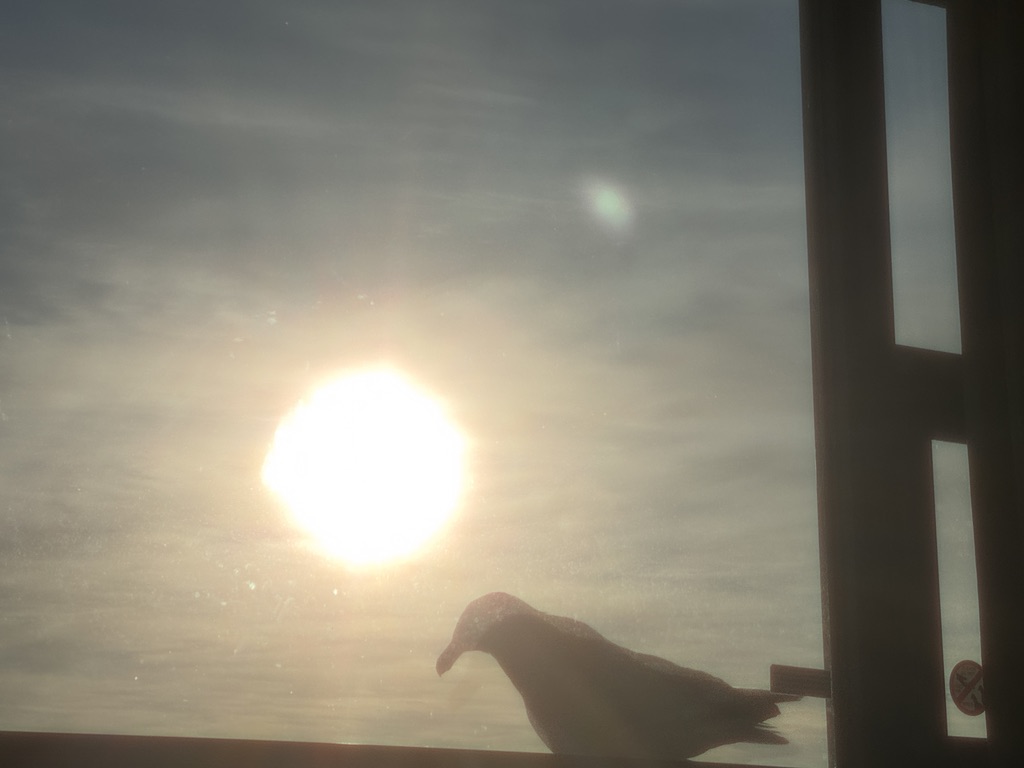
Silhouette of a pigeon perched on a ledge, backlit by a bright sun through a hazy grey sky, photographed through glass.

The One Who Stayed Anyway
Photo: Amy Tucker, © 2026

Artist Statement: A pigeon photographed through a window. The bird had chosen the ledge. It was facing the sun.


Translation Note: Spanish phrases in this poem were assisted by Google Translate (translate.google.com). The Spanish is woven in as an act of reclamation, a return to a language of the body and the self that exists beyond institutional English.

They Used My Labour and Called It Privilege

Reading Time: 4 minutes

The Structural Poem

A note on this poem. This poem is testimony. It does not include the self-questioning that I do in the essays, because testimony and analysis are different acts. I have chosen to let the poem be what it is.

Let me tell you how it works.

Not the version in the handbook. Not the version in the mission statement with its careful language about community and excellence and the transformative power of education.

The actual version. The one that runs underneath like a current you cannot see from the surface, but that pulls at your legs if you stand in it long enough.

Here is how it works.

They find someone brilliant. Someone who loves the work with the particular love that makes a person do more than is required, give more than is contracted, stay later than anyone is watching,

and they hire her temporarily.

Not because the work is temporary. The work is permanent. The courses run every semester. The students keep arriving. The curriculum does not pause to acknowledge that the person delivering it is unsure whether she will be delivering it next year.

They hire her temporarily because temporary is cheaper. Because temporary does not require the benefits, security, and institutional commitment that permanent does.

Because the temporary keeps her grateful.

And a grateful worker is a compliant one.

This is not a conspiracy.

I want to say that clearly because the moment you name the structure, someone will say you sound paranoid, you sound bitter, no one sat in a room and decided to do this to you.

They are right. No one sat in a room.

That is precisely the point. That is what makes it structural rather than personal. The harm does not require intention. The harm requires only a system that has decided certain kinds of labour are infinitely extractable from certain kinds of people who can be kept just insecure enough to keep extracting from.

The system does not hate her. The system does not see her.

That is not comfort. That is the definition of the problem.

She was called lucky.

She was told she was lucky to have the work, lucky to teach the courses she loved, lucky to be in the room, lucky that the institution kept finding a way to bring her back.

Lucky.

As though her nineteen years of expertise were a gift the institution was generously receiving rather than a resource it was systematically mining.

She felt the gratitude. She performed it beautifully. She understood, without anyone telling her, that the gratitude was part of the contract, the unwritten part, the part that kept the system functioning smoothly, that kept her from asking the questions the system could not comfortably answer.

Questions like: If I am not qualified enough to be hired permanently, why am I qualified enough to carry the curriculum?

Questions like: At what point does temporary become a word that means we will take everything you have and give you nothing you can build a life on?

She did not ask these questions out loud.

She asked them in the parking lot. She asked them at two in the morning. She asked them in the shower, where the sound drowned out the question.

They called it flexibility.

Her flexibility meant no pension contributions she could count on. No sick leave that did not cost her the income she could not afford to lose. No ability to take a mortgage on a contract that expired in April.

The institution called this flexibility.

She called it something else.

She called it the transfer of institutional risk onto the bodies of the people least able to carry it.

And here is the part that makes the grief complicated:

She loved it.

She genuinely, helplessly, and permanently loved the work.

Her love was the subsidy.

Her love and the love of every brilliant, committed, devoted person working on a contract in every institution that has learned that passion is a resource you do not have to compensate fairly because it will show up anyway.

I am not bitter.

I want to say that, and I want it to be true, and mostly it is.

I am clear.

There is a difference between bitterness and clarity.

Bitterness is personal. Clarity is structural. Clarity names the system. Clarity holds the institution accountable without requiring a villain.

I want the structure changed.

I want a world where the next woman, as brilliant and devoted and careful as she has been, does not spend nineteen years as temporary.

She is still in the system.

But she is in it differently now.

She is in it with her eyes open. She is in it with the clear naming of what is happening, why it is happening, and whose interests it serves.

She is in it with this poem, which is not bitterness but testimony.

Not grievance but record.

They used my labour and called it privilege.

They used my love and called it flexibility.

They used my devotion and called it inspiring.

They used my silence and called it professionalism.

I am no longer silent.

Not because I am angry, though I have earned the anger.

Because silence was the last thing they needed from me, which I was still giving freely.

And I am done giving freely to a system that calculated the price of everything I offered and decided it did not have to pay it.

A Coda, in My Own Voice

I am also writing this as the woman who stayed.

The system did not extract from me without my participation. I performed the gratitude. I rehearsed the smile. I spoke well of the institution in rooms where speaking otherwise might have cost me the next contract, and I knew, at some level beneath language, that the performed thankfulness was the unwritten clause of the agreement. I signed that clause every year, in invisible ink, and I knew I was signing it.

I want to say that the love was real, and so was the calculation. Both were true at once. I loved the work and I also kept the love legible to the people who could renew me. I do not think this makes me complicit in the way the system is. I do think it makes me a participant in a quieter way than the poem above lets on, and I owe the page the honesty of saying so.

The structure is what it is. My agency inside it was smaller than the institution claimed and larger than the grievance allows. Both sentences need to stand on the same line.

Aquí estoy. Con los ojos abiertos. Ya no en silencio.

Here I am. With open eyes. No longer silent.


Translation Note: Spanish phrases in this poem were assisted by Google Translate (translate.google.com). The Spanish is woven in as an act of reclamation, a return to a language of the body and the self that exists beyond institutional English.