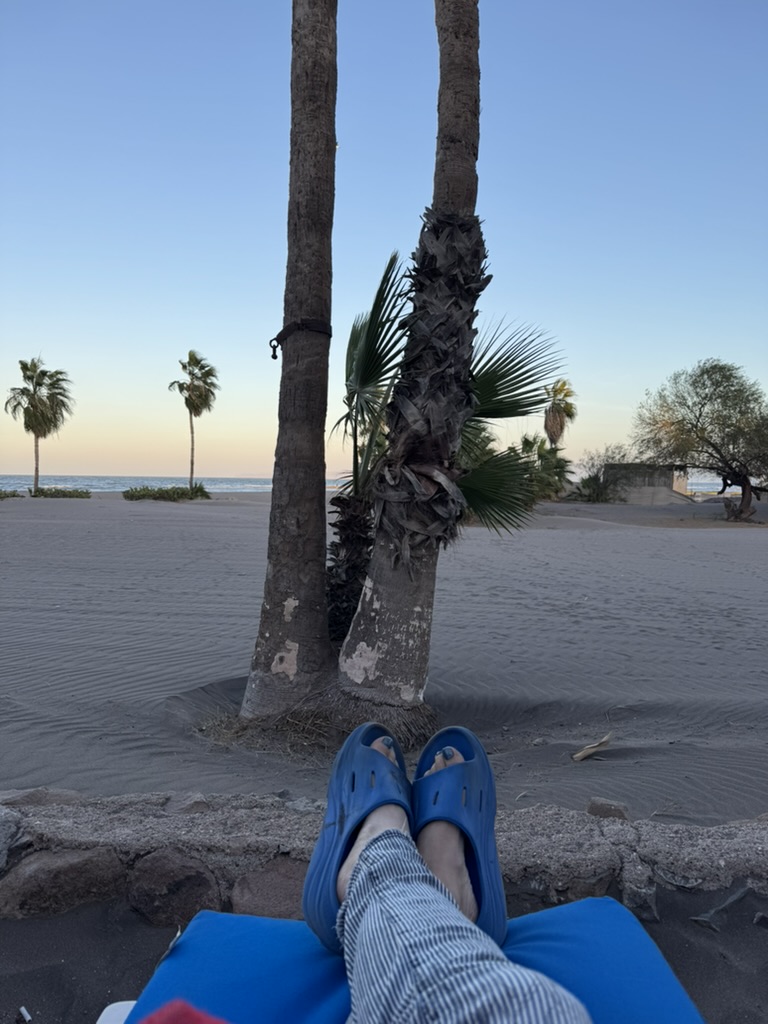
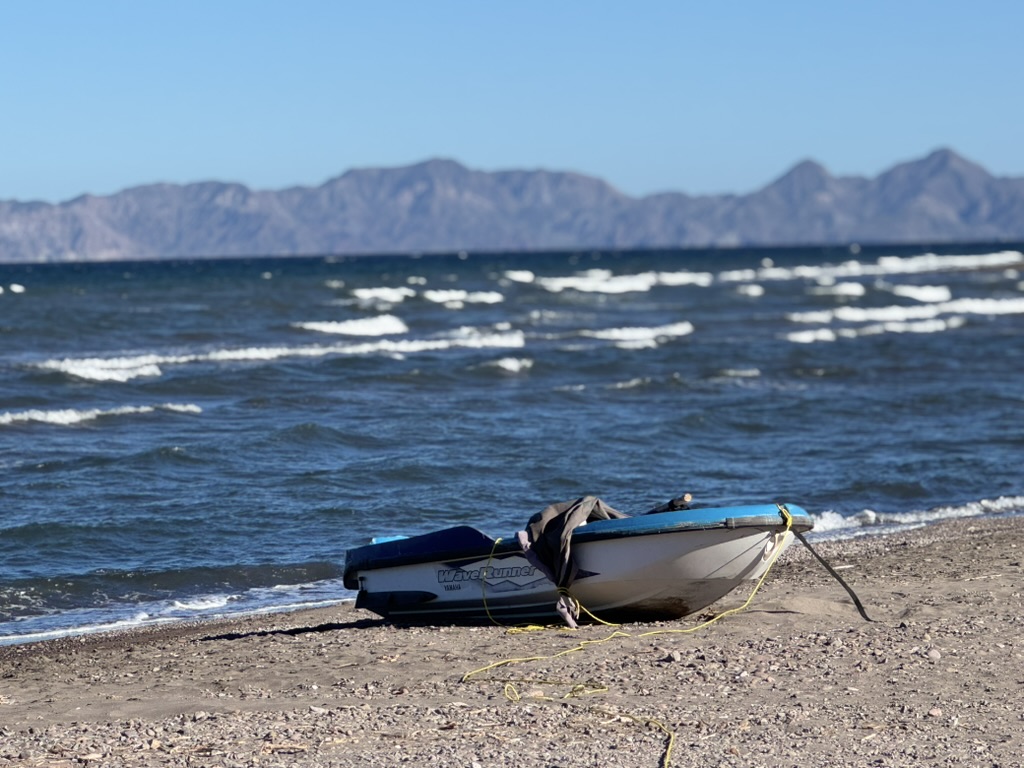
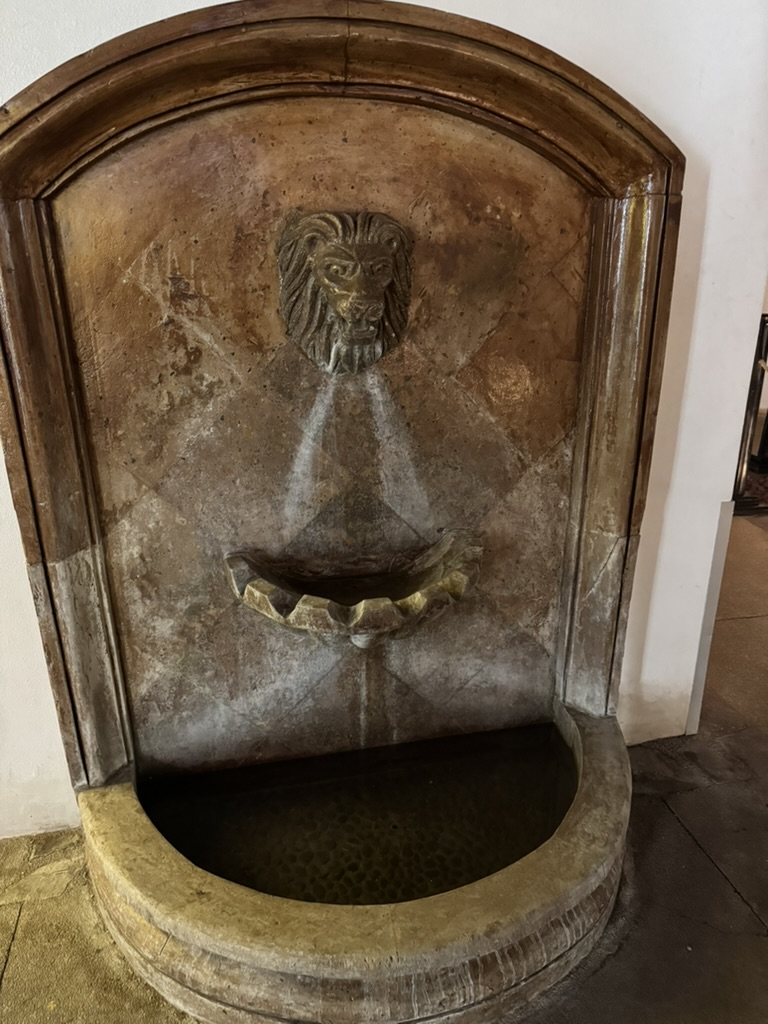
Day Thirteen: La Tierra Bajo Mis Pies

Reading Time: 9 minutes

The Earth Beneath My Feet

Title: The Sea Etched in the Earth
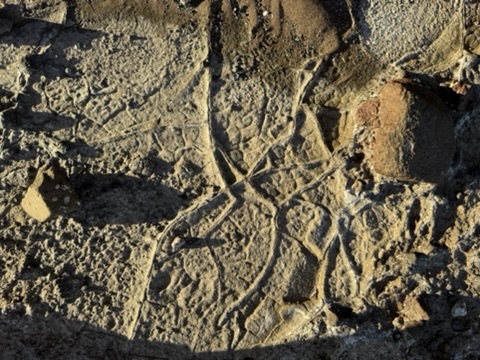
Photo Credit: Amy Tucker, 2026

I woke this morning thinking about roots.

Actually thinking about roots. About how they reach downward into darkness. About how they find water through the soil. About how they hold plants steady against wind while also drawing nutrients upward into the stem, leaf, and flower. Roots as anchor and conduit. Roots as holding and feeding at once.

My attention has been held by the sea. Twelve days of walking in it, watching it, letting it move through my body. Yet this morning, my awareness shifted downward rather than outward. Toward earth. Toward the land that holds this place, this village, this precise curve of coast where the Sea of Cortez meets the Baja desert.

The land has always been here. I have walked across it daily. Still, my attention treated it as surface, as passage, as the space between cottage and shoreline. Water received my devotion. Land remained background.

This morning, I attended differently.

Turning from Water to Land

Today I leave my current space and move to a small village called Nopoló, also settled along the sea’s edge. The change feels subtle yet consequential. A relocation measured in minutes yet weighted with meaning. A shift in orientation rather than distance.

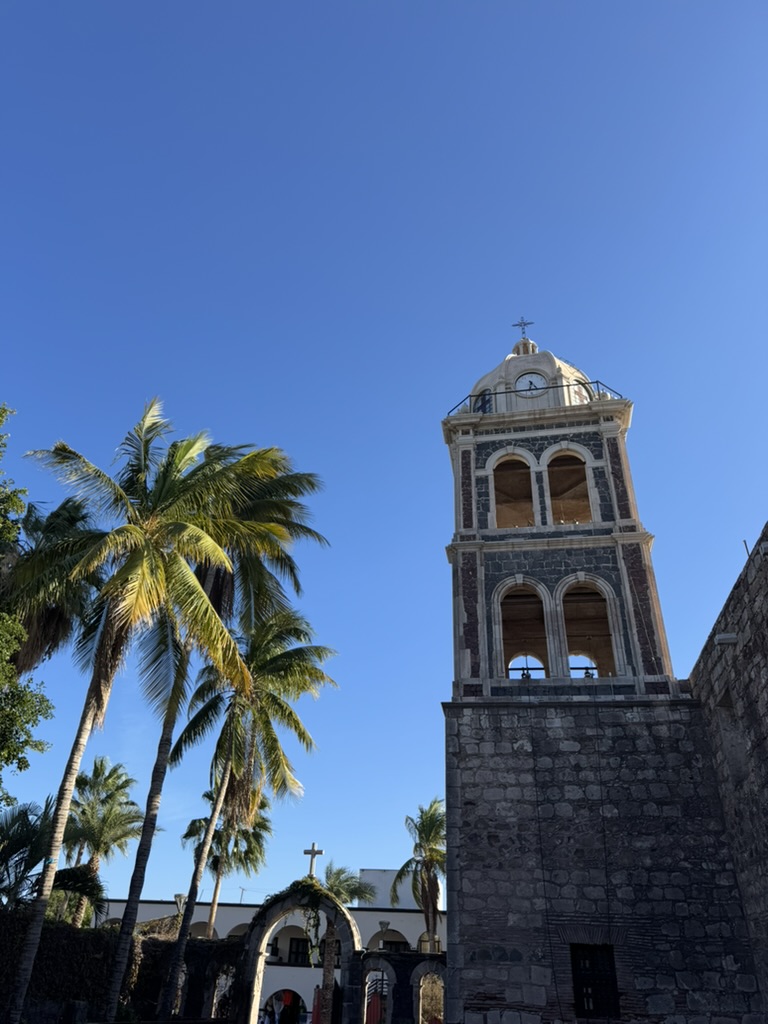
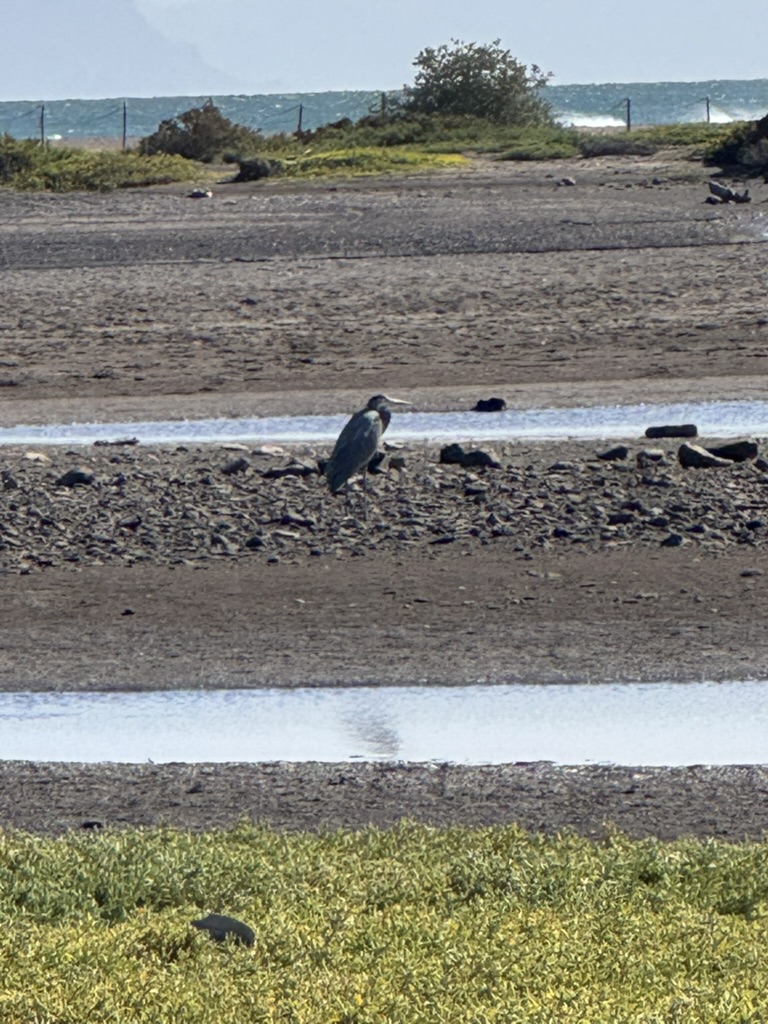
Title: The Colonial Village
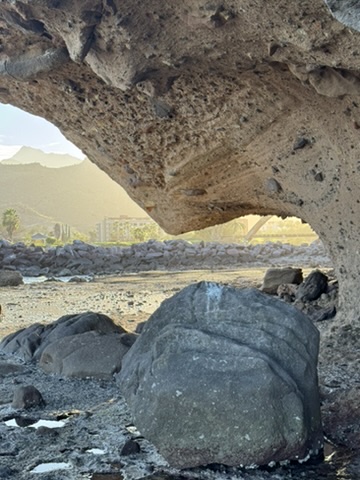
Photo Credit: Amy Tucker, 2026

Entering the Landscape

In the afternoon, I explore Loreto Bay at Nopoló. The sea, the rock formations, the cliffs. I move slowly, allowing the landscape to lead rather than plans or expectations.

The earth here carries a different texture than the earth I know. Rocky. Sparse. The colour of sand, yet compacted and dense, shaped by centuries of sun, wind, and a climate where rain arrives rarely and leaves quickly. Growth here reflects careful strategy. Cacti store water patiently. Shrubs hold small leaves that conserve moisture. Palms appear only where underground water rises close enough for roots to reach.

This kind of understanding emerges through long attention to place. Anthropologist Keith Basso describes how knowledge forms through sustained presence, through learning how the landscape holds memory, instruction, and meaning over time (Basso, 1996). The Cochimí people lived on this land for thousands of years before the arrival of Spanish missions. They knew which plants carried water in their roots. Which animals moved through during particular seasons? Where springs surfaced after rare rains. How weather revealed itself through birds, air, and light.

I lack this knowledge. Thirteen days cannot produce it. Still, attention can begin. I can notice that the land teaches differently from the sea. Each carries wisdom shaped by its own rhythms.

Learning What the Land Knows

Place-based learning grows from exactly this kind of attention. Knowledge is formed through bodily presence, through noticing patterns, textures, and temporal rhythms associated with a specific location. Gruenewald describes this learning as emerging from a relationship rather than abstraction, from inhabiting a place rather than observing it from a distance (Gruenewald, 2003). Ingold similarly writes that understanding arises through movement, through walking landscapes and learning their contours over time (Ingold, 2021).

Here, the land teaches patience. Economy. Endurance.

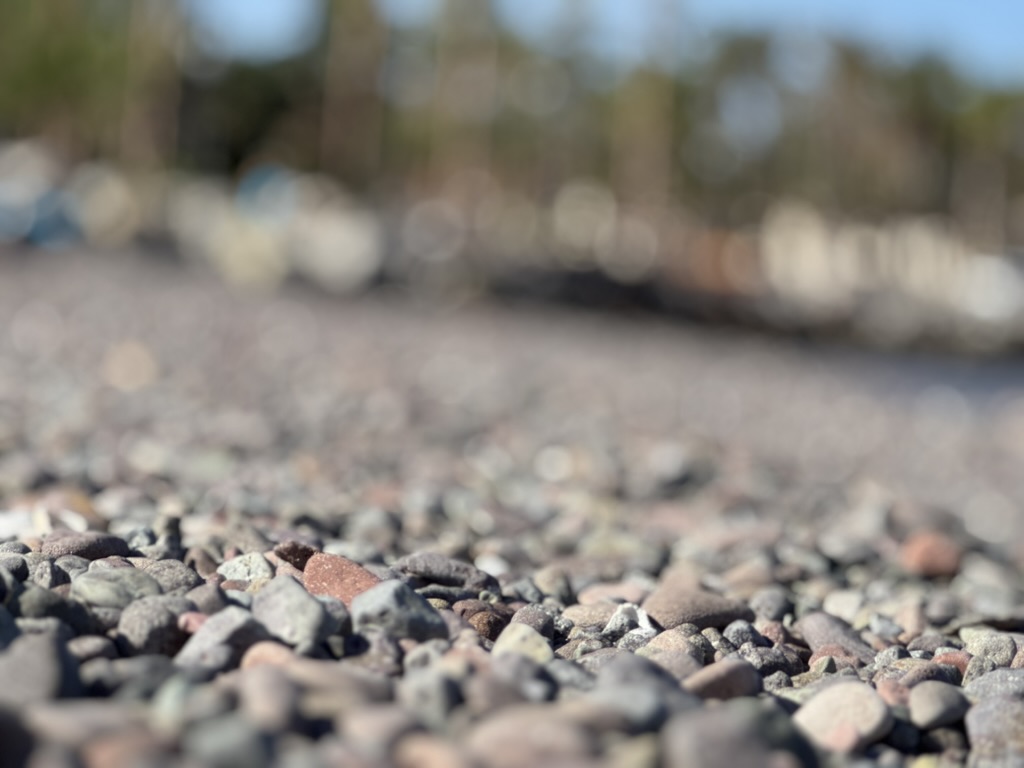
Title: The Faces in the Rock
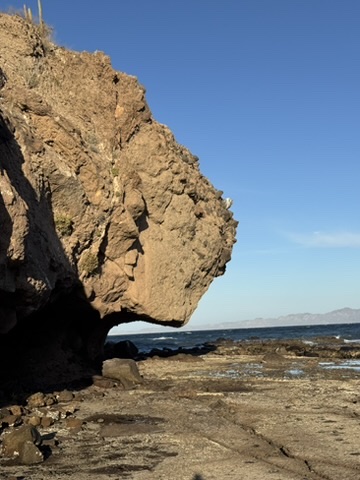
Photo Credit: Amy Tucker, 2026

I climb higher. The street becomes a dirt road. The dirt road becomes a path. The path leads to a small rise where I can see the village below me, the sea beyond it, and the islands visible in morning light across the channel.

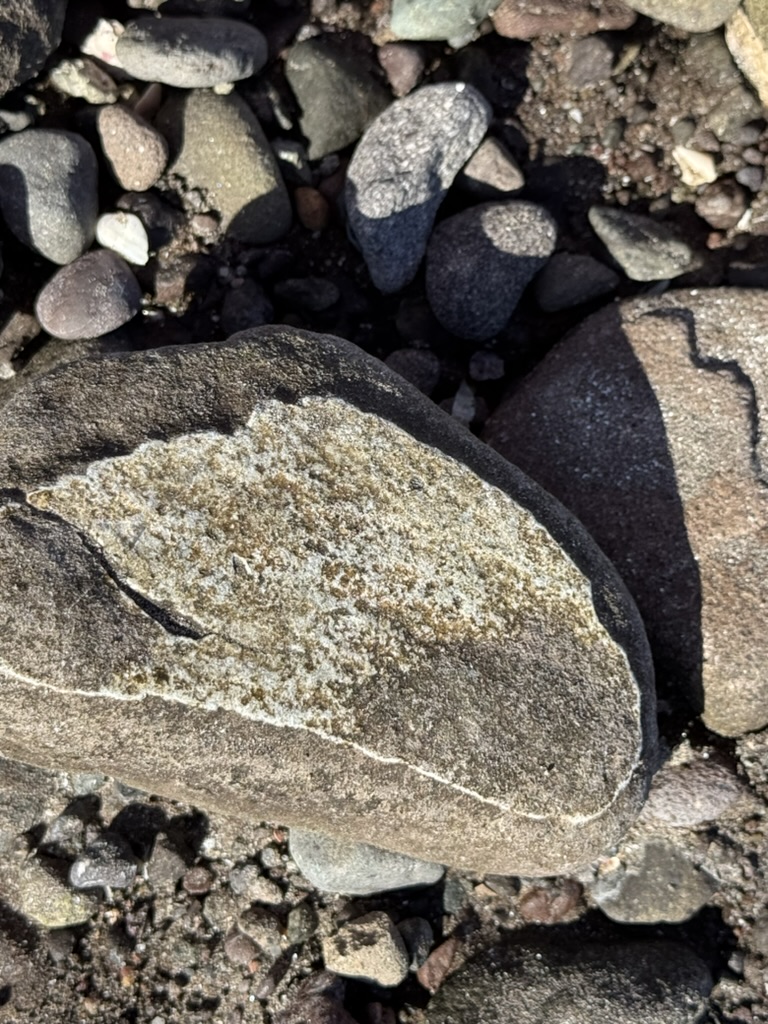
I sit on a rock, a rock embedded in the earth, part of the hillside’s bone structure. Warm already from the sun, though the morning is still early. Rough texture. Solid.

My body recognizes this differently from water. Water yields. Shapes itself around you. Holds you through buoyancy, through displacement, through the physics of floating. Rock is what yields to. Rock holds its form. Rock is a limit, a boundary, a fact that stops you.

And yet that framing needs adjusting. Rock does yield. Just slowly. On timescales beyond human body perception. Wind erodes rock grain by grain. Water wears channels through stone. The mountain I am sitting on was once seafloor, thrust up by tectonic forces that continue to reshape this landscape, imperceptibly, constantly.

Geologic time: the scale at which mountains rise and fall, continents drift, oceans open and close. The scale at which everything solid reveals itself as fluid, moving at speeds that make our lifetimes appear like single breaths (McPhee, 1981).

Sitting on this rock, I am sitting on an ancient seafloor. The calcium in my bones came from the same ocean that deposited the limestone this rock is made of. I am made of the same elements as the mountain. Different arrangement. Different timescale. But the same stuff.

My body knows this. My bones recognize stone. The calcium, the minerals, and the slow patient being that both rock and bone share.

Title: The History of Time
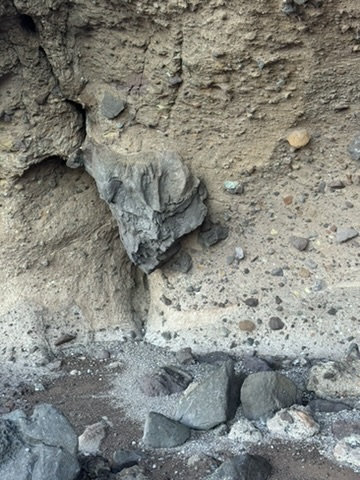
Photo Credit: Amy Tucker, 2026

Shared Heat

A lizard appears beside me. Small. Brown. Entirely still except for the pulse in its throat and the movement of eyes tracking something unseen.

We sit together for several minutes. Two beings warming ourselves on the same sunlit rock. The lizard remains. I remain. No negotiation. No interaction. Shared occupation.

This differs from encounters with village dogs, which involve social cues and mutual recognition. The lizard and I coexist. The rock holds us both.

When the lizard disappears into a narrow crack, I stay. Feeling warmth against my legs and palms. Feeling how my body prefers stone to sand or grass. Perhaps an ancestral memory. Mammals draping themselves across sun-warmed rock for temperature regulation.

Thermoregulation describes the capacity to maintain internal temperature. Humans rely on metabolism, shivering, sweating, and also behaviour. Seeking the sun. Seeking shade. Using the material world to support cellular life.

The lizard depends on this more actively. Still, I participate as well. Sitting. Warming. Settling.

The land teaches this, too. I am material. I require what stone requires. Stability. Mineral composition. Time. Stone holds what I require. Warmth. Solidity. Memory.

Title: The Breath of the Sea
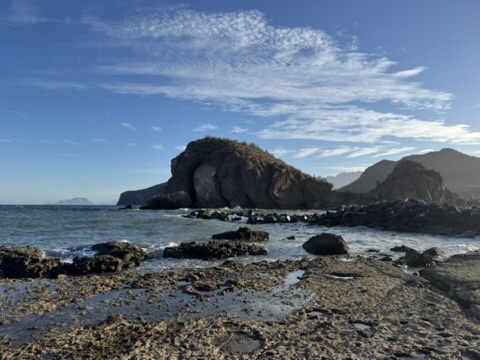
Photo Credit: Amy Tucker, 2026

Land as Relation

Walking back down the hill, I think about Indigenous land relationships. The Cochimí and, later, the Kiliwa and Paipai peoples understood themselves as continuous with the land, responsible to it, and shaped by it (Shipek, 1988). Land existed as a relation rather than a possession.

This understanding largely disappeared within settler cultures. Land became property. Resource. Commodity. Something external to the body rather than continuous with it.

Basso writes that Western Apache people understand places as teachers. Places carry stories. Places remember. Time spent with place produces change. Knowledge emerges through relationships, shaped by the landscape over time (Basso, 1996).

Thirteen days mark the beginning of this instruction. Teaching arrives through the body rather than language. Bones recognize stone. Lungs adapt to this particular air. Skin acquires a balance among sun, wind, and dryness.

What Place Teaches

This reflects place-based learning. Knowledge formed through sustained physical presence. Through walking contours. Through noticing what grows where and why. Through feeling the weather on the skin. Through reading time through light and seasonal rhythm (Gruenewald, 2003; Ingold, 2021).

The land teaches groundedness. Literal grounding. A reminder that I am terrestrial. That my legs belong to earth. That water offers refuge while land offers belonging.

Title: Sea Bone
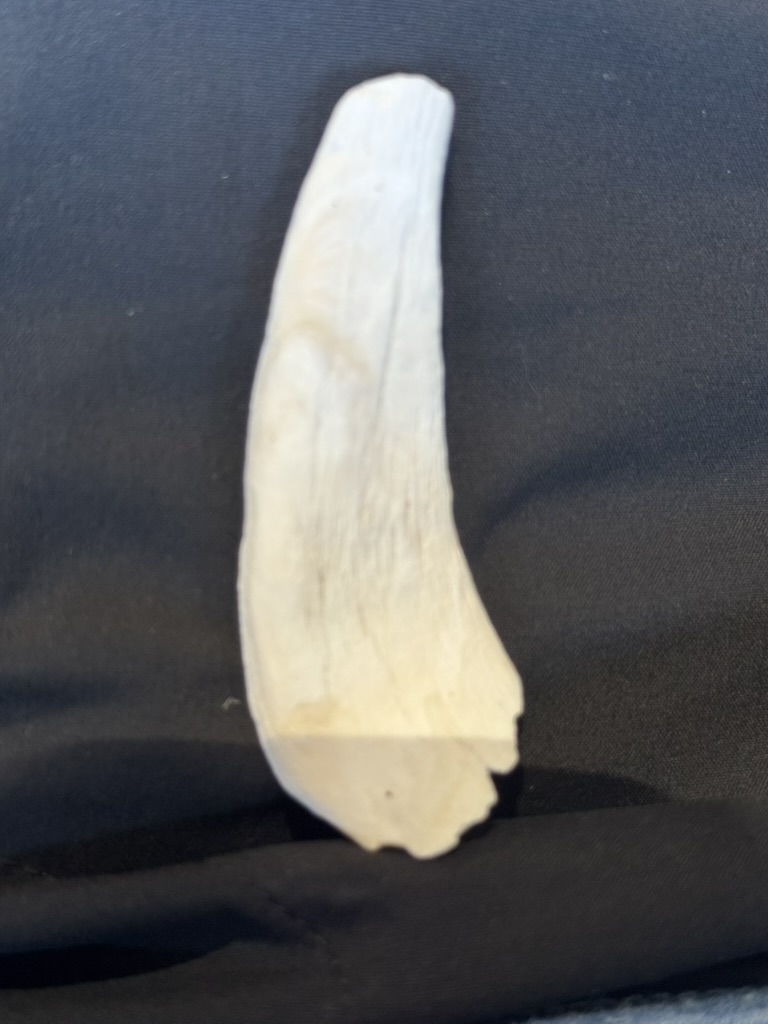
Photo Credit: Amy Tucker, 2026

Held, Temporarily

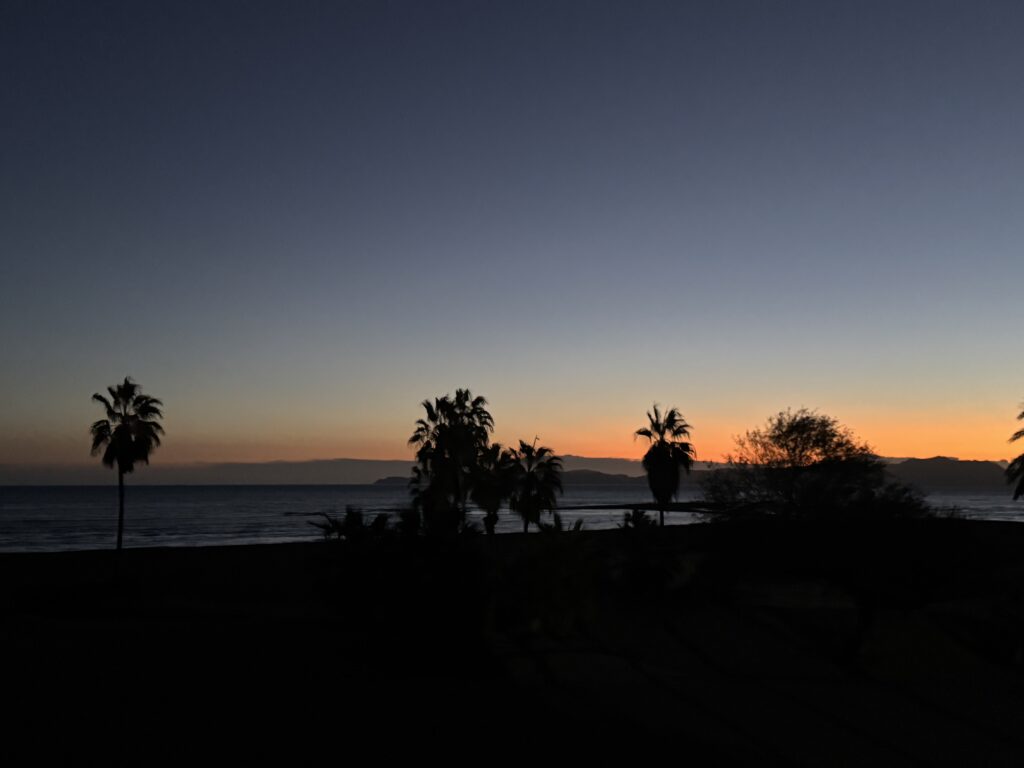
The day warms. Pelicans follow their mid-morning patterns. The sea continues its rhythms.

Something has shifted. Attention expands. Land joins water. Earth beneath the cottage. Mountains rising westward. Desert stretching along the peninsula. All alive. All teaching.

Tomorrow I will walk again. Perhaps up the arroyo that cuts through the village, dry now, shaped by rare floods. Perhaps south along the beach where buildings end, and desert meets sea without mediation.

The land has been here long before me. It will remain long after the cottage crumbles and the village becomes another layer in the geologic record. The rock that held me this morning has existed for millions of years. It will continue for millions more.

I am here briefly. The land holds me the way it holds everything. Temporarily. Lightly. Aware that all presence passes, all bodies return borrowed elements.

Gracias, tierra.
Thank you, Earth.

Por sostenerme.
For holding me.

Por enseñarme la paciencia.
For teaching me patience.

Por recordarme que soy hecha de ti.
For reminding me that I am made of you.

Y que volveré a ti.
And that I will return to you.

Title: Shoreline
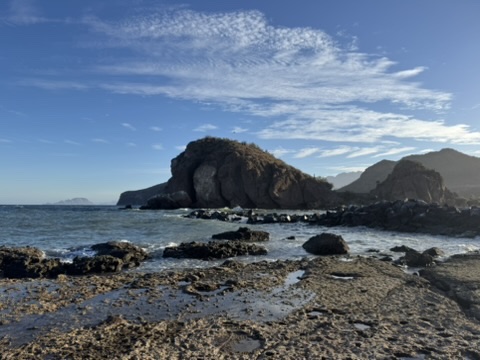
Photo Credit: Amy Tucker, 2026

Walking back down the hill, I think about Indigenous land relationships. How the Cochimí and later the Kiliwa and Paipai peoples understood themselves as part of land rather than separate from it, continuous with it, responsible to it and for it (Shipek, 1988).

This is what settler cultures have largely lost: the understanding that we are of the land rather than on it. That land is relation, kin, the material basis of existence that cannot be owned any more than you can own your own body (though capitalism tries to convince us we can and should).

Basso (1996) writes about how Western Apache people understand places as teachers. Actually, beyond metaphor. Places hold stories. Places remember. Places shape those who spend time with them. To know a place deeply is to be taught by it, changed by it, made into someone slightly different from who you were before you arrived.

I have been here for thirteen days. The place has begun to teach me. Through presence rather than language, and the land’s own language may always exceed my fluency, but through my body. Through my bones, recognizing stone. Through my lungs, adjusting to this particular quality of air. Through my skin, learning this specific combination of sun, wind, and dryness.

Place-based learning: knowledge that emerges from sustained physical presence in a location rather than from books or lectures,on. From walking its contours. From noting what grows where and why. From feeling the weather on your skin and reading time through light, to learning the daily and seasonal rhythms that make this place what it is.

The land is teaching me something the sea cannot teach: groundedness. Literal grounding. The reminder that I am a terrestrial animal, that I walk on legs designed for earth rather than fins designed for water, that my primary relationship is with solid ground, even when I love the water.

Title: The Tide
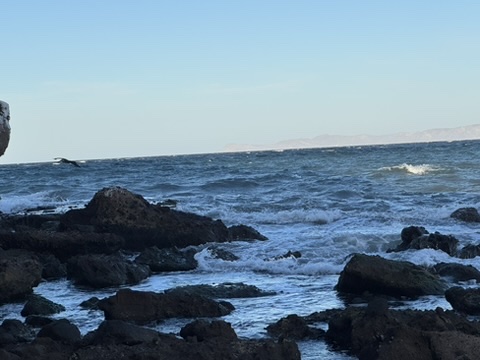
Back in my space now. The morning has warmed considerably. The pelicans are fishing their mid-morning pattern. The sea continues its rhythms.

But something has shifted in how I hold my attention. Less focused solely on water. More aware of the land: the earth under the cottage, the mountains rising to the west, the desert stretching north and south along the peninsula. All of it is alive. All of it is teaching.

Tomorrow I will walk again. Different direction perhaps. Up the arroyo that cuts through the village, dry now but carved by occasional floods when rare rains come. Or south along the beach to where buildings end, and desert meets sea directly, no human settlement mediating the meeting.

The land is here. Has been here. Will be here long after I leave, long after the cottage crumbles, long after the village itself becomes another layer in the geologic record. The rocks I sat on this morning have been sitting there for millions of years. They will sit there for millions more.

I am here for thirty days. The land holds me the way it holds everything: temporarily, lightly, knowing that all occupation is provisional, all presence fleeting, all bodies eventually returning to the elements they borrowed.

Gracias, tierra. Thank you, Earth.

Por sostenerme. For holding me.

Por enseñarme la paciencia. For teaching me patience.

Por recordarme que soy hecha de ti. To remind me, I am made of you.

Y que volveré a ti. And that I will return to you.


Translation Note

Note. Spanish-language passages were generated using Google Translate (Google, n.d.) and subsequently reviewed and refined by the author. Any remaining infelicities reflect the limits of machine translation rather than intent.

References

Basso, K. H. (1996). Wisdom sits in places: Landscape and language among the Western Apache. University of New Mexico Press.

Google. (n.d.). Google Translate. https://translate.google.com

Gruenewald, D. A. (2003). The best of both worlds: A critical pedagogy of place. Educational Researcher, 32(4), 3–12. https://doi.org/10.3102/0013189X032004003

Ingold, T. (2021). Being alive: Essays on movement, knowledge and description. Routledge.

McPhee, J. (1981). Basin and range. Farrar, Straus and Giroux.

Shipek, F. C. (1988). Pushed into the rocks: Southern California indian land tenure, 1769-1986. University of Nebraska Press.

Academic Lens

Ground beneath the feet, earth, sand, rock, is one of the oldest body-based metaphors for stability. In Levine's (2010) body-based experiencing framework, grounding is a literal therapeutic practice: contact with the earth as a nervous system intervention, activating the sense of being held. The land of Baja California, Cochimí territory, carries no neutrality; this entry is implicitly engaged with what Wilson (2008) calls relational accountability in Indigenous research methodologies: the land has its own knowledge, its own history, and its own rights as a witness.
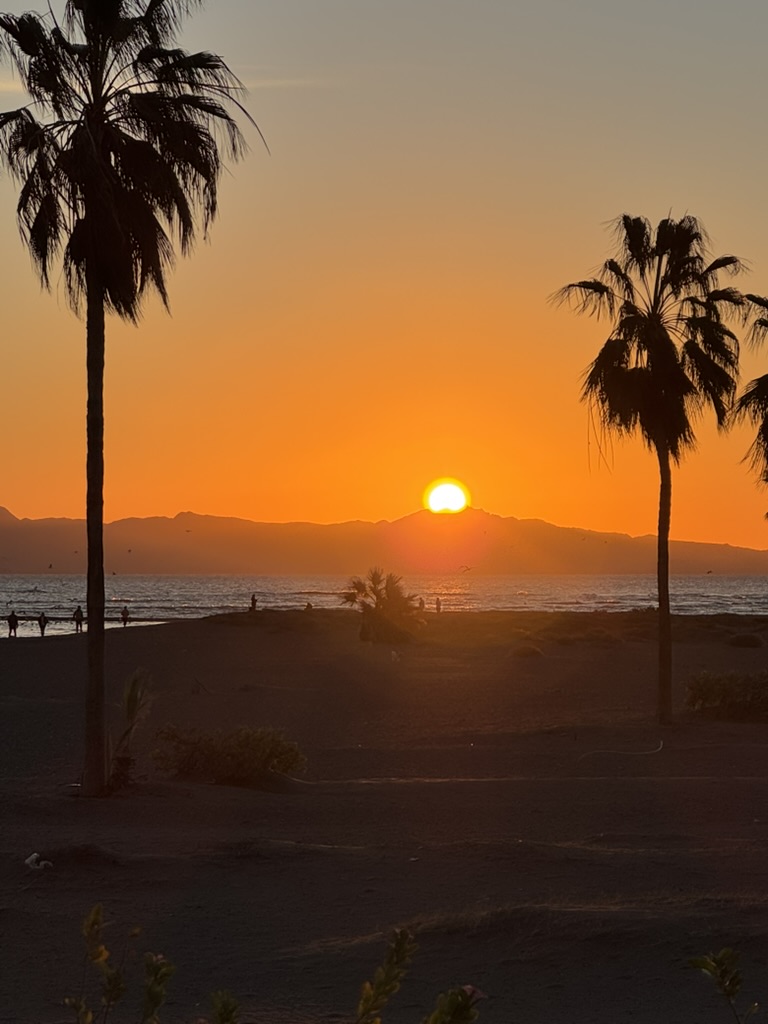
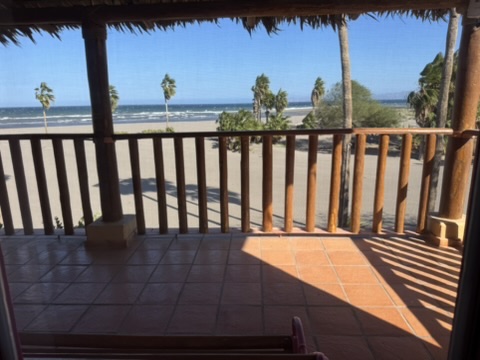
La Continuación / The Continuation

Reading Time: 6 minutes

I woke before the light this morning. I woke free of anxiety. My thoughts moved gently rather than racing toward demands. I was simply awake in the way an animal wakes: aware, present, responsive to some internal signal that sleep was complete and consciousness could return. I slept solidly last night.

Title: Crack of Dawn

Photo Credit: January 13, 2026

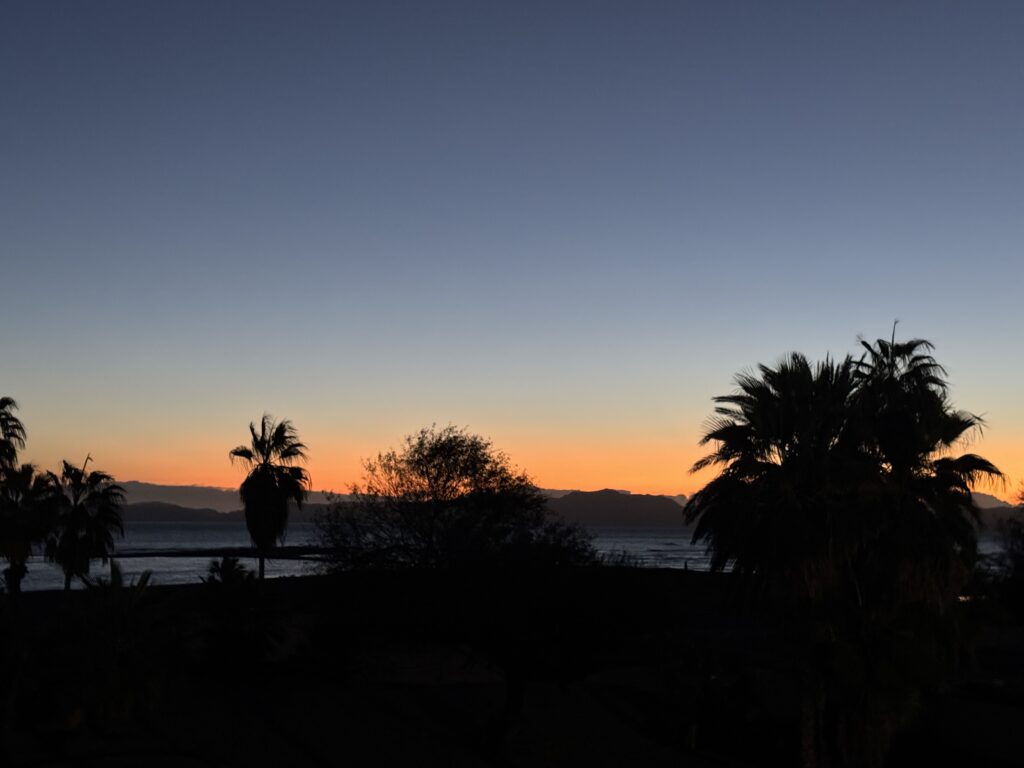
The darkness held a particular quality at this hour. It was dense and gentle. The Sea of Cortez whispered rather than spoke, its sound intimate and close, as though sharing secrets only pre-dawn can hear. I lay there listening, tracking the gradual shift from deep black to grey to that moment just before sunrise, when the world begins to remember colour.

Fifth morning of unbroken sleep. Cinco mañanas.

I notice how differently I hold this information now than on Day Nine, when the pattern first established itself. Then it felt miraculous, fragile, something that might shatter if examined too closely. Now it feels ordinary. It is natural-ordinary, the way breathing is ordinary: essential, life-sustaining, but no longer requiring constant amazement.

My system no longer scans for threats upon waking. It simply wakes, assesses the environment as safe through accumulated data points (consistent sounds, familiar light patterns, the absence of disruption), and allows consciousness to emerge without the defensive mobilization that characterized my mornings for months before arriving here. This is how we steady one another with place. The sea, the light, and the flight patterns of pelicans are my companions in restoration. My nervous system orients to their constancy.

This is re-inhabitation. A return to the deeper rhythms that survived beneath who I had to become. Learning has shifted from conscious recognition to what the body knows. From something I observe to something I am.

The light is beginning now.

Title: A View From My Deck

Photo Credit: Amy Tucker, 2026

I can see it even with my eyes closed: the gradual brightening that comes before sunrise, the world remembering itself. I get up, pull on clothes, and walk to the balcony. The pelicans are already fishing, their morning routine as established as my own has become.

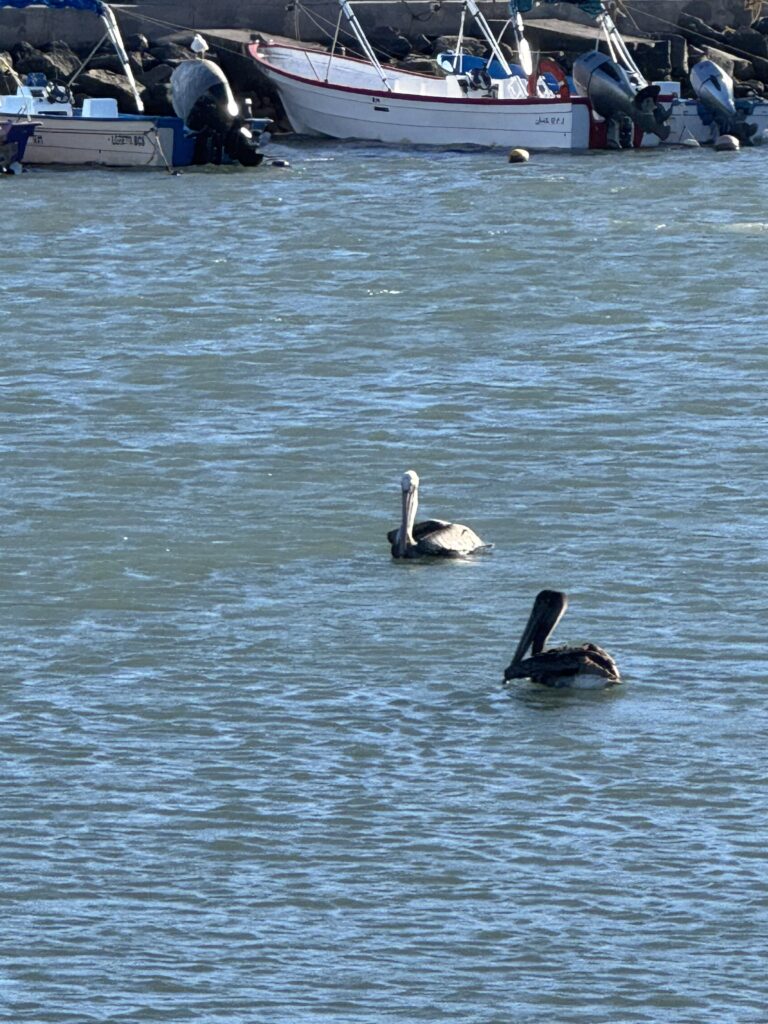
I watch one pelican dive. The complete commitment of it: wings folding, body dropping, the compact missile of intention entering water with barely a splash. Surfaces. Waits. The fish is visible in the throat pouch, and the backward tilt of the head sends it down. Then stillness. Complete stillness. The body rests on water while the system processes what it has caught. No hurry. The pelican rests with what it has before seeking the next fish. Digests. Allows the body to complete one cycle before beginning another.

Esto también es una enseñanza. This, too, is a teaching.

The pelican dives because its body signals hunger, beyond any schedule that dictates it should fish at this hour. This is intrinsic motivation in its purest form: action arising from internal states rather than external pressures or rewards.

For nineteen years, I lived according to externally imposed rhythms. What I was experiencing, I now understand, was chronic autonomy frustration, one of the three basic psychological needs Self-Determination Theory identifies as essential for well-being.

This kind of exhaustion is disproportionately borne by women. Especially those navigating midlife in systems that reward endless availability and punish embodied limits. What I am naming here extends beyond personal recovery. It is a reclamation of rhythm in a world that teaches women to ignore their own.
What Gabor Maté (2022) calls “the myth of normal” is unravelling. I no longer pathologize exhaustion or anxiety as personal flaws. I see them as natural responses to abnormal conditions, conditions I am now beginning to unlearn.

Title: What is Normal?

Photo Credit: Amy Tucker, 2026

Twelve days ago, I arrived here holding the question of whether I could stay. I am here. The days unfold. The routine continues. And somewhere in the last twelve days, I stopped asking for permission and simply started living.

This is what Haraway (1988) means by situated knowledge: beyond abstract theorizing about what knowledge might be, grounded in the concrete recognition that I am in this body, in this place, at this moment, noticing what I notice. That observation matters.

Coming here, choosing this documentation, claiming this experience as scholarship: these are acts of resistance against that denial. I am saying my knowing matters. My observation counts. My embodied experience constitutes valid data.

The sunrise is happening now. The pattern provides structure. The variation provides life.

How do I document my own experience with enough rigour to make it a scholarship while remaining present enough to actually experience what I am documenting?

The theoretical scaffolding continues to build. But this morning, before the reading begins, I simply sit with what is here. Water. Birds. Light. Breath. The embodied reality that theory helps me understand but cannot replace.

And you, reading this: what has your morning taught you? What rhythms in your life have asked to be trusted, held without cross-examination?

Coffee now. The smell of it. The warmth of the cup. The first sip that signals morning has arrived, you are awake, and the day is beginning.

I think about routine again. It has stopped feeling like a constraint and has become a container. The predictability allows spontaneity because the calculating has quieted.

My body is learning to read time by sunrise, by the pelicans’ fishing patterns, by the quality of light at different hours. These serve as zeitgebers, helping my disrupted circadian system recalibrate to a more natural rhythm.

Now I know the difference. Freedom is a structure you choose that holds you safely and that you can trust to continue even when you stop monitoring it.

Soon I will swim. What I am learning through swimming is what Csikszentmihalyi (1990) calls flow, though the flow I experience is quieter than what he typically describes.

Perhaps this is what alonetude looks like in motion. Beyond performance or accomplishment. Just being fully present with yourself in an activity that asks nothing beyond presence itself.

Title: Rock Art

Photo Credit: Amy Tucker, 2o26

La luz me sostiene. The light holds me.

El mar me enseña. The sea teaches me.

Y mi cuerpo recuerda. And my body remembers.


Translation Note

Note. Spanish-language passages were generated using Google Translate (Google, n.d.) and subsequently reviewed and refined by the author. Any remaining infelicities reflect the limits of machine translation rather than intent.

References

Csikszentmihalyi, M. (1990). Flow: The psychology of optimal experience. Harper & Row.

Google. (n.d.). Google Translate. https://translate.google.com

Haraway, D. J. (1988). Situated knowledges: The science question in feminism and the privilege of partial perspective. Feminist Studies, 14(3), 575–599. https://doi.org/10.2307/3178066

Maté, G., & Maté, D. (2022). The myth of normal: Trauma, illness, and healing in a toxic culture. Avery.

ACADEMIC LENS

The quality of waking described here, “aware, present, responsive to the world and unbraced against it,” represents what Porges (2011) calls ventral vagal activation: the biological state that underlies genuine curiosity, openness, and engagement. Van der Kolk (2014) distinguishes this from the forced calmness of emotional suppression: true regulation is characterized by ease rather than management. The image of “waking the way an animal wakes” deliberately bypasses the self-monitoring of the institutionalised academic subject, invoking instead Menakem’s (2017) concept of embodied animal wisdom: the somatic knowing that precedes and grounds conceptual thought. The word “continuation” also carries methodological weight: this entry records the continuation rather than any breakthrough or arrival, ongoing quality of a process, the steady accumulation of new somatic experience that Levine (2010) identifies as the mechanism of healing. It is the persistence of the changed nervous system state across days, rather than a single dramatic shift, that constitutes genuine recovery. Richardson and St. Pierre (2005) would recognize this daily writing practice itself as part of the inquiry: the journal entry as data, the noticing as method.

Siesta

Reading Time: 3 minutes

Afternoon

The heat has arrived.

By one o’clock, the temperature has climbed into the mid-thirties, and the village has responded the way it responds every afternoon: by stopping. Shops close. Streets empty. Even the dogs find shade and cease their wandering.

Title: Fishing Boat

Photo Credit: Amy Tucker, 2026

I am learning this rhythm. Joining the collective surrender to the heat rather than fighting it. After lunch, I close the curtains against the sun, lie on the bed under the ceiling fan, and simply rest.

Rest, rather than sleep. The body horizontal, the mind quiet, time passing without purpose or productivity.

This is siesta. The practical wisdom of a place beyond romanticized tourism, a place that knows heat must be respected. You stop. You release the push-through. You rest. You wait for the world to become livable again.

For twelve days now, I have been learning to stop without guilt. To rest without justifying it. To simply be horizontal in the afternoon heat and let that be enough.

Today, it finally feels natural. Simply the appropriate response to what the day is asking.

El calor manda. The heat commands.

Y yo obedezco. And I obey.

Day’s of My Life

By three o’clock, the worst has passed. The temperature remains high, but the quality changes. Bearable. Moveable. I get up, drink water, and sit on the shaded patio watching the water.

A pelican flies past. Low and slow. Unhurried.

The village is beginning to wake again. A shop door opens. A car starts. Life resuming its rhythm, altered by the heat and still intact.

I think about the years I spent overriding my body’s signals. Tired but pushing through. Hot but staying at the desk. Needing rest but never quite allowing it because rest felt like failure, like giving up, like evidence that I lacked the strength others seemed to carry so easily.

Title: Afternoon Skies

Photo Credit: Amy Tucker, 2026

The wisdom here is different. Rest is a response. It is the appropriate accommodation to conditions that require it.

Twelve days of practising this, and something is shifting. The guilt that used to accompany rest is dissolving. Slowly. But dissolving.

Poco a poco. Little by little.

The body learning what the village already knows: some hours are for work. Some hours are for rest. And knowing which is which is its own kind of wisdom.

Title: Mission Church

Photo Credit: Amy Tucker, 2026


ACADEMIC LENS

The siesta described here is more than a cultural curiosity; it is a somatic practice that enacts what Hersey (2022) calls “rest as resistance”: the refusal of a productivity ethic that treats the body as an instrument rather than a subject. The narrator’s observation that rest “felt like failure” for years names the internalized logic of what Maslach, Schaufeli, and Leiter (2001) identify as the burnout cycle, the compulsive override of the nervous system’s regulatory signals in service of institutional demands. Siesta, by contrast, offers what Levine (2010) describes as a completion cycle: the body allowed to move through activation and into genuine discharge, rather than being driven through exhaustion and back into performance.

The phrase el calor manda, the heat commands, carries epistemological weight beyond its simplicity. It articulates a form of environmental authority that precedes and exceeds human scheduling: what Merleau-Ponty (1945/1962) would recognize as the primacy of the body’s dialogue with its world over the abstractions of clock-time and productivity. The village’s collective rhythm enacts this daily, modelling what van der Kolk (2014) argues trauma survivors must relearn: that the body’s signals are trustworthy guides rather than obstacles to be managed. The recovery described across this entry, from guilt-laden rest to rest that “finally feels natural”, tracks precisely the trajectory Levine (2010) maps as somatic healing: a gradual recalibration rather than a sudden shift,n of the nervous system toward safety.

Memory: The Moment That Changed Everything

Reading Time: 3 minutes

Content Warning: This post contains reflections on trauma, childhood experiences, and the body’s memory of harm. Please care for yourself as you read, and feel free to step away if you need to.

May 2, 2025. Friday morning. My kitchen table at home.

The notification sound chimed while I was grading papers, the familiar tone I had conditioned myself to respond to instantly after nineteen years of contract teaching. I reached for my phone expecting routine correspondence, perhaps a student question or a committee meeting notice. Instead, the subject line read: “Employment Status Update.”

My contract position for the fall of 2025 and 2026 was uncertain.

The email was brief, professional, and efficient. It explained enrolment shifts, budget realities, and difficult decisions. It thanked me for my service. It wished me well in future endeavours. It arrived without conversation, without the relational check-in that twenty-five years at Thompson Rivers University might have warranted. It arrived as data, a notification, a conclusion reached somewhere in a spreadsheet I would never see.

I sat at my kitchen table, the same surface scarred by coffee rings from decades of grading student papers, and stared at the screen. Seventeen years as contract faculty. Twenty-five years total at the institution. Course materials I had developed, teaching awards I had won, students I had mentored, committees I had served. Excellence that had earned institutional recognition but never security, never permanence, never the guarantee that May would arrive without this particular notification.

The plaques were arranged on my shelf, forming a timeline of institutional validation: the TRU Student Empowerment Award (2021), the TRU Interculturalisation Award (2023), and the Faculty Council Service Award (2024). Each one represented students who had written nomination letters, colleagues who had advocated, and committees who had deliberated. Each one testified to work that the institution deemed exemplary. Yet on May 2, 2025, none of that mattered against the budget’s arithmetic.

Thirty days later, another notification arrived. This time, the subject line read: “Congratulations.” I had won the Faculty Council Teaching Award for 2025. The irony possessed a weight that was almost architectural. The institution that had deemed me expendable simultaneously declared I was exemplary. The same system that processed my termination processed my commendation. Two documents, two logics, two entirely separate bureaucratic pathways that never spoke to each other.

I understood something sitting at that kitchen table, something I had been circling around for years without language to name it: I had forgotten how to simply be. I could perform brilliantly. I could show up on time, deliver lectures, grade papers, serve on committees, support colleagues, and mentor students. I could produce evidence of my value constantly, compulsively, because survival demanded it. But when the institution finally severed that demand, when performance could no longer protect me, I discovered I had no idea who I was underneath all that doing.

The months between May and December 2025 felt like slow-motion drowning. I woke at 3 AM with panic attacks, my heart racing, convinced I had forgotten something critical, only to remember I had nothing to forget because I had no employment requiring vigilance.

I checked my email compulsively, even though I had no employer to email. I filled every hour with tasks, projects, obligations, anything to avoid the emptiness that waited when I stopped moving. The relief I expected from no longer needing to perform never arrived. Instead, what came was a vast, disorienting blankness, an inability to rest even when rest was finally possible.

Thompson Rivers University – Faculty Teaching Award 2026

Photo Credit: Jesal Thakkar, 2025

Twelve Days: Doce días.

Reading Time: < 1 minute

A field note. Some mornings ask for a poem instead of a paragraph. This is one of them.

La continuación.
The continuation.

No es dramática.
It is quiet, undramatic.

Es como el amanecer:
It is like sunrise:

sucede porque es lo que sucede,
it happens because it is what happens,

sin necesidad de hacer que suceda.
without needing to make it happen.

Yo también estoy aprendiendo esto.
I am learning this too.

Continuar sin esfuerzo.
To continue without effort.

Confiar en el patrón.
To trust the pattern.

Estar aquí.
To be here.

Nada exige urgencia.
Nothing requires urgency.

Todo sigue su secuencia.
Everything follows its sequence.

Yo también.
So do I.

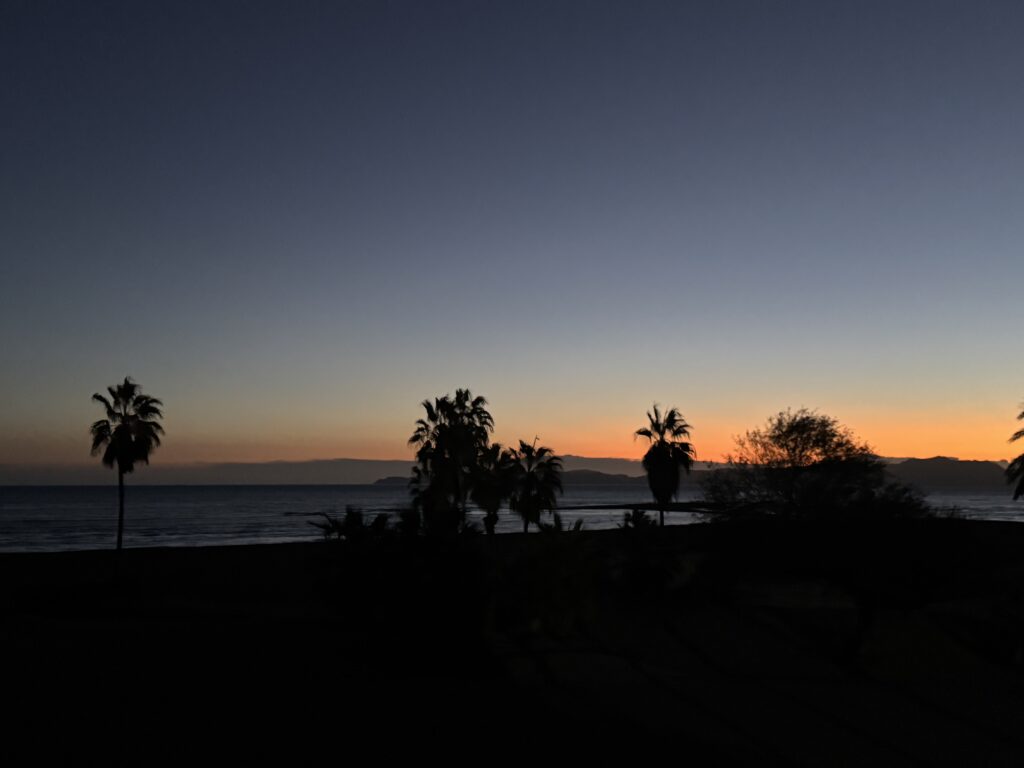
Title: Overlooking the Sea of Cortez

Photo Credit: Amy Tucker, 2026


Note. Spanish-language passages were generated using Google Translate (Google, n.d.) and subsequently reviewed and refined by the author. Any remaining infelicities reflect the limits of machine translation rather than intent.

References

Google. (n.d.). Google Translate. https://translate.google.com

Los Perros del Pueblo

Reading Time: 9 minutes

The Village Dogs

“You do not have to be good. You only have to let the soft animal of your body love what it loves.”
Mary Oliver, 1986

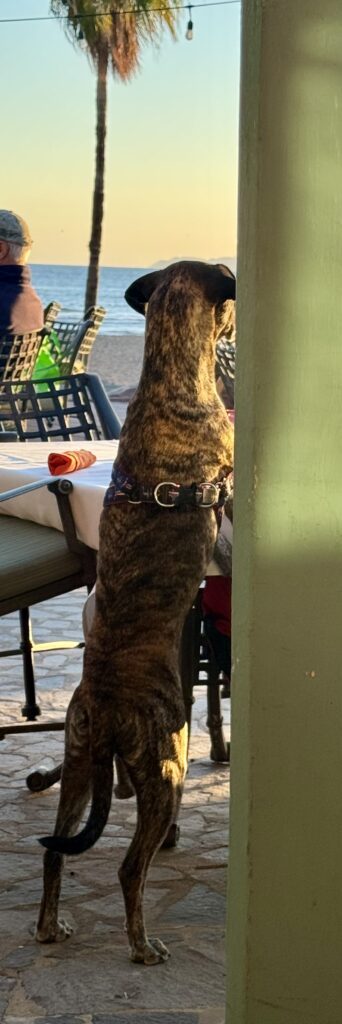
The dog stands at the table as though she has been invited. Beyond begging. Beyond servility. Simply present, front paws on the table’s edge, looking out at the Sea of Cortez with the same quality of attention a person might bring to a sunset. Behind her, the early morning light turns everything gold: the water, the sand, the palm fronds moving in whatever breeze comes off the ocean this time of day. A plate of food sits on the white tablecloth. A drink sweats condensation in the heat. The dog notices these things the way you notice things that are simply part of the landscape, neither wanting them nor turning away from them. Just acknowledging: yes, these are here too.

Title: Dog Enjoying the Sunrise

Photo Credit: Amy Tucker, 2026

I took this photograph this morning at a beachside restaurant where I enjoyed a cup of coffee. The dog appeared from nowhere in particular and everywhere at once. She checked the table the way dogs check things: a quick assessment to see whether this moment held anything that required her attention. Then she placed her paws on the table’s edge and turned her gaze outward, toward the water. The owner is getting coffee.

What struck me then and strikes me still, looking at the image now, is her posture. There is no asking in it. No supplication. No performance of need is designed to elicit care. She works toward nothing. She is simply a dog standing at a table at the edge of the sea, and if that position happens to be where food and drink exist, well, that is where food and drink exist. It leaves unchanged the essential fact of her presence, which requires no justification beyond itself.

I sat there for perhaps twenty minutes watching her. Other tourists approached, took photos, and moved on. A waiter brought fresh coffee to the table. No reluctance. No hurry. This part is complete; the next follows, and both are equally fine.

The village dogs of Loreto have been teaching me something I had yet to discover I needed to learn.

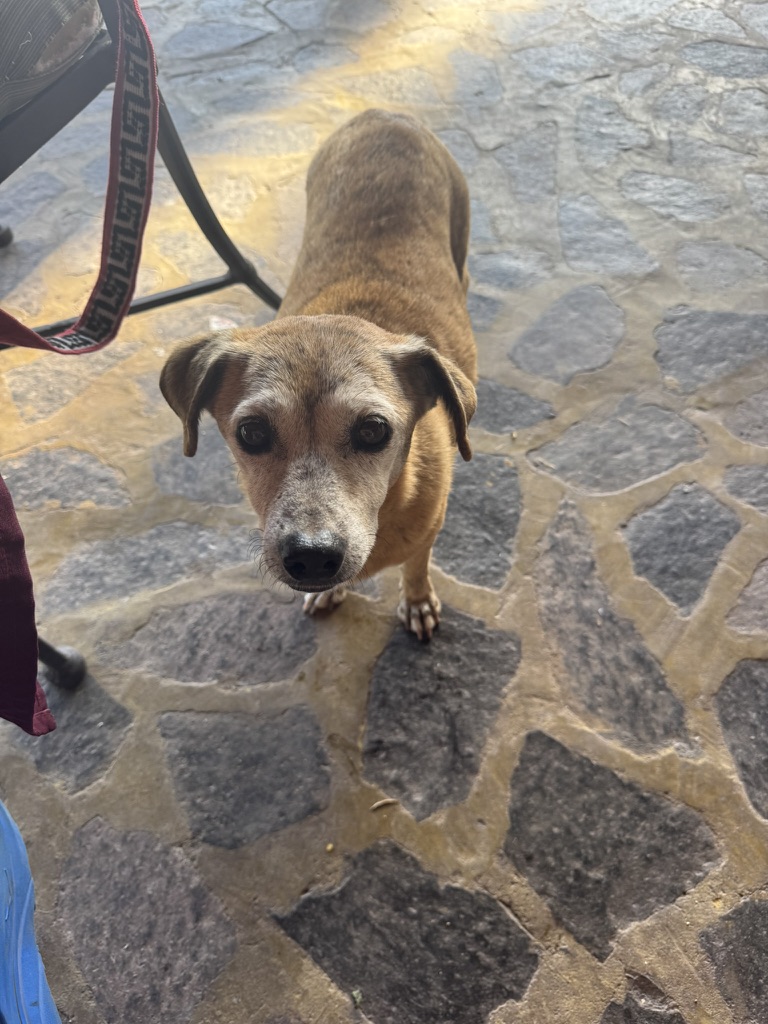
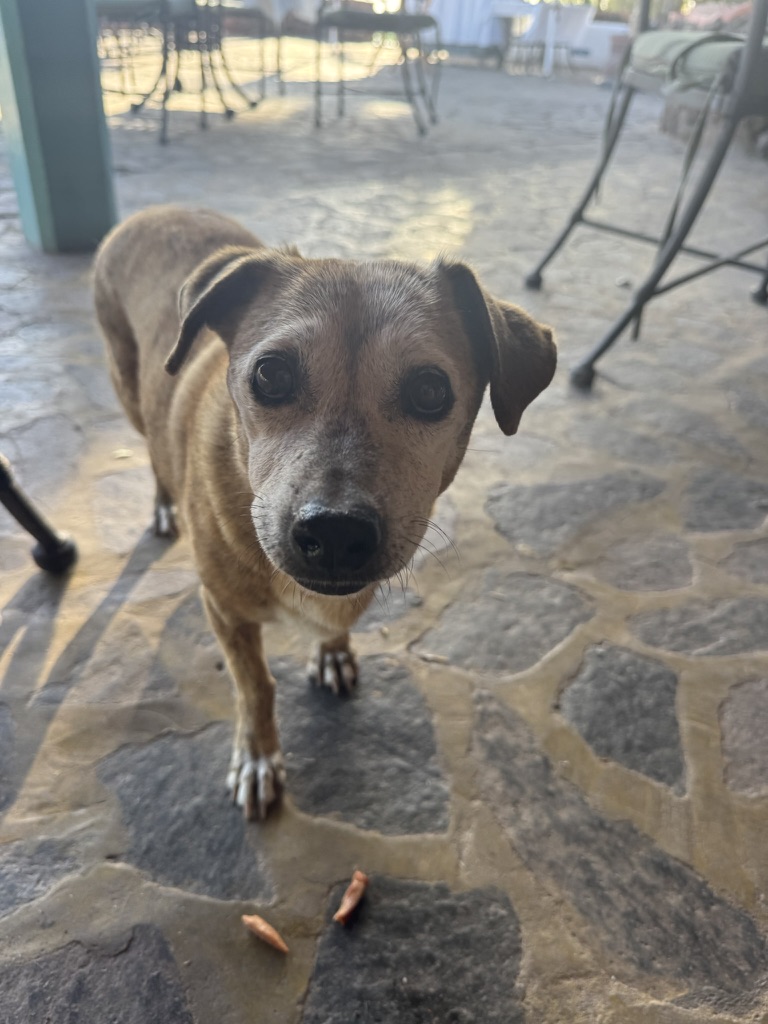
I wrote about them briefly in the early days here: the brown dog with gentle eyes who appeared that first evening, who sniffed my hand and then simply stood beside me in the fading light, two beings with nowhere particular to be. I called her a companion then, though companion suggests a relationship more defined than what we actually share. She appears. She stays, or she leaves. She requires nothing. I offer nothing beyond my presence. And somehow this non-relationship has become one of the steadiest features of my days here.

She is far from the only one. There are perhaps a dozen dogs I see regularly in the village. Brindle and brown and black and that particular dusty tan that seems designed by evolution to blend with sand. Well-fed, free of ownership. Collared occasionally (someone’s gesture of care) but clearly belonging to no one, or perhaps more accurately, belonging to everyone and therefore to themselves.

They move through the village with an ease I recognize as what I am attempting to learn. No schedule. No destination that must be reached. No performance of purpose to justify their occupation of space. They simply are where they are; when they are somewhere else, they are there instead, and the transition requires no explanation, no apology, no account of why the first place stopped being right and the second place became necessary.

Title: My Lady Friend

Photo Credit: Amy Tucker, 2026

I have been watching them for twelve days now with increasing attention. The way they navigate public space without claiming it. The way they accept care without becoming obligated. The way they rest in the middle of sidewalks, streets, or restaurant patios without any apparent concern that they might be inconveniencing someone. And the remarkable thing (the thing I am still trying to fully understand) is that the village allows this. More than allows it. Holds it. Make space for it. Treats it as simply as it is.

In the city where I lived for twenty-five years, this would be impossible. Dogs in restaurants must be leashed, under control, and clearly attached to responsible humans. Dogs on public beaches require permits. Dogs that exist without visible owners raise concern: Who is responsible for this animal? Who will manage it? Who vouches for its right to occupy space?

The questions come automatically, reflexively, born from a culture that cannot imagine existence without ownership, without someone being accountable, without the clear assignment of responsibility and control.

But here, the dogs simply exist, and the village simply lets them be. Feeds them when they are hungry. Gives them water when they are thirsty. Tolerates their presence at tables, in shops, and on beaches. And the dogs, for their part, seem to understand the unspoken agreement: we are here together, you and we, and the terms of our togetherness require neither ownership nor abandonment, neither claim nor rejection, just this ongoing negotiation of shared space that somehow works without anyone having to articulate the rules.

I realized, walking back to the cottage in the heat, that I had seen six different dogs in the space of an hour, and each one had seemed perfectly at ease wherever it was. No anxiety. No performance. Just dogs being dogs in the various locations where dogs be.

This is remarkable when you think about it. These are beyond the category of pets that have learned to read human moods and respond to human needs. These are beyond the working dogs with assigned tasks. These are dogs who have somehow negotiated a way of existing alongside humans without becoming dependent on them, without losing whatever essential dog-ness makes them what they are.

They are, I realize, practising aloneness. Beyond the human version (the one that requires choosing, intending, and reflecting on whether you are doing it right), but alonetude nonetheless. Being with others without losing themselves. Accepting care without becoming obligated. Moving between community and solitude as each moment requires, without any of it needing to be a statement, a position, or a defended choice.

I have been thinking about what these dogs are teaching me about being in community without being consumed by it.

“Settling in asks surrender of nothing. It is choosing to stay with yourself.” Amy Tucker, 2026

For twenty-five years, I worked in an institution that demanded constant availability, constant responsiveness, and constant proof that I was committed, present, and performing my role adequately. Contract faculty hold far less authority to set boundaries than tenured faculty. You are available when needed. You adjust your schedule around theirs. You say yes even when yes costs you more than you can afford because saying no might mean being asked again.

This creates a particular relationship to community and to solitude. Community becomes something you perform. Solitude becomes something you seize in stolen moments, knowing you will be interrupted, knowing you need to stay alert for the email, the call, or the meeting that suddenly arises, requiring an immediate response.

The village dogs know nothing of this exhaustion. They exist in what I can only describe as a gift economy so old and so embedded that it has become invisible. The village feeds them because that is what the village does. The dogs provide companionship because that is what dogs provide. No contract. No performance evaluation. No calculation of whether the exchange balances.

Just: this is how we are together. These are the terms of our coexistence. It holds, or it falls away; if it stops holding, adjustments are made, but none of it requires the elaborate structure of obligation, debt, and credit that governed my professional relationships for all those years.

Watching them, I realize what I am trying to recover. Beyond isolation (I have never wanted that, and this month of intentional solitude has been about drawing near, never about fleeing human contact). What I want is what the dogs have: the capacity to be with others without losing myself. To accept care without becoming obligated. To offer presence without performing. To know when I need to be alone and when I want company, and to trust that both needs are legitimate and neither requires extensive justification.

The dogs are alone together. Present in the community, beyond being consumed by it. They rest in public space without apology. They approach when something interests them and walk away when it no longer does. And somehow the village holds this, makes room for it, allows dogs to be dogs even amid human activity.

This is the model I am learning to inhabit. Beyond the isolation of withdrawal: the freedom of undefended presence. Being here without bracing. Receiving care without owing. Offering attention without depleting myself.

The brown dog is here again. She has been here for perhaps forty minutes. I have been writing. Neither of us has required anything of the other. We are simply here together, she in her rest and I in my work, and the togetherness asks nothing beyond the acknowledgment that we both occupy this space.

Photo Credit: Amy Tucker, 2026

The dog knows without any of this apparatus. She knows when to trust and when to be wary. She knows when to approach and when to hold distance. She knows when someone will feed her and when someone will pass by. She knows where shade is in the heat of the day and where the evening breeze comes first. She knows all of this immediately, without thought, without reflection, without the constant meta-commentary that humans call consciousness.

This is no less knowing. It is different knowing. And it might be the knowing I most need to recover: the capacity to respond to what is without the endless mediation of thought about response. To be hungry and eat. To be tired and rest. To want solitude and take it. To want company and seek it. Without justification. Without explanation. Without the entire apparatus of defence and rationalization that precarious employment built into me so deeply, I forgot it was anything other than natural.

Just: this is what the body knows. This is what the moment calls for. This is what I do.

The Freedom to Simply Be

“I am allowed to land. I am allowed to stay. I am allowed to soften.”

Amy Tucker, 2026

The dog has left now. I missed her leaving. I was focused on writing, and when I looked up, she was simply gone, off to wherever dogs go when they go. The light continues its shift toward darkness. Soon I will make dinner, following the rhythm that has become automatic. The evening will unfold as it has unfolded for eleven evenings before this one.

But something feels different tonight. Less effortful. Less monitored. As though I am finally beginning to inhabit the routine rather than performing it. Beginning to trust that my body knows what it needs and when, and that I can simply trust without constantly checking and verifying that I am resting correctly.

The dogs are teaching me this. How to be present without performance. How to accept care without obligation. How to exist in a community without losing the capacity for solitude. How to move between togetherness and apartness as the moment requires, without any of it being a statement or a defence or a position requiring elaborate justification.

Los perros del pueblo. The village dogs. Teachers with no awareness teach. Companions who require no relationship. Beings who practice alonetude so naturally they have no word for it because it is simply how they are.

I am learning from them. Slowly. With all the awkwardness of someone who forgot and is now remembering. But learning nonetheless. And tonight, this twelfth evening of intentional solitude, I feel closer to what they know. Closer to trusting my own knowing, the way they trust theirs. Closer to being what I am without the constant overlay of thought about whether I am being it correctly.

And I think again of Mary Oliver, the poet who reminded us to let the soft animal of the body love what it loves. Who asked, without urgency but with piercing clarity: “Tell me, what is it you plan to do / with your one wild and precious life?”

For the first time in a long while, I feel like I have an answer, though beyond words, and beyond any plan. It is in the small things: in the way I sit without bracing, in the way I walk without explanation, in the way I trust the day to shape itself without my need to define it in advance.

I, too, find my front paws on the table’s edge, beyond asking, beyond waiting, just watching the water shift its shape, and feeling the sun arrive exactly as it is.

Beyond performance. Beyond striving.

Just this: the body knows. The moment knows. The dog knows.
And that knowing, I am learning, is enough.

Thank you, my lady friend.

References

Haraway, D. J. (1988). Situated knowledges: The science question in feminism and the privilege of partial perspective. Feminist Studies, 14(3), 575–599. https://doi.org/10.2307/3178066

Oliver, M. (1986). Wild geese. In Dream work (pp. 14–15). Atlantic Monthly Press.

ACADEMIC LENS

Mary Oliver’s epigraph frames the entire village dogs reflection within a philosophical permission: that being requires no justification, that presence is sufficient. This resonates with Buber’s (1970) distinction between I-It and I-Thou relationships: the dog at the table occupies an I-Thou orientation, fully present without agenda, offering the kind of unconditional regard that Buber identifies as the ground of genuine encounter. The observation that the dog is “beyond begging, beyond servility, simply present” enacts what Moustakas (1961) calls the courage of loneliness: the willingness to be fully oneself without performing for others’ acceptance. For the precarious academic who has spent nineteen years performing compliance and availability, the dog’s unapologetic presence becomes a somatic lesson. Menakem (2017) describes this kind of encounter with non-human creatures as a form of co-regulation: the settled nervous system of an animal can, through proximity, help to entrain a dysregulated human nervous system toward greater calm. The bilingual dimension, the Spanish village, the dogs that belong to no one and to everyone, also invites Anzaldúa’s (1987) reading: the in-between creature as the embodiment of borderlands wisdom.

El Ritmo de los Días

Reading Time: 7 minutes

The Rhythm of Days

Observing the Pelicans

The pelicans know when to stop.

I have been watching them for twenty minutes now, their final flights to roosting sites marked by something I can only describe as completeness. Simply no hurry. No reluctance. Just the simple recognition that the fishing day is done, that rest is what comes next, that tomorrow will bring another cycle.

They raise no question about whether they have fished enough. They carry no worry about tomorrow’s needs. They simply finish when finishing is what the body, the light, and the day require.

Title: The Three Palms

Photo Credit: Amy Tucker, 2026

Discovering the Pattern

I am learning this. Estoy aprendiendo esto.

Eleven days of the same evening sequence, dinner as light begins to change, gentle movement, watching the sky transform, settling into darkness, and something in me is finally believing it. The rhythm is something beyond my imposing. It is something I am joining. Something that was here before I arrived and will continue after I leave.

The pelicans taught me this first. Nowadays, the days themselves are teaching it.

Title: My View

Photo Credit: Amy Tucker, 2026

Tonight, sitting on this balcony as stars appear one by one above the Sea of Cortez, the questions feel less urgent than they did this morning. Less like problems requiring a solution and more like… context. Background. The theoretical scaffolding that helps me understand the larger significance of what I am doing here, yet the thing itself remains just beyond language.

The thing itself is simpler.

Unlearning Vigilance

I came here exhausted. Sleep fragmented, thoughts scattered, body braced against threats that had become so constant I no longer noticed the bracing. Nineteen years of precarious employment had taught my nervous system a particular kind of vigilance, necessary for survival, corrosive to everything else.

My body was more than tired. It was thrown off balance.

I was beyond overworked. I had become wired for survival. Survival allows no room for rest. It requires vigilance, constant adaptation, and the refusal to soften.

Now, after days of consistency, the rhythm is beginning to offer a different experience. A quiet structure. A sense of what comes next. The return of a nervous system that no longer waits for disruption, but begins to anticipate calm.

It is subtle. Gentle. Emerging like light at the edge of morning.

What once felt like repetition now feels like relief. The pattern releases me from constraint. It holds me. It offers what the nervous system has long needed but could never request: predictability, softness, and something that resembles safety.


Eleven days of consistent rhythm, and the bracing is releasing. All at once? No. Dramatically? No. Just gradually, like ice melting so slowly you barely notice the transition from solid to liquid, you only notice one day that what was frozen is now flowing.

Reclaiming Routine

I have been thinking about routine.

For nineteen years, routine was what I resisted. Every semester brought different courses, different students, different schedules cobbled together from whatever the institution needed and was willing to pay for. I prided myself on adaptability. On being able to shift quickly. On moving without consistency.

But that pride was really a cover story for precarity. You cannot depend on routine when your employment is contingent. You learn instead to be endlessly flexible, endlessly available, ready to reconfigure your life around whatever work appears.

These eleven days have shown me what I lost in that flexibility.

The routine here is simple. Wake with the light. Swim in the morning. Read. Walk in the afternoon when the heat has softened. Watch pelicans. Make dinner as the sky transforms. Sit on the patio as stars appear. Sleep.

Title: Collected Beach Treasures

Photo Credit: Amy Tucker, 2026

The same pattern, day after day.

It is a healing ritual, organic rather than imposed, beyond the performative, emergent. A sequence the body now recognizes as kind. As sacred. As home.

And instead of feeling monotonous or constraining, it feels… liberating. My nervous system knows what comes next. My body can anticipate the rhythm. I can release the need to constantly recalibrate, constantly adjust, and constantly brace for the unexpected.

The routine holds me. And in being held, I can finally let go.

This is what I would call settledness. Or maybe: re-inhabiting the self. It is beyond transcendence. It is about being able to stay with myself, without bracing, without apology.

This is what I came here to discover, though I arrived without knowing it. Beyond dramatic transformation. Beyond sudden enlightenment. Just the quiet recognition that routine is the ally, never the enemy, of freedom. Precarity is. Routine, the kind you choose, the kind that serves your actual needs rather than someone else’s demands, is the structure that makes freedom possible.

Title: Afternoon Seista

Photo Credit: Amy Tucker, 2026

Evening Reflection: What the Day Held

Pelicans are completing their fishing day. Sky is transforming through its sequence. My own completion of the day’s work, reading done, walking done, body cared for, mind given what it needs.

The pattern repeats. And I am learning to trust the pattern.

Tomorrow I will read more deeply, Haraway on situated knowledges, more Ahmed on orientation and the work of reorientation. The theoretical scaffolding continues to grow, helping me grasp the broader significance of what I am documenting here.

But tonight the theory feels secondary to something simpler. To the recognition that my body has stopped bracing. That sleep comes without struggle. That I can sit on a balcony in the evening watching pelicans and feel… at peace. Simply at peace. Without needing to analyze it, justify it, or turn it into something useful.

Title: Good Night Loreto

Photo Credit: Amy Tucker, 2026

This is alonetude. Beyond concept. Beyond framework. Just this: being with yourself in a rhythm that your nervous system trusts, in a place that feels safe enough to finally stop performing, surrounded by the ordinary beauty of birds and water and light that asks nothing of you except that you notice.

I notice.

Lo noto.

And tonight, that is enough.

~

Tonight I will follow the familiar sequence.

Dinner already eaten, simple fish grilled with lime, rice, and vegetables that I no longer think about preparing, my hands knowing now what the routine requires. Cottage already tidied, the small acts of care that signal evening’s approach. Soon I will dim the lights, sit on the patio and watch the stars emerge, then shower and prepare for sleep.

Will I sleep through? Fifth night in a row? Or will tonight bring waking, the pattern interrupted, the nervous system deciding it needs to check, to assess, to maintain some vestige of vigilance?

The answer remains open. But tonight I notice something different in my open-wondering. No anxiety about whether I will sleep. Just… curiosity. The way you might wonder whether it will rain tomorrow. Information that will reveal itself when it reveals itself. Nothing to control. Nothing to fix in advance.

This, too, is letting go. Learning to hold the question without needing to force the answer.

The pelicans carry no worry about tomorrow’s fishing. They simply rest tonight, trusting that tomorrow will bring what it brings, that they will respond to what it requires, that the rhythm will continue, with or without their worry.

I am learning from them. Slowly. With the particular awkwardness that comes from unlearning decades of vigilance. But learning.

The day ends. Another day will begin. The rhythm continues.

And I am here, finally, learning how to join it rather than fight it.

Credit: NotebookLM 2026

El ritmo de los días.
The rhythm of days.

Simple. Constante. Sanador.
Simple. Constant. Healing.

No necesito entenderlo completamente.
Understanding it completely can wait.

Solo necesito confiar en él.
I only need to trust it.

Y esta noche, confío.
And tonight, I trust.

El patrón sostiene.
The pattern holds.

El cuerpo descansa.
The body rests.

Y eso es suficiente.
And that is enough.

When we are at last able to rest, we learn that effort was never the only way to belong.

Amy Tucker, 2026

References

Ahmed, S. (2006). Queer phenomenology: Orientations, objects, others. Duke University Press.

Google. (2026). El Ritmo de los Días [AI-generated image]. NotebookLM. https://notebooklm.google.com

Nash, R. J. (2004). Liberating scholarly writing: The power of personal narrative. Teachers College Press.


Translation Note

Note. Spanish-language passages were generated using Google Translate (Google, n.d.) and subsequently reviewed and refined by the author. Any remaining infelicities reflect the limits of machine translation rather than intent.

ACADEMIC LENS

The pelicans’ unhurried return to roost offers a lesson in what Kaplan (1995) calls “soft fascination”: the quality of natural environments that hold attention without effortful engagement, allowing the directed attention system to rest and replenish. The observation that the pelicans “know when to stop” reflects the circadian intelligence that Satchin Panda (2019) has documented in chronobiology: the body’s deep temporal knowing, suppressed by artificial light and institutional demands, that governs the natural rhythm of effort and rest. Van der Kolk (2014) notes that one of the central injuries of chronic stress is the disruption of this internal rhythm, and that recovery involves re-synchronising with natural temporal patterns. The rhythm of days described in this post, structured by tide and light rather than calendar and contract, represents what Nixon (2011) might call a counter-temporality: a way of inhabiting time that resists the slow violence of productivised life. The Mary Oliver epigraph present in other entries on this blog extends here: permission to “let the soft animal of your body love what it loves” includes permission to end the day when the day is done.

La Fundación

Reading Time: < 1 minute

A field note from Day Ten. Sometimes the body understands something before the mind has words for it. This is an attempt to write it down before the understanding disappears.

Ten days to build a foundation.
Perhaps small, you might think.
Too brief, it seems, for anything significant.

But foundations are built to be solid, never showy.
They are meant to hold.
Hidden underground, bearing weight,
making everything above them possible.

I came here exhausted.
Sleep fragmented, thoughts scattered,
body braced for threats that never came
but whose approach I had learned to anticipate
with the precision of an expert meteorologist
reading the weather that only I could see.

Ten days to teach my nervous system:
The emergency is over.
The storm has passed.
You can stop bracing now.

Ten days of the same evening sequence.
Ten days of the same morning light.
Ten days of pelican fishing at predictable times.
Ten days of waves maintaining their patient rhythm.
Ten days of data accumulating below conscious awareness.

And somewhere in those ten days,
my body decided to believe it.

La fundación sostiene.
The foundation holds.

Without forcing it.
Without earning it.
Without proving myself worthy.

Because I maintained conditions.
Because I honoured rhythms.
Because I stopped interfering
with processes wiser than conscious thought.

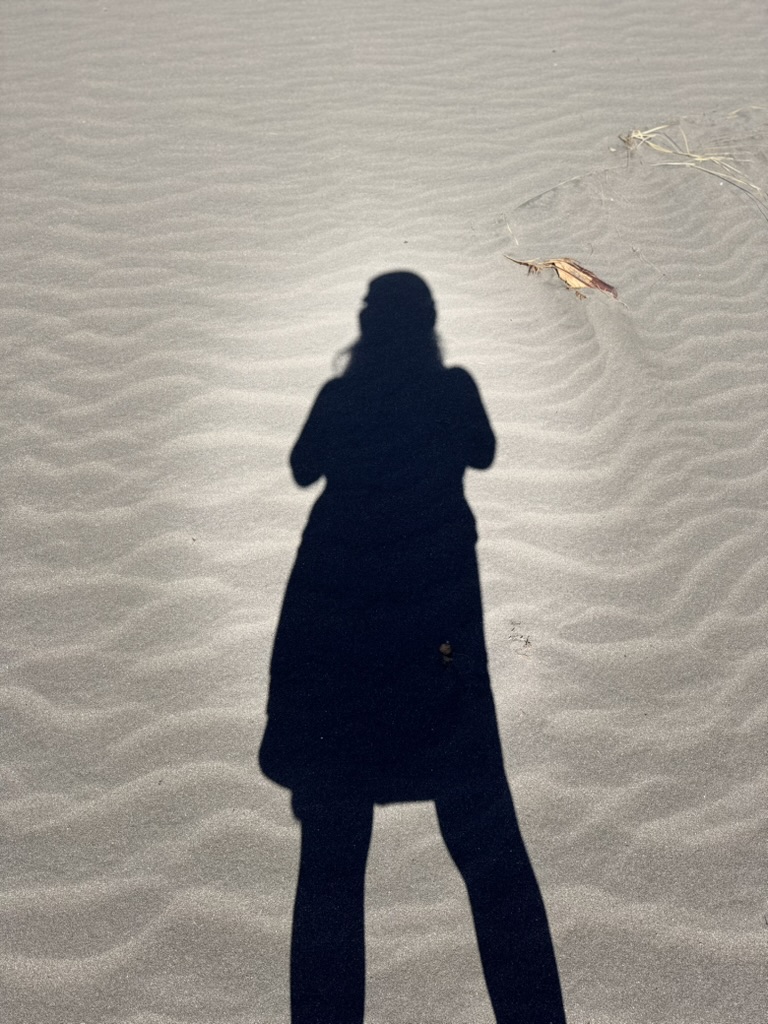
Ten days.
Diez días.

Title: The Sand Shadow

Photo Credit: Amy Tucker, 2026


Translation Note

Note. Spanish-language passages were generated using Google Translate (Google, n.d.) and subsequently reviewed and refined by the author. Any remaining infelicities reflect the limits of machine translation rather than intent.

References

Google. (n.d.). Google Translate. https://translate.google.com

Day Ten: La Fundación

Reading Time: 10 minutes

Evening

Ten evenings. I am starting to understand why I came here.

Blue dissolving into gold, gold bleeding into rose, rose deepening into violet. Del azul al oro, al rosa y al violeta. I have watched this transformation from this balcony for ten evenings now, and it has never been the same twice. The colour shifts with cloud cover, humidity, and the presence or absence of wind. Each sunset is singular. Unrepeatable. A gift offered once and then gone.

I am learning to receive it without trying to hold it.

This is harder than it sounds. My instinct, honed by decades of academic work, is to document, analyze, and pin down. To turn experience into data that can be preserved, referenced, and cited. But sunsets resist this treatment entirely. They happen, they transform, they vanish. All you can do is be present while they occur.

Title: Shadows that Haunt Me

Photo Credit: Amy Tucker, 2026

Ten days. Diez días.

It feels both longer and shorter than that. Longer because so much has shifted, the sleep that consolidates, the thoughts that clarify, the nervous system that learns to trust. Shorter because time here moves differently from time in my old life. The days unfold rather than accumulate into weeks that must be gotten through. They simply unfold, each one complete in itself.

This morning I wrote about being ready for deeper work.

This afternoon, I discovered whether that was true.

Three hours reading Kaplan and Kaplan’s The Experience of Nature. Dense academic writing. Multiple theoretical frameworks were synthesized. Complex arguments are built across chapters. The kind of scholarship that, a month ago, would have required multiple passes, extensive notes, and constant backtracking to passages still just beyond my grasp.

Today, it made sense on first reading.

Title: Rock Art

Photo Credit: Amy Tucker, 2026

Some concepts will need return visits, to sit with, to let marinate. But the basic structure of their argument, the way they build their case for nature experience as psychologically restorative, the relationship they trace between environmental qualities and cognitive restoration: clear. Accessible. My mind is following along without forcing it.

This is what full cognitive capacity feels like. The ability to think deeply, with them. To follow sustained arguments. To hold multiple ideas in relationship. To synthesize.

The relief of this is enormous.

I had begun to wonder whether the cognitive impairment was permanent. Whether months of sleep fragmentation and chronic stress had done lasting damage. Whether I would ever again be able to engage with complex theory the way I once had.

The answer, apparently, is yes. Given sufficient rest, given release from chronic threat, given time for the nervous system to recalibrate, the capacity returns.

Arnsten’s research on stress and prefrontal function helps me understand why. When the nervous system operates in a defensive state for extended periods, blood flow and glucose are redirected away from the prefrontal cortex, the brain’s executive centre, toward more primitive structures involved in survival. This is adaptive in the short term. Nuanced analysis is useless when facing immediate danger. You need fast, automatic responses.

But when the threat becomes chronic, when the nervous system never gets the signal that it is safe to stand down, those executive functions simply go offline. Offline. Temporarily unavailable. The biological infrastructure that supports complex thought is taken out of commission to conserve resources for survival.

These ten days have convinced my nervous system that the emergency is over. Those resources can be redirected back toward thinking, toward curiosity, toward engagement with ideas.

The prefrontal cortex is online again.

Gracias, cuerpo. Thank you for this restoration.

Title: The Skies Above Me

Photo Credit: Amy Tucker, 2026

After reading, I stopped.

This is remarkable, though it may sound otherwise.

For years, I have operated with a productivity logic that says: if you can still function, you should keep working. Rest is what you do when you literally cannot continue. Until then, push.

This afternoon I was tired. Just tired in that natural way, that comes after sustained intellectual engagement. My body said enough for now. And I listened.

I made lunch. Sat on the patio. Ate without reading, without working, without multitasking. Simply ate. Tasted the food. Felt the sun.

Title: Lunch

Photo Credit: Amy Tucker, 2026

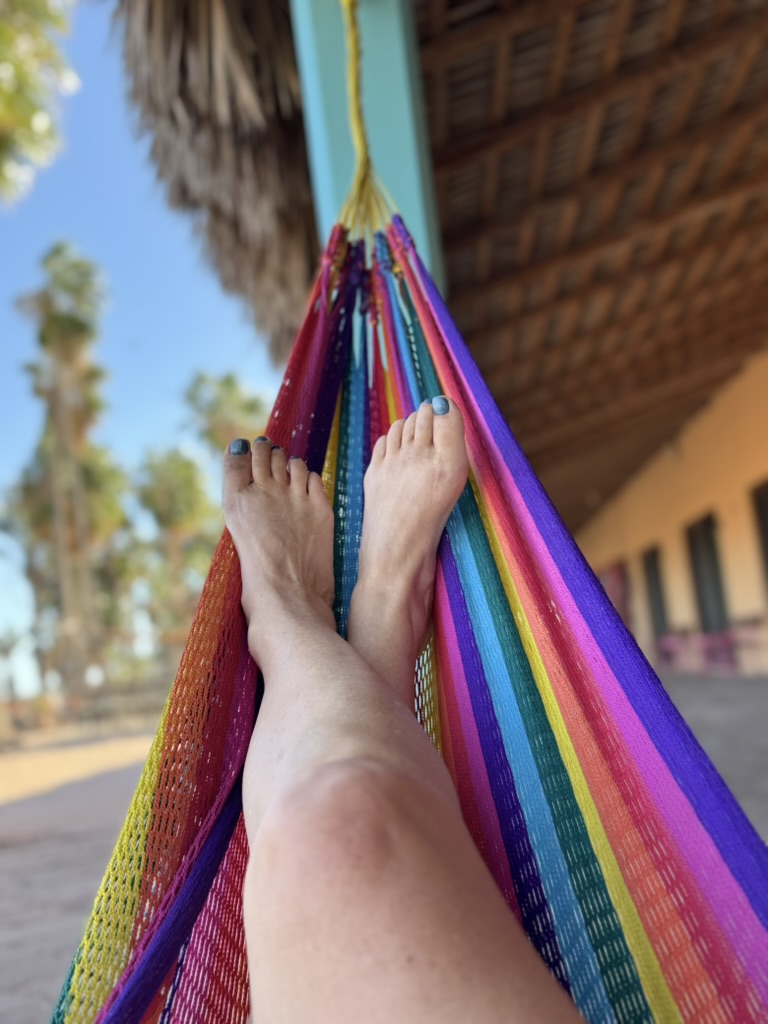
Then I lay in the hammock for an hour.

Resting, in a hammock in the afternoon with the sound of waves, the movement of air, and the warmth of the sun filtered through palm fronds.

This is what Nash means when he writes about Scholarly Personal Narrative as a practice of presence. Being fully in the experience, beyond just documenting it. Allowing yourself to notice what is actually happening rather than constantly narrating it, analyzing it, and turning it into something useful.

Sometimes you just lie in a hammock.

That is the whole story.

Title: Rocks!

Photo Credit: Amy Tucker, 2026

Late afternoon, I walked.

Beyond fitness goals or counted steps. Without a destination in mind. Just walking because my body wanted to move, and the beach was there, and the light was beginning to change.

I walked north until I reached the tide pools. Sat on a rock. Watched small crabs scuttle between crevices, tiny fish dart through shallow water, sea anemones open and close their delicate tentacles.

Title: Sea Life

Photo Credit: Amy Tucker, 2026

An entire world in a depression carved into stone by centuries of waves.

Time felt different there. Expansive. Unhurried. As though the afternoon had all the space it needed, and there was no rush to get to the evening. Merleau-Ponty (1945/2012) writes about lived time, time as experienced rather than measured. Time expands when you are fully present and contracts when you are anxious about what comes next.

When I finally stood to walk back, my legs were stiff from sitting, but my mind was quiet in a way months had taken from it. The constant low-level hum of anxiety, the voice that is always calculating, planning, worrying about what needs doing next, had simply stopped.

This is what Kaplan calls “the gentle pull of the natural world.” The quality of engagement that holds your attention gently, without effort, without demanding anything. Natural environments provide this. The movement of water. The scuttling of crabs. The opening and closing of anemones. Your attention is engaged and unhurried. And in that gentle engagement, something in the nervous system settles.

The quiet way nature restores us. Theory argues that modern life depletes what they call “directed attention,” the capacity to focus on tasks that require effort, to inhibit distraction, and to sustain concentration. We exhaust this capacity constantly: driving in traffic, responding to emails, sitting through meetings, forcing ourselves to concentrate on work that holds little natural interest.

Nature restores directed attention by allowing rest rather than stimulating further. By providing what Kaplan calls “being away,” a break from the demands that deplete us. By offering the gentle pull of the natural world, engagement without effort. By creating compatibility between what the environment offers and what we need in that moment.

Sitting on that rock watching tide pools, I was away. I was softly fascinated. The environment was perfectly suited to what I needed.

And something that had been tightly wound for months finally loosened.

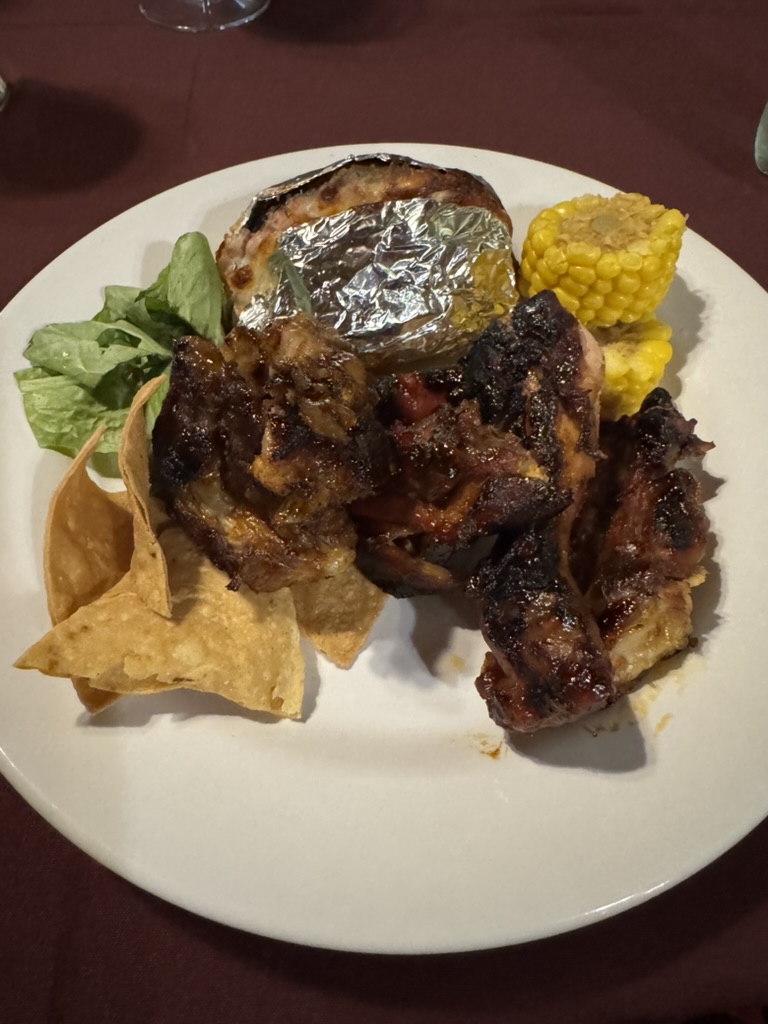
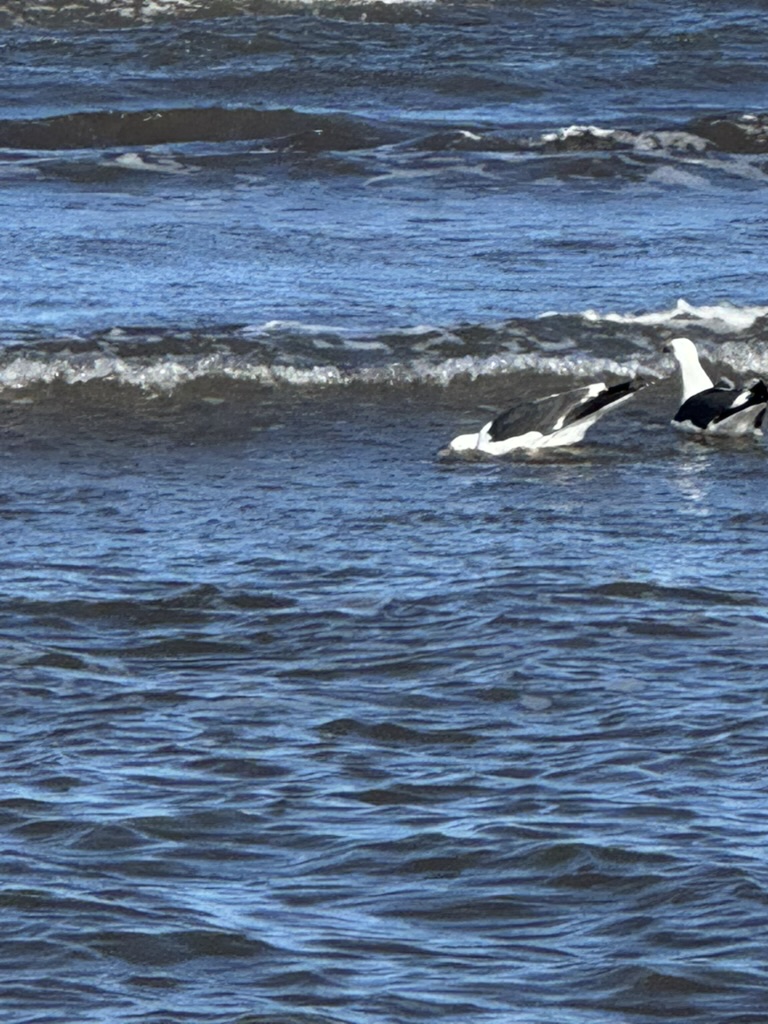
Title: Sea Gulls Fishing

Photo Credit: Amy Tucker, 2026

Evening now.

I made dinner as the light began its transformation. Simple food: canned fish with lime, rice, and vegetables. Ate on the patio. Watched the birds complete their final fishing runs before settling for the night.

Title: Dinner Time

The pattern is so familiar now that I could set a clock by it. Morning fishing. The midday rest. The late afternoon fishing. The evening returns to roosting sites. Day after day, the same rhythm.

Rich with variation, each day holds its own variations. Weather. Wind. The presence or absence of baitfish near the surface. Sometimes the pelicans fish alone. Sometimes in groups. Sometimes they dive from great heights. Sometimes they simply skim the surface, plucking small fish without submerging.

The rhythm allows for variation. The variation occurs within rhythm. Neither negates the other.

I am learning this. Estoy aprendiendo esto.

Slowly.

What has ten days built?

I have been asking myself this as the light fades and the first stars appear. What is different now from ten days ago when I arrived at this cottage, suitcase still packed, uncertain whether I knew how to stay?

Sleep: Three nights of sleeping through. The pattern is consolidating. My nervous system, learning that night, means rest: that darkness is safe, that vigilance can be released for seven hours without catastrophe.

Cognition: Prefrontal cortex restored. Can read complex theory. Follow sustained arguments. Synthesise across frameworks. Think without forcing each thought into existence through sheer will.

Embodiment: Being in my body rather than trying to manage it from outside. Can feel sensations without them being threatening. Can notice needs before they escalate into emergencies.

Rhythm: Evening sequence established. Morning patterns are consolidating. The body learning to read time through environmental cues, light quality, temperature, the pelicans’ flight patterns, rather than the external demands that structured my old life.

Trust: the foundation beneath everything else. My nervous system is beginning to trust. Trust that this environment is safe. Trust that rest will come. Trust that the next crisis can find me unhurried, the next email that changes everything, the next announcement that requires scrambling, repositioning, and proof of worth.

The foundation holds.

Tomorrow I will build on it. More reading. More theoretical engagement. Days eleven through twenty moving toward integration, bringing embodied experience into conversation with scholarly frameworks. Seeing how research illuminates what the body already knows. Contributing, eventually, to conversations about solitude and healing and the conditions that support nervous system regulation.

But tonight I simply rest in what ten days have created. In the capacity that has been restored. In the trust built brick by brick, through consistent rhythms and environmental cues, my conscious mind barely registered, but my nervous system tracked with precision.

Title: Sea of Cortez

Photo Credit: Amy Tucker, 2026

Long enough to begin.

In an hour, I will begin the evening sequence. The rituals my nervous system has learned to recognize as the approach of rest.

Dinner already eaten. Dishes washed. Cottage tidy. All the small acts of care that signal: evening is here, night is coming, you can begin to let go.

Will I sleep through tonight? Fourth night in a row would confirm the pattern even more strongly. It would give my system even more evidence that this is real, sustainable, and trustworthy.

But even if I wake, even if tonight fragments again, I know more now than I did ten days ago. I know what supports sleep. I know what environmental cues signal safety. I know how to maintain conditions even when the immediate results fall short of my hopes.

Healing releases control of outcomes. It is about maintaining conditions and trusting the system to respond.

I cannot force my nervous system to trust. But I can keep creating the circumstances that make trust possible. Keep following rhythms. Keep honouring the body’s signals. Keep providing the environmental conditions required for safety.

The actual sleeping, the actual healing, the actual transformation. These happen in their own time. Beyond conscious control. According to processes more ancient and wiser than anything my conscious mind can manage.

All I can do is maintain the conditions and step aside.

El umbral. The threshold.

I stand on it tonight. Looking back at the ten days that built a foundation. Looking forward to twenty more that will build on it.

Here. On this threshold. Leaving what was behind, arriving toward what comes next. Noticing what is.

The foundation holds. My body knows this. My nervous system has learned it through accumulated evidence that conscious thought played almost no role in gathering. Tomorrow I build upward from here.

But tonight, esta noche, I rest.

The pelicans have settled for the evening, wherever it is they go when light fails, and the sea turns dark. The stars are beginning to appear, one by one, then a handful, then too many to count. The waves continue their patient rhythm, the same rhythm they have maintained for millions of years, the same rhythm they will maintain long after I have left this place and returned to whatever life awaits me back home.

And I sit on the balcony on the tenth evening, holding the question that all thresholds hold:

What becomes possible when the foundation is sound?

Tomorrow I begin finding out.

La fundación sostiene.
The foundation holds.

Mañana construimos hacia arriba.
Tomorrow we build upward.

Pero esta noche, solo esto.
But tonight, just this.

El mar. Las estrellas. El ritmo constante.
The sea. The stars. The constant rhythm.

Y un cuerpo que finalmente descansa.
And a body that finally rests.


Translation Note

Note. Spanish-language passages were generated using Google Translate (Google, n.d.) and subsequently reviewed and refined by the author. Any remaining infelicities reflect the limits of machine translation rather than intent.

References

Arnsten, A. F. T. (2009). Stress signalling pathways that impair prefrontal cortex structure and function. Nature Reviews Neuroscience, 10(6), 410–422. https://doi.org/10.1038/nrn2648

Kaplan, R., & Kaplan, S. (1989). The experience of nature: A psychological perspective. Cambridge University Press.

Kaplan, S. (1995). The restorative benefits of nature: Toward an integrative framework. Journal of Environmental Psychology, 15(3), 169–182. https://doi.org/10.1016/0272-4944(95)90001-2

Merleau-Ponty, M. (2012). Phenomenology of perception (D. A. Landes, Trans.). Routledge. (Original work published 1945)

Nash, R. J. (2004). Liberating scholarly writing: The power of personal narrative. Teachers College Press.

ACADEMIC LENS

The concept of foundation, la fundación, names the epistemic shift that occurs when the body has rested sufficiently to become a reliable ground of knowing. Levine (2010) describes this as the “somatic floor”: the felt sense of bodily stability from which genuine movement and exploration become possible. Before the nervous system can restore, it requires what Porges (2011) calls cues of safety, consistently repeated signals that the environment is no longer hostile. Ten days of such signalling represents, neurologically, the beginning of what van der Kolk (2014) calls the revision of implicit memory: the gradual updating of the body’s baseline predictions about what the world holds. The bilingual form of this entry also enacts a kind of foundation: Anzaldúa’s (1987) argument that the borderlands between languages constitute an epistemological ground from which new thought becomes possible, precisely because neither language’s existing categories can fully contain the experience being named. The foundation built here is thus simultaneously somatic, linguistic, and methodological.

Day Nine: Lo Que La Restauración Hace Posible

Reading Time: 11 minutes

What Makes Restoration Possible

Title: When the Sky Speaks

Photo Credit: Amy Tucker, 2026

The sky is doing that thing again. Blue becomes gold, becomes rose, becomes violet, and if you blink, you miss the exact moment one colour surrenders to the next. Del azul al oro, al rosa y al violeta. (For the record, I have to look up every word in Spanish in my translator.) I have been sitting here on the balcony watching it happen, trying to find words for what today felt like, and I keep circling back to the same inadequate word: different.

Different. And yes, better.

Title: Coffee by the Sea

Photo Credit: Amy Tucker, 2026

Different in a way that makes me realize how long I have been living in that other place. The one where everything costs. Where even simple things, getting out of bed, making coffee, being present in my own life, require negotiation and force and that particular grinding willpower that is really just exhausted determination wearing a productivity costume.

Today arrived without force. No tuve que forzar nada.

I woke without the usual calculation of whether I had enough in the tank to make it through. No caffeine required, no stubbornness invoked to override my body. No careful rationing of attention, like it might run out before sunset.

Things just… happened. Todo fluyó. Thoughts connected. Words came. My body moved through space without requiring constant management. Natural. Like breathing. Like the way I imagine other people, rested people, move through their days without even noticing how easy it is.

Three hours

This morning I wrote for three hours. Tres horas. The kind of writing where you look up and realize time passed, and you were simply in it, beyond counting, beyond the forcing of each sentence into existence through sheer will.

I wrote about what happened last night. About sleep architecture and nervous system states, and why my body finally trusted enough to sleep through. I wove together material from Walker (2017) on sleep cycles and Porges (2011) on the nervous system system, along with what actually happened in my own body between 11 PM and 6 AM. Complex theoretical frameworks are talking to each other through my experience. All of it makes sense. All of it flowing.

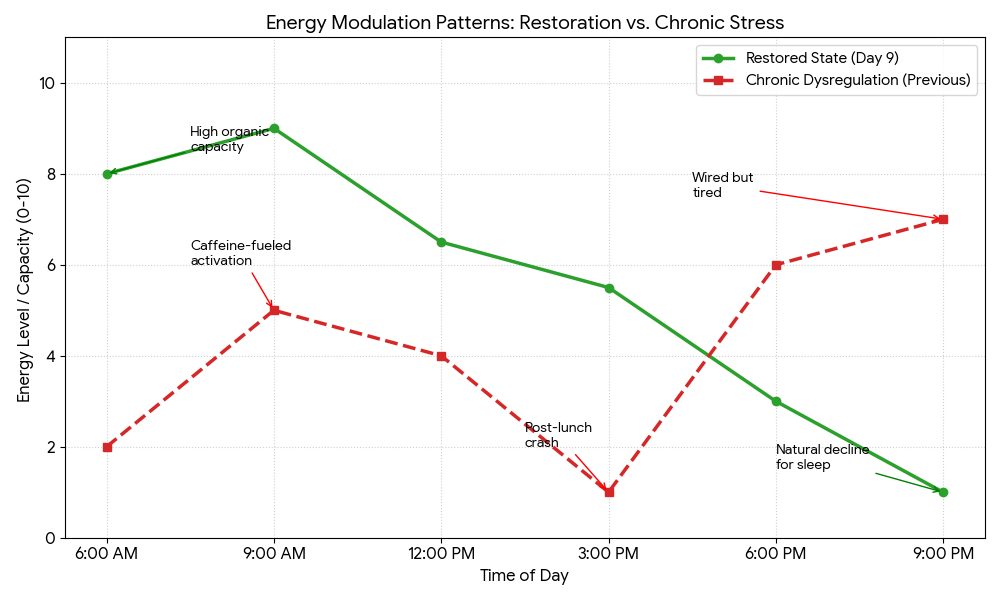
Title: Sleep Cycle

Created: Gemini AI, 2o26

Three months ago, this would have been impossible.

Beyond hard. Impossible.

And I need to be precise about that distinction because it matters.

There is this thing that happens when you have been stressed and sleep-deprived for long enough. People talk about it like you are just a little foggy, a little slower, like turning down the volume on a radio. That description misses what it feels like from inside. From inside, it feels like parts of your brain just… stop. Go dark. Offline (Arnsten, 2009).

The prefrontal cortex, the part that does complex thinking, that holds multiple ideas at once, that synthesises and integrates and makes connections, needs massive resources to run. Blood flow. Glucose. Energy. And when your body thinks it is in danger, when your nervous system has been reading the environment as threatening for weeks or months, those resources get redirected. Away from thinking, toward surviving. The amygdala scans for threats. The brainstem is ready to react. Ancient survival systems running the show while the thinking parts go quiet (Arnsten, 2009; Goldstein & Walker, 2014).

Which makes perfect evolutionary sense if you are running from a predator. Nuance is useless when you need to run. You need fast, automatic, proven responses.

The problem is that economic precarity (precariedad económica) is no predator. Contract uncertainty cannot be outrun. But try telling that to a nervous system running million-year-old software that says: sustained threat equals redirect all resources to survival.

So the thinking parts go offline. Executive functions dim. And you tell yourself you are just tired, that you need to try harder, that you need more coffee.

Title: Untitled

Photo Credit: Amy Tucker, 2026

Except that trying harder proves ineffective when the biological structures that underpin complex thinking have been taken offline to conserve resources for mere survival.

This morning, those structures were back. I could feel it, bodily, somáticamente, in my actual body. I read something from Walker’s work, and I could hold the concept while simultaneously connecting it to Porges and to what happened in my own sleep last night. Three frameworks, held together, talking to each other in my mind.

A month ago, reading that same passage, I would have had to stop. Reread. Make notes. Force comprehension through sheer determination. Today it just… made sense. La comprensión fluyó. Understanding flowed.

The Files

After lunch, I did something I have been avoiding. I opened my files. The pages I wrote months ago when sleep was breaking every night, when my nervous system was in constant alert, when exhaustion had become so normal I had stopped recognizing it as a state separate from just being me.

I was bracing for it to be bad. Full of gaps. Incoherent in places. The kind of work you produce when your prefrontal cortex is running on fumes, and you are just trying to get through.

It was good. Actually, genuinely good. The arguments held. The theory was solid. The thinking was clear.

And I sat there staring at these pages I wrote while barely functional and felt this complicated tangle of relief and grief. Una especie de duelo. Because if I could do that work while exhausted, produce something sound while my body was in survival mode, while parts of my brain were literally offline, what might I have been capable of if I had been rested?

What did I lose to those months of pushing through?

I watched the pelican outside my window for a long time. Dive. Rest. Zambullirse y descansar. Dive. Rest. Over and over. That simple rhythm. And something shifted in how I was thinking about the question.

The assumption underneath my grief was that exhausted-me and rested-me are the same person in different states. But that framing misses something. The work I produced while exhausted was shaped by that exhaustion. The questions I asked, the frameworks I reached for, the way I approached the material: all of it came from living inside chronic activation and precarity.

That work has value because it was written from within the very thing it seeks to understand. Nash (2004) argues that lived experience (experiencia vivida) is legitimate scholarly data when you examine it rigorously. My exhaustion was enriching the work. It was part of the data.

What restoration gives me goes beyond redoing that work “properly.” It is the chance to add another layer. To examine chronic activation from the perspective of someone who has lived both states and can now see the relationship between them.

Both matter. Both are real. Both contribute.

I have been writing down what I notice in my body at different points today. For no formal reason. Just because the consistency seemed worth documenting.

Morning: Waking without an alarm. The body knows what time it is from some internal clock that fragmented sleep had disrupted. That feeling of being actually rested sinks all the way into my bones. Quiet joy mixing with disbelief, mixing with gratitude. High energy but organic, unforced, free of chemical aid, just available. First conscious thought: I slept through.

Mid-morning: Three hours of writing behind me. Shoulders loose. Jaw soft. Hands steady. That focused clarity without the edge of strain I am so used to. Still high energy, sustained without effort. No fatigue. Apparently, complex intellectual work thrives beyond defensive nervous system states. Who knew.

Afternoon: After lunch. Gentle hunger satisfied. Digestion easy. Muscles relaxed. Just… contentment. Being in my body instead of trying to manage it from somewhere outside. Energy is moderate now, appropriate to midday. Body speaking up clearly about needs: thirst, hunger, time to move, instead of waiting until an emergency before getting my attention.

Later afternoon: Reading dissertation. Sitting comfortably without conscious effort. No tension accumulating in the neck and shoulders. Emotions are complex, that relief-grief tangle, present but manageable. Holding contradictory feelings without my nervous system reading emotional complexity as a threat. Energy is holding steady.

Evening: Sunset. Cooling air. Breath synchronized with waves. Body at ease. Deep peace. That gentle anticipation of evening unfolding. Energy naturally declines as the day winds down. Unwound rather than crashed. Present rather than depleted. Responsive to circadian rhythms, to what is actually needed now.

Night: Preparing for sleep. The body is already beginning the transition. Muscles releasing. Calm. Trust that sleep will come, that my body knows how to do this. Very low energy, sleep-ready. And here is what strikes me: no anxiety about whether tonight will repeat last night. Just readiness.

Looking at this pattern, the way energy moved across the day, I can see how it is supposed to work. La naturalidad. The naturalness of it. High when needed for writing. Moderate for reading. Naturally declining toward rest. Responsive. Appropriate. Organic.

For months, my energy looked nothing like this. Low despite caffeine. Forced into function through will. Brief spikes when adrenaline kicked in. Complete crashes. Forced back up. Anxious and activated at night when I needed sleep.

That is the nervous system thrown off balance, affecting the performance of its functions. That is the nervous system thrown off balance. That is what happens when the nervous system cannot access the state that allows for appropriate energy modulation.

Today, my energy followed the pattern research says is healthy (Kaplan, 1995; Ryan & Deci, 2000). And I know that sounds abstract, mere “research says” abstraction, but from inside it feels like my body finally remembering how to be a body. How to respond to actual needs instead of just surviving threat after threat after threat.

Title: The Pelican’s Teaching

Photo Credit: Amy Tucker, 2026

My hands wanted charcoal this afternoon. For no reason except that they wanted it. So I drew the pelican. El pelícano. The one I have been watching all week. Beyond accuracy, trying to capture the quality of movement. The dive. The pause. The rest. El ritmo. That rhythm.

And here is what I am seeing: effort and ease work as partners. El esfuerzo y la facilidad no son opuestos. They are partners.

The dive takes everything. Wings folding, body plummeting, that violent entry into water, struggling with a fish. Real effort. Then the rest is complete. Body still on the surface, conserving, digesting. Real rest.

Neither negates the other. The effort is recognized; it simply requires rest. The rest is earned because it follows effort. They are both necessary. Both are part of the natural rhythm.

I have been living like they are in competition. Like rest is something I have to earn through sufficient effort. Like, I can only access it once I have accomplished enough to justify it. Like needing rest means I am weak or inefficient or somehow failing.

El pelícano no piensa así. The pelican holds no such story. The pelican dives when hungry. Rests because the body needs to conserve energy between dives. Neither requires justification. Both are what the body needs.

I am learning this. Despacio. Slowly. Con dificultad. With difficulty. But learning.

What I am afraid of

It is almost time for bed, and there is a question I have been avoiding all day. What if last night was a fluke? What if tonight I wake at 2 AM with thoughts racing? What if my nervous system’s trust was temporary, contingent, fragile?

I can feel anxiety activating around this. Shoulders tensing. Breathe shallow. a state of constant alertness, always scanning for danger creeping back: scanning, trying to control, attempting to guarantee through worry that last night repeats.

But here is what I learned this morning, what the research showed me: nervous systems bypass conscious decisions about safety entirely. They respond to environmental cues. Señales ambientales. To patterns repeated across time. To accumulate data (Porges, 2011).

Nine nights now. Same evening sequence. Same environmental cues. That is data my nervous system has been gathering.

One night of unbroken sleep does something more interesting than erase that pattern. It confirms it. The conditions that supported last night’s rest remain. Evening rhythm is stable. The acoustic environment provides low-frequency, rhythmic patterns that signal safety. Darkness is complete and held safely. Predictability that allowed my system to trust enough to release vigilance.

I cannot control whether I sleep through tonight. But I can maintain the conditions that supported last night. Follow the same sequence. Honrar el ritmo. Honour the rhythm. Trust my nervous system is doing what nervous systems do: gathering data, testing predictions, updating assessments.

And if I wake tonight? That is also data. Data. Information about how healing actually proceeds when you get close enough to see it.

Nine days

Nueve días. Nine cycles of morning and evening. Nine progressions dark to light to dark. The pattern repeats but is never exactly the same. Each day is similar in structure, unique in texture, in quality, in what it shows me.

Today showed capacity. Hoy reveló capacidad. The capacity to think clearly. Write with rigour and creativity. Hold complexity without overwhelm. Feel contradictory emotions without the nervous system thrown off balance. Notice what the body needs and respond appropriately.

I had begun to think these capacities were gone. Diminished permanently by months of stress and fragmentation. But they were offline, waiting. Estaban desconectadas. Waiting for conditions that would let them function.

Last night’s unbroken sleep provided those conditions. Seven hours of sustained regulation. Seven hours of complete sleep cycles. Seven hours of trust.

And today, the harvest. La cosecha de ese descanso. Clear thinking. Sustained energy. Natural rhythms.

Tomorrow night will bring its own data. Sleep through or wake, either contributes to understanding. The nervous system is learning what safety feels like. El sistema nervioso está aprendiendo cómo se siente la seguridad. Learning to recognize it. Trust it. That learning moves in spirals, circling back. Some nights, complete rest, some partial waking. Both teaching the system about regulation, about what supports healing, about the gradual recalibration from threat to safety.

Title: What Direction?

Photo Credit: Amy Tucker, 2026

What I know tonight, sitting here as the last light fades and first stars appear above the sea, mientras se desvanece la última luz del cielo y aparecen las primeras estrellas sobre el mar: healing is something concrete and measurable. It is a concrete, lived, measurable reality.

My body slept through last night. First time in months.

My mind engaged in complex theoretical work today. First time in weeks.

My energy modulated appropriately across the day. First time I can remember.

Facts. Data points. The larger pattern of regulation and recovery is becoming visible.

El ritmo continúa. The rhythm continues. The pattern repeats. The body learns. And I, finally, am learning to trust this.

Gracias, cuerpo. Thank you, body.

Por este día de claridad. For this day of clarity.

Por mostrarme lo que es posible cuando descansas. For showing me what is possible when you rest.

Por enseñarme que el esfuerzo y la facilidad son socios, no enemigos. For teaching me that effort and ease are partners.

Por el ritmo. For the rhythm.

Title: The Lion’s Breath

Photo Credit: Amy Tucker, 2026


Translation Note

Note. Spanish-language passages were generated using Google Translate (Google, n.d.) and subsequently reviewed and refined by the author. Any remaining infelicities reflect the limits of machine translation rather than intent.

References

Arnsten, A. F. T. (2009). Stress signalling pathways that impair prefrontal cortex structure and function. Nature Reviews Neuroscience, 10(6), 410–422. https://doi.org/10.1038/nrn2648

Goldstein, A. N., & Walker, M. P. (2014). The role of sleep in emotional brain function. Annual Review of Clinical Psychology, 10, 679–708. https://doi.org/10.1146/annurev-clinpsy-032813-153716

Google. (n.d.). Google Translate. https://translate.google.com

Google. (2026). From survival mode to flow state [AI-generated image]. NotebookLM. https://notebooklm.google.com

Kaplan, S. (1995). The restorative benefits of nature: Toward an integrative framework. Journal of Environmental Psychology, 15(3), 169–182. https://doi.org/10.1016/0272-4944(95)90001-2

Kaplan, R., & Kaplan, S. (1989). The experience of nature: A psychological perspective. Cambridge University Press.

Nash, R. J. (2004). Liberating scholarly writing: The power of personal narrative. Teachers College Press.

Porges, S. W. (2011). The Polyvagal Theory: Neurophysiological foundations of emotions, attachment, communication, and finding our own calm. W. W. Norton & Company.

Ryan, R. M., & Deci, E. L. (2000). Self-determination theory and the facilitation of intrinsic motivation, social development, and well-being. American Psychologist, 55(1), 68–78. https://doi.org/10.1037/0003-066X.55.1.68

Walker, M. (2017). Why we sleep: Unlocking the power of sleep and dreams. Scribner.

Academic Lens

What restoration makes possible, the return of curiosity, appetite, creative impulse, is the clinical literature's definition of recovery from burnout (Maslach, Schaufeli, & Leiter, 2001): the restoration of engagement, efficacy, and energy that chronic overextension depletes. Ryan and Deci's (2000) self-determination theory frames this as the re-emergence of intrinsic motivation once external demands are suspended. This entry marks a pivot point in the inquiry: the beginning of the third phase, where alonetude stops being survival and starts being inquiry.