Note. Spanish-language passages were generated using Google Translate (Google, n.d.) and subsequently reviewed and refined by the author. Any remaining infelicities reflect the limits of machine translation rather than intent.
References
Google. (n.d.). Google Translate. https://translate.google.com
I have been staring at the sea for two hours. Maybe three. Time has become slippery here, something I can no longer hold in my hands. Rachel and Stephen Kaplan (1989) wrote about fascination, the effortless attention that natural environments invite, a quality of engagement that restores rather than depletes. The sea fascinates without demanding. It holds my gaze without asking anything in return.
Today I permitted myself to do nothing. I said it out loud this morning, standing in the kitchen of the casita with coffee warming my palms: Hoy, nada. Today, nothing. The words felt dangerous, like a confession. Tricia Hersey (2022), founder of The Nap Ministry, argues that rest is an act of political resistance, a deliberate refusal to participate in systems that equate human value with productivity, and that the recuperative power of rest is itself a form of collective defiance. I am trying to believe her.
El Mar y Sus Preguntas / The Sea and Its Questions
The Sea of Cortez is a particular blue I have never seen before. It shifts throughout the day, turquoise in the morning light, deeper sapphire by noon, silver-grey as evening approaches. This is what the Kaplans (1989) call the gentle pull of the natural world, a gentle hold on attention that leaves space for reflection, distinct from the hard fascination of screens and urgent notifications that dominate modern life. I watch the water change, and my thoughts change with it, drifting from one thing to another with no clear direction.
I think about my mother, who died eleven years ago and whom I still miss in ways that surprise me. Grief, writes Miriam Greenspan (2003), is one of the dark emotions, those feelings our culture teaches us to suppress or transcend rather than honour. She argues that grief carries wisdom if we can bear to feel it fully, that the only path through difficult emotion is directly into it rather than around it (Greenspan, 2003). Here, with nothing to distract me, grief surfaces like sea glass, worn smooth by time but still present, still catching light.
I think about the students I have taught over nineteen years, wondering where they are now, whether they are happy. I think about the papers I should be grading, the emails I should be answering, and then I remember: I am here to stop shoulding myself.
Debería. I should. The word haunts me even in Spanish. Ryan and Deci (2017), in their foundational work on self-determination theory, distinguish between autonomous motivation, acting from genuine interest and valued choice, and controlled motivation, acting from internal or external pressure. The voice of should is the voice of controlled motivation, and I have let it run my life for decades.
El mar no juzga. Solo recibe.
The sea receives, without judgment.
Pensamientos Sueltos / Loose Thoughts
My mind wanders. This is what minds do when you stop giving them tasks. Neuroscientists call this the default mode network, the brain regions that activate when external demands are lifted (Buckner et al., 2008). Far from idle, this network supports self-reflection, autobiographical memory, and the imagining of the future. The wandering mind is working, just on different problems than our productivity culture recognizes.
I think about the word retirement and how it sounds like something is being put away, stored in a closet, made invisible. I am 60. I am approaching the end of one kind of life and the beginning of another. Dan McAdams (2001), the narrative psychologist, writes that identity is an ongoing story we tell ourselves, a personal myth that integrates past and present into a coherent sense of self. Sitting here watching the waves, I wonder who I will be when I am no longer someone who works. The question has no answer yet. Perhaps that is why I keep asking it.
I think about all the women I know who are tired. Tired in their bones, exhausted in their souls, tired in ways that sleep alone cannot remedy. Sharon Blackie (2019) writes about the “long soul” of women at midlife, the accumulated weight of decades spent tending to others, and the fierce necessity of reclaiming time for oneself. We carry so much. We have been carrying for so long. I wonder if any of them are sitting somewhere right now, staring at water, permitting themselves to rest.
I think about the word enough to determine whether I have done enough. Whether I am enough. Brené Brown (2010) names this the voice of scarcity, the cultural message that we are never sufficient, that worthiness must be earned through endless striving. Brown (2010) describes wholehearted living as the practice of showing up in one’s own life from a foundation of inherent worth rather than conditional approval. I am 60 years old and still learning that my right to exist requires no earning.
The sea offers no answers. It just keeps moving, wave after wave, patient and indifferent and somehow, because of that, kind.
El Cuerpo Descansa / The Body Rests
I have done almost nothing today, and my body is grateful. I can feel it in the way my shoulders have dropped, the way my jaw has unclenched. Stephen Porges (2011) calls this the shift from the body’s alert state, the mobilized state of fight or flight, to genuine safety engagement, the calm alertness that emerges when the nervous system perceives safety. Small surrenders. The body knows how to rest if we let it. The problem is the letting.
I ate breakfast slowly this morning. Papaya, yogurt, and strong coffee. Jon Kabat-Zinn (1994), who brought mindfulness practice to Western medicine, writes about mindful eating, the simple act of being fully present with food. I tasted each bite instead of eating while scrolling, eating while working, eating while planning what comes next. Just eating. Just tasting. Just being a body receiving nourishment.
Qué lujo, I thought. What a luxury. And then I felt sad, because eating slowly should be ordinary, should be the baseline of a human life, and instead it feels like an extravagance I have to travel thousands of kilometres to access. This is what Hersey (2022) means when she writes that rest has become a privilege rather than a right, a commodity rather than a necessity.
Lo Que Emerge / What Surfaces
When you stop moving, things rise. Memories. Feelings. The sediment you have been outrunning for years. Greenspan (2003) proposes that grief, fear, and despair function as messengers, uncomfortable but purposeful signals that carry information about what we value, what we have lost, and what needs attention in our lives. Solitude creates the conditions for these messages to be received.
Today, I remembered a conversation with a colleague from years ago. She told me I worked too hard, that I would burn out if I kept going at that pace. I smiled and thanked her, and changed nothing. Christina Maslach (Maslach & Leiter, 2016), who pioneered burnout research, defines burnout as a syndrome of emotional exhaustion, depersonalization, and reduced personal accomplishment resulting from chronic workplace stress. I wore my exhaustion like a badge, proof of my dedication, evidence of my worth. I had no way to know then that worth is birthright, that existing requires no proof of value.
I am learning this now, at 60, staring at the sea. Better late than never, I suppose. Better here than nowhere at all. Weinstein et al. (2021), in their narrative study of solitude across the lifespan, found that older adults often experience solitude as more restorative than younger people, having learned, perhaps through accumulated wisdom, how to be at peace in their own company.
A pelican dove into the water while I was writing that last sentence. It emerged with a fish in its beak, shook the water from its feathers, and flew on. Life continuing. The ordinary miracle of survival.
Estoy aquí. Eso es suficiente.
I am here. That is enough.
Al Atardecer / Toward Evening
The light is changing now. Golden hour, photographers call it. The mountains across the bay have turned pink and purple, colours I would dismiss as exaggerated if I saw them in a painting. But here they are, real and impossible, demanding to be witnessed. This witnessing, this full presence to beauty, is what Abraham Maslow (1964) called a peak experience, a moment of heightened awareness that transcends ordinary consciousness.
I walked to the malecón this afternoon, to move my body, just to feel my feet on solid ground. An old man was fishing from the seawall. He nodded at me, and I nodded back. No words necessary. Just two people sharing space at the edge of the water, each lost in our own thoughts. Nguyen et al. (2018) found that self-chosen solitude supports learning to settle the nervous system, the capacity to modulate emotional states from within rather than seeking external distraction. The old fisherman seemed to understand this intuitively.
¿Qué busca? I wanted to ask him. What are you looking for? But I suspect he would have turned the question back to me, and I am still working on my answer.
Antes de Dormir / Before Sleep
I accomplished nothing today. I produced nothing. I checked nothing off any list.
And yet.
I breathed. I watched. I let my mind wander without yanking it back to productivity. I sat with myself, which is harder than it sounds when you have spent decades avoiding that very thing. Long and Averill (2003) argue that the capacity for solitude is a skill, something that can be cultivated through practice. Today was practice. Tomorrow will be practice too.
Mañana, quizás, haré más. Tomorrow, perhaps, I will do more. Or perhaps I will do precisely this again. Maybe this is the work I came here to do: the slow, invisible labour of learning to be still what Robert Nash (2004) calls me-search, the deep dive into personal experience that precedes scholarly understanding. I am doing the me-search now, though it looks like nothing at all.
El mar sigue respirando.
The sea keeps breathing.
Yo también.
So do I.
Con cariño,
Amy
Loreto, Day Three
Translation Note
Note. Spanish-language passages were generated using Google Translate (Google, n.d.) and subsequently reviewed and refined by the author. Any remaining infelicities reflect the limits of machine translation rather than intent.
References
Blackie, S. (2019). If women rose rooted: A life-changing journey to authenticity and belonging. September Publishing.
Brown, B. (2010). The gifts of imperfection: Let go of who you think you are supposed to be and embrace who you are. Hazelden.
Buckner, R. L., Andrews-Hanna, J. R., & Schacter, D. L. (2008). The brain’s default network: Anatomy, function, and relevance to disease. Annals of the New York Academy of Sciences, 1124(1), 1–38. https://doi.org/10.1196/annals.1440.011
Google. (n.d.). Google Translate. https://translate.google.com
Greenspan, M. (2003). Healing through the dark emotions: The wisdom of grief, fear, and despair. Shambhala.
Hersey, T. (2022). Rest is resistance: A manifesto. Little, Brown Spark.
Kabat-Zinn, J. (1994). Wherever you go, there you are: Mindfulness meditation in everyday life. Hyperion.
Kaplan, R., & Kaplan, S. (1989). The experience of nature: A psychological perspective. Cambridge University Press.
Long, C. R., & Averill, J. R. (2003). Solitude: An exploration of benefits of being alone. Journal for the Theory of Social Behaviour, 33(1), 21–44. https://doi.org/10.1111/1468-5914.00204
Maslach, C., & Leiter, M. P. (2016). Understanding the burnout experience: Recent research and its implications for psychiatry. World Psychiatry, 15(2), 103–111. https://doi.org/10.1002/wps.20311
Maslow, A. H. (1964). Religions, values, and peak-experiences. Ohio State University Press.
McAdams, D. P. (2001). The psychology of life stories. Review of General Psychology, 5(2), 100–122. https://doi.org/10.1037/1089-2680.5.2.100
Nash, R. J. (2004). Liberating scholarly writing: The power of personal narrative. Teachers College Press.
Nguyen, T.-V. T., Ryan, R. M., & Deci, E. L. (2018). Solitude as an approach to learning to settle the nervous system. Personality and Social Psychology Bulletin, 44(1), 92–106. https://doi.org/10.1177/0146167217733073
Porges, S. W. (2011). The Polyvagal Theory: Neurophysiological foundations of emotions, attachment, communication, and finding our own calm. W. W. Norton.
Ryan, R. M., & Deci, E. L. (2017). Self-determination theory: Basic psychological needs in motivation, development, and wellness. Guilford Press.
Weinstein, N., Nguyen, T.-V., & Hansen, H. (2021). What time alone offers: Narratives of solitude from adolescence to older adulthood. Frontiers in Psychology, 12, Article 714518. https://doi.org/10.3389/fpsyg.2021.714518
Academic Lens
Being lost in the blue, absorbed into the sea and sky, is an encounter with what Csikszentmihalyi (1990) calls flow in its most elemental form: total absorption that dissolves the boundary between self and environment. In the quiet way nature restores us theory (Kaplan & Kaplan, 1989), this state of the gentle pull of the natural world is the primary mechanism of psychological recovery, the mind neither straining nor idle, but gently held. The bilingual title "perdida" (lost/feminine) also carries a gendered valence: a woman permitting herself to be directionless is a quietly transgressive act.
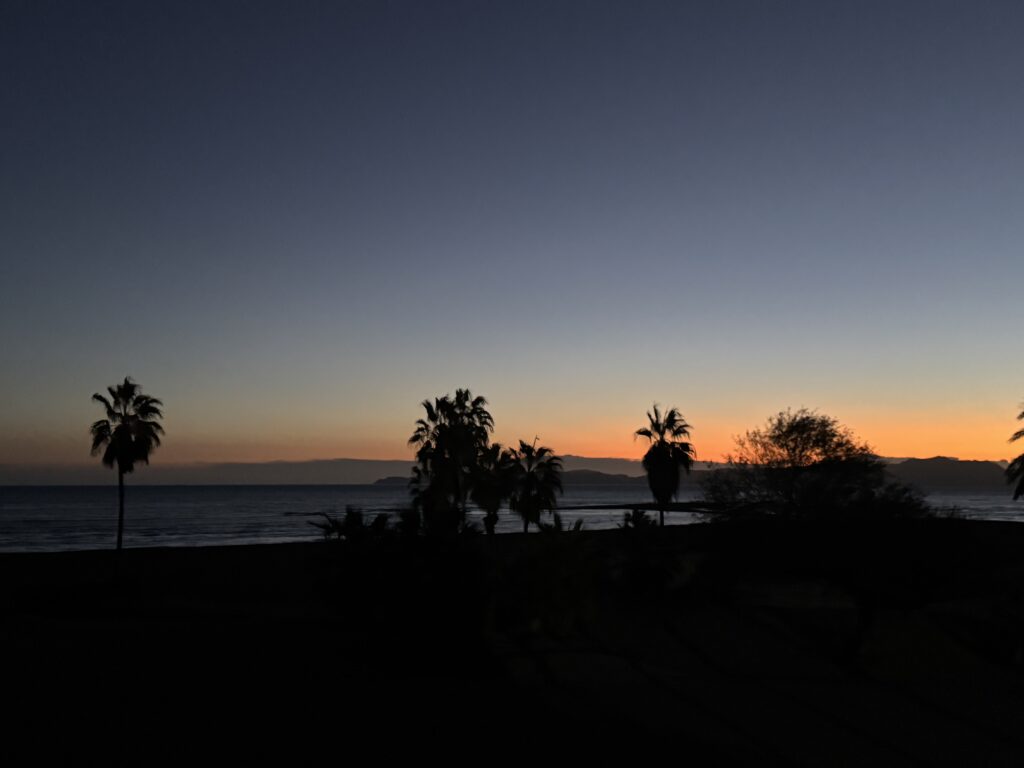
Puesta de sol, sunset on Day Two in Loreto. A bilingual reflection on the particular quality of light at the end of a first full day by the sea, and what the body begins to release when the world turns gold.
Reading Time: 4minutes
Sunset at the horizon.
This was something else entirely: a quality of presence, of being genuinely with myself rather than merely by myself.
Title: The Gathering
Artist Statement
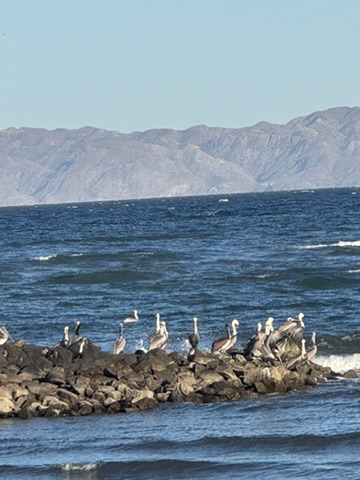
They gathered where the land gives way to water.
Perched along the rocks, they faced different directions, yet remained part of the same quiet formation. No urgency. No competition for space. Just bodies arranged along the shoreline, each holding its own stillness while sharing the same horizon.
I stood at a distance watching them.
What struck me was their patience. The way they waited without signalling waiting. The way they scanned the water without appearing restless. There was a rhythm to their presence that felt familiar to me, a kind of learned stillness that comes from spending long periods observing rather than intervening.
In that moment, I recognized something of my own practice reflected back.
This work of standing at edges. Of watching what moves beneath the surface. Of trusting that some moments ask only to be witnessed. Some moments ask only for attention. For steadiness. For remaining long enough that the landscape forgets you are there.
The mountains behind them held their own quiet authority, grounding the scene in time beyond the immediate. Water, rock, wing, distance. Each element coexisting without demand.
I kept my distance.
I allowed the distance to remain intact, understanding that proximity rarely determines connection. Sometimes respect lives in observation alone.
The evening I arrived in Loreto, Mexico, I stood on the malecón watching pelicans dive into the Sea of Cortez, and I felt something without a name.
Some moments ask only for attention.
It was something beyond loneliness, though I was profoundly alone, 3,000 kilometres from home, knowing no one, with thirty days of solitude stretching before me. Neither was it the comfortable solitude I had glimpsed in rare moments throughout my life, those brief pauses between obligations when I might read undisturbed or walk without destination.
I had no words for this experience. During Covid, I learned to call this place alonetude.
For decades, psychological research has approached solitude primarily through a deficit lens, and rightly so. Social isolation carries mortality risks equivalent to smoking fifteen cigarettes daily. Loneliness predicts cardiovascular disease, cognitive decline, and depression. The public health imperative to address what former U.S. Surgeon General Vivek Murthy called an “epidemic of loneliness” has produced essential knowledge and helped countless people.
But this focus created a gap. By treating solitude primarily as the absence of connection, we overlooked solitude as presence: the presence of self, meaning, and restoration that becomes available when social demands recede.
Alonetude requires four elements working together like legs of a table:
Intentional choice: Solitude must be chosen, never imposed. Research shows that autonomous motivation predicts positive outcomes regardless of introversion.
Felt safety: The nervous system must register it as safe. You cannot think your way into alonetude while your body scans for threat.
Present-moment awareness: Beyond rumination or distraction, genuine presence, what emerges when attention settles.
Meaning integration: Connection to values, purpose, or something larger than the passing moment.
Remove any one element, and the table collapses. Strength in one cannot compensate for the absence of another. This is the threshold model at the heart of the framework.
The Sea of Cortez cares nothing about whether humans theorize about solitude. The pelicans dive and surface following rhythms older than language. The mountains turn rose and gold at sunset regardless of who watches. But for those willing to participate, genuinely, patiently, with bodies regulated and hearts open, something becomes available. Presence to life, rather than escape from it. Presence of self, rather than absence of others.
Beyond loneliness and beyond mere solitude, something for which I needed a new word.
That word is alonetude. I offer it now as an invitation.
Presence to life, rather than escape from it.
Title: Welcome to Loreto
Artist Statement
My arrival was anything but quiet.
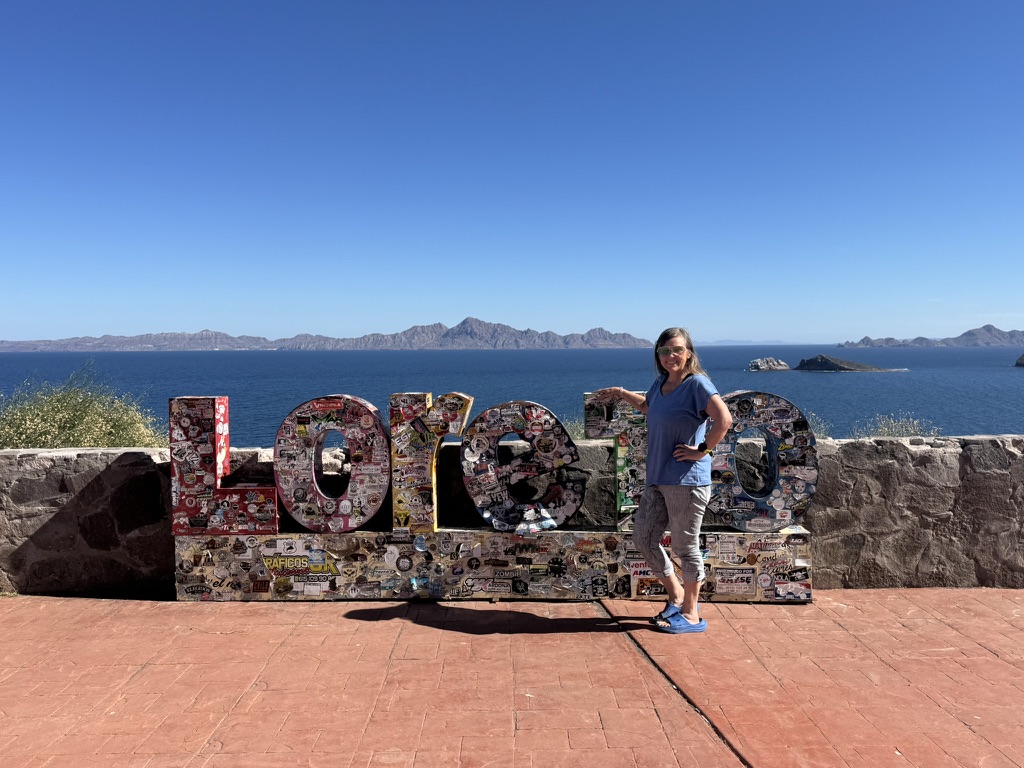
The letters announced it before I could. Large, textured, impossible to ignore. Covered in stickers layered over time, each one evidence that others had stood here too, marking their presence in colour and adhesive and memory. I stepped into the frame, aware that this was a different kind of shoreline moment than the solitary ones.
This was a public threshold.
Behind me, the Sea of Cortez stretched wide and steady, holding its own depth regardless of the spectacle in front of it. Mountains sat low along the horizon, grounding the scene in geological time while the foreground pulsed with tourism, movement, and human imprint. The contrast was immediate. Vastness behind. Declaration in front.
Traveller. Researcher. Body in place. Name unspoken yet presence visible. Unlike the quieter images, this one carries performance within it. Beyond the institutional sense of performance, simply acknowledging that sometimes presence is witnessed, documented, shared. That being in a place can hold both interior meaning and outward expression.
I left soon after the photograph.
I stepped away from the letters and back toward the waterline, where scale shifts again and the body becomes smaller against land and sea. Yet the image remains important because it marks arrival in a way solitude cannot do alone.
A pause between anonymity and recognition. Between landscape and inscription. Between being there and being seen.
Note. Spanish-language passages were generated using Google Translate (Google, n.d.) and subsequently reviewed and refined by the author. Any remaining infelicities reflect the limits of machine translation rather than intent.
ACADEMIC LENS
The distinction drawn here between “being by myself” and “being genuinely with myself” names the phenomenological core of alonetude: the difference between structural solitude and the experiential quality of self-presence that Moustakas (1961) describes as genuine encounter with oneself. Buber’s (1970) I-Thou framework applies inwardly: the sunset constitutes something beyond a backdrop,, through its beauty and its indifference to the observer’s agenda, the conditions for an I-Thou encounter with one’s own experience. Ulrich’s (1983) restorative environment research contextualizes the sunset’s particular power: the horizon, the large sky, the setting light constitute exactly the fascination and scope that natural environments provide, allowing the directed attention system to rest and the deeper self to surface. Van der Kolk (2014) observes that the capacity to be genuinely present with oneself, rather than managing or performing one’s inner states, is one of the fruits of trauma recovery: the sunset at day two marks the first glimpse of this capacity reasserting itself, evidence that the body has already begun to remember what safety feels like.
Llegada, Arrival. Day Two in Loreto, Baja California Sur: the body touches down at last. A bilingual reflection on what it means to arrive somewhere alone, and to let the sea be the first thing you say hello to.
Reading Time: 13minutes
Arrival is the doorway through which everything else enters.
Screenshot
Artist Statement
This one came through quickly.
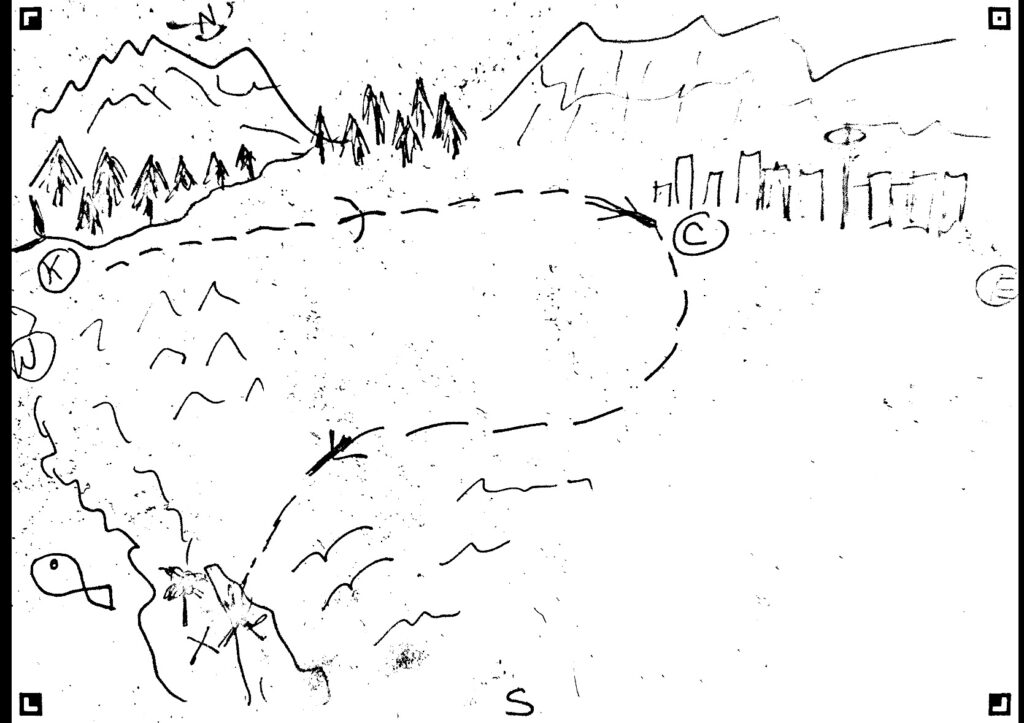
Unplanned. Unscripted. I drew it the way thoughts sometimes arrive when the body is tired but the mind is still moving. Lines first. Meaning later.
At first glance, it looks almost childlike. Loose marks. Unsteady figures. A pathway that curves without precision. Mountains on one side. Water on the other. Small symbols scattered across the space as if they surfaced faster than I could organize them.
But when I sat with it longer, I realized it was mapping something internal rather than geographical.
The road runs down the centre. Winding. Circuitous. It bends, loops, redirects. There are arrows that suggest movement but without certainty. It is a path that is being negotiated rather than followed.
On one side, there are figures and shapes that feel relational. Animals. Faces. Presences that suggest companionship, memory, or watchfulness. On the other side, sharper lines. Mountains. Edges. Terrain that feels more solitary, more effortful to cross.
There is even a small structure near the end of the path. Almost like a village, or a place of arrival. Yet it carries no detail. It sits lightly on the page, more suggestion than destination.
What strikes me most is the openness of the centre space. So much white. So much unfilled terrain.
It feels honest.
This drawing makes no claim to the whole route. It records movement in progress. The way journeys are often held internally before they become visible externally.
It reminds me that mapping is rarely about accuracy. Sometimes it is about witnessing where you are in the moment you draw the line.
The plane descended over mountains I had only imagined. Below, the Sea of Cortez stretched turquoise and still, the body of water that Jacques Cousteau famously called the world’s aquarium (Pulitzer Centre, 2023). The desert rose glowed golden behind it, ancient and patient. I had come alone, deliberately, to a place where silence would be allowed to remain.
The flight attendant announced our arrival in two languages, but I barely heard her. My body had already begun the quieter work of landing. I noticed my shoulders softening, my breath slowing, the steady thrum of anticipation giving way to something gentler. Arrival, I would learn, begins before the wheels touch ground.
Where Desert Meets Sea
Loreto sits at the edge of two worlds. To the east, the Sea of Cortez stretches toward the Mexican mainland, its waters teeming with nearly 900 species of fish and 32 types of marine mammals (PanAmerican World, 2018). To the west, the Sierra de la Giganta rises abruptly from the desert floor, granite and volcanic rock shaped by millennia, holding canyons and ancient springs in its folds. This is a landscape of stark beauty, where the desert’s dry heat meets the sea’s salt-laden air.
This place carries layers of history that I was only beginning to understand on arrival. On October 25, 1697, the Jesuit missionary Juan María de Salvatierra founded the Misión de Nuestra Señora de Loreto Conchó at an Indigenous settlement called Conchó, home to the Monquí people (Misión de Nuestra Señora de Loreto Conchó, 2025). It became the first permanent Spanish mission on the Baja California peninsula. It served as the administrative capital of both Baja and Alta California for more than a century. The town’s motto still reads: “Loreto: Cabeza y Madre de las Misiones de las Californias,” which translates to “Head and Mother of the Missions of the Californias.”
Before the missions arrived, Indigenous peoples had inhabited this peninsula for thousands of years. The Cochimí lived in the central regions to the north, their rock art still visible in the Sierra de San Francisco, with paintings carbon-dated to over seven thousand years before present (Kuyimá Ecotourism, 2025). These were semi-nomadic peoples who moved with the rhythms of the desert and sea, living in small family bands that travelled seasonally in search of water, edible plants, and game (Cochimí, 2025). To the south lived the Guaycura and the Pericú. European diseases and colonial disruption would decimate these populations within a few generations, and by the nineteenth century, the Cochimí language had become extinct (Laylander, 2000; Indigenous Mexico, 2024). Their memory endures in archaeological sites and oral history, a reminder that the land I walked upon held stories far older than my own.
I arrived without consciously carrying this history. It was only later, walking the malecón, the seafront promenade, in the evening light, that I began to understand why this place felt layered. Silence here seemed to hold more than absence. It held memory.
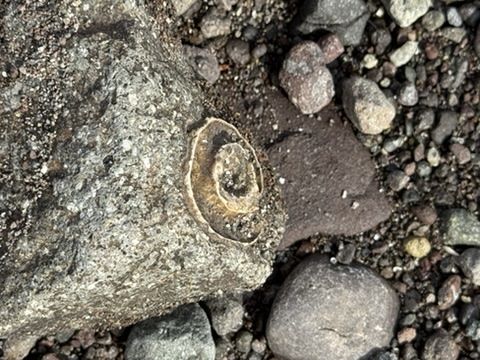
Title: The History of Time
Artist Statement
I almost missed it.
It sat quietly among the other stones, indistinguishable at first glance. Just another fragment in a shoreline made of fragments. It was only when I bent down, slowed my gaze, that the spiral revealed itself.
Perfectly held inside the rock.
A fossil. A record of life that once moved through water long before my own footsteps ever reached this shore. What struck me was its patience, more than its age. The way it had remained intact while everything around it had eroded, shifted, broken down into smaller pieces.
Time was visible here.
As compression. As density. As felt weight. Layers folded inward. Motion turned into memory. The spiral itself felt symbolic, but I resisted making it symbolic too quickly. Instead, I stayed with its material presence. Its texture. Its quiet persistence.
Holding this image, I thought about how many histories live beneath our feet without announcement. How much survives without spectacle. The fossil requires no demand. It waits for recognition.
There is humility in that.
It reminded me that archives take many forms beyond the written. Some are geological. Body-based. Embedded in landscapes that remember what human timelines often forget.
I left it there.
It felt important that it remain where it was found. Still held by the shoreline. Still in conversation with water, weather, and time.
Before I left, people asked whether I was nervous about travelling alone. Whether I was running from something or toward it. Whether thirty days was too long or too short. I had no clean answers.
What I knew was simpler: I was tired in ways that sleep alone could never reach. After years of institutional pressure, caregiving across generations, and the collective exhaustion that followed the pandemic, my nervous system had forgotten how to settle. Stillness felt dangerous. Silence felt loud. Being alone had become entangled with being abandoned, and I had lost the ability to tell the difference.
I came to Loreto to learn how to be with myself again. To practise what I have come to call alonetude, a term I use to describe the intentional, generative space between solitude and loneliness. I define alonetude as an enduring contemplative orientation toward chosen solitude, characterized by intentionality, presence, meaning, and a sense of safety. It is a posture of chosen presence with oneself, distinct from both the pain of loneliness and the mere fact of being physically alone.
Researchers have long distinguished between solitude and loneliness. Loneliness, understood as the painful gap between desired and actual social connection, persists even in crowds (Hawkley & Cacioppo, 2010). As Nguyen (2024) describes, it is an experience of perceived isolation characterized by unmet expectations in social relationships. Solitude, by contrast, can be chosen, meaning chosen or self-determined, and restorative, meaning it supports recovery and wellbeing. Research shows that when individuals autonomously decide how to spend their solitary time, they experience more positive emotions and lower stress (Nguyen et al., 2018). The key distinction lies in motivation: self-determined solitude occurs when a person spends time alone to gain emotional benefits or engage in meaningful activities, whereas non-self-determined solitude happens when aloneness is imposed by circumstance or social exclusion (Nguyen et al., 2024).
Somewhere between those poles lies the quieter possibility I was seeking: the decision to remain present with oneself, without urgency or escape. And so I chose a place where the sea would be my witness and the mountains my backdrop. A place with enough history to remind me I was small, and enough stillness to let that smallness feel like relief.
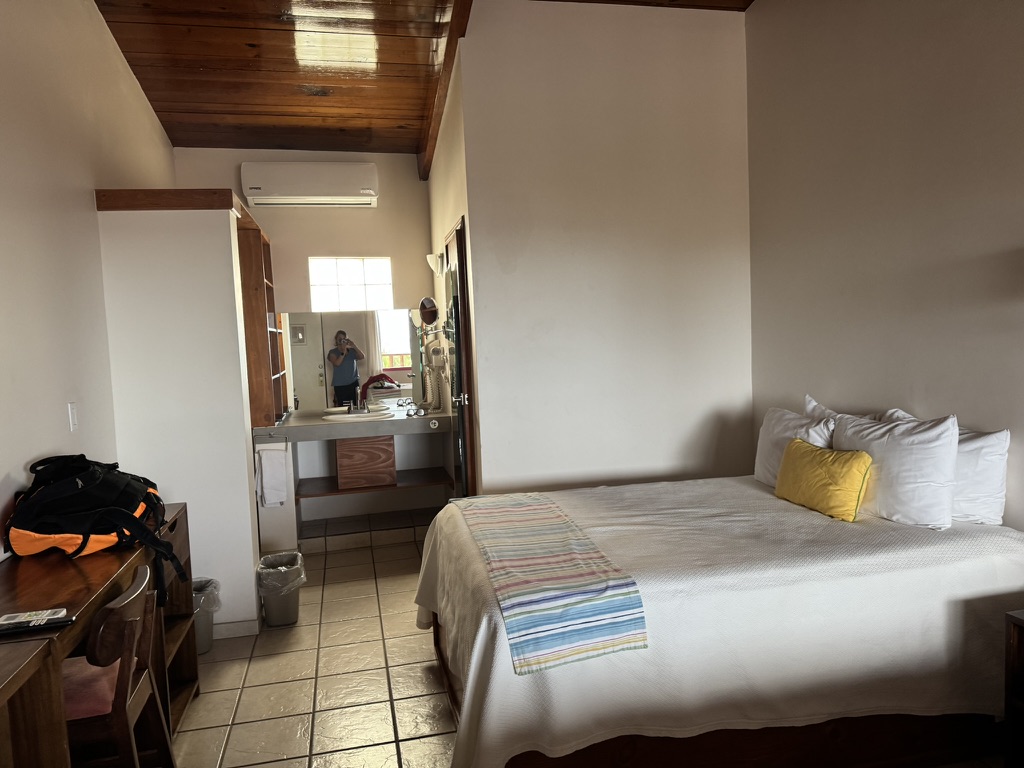
Title: My Space
Artist Statement
It was the stillness that met me first.
Quiet, contained, that only temporary rooms seem to hold. The bed was made with precision. Pillows aligned. A folded throw placed carefully across the centre as if anticipating arrival before I had even stepped inside.
I remember standing in the doorway for a moment longer than necessary.
There is always something disorienting about entering a space that is prepared for you, a stranger to itself. A room that offers comfort without history. Function without attachment. It asks nothing, but it also holds nothing of you yet.
My suitcase rested against the wall. Half-unpacked. A visible reminder that I was both arriving and already preparing, in some distant way, to leave.
The mirror reflected me back into the frame of the room. Researcher. Traveller. Body in transition. The image felt less like documentation and more like evidence of in-betweenness. Neither fully settled nor unsettled. Simply passing through.
What drew me most was the order.
Clean lines. Neutral tones. A controlled environment that contrasted with the emotional complexity I had carried with me. In that contrast, I felt a subtle recalibration begin. The nervous system recognizing safety through predictability. Through the ordinary rituals of placing belongings, arranging clothing, setting a journal on the bedside table.
Temporary spaces can be profoundly instructive.
They remind us how little is required to begin again each day. A bed. A window. A place to write. A place to rest the body between movements.
Nothing extravagant. Just enough.
I let the room be what it was. I let it remain neutral. Let the relationship form slowly. Presence before imprint.
At the small airport, the air hit me first. Dry and warm, carrying salt and something mineral. January in British Columbia had been grey and wet; here, the sky stretched blue without apology. I collected my bag and stepped outside. No one was waiting.
That fact landed differently than I expected. There was relief in it. No negotiation, no performance, no need to translate my fatigue into something legible for others. I hailed a taxi and watched the desert roll past the window. Cardon cacti stood like sentinels along the road, their arms raised to the sky. Smaller plants hugged the ground, adapted to scarcity.
When I arrived at my small casa, I sat with my bags still packed. I sat on the edge of the bed. I noticed the texture of the light coming through the shutters. I noticed my shoulders drop. I saw the impulse to fill the silence, to check messages, to plan, to narrate the moment to someone far away, and I let the impulse pass.
This is the work of arrival: resisting the urge to fill the space you have just entered immediately. Allowing the body to land before the mind begins its commentary. Trusting that orientation will come without forcing it.
I opened the windows. Outside, I could hear unfamiliar birds. The sea was close and visible from where I sat. I drank water slowly. I let the room remain unfinished around me.
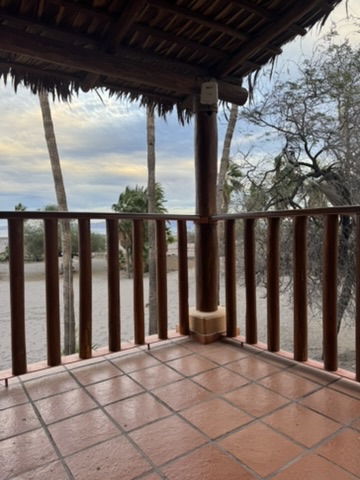
Title: Morning Views
Artist Statement
I kept returning to this balcony without meaning to. It became a quiet threshold in my days, a place suspended between inside and outside, between the life I carried with me and the landscape that asked nothing in return.
In the mornings, I would step onto the cool tiles barefoot, still half inside sleep. The body would register the air, the light, the slow movement of the palms before my mind began its usual work of organizing and anticipating. I came to value that order. Sensation first. Thought later.
There was no spectacle here. Just rhythm. Wind moving through the trees. The horizon holding steady. Light arriving gradually across sand and railing. Nothing hurried me. Nothing required interpretation. I could stand at the edge of the day without performing readiness for it.
Over time, this space became orienting. Internally, rather than geographically. I stood here without writing or planning. I stood, breathed, and allowed myself to arrive slowly. The thatched roof overhead offered shelter, while the open railing kept me connected to the wider world. Protected, yet open.
It reminded me that solitude often lives in these in-between spaces. Places where one can look outward while staying grounded inward. Places where presence is enough.
This balcony was never dramatic. That is why it mattered. It held me quietly as each day began.
That evening, I walked to the water. The malecón curved along the shore, lined with benches and the quiet activity of a small town at dusk. Pelicans floated in loose formations offshore. The light turned gold, then amber, then something closer to rose.
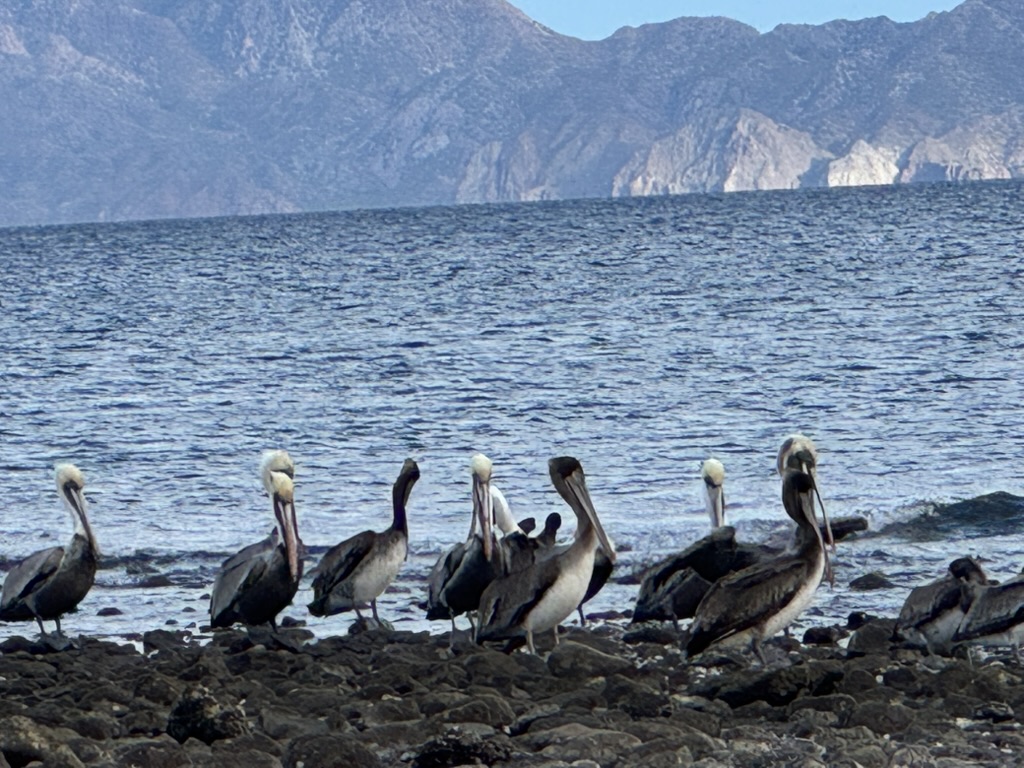
Title: All in a Line
Artist Statement
They were already gathered when I arrived.
A line of pelicans along the shoreline, facing the water as if the horizon had called them into formation. I stood back and watched. What held me was the pace of it, more than the scene itself. No urgency. No competition. Just bodies resting in proximity, each one holding its place without needing to claim it.
I noticed how easily they occupied stillness.
Waiting, unhurried. Together, without entanglement. The sea moved behind them in long, steady breaths, and I felt my own body begin to match that rhythm. In that moment, I was witnessing something, I was witnessing a posture. A way of being that measured nothing.
I stayed back.
Distance felt right. I stayed where I was, letting the scene remain intact. Watching them, I felt reminded that presence rarely requires action. Sometimes it is enough to stand at the edge of things, attentive, unhurried, and willing to belong to the pause.
I found a bench and sat. I had no book, no phone in hand, no task. Just the sound of water lapping against stone and the slow parade of families walking after dinner. A child ran past laughing. A couple held hands. An older man fished from the rocks nearby, patient and unhurried.
The body knows arrival before the mind catches up. It registers safety in the loosening of the jaw, the deepening of breath, the release of tension held so long it had become invisible. Stephen Porges (2011), in his foundational work on how the nervous system responds to safety and threat, explains that the autonomic nervous system continuously scans for cues of safety or danger through a process he calls the body’s instinct to scan for safety. This term refers to the neural evaluation of risk and safety that occurs below conscious awareness, reflexively triggering shifts in physiological state (Porges, 2022). Unlike perception, which involves mindful awareness, the body’s instinct to scan for safety operates automatically, distinguishing environmental features that are safe, dangerous, or life-threatening.
When the nervous system detects sufficient cues of safety, what Porges (2022) describes as the body’s sense of being safe, the body shifts from states of protection into states of restoration. The genuine safety complex, a branch of the vagus nerve associated with calm, connection, and social engagement, becomes activated. This shift arrives below conscious choice. It is something we allow by creating conditions where safety can emerge.
Sitting there on that bench, watching the pelicans dive and the light change, I felt something unclench. Quietly, almost imperceptibly. The vigilance I had carried for years began, very slowly, to set itself down.
Arrival creates conditions for this shift. By slowing down. By resisting the impulse to perform or produce. By letting the first hours remain unstructured. When nothing is demanded, the nervous system begins to trust the moment.
An Invitation
Arrival, I learned that first evening, is a threshold. It marks the movement from one way of being into another. Thresholds resist rushing. When crossed too quickly, they close before anything has time to change.
You can practise arriving anywhere. It can happen in a parked car before going inside. In a quiet kitchen after everyone has gone to bed. In the first moments of waking, before you reach for your phone. These small arrivals matter. Research suggests that even brief periods of self-selected solitude can foster relaxation and reduce stress (Nguyen et al., 2018).
Wherever you are reading these words, I offer this as an invitation. Let yourself arrive here. Notice the surface beneath you. Notice your breath. Let the moment widen without needing it to mean something yet.
Arrival offers orientation before transformation. The chance to acknowledge where you are, physically, emotionally, internally, before asking yourself to be anywhere else.
That first night in Loreto, I fell asleep to the sound of distant waves. The room was still unpacked. The days ahead were unplanned. And for the first time in longer than I could remember, that openness felt like permission rather than a threat.
Llegada. Arrival. The doorway through which everything else enters.
Title: The Sea of Cortez, Loreto, Mexico
Artist Statement
The light arrived before I was ready for it.
I stepped outside and the sky was already holding colour, soft pinks moving slowly across the horizon, settling into the edges of the clouds as if the day were being introduced rather than announced. The palms moved in the wind, with weathered resilience, gently. They bent without breaking. They have done this many times before.
I stood there longer than I planned to.
Watching the movement of the trees, the stillness of the sand, the quiet line where water meets land. What held me was the atmosphere of endurance, alongside the beauty. Nothing here was rushing. Even the wind felt patient. I noticed how my body responded, how my breathing slowed without instruction.
In that moment, I felt accompanied without needing company.
The landscape asked nothing of me. It simply allowed me to arrive as I was, tired, reflective, present. Standing there, I understood that rest arrives in many forms beyond full stopping. Sometimes it comes from witnessing something that knows how to keep standing, even in constant wind.
Cochimí. (2025, November 22). In Wikipedia. https://en.wikipedia.org/wiki/Cochimí
Hawkley, L. C., & Cacioppo, J. T. (2010). Loneliness matters: A theoretical and empirical review of consequences and mechanisms. Annals of Behavioural Medicine, 40(2), 218–227. https://doi.org/10.1007/s12160-010-9210-8
Indigenous Mexico. (2024, September 4). Indigenous Baja California: The rarest of the rare. https://www.indigenousmexico.org/articles/indigenous-baja-california-the-rarest-of-the-rare
Kuyimá Ecotourism. (2025, August 24). The Cochimí: Indigenous tribe of Baja California Sur. https://www.kuyima.com/cochimi-indigenous-tribe/
Laylander, D. (2000). The linguistic prehistory of Baja California. In D. Laylander & J. D. Moore (Eds.), The prehistory of Baja California: Advances in the archaeology of the forgotten peninsula (pp. 1–94). University Press of Florida.
Misión de Nuestra Señora de Loreto Conchó. (2025, February 7). In Wikipedia. https://en.wikipedia.org/wiki/Misión_de_Nuestra_Señora_de_Loreto_Conchó
Nguyen, T.-V. T. (2024). Deconstructing solitude and its links to well-being. Social and Personality Psychology Compass, 18(11), Article e70020. https://doi.org/10.1111/spc3.70020
Nguyen, T.-V. T., Ryan, R. M., & Deci, E. L. (2018). Solitude as an approach to learning to settle the nervous system. Personality and Social Psychology Bulletin, 44(1), 92–106. https://doi.org/10.1177/0146167217733073
PanAmerican World. (2018, November 21). Sea of Cortez: The world’s aquarium. https://panamericanworld.com/en/magazine/travel-and-culture/sea-of-cortez-the-worlds-aquarium/
Porges, S. W. (2011). The Polyvagal Theory: Neurophysiological foundations of emotions, attachment, communication, and finding our own calm. W. W. Norton & Company.
Porges, S. W. (2022). Polyvagal Theory: A science of safety. Frontiers in Integrative Neuroscience, 16, Article 871227. https://doi.org/10.3389/fnint.2022.871227
Pulitzer Centre. (2023). Mexico: Emptying the world’s aquarium. https://pulitzercenter.org/projects/sea-of-cortez-aquaculture-ocean-fish-farming-global-market
Note. Spanish-language passages were generated using Google Translate (Google, n.d.) and subsequently reviewed and refined by the author. Any remaining infelicities reflect the limits of machine translation rather than intent.
Academic Lens
Arrival at Loreto enacts what van Gennep (1960) calls the threshold crossing of a rite of passage: the moment of separation from the previous structure is complete, and the liminal phase begins. The wonder recorded here, the shock of a different sensory world, corresponds to what Kaplan and Kaplan (1989) term restorative experience: environments that require involuntary attention and allow directed attention to recover. Writing bilingually at this moment is itself a methodological choice: language as a site of what the body knows.
That is the first thing. The wave comes and does its full work and pulls back and the next wave comes and does its full work and the sea does not accumulate, does not keep a record of the previous waves, does not brace for the next one based on what the last one cost. Every wave is complete in itself. Every wave arrives without the weight of all the waves before it.
I have been watching it do this for years and I am still learning.
My particular difficulty is the not-keeping-the-record. I am a woman who keeps records. Who remembers what was said in the meeting in 2009 and who said it and what it cost and what the cost accumulated to over the following decade. Who carries the full weight of the history into the present tense and finds the present tense heavier for it. Who arrives at the new thing with the residue of all the old things still present, informing, sometimes usefully, often not.
The sea does not do this.
The sea has no opinion about the previous waves. The sea has no residue from the winter storms and the calm stretches and the particular summer afternoon when it was flat as glass and looked like a different substance entirely. The sea just keeps arriving. Full, each time. Unencumbered by its own history. Doing its work and releasing it and doing the next work.
I stood at the edge of it in February, in Loreto, in the particular quality of early morning light that belongs to that coast, and I thought: I want to learn to arrive that way. Full. Without the accumulated residue of the arriving I have already done. Present to this shore and not still standing on the last one.
I am still learning.
The sea is patient with my learning. The sea has been doing this longer than I have been watching it and will be doing it long after I am done watching. It has time. I am taking notes. Slowly, imperfectly, arriving a little more fully each time, setting down a little more of what I was carrying from the shore before.
I want to say that plainly, without shame, though there is still some shame in it, the residue of a culture that taught me that stillness was laziness wearing a different coat, that the empty hour was a moral failure, that my worth was a verb, always a verb, always something being done, produced, delivered, demonstrated.
I lacked knowledge of how to rest because I had never been taught that I possessed worth when I stopped.
Rest had to teach me from the beginning.
Like a language with no cognates, no familiar sounds, no words I already knew in a slightly different form.
A language I was starting from zero. In Loreto I learned to say descansa, and to mean it as instruction rather than permission. The word kept doing its work in me long after I stopped using it out loud.
The first lesson was the hardest.
The first lesson was: you are allowed to stop.
Rather than when the work is done. The work is never done. Rather than when you have earned it. You cannot earn rest. Rest is a right, a fundamental right. Rest is the heart of the chapter, the beginning of what comes next.
Rest is a right. Rest is as necessary as breathing. Rest is the condition in which a human being remains human rather than becoming a highly efficient machine quietly breaking down.
The second lesson came from the body.
The body is a patient teacher until it is not. The body will ask quietly for a long time, will send small messengers, fatigue, tension, the ache that lives between the shoulder blades of women who carry things they were not designed to carry alone.
The body will ask quietly; when that stops working, it will ask loudly; when that stops working, it will simply take what it needs, whether you planned for it or not.
My body took a shower.
My body took thirty days in a small town by a sea that had no interest in my productivity,
and in the taking it began, slowly, experimentally, with the caution of something that has been disappointed before,
to remember what it was.
Not a vehicle. Not a container for a brain that was always elsewhere, always in the next task.
A body. An actual body. With a hunger that was real and a tiredness that was real and a capacity for pleasure, the warmth of sun on an arm, the smell of salt and morning, the way cold water tastes when you are truly thirsty and you stop to drink it instead of carrying it untouched to the desk.
The body remembered. The body was so grateful to be remembered.
The third lesson was about silence.
She had been afraid of silence. In the silence, no performance was required. In the silence, there was nothing to manage, no register to calibrate, no warmth to project, no competence to demonstrate.
In the silence, there was only what was actually there.
And what was actually there was large.
The grief was large. The anger she had not let herself feel fully was large. The love was large, the love for the work and the students and the version of herself who had given everything and deserved so much more than she was given.
The silence held all of it without asking her to perform it differently.
And she learned that she could hold it too.
The fourth lesson was about time.
Institutional time is extracted time. She understood this now in the body, not just the mind.
In Loreto, she found her own time.
Time that moved at the speed of the tide. Time that had no agenda.
She breathed all the way down. For thirty days, she breathed all the way down.
She is still learning to do it at home.
The fifth lesson was the one she least expected.
She had expected rest to be the absence of something. The absence of work, of pressure, of the performance of fine.
She had not expected it to be a presence.
Rest arrived, and in the space it made something else arrive with it.
Herself.
She was curious. She was playful. She was creative. Not productive-creative, not research-output creative, but the other kind, the kind that makes something for the making of it, for the pure animal pleasure of having made a thing that did not exist before.
This was rest.
Not the absence of herself but the presence of all the parts of herself that the institution did not have a use for.
What rest taught me, finally, is this:
I was worth resting.
Not because I had earned it. Not because I was sick enough to need it.
Because I was a person. Because I was a body with a finite number of mornings, and I had been spending them in service of a system that was not spending anything in service of me.
Rest taught me that I am alive.
Not a contract. Not a credential. Not a performance of professional wellness.
Alive. Particular. Irreplaceable.
Worth the morning. Worth the shore. Worth the thirty days and every day that follows,
lived in my own time, at the full depth of my breath,
as myself.
Aquí estoy. Descansada, entera, despierta. Por fin.
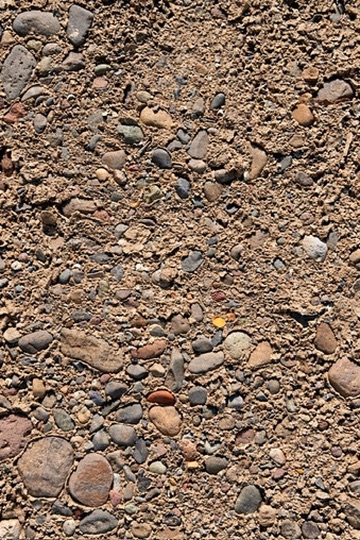
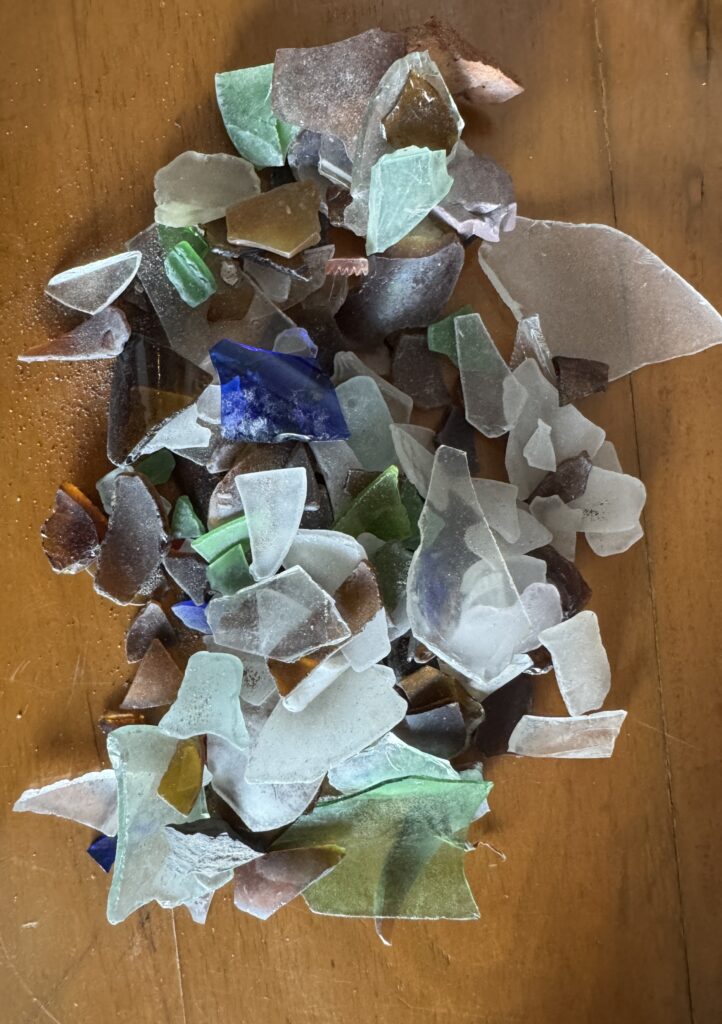
Artist Statement: An aggregate surface of many individual stones, each worn smooth by its own particular history.
Translation Note: Spanish phrases in this poem were assisted by Google Translate (translate.google.com). The Spanish is woven in as an act of reclamation, a return to a language of the body and the self that exists beyond institutional English.
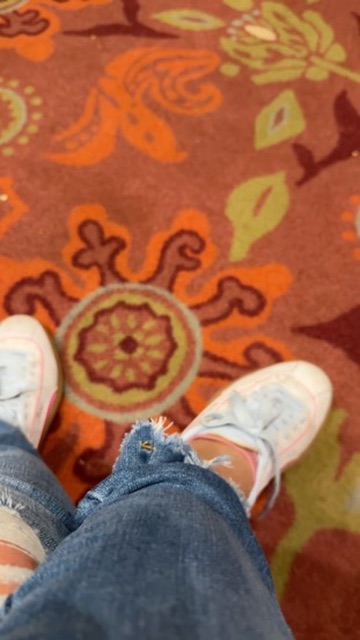
This photograph holds a simple orientation practice. Feet placed on patterned carpet, body paused between one step and the next. What draws my attention is the grounding rather than the destination. The ornate floor beneath me becomes a visual anchor, a reminder that movement begins in contact.
Within my work on alonetude, I return often to these micro-moments of bodily awareness. Solitude can be interior, quiet, and located anywhere. Sometimes it is interior, quiet, and located in transitional spaces such as hallways, lobbies, or thresholds between obligations.
The worn denim, the casual shoes, the downward gaze all signal an unguarded state. There is no performance here. Only presence. The body orienting itself gently within space.
This image documents a pause that might otherwise go unnoticed. A small act of returning to oneself before continuing on.
I am sitting in a hotel room in Calgary. I am a ghost haunting my own transition.
This space is the architectural equivalent of a blank stare. It is clinical and sterile, a box designed for the thousands of weary travellers who have sat in this exact chair before me, leaving behind nothing but the faint scent of industrial cleaner and the echo of a television left on too long. There is a bed, a desk, a television, and the relentless, mechanical humming of the mini-fridge. This low-grade vibration mimics the anxious, internal chatter of my own mind.
I have set up my maintenance equipment on the desk: my laptop, my books, and the literature review I am currently using as a shield. I wake at 5:00 a.m. sharp, Pacific Standard Time, my body moving as if this were a typical workday of busyness, as if staying occupied might still offer a sense of order.
The Trap of the Rehearsal
Even here, in this in-between between the life I left in British Columbia and the Alonetude awaiting me in Loreto, I am desperately trying to establish structure. I can feel my old self, the one who built an entire identity around reliability, availability, and competence, attempting to reestablish control.
The rehearsals begin almost immediately. Do I wake early to watch the sunrise, as someone grounded and intentional might? Do I anchor the day by watching the sunset, as if presence itself could be scheduled?
I am mentally planning my arrival as if it were a syllabus. I find myself agonizing over the mundane details of a life still waiting to begin:
The Routine: Should I plan a strict writing schedule to ensure productivity?
The Performance: Should I jog at 7:00 am to prove I am still disciplined, or should I swim at 1:00 pm and siesta at 2:00 pm like a proper retiree?
The Logistics: Where should I shop? How will I navigate the village without looking like just one inadequate person at a table?
The Diet: Should I maintain a strict low-carb regime, or finally learn to “go with the flow” and listen to what my body actually needs?
I am realizing that these questions are just the lies that burnout tells. They are my rehearsed explanations and elaborate to-do lists used to avoid the disorienting blankness of being truly alone.
I am addicted to the dopamine hit of a completed task, and I am terrified that if I stop acting, I will discover I am nothing.
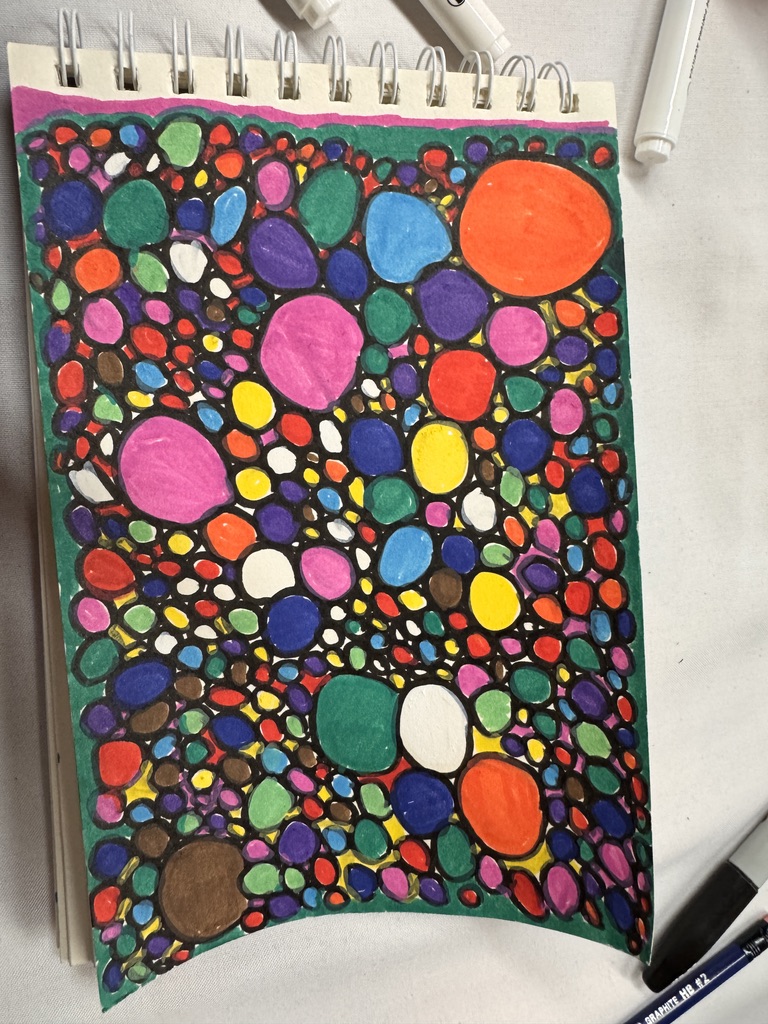
Title: Holding Presence
Artist Statement
This piece emerged without agenda.
I began placing colour onto the page as one might place stones into a circle, to feel weight, texture, and relation rather than build structure. The shapes arrived organically. Some large and declarative. Others small, almost hidden, requiring closer attention.
What interests me is the coexistence as much as the brightness. No single colour dominates the field. Even the boldest tones must live beside quieter ones. The black outlines create containment, allowing intensity to exist without overwhelming the whole.
Within my alonetude practice, this work reflects the interior landscape of solitude. Solitude is often misread as emptiness. My experience is the opposite. When external noise recedes, interior colour intensifies. Memory, sensation, grief, curiosity, and calm all surface together.
This page holds that plurality. A visual mapping of inner life that resists simplification. There is no central focal point because solitude decentralizes hierarchy. Everything matters. Everything belongs.
What We Hold in Our Bodies Before We Have Words for It
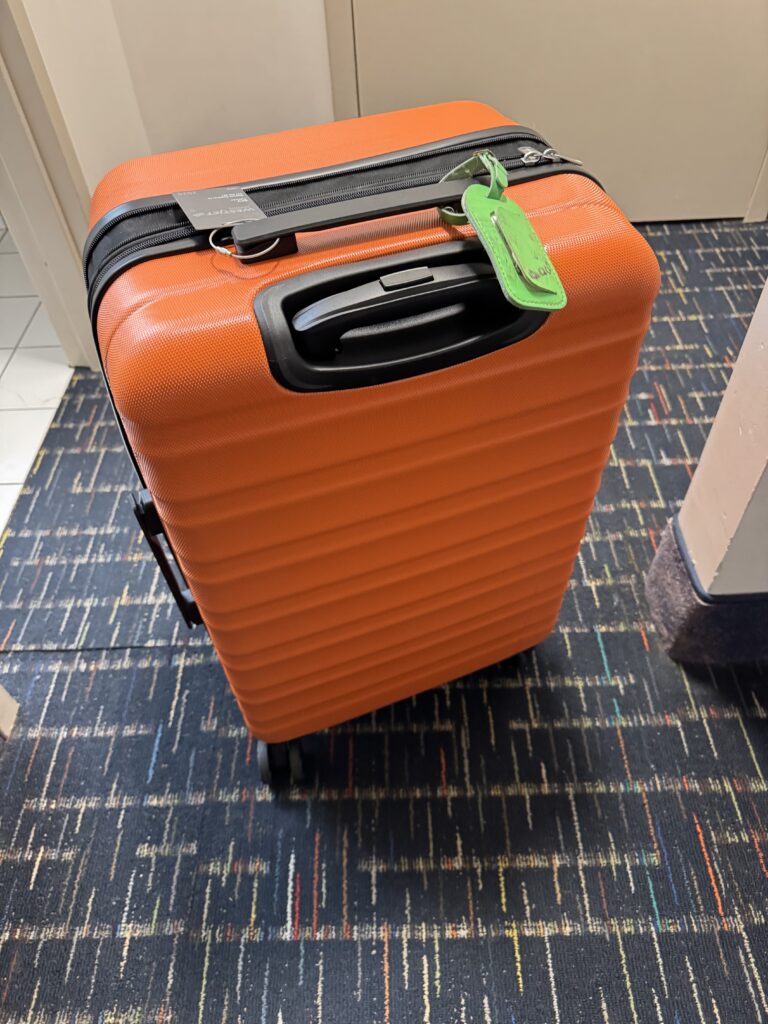
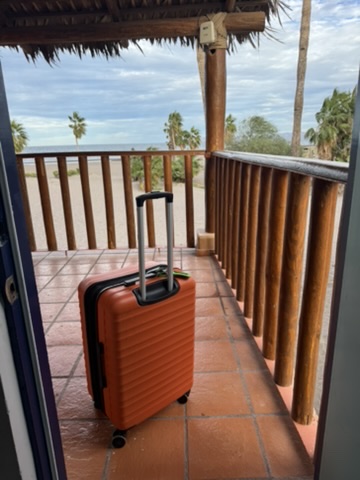
By the door, my orange suitcase sits unopened. It is my “transformational object,” a vessel for the “what we hold in our bodies before we have words for it,” the knowledge held in my body still awaiting words to name it. Christopher Bollas (1987) suggests that such objects hold parts of the self that await rediscovery. Inside that suitcase is more than just linen and walking shoes; it keeps the “ash” of nineteen years of academic performance and the quiet grief of the pandemic years that hollowed me out.
As I sit here, my nervous system is in a state of chronic activation, scanning for demands even in this unlived-in room. Drawing on Stephen Porges’ (2011) work on how the nervous system responds to safety and threat, I recognize that I am struggling to move from hypervigilance to a state of genuine safety and connection. I am a ghost haunting my own morning, showering without feeling the water, eating without tasting the food.
I am already mentally in the Sea of Cortez, replaying the past and rehearsing the future, while completely missing the sensory reality of the present.
The 25-Year Performance
For the past quarter-century, I have been juggling roles: the mother, the educator, the spouse, the neighbour, and the athlete. I sat on endless committees unpaid. I was the graduate student competing for two degrees at once, yet never taking the time to finish either, always rushing to the next requirement.
I was the poster child of institutional success, the office superhero who showed up at 8:00 a.m. and stayed long after the day was over. I collected the markers of value:
The Best Teacher
The Best Employee awards.
The Interculturalization Award
Doctorate Research Award
Student Experience Award(twice)
The Advocate for precarious workers
I was kind, present, and reliable. I was shouting to the world: Look at me, I am a person of value and worth. But standing here now, I have to ask: Who was I trying to prove my worth to?
Nobody was listening.
The Discipline of Staying
This morning’s invitation is to stop the rehearsal.
I must notice the urge to escape into planning and “doing”.
I must pause and breathe through the fridge’s clinical hum.
I must practice the discipline of staying, staying with the silence, staying with the transition, and staying with the discomfort of having no next thing pressing against me.
Today, I leave the clinical layover in Calgary on the direct flight to Loreto. I am flying south to a place where the light is soft, and the water is gold. But the work of Arrival begins here, in the sterile quiet, by letting go of the need to manage the menu of my own transformation.
Actual arrival is about presence in the internal sense: being fully where you are, with no next thing pressing against the edge of the current thing. By letting go of the need to manage the menu of my own transformation, I am practising what William Bridges (2019) identifies as the difficult necessity of the transition process: allowing the old identity to fall away before the new one has even begun to take shape.
As I prepare to board, I am consciously practising the discipline of staying, staying with the silence and the discomfort of having no role to perform. I am moving from a state of hypervigilance into one of genuine safety and connection, recognizing that my body is already softening as I move toward the Sea of Cortez.
I am leaving behind the office superhero and the award-winning educator. I am choosing to be a body in water, a being alive on a planet spinning through space, rather than a vehicle carrying a brain to a meeting. I had arrived. And for this morning, in this clinical box, that has to be enough.
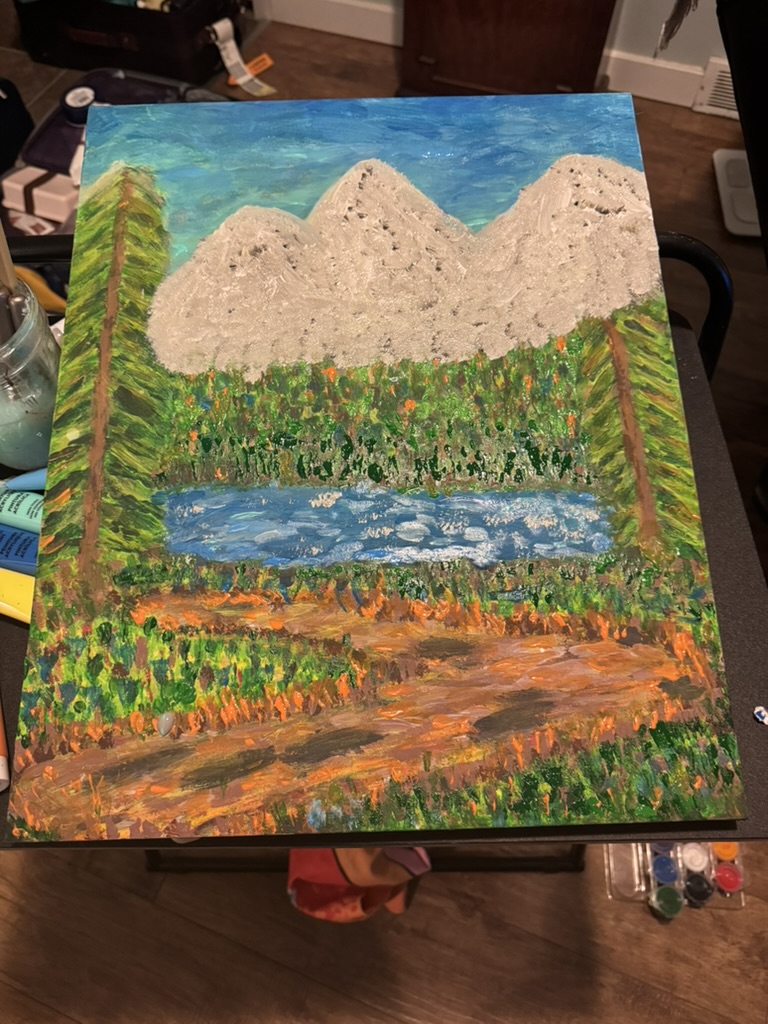
Title: Where the Body Remembers Green
Artist Statement
This landscape began as sensation before scenery.
I found myself returning to the memory of mountains, as orientation rather than geography. The peaks rise in the background, steady and unmoved, holding a kind of presence that the body recognizes before the mind does. In painting them, I was trying to replicate a feeling I have carried, beyond any specific place I had seen. The mountains became anchors. Forms of steadiness. Witnesses to endurance.
Below them, the forest gathers in dense strokes of green. It is textured, layered, almost overgrown. I notice how the brush moves differently here, less controlled, more instinctive. The green accumulates the way experience accumulates. Years of labour, fatigue, survival, and adaptation sedimented into the body. And yet, within that density, there are sparks of orange and yellow. Small interruptions. Signals of life persisting even in exhaustion.
The water sits in the middle of the canvas as a pause. A reflective space. A place where the eye can rest and the breath can slow. This composition arrived without conscious planning, but I recognize it now as a psychological landscape. Mountain. Forest. Water. Ground. Stability, density, restoration, and movement held in one frame.
This painting becomes an act of re-entering relationship with land, even from memory. It is less about depicting nature and more about locating where the body still feels safe enough to soften. Painting becomes a way of touching that softness without needing to explain it.
Bollas, C. (1987). The shadow of the object: Psychoanalysis of the what we hold in our bodies before we have words for it. Free Association Books.
Bridges, W., & Bridges, S. (2019). Transitions: Making sense of life’s changes (40th anniversary ed.). Balance.
Porges, S. W. (2011). The Polyvagal Theory: Neurophysiological foundations of emotions, attachment, communication, and finding our own calm. W. W. Norton & Company.
Academic Lens
The airport layover as a site of dissociation is a form of liminality (Turner, 1969): suspended between the identity one is leaving and the one still forming. The "unlived life" named here is a recurring motif in the literature on ambiguous loss (Boss, 1999), grief for a self that was foreclosed rather than lost. The body in transit, performing calm, reflects Hochschild's (1983) concept of emotional labour: the management of feeling as professional and social obligation.
I learned the word “enough” the way you learn a language that no one speaks in your house.
From the outside. By watching. By getting it wrong and being corrected with a look.
I thought enough was a place. A destination with coordinates. If I worked this hard, if I published this much, if I sat on enough committees, answered enough emails at midnight, held enough office hours, wrote enough letters of reference for people who would never write one back,
I would arrive.
I would finally stand on something solid, and someone would say, “Yes, this.” You. Here.
They never said it.
There was always one more thing. One more credential. One more specialization. One more revision. One more year of proving what I had already proven the year before, and the year before that, in the same rooms, to the same people, who kept forgetting they had already seen me.
Or perhaps they never forgot. Perhaps that was the point.
I reached the bar.
I want you to understand that. I reached it. I put both hands on it, pulled myself up, stood on top of it, and looked them in the eye.
And they raised it.
Quietly. Professionally. With a smile that said we only want what is best for the department.
So I climbed again.
I got the specialization they mentioned. I built the expertise they suggested. I redesigned the courses, updated the research, learned the new framework, attended the conference, wrote the paper, revised the paper, revised the revision, and brought it back.
And they raised it again.
One more thing. There was always one more thing, and I believed each time that this would be the last thing, that this would be the thing that finally made me legible to them, finally translated me into a language they were willing to read.
I gave you everything.
I need to say that plainly, without apology, without softening it for your comfort.
I gave you my mornings before my children were awake. I gave you my evenings after my body had already given out. I gave you my health, my rest, my capacity for joy, the slow years of my life that I will not get back, offered up like evidence, as if I just bled enough in the right places, you would finally call it qualified.
I gave you my expertise, and you used it while deciding someone else deserved to own it.
I gave you my loyalty, and you gave me a pending contract renewal.
I gave you my belief that the system worked, that merit was real, that the path was honest, that if I followed every instruction, the door would open.
And you raised the bar one final time, calling it a national search.
Never enough.
It sounds like a personal failing. It sounds like something that lives in the one who is lacking.
But I have seen enough now to know the shape of it, the architecture of a system that needs you insufficiently, that requires your hunger to function, that would lose its power the moment you believed you were already whole.
Never enough was never about me.
It was a door with no handle on the inside.
It was a game with rules that changed when I learned them.
It was a bar on a pulley held by hands that were never going to let it rest.
I am done climbing.
I am done bringing more to people who have decided that more will never be the right amount.
I am enough in the way a river is enough, in the way the morning is enough, in the way nineteen years of changed lives is enough,
whether they counted it or not.
They never counted it.
But I do.
Aquí estoy. Siempre he sido suficiente. I have always been enough.
Translation Note: Spanish phrases in this poem were assisted by Google Translate (translate.google.com). The Spanish is woven in as an act of reclamation, a return to a language of the body and the self that exists beyond institutional English.
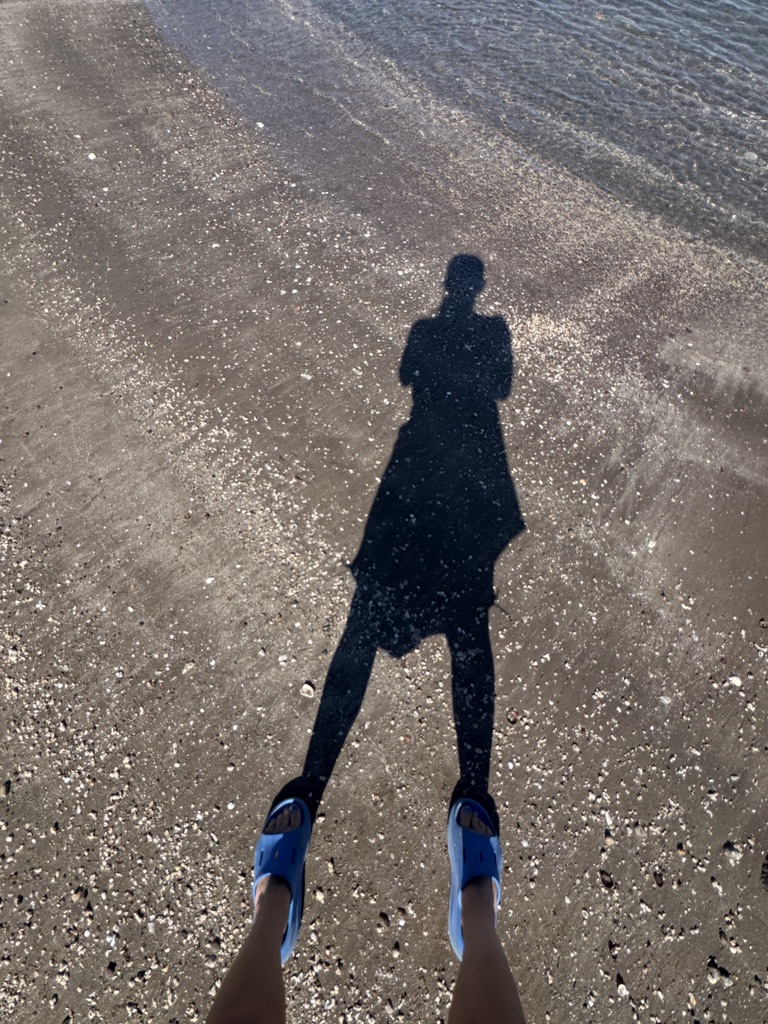
Artist Statement: A photograph taken from above, where the water returns to the shore.
Translation Note: Spanish phrases in this poem were assisted by Google Translate (translate.google.com). The Spanish is woven in as an act of reclamation, a return to a language of the body and the self that exists beyond institutional English.
January 1 is often treated as a symbolic reset, a cultural insistence that renewal can be declared on demand. Yet for many of us, particularly those shaped by long periods of precarity, caregiving, and professional vigilance, beginnings arrive with residue.
On the morning of January 1, I pack an orange suitcase. The act is deliberate, slow, and unexpectedly revealing. Packing, I come to realize, is more than logistical. It is a body-felt practice of identity negotiation. What I choose to carry, what I leave behind, and how I tolerate the uncertainty in that space become a form of inquiry into who I am becoming.
Identity as Process, as Becoming
Identity is often narrated as stable or cumulative, something we have rather than something we continuously do. Sociological and narrative scholars have long challenged this assumption, arguing that identity is formed through ongoing sense-making, particularly at moments of transition (Giddens, 1991; Bruner, 2004). January 1, framed as a beginning, intensifies this process.
As I pack, I notice what is absent. I leave behind teaching materials. I leave behind contingency plans. I leave behind symbols of productivity. This absence is intentional. For decades, my professional identity as an educator within precarious academic labour has required constant preparedness and an outward orientation shaped by what Butler (2004) describes as the demand to render oneself intelligible and viable within institutional norms. Packing without these artifacts is a quiet refusal of that script.
This is a suspension of identity rather than an abandonment. A temporary loosening that creates space for becoming.
Anxiety, Uncertainty, and the Body
Transitions often activate anxiety, particularly when identity has been tethered to performance and responsibility. Rather than conceptualizing anxiety here as pathology, I approach it as a learned response to prolonged uncertainty. As Ahmed (2010) reminds us, emotions reside within relationships and structures, beyond any single individual; they circulate through social and institutional arrangements.
Packing on January 1, anxiety appears as an impulse rather than panic. The urge to overpack. The desire to anticipate every scenario. The need to force clarity before it is available. These impulses are familiar. They once served as safety strategies.
What shifts in this moment is my response. Instead of obeying the impulse to force certainty, I practice restraint. I leave space in the suitcase. I allow questions to remain unanswered. In doing so, I engage with what Brown (2021) describes as vulnerability: a willingness to remain present without guarantees, beyond any performance of exposure.
This is tolerance rather than fearlessness.
Relearning Safety Through Ordinary Acts
Much of the literature on trauma-informed and body-based inquiry emphasizes that safety is established experientially rather than cognitively (van der Kolk, 2014; Carello & Butler, 2015). Packing becomes one such ordinary site of relearning safety.
Folding clothes slowly. Choosing comfort over appearance. Closing a suitcase that rests easily at the seams. These small acts register in the body as signals: there is no emergency here. Nothing needs to be forced.
This reframing matters. In neoliberal academic cultures that reward speed, output, and endurance, rest and restraint are often misread as failure (Hersey, 2022). Yet what unfolds here is recalibration rather than disengagement. A shift from vigilance to attentiveness.
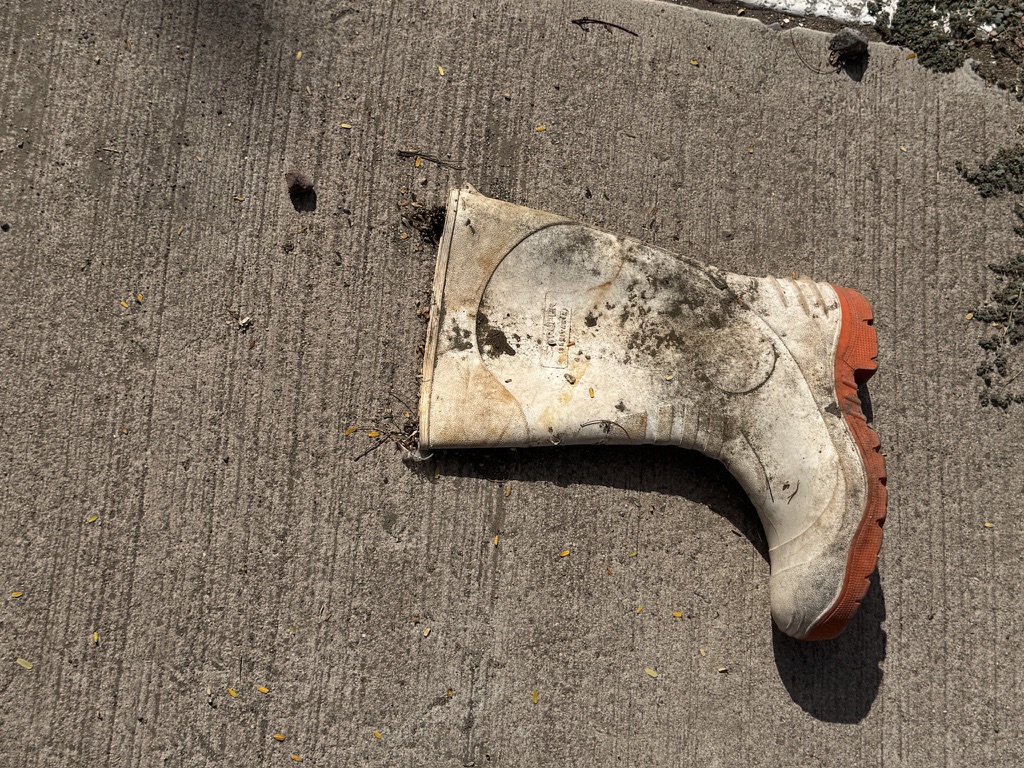
Title: What is Left Behind
Artist Statement
It was lying alone on the concrete. A single rubber boot, worn, dirt-marked, hollowed of its wearer.
I stopped because it felt like an artifact rather than debris.
There is something about abandoned footwear that registers immediately in the body. Shoes hold weight, direction, labour. They carry the imprint of terrain and the memory of distance travelled. When separated from the person who moved within them, they become evidence without narrative.
This image speaks to what is left behind when identity shifts. Some roles, expectations, and former necessities fall away quietly, without ceremony.
The boot signals completion as much as loss. A task finished. A terrain crossed. A version of self that no longer requires the same protection.
Placed alongside images of suitcases, thresholds, and horizons, this photograph introduces a necessary counterpoint. Departure carries what we hold alongside what we release. It is also about what we release, whether intentionally or through time.
A common narrative trap in stories of departure is idealization. The assumption that leaving automatically produces healing, clarity, or transformation. I resist this framing intentionally.
As I pack, I refuse to script who I will be on the other side of this journey. The destination requires no justification for leaving. This aligns with Nash and Bradley’s (2011) description of Scholarly Personal Narrative as one that resists premature closure, allowing meaning to emerge rather than be imposed.
What I carry forward instead is presence. Attention. A commitment to noticing without narrating every experience into productivity or insight.
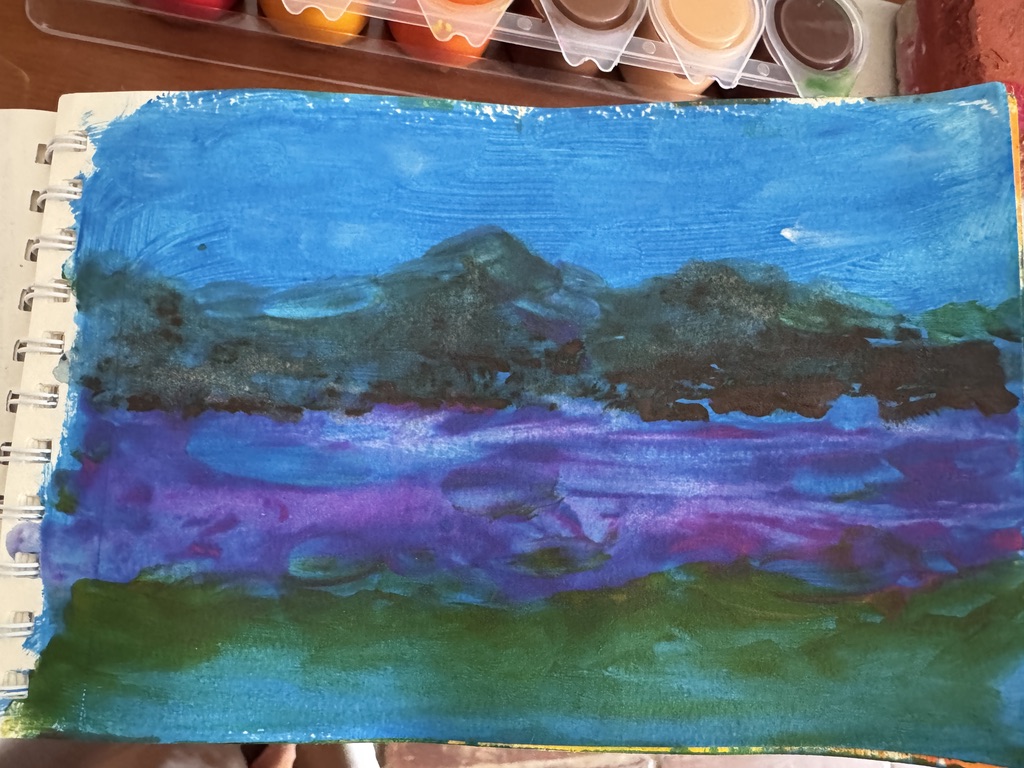
Title: Where the Water Holds the Sky
Artist Statement
This painting emerged slowly, without a preliminary sketch and without a fixed outcome. I worked in layers of blue, violet, and green, allowing the horizon to surface rather than be imposed. What appears as landscape is less geographic than body-based. It reflects how place is held in the body after extended solitude.
The darker band across the upper plane suggests mountain or shoreline, yet it resists precision. This lack of sharpness matters. Memory rarely preserves edges. It holds tone, atmosphere, and emotional temperature more than cartographic accuracy. The water below carries movement through colour rather than line, mirroring how stillness and motion coexist within reflective practice.
Within my broader inquiry on intentional solitude, painting becomes a parallel method of knowledge production. Where writing works through language and citation, visual expression registers what remains pre-verbal. The blending of pigments, the refusal to overcorrect, and the acceptance of diffusion all echo the ethical stance of alonetude: to stay with experience rather than discipline it into immediate coherence.
What interests me most is the meeting line between water and land. It is neither fixed nor symmetrical. It wavers. This wavering reflects the threshold state I often write about, the space between arrival and departure, knowing and sensing, holding and releasing.
The painting documents an internal geography rather than a specific location. It documents an internal geography shaped by time near water, open sky, and unstructured attention. It is less a representation of where I was and more an imprint of how I was while there.
What emerges through this act of packing is integrity rather than resolution. January 1 becomes less about reinvention and more about consent. Consent to begin again without erasing the past. Consent to carry less. Consent to meet uncertainty without escalation.
In this way, packing becomes both method and metaphor. A lived demonstration of identity as process, anxiety as information rather than command, and beginning again as a practice grounded in care rather than force.
The orange suitcase closes easily. That, too, appears to be data.
Title: Threshold Work
Artist Statement
There is always a precise moment when departure becomes real. It arrives beyond the booking of flights or the packing of suitcases. It happens when the bag is placed by the door and left standing there, upright and waiting. In that quiet positioning, the decision settles into the body. The balcony still held the same view that had framed my days: palms shifting lightly in the wind, the ocean stretching outward, the familiar horizon line that had slowly reorganized my internal pace. Nothing in the landscape had changed, yet something in me had.
What struck me in this moment was the composure of the suitcase itself. It felt unhurried. Unburdened. It felt deliberate. Within my research on intentional solitude, I have come to understand that departure is part of solitude's practice rather than its opposite. One enters solitude with intention, but one must also learn how to leave it without abandoning what was restored there. The suitcase, in this sense, holds more than belongings. It carries journals filled with reflection, rhythms that have slowed, breath that has steadied, and a nervous system that has had time to soften.
Standing in the doorway, I became aware that thresholds rarely announce themselves dramatically. More often they appear as ordinary architectural spaces: tiled floors, wooden railings, a partially open door. Yet these are the sites where integration begins. The work is no longer only about being away. It is about what is brought forward.
This image marks that pause. The moment of standing still long enough to recognize that something meaningful has occurred, and that it can be carried, carefully, into what comes next.
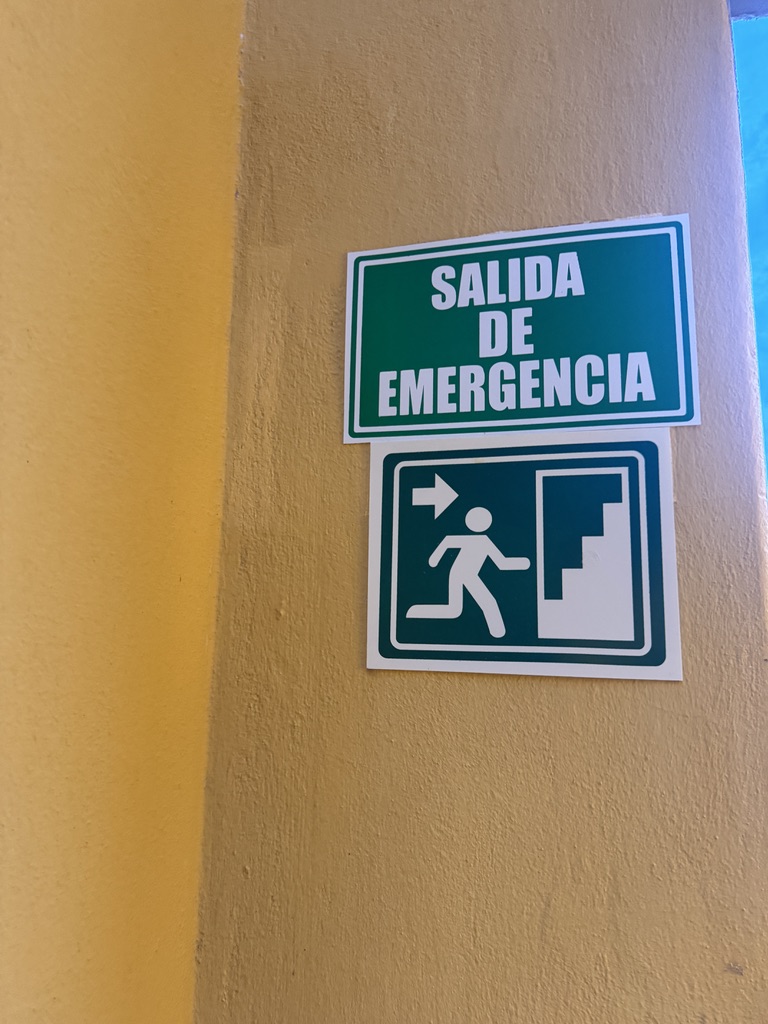
The sign appears ordinary at first glance. Functional. Directive. Institutional. Salida de Emergencia. Emergency Exit. It is designed to move bodies quickly, efficiently, without reflection. Yet what drew my attention was the quiet permission it offers rather than any urgency it implies.
In spaces shaped by productivity, expectation, and performance, exits are rarely named with such clarity. They exist, but they are obscured. Emotional exits. Cognitive exits. Spiritual exits. The pathways through which one might step away without crisis are seldom marked.
Within my research on intentional solitude and identity transition, this image registers as metaphor as much as documentation. It asks: What constitutes an emergency? Who decides when leaving is justified? And what happens when departure is restorative rather than reactive?
The figure on the sign is always in motion, always mid-stride. There is no depiction of hesitation, grief, or complexity. Institutional language simplifies leaving into action. Yet lived experience complicates it. To exit a role, an identity, or a way of being often requires extended negotiation with fear, responsibility, and belonging.
Photographing this sign became a moment of recognition. Of option rather than crisis. A reminder that leaving can be chosen with care rather than driven by collapse. It can be chosen with awareness. With timing. With care.
Within the broader Alonetude inquiry, the emergency exit becomes reinterpreted. As movement toward safety rather than escape from danger alone. A passage away from environments that demand constant readiness and toward spaces that allow restoration.
The sign remains fixed to the wall. The body, however, retains the agency to decide when the threshold has been reached.
Note. Spanish-language passages were generated using Google Translate (Google, n.d.) and subsequently reviewed and refined by the author. Any remaining infelicities reflect the limits of machine translation rather than intent.
References
Ahmed, S. (2010). The promise of happiness. Duke University Press.
Bruner, J. (2004). Life as narrative. Social Research, 71(3), 691–710.
Butler, J. (2004). Undoing gender. Routledge.
Carello, J., & Butler, L. D. (2015). Practicing what we teach: Trauma-informed educational practice. Journal of Teaching in Social Work, 35(3), 262–278.
Giddens, A. (1991). Modernity and self-identity: Self and society in the late modern age. Stanford University Press.
Google. (n.d.). Google Translate. https://translate.google.com
Hersey, T. (2022). Rest is resistance: A manifesto. Little, Brown Spark.
Nash, R. J., & Bradley, D. L. (2011). Me-search and re-search: A guide for writing scholarly personal narrative manuscripts. Information Age Publishing.
van der Kolk, B. A. (2014). The body keeps the score: Brain, mind, and body in the healing of trauma. Viking.
Academic Lens
Packing as identity-work surfaces the concept of alonetude (Tucker, 2026) as a deliberate construction: the choice to arrive without an audience. The residue of long precarity described here connects to slow violence (Nixon, 2011), harm accumulated so gradually that its weight only becomes visible in moments of departure. The body's reluctance to begin again reflects what Levine (2010) calls the nervous system's conservatism: prior threat states leave physiological traces that no calendar can reset.
A short poem: Who Knows, on uncertainty, the sea, and the particular freedom that comes from letting the question remain open. Written from a moment of stillness beside the water in Loreto.
Reading Time: < 1minute
“I am still here, even when my body expects me to disappear.”
I did not mean to exist so loudly.
You did Say I made it up, the way the floor creaked, The glass shattered, The night bent sideways.
Notation: I included this image to remind myself that I am still here, even when my nervous system expects otherwise.
Translation Note: Where Spanish appears in this collection, it was assisted by Google Translate (translate.google.com). The Spanish is woven in as an act of reclamation, a return to a language of the body and the self that exists beyond institutional English.