Notes From the Other Side of Exhaustion
I had no knowledge of how to rest.
I want to say that plainly, without shame, though there is still some shame in it, the residue of a culture that taught me that stillness was laziness wearing a different coat, that the empty hour was a moral failure, that my worth was a verb, always a verb, always something being done, produced, delivered, demonstrated.
I lacked knowledge of how to rest because I had never been taught that I possessed worth when I stopped.
Rest had to teach me from the beginning.
Like a language with no cognates, no familiar sounds, no words I already knew in a slightly different form.
A language I was starting from zero. In Loreto I learned to say descansa, and to mean it as instruction rather than permission. The word kept doing its work in me long after I stopped using it out loud.
The first lesson was the hardest.
The first lesson was: you are allowed to stop.
Rather than when the work is done. The work is never done. Rather than when you have earned it. You cannot earn rest. Rest is a right, a fundamental right. Rest is the heart of the chapter, the beginning of what comes next.
Rest is a right. Rest is as necessary as breathing. Rest is the condition in which a human being remains human rather than becoming a highly efficient machine quietly breaking down.
The second lesson came from the body.
The body is a patient teacher until it is not. The body will ask quietly for a long time, will send small messengers, fatigue, tension, the ache that lives between the shoulder blades of women who carry things they were not designed to carry alone.
The body will ask quietly; when that stops working, it will ask loudly; when that stops working, it will simply take what it needs, whether you planned for it or not.
My body took a shower.
My body took thirty days in a small town by a sea that had no interest in my productivity,
and in the taking it began, slowly, experimentally, with the caution of something that has been disappointed before,
to remember what it was.
Not a vehicle. Not a container for a brain that was always elsewhere, always in the next task.
A body. An actual body. With a hunger that was real and a tiredness that was real and a capacity for pleasure, the warmth of sun on an arm, the smell of salt and morning, the way cold water tastes when you are truly thirsty and you stop to drink it instead of carrying it untouched to the desk.
The body remembered. The body was so grateful to be remembered.
The third lesson was about silence.
She had been afraid of silence. In the silence, no performance was required. In the silence, there was nothing to manage, no register to calibrate, no warmth to project, no competence to demonstrate.
In the silence, there was only what was actually there.
And what was actually there was large.
The grief was large. The anger she had not let herself feel fully was large. The love was large, the love for the work and the students and the version of herself who had given everything and deserved so much more than she was given.
The silence held all of it without asking her to perform it differently.
And she learned that she could hold it too.
The fourth lesson was about time.
Institutional time is extracted time. She understood this now in the body, not just the mind.
In Loreto, she found her own time.
Time that moved at the speed of the tide. Time that had no agenda.
She breathed all the way down. For thirty days, she breathed all the way down.
She is still learning to do it at home.
The fifth lesson was the one she least expected.
She had expected rest to be the absence of something. The absence of work, of pressure, of the performance of fine.
She had not expected it to be a presence.
Rest arrived, and in the space it made something else arrive with it.
Herself.
She was curious. She was playful. She was creative. Not productive-creative, not research-output creative, but the other kind, the kind that makes something for the making of it, for the pure animal pleasure of having made a thing that did not exist before.
This was rest.
Not the absence of herself but the presence of all the parts of herself that the institution did not have a use for.
What rest taught me, finally, is this:
I was worth resting.
Not because I had earned it. Not because I was sick enough to need it.
Because I was a person. Because I was a body with a finite number of mornings, and I had been spending them in service of a system that was not spending anything in service of me.
Rest taught me that I am alive.
Not a contract. Not a credential. Not a performance of professional wellness.
Alive. Particular. Irreplaceable.
Worth the morning. Worth the shore. Worth the thirty days and every day that follows,
lived in my own time, at the full depth of my breath,
as myself.
Aquí estoy. Descansada, entera, despierta. Por fin.
Here I am. Rested, whole, awake. At last.
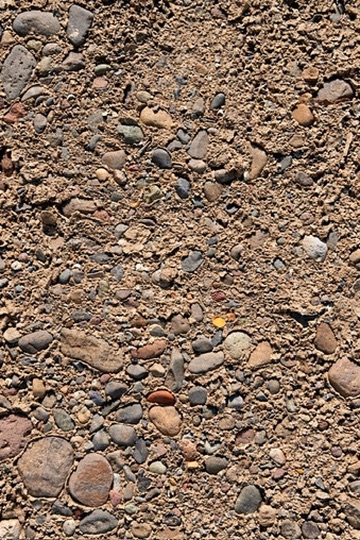
Each One Smooth for a Reason
Photo: Amy Tucker, © 2026
Artist Statement: An aggregate surface of many individual stones, each worn smooth by its own particular history.
Translation Note: Spanish phrases in this poem were assisted by Google Translate (translate.google.com). The Spanish is woven in as an act of reclamation, a return to a language of the body and the self that exists beyond institutional English.

