Content Warning: This post contains reflections on body shame, institutional harm, and the experience of exhaustion. Please care for yourself as you read, and feel free to step away if you need to.
An overachiever’s confession
A Reckoning by the Sea
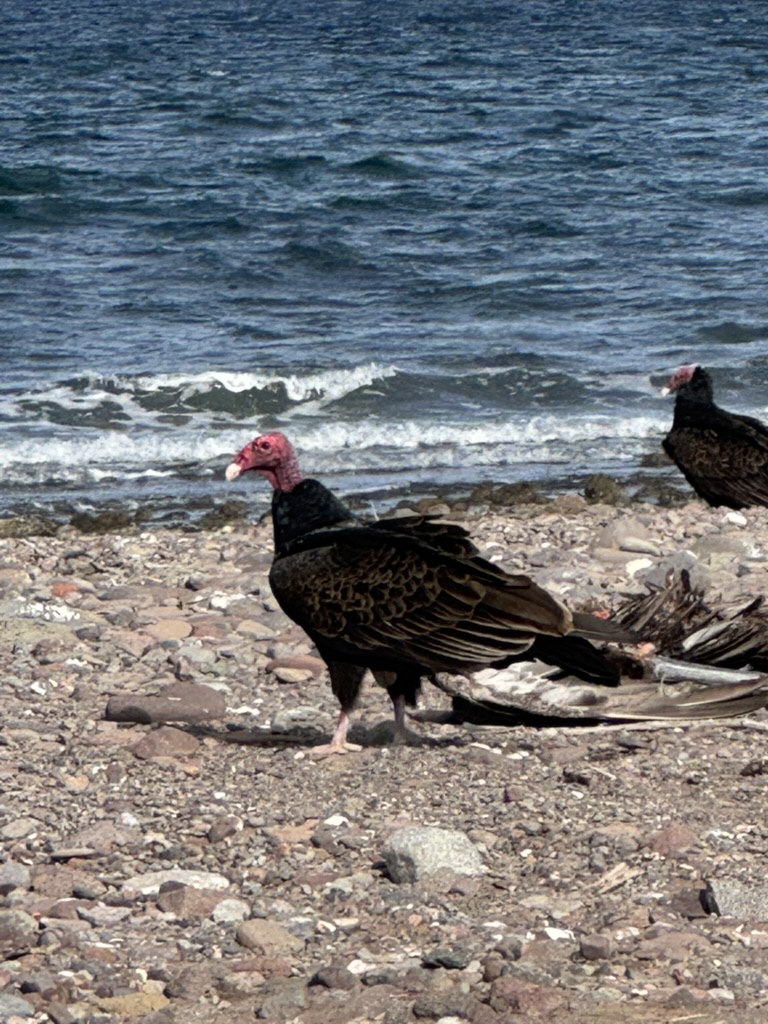
It happened while I was watching the pelicans.
They dive with such certainty, folding their wings at the last possible moment, surrendering to gravity and instinct. They trust the trajectory. They dive and let instinct decide the rest. They dive, surface, swallow, and rest on the water until the next impulse moves them.
Watching them, coffee cooling in my hands, I felt something crack open inside my chest. The realization arrived without announcement, without the careful preparation I usually require before allowing myself to know brutal truths.
I am an overachiever. And I am burned out.
The words felt foreign, even as I knew them to be true. For decades, I had called it other things: dedicated, committed, hardworking, passionate. I had worn exhaustion like a badge, proof that I was earning my place in a world that seemed to demand constant demonstration of worth.
What Remained Hidden
Brené Brown (2010), in The Gifts of Imperfection, names the belief system I had been living inside without recognizing its walls. Her research reveals that perfectionism operates as a self-destructive and addictive pattern, rooted in the belief that flawless appearance, behaviour, and accomplishment can somehow shield us from shame, judgement, and blame. Brown’s work demonstrates that most perfectionists were raised receiving praise primarily for achievement and performance, whether academic grades, good manners, rule-following, or people-pleasing. Somewhere in that conditioning, many of us internalized a dangerous equation: our worth equals our accomplishments and how well we accomplish them.
Reading those words by the sea, I felt the shock of recognition. That belief had been the operating system of my entire adult life. Every committee I joined. Every extra course I taught. Every student crisis I absorbed as my own responsibility. Every late night, every weekend sacrificed, every moment of rest interrupted by the nagging sense that I should be doing something more, something better, something that would finally prove I deserved to be here.
Brown’s research reveals a more complicated truth: perfectionism fundamentally concerns itself with earning approval and acceptance rather than with genuine self-improvement (Brown, 2010). The pattern follows a predictable sequence: please, perform, perfect. I had been following that formula in education for nineteen years, believing it would eventually lead to security, to belonging, to the sense that I had finally done enough.
It never did. It never could. That is the nature of the trap.
What Burnout Looks Like From the Inside
Christina Maslach and Michael Leiter (2016), the researchers who developed the most widely used measure of occupational burnout, describe it through three interconnected dimensions. The first involves overwhelming exhaustion, the sense of being worn out, depleted, and unable to recover. The second manifests as cynicism and detachment from work, a protective numbing that separates us from caring too much. The third is a diminished sense of professional efficacy, a creeping belief that nothing we do makes a real difference.
van der Kolk, B. A. (2014). The body keeps the score: Brain, mind, and body in the healing of trauma. Viking.
What struck me, reading their work, was how the third dimension creates a vicious cycle. The more burned out we become, the less effective we feel. The less effective we think, the harder we push to prove our worth. The harder we try, the more depleted we become. I had been running that cycle for years, perhaps decades, without seeing it clearly.
Bessel van der Kolk (2014), in The Body Keeps the Score, observes that people who have experienced chronic stress often feel perpetually unsafe within their own bodies. While I would hesitate to claim trauma as an identity, I recognize its residue: the years of institutional vigilance, the constant calibration to others’ needs, the way exhaustion became so familiar I forgot it was exhaustion. My shoulders, perpetually braced. My jaw was clenched through the night. My sleep, fractured by worry that arrived without specific content, just a generalized dread that something was undone, someone was disappointed, some standard had been missed.
Here, by the sea, those symptoms have begun to ease. The shoulders are learning to drop. The jaw softens. Sleep comes and stays. The body is remembering safety, one quiet morning at a time.
Exhaustion as Status Symbol
Brown (2010) names something I had never consciously examined: the cultural tendency to treat exhaustion as a status symbol and productivity as the measure of self-worth. In academic culture, in caregiving, in so many of the roles I have inhabited, exhaustion signals commitment. To admit tiredness is to demonstrate that I am working hard enough to deserve my place. To acknowledge a need for rest is to risk appearing uncommitted, unserious, insufficient.
The contract I wrote this morning, the one promising myself eight hours of sleep and mornings without performance, pushes directly against this belief. Every clause is a small rebellion against the culture that trained me to equate worth with output, value with visible effort.
Jenny Odell (2019), in How to Do Nothing: Resisting the Attention Economy, writes about a different kind of productivity, one focused on maintaining oneself and healing rather than generating output. That concept stopped me when I first encountered it. The productivity of healing. As if rest could be framed as output. As if I needed permission, even from myself, to justify time spent recovering.
Perhaps I do need that permission. Maybe the language of productivity is the only dialect my overachiever’s mind can currently accept. If so, I will use it as a bridge until I can cross to the other side, where rest requires no justification at all.
What Solitude Makes Visible
Christopher Long and James Averill (2003), in their foundational study of positive solitude, found that being alone provides a particular kind of freedom: release from external constraints, from the performance demands of social interaction, from the need to calibrate ourselves to others’ expectations. In their research, people reported that solitude allowed them to see themselves more clearly, free from the distortions of social performance and others’ expectations. Solitude strips away the roles we perform, leaving us face-to-face with who we have become.
That confrontation can be painful. What I am seeing here by the Sea of Cortez is a woman who has spent decades outrunning her fear of inadequacy. A woman who believed, at some level too deep for conscious examination, that if she ever stopped performing, stopped achieving, stopped proving, she would discover she was nothing at all.
This is what Brown (2010) means when she describes perfectionism as a heavy shield we carry around, believing it will protect us, when in reality it prevents us from taking flight. I have been carrying that shield for so long that I forgot it was heavy. Here, I am finally setting it down.
What Comes After Recognition
The novelist Anna Quindlen once observed that the truly difficult and truly amazing work lies in giving up on being perfect and beginning the work of becoming yourself (as cited in Brown, 2010). That work starts here, in this place where no one knows my credentials or my accomplishments or how many hours I have logged in service to institutions that offered little security in return. Here, I am simply a woman by the sea. A woman learning to rest without guilt. A woman discovering that her worth existed before she proved anything, and will remain after she stops proving altogether.
Brown (2010) describes herself as a recovering perfectionist and an aspiring good-enoughist. That phrase makes me smile, this gentle reframing of recovery from perfectionism. I am an aspiring good-enoughist. I am learning to accept that enough is a destination, perhaps the only one worth reaching.
The pelicans are diving again. They keep no score. They make no comparisons with yesterday’s haul. They rest when they are full and dive when they are hungry, floating on the water between efforts, trusting that the sea will continue to provide.
I am watching them. I am learning.
Learning to Be Alone Without Loneliness
Note. Spanish-language passages were generated using Google Translate (Google, n.d.) and subsequently reviewed and refined by the author. Any remaining infelicities reflect the limits of machine translation rather than intent.
References
Brown, B. (2010). The gifts of imperfection: Let go of who you think you are supposed to be and embrace who you are. Hazelden.
Google. (n.d.). Google Translate. https://translate.google.com
Long, C. R., & Averill, J. R. (2003). Solitude: An exploration of benefits of being alone. Journal for the Theory of Social Behaviour, 33(1), 21–44. https://doi.org/10.1111/1468-5914.00204
Maslach, C., & Leiter, M. P. (2016). Understanding the burnout experience: Recent research and its implications for psychiatry. World Psychiatry, 15(2), 103–111. https://doi.org/10.1002/wps.20311
Odell, J. (2019). How to do nothing: Resisting the attention economy. Melville House.
Van der Kolk, B. (2014). The body keeps the score: Brain, mind, and body in the healing of trauma. Viking.
ACADEMIC LENS
This bilingual confession enacts what Richardson and St. Pierre (2005) call the “vulnerable text”: a piece of writing that risks self-disclosure in the service of larger truths about structural harm. The “overachiever’s confession” names what Hochschild (2012) documents as the feminised dimension of emotional labour: the internalisation of institutional standards as personal failure, so that the exhaustion produced by structural conditions is experienced as individual inadequacy. Nixon’s (2011) slow violence framework is directly applicable: the harm of nineteen years of precarious overachievement accumulated without recognition or compensation, and the “reckoning by the sea” is the moment when this accumulated harm becomes visible to the person who has been carrying it. Menakem (2017) argues that healing requires more than intellectual understanding of structural harm but the somatic renegotiation of the bodily patterns it has encoded: the body must learn that it is permitted to stop performing before the mind’s understanding of that permission can become real. Writing in both Spanish and English allows the confession to arrive from two directions simultaneously, enacting Anzaldúa’s (1987) claim that the borderlands between languages are also the location of the most honest self-knowledge.
I acknowledge that I am in a period of completion rather than initiation. I recognize that my body, mind, and spirit require containment, rest, and clarity to finish well. I affirm that my worth is inherent, independent of productivity, praise, or perfection.
This contract exists to protect my energy, my work, and my dignity.
ARTICLE I: SLEEP AND REGULATION
I agree to:
Honour my need for 8–9 hours of sleep whenever possible
Treat sleep as essential infrastructure, as fundamental as food
Respond to irritability, fatigue, or anxiety as signals to rest rather than push
I release the belief that exhaustion is evidence of commitment.
ARTICLE II: FOCUS AND SCOPE
I agree to:
Work on only one primary intellectual task per day
Prioritize 30 Days by the Sea as my MA thesis
Engage with defence preparation lightly and strategically while feedback is pending
Refrain from creating new projects, commitments, or obligations during this period
I accept that sequencing is wisdom. It is discernment.
ARTICLE III: FEEDBACK AND REVIEW
I agree to:
Meet feedback with curiosity rather than self-judgement
Separate my identity from my work during review processes
Read feedback in stages, allowing my nervous system time to settle
Ask for clarification rather than assume criticism
I understand that feedback is part of the completion process, separate from any measure of my value.
ARTICLE IV: BOUNDARIES AND ENERGY
I agree to:
Limit exposure to negative, draining, or nagging interactions
Release responsibility for other people’s emotions or expectations
Say no, delay, or disengage without justification when needed
Protect mornings and evenings as sacred bookends of the day
I recognize that my calm is a responsibility I take seriously.
ARTICLE V: BODY AND CARE
I agree to:
Move my body in ways that feel supportive and kind
Eat and nourish myself without moral judgment
Allow rest days without guilt
Use walking, swimming, stretching, and silence as forms of care
I commit to listening to my body before correcting it.
ARTICLE VI: INNER LIFE AND COMPASSION
I agree to:
Speak to myself with honesty and gentleness
Release perfectionism tied to recognition or proving
Allow space for uncertainty without rushing to resolve it
Treat this season as a threshold, a passage rather than a proving ground
I accept that being enough is already true.
ARTICLE VII: WHEN I STRAY FROM THIS AGREEMENT
I agree that if I:
Overcommit
Push through fatigue
Spiral into self-criticism
Attempt to carry everything at once
I will respond by returning, with gentleness rather than reprimand.
I will ask:
“What can I remove or rest right now?”
AFFIRMATION
I affirm that:
I am finishing important work
I am allowed to move slowly and still succeed
I am capable, thoughtful, and prepared
I trust the long arc of my life and scholarship
Sincerely,
Amy Tucker, January 5, 2026
Title: The Sun Always Rises and Sets
Credit: Amy Tucker, 2026
ACADEMIC LENS
The self-contract as a research document enacts what Moustakas (1961) calls the initial engagement phase of heuristic inquiry: the explicit commitment to attending to a phenomenon with full investment, before the inquiry’s form or conclusions are known. The language of the preamble, “completion rather than initiation,” “containment,” reflects van der Kolk’s (2014) clinical understanding of what the healing nervous system requires: a bounded space rather than more demands, within which the unfinished business of the past can complete itself. The contract also performs a small political act: it applies the institutional frameworks of accountability and documentation, which precarious labour has turned against the worker, to the service of the worker’s own healing. Levine (2010) might recognize this as a “somatic contract”: a commitment of the self to its own care that functions as a cue of safety, signalling to the nervous system that someone, specifically the self, is taking responsibility for the conditions of the inquiry. The “good faith” of the preamble is ethical rather than legal: an acknowledgment that genuine inquiry requires honest attention rather than performance.
Wake with the light. Open the window. Let the air in.
Fruit and yogurt for breakfast, cool and simple. Coffee by the sea. Write in my journal while the morning finds its shape.
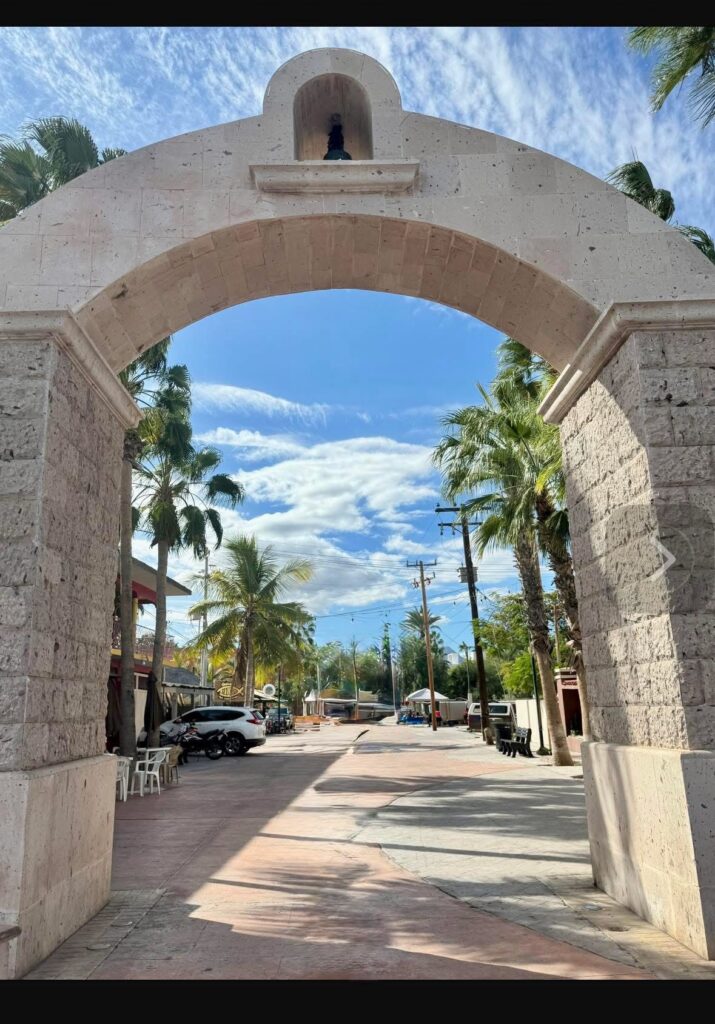
Walk the Malecón. Watch the pelicans dive. Pet the dogs, often. Pause when something asks for attention.
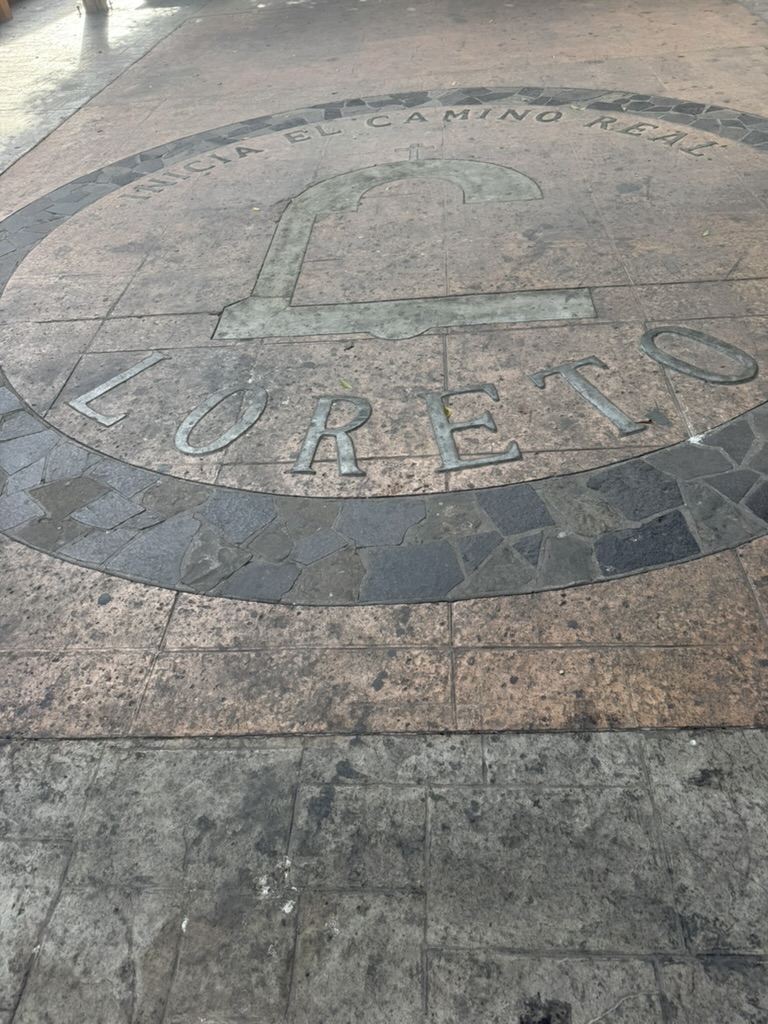
Follow El Camino Real, the Mission of Our Lady of Loreto. The Royal Road stretches north, from Sonoma, California, roads that remember those who have passed before.
Walking becomes meditation. Finding space. Listening for silent whispers beside the Sea of Cortez.
Suntan on the beach. Swim in the sunshine. Dip toes into salt water. Find the tide. Ride the tide. Look for glass on the beach.
Pick a random food truck for lunch. Eat without hurry. Drink bubbly Topo Chico, cold and bright.
Read in the early afternoon. Nap in the shade, without apology.
As the evening cools, watch the sunset. Drink bubbly Topo Chico, Eat flan for dinner, because pleasure counts.
Watch the stars dance. Watch the moon rise. Notice what the dark makes possible.
Close the day gently. Nothing left to prove. Only the quiet work of staying.
Reading Time: 14minutesCaminando el Malecón on the fourth day: a bilingual reflection on walking the seafront promenade in Loreto, and what the body learns when it is given permission to move slowly, without destination.
Reading Time: 14minutes
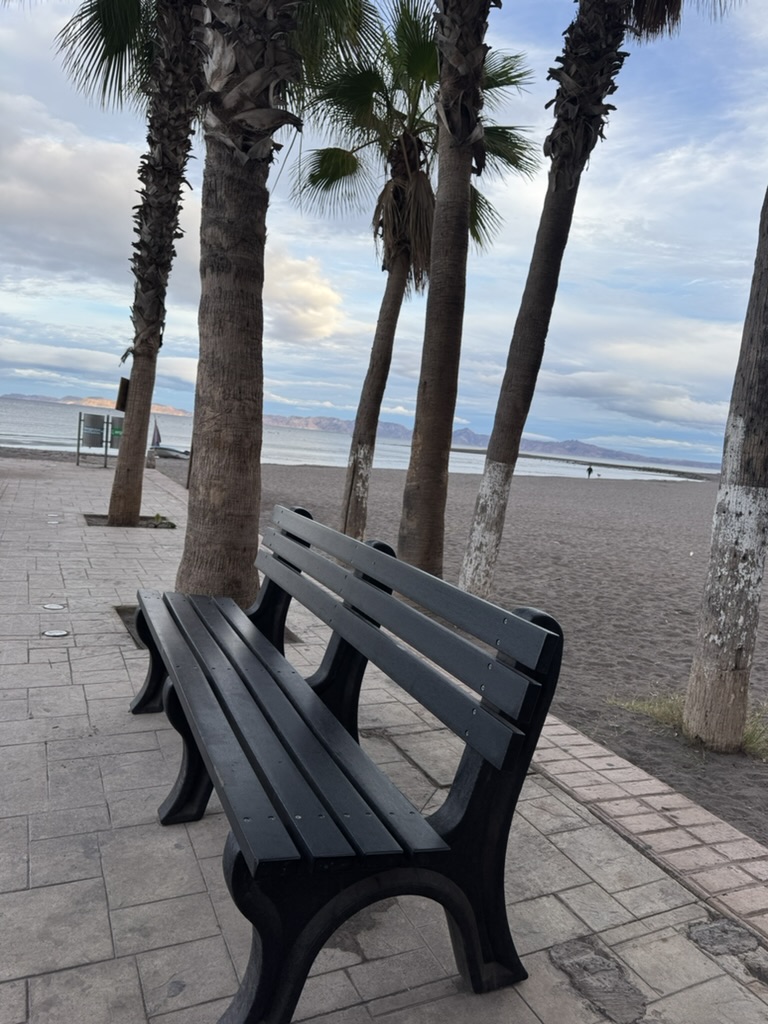
Title: The Bench That Waits
Artist Statement

It was empty when I arrived.

Empty, waiting. The kind of waiting that holds space for whoever might need it, without straining toward arrival. Positioned between palms and water, the bench faced outward, offering its view without instruction. Sit or continue. Stay or keep walking. The invitation was gentle enough to refuse.

I noticed how naturally my body moved toward it.

As if rest recognizes itself. The slats still cool from morning air, the sea stretching steady beyond the shoreline, mountains holding their distance across the water. Nothing demanded attention. The bench offered comfort directly. It simply provided it.

I stayed just long enough.

But long enough to feel the pause it offered. Long enough to understand that some forms of support ask nothing in return. They exist so that, when needed, we can set our weight down for a moment and remember what it feels like to be held without expectation.

Photo Credit: Amy Tucker, January 2026
This morning, I walked.
It sounds unremarkable, and perhaps it is. People walk every day for transportation, exercise, and the simple need to move from one place to another. But this walking was different. This walking was deliberate, unhurried, without destination. I walked the malecón, the seaside promenade that curves along Loreto’s waterfront, and somewhere between my first step and my last, something shifted. I began to find myself in the rhythm of my own feet.
Rebecca Solnit (2001), in her meditation on the history and meaning of walking, observes that the physical rhythm of walking and the movement of thought are deeply intertwined, each step through a landscape corresponding to a movement through ideas. Walking, she argues, is locomotion and so much more. It is a mode of being in the world, a way of thinking with the body, a practice that has shaped philosophers, poets, and pilgrims for millennia. I set out this morning simply to move. I set out to move. But movement, I am learning, has its own intelligence.
El Malecón / The Promenade
The malecón stretches along the edge of the Sea of Cortez, a paved path bordered by palm trees on one side and water on the other. In the early morning, before the heat becomes oppressive, it fills with walkers: elderly couples moving slowly arm in arm, young mothers pushing strollers, fishermen heading to their boats, tourists like me trying to find our place in this unfamiliar landscape.
I joined the flow without speaking to anyone. I was alone in a crowd, solitary yet surrounded, occupying what the sociologist Erving Goffman (1963) called civil inattention: a delicate social contract in which strangers acknowledge each other’s presence through brief eye contact or a nod, then politely look away, granting each other the privacy of public space. There is a particular freedom in being unknown. No one on this malecón knows my name, my history, my roles, my failures. I am simply a woman walking, indistinguishable from any other woman walking, anonymous in the best possible way.
Yi-Fu Tuan (1977), the humanist geographer whose work explores the relationship between people and place, distinguishes between space and place. Space, he suggests, is abstract, undifferentiated, open. Place is space that has been given meaning through experience, through movement, through the accumulation of memory and feeling. I am in the process of transforming this malecón from space into place, step by step, morning by morning, until it becomes somewhere I belong rather than somewhere I am visiting.
Title: Looking Up
Artist Statement

I noticed the sky because the trees asked me to.

Their trunks moved upward and outward, drawing my gaze away from the ground I had been watching all morning. Palms reaching, bending slightly, as if shaped by years of wind and salt air. I stood beneath them, small in comparison, aware of how rarely I stop long enough to look up without purpose. What held me there was the layering.

Fronds crossing one another. Dark silhouettes against a pale, clouded sky. Movement without urgency. Even the stillness felt alive, suspended between breeze and pause. It reminded me that perspective shifts quietly, sometimes offered by nothing more than changing the direction of your gaze. I stayed a moment longer than expected.

Simply allowing the upward view to hold me. A reminder that rest arrives in many forms beyond lying down. Sometimes it arrives in the simple act of lifting your eyes and letting the world open above you.

Photo Credit: Amy Tucker, January 2026
El Ritmo de los Pies / The Rhythm of Feet
There is something about the pace of walking that matches the pace of thought. Frédéric Gros (2014), the French philosopher who wrote a book-length exploration of walking as a philosophical practice, observes that walking is human. When we walk, we move at approximately five kilometres per hour, the pace at which humans have moved for most of our evolutionary history. This is the speed at which the world makes sense, at which details can be noticed, at which the mind can wander without becoming lost.
I noticed things this morning that I would have missed from a car or a bus. A pelican perched on a piling, utterly still, watching the water. An old man mending a fishing net, his fingers moving with the ease of decades of practice. A child chasing pigeons, her laughter bright against the morning quiet. Bougainvillea spilling over a white wall in shades of magenta and coral. A dog sleeping in a patch of sun, so profoundly at peace that I envied him.
These small observations accumulated as I walked, asking nothing, just offering themselves to my attention. This is what the Kaplans (1989) meant by “the gentle pull of the natural world”: the gentle engagement with the environment that allows the mind to rest while remaining alert. Walking provides a constant stream of such fascination: the changing view, the shifting light, the small dramas of ordinary life unfolding at the edges of the path. My attention was held without being captured. I was present without being vigilant.
Una Mujer Caminando Sola / A Woman Walking Alone
There is a particular experience of being a woman walking alone in a public space. Lauren Elkin (2017), in her exploration of female flânerie, the art of wandering through city streets, notes that the figure of the flâneur, the leisurely male stroller who observes urban life, has historically had no female equivalent. Women in public spaces have been subject to scrutiny, harassment, and assumptions about their availability or their morality. The freedom to wander, to be seen without being accosted, to occupy space without justification, has been a privilege unevenly distributed.
Here on the malecón, I felt safe. The morning light, the presence of families, and the openness of the waterfront all contributed to a sense of ease. However, I am aware that this ease is neither universal nor guaranteed. I carry decades of conditioning about where women can go, when, and with whom. I have the vigilance that women learn early, the constant low-level assessment of threat that becomes so habitual it feels like instinct. Walking alone, as a woman, at 60, in a foreign country, is an act of quiet defiance. It is a claiming of space, a declaration that I have as much right to this malecón as anyone.
Sara Maitland (2009), writing about her own experiments with solitude, describes how aloneness for women has historically been framed as socially suspect, as something pathological, dangerous, or a sign of having failed at the relational obligations expected of women. A woman alone must be waiting for someone. A woman alone must be lonely. A woman alone must require rescue, company, or protection. These assumptions persist even when we have consciously rejected them. Walking the malecón alone, I am practising a different narrative: that solitude can be chosen, that a woman can be complete unto herself, that walking alone is pure presence.
I am finding myself, precisely here.
Caminar Como Pensar / Walking as Thinking
Title: Standing with Myself
Artist Statement

I saw the shadow before I saw the photograph. Cast long across the sand, shaped by a sun beyond my direct view, my body appeared as outline rather than detail. No expression. No colour. Just form held briefly on the surface of the earth. I stood still for a moment, noticing how unfamiliar it felt to look at myself without the usual identifiers. No face. No eyes. Only presence. What stayed with me was the clarity of the silhouette.

There is honesty in shadow. It removes performance. Removes the small adjustments we make when we know we are being seen. What remains is posture. Weight distribution. The simple fact of occupying space. I realized I was looking at evidence of being there rather than proof of who I am. A quieter form of documentation. The sand held me without resistance.

Wind-shaped ridges moving outward in soft repetition, my shadow resting across them without altering their pattern. Temporary. Already shifting as the sun moved. I stood there aware that this is what much of life feels like, moments of presence held briefly on landscapes that existed long before us and will continue long after. I let the shadow remain a while.

I let the shadow remain intact a little longer, recognizing it as companion rather than absence. Beyond loneliness. Beyond solitude. Just the simple act of standing with myself, visible in outline, grounded in light.

Photo Credit: Amy Tucker, January 2026
The philosophers understood what neuroscience is only beginning to confirm: that walking changes how we think. Aristotle taught while walking, his students strolling beside him through the Lyceum’s colonnades. Rousseau claimed that he could compose only while walking. Nietzsche held that genuine philosophical thought could only arise in motion (as cited in Gros, 2014). Wordsworth walked an estimated 180,000 miles in his lifetime, composing poems with each step.
Contemporary research supports these intuitions. Oppezzo and Schwartz (2014), in a series of experiments at Stanford University, found that walking significantly increases creative divergent thinking, the ability to generate multiple solutions to open-ended problems. Participants who walked, whether on a treadmill or outdoors, produced more creative responses than those who sat. The effect persisted even after walking ended, suggesting that movement primes the mind for creative thought in ways that outlast the activity itself.
This morning, as I walked, thoughts arose that had been inaccessible during the first three days of sitting and settling. Ideas for writing. Insights about patterns in my life. Connections between things I had read and things I had experienced. It was as if the movement of my body had loosened something in my mind, allowing thoughts that had been stuck, dammed up behind the exhaustion, vigilance, and accumulated tension of years to flow. Walking, I began to think again. Walking, I began to find the thoughts that had been waiting for space to emerge.
Title: A Small Signal
Artist Statement

The self-portrait arrived without intention. I was watching the shoreline, the way the stones gathered where the tide had last reached, when my shadow entered the frame. Familiar now, this outline of myself appearing unannounced. My hand lifted without planning, two fingers raised in a quiet gesture. For no audience at all. Just a small signal that I was here, standing between water and land, present in the light of that moment.

What stayed with me was how brief it was. The sea kept moving. The sand kept holding its patterns. My shadow shifted as the sun moved, the gesture dissolving almost as soon as it formed. And yet it felt enough. A soft reassurance offered inward rather than outward. I am here. I am steady. Still arriving, even now.

Photo Credit: Amy Tucker, January 2026
El Cuerpo Recuerda Cómo Moverse / The Body Remembers How to Move
I have been a swimmer, a triathlete, a woman who pushed her body through marathons and triathlons. Movement has always been part of who I am. But somewhere in the last few months, I stopped. The demands of work, the weight of caregiving, the creeping exhaustion that made even small exertions feel impossible: these accumulated until I no longer recognized myself as someone who moved. I became sedentary. I became still in all the wrong ways.
Walking the malecón this morning, I felt my body remember. The swing of arms, the push of feet against pavement, the rhythm of breath deepening with exertion. It was gentle, nothing like the intensity of training, but it was movement. It was my body doing what bodies are designed to do: carrying us through the world, encountering terrain, responding to the demands of gravity, distance, and time.
Researchers in embodied cognition argue that thinking extends beyond the brain, distributed throughout the body and its interactions with the environment (Shapiro, 2019). We think through the world rather than about it from a position of detachment; we think through our bodies, with our bodies, as our bodies. Walking is a form of thinking. Movement is a form of knowing. When I walk, I am doing something beyond transporting my mind from place to place. I am engaging in a fundamentally different mode of cognition, one that integrates body and world in ways that sitting cannot replicate.
Encuentros / Encounters
Near the end of the malecón, where the pavement gives way to sand, and the tourist hotels yield to fishing shacks, I stopped to rest on a bench. An elderly woman sat at the other end, her face weathered by sun and time, her hands folded in her lap. We nodded at each other, the universal greeting of strangers sharing space.
“Bonita mañana,” she said after a moment. Beautiful morning.
“Sí,” I agreed. “Muy bonita.”
We sat in companionable silence, watching the water. I knew nothing of her name, her story, nothing about the life that had brought her to this bench on this morning. She knew nothing of mine. And yet there was a connection, brief and wordless, the kind of connection that can only happen between strangers who have no agenda, no history, no expectation of each other. Just two women, sharing a bench, watching the sea.
The sociologist Georg Simmel (1908/1971), writing about urban life, described the paradox of proximity and distance that characterizes encounters with strangers. We are physically close, often closer than we would be with intimates, yet socially distant, protected by conventions of anonymity. This distance, Simmel argued, can be liberating. It allows us to be seen without being known, to exist in public without the weight of personal history.
The woman rose to leave, gathering a small bag I had missed until that moment. “Que le vaya bien,” she said. May it go well for you. “Igualmente,” I replied. Same to you. She walked away, and I stayed on the bench, holding the small gift of that encounter, that moment of human connection that asked nothing and gave everything.
Encontrándome / Finding Myself
Title: Where the Water Waits
Artist Statement

I found it tucked into the wall as though it had always been there, water gathering quietly beneath the carved lion’s face. The stream was gentle, almost ceremonial, falling into the basin without urgency. I stood there longer than I expected, listening to the soft repetition of water meeting stone. There was something grounding in its rhythm, a steadiness that asked nothing of me and yet held the space all the same.

What struck me most was the feeling of offering. The fountain asked nothing of thirst. It simply waited, holding water for whoever might arrive needing pause, reflection, or refreshment. I felt that invitation without having to drink. Just standing near it was enough, reminded that restoration often lives in small, quiet places, flowing patiently until we are ready to receive it.

Photo Credit: Amy Tucker, January 2026
What does it mean to find yourself? The phrase is so common that it has become cliché, the stuff of self-help books, wellness retreats and midlife crisis narratives. And yet, walking back along the malecón this morning, I understood something about what it might actually mean.
Finding yourself is encountering something in motion, beyond any unchanging core that has been there all along, hidden beneath roles and responsibilities. The self is no buried treasure. Instead, as the philosopher Charles Taylor (1989) argues, the self is something we construct through our choices, our relationships, our engagements with the world. Taylor (1989) suggests that selfhood is constituted by the things that genuinely matter to us; identity is formed through what w rather than simply discovered,e care about and choose to orient ourselves toward. We find ourselves by discovering what matters, by choosing what to attend to, by moving toward what calls us.
Walking matters to me. I had forgotten, but this morning I remembered. Movement matters. The body in space, encountering the world at the speed of feet, matters. Solitude in public, the freedom to be alone among others, matters. The malecón is teaching me what matters. Each step is a small declaration: this is who I am. This is who I am becoming.
Dan McAdams (2001), the narrative psychologist, suggests that identity is fundamentally a story we tell about ourselves, a personal myth that integrates past, present, and anticipated future into a coherent sense of who we are. Finding yourself in this framework means revising the story. It means writing new chapters. It means recognizing that the self is fluid, authored, made.
I am making myself on this malecón. Step by step, I am writing a new chapter in which I am a woman who walks alone, who claims space, who moves through the world at the speed of thought, who finds herself through solitude, because of it.
Paso a paso, me estoy convirtiendo en quien siempre fui.
Step by step, I am becoming who I always was.
Reflexión de la tarde / Evening Reflection
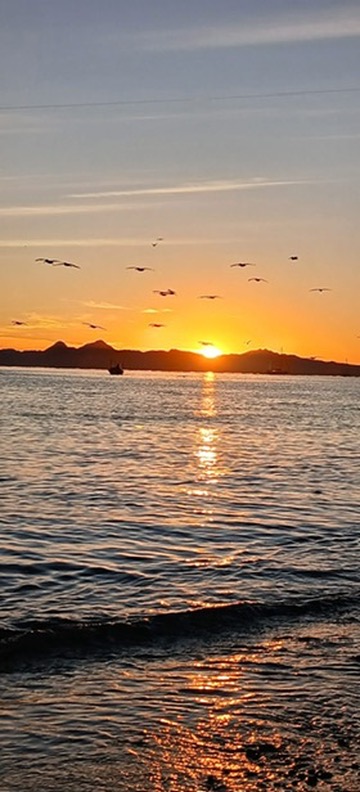
Title: Daybreak Crossing
Artist Statement

I arrived before the sun cleared the mountains, when the sea was still holding night in its depths. The horizon glowed slowly, a thin line of gold widening by the minute, as though the day were being poured carefully into the world. Birds crossed the sky in loose formation, their wings catching the first light. I stood still, aware of how quietly morning begins when no one is rushing it forward.

What I felt most was permission. The water moved without urgency. The light unfolded at its own pace. Nothing demanded that I be anything other than present to the crossing from dark to day. In that moment, I understood arrival differently, as something ongoing, something that happens gradually, like sunrise, asking only that I remain long enough to witness it.

Photo Credit: Amy Tucker, January 2026
I walked again this evening, as the sun dropped toward the mountains and the light turned golden. The malecón was different at this hour: more crowded, more festive, families out for their evening paseo, that lovely Latin custom of strolling together as the day cools. I was alone among the couples and the families, and I felt held by that rhythm. I felt held by the rhythm of the walk, the beauty of the light, the simple pleasure of a body in motion.
Tomorrow I will walk again. And the day after that. Walking has become my practice here, my daily discipline, my way of being in this place and in this body. Each walk is different: different light, other encounters, different thoughts arising from the rhythm of feet. And each walk is the same: the same path, the same sea, the same self, meeting the world one step at a time.
Solnit (2001) remarks that the pace of genuine thought roughly matches the pace of walking, and that contemporary life, moving far faster than either, routinely outruns the capacity for real reflection. Here in Loreto, I am slowing down to the speed of thought. I am letting my mind keep pace with my feet. I am finding myself in the ordinary miracle of movement, of breath, of a body carrying me through a world that reveals itself slowly, step by step, along a malecón I am learning to call my own.
El camino me enseña quién soy.
The path teaches me who I am.
Un paso a la vez.
One step at a time.
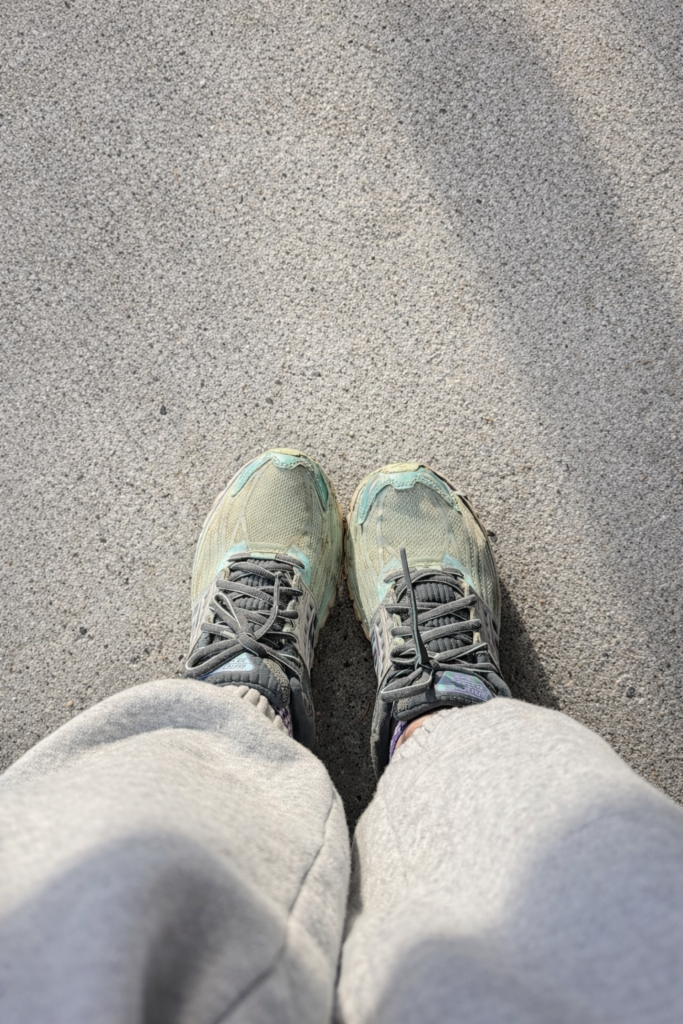
Title: My Dirty Shoes
Photo Credit: Amy Tucker, 2026
References
Elkin, L. (2017). Flâneuse: Women walk the city in Paris, New York, Tokyo, Venice, and London. Farrar, Straus and Giroux.
Goffman, E. (1963). Behaviour in public places: Notes on the social organization of gatherings. Free Press.
Gros, F. (2014). A philosophy of walking (J. Howe, Trans.). Verso.
Kaplan, R., & Kaplan, S. (1989). The experience of nature: A psychological perspective. Cambridge University Press.
Maitland, S. (2009). A book of silence. Granta.
McAdams, D. P. (2001). The psychology of life stories. Review of General Psychology, 5(2), 100–122. https://doi.org/10.1037/1089-2680.5.2.100
Oppezzo, M., & Schwartz, D. L. (2014). Give your ideas some legs: The positive effect of walking on creative thinking. Journal of Experimental Psychology: Learning, Memory, and Cognition, 40(4), 1142–1152. https://doi.org/10.1037/a0036577
Shapiro, L. (2019). Embodied cognition (2nd ed.). Routledge.
Simmel, G. (1971). The stranger. In D. N. Levine (Ed.), Georg Simmel: On individuality and social forms (pp. 143–149). University of Chicago Press. (Original work published 1908)
Solnit, R. (2001). Wanderlust: A history of walking. Penguin.
Taylor, C. (1989). Sources of the self: The making of the modern identity. Harvard University Press.
Tuan, Y.-F. (1977). Space and place: The perspective of experience. University of Minnesota Press.
Note. Spanish-language passages were generated using Google Translate (Google, n.d.) and subsequently reviewed and refined by the author. Any remaining infelicities reflect the limits of machine translation rather than intent.
Academic Lens
Walking the malecon as daily ritual embodies what Pink (2013) calls sensory ethnography: knowledge gathered through the moving, attentive body in a specific place. The body adapting to a new rhythm, new smells, sounds, temperatures, signals the early stages of body-based regulation that Levine (2010) describes as the nervous system's capacity to "track" safety. The bilingual form of this entry reflects the way the Spanish-speaking environment was generating a different kind of cognitive and embodied presence.
ACADEMIC LENS
Walking as a research method has a long tradition in what O’Rourke (2013) calls “walking methodologies”: the mobile body as instrument of inquiry, the act of moving through space as a form of thinking. This day-four entry on the malecón traces what Tuan (1977) calls the phenomenology of place attachment: how a landscape becomes meaningful through repeated bodily encounter, through the accumulation of sensory memory that gradually transforms space into place. The proximity of the sea is methodologically central rather than incidental,ral: Blue Mind research (Nichols, 2014) documents the measurable calming effect of blue spaces on the human nervous system, partially explaining the restorative quality of this daily practice. The bilingual notation, moving between Spanish place names and English reflection, performs what Anzaldúa (1987) describes as the writing of the borderlands: language that belongs fully to neither territory and thus opens a third epistemological space. The early-project quality of this walk, still tentative, still scanning, still learning what it means to move without agenda, also documents the initial stages of what Levine (2010) calls somatic re-orientation: teaching the nervous system, through repeated safe experience, that purposeless movement is permitted.
Two flights. Six plus hours. The particular exhaustion of leaving everything.
Taxi window. Dust road. Mountains I have never seen turning pink in the distance.
¿Primera vez en Loreto? First time? Sí. Yes.
Estoy cansada. I am tired.
The driver nods. Sí, se ve. Yes. It shows.
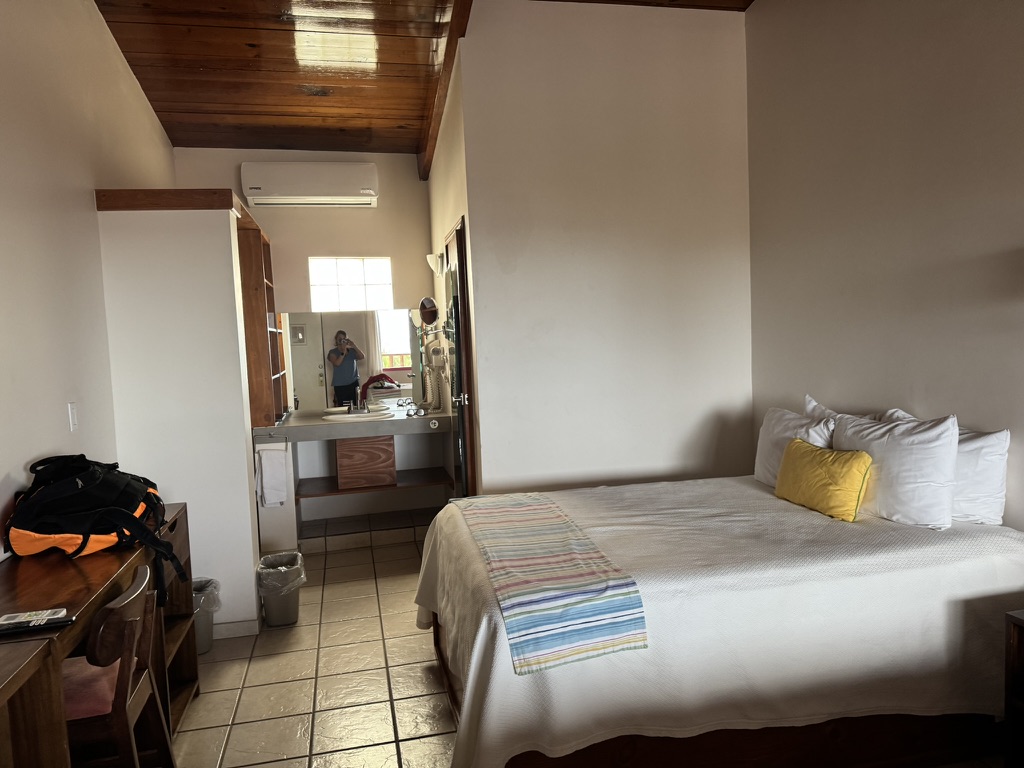
Key in the lock. Door swinging open. A room that belongs to no one yet.
Bag on the floor. Zipped shut. The quiet discipline of leaving it unpacked.
Salt air. Open window. The sea I came to meet.
Sixty years old. Alone. The radical act of arriving for myself.
No one is waiting. No one is expecting. No one is asking what took so long.
Shoulders dropping. The body knowing before the mind admits.
Threshold. Umbral. The space between who I was and who I am becoming.
Light fading. Sea darkening. The first night of thirty beginning.
Mañana será otro día. Tomorrow will be another day.
But tonight, just this arriving.
He llegado. I have arrived.
For now, that is enough.
Title: Weathered Open
Artist Statement

I almost walked past it.

It lay half-set in the sand, unannounced, the colour of something that had spent years under sun and water. What drew me back was the opening. Small. Quiet. A hollow worn clean through the stone as if time itself had needed passage.

I picked it up and felt its weight.

Solid everywhere except for that one opening. The hole held no weakness in it. If anything, it revealed its endurance. Pressure had shaped it instead. It had shaped it. Wind, salt, movement, persistence. Forces working slowly enough that transformation appeared gentle even when the forces were fierce.

Standing there, I thought about what it means to be marked without being broken.

How life wears through us in places. How absence forms where certainty once lived. How openings appear beyond damage, as evidence of having stayed long enough for change to move through.

I placed it back where I found it.

Some objects feel less like discoveries and more like acknowledgements. A quiet recognition of what survives shaping. Of what remains strong even with light moving through it.

Photo Credit: Amy Tucker, January 2026
Note. Spanish-language passages were generated using Google Translate (Google, n.d.) and subsequently reviewed and refined by the author. Any remaining infelicities reflect the limits of machine translation rather than intent.
References
Google. (n.d.). Google Translate. https://translate.google.com
I had carried it outside before the day fully formed, before voices rose from the pathways below, before the shoreline began its quiet negotiations with footsteps and movement. The mug sat heavy in my hands, ceramic warmed by what it held, painted with colours that felt brighter than the hour itself. Loreto written across it, as place, briefly touching my palms, without declaration. I realized I was holding geography in a way maps never allow. Heat. Weight. Stillness.
What struck me was the pause.
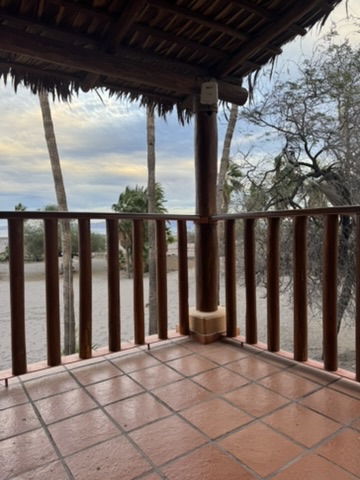
I let it sit first. I let the steam lift, let the horizon remain slightly out of focus beyond the wooden railing. There was comfort in the blur, in allowing the world to stay softened while I woke into it slowly. No urgency to begin the day. No performance required. Just breath, warmth, and the steady presence of water beyond sight but within reach. It felt like a continuation of something I had been learning here, that mornings can be received rather than seized. They can be received.
I thought about how many cups of coffee I have held in my life.
Behind counters. At kitchen tables. In classrooms before students arrived. Each one marking a threshold between effort and endurance, between showing up and staying anyway. This cup felt different. It had everything to do with how I was sitting with it. Unhurried. Unguarded. Simply present to the small ritual of warmth against my hands, aware that sometimes the most profound forms of steadiness arrive quietly, asking nothing more than that we hold them long enough to feel their heat.
Photo Credit: Amy Tucker, January 2026
Arrival rarely looks the way we imagine it will.
There is the physical act of stepping into a room, setting a bag down, and closing a door behind you. And then there is the quieter arrival that unfolds beneath the surface, the one that takes longer, the one the body negotiates in its own time. I landed in Loreto yesterday, somewhere between waking and dreaming, my sense of time dissolved by two flights and several hours of transit. The body arrives first. The breath follows. The mind lingers behind, still scanning, still carrying the vigilance of the life I have temporarily left.
Estoy cansada. I am tired. The phrase surfaced unbidden as the taxi wound through the quiet streets of this small town on the Sea of Cortez. I said it aloud, testing how Spanish felt in my mouth after so many years. The driver glanced at me in the rearview mirror and nodded. Sí, se ve, he said gently. Yes, it shows.
Presence of self, rather than absence of others.
Cruzando / Crossing
I came here alone. That sentence still feels radical, even as I write it. At 60, after nineteen years navigating the relentless demands of academic life, I booked a solo retreat to a place where I know no one, where no one expects anything of me, where the only schedule is the one I choose to keep. The decision carried both relief and a strange tenderness, as if I were doing something slightly forbidden.
Arnold van Gennep (1909/1960), the anthropologist who coined the term liminality, described thresholds as spaces of transition, neither fully one thing nor another. The word itself comes from the Latin limen, meaning “boundary” or “doorstep”. To stand on a threshold is to occupy the space between what was and what might be, to hover in the doorway before stepping through. That is where I find myself tonight: on the threshold between the life I have been living and something I cannot yet name.
Victor Turner (1969), building on van Gennep’s work, described liminal spaces as places where ordinary structures dissolve, where the usual rules loosen their grip. He called this betwixt and between, a phrase that captures the particular disorientation of transition. I feel that disorientation now, sitting on a terrace overlooking water I have never seen before, in a country where I speak the language imperfectly, in a solitude I have chosen but am only beginning to inhabit.
El umbral es el lugar donde todo puede cambiar.
The threshold is the point at which everything can change.
Title: Después de Años de Disrupción / After Years of Disruption
Title: Where Sound Holds Time

I arrived before the bells moved.

The tower rose out of the morning sky with a kind of quiet authority that asked nothing and yet remained undeniable. Stone layered upon stone, holding heat from centuries of sun, holding prayer, grief, celebration, confession, all sedimented into the structure itself. I stood at its base looking upward, aware of my own smallness against its vertical reach. Contextualized rather than diminished. Placed within a timeline far longer than my own.

What struck me most was the anticipation of sound.

The bells hung still, suspended in that brief space before motion. I found myself listening for something still ahead, aware that when they did ring, the vibration would move through air, through wall, through body. There is something about churches that organizes silence differently. Even emptiness feels structured. Held. As though quiet itself has been practised here long before anyone enters.

I stayed outside first.

I stayed at the threshold, aware that entry is never only architectural. It is emotional. Spiritual. Historical. To cross from sunlight into that interior dimness would be to step into accumulated presence. So I remained outside a while longer, letting the bells remain still, letting the stone hold its stories without requiring mine to be added. Some places ask for reverence through participation. Others offer it simply through standing close enough to feel time moving slowly around you.

Photo Credit: Amy Tucker, January 2026
Presence of self, rather than absence of others.
This arrival carries history. After the pandemic, many people learned how to be alone in ways they never intended. Isolation arrived suddenly, unevenly, and without consent. Homes became offices. Screens replaced faces. Silence grew louder, then exhausting. Loneliness took many forms, some quiet, some crowded, some invisible even to those experiencing them.
Coming into solitude by choice feels different. And yet the body remembers. It holds traces of vigilance, of separation, of longing for connection that went unmet during those long months. Bessel van der Kolk (2014), in his landmark work on trauma, reminds us that the body keeps the score, storing experience in tissue and nervous system long after the mind has moved on. My body carried the pandemic here, tucked into my luggage alongside my journal and my watercolours. Arrival asks me to acknowledge that history rather than rush past it.
Tricia Hersey (2022), founder of The Nap Ministry, writes that rest is resistance, a refusal to participate in systems that reduce human worth to productivity. For those of us who survived the pandemic by working harder, by performing wellness while quietly falling apart, rest can feel transgressive. Choosing solitude after years of forced isolation requires a different kind of courage: the willingness to be alone on purpose, to trust that this time the aloneness will heal rather than harm.
La Primera Noche / The First Evening
At first, habit took over. I considered unpacking everything immediately. I thought about schedules, routes, and productivity. My mind offered a list of things I could accomplish before bed: organize the kitchen, plan tomorrow’s meals, and respond to the emails still waiting on my phone. This reflex runs deep, an inherited habit shaped by a world that rewards motion and punishes stillness.
So I sat.
I let the room remain unfinished. I left the bag zipped. I noticed how my shoulders softened when there was nowhere else to be. Outside, light shifted almost imperceptibly, the desert mountains turning pink and then purple as the sun dropped toward the sea. Inside, something settled.
The Kaplans (1989), environmental psychologists who developed the quiet way nature restores us theory, describe specific environments as offering the gentle pull of the natural world, a gentle hold on attention that allows the mind to rest while remaining engaged. Natural settings, they argue, restore depleted cognitive resources by providing stimulation that requires effort to ignore but minimal effort to attend to. The sea outside my window offers exactly this: something to watch without watching, something to hear without listening, something to receive without reaching.
I opened the windows and let the evening in. Salt air. The distant sound of waves. A dog barking somewhere in town. These sounds asked nothing of me. They existed, and I lived alongside them, and for the first time in longer than I can remember, that felt like enough.
El Acto Radical / The Radical Act
Title: Night Fire, Inner Quiet
Artist Statement

I found this place after most people had gone in.

The courtyard held that particular kind of night silence that is never empty, only softened. Chairs pushed back. Glass tables catching reflections of low light. The ocean somewhere beyond the dark, present but unseen. And in the centre, the fire already burning, as if it had been waiting for someone willing to sit without conversation.

I stood at the edge first, feeling the heat reach outward in small waves. Fire reorganizes space differently than daylight does. It draws the body inward. Invites stillness without demanding it. I noticed how the flames moved, steadily consuming what had already been offered. There was something reassuring in that rhythm. Transformation happening without spectacle.

Eventually, I sat.

To accompany the burning. To watch what happens when wood becomes ember, when form gives way to glow. I thought about how many versions of myself had been shaped in similar fires, slow, unseen processes of change that only reveal themselves in hindsight. The courtyard remained quiet. The flames continued their patient work. And for a while, I let the night hold me there, lit just enough to feel present, but held within it.

Photo Credit: Amy Tucker, January 2026
Arriving alone carries a particular tenderness. There is no one to absorb the moment for you, no one to narrate the experience to, no one whose presence dilutes the intensity of meeting yourself in an unfamiliar place. You stand at the threshold, and you stand there alone, and whatever comes next is yours to receive without mediation.
For women, especially women at midlife, this can feel revolutionary. Carol Gilligan (1982), in her foundational work on women’s psychological development, described how women often define themselves through relationships, through care for others, through responsiveness to needs that are rarely their own. To step away from those relationships, even temporarily, can feel like abandonment, like selfishness, like a betrayal of everything we were taught to value.
I think about my mother in Lethbridge, 80 years old, navigating widowhood in the house that still holds her husband’s absence. I think about the colleagues who will cover my responsibilities while I am away. I think about all the ways I have been trained to feel guilty for taking up space, claiming time, and prioritizing my own restoration. And then I think about what Audre Lorde (1988) wrote, that caring for myself is an act of political warfare, a refusal to participate in my own depletion.
Tonight, I am practising that refusal. I am letting the bag stay zipped. I am letting the emails wait. I am allowing myself to be tired without apologizing for it, without performing recovery before recovery has had a chance to begin.
Descansar es un acto de valentía.
To rest is an act of courage.
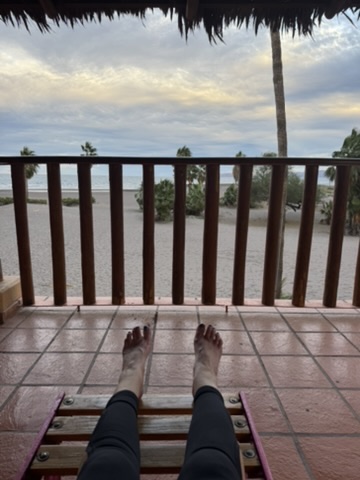
Title: Between Palms and Water
Artist Statement

I sat down without planning to stay long.

The chair faced the water, but my body settled first into the pause rather than the view. Two palms stood directly in front of me, their trunks close enough to feel companionable, their fronds catching the last light of the day. Beyond them, the Sea of Cortez moved in its steady, untroubled rhythm. Undramatic. Unclaiming. Just continuing.

What I noticed most was the layering of distance.

My feet resting in the foreground, grounded and still. Sand stretching outward in soft, wind-marked patterns. Trees spaced across the shoreline like quiet sentinels. And then the horizon line, holding everything without urgency. I felt held within those layers, neither separate from the landscape nor fully absorbed by it. Present, but gently so.

There is a particular quality to sitting alone at the edge of day.

The body softens. Breath lengthens. Thought loosens its grip. Nothing is being asked. Nothing needs to be solved. In that moment, I was beyond researching, teaching, producing, or proving. I was simply occupying space, allowing the environment to meet me without expectation.

I stayed longer than I thought I would.

Long enough for the light to shift. Long enough to feel that familiar return to myself that happens when stillness is given time rather than rushed through. The palms remained. The water continued. And I sat there, suspended briefly between land and horizon, aware that presence sometimes arrives quietly, asking only that I remain.

Photo Credit: Amy Tucker, January 2026
Lo que enseña el agotamiento / What exhaustion teaches
Jet lag is a strange teacher. It strips away the usual defences, the ability to perform wellness even when wellness is absent. Christina Maslach (Maslach & Leiter, 2016), who pioneered research on burnout, defines the syndrome as a combination of emotional exhaustion, depersonalization, and reduced personal accomplishment resulting from chronic workplace stress. I recognize myself in that definition more than I would like to admit. I have been running on empty for longer than I knew, and the running itself became invisible, just the way things were, just what the job required.
Tonight, stopped at last, I can feel how tired I actually am. It lives in my bones, in the heaviness of my limbs, in the way my eyes want to close even as my mind keeps scanning for the next thing to do. Stephen Porges (2011), the neuroscientist who developed the theory of how the nervous system responds to safety and threat, explains that our autonomic nervous system evaluates safety and danger through a process he calls the body’s instinct to scan for safety. The assessment below consciousnessshapes our physiological state. My body’s instinct to scan for safety has been calibrated for threat for so long that even here, in this quiet room by the sea, my body remains on alert, still scanning for turbulence that is no longer present.
It will take more than one evening to convince my nervous system that it is safe. But this evening is where that convincing begins.
Antes de Dormir / Before Sleep
The night has deepened. The sea is audible but invisible now, just the rhythm of waves and the occasional cry of a night bird. In Kamloops, it is late. In Lethbridge, my mother is probably already asleep, her scriptures on the nightstand, her prayers said, the space beside her filled with faith and memory. I am connected to her across the distance, connected to everyone I love, even as I sit here alone.
This is what I am beginning to understand: solitude is a relational state, shaped by the connections we carry with us even when those we love are far away. Netta Weinstein and colleagues (2021) found, in their narrative study of solitude across the lifespan, that our sense of connection to others profoundly shapes the experience of being alone. Solitude becomes restorative when it is chosen, when it is bounded, when it exists within a larger web of relationships rather than as exile from connection.
I chose this. I bound it with return tickets and phone calls home, and the knowledge that thirty days will end. I carry my people with me, held in my heart rather than in my hand. And from that holding, I can begin to rest.
Mañana será otro día. Tomorrow will be another day. For now, I am letting this one be enough. I am letting exhaustion teach me what it knows: that I have been carrying too much, that the carrying has cost me, that setting the weight down, even for a moment, is the first step toward remembering what it feels like to be whole.
He llegado.
I have arrived.
Por ahora, eso es todo lo que necesito hacer.
For now, that is all I need to do.
Title: Elegance in Impermanence
Artist Statement

She was already standing there when I walked by.

Umbrella lifted. Dress falling neatly to the ground. There was something composed about her posture, as if she had paused rather than been placed. I noticed the pink first. Soft. Careful. Almost celebratory against the stone behind her.

What stayed with me was the contrast.

Bone and colour. Stillness and personality. The small details, the hat, the purse, the way she seemed dressed for presence rather than disappearance. Honest, rather than morbid. A quiet reminder that identity and expression persist past the finite edges of a life.

I stood there longer than I expected.

Simply noticing. The humour, the dignity, the gentleness within the figure. A simple moment of being reminded that impermanence and beauty can exist in the same space.

Photo Credit: Amy Tucker, January 2026
References
Gilligan, C. (1982). In a different voice: Psychological theory and women’s development. Harvard University Press.
Hersey, T. (2022). Rest is resistance: A manifesto. Little, Brown Spark.
Kaplan, R., & Kaplan, S. (1989). The experience of nature: A psychological perspective. Cambridge University Press.
Lorde, A. (1988). A burst of light: Essays. Firebrand Books.
Maslach, C., & Leiter, M. P. (2016). Understanding the burnout experience: Recent research and its implications for psychiatry. World Psychiatry, 15(2), 103–111. https://doi.org/10.1002/wps.20311
Porges, S. W. (2011). The Polyvagal Theory: Neurophysiological foundations of emotions, attachment, communication, and finding our own calm. W. W. Norton & Company.
Turner, V. (1969). The ritual process: Structure and anti-structure. Aldine Publishing.
van der Kolk, B. A. (2014). The body keeps the score: Brain, mind, and body in the healing of trauma. Viking.
van Gennep, A. (1960). The rites of passage (M. B. Vizedom & G. L. Caffee, Trans.). University of Chicago Press. (Original work published 1909)
Weinstein, N., Nguyen, T.-V., & Hansen, H. (2021). What time alone offers: Narratives of solitude from adolescence to older adulthood. Frontiers in Psychology, 12, Article 714518. https://doi.org/10.3389/fpsyg.2021.714518
I am still walking. I am still staying anyway.
Translation Note
Note. Spanish-language passages were generated using Google Translate (Google, n.d.) and subsequently reviewed and refined by the author. Any remaining infelicities reflect the limits of machine translation rather than intent.
ACADEMIC LENS
El umbral, the threshold, occupies the conceptual centre of this project: it is the liminal space Turner (1969) described as the territory between one identity configuration and another, where transformation becomes possible precisely because the habitual self-structure has yet to reassert itself. The morning coffee ritual described here enacts what van Gennep (1960) called rites of passage in miniature: small, repeated ceremonies that mark the boundary between states of being and create the conditions for transition. Bachelard’s (1969) phenomenology of intimate space is directly relevant: the cup held in both hands, the morning light through the window, the first sip before the day’s demands arrive, all constitute what he calls the “felicitous space” of the inhabited moment. The bilingual form of this entry, moving between Spanish and English without explanation or apology, enacts Anzaldúa’s (1987) argument that the borderlands between languages are epistemological rather than merely geographic,ical: to move between tongues is to move between ways of knowing, and the threshold is precisely the place where such movement becomes possible.
Content Warning: This post contains reflections on trauma, childhood experiences, and the body’s memory of harm. Please care for yourself as you read, and feel free to step away if you need to.
A Vignette on Staying Anyway
Title: Portable Colour
Artist Statement

It travels with me.

As permission, beyond equipment. The palette sits quietly on the table, its circular wells holding pigments that feel less like supplies and more like emotional registers. Reds that hold heat. Blues that steady breath. Yellows that carry small, stubborn forms of optimism. I open it when the moment calls. Its presence alone is enough to remind me that expression remains available when language recedes.

What strikes me most is its containment.

Each colour held in its own boundary, yet arranged in relationship to the others. No hierarchy. No single tone dominating the field. It mirrors something I am relearning within myself, that emotions can coexist without needing resolution. That intensity and calm, grief and curiosity, fatigue and wonder can sit side by side without cancelling one another out.

In the context of this journey, the palette becomes less about making images and more about making space. A small, portable landscape of possibility. Evidence that creativity thrives even without perfect conditions. Only willingness. Only presence.

Photo Credit: Amy Tucker, January 2026
I have learned to stay anyway.
Before Dawn (1995)
The doughnut shop opened at five. I arrived at four-thirty to start the coffee, to arrange the trays, to tie on the apron that smelled of yeast and sugar and the particular exhaustion of people who work before the sun rises. I was twenty-five years old. I had three children at home. I had textbooks in my bag.
Between customers, I would pull out whatever I was reading that week. Introduction to Political Science. Organizational Behaviour. The pages grew soft from handling, spotted with fingerprints I carried from my shift into my afternoon class, and my afternoon class began. I had no idea then that I was living a paradox: surrounded by people all morning, profoundly alone in what I was trying to become. No one in my family had gone to university. No one I worked with understood why I would spend money we could barely spare on books I read standing up behind a counter at five in the morning.
I think now about what I was learning in those hours before dawn. Beyond the content of the textbooks, though, that mattered. I was learning how to be with myself in the middle of chaos. I was learning that solitude differs from simple aloneness. You can be surrounded by people and still be utterly isolated in your purpose. You can be physically alone and feel accompanied by something larger than yourself. The space between five and nine, between the first customer and the last page I could read before class, became a kind of practice. I lacked language for it then. I do now. I call it alonetude: the contemplative, chosen engagement with solitude that allows you to be genuinely present to yourself rather than merely by yourself.
I was learning how to be with myself in the middle of chaos.
The Long Middle
Years passed. I completed my degrees. I built a career contract teaching at Thompson Rivers University, standing in front of classrooms instead of behind counters, talking about leadership, ethics, and organizational behaviour to students who reminded me of myself. Some of them worked night shifts before my morning classes. Some of them calculated whether they could afford both tuition and groceries. I saw them, because I had been them.
But the uncertainty never fully lifted. For nineteen years, I have worked as a contract faculty member. Each semester brings the question of whether I will be offered work. Each contract is temporary. I have applied for permanent positions more times than I can count and watched others receive what I was told remained just out of my reach. The institution depends on my flexibility, my expertise, and my willingness to show up semester after semester without guarantees. I have learned to live in the space between being essential and being disposable. I have learned that staying anyway is its own form of practice.
When people ask about my research on precarity and belonging in higher education, I sometimes want to say, “I am living this from the inside.” I am living it. The international students I research, the contract faculty I represent, and my children, who need me to show up every single day, regardless of what next semester holds. We are all navigating institutions that claim to welcome us while refusing to secure our place within them.
You can be surrounded by people and still be utterly isolated in your purpose.
Title: Where Light Breaks Open
Artist Statement

It began with colour before it began with form.

The yellow arrived first. Unplanned. Released. It spread across the page with a warmth that felt less like sunlight and more like emergence. Around it, blues and greens moved in to hold it, to give it somewhere to rest, The horizon line came later, almost as an afterthought, a quiet gesture to ground what was otherwise dissolving.

What I notice now is the permeability of everything.

No edge holds for long. Colour bleeds into colour. Water becomes sky. Sky becomes field. Even the darker mass on the right, tree or memory or shelter, participates in the landscape rather than interrupting it. This is what happens when I paint from sensation rather than observation. The world appears less fixed. More relational. More felt than seen.

In this way, the piece documents a state rather than a place.

A moment where brightness felt held, where saturation was safe to carry. Where expression moved ahead of interpretation. I released the outcome. I let the pigments find their own conversations across the paper.

Photo Credit: Amy Tucker, January 2026
Thirty Days on the Sea of Cortez
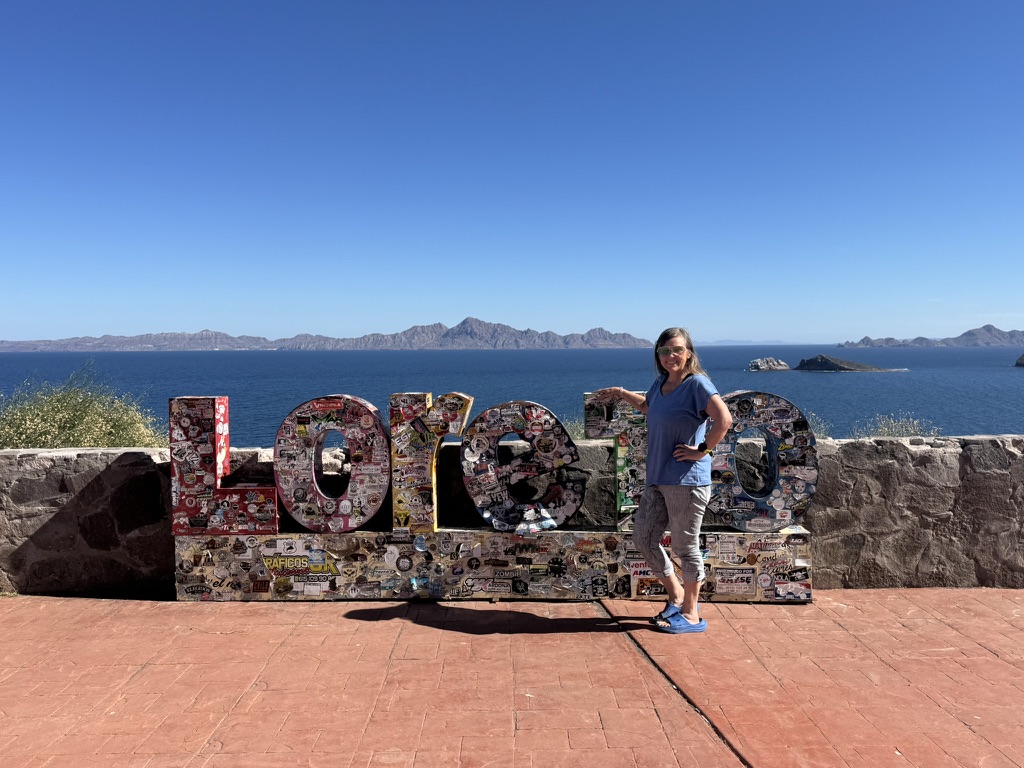
Today, I stood on a malecón in Loreto, Mexico, watching pelicans dive into the Sea of Cortez. I was three thousand kilometres from home, alone in a way I had forgotten since those early mornings behind the doughnut counter. Thirty days stretched before me. No students to teach. No meetings to attend. No one needed me to hold their world together. Just myself and the question of what I would find there.
What I found was presence. I began to understand that all those years of navigating precarity, of staying anyway when institutions offered no guarantees, had taught me something learned only that way. They had taught me how to be with uncertainty. They had taught me that safety lives in the felt sense, separate from the absence of risk, that you can meet whatever comes. They had taught me that meaning is woven into the walking itself.
I came to Loreto with a word: alonetude. This is a word I coined to describe the in-between place of loneliness and solitude. It names the experience of being genuinely present to yourself in solitude, of choosing to be alone in a way that restores rather than depletes. It requires four things: intentional choice, felt safety, present-moment awareness, and meaning integration. All four must be present. You cannot think your way into alonetude if your nervous system is screaming danger. You cannot force meaning onto empty time. But when the conditions align, something opens. You remember that you have always been enough, even when the world told you otherwise.
Title: Held in Stillness
Artist Statement I noticed the posture before I noticed the figure. Hands pressed together. Head slightly lifted. In pause, rather than performance. The stone carried a weight of quiet that felt older than the building behind it, older even than the palms rising into the sky. It stood there without announcement, without instruction, simply holding its position between ground and air. What stayed with me was the gesture of inwardness. Prayer, perhaps. Or reflection. Or the kind of listening that happens when words are no longer necessary. The surface of the sculpture is rough, almost weathered, yet the stance is gentle. It receives attention slowly, if one is willing to stop long enough. In that moment, I felt my own body respond. Shoulders lowering. Breath slowing. A subtle mirroring of the stillness in front of me. Recognition, rather than formal reverence. A reminder that quiet postures carry their own forms of strength. That stillness, too, can be an active state of being. Photo Credit: Amy Tucker, January 2026
Some things you carry with you. Some practices ask only for willingness. The conditions are secondary.
Staying Anyway
I hold what next semester brings with open hands. I hold whether the applications I have submitted will lead to interviews, to offers, to the security I have worked toward for decades. What I know is that I have learned to stay anyway. I have learned that the space between five and nine, between uncertainty and meaning, between isolation and alonetude, is where the real work happens. It is where we become the people we are trying to be, shaped by the precarity and carried through it.
The doughnut shop is long gone. But I still wake before dawn sometimes, still reach for whatever I am reading, still feel that particular presence that comes from being alone with your own becoming. Some things you carry with you. Some practices require nothing more than attention. They need only the willingness to stay, to pay attention, to believe that the doors of education are worth the cost of walking through them.
I am still walking. I am still staying anyway.
Title: Shared Horizon
Artist Statement They stood on the same rock but faced different directions. One turned outward toward the open water, body lifted, alert to movement beyond the shoreline. The other remained lower, closer to the curve of the stone, angled inward as if watching the rhythm of the waves meeting land. Two postures. Two orientations. One shared ground beneath their feet. What held my attention was the balance between them. There was no sense of separation, even in their difference. No competition for vantage point. Just a quiet coexisting. A reminder that presence rarely requires alignment. That companionship can exist without mirroring. That standing beside another means nothing about looking the same way. I watched them longer than I expected. The water moved constantly around the rock, never still, yet they remained steady within it. It felt familiar to me, this act of holding one’s place while everything else shifts. A small lesson offered without instruction. Stability as groundedness shared, across difference. Photo Credit: Amy Tucker, January 2026
I am still here.
I am still walking. I am still staying anyway.
ACADEMIC LENS
This reflection on the portable watercolour palette engages what Bachelard (1969) calls the phenomenology of material imagination: the way physical objects carry and release emotional knowledge that precedes language. The observation that “each colour held in its own boundary, yet arranged in relationship to the others” resonates with Menakem’s (2017) somatic framework, in which healing extends beyond the elimination of difficult emotions but the development of a nervous system capable of holding multiple states without collapsing. Van der Kolk (2014) similarly argues that trauma recovery requires engagement with rather than suppression of somatic experience but its integration: teaching the body that it can contain intensity without being overwhelmed by it. The image of coexisting colours without hierarchy mirrors what Porges’s (2011) Polyvagal Theory describes as ventral vagal regulation: a state in which the nervous system is flexible enough to move between states without becoming fixed in survival mode. The arts-based methodology here, using visual art-making as both data and analysis, aligns with Richardson and St. Pierre’s (2005) contention that creative forms can access dimensions of experience that conventional academic prose cannot reach.
Reading Time: 4minutesPuesta de sol, sunset on Day Two in Loreto. A bilingual reflection on the particular quality of light at the end of a first full day by the sea, and what the body begins to release when the world turns gold.
Reading Time: 4minutes
Sunset at the horizon.
This was something else entirely: a quality of presence, of being genuinely with myself rather than merely by myself.
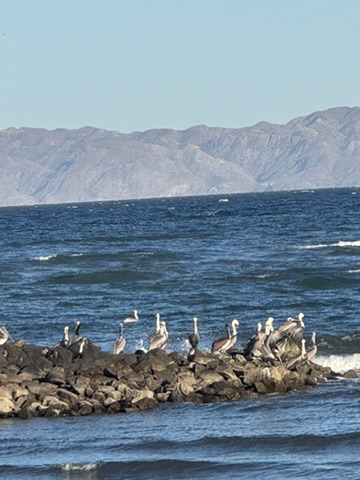
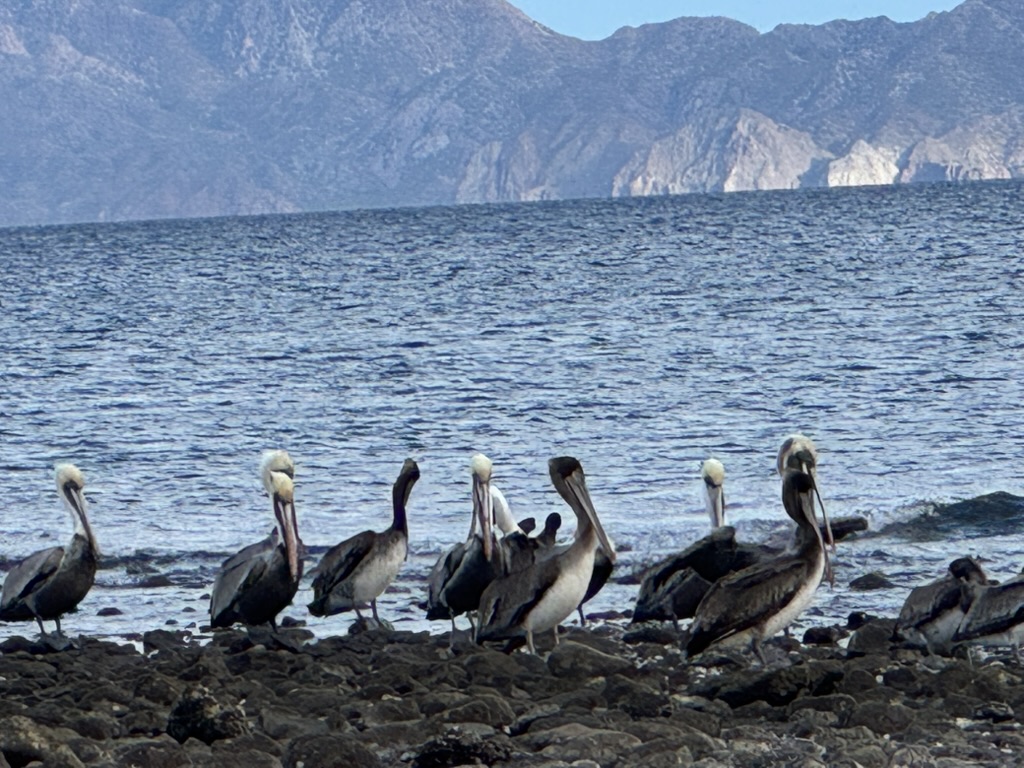
Title: The Gathering
Artist Statement

They gathered where the land gives way to water.

Perched along the rocks, they faced different directions, yet remained part of the same quiet formation. No urgency. No competition for space. Just bodies arranged along the shoreline, each holding its own stillness while sharing the same horizon.

I stood at a distance watching them.

What struck me was their patience. The way they waited without signalling waiting. The way they scanned the water without appearing restless. There was a rhythm to their presence that felt familiar to me, a kind of learned stillness that comes from spending long periods observing rather than intervening.

In that moment, I recognized something of my own practice reflected back.

This work of standing at edges. Of watching what moves beneath the surface. Of trusting that some moments ask only to be witnessed. Some moments ask only for attention. For steadiness. For remaining long enough that the landscape forgets you are there.

The mountains behind them held their own quiet authority, grounding the scene in time beyond the immediate. Water, rock, wing, distance. Each element coexisting without demand.

I kept my distance.

I allowed the distance to remain intact, understanding that proximity rarely determines connection. Sometimes respect lives in observation alone.

Photo Credit Amy Tucker, January 2026
References
The evening I arrived in Loreto, Mexico, I stood on the malecón watching pelicans dive into the Sea of Cortez, and I felt something without a name.
Some moments ask only for attention.
It was something beyond loneliness, though I was profoundly alone, 3,000 kilometres from home, knowing no one, with thirty days of solitude stretching before me. Neither was it the comfortable solitude I had glimpsed in rare moments throughout my life, those brief pauses between obligations when I might read undisturbed or walk without destination.
I had no words for this experience. During Covid, I learned to call this place alonetude.
For decades, psychological research has approached solitude primarily through a deficit lens, and rightly so. Social isolation carries mortality risks equivalent to smoking fifteen cigarettes daily. Loneliness predicts cardiovascular disease, cognitive decline, and depression. The public health imperative to address what former U.S. Surgeon General Vivek Murthy called an “epidemic of loneliness” has produced essential knowledge and helped countless people.
But this focus created a gap. By treating solitude primarily as the absence of connection, we overlooked solitude as presence: the presence of self, meaning, and restoration that becomes available when social demands recede.
Alonetude requires four elements working together like legs of a table:
Intentional choice: Solitude must be chosen, never imposed. Research shows that autonomous motivation predicts positive outcomes regardless of introversion.
Felt safety: The nervous system must register it as safe. You cannot think your way into alonetude while your body scans for threat.
Present-moment awareness: Beyond rumination or distraction, genuine presence, what emerges when attention settles.
Meaning integration: Connection to values, purpose, or something larger than the passing moment.
Remove any one element, and the table collapses. Strength in one cannot compensate for the absence of another. This is the threshold model at the heart of the framework.
The Sea of Cortez cares nothing about whether humans theorize about solitude. The pelicans dive and surface following rhythms older than language. The mountains turn rose and gold at sunset regardless of who watches. But for those willing to participate, genuinely, patiently, with bodies regulated and hearts open, something becomes available. Presence to life, rather than escape from it. Presence of self, rather than absence of others.
Beyond loneliness and beyond mere solitude, something for which I needed a new word.
That word is alonetude. I offer it now as an invitation.
Presence to life, rather than escape from it.
Title: Welcome to Loreto
Artist Statement

My arrival was anything but quiet.

The letters announced it before I could. Large, textured, impossible to ignore. Covered in stickers layered over time, each one evidence that others had stood here too, marking their presence in colour and adhesive and memory. I stepped into the frame, aware that this was a different kind of shoreline moment than the solitary ones.

This was a public threshold.

Behind me, the Sea of Cortez stretched wide and steady, holding its own depth regardless of the spectacle in front of it. Mountains sat low along the horizon, grounding the scene in geological time while the foreground pulsed with tourism, movement, and human imprint. The contrast was immediate. Vastness behind. Declaration in front.


Traveller. Researcher. Body in place. Name unspoken yet presence visible. Unlike the quieter images, this one carries performance within it. Beyond the institutional sense of performance, simply acknowledging that sometimes presence is witnessed, documented, shared. That being in a place can hold both interior meaning and outward expression.

I left soon after the photograph.

I stepped away from the letters and back toward the waterline, where scale shifts again and the body becomes smaller against land and sea. Yet the image remains important because it marks arrival in a way solitude cannot do alone.

A pause between anonymity and recognition.
Between landscape and inscription.
Between being there and being seen.

Photo Credit Amy Tucker, January 2026
I am still here.
Note. Spanish-language passages were generated using Google Translate (Google, n.d.) and subsequently reviewed and refined by the author. Any remaining infelicities reflect the limits of machine translation rather than intent.
ACADEMIC LENS
The distinction drawn here between “being by myself” and “being genuinely with myself” names the phenomenological core of alonetude: the difference between structural solitude and the experiential quality of self-presence that Moustakas (1961) describes as genuine encounter with oneself. Buber’s (1970) I-Thou framework applies inwardly: the sunset constitutes something beyond a backdrop,, through its beauty and its indifference to the observer’s agenda, the conditions for an I-Thou encounter with one’s own experience. Ulrich’s (1983) restorative environment research contextualizes the sunset’s particular power: the horizon, the large sky, the setting light constitute exactly the fascination and scope that natural environments provide, allowing the directed attention system to rest and the deeper self to surface. Van der Kolk (2014) observes that the capacity to be genuinely present with oneself, rather than managing or performing one’s inner states, is one of the fruits of trauma recovery: the sunset at day two marks the first glimpse of this capacity reasserting itself, evidence that the body has already begun to remember what safety feels like.
Reading Time: 13minutesLlegada, Arrival. Day Two in Loreto, Baja California Sur: the body touches down at last. A bilingual reflection on what it means to arrive somewhere alone, and to let the sea be the first thing you say hello to.
Reading Time: 13minutes
Arrival is the doorway through which everything else enters.
Screenshot
Artist Statement

This one came through quickly.

Unplanned. Unscripted. I drew it the way thoughts sometimes arrive when the body is tired but the mind is still moving. Lines first. Meaning later.

At first glance, it looks almost childlike. Loose marks. Unsteady figures. A pathway that curves without precision. Mountains on one side. Water on the other. Small symbols scattered across the space as if they surfaced faster than I could organize them.

But when I sat with it longer, I realized it was mapping something internal rather than geographical.

The road runs down the centre. Winding. Circuitous. It bends, loops, redirects. There are arrows that suggest movement but without certainty. It is a path that is being negotiated rather than followed.

On one side, there are figures and shapes that feel relational. Animals. Faces. Presences that suggest companionship, memory, or watchfulness. On the other side, sharper lines. Mountains. Edges. Terrain that feels more solitary, more effortful to cross.

There is even a small structure near the end of the path. Almost like a village, or a place of arrival. Yet it carries no detail. It sits lightly on the page, more suggestion than destination.

What strikes me most is the openness of the centre space. So much white. So much unfilled terrain.

It feels honest.

This drawing makes no claim to the whole route. It records movement in progress. The way journeys are often held internally before they become visible externally.

It reminds me that mapping is rarely about accuracy. Sometimes it is about witnessing where you are in the moment you draw the line.

Photo Credit Amy Tucker, January 2026
The plane descended over mountains I had only imagined. Below, the Sea of Cortez stretched turquoise and still, the body of water that Jacques Cousteau famously called the world’s aquarium (Pulitzer Centre, 2023). The desert rose glowed golden behind it, ancient and patient. I had come alone, deliberately, to a place where silence would be allowed to remain.
The flight attendant announced our arrival in two languages, but I barely heard her. My body had already begun the quieter work of landing. I noticed my shoulders softening, my breath slowing, the steady thrum of anticipation giving way to something gentler. Arrival, I would learn, begins before the wheels touch ground.
Where Desert Meets Sea
Loreto sits at the edge of two worlds. To the east, the Sea of Cortez stretches toward the Mexican mainland, its waters teeming with nearly 900 species of fish and 32 types of marine mammals (PanAmerican World, 2018). To the west, the Sierra de la Giganta rises abruptly from the desert floor, granite and volcanic rock shaped by millennia, holding canyons and ancient springs in its folds. This is a landscape of stark beauty, where the desert’s dry heat meets the sea’s salt-laden air.
This place carries layers of history that I was only beginning to understand on arrival. On October 25, 1697, the Jesuit missionary Juan María de Salvatierra founded the Misión de Nuestra Señora de Loreto Conchó at an Indigenous settlement called Conchó, home to the Monquí people (Misión de Nuestra Señora de Loreto Conchó, 2025). It became the first permanent Spanish mission on the Baja California peninsula. It served as the administrative capital of both Baja and Alta California for more than a century. The town’s motto still reads: “Loreto: Cabeza y Madre de las Misiones de las Californias,” which translates to “Head and Mother of the Missions of the Californias.”
Before the missions arrived, Indigenous peoples had inhabited this peninsula for thousands of years. The Cochimí lived in the central regions to the north, their rock art still visible in the Sierra de San Francisco, with paintings carbon-dated to over seven thousand years before present (Kuyimá Ecotourism, 2025). These were semi-nomadic peoples who moved with the rhythms of the desert and sea, living in small family bands that travelled seasonally in search of water, edible plants, and game (Cochimí, 2025). To the south lived the Guaycura and the Pericú. European diseases and colonial disruption would decimate these populations within a few generations, and by the nineteenth century, the Cochimí language had become extinct (Laylander, 2000; Indigenous Mexico, 2024). Their memory endures in archaeological sites and oral history, a reminder that the land I walked upon held stories far older than my own.
I arrived without consciously carrying this history. It was only later, walking the malecón, the seafront promenade, in the evening light, that I began to understand why this place felt layered. Silence here seemed to hold more than absence. It held memory.
Title: The History of Time
Artist Statement

I almost missed it.

It sat quietly among the other stones, indistinguishable at first glance. Just another fragment in a shoreline made of fragments. It was only when I bent down, slowed my gaze, that the spiral revealed itself.

Perfectly held inside the rock.

A fossil. A record of life that once moved through water long before my own footsteps ever reached this shore. What struck me was its patience, more than its age. The way it had remained intact while everything around it had eroded, shifted, broken down into smaller pieces.

Time was visible here.

As compression. As density. As felt weight. Layers folded inward. Motion turned into memory. The spiral itself felt symbolic, but I resisted making it symbolic too quickly. Instead, I stayed with its material presence. Its texture. Its quiet persistence.

Holding this image, I thought about how many histories live beneath our feet without announcement. How much survives without spectacle. The fossil requires no demand. It waits for recognition.

There is humility in that.

It reminded me that archives take many forms beyond the written. Some are geological. Body-based. Embedded in landscapes that remember what human timelines often forget.

I left it there.

It felt important that it remain where it was found. Still held by the shoreline. Still in conversation with water, weather, and time.

Sometimes witnessing is enough.

Photo Credit Amy Tucker, January 2026
Why I Came Alone
Before I left, people asked whether I was nervous about travelling alone. Whether I was running from something or toward it. Whether thirty days was too long or too short. I had no clean answers.
What I knew was simpler: I was tired in ways that sleep alone could never reach. After years of institutional pressure, caregiving across generations, and the collective exhaustion that followed the pandemic, my nervous system had forgotten how to settle. Stillness felt dangerous. Silence felt loud. Being alone had become entangled with being abandoned, and I had lost the ability to tell the difference.
I came to Loreto to learn how to be with myself again. To practise what I have come to call alonetude, a term I use to describe the intentional, generative space between solitude and loneliness. I define alonetude as an enduring contemplative orientation toward chosen solitude, characterized by intentionality, presence, meaning, and a sense of safety. It is a posture of chosen presence with oneself, distinct from both the pain of loneliness and the mere fact of being physically alone.
Researchers have long distinguished between solitude and loneliness. Loneliness, understood as the painful gap between desired and actual social connection, persists even in crowds (Hawkley & Cacioppo, 2010). As Nguyen (2024) describes, it is an experience of perceived isolation characterized by unmet expectations in social relationships. Solitude, by contrast, can be chosen, meaning chosen or self-determined, and restorative, meaning it supports recovery and wellbeing. Research shows that when individuals autonomously decide how to spend their solitary time, they experience more positive emotions and lower stress (Nguyen et al., 2018). The key distinction lies in motivation: self-determined solitude occurs when a person spends time alone to gain emotional benefits or engage in meaningful activities, whereas non-self-determined solitude happens when aloneness is imposed by circumstance or social exclusion (Nguyen et al., 2024).
Somewhere between those poles lies the quieter possibility I was seeking: the decision to remain present with oneself, without urgency or escape. And so I chose a place where the sea would be my witness and the mountains my backdrop. A place with enough history to remind me I was small, and enough stillness to let that smallness feel like relief.
Title: My Space
Artist Statement

It was the stillness that met me first.

Quiet, contained, that only temporary rooms seem to hold. The bed was made with precision. Pillows aligned. A folded throw placed carefully across the centre as if anticipating arrival before I had even stepped inside.

I remember standing in the doorway for a moment longer than necessary.

There is always something disorienting about entering a space that is prepared for you, a stranger to itself. A room that offers comfort without history. Function without attachment. It asks nothing, but it also holds nothing of you yet.

My suitcase rested against the wall. Half-unpacked. A visible reminder that I was both arriving and already preparing, in some distant way, to leave.

The mirror reflected me back into the frame of the room. Researcher. Traveller. Body in transition. The image felt less like documentation and more like evidence of in-betweenness. Neither fully settled nor unsettled. Simply passing through.

What drew me most was the order.

Clean lines. Neutral tones. A controlled environment that contrasted with the emotional complexity I had carried with me. In that contrast, I felt a subtle recalibration begin. The nervous system recognizing safety through predictability. Through the ordinary rituals of placing belongings, arranging clothing, setting a journal on the bedside table.

Temporary spaces can be profoundly instructive.

They remind us how little is required to begin again each day. A bed. A window. A place to write. A place to rest the body between movements.

Nothing extravagant. Just enough.

I let the room be what it was. I let it remain neutral. Let the relationship form slowly. Presence before imprint.

It was never meant to be mine.

Only to hold me for a while.

Photo Credit Amy Tucker, January 2026
The First Hours
At the small airport, the air hit me first. Dry and warm, carrying salt and something mineral. January in British Columbia had been grey and wet; here, the sky stretched blue without apology. I collected my bag and stepped outside. No one was waiting.
That fact landed differently than I expected. There was relief in it. No negotiation, no performance, no need to translate my fatigue into something legible for others. I hailed a taxi and watched the desert roll past the window. Cardon cacti stood like sentinels along the road, their arms raised to the sky. Smaller plants hugged the ground, adapted to scarcity.
When I arrived at my small casa, I sat with my bags still packed. I sat on the edge of the bed. I noticed the texture of the light coming through the shutters. I noticed my shoulders drop. I saw the impulse to fill the silence, to check messages, to plan, to narrate the moment to someone far away, and I let the impulse pass.
This is the work of arrival: resisting the urge to fill the space you have just entered immediately. Allowing the body to land before the mind begins its commentary. Trusting that orientation will come without forcing it.
I opened the windows. Outside, I could hear unfamiliar birds. The sea was close and visible from where I sat. I drank water slowly. I let the room remain unfinished around me.
Title: Morning Views
Artist Statement

I kept returning to this balcony without meaning to. It became a quiet threshold in my days, a place suspended between inside and outside, between the life I carried with me and the landscape that asked nothing in return.

In the mornings, I would step onto the cool tiles barefoot, still half inside sleep. The body would register the air, the light, the slow movement of the palms before my mind began its usual work of organizing and anticipating. I came to value that order. Sensation first. Thought later.

There was no spectacle here. Just rhythm. Wind moving through the trees. The horizon holding steady. Light arriving gradually across sand and railing. Nothing hurried me. Nothing required interpretation. I could stand at the edge of the day without performing readiness for it.

Over time, this space became orienting. Internally, rather than geographically. I stood here without writing or planning. I stood, breathed, and allowed myself to arrive slowly. The thatched roof overhead offered shelter, while the open railing kept me connected to the wider world. Protected, yet open.

It reminded me that solitude often lives in these in-between spaces. Places where one can look outward while staying grounded inward. Places where presence is enough.

This balcony was never dramatic. That is why it mattered. It held me quietly as each day began.

Photo Credit Amy Tucker, January 2026
Listening to the Body
That evening, I walked to the water. The malecón curved along the shore, lined with benches and the quiet activity of a small town at dusk. Pelicans floated in loose formations offshore. The light turned gold, then amber, then something closer to rose.
Title: All in a Line
Artist Statement

They were already gathered when I arrived.

A line of pelicans along the shoreline, facing the water as if the horizon had called them into formation. I stood back and watched. What held me was the pace of it, more than the scene itself. No urgency. No competition. Just bodies resting in proximity, each one holding its place without needing to claim it.

I noticed how easily they occupied stillness.

Waiting, unhurried. Together, without entanglement. The sea moved behind them in long, steady breaths, and I felt my own body begin to match that rhythm. In that moment, I was witnessing something, I was witnessing a posture. A way of being that measured nothing.

I stayed back.

Distance felt right. I stayed where I was, letting the scene remain intact. Watching them, I felt reminded that presence rarely requires action. Sometimes it is enough to stand at the edge of things, attentive, unhurried, and willing to belong to the pause.

Photo Credit Amy Tucker, January 2026
I found a bench and sat. I had no book, no phone in hand, no task. Just the sound of water lapping against stone and the slow parade of families walking after dinner. A child ran past laughing. A couple held hands. An older man fished from the rocks nearby, patient and unhurried.
The body knows arrival before the mind catches up. It registers safety in the loosening of the jaw, the deepening of breath, the release of tension held so long it had become invisible. Stephen Porges (2011), in his foundational work on how the nervous system responds to safety and threat, explains that the autonomic nervous system continuously scans for cues of safety or danger through a process he calls the body’s instinct to scan for safety. This term refers to the neural evaluation of risk and safety that occurs below conscious awareness, reflexively triggering shifts in physiological state (Porges, 2022). Unlike perception, which involves mindful awareness, the body’s instinct to scan for safety operates automatically, distinguishing environmental features that are safe, dangerous, or life-threatening.
When the nervous system detects sufficient cues of safety, what Porges (2022) describes as the body’s sense of being safe, the body shifts from states of protection into states of restoration. The genuine safety complex, a branch of the vagus nerve associated with calm, connection, and social engagement, becomes activated. This shift arrives below conscious choice. It is something we allow by creating conditions where safety can emerge.
Sitting there on that bench, watching the pelicans dive and the light change, I felt something unclench. Quietly, almost imperceptibly. The vigilance I had carried for years began, very slowly, to set itself down.
Arrival creates conditions for this shift. By slowing down. By resisting the impulse to perform or produce. By letting the first hours remain unstructured. When nothing is demanded, the nervous system begins to trust the moment.
An Invitation
Arrival, I learned that first evening, is a threshold. It marks the movement from one way of being into another. Thresholds resist rushing. When crossed too quickly, they close before anything has time to change.
You can practise arriving anywhere. It can happen in a parked car before going inside. In a quiet kitchen after everyone has gone to bed. In the first moments of waking, before you reach for your phone. These small arrivals matter. Research suggests that even brief periods of self-selected solitude can foster relaxation and reduce stress (Nguyen et al., 2018).
Wherever you are reading these words, I offer this as an invitation. Let yourself arrive here. Notice the surface beneath you. Notice your breath. Let the moment widen without needing it to mean something yet.
Arrival offers orientation before transformation. The chance to acknowledge where you are, physically, emotionally, internally, before asking yourself to be anywhere else.
That first night in Loreto, I fell asleep to the sound of distant waves. The room was still unpacked. The days ahead were unplanned. And for the first time in longer than I could remember, that openness felt like permission rather than a threat.
Llegada. Arrival. The doorway through which everything else enters.
Title: The Sea of Cortez, Loreto, Mexico
Artist Statement

The light arrived before I was ready for it.

I stepped outside and the sky was already holding colour, soft pinks moving slowly across the horizon, settling into the edges of the clouds as if the day were being introduced rather than announced. The palms moved in the wind, with weathered resilience, gently. They bent without breaking. They have done this many times before.

I stood there longer than I planned to.

Watching the movement of the trees, the stillness of the sand, the quiet line where water meets land. What held me was the atmosphere of endurance, alongside the beauty. Nothing here was rushing. Even the wind felt patient. I noticed how my body responded, how my breathing slowed without instruction.

In that moment, I felt accompanied without needing company.

The landscape asked nothing of me. It simply allowed me to arrive as I was, tired, reflective, present. Standing there, I understood that rest arrives in many forms beyond full stopping. Sometimes it comes from witnessing something that knows how to keep standing, even in constant wind.

Photo Credit Amy Tucker, January 2026
References
Cochimí. (2025, November 22). In Wikipedia. https://en.wikipedia.org/wiki/Cochimí
Hawkley, L. C., & Cacioppo, J. T. (2010). Loneliness matters: A theoretical and empirical review of consequences and mechanisms. Annals of Behavioural Medicine, 40(2), 218–227. https://doi.org/10.1007/s12160-010-9210-8
Indigenous Mexico. (2024, September 4). Indigenous Baja California: The rarest of the rare. https://www.indigenousmexico.org/articles/indigenous-baja-california-the-rarest-of-the-rare
Kuyimá Ecotourism. (2025, August 24). The Cochimí: Indigenous tribe of Baja California Sur. https://www.kuyima.com/cochimi-indigenous-tribe/
Laylander, D. (2000). The linguistic prehistory of Baja California. In D. Laylander & J. D. Moore (Eds.), The prehistory of Baja California: Advances in the archaeology of the forgotten peninsula (pp. 1–94). University Press of Florida.
Misión de Nuestra Señora de Loreto Conchó. (2025, February 7). In Wikipedia. https://en.wikipedia.org/wiki/Misión_de_Nuestra_Señora_de_Loreto_Conchó
Nguyen, T.-V. T. (2024). Deconstructing solitude and its links to well-being. Social and Personality Psychology Compass, 18(11), Article e70020. https://doi.org/10.1111/spc3.70020
Nguyen, T.-V. T., Ryan, R. M., & Deci, E. L. (2018). Solitude as an approach to learning to settle the nervous system. Personality and Social Psychology Bulletin, 44(1), 92–106. https://doi.org/10.1177/0146167217733073
PanAmerican World. (2018, November 21). Sea of Cortez: The world’s aquarium. https://panamericanworld.com/en/magazine/travel-and-culture/sea-of-cortez-the-worlds-aquarium/
Porges, S. W. (2011). The Polyvagal Theory: Neurophysiological foundations of emotions, attachment, communication, and finding our own calm. W. W. Norton & Company.
Porges, S. W. (2022). Polyvagal Theory: A science of safety. Frontiers in Integrative Neuroscience, 16, Article 871227. https://doi.org/10.3389/fnint.2022.871227
Pulitzer Centre. (2023). Mexico: Emptying the world’s aquarium. https://pulitzercenter.org/projects/sea-of-cortez-aquaculture-ocean-fish-farming-global-market
Note. Spanish-language passages were generated using Google Translate (Google, n.d.) and subsequently reviewed and refined by the author. Any remaining infelicities reflect the limits of machine translation rather than intent.
Academic Lens
Arrival at Loreto enacts what van Gennep (1960) calls the threshold crossing of a rite of passage: the moment of separation from the previous structure is complete, and the liminal phase begins. The wonder recorded here, the shock of a different sensory world, corresponds to what Kaplan and Kaplan (1989) term restorative experience: environments that require involuntary attention and allow directed attention to recover. Writing bilingually at this moment is itself a methodological choice: language as a site of what the body knows.
For much of my adult life, I believed that being alone was something to manage rather than something to understand. Like many people shaped by caregiving roles, professional responsibility, and constant availability, I learned to associate aloneness with either failure or escape. To be alone for too long was suspect. To seek it deliberately required justification.
Keywords: alonetude, loneliness, solitude, third way, being alone, human rights, rest, scholarly personal narrative, embodied knowing
Title: The Threshold
Artist Statement

I was drawn to this moment, arrival and release.

The body is positioned in rest, still partway toward surrender. Legs extended, feet bare, the posture signals pause rather than sleep. I am neither moving nor working. I am simply placed. The wooden railing forms a horizontal boundary across the frame, a subtle reminder of enclosure, of protection, of holding. Beyond it, the landscape opens without demand. Sand. Palms. Sea. Sky.

What strikes me most is how unfamiliar this posture felt when I first entered it. Rest, after prolonged precarity, comes with difficulty. The body takes time to trust stillness. Even here, overlooking water, there is a period of adjustment where the nervous system scans for urgency that is no longer present.

This photograph documents the early stages of relearning safety. Porges's (2011) polyvagal theory reminds us that the body must perceive safety before it can inhabit rest. The environment offers cues: horizon line, open air, diffused light, the absence of surveillance or expectation. Slowly, the breath lengthens. The shoulders release. The feet, unguarded, extend into space.

There is also something important about perspective. The image is taken from the body rather than of the body. This matters methodologically. It situates the viewer within the experience rather than outside it. This is inhabitation rather than observation.

Rest, here, is recalibration.

The threshold is the body learning it no longer has to brace.

Description

A first-person view from a shaded balcony. Bare feet extend toward a wooden railing overlooking sand, palm trees, and the sea under a soft, clouded sky. The composition centres stillness, horizon, and embodied perspective.

Photo Credit: Amy Tucker, January 2026
This tension has only intensified in recent years. Public discourse now frames loneliness as a public health crisis, with good reason. A growing body of research links chronic loneliness to increased risk of depression, cardiovascular illness, cognitive decline, and early mortality (Cacioppo & Cacioppo, 2018; Holt-Lunstad et al., 2015). Indeed, a meta-analysis of 148 studies involving more than 300,000 participants found that stronger social relationships were associated with a 50% higher likelihood of survival (Holt-Lunstad et al., 2010).
Yet alongside this concern runs another, quieter exhaustion: many people feel overwhelmed by constant connection, by the expectation of perpetual responsiveness, and by the emotional labour of being continually available.
We are caught between two unsatisfying stories about being alone.
On one side lies loneliness, understood as a painful, unwanted disconnection. In contrast lies romanticized solitude, idealized as a rarefied retreat available only to those with time, money, or particular personality traits. During my research and lived inquiry, I came to believe that this binary is incomplete. There is a third way of being alone that is neither deprivation nor escape. I call this way alonetude.
Defining Alonetude
Alonetude is a cultivated, sustainable relationship with one’s own company. It is the capacity to be peacefully and intentionally alone without collapsing into loneliness or relying on fantasy versions of solitude. Alonetude represents a way of being, beyond any particular place or retreat.
Unlike solitude, which is a neutral description of physical aloneness, alonetude refers to an inner condition. One can be physically alone without experiencing alonetude, and one can experience alonetude in the presence of others. It is defined by relationship rather than isolation: specifically, the relationship one has with oneself. Recent qualitative research confirms that both laypeople and researchers distinguish between objective solitude (physical separation from others) and subjective solitude (mental disengagement from social demands), with the latter possible even in public spaces (Weinstein et al., 2023a).
This distinction matters because much of the harm associated with being alone arises from the meanings we attach to it rather than from aloneness itself. Loneliness, as defined in the literature, is the subjective distress that results from a perceived gap between desired and actual connection (Perlman & Peplau, 1981). Solitude, by contrast, describes the absence of immediate social contact. Aloneness refers to what can arise when solitude is approached with choice, care, and presence.
Choice, Autonomy, and the Conditions for Alonetude
Title: Witness on the Edge
Artist Statement

They were already there when I arrived.

Standing at the shoreline, unbothered by my presence, as if I had entered their space rather than the other way around. The water moved in its steady rhythm behind them, small waves folding themselves onto the rocky beach. Nothing dramatic. Just repetition. Breath-like.

What struck me first was their stillness.

The absence of urgency rather than movement. They stood in a way that felt deliberate, almost ceremonial. One closer to me. One slightly behind. A quiet companionship beyond the need for interaction.

There is something about vultures that unsettles people. We are taught to read them as symbols of decay, of endings, of what is left behind. Yet standing there, watching them, I felt recognition rather than fear or discomfort.

They are cleaners of landscapes. Carriers of ecological responsibility. They arrive where others turn away. They do necessary work without spectacle.

In that way, they felt less like ominous figures and more like witnesses. Keepers of threshold spaces. Present where land, water, and mortality meet.

The shoreline itself felt like a liminal zone that morning. Caught between ocean and land. A place of arrival and departure. Of what washes in and what is taken back out.

Seeing them there, grounded and unhurried, I felt reminded that presence can exist without performance. Some forms of being are observational. Attentive. Essential without needing to be visible in celebratory ways.

I stayed where I was.

I let the distance remain. A respectful space between species, between roles. I watched. They watched. And the water continued its steady conversation with the shore.

Less symbolism. More coexistence.


Photo Credit Amy Tucker, January 2026
One of the most consistent findings in psychological research is that the quality of time spent alone depends less on personality and more on motivation. Research grounded in Self-Determination Theory demonstrates that solitude supports well-being when it is chosen and values-aligned, and undermines well-being when it is imposed or avoidant (Ryan & Deci, 2017; Nguyen et al., 2018). A 21-day diary study of 178 adults found that the detrimental effects of solitude on loneliness and life satisfaction were nullified or reduced when daily solitude was autonomous, that is, chosen rather than imposed (Weinstein et al., 2023b).
This insight reshaped my own assumptions. I had long believed that comfort with being alone was a matter of introversion. The research suggests otherwise. Three experimental studies by Nguyen et al. (2018) found that autonomous motivation for solitude predicted positive outcomes regardless of participants’ introversion levels. When people choose solitude for reasons such as restoration, reflection, or creativity, they tend to experience greater emotional regulation and clarity. When solitude is driven by fear, exclusion, or obligation, it often intensifies distress.
Alonetude emerges under conditions of autonomy. It arrives through allowance rather than force; one chooses to remain present with oneself rather than immediately seeking distraction or validation.
The Body’s Role in Being Alone Well
Another central insight from my research is that alonetude is, first and foremost, a physiological achievement. How the nervous system responds to safety and threat offers a helpful lens here. According to this framework, the autonomic nervous system continuously scans for cues of safety or threat through a process called the body’s instinct to scan for safety, the detection that occurs below conscious awareness and shapes emotional and relational capacity (Porges, 2011). When the body perceives a threat, the sympathetic nervous system mobilizes the fight-or-flight response, and being alone can feel agitating or unbearable.
When the body experiences safety through activation of the genuine safety pathway, quiet becomes accessible. This distinction explains why simply telling oneself that solitude is “good” rarely works. Felt safety cannot be reasoned into existence. It is established through rhythm, gentleness, predictability, and sensory cues that the body recognizes as regulating. Only when the nervous system settles does reflective capacity return.
In this sense, alonetude is a body-felt practice. It develops through repeated experiences of staying present long enough for the body to register safety, rather than through insight alone.
Alonetude and Relational Capacity
A common concern is that time alone weakens social bonds. My findings suggest the opposite. When individuals cultivate a stable, companionable relationship with themselves, they often return to others with greater attentiveness and emotional availability.
This aligns with research suggesting that positive solitude correlates with enhanced intimacy rather than diminished connection (Long & Averill, 2003). In their foundational exploration of solitude’s benefits, Long and Averill identified intimacy as one of four key benefits, alongside freedom, creativity, and spirituality, and noted that time alone can deepen rather than diminish our capacity for closeness. The relational ethicists Carol Gilligan (1982) and Nel Noddings (1984) similarly argue that secure self-connection supports healthier interpersonal engagement. Alonetude strengthens what I describe as relational capacity: the ability to engage with others without losing oneself, over-functioning, or seeking constant reassurance.
From this perspective, alonetude prepares the ground for connection rather than competing with it.
Loneliness as Visitor, as Teacher
Alonetude holds loneliness alongside itself. Even within chosen solitude, moments of missing others still arise. The difference lies in how these moments are met.
When loneliness is approached with presence rather than avoidance, it often reveals itself as evidence of attachment and care rather than deficiency. It signals what matters. Research on emotion regulation supports this approach, suggesting that allowing emotional states to be experienced without immediate suppression supports long-term well-being (Gross, 2015). Attempts to suppress or avoid emotions are counterproductive, whereas acceptance and reappraisal facilitate adaptive processing.
In this sense, loneliness is part of the terrain one learns to walk with steadiness.
Alonetude as a Gentle Discipline
Developing alonetude requires what I call the discipline of staying. This is discipline as faithfulness rather than rigidity or endurance, but discipline as devotion. It is the repeated choice to remain present with oneself rather than immediately filling silence or discomfort.
This practice echoes contemplative traditions while remaining accessible in everyday life. Alonetude is cultivated through small, consistent acts of attention: staying with a morning cup of tea, allowing quiet to stretch a little longer, noticing the impulse to distract and choosing to pause instead.
Over time, these practices create an inner refuge that can be carried into the noise of daily life.
Coming Home to Oneself
Alonetude is a relationship developed over time rather than a destination reached once. It allows a person to move through the world without constant self-abandonment, to be with others without depletion, and to return to oneself as a place of steadiness.
As I continue to write and research in this area, I find myself returning to a simple question that now guides much of my work:
What if home is a relationship we learn to inhabit within ourselves?
Title: What We See
Artist Statement
I almost missed it.
Simply because it was underfoot. Embedded into the ground in a way that asked for attention without demanding it. A circular marker, worn slightly by footsteps, weather, and time.
“Hacia el Camino Real. Loreto.”
Toward the Royal Road.
Standing there, I felt the quiet gravity of direction. Orientation rather than movement or departure. A reminder that paths existed long before I arrived and will continue long after I leave.
There is something humbling about markers placed in the earth rather than raised above it. They require you to look down. To lower your gaze. To acknowledge place before progress.
The stone held history without narration. No explanation panels. No instructions. Just an invitation to consider where you are standing and what routes extend outward from that point.
I stood within the circle for a few moments, noticing the textures beneath my feet. The worn edges of the lettering. The way the morning light caught the surface unevenly.
It felt less like a tourist marker and more like a threshold.
A place that holds both arrival and continuation. A reminder that every journey includes pauses of orientation. Moments where the body registers location before choosing direction.
Holt-Lunstad, J., Smith, T. B., Baker, M., Harris, T., & Stephenson, D. (2015). Loneliness and social isolation as risk factors for mortality: A meta-analytic review. Perspectives on Psychological Science, 10(2), 227–237. https://doi.org/10.1177/1745691614568352
Holt-Lunstad, J., Smith, T. B., & Layton, J. B. (2010). Social relationships and mortality risk: A meta-analytic review. PLOS Medicine, 7(7), Article e1000316. https://doi.org/10.1371/journal.pmed.1000316
Long, C. R., & Averill, J. R. (2003). Solitude: An exploration of the benefits of being alone. Journal for the Theory of Social Behaviour, 33(1), 21–44. https://doi.org/10.1111/1468-5914.00204
Nguyen, T. T., Ryan, R. M., & Deci, E. L. (2018). Solitude as an approach to learning to settle the nervous system. Personality and Social Psychology Bulletin, 44(1), 92–106. https://doi.org/10.1177/0146167217733073
Noddings, N. (1984). Caring: A feminine approach to ethics and moral education. University of California Press.
Perlman, D., & Peplau, L. A. (1981). Toward a social psychology of loneliness. In S. Duck & R. Gilmour (Eds.), Personal relationships 3: Personal relationships in disorder (pp. 31–56). Academic Press.
Porges, S. W. (2011). The Polyvagal Theory: Neurophysiological foundations of emotions, attachment, communication, and finding our own calm. W. W. Norton.
Ryan, R. M., & Deci, E. L. (2017). Self-determination theory: Basic psychological needs in motivation, development, and wellness. Guilford Press.
Weinstein, N., Hansen, H., & Nguyen, T.-V. (2023a). Definitions of solitude in everyday life. Personality and Social Psychology Bulletin, 49(8), 1185–1200. https://doi.org/10.1177/01461672221115941
Weinstein, N., Vuorre, M., Adams, M., & Nguyen, T.-V. (2023b). Balance between solitude and socialising: Everyday solitude time both benefits and harms well-being. Scientific Reports, 13, Article 21160. https://doi.org/10.1038/s41598-023-44507-7
Note. Spanish-language passages were generated using Google Translate (Google, n.d.) and subsequently reviewed and refined by the author. Any remaining infelicities reflect the limits of machine translation rather than intent.
ACADEMIC LENS
This conceptual essay performs the work of what Moustakas (1961) calls existential inquiry: beginning with lived experience and working outward toward theoretical articulation. The term alonetude is proposed here as a distinct third category that existing frameworks cannot fully contain. Cacioppo and Patrick (2008) have documented loneliness as a chronic stressor with measurable physiological consequences, while Bowker et al. (2017) have distinguished productive solitude as a restorative state. Yet neither framework captures the particular quality of at-home-ness that alonetude names: a felt sense of completion in one’s own company that is neither deficit nor withdrawal. Tillich’s (1963) distinction between loneliness and solitude provides an important antecedent, but alonetude moves beyond Tillich’s spiritual framing toward an embodied, relational understanding. Buber’s (1970) I-Thou ontology is also relevant: alonetude might be understood as the possibility of genuine I-Thou encounter with oneself, where presence replaces performance and the self becomes available to itself. The image of the threshold in this post, the body neither arriving nor departing, enacts what van Gennep (1960) terms liminality: occupying the productive uncertainty of the in-between.