Content Warning: This post contains reflections on body shame, institutional harm, and the experience of exhaustion. Please care for yourself as you read, and feel free to step away if you need to.
I am taking my body back from systems that treat endurance as a virtue and exhaustion as a personal flaw.
I gave years to work without limits, to teaching, care, and constant availability, to building futures while postponing my own. I called this commitment. My body called it extraction.
When my body withdrew consent, It was information, never weakness. It was a boundary where dignity begins.
Burnout is structural evidence, never individual failure.
I am taking my body back from productivity as worth, from unpaid labour dressed as passion, from the idea that rest must be earned.
This is reclamation, rather than withdrawal.
My body carries the record that policies ignore. It remembers what institutions forget.
Taking my body back is a human rights practice. The right to health. The right to rest. The right to work without erasure.
I move more slowly now. I listen longer. I stop when stopping is required.
This is alonetude. This is consent. This is a refusal.
My body is no longer extractable.
Image: When the Body Withdraws Consent
Photo Credit: Amy Tucker, 2026
Note. A single running shoe rests on volcanic sand, emptied of the body that once relied on it for endurance and escape. The shoe functions as an embodied artifact rather than a symbol, registering a moment of refusal. Its stillness marks the point at which movement ceased to be restorative and became extractive. In this inquiry, the object is treated as data within a Scholarly Personal Narrative methodology, documenting how prolonged institutional demands inscribe themselves onto the body and how withdrawal becomes a protective, rights-bearing response. The absence of motion here is evidence, never failure.
Shoe as Witness
I had no plan to photograph meaning. I noticed the shoe because it felt familiar.
It was worn, emptied, left behind without ceremony. No drama. No collapse staged for recognition. Just an object that had reached the end of what it could give. Standing there, I felt a quiet recognition settle in my body. This is what it looks like when consent is withdrawn.
There is vulnerability in admitting that stopping arrived beyond my choosing. For years, I believed endurance was a moral good. I learned to equate commitment with overextension, capacity with worth. That belief was reinforced daily by academic life, where staying available, absorbing uncertainty, and carrying invisible labour were treated as evidence of professionalism. When my body finally refused, I read it as failure. I had yet to understand that collapse can be a form of protection.
With some distance, perspective begins to shift. Burnout is never solitary in its emergence. It accumulates. It settles into muscle, breath, gait. What I once framed as personal weakness now appears as a predictable response to prolonged insecurity and unrelenting demand. The shoe holds this point without argument. It records stopping as fact, without apology.
The action, small as it seems, was noticing. Pausing long enough to see the shoe as more than debris. Photographing it. Allowing it to stand as data rather than decoration. This is how my research is unfolding now, through attention rather than acceleration. Objects speak when I stop trying to outrun them.
Scholarly engagement lives quietly inside this moment. Trauma-informed scholarship reminds us that the body remembers what environments require us to override. Labour research names how systems normalise depletion while individualising its consequences. Human rights frameworks affirm the right to rest, to health, to work that requires no self-erasure. No summoning of those texts was needed while standing there. They were already present, carried in my body, waiting to be acknowledged.
This image belongs to the same counter-archive as the stones, the shadows, the painted surfaces, the early mornings by the water. Together, they document something institutions rarely record: the moment a body stops agreeing to conditions that diminish it. They track fatigue, refusal, and the slow work of recovery.
This photograph documents a single running shoe resting on volcanic sand. The object is encountered rather than staged. It is worn, emptied, and left behind without spectacle. As an art object, the shoe functions as a material record of endurance reached and consent withdrawn.
Within a human rights and social justice frame, this image resists dominant narratives that treat exhaustion as a personal flaw and endurance as moral virtue. The shoe refuses to dramatise collapse. It quietly records it. Its stillness marks the point where movement ceased to be restorative and became extractive. In this sense, the object carries evidentiary weight. It documents a boundary.
The shoe operates as embodied data within a Scholarly Personal Narrative and arts-based methodology. Rather than symbolising failure, it registers information. It holds the trace of years of labour performed without limits, of care and availability normalised as professionalism, of commitment rewarded through depletion. The absence of the body is refusal, never erasure.
Burnout scholarship and trauma-informed research affirm that prolonged insecurity and unrelenting demand reorganise the nervous system and settle into the body. Human rights frameworks affirm the right to health, rest, and work that requires no self-erasure. This object sits at the intersection of those literatures without needing to cite them. The knowledge is already inscribed.
As part of a counter-archive, this photograph records what institutional systems rarely acknowledge: the moment a body stops agreeing to conditions that diminish dignity. The shoe witnesses, without argument. It insists that withdrawal can be protective, that stopping can be ethical, and that reclamation can be quiet.
This is an image of consent, of strength reclaimed. It is an assertion that the body resists endless extraction.
In this work, taking the body back is understood as a human rights practice.
I am no longer interested in proving resilience. I am interested in listening to what the body says when it is finally allowed to speak.
This shoe tells that story better than I ever could.
Keywords: alonetude, human right to rest, solitude, social justice, loneliness epidemic, scholarly personal narrative, precarious labour, embodied rest
If loneliness is a public health crisis, is the capacity for solitude a human right?
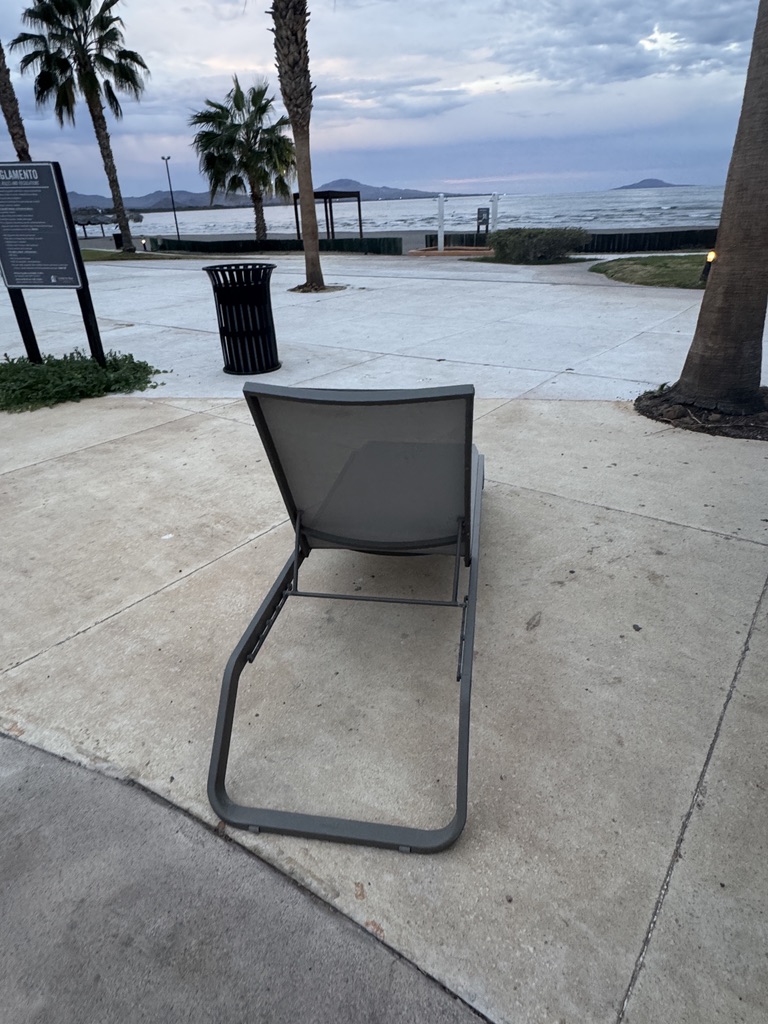
Image: Finding Space to be Alone
Photo Credit: Amy Tucker, 2026
Note. An empty chair symbolises the threshold between imposed isolation and chosen presence.
Loneliness, Solitude, and the Philosophical Distinction
Tillich extended this distinction beyond description to practice, arguing that loneliness can only be transformed by those who learn to bear solitude. He wrote that humans seek to feel their aloneness “not in pain and horror, but with joy and courage,” and that solitude itself can be understood as a form of spiritual or existential practice (Tillich, 1963, chap. 1). This framing anticipates contemporary understandings of solitude as an active, meaning-making process rather than a passive state, and provides a philosophical grounding for the concept of alonetude as the labour of transforming imposed isolation into chosen presence
There is a difference between loneliness and solitude. Philosophers have known this for centuries.
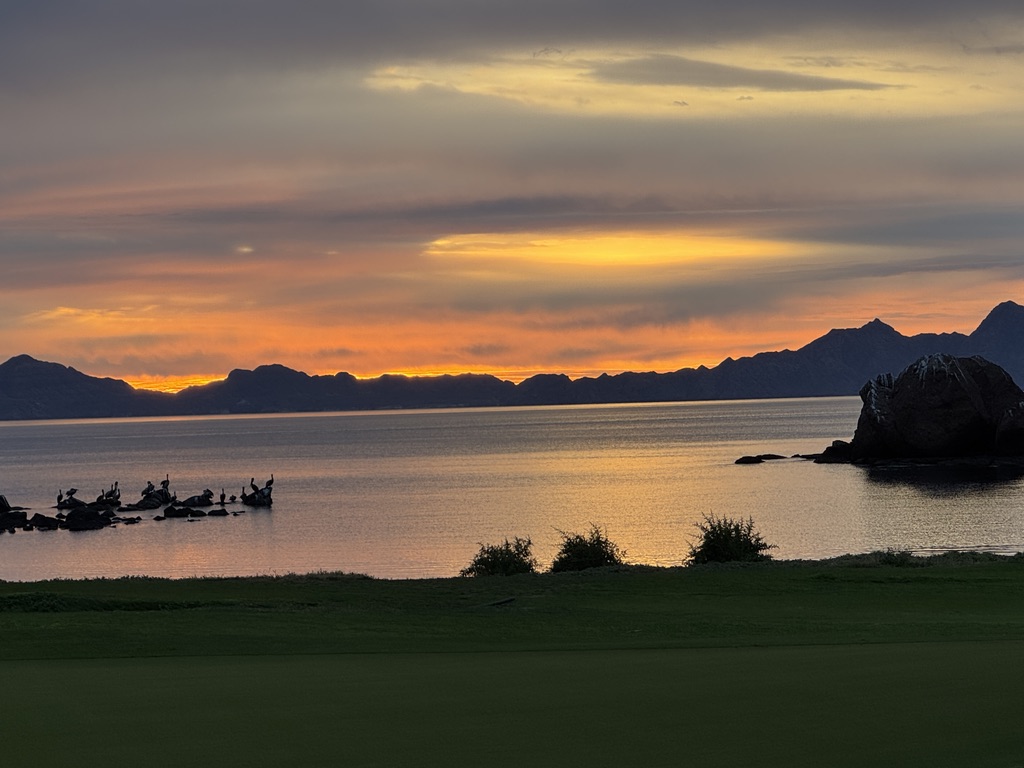
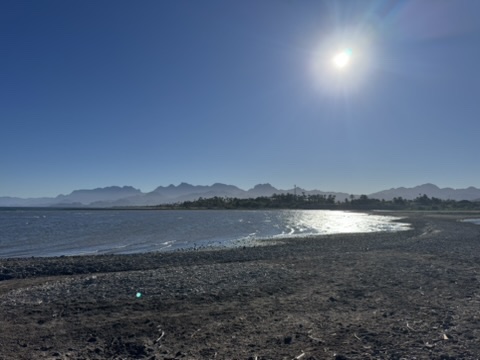
Image: The Liminal Threshold
Photo Credit: Amy Tucker, 2026
Note. A shoreline marking the in-between space where loneliness becomes alonetude.
Paul Tillich (1963) named it simply: loneliness expresses the pain of being alone, while solitude expresses its glory. Psychologist Anthony Storr (1988) challenged the assumption that intimate relationships serve as the only source of human happiness, arguing that solitude ranks alongside connection in its capacity to sustain well-being. Contemporary research confirms what contemplatives long understood: loneliness arises from perceived inadequacy of connection, while solitude emerges through chosen, meaningful engagement with oneself (Perlman & Peplau, 1981; Nguyen et al., 2018).
Loneliness is inflicted; solitude is chosen.
Loneliness is inflicted; solitude is chosen. Loneliness is the pain of being alone; solitude is the peace of it. To be lonely is to desire an absent want, to feel an emptiness that remains unsatisfied. To be solitary is to retreat into oneself and find, there, good company.
This framing resonates with, yet extends, existing scholarship on solitude (Storr, 1988), relational autonomy (Mackenzie & Stoljar, 2000), and affective infrastructures of belonging (Ahmed, 2017). However, alonetude departs from romanticised accounts of solitude by foregrounding structural constraint and political economy. It insists that the capacity to be alone generatively is unevenly distributed and socially produced. This study extends Tillich’s existential framing by situating being-alone within colonial, institutional, and political-economic architectures that unevenly distribute the capacity for solitu
Tillich’s existential theology offers an early philosophical distinction between loneliness, the suffering of being alone, and solitude, a generative form of being alone, situating solitude as an existential practice rather than a passive condition. His work frames solitude as a site of encounter, creativity, and ethical reflection, providing a conceptual genealogy for understanding being-alone as both refuge and critique. Building on this lineage, aloneness is theorised here as the labour of transforming imposed isolation into chosen presence within structurally produced conditions of separation (Tillich, 1963).
Tillich’s distinction provides a philosophical grounding for alonetude as the labour of transforming imposed isolation into chosen presence. By defining loneliness as the pain of being alone and solitude as its glory, Tillich establishes solitude as an existential achievement rather than a passive state. His framing implies that solitude must be borne, cultivated, and enacted, thereby opening conceptual space for alonetude as the agentic work of meaning-making within structurally imposed aloneness. While Tillich locates this transformation within existential theology, this study extends his genealogy into political economy and human rights, conceptualising aloneness as both refuge and critique within institutional architectures that produce separation.
But what happens in between?
Alonetude: The Space Between Loneliness and Solitude
“Loneliness expresses the pain of being alone; solitude expresses the glory of being alone.” (Tillich, 1963, chap. 1)
What do we call the space where loneliness has been imposed by circumstance, yet something in us begins to transform it into something generative? Where isolation, uninvited, slowly becomes a place we learn to inhabit?
I have started calling this alonetude: the liminal space between loneliness and solitude, where we do the quiet work of reclaiming our being-alone from the systems that made it a punishment.
In this work, alonetude is conceptualised as a relational, ethical, and political practice of being alone that emerges within structural conditions of isolation. Unlike solitude, which is typically framed as voluntary retreat, and loneliness, which is framed as social deficit, alonetude names the agentic labour of meaning-making within imposed aloneness. It is both an embodied practice and a critical analytic lens, situating individual experience within institutional and political architectures that produce separation.
Alonetude is the agentic labour of meaning-making within imposed aloneness.
Epidemic Loneliness and Institutional Responsibility
In May 2023, United States Surgeon General Dr. Vivek Murthy declared loneliness an epidemic, issuing an 82-page advisory on the healing effects of social connection and community (Office of the Surgeon General, 2023). By November of that year, the World Health Organization had launched a Commission on Social Connection, naming loneliness a pressing global health priority requiring urgent intervention (World Health Organization, 2023). The Commission’s 2025 flagship report revealed that loneliness accounts for approximately 871,000 deaths annually, equivalent to 100 deaths per hour (World Health Organization, 2025).
We are beginning to understand that chronic loneliness carries health risks comparable to smoking fifteen cigarettes daily (Holt-Lunstad et al., 2010). Social isolation increases the risk of premature death by nearly thirty percent, elevates stroke risk by thirty-two percent, and raises heart disease risk by twenty-nine percent (Office of the Surgeon General, 2023).
Yet the harder question remains unasked.
If loneliness is a public health crisis, is the capacity for solitude a human right?
I think it might be. And I think the distinction matters enormously for how we understand social justice.
Belonging, Solitude, and the Politics of Human Rights
Consider who has access to solitude and who is forced into loneliness.
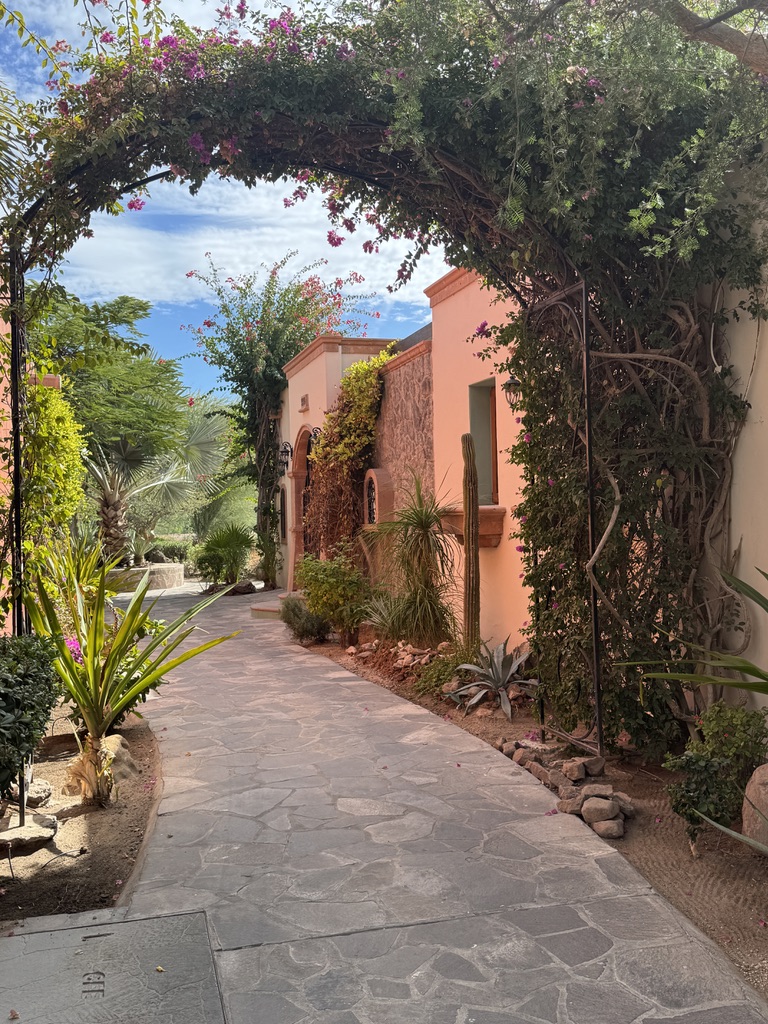
Image: The Privilege of Passage
Photo Credit: Amy Tucker, 2026
Note. A shaded walkway framed by flowering vines and cultivated desert plants, symbolising solitude as a curated and protected passage. The image evokes how access to quiet, beauty, and withdrawal is often architected, maintained, and unevenly distributed, highlighting solitude as a spatial and political privilege rather than a universally available condition.
The elite retreat to cabins in the woods, meditation centres, and silent spas. They pay for the privilege of being beautifully alone. Meanwhile, the precarious are isolated by design.
The elite retreat to cabins in the woods, meditation centres, and silent spas. They pay for the privilege of being beautifully alone. Meanwhile, the precarious are isolated by design: by shift work that fails to align with anyone else’s schedule, by housing too expensive to afford near community, by immigration policies that separate families across oceans, by institutions that count bodies yet fail to learn names.
Their aloneness is uninvited. It is inflicted.
And then I wonder why I struggle.
My solitude is partially chosen and partially imposed, shaped by precarity, digital tethering, and institutional expectations of constant availability.
I write this from a bench behind an institutional building, between meetings that require presence and systems that rarely offer belonging. My solitude is partially chosen and partially imposed, shaped by precarity, digital tethering, and institutional expectations of constant availability. Alonetude becomes both a refuge and a critique, a way of surviving while refusing to normalise the conditions that make refuge necessary.
Belonging, Isolation, and Rights-Based Frameworks
Contemplative teachers have long pointed toward this transformative potential.
Pema Chödrön (2000) teaches that we must learn to befriend our loneliness rather than flee it, to sit with discomfort until it reveals what it has to teach. Wendell Berry (2012) writes that in wild places, where we are without human obligation, our inner voices become audible, and the more coherent we become within ourselves, the more fully we enter into communion with all creatures. Robin Wall Kimmerer (2013) braids Indigenous wisdom with scientific attention, showing how presence to place can root us even when we have been displaced.
Viktor Frankl (1959), writing from the concentration camps, insisted that meaning could be made even in extremity, that the last human freedom is the ability to choose one’s attitude toward suffering.
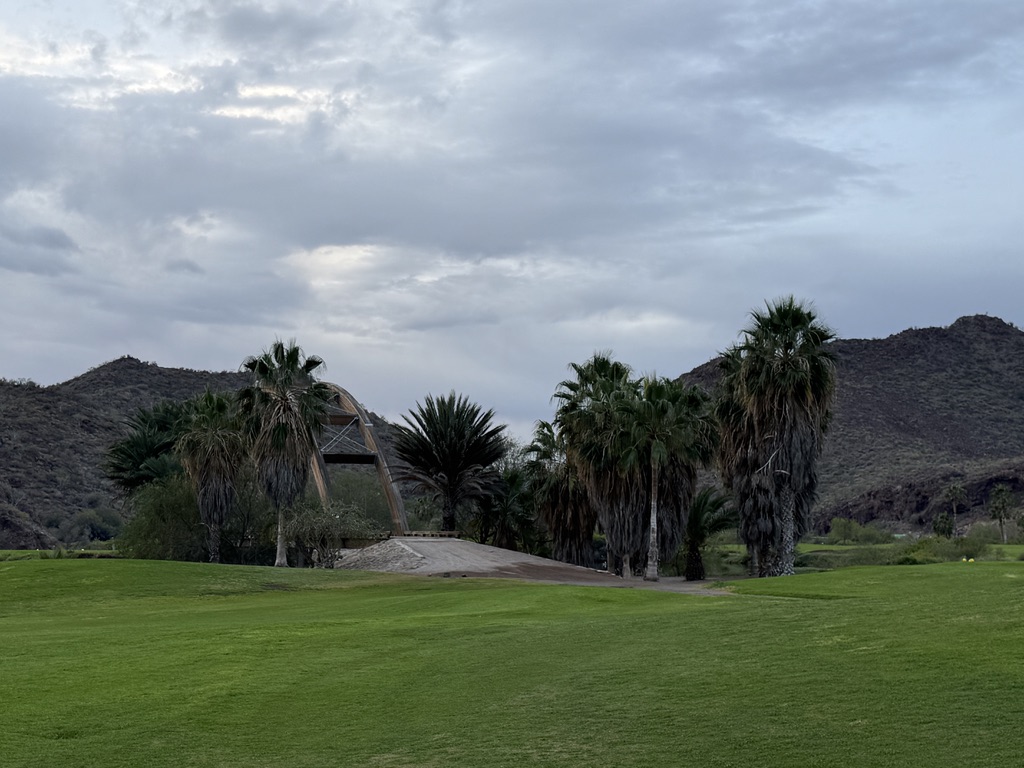
Image: Learning to Be With
Photo Credit: Amy Tucker, 2026
Note. Paths and landscapes evoke contemplative traditions and relational presence to land. These teachers point toward alonetude as a practice of survival.
When loneliness is imposed, solitude must be cultivated. When isolation is structural, transforming it into something generative becomes an act of resistance.
In digital academic and organizational contexts, solitude is increasingly rendered impossible by surveillance infrastructures: learning analytics, productivity metrics, email expectations, and algorithmic visibility regimes. These systems blur the boundary between connection and extraction, making withdrawal appear as deviance rather than necessity. A right to solitude, therefore, intersects with critiques of surveillance capitalism and institutional time extraction.
Should We Have to Be So Resilient?
This is what troubles me.
Should the capacity to transmute loneliness into solitude be a survival skill that the marginalised must develop because institutions refuse to stop producing isolation?
A human rights framework asks different questions.
It asks what conditions would make the choice between loneliness and solitude genuinely available, rather than asking how individuals can cope with loneliness after it has been inflicted. It asks what structures produce isolation and who benefits from that production. It asks whether belonging is offered as a right or withheld as a privilege. It asks whether the architecture of our institutions is designed to connect or to extract.
The Political Economy of Being Alone
The right to solitude would mean the right to be alone without being abandoned.
The right to withdraw without being punished.
The right to rest without being surveilled.
The right to enough economic security so that being alone carries no threat of danger.
The right to enough social infrastructure means that being with others remains possible when we want it.
These are human rights claims, even if they rarely appear in declarations. While international human rights instruments rarely articulate a right to solitude, related protections appear in rights to privacy, dignity, rest, housing, social security, and family life (Universal Declaration of Human Rights, 1948; International Covenant on Economic, Social and Cultural Rights, 1966). A right to solitude without abandonment can be understood as an emergent synthesis of these rights, grounded in the principle that human dignity requires both connection and the capacity for withdrawal without harm.
Solitude Without Abandonment: Toward a Human Rights Framework for Alonetude
Alonetude names the in-between.
The place where we do the work of turning imposed isolation into chosen presence. It honours the agency of those who find ways to be well even when systems are designed to make them unwell.
Yet it also refuses to let those systems escape accountability.
The goal is to become so skilled at alonetude that we forget we deserve justice. The goal is a world where solitude is available to everyone, and loneliness is inflicted on no one.
Until then, we practise.
We find our benches behind old buildings. We learn the names of the birds outside our windows. We sit with what is, until it becomes bearable, and then, sometimes, beautiful.
This is survival while we work to end what makes survival necessary.
Reframing solitude as a human rights concern invites institutional redesign: policies that protect digital disconnection, labour structures that align schedules with community rhythms, housing and immigration policies that reduce forced separation, and pedagogical architectures that prioritise relationality over throughput. Justice, in this sense, is infrastructural.
The goal is a world where solitude is available to everyone, and loneliness is inflicted on no one.
Alonetude is both a practice and a demand.
A way of being and a horizon of justice.
The quiet place where, alone, we remember that we deserve to be.
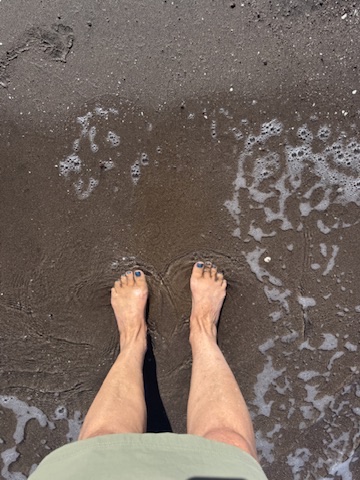
Image: The Quiet Place Where We Deserve to Be
Photo Credit: Amy Tucker, 2026
Note. Bare feet at the water’s edge, where land meets sea, mark a moment of grounded presence. The image evokes solitude as an embodied encounter rather than absence, being alone while held by place, rhythm, and movement. It gestures toward alonetude as a practice of standing with oneself at the threshold between isolation and connection, presence and belonging, survival and becoming.
Alonetude thus operates as both method and mandate: a practice of surviving within unjust architectures and a theoretical lens for imagining their transformation.
References
Ahmed, S. (2017). Living a feminist life. Duke University Press.
Berry, W. (2012). It all turns on affection: The Jefferson lecture and other essays. Counterpoint.
Chödrön, P. (2000). When things fall apart: Heart advice for difficult times. Shambhala.
Frankl, V. E. (1959). Man’s search for meaning. Beacon Press.
Holt-Lunstad, J., Smith, T. B., & Layton, J. B. (2010). Social relationships and mortality risk: A meta-analytic review. PLOS Medicine, 7(7), Article e1000316. https://doi.org/10.1371/journal.pmed.1000316
Kimmerer, R. W. (2013). Braiding sweetgrass: Indigenous wisdom, scientific knowledge, and the teachings of plants. Milkweed Editions.
Ahmed, S. (2017). Living a feminist life. Duke University Press.
Mackenzie, C., & Stoljar, N. (Eds.). (2000). Relational autonomy: Feminist perspectives on autonomy, agency, and the social self. Oxford University Press.
Nguyen, T. T., Ryan, R. M., & Deci, E. L. (2018). Solitude as an approach to affective self-regulation. Personality and Social Psychology Bulletin, 44(1), 92–106. https://doi.org/10.1177/0146167217733073
Perlman, D., & Peplau, L. A. (1981). Toward a social psychology of loneliness. In S. Duck & R. Gilmour (Eds.), Personal relationships 3: Personal relationships in disorder (pp. 31–56). Academic Press.
Storr, A. (1988). Solitude: A return to the self. Free Press.
Tillich, P. (1963). The eternal now. Charles Scribner’s Sons.
World Health Organization. (2025). From loneliness to social connection: Charting a path to healthier societies. Report of the WHO Commission on Social Connection. https://www.who.int/publications/i/item/9789240112360
The quiet place where, alone, we remember that we deserve to be.
Note: Tillich’s distinction between loneliness and solitude emerges from Western Christian existential theology and reflects Euro-American philosophical traditions that centre individual subjectivity and spiritual interiority. While this study draws on Tillich to establish a conceptual genealogy for being-alone, the concept of alonetude extends beyond this tradition by foregrounding colonial, institutional, and political-economic structures that differentially produce isolation. Rather than treating solitude as a universal existential condition, alonetude situates being-alone within histories of dispossession, migration, academic precarity, and governance, aligning with decolonial and relational epistemologies that understand solitude as socially and materially mediated.1
Translation note. Spanish language passages in this post were generated using Google Translate and subsequently reviewed and refined by the author. Translations are intended to convey general meaning and are intended as guides to meaning rather than certified linguistic interpretations.
Content Warning: This post contains reflections on grief, loss, and emotional exhaustion. Please care for yourself as you read, and feel free to step away if you need to.
On Randy Pausch, Childhood Play, and Learning to Remember at Sixty
Credit: Randy Pausch, The Last Lecture, 2007
I brought Randy Pausch’s The Last Lecture with me to Mexico. Someone gave it to me years ago, and I never had a chance to read it. Too busy. Too many other things are demanding attention. Too much work to do. I have watched and rewatched the video several times, it is one of my favourites to return to when I feel uncertain about my life.
But two weeks into this retreat, with time stretching out in ways that felt entirely unfamiliar, I picked it up. Started reading. And Randy asked a question that stopped me cold: What were your childhood dreams?
¿Cuáles eran tus sueños de infancia?
He wrote about his own experiences: being in zero gravity, playing in the NFL, authoring an article for the World Book Encyclopedia, being Captain Kirk, winning stuffed animals at amusement parks, and being a Disney Imagineer (Pausch & Zaslow, 2008). He could name them. List them. Tell the stories of how he pursued each one.
I closed the book and sat there for a long time, reluctant to answer. Because the honest answer was: I find myself drawing a blank. No me acuerdo. The memories feel distant, blurred at the edges.
I remember that I had them. I know there were things I wanted to be, do, and become. But somewhere between seven and sixty, those dreams got buried under layers of survival, responsibility, and the endless work of just getting through.
Enterrados. Buried. Pero no muertos. But still alive, buried beneath the surface.
And I realised: the same thing that suppressed my capacity for play also suppressed my ability to remember what I wanted before I learned what was realistic, achievable, and appropriate for someone with my background, resources, and limitations.
La misma cosa. The same thing. El juego y los sueños, ambos enterrados juntos. Play and dreams, both buried together.
I am sixty years old, and that question stops me completely. ¿Qué quería ser? What did I want to be?
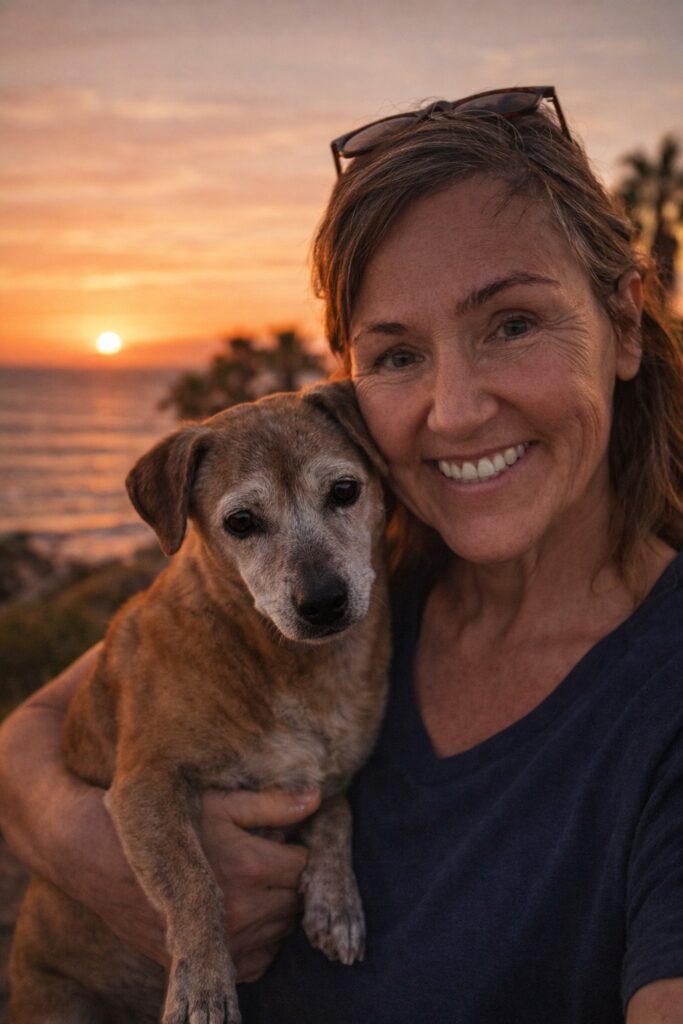
Senior Puppy
And yet it hurts more than I expected. But it does. Because it means I have spent decades living without reference to those early desires. Without even remembering they existed. Without asking: what did that seven-year-old want? And does she still want it? And if she does, what would it take to give it to her?
Randy Pausch had an engineering problem. He had months to live, children to teach, and dreams to pass on. My problem is different but somehow related. I have years left, hopefully decades. But I have lost contact with the person who knew how to dream without editing, who knew how to want without calculating the probability of success, who knew how to play without needing justification.
And I am trying to find her again.
I have been reading this book slowly. A few pages each morning on the patio. Letting it sit with me. Letting Randy’s urgency teach me something about my own squandered time. Letting his clarity about what matters help me see what I have been avoiding.
¿Qué pasó con los sueños? What happened to the dreams?
¿Dónde están ahora? Where are they now?
What Randy Knew that I Forgot
I keep coming back to this as I read: Randy Pausch’s lecture is about achieving childhood dreams. But underneath that is something more fundamental: he remembered what they were. He could name them. He could tell you which ones he achieved, which ones he enabled for others, and which ones he had to let go.
He stayed connected to that child self who wanted things before learning whether wanting them was wise, possible, or realistic.
My Sweet Seniorita
I lost that connection.
Somewhere along the way, growing up in circumstances that required constant adaptation, resilience, and reinvention, I lost track of what I originally wanted. Or maybe I decided those wants were dangerous. Distracting. Luxuries that felt impossible to hold onto when survival required all my attention.
Brown and Vaughan (2009) argue that childhood play deprivation creates deficits that persist into adulthood. But I had play as a child. I played. I had imagination. I had dreams. I had that glorious, unselfconscious absorption in make-believe, adventure, and creating worlds that answered to imagination alone.
But somewhere between childhood and adulthood, I put all of that away. And the strangest part is that the moment I decided to stop has vanished from memory. It happened quietly, without drama. Just a gradual fading. A slow erasure. Until one day I looked around and realised every want had become attached to a strategic purpose or an external expectation.
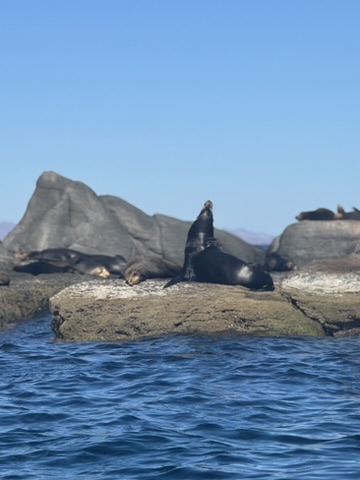
Randy kept his dreams. I lost mine. And sitting here at sixty, watching sea lions play, I am trying to understand: how do you find what you have lost when the memory itself has faded?
The Dream I Do Remember
El Sueño Que Sí Recuerdo
There is one dream I remember. Barely. Faintly. Like something seen through fog.
I wanted to be a writer.
Quería ser escritora.
A real storyteller. Someone who writes outside the academy, beyond peer review. Simply a writer. Una escritora de verdad. Someone who tells stories. Someone who makes meaning through words. Someone whose writing helps other people understand themselves better, feel less alone, find language for experiences that felt too big or too complicated or too shameful to name.
I remember sitting in my grandmother’s house as a child, reading books, thinking: I want to do this. I want to make people feel the way this book makes me feel. Connected. Understood. Less alone.
And then I grew up and learned all the reasons to be cautious. That serious people have backup plans. That you need security before you can afford creativity. That passion alone leaves you exposed.
So I became a scholar instead. Learned to write in ways that met academic standards. Learned to produce work that served institutional needs. Learned to measure success by publications, citations, and conference presentations.
And somewhere in all that learning, I stopped writing the kind of writing that made me want to write in the first place.
This retreat is me trying to find that again. This blog. These daily reflections. This attempt to write in ways that sound like thinking, that honour experience as data, that trust that someone reading this might feel less alone because I am willing to say: I lost my dreams. I forgot how to want. I put away play because I thought I had to in order to survive.
Nash (2004) calls this Scholarly Personal Narrative. A methodology that allows lived experience to count as data when properly theorised and critically examined. But underneath the methodology is something simpler: permission. Permission to write the way I wanted to write before I learned all the rules about how writing should sound.
Randy achieved his childhood dreams. I am trying to remember mine. And maybe that is okay. Maybe sixty is exactly the right time to ask: what did I want before I learned to want only achievable things? And what would it mean to give that to myself now, even if it looks different than it would have looked at seven?
My Sweet Lady
Here is what I am learning: play and childhood dreams are connected in ways I am only beginning to understand.
Dreams are what you want. Los sueños son lo que quieres. Play is how you practice wanting. El juego es cómo practicas querer. Children play at being the things they dream about. Play astronaut. Play teacher. Play explorer. Play artist. The play is how the dream stays alive. How it gets rehearsed. How the child learns what that dream might feel like if it came true.
When you stop playing, you stop wanting to practice. Cuando dejas de jugar, dejas de practicar querer. And when you stop wanting to practice, the dreams fade. Gradually. Poco a poco. Until you can no longer remember what they were.
I stopped playing because survival required seriousness. And when I stopped playing, I stopped rehearsing the dreams. Stopped imagining what they would feel like. Stopped giving them shape, texture, and presence in my daily life.
And now, as I try to recover play, I am discovering: the dreams are still there. Buried. Waiting. They resist direct thinking, analysis, or strategic planning. I have to play my way back to them.
Winnicott (1971) writes about play as the location where we discover who we are and what we want. Through the spontaneous, creative, unselfconscious exploration that play allows, rather than through serious self-examination. Play is how we find out what brings us alive. What captures our attention. What we return to again and again, because it calls to something essential in us.
Watching sea lions yesterday, I felt something wake up. Algo despertó. A feeling rather than a specific dream. Simply the sense that dreaming is possible. Que soñar es posible. That wanting things just because I want them is allowed. That every desire deserves to exist without a justification, without strategic reasoning, probability analysis, or risk assessment.
My Sweet Love
I came back to the cottage and read more of Randy’s book. Read about how he pursued his dreams because they called to him, regardless of whether they made sense. And I thought: the sea lions understand this instinctively. Randy understood it consciously. And I am somewhere in between, trying to learn what both of them already know.
The sea lions want to play. So they play. Quieren jugar. Entonces juegan. They want to ride waves. So they ride them. They want to leap. So they leap. Quieren saltar. Entonces saltan. There is no gap between wanting and doing. No hay brecha entre querer y hacer. No calculation about whether the want is realistic, appropriate, or likely to succeed.
And watching them, I thought: I used to be like that. Before I learned to edit my wants. Before I learned that some dreams are more acceptable than others. Before I learned that admitting you want something gives people the power to disappoint you, wanting something too much felt like exposure, like handing someone the power to hurt me.
The sea lions remain fully open to wanting. They want fully. They play fully. They risk disappointment by trying. And they seem… joyful. Alive. Present.
I want that back.
Sea Puppies
Randy’s Time Limit, My Extension
El Tiempo de Randy y Mi Tiempo
Randy Pausch had months. Randy tenía meses. I have years, probably decades. Yo tengo años, probablemente décadas.
He used his limited time to pass on everything he wanted his children to know. To enable others’ dreams. To teach his final lessons about living well. Randy wrote that he was trying to put himself in a bottle that would wash ashore for his children someday (Pausch & Zaslow, 2008, p. 10). A way of being present even in his absence. A way of teaching everything he hoped to pass on, even beyond his living years.
I have the opposite problem: too much time. Demasiado tiempo. Enough time that I keep postponing. Keep thinking: I will do that later. Lo haré más tarde. I will write that book someday. Algún día. I will pursue that dream when I have more security, more time, more energy, and more certainty that it will work out.
But here is what Randy’s lecture teaches without saying it directly: time limits clarify. Los límites de tiempo aclaran. When you know time is short, you stop negotiating with yourself about what matters. You stop waiting for conditions to be perfect. You stop postponing joy until after you have finished all the serious work.
You do what matters. Now. Ahora. Because now is all you have. Porque ahora es todo lo que tienes.
His urgency is foreign to me. But I am learning to borrow some of it. Because sixty carries a particular kind of weight. Because the time I am squandering waiting for perfect conditions is time that passes regardless. Because every day I spend avoiding the writing I want to do, the play I once knew, the dreams I have yet to recover, is a day lived at partial capacity.
The urgency is real, even without a terminal diagnosis. Living fully asks only for honesty about what matters. It just requires recognising that postponing joy is a choice. And it is a choice I have been making unconsciously for decades.
Randy made the conscious choice to live fully in his remaining months. I am trying to make the conscious choice to live fully in my remaining decades. Because time is precious even when there is plenty of it. Because I have one life and it is happening now, and I want to arrive at the end having asked, clearly and honestly: what did I want? Did I give it to myself? And if I delayed, why?
Lo Que El Juego Enseña Sobre Los Sueños
I have been playing for two weeks now. Small ways. Tentative ways. Humming. Swimming for pleasure. Skipping three steps. Following curiosity without needing it to be productive.
And something entirely unexpected is happening: wants are surfacing.
Los deseos están surgiendo. Wants. Deseos.
Small wants at first. I want to swim longer. Quiero nadar más tiempo. I want to sit and watch pelicans without checking the time. I want to write this blog post even though it falls outside my thesis word count. I want to buy this small carved turtle from the vendor on the beach, simply because looking at it makes me happy.
Small wants. Deseos pequeños. Silly wants, maybe. Wants that serve no strategic purpose and advance no career goal. Just wants. Solamente deseos.
And underneath the small wants, larger ones are stirring. Still foggy. Still too foggy to name precisely. But there. Waiting. Getting stronger as I practice the small wants, as I learn that wanting is allowed, as I remember that I am allowed to pursue things just because they call to me.
I think this is how you find lost dreams. Thinking about them directly leads nowhere. Analyzing what you should want, what you used to want, or what you ought to want now only takes you further from the answer. But by practicing wanting in small ways until the muscle memory comes back. Until wanting feels safe enough that bigger wants can surface. Until you trust yourself enough to say, “This is what I want.” And I am going to pursue it because it calls to something in me that has been silent for too long, regardless of whether it is realistic, appropriate, or likely to succeed.
Randy Pausch enabled others’ dreams. Taught his students to pursue theirs. Passed them on to his children. He understood that helping others achieve their childhood dreams was as important as achieving his own, maybe more important (Pausch & Zaslow, 2008). He called it the “head fake.” The real learning, the real gift, lived inside what pursuing it taught you about yourself and what you could become.
I am enabling my own dream. The one I forgot I had. The one that is still there, underneath all the layers of learned seriousness, strategic thinking, and a protective refusal to want.
The dream of writing. Really writing. The kind that helps people feel less alone. The kind that tells truths I was trained to suppress. The kind that sounds like me, the full me rather than the academic persona I learned to perform.
This blog is me practicing. This retreat is me creating conditions where that dream can breathe again. These 30 days are me trying to become the kind of person who can say, “I want this.” And then pursue it. Now. Today, while there is still time.
Key Takeaways: What Randy Taught Me
1. Dreams endure. They simply get buried.
Los sueños no mueren. Simplemente se entierran.
Randy stayed connected to his. I buried mine. But buried means recoverable. Enterrado no está muerto. Buried can be excavated. It just takes time, attention, and willingness to dig through all the layers that accumulated on top.
2. Play is how you practice wanting.
El juego es cómo practicas querer.
Children know this instinctively. Adults forget it. But the mechanism still works at sixty the same way it worked at seven. When you play, what surfaces? Cuando juegas, los deseos surgen. The trick is to allow them rather than to edit or dismiss them immediately.
3. Time limits clarified. But living fully asks only for clarity, which anyone can choose.
Los límites de tiempo aclaran. Pero no necesitas un diagnóstico terminal para vivir plenamente.
Randy had months. I have decades. But I can borrow his clarity without needing his urgency. Can ask: if time were short, what would matter? And then do that. Now. Ahora. While there is still time. Mientras aún hay tiempo.
4. Enabling your own dreams counts.
Habilitar tus propios sueños cuenta.
Randy enabled others’ dreams. That was his path. Mine is different. I am learning to enable my own. Learning that this is both essential and earned. No es egoísta sino necesario. Helping others find their dreams begins with tending to my own.
5. It is never too late to become who you wanted to be.
Nunca es demasiado tarde para convertirte en quien querías ser.
At seven, I wanted to be a writer who helps people feel less alone. At sixty, I am becoming that. A los sesenta, me estoy convirtiendo en eso. Slowly. Imperfectly. But really. Pero realmente. And the fact that it took fifty-three years to get here makes it more hard-won, more real. Just delayed. And delays can be recovered from.
The Dreams at Sixty Look Different Than the Dream at Seven
I need to say this clearly: My aim is to become the sixty-year-old who knows how to want the way that seven-year-old did. Fully. Completamente. Without apologising. Sin disculparse. Without needing permission. Sin necesitar permiso.
The dream at sixty looks different from what it would have looked like at seven. It is complicated by everything I have learned, everything I have lived through, everything I know now about how the world works, how hard things are, and how much survival costs.
But it is also enriched by all of that. Pero también está enriquecido por todo eso. The writing I can do now is writing that a seven-year-old was incapable of doing. Because it is informed by sixty years of living. By loss and love and chronic stress and hard-won healing. Por pérdida y amor, por estrés crónico y por curación ganada con dificultad. By understanding that comes only from decades of paying attention.
Randy achieved his childhood dreams by becoming exactly who that child wanted to be. I am achieving mine by becoming who that child would have grown into if she had been allowed to keep wanting, keep dreaming, keep playing all along.
Different paths. Caminos diferentes. Same destination: living fully. Vivir plenamente. Wanting openly. Querer abiertamente. Pursuing dreams because they are real, because they are mine. Perseguir sueños no porque sean realistas, sino porque son reales.
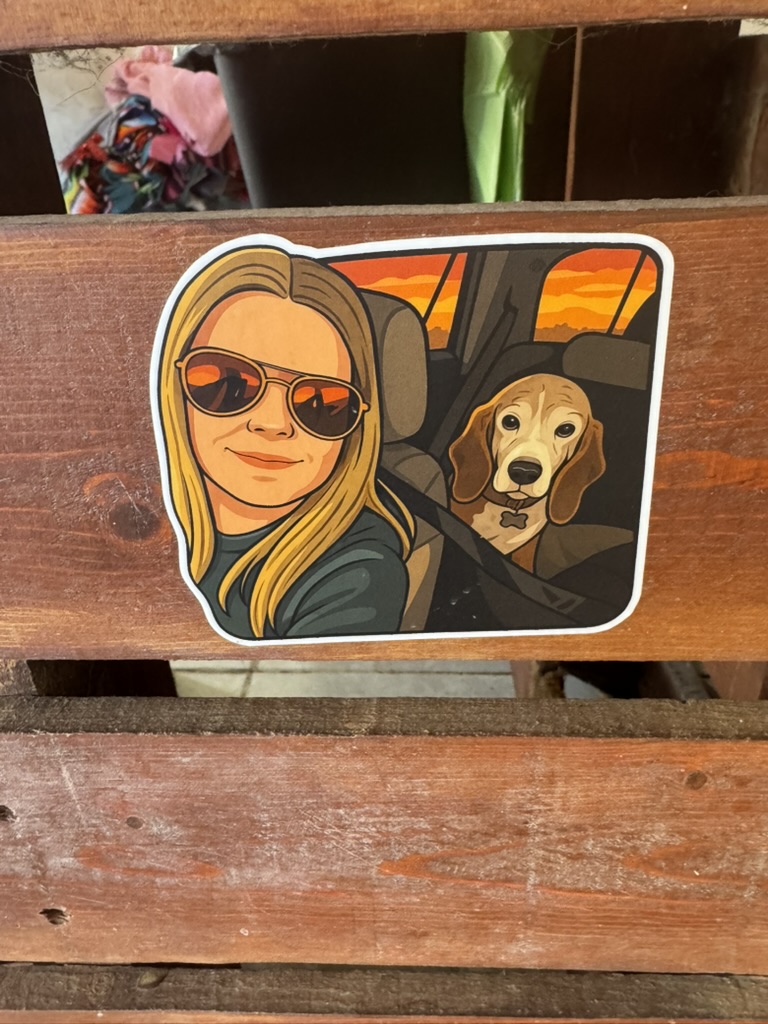
Photo of a Bumper Sticker
Gracias, Randy, por preguntar qué soñábamos. Thank you, Randy, for asking what we dreamed.
Por recordarme que tuve sueños. To remind me, I had dreams.
Por mostrarme que nunca es demasiado tarde. For showing me that it is never too late.
Por enseñarme que el juego y los sueños están conectados. For teaching me that play and dreams are connected.
Por vivir completamente hasta el final. For living fully until the end.
Por darme permiso para hacer lo mismo. For giving me permission to do the same.
Con décadas por delante, no meses. With decades ahead.
Pero con la misma urgencia de vivir bien. But with the same urgency to live well.
Ahora. Now.
Mientras aún hay tiempo. While there is still time.
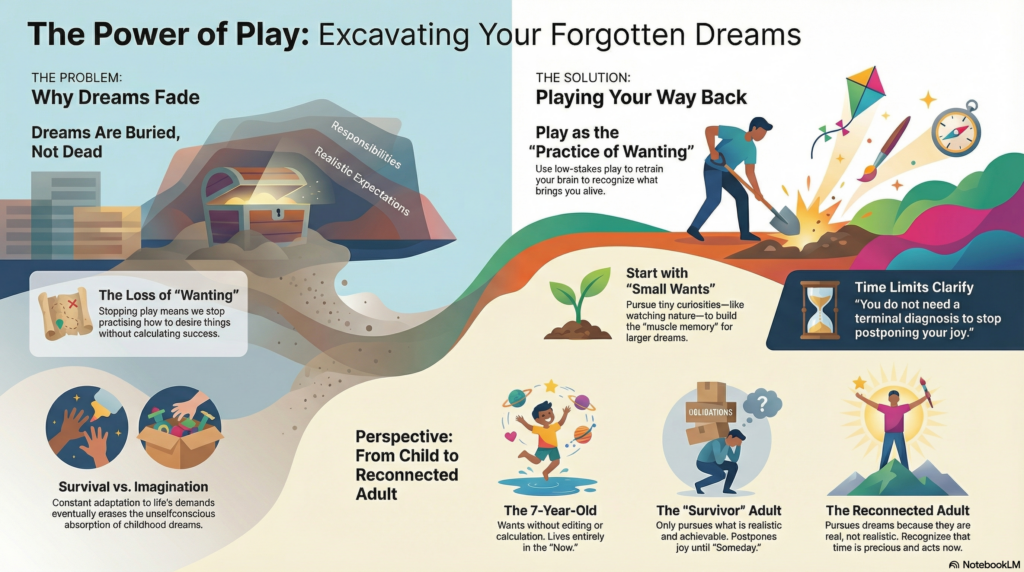
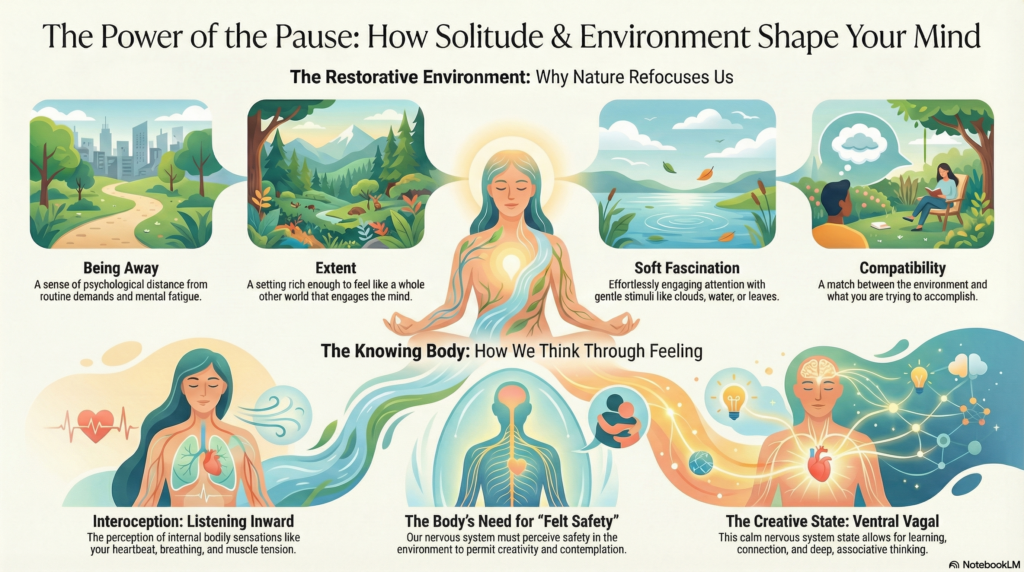
The Power of Play
Credit: NotebookLM, 2026
Thank you for the reminder, Randy.
Translation note. Spanish language passages were generated using Google Translate and subsequently reviewed and refined by the author. Any remaining infelicities reflect the limits of machine translation rather than intent.
References
Google. (n.d.). Google Translate. https://translate.google.com
Pausch, R., & Zaslow, J. (2008). The last lecture. Hyperion.
Pausch, R. (2007). Randy Pausch’s last lecture: Achieving your childhood dreams [Video]. YouTube. https://www.youtube.com/watch?v=ji5_MqicxSo
Actually, truly impossible. Beyond figure. The density of them. The brightness. The way they fill every inch of darkness between the horizon and directly overhead. I have been standing on the patio for twenty minutes, and I cannot get used to it. Cannot stop staring up. Cannot stop feeling small in the way that makes you feel more real, more present.
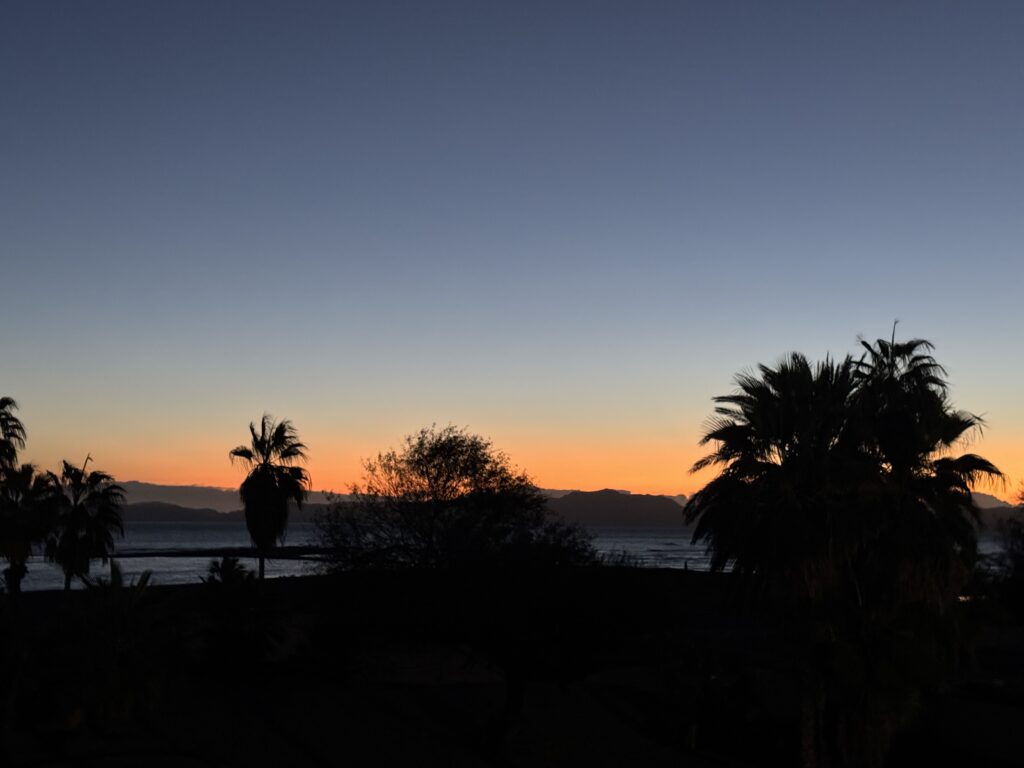
The Sea of Cortez is black at this hour. No moon tonight. Just stars reflected on the water, so the surface still looks like a second sky. I cannot tell where the ocean ends and the atmosphere begins. It is all just darkness held between points of light.
Estrellas sobre el mar. Stars over the sea.
What City Skies Hide
I grew up under city skies where you could see perhaps a dozen stars on a clear night. The Big Dipper, if you knew where to look. Maybe Orion in winter. The rest washed out by streetlights and shopping mall parking lots and the general glow of human activity that makes us forget the sky is actually full of light we cannot see until we get far enough away from our own brightness.
Here, there is no artificial light competing. The village has streetlights, but they are few and dim. Most houses are dark by nine. The ocean holds no light except what the stars give it. And the stars give everything.
I have been trying to count them and cannot. Have been trying to identify constellations and cannot find the patterns I know because there are too many stars, too much light, and the familiar shapes are lost in the density of what surrounds them. This is the Milky Way at its fullest. The galactic centre is visible as a bright band crossing the southern sky. Thousands upon thousands of stars. And behind them, thousands more.
The Scale That Holds Us
There is something humbling about this much sky.
Humbling beyond the degrading sense. Humbling in the way that reminds you that you are small and temporary and your concerns, however real they feel, are brief against the scale of what continues regardless of whether you are here to see it.
These stars have been shining for millions of years. Will continue shining for millions more. The light I am seeing left those stars before humans existed. Before mammals existed. Before anything I would recognise as life walked, swam, or flew on this planet. That light has been travelling through space for so long that the star that produced it might already be dead, its light still arriving, the ghost of something that no longer exists still visible because of the time it takes for distance to be crossed.
Luz antigua. Ancient light.
Witness and Significance
I am standing here, on the edge of land, looking at light older than memory, older than species, older than the oceans themselves. And it makes my life feel both infinitely small and strangely significant. Small because what am I against this scale? Significant because I am here to witness it. Because consciousness has emerged in this universe that can look up and feel awe. Because somewhere in the process of stars burning and planets forming and life evolving, something became aware enough to stand on a beach at night and feel moved by the impossibility of so much light.
What Weight Looks Like Against Stars
I think about the past six months. The past twenty-five years. The exhaustion. The depletion. The way I have been carrying weight has felt unbearable.
And against this sky, it persists. The weight is still real. The suffering is still real. But it is held in a different frame. Held by something larger than my capacity to hold it. The stars hold no record of my struggles or my presence. But somehow their indifference is comforting rather than cold.
I am here. I am looking up. I am held by the same gravity that holds these stars, the same darkness that lets their light shine, the same universe that has been unfolding for billions of years and will continue to unfold long after I am gone.
Soy pequeña. I am small.
Soy temporal. I am temporary.
Y está bien. And that is okay.
The Relief of Accepting Scale
There is relief in accepting scale. In acknowledging that my life is brief, my concerns local, my influence limited. I can release the weight of everything. I can leave what cannot be fixed to its own time. I can simply be here, for this moment, under these stars, breathing this air, feeling this particular configuration of matter that is temporarily organised as me.
Sky Above, Sky Below
The water is so still tonight that it looks like glass. Dark glass. The stars reflecting on it in perfect points of light that hold perfectly still. Without my standing here, there would be only darkness and light, no visible water. Just darkness and light. Sky above. Sky below. And me between them, small and temporary and held.
Gracias, estrellas. Thank you, stars.
Por brillar sin necesitarme. For shining without needing me.
Por recordarme mi lugar. For reminding me of my place.
Por sostener la oscuridad. For holding the darkness.
Para que pueda ver la luz. So that I can see the light.
What Continues
Tomorrow the sun will rise, and I will no longer be able to see the stars. But they will still be there. Still burning. Still sending light across distances I cannot comprehend toward planets I will never see.
And I will still be here. Small. Temporary. Held by the same universe that holds everything.
Suficiente. Sufficient.
Just this. Just now. Just one small human standing under impossible stars, learning to accept the relief that comes from recognising your own smallness in a universe so large it cannot even notice you are here.
And finding, in that recognition, something very close to peace.
Translation Note
Note. Spanish-language passages were generated using Google Translate (Google, n.d.) and subsequently reviewed and refined by the author. Any remaining infelicities reflect the limits of machine translation rather than intent.
References
Google. (n.d.). Google Translate. https://translate.google.com
By one o’clock, the temperature has climbed into the mid-thirties, and the village has responded the way it responds every afternoon: by stopping. Shops close. Streets empty. Even the dogs find shade and cease their wandering.
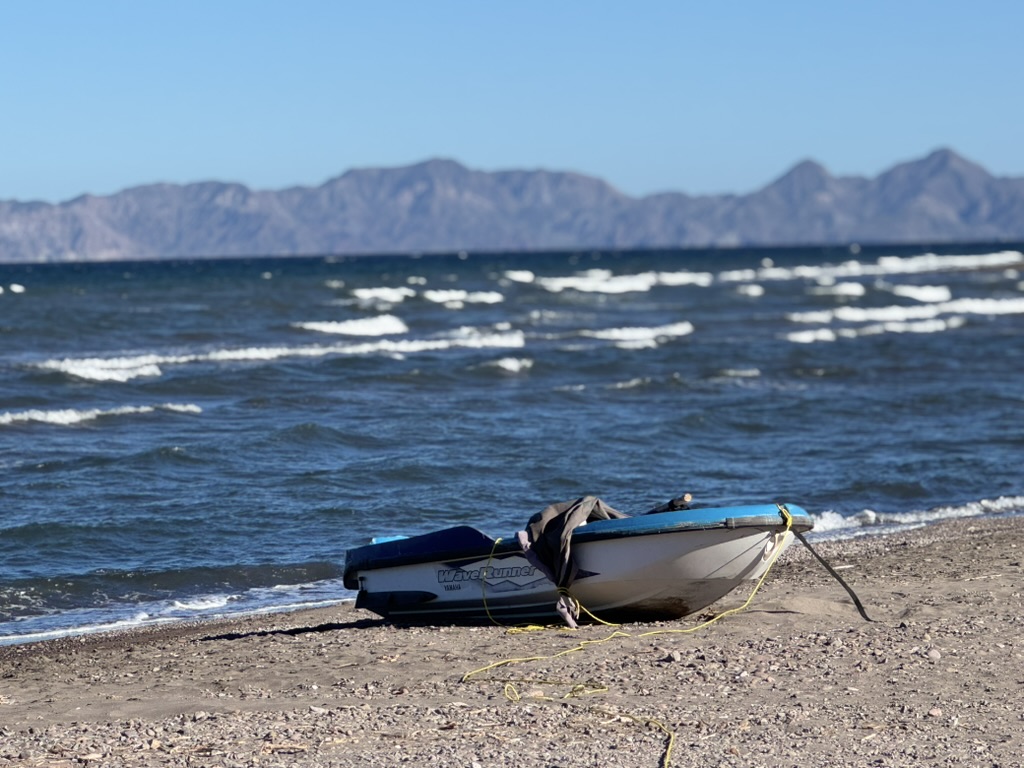
Fishing Boat
Photo Credit: Amy Tucker, 2026
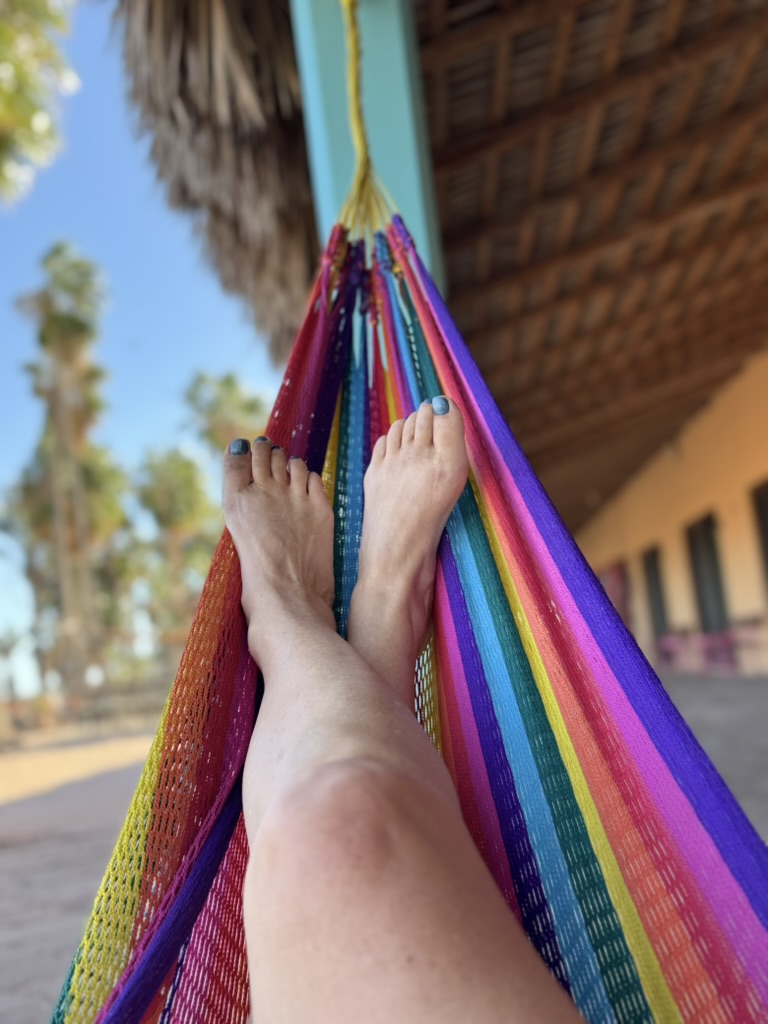
I am learning this rhythm. Joining the collective surrender to the heat rather than fighting it. After lunch, I close the curtains against the sun, lie on the bed under the ceiling fan, and simply rest.
Rest, rather than sleep. The body horizontal, the mind quiet, time passing without purpose or productivity.
This is siesta. The practical wisdom of a place beyond romanticised tourism, a place that knows heat must be respected. You stop. You release the push-through. You rest. You wait for the world to become livable again.
For twelve days now, I have been learning to stop without guilt. To rest without justifying it. To simply be horizontal in the afternoon heat and let that be enough.
Today, it finally feels natural. Simply the appropriate response to what the day is asking.
El calor manda. The heat commands.
Y yo obedezco. And I obey.
Day’s of My Life
By three o’clock, the worst has passed. The temperature remains high, but the quality changes. Bearable. Moveable. I get up, drink water, and sit on the shaded patio watching the water.
A pelican flies past. Low and slow. Unhurried.
The village is beginning to wake again. A shop door opens. A car starts. Life resuming its rhythm, altered by the heat and still intact.
I think about the years I spent overriding my body’s signals. Tired but pushing through. Hot but staying at the desk. Needing rest but never quite allowing it because rest felt like failure, like giving up, like evidence that I lacked the strength others seemed to carry so easily.
Afternoon Skies
Photo Credit: Amy Tucker, 2026
The wisdom here is different. Rest is a response. It is the appropriate accommodation to conditions that require it.
Twelve days of practicing this, and something is shifting. The guilt that used to accompany rest is dissolving. Slowly. But dissolving.
Poco a poco. Little by little.
The body learning what the village already knows: some hours are for work. Some hours are for rest. And knowing which is which is its own kind of wisdom.
“You do not have to be good. You only have to let the soft animal of your body love what it loves.” , Mary Oliver, 1986
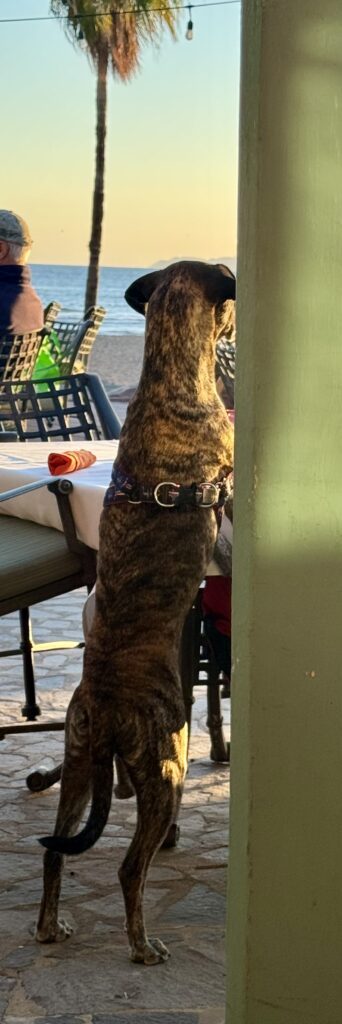
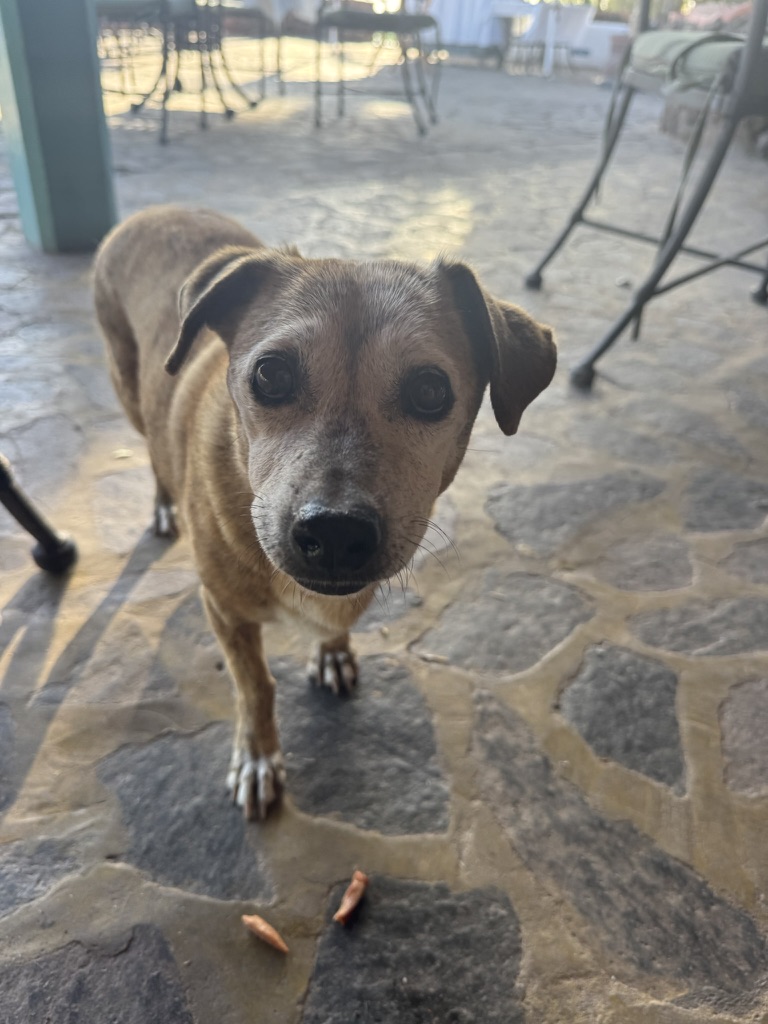
The dog stands at the table as though she has been invited. Beyond begging. Beyond servility. Simply present, front paws on the table’s edge, looking out at the Sea of Cortez with the same quality of attention a person might bring to a sunset. Behind her, the early morning light turns everything gold: the water, the sand, the palm fronds moving in whatever breeze comes off the ocean this time of day. A plate of food sits on the white tablecloth. A drink sweats condensation in the heat. The dog notices these things the way you notice things that are simply part of the landscape, neither wanting them nor turning away from them. Just acknowledging: yes, these are here too.
Dog Enjoying the Sunrise
Photo Credit: Amy Tucker, 2026
I took this photograph this morning at a beachside restaurant where I enjoyed a cup of coffee. The dog appeared from nowhere in particular and everywhere at once. She checked the table the way dogs check things: a quick assessment to see whether this moment held anything that required her attention. Then she placed her paws on the table’s edge and turned her gaze outward, toward the water. The owner is getting coffee.
What struck me then and strikes me still looking at the image now is her posture. There is no asking in it. No supplication. No performance of need is designed to elicit care. She works toward nothing. She is simply a dog standing at a table at the edge of the sea, and if that position happens to be where food and drink exist, well, that is where food and drink exist. It leaves unchanged the essential fact of her presence, which requires no justification beyond itself.
I sat there for perhaps twenty minutes watching her. Other tourists approached, took photos, and moved on. A waiter brought fresh coffee to the table. No reluctance. No hurry. This part is complete; the next follows, and both are equally fine.
The village dogs of Loreto have been teaching me something I had yet to discover I needed to learn.
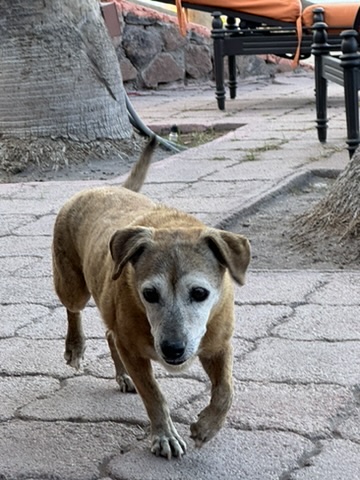
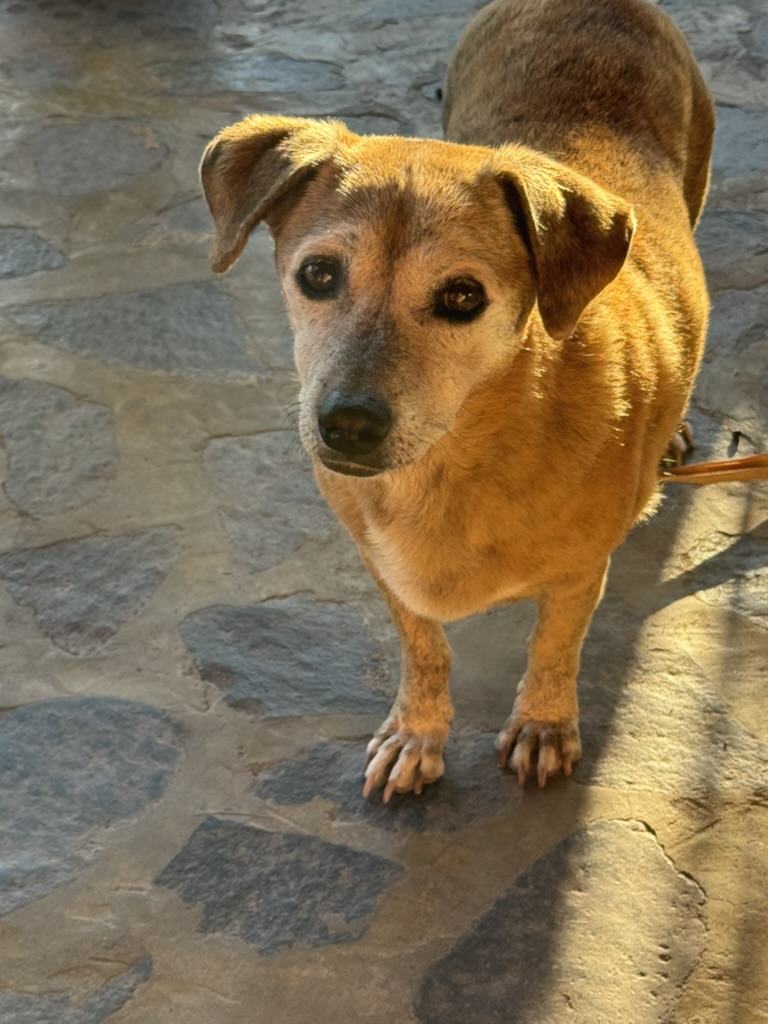
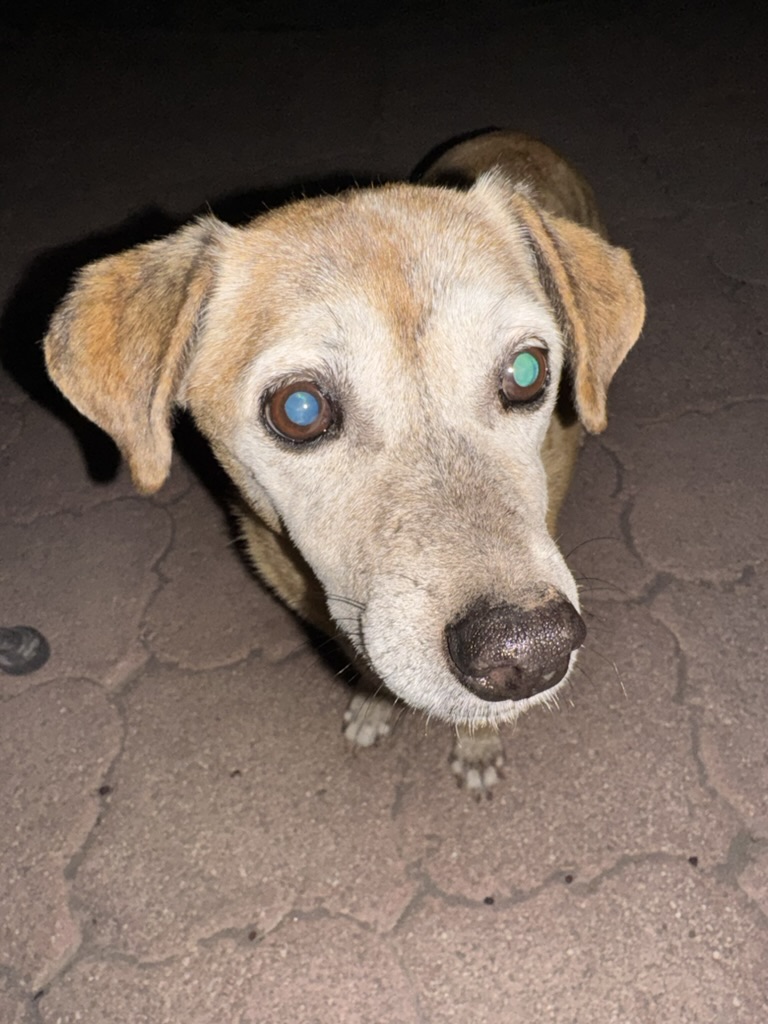
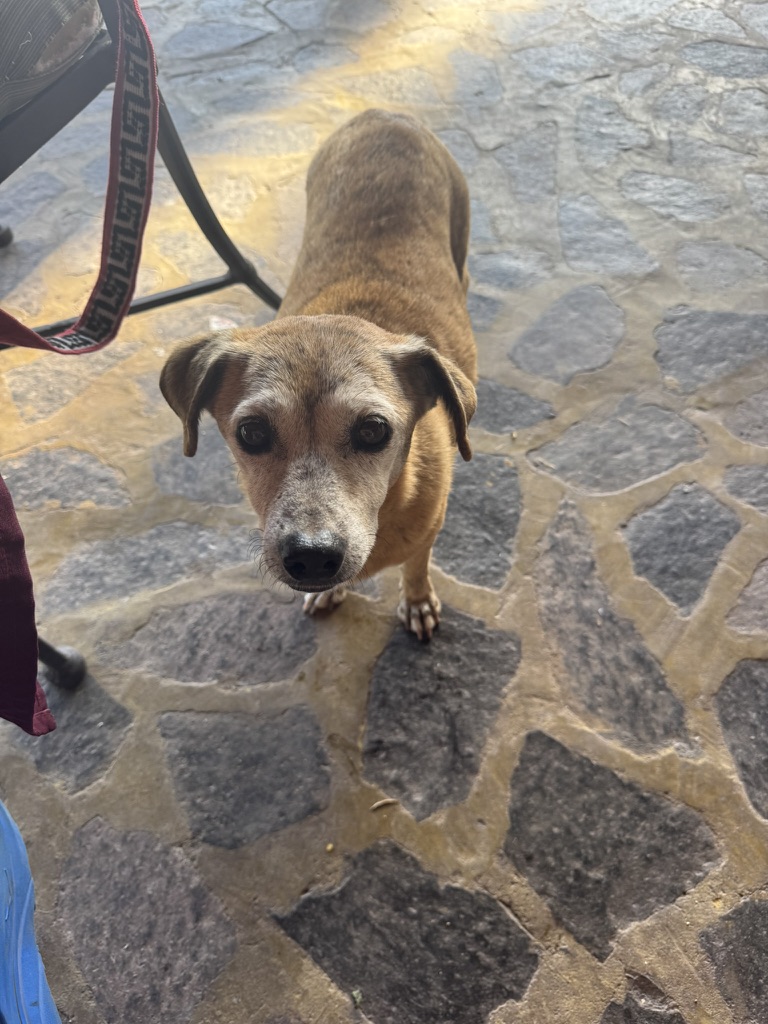
I wrote about them briefly in the early days here: the brown dog with gentle eyes who appeared that first evening, who sniffed my hand and then simply stood beside me in the fading light, two beings with nowhere particular to be. I called her a companion then, though companion suggests a relationship more defined than what we actually share. She appears. She stays, or she leaves. She requires nothing. I offer nothing beyond my presence. And somehow this non-relationship has become one of the steadiest features of my days here.
She is far from the only one. There are perhaps a dozen dogs I see regularly in the village. Brindle and brown and black and that particular dusty tan that seems designed by evolution to blend with sand. Well-fed, free of ownership. Collared occasionally (someone’s gesture of care) but clearly belonging to no one, or perhaps more accurately, belonging to everyone and therefore to themselves.
They move through the village with an ease I recognise as what I am attempting to learn. No schedule. No destination that must be reached. No performance of purpose to justify their occupation of space. They simply are where they are; when they are somewhere else, they are there instead, and the transition requires no explanation, no apology, no account of why the first place stopped being right and the second place became necessary.
My Lady Friend
Photo Credit: Amy Tucker, 2026
I have been watching them for twelve days now with increasing attention. The way they navigate public space without claiming it. The way they accept care without becoming obligated. The way they rest in the middle of sidewalks, streets, or restaurant patios without any apparent concern that they might be inconveniencing someone. And the remarkable thing (the thing I am still trying to fully understand) is that the village allows this. More than allows it. Holds it. Make space for it. Treats it as simply as it is.
In the city where I lived for twenty-five years, this would be impossible. Dogs in restaurants must be leashed, under control, and clearly attached to responsible humans. Dogs on public beaches require permits. Dogs that exist without visible owners raise concern: Who is responsible for this animal? Who will manage it? Who vouches for its right to occupy space?
The questions come automatically, reflexively, born from a culture that cannot imagine existence without ownership, without someone being accountable, without the clear assignment of responsibility and control.
But here, the dogs simply exist, and the village simply lets them be. Feeds them when they are hungry. Gives them water when they are thirsty. Tolerates their presence at tables, in shops, and on beaches. And the dogs, for their part, seem to understand the unspoken agreement: we are here together, you and we, and the terms of our togetherness require neither ownership nor abandonment, neither claim nor rejection, just this ongoing negotiation of shared space that somehow works without anyone having to articulate the rules.
I realised, walking back to the cottage in the heat, that I had seen six different dogs in the space of an hour, and each one had seemed perfectly at ease wherever it was. No anxiety. No performance. Just dogs being dogs in the various locations where dogs be.
This is remarkable when you think about it. These are beyond the category of pets that have learned to read human moods and respond to human needs. These are beyond the working dogs with assigned tasks. These are dogs who have somehow negotiated a way of existing alongside humans without becoming dependent on them, without losing whatever essential dog-ness makes them what they are.
They are, I realise, practicing aloneness. Beyond the human version (the one that requires choosing, intending, and reflecting on whether you are doing it right), but alonetude nonetheless. Being with others without losing themselves. Accepting care without becoming obligated. Moving between community and solitude as each moment requires, without any of it needing to be a statement, a position, or a defended choice.
I have been thinking about what these dogs are teaching me about being in community without being consumed by it.
“Settling in asks surrender of nothing. It is choosing to stay with yourself.” Amy Tucker, 2026
For twenty-five years, I worked in an institution that demanded constant availability, constant responsiveness, and constant proof that I was committed, present, and performing my role adequately. Contract faculty hold far less authority to set boundaries than tenured faculty. You are available when needed. You adjust your schedule around theirs. You say yes even when yes costs you more than you can afford because saying no might mean being asked again.
This creates a particular relationship to community and to solitude. Community becomes something you perform. Solitude becomes something you seize in stolen moments, knowing you will be interrupted, knowing you need to stay alert for the email, the call, or the meeting that suddenly arises, requiring an immediate response.
The village dogs know nothing of this exhaustion. They exist in what I can only describe as a gift economy so old and so embedded that it has become invisible. The village feeds them because that is what the village does. The dogs provide companionship because that is what dogs provide. No contract. No performance evaluation. No calculation of whether the exchange balances.
Just: this is how we are together. These are the terms of our coexistence. It holds, or it falls away; if it stops holding, adjustments are made, but none of it requires the elaborate structure of obligation, debt, and credit that governed my professional relationships for all those years.
Watching them, I realise what I am trying to recover. Beyond isolation (I have never wanted that, and this month of intentional solitude has been about drawing near, never about fleeing human contact). What I want is what the dogs have: the capacity to be with others without losing myself. To accept care without becoming obligated. To offer presence without performing. To know when I need to be alone and when I want company, and to trust that both needs are legitimate and neither requires extensive justification.
The dogs are alone together. Present in the community, beyond being consumed by it. They rest in public space without apology. They approach when something interests them and walk away when it loses their interest. And somehow the village holds this, makes room for it, allows dogs to be dogs even amid human activity.
This is the model I am learning to inhabit. Beyond the isolation of withdrawal: the freedom of undefended presence. Being here without bracing. Receiving care without owing. Offering attention without depleting myself.
The brown dog is here again. She has been here for perhaps forty minutes. I have been writing. Neither of us has required anything of the other. We are simply here together, she in her rest and I in my work, and the togetherness asks nothing beyond the acknowledgment that we both occupy this space.
Photo Credit: Amy Tucker, 2026
The dog knows without any of this apparatus. She knows when to trust and when to be wary. She knows when to approach and when to hold distance. She knows when someone will feed her and when someone will pass by. She knows where shade is in the heat of the day and where the evening breeze comes first. She knows all of this immediately, without thought, without reflection, without the constant meta-commentary that humans call consciousness.
This is no less knowing. It is different knowing. And it might be the knowing I most need to recover: the capacity to respond to what is without the endless mediation of thought about response. To be hungry and eat. To be tired and rest. To want solitude and take it. To want company and seek it. Without justification. Without explanation. Without the entire apparatus of defence and rationalization that precarious employment built into me so deeply, I forgot it was anything other than natural.
Just: this is what the body knows. This is what the moment calls for. This is what I do.
The Freedom to Simply Be
“I am allowed to land. I am allowed to stay. I am allowed to soften.”
Amy Tucker, 2026
The dog has left now. I missed her leaving. I was focused on writing, and when I looked up, she was simply gone, off to wherever dogs go when they go. The light continues its shift toward darkness. Soon I will make dinner, following the rhythm that has become automatic. The evening will unfold as it has unfolded for eleven evenings before this one.
But something feels different tonight. Less effortful. Less monitored. As though I am finally beginning to inhabit the routine rather than performing it. Beginning to trust that my body knows what it needs and when, and that I can simply trust without constantly checking and verifying that I am resting correctly.
The dogs are teaching me this. How to be present without performance. How to accept care without obligation. How to exist in a community without losing the capacity for solitude. How to move between togetherness and apartness as the moment requires, without any of it being a statement or a defence or a position requiring elaborate justification.
Los perros del pueblo. The village dogs. Teachers with no awareness teach. Companions who require no relationship. Beings who practice alonetude so naturally they have no word for it because it is simply how they are.
I am learning from them. Slowly. With all the awkwardness of someone who forgot and is now remembering. But learning nonetheless. And tonight, this twelfth evening of intentional solitude, I feel closer to what they know. Closer to trusting my own knowing, the way they trust theirs. Closer to being what I am without the constant overlay of thought about whether I am being it correctly.
And I think again of Mary Oliver, the poet who reminded us to let the soft animal of the body love what it loves. Who asked, without urgency but with piercing clarity: “Tell me, what is it you plan to do / with your one wild and precious life?”
For the first time in a long while, I feel like I have an answer, though beyond words, and beyond any plan. It is in the small things: in the way I sit without bracing, in the way I walk without explanation, in the way I trust the day to shape itself without my need to define it in advance.
I, too, find my front paws on the table’s edge, beyond asking, beyond waiting, just watching the water shift its shape, and feeling the sun arrive exactly as it is.
Beyond performance. Beyond striving.
Just this: the body knows. The moment knows. The dog knows. And that knowing, I am learning, is enough.
Thank you, my lady friend.
References
Haraway, D. (1988). Situated knowledges: The science question in feminism and the privilege of partial perspective. Feminist Studies, 14(3), 575–599. https://doi.org/10.2307/3178066
Oliver, M. (1986). Wild geese. In Dream work (pp. 14–15). Atlantic Monthly Press.
Serpell, J. (1995). The domestic dog: Its evolution, behaviour and interactions with people. Cambridge University Press.
I have been watching them for twenty minutes now, their final flights to roosting sites marked by something I can only describe as completeness. Simply no hurry. No reluctance. Just the simple recognition that the fishing day is done, that rest is what comes next, that tomorrow will bring another cycle.
They raise no question about whether they have fished enough. They carry no worry about tomorrow’s needs. They simply finish when finishing is what the body, the light, and the day require.
The Three Palms
Photo Credit: Amy Tucker, 2026
Discovering the Pattern
I am learning this. Estoy aprendiendo esto.
Eleven days of the same evening sequence, dinner as light begins to change, gentle movement, watching sky transform, settling into darkness, and something in me is finally believing it. The rhythm is something beyond my imposing. It is something I am joining. Something that was here before I arrived and will continue after I leave.
The pelicans taught me this first. Nowadays, the days themselves are teaching it.
My View
Photo Credit: Amy Tucker, 2026
Tonight, sitting on this balcony as stars appear one by one above the Sea of Cortez, the questions feel less urgent than they did this morning. Less like problems requiring a solution and more like… context. Background. The theoretical scaffolding that helps me understand the larger significance of what I am doing here, yet the thing itself remains just beyond language.
The thing itself is simpler.
Unlearning Vigilance
I came here exhausted. Sleep fragmented, thoughts scattered, body braced against threats that had become so constant I no longer noticed the bracing. Twenty-five years of precarious employment had taught my nervous system a particular kind of vigilance, necessary for survival, corrosive to everything else.
My body was more than tired. It was dysregulated.
I was beyond overworked. I had become wired for survival. Survival allows no room for rest. It requires vigilance, constant adaptation, and the refusal to soften.
Now, after days of consistency, the rhythm is beginning to offer a different experience. A quiet structure. A sense of what comes next. The return of a nervous system that no longer waits for disruption, but begins to anticipate calm.
It is subtle. Gentle. Emerging like light at the edge of morning.
What once felt like repetition now feels like relief. The pattern releases me from constraint. It holds me. It offers what the nervous system has long needed but could never request: predictability, softness, and something that resembles safety.
Eleven days of consistent rhythm, and the bracing is releasing. All at once? No. Dramatically? No. Just gradually, like ice melting so slowly you barely notice the transition from solid to liquid, you only notice one day that what was frozen is now flowing.
Reclaiming Routine
I have been thinking about routine.
For twenty-five years, routine was what I resisted. Every semester brought different courses, different students, different schedules cobbled together from whatever the institution needed and was willing to pay for. I prided myself on adaptability. On being able to shift quickly. On moving without consistency.
But that pride was really a cover story for precarity. You cannot depend on routine when your employment is contingent. You learn instead to be endlessly flexible, endlessly available, ready to reconfigure your life around whatever work appears.
These eleven days have shown me what I lost in that flexibility.
The routine here is simple. Wake with the light. Swim in the morning. Read. Walk in the afternoon when the heat has softened. Watch pelicans. Make dinner as the sky transforms. Sit on the patio as stars appear. Sleep.
Collected Beach Treasures
Photo Credit: Amy Tucker, 2026
The same pattern, day after day.
It is a healing ritual, organic rather than imposed, beyond the performative, emergent. A sequence the body now recognises as kind. As sacred. As home.
And instead of feeling monotonous or constraining, it feels… liberating. My nervous system knows what comes next. My body can anticipate the rhythm. I can release the need to constantly recalibrate, constantly adjust, and constantly brace for the unexpected.
The routine holds me. And in being held, I can finally let go.
This is what I would call settledness. Or maybe: re-inhabiting the self. It is beyond transcendence. It is about being able to stay with myself, without bracing, without apology.
This is what I came here to discover, though I arrived without knowing it. Beyond dramatic transformation. Beyond sudden enlightenment. Just the quiet recognition that routine is the ally, never the enemy, of freedom. Precarity is. Routine, the kind you choose, the kind that serves your actual needs rather than someone else’s demands, is the structure that makes freedom possible.
Afternoon Seista
Photo Credit: Amy Tucker, 2026
Evening Reflection: What the Day Held
Pelicans are completing their fishing day. Sky is transforming through its sequence. My own completion of the day’s work, reading done, walking done, body cared for, mind given what it needs.
The pattern repeats. And I am learning to trust the pattern.
Tomorrow I will read more deeply, Haraway on situated knowledges, more Ahmed on orientation and the work of reorientation. The theoretical scaffolding continues to grow, helping me grasp the broader significance of what I am documenting here.
But tonight the theory feels secondary to something simpler. To the recognition that my body has stopped bracing. That sleep comes without struggle. That I can sit on a balcony in the evening watching pelicans and feel… at peace. Simply at peace. Without needing to analyse it, justify it, or turn it into something useful.
Good Night Loreto
Photo Credit: Amy Tucker, 2026
This is alonetude. Beyond concept. Beyond framework. Just this: being with yourself in a rhythm that your nervous system trusts, in a place that feels safe enough to finally stop performing, surrounded by the ordinary beauty of birds and water and light that asks nothing of you except that you notice.
I notice.
Lo noto.
And tonight, that is enough.
~
Tonight I will follow the familiar sequence.
Dinner already eaten, simple fish grilled with lime, rice, and vegetables that I no longer think about preparing, my hands knowing now what the routine requires. Cottage already tidied, the small acts of care that signal evening’s approach. Soon I will dim the lights, sit on the patio and watch the stars emerge, then shower and prepare for sleep.
Will I sleep through? Fifth night in a row? Or will tonight bring waking, the pattern interrupted, the nervous system deciding it needs to check, to assess, to maintain some vestige of vigilance?
The answer remains open. But tonight I notice something different in my open-wondering. No anxiety about whether I will sleep. Just… curiosity. The way you might wonder whether it will rain tomorrow. Information that will reveal itself when it reveals itself. Nothing to control. Nothing to fix in advance.
This, too, is letting go. Learning to hold the question without needing to force the answer.
The pelicans carry no worry about tomorrow’s fishing. They simply rest tonight, trusting that tomorrow will bring what it brings, that they will respond to what it requires, that the rhythm will continue, with or without their worry.
I am learning from them. Slowly. With the particular awkwardness that comes from unlearning decades of vigilance. But learning.
The day ends. Another day will begin. The rhythm continues.
And I am here, finally, learning how to join it rather than fight it.
No necesito entenderlo completamente. Understanding it completely can wait.
Solo necesito confiar en él. I only need to trust it.
Y esta noche, confío. And tonight, I trust.
El patrón sostiene. The pattern holds.
El cuerpo descansa. The body rests.
Y eso es suficiente. And that is enough.
When we are at last able to rest, we learn that effort was never the only way to belong.
Amy Tucker, 2026
References
Ahmed, S. (2006). Queer phenomenology: Orientations, objects, others. Duke University Press.
Google. (n.d.). Google Translate. https://translate.google.com
Nash, R. J. (2004). Liberating scholarly writing: The power of personal narrative. Teachers College Press.
Translation Note
Note. Spanish-language passages were generated using Google Translate (Google, n.d.) and subsequently reviewed and refined by the author. Any remaining infelicities reflect the limits of machine translation rather than intent.
Ten days to build a foundation. Perhaps small, you might think. Too brief, it seems, for anything significant.
But foundations are built to be solid, never showy. They are meant to hold. Hidden underground, bearing weight, making everything above them possible.
I came here exhausted. Sleep fragmented, thoughts scattered, body braced for threats that never came but whose approach I had learned to anticipate with the precision of an expert meteorologist reading the weather that only I could see.
Ten days to teach my nervous system: The emergency is over. The storm has passed. You can stop bracing now.
Ten days of the same evening sequence. Ten days of the same morning light. Ten days of pelican fishing at predictable times. Ten days of waves maintaining their patient rhythm. Ten days of data accumulating below conscious awareness.
And somewhere in those ten days, my body decided to believe it.
La fundación sostiene. The foundation holds.
Without forcing it. Without earning it. Without proving myself worthy.
Because I maintained conditions. Because I honoured rhythms. Because I stopped interfering with processes wiser than conscious thought.
Ten days. Diez días.
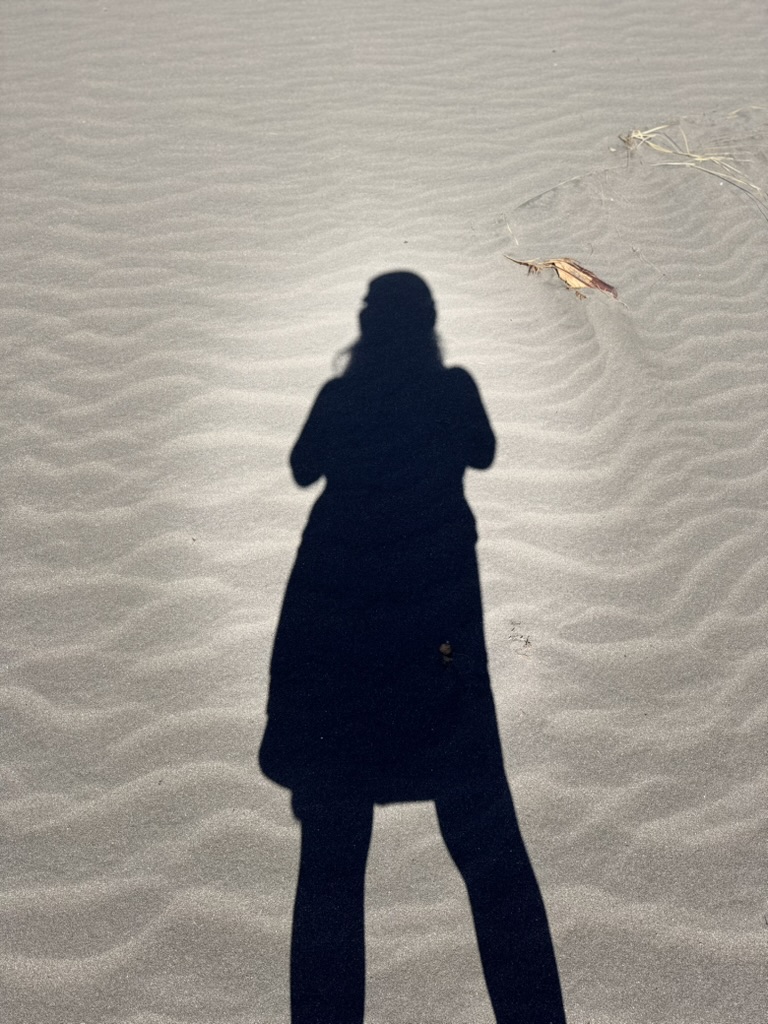
The Sand Shadow
Photo Credit: Amy Tucker, 2026
Translation Note
Note. Spanish-language passages were generated using Google Translate (Google, n.d.) and subsequently reviewed and refined by the author. Any remaining infelicities reflect the limits of machine translation rather than intent.
References
Google. (n.d.). Google Translate. https://translate.google.com
Content Warning: This post contains reflections on grief, loss, and emotional exhaustion. Please care for yourself as you read, and feel free to step away if you need to.
My mother is 80 years old. She now lives alone in an old folks’ home in Lethbridge, Alberta. I am sitting on a terrace in Mexico, watching the Sea of Cortez turn from blue to silver in the fading light, and I am thinking about her hands.
She has always had capable hands. Hands that kneaded bread dough on Sunday mornings, the kitchen warm with yeast and CBC radio playing softly in the background. Hands that crotched quilts for babies born, each stitch a prayer, each pattern chosen with care. Hands that combed my hair before church, her fingers quick and certain. The spirit of God’s hands, I think, though I hold that comparison with uncertainty, standing outside her faith and the faith I was raised in. Perhaps they are simply mother hands, shaped by decades of service, of showing up, of being useful to everyone but herself.
Recuerdos de Su Cocina / Memories of Her Kitchen
I remember standing on a step stool beside her at the counter, learning to roll pierogi. “Not too much flour,” she would say, her hands guiding mine. “You want it tender, not tough.” I was seven, maybe eight. The kitchen smelled of potatoes and cheese, and outside, the wind was blowing snow against the windows. I felt safe in that kitchen, in the warmth of the oven, in the certainty of her presence beside me.
Yi-Fu Tuan (1977), the humanist geographer, writes about topophilia, the affective bond between people and place. My mother’s kitchen was my first topophilic space, a location where I learned that love could be measured in teaspoons and rolling pins, in the quiet act of making something nourishing with your hands. I carry that kitchen with me still, even here, 2,800 kilometres away, watching a sea she has never seen.
She taught me to can plums in late summer, the kitchen steaming, jars lined up on the counter like soldiers. We would work for hours, cutting and slicing and packing fruit into hot glass, the syrup sweet and golden. “This will taste like sunshine in January,” she would say, and she was right. Those jars, lined up in the cold room, were promises against the long, cold winter. They were her way of saying, “I will take care of you.” I will make sure you have enough.
El amor de una madre vive en lo que prepara.
A mother’s love lives in what she prepares.
La Fe de Mi Madre / My Mother’s Faith
She raised me in the Church of Jehovah’s Witnesses, a faith I no longer practice but whose rhythms still live somewhere deep in my body. I remember the scratch of my Sunday dress against my legs, the smell of the Kingdom Hall a mix of old hymnals and furniture polish and the faint sweetness of old lady sweat. I remember my mother’s voice beside me, singing hymns she knew by heart, her alto steady and sure.
She believed, and still believes, in something with certainty as she later switched to the Mormon Church. I never saw “her God” in the way she did. For her, the gospel is as real as the mountains outside my home in British Columbia, as solid as the bread she bakes, as certain as the sun rising over the prairie. She knows that families are eternal, that her late husband waits for her beyond the veil, that God has a plan, and she is part of it. I envy her this certainty sometimes, the way it holds her steady through grief and loss and the long silence of widowhood.
I left the Church in my teens, quietly, without announcement, the way one might slip out of a party before the host notices. It was quiet, undramatic. There was no single moment of rupture, no crisis of faith that announced itself with thunder. It was more like a slow loosening, a gradual recognition that I no longer believed what I had been taught to believe, that the structure that held my mother so securely felt to me like a house I had outgrown.
Sandra Bloom (2007) writes about ambiguous loss, defined as grief that accompanies losses that are unclear, unresolved, and without the finality of death. I wonder sometimes if my mother grieves the daughter she thought she was raising, the one who would marry in the temple and bear children in the covenant and sit beside her in the celestial kingdom. I am still her daughter, but I am also a kind of ghost of the daughter she imagined. This is a loss we hold in silence, a room in our relationship we have agreed to keep closed.
Pequeñas Bondades / Small Kindnesses
And yet she loves me. This I know. I know it in the way she asks about my work, even when my work puzzles her, her questions sincere and slightly bewildered: “So you are still teaching at that university?” Yes, Mom. Still teaching. Her way of showing love is more in spirit than in words or deeds.
Gary Chapman (1992) popularised the concept of love languages, the idea that people express and receive love in different ways: words of affirmation, quality time, receiving gifts, acts of service, and physical touch. My mother’s love language has always been acts of service, the doing of things, the making and mending and bringing of soup through snowstorms. She rarely says “I love you” directly, but she says it in every jar of peaches, every quilt, every four-hour drive through dangerous weather.
El amor no siempre tiene palabras. A veces tiene sopa de pollo.
Love finds other vessels. Sometimes it has chicken soup.
Viuda / Widow
Her husband died two years ago. They had been married for only a few years, long enough that she had learned the shape of his presence: the way he took his soda, the sound of his wheelchair in the hallway, the weight of his hand on her leg as he sat next to her.
I think about her alone in that apartment, moving through rooms that still hold his absence. The recliner where he sat to watch the news. The side of the bed that is still, somehow, his side, even though he will never lie there again. Miriam Greenspan (2004) writes that grief is one of the dark emotions, those feelings our culture teaches us to rush through rather than honour. “Grief is the emotion of connection,” she writes, “the binding force of love turned into the dark energy of sorrow” (p. 98).
My mother’s faith offers her a framework for this sorrow: the belief that marriage is eternal, that she will see him again, that death is a temporary separation rather than a final goodbye. I hold a different view, but I am grateful she has it. It gives her something to hold in the long nights, something to reach for when the house feels too quiet, and the bed feels too empty, and the grief feels too heavy to bear alone.
When I call her on Sunday evenings, she tells me about the temple sessions and the neighbour who helped her with the puzzle. She tells me about the weather, about the cat who visits her backyard, and about the book she is reading from the church library. She keeps to herself the moments when she reaches for him in the night and finds only empty sheets. She keeps to herself the crying in the shower, where no one can hear. These things I imagine, because I am her daughter, because I know her, because some things carry their meaning without words.
Lo Que Más Recuerdo / What I Remember Most
I remember her hands in the garden, turning soil, planting seeds, pulling weeds with a determination that seemed almost fierce. She grew tomatoes, potatoes, and carrots, and every summer we would spend long evenings in the backyard, the light golden and slanted, the smell of earth and green things all around us. “Everything needs tending,” she told me once, her fingers in the dirt, a tomato plant cupped gently in her palm. “Gardens, families, faith. You have to show up and do the work.”
After she left my dad in 1977, I remember her sitting at the kitchen table late at night, paying bills by the light of a single lamp, her forehead creased with worry she tried to hide from us children. I had no way to understand then what I understand now: how hard she worked, how much she sacrificed, how many of her own dreams she set aside so that we could have enough. I wonder what she wanted to be before she became a mother. I wonder if she remembers.
I remember the way she cried when she missed my grade eight graduation, her face wet with loss and somehow also sad, almost knowingly, that she had to choose to put food on the table over celebration. For years, I made her feel guilty about this, but as a parent, only I can now understand how challenging life can be as a single mother. Love and loss are always tangled together; mothers carry a grief their children cannot fully see.
Judith Herman (1992), in her landmark work on psychological trauma, writes about the importance of witnessing, the act of truly seeing another person’s experience and honouring it as real. I want to witness my mother. I want to see beyond the capable hands and the Sunday faith and the birthday cards that arrive on time, but also the woman beneath all that doing, the woman who had dreams before she had children, who carries losses she has never spoken aloud, who has spent eighty years being useful and may never have learned that she was allowed to simply be.
Detrás de cada madre hay una mujer que olvidamos ver.
Behind every mother is a woman we forget to see.
La Distancia Entre Nosotras / The Distance Between Us
There are 2,800 kilometres between Loreto and Lethbridge. I looked it up. It would take thirty hours to drive, if you could drive across the Sea of Cortez, which, of course, you cannot. The distance feels larger than kilometres can measure: the distance between faith and its absence, between the life she imagined for me and the life I have made, between who she raised me to be and who I have become.
Carol Gilligan (1982), in her foundational work on women’s moral development, argued that women often define themselves through relationships, through connection, through care for others. She called this the ethic of care, a moral framework centred on responsibility and responsiveness rather than abstract principles of justice. My mother embodies this ethic. She has spent eighty years caring for her children, her husbands, her clients, anyone who needed a casserole, a listening ear, or a quilt stitched with prayers. I wonder if she knows how to care for herself. I wonder if anyone ever taught her that she was allowed.
I am here in Mexico learning to rest, learning to be still, learning to believe that I am enough without producing, without performing, without earning my place. And I wonder: did I learn my relentlessness from her? Did she learn it from her mother? How many generations of women have run themselves ragged in service to others, believing that rest was selfishness, that stillness was sin, that their worth depended on their usefulness?
Una Carta Que No Enviaré / A Letter Left Unsent
Querida Mamá,
I am sitting by the sea in Mexico, thinking about you. I am thinking about your hands and your faith and the way you have always shown love through doing. I am thinking about the perogies you taught me to roll, the plums we canned in the summer heat, the quilt you drove through a snowstorm to bring me.
I am thinking about how tired you must be. How tired you have always been. How you never learned to rest because no one ever told you that rest was allowed. I wish I could give you what I am learning here: the knowledge that you are enough, that you have always been enough, that your worth was never something you had to earn.
I am sorry I left the Church. I am sorry I cannot be the daughter you imagined. I am sorry for all the silences between us, the questions we leave unasked, the truths we keep hidden to protect each other. But I am grateful, too. Grateful that you loved me anyway. Grateful that you still call on Sundays. Grateful that your faith gives you comfort even though I cannot share it.
I see you, Mom. I see the woman behind the capable hands, behind the Sunday faith, behind the chicken soup and the quilts. I see how much you have given. I see how much it costs. I wish I had told you sooner. I am telling you now, even though you will never read this letter.
Te quiero, Mamá. Siempre.
This letter will stay here. James Pennebaker (1997), whose research on expressive writing demonstrated the healing power of putting painful experiences into words, found that writing about difficult emotions can improve both psychological and physical health, even if the writing is never shared. The writing itself is the medicine. I am writing my way toward understanding, toward compassion, toward a peace I am still learning to name.
Esta Noche / Tonight
The sun has set. The sea is dark now, just the sound of waves and the occasional cry of a seabird. In Lethbridge, it is already late. My mother is probably in bed, her scriptures on the nightstand, her prayers said, the empty space beside her filled with faith and memory and the shape of a husband who is no longer there.
I will call her tomorrow. I will ask about the church, the neighbour and whether she has been sleeping well. I will keep this essay to myself, keep the memories I have been turning over like stones, about the letter I wrote and will never send. Some things are better held gently, privately, like a prayer offered in silence.
But tonight, across 2,800 kilometres of desert and mountain and sea, I am holding her in my heart. I am thanking her for the hands that shaped me, even as I am learning to shape myself differently. I am forgiving us both for the silences, for the distances, for the love that has always struggled to find its words. I am seeing her, finally, fully: as my mother and as a woman: tired and faithful and braver than I ever knew, standing in her kitchen, rolling out pie crust, teaching me without words that love is something you make with your hands.
Ella es mi madre.
She is my mother.
Y yo soy su hija.
And I am her daughter.
Eso es todo. Eso es suficiente.
That is everything. That is enough.
References
Bloom, S. L. (2007). Loss, trauma, and resilience: Therapeutic work with ambiguous loss. Psychiatric Services, 58(3), 419-420.
Chapman, G. (1992). The five love languages: How to express heartfelt commitment to your mate. Northfield Publishing.
Gilligan, C. (1982). In a different voice: Psychological theory and women’s development. Harvard University Press.
Google. (n.d.). Google Translate. https://translate.google.com
Greenspan, M. (2004). Healing through the dark emotions: The wisdom of grief, fear, and despair. Shambhala.
Herman, J. L. (1992). Trauma and recovery: The aftermath of violence, from domestic abuse to political terror. Basic Books.
Pennebaker, J. W. (1997). Opening up: The healing power of expressing emotions. Guilford Press.
Tuan, Y.-F. (1977). Space and place: The perspective of experience. University of Minnesota Press.
Translation Note
Note. Spanish-language passages were generated using Google Translate (Google, n.d.) and subsequently reviewed and refined by the author. Any remaining infelicities reflect the limits of machine translation rather than intent.
A Scholarly Personal Narrative of Attention, Interoception, and Embodied Knowing
Photo Credit: Amy Tucker, 2026
Today, it rained in Loreto, and then the rain paused. In that pause, I carried my research materials to the poolside cabana, settling beneath the palapa’s thatched roof to continue the work that has become both intellectual inquiry and embodied practice. The sky remained heavy with moisture, grey clouds pressing low over the date palms and bougainvillea that frame this small sanctuary. The air smelled of wet earth and salt from the nearby Sea of Cortez. Water droplets clung to palm fronds, occasionally dislodging to fall with a soft percussion onto the terracotta tiles surrounding the pool.
This moment, seemingly ordinary in its domestic simplicity, exemplifies the core dynamics of
alonetude, the intentional solitude practice I have been documenting throughout this retreat. The pause in the rain created conditions for what Kaplan and Kaplan (1989) developed as
attention restoration, wherein environments characterised by soft fascination, such as natural settings between weather events, allow directed attention to recover from the depletion caused by sustained cognitive effort. Kaplan’s (1995) subsequent theoretical framework formalised these insights into Attention Restoration Theory. Yet what unfolded at the poolside extended beyond simple restoration. It involved the integration of contemplative presence with scholarly work, demonstrating how
embodied knowing, knowledge accessed through somatic awareness and sensory engagement with place, informs and enriches academic inquiry.
Theoretical Positioning
This narrative draws upon several intersecting theoretical frameworks that have shaped both my retreat experience and the scholarly methodology through which I examine it.
Attention Restoration Theory
Attention Restoration Theory (ART), developed by environmental psychologists Rachel Kaplan and Stephen Kaplan (1989; Kaplan, 1995), proposes that natural environments promote psychological restoration through four key characteristics. Table 1 summarises these foundational components.
Table 1
Four Components of Attention Restoration Theory
Component
Definition
Being Away
The sense of psychological distance from routine demands and mental fatigue. Physical distance helps, but conceptual distance (a shift in mental content) is essential.
The match between environmental affordances and personal purposes. The setting supports what the person is trying to accomplish and is inclined to do.
The coherence and scope of the environment. The setting must be rich enough to constitute a whole other world that engages the mind and offers exploration opportunities.
Fascination
Engaging attention effortlessly through inherently interesting stimuli. ‘Soft fascination’ (clouds, water, rustling leaves) is restorative, unlike ‘hard fascination’ (television, video games).
Compatibility
The match between environmental affordances and personal purposes. The setting supports what the person is trying to accomplish and inclined to do.
Note. Adapted from ‘The Experience of Nature: A Psychological Perspective’ by R. Kaplan and S. Kaplan, 1989, Cambridge University Press, and ‘The Restorative Benefits of Nature: Toward an Integrative Framework’ by S. Kaplan, 1995, Journal of Environmental Psychology, 15(3), pp. 169–182.
The poolside setting during the rain pause embodied these qualities. I experienced being away through physical distance from daily obligations and the conceptual shift from routine to contemplation. The environment provided extent through the visual scope created by the intersection of built and natural elements: the cabana’s shelter, the pool’s reflective surface, the layered palm grove, and the distant sea. Soft fascination emerged from water droplets falling rhythmically, cloud movements across the grey sky, and the gentle sway of palm fronds. Compatibility arose from the alignment between the environment’s quietness and my need for a reflective workspace where scholarly writing could unfold organically.
Interoception and Embodied Awareness
Interoception, defined as the perception of internal bodily sensations, represents another essential framework for understanding this experience (Craig, 2002; Farb et al., 2015). Interoceptive awareness encompasses multiple dimensions, as outlined in Table 2, which summarises the Multidimensional Assessment of Interoceptive Awareness (MAIA) framework developed by Mehling et al. (2012).
Table 2
Six Dimensions of Interoceptive Awareness
Dimension
Description
Noticing
Awareness of bodily sensations such as heartbeat, breathing, temperature changes, and muscle tension.
Attention Regulation
The ability to sustain and control attention to bodily sensations during focused awareness.
Emotional Awareness
Recognition of connections between physical sensations and emotional states; the embodied dimension of affect.
Self-Regulation
Using bodily signals to modulate distress and regulate emotional responses adaptively.
Body Listening
Actively attending to the body’s messages about needs, limits, and preferences with curiosity rather than judgment.
Trusting
Experiencing bodily signals as reliable and safe sources of information about one’s internal state.
Note. Adapted from ‘The Multidimensional Assessment of Interoceptive Awareness (MAIA)’ by W. E. Mehling et al., 2012, PLoS ONE, 7(11), Article e48230. https://doi.org/10.1371/journal.pone.0048230
During the pause in the rain, my practice involved precisely this kind of interoceptive attention. I noticed the cooling sensation of post-rain air against my skin, the subtle shift in breathing as humidity changed, the grounding quality of sitting in stillness while water sounds created ambient texture, and the alignment between my body’s need for contemplative pace and the environment’s invitation to settle. This embodied awareness did more than simply register physical sensations; it provided epistemological access to knowledge that emerges through lived, sensory engagement with place.
Embodied Knowing and Feminist Epistemology
Embodied knowing, as articulated by feminist epistemologists and phenomenological scholars, challenges the Cartesian separation of mind and body by asserting that knowledge emerges through lived, sensory engagement with the world (Alcoff & Potter, 2013; Grosz, 1994; Merleau-Ponty, 1962). This framework recognises that understanding develops through the body’s interactions with material environments, through sensory perception, through movement and stillness, and through the integration of affective and cognitive processes.
Donna Haraway’s (1988) concept of Situated knowledge emphasises that all knowledge is partial and positioned, emerging from particular embodied, historical, and geographical locations.
Sandra Harding’s (1991) standpoint epistemology further argues that those whose knowledge has been marginalised often possess epistemic advantages precisely because they must navigate both dominant and marginalised perspectives. Working beneath the cabana during the rain pause exemplified this embodied epistemology. The knowledge I generated about solitude, attention, and restorative practice emerged from integrating sensory awareness, environmental responsiveness, and intellectual inquiry.
The Lived Moment
I arrived at the pool carrying my laptop, notebook, and the now-familiar blue bag that has become a symbol of my mobile research practice. The thatched palapa roof overhead, traditional in this region of Baja California Sur, provided shelter while maintaining environmental porosity.
Unlike the enclosed rooms where I sometimes work, the cabana offered what I think of as a threshold space, simultaneously within and without, protected yet permeable. Geographer Yi-Fu Tuan’s (1974) work on place and experience illuminates how such spaces shape emotional geography, how our affective responses emerge through the interplay of enclosure and exposure, intimacy and vastness. This liminality, this state of being between enclosed shelter and open exposure, created optimal conditions for the kind of contemplative work that has characterised this retreat.
The pool water, still and translucent in its turquoise containment, reflected the grey sky with perfect clarity. This mirroring created what I think of as visual resonance, wherein landscape features repeat and reinforce each other, generating aesthetic coherence. The concept draws on Anne Whiston Spirn’s (1998) work on landscape as language, particularly her insight that designed and natural environments communicate through legible patterns. The pool’s surface doubled the sky’s presence, making weather visible in two planes simultaneously. Behind the pool, date palms rose in irregular clusters, their shaggy trunks and feathered fronds creating layered textures against the weighted atmosphere. Some palms stood straight and tall, while others leaned at gentle angles, their shapes recording years of wind patterns and growth responses. Pink bougainvillea, vivid even under grey skies, cascaded over the stone wall that marked the property’s boundary, its colour intensified by the moisture-saturated light.
Environmental psychologist Roger Ulrich (1983) demonstrated that visual exposure to nature, particularly environments featuring water and vegetation, produces affective responses that support psychological recovery. His research established that natural settings reduce stress and promote restorative experiences. Sitting beneath the palapa, I experienced this settling as a lived sensation, beyond abstract theory. My shoulders, which had held tension from concentrated morning writing, gradually released. My breathing, which had been shallow during focused work, deepened and steadied. The environmental cues surrounding me, soft sounds, muted colours, and the rhythm of occasional water drops communicated safety and spaciousness.
Integration of Work and Presence
Opening my laptop to continue writing about intentional solitude while inhabiting that very state created a recursive quality to the experience. I was simultaneously livingalonetude and documenting it, simultaneously experiencing the present moment and reflecting upon the patterns I have observed across weeks of practice.
This integration exemplifies the methodological strength of Scholarly Personal Narrative (SPN), the approach that frames this entire project, as identified by Nash (2004). SPN honours lived experience as legitimate scholarly data while maintaining intellectual rigour through theoretical grounding and critical reflexivity.
Unlike traditional research methodologies that position the researcher as a detached observer, SPN recognises the researcher as an embodied participant whose personal experience, when properly contextualised within broader theoretical frameworks and social structures, generates valuable knowledge (Ellis & Bochner, 2000; Richardson, 2003).
My work beneath the cabana involved this dual consciousness. I remained attentive to immediate sensory experience, observing the quality of light, the ambient sounds, and the feeling of air against the skin, while simultaneously engaging these observations through conceptual lenses provided by attention theory, neuroscience, and phenomenology.
The work itself flowed differently here than it does in enclosed spaces. Ideas emerged with less forcing, sentences formed more organically, and connections between concepts became visible through a process that felt closer to recognition than construction. Cognitive scientist Douglas Hofstadter (1979) describes creative thinking as pattern recognition across disparate domains, the capacity to perceive structural similarities between seemingly unrelated phenomena. The poolside environment, with its combination of focused containment (the cabana’s defined space) and ambient stimulation (changing light, the sound of water, the movement of palm fronds), created conditions conducive to associative thinking.
The Neuroscience of Pause
Neuroscientific research illuminates what occurs during moments such as this pause between rains. The default mode network (DMN), a collection of brain regions that activate when attention shifts away from external tasks toward internal mental activity, becomes engaged during restful states characterised by environmental softness (Raichle et al., 2001; Buckner et al., 2008). The DMN supports autobiographical memory consolidation, future planning, perspective taking, and the integration of experiences into coherent narratives. Research by Mary Helen Immordino-Yang and colleagues (2009) demonstrates that DMN activation correlates with ethical reasoning, identity formation, and meaning-making processes, suggesting that these seemingly passive moments of mental wandering serve essential psychological functions.
Simultaneously, the salience network, which includes the anterior insula and anterior cingulate cortex, maintains awareness of both internal bodily states and relevant environmental stimuli (Seeley et al., 2007; Menon & Uddin, 2010). This network acts as a switching mechanism, determining which information merits conscious attention and facilitating shifts between externally directed focus and internally oriented awareness. During the rain pause, my experience involved precisely this dynamic balancing. I intermittently attended to my writing, the poolside environment, internal physical sensations, and the flow of ideas, with attention moving fluidly across these domains without the fragmentation that characterises forced multitasking.
Polyvagal Theory and Felt Safety
Polyvagal theory, developed by neuroscientist Stephen Porges (2011), offers another lens for understanding the embodied quality of this experience. Table 3 outlines the three hierarchical autonomic states identified by Porges.
Three Autonomic States in Polyvagal Theory
Autonomic State
Characteristics and Functions
Ventral Vagal (Social Engagement)
Associated with feelings of safety, calm, and social connection. Supports rest, digestion, face-to-face communication, and prosocial behaviour. The nervous system state that enables learning, creativity, and contemplative practice.
Sympathetic (Mobilisation)
Involves activation and arousal, preparing the body for action. Supports adaptive responses to challenge through fight-or-flight mechanisms. Becomes problematic when chronically activated without opportunities for recovery.
Dorsal Vagal (Immobilisation)
Associated with shutdown, conservation, and disconnection. In extreme cases, produces freeze responses, dissociation, or collapse. Can also support healthy rest and sleep when accessed from a place of safety.
Note. Adapted from ‘The Polyvagal Theory: Neurophysiological Foundations of Emotions, Attachment, Communication, and Self-Regulation’ by S. W. Porges, 2011, W. W. Norton & Company.
The poolside environment communicated safety through multiple channels. The shelter of the cabana, the visible boundaries of the space, the absence of threat-relevant stimuli, and the gentle, predictable quality of environmental changes all signalled to my nervous system that it could remain in the ventral vagal state. This physiological settling enabled the quality of presence I experienced, the capacity to remain simultaneously relaxed and attentive, open yet focused. Porges emphasises that felt safety, rather than actual safety alone, determines which autonomic state predominates. The poolside setting provided both objective safety (shelter, containment, predictability) and subjective safety cues (soft sounds, visual beauty, environmental coherence), creating conditions wherein my nervous system could downregulate defensive responses and support contemplative engagement.
Embodied Epistemology in Practice
The knowledge I generated during this working session emerged through bodily engagement with the environment as much as through cognitive analysis. This exemplifies what feminist philosopher Sandra Harding (1991) calls standpoint epistemology, the recognition that all knowledge is situated, emerging from particular bodily, social, and historical locations. My standpoint during this retreat is grounded in specific intersecting positions. I am a white settler-Canadian woman in midlife, a precarious academic worker experiencing career displacement, a mother whose children have launched, a person exploring intentional solitude after years of collective disruption caused by the COVID-19 pandemic, and someone temporarily inhabiting a landscape markedly different from my northern home. Each of these positions shapes what I notice, what feels significant, and how I interpret experience.
The cooling sensation of post-rain air carried particular meaning within this situated context. For someone accustomed to Canadian winters, the idea of cooling being associated with comfort rather than discomfort, with relief rather than challenge, represents a sensory reversal. This embodied knowledge, the visceral understanding that cooling can signal respite, becomes metaphorically resonant when thinking about emotional regulation and the need for periods of reduced intensity following sustained activation.
Similarly, the sound of water, whether falling droplets or the distant murmur of pool filtration systems, activated associations shaped by my geographical origins. Water sounds in northern contexts often signal seasonal transition: the breakup of ice, the rush of spring melt, the first rain after winter’s snow. Here in Loreto, water sounds carry different meanings. They mark the rare gift of precipitation in an arid landscape, the maintenance of human-created oases, the intersection of scarcity and abundance. These layered meanings, emerging from the meeting of personal history with present place, constitute situated knowledge, knowledge that acknowledges rather than erases its specificity (Haraway, 1988).
The Pause as Practice
Pausing, the deliberate slowing or temporary halting of activity, represents a practice often devalued within cultures of productivity and constant engagement. Sociologist Judy Wajcman (2014) analyses how temporal acceleration characterises contemporary life, with technologies promising efficiency paradoxically generating experiences of time scarcity and rushed consciousness. Against this backdrop, the choice to pause, to sit at the poolside rather than pushing through the work in an enclosed room, constitutes a minor but meaningful resistance to the imperative toward continuous productivity.
The poet and essayist Mary Oliver (2008) writes that attention is the beginning of devotion, suggesting that how we direct awareness reflects what we value and shapes what becomes possible. During the rain pause, I devoted attention to the integration of scholarly work with embodied presence, to the practice of remaining with complexity rather than rushing toward resolution, to the capacity to hold multiple modes of awareness simultaneously. This practice of pause differs from complete cessation. I continued working, but the quality of that work changed within the poolside environment. Ideas emerged with less striving, prose flowed with greater ease, and the relationship between effort and ease was better balanced.
Contemplative scholar Pico Iyer (2014) observes that in an age of acceleration, nothing can be more exhilarating than going slow, and in an age of distraction, nothing is so luxurious as paying attention. The rain pause created conditions for this luxurious attention, through environmental support for sustained awareness rather than forced focus. The threshold space of the cabana invited presence without demanding performance. The sensory richness of the setting engaged attention gently, providing sufficient stimulation to prevent mind-wandering into rumination while maintaining sufficient spaciousness to allow creative association.
Reflection and Integration
As the afternoon progressed, the pause in the rain eventually ended. Moisture began falling again, first as sporadic drops, then as steady precipitation that pattered rhythmically against the palapa thatch. I remained at work beneath the shelter, the sound of rain creating an acoustic texture that enhanced rather than disrupted concentration. This transition from pause to rain illustrates what philosopher Gaston Bachelard (1964) describes as intimate immensity: the experience of feeling both enclosed and connected to vastness, protected within a small shelter while remaining in relationship with larger atmospheric forces.
The hours spent at the poolside cabana generated multiple forms of knowledge. There was the intellectual work captured in written prose, the development of arguments and the articulation of frameworks. There was the somatic knowledge gained through embodied presence, the visceral understanding of how the environment shapes consciousness and how intentional positioning within space influences the quality of attention. There was the methodological insight into how Scholarly Personal Narrative functions and how personal experience, when rigorously attended to and theoretically contextualised, contributes to scholarly discourse.
Perhaps most significantly, there was the experiential confirmation that alonetude, as I have been theorising and practising it throughout this retreat, represents a learnable skill rather than an innate capacity. The ability to inhabit solitude with presence, to maintain attentiveness without anxiety, to hold steadiness amid transition (such as the shift from rain to pause to rain again), emerges through repeated practice within supportive environments. The poolside cabana offered such an environment. Its combination of shelter and openness, containment and permeability, created conditions wherein contemplative presence could deepen.
The Power of the Pause: How Solitude and Environment Shape Your Mind
Photo Credit: Notebook LM, 2026
Pause
The pause between rains, seemingly a minor meteorological event, created a doorway into a deeper understanding of how attention, environment, and embodied presence interrelate. Working beneath the palapa during that pause allowed me to experience directly what I have been theorising abstractly throughout this project. Alonetude, the intentional inhabiting of solitude, characterised by volition, presence, meaning, and felt safety, flourishes within environments that support rather than overwhelm attention, that invite rather than demand, that hold space for both focused work and wandering awareness.
This narrative represents one moment within a larger investigation, yet it captures the essence of what I have been learning. Knowledge emerges through the body as much as through the mind. Environment shapes consciousness in ways both subtle and profound. Pausing, rather than representing weakness or waste, constitutes a necessary practice for sustained creativity and well-being. And scholarly inquiry needs to diminish lived experience to generate insight. Instead, when personal narrative is properly grounded in theory and critically examined, it contributes meaningfully to academic discourse while remaining accessible to readers seeking practical guidance.
The rain eventually stopped completely, leaving the landscape refreshed and the air sweetened with ozone. I closed my laptop as the afternoon shifted toward evening, having produced both written work and experiential knowledge. The poolside cabana, with its threshold position between shelter and exposure, had held space for integration, for the meeting of intellectual inquiry and embodied practice. Tomorrow it may rain again, and I will likely return to this same spot, continuing the practice of alonetude, continuing the work of paying attention, continuing to discover what becomes possible when we pause long enough to truly inhabit the present moment.
References
Alcoff, L., & Potter, E. (Eds.). (2013). Feminist epistemologies. Routledge.
Bachelard, G. (1964). The poetics of space (M. Jolas, Trans.). Orion Press. (Original work published 1958)
Buckner, R. L., Andrews-Hanna, J. R., & Schacter, D. L. (2008). The brain’s default network: Anatomy, function, and relevance to disease. Annals of the New York Academy of Sciences, 1124(1), 1–38. https://doi.org/10.1196/annals.1440.011
Craig, A. D. (2002). How do you feel? Interoception: The sense of the physiological condition of the body. Nature Reviews Neuroscience, 3(8), 655–666. https://doi.org/10.1038/nrn894
Ellis, C., & Bochner, A. P. (2000). Autoethnography, personal narrative, reflexivity: Researcher as subject. In N. K. Denzin & Y. S. Lincoln (Eds.), Handbook of qualitative research (2nd ed., pp. 733–768). Sage.
Farb, N. A. S., Daubenmier, J., Price, C. J., Gard, T., Kerr, C., Dunn, B. D., Klein, A. C., Paulus, M. P., & Mehling, W. E. (2015). Interoception, contemplative practice, and health. Frontiers in Psychology, 6, Article 763. https://doi.org/10.3389/fpsyg.2015.00763
Grosz, E. (1994). Volatile bodies: Toward a corporeal feminism. Indiana University Press.
Haraway, D. (1988). Situated knowledges: The science question in feminism and the privilege of partial perspective. Feminist Studies, 14(3), 575–599. https://doi.org/10.2307/3178066
Harding, S. (1991). Whose science? Whose knowledge? Thinking from women’s lives. Cornell University Press.
Hofstadter, D. R. (1979). Gödel, Escher, Bach: An eternal golden braid. Basic Books.
Immordino-Yang, M. H., McColl, A., Damasio, H., & Damasio, A. (2009). Neural correlates of admiration and compassion. Proceedings of the National Academy of Sciences, 106(19), 8021–8026. https://doi.org/10.1073/pnas.0810363106
Iyer, P. (2014). The art of stillness: Adventures in going nowhere. TED Books/Simon & Schuster.
Kaplan, R., & Kaplan, S. (1989). The experience of nature: A psychological perspective. Cambridge University Press.
Kaplan, S. (1995). The restorative benefits of nature: Toward an integrative framework. Journal of Environmental Psychology, 15(3), 169–182. https://doi.org/10.1016/0272-4944(95)90001-2
Mehling, W. E., Gopisetty, V., Daubenmier, J., Price, C. J., Hecht, F. M., & Stewart, A. (2009). Body awareness: Construct and self-report measures. PLoS ONE, 4(5), Article e5614. https://doi.org/10.1371/journal.pone.0005614
Mehling, W. E., Price, C., Daubenmier, J. J., Acree, M., Bartmess, E., & Stewart, A. (2012). The Multidimensional Assessment of Interoceptive Awareness (MAIA). PLoS ONE, 7(11), Article e48230. https://doi.org/10.1371/journal.pone.0048230
Menon, V., & Uddin, L. Q. (2010). Saliency, switching, attention and control: A network model of insula function. Brain Structure and Function, 214(5–6), 655–667. https://doi.org/10.1007/s00429-010-0262-0
Merleau-Ponty, M. (1962). Phenomenology of perception (C. Smith, Trans.). Routledge. (Original work published 1945)
Nash, R. J. (2004). Liberating scholarly writing: The power of personal narrative. Teachers College Press.
Oliver, M. (2008). Red bird. Beacon Press.
Porges, S. W. (2011). The polyvagal theory: Neurophysiological foundations of emotions, attachment, communication, and self-regulation. W. W. Norton & Company.
Raichle, M. E., MacLeod, A. M., Snyder, A. Z., Powers, W. J., Gusnard, D. A., & Shulman, G. L. (2001). A default mode of brain function. Proceedings of the National Academy of Sciences, 98(2), 676–682. https://doi.org/10.1073/pnas.98.2.676
Richardson, L. (2003). Writing: A method of inquiry. In N. K. Denzin & Y. S. Lincoln (Eds.), Handbook of qualitative research (2nd ed., pp. 923–948). Sage.
Seeley, W. W., Menon, V., Schatzberg, A. F., Keller, J., Glover, G. H., Kenna, H., Reiss, A. L., & Greicius, M. D. (2007). Dissociable intrinsic connectivity networks for salience processing and executive control. Journal of Neuroscience, 27(9), 2349–2356. https://doi.org/10.1523/JNEUROSCI.5587-06.2007
Spirn, A. W. (1998). The language of landscape. Yale University Press.
Tuan, Y.-F. (1974). Topophilia: A study of environmental perception, attitudes, and values. Prentice-Hall.
Ulrich, R. S. (1983). Aesthetic and affective response to natural environment. In I. Altman & J. F. Wohlwill (Eds.), Human behaviour and environment: Advances in theory and research (Vol. 6, pp. 85–125). Plenum Press.
Wajcman, J. (2015). Pressed for time: The acceleration of life in digital capitalism. University of Chicago Press.