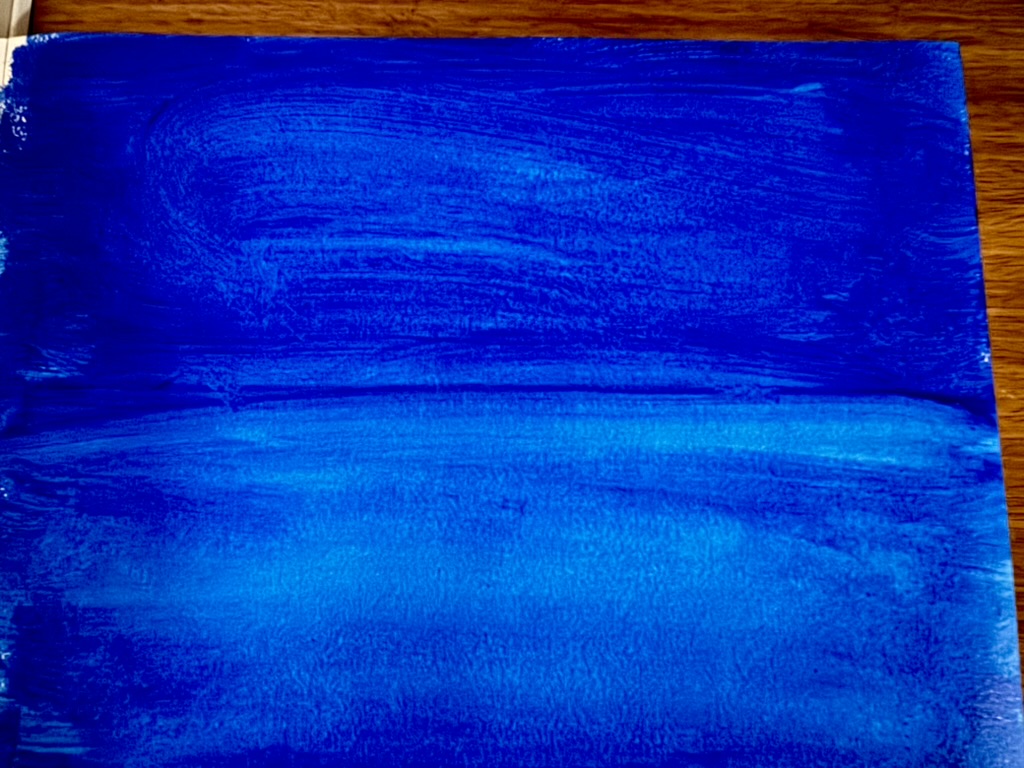
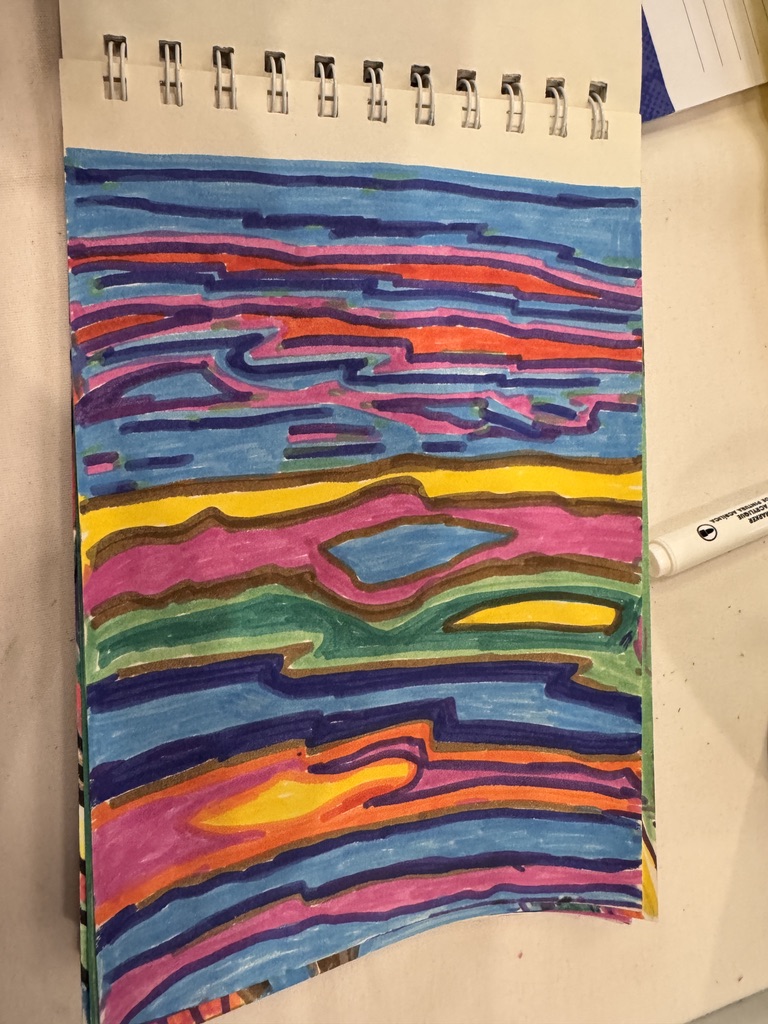
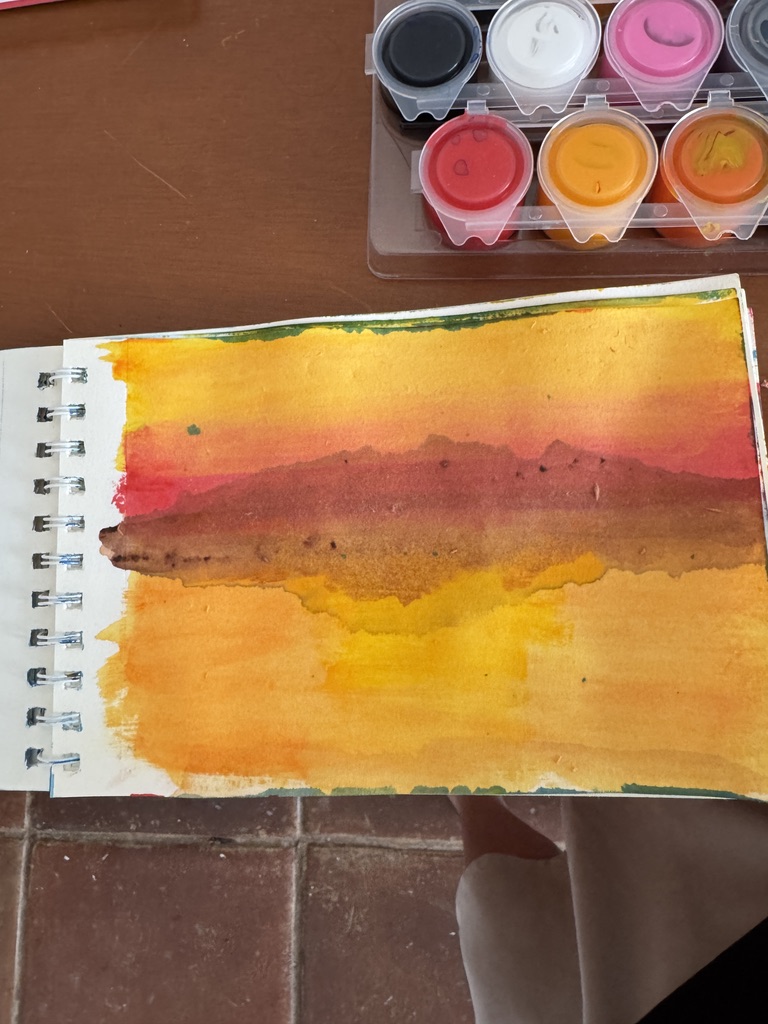
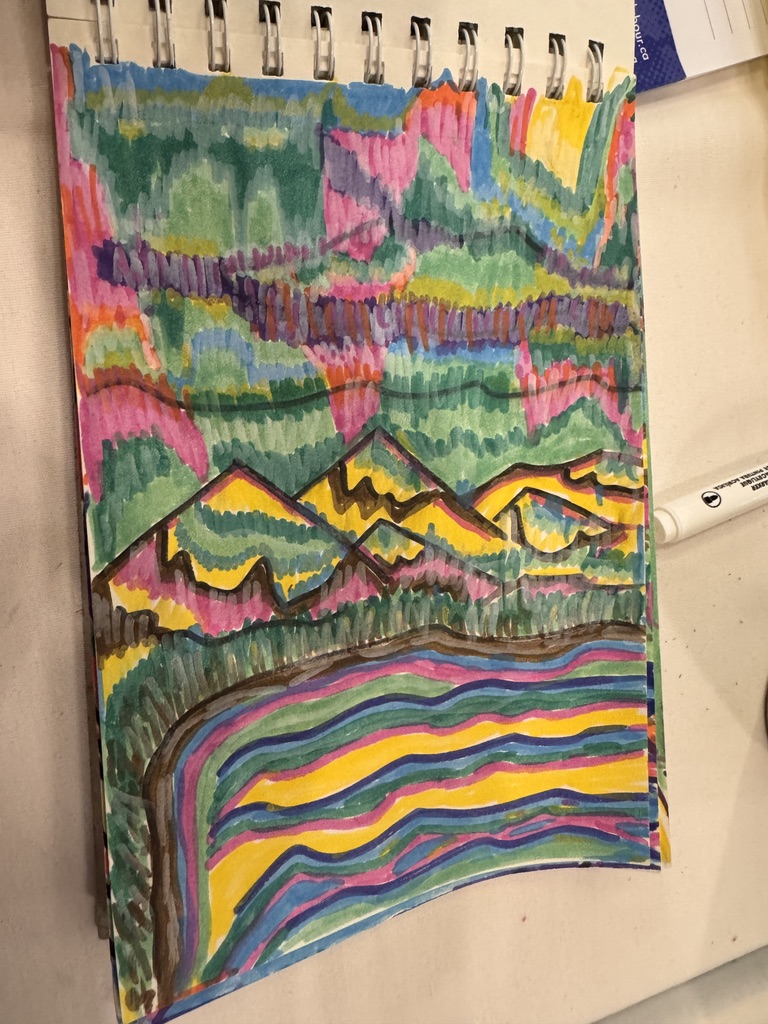
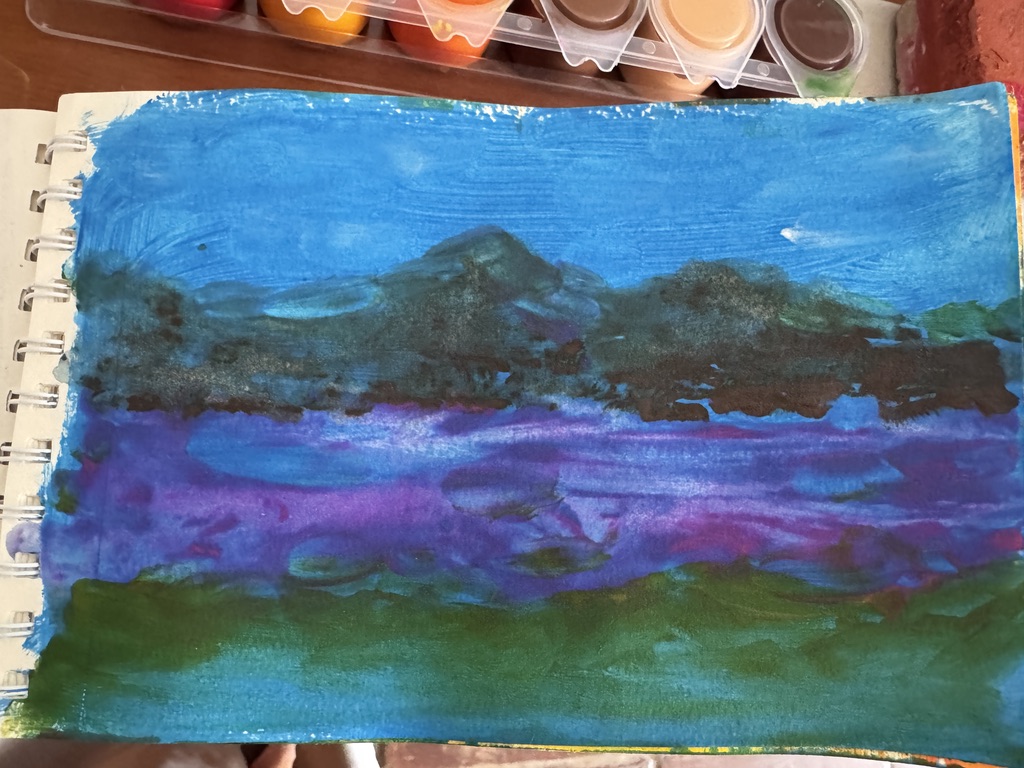
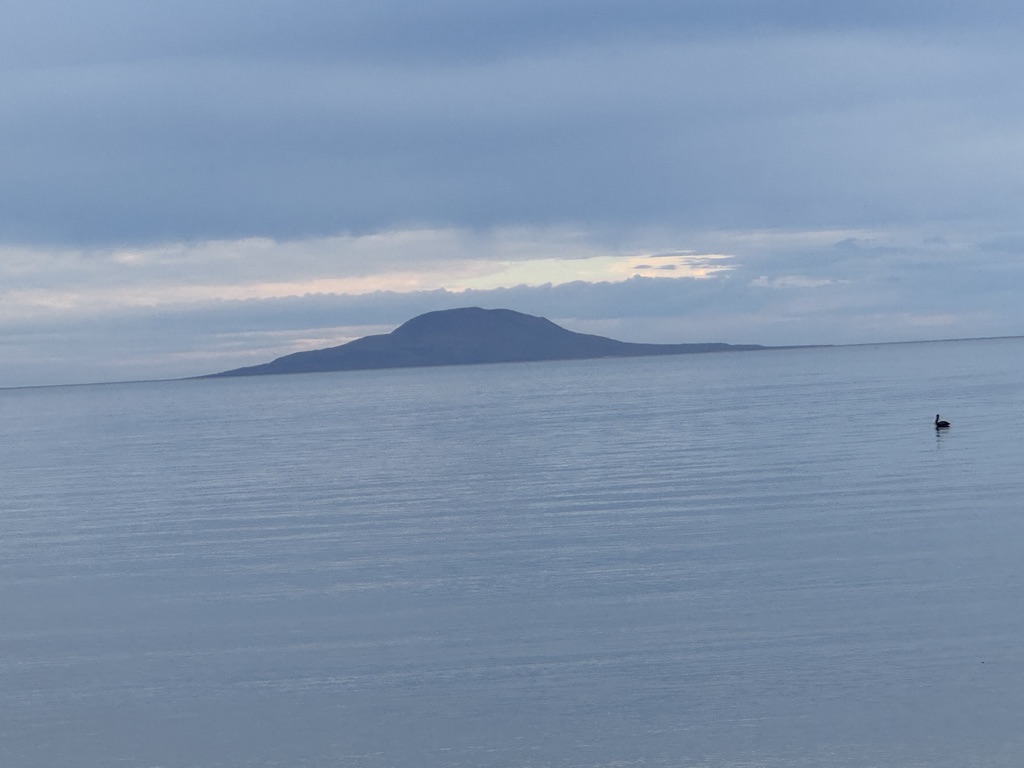
Day 31: Goodbye

Crossing Back, Carrying Forward

On Leaving the Liminal, Returning to the World, and What the Third Shore Teaches About Thresholds


The sweetness is gone, yet the form persists.

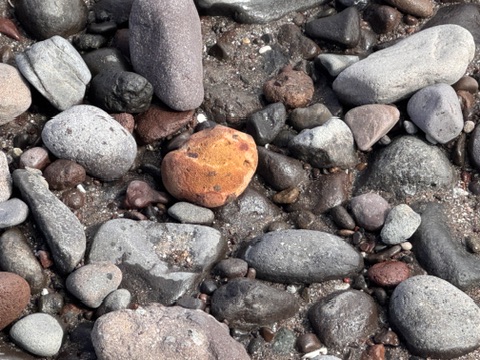
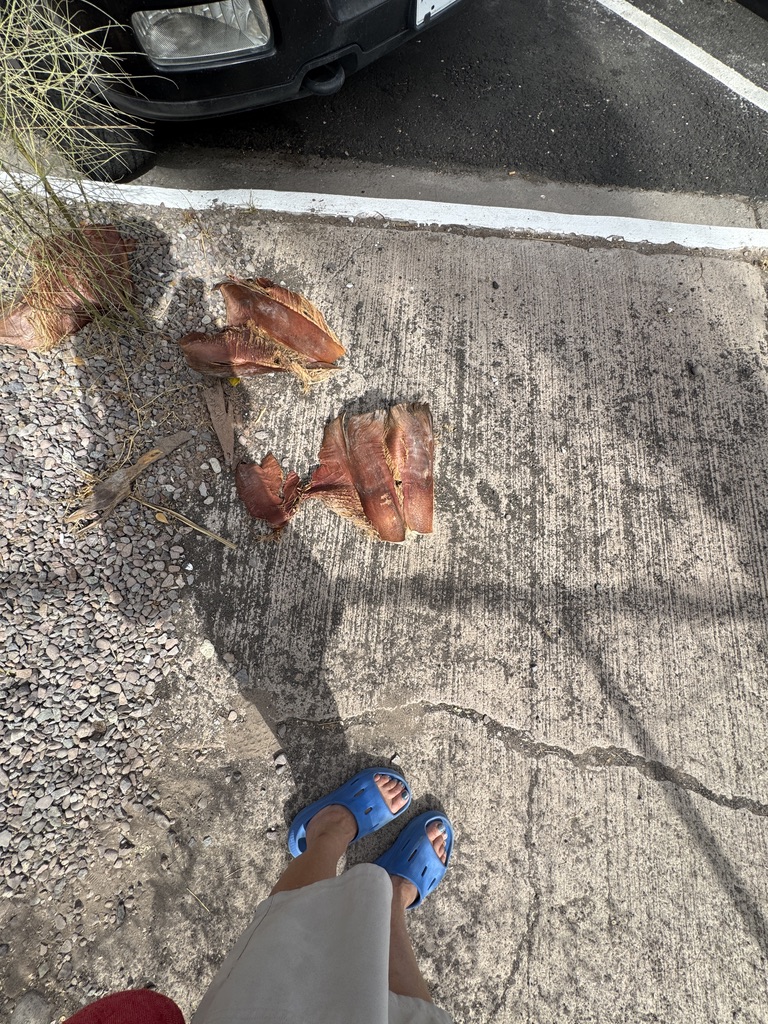
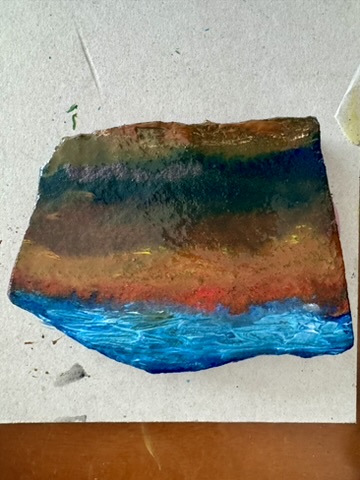
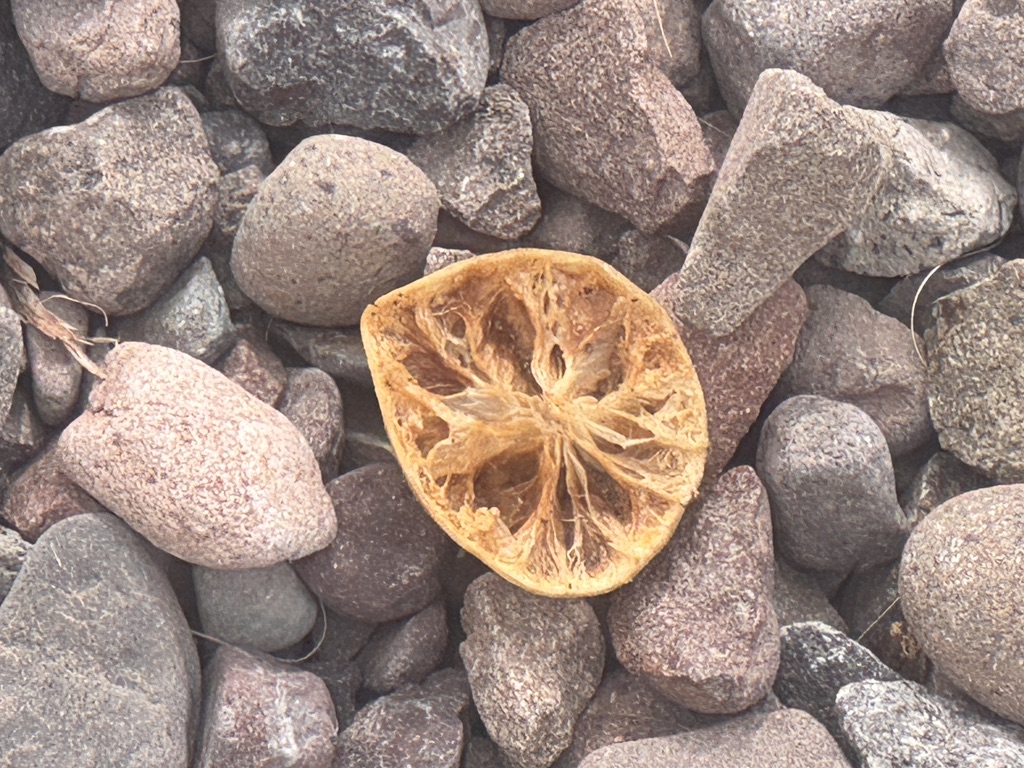
Title: Weathered Sweetness
Artist Statement

I came across this fragment while walking slowly along a stony stretch of shoreline, a place where very little seemed to belong and yet everything had arrived there for a reason. The dried citrus peel rested among the rocks, its colour still vivid despite the evident passage of time. It had once held moisture, brightness, and nourishment. Now it remained as structure, fibre, and trace.

I was drawn to the contrast. The surrounding stones felt ancient, dense, and immovable, while the peel carried the delicate architecture of something that had been alive in a different way. Placed together, they formed a quiet study in endurance. One shaped by geological time. The other by the brief, sensory life of fruit.

In my reflective practice, I often find meaning in what has been left behind. Objects that might be overlooked begin to feel like records of transition. This fragment speaks to me about what remains after usefulness has passed. The sweetness is gone, yet the form persists. There is dignity in that persistence, a reminder that value persists even as function changes.

I photographed it as I found it, without rearrangement. The moment felt complete. A small offering of colour held within an otherwise muted landscape. It invited me to consider how traces of vitality remain visible long after the season that produced them has ended.

Photo Credit: Amy Tucker, 2026

The Last Morning

How does one leave a threshold?

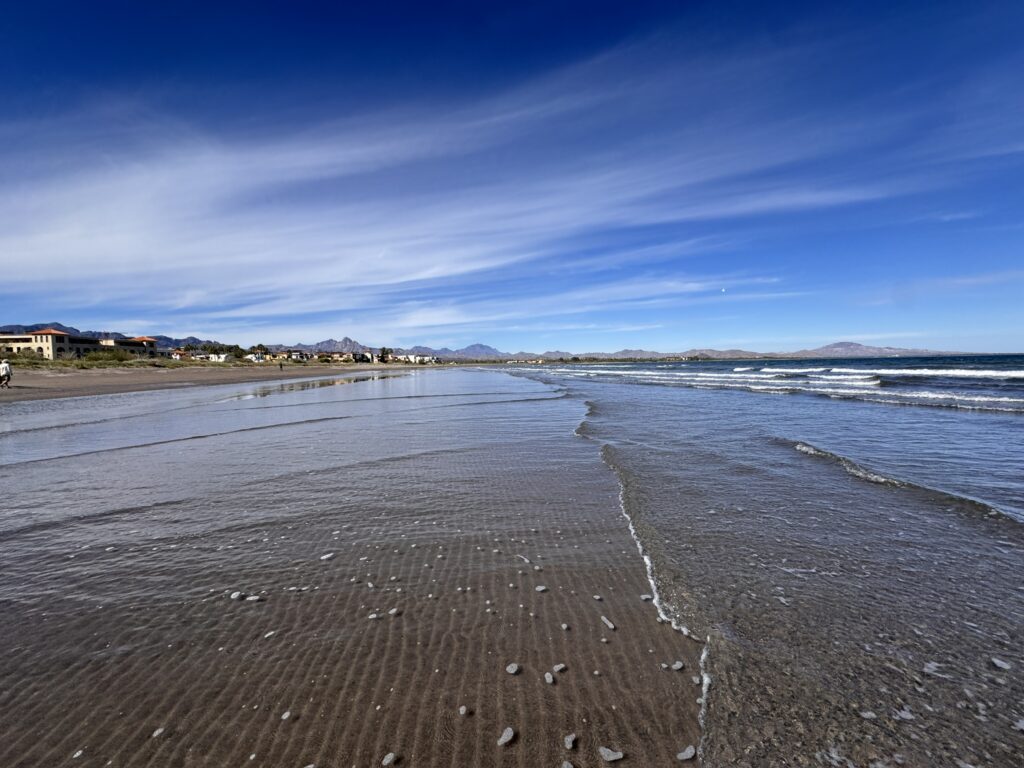
I woke before dawn on the final day. The casita was still dark, the Sea of Cortez invisible beyond the window, present only as sound: the soft rhythmic collapse of waves against sand, that constant whisper I have been falling asleep to for thirty nights. Tomorrow I will wake to silence, or to the different silence of a Canadian winter, and this sound will exist only in memory.

Se acaba. It ends.

I have been preparing for this moment without knowing how. How does one leave a threshold? How does one step back into ordinary time after thirty days suspended between who one was and who one is becoming? The literature on liminality describes the passage into threshold spaces with precision, yet remains quieter about the passage out. Perhaps because leaving the liminal zone is harder to theorise. Perhaps because each crossing back is as particular as the person making it.

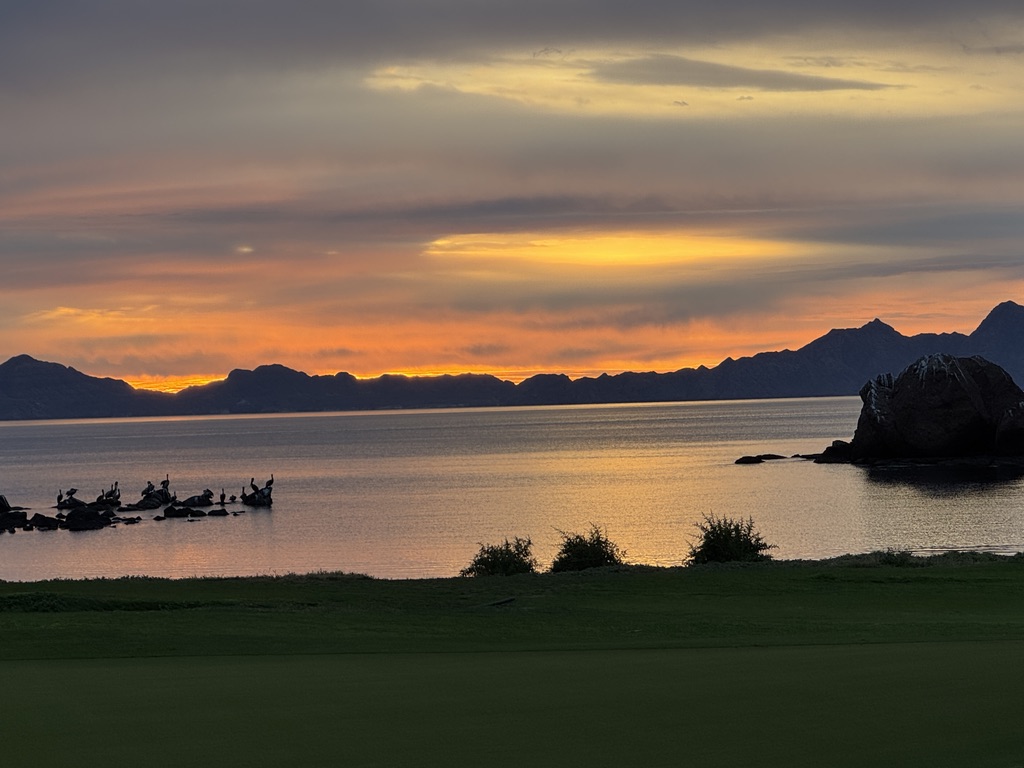
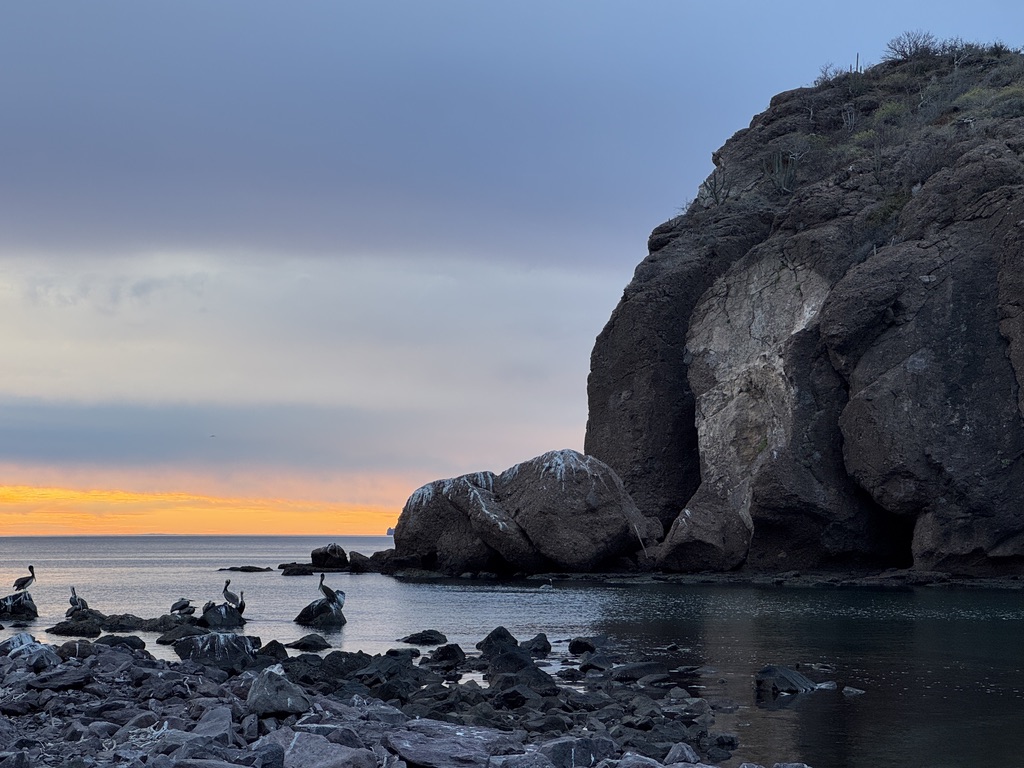
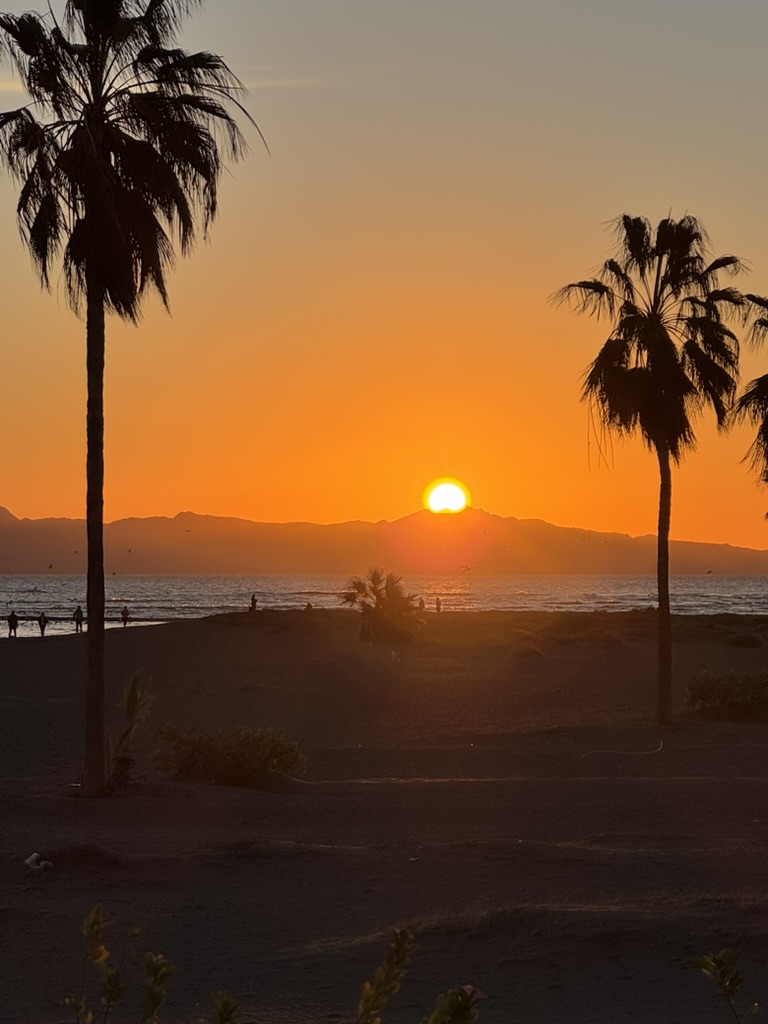
Title: Before the Sun
Artist Statement

I took this photograph in the last hour of darkness, when the sea and sky were still indistinguishable. This is the threshold hour, the liminal moment when categories dissolve and everything exists in a state of becoming. For thirty days, I have inhabited a similar dissolution: neither fully the person I was when I arrived nor yet the person I will be when I leave. This image holds that ambiguity without resolving it. The horizon line is visible but barely, a suggestion rather than a declaration. I am learning that thresholds are places of power precisely because they refuse clarity. They ask us to tolerate uncertainty, to exist in the between, to trust that what emerges on the other side will be worth the crossing.

Photo Credit: Amy Tucker, January 2026


What the Anthropologists Knew

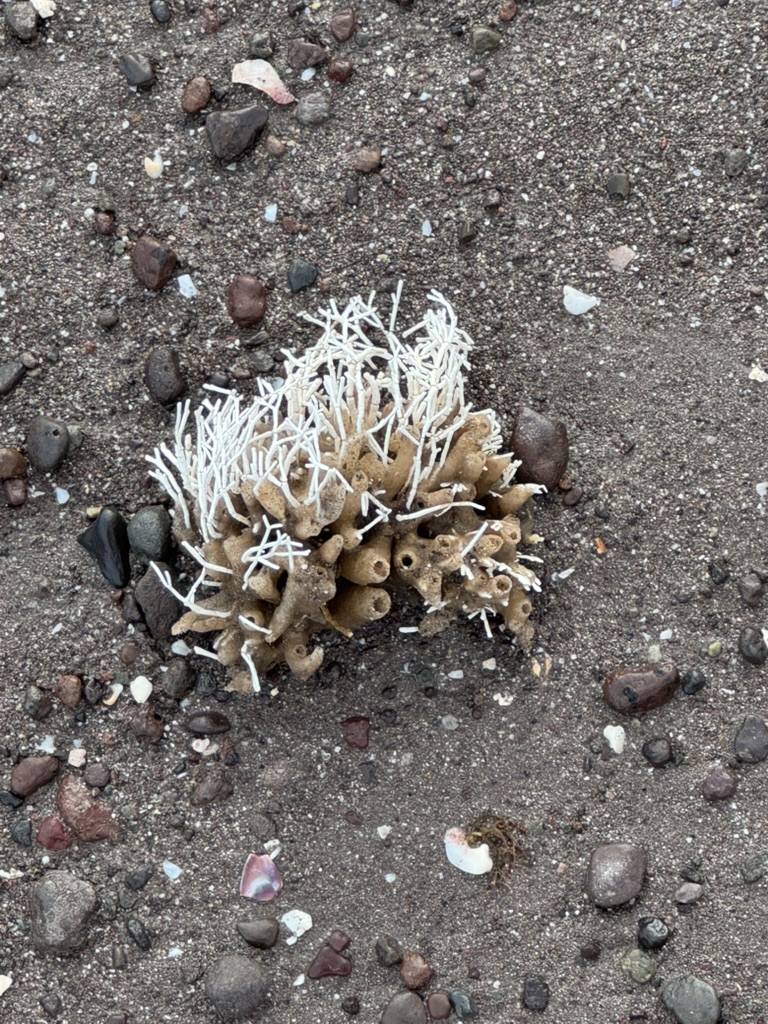
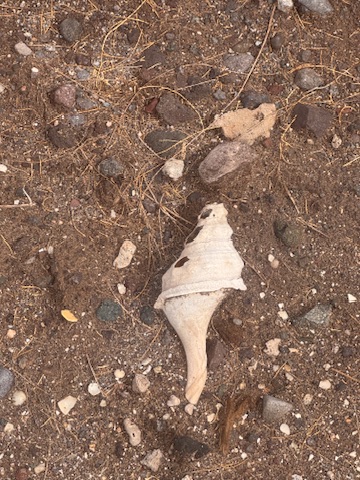
Title: What Remains After Tide
Artist Statement

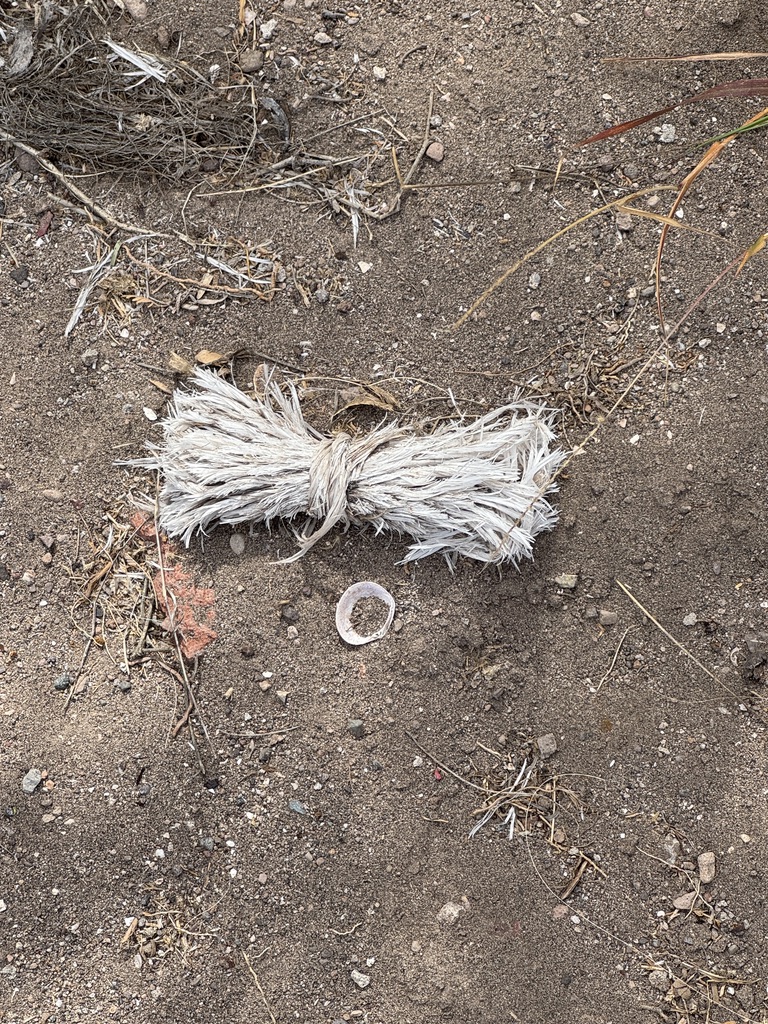
I found this shell far from the water’s edge, resting in dry earth rather than along the shoreline where one might expect it. Its placement caught my attention first. It felt displaced, carried beyond its original context and left to settle somewhere quieter, somewhere less obvious.

The shell itself bears the marks of time. Its surface is worn, its edges softened, its spiral intact but weathered. I was struck by how it still held its form despite everything it had moved through. Once a living structure, it now exists as residue. A trace. A record of what once housed life and sound and movement beneath the sea.

In my reflective work, I am often drawn to objects that signal transition rather than completion. This shell feels like evidence of passage. It has travelled, endured pressure, and arrived altered but recognizable. Its presence on the ground invites contemplation about displacement, survival, and the quiet dignity of what remains after the tide has receded.

I left it as I found it. I photographed it as I encountered it, partially embedded in the soil, surrounded by small stones and fragments of organic debris. The setting matters. It speaks to the way beauty and meaning surface in unexpected locations, outside the environments where they were first formed.

This image becomes a meditation on endurance. On the structures we carry within us even after the conditions that shaped them have changed. On how remnants continue to hold story long after their original function has passed.

Photo Credit: Amy Tucker, 2026

I came to this shoreline already in the threshold, already betwixt and between.

Arnold van Gennep, writing in 1909, gave us the vocabulary we still use for understanding transitions. In Les Rites de Passage, he identified three phases that characterise all major life transitions: separation, in which individuals are removed from their ordinary social position; liminality, the threshold period of ambiguity and transformation; and incorporation, the return to society in a new status or condition.

Victor Turner (1969/1977) built on van Gennep’s ideas by placing greater emphasis on the transitional, in-between stage of a rite of passage. He described this “liminal” phase as a state of deep uncertainty and ambiguity, in which individuals no longer hold their previous identities and have yet to assume new ones. Turner noted that during this period, people exist outside of the normal social order, beyond the roles and structures defined by tradition or authority. Although this stage can be unsettling and even risky, it also holds the potential for meaningful transformation, precisely because conventional boundaries and expectations are temporarily removed.

I arrived in Loreto in separation. I had been removed from my institutional position, stripped of the identity that “contract academic” had provided for twenty-five years. I came to this shoreline already in the threshold, already betwixt and between. The thirty days here have been an extended liminality, a sustained dwelling in the in-between space that most rituals compress into hours or days.

Now I face incorporation. The return. The crossing back.

Turner (1969/1977) suggests that what makes liminal experiences distinctive is their combination of seeming opposites: humility alongside sacred significance, and sameness alongside a sense of deep connection. In these ritual moments, individuals step temporarily outside ordinary time and everyday social structures. Although brief, this suspension allows for shared recognition of a broader social bond that transcends normal roles and hierarchies.

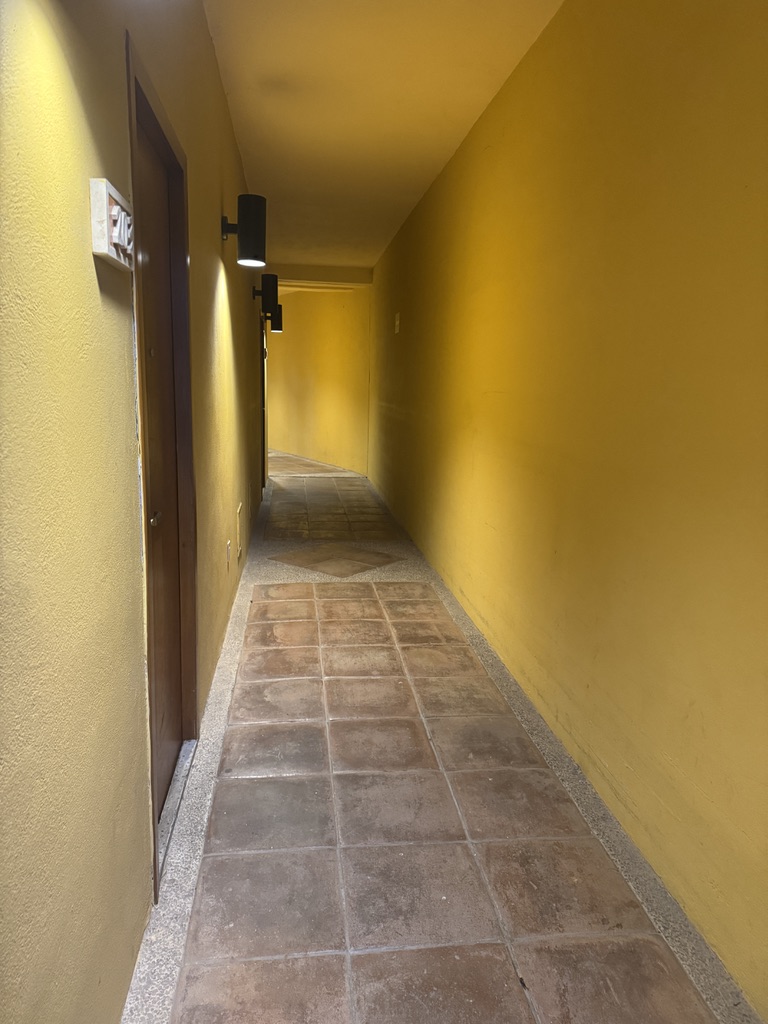
Title: The Doorway I Will Leave Through
Artist Statement

Van Gennep understood that thresholds are physical as well as symbolic. The Latin word limen means doorway, the literal space between inside and outside, the strip of ground one crosses when entering or leaving. This doorway has held me for thirty days. I have passed through it each morning to walk the shoreline; I have returned through it each evening to rest.

It has been my crossing point between solitude and the world, between the interior work of healing and the exterior fact of place. Tomorrow I will pass through it one last time, carrying my bags, closing it behind me. The door will remain. I will be gone. This is what thresholds teach: we pass through them, but they stay behind. We carry only what we can hold in our hands and in our memory.

Photo Credit: Amy Tucker, January 2026

The Third Shore as Liminal Space

I named this blog “The Third Shore” because the phrase captured something I could feel but could barely articulate when I began. There is the shore of loneliness, where aloneness is suffered, where the absence of others aches like a wound. There is the shore of solitude, where aloneness is chosen, where being with oneself becomes nourishing rather than depleting. And there is a third shore, the liminal space between them, where the practice of alonetude unfolds.

Long and Averill (2003), in their foundational study of solitude, observed that beneficial aloneness requires certain conditions: freedom from social demands, permission to express emotions, and the capacity for self-reflection. Loneliness, by contrast, is characterised by the painful perception that one’s social connections are insufficient (Perlman & Peplau, 1981). These are distinct states, yet they share a border. One can slip from solitude into loneliness without noticing the crossing. One can transform loneliness into solitude through attention and intention.

The third shore is where that transformation occurs. It is a liminal space: neither fully one thing nor the other, holding both possibilities, requiring constant navigation. Walking has been the central practice of these thirty days.

Estoy aprendiendo a caminar entre dos mundos. I am learning to walk between two worlds.

Table 1

Van Gennep’s Three Phases Applied to the Alonetude Retreat

Departure from Canada; loss of institutional identity as a contract academic; physical journey to LoretoVan Gennep’s DefinitionApplication to Alonetude Retreat
Return to society in a new status; reintegration with a transformed identity; carrying liminal wisdom into ordinary lifeRemoval from ordinary social structure and previous status; symbolic death of former identityDeparture from Canada; loss of institutional identity as contract academic; physical journey to Loreto
LiminalityThreshold period of ambiguity; “betwixt and between”; outside normal classifications; transformation becomes possibleThe thirty days of retreat; walking the third shore between loneliness and solitude; practising alonetude; gathering fragments; allowing rest
Return to society in a new status; reintegration with a transformed identity; carrying liminal wisdom into ordinary lifeReturn to society in new status; reintegration with transformed identity; carrying liminal wisdom into ordinary lifeReturn to Canada; carrying forward embodied knowledge of rest, attention, and self-worth; maintaining alonetude practice within ordinary life

Note. Van Gennep’s (1909) tripartite structure provides a framework for understanding the retreat as a ritual process. The separation phase involved physical departure from Canada and symbolic departure from institutional identity. The liminal phase comprised the thirty days of alonetude practice. The incorporation phase, now beginning, involves returning to ordinary life while carrying forward what was learned in the threshold.

We pass through thresholds, but the thresholds stay behind.


What I Carry Forward

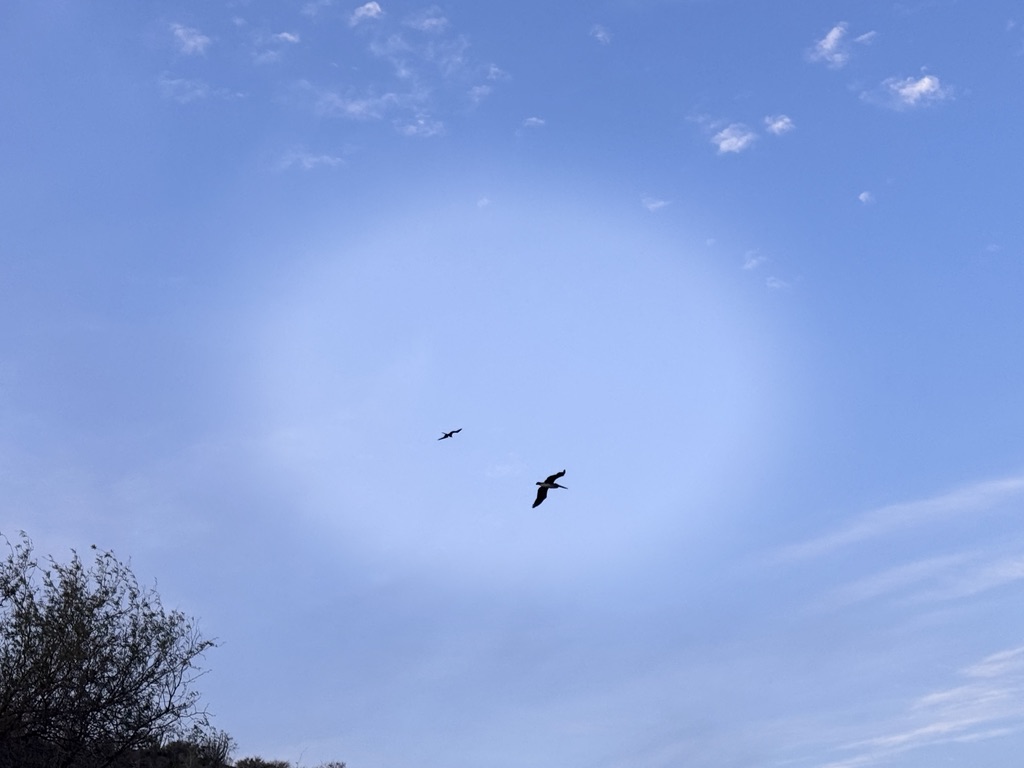
Title: Sky Practice
Artist Statement (Scholarly Personal Narrative Reflection)

I took this photograph while standing still long enough for my breathing to slow. The sky was wide and uninterrupted, the kind of expanse that asks nothing but attention. Two birds crossed the frame at different distances from where I stood, one closer, wings extended in full glide, the other smaller, further out, moving along its own invisible current. Their spacing held my gaze.

What stayed with me was the quiet relationship between proximity and independence. Each flew independently, in no formation together, yet neither was alone. Each moved within the same field of air, carried by the same conditions, responding to the same thermals, but at their own pace, along their own trajectory. Watching them, I felt something settle inside me about how companionship can exist without entanglement.

I have been thinking about how presence works in this way. How we share sky with others, share time, share movement through particular seasons of life, yet still remain responsible for our own lift and direction. There was no urgency in their flight, no need to arrive quickly. The moment felt unhurried, held open by light and distance.

In my own practice, images like this become reminders of scale. Of how small the human body is against open sky, and how relieving that recognition can be. The photograph holds a brief alignment between body, breath, and horizon. A pause long enough to notice that movement sometimes requires trust far more than effort. Sometimes it requires trust in the air that holds you.

Photo Credit: Amy Tucker, 2026

Turner (1969/1977) observed that people who emerge from liminal experiences often carry with them a different relationship to social structure. Having existed outside the usual categories, they see those categories more clearly. Having been stripped of status markers, they understand how arbitrary such markers can be. This is liminal knowledge: wisdom gained through the suspension of ordinary ways of being.

I carry forward the knowledge that my value was never contingent on institutional recognition. This sounds simple. It has taken me twenty-five years to learn it in my body rather than merely understand it in my mind. The precarious academic learns to measure worth through external validation: contracts renewed, courses assigned, the provisional belonging that must be constantly re-earned. Alonetude has taught me a different arithmetic. I am valuable because I am. Full stop. No contract required.

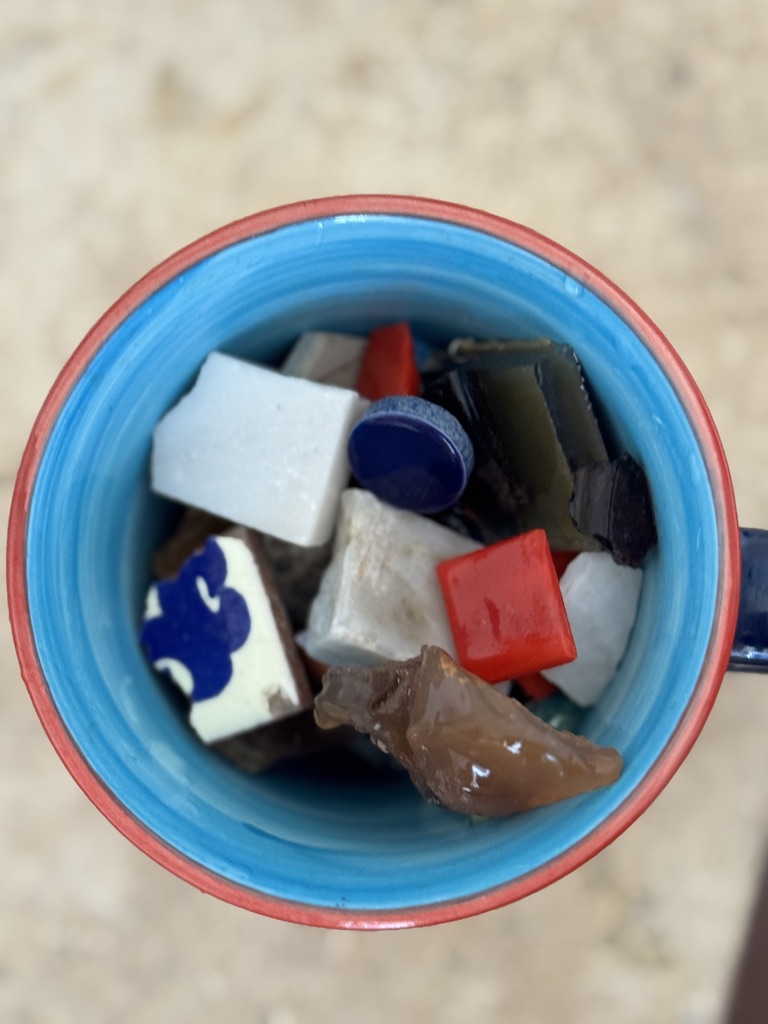
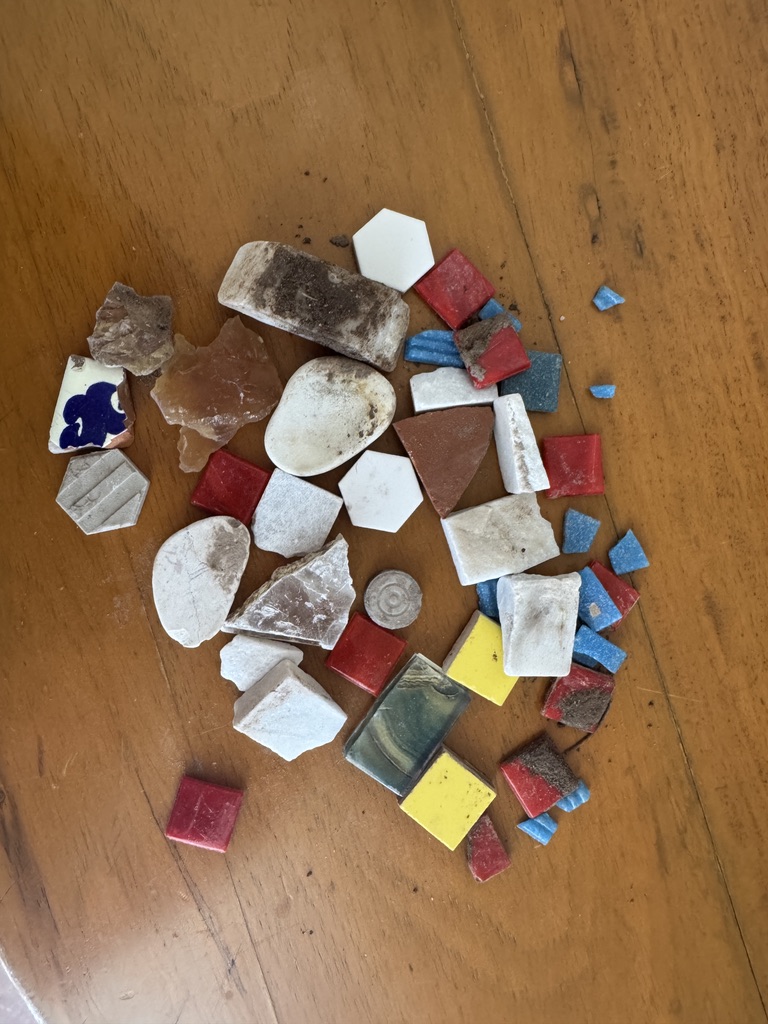
I carry forward the practice of slow attention. The discipline of walking without a destination. The permission to notice colour, texture, and light. The fragments of tile and glass I gathered from the empty field sit in my bag, waiting to become something I cannot yet name. They are evidence that treasure exists in overlooked places, that beauty persists despite neglect, that brokenness can be the beginning of a new form.

I carry forward the understanding that rest is resistance. Hersey (2022) is right: in a culture that extracts value from bodies until they break, choosing to rest is a political act. Choosing to heal rather than merely survive. Choosing to attend to my own restoration rather than performing wellness for those who profit from my depletion. This is knowledge I will need in the world I am returning to, which remains structured by the same extractive logics I fled.

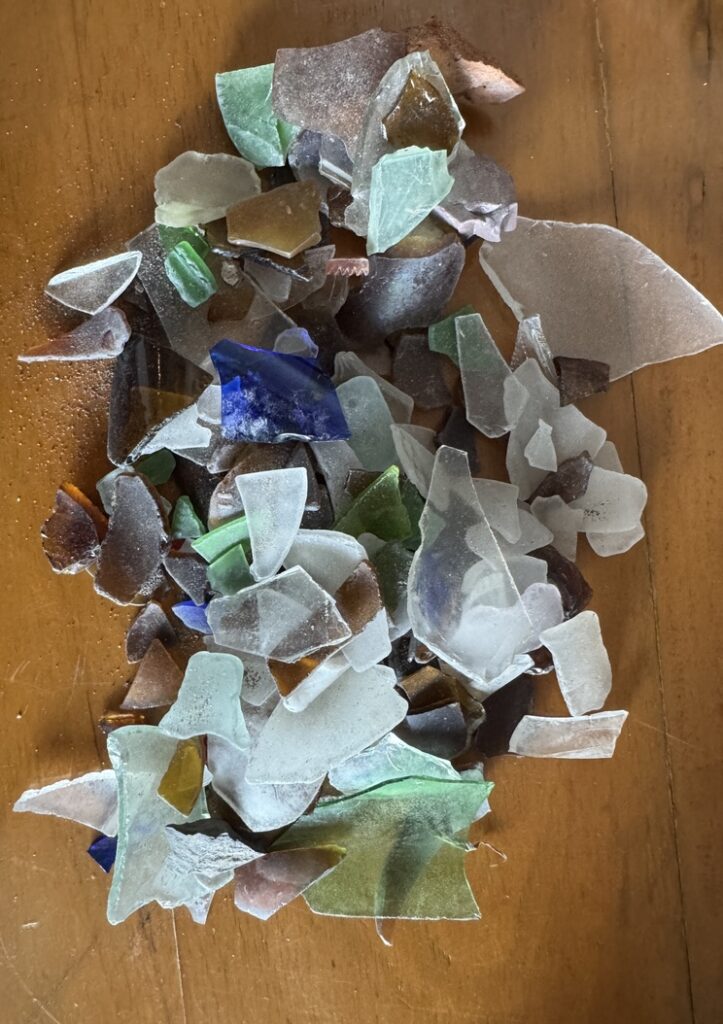
Title: What Fits in a Bag
Artist Statement

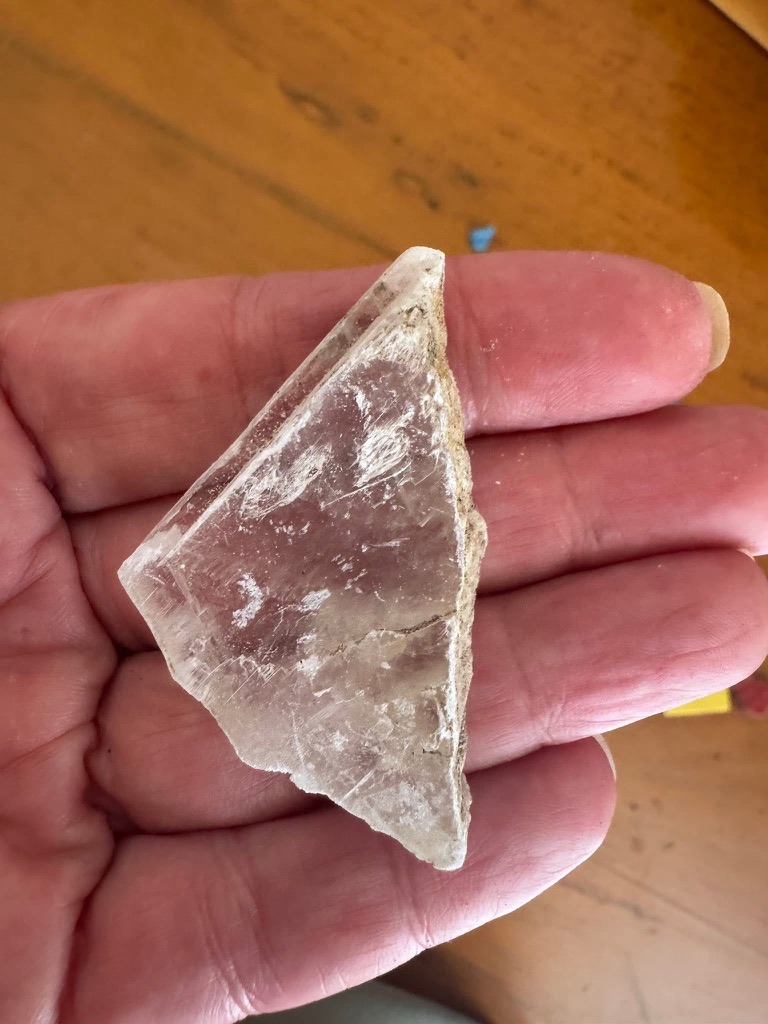
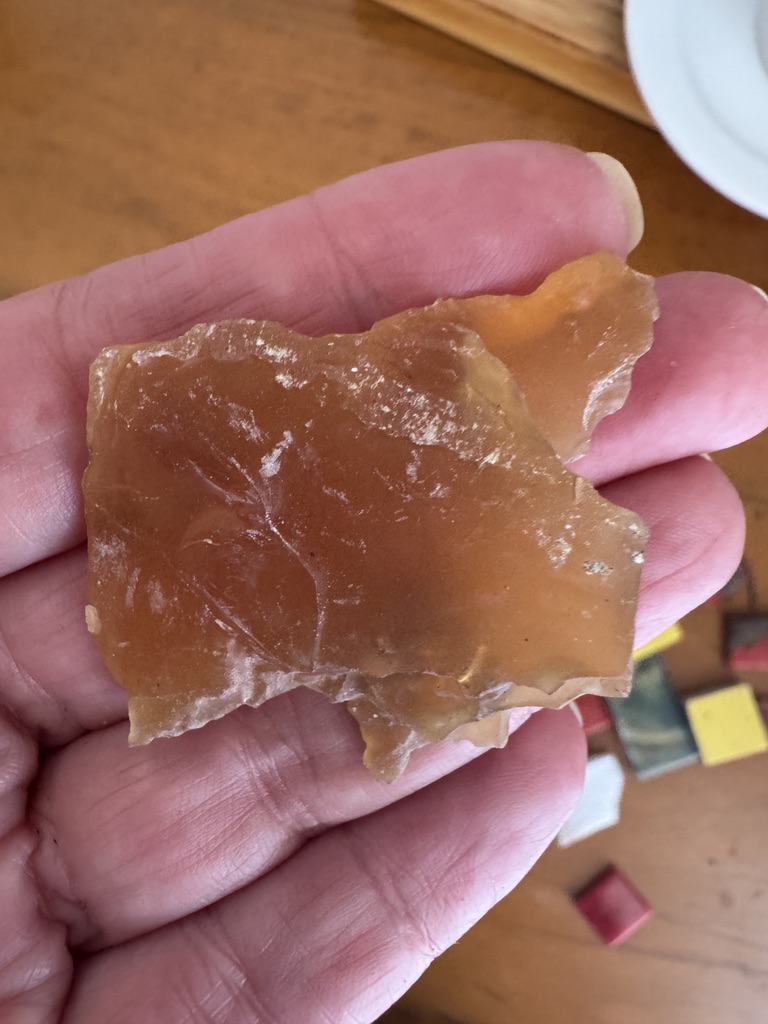
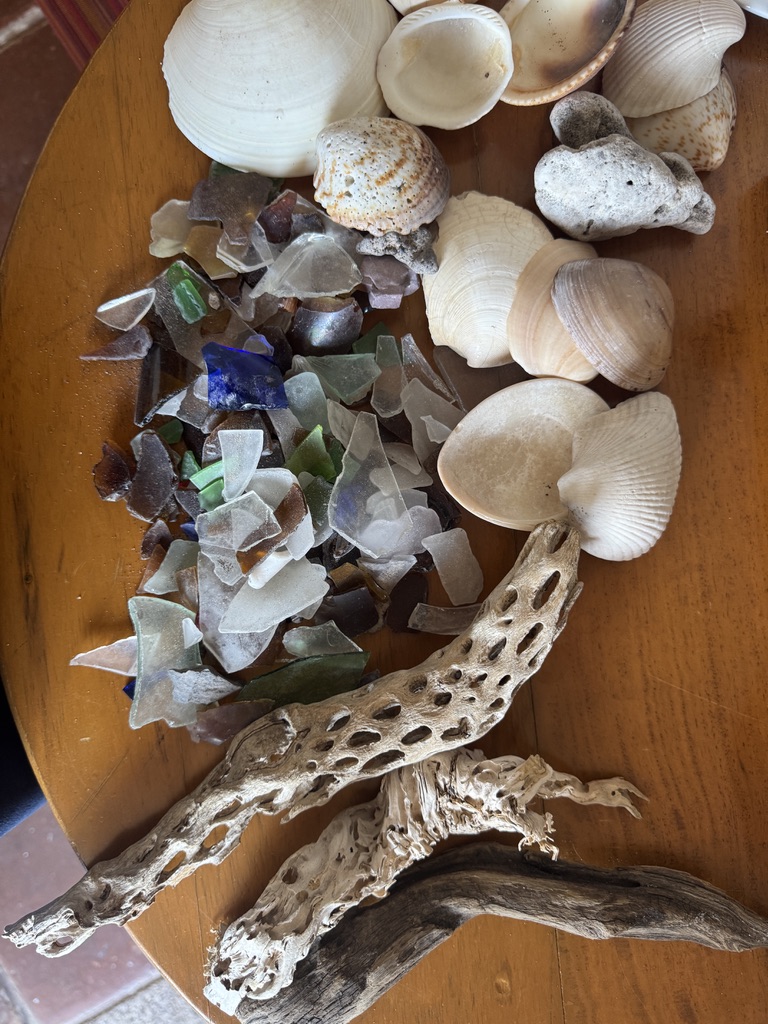
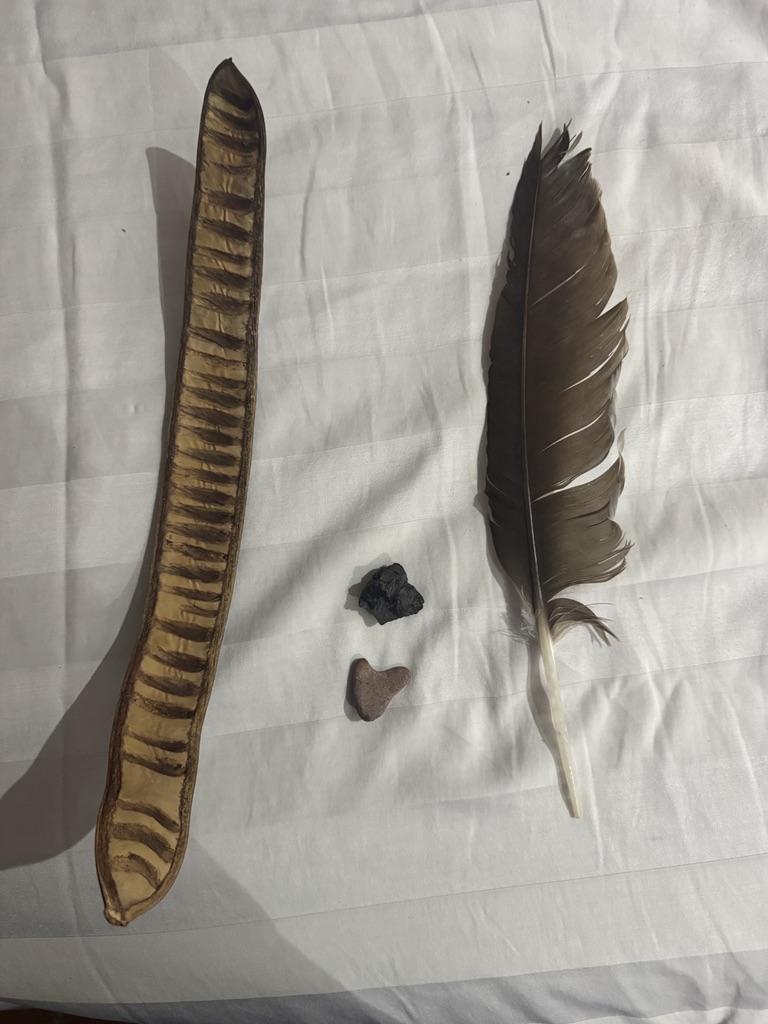
I photographed what I am carrying home because objects hold memory differently than words. These fragments of tile, glass, and stone have no market value. They would carry their full meaning only for someone who had walked the fields where I found them, had bent down to pick them up, had felt their weight in the palm while the afternoon light slanted across the desert floor. They are worthless and priceless at once. They are evidence of attention, material proof that I was here, that I looked, that I gathered what the world had discarded and held it precious. The amber stone catches light even now. The blue tiles will become mosaic, eventually, when I am ready to arrange them into new form. What fits in a bag is never everything. What fits in a bag is only what we can carry. The rest, the sea sound, the quality of morning light, the feeling of being held by a landscape that asked nothing of me, this I carry in my body. This I carry forward into whatever comes next.

Photo Credit: Amy Tucker, January 2026

The Danger of Re-Entry

The third shore is where that transformation occurs.

Transition theorist William Bridges (2004) warns that the incorporation phase is often the most difficult. We emerge from liminal experience transformed, yet the world we return to remains largely unchanged. The people who knew us before may expect the person we used to be. The structures that shaped our earlier suffering remain in place. There is a profound dissonance between inner transformation and outer continuity.

I am aware of this danger. Canada waits for me: the same country, the same academic culture, the same precarious conditions that burnt me out in the first place. The institutions have learned nothing from my departure. They will continue extracting value from contingent workers until those workers, too, collapse. I cannot return to the same relationship with those structures and expect different outcomes.

Yet I am returning differently. This is the gift of liminality: the threshold changes us even when the world on the other side remains the same. I know now what my face looks like when it belongs only to me. I know what my body feels like when it sleeps without the weight of performance. I know that invisibility can be medicine, that rest is resistance, that alonetude is a practice I can continue even in places where solitude must be carved from crowded hours.

Volveré diferente. I will return differently. That has to be enough.

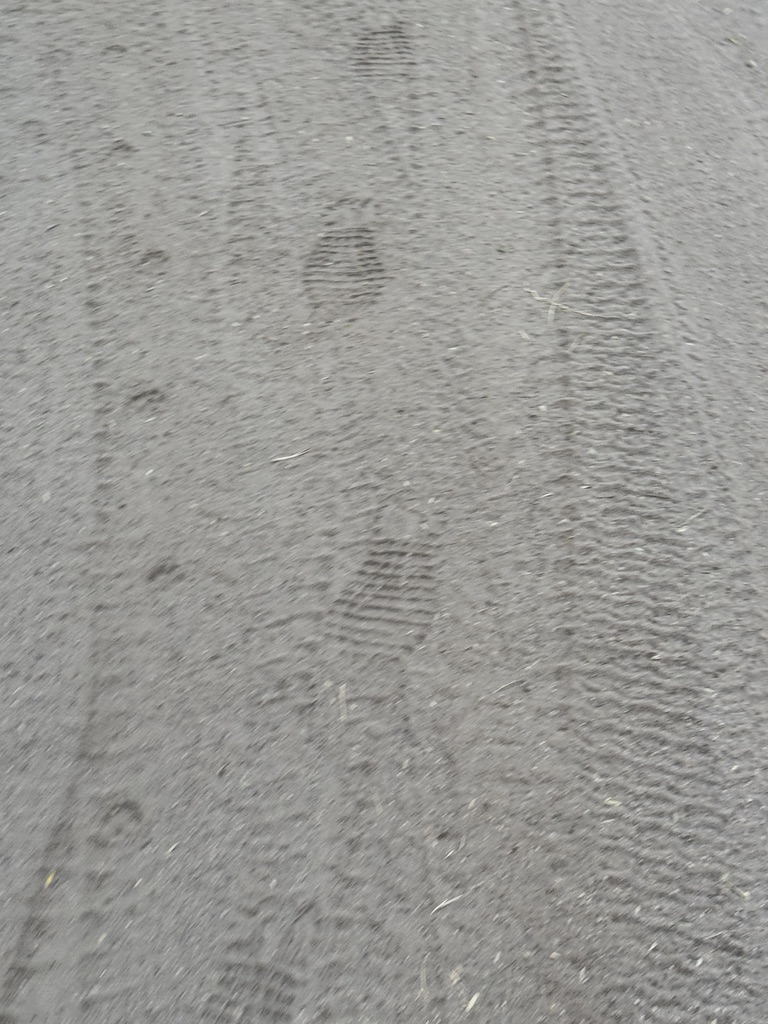
Title: Footprints Filling
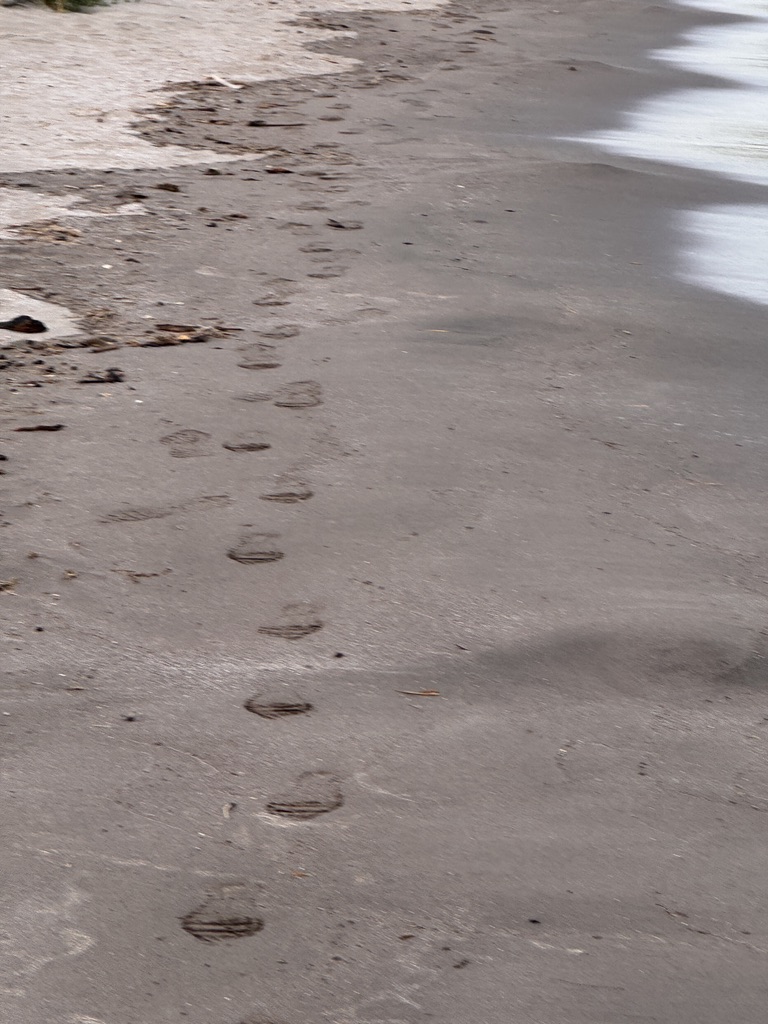
Artist Statement

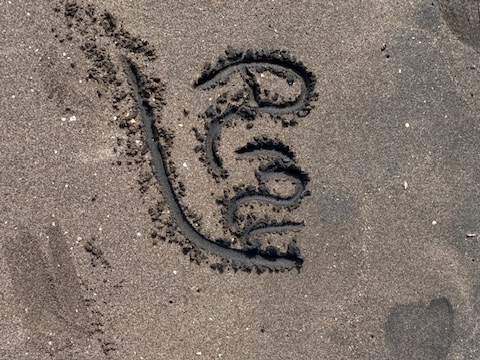
These are my footprints, walking away. By the time I took this photo, the tide was already beginning to blur them, softening the edges, starting the quiet work of erasure. By nightfall, the sand would be smooth again.

I have walked this shoreline every day for thirty days. Thousands of steps, each one erased. This is what the ocean teaches: presence endures, even when evidence disappears. I was here. The marks are gone.

What remains is the rhythm: the act of walking, one foot and then the other, the commitment to return each morning regardless of whether anything remains.

Tomorrow someone else will walk this same shore. The sand will hold their steps just as it held mine: fully, briefly, without keeping score.

Photo Credit: Amy Tucker, January 2026

Alonetude as Ongoing Practice

The retreat ends, but alonetude continues. This is the insight I want to carry most carefully across the threshold: the practice was never about the place. Loreto held me while I learned, but what I learned is portable. Alonetude, the intentional, embodied, chosen practice of solitude as healing, can be practised anywhere there is space for attention, permission for presence, and willingness to be with oneself.

Kabat-Zinn (1994) writes that mindfulness is available in any moment we choose to be present. The difficulty lies in remembering to choose it, in carving out space for attention within lives structured by distraction and demand. This will be my work in the months ahead: protecting the practice, maintaining the discipline, refusing to let ordinary life erode what extraordinary solitude built.

I will walk in Canada the way I walked here: slowly, without a destination, attending to what appears. I will paint stones even without the Sea of Cortez to wash them clean. I will practise the quiet permission of invisibility even in places where people expect my performance. I will rest, and I will call that rest resistance, and I will refuse the shame that productivity culture attaches to stillness.

These are promises I am making to myself. They are also political commitments. Every hour I give to alonetude is an hour withdrawn from the extraction economy. Every moment of presence is a refusal of the scattered attention that capitalism demands. This is a small resistance. It is also the only resistance available to a body recovering from exploitation: the insistence on caring for myself even when systems would prefer I be available, productive, and perpetually giving.

Title: The Sea Will Still Be Here
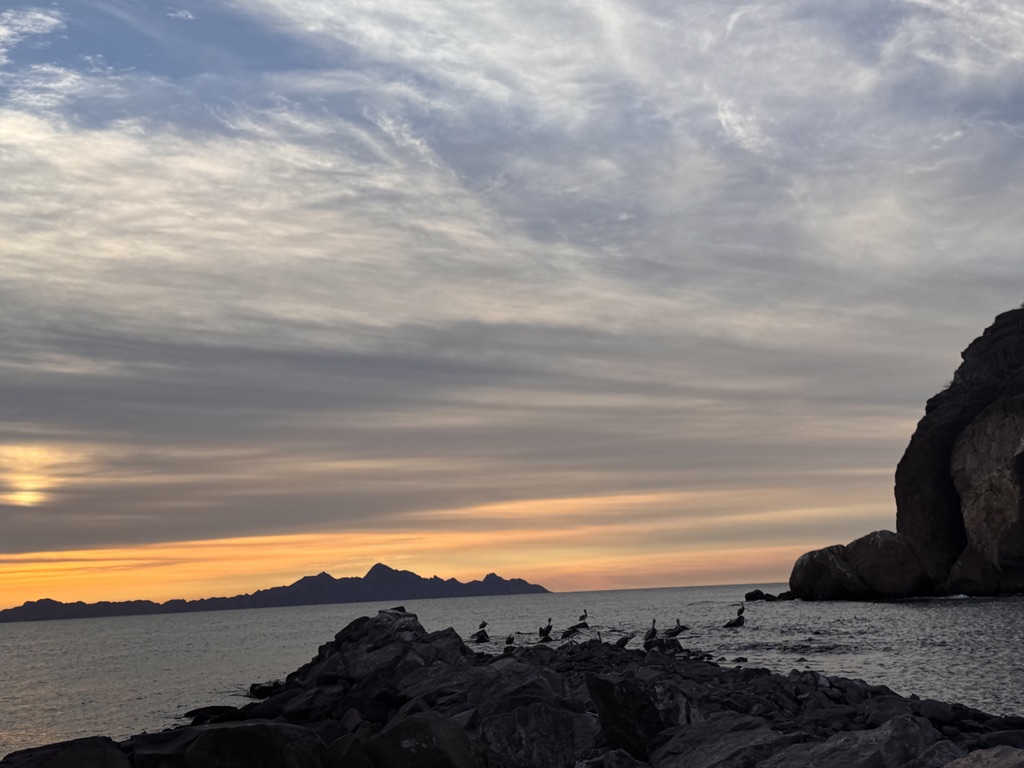
Artist Statement 

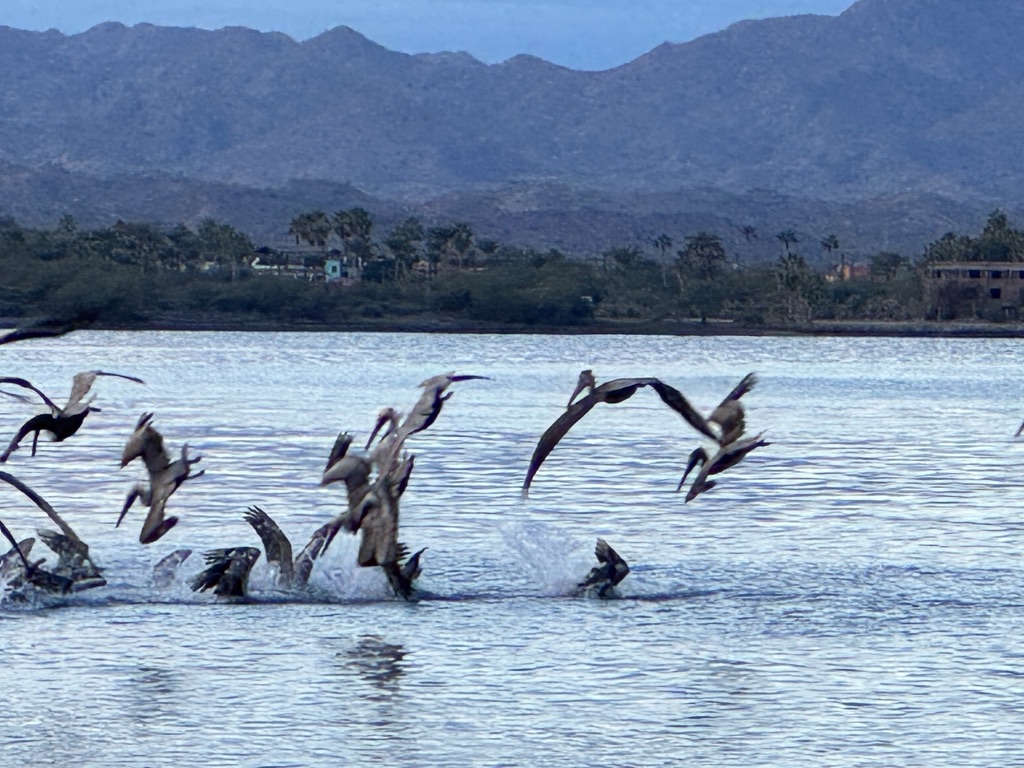
I took this photograph as a form of gratitude. The sea received me for thirty days. It held my walks, witnessed my tears, caught the light I photographed each morning. It will continue doing all of this after I leave. The tides will rise and fall. The pelicans will skim the surface. The waves will collapse against sand with the same rhythm they have kept for millennia.

My presence here has changed nothing about this place. And yet this place has changed everything about me. This is the paradox of alonetude: we are held by something larger than ourselves, something that remains indifferent to our particular struggles, and in that indifference we find permission. Permission to be small. Permission to be temporary. Permission to rest within the vast continuity of water and light and time. Gracias, mar. Gracias por todo. Thank you, sea. Thank you for everything.

Photo Credit: Amy Tucker, January 2026

Crossing the Threshold

Title: Where the Boundary Gives Way
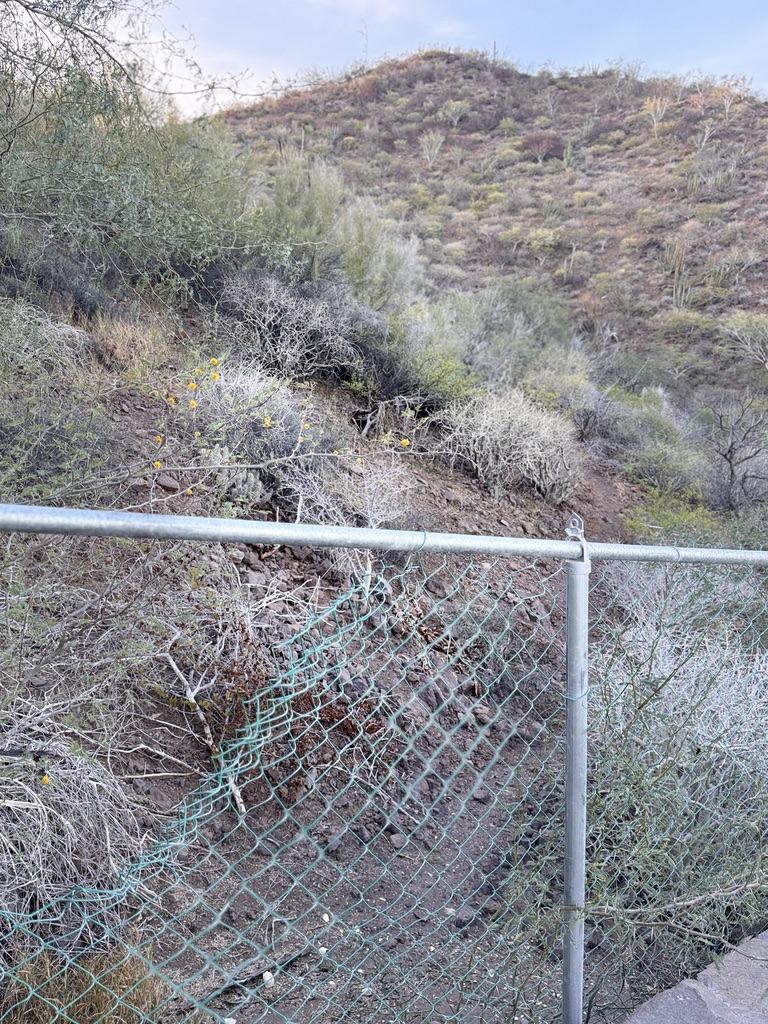
Artist Statement

I took this photograph while walking a familiar path, one I had come to rely on for steadiness. What drew my attention was the fence. It was meant to mark a boundary, to hold a line between walkway and hillside, between what was permitted and what was left to grow undisturbed. Yet the fence had given way. The metal mesh bent inward, pulled down by time, weather, and gravity. It no longer stood as a firm divider. It sagged, softened, and followed the shape of the land it once tried to contain.

I paused there longer than I expected. I found myself thinking about how many of the boundaries in my own life had begun this way, strong at first, clearly defined, built for protection. Over time, some held. Others shifted. Some were worn down by repeated pressure, by responsibility, by care extended outward without equal care extended inward. The image became less about infrastructure and more about the quiet labour of maintenance, both external and internal.

The hillside beyond the fence was alive in its own way. Dry brush, small blooms, cactus, and stone coexisted without straight lines or imposed order. There was a different kind of structure there, one shaped by adaptation rather than enforcement. Standing between the path and the slope, I felt the tension between containment and release, between holding form and allowing movement.

This photograph sits within my ongoing inquiry into thresholds and limits. It reminds me that boundaries shift and change. They require tending. They bend when neglected. They also teach. The softened fence signals information, never failure, to me. It signals information. It asks where reinforcement is needed and where flexibility might be wiser.

I left the scene thinking about the balance between protection and permeability. About how living well requires both. About how even a boundary that has given way can still mark a place of learning.

Photo Credit: Amy Tucker, 2026

Van Gennep understood that thresholds require ritual acknowledgment. We cannot simply drift from one state to another; we must mark the crossing, honour the passage, name what is ending and what is beginning. Without ritual, transitions remain incomplete. We carry unfinished business into our new lives, and it weighs us down.

This blog post is my ritual. These words mark the crossing. I name what is ending: thirty days of formal retreat, the sustained liminality of this particular place and time, the intense attention that structured solitude made possible. I name what is beginning: return, incorporation, the carrying forward of what I learned into ordinary life.

I acknowledge the threshold by standing on it one last time. Here, at the edge, I can still feel both shores. The loneliness I feared before I came. The solitude I cultivated while I was here. And the third shore between them, the liminal space where alonetude unfolds, where the practice of intentional presence transforms suffering into wisdom.

I cross now. I carry what I can carry. I leave the rest at the water’s edge, trusting that the sea will tend it, that the tide will smooth it, that some future walker may find treasure in what I leave behind.

Title: After
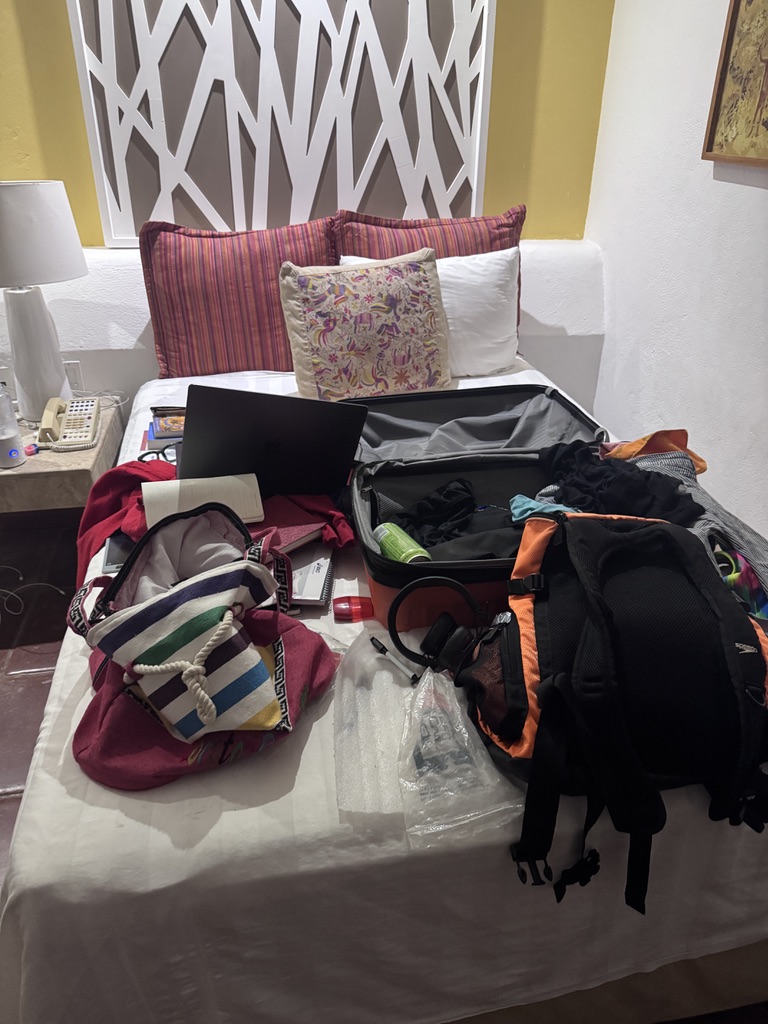
Artist Statement

This image documents a threshold moment, taken as I prepared to leave a place that had quietly shaped my inner world. The disorder of the bed is evidence of transition rather than chaos, of embodied movement between states of being. I was struck by how the act of leaving is plural; it unfolds in gestures, hesitations, and rituals of gathering.

The photograph is part of a broader inquiry into what it means to depart, physically, yes, and emotionally too. As I packed, I realised that objects carry more than function: they hold memory, narrative, and proof of transformation. The image reflects the tension between mobility and attachment, between material departure and affective residue.

In reflecting on this moment, I am reminded of Victor Turner’s notion of liminality: a suspended state in which the old identity is no longer fully intact and the new one has yet to crystallise. This photo stands as evidence of that space: hovering, neither quite here nor quite there, rich with meaning throughout.

Photo Credit: Amy Tucker, 2026

The third shore will be here when I need it. The practice continues, even without the sea.

Cruzo ahora. Sigo adelante. Llevo todo conmigo.

I cross now. I go forward. I carry everything with me.


References

Bridges, W. (2004). Transitions: Making sense of life’s changes (2nd ed.). Da Capo Press.

Hersey, T. (2022). Rest is resistance: A manifesto. Little, Brown Spark.

Kabat-Zinn, J. (1994). Wherever you go, there you are: Mindfulness meditation in everyday life. Hyperion.

Long, C. R., & Averill, J. R. (2003). Solitude: An exploration of benefits of being alone. Journal for the Theory of Social Behaviour, 33(1), 21–44. https://doi.org/10.1111/1468-5914.00204

Perlman, D., & Peplau, L. A. (1981). Toward a social psychology of loneliness. In S. Duck & R. Gilmour (Eds.), Personal relationships 3: Personal relationships in disorder (pp. 31–56). Academic Press.

Turner, V. W. (1969/1977). The ritual process: Structure and anti-structure. Cornell University Press.

van Gennep, A. (1960). The rites of passage(M. B. Vizedom & G. L. Caffee, Trans.). University of Chicago Press. (Original work published 1909)

Translation note. Spanish language passages were generated using Google Translate and subsequently reviewed and refined by the author. Any remaining infelicities reflect the limits of machine translation rather than intent.

I am valuable because I am. Full stop.
Day 30: What Faces Inward

Day 30: the last full day by the sea. A reflection on what faces inward when the outward noise falls away, on grief, solitude, embodiment, and what thirty days of alonetude has revealed about the shape of a life.

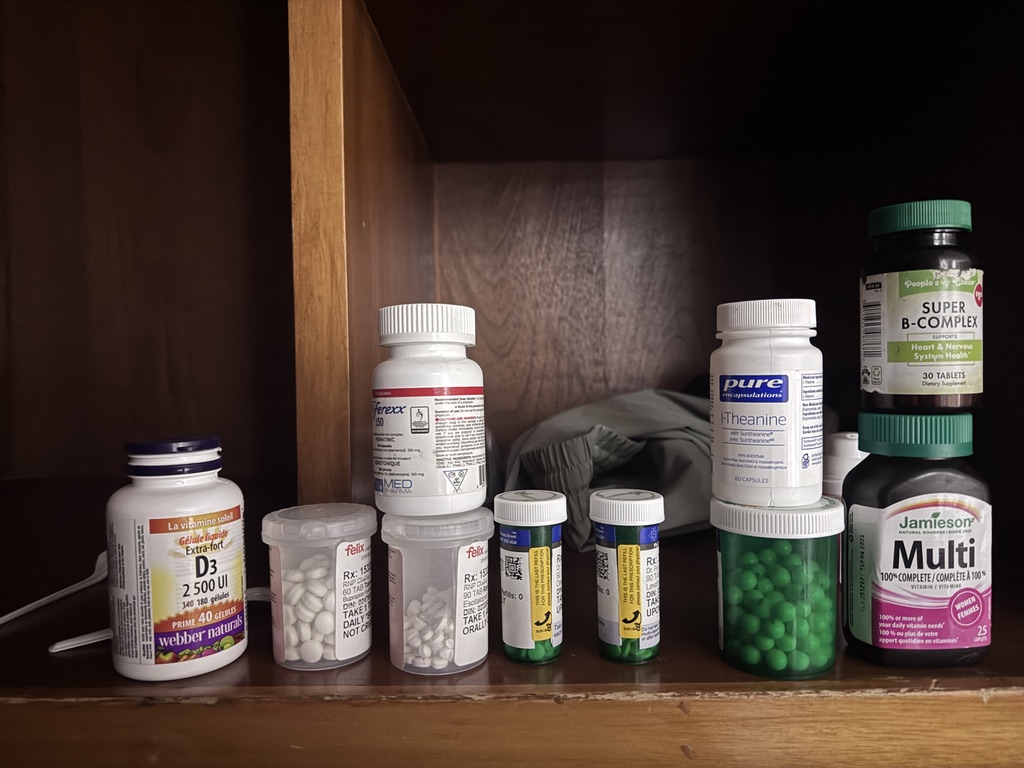
Title: What Gives Me Life

Artist Statement

This collection speaks of dependency and care, of the daily negotiations required to maintain balance. I stopped when I saw these bottles lined up like a private apothecary, each label marking a different struggle being addressed, managed, and contained.

Photo Credit: Amy Tucker, January 2026

These medications are architecture, never crutches for the broken. They are architecture for survival, structures that hold space for healing to occur.

Amy Tucker, 2026

For years, I hid these interventions in shame, viewing them through a lens of failure. The wellness industry had convinced me that my need for pharmaceutical support indicated weakness, that natural remedies and willpower should be enough. Yet what I have come to understand is something different entirely.

There is no romance in them. Only practicality. Only the quiet persistence of someone determined to continue despite the weight of invisible struggles. The different hues of the capsules and tablets, the varied dosages: these represent my refusal to disappear, to fade into the background or surrender to the pull of despair.

I took this photograph as a witness, beyond any admission. Proof that seeking help is a strength. That understanding what your body and mind require is clarity, never compromise. On the wooden shelf, they sit, ordinary objects transformed into something sacred through the simple act of being seen.

Title: What Depression Looks Like

Artist Statement

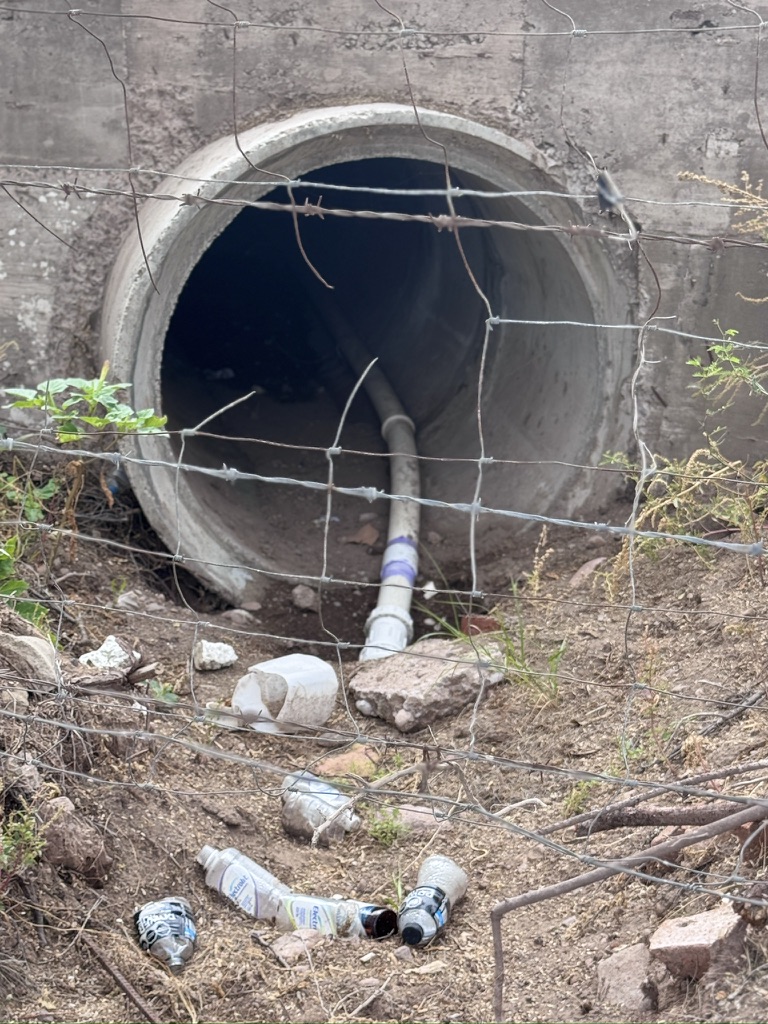
I discovered this structure on one of my walks and paused for a long time before it. The darkness within held a terrible familiarity. Depression manifests as a corridor you cannot see beyond, a place where things vanish. The barbed wire felt equally recognizable, the barriers between where I am and where I want to be. The ways in which moving toward wholeness becomes an act requiring deliberate will.

The empty bottles scattered in the dirt became a meditation on difference. I thought of my own medications, the ones I depend on. The contrast is stark. Some are abandoned, left behind. Others continue their work, filling the spaces within me, allowing me to stand upright and document this moment, rather than being consumed by the darkness they represent.

Photo Credit: Amy Tucker, January 2026

The structure itself offers no explanation. It simply opens into shadow. Some days that is precisely what occurs in the landscape of my own mind.

Amy Tucker, 2026

The diagnosis arrived two years ago, though in retrospect I can trace its shape much further back. What I had named dedication, I was in fact describing the shape of anxiety. What I believed was discipline was the armour of a mind protecting itself. For years, I confused my ability to maintain momentum with evidence of my worth, all the while describing the symptoms of a mind under siege.

This photograph makes no claim to resolve the discomfort. It bears witness to it. Without drama, without explanation. Simply two mismatched things, a presence and its opposite, existing together in the frame.

Title: The Shape I Left Behind

Artist Statement

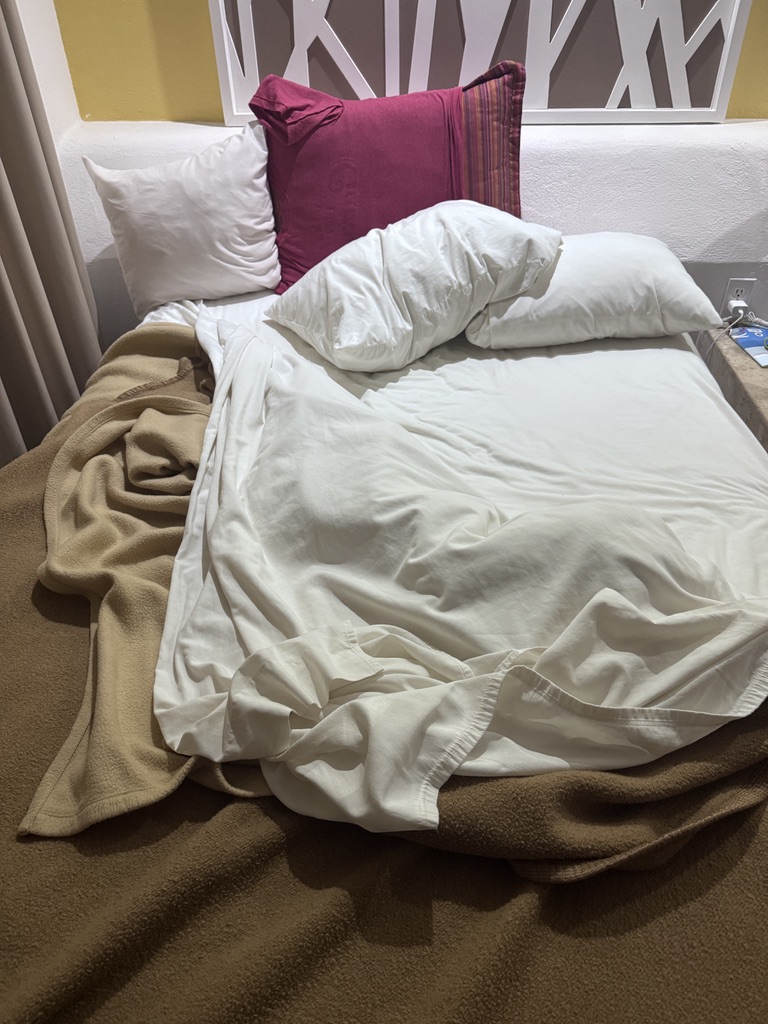
This bed records a quiet interval between rest and return. The sheets are unsettled, the pillows uneven, bearing the imprint of a body that has risen yet lingers in its leaving. Nothing here is staged. This is how the night ended and how the morning began.

I am interested in these transitional spaces, where effort pauses, and performance is absent. An unmade bed is often read as disorder, yet what I see is evidence of care extended inward. Rest taken seriously. A body allowed to occupy space without apology, without tidying itself away for an imagined audience.

The layering of textures matters to me. The weight of the blankets, the softness of the pillows, and the slight collapse at the centre all speak to containment rather than chaos. This is presence lingering, far from absence. A trace of someone choosing to stay a little longer, to gather strength before re-entering the day.

I photographed this moment as a form of witness. To honour rest as labour. To acknowledge that recovery leaves marks. To remind myself that it is acceptable, necessary even, to leave evidence of having been here.

Photo Credit: Amy Tucker, 2026

How Geography Became My Responsibility

I came believing that place could remake me.
That distance from everything I knew could reconstruct what was broken.
México was supposed to be my healing place,
the sea, the light, the possibility of becoming someone lighter.

But the land had other intentions.
What began as respite unfolded into confrontation.
I learned, in the hush of the tide, 
what I had avoided understanding for decades:
that geography alone cannot do the work of healing.
That no distance is far enough to outrun yourself.

I thought I was coming to a sanctuary.
I have learned instead that I am the sanctuary.
That the work of healing happens less through location
than through the refusal to disappear,
through the willingness to face what presents itself.
Through medication and practice.
Through therapy and truth-telling.
Through the small acts of continued presence.

The medicines on the shelf speak to this.
They whisper: you are worth keeping alive.
They testify: your suffering is real and your resistance is real.
They proclaim: wellness is beside the point, you have only to show up.

I have been diagnosed with depression and anxiety.
Two years now, and the understanding only deepens.
What I thought was strength was the weight of unprocessed grief.
What I believed was discipline was the armor of a mind protecting itself.

But I am tired of that work.
So on this third shore, México, I am learning a different language.
Spanish words, yes, among others.
Rather, the language of permission.
The vocabulary of limits.
The grammar of self-compassion.

Mexico was supposed to be my healing place.
It still may be.
But in ways I had never imagined.
Instead, it is becoming the place where I learn
that healing is the practice of becoming, beyond transformation into someone new.
It is the practice of showing up, exactly as I am,
again and again and again.

P.S.

I arrived in México with no way of knowing that the next thirty days would fundamentally change how I understood myself. I came expecting the sea, the warmth, the distance to heal me. Instead, I have come to realise that healing is something you do, rather than something that happens to you. It is something you become willing to do.

These photographs, this documentation of my daily pills and the darkness of depression, are evidence of that willingness. They show me, now in retrospect, that I have stopped hiding. That somewhere between arriving broken and these final days, I learned to call myself by my real name instead of apologising for taking up space.

This journey has changed what I believe is possible. The struggle stays, and I can live alongside it with honesty. With medication and practice. With the simple, radical act of showing up for myself, again and again.

That is the real transformation.

Here rests the evidence of care: beyond cure, beyond triumph, the steady labour of staying.
These objects mark a life held together by honesty, support, and the courage to be seen.
I name them without shame, as architecture for survival and witnesses to persistence.
I was here. I chose to remain.

Title: What the Ceiling Could No Longer Hold

Artist Statement

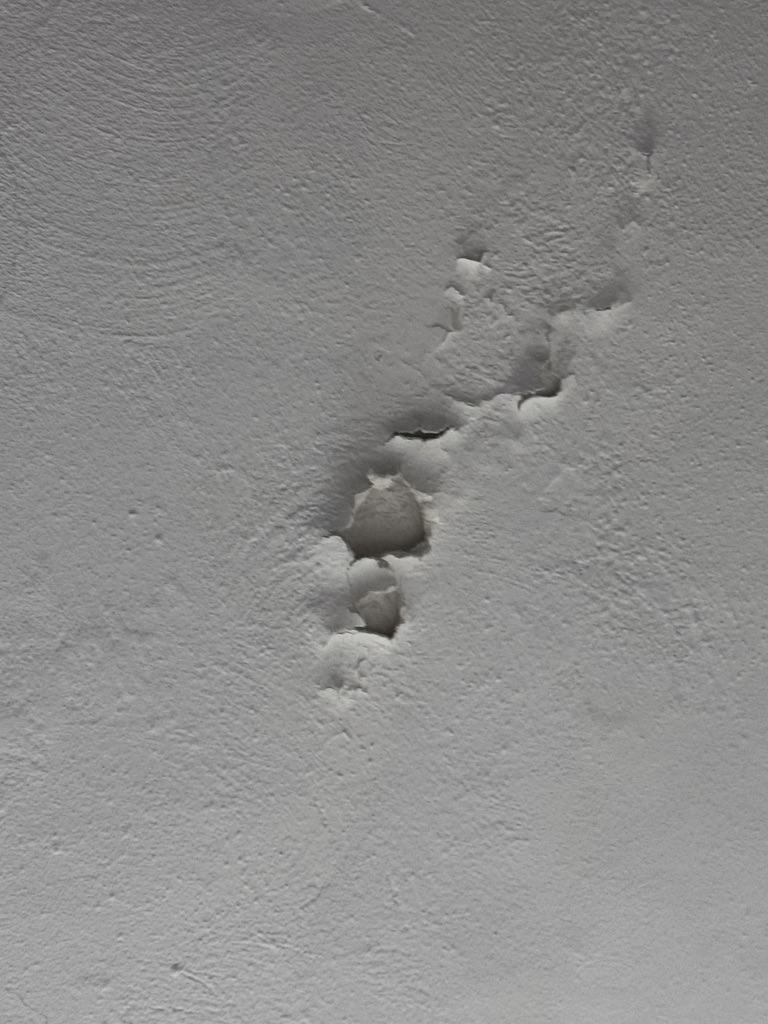
I noticed this damage only after I had stopped looking for meaning. The ceiling, a surface meant to be invisible and dependable, had begun to give way. Paint peeled back in layers, exposing what lay beneath, tracing a quiet rupture that had been forming long before it announced itself.

I am drawn to these moments of structural honesty. The failure is cumulative, rarely sudden. Moisture, pressure, time. What appears as neglect is often endurance pushed past its capacity. This image became a mirror for how strain registers when it is carried silently, when maintenance replaces care, and when surfaces are expected to remain intact regardless of what they absorb.

I photographed this as testimony, beyond any record of decay. A record of something refusing to perform wholeness any longer. The peeling paint refuses to dramatise its condition. It simply tells the truth of what it can no longer contain.

In attending to this fracture, I am practising a form of witnessing that matters deeply to my work: staying with what breaks slowly, without assigning blame, and allowing the evidence of wear to be seen.

Photo Credit: Amy Tucker, 2026

Title: I am Still Here

Artist Statement (Scholarly Personal Narrative Reflection)

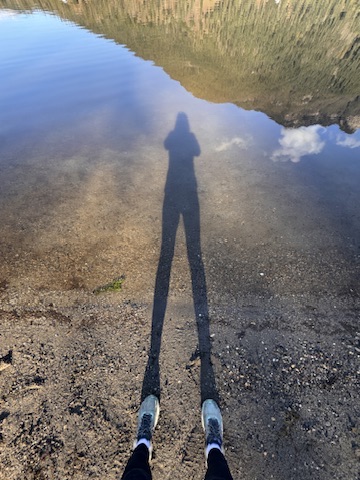
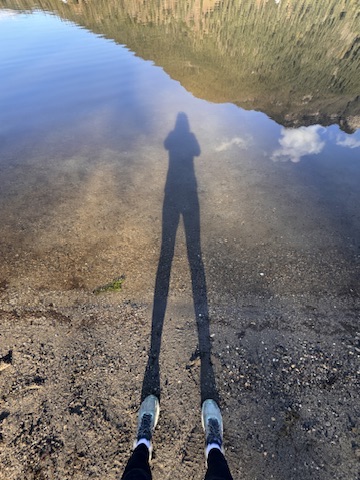
This photograph was taken while standing at the edge of still water, where reflection replaces surface and the ground seems to hold more than it reveals. I had no intention of photographing myself. I was noticing the clarity of the water, the way the mountain line folded into the sky, when my shadow entered the frame. Long, elongated, almost unfamiliar in proportion, it stretched across the shoreline and into the mirrored landscape beyond.

I paused when I saw it. There was something steadying in the recognition. The body appears here only as silhouette, reduced to outline and posture, yet unmistakably present. The shadow performs nothing. It explains nothing. It simply marks existence within a particular moment of light.

In my reflective practice, I have been thinking about visibility and endurance. About what remains when identity markers fall away, when professional roles, expectations, and external validations grow quieter. The shadow becomes a kind of evidence. Proof of standing. Proof of continuing. Proof that presence requires no spectacle to be real.

The water holds both the world and its inversion. Sky below, earth above. The image rests within that reversal, suggesting that survival is rarely linear. We move through reflection, through distortion, through unfamiliar angles of self-recognition. Yet even within inversion, the body remains upright, held by gravity and ground.

This photograph reminds me that persistence is often quiet. It rarely announces itself in milestones or declarations. Sometimes it appears as a shadow at the shoreline, lengthened by late light, steady and unbroken.

I am still here.

Photo Credit: Amy Tucker, 2026

Translation note. Spanish language passages were generated using Google Translate and subsequently reviewed and refined by the author. Any remaining infelicities reflect the limits of machine translation rather than intent.

Day 29: When the Shore Begins to Speak

Day 29: the shore begins to speak in a language that requires stillness to hear. On presence, wonder, nature, and the particular quality of knowing that comes when you have been quiet long enough for the world to trust you.

Title: Two Among Many

Artist Statement

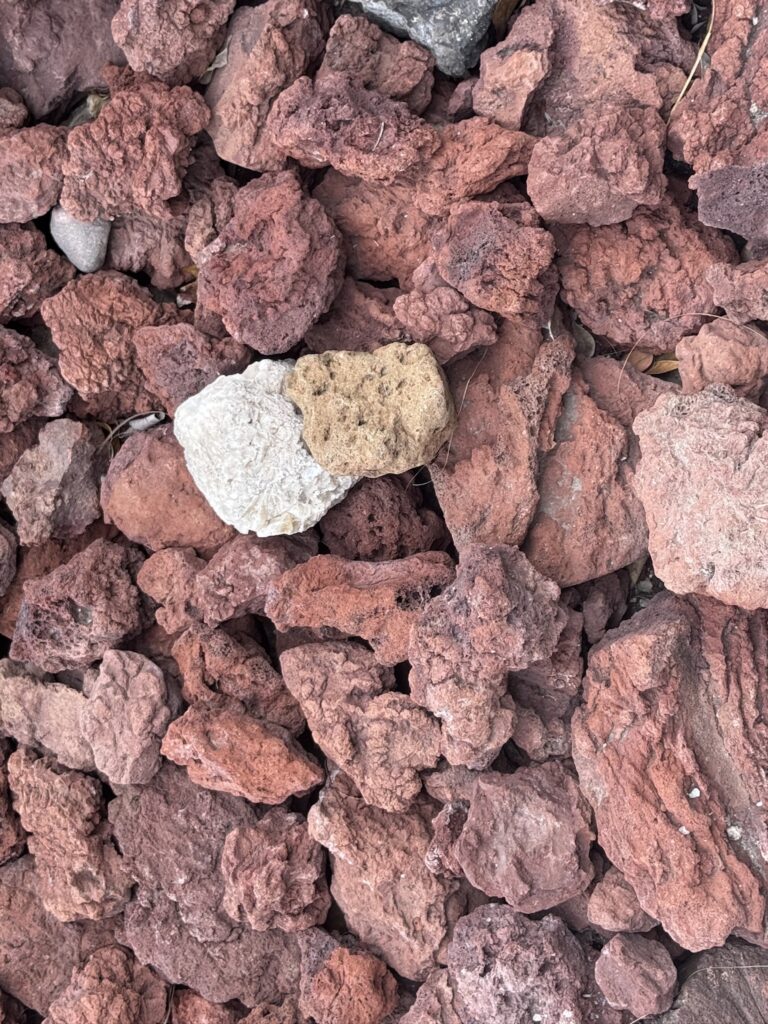
I stopped when I saw them. Two pale stones resting together in a field of red, their muted tones pressing close as if they had arrived as a pair. The volcanic rock surrounding them was textured and vivid, pocked with air bubbles from ancient heat, dyed the colour of rust and dried blood. The two lighter stones held their difference quietly, without apology.

This is one of the rare photographs in my collection that I have kept in colour. The decision was deliberate. In a body of work devoted to black and white, to the ethics of reduction and the discipline of restraint, colour must earn its place. Here, the red demanded to be seen. The contrast between the two pale stones and the field of crimson that held them would have collapsed into sameness without it. The image required colour to speak its meaning.

I am drawn to what resists matching. To the presence that stands apart without performing its difference. These two stones arrived without design. They were placed by no one, creating contrast and illustrating a point. They simply came to rest where the ground received them, and in resting, they found each other. The image holds no drama. It offers only the quiet fact of two things that belong together amid a landscape to which they bear no resemblance.

I have often felt like the pale stone in a field of red. Present but visibly different. Held by the same ground as everyone else, yet marked by texture and tone that set me apart. This photograph makes no claim to resolve that feeling. It simply witnesses it. The two stones lean toward one another, their edges nearly touching, as if proximity itself were a form of kinship.

The volcanic rock speaks to heat and transformation, to pressure that reshapes matter into something porous and lasting. The pale stones speak to another origin, another journey. They share the frame without sharing a story. What holds them together is only the ground beneath and the eye that noticed them, paused, and chose to preserve the encounter.

Photo Credit: Amy Tucker, January 2026

Where the Shore Begins to Speak

Wonder was far from what I came here seeking.
I came to rest,
to fold the sharp corners of thought
into something dull and silent.

But the land had other plans.
It began in the hush of the tide,
a language I almost remembered.
Salt tracing old maps across my ankles,
sand whispering through the creases of my shoes.

A shell, cracked.
A stone, too smooth to be accidental.
Even the wind seemed to pause,
just long enough
to ask if I was listening.

I watched a crab write its name in the shallows,
unconcerned with permanence.
Watched a gull lift, drop, lift again,
more patient than I have ever been.

Slowly,
The shore began to stitch its rhythm into me.
Beyond grandeur,
with quiet insistence,
the way grief teaches,
or healing,
or soil under fingernails.

Here, I found interest,
an invitation rather than a spark.
A kind of leaning-in
to what has always waited
beneath the noise of being useful.

And I began to understand:
The land asks nothing of performance.
It asks for presence
And maybe, at last,
I am learning how to offer that


Title: Tidebound

Artist Statement

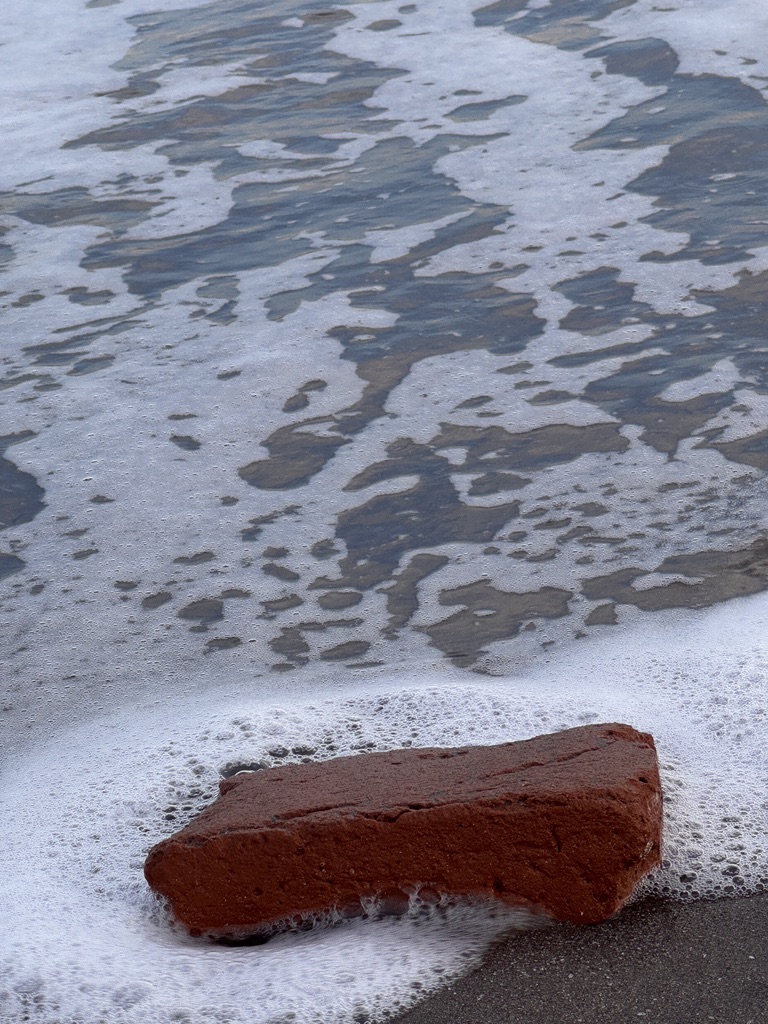
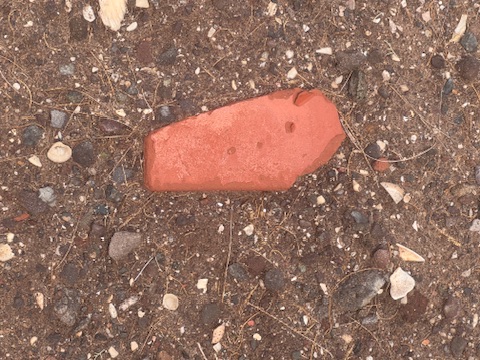
This image captures a solitary brick caught in the meeting of ocean and sand an object out of place, yet strangely grounded. I was struck by the quiet resilience of this fragment of construction, shaped for structure and permanence, now yielding to saltwater and tide. It no longer serves its original purpose, and yet it remains, weathered, softened, still unmistakably present.

In the context of my broader research on alonetude, embodiment, and recovery from institutional extraction, this photograph becomes a visual metaphor for the self in transition. The brick speaks to what remains after long periods of performance, labor, and containment. It holds the memory of function, but it no longer needs to fulfill it. The tide surrounds it without resistance. There is no urgency to prove worth.

This moment asks: what happens when we stop resisting erosion? When we allow the forces around us to touch us, wear us down, soften our edges, transforming rather than defeating?

Here, the brick becomes more than debris. It becomes evidence. Of survival. Of change. Of the beauty that emerges when we are no longer trying to hold our original shape.

Photo Credit: Amy Tucker, January 2026

Title: Trace of Ascent

Artist Statement

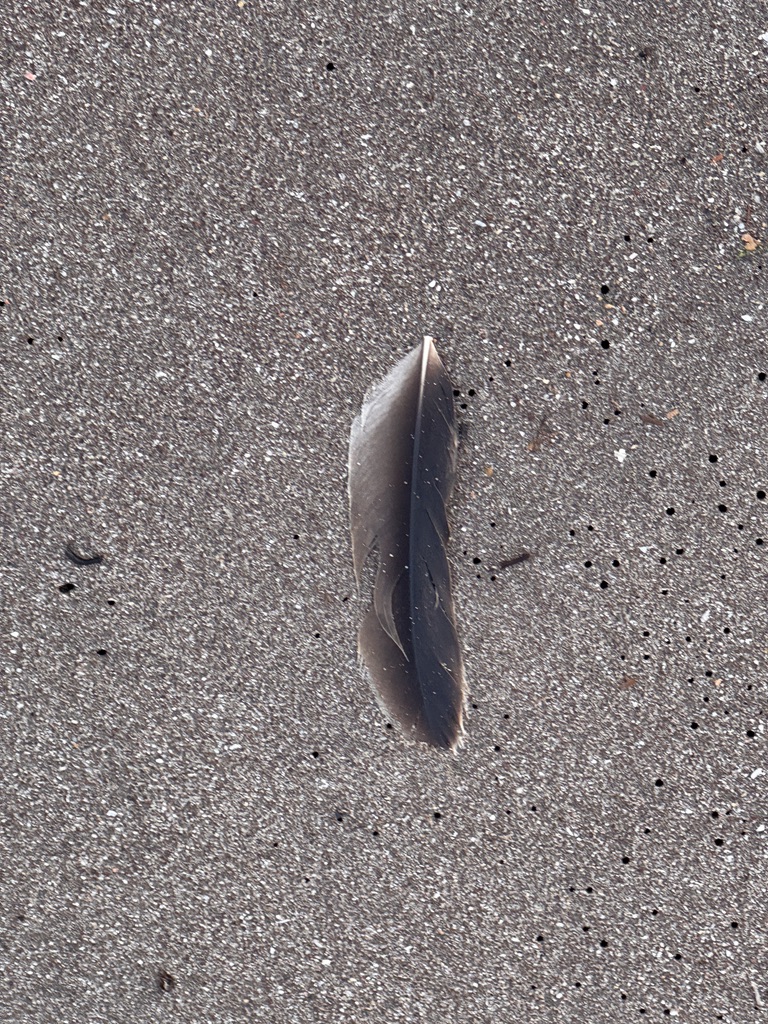
This feather, resting alone on darkened sand, holds the quiet memory of flight. It is no longer airborne, yet it carries the architecture of uplift: spine, barbs, hollow shaft, all evidence of having once moved with wind and intention. What drew me to this image was its stillness, residue rather than absence: the presence of something that has passed through, marked by both release and belonging.

In the context of my arts-based inquiry into alonetude and embodied presence, this feather becomes a metaphor for what remains after movement. It invites reflection on what we shed, what we carry, and what we recognise only after landing. Unlike the frantic need to perform, this moment asks nothing. It simply offers itself as witness.

Here, the feather is returned, beyond lost. To earth. To texture. To the soft hush of enoughness.

Photo Credit: Amy Tucker, 2026

Title: To Need No Monument

I walk,
beyond arriving,
to remember
what it feels like
to move without performance.

Each step presses gently
into the wet hush of sand,
a temporary record,
beyond purpose,
simply presence.

No one is watching.
There is no rubric for how I place my feet.
No metrics trace the curve of my wandering.
Still, the earth notices.

The tide asks nothing
of earning this peace.
It rises all the same,
softening the edges of every impression
until all that remains
is rhythm.

I am learning to love
what is passing.
To walk for the sake of walking.
To be the kind of story
That holds its truth
beyond the telling.

Let the waves erase me.
Let the next morning’s light find
no evidence but smoothness.
That, too, is a kind of grace,
to know I was here,
and to need no monument.


Title: Evidence of Passing

Artist Statement

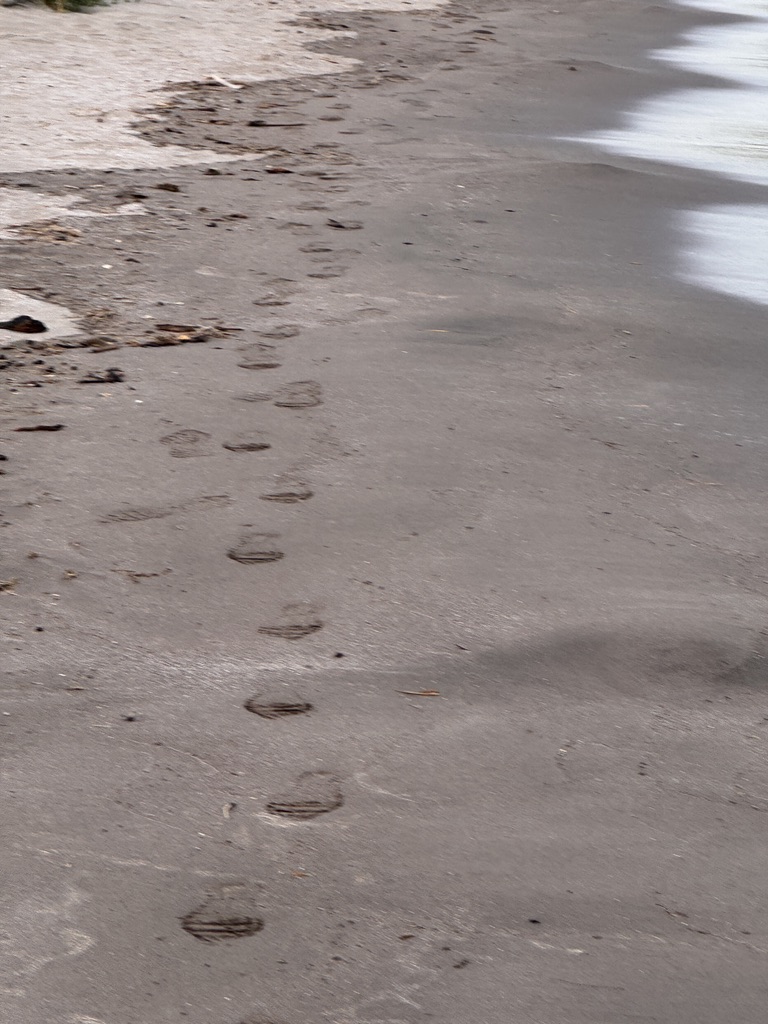
This image captures a winding trail of footprints pressed into damp shoreline, slowly softening under the pull of tide and time. What compelled me to take this photograph was their impermanence rather than their presence, the quiet truth that every mark we make is always in the process of being undone.

As part of my ongoing inquiry into alonetude and embodied recovery, this image speaks to the paradox of solitude: we walk alone, yet leave traces. In academic and institutional contexts, I was conditioned to believe that only visible, measurable output mattered. But here, the act of walking, with no destination, no audience, no performance, is itself enough. The shore records without judgment, erases without malice.

Evidence of Passing reminds me that presence requires no permanence as proof. It is proven through being. Each footprint is both an arrival and a letting go.

Photo Credit: Amy Tucker, 2026

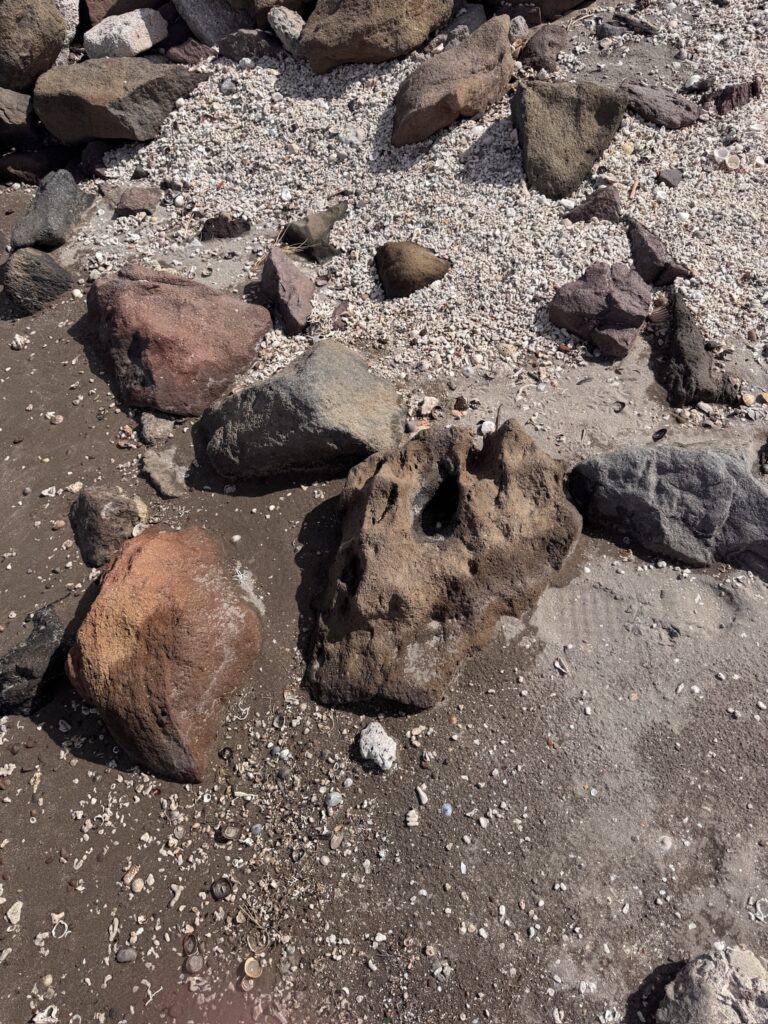
Title: What the Rocks Remember

Artist Statement

This image captures a gathering of volcanic stones, worn shells, and sunbaked earth: a convergence of textures that have withstood heat, weight, and time. I was drawn to the contrasts: hardness beside fragments, shadows against brightness, the jagged edges of endurance softening into the granular memory of dissolution.

Each rock holds a story that predates language. Each shell, a hushed echo of a body once held. Together, they create a kind of grounded archive: one requiring no explanation, only attention. In the context of my arts-based inquiry into precarity, embodiment, and alonetude, this scene offers a reminder that presence can take many forms, and some resist smoothness and easy containment.

Here, survival is sedimented rather than silent, deliberate rather than dramatic. These exceed the traditional monument. They are records of what withstood and what remains, unpolished, unnamed, enough.

Photo Credit: Amy Tucker, 2026

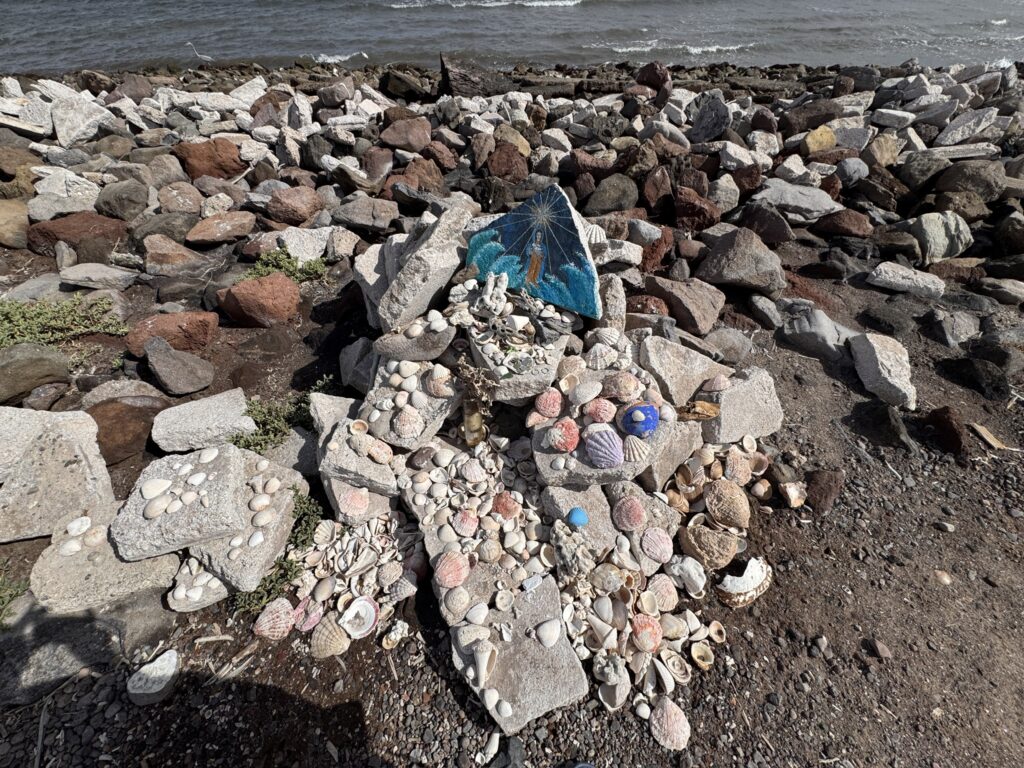
Title: Altar of the Ordinary

Artist Statement

This shoreline shrine, assembled from painted shells, broken tiles, and sea-washed stones, stands as a communal gesture, unofficial, unclaimed, yet unmistakably sacred. I was moved by the way everyday objects, often overlooked, had been offered with quiet intention. A single blue rock. A painted Virgin. A bottle nestled among fragments. Nothing expensive, nothing pristine. And yet, everything chosen.

In the context of my research into alonetude, belonging, and the ethics of presence, this altar reveals the sacredness of the unremarkable. Built without fanfare, maintained without instruction, it is a collective act of noticing. These materials were gathered to witness, beyond any desire to impress. To remember. To offer.

There is no plaque here, no inscription. Only the evidence that someone stopped long enough to care, to arrange, to leave something behind. It reminds me that memory can be handmade. That holiness can be found in what the sea returns.

This exceeds any monument to power. It is a testament to tenderness.

Photo Credit: Amy Tucker, 2026

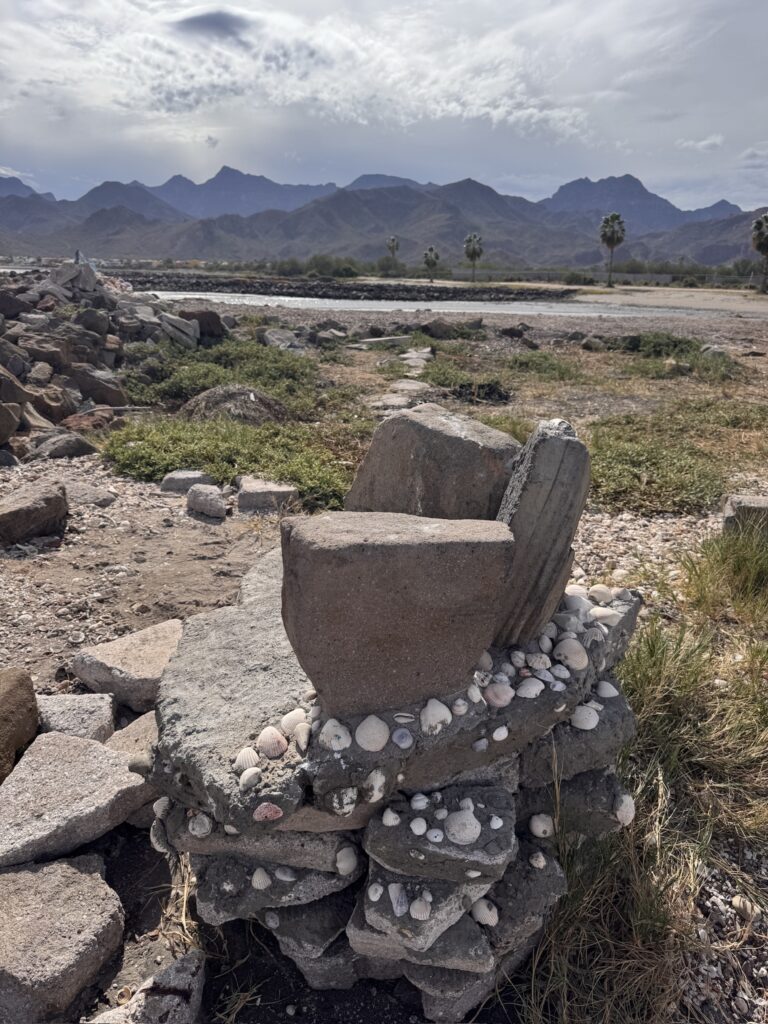
Title: Throne for No One

Artist Statement

This weathered structure, assembled from slabs of broken concrete and rimmed with small white shells, sits quietly before a vast and mountainous horizon. It evokes a throne, but one with no occupant, no ceremony, no claim. What moved me most was its paradox: it suggests importance, yet resists ownership. It holds form, yet refuses to declare function.

In my research on alonetude, trauma-informed practice, and the ethics of retreat from visibility, this piece became a meditation on authority reimagined. Who gets to take up space? Who builds thrones, and who are they for? This monument seems to ask a different question altogether: What if the seat of power is emptiness? What if it invites rest rather than dominance?

The shells, carefully placed along the cracks, remind us that care can live within ruin. This is beyond a pedestal. Beyond an altar. It is a possibility: a place where no one rules, yet everything is held.

Photo Credit: Amy Tucker, 2026

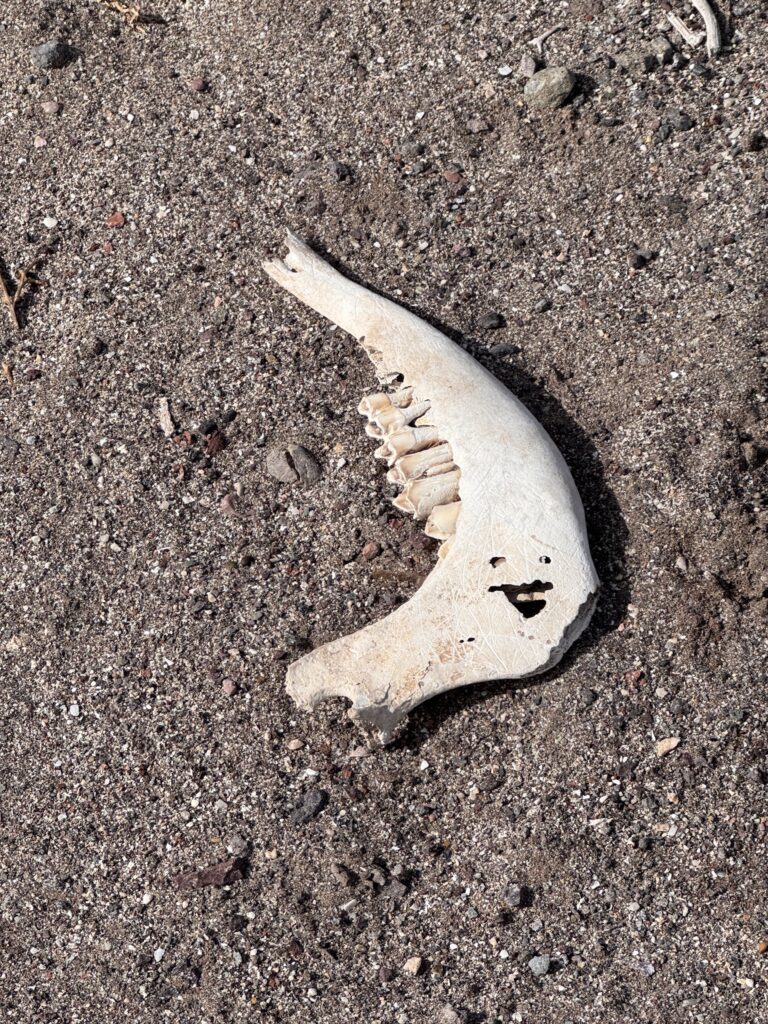
Title: What Remains May Smile

Artist Statement

This fragment of bone, likely a lower jaw, worn smooth by time and sand, lay half-buried, yet unmistakably visible. What caught my eye was the accidental pattern of holes, worn into something resembling a smile. Unintentional. Uncanny. A gesture of joy etched into what should speak of loss.

In my arts-based inquiry into alonetude, institutional fatigue, and the body’s quiet ways of knowing, this image became a moment of unsettling wonder. Even in decomposition, there is expression. Even in absence, there is form. It asks us to consider the meanings we impose, and the ones that emerge without effort.

This exceeds the traditional memento mori. It cautions against nothing, glorifies no decay. Instead, it suggests something quieter: that even what breaks down can still hold presence, can still gesture toward feeling, can still, perhaps by accident, smile.

Photo Credit: Amy Tucker, 2026

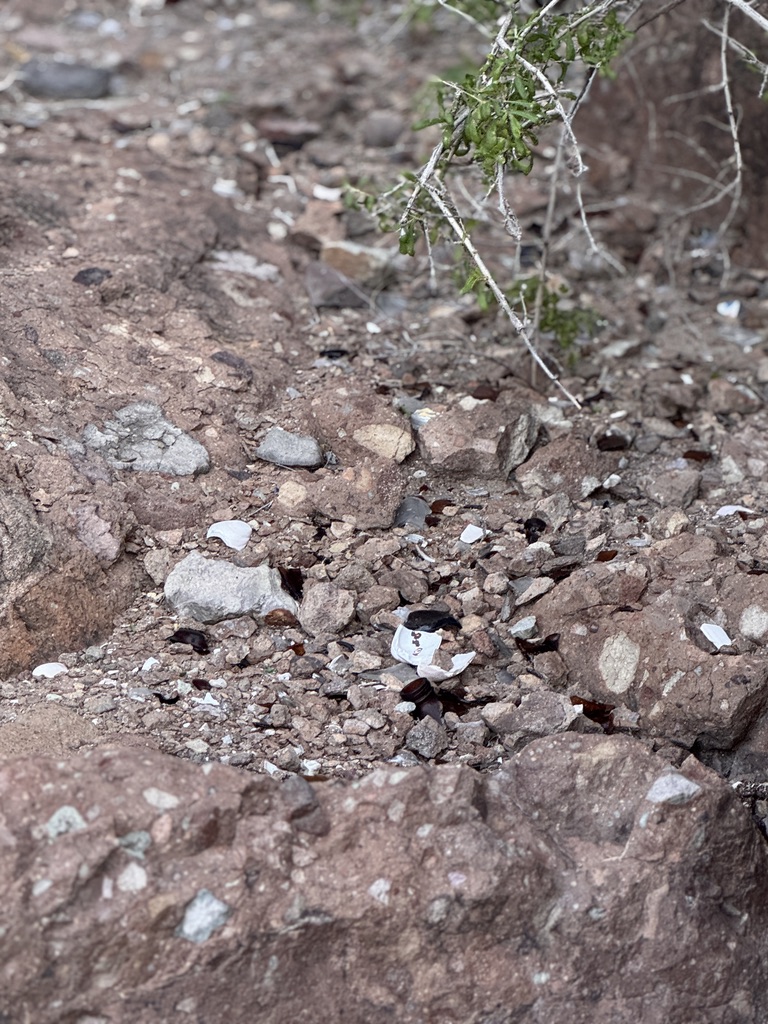
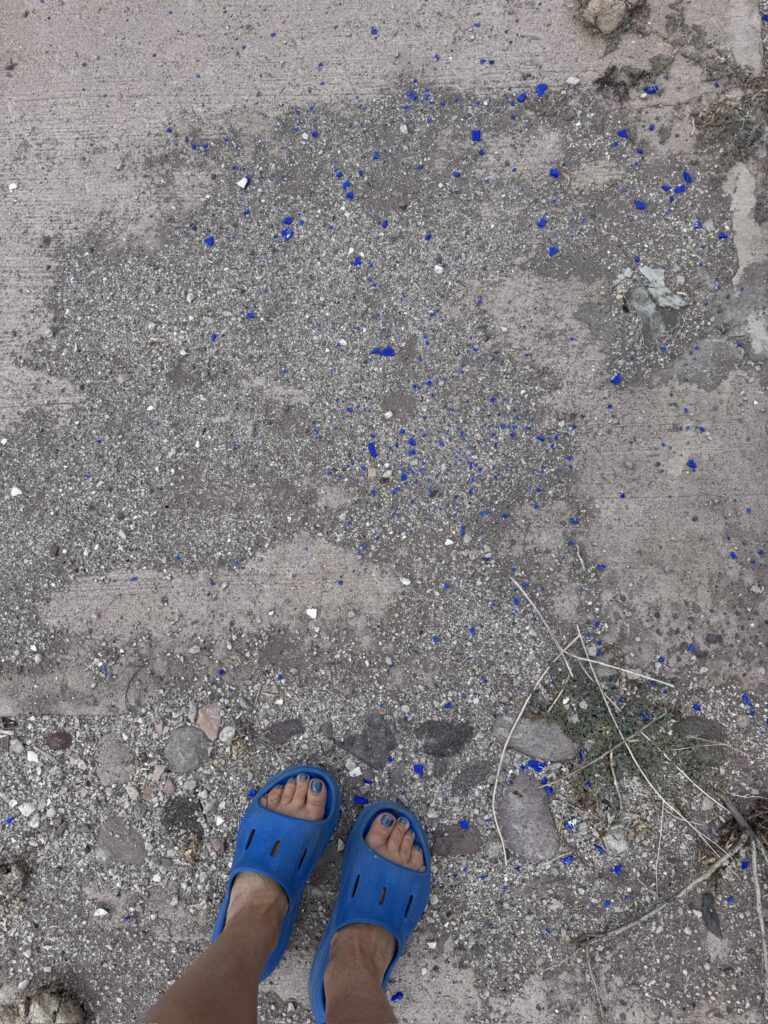
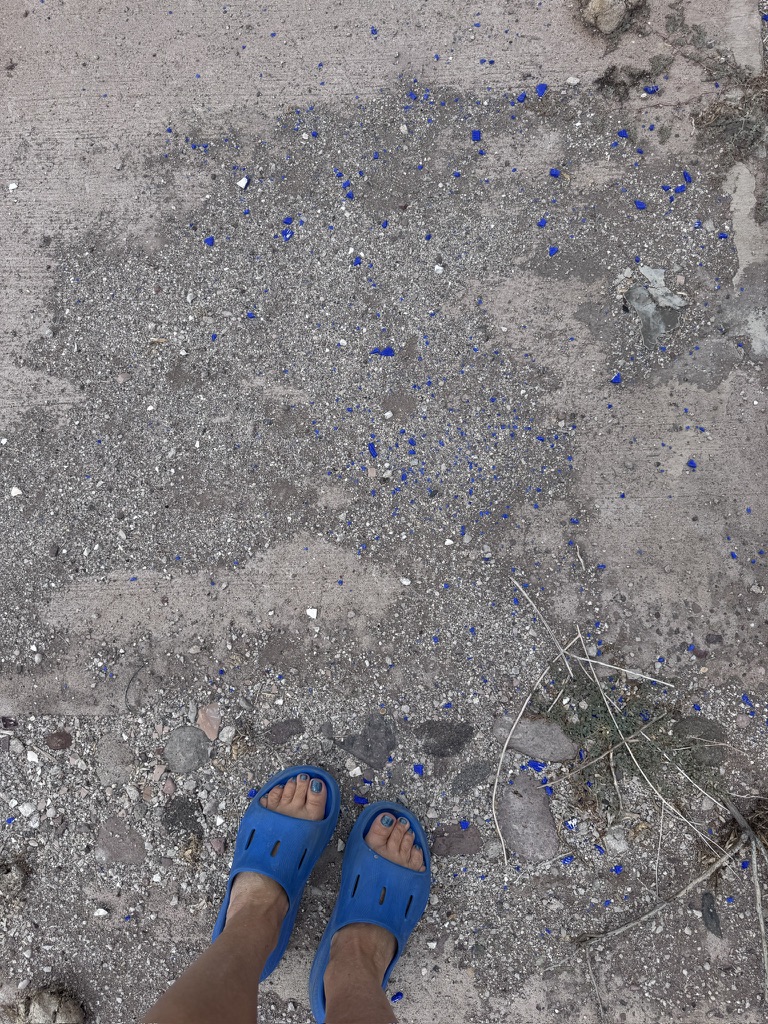
Title: Fragments That Refuse Disappearance

Artist Statement

I noticed these fragments while walking a narrow, uneven path where the ground was layered with stone, dust, and small evidence of what had once passed through. At first, the field of view felt monochrome, muted by earth tones and dryness. Then the glass caught the light. Small shards, dark and amber, scattered among the rocks as if the land itself had exhaled them.

I held my ground. I stood where I was and allowed my eyes to adjust, tracing the contrast between what was natural and what had been left behind. The glass belonged to a different time than the geological hillside. It belonged to interruption, to human presence, to a moment of discard now weathering into the terrain.

In my reflective practice, I am often drawn to sites where rupture and endurance coexist. These fragments hold that tension. Once whole, once functional, now broken and partially buried, they remain visible despite time and erosion. The land holds them in a kind of stasis, neither rejecting nor absorbing them fully. They exist in a suspended state, neither fully integrated nor entirely separate.

I photographed the scene as I encountered it, resisting the urge to rearrange or collect. There was meaning in the placement itself. The brokenness read as testimony rather than failure. Evidence that impact leaves trace. Evidence that what shatters persists. It persists, altered but present.

This image sits within my ongoing inquiry into what remains after disruption. Into how landscapes, like bodies, hold memory in fragments. Into how even the smallest shards carry narrative weight when we are willing to pause long enough to see them.

Photo Credit: Amy Tucker, 2026

Epitah

Here lies a fragment, once part of breath,
Now shaped by salt, silence, and time.
Changed but present,
Still telling a story,
Still holding a smile.


Day 28: The Quiet Permission of Invisibility

On Refusing to Perform, Ceasing to Pretend, and the Liberation of Being Unseen


“A movement fueled by the freedom that comes when we stop pretending that everything is okay when it is not. A call that rises up from our bellies when we find the courage to celebrate those intensely joyful moments even though we have convinced ourselves that savoring happiness is inviting disaster. Revolution might sound a little dramatic, but in this world, choosing authenticity and worthiness is an absolute act of resistance.” (Brown, 2010, p. 126)


This morning, I walked along the beach and realised something startling: nobody was looking at me.

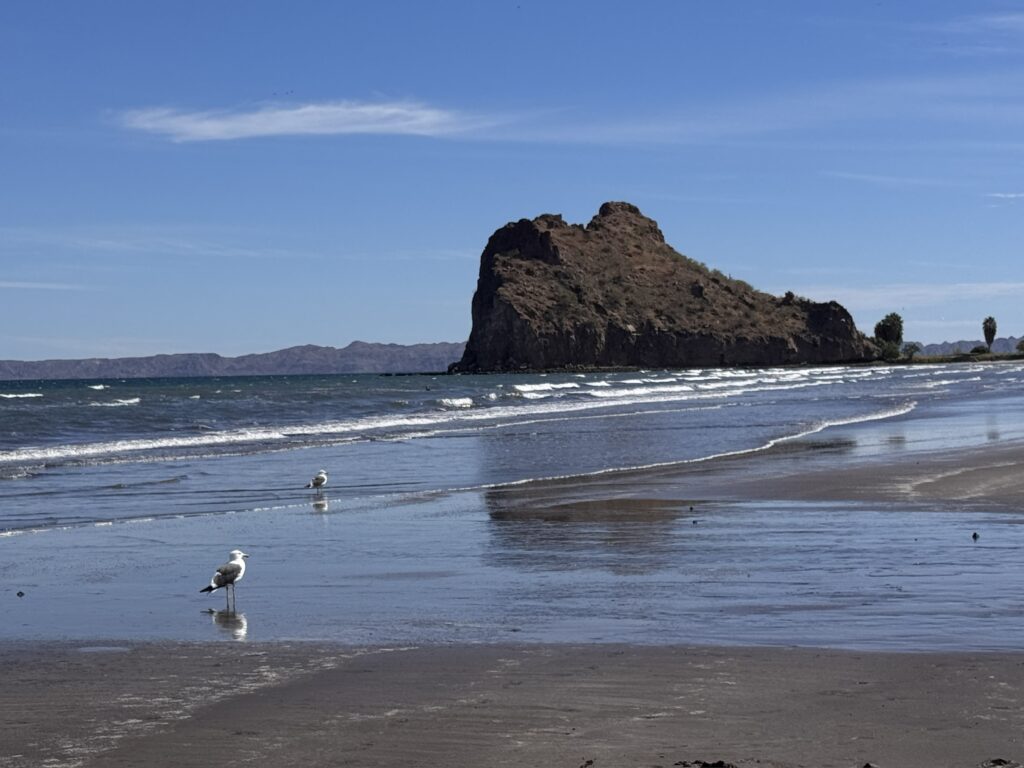
Title: Sentinel Shores

Artist Statement

This image captures the rocky island as a physical manifestation of Brené Brown's concept of the gift of imperfection, a marker of witness that asks nothing of the observer. What struck me most powerfully was the realization that the island itself exists without performance, without seeking validation for its presence. In scholarly personal narrative, this moment became a turning point where I could articulate how institutional demands for constant visibility had become so habitual that invisibility felt transgressive. The seabirds, unaware and unconcerned with observation, embody what Brown describes as authentic presence. Their gathering without fanfare mirrors my own growing understanding that worthiness requires no performance.

I find permission to simply be, without performing visibility for an audience that has stepped away. Here, in the pattern of waves and the scatter of seabirds, there is no requirement to announce my existence. The island asks nothing of me but presence.

Photo Credit: Amy Tucker, January 2026

Nobody needed me to be anything. Nobody was waiting for my cheerful greeting, my performed enthusiasm, my carefully calibrated professional warmth. I was simply a woman walking along a seawall in a small Mexican town, unremarkable and unobserved, and the relief that flooded my body felt almost shameful in its intensity.

Qué alivio. What relief.

I learned to smile when I was exhausted. I learned to express gratitude for crumbs. I learned to appear endlessly available, endlessly capable, endlessly willing.

I have spent twenty-five years in precarious academic employment, learning to be visible in very particular ways. Visible enough to be valued. Invisible enough to avoid threat. Always performing the precise calibration of presence that contingent labour demands. I learned to smile when I was exhausted. I learned to express gratitude for crumbs. I learned to appear endlessly available, endlessly capable, endlessly willing. The performance became so habitual that I forgot it was a performance at all.

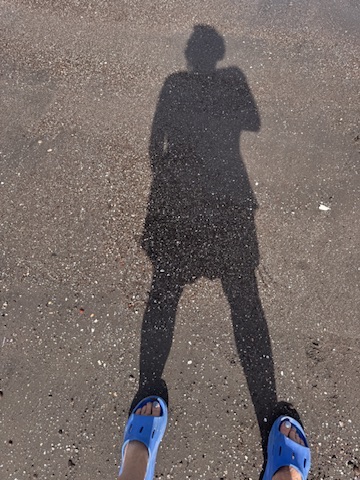
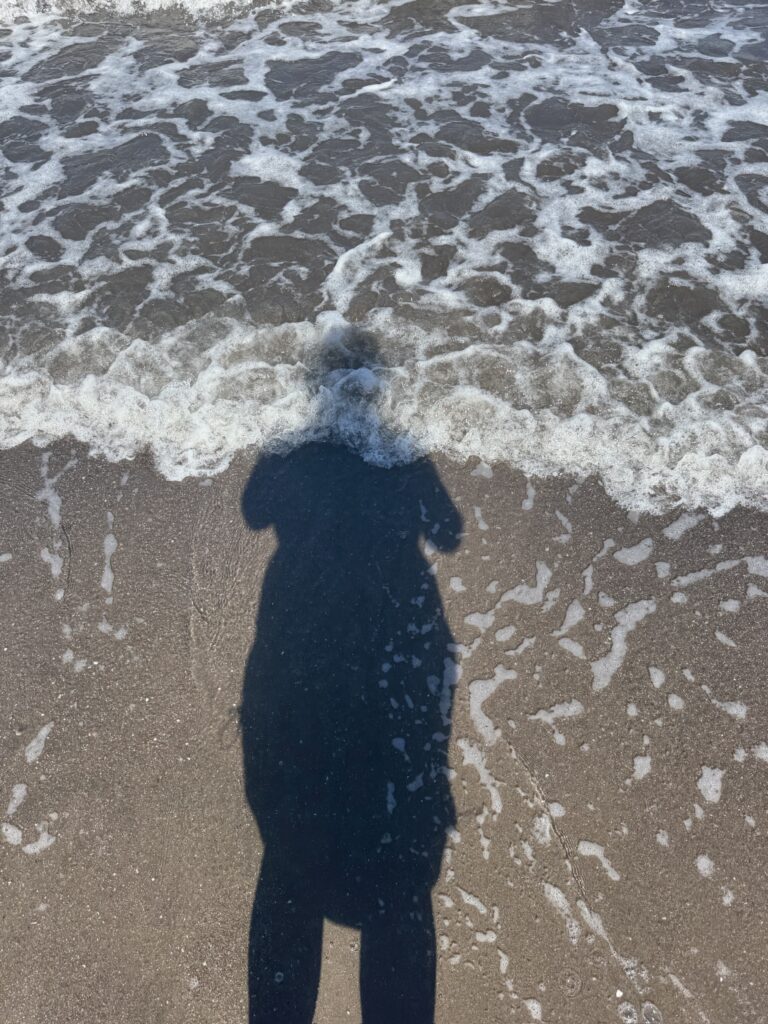
Title: Tidal Margins

Artist Statement

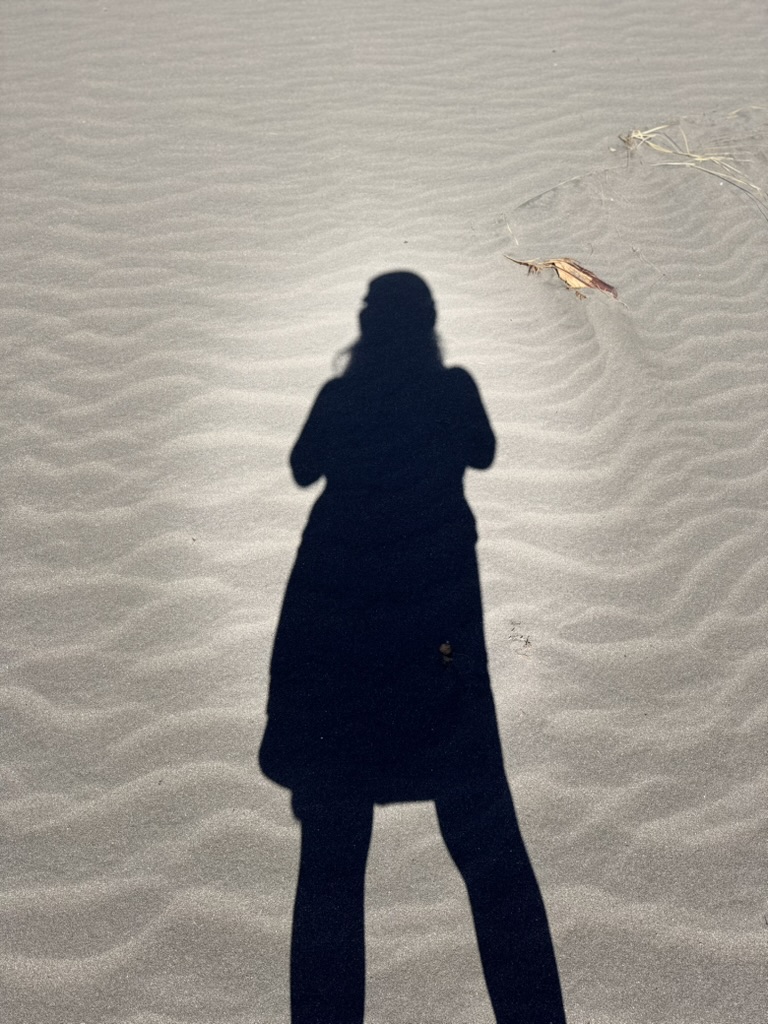
This shadow self-portrait speaks to the liminal space between visibility and hiddenness. I was drawn to this image because it captures me at the precise moment when I became aware of my own shadow, both literal and metaphorical.

This represents a methodological turn toward reflexivity, where the researcher becomes visible through absence. The tidal margins represent what Audre Lorde calls the 'erotic' as a source of power, the knowledge that exists in the spaces beyond performance. Standing at this threshold, I understood that the most profound relief comes from the permission to be unremarkable.

Photo Credit: Amy Tucker, January 2026

I live, I realise, in perpetual audition.

I am thinking this morning about what Brené Brown calls “the freedom that comes when we stop pretending.” I read those words years ago and thought I understood them. I had no real grasp of them then. I understood them intellectually, the way one understands a theorem or a map of a place one has never visited. Understanding them in my body, in the unclenching of my jaw and the descent of my shoulders from their permanent station near my ears, this is something else entirely.

Here, on this shoreline where nobody knows my institutional history, where nobody requires my competence or my compliance, I am discovering what it feels like to simply be present without performing presence. The difference registers first in my body. I notice my breath moving freely, unguarded by the vigilance that institutional survival demanded. I notice my face doing whatever it wants, unmanaged for external consumption.

I am learning what my face actually looks like when it has stopped arranging itself for others.

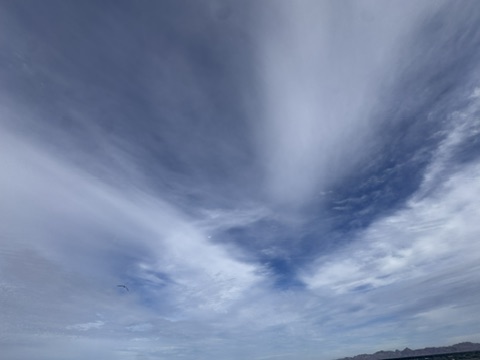
Title: Unnoticed Gathering

Artist Statement

The sky in this moment holds the experience of being present without audience. What moved me about capturing this image was the simultaneity of presence and invisibility the birds were there, I was there, and nothing required us to announce ourselves. Returning to Brown's work on the vulnerability paradox, I realised that my assumption that visibility equals value was false.

This moment articulates the ethical turn toward witnessing one's own life without need for external validation. The gathering without performance became a model for how institutional structures might be reimagined to honor presence itself rather than the appearance of productivity.

Photo Credit: Amy Tucker, January 2026

The Frontstage Life

I am learning what my face actually looks like when it has stopped arranging itself for others.

Erving Goffman, writing in 1959, gave me language I had been missing. In The Presentation of Self in Everyday Life, he describes social existence as a theatrical performance. We maintain a “frontstage” self designed for public consumption while preserving a “backstage” self hidden from view. The frontstage involves what Goffman calls “impression management”: the careful curation of behaviours, expressions, and appearances designed to elicit desired responses from our audience.

Reading Goffman here in Loreto, I understand something I could only grasp now, at distance from institutional life. For workers in precarious positions, and I was precarious for twenty-five years, always contingent, always renewable, always provisional, there may be no backstage at all. The performance must be maintained at all times, because the audience is always watching, always evaluating, always deciding whether one deserves continued employment.

I live, I realise, in perpetual audition.

Title: The Unburdened Shore

Artist Statement

This direct photograph of my experience walking an unobserved shoreline struck me as perhaps the most honest moment of the project. I wrote my name in the sand, for me.

Nobody needed my performed joy, my calibrated warmth, my endless availability. This represents what Sara Ahmed calls the 'willfulness' of creating space for one's own experience outside institutional frameworks.

What stood out was the bodily recognition, the unclenching of my jaw, the descent of my shoulders from their permanent station near my ears. This embodies what Brown identifies as the revolutionary act of choosing authenticity over performed compliance, a concept that becomes material and embodied in this single moment of unobserved presence.

Photo Credit: Amy Tucker, January 2026

I am practising invisibility as medicine.

Arlie Russell Hochschild extended this analysis in ways that name precisely what I experienced. In The Managed Heart, she introduced the concept of “emotional labour”: the work of managing one’s feelings to create a publicly observable display that meets occupational requirements.

I think about the thousands of times I smiled when I felt rage. The meetings where I projected calm while my stomach churned with anxiety. The performance reviews where I expressed gratitude for feedback that felt like erasure. Hochschild names this labour “invisible” because employers and institutions see nothing of it, compensate nothing, and acknowledge nothing of its occurrence. Yet it extracts a profound toll.

The toll is what I am healing from now, here, where nobody requires my managed heart.

Title: Dispersed Presence

Artist Statement

In this image, the beach holds multiple presences, myself, the rocks, the sand patterns - none requiring central observation. What captured my attention was the recognition that existence requires no concentration in the gaze of others.

This moment became crucial for articulating how institutions demand centrality: the central thesis, the central argument, the central self. Yet this beach scene demonstrates that meaning-making occurs in dispersal, in the scatter of experience. This connects directly to Brown's assertion that imperfection is a fuller expression of humanity rather than a flaw - distributed, complex, and valid precisely in its refusal of singular visibility.

Photo Credit: Amy Tucker, January 2026

Table 1

Key Theoretical Concepts: The Architecture of Performed Selfhood

Definition and Application to AlonetudeDefinition and Application to Alonetude Goffman’s (1959) theory that social interaction operates like a theatrical performance. Individuals manage impressions on the “frontstage” while reserving authentic expression for “backstage” spaces. In alonetude, the 30-day retreat creates an extended backstage where the performance can finally cease.
Dramaturgical FrameworkGoffman’s (1959) theory that social interaction operates like theatrical performance. Individuals manage impressions on the “frontstage” while reserving authentic expression for “backstage” spaces. In alonetude, the 30-day retreat creates an extended backstage where the performance can finally cease.
Emotional LabourHochschild’s (1983) concept describes the work of managing one’s emotions to fulfil occupational requirements. For precarious academic workers, this includes performing gratitude, suppressing exhaustion, and projecting perpetual availability. Alonetude involves the cessation of this labour.
The PrecariatStanding’s (2011) term for the growing class of workers characterised by chronic insecurity, lack of occupational identity, and truncated rights. The precariat lives in permanent audition, unable to relax vigilance because employment is always provisional.
Auto-ExploitationStanding’s (2011) term for the growing class of workers characterised by chronic insecurity, lack of occupational identity, and truncated rights. The precariat lives in permanent audition, unable to relax vigilance because employment is always provisional.

Note. These theoretical concepts provide language for understanding how institutional demands shape embodied experience. Each framework illuminates a different dimension of what alonetude is healing: the exhaustion of performance, the depletion of emotional labour, the hypervigilance of precarity, and the internalization of extractive demands.


The Mask Becomes the Face

La máscara se convierte en la cara. The mask becomes the face.

Byung-Chul Han (2010/2015) argues in The Burnout Society that contemporary exhaustion differs from earlier forms of exploitation because the master has been internalised. We no longer need external overseers to drive us toward breakdown. We drive ourselves.

I recognise myself in these words with a clarity that feels like grief. For how many years did I mistake self-exploitation for dedication? How many evenings did I work past exhaustion, believing this was what commitment looked like? How deeply had I internalised the demand for constant availability until I could no longer distinguish institutional requirement from personal identity?

La máscara se convierte en la cara. The mask becomes the face.

What I am learning here in Loreto, in this practice of alonetude, is that the mask can be removed. The face beneath it still exists. It has been waiting, all these years, for permission to emerge.

Title: Weathered Acceptance

Artist Statement

This image resonated because it offered a visual metaphor for what Brené Brown terms 'normal wear and tear' the evidence of a life fully lived. This becomes an argument for the validity of weathering, of showing marks of growth rather than performing unmarked perfection. What struck me most powerfully was understanding that my own weathering the visible evidence of institutional survival, of negotiating precarity requires no hiding. The rocks offer no apology for their transformation; they simply exist in evidence of it.

Photo Credit: Amy Tucker, January 2026

The Practice of Being Unseen

I am practising invisibility as medicine.

This is what it looks like: I walk through town without performing approachability. I sit at cafés without arranging my face into pleasant neutrality. I allow my body to hold whatever expression it naturally holds without editing for external consumption. Sometimes that expression is weariness. Sometimes grief. Sometimes, a blankness that might read as unfriendly to those trained to expect women to project warmth at all times.

I notice, with something like wonder, how much energy this releases. Energy that was going toward performance is now available for other purposes. For feeling. For noticing. For simply being present in this body, on this shoreline, under this particular quality of winter light.

Title: Peripheral Vision

Artist Statement

This photograph captures the moment when I realised that being present required no centrality. In the periphery, I found a kind of peace that visibility could never offer. Connecting this to scholarly personal narrative, the margins have long been the location of intellectual and artistic work by those excluded from centres of power. What moved me about this image was the recognition that my position on the periphery could become a methodological stance, a choice rather than a limitation imposed from without, to see differently. Brown's work on vulnerability intersects here with marginality theory: the margin transforms from a place of diminishment into a site of distinct epistemological power.

Photo Credit: Amy Tucker, January 202

The relief that flooded my body felt almost shameful in its intensity.

Stephen Porges’s polyvagal theory helps me understand what is happening in my nervous system. Porges describes three states of autonomic function: ventral vagal (social engagement and felt safety), sympathetic (mobilization for fight-or-flight), and dorsal vagal (immobilization and shutdown). The ventral vagal state, the state of genuine ease and relaxed presence, requires what Porges calls “neuroception of safety.” The nervous system must detect, below conscious awareness, that the environment is safe enough to lower defences.

I understand now why rest felt dangerous for so many years. My nervous system was correctly detecting that the institutional environment was unsafe. Precarious employment is, in fact, a threat. The vigilance was appropriate to the conditions. What I am experiencing in Loreto, removed from that context, is the gradual return of ventral vagal capacity. My nervous system is slowly registering that the threat has passed.

The jaw unclenches. The shoulders descend. The breath deepens. The face softens into whatever expression emerges naturally rather than the expression that survival required.

This is what healing looks like. It looks quiet. It looks unremarkable. It looks like a woman sitting at a café without smiling.

Title: The Quiet Horizon

Artist Statement

Looking toward the horizon in this image, I see no audience waiting for arrival, no applause from the sky or judgment from the water. This moment struck me as crystallising Brown's central insight about the performance paradox: the freedom that comes when we stop performing.The horizon represents the necessary distance from institutional frameworks that demand constant self-presentation. What resonated most was the embodied sense of the sky's indifference, genuinely uninterested in my performed competence. This indifference, paradoxically, becomes liberatory, allowing for existence without the burden of constant visibility.


Photo Credit: Amy Tucker, January 2026

Visual Witness

Image: A Face Released from Performance

Photo Credit: Amy Tucker, 2026

Title: Shallow Waters

Artist Statement

Where water is shallow and clear, everything is visible to those who look closely, yet some things go unlooked at. This distinction became crucial to my understanding. This image articulates the difference between transparency and surveillance between voluntary self-disclosure and mandated visibility. What struck me most powerfully was the recognition that Brené Brown's call to 'show up and be seen' has been weaponised in institutional contexts, transformed from an invitation into a demand. This shallow water photograph reclaims the right to exist in visibility without being watched, to be knowable without being known.

Photo Credit: Amy Tucker, January 2026

The Wisdom of Withdrawal

Audre Lorde (1988) argues that caring for oneself, especially in environments that systematically exploit and deplete individuals, is, beyond selfishness, a vital form of self-preservation that holds political significance. Building on this perspective, Hersey (2022) positions rest as an intentional disruption of extractive systems rooted in capitalism and white supremacy. She emphasises that in a world that treats people as instruments of productivity, the decision to rest is a radical rejection of dehumanization.

Through this lens, my retreat from visibility in Loreto becomes both a political and a personal gesture. By stepping back from performative roles and refusing the expectation of constant emotional availability, I challenge the norms that prioritise compliance and positivity over authenticity. This withdrawal is a reassertion of my interior life, beyond avoidance over institutional demands. In reclaiming the right to be unseen, I recover a space that precarious labour conditions had taken away.

In this way, I am beginning to understand alonetude as resistance and self-reclamation, a deliberate, grounded return to the self.

This is how I am coming to understand alonetude, as resistance, as reclamation, as the slow and quiet work of returning to myself.

Title: Windswept Freedom

Artist Statement

The wind in this moment disturbs and reveals without judgment. What moved me about capturing this image was the recognition that forces beyond my control could touch and change me without requiring my consent or performance. Returning to Brown's concept of vulnerability, I understood that true vulnerability might mean allowing oneself to be moved, revealed, and transformed without controlling how that transformation is perceived. In scholarly personal narrative, this becomes the ethical stance of allowing one's own becoming to be visible without explanatory framing. The wind's indifference models a kind of presence that can be authentic precisely because it is unmonitored.

Photo Credit: Amy Tucker, January 2026

Table 2

Contrasting Performance and Presence: An Embodied Mapping

Outward, managing others’ perceptionsInstitutional PerformanceAlonetude Presence
VisibilityStrategic; managed for evaluationReleased; being seen without being watched
Emotional StateManaged; performing prescribed feelingsAuthentic; allowing whatever emerges
Nervous SystemSympathetic activation; hypervigilanceVentral vagal engagement; felt safety
FaceArranged; the mask maintainedReleased; the face beneath the mask
Energy DirectionOutward; managing others’ perceptionsInward; attending to actual experience
Outward, managing others’ perceptionsAlienated; self as instrumentIntegrated; self as presence

Note. This table maps the embodied shifts I am experiencing between institutional performance demands and the presence cultivated through alonetude. The contrast illuminates how withdrawal from performance constitutes healing rather than avoidance. Each dimension represents territory being reclaimed.

~

What Becomes Possible

Title: Solitary Witness

Artist Statement

Walking alone along the shore, I discovered that I could be complete in my own witnessing. This image resonated because it represented the culmination of my understanding that validation can arise entirely from within.

This solitary stance connects to what Gloria Anzaldúa calls the 'Coatlicue state' - the necessary period of withdrawal and self-confrontation. What struck me was that Brown's concept of wholehearted living requires no audience; it requires only one's own presence to oneself. This photograph documents the moment when I understood that the simple act of witnessing my own life, exactly as it was unfolding, constituted sufficient permission.

Photo Credit: Amy Tucker, January 2026

Brown writes that authenticity is “the daily practice of letting go of who we think we are supposed to be and embracing who we are” (2010, p. 50). I am beginning to understand what this might actually feel like. It feels quiet. It feels unremarkable. It feels like walking along a seawall with whatever face my face wants to make, without editing, without management, without performance.

The invisibility I am practising here is a temporary gift. I will return to contexts that require some degree of impression management; that is the nature of social life. What I am learning, however, is the difference between the performances that genuine connection requires and the performances that exploitative systems demand. There is a difference between adjusting one’s presence for mutual understanding and warping one’s entire being for institutional survival.

Estoy aprendiendo la diferencia. I am learning the difference.


The sea cares nothing about my smile. The pelicans require no enthusiasm from me. The afternoon light falls on my shoulders, whether I am projecting competence or simply existing in my actual state of being. Here, in this chosen solitude, in this practice of alonetude, I am remembering what my face looks like when it is my own.

That remembering is itself evidence. Evidence that the body can recover from extraction. Evidence that the self remains beneath the mask. Evidence that withdrawal can be protective, that stopping can be ethical, and that invisibility can be medicine.

I will rest here a while longer, unseen.

The quiet is enough.

Title: The Relief of Being Unseen

Artist Statement

As I turned from the beach, I carried the profound relief of having been unwatched and unneeded. What moved me about this concluding image was the bodily recognition of release the relief was deeply embodied, beyond the merely intellectual. This moment articulates what it means to step outside the panopticon of institutional visibility. Connecting this to Brown's work on shame and worthiness, I understood that my fear of invisibility had been shaped by systems that equate visibility with value. This image documents the revolutionary recognition that invisibility born from freedom differs entirely from invisibility born from erasure. The permission I found was beyond being seen: the profound gift of being allowed to simply exist.

Photo Credit: Amy Tucker, January 2026

References

Brown, B. (2010). The gifts of imperfection: Let go of who you think you are supposed to be and embrace who you are. Hazelden Publishing.

Goffman, E. (1959). The presentation of self in everyday life. Anchor Books.

Han, B.-C. (2015). The burnout society (E. Butler, Trans.). Stanford University Press. (Original work published 2010)

Hersey, T. (2022). Rest is resistance: A manifesto. Little, Brown Spark.

Hochschild, A. R. (1983). The managed heart: Commercialization of human feeling. University of California Press.

Lorde, A. (1988). A burst of light: Essays. Firebrand Books.

Nash, R. J. (2004). Liberating scholarly writing: The power of personal narrative. Teachers College Press.

Pink, S. (2013). Doing visual ethnography (3rd ed.). SAGE.

Porges, S. W. (2011). The polyvagal theory: Neurophysiological foundations of emotions, attachment, communication, and self-regulation. W. W. Norton.

Standing, G. (2011). The precariat: The new dangerous class. Bloomsbury Academic.

Translation note. Spanish language passages were generated using Google Translate and subsequently reviewed and refined by the author. Any remaining infelicities reflect the limits of machine translation rather than intent.

Day 27: Playing with Bright Colours

Finding Beauty in the Unexpected

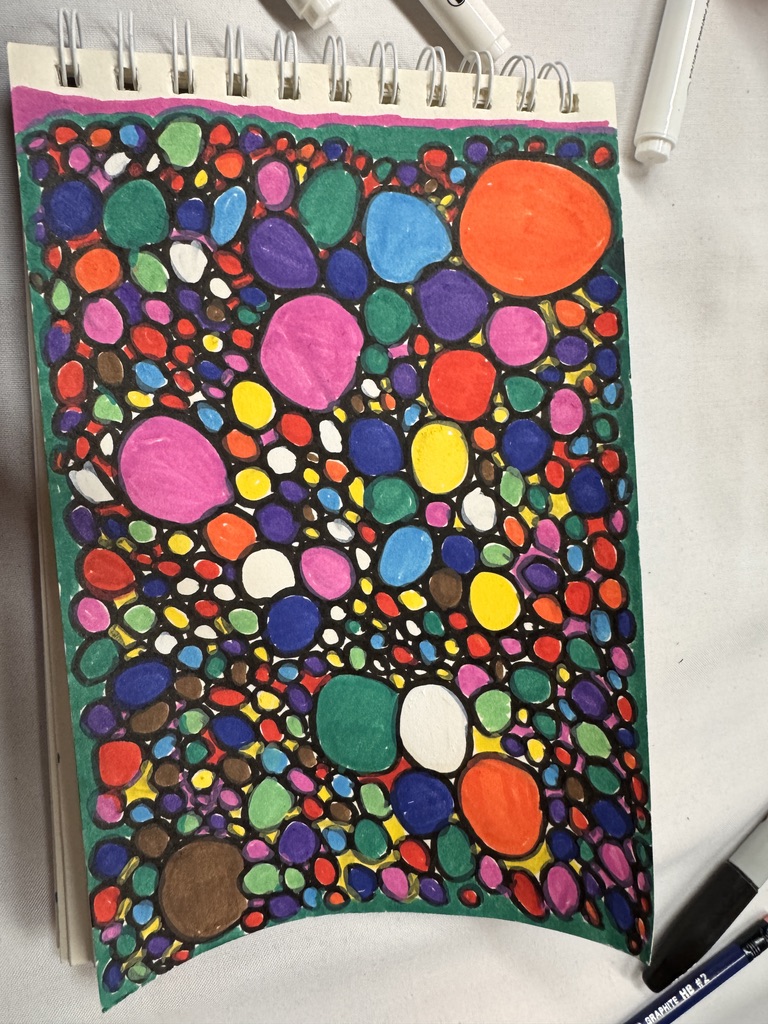
Title: Held Within the Field

Artist Statement 

This piece emerged through repetition rather than planning. I began with a single shape, then another, and another, allowing colour and form to accumulate without imposing hierarchy. What developed was a dense field of rounded figures, each contained, each distinct, yet held within a shared space. The work unfolded beyond linear intention, through a quiet attentiveness to what wanted to appear.

In my reflective practice, circular and stone-like forms often surface when I am thinking about belonging, plurality, and the coexistence of emotional states. No single shape dominates the composition. Larger forms draw the eye momentarily, but they are held in balance by the many smaller presences surrounding them. This distribution mirrors how experience lives within me. No one memory or feeling stands alone. Each is shaped by proximity to others.

Colour operates here as emotional register. Bright pinks, deep blues, citrus orange, moss greens, and earth tones sit beside one another without blending. They remain intact, suggesting that complexity requires no resolution. Contradictory feelings can exist simultaneously without cancelling one another out. The dark outlines serve as holding structures, containers rather than barriers, allowing each fragment to remain visible while contributing to the whole.

What interests me most is the tension between density and spaciousness. Although the surface appears crowded, there is rhythm in the placement. Pathways of dark ground weave between the forms, creating movement and breath within the field. The composition holds fullness without collapse.

I understand this drawing as an exploration of internal multiplicity. A recognition that identity is plural rather than singular, gathered, layered, and continuously reassembled. Each form holds its own colour, its own boundary, its own story. Together, they create a living mosaic of presence.

Photo Credit: Amy Tucker, 2026

The Flash of Perception

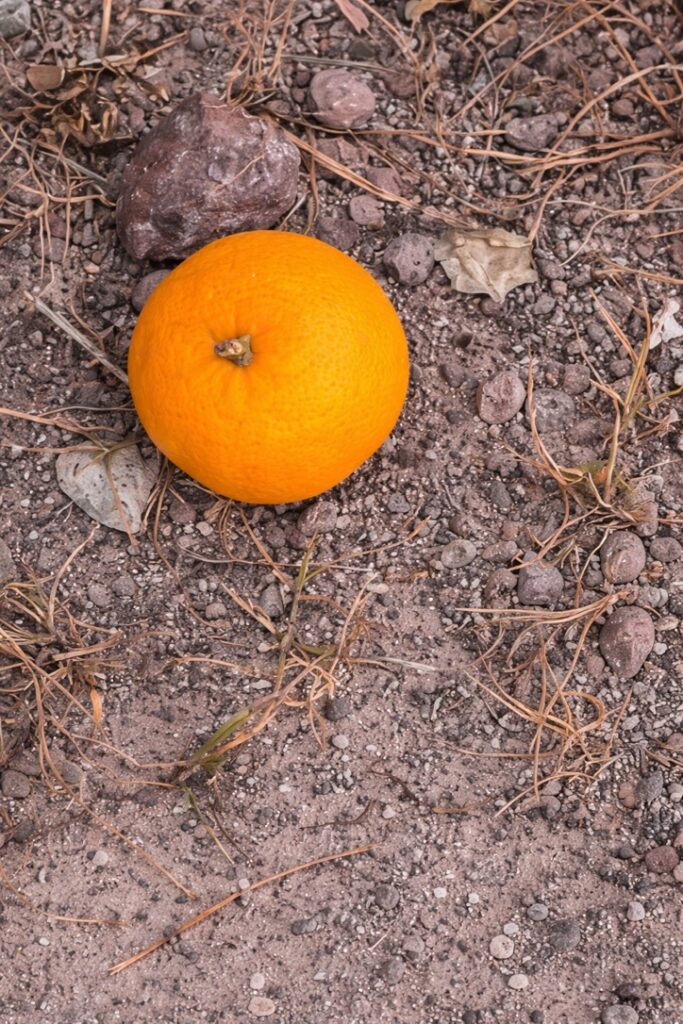
I almost walked past it. An orange, vivid and whole, resting on the dry earth as if it had been placed there by intention rather than chance. The ground around it was grey and brown, scattered with stones, dried grass, and brittle leaves. The orange held its colour like a small act of defiance. It did nothing to blend in. And yet here it was, this bright sphere of sweetness against a landscape of dust and stillness.

The orange held its colour like a small act of defiance.

This is the moment contemplative photographers call the flash of perception: that instant when something in the visual field stops you, interrupts the continuous scroll of seeing, and asks to be noticed. Karr and Wood (2011) describe this experience as connecting with perception before concept takes over, before the mind labels and dismisses. The orange was simply colour and form before it became orange, before it became a question of how it arrived or what it might mean.

This is the moment contemplative photographers call the flash of perception.

Me detuvo en seco. It stopped me cold. And in that stopping, I recognised something I had been missing in my practice of alonetude: the permission to see in colour.

I recognised something I had been missing in my practice of alonetude: the permission to see in colour.

Title: Sweetness in Dust

Artist Statement

The orange arrived without explanation. Perhaps it fell from a bag. Perhaps it rolled from a table and was never retrieved. Perhaps someone left it as an offering, though to whom or what I cannot say. The fruit showed no sign of decay. Its skin was smooth, its form intact. Its slow return to the earth had yet to begin. For now, it simply rested, bright and round, waiting for what would come next. This is the only photograph in my collection that I have kept in colour. The choice was deliberate. In a body of work committed to black and white, to reduction and restraint, this image demanded something different. The orange refused to be muted. Its brightness was the point. To convert it to greyscale would have been to erase what made the encounter remarkable: the unexpected presence of sweetness in a landscape of dust and stillness. Amy Tucker, January 2026

I moved closer. This is what contemplative practice asks of us: to stay with what stopped us, to look longer, to resist the urge to glance and move on. The closer I came, the more the orange revealed. The texture of its skin. The small star where the stem once attached. The way light fell across its curved surface. In my years of academic work, I learned to keep distance, to analyse from above, to maintain the scholarly remove that institutions reward. This practice of moving closer feels like unlearning. The orange cares nothing about my credentials or my theoretical frameworks. It simply exists, vivid against volcanic pebbles, asking nothing of me except presence. Acercarme es un acto de confianza. Moving closer is an act of trust.

In my years of academic work, I learned to keep distance. This practice of moving closer feels like unlearning.

Defining Key Concepts

The decision to notice the orange was beyond me. My body responded before my mind caught up.

Visual Salience

Title: Fractures That Hold Light

Artist Statement

This drawing began as an exploration of fragmentation. I was thinking about how experience rarely arrives in seamless form. Instead, it presents itself in angles, interruptions, and shifting planes. I allowed the lines to move first, creating divisions that felt organic rather than measured. Only afterward did colour enter, filling the spaces that had already claimed their boundaries.

What emerged was a stained-glass effect, though untied to any sacred architecture. The sacredness here feels internal. Each segment holds its own intensity. Bright yellows sit beside deep violets. Saturated pinks meet earth browns and dense blues. The colours resist blending. They remain intact, suggesting that contrast is coexistence rather than conflict.

In my reflective practice, fractured compositions often mirror psychological landscapes. Identity, memory, and healing rarely unfold as continuous surfaces. They exist in pieces that must learn to sit beside one another. Some segments feel expansive and open. Others feel enclosed, heavier, or more opaque. Yet all are necessary to the integrity of the whole.

The black lines function as both separation and structure. They divide, but they also hold. Without them, the colours would dissolve into each other. With them, each fragment is given legitimacy, a defined presence. I understand these lines as boundaries that have formed through experience. Protective, clarifying, and sometimes shaped by rupture rather than design.

There is no single focal point. The eye moves continuously, tracing edges, following colour pathways, pausing where intensity gathers. This movement reflects the ongoing nature of integration. Healing is a sustained process of learning how the pieces live together.

I see this work as a meditation on wholeness assembled through fracture. A recognition that brokenness rearranges beauty rather than eliminating it. Light enters differently through divided spaces. And sometimes, it is precisely the fractures that allow illumination to pass through at all.

Photo Credit: Amy Tucker, 2026

Visual salience refers to the quality that makes certain elements in a visual field stand out from their surroundings and automatically capture attention. Neuroscience research shows that the human visual system has evolved to detect stimuli that differ markedly from their context, particularly in colour, contrast, and luminance (Treue, 2003). When we encounter a bright orange against a field of browns and greys, our nervous system responds before conscious thought engages. This bottom-up attention capture served evolutionary purposes, helping our ancestors detect ripe fruit, potential predators, and social signals.

The decision to notice the orange was beyond me. My body responded before my mind caught up.

What fascinates me about this phenomenon is how it operates beneath the surface of awareness. The decision to notice the orange was beyond me. My body responded before my mind caught up. This is what Porges (2011) describes in Polyvagal Theory as neuroception: the nervous system’s capacity to evaluate environmental cues without conscious involvement. In the context of healing from occupational trauma, relearning to trust these automatic responses feels like reclaiming territory that exhaustion had claimed.

Contemplative Photography

Contemplative photography is a practice that uses the camera as a tool for mindful seeing rather than technical image-making. Originating in Buddhist meditation traditions and systematically developed by Chögyam Trungpa Rinpoche’s students, this approach emphasises presence over perfection, perception over concept. Karr and Wood (2011) explain that the practice involves three stages: recognising the flash of perception, stabilising connection through continued looking, and forming an image that captures what was seen rather than what the photographer wanted to see.

The root meaning of the word contemplate is connected with careful observation. It means to be present with something in an open space. When we contemplate a subject, we open to it rather than treating it as something to be analysed or understood. (Karr & Wood, 2011, p. 5)

This definition resonates deeply with the practice of alonetude. To be present with something in an open space is precisely what this retreat asks of me: to remain in the liminal territory between loneliness and solitude, to transform imposed isolation into chosen presence through attention itself.

Playing with Bright Colours: A Departure

Throughout this retreat, I have committed to black-and-white photography, to reduction and restraint, to the greyscale palette that strips scenes down to their essential forms. This choice emerged from the desire to document exhaustion, aftermath, and the quiet work of healing without the distraction of colour’s emotional pull. Black-and-white photography creates distance, allows objects to become symbols, and privileges texture and contrast over the seduction of hue.

And yet.

Walking through Loreto, I found myself stopped again and again by colour. Bright, saturated, unapologetic colour that refused to be muted even in my imagination. The red of a plastic cup abandoned among grey leaves. The crimson of a painted butterfly on a white stone. The vivid orange of bougainvillea against ancient rock. The cheerful red of a classic Volkswagen Beetle parked on a quiet street. These colours were asking something of me, and what they asked was this: to let go, just a little, of the aesthetic framework I had imposed. To allow brightness back in.

El color también es una forma de conocimiento. Colour is also a way of knowing.

Title: Party’s Over

Artist Statement

I know this cup. I have held this cup at faculty gatherings, at end-of-term celebrations, at the casual socials that punctuated academic life before everything changed. The red Solo cup is North American shorthand for festivity, for letting loose, for the brief suspension of professional performance. Finding one here, among the grey leaves and brittle grass of a Loreto afternoon, felt like encountering an artifact from another life. Someone celebrated here. Someone gathered with others, drank something, discarded the evidence. The cup remains, cheerful and incongruous, long after the party ended. I photograph it because I recognise both the celebration and the aftermath. Because I am learning that endings leave traces, and sometimes those traces are bright red against a field of grey. Because the cup, like me, persists in a landscape that was never quite its home. Photo Credit: Amy Tucker, January 2026

Title: Someone Else’s Transformation

Artist Statement

I have been painting stones throughout this retreat, transforming found objects into small monuments of presence and process. This stone was painted by someone else. I found it resting among grey pebbles, its white surface marked with a red butterfly, wings spread as if caught mid-flight. The butterfly is imperfect. The paint has texture and variation. This was made by hand, by a person who chose to mark this stone with a symbol of transformation and left it here for anyone to find. No estoy sola en esta práctica. I am alone in my practice, yet hardly the only one who practices. Somewhere in Loreto, or passing through, someone else felt the impulse to transform stone into meaning. Someone else left evidence of attention, of care, of the quiet human need to make marks on the world. I photograph this stone because it reminds me that alonetude connects to a larger community of those who attend, who notice, who create small beautiful things and release them into the world. Photo Credit: Amy Tucker, January 2026

Global Red

Artist Statement


The red of the Coca-Cola label is engineered to be seen. Billions of dollars and decades of research have ensured that this particular shade of red captures attention in any context, any culture, any landscape. Here it lies, crushed and discarded on dusty earth, still vivid, still demanding to be noticed. I have complicated feelings about photographing corporate debris. There is critique here: the reach of globalised consumer culture, the persistence of plastic in natural environments, the way branded objects colonise every corner of the world. And there is also simple visual truth: the red is beautiful against the brown. The bottle, for all it represents, still stopped me. Still asked to be seen. In my practice, I try to hold both truths. The systems that produce such objects are worthy of critique. The objects themselves still carry colour, still participate in the visual world, still have something to teach about persistence and salience and the stubborn brightness of things that refuse to disappear. Photo Credit: Amy Tucker, January 2026

Title: What the Land Offers

Artist Statement

Unlike the cup, the bottle, the painted stone, this colour emerged from the land itself. Bougainvillea evolved its crimson bracts to attract pollinators, to ensure reproduction, to continue its lineage across generations. The red serves biological purpose. It exists because it works.

Against the grey stone of a Loreto wall, the flowers blazed with the kind of beauty that requires no justification, no theoretical framework, no scholarly analysis. They were simply, extravagantly, themselves.

I photograph them because they remind me that colour is older than human culture, that attention capture served survival long before it served commerce, that beauty has reasons we may never fully understand. La tierra también sabe crear belleza. The land also knows how to create beauty. In the practice of alonetude, where I am learning to trust my body's responses, these flowers offer evidence that brightness is natural, that noticing what is vivid is coded into the very structure of perception. Amy Tucker, January 2026

El Vocho Rojo: The Red Beetle

On a quiet street in Loreto, a red Volkswagen Beetle sat in the afternoon light like something from another decade. In México, these cars are called vochos, and they carry cultural significance beyond their mechanical function. For decades, the Beetle was the affordable, reliable car that connected communities, carried families, and moved through landscapes with a particular personality that contemporary vehicles somehow lack.

This one was red. Very red.

This one was red. Very red. Its colour commanded attention against the palm trees and blue sky, against the dusty street and white buildings. I photographed it twice: once from behind, its rounded form echoing the organic shapes of the oranges I had noticed elsewhere, and once from the side, showing its classic profile and the wear of years in a desert climate.

Hay belleza en lo que ha durado. There is beauty in what has endured.

Title: El Vocho: From Behind

Amy Tucker, January 2026

Artist Statement

From behind, the Beetle's curves echo something organic. The rounded rear window, the gentle slope of the body, the way light plays across the painted surface. There is a face-like quality to this view, though I resist the urge to anthropomorphise. What strikes me instead is the car's solidity, its thereness, its quality of having persisted. This vocho has lived through decades of Baja California sun. Its red has faded slightly but remains vivid. Its form remains classic, recognisable, beloved. I photograph it because I am thinking about persistence, about what remains bright despite time and exposure, about the objects that carry cultural memory in their very shape. In my own life, I am learning what persists after institutional belonging ends. What colours remain when the context changes. What shape I hold when the structures that once defined me fall away. The vocho offers no answers, only presence: still red, still here, still beautiful after all these years. Photo Credit: Amy Tucker, January 2026

El Vocho: Profile of Persistence

Artist Statement 

Amy Tucker, January 2026

The side view reveals the Beetle's full profile: the distinctive silhouette that made it one of the most recognizable vehicles in history. Behind it, a building bears the words "Creo California," anchoring the scene in this place, this Baja California Sur afternoon. The car shows its age here.

Small imperfections, the patina of desert years, the evidence of continued use rather than museum preservation. This is a working vehicle, loved and maintained, still serving its purpose decades after it rolled off the assembly line. I see myself in this persistence. I am also showing my age, carrying my patina of difficult years, bearing the evidence of continued use. The vocho neither apologises for its imperfections nor hides its history. It simply continues, red and present and itself. Seguir adelante también es una forma de belleza. To keep going is also a form of beauty. Photo Credit: Amy Tucker, 2026

Table 1

Colour Instances and Their Personal Resonances

Image TitleVisual ElementPersonal Connection
Connection to my own stone-painting practice; recognition that alonetude links to the larger community; shared impulse to createOrange fruit on dry earthPermission to see in colour; the flash of perception that initiated this collection; trusting automatic responses
Closer StillOrange in close-up viewUnlearning scholarly distance; moving closer as an act of trust; presence over analysis
Party’s OverRed plastic cup among leavesRecognition of academic celebrations past; understanding endings leave traces; persistence after displacement
Someone Else’s TransformationPainted butterfly stoneConnection to my own stone-painting practice; recognition that alonetude links to larger community; shared impulse to create
Global RedCrushed Coca-Cola bottleHolding critique and beauty simultaneously; learning to acknowledge complicated truths; seeing persistence in the problematic
What the Land OffersCrimson bougainvilleaTrusting embodied responses; remembering colour is natural; beauty that requires no justification
El VochoRed VW BeetleWhat persists after context changes; carrying patina with dignity; keeping going as a form of beauty

Note. This table maps each image to its visual content and the personal resonances that emerged through the practice of contemplative photography within the alonetude framework.

Reflection: What Colour Asks of Us

Permission to notice joy even in landscapes of recovery. Permission to be stopped by beauty that has nothing to do with achievement or productivity. Permission to let the eye rest on something simply because it delights.

Greenspan (2003) writes about befriending dark emotions as pathways to wisdom. But what of bright colours? What do they ask when they interrupt our carefully curated palette of greys and browns, of exhaustion and restraint? I think they ask for permission. Permission to notice joy even in landscapes of recovery. Permission to be stopped by beauty that has nothing to do with achievement or productivity. Permission to let the eye rest on something simply because it delights.

The graced eye can glimpse beauty everywhere, seeing the divine at work in the hidden depths of things. The eye of aesthetic spirituality sees more than other eyes. (Paintner, 2013)

These photographs hold a tension I am learning to inhabit: between my commitment to black-and-white documentation and the insistence that colour be seen. Both truths are real. Restraint has its purpose. And brightness has its own knowledge to offer. In the practice of alonetude, perhaps both are necessary. The greyscale for processing what has been lost. The vivid hue for remembering what remains.

I photographed the orange because I could neither look away nor imagine it in greyscale. I kept it in colour because some things ask to be seen exactly as they are. And in doing so, I gave myself permission to notice that healing includes brightness, that recovery holds room for delight, that even in the labour of alonetude, something sweet and vivid can rest on the ground, waiting to be found.

La belleza existe. Existe aquí. Existe ahora.

Beauty exists. It exists here. It exists now.

Some things ask to be seen exactly as they are.

References

Greenspan, M. (2003). Healing through the dark emotions: The wisdom of grief, fear, and despair. Shambhala.

Itti, L. (2007). Visual salience. Scholarpedia, 2(9), 3327. http://www.scholarpedia.org/article/Visual_salience

Karr, A., & Wood, M. (2011). The practice of contemplative photography: Seeing the world with fresh eyes. Shambhala.

Paintner, C. V. (2013). Eyes of the heart: Photography as a Christian contemplative practice. Sorin Books.

Pink, S. (2013). Doing visual ethnography (3rd ed.). SAGE.

Porges, S. W. (2011). The polyvagal theory: Neurophysiological foundations of emotions, attachment, communication, and self-regulation. W. W. Norton.

Treue, S. (2003). Visual attention: The where, what, how and why of saliency. Current Opinion in Neurobiology, 13(4), 428-432. https://doi.org/10.1016/S0959-4388(03)00105-3

Translation note. Spanish language passages were generated using Google Translate and subsequently reviewed and refined by the author. Any remaining infelicities reflect the limits of machine translation rather than intent.

Day 26: Scattered Blue

Day 26: Scattered Blue, a photographic meditation on the colour blue and what it means to find your whole palette scattered across the floor of a life. On creativity, alonetude, and the wonder of the Sea of Cortez.

Title: When I am Feeling Blue

Artist Statement

I looked down and laughed. My blue sandals, my blue toenails, and scattered across the concrete before me, droplets of blue paint that someone had spilled and never cleaned. The coincidence was too precise to ignore. This arrived without planning. I had simply stopped walking and noticed that the ground was echoing me back.

This is one of the photographs I have kept in colour. The blue demanded it. Against the grey and beige of the weathered concrete, the paint droplets appeared like a constellation, random yet patterned, evidence of movement and accident. My sandals anchored the frame at the bottom, situating my body within the encounter. I was fully within the encounter rather than observing from a distance. I was standing in the middle of what I found.

I am drawn to moments of unexpected correspondence. The times when what I carry meets what the world offers without intention or design. The blue paint was left for no one. It was residue from labour I had no way to witness, a task completed and moved on from, the spillage deemed too minor to address. Yet standing there, I became part of its composition. My feet completed a pattern that had been waiting, perhaps, for someone to notice.

In my broader practice, I think often about trace and residue. What remains after work is finished. What gets left behind when attention moves elsewhere. The paint droplets will fade eventually, worn away by foot traffic and weather. But for this moment, they held their blue against the grey, bright and unashamed, and I stood among them wearing the same colour, as if the ground and I had agreed on something without speaking.

The photograph holds play and presence in equal measure. It reaches beyond profundity. It simply records a moment when I looked down, saw myself reflected in what had been discarded, and smiled at the small magic of correspondence. Sometimes the land teaches through means other than solemnity. Sometimes it teaches through delight.

Photo Credit: Amy Tucker, January 2026

I have always been drawn to blue.

Beyond the way people speak of favourite colours, a casual preference carried from childhood without much thought. This is something else. Something that lives in my body before my mind has time to name it. When I see a particular shade of blue, the soft turquoise of shallow water, the deep indigo of twilight, the bright cerulean of a painted door, something in me settles. My shoulders drop. My breath slows. The world becomes manageable for a moment.
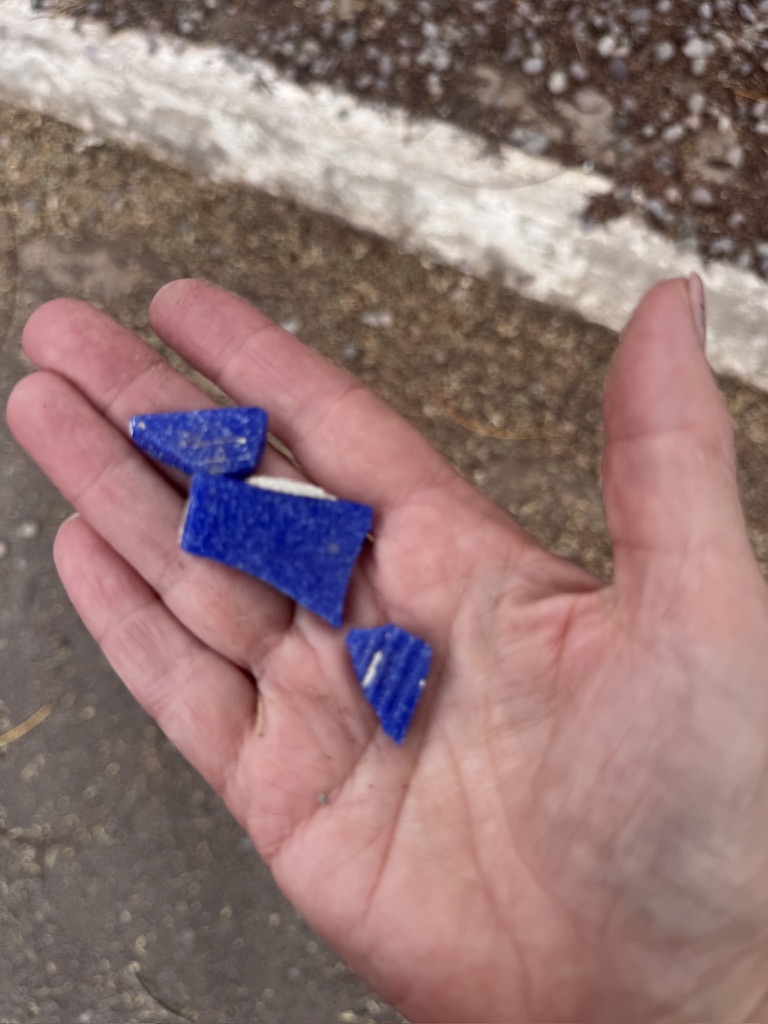
“I have always been attracted to this colour. It reminds me of calm. Peace. Seas.”

Blue is my nervous system’s signal for safety.

Porges (2011), in developing Polyvagal Theory, describes how the autonomic nervous system responds to environmental cues, what he calls neuroception: the body’s unconscious detection of safety or threat. Certain stimuli signal danger: loud noises, aggressive faces, signs of chaos. Others signal safety: soft voices, gentle rhythms, open spaces. I have come to understand that, for me, blue functions as a neuroceptive cue. It tells my body that the threat has passed. It tells my ventral vagal system that it is safe to engage, to play, to rest.

Stopping to notice revealed this to me. Until I stood on grey concrete with blue scattered at my feet and laughed at the unexpected correspondence.

The day I took this photograph, I was walking without a destination.

This has become a practice during my retreat, caminar sin rumbo, walking without direction, letting my feet decide where to go. Kabat-Zinn (1994), in his foundational work on mindfulness, describes this quality of attention as “non-striving,” the willingness to let experience unfold without forcing it toward a predetermined goal. Walking without a destination is non-striving, made ambulatory. The body moves. The mind follows. Sometimes nothing happens. Sometimes everything does.

I had painted my toenails blue before I left Canada. A small aesthetic choice, barely conscious. I had packed the blue sandals because they were comfortable, because they fit the climate, because something in me wanted to carry that colour into this journey. Its significance had stayed quiet.

And then the ground answered.

Title: Constellation of Accident

Artist Statement

I crouched down to see them closer.

The paint droplets varied in weight and pattern. Some had fallen heavily, pooling into thick spots of saturated blue. Others were mere specks, barely visible, almost lost to the texture of the concrete. The pattern was random, no design, no intention, just the physics of liquid falling and landing where gravity placed it.

But randomness can look like pattern when you attend to it long enough. The droplets clustered in some areas, scattered in others, creating rhythms I could almost hear. This is what attention does: it finds meaning in what was never meant to mean anything. It makes constellations from scattered stars.

Someone painted something here. A wall, a sign, a piece of furniture they were refinishing. The work is finished now, moved elsewhere, forgotten. Only this residue remains, evidence of labour, trace of presence, blue marks on grey ground that no one thought to clean.

I am interested in residue. In what remains after the task is complete. In the unintended traces we leave behind.

Photo Credit: Amy Tucker, January 2026

I have been collecting broken blue things.

It started with the tiles I found in the empty field on Day 24, fragments of old Mexican ceramics in that particular turquoise-teal that appears on church domes and courtyard fountains throughout Baja California Sur. I picked them up without knowing why, only that their colour called to me, only that my hand reached for them before my mind could explain.

Since then, I have gathered more. Blue glass tumbled smooth by time. Blue pottery shards with half-erased patterns. Blue sea-worn fragments from the beach, their origins unidentifiable, their colour persistent. Each one caught my eye, and I bent down, and I carried it home, and now I have a small collection of blue facts waiting to be assembled.

The broken pieces are gathering. They will show me what they want to become.

This gathering is its own kind of practice. Leavy (2015), in her work on arts-based research, argues that creative processes generate knowledge that other methods cannot access. The hands learn differently than the mind. The act of selecting, collecting, and arranging is an epistemic activity, a way of knowing through doing. What the blue pieces will become stays open. I only know that gathering them feels important, feels like research, feels like my body telling me something my conscious mind has held rather than articulated.

Title: What I Have Gathered

Artist Statement

Becoming a collector of broken blue things arrived without a plan.

But here they are. Pieces of tile from the empty field. Sea glass from the beach. Pottery shards whose patterns are half-erased by time. Each one came to me separately, in its own moment, asking to be noticed. I said yes. I picked them up. I carried them back to this temporary home where they now rest together, learning each other’s company.
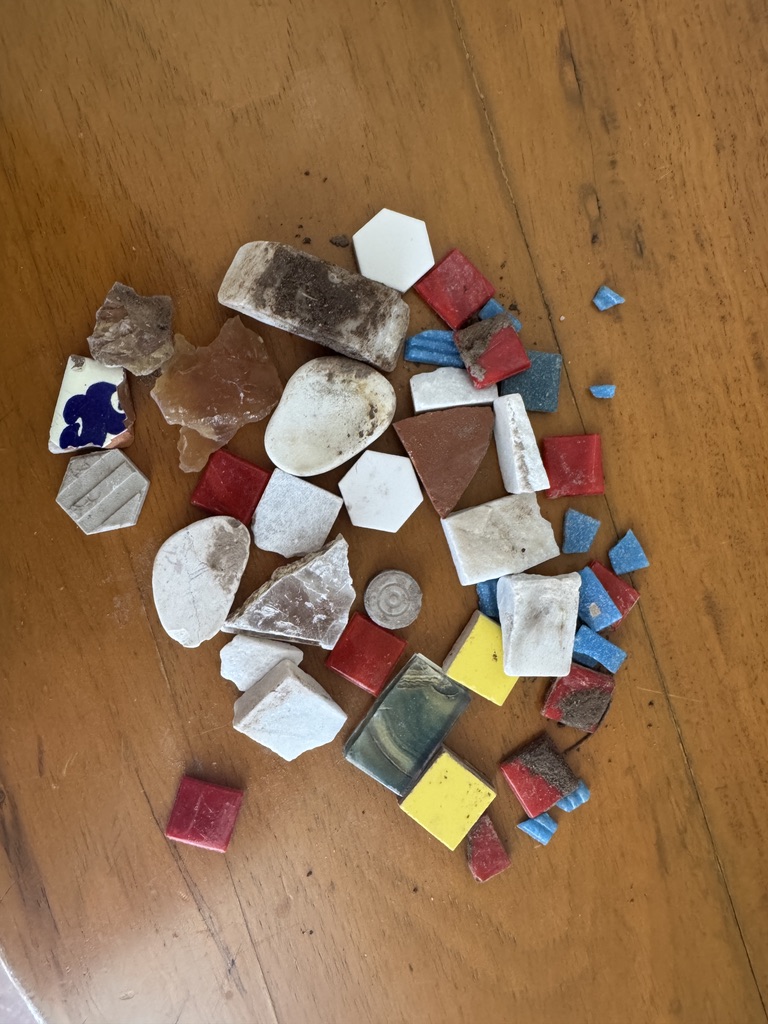
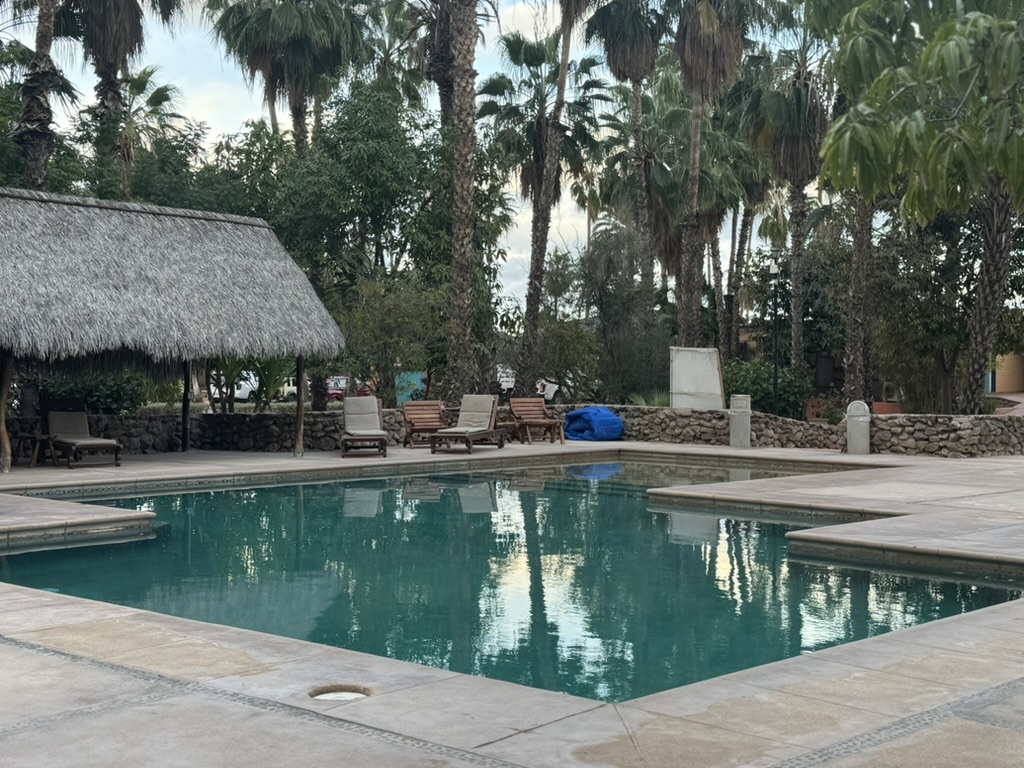
The blues vary. Some lean toward turquoise, some toward indigo, some toward the grey-blue of storm clouds over water. But they belong together. My body knew this before my mind understood. The hand reached; the eye approved; the collection grew.

What will I make with them? A mosaic, perhaps. An assemblage. A frame for something still forming. For now, I am letting them sit together. Letting them tell me what they need.

Photo Credit: Amy Tucker, January 2026

Mosaic, as an art form, is made from broken things.

The word derives from the Greek mouseion, a place sacred to the Muses, goddesses of the arts and sciences who bestow creative inspiration on humans. Mosaics were holy before they were decorative. They covered temple floors and church walls, transforming shattered stone and glass into images of the divine. The Byzantine masters of Ravenna understood this alchemy: that brokenness, properly arranged, becomes more luminous than wholeness ever was.

Pentcheva (2010), in her study of Byzantine aesthetics, describes how mosaic tiles, set at slightly different angles, catch light unevenly. The surface shimmers. The image seems to breathe. “The mosaic is never still,” she writes it changes as the viewer moves, as the light shifts, as time passes (p. 648). What appears fixed is actually in constant subtle motion, alive with the unpredictability of its fragmented construction.

I think about my own fragments this way. The blue pieces I have gathered stay in motion. They carry light differently depending on how I hold them, how the sun enters the window, how my attention moves across their surfaces. They are waiting to become something, but that something will shimmer. It will shift. It will be alive, the way broken things, reassembled, become alive.

There is another dimension to blue I must acknowledge.

Blue is also the colour of sadness. To “feel blue” is to feel low, melancholic, and touched by grief. The blues, as a musical tradition, emerged from the specific sorrows of Black American experience: oppression, loss, the particular ache of being human in a world that often makes no sense. When Robert Johnson sang “Hellhound on My Trail,” when Billie Holiday sang “Strange Fruit,” they were singing the blues. They were giving voice to what lives in the blue frequency of emotion.

I carry this blue, too. The depression I have been writing about throughout this retreat. The sadness that followed me from Canada, that persists despite the warm light and the sound of waves. The grief of losing a career I loved. The fear of an uncertain future. The despair, Greenspan’s (2003) word for it, that arrives sometimes in the early morning and sits on my chest like weather.

Greenspan teaches that grief, fear, and despair are pathways through healing rather than obstacles. “The dark emotions are not pathological states but, in essence, sane and appropriate responses to the state of the world,” she writes (p. 10). We are trained to bypass difficult feelings, to positive-think our way past them, to medicate them into silence. But Greenspan insists that befriending the dark emotions, sitting with them, listening to what they carry, transforms them into wisdom.

Blue holds both. The calm of the sea and the sadness of the spirit. The peace of shallow water and the grief of deep. I am learning that these are neighbours rather than opposites, sharing a colour, sharing a frequency, sharing space in my body as I walk through this month of alonetude.

Title: Blue at Rest

Artist Statement

The blue is resting.

I came to the pool in the late afternoon, when the light had softened and the other guests had gone inside. The water held still, that particular turquoise that exists only in certain latitudes, certain qualities of light. The palapa framed the scene like a theatre curtain, dried palm fronds hanging heavy overhead, creating a threshold between shade and brightness, between shelter and exposure.

A blue towel lies abandoned on the deck. Someone was here. Someone swam or sat or simply rested near the water, then moved on, leaving this soft evidence behind. The towel and the pool speak to each other in the same colour, different textures, different purposes, but belonging to the same family of blue.

I have been thinking about what it means to let things rest. The water simply rests. The towel simply rests. The palm trees sway slightly, at ease. Everything in this frame exists in a state of pause, of waiting, of being without becoming. This is what I came here to learn, how to be still without feeling that stillness is failure.
The turquoise door of the casita echoes the water. Blue answering blue across the space. The world arranged it without my intervention. The world arranged it, and I was present enough to notice.

Photo Credit: Amy Tucker, January 2026

The art project will take shape when I return to Canada.

I imagine a mosaic, perhaps. Something that holds the blue pieces together while honouring the breaks between them. Something that catches light the way Pentcheva describes shimmering, shifting, alive. Something that carries both the calm of these seas and the sadness of these months. Something that transforms what was discarded into something beautiful, the way gleaning transforms forgotten abundance into sustenance.

But I hold it open rather than force it. I am practicing what Chödrön (2000) calls “groundlessness,” the willingness to exist without knowing what comes next, to tolerate the uncertainty of being between. The fragments will tell me what they need. The blue will speak when it is ready.

For now, I gather. I notice. I let the colour find me where it will.

Title: Held in Blue

Artist Statement 

This image emerged unintentionally. I had set out without abstraction as a goal. I had been walking, attentive to land, horizon, and form, when the frame filled instead with colour alone. No shoreline. No sky line. No identifiable object to anchor perception. Only blue, deep and immersive, layered in tonal variation.

At first, I considered discarding it. It held a different kind of witness than my other photographs. It resisted narrative. Yet the longer I sat with it, the more it began to speak in a different register. It moved beyond landscape into interiority.

The field of blue feels oceanic without depicting the ocean. It holds the same sense of suspension I experienced while floating in open water, where orientation dissolves and the body rests in something vast, buoyant, and indifferent to personal history. There is no horizon to measure against. No visual boundary to define scale. Only immersion.

In my reflective practice, this image becomes a study in containment without confinement. Blue often carries associations of depth, quiet, and emotional spaciousness. Here, those qualities feel intensified by the absence of distraction. Nothing interrupts the field. Nothing asks for interpretation. The photograph offers stillness rather than information.

I have come to understand it as a visual analogue for the psychological state cultivated through alonetude. A state in which identity softens, performance recedes, and the self is held rather than displayed. It mirrors the experience of resting within one’s own interior expanse without the need to articulate or explain.

The subtle shifts in tone across the frame suggest movement beneath apparent uniformity. Even in stillness, there is variation. Even in quiet, there is life. The image reminds me that healing rarely appears dramatic. Sometimes it looks like this: immersion in a colour that asks nothing and gives space in return.

I kept the photograph because it holds what cannot be easily represented. The feeling of being suspended between exhaustion and restoration. Between who I was and who I am becoming. Between surface and depth.

Photo Credit: Amy Tucker, 2026

I stood on grey concrete with blue scattered at my feet, and I laughed.

This is what I want to remember from this retreat. More than the hard work of facing depression and grief. More than the theoretical frameworks and the scholarly engagement. More than the counter-archive of institutional harm. But also this: the laughter. The delight. The unexpected joy of finding myself echoed in a scattered patch of paint that someone had spilled and never cleaned.

Alonetude reaches beyond processing suffering. It is also about allowing pleasure. About noticing when the world offers a gift, a visual rhyme, a moment of correspondence, blue meeting blue on grey ground, and receiving it without demanding that it mean something profound.

Sometimes it just means: here is beauty. Here is a play. Here is a moment of delight in a month that has also held heaviness.

I am learning to receive both.

Sometimes the land teaches through means other than solemnity. Sometimes it teaches through delight.

Title: Blue Correspondence

Artist Statement

I return to this image because it holds something I need.

The correspondence arrived without planning. I painted my toenails blue with no knowledge of what I would find on the ground. I wore blue sandals simply as a choice. The meeting was accident, coincidence, grace, whatever word we use for moments when the world seems to be paying attention to us.

But I was paying attention too. That is the key. The paint had been there for weeks, maybe months. Others had walked over it without noticing. I noticed because I was looking down. I was practicing the slow attention of alonetude, the willingness to let experience arrive without rushing past it.

The photograph records this meeting of attentions, mine and the world’s. It holds play and presence in equal measure. It resolves nothing outright. It simply says: here, for this moment, the ground and I agreed on something without speaking.

That agreement feels like the beginning of healing.

Photo Credit: Amy Tucker, January 2026

Azul. El color de la calma. El color de la paz. El color del mar. El color de la tristeza también. El color de todo lo que siento.

Blue. The colour of calm. The colour of peace. The colour of the sea. The colour of sadness, too. The colour of everything I feel.

I am carrying it forward.

Title: The Quiet Field


Artist Statement

This image holds very little in the conventional sense of representation, yet it carries a surprising emotional density. In fact, it is a photo of my pocket.

The frame is filled by a single tonal field, dark blue shifting almost imperceptibly toward charcoal and indigo. There is texture, but it is subtle. There is gradation, but it refuses spectacle. The photograph holds its silence. It waits.


I have come to see this photograph as a meditation on interior quiet. It evokes the psychological state that emerges after prolonged solitude, when the nervous system begins to settle and stimulation no longer feels necessary. The darkness signals containment to me rather than heaviness. It signals containment. A held space where thought can soften.

The faint textural variations across the surface remind me that stillness is never empty. Beneath apparent uniformity, there is movement, grain, and subtle differentiation. Much like emotional healing, the changes are gradual and often invisible to others. Yet they are present, shaping experience from within.

There is also a relational quality to the image. It holds space rather than imposing meaning. It invites projection. Viewers bring their own associations to the field, their own histories with darkness, rest, and quiet. In this way, the photograph functions less as documentation and more as atmosphere.

Within my broader body of work on alonetude and liminal retreat, this image represents the deep interior phase of threshold experience. The stage where identity loosens, where language recedes, where one learns to remain present without needing clarity or resolution.

It is the visual equivalent of closing one’s eyes while awake. Of standing in a room before dawn. Of inhabiting the pause before re-entry into the world of roles and expectations.

The photograph holds that pause without interrupting it.

Photo Credit: Amy Tucker, 2026
Translation note. Spanish language passages were generated using Google Translate and subsequently reviewed and refined by the author. Any remaining infelicities reflect the limits of machine translation rather than intent.

References

Chödrön, P. (2000). When things fall apart: Heart advice for difficult times. Shambhala.

Greenspan, M. (2003). Healing through the dark emotions: The wisdom of grief, fear, and despair. Shambhala.

Kabat-Zinn, J. (1994). Wherever you go, there you are: Mindfulness meditation in everyday life. Hyperion.

Leavy, P. (2015). Method meets art: Arts-based research practice (2nd ed.). Guilford Press.

Pentcheva, B. V. (2010). The sensual icon: Space, ritual, and the senses in Byzantium. The Art Bulletin, 92(4), 631–655.

Porges, S. W. (2011). The polyvagal theory: Neurophysiological foundations of emotions, attachment, communication, and self-regulation. W. W. Norton.

Day 25: Bringing Back My Creativity, Imperfectly and On My Own

Bringing Back My Creativity, Imperfectly and on My Own

Title: Blue Sea, Held by the Blue Sky

Artist Statement

This painting emerged as a gesture of return. After weeks of walking the shoreline, collecting fragments, and listening to land and water, I needed to place the sea onto a surface I could hold. The layered blues follow the rhythm of tide and breath, moving from deep saturation to lighter wash. Each stroke records a moment of presence, a quiet settling of the body into colour and movement. This work reflects alonetude as practice, where the sea becomes both subject and teacher, and painting becomes a form of embodied listening. It will be a background in a future painting.

Credit: Amy Tucker, 2026

For a long time, I believed my creativity belonged to institutions.
To students who needed me.
To colleagues who relied on me.
To the fragile promise of a contract renewed.

Somewhere along the way, I stopped making anything beyond what served a syllabus, a publication target, or an institutional metric. My creative life narrowed into productivity. Art became output. Curiosity became compliance.

And then, quietly, I stopped creating.

Title: What Moves When I Stop Directing

Artist Statement

I made this by staying with the movement rather than correcting it. Line followed line. Colour arrived before meaning. I skipped the sketching. I skipped the planning. I let the markers travel until they decided where to pause and where to press harder.

What this piece reminds me of is how much information lives in rhythm. The bands of colour feel like layers of time rather than landscape. Some are steady. Some break and rejoin. Some thicken where attention lingered. Others thin where the hand grew lighter. Nothing here is accidental, but nothing is controlled either. It emerged through staying present.

As I worked, I noticed how my body settled into repetition. The act became almost meditative. My breathing slowed. My thinking quieted. The colours began to speak to one another without my intervention. This feels important to name. I am learning to trust processes that unfold without explanation, to allow form to emerge through persistence rather than intention.

I have spent many years being rewarded for clarity, structure, and outcomes. This work lives outside that logic. It values continuity over completion. It holds variation without resolving it. The layered lines remind me that experience rarely moves in straight trajectories. It accumulates. It overlaps. It leaves traces.

This piece belongs to my ongoing practice of allowing. Allowing colour to lead. Allowing time to stretch. Allowing myself to make something without translating it into purpose or proof. What moves here is what happens when I stop directing and start listening.

Photo Credit: Amy Tucker, 2026

This month by the sea, something shifted. Beyond drama. Beyond heroics. Imperfectly. Slowly. In fragments.

I began picking up broken tiles from an empty field. Photographing shadows. Washing stones. Holding a small crystal in my palm, noticing how geological time had softened my urgency. These were beyond grand projects. They were gestures. Small acts of attention. But they felt like the return of something that had been taken from me.


Title: Morning Memories

Artist Statement

This painting emerged as a memory of light rather than a literal horizon. The layered oranges, reds, and soft purples trace the moment when day releases itself into evening, and the body follows. The low sun and mirrored water create a quiet symmetry that feels both external and internal, a horizon held in the mind as much as on the page.

This work reflects alonetude as a temporal practice, where colour becomes a way of marking time, emotion, and transition. Painting this scene was an act of slowing, of staying with a moment that would otherwise pass unnoticed.
Credit: Amy Tucker, 2026

Creativity research tells us that creative processes often emerge through incubation, wandering attention, and unconscious processing rather than deliberate effort (Dijksterhuis & Meurs, 2006; Sio & Ormerod, 2009). In other words, creativity returns when we stop forcing it. It returns when we walk, when we notice, when we allow the body to lead.

Title: Learning Where to Stand

Artist Statement 

I began this piece without knowing where it would settle. Colour arrived first, then shape, then a sense of ground. The mountains emerged gradually, as forms that hold rather than landmarks to be conquered, their place quietly. Below them, layers of colour gathered and curved, suggesting movement, water, and time passing without urgency.

What this work brings forward for me is the question of position. Where I place myself in relation to what feels vast. The mountains leave the page undominated. They sit within it, held by the same field of colour that moves around and beneath them. This feels important. I have spent years orienting myself upward, toward peaks of achievement and recognition. This piece asks me to notice what happens when I attend instead to the layers that carry me forward.

As I worked, I felt a steadying in my body. The repetition of lines became grounding. The colours shifted from sharp to blended, from separate to relational. Nothing here is fixed. Everything is in conversation. The land, the water, the sky, and the unseen movements between them coexist without hierarchy.

This drawing belongs to my ongoing practice of slowing down and listening for where I am held rather than where I am headed. It reflects a growing trust in process and in place. I am learning that orientation rarely always come from striving upward. Sometimes it comes from noticing the ground beneath my feet and allowing the landscape, internal and external, to shape how I stand.

Photo Credit: Amy Tucker, 2026

Trauma research echoes this. Arts-based practices are widely recognised as therapeutic pathways for emotional regulation, meaning-making, and recovery (Leavy, 2020; van der Kolk, 2014). Creativity is beyond decoration. It is a regulation. It is restoration. It is a way back to ourselves.

I am learning that my creativity has no requirement to be polished, productive, or legible to anyone else. Peer review is no requirement for validity. Grant language is no requirement for justification. It can be quiet. It can be messy. It can be mine.

Psychologist Mihaly Csikszentmihalyi described creativity as a state of flow, where attention is absorbed and time dissolves (Csikszentmihalyi, 1996). I am finding glimpses of that flow again, through drawing and noticing rather than in writing articles or designing courses, through noticing light on glass, arranging fragments on a table, walking slowly across a field that once looked empty.

Title: Layers I Can Live Inside

Artist Statement 

This piece arrived through accumulation rather than decision. I worked from the top down and the bottom up at the same time, letting bands of colour stack, interrupt, and settle into one another. The lines are deliberate yet fluid. They move because my hand moved, because my body needed rhythm more than precision.

What this work reflects back to me is a growing comfort with complexity. Nothing here resolves into a single horizon. The mountains press forward, the water holds steady, the fields pulse with texture, and the sky refuses to remain quiet. Each layer insists on its own presence while making room for the others. That feels true to how I am living right now.

I notice how the black outlines both contain and release the colour. They mark edges without closing things off completely. This matters to me. I have spent a long time inside structures that demanded clarity, hierarchy, and singular direction. This drawing allows for overlap. It allows for coexistence. It allows for a landscape that can hold many tempos at once.

As I worked, my body stayed engaged. The repetition of horizontal movement grounded me. The brighter colours emerged where energy rose. The cooler tones settled where I needed rest. I let the unevenness stand. I let it speak. The drawing became a record of attention rather than a depiction of place.

This piece belongs to my ongoing inquiry into how layers form a life. Experience accumulates. It layers rather than replaces itself cleanly. Old patterns remain visible beneath new ones. What matters is whether the layers can be lived inside without strain.

Here, they can.

Credit: Amy Tucker, 2026

This feels like a small rebellion against academic capitalism, against the extraction of time, against the idea that creativity must always be monetised, published, or measured. It feels like choosing to create for no audience except myself and the land that is teaching me how to look again.

I am imperfectly bringing back my creativity on my own.
And that feels like freedom.


Title: Fragments, Returning

Artist Statement

This image marks my return to creative practice in fragments rather than finished forms. I gathered these objects, glass, tile, stone, and crystal, while walking through places I once passed without stopping. Each piece carries traces of use, weather, and abandonment, yet also holds colour, texture, and presence. Collecting them was intuitive, guided by the body before the mind could explain why.

For many years, my creativity was shaped by institutional demands, productivity metrics, and the precarious rhythms of contract academic labour. This work emerges from stepping outside those structures. The fragments are both material and metaphor. They reflect how creative life returns imperfectly, in partial gestures, slow noticing, and unplanned encounters with place.

This photograph is part of my arts-based inquiry into trauma, recovery, and relational ways of knowing. Handling these fragments grounded me in the present moment and offered a tactile form of mindfulness. Creativity here is beyond outcomes. It is a practice of attention, a refusal to walk past what appears empty, and a quiet reclaiming of making as personal, relational, and ethical work.

Photo Credit: Amy Tucker, 2026

Reference

Csikszentmihalyi, M. (1996). Creativity: Flow and the psychology of discovery and invention. HarperCollins.

Dijksterhuis, A., & Meurs, T. (2006). Where creativity resides: The generative power of unconscious thought. Consciousness and Cognition, 15(1), 135–146. https://doi.org/10.1016/j.concog.2005.03.007

Leavy, P. (2020). Method meets art: Arts-based research practice (3rd ed.). Guilford Press.

Sio, U. N., & Ormerod, T. C. (2009). Does incubation enhance problem solving? A meta-analytic review. Psychological Bulletin, 135(1), 94–120. https://doi.org/10.1037/a0014212

van der Kolk, B. A. (2014). The body keeps the score: Brain, mind, and body in the healing of trauma. Viking.


Day 24: Finding Treasure in Empty Fields

What the Discarded Teaches Us About Value


I am learning that treasure is what the world overlooks rather than what it values. Treasure is what the world has overlooked, discarded, and left behind for someone patient enough to notice.


Title: Blue Enough to Stop

Artist Statement

I noticed this because the blue refused to disappear.

At first glance, it was just dust and gravel, the kind of ground you walk over without registering it. Then the colour began to surface. Small shards scattered unevenly, catching light in brief, insistent flashes. They were beyond arrangement. Beyond intention. Simply there, insisting on being seen.

This moment reminded me how attention changes the world. What appears monochrome at a distance reveals complexity when approached slowly. The blue fragments felt like remnants of care, traces of something once whole that still carried beauty despite being broken. I thought about how easily colour is erased by speed, by habit, by the assumption that nothing important lies underfoot.

There is something tender in stopping for what is small and sharp-edged. These fragments asked for no fixing and no story beyond their presence. They held their colour against dust and time. That felt instructive. It suggested that value requires no coherence, no completion. It can exist in scattered form, waiting for someone willing to look closely enough to notice.

This image stays with me because it affirms a practice I am learning to trust. To walk slowly. To look down. To allow myself to be interrupted by what glints quietly at the margins. The blue was enough to stop me. That feels like a lesson worth keeping.

Photo Credit: Amy Tucker, 2026

The Empty Field

There is an empty field just beyond the edge of town, where the paved road gives way to dust and the last buildings surrender to open land. I have been walking past it for weeks without stopping. It looked like nothing. Scrub brush. Rubble. The kind of place you glance at and dismiss.

Yesterday, I stopped.

Something beyond naming made me turn off the path and walk into that emptiness. Perhaps I was tired of the routes I already knew. Perhaps my body was leading me somewhere my mind had yet to consent to go. I have been learning, throughout this residency, to follow impulses that resist explanation. This is part of what Scholarly Personal Narrative makes possible: trusting that the body knows things the conscious mind has yet to articulate.

The field was full of treasure.


Title: One Person’s Treasure

Artist Statement

This work began when I stopped walking past what I had assumed was empty. Turning into the field felt intuitive, guided by the body rather than the mind. What appeared as absence revealed fragments of glass and tile, small residues of domestic life and quiet abandonment.

I approach these materials as witnesses, holding traces of memory, use, and erasure. Through Scholarly Personal Narrative and land-based inquiry, this field becomes both site and method, a place where brokenness speaks and presence persists. This work is an act of ethical noticing, listening to what remains.

Photo Credit: Amy Tucker, January 2026

The Practice of Gleaning

What I was doing in that field has a name. It is called gleaning.

Gleaning is an ancient practice. In agricultural societies, gleaners were people who followed behind the harvesters, collecting the grain that had been left behind in the fields. Gleaning was how the poor survived. It was sanctioned in biblical law: landowners were instructed to leave the edges of their fields unharvested so that widows, orphans, and strangers could gather what they needed.

Filmmaker Agnès Varda (2000), in her documentary The Gleaners and I, explored how gleaning persists in contemporary life. Varda filmed people who collect discarded food from markets, artists who work with found materials, and herself, gathering images and stories that others have overlooked. Varda understood gleaning as both a practical survival practice and a creative practice. She called herself a gleaner of images.

I am a gleaner too. I walk through empty fields and collect what has been left behind. Tiles that once covered floors. Pottery that once held food. Glass that once contained something someone needed. These objects have been discarded, but they retain their beauty. Weathered, but intact.

There is something in this practice that speaks to my own experience. I, too, have felt discarded. I, too, have been treated as though my value ended when my utility to an institution was no longer convenient. Walking through that field, picking up fragments that others have dismissed, I am practicing a different way of understanding worth.

Title: What Can I Make With These?

Artist Statement

I picked these up without a plan in mind. I noticed them because they had opened themselves. Split husks resting on concrete, their inner fibres exposed, their protective work already done. They were no longer attached to the tree, no longer enclosing anything, and yet they remained present. That mattered to me.

What drew me in was their honesty. These forms show what happens after holding, after covering, after protection has reached its limit. They make no pretense of wholeness. They try nothing like returning to what they were. They rest exactly as they are, shaped by weather, pressure, and time. I recognised something of myself in that posture.

My practice at this stage is grounded in attention rather than transformation. I am interested in what materials teach when they are allowed to remain close to how they were found. These husks speak about shedding, about release, about the quiet dignity of structures that step aside once their purpose has been fulfilled. They carry evidence of labour without demanding recognition for it.

Placing them together is a way of listening. I let them go beyond resolving into a single form. I let them sit in relation, curved toward and away from one another, holding space without enclosure. They become companions rather than components. The work lives in that relational field.

This piece belongs to my broader inquiry into value, endurance, and recovery. I am learning to recognise worth in what has been cast aside and to trust forms that have no need to seek completion. These husks remind me that protection can be temporary, that opening can be a form of wisdom, and that what remains after release still carries meaning.

Photo Credit: Amy Tucker, 2026

Gleaning is how the discarded find their way back to meaning.


Objects as Co-Researchers

Within arts-based research, found objects can serve as what scholars call co-researchers. This means they move beyond the merely decorative or illustrative. They participate in the inquiry. They carry knowledge. They teach.

Material culture theorist Jane Bennett (2010), in her book Vibrant Matter, argues for what she calls “thing-power”-the capacity of objects to act, to affect, to make things happen. Bennett challenges the assumption that only humans have agency. Objects, she suggests, are active agents. They exert influence. They shape what becomes possible.

I have felt this thing-power in the field. A flash of colour catches my eye. I bend down. My hand reaches before my mind decides. The object has called me. It has exercised a kind of agency, drawing my attention, inviting me to pick it up, to carry it home, to consider what it means.

Anthropologist Tim Ingold (2013) writes about making as a process of correspondence between maker and material. The maker imposes no form on passive matter. Instead, maker and material enter into dialogue. Each responds to the other. Each shapes what emerges.

My relationship with these found objects is a form of correspondence. I decided nothing in advance about what I was looking for. I let the field show me what was there. I let the objects announce themselves. I followed their lead.


Title: Washing the Findings

Artist Statement

I photographed the washing because it is part of the practice. These objects came from the earth, carrying dust, salt, and the residue of years of exposure to weather. Washing them is an act of attention. It is slow, deliberate work. I handle each piece individually, feeling its weight, noticing its texture, watching colours emerge as the dirt lifts away.

This is a contemplative practice in material form. Jon Kabat-Zinn (1994) describes mindfulness as paying attention on purpose, in the present moment, and without judgment. Washing these fragments becomes mindfulness with my hands. It grounds me in the present and connects me to something beyond my circling thoughts.

Photo Credit: Amy Tucker, January 2026

What the Fragments Teach

Each fragment has a history I will never fully know. But I can read what is written on their surfaces.

I believe the coloured tiles came from buildings that once stood in this area. Loreto is an old town, founded in 1697 as the first Spanish colonial settlement on the Baja California Peninsula. These tiles may have covered floors in homes, churches, or municipal buildings. They may be decades old. They may be older. The colours, reds and blues, yellows and whites, were chosen by someone. They were arranged in patterns. They were walked upon, cleaned, and lived with. Now they are fragments in a field, and I am holding them in my palm.

The pottery shards tell similar stories. I found a piece with a blue floral pattern, clearly part of a decorated plate or bowl. Someone painted those flowers. Someone purchased that dish. It held food that nourished someone. Now it is broken, but the pattern remains visible, still beautiful, still evidence of care.

The glass pieces, amber, brown, and translucent, have been tumbled smooth by time. They have the quality of sea glass, though I found them in a dry field. Perhaps they were once bottles that held medicine, wine, or oil. Perhaps they were broken and their fragments scattered, and the wind and sand did the work that waves do on beaches.


Title: Crystal Fragment

Artist Statement: This crystal stopped my breath when I found it. Finding something like this in a scrubby field. It lay half-buried in the dust, catching a slant of afternoon light, and I knew immediately that I had to pick it up. Crystals form over thousands of years, molecules arranging themselves into geometric patterns through processes of heat and pressure and time. This fragment holds geological time in a form I can hold in my hand. Philosopher Gaston Bachelard (1964) wrote about the intimate immensity of certain objects, their capacity to hold vastness within small forms. This crystal is immensely intimate. It is a small thing that opens onto enormous scales of time. Holding it, I feel my own urgency soften. My seventeen years of precarious labour, my exhaustion, my grief: these are real, but they are also brief against the timescale this crystal represents.
Photo Credit: Amy Tucker, January 2026

The Amber Stone

And then there was the amber stone.

I almost missed it. It was the colour of the dust around it, a warm honey-brown that blended with the earth. But something about the way it caught the light made me pause. I bent down. I brushed away the dirt. And there it was: a piece of what I believe is carnelian, or perhaps a form of agate, translucent and glowing like something alive.

I have been carrying it in my pocket ever since. I take it out and hold it to the light. I feel its smooth weight in my palm. It has become a kind of talisman, a physical reminder that beauty exists in overlooked places, that value requires no certification by recognition.


Title: Amber Light

Artist Statement: I photographed this stone because it represents everything I am learning about value. This stone has no market value. No one would pay money for it. By commercial standards, it holds no gemstone status. And yet it is beautiful. It catches light in ways that make me catch my breath. It has weight and warmth and presence. Sociologist Pierre Bourdieu (1984) analysed how systems of cultural capital determine what is valued and what is dismissed. The art world, the academy, the marketplace: all of these systems decide what counts. But here, in my hand, is something that counts to me regardless of what any system says. This is what recovery looks like: learning to trust my own perception of value, learning to recognise beauty beyond external certification of authority. Photo Credit: Amy Tucker, January 2026

“Beauty exists in overlooked places. Value requires no certification by recognition.”

Amy Tucker, Day 24: Finding Treasure in Empty Fields (January 24, 2026)


A Counter-Archive of the Overlooked

I have written about the concept of a counter-archive in earlier posts. This term describes a collection of evidence that documents what official records refuse to acknowledge. Institutions keep archives of what they consider important: contracts, budgets, meeting minutes, and performance metrics. They keep no archives of exhaustion, of grief, of the slow accumulation of harm that precarious labour produces.

My collection of found objects is becoming a counter-archive of a different kind. It is an archive of the overlooked. It gathers what has been discarded, dismissed, or left behind. It insists that these fragments have value, that they are worth preserving, that they carry knowledge.

Cultural theorist Ann Cvetkovich (2003) argues in her book An Archive of Feelings that trauma leaves traces that official archives cannot capture. Cvetkovich proposes alternative archives: collections of ephemera, personal objects, and creative works that document emotional and bodily experiences excluded from institutional memory.

My cup of tiles, stones, and glass is such an archive. It holds evidence of presence, of care, of the persistence of beauty in conditions of neglect. It documents my own practice of attention during this residency. It will travel home with me, a material record of what I learned in this empty field.


Title: The Full Collection

Artist Statement

I arranged these objects on the table to see them all at once, to understand what I had gathered. The arrangement was intuitive, beyond any plan. I simply placed each piece and let the composition emerge. What I see now is a kind of mosaic, a tessellation of fragments that fit together imperfectly yet create something whole nonetheless.

This feels like a metaphor for my life right now. I am made of fragments: the teacher, the mother, the athlete, the advocate, the person who was discarded by an institution she served for seventeen years. These pieces resist fitting together neatly. They have rough edges. They come from different sources. But here they are, arranged on a surface, making a pattern beyond prediction. Artist and writer Anne Truitt (1982) wrote that "art is the product of a person's being" (p. 45). This collection is the product of who I was during these thirty days. It is art made through attention rather than intention.

Photo Credit: Amy Tucker, January 2026

Mosaic as Methodology

Looking at these fragments spread across the table, I think about mosaics.

A mosaic is an art form made from broken pieces. Tiles, glass, stone, pottery: all are shattered or cut into fragments, and then those fragments are arranged into patterns and images. The beauty of a mosaic depends on brokenness. Without the breaking, there would be no small pieces to arrange. Without the fragments, there would be no whole.

Art historian Bissera Pentcheva (2010) writes about Byzantine mosaics and their capacity to transform light. The irregular surfaces of mosaic tiles catch and scatter light in ways that flat surfaces cannot replicate. Mosaics shimmer. They seem alive. Their beauty lies precisely in their fragmentation.

I am thinking about this in relation to my own experience. I have been broken by precarious labour. My sense of professional identity has shattered. My body has carried the weight of chronic stress until it could carry no more. I arrived at this residency in fragments.

But fragments can be arranged. Fragments can become mosaics. The breaking may be the beginning of a different kind of wholeness, one that acknowledges rupture rather than pretending it never happened.


The breaking may be the beginning of a different kind of wholeness.


The Human Right to Beauty

Title: What Was Bound


Artist Statement:

I noticed this because something had already been tied.

A length of frayed fibre lay on the ground, knotted at its centre, holding itself together even as its edges unraveled. It looked used, weathered, and finished with its original task. Nearby, a small ring rested in the dust, separate yet clearly related, as if it had once played a role in keeping something contained.

What this image brings forward for me is the quiet after function. The moment when binding has done its work and is no longer required. I have been thinking a great deal about what it means to hold things together for long periods of time. Roles, responsibilities, expectations. The fibres here show the cost of that work. They are worn thin at the ends, softened by exposure, altered by effort.

There is care embedded in this object. Someone tied it for a reason. Someone relied on it to secure, to fasten, to keep order. And yet it now rests on the ground, released from usefulness, still intact, still present. That feels important. It mirrors an experience I know well. Being valued for what I could hold together, and then set aside once that labour was no longer needed.

I am drawn to the knot at the centre. It is firm, deliberate, almost tender. It suggests intention rather than accident. Around it, the fibres loosen and spread, no longer contained by the same demands. The object has shifted from function to witness. It carries memory in its structure.

This piece belongs to my ongoing practice of noticing what remains after systems of use move on. I am interested in materials that show wear honestly, that hold evidence of service without apology. What was bound here has been released. What remains still carries meaning.

Photo Credit: Amy Tucker, 2026

I want to connect this practice to the human rights framework that grounds this entire project.

Article 27 of the Universal Declaration of Human Rights (United Nations, 1948) affirms that “everyone has the right freely to participate in the cultural life of the community, to enjoy the arts and to share in scientific advancement and its benefits.” This right includes the right to make art, to appreciate beauty, and to engage in creative practice.

But there is something more fundamental here, something about the right to perceive value in what has been devalued.

Philosopher Elaine Scarry (1999) argues in her book On Beauty and Being Just that the experience of beauty is bound up with justice. When we perceive something as beautiful, Scarry suggests, we recognise its right to exist, its claim on our attention, and its worthiness. Beauty, in this sense, is far from frivolous. It is ethical. It trains us to see the value in things and, by extension, in people.

Walking through that empty field, bending down to pick up discarded tiles, I was practicing a form of justice. I was recognising the value in what had been thrown away. I was refusing the logic that says broken things are worthless.

This matters because I, too, have been treated as though my value ended when I was no longer useful to an institution. I, too, have been discarded. Finding beauty in these fragments is a way of insisting that discarded carries no implication of worthlessness. It is a way of practicing, in material form, the belief that every being has inherent dignity regardless of what systems of power decide.


What Remains

Title: What the Sea Returned

Artist Statement

I gathered these pieces slowly, without a plan, letting my hands decide before my mind intervened. Shells smoothed thin by water. Glass softened into quiet colour. Wood hollowed and shaped by time rather than tools. Each object arrived through patience rather than searching, offered up by tide, weather, and repetition.

What this collection reminds me of is how the sea practices care. It breaks things down, yes, but it also rounds edges, tempers sharpness, and leaves behind what can endure touch. The glass no longer cuts. The shells carry the echo of shelter. The wood holds openings where something once moved through it, leaving pathways rather than damage. These materials speak of transformation through persistence rather than force.

As I arranged them together, I became aware of how little I needed to decide. Balance emerged on its own. Colour found companionship. Texture created conversation. This feels aligned with how I am learning to live right now. Less directing. More listening. Allowing relationships to form without insisting on outcome.

There is a quiet ethics in keeping what has been weathered rather than perfected. These objects have lived alongside loss, erosion, and change. They remain beautiful because of that history rather than despite it. Holding them, I am reminded that what survives carries knowledge. What returns has something to teach.

This collection functions as a personal archive of attention. Each piece marks a moment when I slowed down enough to receive rather than pass by. Together they form a record of time spent listening to what the sea was willing to share.

Photo Credit: Amy Tucker, 2026

I will carry these fragments home with me. They will sit on a shelf or a windowsill, catching light, reminding me of this field, this practice, this moment in my recovery.

They will remind me that the world overlooks treasure rather than what it values. Treasure is what the world has overlooked. Treasure is what remains beautiful despite being broken. Treasure lies in empty fields, waiting for someone patient enough to notice.

I am learning to be that patient person. I am learning to walk slowly, to look carefully, to bend down and pick up what catches my eye. I am learning that this practice of attention is itself a form of healing.

van der Kolk (2014) writes that trauma recovery requires the restoration of the capacity for pleasure, for play, for engagement with beauty. Feeling less bad falls short of what we need. We must learn again to feel good, to be moved by what is beautiful, to experience joy without guilt.

These fragments bring me joy. Holding the amber stone up to the light brings me joy. Arranging the tiles on the table and seeing the pattern emerge brings me joy. This joy is medicine, far from frivolous. It is evidence that I am healing.


I am learning that the practice of attention is itself a form of healing.

Estoy encontrando tesoros. Estoy aprendiendo a ver.

I am finding treasure. I am learning to see.

Title: Carried, Then Set Down

Artist Statement

I placed these objects together because they felt as though they had already found one another.

A seed pod, opened and emptied of what it once carried. A feather, shed without injury, its work in the air complete. Two small stones, held briefly in the hand and then released. None of these were taken by force. Each was encountered at a moment when it was ready to be found.

What this arrangement reminds me of is how much of life is held temporarily. Protection, lift, nourishment, weight. These materials speak quietly about function that has ended without failure. The seed pod has released. The feather has fallen. The stones remain exactly as they are. There is no urgency here, no demand to return to usefulness.

I have spent many years believing that value was tied to carrying, to lifting, to producing. This grouping asks something different of me. It invites attention to what happens after effort, after release, after the body no longer needs to hold everything together. There is dignity in that moment. There is relief.

The space between these objects matters as much as the objects themselves. They are arranged with care, yet allowed distance. They share a surface without being bound to one another. That feels instructive. It mirrors a way of being I am learning to trust, one where connection requires no containment.

This work belongs to my ongoing inquiry into attention, recovery, and the ethics of noticing. These materials teach me that carrying is only one phase of existence. Setting down is another. Both are necessary. Both leave traces.

Photo Credit: Amy Tucker, 2026

References

Bachelard, G. (1964). The poetics of space (M. Jolas, Trans.). Orion Press. (Original work published 1958)

Bennett, J. (2010). Vibrant matter: A political ecology of things. Duke University Press.

Bourdieu, P. (1984). Distinction: A social critique of the judgement of taste (R. Nice, Trans.). Harvard University Press. (Original work published 1979)

Cvetkovich, A. (2003). An archive of feelings: Trauma, sexuality, and lesbian public cultures. Duke University Press.

Ingold, T. (2013). Making: Anthropology, archaeology, art and architecture. Routledge.

Kabat-Zinn, J. (1994). Wherever you go, there you are: Mindfulness meditation in everyday life. Hyperion.

Leavy, P. (2020). Method meets art: Arts-based research practice (3rd ed.). Guilford Press.

Pentcheva, B. V. (2010). The sensual icon: Space, ritual, and the senses in Byzantium. Pennsylvania State University Press.

Scarry, E. (1999). On beauty and being just. Princeton University Press.

Truitt, A. (1982). Daybook: The journal of an artist. Pantheon Books.

United Nations. (1948). Universal declaration of human rightshttps://www.un.org/en/about-us/universal-declaration-of-human-rights

van der Kolk, B. A. (2014). The body keeps the score: Brain, mind, and body in the healing of trauma. Viking.

Varda, A. (Director). (2000). Les glaneurs et la glaneuse [The gleaners and I] [Film]. Ciné Tamaris.

Translation note. Spanish language passages were generated using Google Translate and subsequently reviewed and refined by the author. Any remaining infelicities reflect the limits of machine translation rather than intent.

Day 23: Remembering How to Play

Black and White Experiments and the Serious Work of Being Silly


What surprised me was how natural all of this felt. None of it required effort, productivity, or justification. It simply required remembering that curiosity, play, and wonder were never meant to be outgrown.


What I Did Today

Today, I tried to remember what it felt like to be a child. I tried to do, without explanation or permission, the things I once imagined adulthood would allow.

When I was young, I thought being a grown-up meant freedom. I thought it meant staying up as late as I wanted, eating what I wanted, and going where I wanted. I thought adulthood was permission. I had yet to understand that adulthood, particularly adulthood shaped by precarious labour and chronic responsibility, would become its own kind of cage. I had no way of knowing that the freedoms I imagined would be traded for obligations I never explicitly agreed to.

Today, I took some of those freedoms back.

Here is what I did:

I danced with my shadow, curious about how it moved when I moved.

I ordered dessert for dinner, because pleasure requires no earning first.

I painted seashells slowly, letting colour decide where it wanted to land.

I hunted for treasure simply to practise looking.

I drew in the sand, knowing the tide would erase it and trusting that was part of the point.

My room went uncleaned, and nothing terrible happened.

I made funny poses for photographs, laughing at myself instead of correcting myself.

I experimented with black-and-white photography, noticing how light and absence speak to one another.

I snuck onto the golf course after dark to walk across the elegant bridges, feeling both brave and gentle at the same time.

And I talked to dogs, which, if I am honest, has always felt like the most sensible thing to do.


Title: Shadow Dance

Artist Statement

I photographed my shadow because shadows are honest. They perform nothing. They simply follow, stretching and shrinking with the angle of the light, revealing the body's position in space. Dancing with my shadow felt ridiculous at first. I am sixty years old. I am a scholar.

What am I doing, waving my arms at the ground? But that voice, the one that says act your age, the one that says someone might see, is the voice of a culture that has forgotten what play is for. Play researcher Stuart Brown (2009) argues that play stands opposite depression, never work. It is the opposite of depression. Play is how mammals learn, bond, and regulate their nervous systems. My shadow cares nothing about my credentials. It just wants to dance.

Photo Credit: Amy Tucker, January 2026

The Science of Play

I want to take play seriously, which is perhaps a contradiction, but stay with me.

Play is far from frivolous. Far from a waste of time. Far from something we are supposed to outgrow as adults. Play is a biological necessity. It is wired into our nervous systems. It is how we learn, how we connect, how we heal.

Psychiatrist Stuart Brown (2009), founder of the National Institute for Play, has spent decades studying play across species. Brown argues that play is essential for brain development, emotional regulation, and social bonding. In his research with everyone from Nobel laureates to murderers, Brown found a consistent pattern: those who had been deprived of play in childhood showed significant deficits in empathy, problem-solving, and emotional resilience. Play, Brown concludes, is necessary for healthy human development and remains so throughout life.

Neuroscientist Jaak Panksepp (1998), who studied the neuroscience of emotion, identified play as one of the seven primary emotional systems in the mammalian brain. Panksepp discovered that rats laugh when they play, emitting ultrasonic chirps that function like human giggles. Play, Panksepp argued, is hardwired from the start, beyond learned behaviour. It emerges spontaneously when safety conditions are met.

This connects to Stephen Porges’s (2011) polyvagal theory, which I have discussed throughout this blog. Porges emphasises that play requires a sense of felt safety. The social engagement system, which enables play and connection, only comes online when the nervous system perceives safety. When we are in survival mode, when we are anxious or hypervigilant or exhausted, play becomes impossible. The body shuts down the play circuits and redirects resources toward defence.

For years, my nervous system has been in survival mode. Play has been inaccessible to me. I have been too tired, too worried, too busy bracing for the next threat. Today, doing these small, silly things, I felt something shift. My body remembered what play feels like. My nervous system, sensing the absence of threat, allowed the play circuits to come back online.


“Play is not the opposite of work. It is the opposite of depression.” (Brown, 2009, p. 126)


Black and White Experiments

Among today’s plays, the black-and-white photography stood out.

I have been photographing in colour throughout this residency, drawn to the vivid blues of the sea, the warm ochres of the desert, and the bright tiles I found in the empty field. Colour has felt like medicine, like my eyes were starved for saturation after years of grey institutional spaces.

But today I wanted to see differently. I wanted to strip away colour and notice what remained. I wanted to understand how light and shadow speak to one another when hue is removed from the conversation.

Black-and-white photography has a long history as a medium for seeing the essential. Photographer Henri Cartier-Bresson (1952), who helped establish photography as an art form, worked almost exclusively in black and white. He spoke of the decisive moment, the instant when form, gesture, and meaning align. Black and white, Cartier-Bresson believed, revealed the bones of an image, the underlying structure that colour sometimes obscured.

Photographer Minor White (1969) wrote about photography as a contemplative practice. White encouraged photographers to approach their subjects with what he called camera vision, a state of heightened awareness in which the photographer becomes fully present to what is before them. White’s black-and-white images have a meditative quality, inviting slow looking rather than quick consumption.

Today, I tried to approach my playful subjects with a camera’s eye. I photographed my shadow, my sandy drawings, and the bridges on the golf course. I photographed without worrying about whether the images were good. I was experimenting, which is another word for playing.


Title: Witnessing

Artist Statement

I took this photograph while walking on the shore, attentive to how the ground carries memory. The pattern in the sand felt like a living diagram, a temporary archive of movement, water, and touch. The central circle drew my attention as a small void, a receptive space where something had been and where something else could form. The branching lines reminded me of roots, veins, and pathways, evoking how land and body mirror one another in their capacity to hold experience.

Including my shoes in the frame was a deliberate choice. My presence is partial, grounded, and relational rather than dominant. I stand with the land rather than over it. This image becomes a record of encounter, where my body meets the earth in a moment of pause. In trauma-informed and arts-based research, such moments matter. They mark when attention shifts from analysis to embodied witnessing.

This photograph extends my inquiry into how land teaches through traces. The sand speaks beyond words, yet offers patterns, marks, and impressions that invite interpretation. In Photovoice and Scholarly Personal Narrative, images function as prompts for reflection, memory, and relational meaning-making. Here, the land becomes both collaborator and teacher, offering a visual metaphor for connection, healing, and continuity.

I understand this image as a quiet mapping of relationality. The centre suggests a gathering place, while the lines reaching outward suggest connection across time, body, and place. Standing there, I felt both held and called outward. The photograph is an invitation to notice what remains after movement, after presence, after touch. It is a small practice of ethical witnessing, where attention becomes a form of care.

Photo Credit: Amy Tucker, January 2026

What Play Requires

Play requires specific conditions. It cannot be forced. It cannot be scheduled. It cannot be made productive. The moment we try to instrumentalise play, to make it serve some other purpose, it stops being play.

Philosopher Johan Huizinga (1971), in his foundational work Homo Ludens (which translates to “playing human”), argued that play is a primary category of life, as fundamental as reasoning or making. Huizinga defined play as a voluntary activity that takes place within certain limits of time and space, according to rules freely accepted but absolutely binding. Play, Huizinga insisted, is a stepping outside of ordinary life into a temporary sphere of activity with a disposition all its own.

This helps me understand why play has been so difficult during my years of precarious labour. Precarity erodes the conditions that play requires. When you are constantly uncertain about your employment, when you are hypervigilant about institutional politics, when your nervous system is stuck in chronic activation, you cannot step outside ordinary life. Ordinary life is too threatening. The temporary sphere of play cannot form.

Today, I had what play requires: safety, time, and permission.

Safety: no one was watching, no one was judging, no one needed anything from me.

Time: the day stretched out with nothing scheduled, nothing required, nothing pressing against its edges.

Permission: I gave myself permission to be silly, to be unproductive, to do things that served no purpose except the pleasure of doing them.

These conditions are necessities, never luxuries. And they have been systematically denied to me by the conditions of precarious academic labour.


Precarity erodes the conditions play requires. When your nervous system is stuck in chronic activation, the temporary sphere of play cannot form.


Dessert for Dinner

I want to say something about dessert for dinner, because it was such a small thing, and it felt so large.

For years, I have eaten responsibly. I have eaten in ways that fuelled productivity, that supported training, that kept my body functioning as a machine that could work and work and work. I have thought of food as fuel, as an obligation, as something to manage rather than enjoy.

Today, I went to a small restaurant by the water and ordered only dessert. Flan. A cup of coffee. Nothing else.

The waiter looked at me with mild confusion. I smiled and said, Solo postre, por favour. Just dessert, please.

It arrived: creamy, caramel-topped, beautiful. I ate it slowly, savouring each bite. The sweetness was almost overwhelming. Allowing myself sweetness without first earning it.

This is what food researcher and therapist Ellyn Satter (2007) calls eating competence: the ability to eat with joy, flexibility, and attunement to one’s own body. Eating competence is the opposite of rigid dietary rules. It involves trusting the body to know what it needs, allowing pleasure without guilt, and approaching food with curiosity rather than control.

Dessert for dinner was a small act of eating competence. It was me saying to my body: your pleasure matters. What you want matters. Sweetness requires no earning through suffering first.


Title: Dessert for Dinner

Artist Statement

I photographed my dessert to document this small rebellion. The black-and-white treatment makes it feel timeless, like a memory, like something that could have happened yesterday or decades ago. Pleasure is often the first thing we sacrifice when we are in survival mode. We tell ourselves we will enjoy things later, after the work is done and we have earned them. But later keeps receding. The work is never done. Pleasure deferred indefinitely becomes pleasure denied. This photograph says: today I held nothing back. Today I allowed myself sweetness in the middle of everything, as a statement of worth rather than reward.

Photo Credit: Amy Tucker, January 2026

The Golf Course Bridges

After dark, I walked to the golf course at the edge of town. The gates were closed, but a gap in the fence remained. I slipped through.

This is the kind of thing I used to do as a teenager. Sneaking into places I was told were off-limits. The thrill of mild transgression. The feeling of getting away with something.

The golf course was beautiful in the dark. The grass was soft under my feet. The stars were bright overhead. And there were bridges, elegant wooden bridges crossing over water features and sand traps. During the day, these bridges are for golfers. At night, they were for me.

I walked across each bridge slowly, feeling the wood beneath my feet, looking up at the sky. I was trespassing, technically. But the trespass felt gentle, victimless. I damaged nothing. I was just walking across beautiful bridges because I wanted to.

Philosopher Michel de Certeau (1984), in his book The Practice of Everyday Life, writes about the ways ordinary people subvert the structures of power through small acts of resistance. De Certeau calls these acts tactics, as opposed to the strategies employed by those in power. Walking across the golf course bridges at night is a tactic. It is a small refusal of the rules that say certain beautiful spaces are only for certain people at certain times.


Title: Night Bridge

Artist Statement

I nearly let this photograph pass untaken, nervous about being caught. But that nervousness was part of the play. Risk, within safe limits, is part of what makes play exhilarating. Brian Sutton-Smith (1997), a leading play theorist, argues that play always involves some element of uncertainty and a negotiation between order and chaos. Walking across this bridge in the dark, I was negotiating. I was playing with boundaries. I was remembering what it felt like to be young and bold and willing to break small rules for the sake of beauty.

Photo Credit: Amy Tucker, January 2026

The Right to Play

I want to connect today’s activities to the human rights framework that grounds this project.

Article 24 of the Universal Declaration of Human Rights (United Nations, 1948) affirms the right to rest and leisure. Article 27 affirms the right to participate in cultural life and to enjoy the arts. These rights extend beyond children. They belong to adults, too. They are part of a group of 60-year-old women recovering from burnout. They are precarious workers denied the conditions the play requires.

Play researcher René Proyer (2017) has studied playfulness in adults and found that it correlates with psychological well-being, creativity, and life satisfaction. Playful adults, Proyer found, are flexible, curious, and resilient, free of immaturity or irresponsibility. Playfulness is something to cultivate throughout life, beyond outgrowing.

But the conditions of contemporary work make adult play difficult. The expectation of constant availability, the erosion of boundaries between work and leisure, the chronic stress of economic precarity: all of these work against the conditions that play requires. Play becomes something we schedule, something we optimise, something we do for its health benefits rather than for its own sake. And when play becomes instrumental, it stops being play.

Today, I played without instrumentalising it. I danced with my shadow because of joy, never because it would reduce my cortisol levels. I ordered dessert for dinner purely because I wanted it. I snuck onto the golf course purely for the thrill, never because trespassing builds character. I did these things because I wanted to. Because they were fun. Because my body, finally sensing safety, remembered what it felt like to play.


Playfulness is something to cultivate throughout life, beyond outgrowing.


Talking to Dogs

I should say something about talking to dogs.

This behaviour is entirely familiar to me. I have always talked to dogs. I greet them on the street. I ask them about their days. I tell them they are beautiful and good. Their owners can think what they like.

Dogs understand something that adult humans often forget. They live in the present moment. They experience joy without complication. They defer no pleasure. They earn no treats through suffering first. When a dog sees someone it loves, it refuses to pretend to be cool. It wags its entire body.

I aspire to be more like a dog.

Today, I met a small brown dog on the beach. It was digging in the sand with complete focus, searching for something only it could smell. I sat down nearby and watched. The dog glanced at me, decided I was acceptable, and returned to its digging.

Hola, perrito,” I said. “¿Qué buscas?” Hello, little dog. What are you looking for?

The dog offered a wagging tail as answer. That was answer enough.

Animal studies scholar Donna Haraway (2008), in her book When Species Meet, writes about the relationships between humans and companion animals. Haraway argues that we become who we are through our interactions with other species. Dogs are far more than pets. They are companion species, beings with whom we share our lives and who shape us as much as we shape them.

My conversation with the beach dog was a moment of interspecies play. Neither of us needed anything from the other. We were just sharing space, sharing curiosity, sharing the pleasure of being alive on a warm evening by the sea.


Title: Playmate

Artist Statement

Dogs remain entirely unaware they are being photographed. They perform nothing. They simply are. This is what I am trying to learn from them: how to be without performing, how to experience joy without complicating it, how to greet each moment with full-body enthusiasm. The black-and-white treatment of this image strips away distractions and lets me focus on the dog's essential dog-ness: the alert ears, the curious eyes, the readiness for whatever comes next. If I could bottle what dogs have and sell it, I would be rich. But it cannot be bottled. It can only be practised, moment by moment, in the company of beings who have never forgotten how to play.

Photo Credit: Amy Tucker, January 2026

What Play Teaches

Today taught me several things.

First: play is still available to me. I thought precarity and burnout had broken something essential, had severed my connection to joy, silliness, and spontaneity. But that connection was buried, never broken. Under exhaustion. Under obligation. Under the weight of seventeen years of chronic stress. Today, with safety, time, and permission, it emerged.

Second: play requires no expensive equipment or exotic locations. It requires only willingness. A shadow to dance with. A piece of flan. A dog to talk to. A golf course bridge to walk across in the dark. Play is available everywhere, all the time, to anyone willing to receive it.

Third: play requires no earning. This was the hardest lesson. I have been trained to believe that pleasure must be earned, that rest must be earned, that fun is a reward for productivity rather than a right of existence. Today I practiced a different logic: play first, simply because I am alive, and play is part of being alive.

Fourth: black-and-white photography is its own kind of play. Removing colour changes how I see. It invites experimentation, curiosity, willingness to fail. The images I made today are experiments, far from masterpieces. Some are blurry. Some are badly composed. All of them are evidence that I was playing, trying something new, and willing to look silly in the name of learning.


Curiosity, play, and wonder were never meant to be outgrown. They were meant to be carried forward, quietly, into a life that knows when to loosen its grip.


What Remains

The day is ending. My room remains a glorious mess. I have sand in my shoes, caramel on my shirt, and images of shadows and bridges stored on my camera.

I feel lighter than I have felt in a very long time.

Tomorrow I will likely do something responsible. I will write, or walk, or continue the quieter practices of this residency. But today I played. Today I remembered what my body knew before precarity taught it to forget. Today I was a child in a sixty-year-old body, and it was exactly right.

van der Kolk (2014) writes that trauma recovery requires the restoration of play and imagination. Processing difficult experiences through talk alone falls short. We must also rebuild our capacity for joy, for spontaneity, for uncomplicated pleasure. Play is medicine. It is as necessary for healing as rest and reflection.

Today I took my medicine. I danced, ate dessert, talked to dogs, and snuck across bridges in the dark. I experimented with my camera, laughed at my own shadow, and refused to clean my room because someone once told me that adults have to keep things tidy.

No one is grading this. No one is watching. No one needs me to justify how I spent my day.

I played. That is enough.


An Invitation

If you have forgotten how to play, I would like to extend a small invitation.

Think of something you wanted to do when you were a child, something that seemed like it would be possible when you were finally a grown-up.

Now do it.

Dance with your shadow. Order dessert for dinner. Talk to a dog. Walk across something beautiful in the dark. Make funny faces. Draw something that will be erased. Experiment with something unfamiliar.

Permission is yours already. No earning required. No justification needed.

You just need to remember that you were once a child who knew how to play, and that child is still in there, waiting for you to remember.

Hoy jugué. Hoy recordé.

Today I played. Today I remembered.


References

Adams, T. D. (2000). Light writing & life writing: Photography in autobiography. UNC Press Books.

Brown, S. (2009). Play: How it shapes the brain, opens the imagination, and invigorates the soul. Avery.

Cartier-Bresson, H. (1952). The decisive moment. Simon & Schuster.

de Certeau, M. (1984). The practice of everyday life (S. Rendall, Trans.). University of California Press.

Haraway, D. J. (2008). When species meet. University of Minnesota Press.

Huizinga, J. (1971). Homo ludens: A study of the play-element in culture. Beacon press.

Panksepp, J. (2004). Affective neuroscience: The foundations of human and animal emotions. Oxford University Press.

Porges, S. W. (2011). The polyvagal theory: Neurophysiological foundations of emotions, attachment, communication, and self-regulation. W. W. Norton & Company.

Proyer, R. T. (2017). A new structural model for the study of adult playfulness: Assessment and exploration of an understudied individual differences variable. Personality and Individual Differences, 108, 113–122. https://doi.org/10.1016/j.paid.2016.12.011

Satter, E. (2007). Eating competence: Definition and evidence for the Satter Eating Competence Model. Journal of Nutrition Education and Behaviour, 39(5), S142–S153. https://doi.org/10.1016/j.jneb.2007.01.006

Sutton-Smith, B. (1997). The ambiguity of play. Harvard University Press.

United Nations. (1948). Universal declaration of human rightshttps://www.un.org/en/about-us/universal-declaration-of-human-rights

van der Kolk, B. A. (2014). The body keeps the score: Brain, mind, and body in the healing of trauma. Viking.

White, M. (1969). Mirrors messages manifestations. Aperture.

Translation note. Spanish language passages were generated using Google Translate and subsequently reviewed and refined by the author. Any remaining infelicities reflect the limits of machine translation rather than intent.

Day 22: The Body Remembers Its Own Abandonment

Content Warning: This post contains reflections on body abandonment, trauma, and the nervous system’s response to harm. Please care for yourself as you read, and feel free to step away if you need to.

Alonetude operates as far more than a personal retreat; it is a refusal of extractive temporalities that demand constant productivity.

Title: Please Honour This Boundary

Artist Statement

I stopped because the request was gentle.

The sign carries no threat. It carries no scolding. It asks. Please. It marks a boundary in soft language, inviting care rather than compliance. Behind it, the dunes rise slowly, grasses holding sand in place, doing the quiet work of restoration. Beyond that, the water moves, and the mountains remain steady, indifferent to whether I step forward or hold still.

This image brought my relationship with boundaries to the forefront. For a long time, I understood boundaries as exclusion or denial, something imposed from outside. Here, the boundary exists in service of recovery. It protects what is fragile and still becoming. It honours a process that cannot be rushed.

I stood there longer than necessary, noticing how restraint can be an act of respect. Remaining outside is a form of presence. It is participation through care. The land is witnessed without requiring my footsteps. It needs space. It needs time. It needs people willing to stop at the edge and let healing happen without interruption.

This sign speaks to a lesson I am learning in my own life. Restored spaces require protection. Emerging strength requires limits. There is dignity in stepping back when something is growing.

I took this photograph as a reminder that care often looks like a pause. That listening sometimes means remaining at the threshold. That asking permission of land, of body, of self, is a way of staying in right relationship.

Photo Credit: Amy Tucker, 2026

The running shoes sat in the corner of my room for three weeks before I touched them. I had packed them with intention, tucked between journals and watercolours, believing that here, in this place of alonetude beside the Sea of Cortez, I might find my way back to my body. This morning, I finally laced them on.

Alonetude operates as far more than a personal retreat; it is a refusal of extractive temporalities that demand constant productivity. In this sense, solitude becomes a micro-practice of justice, reclaiming time, body, and attention from institutional regimes that normalise depletion.

The soles felt strange against my feet. Foreign. As if they belonged to someone I used to know.

Where universities track contracts, outputs, and enrolments, these artifacts track fatigue, healing, consent, and refusal.

Image: Waiting to Move

Artist Statement

These running shoes exist for return, never speed.

They have carried me through early mornings and late afternoons, through streets that asked nothing of me and paths that asked me to pay attention. They hold the imprint of repetition, of breath finding rhythm, of the body remembering that it knows how to move without explanation.

What these shoes remind me of is how care can be practical. They absorb impact quietly. They meet the ground again and again without complaint. They do the work they were made to do, and in doing so, they allow me to keep going. There is something deeply grounding in that kind of reliability.

Running, for me, has become a practice of listening rather than pushing. I notice how my feet land. I notice when my stride shortens, when my body asks for gentleness rather than distance. These shoes have learned my pace. They hold evidence of effort and rest equally.

I have spent many years moving through systems that rewarded endurance without regard for wear. These shoes offer a different lesson. Support matters. Cushioning matters. Fit matters. Progress happens when the body feels held rather than driven.

This image belongs to my ongoing inquiry into recovery, embodiment, and the ethics of care. Forward motion asks for presence over urgency. Sometimes it simply requires something steady beneath you and the willingness to take the next step.

Photo Credit: Amy Tucker, 2026

My body withdrew consent, choosing for me what I lacked the capacity to choose for myself.

My body withdrew consent, choosing for me what I lacked the capacity to choose for myself. After fifteen years of marathons and morning miles, it reached a threshold where endurance ceased to be virtuous and became extractive. This withdrawal can be read as a rights-bearing refusal, a somatic assertion of dignity when institutional structures failed to uphold the right to safe and secure work. Precarious academic labour extends far beyond an employment condition; it is a human rights issue. International frameworks recognise the right to decent work, rest, and health, yet contingent academic systems routinely undermine these rights through chronic insecurity, unpaid labour, and performance surveillance.

For years, running functioned as infrastructure, a way to metabolise contract uncertainty, wildfire seasons, pandemic isolation, and the quiet violence of academic self-exploitation. My body was both coping and complying. The shoes, therefore, archive institutional extraction, marking how academic capitalism extends into muscle, breath, and gait.

Title: Move

Artist Statement

I made this in layers, letting colour arrive slowly and remain where it landed. Blue first, wide and enclosing. Then darker forms that suggested land without insisting on it. Beneath that, a band of violet and indigo where things began to blur, where certainty softened into atmosphere. Nothing here was outlined. Nothing was corrected.

What this image holds for me is the feeling that comes after effort has passed. The time when the body exhales and the landscape, internal and external, returns to itself. The colours move into one another without resistance. Boundaries exist, but they are permeable. This feels true to how I am learning to live right now, allowing edges to be present without hardening them.

As I worked, my attention stayed low and steady. My aim was to respond rather than describe. I was attending to a state. The surface carries the evidence of pauses, of hands lifting and returning, of pigment settling as it chose. The darker shapes hold their place without dominating the lighter ones. They coexist, layered rather than resolved.

This piece belongs to my ongoing practice of slowing down and letting meaning emerge through accumulation rather than declaration. It reflects a trust in process and in rest, in what becomes visible when nothing is being demanded. What settles here is a condition, held open. One that feels inhabitable.

Photo Credit: Amy Tucker, 2026

Vulnerability: A Body Returns to Motion

I stopped running last August. The word stopped implies a decision, a deliberate cessation. That framing feels too clean. What happened was more like a surrender: the moment a body simply refuses to keep pretending it has anything left to give. I chose to stop only in the sense that my body made the choice for me, and I had no capacity left to argue. I attempted to start running in October, then in November, and, well, today.

For years, running had been my anchor. Through the relentless cycles of precarious academic labour (contract after contract, never knowing if the next semester would bring employment), my morning runs held the chaos at bay. I ran through smoke seasons when Kamloops air turned orange with wildfire haze. I ran through pandemic isolation when the world contracted to screens and uncertainty. I ran through the accumulating weight of what Han (2010/2015) calls the burnout society: that particular form of exhaustion that emerges when self-exploitation becomes indistinguishable from self-improvement.

Until I could run no more.

Title: Discarded Shelter: A Small Artifact of Passage

Artist Statement

This photograph captures a worn cap resting on dry soil and creeping groundcover, an object displaced yet held by the landscape. As a personal artifact, the cap signals exposure and release, something once worn for protection, now relinquished to the elements. It functions as a micro archive of movement and passage, marking a moment where containment gives way to vulnerability.

The surrounding textures of dust, stone, and persistent vegetation speak to resilience within aridity. These materials carry their own histories of endurance and adaptation. Placed together, they form a quiet record of how presence fades without disappearing entirely.

Positioned at the threshold between human trace and ecological continuity, the cap holds tension between what is left behind and what endures. As with other artifacts in this inquiry, the object functions as embodied data. It documents departure, rest, and the ethics of letting go through material evidence rather than narrative explanation.

Photo Credit: Amy Tucker, 2026

Running on Empty

The language of “stopping” is too orderly for what actually happened. It suggests a managerial decision, a tidy life choice, a rational pivot. Bodies rarely follow rational life plans, and exhaustion rarely arrives that way. What happened was more like surrender: the moment when a body simply refuses to continue performing a capacity it no longer possesses.

For fifteen years, running was far more than a hobby. It was infrastructure. It was how I metabolised stress, uncertainty, grief, ambition, and institutional precarity. I ran through contract cycles, through wildfire smoke, through pandemic isolation, through the quiet violence of academic self-exploitation. Running functioned as a regulator, a refuge, and an identity. It was both a coping mechanism and a performance of resilience.

That framing feels too clean, almost managerial. What happened was more like a surrender: the moment a body simply refuses to keep pretending it has anything left to give. I chose to stop only in the sense that my body made the choice for me, and I had no capacity left to argue.

Running has been a huge part of my life. It structured my mornings and offered a sense of coherence in a life shaped by academic precarity, seasonal contracts, and the constant uncertainty of whether the next semester would bring work. I ran through wildfire seasons when Kamloops air turned orange and thick with ash. I ran through pandemic isolation when the world contracted to screens and anxiety. I ran through the accumulation of what Han (2010/2015) describes as the burnout society, where self-exploitation becomes indistinguishable from self-care, and productivity masquerades as virtue.

My body withdrew consent.

My body withdrew consent, choosing for me what I lacked the capacity to choose for myself. After fifteen years of marathons and morning miles, it reached a threshold where endurance ceased to be virtuous and became extractive. This withdrawal can be read as a rights-bearing refusal, a somatic assertion of dignity when institutional structures failed to uphold it.

Title: Vulnerability: A Body Returns to Motion

Artist Statement

This photograph depicts a single running shoe resting on volcanic sand, functioning as a quiet ethnographic artifact. It holds the quiet rather than staging crisis or spectacle. Instead, it holds the ordinary materiality of stopping.

The shoe operates as an extension of the body, a prosthetic of movement shaped by repetition, impact, and endurance. Set down on the ground, it marks a pause rather than a failure. It bears witness to exhaustion as an embodied state and to the moment when motion, once necessary for survival, is interrupted.

What emerges here is a material trace of rupture in an identity long organised around forward movement. The shoe records effort without explanation. It carries the imprint of kilometres travelled and the weight of what it has absorbed. In resting, it shifts function from propulsion to evidence.

As with other artifacts in this inquiry, the object functions as embodied data. It documents the ethics of stopping, the legitimacy of rest, and the quiet knowledge held by materials once devoted to endurance.

Photo Credit: Amy Tucker, 2026

In qualitative terms, this image functions as data. It documents a threshold moment in which the body asserted its limits against institutional, psychological, and cultural demands. The shoe, half-buried, speaks to sedimentation, the layering of fatigue, trauma, ambition, and discipline that eventually accumulates into refusal. In this sense, stopping is a form of information rather than failure.

There is vulnerability in this artifact, but also a possibility. The shoe holds both cessation and return. It sits on the edge of movement, implying that motion may re-emerge on different terms. Returning to running now feels less like reclaiming a former self and more like negotiating a new relationship with embodiment, one that privileges consent, slowness, and care over endurance and performance.

If loneliness is the pain of being alone, solitude is its glory. Similarly, if exhaustion is the pain of productivity, rest may be its quiet counterpart. The body’s refusal becomes a form of wisdom, a boundary that resists the neoliberal logic of infinite capacity.

Title: Shadow at the Threshold

Artist Statement

This image records my shadow elongated across water and shore, a body doubled by reflection and light. I am present twice here and fully in neither place. The shadow stretches into the lake while my feet remain on land, marking a quiet division between where the body stands and where the self extends.

What this moment holds for me is a sense of suspension. The water is still enough to reflect sky and mountain, yet shallow enough to reveal the ground beneath. The shadow moves across both states at once. It belongs to surface and depth simultaneously. I held still. I resisted pulling back. I stayed exactly where I was and let the image form around that decision.

The length of the shadow speaks to timing rather than identity. It records the angle of the sun, the hour of the day, the season of light. My form is stretched thin by circumstance, shaped by forces beyond my control. This feels honest. It mirrors a period in my life where identity is extended, reworked, and softened by context rather than fixed by definition.

As visual data, the photograph captures an embodied moment of orientation. The shoreline becomes a site where body, environment, and time co-produce meaning. The self appears as trace rather than subject, relational and temporary. The shadow is evidence of presence. It is evidence of standing still long enough to be shaped by what surrounds me.

Photo Credit: Amy Tucker, 2026

The shadow also gestures toward institutional surveillance, in which the academic self is often experienced as an object observed and measured rather than as a sovereign subject. Such surveillance practices implicate academic freedom and the right to dignity at work, where bodies become sites of audit and governance rather than care.

This section demonstrates vulnerability as epistemic data, revealing how institutional precarity inscribes itself on the nervous system and how embodied refusal constitutes knowledge.

Scholarly Engagement: The Archive of Exhaustion

Understanding what happens when a body collapses from prolonged occupational stress requires theoretical frameworks that honour embodied knowledge. Polyvagal Theory, developed by Stephen Porges (2011), offers essential language for what I experienced. Porges describes three distinct states of the autonomic nervous system: the ventral vagal state (social engagement, safety, connection), the sympathetic state (fight-or-flight, mobilization), and the dorsal vagal state (shutdown, collapse, conservation).

Title: Learning to Shuffle: Safety as Relational Practice

Artist Statement

This photo centres on a warning sign for manta rays that instructs walkers to shuffle their feet as they enter the sea. The directive is practical, grounded in ecological care and mutual vulnerability. Shuffling helps alert manta rays to human presence, reducing the risk of harm to both. Yet the instruction also operates symbolically, asking the human body to slow down, to signal itself, and to move with awareness rather than entitlement.

What interests me here is how movement becomes ethical practice. The body is asked to alter its habitual patterns in recognition of another being’s habitat and dignity. Shuffling becomes a pedagogy of relational care, a way of learning through the feet that the shoreline is shared space. This is an ecosystem beyond empty leisure where human and more-than-human lives intersect continuously.

The manta ray remains unseen beneath the surface, yet it is central to the instruction. Its invisibility matters. Ethical movement depends on attention to what cannot always be perceived directly. The sign makes visible an obligation to those who are present without being immediately legible, reminding the walker that care often begins before encounter.

As visual data, this artifact extends my inquiry into alonetude and embodied ethics. Movement here is framed neither as conquest nor extraction, but as negotiated presence. The directive to shuffle offers a quiet counterpoint to productivity culture. Slow down. Sense the ground. Acknowledge others. Move in ways that minimise harm. In this sense, the sign functions as both ecological instruction and philosophical metaphor for ethical being-in-place.

Photo Credit: Amy Tucker, 2026

The sign offers a counter-epistemology to academic capitalism: a movement guided by relational accountability rather than speed, competition, and extraction.

For years, my nervous system oscillated between sympathetic activation and desperate attempts to reach ventral vagal safety. The constant hypervigilance of precarious employment (Will there be a contract next term? Am I performing well enough to be renewed? What happens if I speak too honestly about institutional failures?) kept my body in a state Porges calls neuroception of chronic threat. My nervous system read danger everywhere, even when my conscious mind insisted everything was fine.

By August, my body had shifted into dorsal vagal shutdown. This is the state of last resort: what happens when fight-or-flight fails, when mobilization depletes beyond recovery. The system conserves by collapsing. Energy withdraws. Movement becomes effortful. The world flattens into grey.

Running became impossible because running requires mobilization energy. When the tank is truly empty, even self-care becomes another demand the body simply cannot meet.

Table 1

Polyvagal States and Physical Activity: A Personal Cartography

Movement ceases; body refuses mobilisation; exhaustion is pervasivePhysical Activity CapacityWorkplace ConditionsSomatic Markers
Movement ceases; body refuses mobilization; exhaustion is pervasiveFull capacity; movement feels enjoyable and restorativeSecure employment; collegial support; clear expectationsRelaxed jaw; deep breathing; warm hands; open posture
Sympathetic (Mobilisation/Fight-Flight)Running becomes escape; high intensity masking anxietyContract uncertainty; performance surveillance; workload intensificationClenched jaw; shallow breathing; cold extremities; muscle tension
Dorsal Vagal (Shutdown/Collapse)Movement ceases; body refuses mobilisation; exhaustion pervasiveTermination or nonrenewal; institutional betrayal; cumulative harmFlattened affect; leaden fatigue; dissociation; slowed digestion
Emerging Ventral (Day 21, Loreto)Tentative return; fifteen minutes of gentle running; body-led pacingAloneness retreat; absence of institutional demands; environmental safety cuesTentative return; gentle movement; body-led pacing; renewed energy
Alonetude retreat; environmental safety cues; absence of institutional demand
Softened posture; deeper breath; emotional release; felt safety

Note. This table integrates Porges’s (2011) Polyvagal Theory with personal experience during the transition from occupational burnout to healing retreat. The nervous system states are mapped to physical activity capacity, workplace conditions, and somatic markers, as documented over the research period. Adapted for SPN methodology where lived experience constitutes primary data.

Perspective: This Morning’s Run

I walked to the waterfront before dawn. The air held that particular softness that exists only in the hours before the desert sun asserts its dominance. My body felt tentative, as if asking permission to inhabit space differently than it has for months.

Image Before the Sun

Artist Statement

The pre-dawn hour offers what Porges (2011) describes as environmental safety cues: low stimulation, softened light, and the absence of social demand. This temporal threshold between night and day mirrors a physiological transition, as the body begins to move from dorsal vagal shutdown toward ventral vagal engagement.

In this moment, the environment participates actively in regulation. Still water reflects rather than interrupts. Sound is muted. Movement is minimal. Nothing asks for response. The scene supports a gradual return to relational capacity without forcing alertness or productivity. Safety is communicated through quiet continuity rather than reassurance.

What draws my attention here is how regulation emerges through context rather than effort. The body requires no instruction to calm itself. It responds to cues offered by light, temperature, and space. The landscape becomes co-regulator, holding the nervous system in a state of readiness without demand.

As visual data, this image documents a condition of becoming. The water gestures toward possibility rather than outcome. Regulation is present as potential rather than performance. This pre-dawn interval holds the ethics of alonetude, a chosen presence that allows the body to re-enter connection on its own terms.

Photo Credit: Amy Tucker, 2026

The Pace of Care

I began slowly. Pace itself became a form of care. My feet found rhythm on the packed sand near the water’s edge, where the surface offered just enough cushion to absorb impact.

For the first few minutes, my body resisted. Muscles complained. The lungs protested the unfamiliar demand for deeper oxygen exchange. This is what Levine (1997) describes in Waking the Tiger: the body’s natural protective response to resuming activities associated with periods of distress. My nervous system remembered that running used to accompany exhaustion, anxiety, and the desperate attempt to outpace institutional harm.

I kept moving anyway. I let the complaints arise without trying to silence them. I noticed the tightness in my shoulders, the guarding in my jaw, the way my breath wanted to stay shallow.

Title: Sands of Time

Artist Statement

Faint footprints along the shoreline mark movement, presence, and impermanence. They are somatic traces of a body in motion, briefly impressed into wet sand and already in the process of being taken back by the tide. The marks exist within a narrow window of visibility, held only until water returns.

What this image holds for me is the relationship between embodiment and erasure. Presence here is real, yet provisional. The body leaves evidence, but it releases any insistence on permanence. The shoreline registers contact and then releases it, responding through its own rhythm rather than human intention.

The tide functions as collaborator rather than force. It participates in making and unmaking the trace, reminding me that movement always occurs within relational systems. No step exists in isolation. Each imprint is shaped by timing, pressure, moisture, and return.

As visual data, the photograph documents how presence is enacted and dissolved through the shared rhythms of body and sea. The footprints carry no intention of enduring. They mark a moment of passage, offering a quiet lesson in how to move through the world while allowing what follows to take its course.

Photo Credit: Amy Tucker, 2026

The Shift

And then something shifted.

Porges (2011) describes this shift as the nervous system receiving cues of safety from the environment. The rhythm of waves. The cool air on my skin. The absence of screens, notifications, and institutional surveillance. The steadiness of my own footfalls established a new relationship with this body, this moment, this place.

My shoulders dropped. My jaw softened. My breath deepened of its own accord, without instruction or force. The ventral vagal state, that place of safety and connection, emerged. For the first time in months, I felt my body organising itself around presence rather than threat.

Here I am.

Theory: Bodies as Archives of Structural Harm

The exhaustion that brought my running practice to a halt was never merely personal. Academic capitalism, the systematic transformation of higher education into a market-driven enterprise prioritising revenue generation, productivity metrics, and competitive positioning (Slaughter & Rhoades, 2004), creates bodies like mine with systematic precision. The precarious labour conditions that define contemporary university employment produce specific physiological consequences: chronic stress activation, disrupted sleep architecture, inflammatory cascades, and metabolic dysregulation.

Al Serhan and Houjeir (2020) found significant correlations between the intensification of academic capitalism and faculty burnout, documenting how market-driven educational environments create unsustainable demands that erode well-being and professional capacity. Their research validates what my body already knew: this exhaustion is structural, produced by systems designed to extract maximum labour from minimally compensated workers.

Precarious academic labour extends beyond a labour-market condition; it is also a human rights concern. These rights are articulated in Article 7 of the International Covenant on Economic, Social and Cultural Rights (United Nations, 1966), which affirms the right to just and favourable conditions of work, including rest and reasonable limitation of working hours.

The right to decent work, security of employment, and safe working conditions is recognised in international human rights frameworks, including the International Covenant on Economic, Social and Cultural Rights. My body’s collapse thus reflects more than personal vulnerability; it indexes institutional arrangements that systematically violate the right to dignified, secure, and health-sustaining work.

My body’s collapse is thus beyond the simply anecdotal; it is indicative of systemic rights erosion in contemporary higher education.

Title: Strata of the Third Shore: Sea as Memory, Land as Archive

Artist Statement

This painted stone renders the sea as layered strata, with bands of blue, rust, green, and sand-toned pigment evoking shoreline, sediment, and water in dialogue. The rock functions as both canvas and collaborator, carrying its own geological history while receiving contemporary marks of experience. In this sense, the piece becomes a micro archive where land and memory meet.

The horizontal bands suggest temporal and emotional layers. Surface calm gives way to deeper currents, sedimented grief, and emergent healing. The luminous blue at the base gestures toward movement and continuity, while warmer earth tones recall land-based memory and embodied history. The stone resists smoothness, insisting on texture and unevenness. This resistance mirrors the non linear nature of recovery and becoming.

As an arts-based research artifact, this work operates as multimodal data within Scholarly Personal Narrative and humanities inquiry. Painting the sea onto land material enacts a relational methodology in which body, pigment, stone, and place co-produce knowledge. The object becomes a tactile record of alonetude, presence, and the ethics of witnessing landscape as teacher.

Photo Credit: Amy Tucker, 2026

The Labour That Depletes

Hochschild (1983) named this phenomenon emotional labour, the management of feeling to create a publicly observable facial and bodily display. For contingent academics, emotional labour extends beyond classroom performance to include the constant performance of enthusiasm, the manufactured gratitude for unstable employment, and the suppression of legitimate grievances. This labour is invisible, uncompensated, and ultimately depleting.

My body stopped running because it had nothing left. The collapse was honest. The collapse was necessary.

Title: Bleached Architecture: Coral as Witness and Afterlife

Artist Statement

A bleached coral fragment rests on volcanic sand, marking presence, loss, and ecological time. Its porous structure carries traces of former life, openings where relation once flowed. The surface records exposure. What remains is delicate, weight-bearing, and altered by conditions beyond its control.

This fragment brings my attention to fragility as a shared condition. Coral lives through interdependence, relying on temperature, chemistry, and rhythm held in balance. When that balance shifts, the body changes. What appears inert is, in fact, a record of relation strained beyond capacity.

Encountering this piece, I felt my own exhaustion placed within a wider field of precarity. The fragment situates bodily depletion alongside ecological harm, linking labour extraction and environmental degradation as intersecting justice concerns. Both operate through systems that normalise overuse, accelerate demand, and treat depletion as acceptable cost.

Here, coral functions as ecological witness and material archive. It indexes how patterns of strain reverberate across bodies, institutions, and environments, leaving evidence that is quiet yet enduring. The fragment holds no accusation. It remains. In doing so, it asks for attention, care, and a recalibration of how value, labour, and life are held.

Photo Credit: Amy Tucker, 2026

Table 2

Theoretical Integration: Physical Activity Cessation and Return

Theoretical FrameworkKey ConceptApplication to Day 21 Experience
Alonetude (Author Framework)
Chosen solitude as relational and ethical practice
Removal of performance gaze enables embodied truth-telling and healing
Neuroception: the body’s unconscious detection of safety or threat through environmental cuesManagement of feeling to create a publicly observable display; invisible labour that depletes
Somatic Trauma Theory (van der Kolk, 2014)The body keeps the score: trauma is stored somatically and must be addressed through body-based approachesMovement becomes both evidence of stored harm (initial resistance) and pathway to healing (emerging ease)
Movement becomes both evidence of stored harm (initial resistance) and a pathway to healing (emerging ease)Self-exploitation through achievement discourse; exhaustion as structural outcome of neoliberal subjectivityPrevious running was self-exploitation; current running is reclamation, movement without achievement metrics
Emotional Labour (Hochschild, 1983)Management of feeling to create publicly observable display; invisible labour that depletesAlonetude eliminates audience for performance; body can express authentic states without management
Academic Capitalism (Slaughter & Rhoades, 2004)Alonetude eliminates the audience for performance; the body can express authentic states without managementExhaustion is structural, produced by systems; individual recovery must be understood within systemic critique
Trauma-Informed Movement (Levine, 1997)Healing requires completing interrupted defensive responses; movement releases trapped survival energyBody-led pacing allows completion of protective responses; running becomes discharge rather than demand

Note. This table synthesises trauma theory, organizational psychology, and embodiment scholarship to contextualise the cessation and resumption of physical activity following occupational burnout. Sources verified through institutional databases. Framework aligned with Nash’s (2004) SPN requirement that personal narrative engage substantively with scholarly literature.

Action: Movement as Reclamation

I ran for perhaps fifteen minutes this morning. By any previous standard of mine (when I could cover ten kilometres before breakfast, when running was discipline and distance and doing), fifteen minutes would have felt inadequate. A failure.

This morning, those fifteen minutes felt like a revolution.

Title: Daybreak at the Cliff


Artist Statement

Pelicans rest on volcanic rock as dawn light opens the horizon, holding stillness, tide, and geological time in quiet relation. The birds are present without urgency, bodies folded into rest as the ocean continues its steady rhythm. The rock beneath them carries a deeper temporality, shaped by forces that long predate both tide and wing.

What this scene brings into focus is co-presence across scales. Avian life, ocean movement, and volcanic strata occupy the same frame without hierarchy. Dawn holds each rhythm without favouring one over another. It simply reveals them together. The pelicans remain part of the landscape rather than interrupting it. They belong to it, momentarily aligned with processes that exceed any single lifespan.

The image situates time as layered rather than linear. The immediate softness of morning light sits alongside the slow pulse of the sea and the vast duration held in stone. This convergence invites attention to continuity rather than event, to relationship rather than action.

As visual data, the photograph documents a moment where species, elements, and temporalities meet without demand. It foregrounds an ethics of shared presence, reminding me that rest, movement, and endurance can coexist within the same horizon, each holding space for the others.

Photo Credit: Amy Tucker, 2026

With the Body, In Relationship

The difference lies in how I returned. Previously, my running was extraction, demanding performance from a body that had already given everything. The running that happened this morning was related. I moved with my body rather than at it.

Sunderland et al. (2022) describe how trauma-informed movement practices differ fundamentally from conventional exercise frameworks. Rather than imposing external goals on the body, trauma-informed movement invites the body to lead, to set pace, to determine duration, to signal completion. The practitioner’s role shifts from taskmaster to listener.

This morning, I listened. When my body asked to slow down, I slowed down. When it wanted to stop and watch pelicans dive for fish, I stopped. When it asked to walk the final stretch, I walked. Each choice was a conversation rather than a command.

Title: The Pause That Teaches

Artist Statement

The pelicans offered an unplanned lesson in embodied presence. Their hunting unfolds through complete attentiveness to the moment. Hovering. Assessing. Committing fully to the dive. There is no excess movement, no rehearsal. Each action arises from readiness rather than force.

Watching them, I felt my own body slow. The run paused without ending. Breath settled. Attention sharpened. The act of observing became a parallel practice, one that allowed stillness to exist inside motion rather than in opposition to it. The pelicans approached the water without rushing. They waited until the moment was right, and then they moved without hesitation.

This experience reframed how I understand interruption. Within trauma-informed movement, pauses are often misread as failure or loss of discipline. Here, the pause functioned as information. It carried data about safety, timing, and attunement. The body knew when to stop watching and when to move again.

As visual and somatic data, this moment documents a shift in relationship to movement. Attention becomes a form of care. Stillness becomes part of momentum. The pelicans model a way of being that honours precision over speed and presence over persistence, offering permission to pause without abandoning forward motion.

Photo Credit: Amy Tucker, 2026

Without Witnesses

Alonetude made this possible. In solitude, there is no audience for performance. No fitness tracker is demanding improvement. No institutional gaze measuring productivity. There is only the body, the breath, the sea, the slowly brightening sky.

Without witnesses, the body can tell the truth.

Title: Step into the Tide

Artist Statement

A bare foot meets the shoreline, marking contact, return, and the body’s quiet consent to re-enter the sea. The gesture is small, almost unremarkable, yet it carries weight. Skin touches water without armour or urgency. The body chooses proximity rather than distance.

What this moment holds for me is the ethics of consent in movement. The foot pauses before fully entering, allowing sensation to arrive first. Temperature, texture, resistance. The sea is met slowly, on equal terms. This is a return that requires no immersion. It honours readiness.

The shoreline becomes a threshold where the body negotiates trust. Years of holding tension and bracing against impact have taught my body to hesitate. Here, hesitation is attentiveness. It is listening. The foot lowers when the nervous system agrees. Contact becomes collaboration rather than conquest.

As visual data, this image documents an embodied decision point. Re-entry is framed as relational, shaped by timing, sensation, and choice. The body resists rushing to belong. It waits until belonging feels possible.

Photo Credit: Amy Tucker, 2026

Reflection: What the Body Knows

van der Kolk (2014) writes that the body keeps the score, that our tissues, organs, and nervous systems hold the memory of what we have survived. If this is true, then my body has been keeping meticulous records of twenty-five years of precarious labour. The chronic tension. The interrupted sleep. The constant calibration of self-presentation to meet institutional expectations. The grief of contracts that ended, relationships that frayed under unsustainable demands, and dreams deferred and deferred again.

Yet if the body keeps the score of harm, perhaps it can also keep the score of healing. Perhaps these fifteen minutes by the sea, this small, trembling, imperfect return to movement, registers in my tissues as evidence that safety is possible. That rest can be trusted. That the body, given sufficient care and time and solitude, remembers how to feel alive.

Little by Little

This is what alonetude offers: the space to let the body lead. To stop performing wellness and actually experience it. To run slowly along a shoreline at dawn, asking nothing of the moment except presence, and to feel something inside slowly, tentatively, begin to heal.

Little by little, the body finds its way back.

Image: Shadow Self

Artist Statement

This image captures my self-shadow at the water’s edge, marking a liminal encounter between body and sea, presence and erasure. Rendered only as a silhouette, the figure allows for self-observation without the self-consciousness of direct gaze. The body appears indirectly, shaped by light rather than asserted through form.

The advancing foam operates as both boundary and invitation. It traces a shifting line where land, body, and ocean negotiate contact. In this moment, the tide functions as a temporal and relational force, advancing and retreating without urgency. I stand at the threshold, neither immersed nor withdrawn, embodying what I understand as alonetude, a chosen presence within a larger ecological field.

The shadow stretches and softens across wet sand, signalling a body in transition. It reflects a state that has moved beyond contraction and exhaustion, yet is still reassembling itself into certainty. The image holds that in-between condition with care.

As visual data, this photograph documents an embodied epistemic moment. The shoreline becomes a research site where identity, nervous system state, and environment co-produce experience. The self emerges here as relational rather than fixed, a silhouette shaped by water, light, and ground rather than by narrative or performance.

Photo Credit: Amy Tucker, 2026

Visual Element

Title: Watercolour Study: The Return to Movement

Artist Statement

I made this in layers, letting colour arrive slowly and remain where it landed. Blue first, wide and enclosing. Then darker forms that suggested land without insisting on it. Beneath that, a band of violet and indigo where things began to blur, where certainty softened into atmosphere. Nothing here was outlined. Nothing was corrected.

What this image holds for me is the feeling that comes after effort has passed. The time when the body exhales and the landscape, internal and external, returns to itself. The colours move into one another without resistance. Boundaries exist, but they are permeable. This feels true to how I am learning to live right now, allowing edges to be present without hardening them.

As I worked, my attention stayed low and steady. My aim was to respond rather than describe. I was attending to a state. The surface carries the evidence of pauses, of hands lifting and returning, of pigment settling as it chose. The darker shapes hold their place without dominating the lighter ones. They coexist, layered rather than resolved.

This piece belongs to my ongoing practice of slowing down and letting meaning emerge through accumulation rather than declaration. It reflects a trust in process and in rest, in what becomes visible when nothing is being demanded. What settles here is a condition, held open. One that feels inhabitable.

Photo Credit: Amy Tucker, 2026

Closing the Day

Tonight, as the sun sets over the Sierra de la Giganta, I feel the pleasant ache of muscles reawakening. It is a different ache than the chronic tension I carried for months. This one speaks of use rather than depletion, of a body asked to participate in its own life rather than merely endure.

Tomorrow I may run again or walk. Or I may simply sit by the water and breathe. The point is no longer the activity itself but the relationship, the ongoing conversation between intention and capacity, between what the mind desires and what the body can sustain.

The body knows. And finally, I am learning to listen.

Title: Day’s End

Artist Statement

Carmen emerges as a dark silhouette across the Sea of Cortez, anchoring the horizon and holding the quiet of distance, water, and sky. The landmass withholds assertion through detail or texture. It remains intact through outline alone, a steady presence shaped by light rather than proximity.

What this image offers me is a sense of orientation without demand. Carmen holds the horizon gently, giving the eye a place to rest while allowing the surrounding space to remain open. Water and sky expand around it, and time seems to slow in response. The distance matters. It preserves separation while sustaining relationship.

As visual data, the silhouette functions as a stabilising reference point within a wide field of stillness. It reflects how grounding can occur without closeness, how connection can be maintained through recognition rather than arrival. Carmen remains where it is, and that is enough to hold the scene together.

Photo Credit: Amy Tucker, 2026

Methodological Reflection: SPN as Healing Practice

I understand Scholarly Personal Narrative as both a method and a practice. Nash and Bradley (2011) describe SPN as a way of transforming lived experience into scholarly knowledge through theory-informed reflection and an honest engagement with vulnerability. In writing this entry, This entry reaches beyond reporting on experience; it inhabits the methodology. My morning run becomes data. The subtle shift in my nervous system becomes evident. My body’s responses become a legitimate site of knowledge production.

The VPAS framework helps me organise this inquiry. Vulnerability appears in my account of collapse, in the moment my body withdrew consent to continue running. Perspective emerges as I trace the movement from depletion toward tentative return, noticing how hope arrives quietly, almost imperceptibly. Action is present in the fifteen minutes of running, but also in the choices to slow down, to stop, to breathe, and to listen. Scholarly engagement threads through this narrative as I situate my embodied experience within Polyvagal Theory, trauma scholarship, and critiques of academic capitalism.

I extend Scholarly Personal Narrative through multimodal, artifact-based inquiry. The shoes, stones, shadows, and watercolours serve as more than decoration. They are co-researchers. They hold memory, affect, and institutional inscription. By treating these objects as data, I am expanding what counts as evidence in organizational, educational, and human rights research. Framing embodied exhaustion as a human rights issue allows me to move beyond personal narrative and into structural critique, linking my body to policy, labour conditions, and institutional design.

I no longer understand chronic dorsal vagal shutdown as a personal pathology. I understand it as an institutional outcome. My nervous system collapsed beyond isolationtion. It was shaped by contingent contracts, constant performance evaluation, and the quiet pressure to be endlessly available. In this sense, my body becomes diagnostic. It registers what policy documents and strategic plans cannot: the physiological cost of precarious academic labour.

Alonetude has become a methodological condition for this work. In solitude, I hear my body more clearly. Without students, emails, metrics, or surveillance, my body speaks in sensation, breath, and fatigue. Here, data emerges somatically rather than performatively. I am practising scholarship from the inside out, allowing embodiment to guide analysis rather than treating it as an object to be analysed.

Learning to listen to my body feels both intimate and political. It is a healing practice and also a refusal. It interrupts the logic of extraction that shaped my academic life. It challenges the primacy of productivity as a measure of worth. It insists that limits are forms of knowledge, but forms of knowledge and ethical boundaries.

I believe that if higher education institutions are serious about equity, inclusion, and well-being, they must confront the embodied consequences of precarious labour. Secure employment, reasonable workloads, and psychological safety are human rights obligations rather than luxuriesgations. Without structural change, universities will continue to produce bodies calibrated for collapse and then misrecognise that collapse as individual weakness rather than as a failure of institutional design.

Writing this section is therefore both research and resistance. It is an act of counter-archiving, inserting the body back into institutional memory and insisting that embodied experience counts as knowledge.

References

Al Serhan, O., & Houjeir, R. (2020). Academic capitalism and faculty burnout: Evidence from the United Arab Emirates. Cypriot Journal of Educational Sciences, 15(5), 1368–1393. https://doi.org/10.18844/cjes.v15i5.5350

Han, B.-C. (2015). The burnout society (E. Butler, Trans.). Stanford University Press.

Hochschild, A. R. (1983). The managed heart: Commercialization of human feeling. University of California Press.

International Labour Organization. (1999). Decent work. International Labour Office. https://www.ilo.org/global/topics/decent-work/lang–en/index.htm

Levine, P. A. (1997). Waking the tiger: Healing trauma. North Atlantic Books.

Nash, R. J. (2004). Liberating scholarly writing: The power of personal narrative. Teachers College Press.

Nash, R. J., & Bradley, D. L. (2011). Me-search and re-search: A guide for writing scholarly personal narrative manuscripts. Information Age Publishing.

Porges, S. W. (2011). The polyvagal theory: Neurophysiological foundations of emotions, attachment, communication, and self-regulation. W. W. Norton & Company.

Slaughter, S., & Rhoades, G. (2004). Academic capitalism and the new economy: Markets, state, and higher education. Johns Hopkins University Press.

Sunderland, N., Graham, P., & Lorenz, D. (2022). Trauma-informed dance/movement therapy: Considerations for practice. In S. L. Brooke & C. E. Myers (Eds.), The use of creative arts therapies in trauma and recovery (pp. 15–32). Charles C Thomas Publisher.

United Nations. (1966). International Covenant on Economic, Social and Cultural Rights. United Nations Treaty Series, 993, 3.

van der Kolk, B. A. (2014). The body keeps the score: Brain, mind, and body in the healing of trauma. Viking.

Writing this section is itself an act of counter-archive. The academy often records productivity metrics while erasing bodily cost. This narrative inserts the body back into institutional memory, challenging what counts as legitimate knowledge.

Translation note. Spanish language passages in this post were generated using Google Translate and subsequently reviewed and refined by the author. Translations are intended to convey general meaning and are intended as guides to meaning rather than certified linguistic interpretations.