Research Note: On May 26, 2026, I defended my creative expression project, 30 Days by the Sea: A Scholarly Personal Narrative on Alonetude, for the Master of Human Rights and Social Justice program at Thompson Rivers University. This page gathers the academic poster and findings from that project.
About the Project
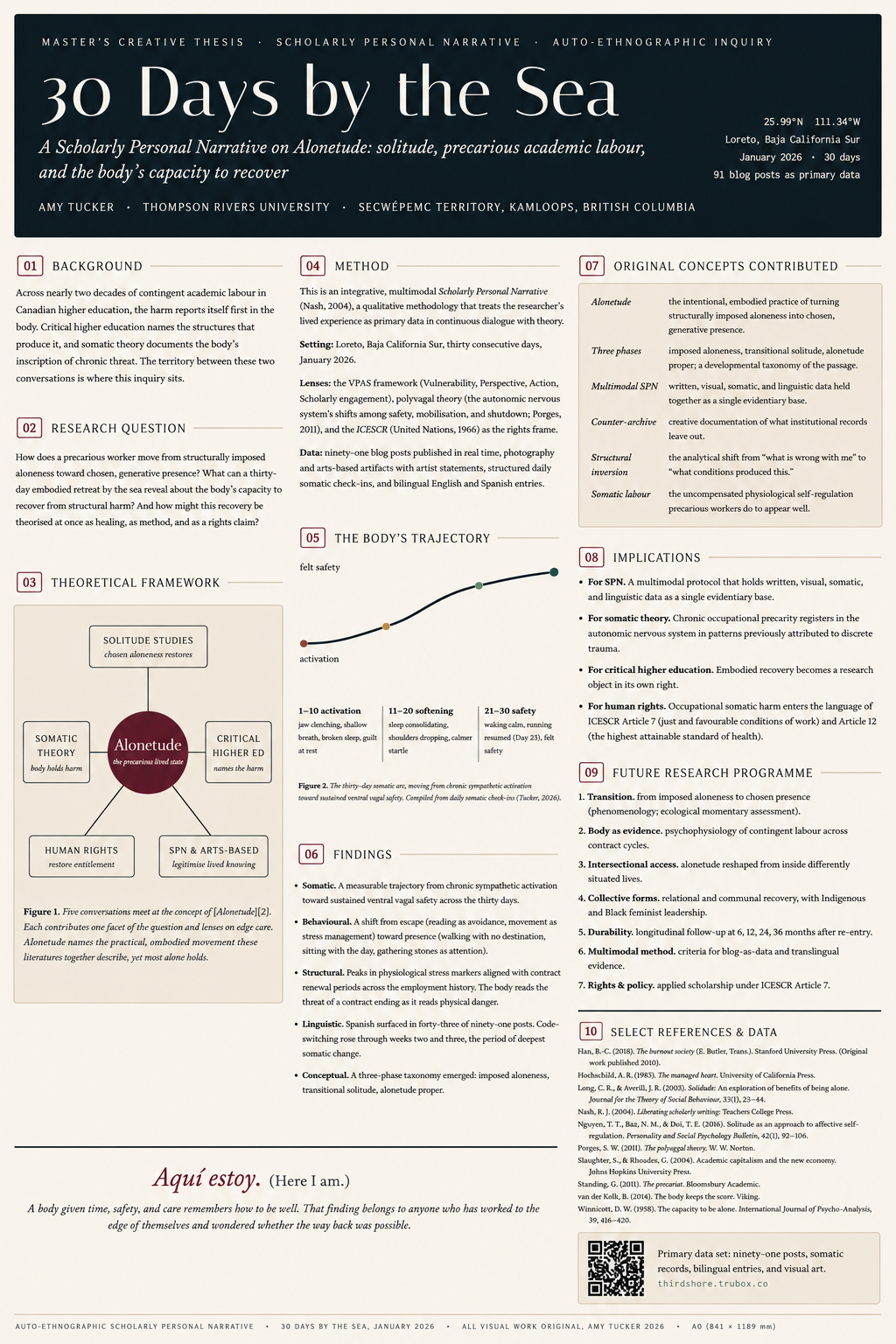
30 Days by the Sea is an integrative, multimodal Scholarly Personal Narrative (Nash, 2004) on Alonetude: solitude, precarious academic labour, and the body’s capacity to recover. The inquiry took place over thirty consecutive days in Loreto, Baja California Sur, in January 2026, with ninety-one blog posts published in real time as the primary data set, alongside photography and arts-based artifacts, structured daily somatic check-ins, and bilingual English and Spanish entries.
Research Question
How does a precarious worker move from structurally imposed aloneness toward chosen, generative presence? What can a thirty-day embodied retreat by the sea reveal about the body’s capacity to recover from structural harm? And how might this recovery be theorised at once as healing, as method, and as a rights claim?
Findings
Somatic. A measurable trajectory from chronic sympathetic activation toward sustained ventral vagal safety across the thirty days.
Behavioural. A shift from escape (reading as avoidance, movement as stress management) toward presence (walking with no destination, sitting with the day, gathering stones as attention).
Structural. Peaks in physiological stress markers aligned with contract renewal periods across the employment history. The body reads the threat of a contract ending as it reads physical danger.
Linguistic. Spanish surfaced in forty-three of ninety-one posts. Code-switching rose through weeks two and three, the period of deepest somatic change.
Conceptual. A three-phase taxonomy emerged: imposed aloneness, transitional solitude, and alonetude proper.
Original Concepts Contributed
Alonetude — the intentional, embodied practice of turning structurally imposed aloneness into chosen, generative presence.
Three phases — imposed aloneness, transitional solitude, alonetude proper; a developmental taxonomy of the passage.
Multimodal SPN — written, visual, somatic, and linguistic data held together as a single evidentiary base.
Counter-archive — creative documentation of what institutional records leave out.
Structural inversion — the analytical shift from “what is wrong with me” to “what conditions produced this.”
Somatic labour — the uncompensated physiological self-regulation precarious workers do to appear well.
Implications
For SPN. A multimodal protocol that holds written, visual, somatic, and linguistic data as a single evidentiary base.
For somatic theory. Chronic occupational precarity registers in the autonomic nervous system in patterns previously attributed to discrete trauma.
For critical higher education. Embodied recovery becomes a research object in its own right.
For human rights. Occupational somatic harm enters the language of ICESCR Article 7 (just and favourable conditions of work) and Article 12 (the highest attainable standard of health).
Aquí estoy. (Here I am.) A body given time, safety, and care remembers how to be well. That finding belongs to anyone who has worked to the edge of themselves and wondered whether the way back was possible.
Suggested commentary citation
Tucker, A. (2026). 30 Days by the Sea: A Scholarly Personal Narrative on Alonetude — solitude, precarious academic labour, and the body’s capacity to recover [Creative expression project, Master of Human Rights and Social Justice, Thompson Rivers University]. Defended May 26, 2026.

