Thirty Days in Loreto, Where I Remembered Myself
I want to tell you about the first morning.
Not the arrival, not the unpacking, not the practical business of a woman setting down her bags in a small room in a small town on the edge of the Sea of Cortez,
the first morning.
When she woke and lay still and realized that the first thing she felt was not the familiar tightening, not the immediate inventory of what was owed to the day, not the calculating of what needed to be performed before she could be a person again,
but something else.
Something so unfamiliar it took her several minutes to name it.
The morning.
Just the morning. Coming through the curtain. Landing on the wall. Belonging to no one. Requiring nothing.
She lay in it like it was water, and she had forgotten she knew how to float.
She had not meant it to be healing.
She had meant it to be research. She had the framework, the methodology, the ethical approval, the blog, the camera, and the scholarly vocabulary for what she was doing and why it mattered.
She was not running away. She was running toward. Toward the question. Toward the data. Toward the thing she needed to understand about rest and precarity and the body’s relationship to institutional time.
This is what she told herself.
But underneath the good answers was a woman who was so tired she had forgotten what she was tired of, who had been carrying the weight so long she had stopped noticing the weight and started noticing only that her hands hurt, that her back hurt, that something deep in the centre of her had gone very quiet in the way that things go quiet just before they stop.
She needed to find out if she still existed outside the performance of herself.
The sea was the first teacher.
She had not expected that. It did not care about her framework. It did not care about her research questions. It moved the way it moved on the schedule it kept since long before she had a contract to worry about, and it asked nothing of her except that she look at it,
which it turns out was everything.
She looked at it.
She sat on the shore in the early morning when the light was doing something she did not have words for, something that required the camera but also required her to put the camera down and simply be inside the moment rather than documenting it,
and she looked at the sea and the sea looked back with the absolute indifference of something ancient and enormous,
and she felt, for the first time in longer than she could name,
small in the right way.
Not small, the way the institution made her small. Small, the way you are small beside something majestic, small the way that reminds you that you are not responsible for holding everything up.
She sat in that smallness and felt something loosen in her chest.
Something that had been held for a very long time.
The days made their own rhythm.
She had not made a schedule. This was an act of rebellion so small it sounds trivial, but she had been living by the schedule for nineteen years,
and to wake up and let the day decide its own shape,
this was extraordinary.
She ate when she was hungry. This sounds so simple. She had not been hungry in years.
The body remembered. The body always remembered. It was the mind that had been convinced the body’s needs were negotiable.
She cried on the fourth day.
She had not understood that the crying she had done so far was the managed kind, the kind that releases the pressure without releasing the thing that is causing it.
On the fourth day, she sat on the shore in the late afternoon when the light was going gold and the pelicans were doing what pelicans do, that ancient, unbothered diving, that complete commitment to the one thing they are made for,
and something in her saw the pelicans and understood something she did not have words for yet,
and she cried the way she had needed to cry for a very long time.
Not for ten minutes. Not tidily. Not the kind that can be managed back into composure before anyone sees.
The real kind. The kind the body needed.
She cried until she was empty.
And then she sat in the empty and felt, underneath it,
something quiet and solid.
Herself.
She was still there. Under all of it, she was still there.
On the last morning, she went to the shore before the light fully arrived.
She sat with what she was taking back.
She was taking back the knowledge that her body existed outside of its usefulness.
She was taking back the memory of a morning that required nothing.
She was taking back the crying that had emptied her and what she had found in the emptiness.
She stood up.
She brushed the sand from her hands.
She looked at the sea one more time, the sea that had asked nothing of her and given her back herself,
and she said, quietly, in the language that carries the most truth when she speaks it,
Gracias.
Thank you for the thirty days. Thank you for the shore. Thank you for the morning that required nothing.
Thank you for showing me that I am still here, that I was always here, underneath the performance, underneath the fine, underneath the nineteen years of contracts and committees and raised bars,
I was always right here.
Aquí estoy. La orilla me devolvió a mí misma. Y me traje a casa.
Here I am. The shore gave me back to myself. And I brought myself home.
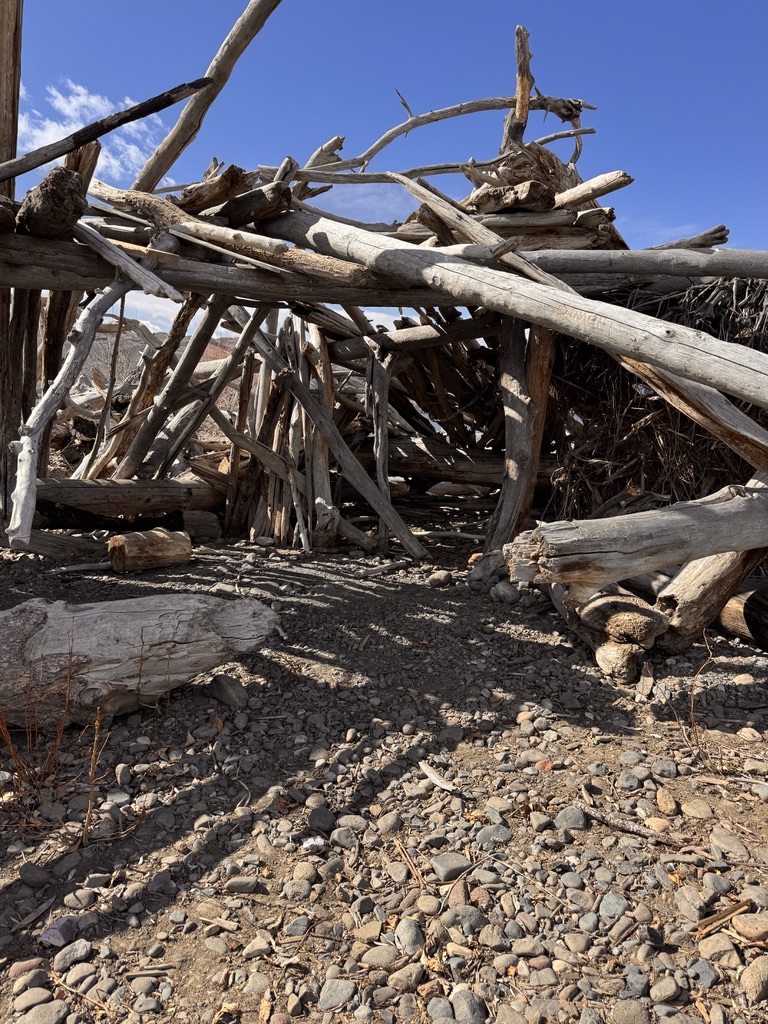
What the Shore Builds from What It Has Been Given
Photo: Amy Tucker, © 2026
Artist Statement: Driftwood reassembled into shelter on the shore at Loreto, by hands I did not see.
Translation Note: Spanish phrases in this poem were assisted by Google Translate (translate.google.com). The Spanish is woven in as an act of reclamation, a return to a language of the body and the self that exists beyond institutional English.

