A Scholarly Personal Narrative of Alonetude, Embodiment, and the Human Right to Rest
I have learned that precarious labour exhausts the mind while also settling into the body as a long, slow violation of the human right to rest.
Keywords: alonetude, scholarly personal narrative, precarious labour, embodiment, human right to rest, somatic inquiry, Sea of Cortez, Loreto Mexico, arts-based research, thirty days
Arriving
The letter arrived by email. After seventeen years, that is how it ended. Just a number on a spreadsheet.
I am writing this from Loreto, México, a small town on the western shore of the Sea of Cortez. I arrived here with one orange suitcase, a camera, a notebook, and no promise of output. For the next thirty days, I will live alone in a casita surrounded by date palms and cactus. I am conducting a research inquiry that begins where I believe all honest inquiry must begin: in the body.
This is my body. It is tired. It is sixty years old. It has carried seventeen years of semester-to-semester contracts, ten courses (plus) per year, graduate studies completed while teaching full-time, and the persistent institutional fiction that maybe next semester would finally bring security. The promise remained unfulfilled.
On April 30, 2025, my contract ended. The letter arrived by email. After seventeen years, that is how it ended. Just a number on a spreadsheet.
I am here because I need to understand what happened to me. I am also here because I believe what happened to me is happening to thousands of other contract faculty across Canada and beyond. My exhaustion is personal, yes. But it is also structural. It is political. It is, I have come to believe, a human rights concern.
Before I left, I photographed the moment of gathering. This was the beginning.
I am conducting a research inquiry that begins where I believe all honest inquiry must begin: in the body.
Title: Travel Awaits
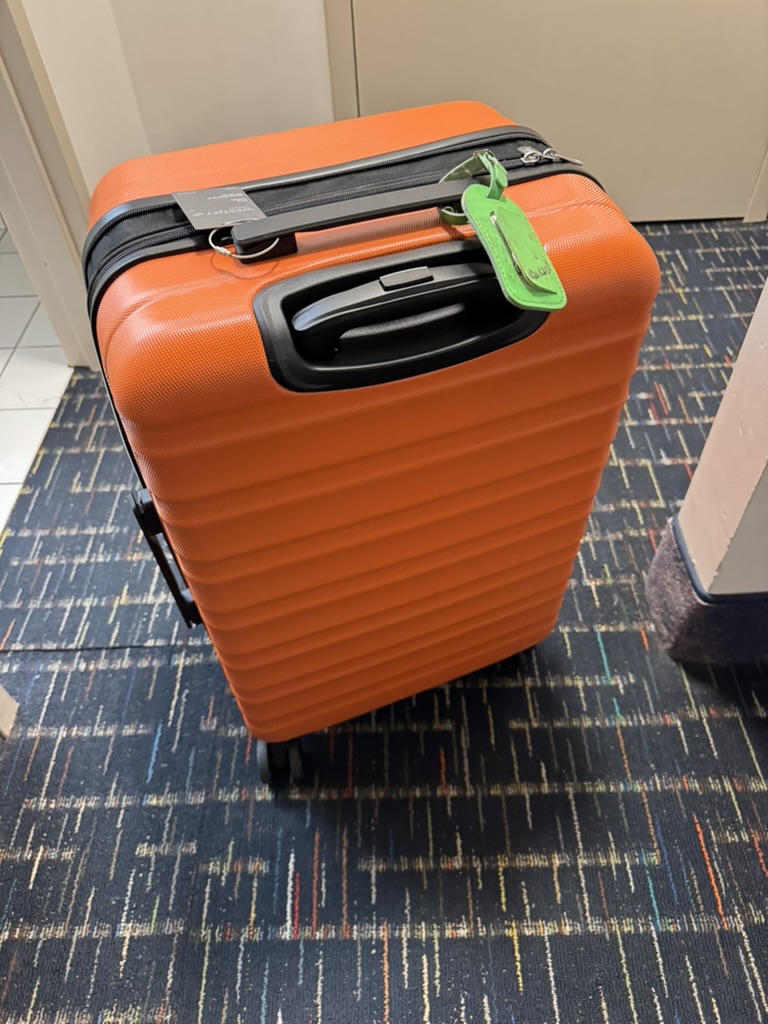
Artist Statement

This photograph shows packing as an impressionistic still life, where colour, texture, and accumulation gesture toward a life in motion. The bright orange of the suitcase and backpack punctuates a field of muted fabrics and paper, suggesting urgency held within containment. Books, journals, and folded garments spill outward, creating a layered composition that blurs the boundaries between intellect and embodiment, thought and movement.

The scene is intentionally unresolved, echoing the unfinished quality of departure and the emotional ambiguity of leaving. Packing here is less about order than about gesture: a gathering of fragments, identities, and intentions into a provisional form. The image holds a quiet tension between weight and lightness, burden and possibility, capturing the liminal moment before travel when objects become proxies for memory, desire, and the hope of becoming otherwise.

Photo Credit: Amy Tucker, January 2026
This project is part of my Master of Arts in Creative Expression, Human Rights and Social Justice at Thompson Rivers University in Kamloops, British Columbia, Canada. It is also something more than an academic requirement. It is an attempt to take my body back from systems that treated my endurance as an inexhaustible resource and my personhood as contingent on productivity.
…an attempt to take my body back from systems that treated my endurance as an inexhaustible resource
What I will find here remains open. That uncertainty is part of the methodology. I am here to pay attention, to document what emerges, and to trust that care, silence, and presence are forms of knowledge. I am hoping to heal and find my peace.
That uncertainty is part of the methodology.
What Is This Project?
I am exploring something I call alonetude. This word refers to a state that lies between being alone, experiencing loneliness, and cultivating solitude. Let me explain what I mean by each of these terms, because the distinctions matter. It is a term I thought about during the COVID-19 era.
Loneliness is the pain of unwanted isolation. It is the ache of unwanted aloneness, the sense that connection is missing, and the hurt that absence causes. Theologian Paul Tillich (1963) wrote that “loneliness expresses the pain of being alone” (p. 17). Loneliness arrives without our consent.
Solitude, by contrast, is chosen aloneness. Tillich (1963) continued: “solitude expresses the glory of being alone” (p. 17). Solitude is what we experience when we step away from the world willingly, when we seek quiet and find peace in it. Solitude is restorative. It is a gift we give ourselves.
But what about the space between? What do we call it when isolation is imposed by circumstance, by structural conditions, by the exhaustion that follows years of precarious labour, and yet we choose to make something meaningful from that aloneness? This is what I am calling alonetude: the agentic labour of transforming imposed isolation into chosen presence.
Let me unpack those terms. Agentic means having agency, which is the capacity to act and make choices even within constraints. Labour here means effort, work, the energy required to create meaning. Alonetude requires practice, learning, and cultivation. This blog documents that practice.
Title: What I Choose to Carry
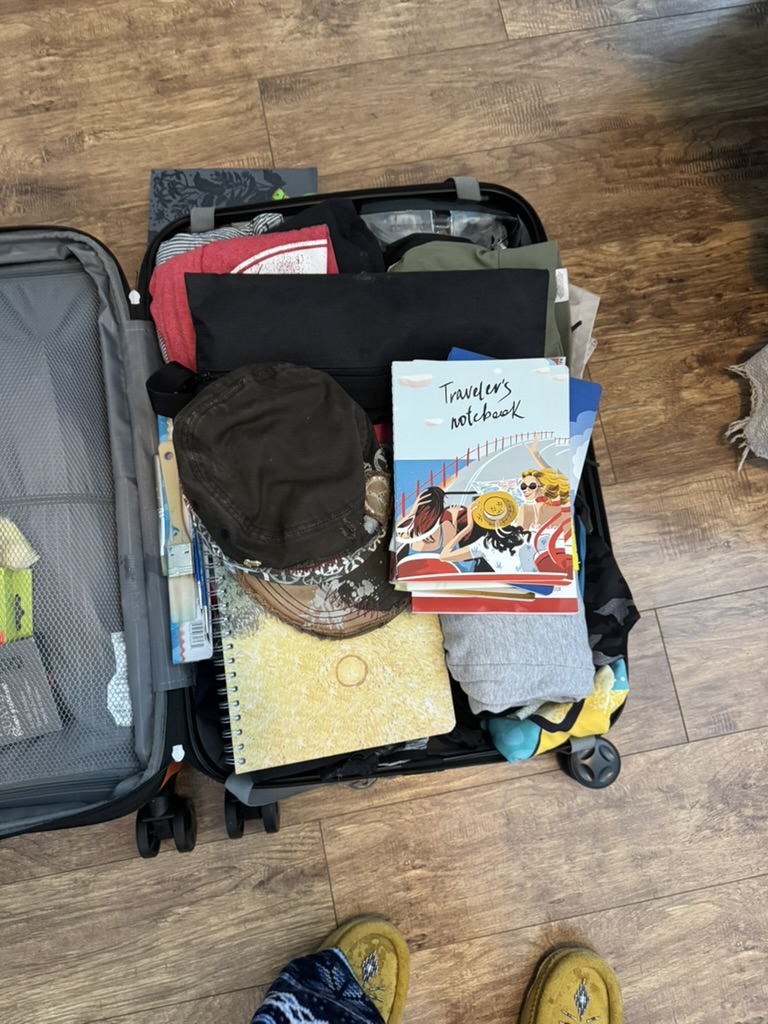
Artist Statement

I stood over an open case on the floor before closing it. Efficiency and fit were the furthest things from my mind. I was thinking about what belonged.

Each item had a reason for being there. Clothes wrapped around notebooks, pens, and small tools for making and noticing. The traveller’s notebook stayed near the top where I could reach it easily. Writing was never meant to sit at the bottom of the bag. A hat rested beside it, practical and grounding, a reminder that sun, heat, and care for myself were part of this journey too.

Nothing here was packed out of aspiration. I was preparing to stay close to who I already am. I was preparing to stay close to myself.

Within the Alonetude project, this moment marked a shift in how I understood preparation. Packing was no longer about productivity or planning outcomes. It became an act of discernment. I chose what would support attention, rest, and reflection, and left behind what carried urgency or performance.

Intentional solitude begins long before arrival. It begins in these quiet decisions, made without audience or expectation. What I carried was about return. It was about protection, about creating the conditions where I could finally slow down and listen.

Photo Credit: Amy Tucker, January 2026
Why This Matters: The Human Right to Rest
I want to be clear about something from the beginning: I am framing this project as a human rights inquiry. This is deliberate. This is political.
Article 24 of the Universal Declaration of Human Rights (United Nations, 1948) states: “Everyone has the right to rest and leisure, including reasonable limitation of working hours and periodic holidays with pay.” Article 25 establishes the right to health. The International Covenant on Economic, Social, and Cultural Rights (United Nations, 1966) elaborates these protections, recognising in Article 7 the right to “rest, leisure and reasonable limitation of working hours.”
These are rights. They are supposed to belong to everyone.
But here is what I have learned from seventeen years of contract academic work: these rights are systematically denied to precarious workers. I have never had a paid sabbatical. I have never had job security. I have worked through illness, through grief, through exhaustion, because stopping meant losing income, losing courses, losing the fragile toehold I had in an institution that never quite made room for me.
The body remembers what institutions deny, carrying years of survival in breath, muscle, and nervous system.
When I say that precarious labour settles into the body as a long, slow violation of the human right, I mean this literally. My body carries the evidence. The jaw that clenches. The shoulders that rise toward my ears when I open an institutional email. The breath that shallows in the presence of authority. The startle response, which is activated by unexpected sounds.
These are symptoms of chronic stress. Psychiatrist Bessel van der Kolk (2014), in his book The Body Keeps the Score, established that traumatic experiences are stored in the body itself. Trauma, in this context, refers to experiences that overwhelm our capacity to cope, leaving lasting imprints on our nervous systems. Trauma survivors carry their histories in patterns of muscular tension, in the ways their nervous systems respond to perceived threat, in physical sensations that persist long after the original events have passed. van der Kolk (2014) argues that the body keeps the score; it remembers what the conscious mind may have forgotten or suppressed.
I believe precarious labour is a form of chronic trauma. I believe my body has been keeping score for seventeen years. This project is my attempt to read that score, to understand what it says, and to begin the slow work of recovery. Situating this narrative within critical scholarship on institutional violence and trauma, I approach precarity as both a structural condition and an embodied experience. Research on trauma-informed theory suggests that prolonged exposure to insecurity, hyper-surveillance, and power asymmetries can produce cumulative psychological and physiological effects that become embedded in the body (Herman, 1992; van der Kolk, 2014).
Within higher education, neoliberal governance structures (institutional arrangements that prioritise market efficiency and cost reduction over human welfare and labour security) and contingent employment regimes can operate as forms of institutional violence, shaping subjectivity, health, and identity through chronic uncertainty and disposability (Ahmed, 2012; Slaughter & Rhoades, 2004). By reading my embodied experiences as data, this study frames recovery as both a personal and political act, connecting bodily memory to broader systems of structural harm and ethical responsibility.
The Methods I Am Using
This project integrates three research methodologies. I want to explain each one clearly, because understanding the methods will help you understand what you are reading in this blog.
Scholarly Personal Narrative
Scholarly Personal Narrative is a methodology developed by education scholar Robert Nash (2004). Nash argued that lived experience is legitimate scholarly data. He believed that when we examine our own lives with rigour, honesty, and theoretical grounding, we generate knowledge that matters.
This differs from traditional academic research, which often asks researchers to stand outside the phenomenon under study, observe from a distance, and remain objective. Scholarly Personal Narrative says: your life is the text. Your experience is the data. Your body, your memories, your struggles, and your questions are valid sources of knowledge.
Nash (2004) identified four elements that make scholarly personal narrative effective. I think of these as the VPAS framework:
Table 1
The VPAS Framework for Scholarly Personal Narrative
| Element | What It Means |
|---|---|
| Vulnerability | The writer takes genuine personal risks by sharing experiences that are difficult, uncertain, or unresolved. The writer refuses to perform mastery or pretend to have all the answers. |
| Perspective | The personal story is connected to larger patterns. Individual experience is situated within theoretical frameworks that help readers understand how one person’s story connects to collective realities. |
| Action | The narrative shows movement or change. Something shifts. Something is learned. Something remains unresolved but is honestly acknowledged. The writer reflects critically and then acts on what has been learned. |
| Scholarly Engagement | The personal story is woven together with relevant research, theory, and critical analysis. Lived experience and academic discourse become conversation partners. |
Note. Adapted from Liberating Scholarly Writing: The Power of Personal Narrative (pp. 25–35), by R. J. Nash, 2004, Teachers College Press.
Throughout this blog, I write from a place of vulnerability. I share what is hard. I situate my experience within theoretical frameworks drawn from trauma studies, human rights scholarship, and organizational behaviour. I attend to what shifts. And I engage with scholarly literature to better understand my own life.
Title: Notes for Moving Slowly
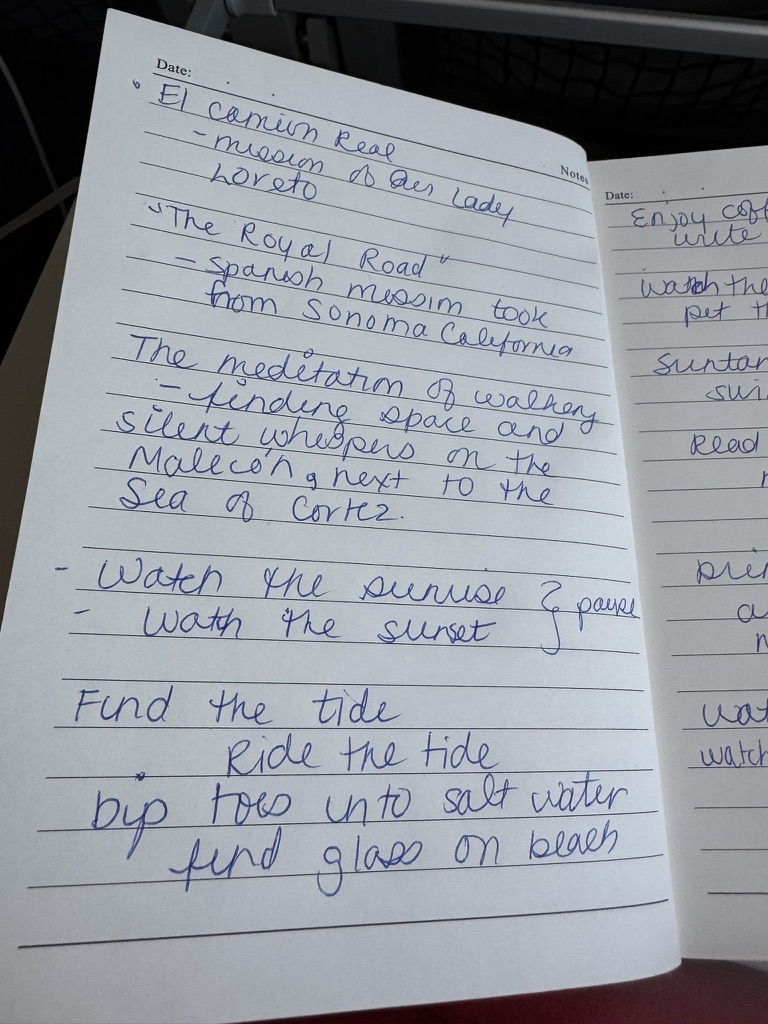
Artist Statement

I took this photograph mid-flight, while the journey was already underway but before arrival. The notebook is open to a page of handwritten intentions, written without polish or certainty. These are reminders rather than goals. The handwriting is uneven, the list unfinished, the language practical and spare. What mattered was orientation rather than precision.

The notes move between history, place, and practice. El Camino Real. The Royal Road. Loreto named as lineage rather than destination, shaped by movement, translation, and layered meaning. Walking appears here as meditation rather than exercise. The Malecón beside the Sea of Cortez becomes a site of attention rather than achievement. Watching the sunrise and sunset is written as practice rather than pastime.

Within the Alonetude inquiry, this page documents intention-setting as an embodied, ethical act. I was planning permission rather than productivity. Each line gestures toward slowing down enough to notice tides, temperature, light, and sound. The repetition of watching, finding, riding, dipping signals a desire to follow rather than control. Nothing here is extractive. Nothing demands outcome.

This image matters because it captures the moment when the inquiry was still forming, before theory, before articulation, before interpretation. It shows learning in its earliest state, when it exists as attention rather than argument. The notebook holds the trace of a commitment made quietly: to move through this time with care, to let place lead, and to trust that presence itself would be sufficient.

Photo Credit: Amy Tucker, January 2026
Photovoice
Photovoice is a participatory visual research methodology developed by Caroline Wang and Mary Ann Burris (1997). The method positions participants as expert witnesses of their own lives. It recognises that photographs can document realities that words alone cannot capture.
Wang and Burris (1997) designed Photovoice for community-based health research. The idea was simple but powerful: give cameras to people affected by an issue, ask them to photograph their experiences, and use those photographs as a basis for critical reflection and dialogue.
In this project, I adapt Photovoice for solo inquiry. I am both a researcher and a participant. I use photography to document my experience of alonetude, recovery, and embodied knowing. Each image in this blog is accompanied by an artist statement, a critical reflection that explains what I noticed when I took the photograph, what I felt, and how the image connects to the theoretical frameworks guiding this inquiry.
The photographs are primary data. This means they are evidence, just as interview transcripts or survey responses would be in other research methodologies. For example, a photograph of running shoes on volcanic sand is data about what the body carries. A photograph of the sea at dusk is data about the environment that holds this inquiry.
Title: Passing Through the Arc of Loretto
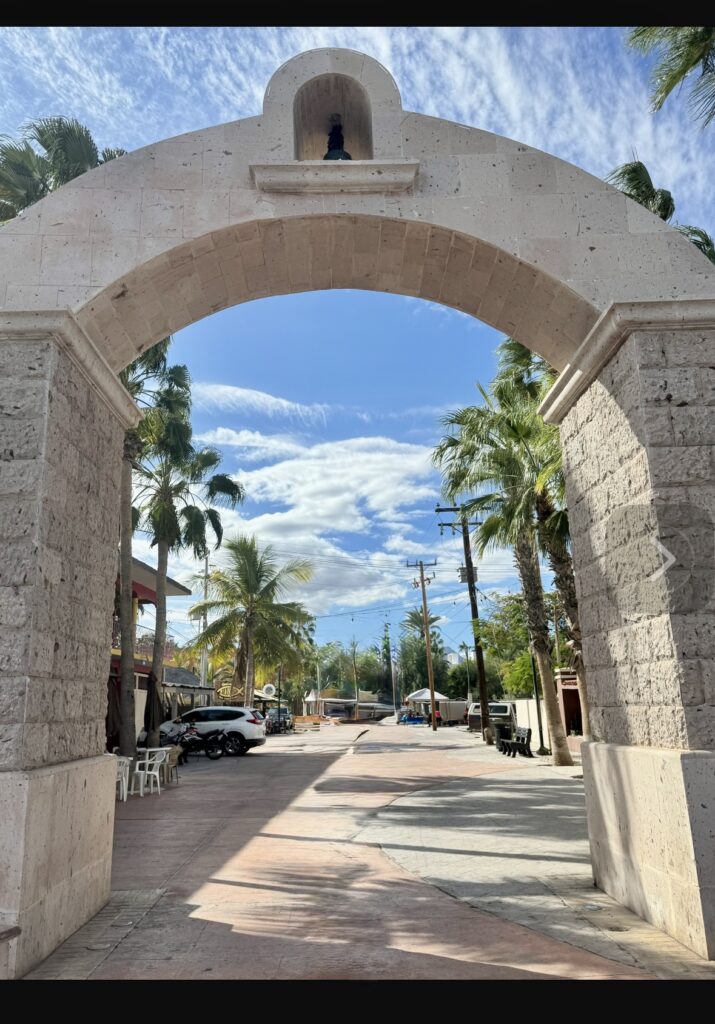
Artist Statement

I took this photograph while walking beneath the stone arch that marks entry into Loreto’s historic centre. I paused long enough to notice the geometry of the structure, how it frames the street beyond without dictating what happens next. The arch witnesses movement rather than stopping it.

What drew me was the sensation of crossing rather than the architecture itself. Behind me was arrival, logistics, orientation. Ahead of me was daily life unfolding at an unhurried pace. Palm shadows stretched across the ground, light pooled unevenly, and the street opened rather than narrowed. There was no instruction here, only passage.

Within the Alonetude inquiry, this image documents a transition from arrival into inhabitation. Thresholds matter. They mark change without spectacle. This arch simply allows transformation rather than announcing it. Passing beneath it, I was neither tourist nor resident, neither working nor resting, neither finished nor beginning. I was in between.

This photograph matters because it captures the moment when attention shifts outward again, after the inward work of preparation. It shows that entry is a process rather than a single event. One crosses in stages. One crosses, pauses, looks up, and continues.

The arch frames a choice rather than a destination. It holds space for movement without urgency, for presence without demand. In this way, it mirrors the practice of alonetude itself: a way of moving through the world that honours thresholds, resists acceleration, and allows meaning to emerge at walking speed.


Photo Credit: Amy Tucker, January 2026
Arts-Based Research
Arts-based research, often abbreviated as ABR, is a methodology that positions creative practice as a legitimate way of generating knowledge. Scholar Patricia Leavy (2022, 2015) has been instrumental in establishing this field. Leavy argues that human experience has dimensions that traditional research methods cannot access: the aesthetic, the emotional, the sensory, the embodied. Art can reach these dimensions.
Throughout this project, I work with multiple creative forms: photography, watercolour painting, found object collection, and drawing. These are ways of knowing. A painted stone holds memory differently than a written paragraph. A poem says what prose cannot. Art is inquiry.
Leavy (2022) identifies several things that arts-based research does particularly well:
- It explores emotional and embodied dimensions of experience
- It makes visible what has been hidden or overlooked
- It creates work that can reach diverse audiences
- It challenges dominant assumptions about what counts as knowledge
- It fosters empathy and understanding
I chose arts-based methods for this project because my inquiry is fundamentally embodied. I am studying what my body carries, how it responds to rest, and what happens when exhaustion is finally given permission to surface. Words alone cannot capture this. I need images, colours, textures, the weight of a stone in my palm.
Title: What the Water Holds
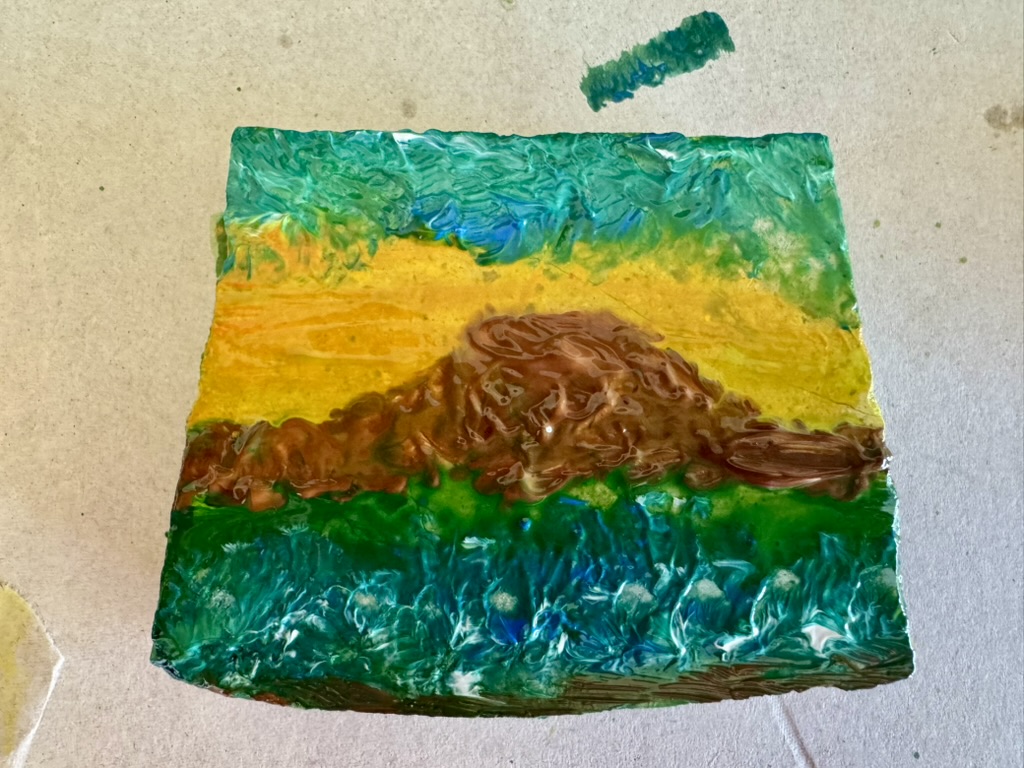
Artist Statement

I made this piece slowly, allowing the material to move before I decided what it was becoming. The surface carries bands of colour that echo the geography I have been walking through: sea, shore, land, and return. Turquoise presses against yellow. Brown settles unevenly in the centre, neither fixed nor fully dissolved. Nothing here is cleanly separated. Each layer bleeds into the next.

What mattered was responsiveness rather than control. I followed the way the medium resisted and yielded, noticing where it thickened, where it thinned, where it pooled. The raised textures record time spent waiting rather than correcting. This was an attempt to stay with sensation rather than capture a landscape. It was an attempt to stay with sensation long enough for something to surface.

Within the Alonetude inquiry, this work documents learning through making. The colours correspond to place, but the process corresponds to attention. I was working without urgency, without a desired outcome, letting the piece find its own balance. The central form emerged gradually, shaped by gravity and flow rather than intention. It resembles land only because land was present in my thinking. The resemblance arrived without plan.

This piece matters because it holds a record of slowing down enough to trust process. It shows how meaning can arise when effort is reduced and listening is extended. The material carries traces of patience, of allowing, of staying present through uncertainty. In this way, the work mirrors the practice of alonetude itself: remaining with what is unfolding rather than forcing resolution.


Photo Credit: Amy Tucker, January 2026
The Paradigm I Work From
Before I go further, I want to explain the worldview that shapes this entire project. In research, we call this a paradigm. A paradigm is the lens through which a researcher sees and understands the world. It includes our beliefs about what is real, what counts as knowledge, and how we can come to know things. Every researcher works from a paradigm, consciously or otherwise (Guba, 1990). I want to name mine.
I work from what scholars call a critical transformative paradigm. Let me explain what this means, because the words matter.
My Ontology: Reality Is Constructed and Multiple
My exhaustion is personal, yes. But it is also structural. It is political.
I believe that reality, particularly social reality, is constructed through human experience, language, and relationships. This holds that reality is constructed and still real. The sea outside my window is real. My exhaustion is real. The termination letter I received in May 2025 was real. But the meaning of these things is constructed. It is made through interpretation, through the stories we tell, through the frameworks we use to understand our experiences.
This view is called constructivism or social constructionism. Sociologists Peter Berger and Thomas Luckmann (2016) argued in their influential book The Social Construction of Reality that human beings create the social world through their interactions, and then experience that created world as if it were an objective, external reality. We forget that we made it. We treat institutions, categories, and social arrangements as natural and inevitable when they are, in fact, human creations that could be otherwise.
I also believe that reality is multiple. People situated in different social locations experience different realities. My reality as a sixty-year-old white woman who has spent seventeen years in precarious academic labour is different from the reality of my tenured colleagues. It is different from the reality of the international students I have taught. It is different from the reality of the administrators who decided to terminate my contract. These are, in important ways, different realities altogether. They are, in important ways, different realities shaped by different positions within power structures.
Feminist philosopher Donna Haraway (1988) called this situated knowledge. All knowledge, Haraway argued, comes from somewhere. It is produced by specific bodies in specific locations with specific histories. All knowledge comes from somewhere. It is produced by specific bodies in specific locations with specific histories. Every claim is situated. Recognising this makes knowledge more honest.
My Epistemology: Knowledge Is Embodied, Relational, and Political
I believe that knowledge lives beyond what can be measured, counted, or observed from a distance. Knowledge also lives in the body. It emerges through relationships. It is shaped by power.
Embodied knowledge is knowledge that we hold in our bodies, often without conscious awareness. It is the knowledge my shoulders carry when they rise toward my ears at the sound of an institutional email notification. It is the knowledge my breath holds when it shallows in the presence of authority. Philosopher Maurice Merleau-Ponty (1962) argued that we know the world first through our bodies, through perception, movement, and sensation. The body is a site of knowing as much as any vehicle for the mind.
This project takes embodied knowledge seriously. When I attend to what my body carries, I am practicing a form of inquiry that recognises the body as a legitimate source of evidence.
Relational knowledge is knowledge that emerges through connection with others, with place, with more-than-human beings. Indigenous scholars have long emphasised that knowledge is relational rather than individual (Wilson, 2008). We know through relationships rather than in isolation. In this project, the sea, the stones, the date palms, and the light are participants in the inquiry. They teach me things I would never learn on my own.
Political knowledge recognises that knowledge production is never neutral. What counts as knowledge, who gets to produce it, whose knowledge is valued and whose is dismissed: these are questions of power. Philosopher Michel Foucault (1980) demonstrated that knowledge and power are deeply intertwined. Those with power shape what counts as truth. Those without power often find their knowledge marginalised, dismissed, or erased.
I approach this project knowing that my embodied experience of precarious labour went uncounted as knowledge within the institution that employed me. My exhaustion was treated as a personal problem rather than as evidence of structural violence. This project insists that my experience is evidence. It is data. It matters.
Title: Measures
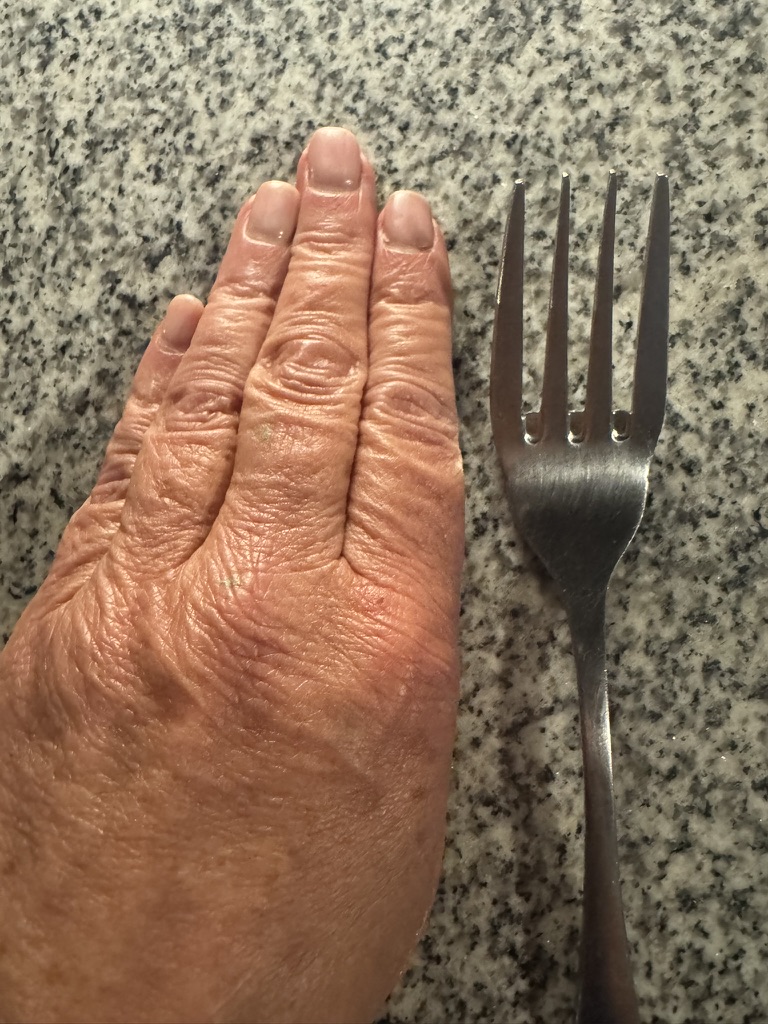
Artist Statement

I took this photograph without arranging anything. My hand rested on the counter beside a fork, both placed as they were in the ordinary flow of a day. What caught my attention was proportion. The familiar scale of the utensil, something designed to be neutral and standardised, sat beside a hand that carries time, labour, and history.

The surface of the skin is marked by use. Lines deepen where grip has been repeated, where work has been done without pause. This image is about accumulation rather than decline. It is an image about accumulation. The hand holds evidence of years spent teaching, writing, preparing, carrying, and adapting. It holds memory without narrative, experience without explanation.

Within the Alonetude inquiry, this photograph documents how comparison quietly enters daily life. The fork offers an external measure. The hand resists it. Standardization fails here. There is no neutral scale for what has been carried or endured. The image interrupts the assumption that labour leaves only abstract traces. That belief is false. It leaves marks.

This photograph matters because it refuses abstraction. It insists on proximity. It brings the inquiry back to the material reality of lived experience, where systems register in policies and contracts and also in flesh, texture, and scale. What appears ordinary becomes evidentiary. What is usually overlooked becomes legible.

Photo Credit: Amy Tucker, January 2026
Positionality
I write this as a white, settler, cisgender woman of middle age, shaped by twenty-five years of precarious contract work in post-secondary education on Secwépemc Territory in what is now called British Columbia, Canada. I am a student in the Master of Arts in Human Rights and Social Justice programme at Thompson Rivers University. I carry the specific exhaustion of someone whose labour has been consistently undervalued within institutional structures that depend on that labour to function, and I carry the specific privilege of someone who was able to choose, even briefly, to stop. My inquiry into alonetude is simultaneously a scholarly undertaking and an embodied necessity. I cannot separate my research questions from my lived conditions, and I do not try to. In the tradition of Scholarly Personal Narrative (Nash, 2004), my subjectivity is data. My body is a site of knowledge. My experience of precarity, rest, and recovery is the very ground this inquiry stands on.
My Methodology: Critical, Creative, and Transformative
A critical approach to research begins from the recognition that society is structured by unequal power relations. Critical researchers acknowledge rather than pretend to be neutral observers. They take sides. They align themselves with those who have been marginalised, exploited, or harmed by existing arrangements. Critical research aims to understand the world and to change it.
Brazilian educator Paulo Freire (1970), in his foundational work Pedagogy of the Oppressed, argued that research and education should be acts of liberation. Freire rejected what he called the “banking model” of education, where knowledge is deposited into passive recipients by authoritative experts. Instead, he advocated for praxis: the integration of critical reflection and transformative action. We reflect on the conditions of our lives, and then we act to change them.
This project is an act of praxis. I am reflecting critically on the conditions that produced my burnout. I am documenting those conditions as evidence. And I am acting, in the modest way available to me, by refusing to be silent about what was done to me and to thousands of other contract faculty.
A creative approach to research recognises that artistic practice generates knowledge that other methods cannot access. Arts-based researchers such as Patricia Leavy (2015) have demonstrated that creative expression, including photography, painting, poetry, and narrative writing, can illuminate dimensions of human experience that statistical analysis and propositional argumentation miss. Creativity is a way of knowing, beyond mere decoration added to research.
A transformative approach to research is explicitly oriented toward social change. Transformative researchers work in solidarity with communities affected by injustice. They aim to produce knowledge that serves liberation rather than domination. Donna Mertens (2008) developed the transformative paradigm as a research framework that centres the experiences of marginalised groups and challenges oppressive structures.
I situate my work within this transformative tradition. I conduct this research from inside precarious academic labour, without the safety of distance. I am a precarious academic worker conducting research from within my own experience. I am living burnout rather than studying it as an abstract phenomenon, documenting it, and refusing to let it be individualised as my personal failure.
Title: Between Here and There
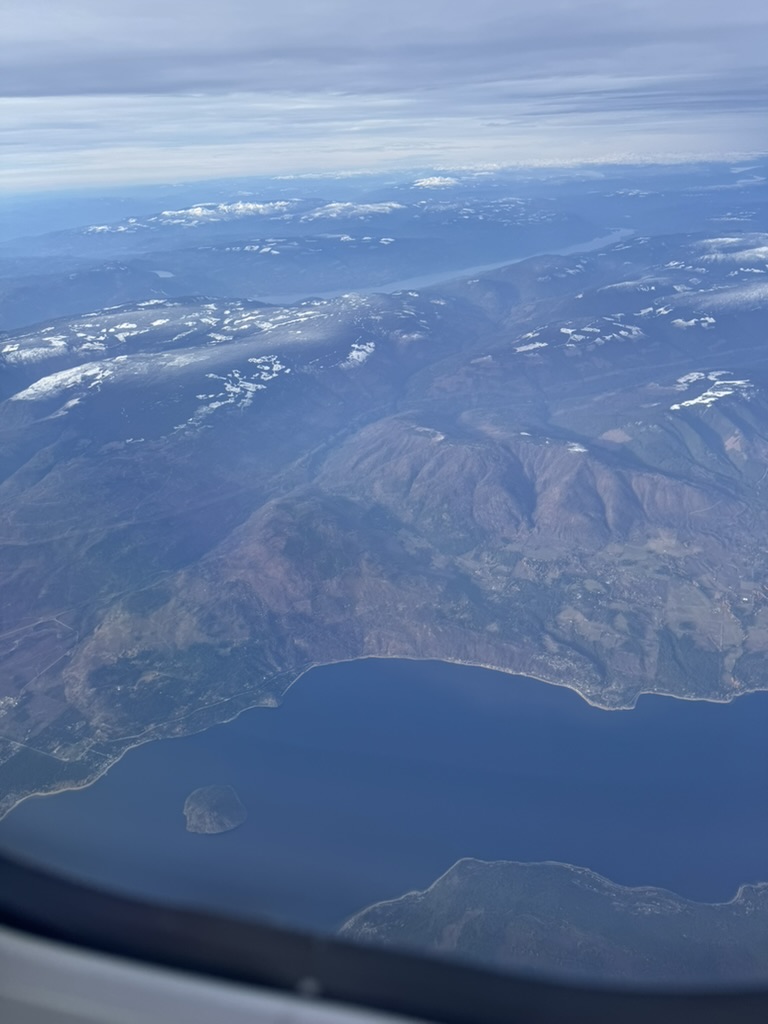
Artist Statement

Somewhere between departure and arrival, I found myself watching the land recede beneath me. Mountains folded into water. Shorelines curved without urgency. From this height, the structures that had organised my pace disappeared.

Flight created a suspended space where expectation loosened. I was no longer inside the systems that had shaped my days. The rhythm I was seeking lay still ahead. I was simply in transit.

Distance rearranged the weight of experience without erasing it. Perspective widened. Breath slowed. The moment held release without resolution, movement without demand.


Photo Credit: Amy Tucker, February 2026
Why Paradigm Matters
I have taken the time to explain my paradigm so you understand what you are reading on this blog. This is a situated, embodied, and political inquiry conducted by someone who has skin in the game.
Some readers may find this uncomfortable. Traditional academic norms suggest that good research is neutral, dispassionate, and objective. I reject this suggestion. I believe that the pretence of neutrality often serves to protect existing power arrangements. When researchers claim to be objective, they are often simply hiding their assumptions, making it harder for readers to evaluate their claims.
I stand in plain sight. I am telling you exactly where I stand. I stand with precarious workers. I stand with those whose labour has been extracted and whose personhood has been dismissed. I stand with those who carry structural violence in their bodies and have been told that their exhaustion is their own fault.
This is the paradigm I work from. It shapes every word I write in this blog.
I conduct this research from inside precarious academic labour, without the safety of distance. I am a precarious academic worker conducting research from within my own experience.
The Theories That Guide Me
Several theoretical frameworks inform this project. I want to introduce them briefly here, because you will encounter them throughout the blog.
The Body Keeps the Score
I have already mentioned Bessel van der Kolk’s (2014) work. His central insight is that trauma is stored in the body. When we experience overwhelming stress, our bodies record it in ways that persist long after the event has ended. Survivors of trauma often carry their histories in chronic pain, in patterns of tension, in nervous system responses that remain activated even in the absence of present danger.
This framework helps me understand my own exhaustion. Seventeen years of precarity have left marks on my body. My jaw. My shoulders. My breath. These are records of what I have endured. This project attends to those records.
Title: What Remains
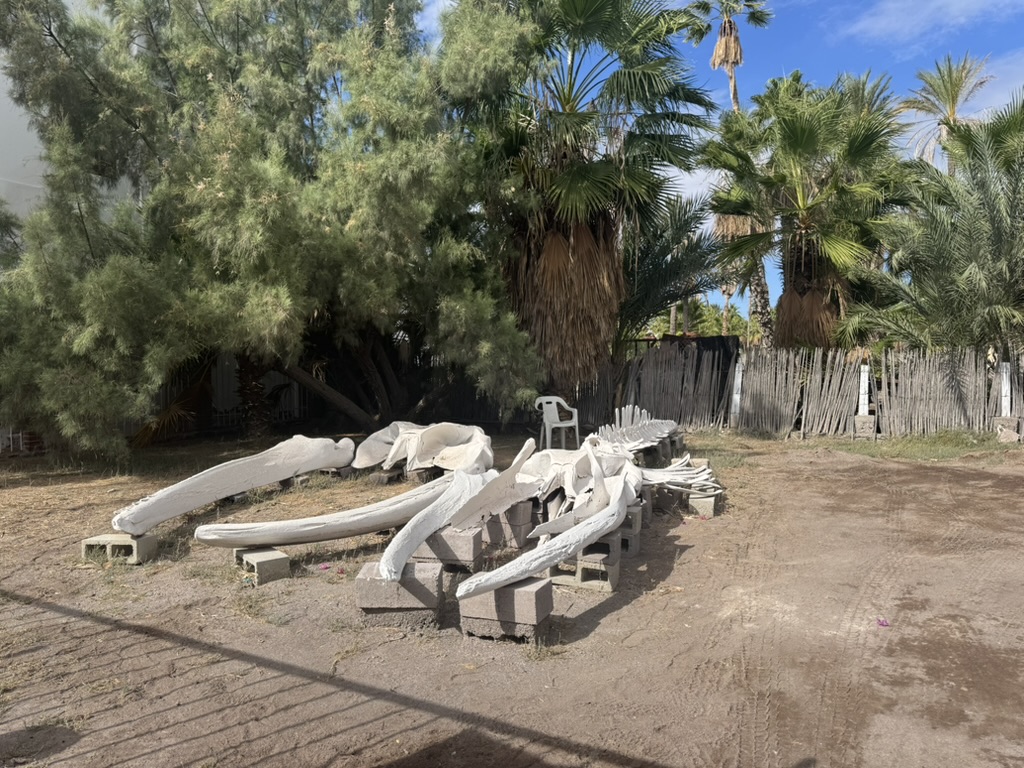
Artist Statement

I came across these bones laid out in the open, bleached by light and time. There was no enclosure, no ceremony, only quiet exposure. They rested between palm trees and dust, held in place and visible.

I stood there longer than expected. The scale of them, the stillness, the fact of what endures after life has moved on. Nothing about the scene asked for interpretation. It asked only for witnessing.

Within the Alonetude inquiry, this moment brought me back to material truth. What is carried. What is worn down. What remains when motion stops. The sun does its work slowly. So does recovery.


Photo Credit: Amy Tucker, February 2026
Polyvagal Theory
Neuroscientist Stephen Porges (2011) developed polyvagal theory to explain how the autonomic nervous system responds to safety and threat. The autonomic nervous system is the part of our nervous system that operates without conscious control. It regulates heartbeat, breathing, digestion, and our responses to danger.
Porges (2011) emphasises that felt safety matters more than objective safety. Our nervous system responds to what it perceives, which may differ from what is actually present. A person can be objectively safe but remain physiologically activated if their nervous system continues to detect threat cues.
This insight is crucial for understanding recovery. Healing requires creating conditions where the nervous system can perceive safety. The environment matters. The pace matters. The absence of surveillance matters. So does the absence of demand. This blog documents my attempt to create those conditions.
Precarity and Academic Capitalism
Sociologist Guy Standing (2011) coined the term precariat to describe a growing class of workers characterised by chronic insecurity. Precarious workers lack stable employment, predictable income, and the protections that previous generations took for granted. They live in a state of permanent uncertainty.
Within universities, scholars Sheila Slaughter and Gary Rhoades (2004) documented the rise of what they call academic capitalism. Universities have increasingly adopted market logic, treating knowledge as a product to be sold and faculty as contingent labour to be hired and discarded according to fluctuations in enrolment.
Contract faculty now teach the majority of undergraduate courses in Canadian universities. We carry the teaching load while being denied the security, benefits, and recognition afforded to permanent faculty. We subsidise institutional flexibility with our own instability.
Philosopher Isabell Lorey (2015) argues that this precarity is deliberate. It is a mode of governance. Keeping workers insecure keeps them compliant, grateful, and willing to accept conditions they might otherwise refuse. Precarity disciplines. Philosopher Byung-Chul Han (2010/2015) describes this as a feature of achievement society: workers exhaust themselves through internalised demands, mistaking self-exploitation for personal ambition.
I situate my own experience within these frameworks. My burnout is personal, but it is also structural. My termination is individual, but it reflects systemic patterns. Understanding this helps me resist the temptation to blame myself for what was done to me.
The Third Shore: A Liminal Space
Title: Sea of Cortez
Artist Statement

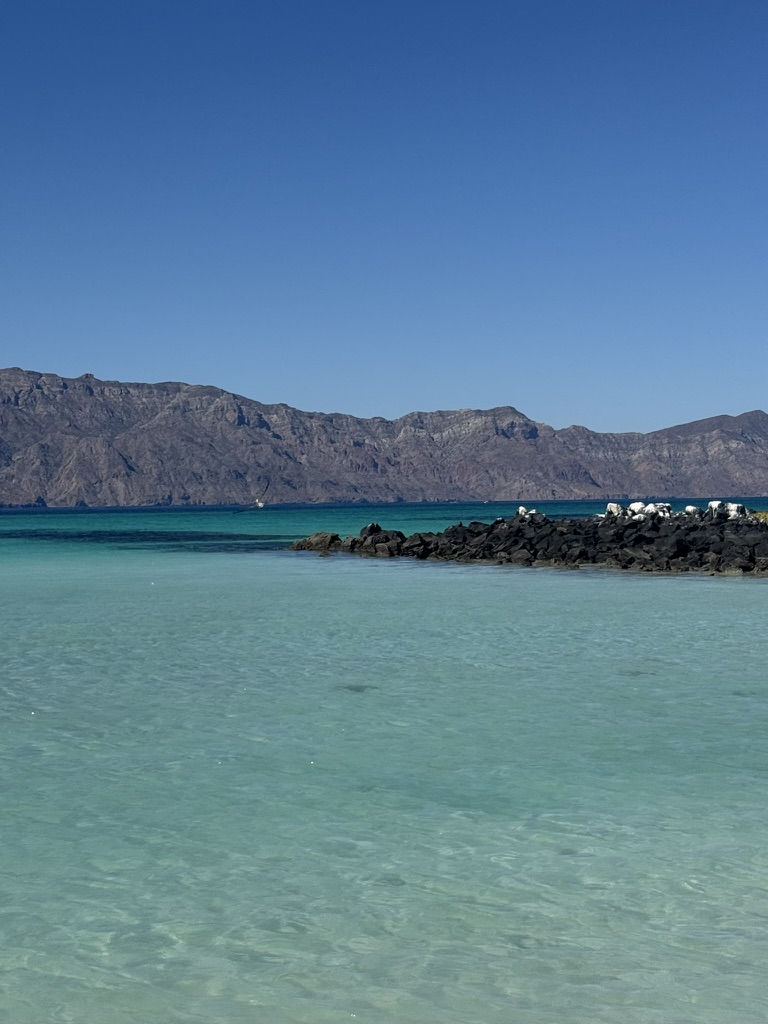
I photographed the sea on my first full day in Loreto. I was drawn to the quality of light, the way the water seemed to hold colour rather than simply reflect it. I was also aware of standing at a threshold. Behind me: the life I had been living. Before me: something still beyond my understanding. The word liminal comes from the Latin limen, meaning threshold. Anthropologist Victor Turner (1969) studied liminal states, the betwixt-and-between moments in rituals and life transitions when a person is no longer what they were and is still becoming what they will be. This sea represents the liminal space I am inhabiting. I am no longer the contract faculty member teaching ten courses per year. I am in the threshold, still becoming whatever comes next. Philosopher Gaston Bachelard (1964) described interior spaces as holding the imagination of those who inhabit them, places where memory and possibility are gathered together. This casita is becoming such a space for me. Environmental psychologist Roger Ulrich (1983) demonstrated that visual exposure to water and natural environments reduces stress and supports psychological restoration. The sea is participant in this inquiry. It is co-researcher.

Photo Credit: Amy Tucker, January 2026
The title of this project, The Third Shore, references this liminality. If one shore is loneliness (the pain of unwanted isolation) and another shore is solitude (the peace of chosen aloneness), then the third shore is alonetude: the space where imposed isolation is transformed through attention and care into something generative.
I travel with one bag and no promise of output, trusting that care, attention, and silence are forms of knowledge.
What Comes Next
Over the next 30 days, I will post regularly to this blog. Each entry will include:
- Narrative writing that documents my experience in the authentic first-person voice of a Scholarly Personal Narrative
- Photographs and art with artist statements explaining what I was noticing and how the image connects to the theoretical frameworks guiding this inquiry
- Theoretical engagement that situates personal experience within broader scholarly discourse
- Human rights framing that connects individual recovery to collective concerns about dignity, rest, and the conditions necessary for human flourishing
What I will discover remains open.
Scholarly Personal Narrative requires genuine vulnerability, which means following the inquiry where it leads rather than performing conclusions I have already reached. I am here to learn what my body knows. I am here to document recovery as it unfolds, in whatever ways it chooses, including ways I cannot predict.
Title: The Workspace
Artist Statement

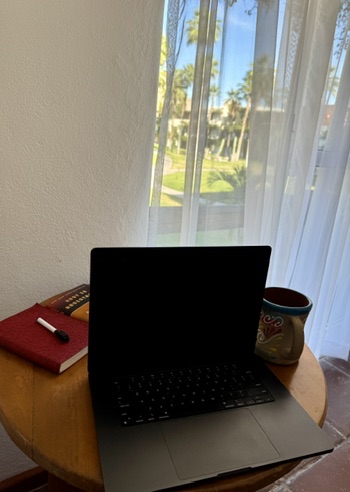
This is where I write. I photographed my workspace because the environment of inquiry matters as much as the questions I bring to it. Attention Restoration Theory, developed by environmental psychologists Rachel Kaplan and Stephen Kaplan (1989), proposes that natural environments promote psychological restoration through four characteristics: being away (psychological distance from routine demands), extent (coherence and scope that engages the mind), fascination (stimuli that engage attention effortlessly), and compatibility (alignment between environment and purpose). This space offers all four. The threshold quality of this setting, simultaneously sheltered and open, creates conditions where contemplative work can unfold. I am learning that where we think shapes what we can think. The simplicity of this workspace is deliberate. It holds only what is needed: tools for writing, tools for making images, space for stillness. There is no clutter of obligation here. There is only the invitation to attend.

Photo Credit: Amy Tucker, January 2026
Estoy aquí. Estoy prestando atención.
I am here. I am paying attention.
Title: Beginning Where I Am Standing
Artist Statement

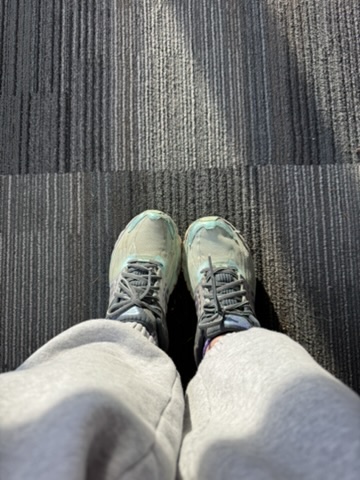
I took this photograph while standing still, looking down at my own feet. The question of running, walking, or turning back inside was still open. What I noticed first was sensation rather than motivation: weight settling evenly, the familiar pressure of shoes that have carried me through years of endurance.

These shoes know something about survival. I have used running as regulation, as escape, as a way to manage stress accumulated through precarious academic labour. For years, movement was rarely chosen freely. It was necessary. It was one of the few ways I could quiet myself enough to keep working, teaching, producing. Forward motion felt safer than stopping.

In this moment, I was practising something different. I paused to ask what I could genuinely offer rather than telling myself what I must do. The downward gaze marks that shift. Attention turns inward, away from performance and toward presence. There is no destination in this image, no finish line. There is only the honesty of where I am standing.

Within the Alonetude inquiry, this photograph documents a subtle but meaningful change. Movement is no longer assumed as virtue. Stillness is no longer framed as failure. I am invited into decision-making rather than being managed by internalised expectations. This pause becomes data, recording a moment when pressure loosens and permission appears.

This image matters because it captures the beginning of recovery as quiet reorientation rather than dramatic transformation. Restoration arrives through many paths beyond motion. Sometimes it begins by standing still long enough to listen.

Photo Credit: Amy Tucker, January 2026
References
Ahmed, S. (2012). On being included: Racism and diversity in institutional life. Duke University Press.
Bachelard, G. (1964). The poetics of space (M. Jolas, Trans.). Orion Press. (Original work published 1958)
Berger, P. L., & Luckmann, T. (2016). The social construction of reality. In W. Longhofer & D. Winchester (Eds.), Social theory re-wired: New connections to classical and contemporary perspectives (2nd ed., pp. 110–122). Routledge. (Original work published 1966)
Foucault, M. (1980). Power/knowledge: Selected interviews and other writings, 1972–1977 (C. Gordon, Ed.; C. Gordon, L. Marshall, J. Mepham, & K. Soper, Trans.). Pantheon Books.
Freire, P. (1970). Pedagogy of the oppressed (M. B. Ramos, Trans.). Continuum.
Google. (n.d.). Google Translate. https://translate.google.com
Guba, E. G. (Ed.). (1990). The paradigm dialogue. Sage Publications.
Han, B.-C. (2015). The burnout society (E. Butler, Trans.). Stanford University Press. (Original work published 2010)
Haraway, D. (1988). Situated knowledges: The science question in feminism and the privilege of partial perspective. Feminist Studies, 14(3), 575–599. https://doi.org/10.2307/3178066
Herman, J. L. (1992). Trauma and recovery: The aftermath of violence, from domestic abuse to political terror. Basic Books.
Kaplan, R., & Kaplan, S. (1989). The experience of nature: A psychological perspective. Cambridge University Press.
Leavy, P. (2015). Method meets art: Arts-based research practice (2nd ed.). Guilford Press.
Leavy, P. (2022). Research design: Quantitative, qualitative, mixed methods, arts-based, and community-based participatory research approaches. Guilford Press.
Lorey, I. (2015). State of insecurity: Government of the precarious (A. Derieg, Trans.). Verso. (Original work published 2011)
Merleau-Ponty, M. (1962). Phenomenology of perception (C. Smith, Trans.). Routledge. (Original work published 1945)
Mertens, D. M. (2008). Transformative research and evaluation. Guilford Press.
Nash, R. J. (2004). Liberating scholarly writing: The power of personal narrative. Teachers College Press.
Porges, S. W. (2011). The polyvagal theory: Neurophysiological foundations of emotions, attachment, communication, and self-regulation. W. W. Norton & Company.
Slaughter, S., & Rhoades, G. (2004). Academic capitalism and the new economy: Markets, state, and higher education. Johns Hopkins University Press.
Standing, G. (2011). The precariat: The new dangerous class. Bloomsbury Academic.
Tillich, P. (1963). The eternal now. Charles Scribner’s Sons.
Turner, V. W. (1969). The ritual process: Structure and anti-structure. Aldine Publishing.
Ulrich, R. S. (1983). Aesthetic and affective response to natural environment. In I. Altman & J. F. Wohlwill (Eds.), Human behaviour and environment: Advances in theory and research (Vol. 6, pp. 85–125). Plenum Press.
United Nations. (1948). Universal declaration of human rights. https://www.un.org/en/about-us/universal-declaration-of-human-rights
United Nations. (1966). International covenant on economic, social, and cultural rights. https://www.ohchr.org/en/instruments-mechanisms/instruments/international-covenant-economic-social-and-cultural-rights
van der Kolk, B. A. (2014). The body keeps the score: Brain, mind, and body in the healing of trauma. Viking.
Wang, C., & Burris, M. A. (1997). Photovoice: Concept, methodology, and use for participatory needs assessment. Health Education & Behaviour, 24(3), 369–387. https://doi.org/10.1177/109019819702400309
Wilson, S. (2008). Research is ceremony: Indigenous research methods. Fernwood Publishing.
Note. Spanish-language text appearing in this project was translated into English using Google Translate (Google, n.d.). Translations are intended to convey general meaning rather than certified linguistic precision.