Actually, truly impossible. Beyond the figure. The density of them. The brightness. The way they fill every inch of darkness between the horizon and directly overhead. I have been standing on the patio for twenty minutes, and I cannot get used to it. Cannot stop staring up. Cannot stop feeling small in the way that makes you feel more real, more present.
The Sea of Cortez is black at this hour. No moon tonight. Just stars reflected on the water, so the surface still looks like a second sky. I cannot tell where the ocean ends and the atmosphere begins. It is all just darkness held between points of light.
Estrellas sobre el mar. Stars over the sea.
What City Skies Hide
I grew up under city skies where you could see perhaps a dozen stars on a clear night. The Big Dipper, if you knew where to look. Maybe Orion in winter. The rest washed out by streetlights and shopping mall parking lots and the general glow of human activity that makes us forget the sky is actually full of light we cannot see until we get far enough away from our own brightness.
Here, there is no artificial light competing. The village has streetlights, but they are few and dim. Most houses are dark by nine. The ocean holds no light except what the stars give it. And the stars give everything.
I have been trying to count them and cannot. Have been trying to identify constellations and cannot find the patterns I know because there are too many stars, too much light, and the familiar shapes are lost in the surrounding density. This is the Milky Way at its fullest. The galactic centre is visible as a bright band crossing the southern sky. Thousands upon thousands of stars. And behind them, thousands more.
The Scale That Holds Us
There is something humbling about this much sky.
Humbling beyond the degrading sense. Humbling in the way that reminds you that you are small and temporary, and your concerns, however real they feel, are brief against the scale of what continues regardless of whether you are here to see it.
These stars have been shining for millions of years. Will continue shining for millions more. The light I am seeing left those stars before humans existed. Before mammals existed. Before anything I would recognize as life walked, swam, or flew on this planet. That light has been travelling through space for so long that the star that produced it might already be dead, its light still arriving, the ghost of something that no longer exists still visible because of the time it takes for distance to be crossed.
Luz antigua. Ancient light.
Witness and Significance
I am standing here, on the edge of land, looking at light older than memory, older than species, older than the oceans themselves. And it makes my life feel both infinitely small and strangely significant. Small because what am I against this scale? Significant because I am here to witness it. Because consciousness has emerged in this universe that can look up and feel awe. Because somewhere in the process of stars burning and planets forming and life evolving, something became aware enough to stand on a beach at night and feel moved by the impossibility of so much light.
What Weight Looks Like Against Stars
I think about the past six months. The past nineteen years. The exhaustion. The depletion. The way I have been carrying weight has felt unbearable.
And against this sky, it persists. The weight is still real. The suffering is still real. But it is held in a different frame. Held by something larger than my capacity to hold it. The stars hold no record of my struggles or my presence. But somehow their indifference is comforting rather than cold.
I am here. I am looking up. I am held by the same gravity that holds these stars, the same darkness that lets their light shine, the same universe that has been unfolding for billions of years and will continue to unfold long after I am gone.
Soy pequeña. I am small.
Soy temporal. I am temporary.
Y está bien. And that is okay.
The Relief of Accepting Scale
There is relief in accepting scale. In acknowledging that my life is brief, my concerns local, my influence limited. I can release the weight of everything. I can leave what cannot be fixed to its own time. I can simply be here, for this moment, under these stars, breathing this air, feeling this particular configuration of matter that is temporarily organized as me.
Sky Above, Sky Below
The water is so still tonight that it looks like glass. Dark glass. The stars reflecting on it in perfect points of light that hold perfectly still. Without my standing here, there would be only darkness and light, no visible water. Just darkness and light. Sky above. Sky below. And me between them, small and temporary and held.
Gracias, estrellas. Thank you, stars.
Por brillar sin necesitarme. For shining without needing me.
Por recordarme mi lugar. For reminding me of my place.
Por sostener la oscuridad. For holding the darkness.
Para que pueda ver la luz. So that I can see the light.
What Continues
Tomorrow the sun will rise, and I will no longer be able to see the stars. But they will still be there. Still burning. Still sending light across distances I cannot comprehend toward planets I will never see.
And I will still be here. Small. Temporary. Held by the same universe that holds everything.
Suficiente. Sufficient.
Just this. Just now. Just one small human standing under impossible stars, learning to accept the relief that comes from recognizing your own smallness in a universe so large it cannot even notice you are here.
And finding, in that recognition, something very close to peace.
Translation Note
Note. Spanish-language passages were generated using Google Translate (Google, n.d.) and subsequently reviewed and refined by the author. Any remaining infelicities reflect the limits of machine translation rather than intent.
References
Google. (n.d.). Google Translate. https://translate.google.com
ACADEMIC LENS
The experience of awe described in this late-night star-gazing entry engages what Dacher Keltner and Jonathan Haidt (2003) identify as the defining phenomenology of awe: the perception of vastness that exceeds existing conceptual frameworks, generating what they call “need for accommodation,” a revision of the self’s understanding of its place in the world. Ulrich’s (1983) restorative environment research suggests that the particular quality of night sky attention described here, effortful looking that gives way to absorption, represents a form of directed attentional rest. For the nervous system recovering from chronic vigilance, the experience of being small beneath an immense, indifferent sky also carries a paradoxical relief: Buber’s (1970) I-Thou encounter extended to the cosmos itself, where the self is released from the burden of its own centrality. The bilingual form of this entry, in which the Spanish “Una noche clara” carries a different emotional resonance than its English translation, enacts Anzaldúa’s (1987) insight that some experiences can only be approached from the borderlands between languages.
Note. Spanish-language passages were generated using Google Translate (Google, n.d.) and subsequently reviewed and refined by the author. Any remaining infelicities reflect the limits of machine translation rather than intent.
References
Google. (n.d.). Google Translate. https://translate.google.com
A field note from Day Ten. Sometimes the body understands something before the mind has words for it. This is an attempt to write it down before the understanding disappears.
Ten days to build a foundation. Perhaps small, you might think. Too brief, it seems, for anything significant.
But foundations are built to be solid, never showy. They are meant to hold. Hidden underground, bearing weight, making everything above them possible.
I came here exhausted. Sleep fragmented, thoughts scattered, body braced for threats that never came but whose approach I had learned to anticipate with the precision of an expert meteorologist reading the weather that only I could see.
Ten days to teach my nervous system: The emergency is over. The storm has passed. You can stop bracing now.
Ten days of the same evening sequence. Ten days of the same morning light. Ten days of pelican fishing at predictable times. Ten days of waves maintaining their patient rhythm. Ten days of data accumulating below conscious awareness.
And somewhere in those ten days, my body decided to believe it.
La fundación sostiene. The foundation holds.
Without forcing it. Without earning it. Without proving myself worthy.
Because I maintained conditions. Because I honoured rhythms. Because I stopped interfering with processes wiser than conscious thought.
Note. Spanish-language passages were generated using Google Translate (Google, n.d.) and subsequently reviewed and refined by the author. Any remaining infelicities reflect the limits of machine translation rather than intent.
References
Google. (n.d.). Google Translate. https://translate.google.com
I have been staring at the sea for two hours. Maybe three. Time has become slippery here, something I can no longer hold in my hands. Rachel and Stephen Kaplan (1989) wrote about fascination, the effortless attention that natural environments invite, a quality of engagement that restores rather than depletes. The sea fascinates without demanding. It holds my gaze without asking anything in return.
Today I permitted myself to do nothing. I said it out loud this morning, standing in the kitchen of the casita with coffee warming my palms: Hoy, nada. Today, nothing. The words felt dangerous, like a confession. Tricia Hersey (2022), founder of The Nap Ministry, argues that rest is an act of political resistance, a deliberate refusal to participate in systems that equate human value with productivity, and that the recuperative power of rest is itself a form of collective defiance. I am trying to believe her.
El Mar y Sus Preguntas / The Sea and Its Questions
The Sea of Cortez is a particular blue I have never seen before. It shifts throughout the day, turquoise in the morning light, deeper sapphire by noon, silver-grey as evening approaches. This is what the Kaplans (1989) call the gentle pull of the natural world, a gentle hold on attention that leaves space for reflection, distinct from the hard fascination of screens and urgent notifications that dominate modern life. I watch the water change, and my thoughts change with it, drifting from one thing to another with no clear direction.
I think about my mother, who died eleven years ago and whom I still miss in ways that surprise me. Grief, writes Miriam Greenspan (2003), is one of the dark emotions, those feelings our culture teaches us to suppress or transcend rather than honour. She argues that grief carries wisdom if we can bear to feel it fully, that the only path through difficult emotion is directly into it rather than around it (Greenspan, 2003). Here, with nothing to distract me, grief surfaces like sea glass, worn smooth by time but still present, still catching light.
I think about the students I have taught over nineteen years, wondering where they are now, whether they are happy. I think about the papers I should be grading, the emails I should be answering, and then I remember: I am here to stop shoulding myself.
Debería. I should. The word haunts me even in Spanish. Ryan and Deci (2017), in their foundational work on self-determination theory, distinguish between autonomous motivation, acting from genuine interest and valued choice, and controlled motivation, acting from internal or external pressure. The voice of should is the voice of controlled motivation, and I have let it run my life for decades.
El mar no juzga. Solo recibe.
The sea receives, without judgment.
Pensamientos Sueltos / Loose Thoughts
My mind wanders. This is what minds do when you stop giving them tasks. Neuroscientists call this the default mode network, the brain regions that activate when external demands are lifted (Buckner et al., 2008). Far from idle, this network supports self-reflection, autobiographical memory, and the imagining of the future. The wandering mind is working, just on different problems than our productivity culture recognizes.
I think about the word retirement and how it sounds like something is being put away, stored in a closet, made invisible. I am 60. I am approaching the end of one kind of life and the beginning of another. Dan McAdams (2001), the narrative psychologist, writes that identity is an ongoing story we tell ourselves, a personal myth that integrates past and present into a coherent sense of self. Sitting here watching the waves, I wonder who I will be when I am no longer someone who works. The question has no answer yet. Perhaps that is why I keep asking it.
I think about all the women I know who are tired. Tired in their bones, exhausted in their souls, tired in ways that sleep alone cannot remedy. Sharon Blackie (2019) writes about the “long soul” of women at midlife, the accumulated weight of decades spent tending to others, and the fierce necessity of reclaiming time for oneself. We carry so much. We have been carrying for so long. I wonder if any of them are sitting somewhere right now, staring at water, permitting themselves to rest.
I think about the word enough to determine whether I have done enough. Whether I am enough. Brené Brown (2010) names this the voice of scarcity, the cultural message that we are never sufficient, that worthiness must be earned through endless striving. Brown (2010) describes wholehearted living as the practice of showing up in one’s own life from a foundation of inherent worth rather than conditional approval. I am 60 years old and still learning that my right to exist requires no earning.
The sea offers no answers. It just keeps moving, wave after wave, patient and indifferent and somehow, because of that, kind.
El Cuerpo Descansa / The Body Rests
I have done almost nothing today, and my body is grateful. I can feel it in the way my shoulders have dropped, the way my jaw has unclenched. Stephen Porges (2011) calls this the shift from the body’s alert state, the mobilized state of fight or flight, to genuine safety engagement, the calm alertness that emerges when the nervous system perceives safety. Small surrenders. The body knows how to rest if we let it. The problem is the letting.
I ate breakfast slowly this morning. Papaya, yogurt, and strong coffee. Jon Kabat-Zinn (1994), who brought mindfulness practice to Western medicine, writes about mindful eating, the simple act of being fully present with food. I tasted each bite instead of eating while scrolling, eating while working, eating while planning what comes next. Just eating. Just tasting. Just being a body receiving nourishment.
Qué lujo, I thought. What a luxury. And then I felt sad, because eating slowly should be ordinary, should be the baseline of a human life, and instead it feels like an extravagance I have to travel thousands of kilometres to access. This is what Hersey (2022) means when she writes that rest has become a privilege rather than a right, a commodity rather than a necessity.
Lo Que Emerge / What Surfaces
When you stop moving, things rise. Memories. Feelings. The sediment you have been outrunning for years. Greenspan (2003) proposes that grief, fear, and despair function as messengers, uncomfortable but purposeful signals that carry information about what we value, what we have lost, and what needs attention in our lives. Solitude creates the conditions for these messages to be received.
Today, I remembered a conversation with a colleague from years ago. She told me I worked too hard, that I would burn out if I kept going at that pace. I smiled and thanked her, and changed nothing. Christina Maslach (Maslach & Leiter, 2016), who pioneered burnout research, defines burnout as a syndrome of emotional exhaustion, depersonalization, and reduced personal accomplishment resulting from chronic workplace stress. I wore my exhaustion like a badge, proof of my dedication, evidence of my worth. I had no way to know then that worth is birthright, that existing requires no proof of value.
I am learning this now, at 60, staring at the sea. Better late than never, I suppose. Better here than nowhere at all. Weinstein et al. (2021), in their narrative study of solitude across the lifespan, found that older adults often experience solitude as more restorative than younger people, having learned, perhaps through accumulated wisdom, how to be at peace in their own company.
A pelican dove into the water while I was writing that last sentence. It emerged with a fish in its beak, shook the water from its feathers, and flew on. Life continuing. The ordinary miracle of survival.
Estoy aquí. Eso es suficiente.
I am here. That is enough.
Al Atardecer / Toward Evening
The light is changing now. Golden hour, photographers call it. The mountains across the bay have turned pink and purple, colours I would dismiss as exaggerated if I saw them in a painting. But here they are, real and impossible, demanding to be witnessed. This witnessing, this full presence to beauty, is what Abraham Maslow (1964) called a peak experience, a moment of heightened awareness that transcends ordinary consciousness.
I walked to the malecón this afternoon, to move my body, just to feel my feet on solid ground. An old man was fishing from the seawall. He nodded at me, and I nodded back. No words necessary. Just two people sharing space at the edge of the water, each lost in our own thoughts. Nguyen et al. (2018) found that self-chosen solitude supports learning to settle the nervous system, the capacity to modulate emotional states from within rather than seeking external distraction. The old fisherman seemed to understand this intuitively.
¿Qué busca? I wanted to ask him. What are you looking for? But I suspect he would have turned the question back to me, and I am still working on my answer.
Antes de Dormir / Before Sleep
I accomplished nothing today. I produced nothing. I checked nothing off any list.
And yet.
I breathed. I watched. I let my mind wander without yanking it back to productivity. I sat with myself, which is harder than it sounds when you have spent decades avoiding that very thing. Long and Averill (2003) argue that the capacity for solitude is a skill, something that can be cultivated through practice. Today was practice. Tomorrow will be practice too.
Mañana, quizás, haré más. Tomorrow, perhaps, I will do more. Or perhaps I will do precisely this again. Maybe this is the work I came here to do: the slow, invisible labour of learning to be still what Robert Nash (2004) calls me-search, the deep dive into personal experience that precedes scholarly understanding. I am doing the me-search now, though it looks like nothing at all.
El mar sigue respirando.
The sea keeps breathing.
Yo también.
So do I.
Con cariño,
Amy
Loreto, Day Three
Translation Note
Note. Spanish-language passages were generated using Google Translate (Google, n.d.) and subsequently reviewed and refined by the author. Any remaining infelicities reflect the limits of machine translation rather than intent.
References
Blackie, S. (2019). If women rose rooted: A life-changing journey to authenticity and belonging. September Publishing.
Brown, B. (2010). The gifts of imperfection: Let go of who you think you are supposed to be and embrace who you are. Hazelden.
Buckner, R. L., Andrews-Hanna, J. R., & Schacter, D. L. (2008). The brain’s default network: Anatomy, function, and relevance to disease. Annals of the New York Academy of Sciences, 1124(1), 1–38. https://doi.org/10.1196/annals.1440.011
Google. (n.d.). Google Translate. https://translate.google.com
Greenspan, M. (2003). Healing through the dark emotions: The wisdom of grief, fear, and despair. Shambhala.
Hersey, T. (2022). Rest is resistance: A manifesto. Little, Brown Spark.
Kabat-Zinn, J. (1994). Wherever you go, there you are: Mindfulness meditation in everyday life. Hyperion.
Kaplan, R., & Kaplan, S. (1989). The experience of nature: A psychological perspective. Cambridge University Press.
Long, C. R., & Averill, J. R. (2003). Solitude: An exploration of benefits of being alone. Journal for the Theory of Social Behaviour, 33(1), 21–44. https://doi.org/10.1111/1468-5914.00204
Maslach, C., & Leiter, M. P. (2016). Understanding the burnout experience: Recent research and its implications for psychiatry. World Psychiatry, 15(2), 103–111. https://doi.org/10.1002/wps.20311
Maslow, A. H. (1964). Religions, values, and peak-experiences. Ohio State University Press.
McAdams, D. P. (2001). The psychology of life stories. Review of General Psychology, 5(2), 100–122. https://doi.org/10.1037/1089-2680.5.2.100
Nash, R. J. (2004). Liberating scholarly writing: The power of personal narrative. Teachers College Press.
Nguyen, T.-V. T., Ryan, R. M., & Deci, E. L. (2018). Solitude as an approach to learning to settle the nervous system. Personality and Social Psychology Bulletin, 44(1), 92–106. https://doi.org/10.1177/0146167217733073
Porges, S. W. (2011). The Polyvagal Theory: Neurophysiological foundations of emotions, attachment, communication, and finding our own calm. W. W. Norton.
Ryan, R. M., & Deci, E. L. (2017). Self-determination theory: Basic psychological needs in motivation, development, and wellness. Guilford Press.
Weinstein, N., Nguyen, T.-V., & Hansen, H. (2021). What time alone offers: Narratives of solitude from adolescence to older adulthood. Frontiers in Psychology, 12, Article 714518. https://doi.org/10.3389/fpsyg.2021.714518
Academic Lens
Being lost in the blue, absorbed into the sea and sky, is an encounter with what Csikszentmihalyi (1990) calls flow in its most elemental form: total absorption that dissolves the boundary between self and environment. In the quiet way nature restores us theory (Kaplan & Kaplan, 1989), this state of the gentle pull of the natural world is the primary mechanism of psychological recovery, the mind neither straining nor idle, but gently held. The bilingual title "perdida" (lost/feminine) also carries a gendered valence: a woman permitting herself to be directionless is a quietly transgressive act.
Content Warning: This post contains reflections on body shame, institutional harm, and the experience of exhaustion. Please care for yourself as you read, and feel free to step away if you need to.
An overachiever’s confession
A Reckoning by the Sea
It happened while I was watching the pelicans.
They dive with such certainty, folding their wings at the last possible moment, surrendering to gravity and instinct. They trust the trajectory. They dive and let instinct decide the rest. They dive, surface, swallow, and rest on the water until the next impulse moves them.
Watching them, coffee cooling in my hands, I felt something crack open inside my chest. The realization arrived without announcement, without the careful preparation I usually require before allowing myself to know brutal truths.
I am an overachiever. And I am burned out.
The words felt foreign, even as I knew them to be true. For decades, I had called it other things: dedicated, committed, hardworking, passionate. I had worn exhaustion like a badge, proof that I was earning my place in a world that seemed to demand constant demonstration of worth.
What Remained Hidden
Brené Brown (2010), in The Gifts of Imperfection, names the belief system I had been living inside without recognizing its walls. Her research reveals that perfectionism operates as a self-destructive and addictive pattern, rooted in the belief that flawless appearance, behaviour, and accomplishment can somehow shield us from shame, judgement, and blame. Brown’s work demonstrates that most perfectionists were raised receiving praise primarily for achievement and performance, whether academic grades, good manners, rule-following, or people-pleasing. Somewhere in that conditioning, many of us internalized a dangerous equation: our worth equals our accomplishments and how well we accomplish them.
Reading those words by the sea, I felt the shock of recognition. That belief had been the operating system of my entire adult life. Every committee I joined. Every extra course I taught. Every student crisis I absorbed as my own responsibility. Every late night, every weekend sacrificed, every moment of rest interrupted by the nagging sense that I should be doing something more, something better, something that would finally prove I deserved to be here.
Brown’s research reveals a more complex truth: perfectionism is fundamentally concerned with earning approval and acceptance rather than genuine self-improvement (Brown, 2010). The pattern follows a predictable sequence: please, perform, perfect. I had been following that formula in education for nineteen years, believing it would eventually lead to security, to belonging, to the sense that I had finally done enough.
It never did. It never could. That is the nature of the trap.
What Burnout Looks Like From the Inside
Christina Maslach and Michael Leiter (2016), the researchers who developed the most widely used measure of occupational burnout, describe it in terms of three interconnected dimensions. The first involves overwhelming exhaustion, the sense of being worn out, depleted, and unable to recover. The second manifests as cynicism and detachment from work, a protective numbing that separates us from caring too much. The third is a diminished sense of professional efficacy, a creeping belief that nothing we do makes a real difference.
van der Kolk, B. A. (2014). The body keeps the score: Brain, mind, and body in the healing of trauma. Viking.
What struck me while reading their work was how the third dimension creates a vicious cycle. The more burned out we become, the less effective we feel. The less effective we think we are, the harder we push to prove our worth. The harder we try, the more depleted we become. I had been running that cycle for years, perhaps decades, without seeing it clearly.
Bessel van der Kolk (2014), in The Body Keeps the Score, observes that people who have experienced chronic stress often feel perpetually unsafe within their own bodies. While I would hesitate to claim trauma as an identity, I recognize its residue: the years of institutional vigilance, the constant calibration to others’ needs, the way exhaustion became so familiar I forgot it was exhaustion. My shoulders, perpetually braced. My jaw was clenched through the night. My sleep, fractured by worry that arrived without specific content, just a generalized dread that something was undone, someone was disappointed, some standard had been missed.
Here, by the sea, those symptoms have begun to ease. The shoulders are learning to drop. The jaw softens. Sleep comes and stays. The body is remembering safety, one quiet morning at a time.
Exhaustion as Status Symbol
Brown (2010) names something I had never consciously examined: the cultural tendency to treat exhaustion as a status symbol and productivity as the measure of self-worth. In academic culture, in caregiving, in so many of the roles I have inhabited, exhaustion signals commitment. To admit tiredness is to demonstrate that I am working hard enough to deserve my place. To acknowledge a need for rest is to risk appearing uncommitted, unserious, insufficient.
The contract I wrote this morning, the one promising myself eight hours of sleep and mornings without performance, pushes directly against this belief. Every clause is a small rebellion against the culture that trained me to equate worth with output, value with visible effort.
Jenny Odell (2019), in How to Do Nothing: Resisting the Attention Economy, writes about a different kind of productivity, one focused on maintaining oneself and healing rather than generating output. That concept stopped me when I first encountered it. The productivity of healing. As if rest could be framed as output. As if I needed permission, even from myself, to justify time spent recovering.
Perhaps I do need that permission. Maybe the language of productivity is the only dialect my overachiever’s mind can currently accept. If so, I will use it as a bridge until I can cross to the other side, where rest requires no justification at all.
What Solitude Makes Visible
Christopher Long and James Averill (2003), in their foundational study of positive solitude, found that being alone provides a particular kind of freedom: release from external constraints, from the performance demands of social interaction, from the need to calibrate ourselves to others’ expectations. In their research, people reported that solitude allowed them to see themselves more clearly, free from the distortions of social performance and others’ expectations. Solitude strips away the roles we perform, leaving us face-to-face with who we have become.
That confrontation can be painful. What I am seeing here by the Sea of Cortez is a woman who has spent decades outrunning her fear of inadequacy. A woman who believed, at some level too deep for conscious examination, that if she ever stopped performing, stopped achieving, stopped proving, she would discover she was nothing at all.
This is what Brown (2010) means when she describes perfectionism as a heavy shield we carry around, believing it will protect us, when in reality it prevents us from taking flight. I have been carrying that shield for so long that I forgot it was heavy. Here, I am finally setting it down.
What Comes After Recognition
The novelist Anna Quindlen once observed that the truly difficult and truly amazing work lies in giving up on being perfect and beginning the work of becoming yourself (as cited in Brown, 2010). That work starts here, in this place where no one knows my credentials or my accomplishments or how many hours I have logged in service to institutions that offered little security in return. Here, I am simply a woman by the sea. A woman learning to rest without guilt. A woman discovering that her worth existed before she proved anything, and will remain after she stops proving altogether.
Brown (2010) describes herself as a recovering perfectionist and an aspiring good-enoughist. That phrase makes me smile, this gentle reframing of recovery from perfectionism. I am an aspiring good-enoughist. I am learning to accept that enough is a destination, perhaps the only one worth reaching.
The pelicans are diving again. They keep no score. They make no comparisons with yesterday’s haul. They rest when they are full and dive when they are hungry, floating on the water between efforts, trusting that the sea will continue to provide.
I am watching them. I am learning.
Learning to Be Alone Without Loneliness
Note. Spanish-language passages were generated using Google Translate (Google, n.d.) and subsequently reviewed and refined by the author. Any remaining infelicities reflect the limits of machine translation rather than intent.
References
Brown, B. (2010). The gifts of imperfection: Let go of who you think you are supposed to be and embrace who you are. Hazelden.
Google. (n.d.). Google Translate. https://translate.google.com
Long, C. R., & Averill, J. R. (2003). Solitude: An exploration of benefits of being alone. Journal for the Theory of Social Behaviour, 33(1), 21–44. https://doi.org/10.1111/1468-5914.00204
Maslach, C., & Leiter, M. P. (2016). Understanding the burnout experience: Recent research and its implications for psychiatry. World Psychiatry, 15(2), 103–111. https://doi.org/10.1002/wps.20311
Odell, J. (2019). How to do nothing: Resisting the attention economy. Melville House.
Van der Kolk, B. (2014). The body keeps the score: Brain, mind, and body in the healing of trauma. Viking.
ACADEMIC LENS
This bilingual confession enacts what Richardson and St. Pierre (2005) call the “vulnerable text”: a piece of writing that risks self-disclosure in the service of larger truths about structural harm. The “overachiever’s confession” names what Hochschild (2012) documents as the feminised dimension of emotional labour: the internalisation of institutional standards as personal failure, so that the exhaustion produced by structural conditions is experienced as individual inadequacy. Nixon’s (2011) slow violence framework is directly applicable: the harm of nineteen years of precarious overachievement accumulated without recognition or compensation, and the “reckoning by the sea” is the moment when this accumulated harm becomes visible to the person who has been carrying it. Menakem (2017) argues that healing requires more than intellectual understanding of structural harm but the somatic renegotiation of the bodily patterns it has encoded: the body must learn that it is permitted to stop performing before the mind’s understanding of that permission can become real. Writing in both Spanish and English allows the confession to arrive from two directions simultaneously, enacting Anzaldúa’s (1987) claim that the borderlands between languages are also the location of the most honest self-knowledge.
Two flights. Six plus hours. The particular exhaustion of leaving everything.
Taxi window. Dust road. Mountains I have never seen turning pink in the distance.
¿Primera vez en Loreto? First time? Sí. Yes.
Estoy cansada. I am tired.
The driver nods. Sí, se ve. Yes. It shows.
Key in the lock. Door swinging open. A room that belongs to no one yet.
Bag on the floor. Zipped shut. The quiet discipline of leaving it unpacked.
Salt air. Open window. The sea I came to meet.
Sixty years old. Alone. The radical act of arriving for myself.
No one is waiting. No one is expecting. No one is asking what took so long.
Shoulders dropping. The body knowing before the mind admits.
Threshold. Umbral. The space between who I was and who I am becoming.
Light fading. Sea darkening. The first night of thirty beginning.
Mañana será otro día. Tomorrow will be another day.
But tonight, just this arriving.
He llegado. I have arrived.
For now, that is enough.
Title: Weathered Open
Artist Statement
I almost walked past it.
It lay half-set in the sand, unannounced, the colour of something that had spent years under sun and water. What drew me back was the opening. Small. Quiet. A hollow worn clean through the stone as if time itself had needed passage.
I picked it up and felt its weight.
Solid everywhere except for that one opening. The hole held no weakness in it. If anything, it revealed its endurance. Pressure had shaped it instead. It had shaped it. Wind, salt, movement, persistence. Forces working slowly enough that transformation appeared gentle even when the forces were fierce.
Standing there, I thought about what it means to be marked without being broken.
How life wears through us in places. How absence forms where certainty once lived. How openings appear beyond damage, as evidence of having stayed long enough for change to move through.
I placed it back where I found it.
Some objects feel less like discoveries and more like acknowledgements. A quiet recognition of what survives shaping. Of what remains strong even with light moving through it.
Note. Spanish-language passages were generated using Google Translate (Google, n.d.) and subsequently reviewed and refined by the author. Any remaining infelicities reflect the limits of machine translation rather than intent.
References
Google. (n.d.). Google Translate. https://translate.google.com
Puesta de sol, sunset on Day Two in Loreto. A bilingual reflection on the particular quality of light at the end of a first full day by the sea, and what the body begins to release when the world turns gold.
Reading Time: 4minutes
Sunset at the horizon.
This was something else entirely: a quality of presence, of being genuinely with myself rather than merely by myself.
Title: The Gathering
Artist Statement
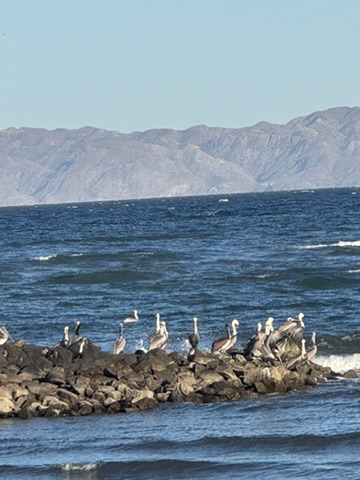
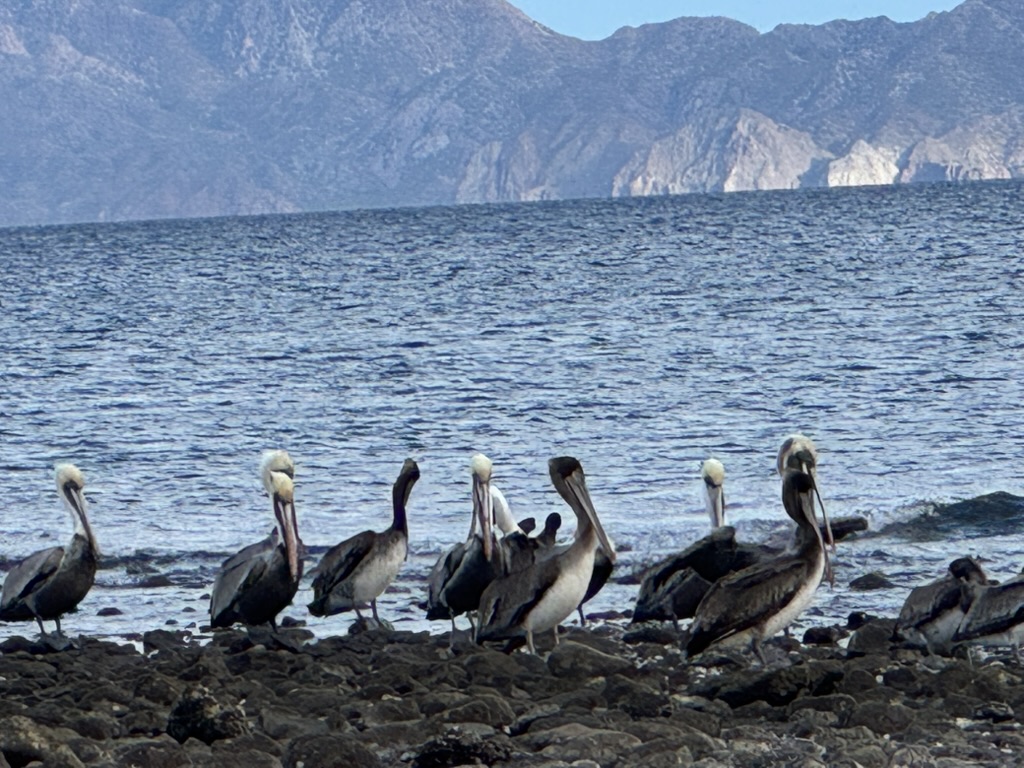
They gathered where the land gives way to water.
Perched along the rocks, they faced different directions, yet remained part of the same quiet formation. No urgency. No competition for space. Just bodies arranged along the shoreline, each holding its own stillness while sharing the same horizon.
I stood at a distance watching them.
What struck me was their patience. The way they waited without signalling waiting. The way they scanned the water without appearing restless. There was a rhythm to their presence that felt familiar to me, a kind of learned stillness that comes from spending long periods observing rather than intervening.
In that moment, I recognized something of my own practice reflected back.
This work of standing at edges. Of watching what moves beneath the surface. Of trusting that some moments ask only to be witnessed. Some moments ask only for attention. For steadiness. For remaining long enough that the landscape forgets you are there.
The mountains behind them held their own quiet authority, grounding the scene in time beyond the immediate. Water, rock, wing, distance. Each element coexisting without demand.
I kept my distance.
I allowed the distance to remain intact, understanding that proximity rarely determines connection. Sometimes respect lives in observation alone.
The evening I arrived in Loreto, Mexico, I stood on the malecón watching pelicans dive into the Sea of Cortez, and I felt something without a name.
Some moments ask only for attention.
It was something beyond loneliness, though I was profoundly alone, 3,000 kilometres from home, knowing no one, with thirty days of solitude stretching before me. Neither was it the comfortable solitude I had glimpsed in rare moments throughout my life, those brief pauses between obligations when I might read undisturbed or walk without destination.
I had no words for this experience. During Covid, I learned to call this place alonetude.
For decades, psychological research has approached solitude primarily through a deficit lens, and rightly so. Social isolation carries mortality risks equivalent to smoking fifteen cigarettes daily. Loneliness predicts cardiovascular disease, cognitive decline, and depression. The public health imperative to address what former U.S. Surgeon General Vivek Murthy called an “epidemic of loneliness” has produced essential knowledge and helped countless people.
But this focus created a gap. By treating solitude primarily as the absence of connection, we overlooked solitude as presence: the presence of self, meaning, and restoration that becomes available when social demands recede.
Alonetude requires four elements working together like legs of a table:
Intentional choice: Solitude must be chosen, never imposed. Research shows that autonomous motivation predicts positive outcomes regardless of introversion.
Felt safety: The nervous system must register it as safe. You cannot think your way into alonetude while your body scans for threat.
Present-moment awareness: Beyond rumination or distraction, genuine presence, what emerges when attention settles.
Meaning integration: Connection to values, purpose, or something larger than the passing moment.
Remove any one element, and the table collapses. Strength in one cannot compensate for the absence of another. This is the threshold model at the heart of the framework.
The Sea of Cortez cares nothing about whether humans theorize about solitude. The pelicans dive and surface following rhythms older than language. The mountains turn rose and gold at sunset regardless of who watches. But for those willing to participate, genuinely, patiently, with bodies regulated and hearts open, something becomes available. Presence to life, rather than escape from it. Presence of self, rather than absence of others.
Beyond loneliness and beyond mere solitude, something for which I needed a new word.
That word is alonetude. I offer it now as an invitation.
Presence to life, rather than escape from it.
Title: Welcome to Loreto
Artist Statement
My arrival was anything but quiet.
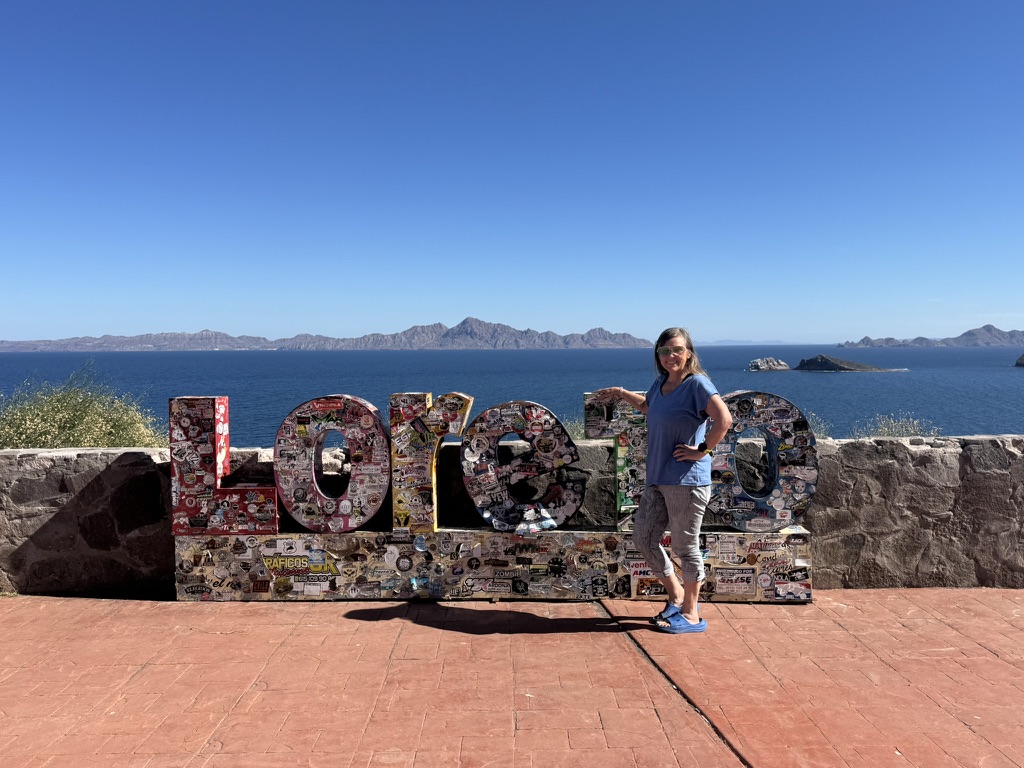
The letters announced it before I could. Large, textured, impossible to ignore. Covered in stickers layered over time, each one evidence that others had stood here too, marking their presence in colour and adhesive and memory. I stepped into the frame, aware that this was a different kind of shoreline moment than the solitary ones.
This was a public threshold.
Behind me, the Sea of Cortez stretched wide and steady, holding its own depth regardless of the spectacle in front of it. Mountains sat low along the horizon, grounding the scene in geological time while the foreground pulsed with tourism, movement, and human imprint. The contrast was immediate. Vastness behind. Declaration in front.
Traveller. Researcher. Body in place. Name unspoken yet presence visible. Unlike the quieter images, this one carries performance within it. Beyond the institutional sense of performance, simply acknowledging that sometimes presence is witnessed, documented, shared. That being in a place can hold both interior meaning and outward expression.
I left soon after the photograph.
I stepped away from the letters and back toward the waterline, where scale shifts again and the body becomes smaller against land and sea. Yet the image remains important because it marks arrival in a way solitude cannot do alone.
A pause between anonymity and recognition. Between landscape and inscription. Between being there and being seen.
Note. Spanish-language passages were generated using Google Translate (Google, n.d.) and subsequently reviewed and refined by the author. Any remaining infelicities reflect the limits of machine translation rather than intent.
ACADEMIC LENS
The distinction drawn here between “being by myself” and “being genuinely with myself” names the phenomenological core of alonetude: the difference between structural solitude and the experiential quality of self-presence that Moustakas (1961) describes as genuine encounter with oneself. Buber’s (1970) I-Thou framework applies inwardly: the sunset constitutes something beyond a backdrop,, through its beauty and its indifference to the observer’s agenda, the conditions for an I-Thou encounter with one’s own experience. Ulrich’s (1983) restorative environment research contextualizes the sunset’s particular power: the horizon, the large sky, the setting light constitute exactly the fascination and scope that natural environments provide, allowing the directed attention system to rest and the deeper self to surface. Van der Kolk (2014) observes that the capacity to be genuinely present with oneself, rather than managing or performing one’s inner states, is one of the fruits of trauma recovery: the sunset at day two marks the first glimpse of this capacity reasserting itself, evidence that the body has already begun to remember what safety feels like.
Llegada, Arrival. Day Two in Loreto, Baja California Sur: the body touches down at last. A bilingual reflection on what it means to arrive somewhere alone, and to let the sea be the first thing you say hello to.
Reading Time: 13minutes
Arrival is the doorway through which everything else enters.
Screenshot
Artist Statement
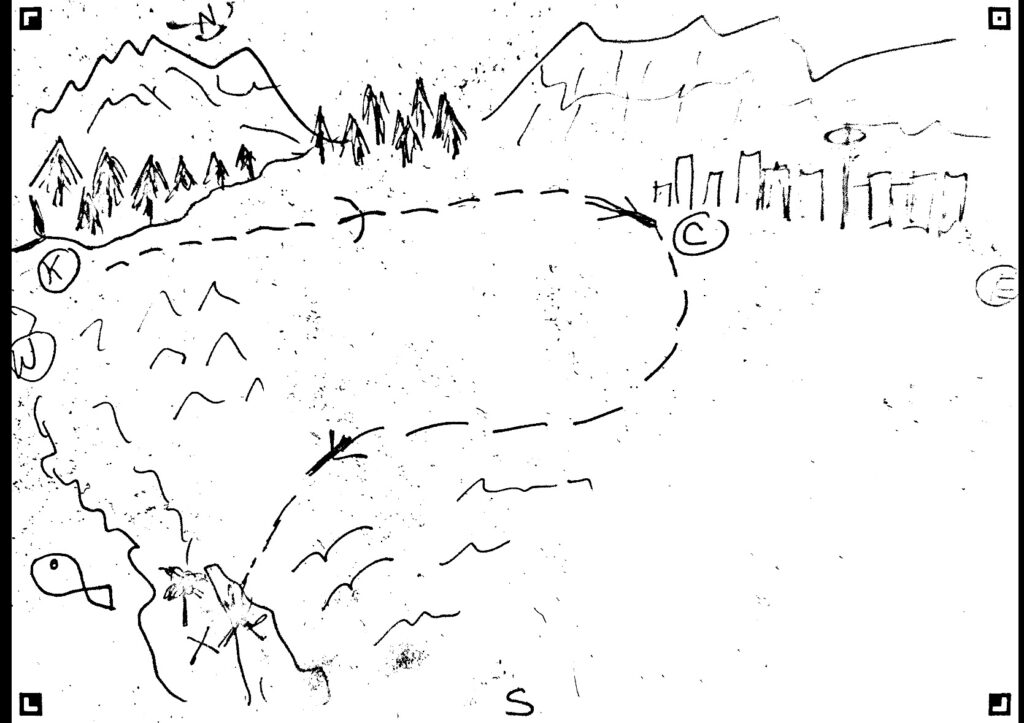
This one came through quickly.
Unplanned. Unscripted. I drew it the way thoughts sometimes arrive when the body is tired but the mind is still moving. Lines first. Meaning later.
At first glance, it looks almost childlike. Loose marks. Unsteady figures. A pathway that curves without precision. Mountains on one side. Water on the other. Small symbols scattered across the space as if they surfaced faster than I could organize them.
But when I sat with it longer, I realized it was mapping something internal rather than geographical.
The road runs down the centre. Winding. Circuitous. It bends, loops, redirects. There are arrows that suggest movement but without certainty. It is a path that is being negotiated rather than followed.
On one side, there are figures and shapes that feel relational. Animals. Faces. Presences that suggest companionship, memory, or watchfulness. On the other side, sharper lines. Mountains. Edges. Terrain that feels more solitary, more effortful to cross.
There is even a small structure near the end of the path. Almost like a village, or a place of arrival. Yet it carries no detail. It sits lightly on the page, more suggestion than destination.
What strikes me most is the openness of the centre space. So much white. So much unfilled terrain.
It feels honest.
This drawing makes no claim to the whole route. It records movement in progress. The way journeys are often held internally before they become visible externally.
It reminds me that mapping is rarely about accuracy. Sometimes it is about witnessing where you are in the moment you draw the line.
The plane descended over mountains I had only imagined. Below, the Sea of Cortez stretched turquoise and still, the body of water that Jacques Cousteau famously called the world’s aquarium (Pulitzer Centre, 2023). The desert rose glowed golden behind it, ancient and patient. I had come alone, deliberately, to a place where silence would be allowed to remain.
The flight attendant announced our arrival in two languages, but I barely heard her. My body had already begun the quieter work of landing. I noticed my shoulders softening, my breath slowing, the steady thrum of anticipation giving way to something gentler. Arrival, I would learn, begins before the wheels touch ground.
Where Desert Meets Sea
Loreto sits at the edge of two worlds. To the east, the Sea of Cortez stretches toward the Mexican mainland, its waters teeming with nearly 900 species of fish and 32 types of marine mammals (PanAmerican World, 2018). To the west, the Sierra de la Giganta rises abruptly from the desert floor, granite and volcanic rock shaped by millennia, holding canyons and ancient springs in its folds. This is a landscape of stark beauty, where the desert’s dry heat meets the sea’s salt-laden air.
This place carries layers of history that I was only beginning to understand on arrival. On October 25, 1697, the Jesuit missionary Juan María de Salvatierra founded the Misión de Nuestra Señora de Loreto Conchó at an Indigenous settlement called Conchó, home to the Monquí people (Misión de Nuestra Señora de Loreto Conchó, 2025). It became the first permanent Spanish mission on the Baja California peninsula. It served as the administrative capital of both Baja and Alta California for more than a century. The town’s motto still reads: “Loreto: Cabeza y Madre de las Misiones de las Californias,” which translates to “Head and Mother of the Missions of the Californias.”
Before the missions arrived, Indigenous peoples had inhabited this peninsula for thousands of years. The Cochimí lived in the central regions to the north, their rock art still visible in the Sierra de San Francisco, with paintings carbon-dated to over seven thousand years before present (Kuyimá Ecotourism, 2025). These were semi-nomadic peoples who moved with the rhythms of the desert and sea, living in small family bands that travelled seasonally in search of water, edible plants, and game (Cochimí, 2025). To the south lived the Guaycura and the Pericú. European diseases and colonial disruption would decimate these populations within a few generations, and by the nineteenth century, the Cochimí language had become extinct (Laylander, 2000; Indigenous Mexico, 2024). Their memory endures in archaeological sites and oral history, a reminder that the land I walked upon held stories far older than my own.
I arrived without consciously carrying this history. It was only later, walking the malecón, the seafront promenade, in the evening light, that I began to understand why this place felt layered. Silence here seemed to hold more than absence. It held memory.
Title: The History of Time
Artist Statement
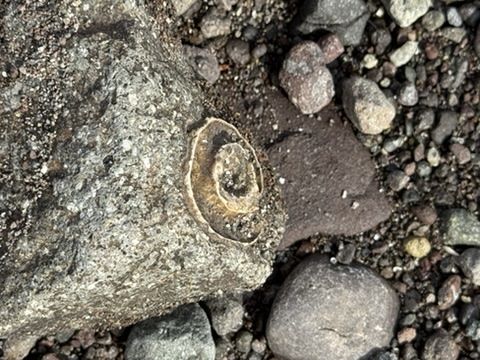
I almost missed it.
It sat quietly among the other stones, indistinguishable at first glance. Just another fragment in a shoreline made of fragments. It was only when I bent down, slowed my gaze, that the spiral revealed itself.
Perfectly held inside the rock.
A fossil. A record of life that once moved through water long before my own footsteps ever reached this shore. What struck me was its patience, more than its age. The way it had remained intact while everything around it had eroded, shifted, broken down into smaller pieces.
Time was visible here.
As compression. As density. As felt weight. Layers folded inward. Motion turned into memory. The spiral itself felt symbolic, but I resisted making it symbolic too quickly. Instead, I stayed with its material presence. Its texture. Its quiet persistence.
Holding this image, I thought about how many histories live beneath our feet without announcement. How much survives without spectacle. The fossil requires no demand. It waits for recognition.
There is humility in that.
It reminded me that archives take many forms beyond the written. Some are geological. Body-based. Embedded in landscapes that remember what human timelines often forget.
I left it there.
It felt important that it remain where it was found. Still held by the shoreline. Still in conversation with water, weather, and time.
Before I left, people asked whether I was nervous about travelling alone. Whether I was running from something or toward it. Whether thirty days was too long or too short. I had no clean answers.
What I knew was simpler: I was tired in ways that sleep alone could never reach. After years of institutional pressure, caregiving across generations, and the collective exhaustion that followed the pandemic, my nervous system had forgotten how to settle. Stillness felt dangerous. Silence felt loud. Being alone had become entangled with being abandoned, and I had lost the ability to tell the difference.
I came to Loreto to learn how to be with myself again. To practise what I have come to call alonetude, a term I use to describe the intentional, generative space between solitude and loneliness. I define alonetude as an enduring contemplative orientation toward chosen solitude, characterized by intentionality, presence, meaning, and a sense of safety. It is a posture of chosen presence with oneself, distinct from both the pain of loneliness and the mere fact of being physically alone.
Researchers have long distinguished between solitude and loneliness. Loneliness, understood as the painful gap between desired and actual social connection, persists even in crowds (Hawkley & Cacioppo, 2010). As Nguyen (2024) describes, it is an experience of perceived isolation characterized by unmet expectations in social relationships. Solitude, by contrast, can be chosen, meaning chosen or self-determined, and restorative, meaning it supports recovery and wellbeing. Research shows that when individuals autonomously decide how to spend their solitary time, they experience more positive emotions and lower stress (Nguyen et al., 2018). The key distinction lies in motivation: self-determined solitude occurs when a person spends time alone to gain emotional benefits or engage in meaningful activities, whereas non-self-determined solitude happens when aloneness is imposed by circumstance or social exclusion (Nguyen et al., 2024).
Somewhere between those poles lies the quieter possibility I was seeking: the decision to remain present with oneself, without urgency or escape. And so I chose a place where the sea would be my witness and the mountains my backdrop. A place with enough history to remind me I was small, and enough stillness to let that smallness feel like relief.
Title: My Space
Artist Statement
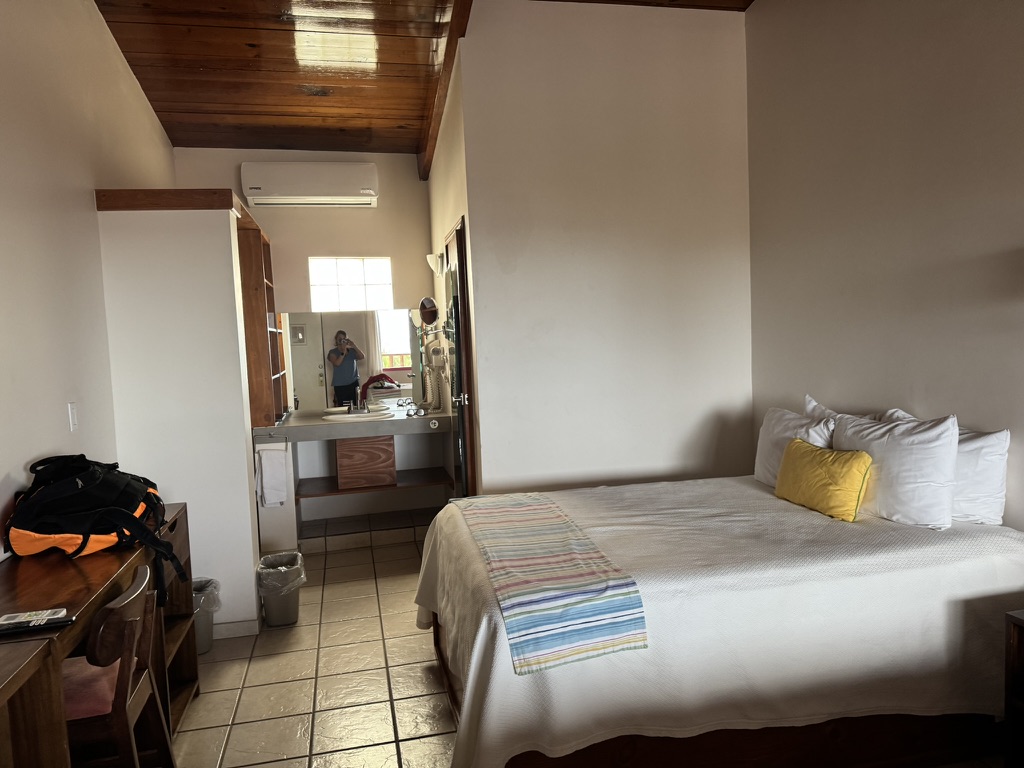
It was the stillness that met me first.
Quiet, contained, that only temporary rooms seem to hold. The bed was made with precision. Pillows aligned. A folded throw placed carefully across the centre as if anticipating arrival before I had even stepped inside.
I remember standing in the doorway for a moment longer than necessary.
There is always something disorienting about entering a space that is prepared for you, a stranger to itself. A room that offers comfort without history. Function without attachment. It asks nothing, but it also holds nothing of you yet.
My suitcase rested against the wall. Half-unpacked. A visible reminder that I was both arriving and already preparing, in some distant way, to leave.
The mirror reflected me back into the frame of the room. Researcher. Traveller. Body in transition. The image felt less like documentation and more like evidence of in-betweenness. Neither fully settled nor unsettled. Simply passing through.
What drew me most was the order.
Clean lines. Neutral tones. A controlled environment that contrasted with the emotional complexity I had carried with me. In that contrast, I felt a subtle recalibration begin. The nervous system recognizing safety through predictability. Through the ordinary rituals of placing belongings, arranging clothing, setting a journal on the bedside table.
Temporary spaces can be profoundly instructive.
They remind us how little is required to begin again each day. A bed. A window. A place to write. A place to rest the body between movements.
Nothing extravagant. Just enough.
I let the room be what it was. I let it remain neutral. Let the relationship form slowly. Presence before imprint.
At the small airport, the air hit me first. Dry and warm, carrying salt and something mineral. January in British Columbia had been grey and wet; here, the sky stretched blue without apology. I collected my bag and stepped outside. No one was waiting.
That fact landed differently than I expected. There was relief in it. No negotiation, no performance, no need to translate my fatigue into something legible for others. I hailed a taxi and watched the desert roll past the window. Cardon cacti stood like sentinels along the road, their arms raised to the sky. Smaller plants hugged the ground, adapted to scarcity.
When I arrived at my small casa, I sat with my bags still packed. I sat on the edge of the bed. I noticed the texture of the light coming through the shutters. I noticed my shoulders drop. I saw the impulse to fill the silence, to check messages, to plan, to narrate the moment to someone far away, and I let the impulse pass.
This is the work of arrival: resisting the urge to fill the space you have just entered immediately. Allowing the body to land before the mind begins its commentary. Trusting that orientation will come without forcing it.
I opened the windows. Outside, I could hear unfamiliar birds. The sea was close and visible from where I sat. I drank water slowly. I let the room remain unfinished around me.
Title: Morning Views
Artist Statement
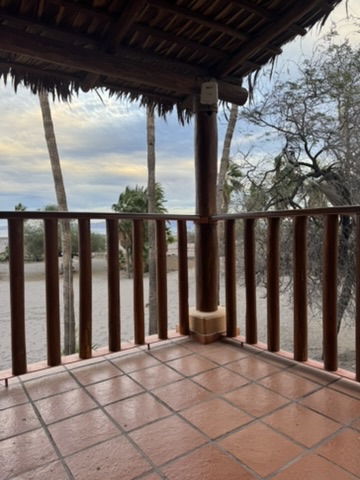
I kept returning to this balcony without meaning to. It became a quiet threshold in my days, a place suspended between inside and outside, between the life I carried with me and the landscape that asked nothing in return.
In the mornings, I would step onto the cool tiles barefoot, still half inside sleep. The body would register the air, the light, the slow movement of the palms before my mind began its usual work of organizing and anticipating. I came to value that order. Sensation first. Thought later.
There was no spectacle here. Just rhythm. Wind moving through the trees. The horizon holding steady. Light arriving gradually across sand and railing. Nothing hurried me. Nothing required interpretation. I could stand at the edge of the day without performing readiness for it.
Over time, this space became orienting. Internally, rather than geographically. I stood here without writing or planning. I stood, breathed, and allowed myself to arrive slowly. The thatched roof overhead offered shelter, while the open railing kept me connected to the wider world. Protected, yet open.
It reminded me that solitude often lives in these in-between spaces. Places where one can look outward while staying grounded inward. Places where presence is enough.
This balcony was never dramatic. That is why it mattered. It held me quietly as each day began.
That evening, I walked to the water. The malecón curved along the shore, lined with benches and the quiet activity of a small town at dusk. Pelicans floated in loose formations offshore. The light turned gold, then amber, then something closer to rose.
Title: All in a Line
Artist Statement
They were already gathered when I arrived.
A line of pelicans along the shoreline, facing the water as if the horizon had called them into formation. I stood back and watched. What held me was the pace of it, more than the scene itself. No urgency. No competition. Just bodies resting in proximity, each one holding its place without needing to claim it.
I noticed how easily they occupied stillness.
Waiting, unhurried. Together, without entanglement. The sea moved behind them in long, steady breaths, and I felt my own body begin to match that rhythm. In that moment, I was witnessing something, I was witnessing a posture. A way of being that measured nothing.
I stayed back.
Distance felt right. I stayed where I was, letting the scene remain intact. Watching them, I felt reminded that presence rarely requires action. Sometimes it is enough to stand at the edge of things, attentive, unhurried, and willing to belong to the pause.
I found a bench and sat. I had no book, no phone in hand, no task. Just the sound of water lapping against stone and the slow parade of families walking after dinner. A child ran past laughing. A couple held hands. An older man fished from the rocks nearby, patient and unhurried.
The body knows arrival before the mind catches up. It registers safety in the loosening of the jaw, the deepening of breath, the release of tension held so long it had become invisible. Stephen Porges (2011), in his foundational work on how the nervous system responds to safety and threat, explains that the autonomic nervous system continuously scans for cues of safety or danger through a process he calls the body’s instinct to scan for safety. This term refers to the neural evaluation of risk and safety that occurs below conscious awareness, reflexively triggering shifts in physiological state (Porges, 2022). Unlike perception, which involves mindful awareness, the body’s instinct to scan for safety operates automatically, distinguishing environmental features that are safe, dangerous, or life-threatening.
When the nervous system detects sufficient cues of safety, what Porges (2022) describes as the body’s sense of being safe, the body shifts from states of protection into states of restoration. The genuine safety complex, a branch of the vagus nerve associated with calm, connection, and social engagement, becomes activated. This shift arrives below conscious choice. It is something we allow by creating conditions where safety can emerge.
Sitting there on that bench, watching the pelicans dive and the light change, I felt something unclench. Quietly, almost imperceptibly. The vigilance I had carried for years began, very slowly, to set itself down.
Arrival creates conditions for this shift. By slowing down. By resisting the impulse to perform or produce. By letting the first hours remain unstructured. When nothing is demanded, the nervous system begins to trust the moment.
An Invitation
Arrival, I learned that first evening, is a threshold. It marks the movement from one way of being into another. Thresholds resist rushing. When crossed too quickly, they close before anything has time to change.
You can practise arriving anywhere. It can happen in a parked car before going inside. In a quiet kitchen after everyone has gone to bed. In the first moments of waking, before you reach for your phone. These small arrivals matter. Research suggests that even brief periods of self-selected solitude can foster relaxation and reduce stress (Nguyen et al., 2018).
Wherever you are reading these words, I offer this as an invitation. Let yourself arrive here. Notice the surface beneath you. Notice your breath. Let the moment widen without needing it to mean something yet.
Arrival offers orientation before transformation. The chance to acknowledge where you are, physically, emotionally, internally, before asking yourself to be anywhere else.
That first night in Loreto, I fell asleep to the sound of distant waves. The room was still unpacked. The days ahead were unplanned. And for the first time in longer than I could remember, that openness felt like permission rather than a threat.
Llegada. Arrival. The doorway through which everything else enters.
Title: The Sea of Cortez, Loreto, Mexico
Artist Statement
The light arrived before I was ready for it.
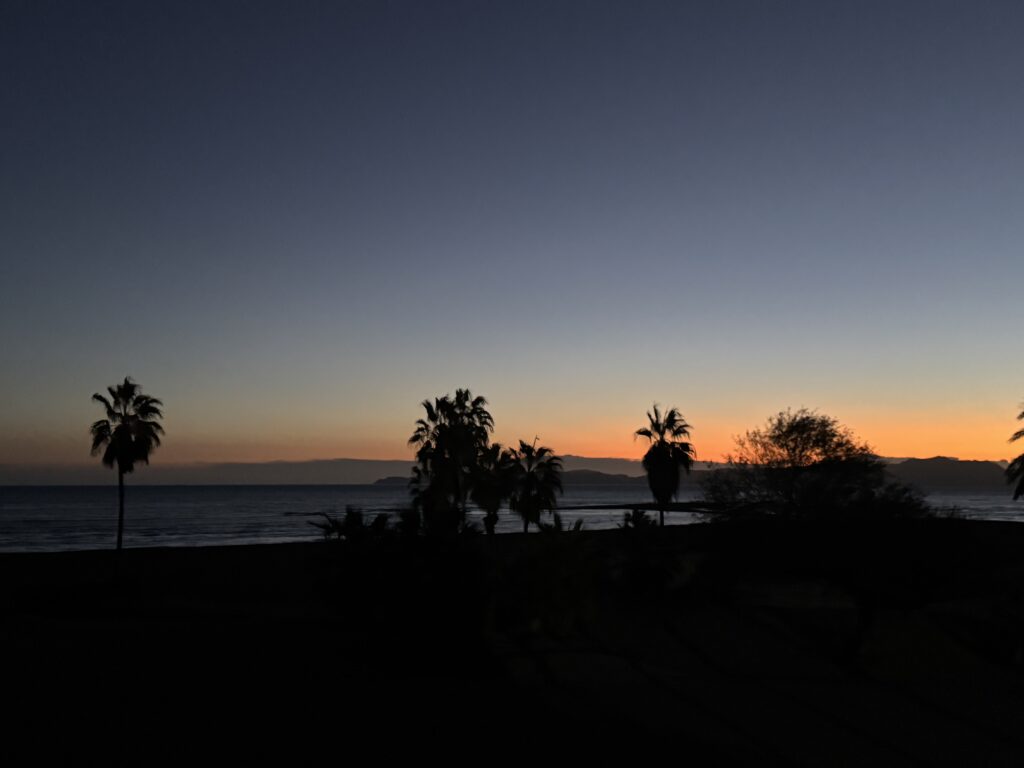
I stepped outside and the sky was already holding colour, soft pinks moving slowly across the horizon, settling into the edges of the clouds as if the day were being introduced rather than announced. The palms moved in the wind, with weathered resilience, gently. They bent without breaking. They have done this many times before.
I stood there longer than I planned to.
Watching the movement of the trees, the stillness of the sand, the quiet line where water meets land. What held me was the atmosphere of endurance, alongside the beauty. Nothing here was rushing. Even the wind felt patient. I noticed how my body responded, how my breathing slowed without instruction.
In that moment, I felt accompanied without needing company.
The landscape asked nothing of me. It simply allowed me to arrive as I was, tired, reflective, present. Standing there, I understood that rest arrives in many forms beyond full stopping. Sometimes it comes from witnessing something that knows how to keep standing, even in constant wind.
Cochimí. (2025, November 22). In Wikipedia. https://en.wikipedia.org/wiki/Cochimí
Hawkley, L. C., & Cacioppo, J. T. (2010). Loneliness matters: A theoretical and empirical review of consequences and mechanisms. Annals of Behavioural Medicine, 40(2), 218–227. https://doi.org/10.1007/s12160-010-9210-8
Indigenous Mexico. (2024, September 4). Indigenous Baja California: The rarest of the rare. https://www.indigenousmexico.org/articles/indigenous-baja-california-the-rarest-of-the-rare
Kuyimá Ecotourism. (2025, August 24). The Cochimí: Indigenous tribe of Baja California Sur. https://www.kuyima.com/cochimi-indigenous-tribe/
Laylander, D. (2000). The linguistic prehistory of Baja California. In D. Laylander & J. D. Moore (Eds.), The prehistory of Baja California: Advances in the archaeology of the forgotten peninsula (pp. 1–94). University Press of Florida.
Misión de Nuestra Señora de Loreto Conchó. (2025, February 7). In Wikipedia. https://en.wikipedia.org/wiki/Misión_de_Nuestra_Señora_de_Loreto_Conchó
Nguyen, T.-V. T. (2024). Deconstructing solitude and its links to well-being. Social and Personality Psychology Compass, 18(11), Article e70020. https://doi.org/10.1111/spc3.70020
Nguyen, T.-V. T., Ryan, R. M., & Deci, E. L. (2018). Solitude as an approach to learning to settle the nervous system. Personality and Social Psychology Bulletin, 44(1), 92–106. https://doi.org/10.1177/0146167217733073
PanAmerican World. (2018, November 21). Sea of Cortez: The world’s aquarium. https://panamericanworld.com/en/magazine/travel-and-culture/sea-of-cortez-the-worlds-aquarium/
Porges, S. W. (2011). The Polyvagal Theory: Neurophysiological foundations of emotions, attachment, communication, and finding our own calm. W. W. Norton & Company.
Porges, S. W. (2022). Polyvagal Theory: A science of safety. Frontiers in Integrative Neuroscience, 16, Article 871227. https://doi.org/10.3389/fnint.2022.871227
Pulitzer Centre. (2023). Mexico: Emptying the world’s aquarium. https://pulitzercenter.org/projects/sea-of-cortez-aquaculture-ocean-fish-farming-global-market
Note. Spanish-language passages were generated using Google Translate (Google, n.d.) and subsequently reviewed and refined by the author. Any remaining infelicities reflect the limits of machine translation rather than intent.
Academic Lens
Arrival at Loreto enacts what van Gennep (1960) calls the threshold crossing of a rite of passage: the moment of separation from the previous structure is complete, and the liminal phase begins. The wonder recorded here, the shock of a different sensory world, corresponds to what Kaplan and Kaplan (1989) term restorative experience: environments that require involuntary attention and allow directed attention to recover. Writing bilingually at this moment is itself a methodological choice: language as a site of what the body knows.