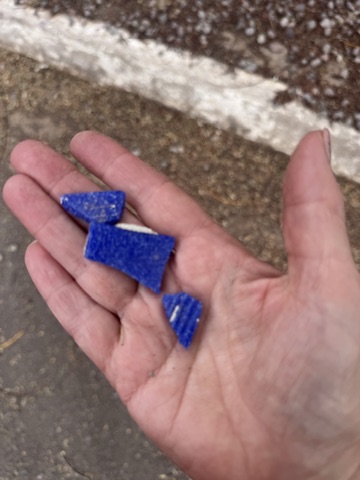
I bent down to collect them. Three fragments of blue tile, scattered across the grey concrete where something had broken and no one had swept up. They were cool in my palm, smooth on one side and rough on the other where the adhesive had once held them to a surface I would never see. I gathered them without knowing why, only that they asked to be picked up.
This is one of the photographs I have kept in colour. The blue is too insistent to mute. Against the grey of the pavement and the pink of my open hand, the tile fragments glow like something rescued. They are small, irregular, each one shaped by the break that freed it from the whole. The largest is no bigger than my thumb. The smallest could disappear between my fingers. Together, they form a collection that makes sense only to me.
I am drawn to fragments. To what remains after something larger has come apart. These tiles were once part of a pattern, a wall or a floor or a decorative edge designed to hold together. Now they exist as pieces, separated from their original purpose, available for reinterpretation. I witnessed none of the breaking. I only arrived in time to gather what was left.
In my scholarly and personal life, I have come to understand that wholeness is rarely the goal. Sometimes what matters is the willingness to collect what has scattered, to hold the pieces in an open hand without demanding they reassemble into what they were. The tile fragments have no need to become a wall again. They are enough as they are: blue, broken, held.
The photograph situates my body in the encounter. My hand is visible, open, cradling rather than grasping. The lines of my palm map a different kind of history, one written in skin rather than clay. The fragments rest where I placed them, trusting the hand that gathered them. I kept them. I carried them home. They sit now on my desk, small witnesses to the practice of noticing what others leave behind.