Bringing Back My Creativity, Imperfectly and on My Own
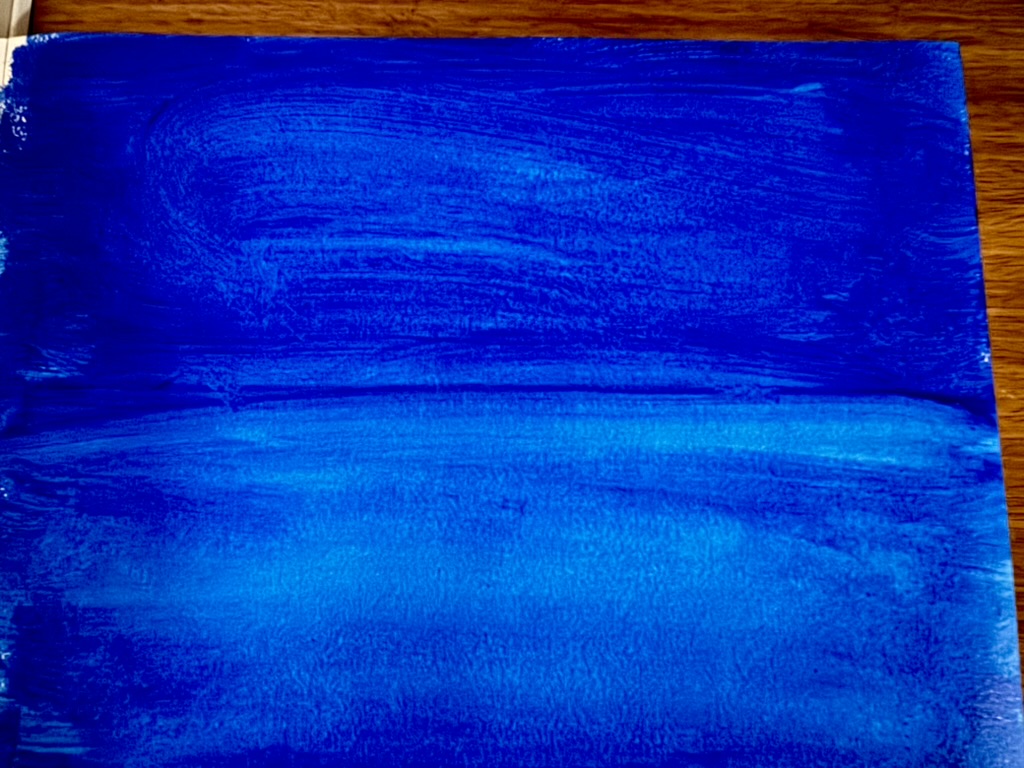
Title: Blue Sea, Held by the Blue Sky
Artist Statement

 This painting emerged as a gesture of return. After weeks of walking the shoreline, collecting fragments, and listening to land and water, I needed to place the sea onto a surface I could hold. The layered blues follow the rhythm of tide and breath, moving from deep saturation to lighter wash. Each stroke records a moment of presence, a quiet settling of the body into colour and movement. This work reflects alonetude as practice, where the sea becomes both subject and teacher, and painting becomes a form of embodied listening. It will be a background in a future painting.

Credit: Amy Tucker, 2026
For a long time, I believed my creativity belonged to institutions.
To students who needed me.
To colleagues who relied on me.
To the fragile promise of a contract renewed.
Somewhere along the way, I stopped making anything beyond what served a syllabus, a publication target, or an institutional metric. My creative life narrowed into productivity. Art became output. Curiosity became compliance.
And then, quietly, I stopped creating.
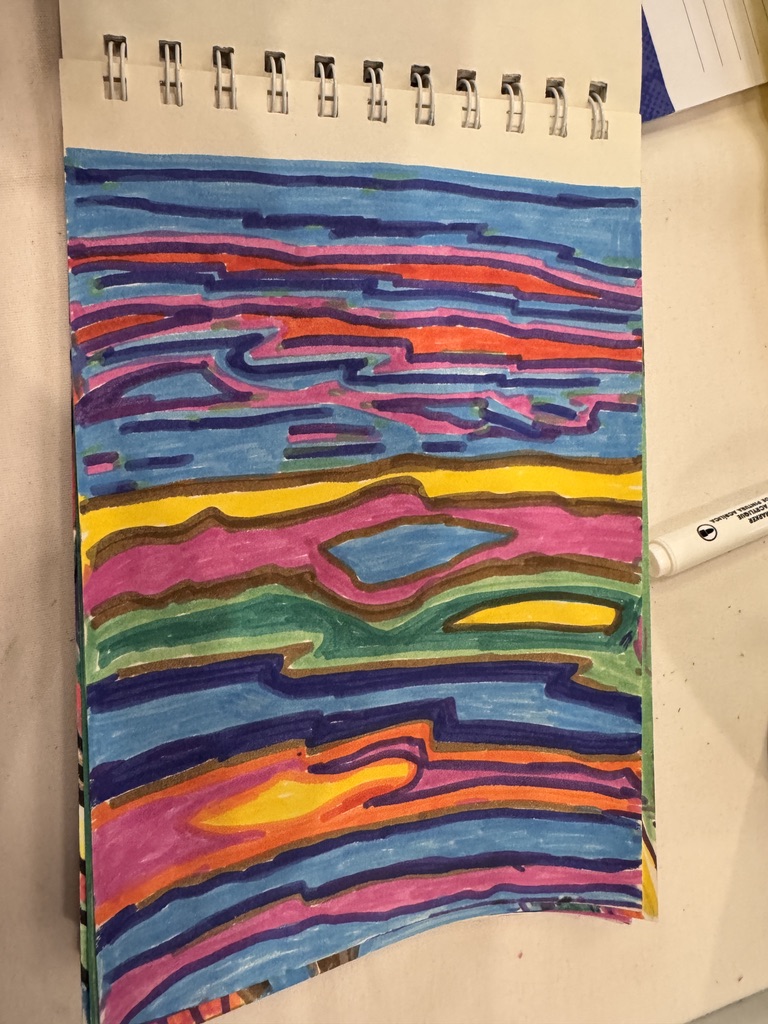
Title: What Moves When I Stop Directing
Artist Statement

I made this by staying with the movement rather than correcting it. Line followed line. Colour arrived before meaning. I skipped the sketching. I skipped the planning. I let the markers travel until they decided where to pause and where to press harder.

What this piece reminds me of is how much information lives in rhythm. The bands of colour feel like layers of time rather than landscape. Some are steady. Some break and rejoin. Some thicken where attention lingered. Others thin where the hand grew lighter. Nothing here is accidental, but nothing is controlled either. It emerged through staying present.

As I worked, I noticed how my body settled into repetition. The act became almost meditative. My breathing slowed. My thinking quieted. The colours began to speak to one another without my intervention. This feels important to name. I am learning to trust processes that unfold without explanation, to allow form to emerge through persistence rather than intention.

I have spent many years being rewarded for clarity, structure, and outcomes. This work lives outside that logic. It values continuity over completion. It holds variation without resolving it. The layered lines remind me that experience rarely moves in straight trajectories. It accumulates. It overlaps. It leaves traces.

This piece belongs to my ongoing practice of allowing. Allowing colour to lead. Allowing time to stretch. Allowing myself to make something without translating it into purpose or proof. What moves here is what happens when I stop directing and start listening.

Photo Credit: Amy Tucker, 2026
This month by the sea, something shifted. Beyond drama. Beyond heroics. Imperfectly. Slowly. In fragments.
I began picking up broken tiles from an empty field. Photographing shadows. Washing stones. Holding a small crystal in my palm, noticing how geological time had softened my urgency. These were beyond grand projects. They were gestures. Small acts of attention. But they felt like the return of something that had been taken from me.
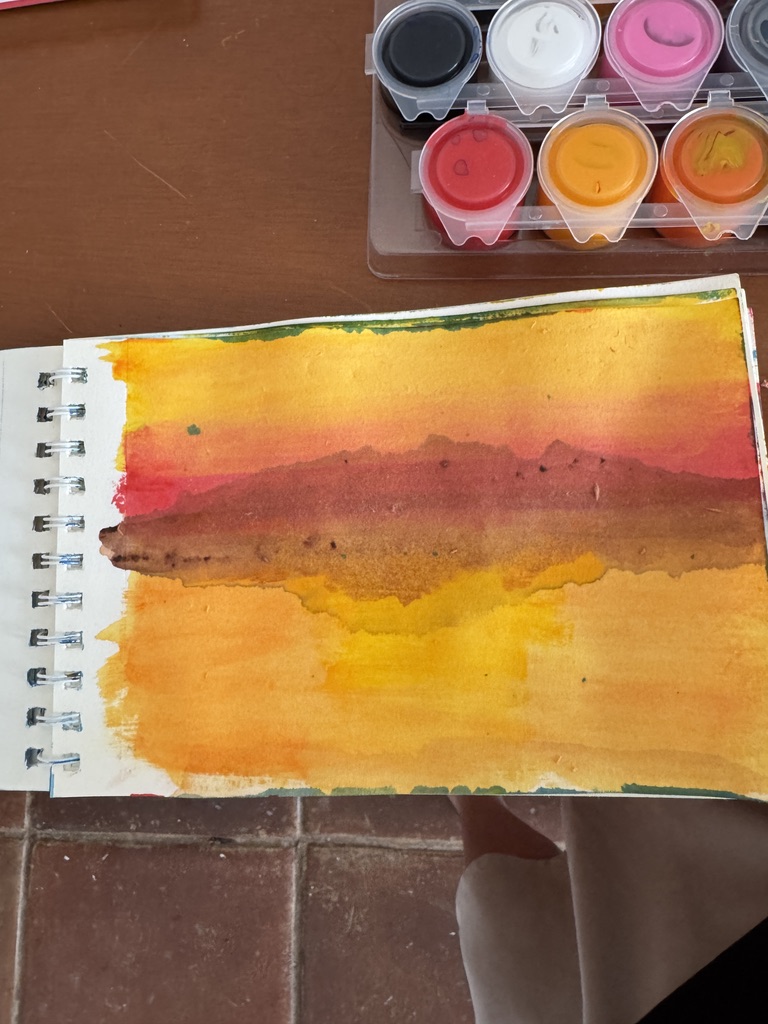
Title: Morning Memories
Artist Statement

This painting emerged as a memory of light rather than a literal horizon. The layered oranges, reds, and soft purples trace the moment when day releases itself into evening, and the body follows. The low sun and mirrored water create a quiet symmetry that feels both external and internal, a horizon held in the mind as much as on the page.

This work reflects alonetude as a temporal practice, where colour becomes a way of marking time, emotion, and transition. Painting this scene was an act of slowing, of staying with a moment that would otherwise pass unnoticed.
Credit: Amy Tucker, 2026
Creativity research tells us that creative processes often emerge through incubation, wandering attention, and unconscious processing rather than deliberate effort (Dijksterhuis & Meurs, 2006; Sio & Ormerod, 2009). In other words, creativity returns when we stop forcing it. It returns when we walk, when we notice, when we allow the body to lead.
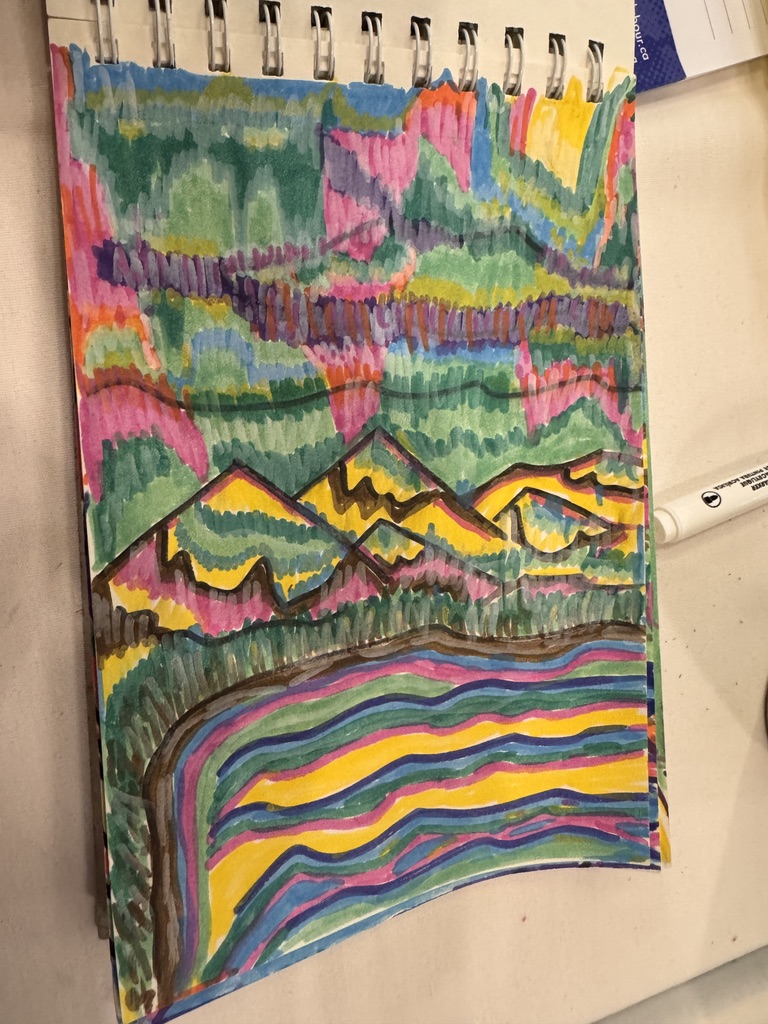
Title: Learning Where to Stand
Artist Statement

I began this piece without knowing where it would settle. Colour arrived first, then shape, then a sense of ground. The mountains emerged gradually, as forms that hold rather than landmarks to be conquered, their place quietly. Below them, layers of colour gathered and curved, suggesting movement, water, and time passing without urgency.

What this work brings forward for me is the question of position. Where I place myself in relation to what feels vast. The mountains leave the page undominated. They sit within it, held by the same field of colour that moves around and beneath them. This feels important. I have spent years orienting myself upward, toward peaks of achievement and recognition. This piece asks me to notice what happens when I attend instead to the layers that carry me forward.

As I worked, I felt a steadying in my body. The repetition of lines became grounding. The colours shifted from sharp to blended, from separate to relational. Nothing here is fixed. Everything is in conversation. The land, the water, the sky, and the unseen movements between them coexist without hierarchy.

This drawing belongs to my ongoing practice of slowing down and listening for where I am held rather than where I am headed. It reflects a growing trust in process and in place. I am learning that orientation rarely always come from striving upward. Sometimes it comes from noticing the ground beneath my feet and allowing the landscape, internal and external, to shape how I stand.

Photo Credit: Amy Tucker, 2026
Trauma research echoes this. Arts-based practices are widely recognised as therapeutic pathways for emotional regulation, meaning-making, and recovery (Leavy, 2020; van der Kolk, 2014). Creativity is beyond decoration. It is a regulation. It is restoration. It is a way back to ourselves.
I am learning that my creativity has no requirement to be polished, productive, or legible to anyone else. Peer review is no requirement for validity. Grant language is no requirement for justification. It can be quiet. It can be messy. It can be mine.
Psychologist Mihaly Csikszentmihalyi described creativity as a state of flow, where attention is absorbed and time dissolves (Csikszentmihalyi, 1996). I am finding glimpses of that flow again, through drawing and noticing rather than in writing articles or designing courses, through noticing light on glass, arranging fragments on a table, walking slowly across a field that once looked empty.
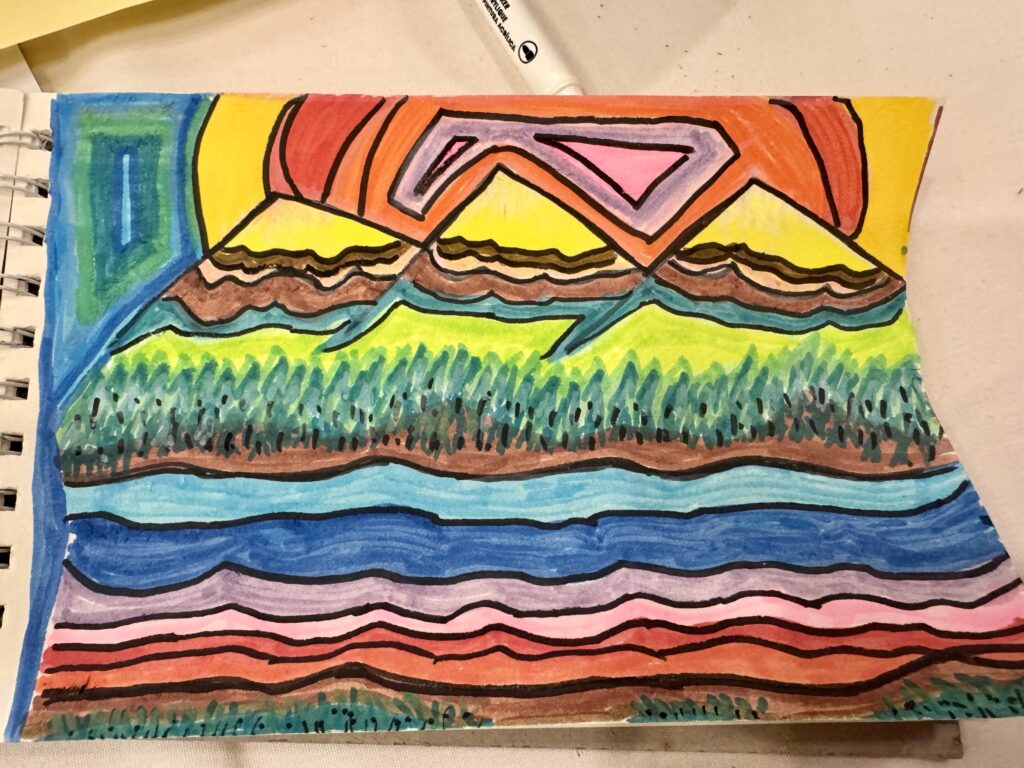
Title: Layers I Can Live Inside
Artist Statement

This piece arrived through accumulation rather than decision. I worked from the top down and the bottom up at the same time, letting bands of colour stack, interrupt, and settle into one another. The lines are deliberate yet fluid. They move because my hand moved, because my body needed rhythm more than precision.

What this work reflects back to me is a growing comfort with complexity. Nothing here resolves into a single horizon. The mountains press forward, the water holds steady, the fields pulse with texture, and the sky refuses to remain quiet. Each layer insists on its own presence while making room for the others. That feels true to how I am living right now.

I notice how the black outlines both contain and release the colour. They mark edges without closing things off completely. This matters to me. I have spent a long time inside structures that demanded clarity, hierarchy, and singular direction. This drawing allows for overlap. It allows for coexistence. It allows for a landscape that can hold many tempos at once.

As I worked, my body stayed engaged. The repetition of horizontal movement grounded me. The brighter colours emerged where energy rose. The cooler tones settled where I needed rest. I let the unevenness stand. I let it speak. The drawing became a record of attention rather than a depiction of place.

This piece belongs to my ongoing inquiry into how layers form a life. Experience accumulates. It layers rather than replaces itself cleanly. Old patterns remain visible beneath new ones. What matters is whether the layers can be lived inside without strain.

Here, they can.

Credit: Amy Tucker, 2026
This feels like a small rebellion against academic capitalism, against the extraction of time, against the idea that creativity must always be monetised, published, or measured. It feels like choosing to create for no audience except myself and the land that is teaching me how to look again.
I am imperfectly bringing back my creativity on my own.
And that feels like freedom.
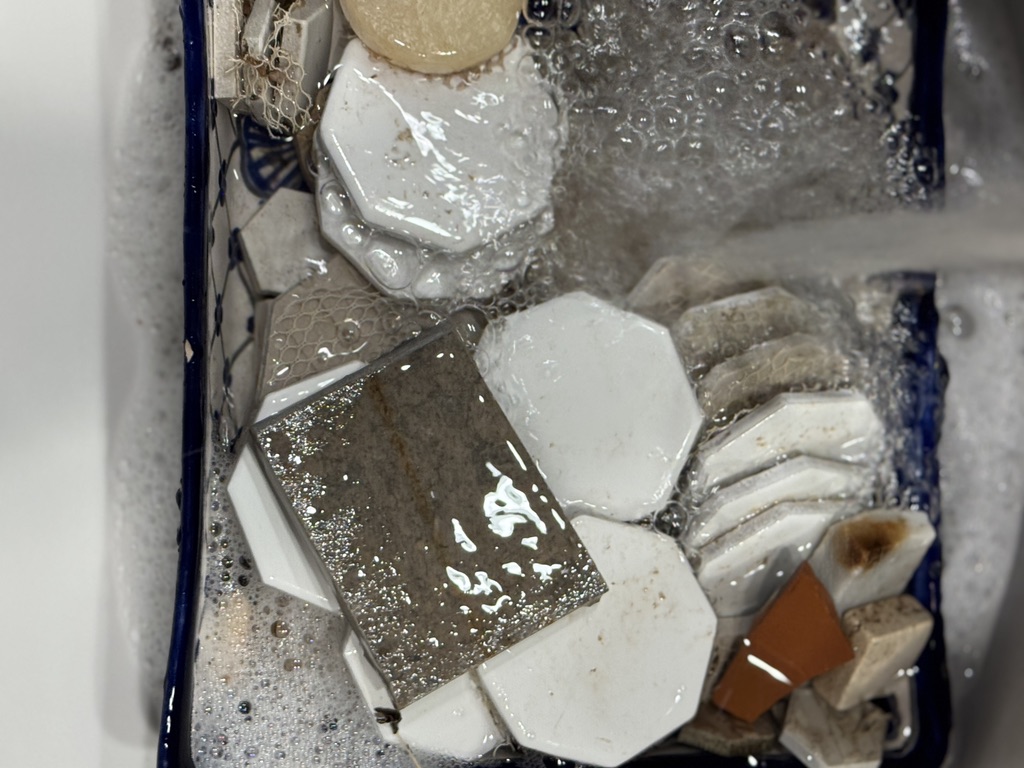
Title: Fragments, Returning
Artist Statement

 This image marks my return to creative practice in fragments rather than finished forms. I gathered these objects, glass, tile, stone, and crystal, while walking through places I once passed without stopping. Each piece carries traces of use, weather, and abandonment, yet also holds colour, texture, and presence. Collecting them was intuitive, guided by the body before the mind could explain why.

For many years, my creativity was shaped by institutional demands, productivity metrics, and the precarious rhythms of contract academic labour. This work emerges from stepping outside those structures. The fragments are both material and metaphor. They reflect how creative life returns imperfectly, in partial gestures, slow noticing, and unplanned encounters with place.

This photograph is part of my arts-based inquiry into trauma, recovery, and relational ways of knowing. Handling these fragments grounded me in the present moment and offered a tactile form of mindfulness. Creativity here is beyond outcomes. It is a practice of attention, a refusal to walk past what appears empty, and a quiet reclaiming of making as personal, relational, and ethical work.

Photo Credit: Amy Tucker, 2026
Reference
Csikszentmihalyi, M. (1996). Creativity: Flow and the psychology of discovery and invention. HarperCollins.
Dijksterhuis, A., & Meurs, T. (2006). Where creativity resides: The generative power of unconscious thought. Consciousness and Cognition, 15(1), 135–146. https://doi.org/10.1016/j.concog.2005.03.007
Leavy, P. (2020). Method meets art: Arts-based research practice (3rd ed.). Guilford Press.
Sio, U. N., & Ormerod, T. C. (2009). Does incubation enhance problem solving? A meta-analytic review. Psychological Bulletin, 135(1), 94–120. https://doi.org/10.1037/a0014212
van der Kolk, B. A. (2014). The body keeps the score: Brain, mind, and body in the healing of trauma. Viking.