What Arrives When You Are Ready
Can You See Me?

Photo Credit: Amy Tucker, 2026
The Grief I Have Been Holding
This morning I cried.
Really cried. The kind of crying that starts somewhere below your ribs and moves through your whole body. The kind that makes you sit down because standing requires more structure than you have right now.
I was watching pelicans. Just watching pelicans fish. And suddenly I was weeping.
For seventeen days, I have been here, establishing safety and learning to sleep. Learning to play. Touching rocks. Watching whales. Allowing my nervous system to register that threat has passed, that I am here, that nothing is chasing me.
And this morning, my body decided it was safe enough. Safe enough to feel what I have been carrying. Safe enough to let the grief arrive.
Finalmente segura para sentir. Finally safe enough to feel.
What Greenspan Teaches About Dark Emotions
I brought Greenspan’s (2004) Healing Through the Dark Emotions with me to Mexico. Have been reading it in small pieces, letting it teach me what I am experiencing rather than rushing ahead to understand before feeling.
Greenspan argues that what we call “negative emotions” are badly felt energies, suppressed or misunderstood, rather than inherently problematic. She writes:
The dark emotions are purposeful. Their pain calls for attention, as does physical pain. (p. 88)
This stopped me in my tracks when I first read it weeks ago. Stopped me again this morning when the crying started.
The grief is purposeful. It is calling for attention. It has been calling for seventeen days, but I could hear it only once my nervous system registered enough safety to allow it.
El dolor tiene propósito. The pain has purpose.
Greenspan identifies grief as one of three “dark emotions” alongside fear and despair. She refuses to call them negative, insisting that “the energy of dark emotions is just energy” (p. 86). What makes emotions toxic is how we handle them: suppressing, denying, transcending prematurely, avenging, and escaping. The emotions themselves are neutral. Essential. Carrying information our bodies need us to know.
This reframes everything.
For five months before this retreat, I carried enormous grief. Witnessing someone I love disappear into addiction. Watching helplessly as the person I knew was displaced by someone whose behaviour felt profoundly other. Boss (1999) calls this ambiguous loss: grief without closure because the person remains physically present while psychologically transformed.
Turkey Vulture

Photo Credit: Amy Tucker, 2026
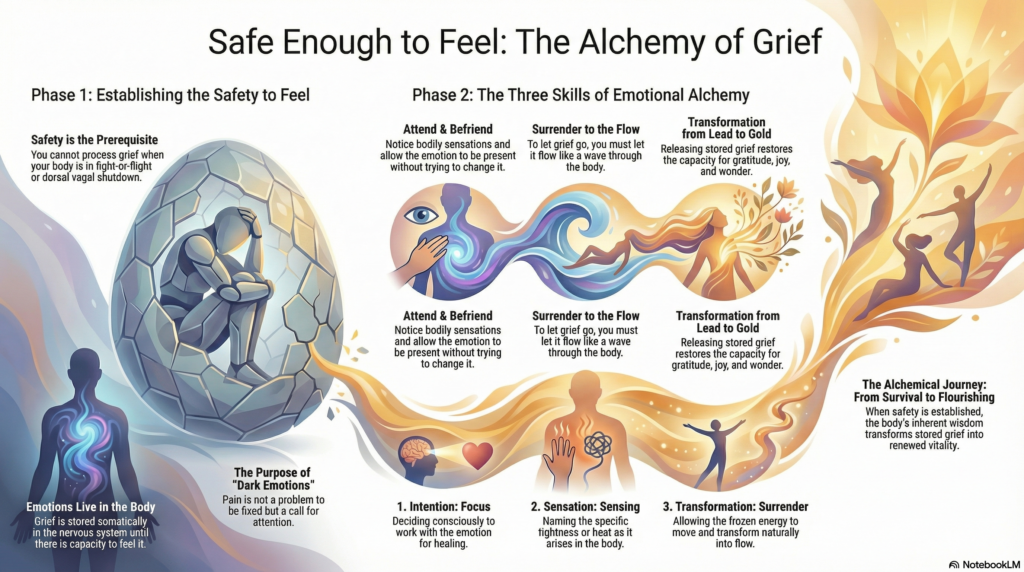
But I could cry about nothing else. My nervous system was in constant threat response. Porges (2011) explains that the social engagement system (which supports emotional expression, connection, and facial expressiveness) goes offline during sympathetic activation or dorsal vagal shutdown. You cannot process grief when your body is preparing for fight or flight or freeze.
So I carried it. Held it. Waited.
And this morning, watching pelicans, my nervous system signalled: it is safe now. You can feel this now.
Ahora es seguro. Now it is safe.
The Three Skills of Emotional Alchemy
Greenspan offers what she calls “emotional alchemy,” transforming dark emotions from lead into gold through three core skills:
Skill 1: Attending. Learning to listen to the emotion. To notice it. To turn toward it rather than away. (p. 75)
Skill 2: Befriending. Feel it to heal it. Allowing the emotion to be present without trying to fix, change, or understand it. Just feeling it. (p. 76)
Skill 3: Surrendering. To let it go, you have to let it flow. Allowing the emotion to move through you, trusting that emotions are temporary, that they crest and subside like waves. (p. 78)
Sitting on the patio this morning, pelicans fishing below, I practiced these skills.
An Afternoon Scratch

Photo Credit: Amy Tucker, 2026
I attended. Noticed the tightness in my chest. The way my breath was catching. The pressure behind my eyes. The heat in my throat. I turned toward the grief rather than distracting myself with coffee, reading, or planning the day.
I befriended. Sat with the feeling. Did my best to allow it without needing to understand why pelicans triggered weeping. Without needing to make sense of timing. Without needing the emotion to be different from what it was. Just: this is grief. It is here. It is allowed to be here.
I surrendered. Let the crying happen. Let it move. Let it flow without trying to contain or control or finish it quickly. Greenspan writes that “the art of surrendering to fear is the art of living” (p. 195). The same is true for grief. Surrendering to grief is allowing life to move through you honestly.
Atender. Hacerse amigo. Rendirse. Attend. Befriend. Surrender.
Vulnerability as the Power of No Protection
Greenspan opens one chapter with this: “The open heart is the doorway, inviting angels in, revealing that the world, even in the pit of hell, is charged with the sacred” (p. 25).
This terrifies me and compels me at the same time.
For seventeen days, I have been building protection. Routine. Predictability. Environmental consistency. The conditions that allow the nervous system to regulate. And this has been necessary. Essential. I could do nothing else first.
But now protection is sufficient that I can afford brief moments without it. Can afford to open slightly. Can afford to let grief arrive.
Greenspan calls this “vulnerability as the power of no protection.” She writes:
But vulnerability is about openness, beyond hurting. Openness to pain, adversity, loss, and death, but also to the things we most desire and cherish: to love, intimacy, creativity, sex, birth, wonder; to being truly touched by another human being, being truly seen for who we are; to the sheer adventure of being alive; to the sacred spirit that imbues the world.
This is what alonetude is teaching me. That safety is the condition that allows vulnerability rather than its opposite. That I came here to establish enough protection that I could risk having no protection. The open heart requires the regulated nervous system first.
La vulnerabilidad requiere seguridad primero. Vulnerability requires safety first.
Brené Brown (2012) writes extensively about vulnerability requiring courage. But what I am learning here is that vulnerability also requires nervous system regulation. You cannot risk openness when your body is in chronic threat. Cannot allow grief to flow when every resource goes toward survival.
I See You

Photo Credit: Amy Tucker, 2026
Alonetude creates conditions where vulnerability becomes possible. Where dark emotions can arrive because the body finally trusts that it can handle them.
Emotions Live in the Body
One of Greenspan’s seven foundations is this: “Emotions live in the body, in the world” (p. 88).
This feels obvious once you pay attention, but for most of my life, I believed emotions lived in my head. Was that crying something you chose? That grief was a cognitive state you could think your way through.
But this morning taught me otherwise. The grief arrived somatically before I had conscious thought about it. My chest tightened. My breath caught. My eyes filled. Only then did my mind notice: oh. I am crying. Something is moving through me.
van der Kolk (2014) emphasises this: the body keeps the score. Emotions are stored in the nervous system, accessed through somatic pathways rather than through thought. This is why talk therapy alone often fails with trauma. The body holds what language cannot reach.
El cuerpo guarda lo que las palabras no pueden tocar. The body holds what words cannot touch.
Watching myself cry this morning, I understood something new. The grief was never absent. It was present all along, stored in my body, waiting for conditions where it could be processed safely. My nervous system was protecting me by keeping it stored until I had capacity to feel it. Now, seventeen days into alonetude, capacity has increased slightly. Enough for this morning’s grief. Probably insufficient for all the grief I carry. But enough for today.
This is what Porges (2011) describes: nervous system regulation as creating capacity for emotional experience. When we are dysregulated, we cannot access the full range of emotional life. Regulation restores access gradually, bit by bit, as the system learns safety.
Dark Emotions
Greenspan offers a process for working with dark emotions that feels remarkably similar to what I have been doing intuitively:
Step 1: Intention. Focusing your spiritual will. Deciding consciously to work with the emotion for healing and transformation. (p. 79)
Step 2: Affirmation. Developing an emotion-positive attitude. Believing that emotions are purposeful rather than problematic. (p. 80)
Step 3: Bodily Sensation. Sensing, soothing, naming emotions as they arise in the body. (p. 80)
Step 4: Contextualization. Telling a wider story. Understanding the emotion within its broader personal and social context. (p. 83)
Step 5: Non-Action. Befriending what hurts. Being simply present without trying to avoid, cling to, fix, or even understand. (p. 85)
Step 6: Action. Social action, spiritual service. Hearing what the emotion is asking of you and responding from the heart. (p. 85)
Step 7: Transformation. The way of surrender is allowing the emotion to flow and transform naturally. (p. 86)
This morning, I moved through these steps without consciously intending to:
I set an intention by recognising grief was present and choosing to sit with it rather than distract myself.
I affirmed that grief is purposeful by remembering Greenspan’s teaching that dark emotions carry essential information.
I attended to bodily sensation: tightness, heat, pressure, trembling, the specific texture of grief in my chest and throat.
I contextualised this grief by connecting it to five months of witnessing addiction, to ambiguous loss, to the accumulated weight of helplessness.
I practiced non-action by simply sitting. Without trying to make the crying stop. Without needing to understand it fully. Just being with it.
Action will come later. For now, the grief is teaching me what it needs to teach.
And transformation is happening whether I direct it or experience it passively. The crying eventually subsided. My breath evened. The pressure eased. Something shifted. Something moved. Something that was stored became something that flowed.
Algo que estaba almacenado se convirtió en algo que fluyó. Something that was stored became something that flowed.
Pelicans Flying Over the Sea

Photo Credit: Amy Tucker, 2026
What This Means
Alonetude is proving more complex than I initially understood.
I came here thinking alonetude was about rest. About nervous system regulation. About recovering playfulness and establishing a routine. And it is all of those things.
But alonetude is also about creating conditions where difficult emotions can finally be processed. Where grief that has been held in the body for months can surface because the nervous system finally has capacity to feel it.
Greenspan writes that “without a listener, the healing process is aborted” (p. 14). In conventional therapeutic contexts, the listener is the therapist. But in alonetude, the listener is the self. Is the body attending to itself? Is the nervous system learning to hold what it previously could hold only in stored, frozen form?
En la alonetud, me escucho a mí misma. In alonetude, I listen to myself.
This feels important methodologically. Scholarly Personal Narrative (Nash, 2004) positions lived experience as legitimate data when properly contextualised. But what I am learning is that some lived experiences cannot be accessed until nervous system conditions allow it. The data exists in the body but remains inaccessible until safety permits processing.
Alonetude creates these conditions. Seventeen days of consistent safety. Seventeen days of routine. Seventeen days of play returning, of rocks teaching, of whales breathing, of stones offering patience. All of this accumulated into sufficient nervous system regulation that this morning my body decided: now. Now we can feel the grief about what happened before we came here.
Sands of Time

The Widsom of Grief
Greenspan calls this “the wisdom of grief” (2004). She argues that grief serves crucial functions:
- It connects us to what we have loved and lost
- It teaches us about attachment and impermanence
- It opens our hearts to compassion
- It reminds us we are vulnerable, alive, and capable of deep feeling
- It transforms us from who we were before loss into who we become through integrating loss
Sitting here now, hours after this morning’s crying, I feel different. Lighter somehow. As though releasing some of the stored grief made space for something else. Made breathing easier. Made my chest less tight.
This is what Greenspan means by transformation. From grief to gratitude. Gratitude arrives through grief rather than replacing it, moving through grief makes gratitude accessible again. Makes joy possible. Makes life feel less heavy.
Del dolor a la gratitud. From pain to gratitude.
The pelicans are still fishing. The sea is still calm. The stones still sit patiently, teaching their lessons about deep time. Nothing external has changed.
But something internal has shifted. Some energy that was frozen is now flowing. Some stored emotion is now being partially processed.
And I am grateful. Grateful that my body knew to wait until safety was established. Grateful that alonetude created conditions where grief could arrive. Grateful for Greenspan’s framework that helps me understand what is happening. Grateful for the pelicans who somehow triggered the release I needed.
Figure: Safe Enough to Feel
Credit: NotebookLM, 2026
Can You See Me?

Photo Credit: Amy Tucker, 2026
Gracias por la seguridad que permite sentir. Thank you for the safety that permits feeling.
Gracias por el dolor que enseña. Thank you for the pain that teaches.
Gracias por las lágrimas que fluyen. Thank you for the tears that flow.
Gracias por el cuerpo que sabe cuándo es el momento. Thank you for the body that knows when it is time.
Frameworks and Concepts for Healing Dark Emotions
| Concept or Framework Name | Author(s) or Source Cited | Key Definition or Description | Associated Stages or Skills | Somatic or Psychological Purpose | Source |
|---|---|---|---|---|---|
| Emotional Alchemy | Greenspan (2003) | Dark emotions are purposeful energies that carry essential information; their pain calls for attention, like physical pain, for healing and transformation. | 3 Core Skills: 1. Attending, 2. Befriending, 3. Surrendering. 7 Foundations: 1. Intention, 2. Affirmation, 3. Bodily Sensation, 4. Contextualization, 5. Non-Action, 6. Action, 7. Transformation. | Dark emotions are purposeful energies that carry essential information; their pain calls for attention similar to physical pain for the purpose of healing and transformation. | [1] |
| Polyvagal Theory / Social Engagement System | Porges (2011) | A neurophysiological framework explaining how the nervous system regulates emotional expression and connection based on perceived safety or threat. | 1. Sympathetic activation (fight/flight), 2. Dorsal vagal shutdown (freeze), 3. Social engagement system. | Creates the capacity for emotional experience; the body must register safety to move out of threat response and allow the social engagement system to process grief. | [1] |
| Alonetude | A state of intentional solitude is used to establish safety, routine, and nervous system regulation. | A state of intentional solitude used to establish safety, routine, and nervous system regulation. | Establishing safety, learning to sleep/play, touching rocks, watching nature, and establishing routine. | Creates conditions in which the body finally trusts it can handle and process stored, frozen emotions like grief. | A state of intentional solitude is used to establish safety, routine, and nervous system regulation. |
| The Body Keeps the Score / Somatic Storage | van der Kolk (2014) | The concept that emotions and trauma are stored in the nervous system and body rather than just as cognitive thoughts. | Accessing somatic pathways rather than just language or talk therapy. | The body protects the individual by storing emotions until the nervous system has the capacity to process them safely. | [1] |
| Vulnerability as the Power of No Protection | Greenspan (2003); Brown (2012) | An openness beyond pain and loss, extending to love, intimacy, and wonder; it is the state of having an open heart allowed by a regulated nervous system. | Requires nervous system regulation and courage. | Allows an individual to be truly touched or seen and to experience the “sheer adventure of being alive” once sufficient protection/safety is established. | [1] |
| Ambiguous Loss | Boss (1999) | A type of grief occurring without closure because a person remains physically present but is psychologically transformed or absent (e.g., through addiction). | Absent from source | Identifies the specific source of unresolved grief where typical closure is unavailable. | [1] |
| Scholarly Personal Narrative (SPN) | Nash (2004) | A methodological approach that positions lived experience as legitimate data when properly contextualised. | Contextualising lived experience. | Validates the individual’s personal journey and bodily experiences as a source of knowledge and truth. | [1] |
Note. Safe Enough to Feel: The Alchemy of Grief, Source Blog Post Day 17, 2026
Translation note. Spanish language passages were generated using Google Translate and subsequently reviewed and refined by the author. Any remaining infelicities reflect the limits of machine translation rather than intent.
References
Boss, P. (1999). Ambiguous loss: Learning to live with unresolved grief. Harvard University Press.
Brown, B. (2012). Daring greatly: How the courage to be vulnerable transforms the way we live, love, parent, and lead. Gotham Books.
Google. (n.d.). Google Translate. https://translate.google.com
Greenspan, M. (2004). Healing through the dark emotions: The wisdom of grief, fear, and despair. Shambhala Publications.
Nash, R. J. (2004). Liberating scholarly writing: The power of personal narrative. Teachers College Press.
Porges, S. W. (2011). The polyvagal theory: Neurophysiological foundations of emotions, attachment, communication, and self-regulation. W. W. Norton & Company.
van der Kolk, B. A. (2014). The body keeps the score: Brain, mind, and body in the healing of trauma. Viking.
What arrives when you are ready — not forced, not scheduled — is the subject of intrinsic motivation theory (Ryan & Deci, 2000): genuine curiosity and creative impulse emerge when the conditions of autonomy, competence, and relatedness are met, and collapse under surveillance and external contingency. The readiness named here is also somatic: van der Kolk (2014) argues that the body must settle before the mind can receive. This entry documents what Lorde (1988) called the uses of the erotic — the knowledge that arrives through feeling rather than analysis.