Title: Grounding
Artist Statement

I look down before I move forward.

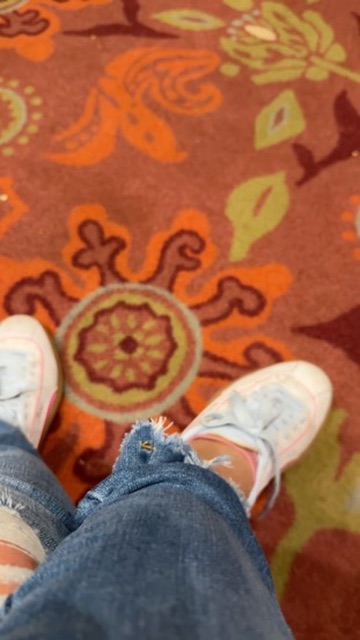
This photograph holds a simple orientation practice. Feet placed on patterned carpet, body paused between one step and the next. What draws my attention is the grounding rather than the destination. The ornate floor beneath me becomes a visual anchor, a reminder that movement begins in contact.

Within my work on alonetude, I return often to these micro-moments of bodily awareness. Solitude can be interior, quiet, and located anywhere. Sometimes it is interior, quiet, and located in transitional spaces such as hallways, lobbies, or thresholds between obligations.

The worn denim, the casual shoes, the downward gaze all signal an unguarded state. There is no performance here. Only presence. The body orienting itself gently within space.

This image documents a pause that might otherwise go unnoticed. A small act of returning to oneself before continuing on.

Photo Credit: Amy Tucker, January 2026
I am sitting in a hotel room in Calgary. I am a ghost haunting my own transition.
This space is the architectural equivalent of a blank stare. It is clinical and sterile, a box designed for the thousands of weary travellers who have sat in this exact chair before me, leaving behind nothing but the faint scent of industrial cleaner and the echo of a television left on too long. There is a bed, a desk, a television, and the relentless, mechanical humming of the mini-fridge. This low-grade vibration mimics the anxious, internal chatter of my own mind.
I have set up my maintenance equipment on the desk: my laptop, my books, and the literature review I am currently using as a shield. I wake at 5:00 a.m. sharp, Pacific Standard Time, my body moving as if this were a typical workday of busyness, as if staying occupied might still offer a sense of order.
The Trap of the Rehearsal
Even here, in this Neutral Zone between the life I left in British Columbia and the Alonetude awaiting me in Loreto, I am desperately trying to establish structure. I can feel my old self, the one who built an entire identity around reliability, availability, and competence, attempting to reestablish control.
The rehearsals begin almost immediately. Do I wake early to watch the sunrise, as someone grounded and intentional might? Do I anchor the day by watching the sunset, as if presence itself could be scheduled?
I am mentally planning my arrival as if it were a syllabus. I find myself agonising over the mundane details of a life still waiting to begin:
- The Routine: Should I plan a strict writing schedule to ensure productivity?
- The Performance: Should I jog at 7:00 am to prove I am still disciplined, or should I swim at 1:00 pm and siesta at 2:00 pm like a proper retiree?
- The Logistics: Where should I shop? How will I navigate the village without looking like just one inadequate person at a table?
- The Diet: Should I maintain a strict low-carb regime, or finally learn to “go with the flow” and listen to what my body actually needs?
I am realising that these questions are just the lies that burnout tells. They are my rehearsed explanations and elaborate to-do lists used to avoid the disorienting blankness of being truly alone.
I am addicted to the dopamine hit of a completed task, and I am terrified that if I stop acting, I will discover I am nothing.
Title: Holding Presence
Artist Statement

This piece emerged without agenda.

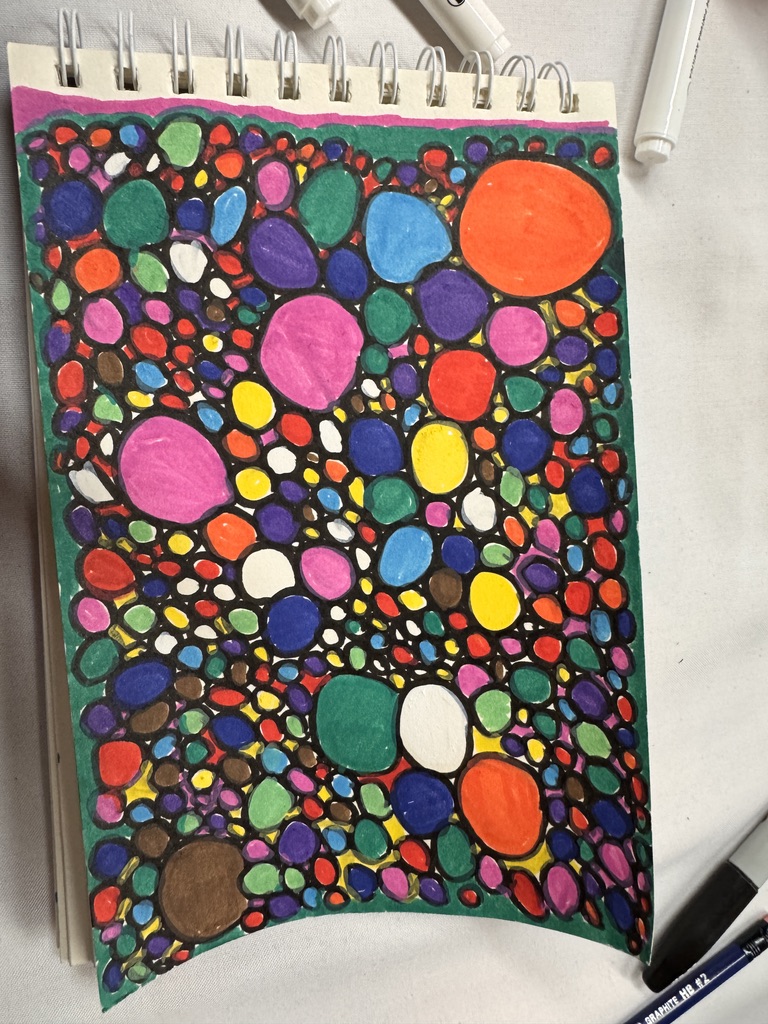
I began placing colour onto the page as one might place stones into a circle, to feel weight, texture, and relation rather than build structure. The shapes arrived organically. Some large and declarative. Others small, almost hidden, requiring closer attention.

What interests me is the coexistence as much as the brightness. No single colour dominates the field. Even the boldest tones must live beside quieter ones. The black outlines create containment, allowing intensity to exist without overwhelming the whole.

Within my alonetude practice, this work reflects the interior landscape of solitude. Solitude is often misread as emptiness. My experience is the opposite. When external noise recedes, interior colour intensifies. Memory, sensation, grief, curiosity, and calm all surface together.

This page holds that plurality. A visual mapping of inner life that resists simplification. There is no central focal point because solitude decentralises hierarchy. Everything matters. Everything belongs.

Photo Credit: Amy Tucker, 2026
The Unthought Known
By the door, my orange suitcase sits unopened. It is my “transformational object,” a vessel for the “unthought known,” the knowledge held in my body still awaiting words to name it. Christopher Bollas (1987) suggests that such objects hold parts of the self waiting to be rediscovered. Inside that suitcase is more than just linen and walking shoes; it keeps the “ash” of twenty-five years of academic performance and the quiet grief of the pandemic years that hollowed me out.
As I sit here, my nervous system is in a state of chronic activation, scanning for demands even in this unlived-in room. Drawing on Stephen Porges’ (2011) Polyvagal Theory, I recognise I am struggling to move from hyper-vigilance into a Ventral Vagal state of safety. I am a ghost haunting my own morning, showering without feeling the water, eating without tasting the food.
I am already mentally in the Sea of Cortez, replaying the past and rehearsing the future, while completely missing the sensory reality of the present.
The 25-Year Performance
For the past quarter-century, I have been juggling roles: the mother, the educator, the spouse, the neighbour, and the athlete. I sat on endless committees unpaid. I was the graduate student competing for two degrees at once, yet never taking the time to finish either, always rushing to the following requirement, truly.
I was the poster child of institutional success, the office superhero who showed up at 8:00 a.m. and stayed long after the day was over. I collected the markers of value:
- The Best Teacher
- The Best Employee awards.
- The Interculturalization Award
- Doctorate Research Award
- Student Experience Award (twice)
- The Advocate for precarious workers
I was kind, present, and reliable. I was shouting to the world: Look at me, I am a person of value and worth. But standing here now, I have to ask: Who was I trying to prove my worth to?
Nobody was listening. I included.
The Discipline of Staying
The invitation this morning is to stop the rehearsal.
- I must notice the urge to escape into planning and “doing”.
- I must pause and breathe through the fridge’s clinical hum.
- I must practice the discipline of staying, staying with the silence, staying with the transition, and staying with the discomfort of having no next thing pressing against me.
Today, I leave the clinical layover in Calgary on the direct flight to Loreto. I am flying south to a place where the light is soft, and the water is gold. But the work of Arrival begins here, in the sterile quiet, by letting go of the need to manage the menu of my own transformation.
Actual arrival is about presence in the internal sense: being fully where you are, with no next thing pressing against the edge of the current thing. By letting go of the need to manage the menu of my own transformation, I am practicing what William Bridges (2019) identifies as the difficult necessity of the transition process: allowing the old identity to fall away before the new one has even begun to take shape.
As I prepare to board, I am consciously practicing the discipline of staying, staying with the silence and the discomfort of having no role to perform. I am moving from a state of hyper-vigilance into a Ventral Vagal state of safety, recognising that my body is already softening as I move toward the Sea of Cortez.
I am leaving behind the office superhero and the award-winning educator. I am choosing to be a body in water, a being alive on a planet spinning through space, rather than a vehicle carrying a brain to a meeting. I had arrived. And for this morning, in this clinical box, that has to be enough.
Title: Where the Body Remembers Green
Artist Statement

This landscape began as sensation, before scenery. It began as sensation.

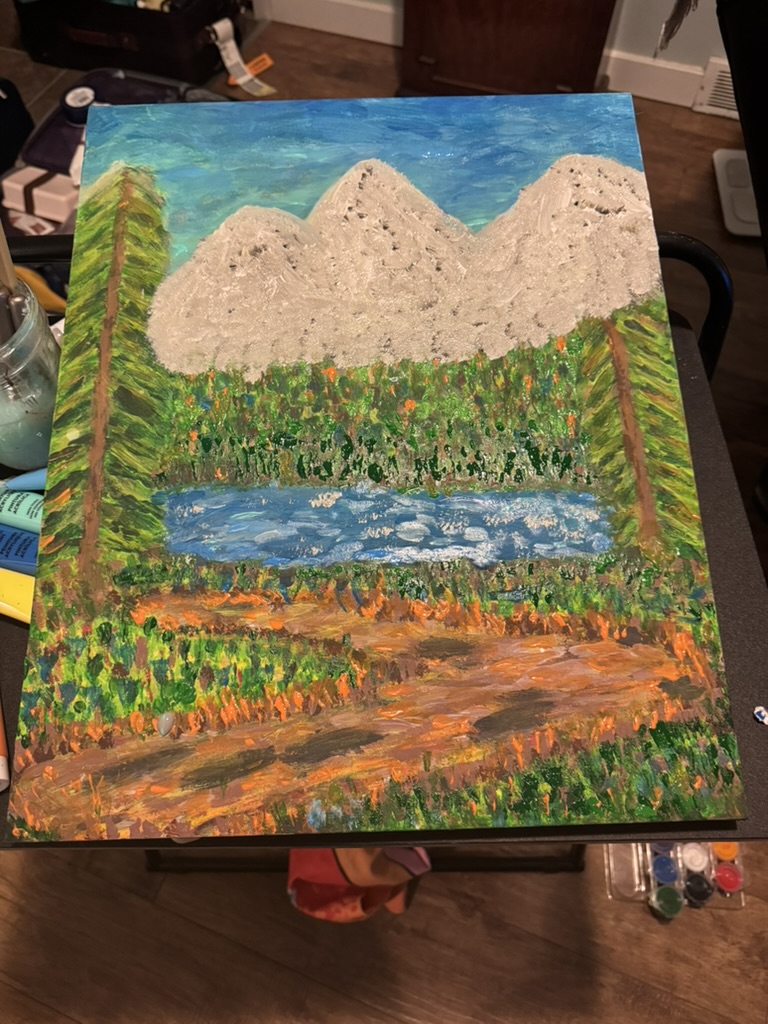
I found myself returning to the memory of mountains, as orientation rather than geography. The peaks rise in the background, steady and unmoved, holding a kind of presence that the body recognises before the mind does. In painting them, I was trying to replicate a feeling I have carried, beyond any specific place I had seen. The mountains became anchors. Forms of steadiness. Witnesses to endurance.

Below them, the forest gathers in dense strokes of green. It is textured, layered, almost overgrown. I notice how the brush moves differently here, less controlled, more instinctive. The green accumulates the way experience accumulates. Years of labour, fatigue, survival, and adaptation sedimented into the body. And yet, within that density, there are sparks of orange and yellow. Small interruptions. Signals of life persisting even in exhaustion.

The water sits in the middle of the canvas as a pause. A reflective space. A place where the eye can rest and the breath can slow. This composition arrived without conscious planning, but I recognise it now as a psychological landscape. Mountain. Forest. Water. Ground. Stability, density, restoration, and movement held in one frame.

Within the Alonetude inquiry, this painting becomes an act of re-entering relationship with land, even from memory. It is less about depicting nature and more about locating where the body still feels safe enough to soften. Painting becomes a way of touching that softness without needing to explain it.

This is a place I returned to, beyond travel.

Photo Credit: Amy Tucker, 2026
References
Bollas, C. (1987). The shadow of the object: Psychoanalysis of the unthought known. Free Association Books.
Bridges, W., & Bridges, S. (2019). Transitions: Making sense of life’s changes (40th anniversary ed.). Balance.
Porges, S. W. (2011). The polyvagal theory: Neurophysiological foundations of emotions, attachment, communication, and self-regulation. W. W. Norton & Company.
The airport layover as a site of dissociation is a form of liminality (Turner, 1969): suspended between the identity one is leaving and the one not yet formed. The "unlived life" named here is a recurring motif in the literature on ambiguous loss (Boss, 1999) — grief for a self that was foreclosed rather than lost. The body in transit, performing calm, reflects Hochschild's (1983) concept of emotional labour: the management of feeling as professional and social obligation.