January 1 is often treated as a symbolic reset, a cultural insistence that renewal can be declared on demand. Yet for many of us, particularly those shaped by long periods of precarity, caregiving, and professional vigilance, beginnings arrive with residue.
Image: The Orange Suitcase
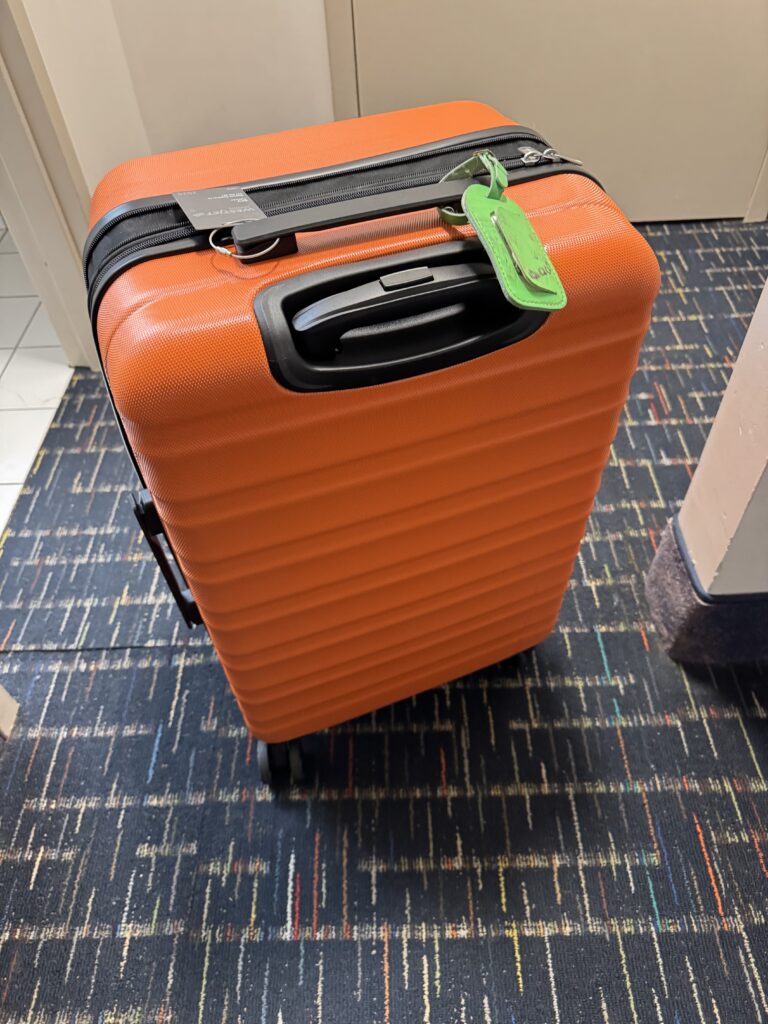
Photo Credit: Amy Tucker, January 2026
They arrive through the body.
On the morning of January 1, I pack an orange suitcase. The act is deliberate, slow, and unexpectedly revealing. Packing, I come to realise, is more than logistical. It is an embodied practice of identity negotiation. What I choose to carry, what I leave behind, and how I tolerate the uncertainty created by that space becomes a form of inquiry into who I am becoming.
Identity as Process, as Becoming
Identity is often narrated as stable or cumulative, something we have rather than something we continuously do. Sociological and narrative scholars have long challenged this assumption, arguing that identity is formed through ongoing meaning-making, particularly at moments of transition (Giddens, 1991; Bruner, 2004). January 1, framed as a beginning, intensifies this process.
As I pack, I notice what is absent. I leave behind teaching materials. I leave behind contingency plans. I leave behind symbols of productivity. This absence is intentional. For decades, my professional identity as an educator within precarious academic labour has required constant preparedness and an outward orientation shaped by what Butler (2004) describes as the demand to render oneself intelligible and viable within institutional norms. Packing without these artifacts is a quiet refusal of that script.
This is a suspension of identity rather than an abandonment. A temporary loosening that creates space for becoming.
Anxiety, Uncertainty, and the Body
Transitions often activate anxiety, particularly when identity has been tethered to performance and responsibility. Rather than conceptualising anxiety here as pathology, I approach it as a learned response to prolonged uncertainty. As Ahmed (2010) reminds us, emotions reside within relationships and structures, beyond any single individual; they circulate through social and institutional arrangements.
Packing on January 1, anxiety appears as an impulse rather than panic. The urge to overpack. The desire to anticipate every scenario. The need to force clarity before it is available. These impulses are familiar. They once served as safety strategies.
What shifts in this moment is my response. Instead of obeying the impulse to force certainty, I practice restraint. I leave space in the suitcase. I allow questions to remain unanswered. In doing so, I engage what Brown (2021) describes as vulnerability as a willingness to remain present without guarantees, beyond any performance of exposure.
This is tolerance rather than fearlessness.
Relearning Safety Through Ordinary Acts
Much of the literature on trauma-informed and somatic inquiry emphasises that safety is established experientially rather than cognitively (van der Kolk, 2014; Carello & Butler, 2015). Packing becomes one such ordinary site of relearning safety.
Folding clothes slowly. Choosing comfort over appearance. Closing a suitcase that rests easy at the seams. These small acts register in the body as signals: there is no emergency here. Nothing needs to be forced.
This reframing matters. In neoliberal academic cultures that reward speed, output, and endurance, rest and restraint are often misread as failure (Hersey, 2022). Yet what unfolds here is recalibration rather than disengagement. A shift from vigilance to attentiveness.
Title: What is Left Behind
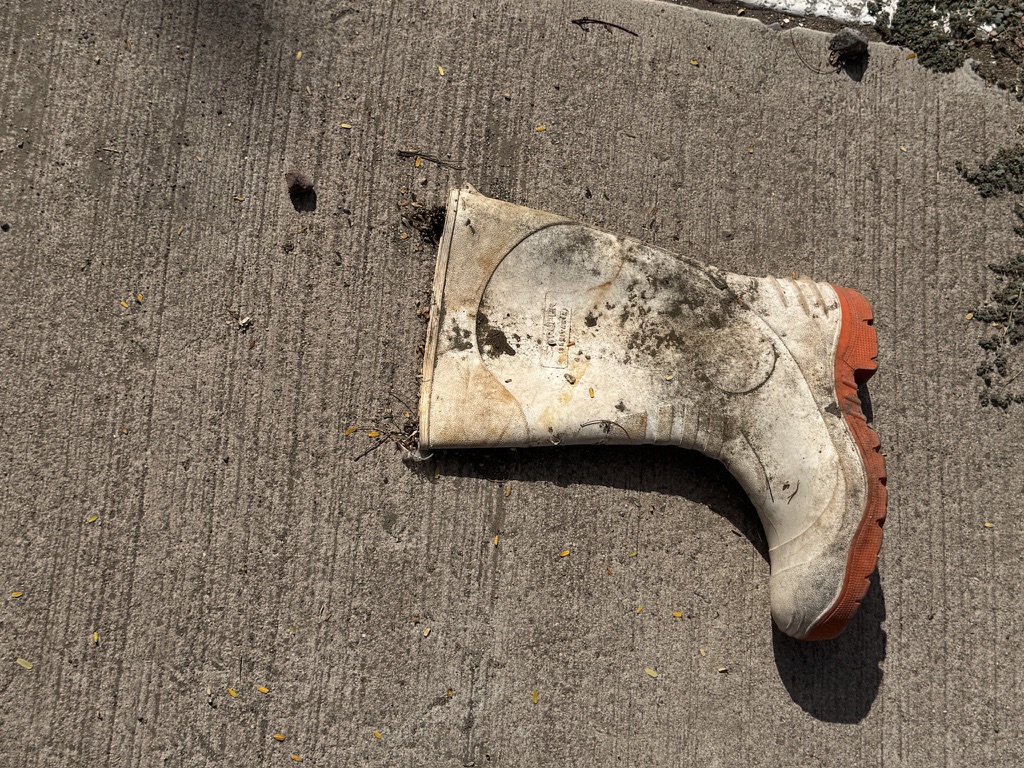
Artist Statement

It was lying alone on the concrete. A single rubber boot, worn, dirt-marked, hollowed of its wearer.

I stopped because it felt like an artifact rather than debris.

There is something about abandoned footwear that registers immediately in the body. Shoes hold weight, direction, labour. They carry the imprint of terrain and the memory of distance travelled. When separated from the person who moved within them, they become evidence without narrative.

Within the Alonetude inquiry, this image speaks to what is left behind when identity shifts. Some things are left behind when identity shifts. Some roles, expectations, and former necessities fall away quietly, without ceremony.

The boot signals completion as much as loss. It signals completion. A task finished. A terrain crossed. A version of self that no longer requires the same protection.

Placed alongside images of suitcases, thresholds, and horizons, this photograph introduces a necessary counterpoint. Departure carries what we hold alongside what we release. It is also about what we release, whether intentionally or through time.

Less is carried. More is understood.


Photo Credit: Amy Tucker, January 2026
Leaving Without Idealising Arrival
A common narrative trap in stories of departure is idealization. The assumption that leaving automatically produces healing, clarity, or transformation. I resist this framing intentionally.
As I pack, I refuse to script who I will be on the other side of this journey. The destination requires no justification for leaving. This aligns with Nash and Bradley’s (2011) description of Scholarly Personal Narrative as one that resists premature closure, allowing meaning to emerge rather than be imposed.
What I carry forward instead is presence. Attention. A commitment to noticing without narrating every experience into productivity or insight.
Title: Where the Water Holds the Sky
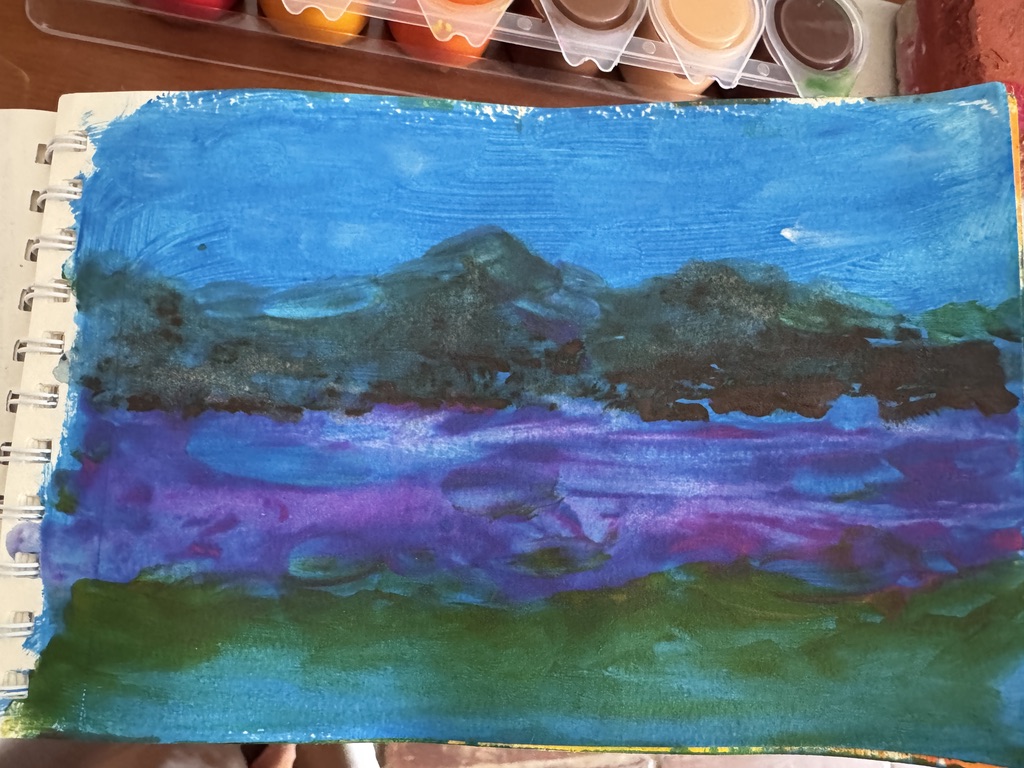
Artist Statement

This painting emerged slowly, without a preliminary sketch and without a fixed outcome. I worked in layers of blue, violet, and green, allowing the horizon to surface rather than be imposed. What appears as landscape is less geographic than somatic. It reflects how place is held in the body after extended solitude.

The darker band across the upper plane suggests mountain or shoreline, yet it resists precision. This lack of sharpness matters. Memory rarely preserves edges. It holds tone, atmosphere, and emotional temperature more than cartographic accuracy. The water below carries movement through colour rather than line, mirroring how stillness and motion coexist within reflective practice.

Within my broader inquiry on intentional solitude, painting becomes a parallel method of knowledge production. Where writing works through language and citation, visual expression registers what remains pre-verbal. The blending of pigments, the refusal to overcorrect, and the acceptance of diffusion all echo the ethical stance of alonetude: to stay with experience rather than discipline it into immediate coherence.

What interests me most is the meeting line between water and land. It is neither fixed nor symmetrical. It wavers. This wavering reflects the threshold state I often write about, the space between arrival and departure, knowing and sensing, holding and releasing.

The painting documents an internal geography rather than a specific location. It documents an internal geography shaped by time near water, open sky, and unstructured attention. It is less a representation of where I was and more an imprint of how I was while there.

Photo Credit: Amy Tucker, January 2026
January 1 as Ethical Beginning
What emerges through this act of packing is integrity rather than resolution. January 1 becomes less about reinvention and more about consent. Consent to begin again without erasing the past. Consent to carry less. Consent to meet uncertainty without escalation.
In this way, packing becomes both method and metaphor. A lived demonstration of identity as process, anxiety as information rather than command, and beginning again as a practice grounded in care rather than force.
The orange suitcase closes easily. That, too, appears to be data.
Title: Threshold Work
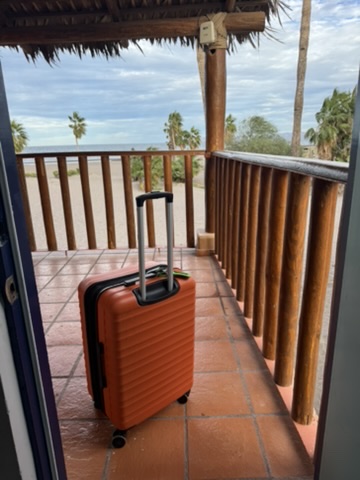
Artist Statement

There is always a precise moment when departure becomes real. It arrives beyond the booking of flights or the packing of suitcases. It happens when the bag is placed by the door and left standing there, upright and waiting. In that quiet positioning, the decision settles into the body. The balcony still held the same view that had framed my days: palms shifting lightly in the wind, the ocean stretching outward, the familiar horizon line that had slowly reorganised my internal pace. Nothing in the landscape had changed, yet something in me had.

What struck me in this moment was the composure of the suitcase itself. It felt unhurried. Unburdened. It felt deliberate. Within my research on intentional solitude, I have come to understand that departure is part of solitude's practice rather than its opposite. One enters solitude with intention, but one must also learn how to leave it without abandoning what was restored there. The suitcase, in this sense, holds more than belongings. It carries journals filled with reflection, rhythms that have slowed, breath that has steadied, and a nervous system that has had time to soften.

Standing in the doorway, I became aware that thresholds rarely announce themselves dramatically. More often they appear as ordinary architectural spaces: tiled floors, wooden railings, a partially open door. Yet these are the sites where integration begins. The work is no longer only about being away. It is about what is brought forward.

This image marks that pause. The moment of standing still long enough to recognise that something meaningful has occurred, and that it can be carried, carefully, into what comes next.

Photo Credit: Amy Tucker, January 2026
Title: Exit as a Method
Artist Statement

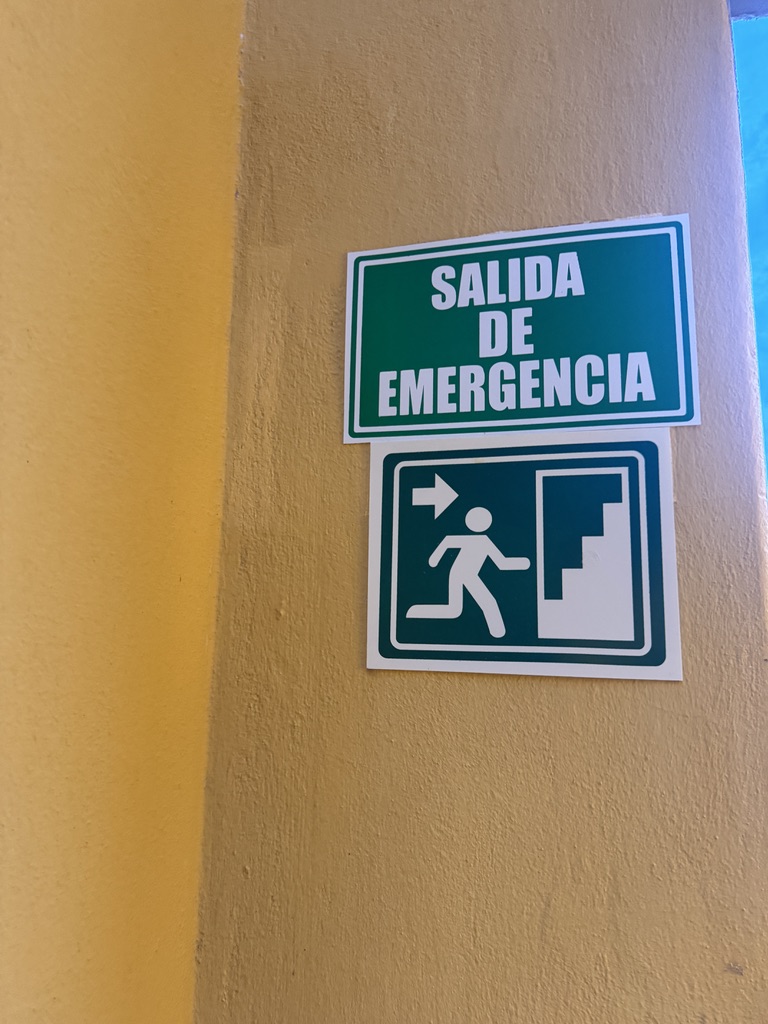
The sign appears ordinary at first glance. Functional. Directive. Institutional. Salida de Emergencia. Emergency Exit. It is designed to move bodies quickly, efficiently, without reflection. Yet what drew my attention was the quiet permission it offers rather than any urgency it implies.

In spaces shaped by productivity, expectation, and performance, exits are rarely named with such clarity. They exist, but they are obscured. Emotional exits. Cognitive exits. Spiritual exits. The pathways through which one might step away without crisis are seldom marked.

Within my research on intentional solitude and identity transition, this image registers as metaphor as much as documentation. It asks: What constitutes an emergency? Who decides when leaving is justified? And what happens when departure is restorative rather than reactive?

The figure on the sign is always in motion, always mid-stride. There is no depiction of hesitation, grief, or complexity. Institutional language simplifies leaving into action. Yet lived experience complicates it. To exit a role, an identity, or a way of being often requires extended negotiation with fear, responsibility, and belonging.

Photographing this sign became a moment of recognition. Of option rather than crisis. A reminder that leaving can be chosen with care rather than driven by collapse. It can be chosen with awareness. With timing. With care.

Within the broader Alonetude inquiry, the emergency exit becomes reinterpreted. As movement toward safety rather than escape from danger alone. A passage away from environments that demand constant readiness and toward spaces that allow restoration.

The sign remains fixed to the wall. The body, however, retains the agency to decide when the threshold has been reached.

Photo Credit: Amy Tucker, January 2026
Note. Spanish-language passages were generated using Google Translate (Google, n.d.) and subsequently reviewed and refined by the author. Any remaining infelicities reflect the limits of machine translation rather than intent.
References
Ahmed, S. (2010). The promise of happiness. Duke University Press.
Bruner, J. (2004). Life as narrative. Social Research, 71(3), 691–710.
Butler, J. (2004). Undoing gender. Routledge.
Carello, J., & Butler, L. D. (2015). Practicing what we teach: Trauma-informed educational practice. Journal of Teaching in Social Work, 35(3), 262–278.
Giddens, A. (1991). Modernity and self-identity: Self and society in the late modern age. Stanford University Press.
Google. (n.d.). Google Translate. https://translate.google.com
Hersey, T. (2022). Rest is resistance: A manifesto. Little, Brown Spark.
Nash, R. J., & Bradley, D. L. (2011). Me-search and re-search: A guide for writing scholarly personal narrative manuscripts. Information Age Publishing.
van der Kolk, B. A. (2014). The body keeps the score: Brain, mind, and body in the healing of trauma. Viking.
Packing as identity-work surfaces the concept of alonetude (Tucker, 2026) as a deliberate construction: the choice to arrive without an audience. The residue of long precarity described here connects to slow violence (Nixon, 2011) — harm accumulated so gradually that its weight only becomes visible in moments of departure. The body's reluctance to begin again reflects what Levine (2010) calls the nervous system's conservatism: prior threat states leave physiological traces that no calendar can reset.