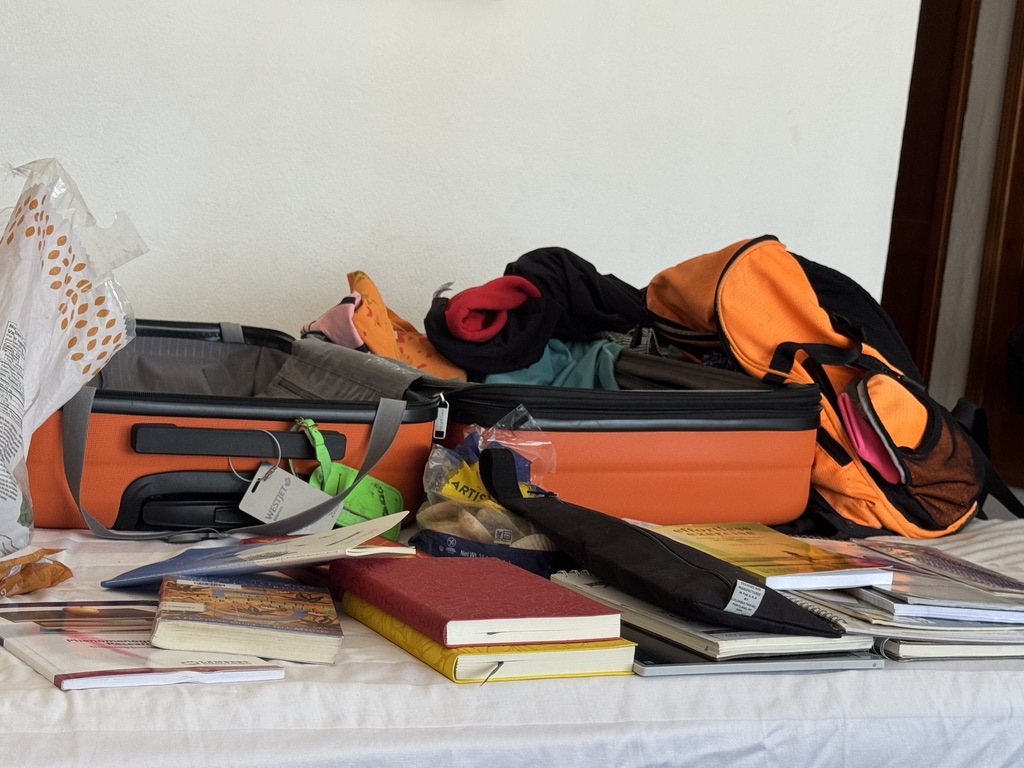
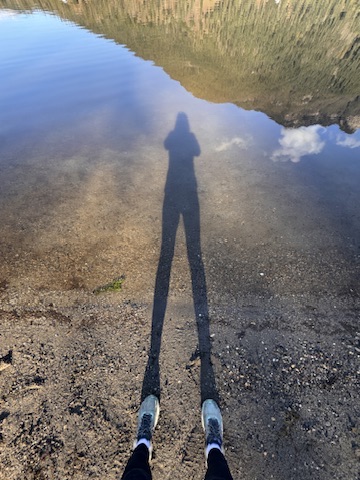
I brought one book with me to Loreto that I’ve already read three times.
The Body Keeps the Score sits on the nightstand, spine cracked, pages soft from handling. I do not open it much anymore. I do not need to. The words have moved from page to practice. But having it nearby feels important, the way certain objects become witnesses to our becoming.
How I Found This Book
I found van der Kolk’s book during a period when I couldn’t name what was wrong.
I was not in crisis. I was functioning. Teaching my classes, meeting my deadlines, and showing up where I was supposed to show up. But something had gone quiet inside me. Joy arrived less often and stayed for shorter periods. Sleep fractured into segments of vigilance. My shoulders had taken up permanent residence somewhere near my ears.
I thought this was just adulthood. Just the weight of a demanding career. Just what happens when you’ve been working contract to contract for twenty-five years, never quite sure if next semester will hold a place for you.
Then I read this sentence: “Traumatized people chronically feel unsafe inside their bodies.”
I put the book down. I looked at my hands. I noticed, for the first time in years, how tightly I was holding my own fingers.
What I Learned About the Score
Van der Kolk’s title comes from a simple observation: the body remembers what the mind tries to forget.
Every time we brace against difficulty, the body records it. Every moment of feeling unsafe, unvalued, and uncertain. Every adaptation we make to survive environments that ask too much and offer too little. The body keeps a running tally. A score.
I started noticing my own score.
The way my jaw clenched during work emails. The shallow breathing that never quite reached my belly. The startle response when my phone buzzed unexpectedly. The difficulty relaxing even when nothing was wrong, especially when nothing was wrong, because the absence of an obvious threat had become its own kind of suspicion.
These were not dramatic symptoms. They were ordinary. That was the problem. I had normalized a state of chronic bracing, and my body had been keeping score the whole time.
The Part That Changed Everything
The part of van der Kolk’s book that changed everything for me was his distinction between knowing and feeling.
He explains that you can intellectually understand that you are safe. You can know that the difficult period is over, that the threat has passed, that you survived. But your body might not believe you. The alarm system operates below the level of language. It doesn’t respond to rational argument.
This explained so much.
I understood that precarious employment was just a system, not a personal failing. I understood that institutional instability was not about me. I understood all of this. But my body still braced every time I checked my email. My nervous system still treated uncertainty as danger, even when my mind knew better.
Van der Kolk writes that insight is not enough. You cannot think your way out of a body that has learned to be afraid. You have to give the body new experiences. You have to teach the nervous system, through repetition and patience, that safety is possible.
This is why I came to Loreto.
Learning the Body’s Language
One of the most useful things van der Kolk taught me is a word: interoception.
It means awareness of internal bodily sensations. The ability to notice what’s happening inside you, to feel your own interior landscape.
I thought I had this. I was wrong.
When I first tried to check in with my body, I got nothing. Fine. Normal. Whatever. The channel was full of static. Decades of pushing through had taught me to override bodily signals rather than listen to them. I had become fluent in ignoring myself.
Here in Loreto, I’ve been practising. Every morning and evening, I sit quietly and ask simple questions. Where is there tension? What is my breath doing? What does my belly feel like today?
At first, the answers were vague. But slowly, the body has started to speak more clearly.
Tight behind the eyes today. Jaw softer than yesterday. A pulling sensation in my chest that might be grief, or might be longing, or might be something that doesn’t have a name yet.
This is what van der Kolk means when he says interoception is the foundation of agency. You cannot respond to what you cannot feel. You cannot change what you cannot notice. The first step in any different direction is simply knowing where you are.
Why the Sea of Cortez
Van der Kolk writes about what actually calms a nervous system that has learned to be afraid: rhythm, breath, movement, and environmental cues of safety.
I did not fully understand why I needed the sea until I read those words.
The waves arrive and recede with a regularity that teaches something below language. The body learns, through repetition, that things have beginnings and endings. That which rises also falls. That the next moment will come, and the one after that.
Swimming requires attention to breath in a way that ordinary life does not. I cannot swim and hold my breath due to anxiety. The water demands exhalation. It teaches my body what my mind has been trying to explain for years: you can let go, and you will not drown.
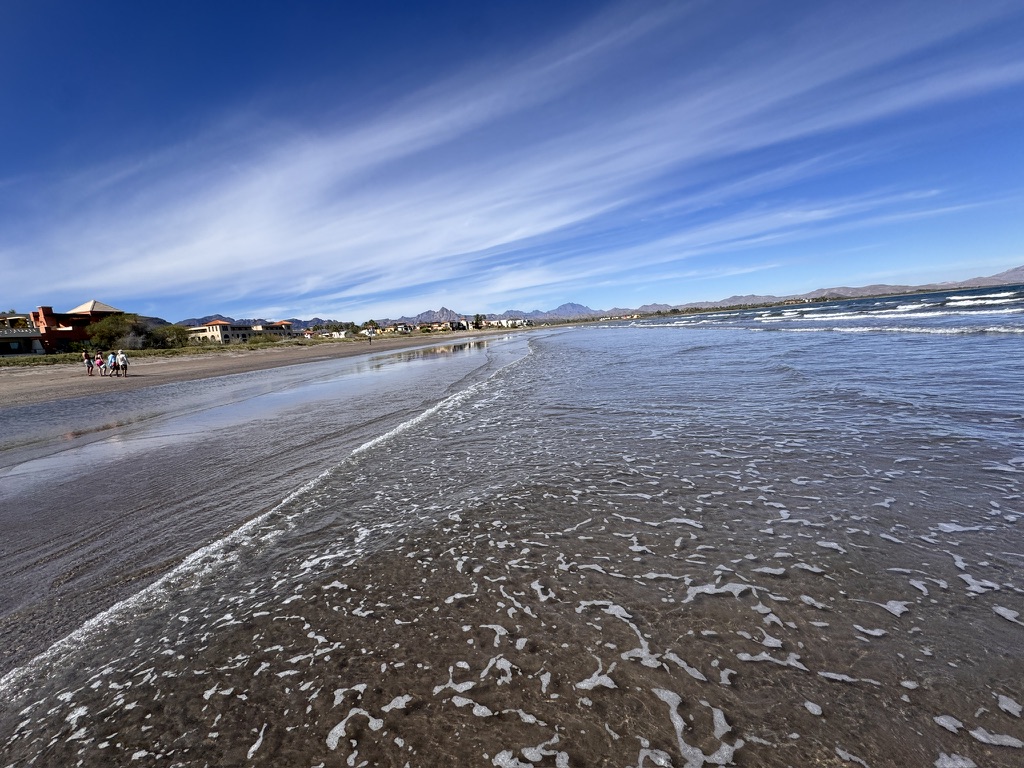
Walking the shoreline is movement without a destination. No goal except the next step. No metric except presence. The body moves, and the mind follows, rather than the other way around.
And the wideness of the horizon, the warmth of the air, the predictability of light on water, these tell the ancient parts of my brain that right now, in this moment, I am not under threat.
This is what van der Kolk calls bottom-up healing. Not thinking my way to safety, but feeling my way there. Giving my body experiences that contradict the score it has been keeping.
The Hardest Part
The hardest part of van der Kolk’s book, for me, was accepting that healing takes time.
I wanted a solution. A technique. Something I could implement and complete. But he describes recovery as a process of slowly, gently, teaching the body that the past is past. Not through insight but through experience. Not once, but over and over, until the nervous system begins to trust.
This is why thirty days.
Not because thirty days will fix everything. But because thirty days of waking in the same safe room, of walking the same peaceful shore, of breathing the same salt air might begin to shift something. The body needs repetition. It needs evidence. It needs proof that safety can be sustained.
I am not here to achieve healing. I am here to practice it.
What My Body Is Saying Now
This morning, I noticed something new.
I woke without the usual surge of anxiety. No immediate reach for my phone. No mental inventory of what might have gone wrong overnight. Just the sound of waves and the pale light of early morning and my own body, breathing.
My shoulders were down. Not because I had remembered to relax them, but because they had relaxed on their own.
I lay there for a long time, feeling the strangeness of it. This is what van der Kolk means by the nervous system learning safety. Not a thought. A state. Something the body does when it finally believes what the mind has been saying.
It did not last. By afternoon, I had found new tensions to carry. But it happened. The body is learning.
Sea Glass
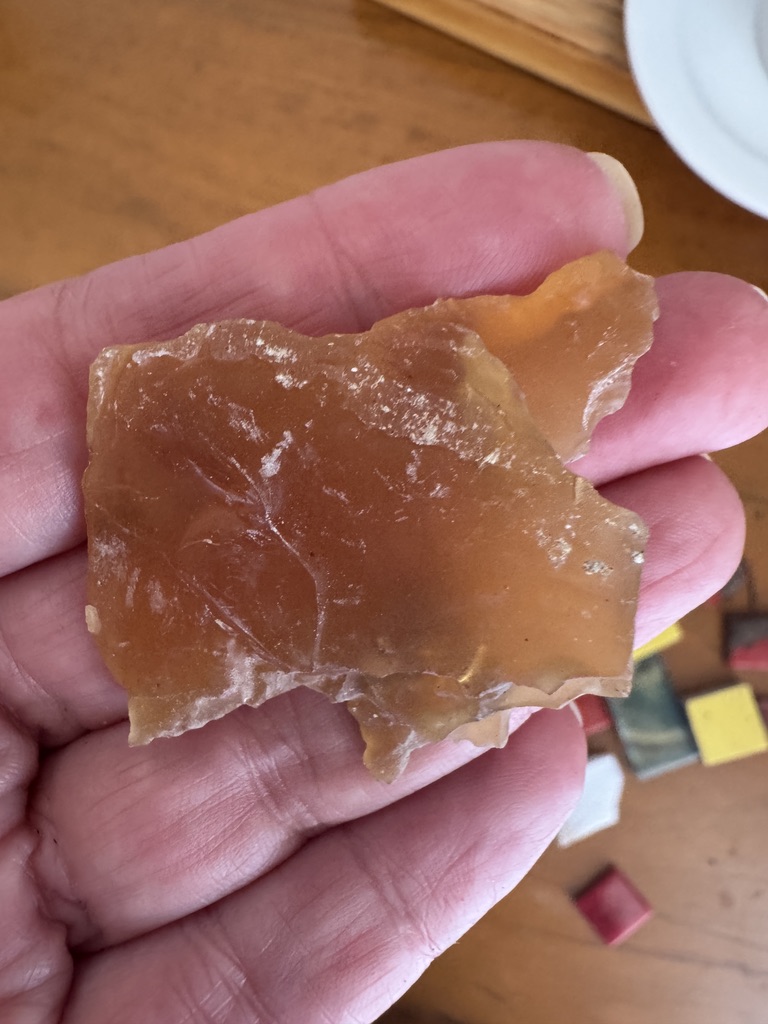
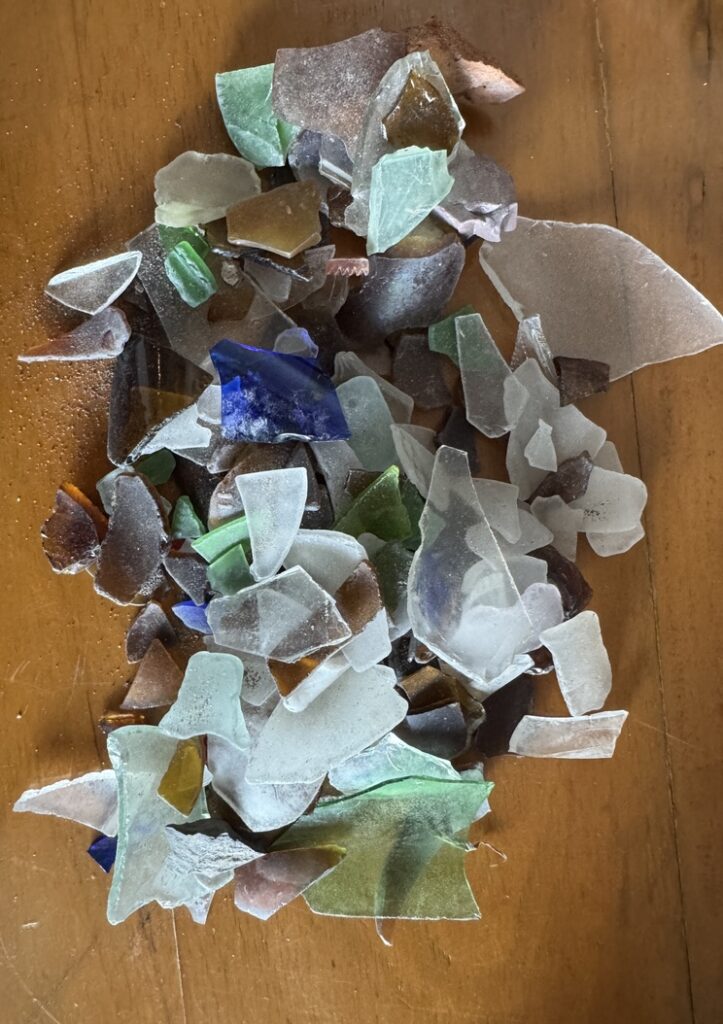
I’ve been collecting sea glass on my walks.
Each piece started as something broken. A bottle shattered against rocks. A jar that did not survive the journey. Sharp edges that could cut.
Time and salt transformed them. The tumbling softened what was dangerous. The constant motion wore away the sharpness until what remains is smooth, frosted, and safe to hold.
Van der Kolk writes about neuroplasticity, the brain’s capacity to be reshaped by experience. The nervous system that learned fear can also learn safety. The braced body can also soften.
Sea glass does not forget it was once broken. The frosted surface carries evidence of its history. But it is no longer dangerous. It has been changed by the environment in which it is held.
I think about this every time I pick up a piece of green or blue or amber glass from the sand. I think: this is what I’m doing here. Being tumbled. Being smoothed. Not forgetting, but transforming.
For Anyone Whose Body Is Keeping Score
If you are reading this, maybe your body is keeping score too.
Maybe you do not call it trauma. Maybe it’s just stress, difficulty, the ordinary accumulation of a hard life. But if your shoulders live near your ears and your sleep fractures into vigilance and your capacity for joy has narrowed into something you can barely remember, van der Kolk’s book might matter to you.
Here’s what I want you to know, from eighteen days into this experiment:
Your body’s responses are not weakness. They are adaptations. They helped you survive something. The problem isn’t that you developed them. The problem is that you might no longer need them, but they’re still running.
Healing happens through the body. Understanding why you feel the way you feel is valuable. But the nervous system needs new experiences, not just new insights. It needs to feel safe, not just know it.
Time and salt transform things. Healing does not follow schedules. But the body that has been keeping a difficult score can learn to keep a different one.
This Evening
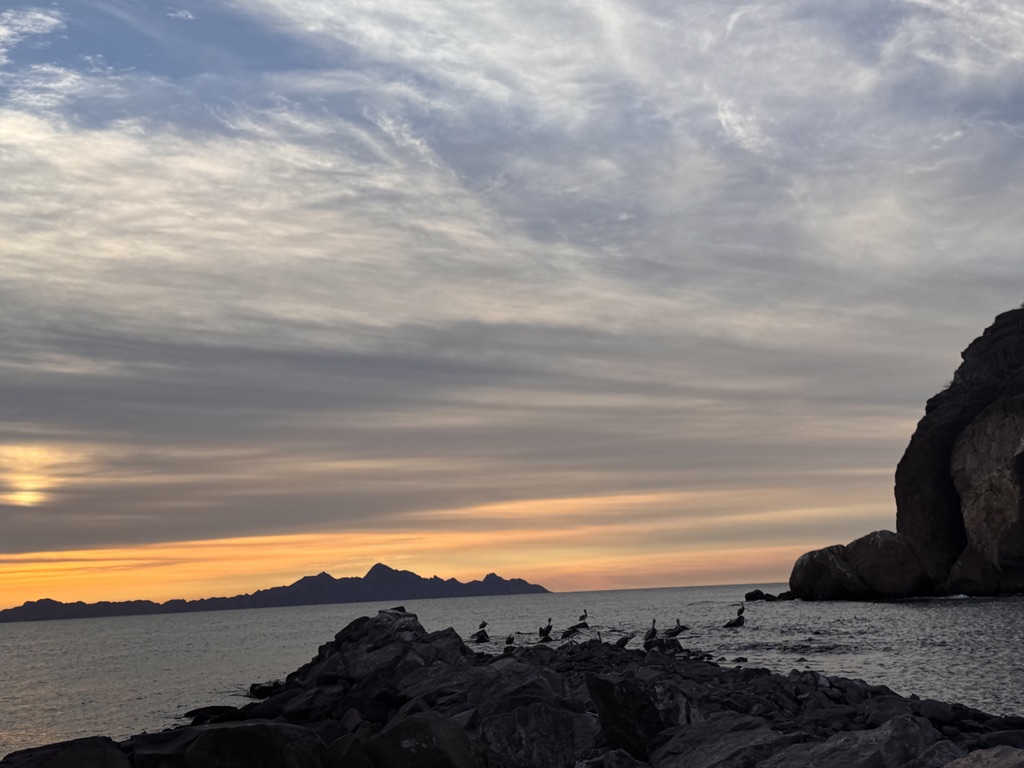
The sun is setting over the Sea of Cortez. The water has turned gold, then copper, then something darker, nameless.
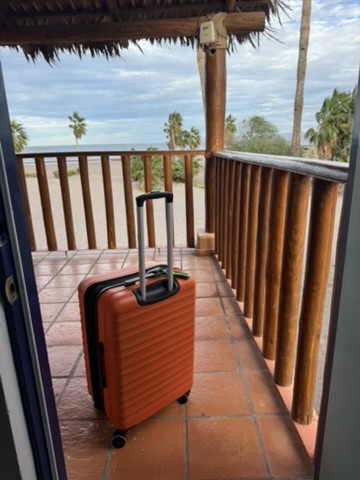
I am sitting on the balcony with van der Kolk’s book beside me, unopened. I don’t need to read it tonight. The words have become practice. The practice has become this: sitting here, watching light change, noticing that my breath is slow, my shoulders are down, and my body, for this moment, is not bracing against anything.
The score is changing.
Slowly. Imperfectly. But changing.
Reference
Van der Kolk, B. (2014). The body keeps the score: Brain, mind, and body in the healing of trauma. Viking.
Really cried. The kind of crying that starts somewhere below your ribs and moves through your whole body. The kind that makes you sit down because standing requires more structure than you have right now.
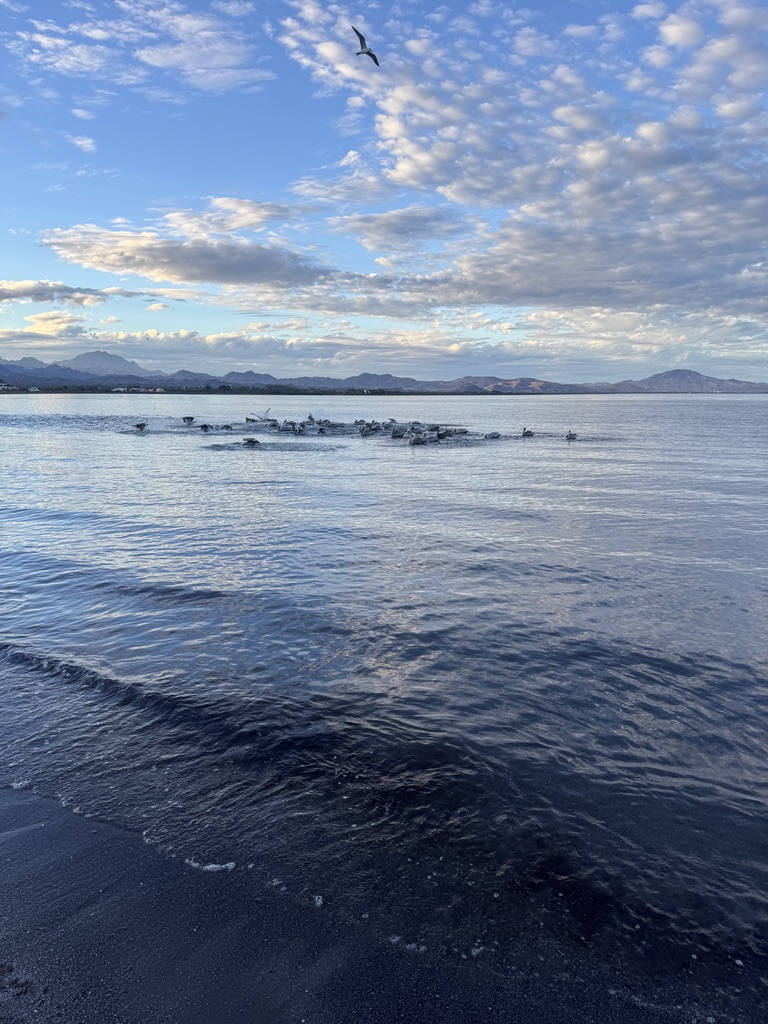
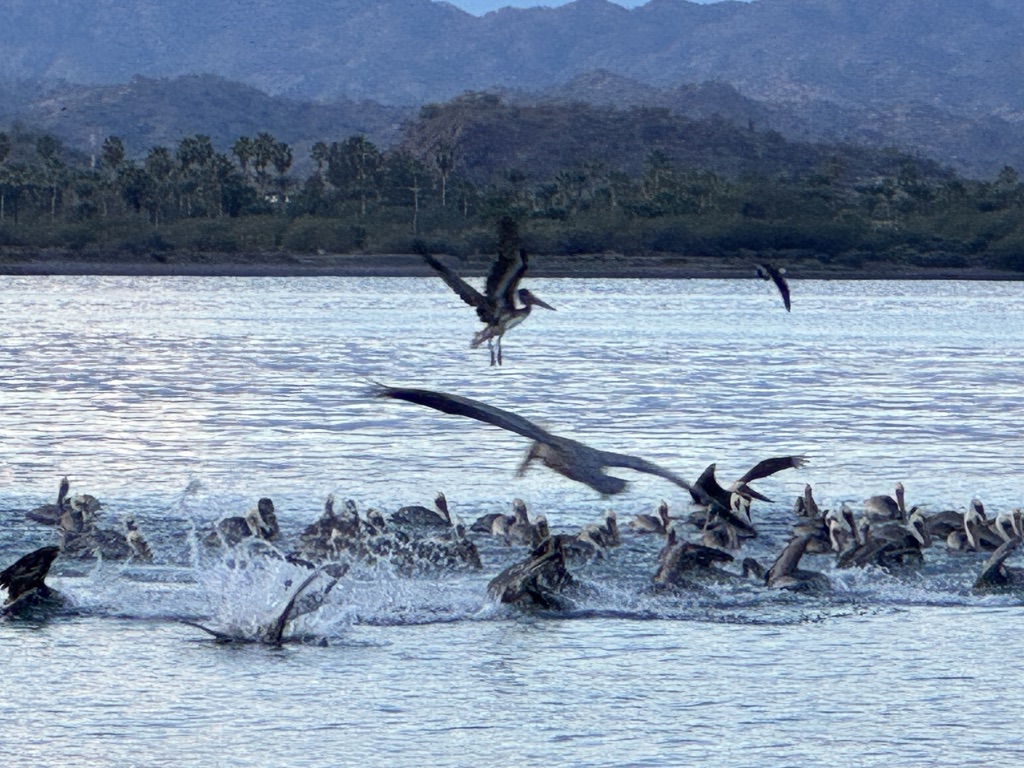
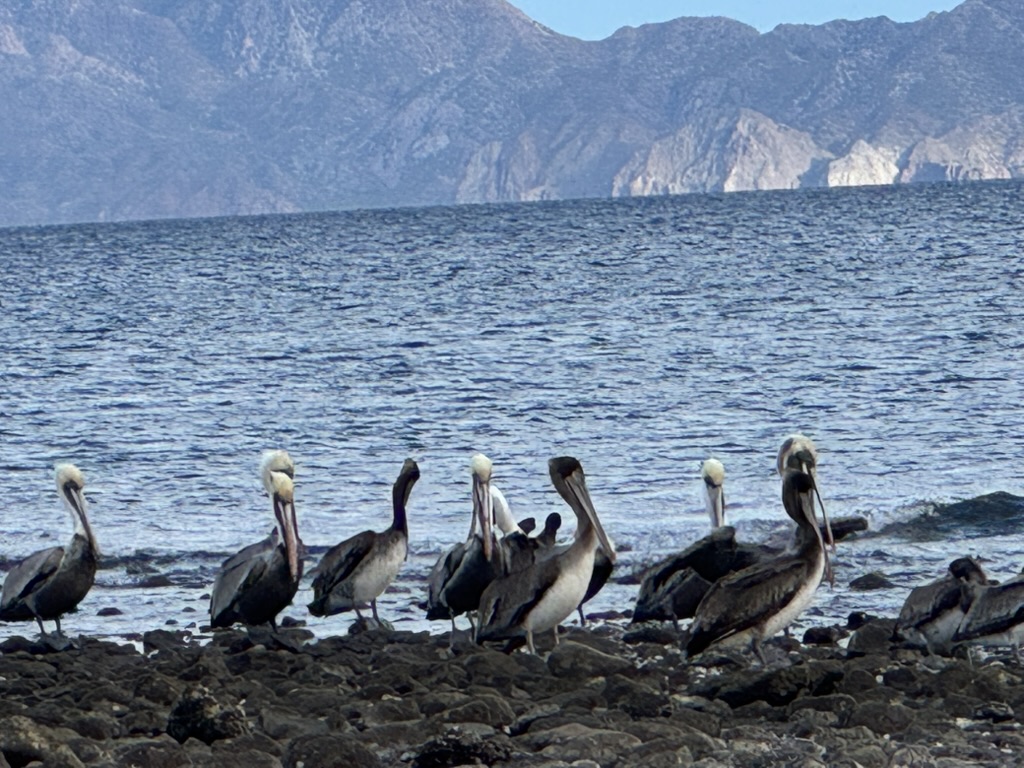
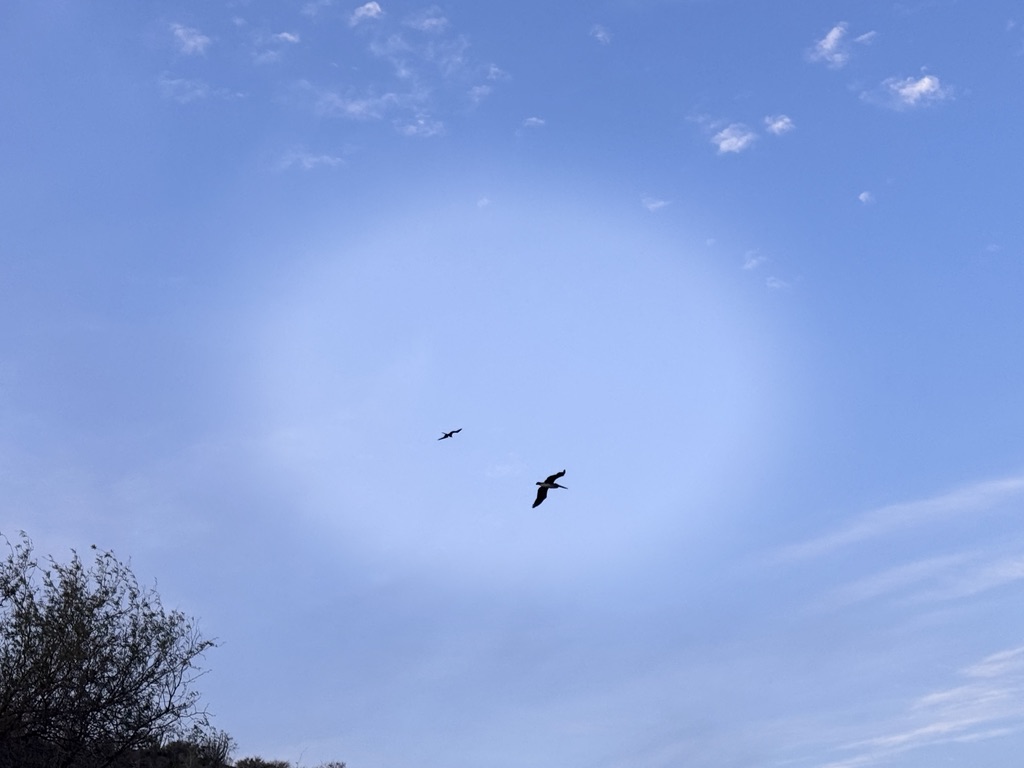
I was watching pelicans. Just watching pelicans fish. And suddenly I was weeping.
For seventeen days, I have been here, establishing safety and learning to sleep. Learning to play. Touching rocks. Watching whales. Allowing my nervous system to register that threat has passed, that I am here, that nothing is chasing me.
And this morning, my body decided it was safe enough. Safe enough to feel what I have been carrying. Safe enough to let the grief arrive.
Finalmente segura para sentir. Finally safe enough to feel.
What Greenspan Teaches About Dark Emotions
I brought Greenspan’s (2004) Healing Through the Dark Emotions with me to Mexico. Have been reading it in small pieces, letting it teach me what I am experiencing rather than rushing ahead to understand before feeling.
Greenspan argues that what we call “negative emotions” are badly felt energies, suppressed or misunderstood, rather than inherently problematic. She writes:
The dark emotions are purposeful. Their pain calls for attention, as does physical pain. (p. 88)
This stopped me in my tracks when I first read it weeks ago. Stopped me again this morning when the crying started.
The grief is purposeful. It is calling for attention. It has been calling for seventeen days, but I could hear it only once my nervous system registered enough safety to allow it.
El dolor tiene propósito. The pain has purpose.
Greenspan identifies grief as one of three “dark emotions” alongside fear and despair. She refuses to call them negative, insisting that “the energy of dark emotions is just energy” (p. 86). What makes emotions toxic is how we handle them: suppressing, denying, transcending prematurely, avenging, and escaping. The emotions themselves are neutral. Essential. Carrying information our bodies need us to know.
This reframes everything.
For five months before this retreat, I carried enormous grief. Witnessing someone I love disappear into addiction. Watching helplessly as the person I knew was displaced by someone whose behaviour felt profoundly other. Boss (1999) calls this ambiguous loss: grief without closure because the person remains physically present while psychologically transformed.
Turkey Vulture
Photo Credit: Amy Tucker, 2026
But I could cry about nothing else. My nervous system was in constant threat response. Porges (2011) explains that the social engagement system (which supports emotional expression, connection, and facial expressiveness) goes offline during sympathetic activation or dorsal vagal shutdown. You cannot process grief when your body is preparing for fight or flight or freeze.
So I carried it. Held it. Waited.
And this morning, watching pelicans, my nervous system signalled: it is safe now. You can feel this now.
Ahora es seguro. Now it is safe.
The Three Skills of Emotional Alchemy
Greenspan offers what she calls “emotional alchemy,” transforming dark emotions from lead into gold through three core skills:
Skill 1: Attending. Learning to listen to the emotion. To notice it. To turn toward it rather than away. (p. 75)
Skill 2: Befriending. Feel it to heal it. Allowing the emotion to be present without trying to fix, change, or understand it. Just feeling it. (p. 76)
Skill 3: Surrendering. To let it go, you have to let it flow. Allowing the emotion to move through you, trusting that emotions are temporary, that they crest and subside like waves. (p. 78)
Sitting on the patio this morning, pelicans fishing below, I practiced these skills.
An Afternoon Scratch
Photo Credit: Amy Tucker, 2026
I attended. Noticed the tightness in my chest. The way my breath was catching. The pressure behind my eyes. The heat in my throat. I turned toward the grief rather than distracting myself with coffee, reading, or planning the day.
I befriended. Sat with the feeling. Did my best to allow it without needing to understand why pelicans triggered weeping. Without needing to make sense of timing. Without needing the emotion to be different from what it was. Just: this is grief. It is here. It is allowed to be here.
I surrendered. Let the crying happen. Let it move. Let it flow without trying to contain or control or finish it quickly. Greenspan writes that “the art of surrendering to fear is the art of living” (p. 195). The same is true for grief. Surrendering to grief is allowing life to move through you honestly.
Greenspan opens one chapter with this: “The open heart is the doorway, inviting angels in, revealing that the world—even in the pit of hell—is charged with the sacred” (p. 25).
This terrifies me and compels me at the same time.
For seventeen days, I have been building protection. Routine. Predictability. Environmental consistency. The conditions that allow the nervous system to regulate. And this has been necessary. Essential. I could do nothing else first.
But now protection is sufficient that I can afford brief moments without it. Can afford to open slightly. Can afford to let grief arrive.
Greenspan calls this “vulnerability as the power of no protection.” She writes:
But vulnerability is not just about hurting. It is about openness. Not only to pain, adversity, loss, and death, but also to the things we most desire and cherish: to love, intimacy, creativity, sex, birth, wonder; to being truly touched by another human being, being truly seen for who we are; to the sheer adventure of being alive; to the sacred spirit that imbues the world.
This is what alonetude is teaching me. That safety is the condition that allows vulnerability rather than its opposite. That I came here to establish enough protection that I could risk having no protection. The open heart requires the regulated nervous system first.
La vulnerabilidad requiere seguridad primero. Vulnerability requires safety first.
Brené Brown (2012) writes extensively about vulnerability requiring courage. But what I am learning here is that vulnerability also requires nervous system regulation. You cannot risk openness when your body is in chronic threat. Cannot allow grief to flow when every resource goes toward survival.
I See You
Photo Credit: Amy Tucker, 2026
Alonetude creates conditions where vulnerability becomes possible. Where dark emotions can arrive because the body finally trusts that it can handle them.
Emotions Live in the Body
One of Greenspan’s seven foundations is this: “Emotions live in the body, in the world” (p. 88).
This feels obvious once you pay attention, but for most of my life, I believed emotions lived in my head. Was that crying something you decided to do or not? That grief was a cognitive state you could think your way through.
But this morning taught me otherwise. The grief arrived somatically before I had conscious thought about it. My chest tightened. My breath caught. My eyes filled. Only then did my mind notice: oh. I am crying. Something is moving through me.
Van der Kolk (2014) emphasizes this: the body keeps the score. Emotions are stored in the nervous system, accessed through somatic pathways rather than through thought. This is why talk therapy alone often fails with trauma. The body holds what language cannot reach.
El cuerpo guarda lo que las palabras no pueden tocar. The body holds what words cannot touch.
Watching myself cry this morning, I understood something new. The grief was never absent. It was present all along, stored in my body, waiting for conditions where it could be processed safely. My nervous system was protecting me by keeping it stored until I had capacity to feel it. Now, seventeen days into alonetude, capacity has increased slightly. Enough for this morning’s grief. Probably insufficient for all the grief I carry. But enough for today.
This is what Porges (2011) describes: nervous system regulation as creating capacity for emotional experience. When we are dysregulated, we cannot access the full range of emotional life. Regulation restores access gradually, bit by bit, as the system learns safety.
Dark Emotions
Greenspan offers a process for working with dark emotions that feels remarkably similar to what I have been doing intuitively:
Step 1: Intention. Focusing your spiritual will. Deciding consciously to work with the emotion for healing and transformation. (p. 79)
Step 2: Affirmation. Developing an emotion-positive attitude. Believing that emotions are purposeful rather than problematic. (p. 80)
Step 3: Bodily Sensation. Sensing, soothing, naming emotions as they arise in the body. (p. 80)
Step 4: Contextualization. Telling a wider story. Understanding the emotion within its broader personal and social context. (p. 83)
Step 5: Non-Action. Befriending what hurts. Being simply present without trying to avoid, cling to, fix, or even understand. (p. 85)
Step 6: Action. Social action, spiritual service. Hearing what the emotion is asking of you and responding from the heart. (p. 85)
Step 7: Transformation. The way of surrender is allowing the emotion to flow and transform naturally. (p. 86)
This morning, I moved through these steps without consciously intending to:
I set an intention by recognizing grief was present and choosing to sit with it rather than distract myself.
I affirmed that grief is purposeful by remembering Greenspan’s teaching that dark emotions carry essential information.
I attended to bodily sensation: tightness, heat, pressure, trembling, the specific texture of grief in my chest and throat.
I contextualized this grief by connecting it to five months of witnessing addiction, to ambiguous loss, to the accumulated weight of helplessness.
I practiced non-action by simply sitting. Not trying to make the crying stop. Not trying to understand it fully. Just being with it.
Action will come later. For now, the grief is teaching me what it needs to teach.
And transformation is happening whether I direct it or experience it passively. The crying eventually subsided. My breath evened. The pressure eased. Something shifted. Something moved. Something that was stored became something that flowed.
Algo que estaba almacenado se convirtió en algo que fluyó. Something that was stored became something that flowed.
Pelicans Flying Over the Sea
Photo Credit: Amy Tucker, 2026
What This Means
Alonetude is proving more complex than I initially understood.
I came here thinking alonetude was about rest. About nervous system regulation. About recovering playfulness and establishing a routine. And it is all of those things.
But alonetude is also about creating conditions where difficult emotions can finally be processed. Where grief that has been held in the body for months can surface because the nervous system finally has capacity to feel it.
Greenspan writes that “without a listener, the healing process is aborted” (p. 14). In conventional therapeutic contexts, the listener is the therapist. But in alonetude, the listener is the self. Is the body attending to itself? Is the nervous system learning to hold what it previously could hold only in stored, frozen form?
En la alonetud, me escucho a mí misma. In alonetude, I listen to myself.
This feels important methodologically. Scholarly Personal Narrative (Nash, 2004) positions lived experience as legitimate data when properly contextualized. But what I am learning is that some lived experiences cannot be accessed until nervous system conditions allow it. The data exists in the body but remains inaccessible until safety permits processing.
Alonetude creates these conditions. Seventeen days of consistent safety. Seventeen days of routine. Seventeen days of play returning, of rocks teaching, of whales breathing, of stones offering patience. All of this accumulated into sufficient nervous system regulation that this morning my body decided: now. Now we can feel the grief about what happened before we came here.
Sands of Time
The Widsom of Grief
Greenspan calls this “the wisdom of grief” (2004). She argues that grief serves crucial functions:
It connects us to what we have loved and lost
It teaches us about attachment and impermanence
It opens our hearts to compassion
It reminds us we are vulnerable, alive, and capable of deep feeling
It transforms us from who we were before loss into who we become through integrating loss
Sitting here now, hours after this morning’s crying, I feel different. Lighter somehow. As though releasing some of the stored grief made space for something else. Made breathing easier. Made my chest less tight.
This is what Greenspan means by transformation. From grief to gratitude. Not that gratitude replaces grief, but that moving through grief makes gratitude accessible again. Makes joy possible. Makes life feel less heavy.
Del dolor a la gratitud. From pain to gratitude.
The pelicans are still fishing. The sea is still calm. The stones still sit patiently, teaching their lessons about deep time. Nothing external has changed.
But something internal has shifted. Some energy that was frozen is now flowing. Some stored emotion is now being partially processed.
And I am grateful. Grateful that my body knew to wait until safety was established. Grateful that alonetude created conditions where grief could arrive. Grateful for Greenspan’s framework that helps me understand what is happening. Grateful for the pelicans who somehow triggered the release I needed.
Figure: Safe Enough to Feel
Credit: NotebookLM, 2026
Can You See Me?
Photo Credit: Amy Tucker, 2026
Gracias por la seguridad que permite sentir. Thank you for the safety that permits feeling.
Gracias por el dolor que enseña. Thank you for the pain that teaches.
Gracias por las lágrimas que fluyen. Thank you for the tears that flow.
Gracias por el cuerpo que sabe cuándo es el momento. Thank you for the body that knows when it is time.
Frameworks and Concepts for Healing Dark Emotions
Concept or Framework Name
Author(s) or Source Cited
Key Definition or Description
Associated Stages or Skills
Somatic or Psychological Purpose
Source
Emotional Alchemy
Greenspan (2003)
Dark emotions are purposeful energies that carry essential information; their pain calls for attention, like physical pain, for healing and transformation.
Dark emotions are purposeful energies that carry essential information; their pain calls for attention similar to physical pain for the purpose of healing and transformation.
[1]
Polyvagal Theory / Social Engagement System
Porges (2011)
A neurophysiological framework explaining how the nervous system regulates emotional expression and connection based on perceived safety or threat.
Creates the capacity for emotional experience; the body must register safety to move out of threat response and allow the social engagement system to process grief.
[1]
Alonetude
A state of intentional solitude is used to establish safety, routine, and nervous system regulation.
A state of intentional solitude used to establish safety, routine, and nervous system regulation.
Establishing safety, learning to sleep/play, touching rocks, watching nature, and establishing routine.
Creates conditions in which the body finally trusts it can handle and process stored, frozen emotions like grief.
A state of intentional solitude is used to establish safety, routine, and nervous system regulation.
The Body Keeps the Score / Somatic Storage
Van der Kolk (2014)
The concept that emotions and trauma are stored in the nervous system and body rather than just as cognitive thoughts.
Accessing somatic pathways rather than just language or talk therapy.
The body protects the individual by storing emotions until the nervous system has the capacity to process them safely.
[1]
Vulnerability as the Power of No Protection
Greenspan (2003); Brown (2012)
An openness not just to pain and loss, but to love, intimacy, and wonder; it is the state of having an open heart allowed by a regulated nervous system.
Requires nervous system regulation and courage.
Allows an individual to be truly touched or seen and to experience the “sheer adventure of being alive” once sufficient protection/safety is established.
[1]
Ambiguous Loss
Boss (1999)
A type of grief occurring without closure because a person remains physically present but is psychologically transformed or absent (e.g., through addiction).
Not in source
Identifies the specific source of unresolved grief where typical closure is unavailable.
[1]
Scholarly Personal Narrative (SPN)
Nash (2004)
A methodological approach that positions lived experience as legitimate data when properly contextualized.
Contextualizing lived experience.
Validates the individual’s personal journey and bodily experiences as a source of knowledge and truth.
[1]
Note: Safe Enough to Feel: The Alchemy of Grief, Source Blog Post Day 17, 2026
References
Boss, P. (1999). Ambiguous loss: Learning to live with unresolved grief. Harvard University Press.
Brown, B. (2012). Daring greatly: How the courage to be vulnerable transforms the way we live, love, parent, and lead. Gotham Books.
Greenspan, M. (2004). Healing through the dark emotions: The wisdom of grief, fear, and despair. Shambhala Publications.
Nash, R. J. (2004). Liberating scholarly writing: The power of personal narrative. Teachers College Press.
Porges, S. W. (2011). The polyvagal theory: Neurophysiological foundations of emotions, attachment, communication, and self-regulation. W. W. Norton & Company.
Van der Kolk, B. (2014). The body keeps the score: Brain, mind, and body in the healing of trauma. Viking.
The Life Stories of Stones: Trauma, Alonetude, and Learning Through Deep Time
I have come to understand that stones carry life stories.
Las piedras hablan. The stones speak.
Stone Wash
Photo Credit: Amy Tucker, 2026
They speak through surface and fracture, through accumulation and erosion, through the long patience of matter shaped by time. Sitting with stone has shifted how I understand trauma, recovery, and the specific quality of solitude I am calling alonetude: intentional, embodied, chosen solitude as healing practice. The land has become both witness and teacher, offering forms of knowing that sit beyond language yet resonate deeply with what scholarship on place, embodiment, and healing has long described.
This is methodological work. Nash (2004) argues that Scholarly Personal Narrative honours lived experience as legitimate scholarly data when properly contextualized within theoretical frameworks. What follows represents this integration: a personal encounter with stone, theoretical frameworks that help me understand what I am experiencing, and the development of alonetude as both a lived practice and a conceptual contribution.
The stones offer what I am calling the pedagogy of deep time, a form of land-based learning that operates at a geological rather than a human scale, providing perspective on trauma recovery that conventional therapeutic timelines cannot access.
Aprendo del tiempo profundo. I learn from deep time.
What the Tide Leaves
Photo Credit: Amy Tucker, 2026
The Story of Transformation: Holding Heat Without Burning
One volcanic rock face appears frozen mid-flow, capturing the precise moment when molten lava solidified. Its early life was shaped by intensity and force. Heat moved the land. Fire restructured matter.
Over time, that same surface has become a place of quiet shelter. Lichens grow. Birds rest. The stone carries the memory of heat without reliving it.
Recuerda el fuego sin arder. It remembers the fire without burning.
Photo Credit: Amy Tucker, 2026
Linking to Trauma Theory:
Herman (2015) describes trauma recovery as occurring in stages: establishing safety, reconstructing the trauma narrative, and restoring connections with others. But she acknowledges that recovery is neither linear nor complete. Some trauma leaves permanent marks even as healing proceeds. The volcanic stone embodies this precisely. The violence of eruption is permanent in the stone’s composition and structure, yet the stone is also transformed—cooled into something that can be touched, that can hold life, that functions as a foundation rather than an active threat.
Van der Kolk (2014) writes that trauma resolution occurs when the body learns safety again rather than through cognitive understanding alone. The stone teaches this lesson through its material presence. My body responds to the touch of the stone that was once fire. My nervous system registers: this heat has cooled. This violence has integrated. This danger has passed. The teaching is somatic, pre-reflective, accessed through touch rather than through thought.
El cuerpo aprende lo que la mente no puede enseñar. The body learns what the mind cannot teach.
Alonetude as a Necessary Condition:
This learning requires the specific conditions alonetude provides. Alonetude differs from loneliness (involuntary, depleting) and from simple solitude (neutral absence of others). Aloneness is intentional, embodied, chosen solitude undertaken with a specific purpose: to create conditions where nervous system regulation becomes possible, where body knowledge can emerge, where integration can occur at the pace trauma requires rather than the pace productivity demands.
What the Tide Leaves
Photo Credit: Amy Tucker, 2026
In alonetude, I have time to sit with this stone. To touch it repeatedly over days. To allow my body to learn from it without hurry, without interpretation, without needing to translate the experience into productivity or outcome. The stone’s patience meets my need for slow learning. Alonetude creates the temporal and spatial conditions where this encounter becomes transformative rather than merely observational.
La soledad intencional crea espacio para sanar. Intentional solitude creates space for healing.
The Story of Survival: Fracture as Record
A tall rock split by a narrow vertical fracture stands nearby. Light passes through the opening. The break records a moment when pressure exceeded capacity. Thermal shock. Accumulated stress. A single event or many.
The defining part of this story lives in what followed. The stone remains upright. Gravity and friction hold its halves together. Endurance continues.
La fractura no es el final. Es parte de la historia. The fracture is not the end. It is part of the story.
Embodied Epistemology:
Merleau-Ponty (1945/2012) argues that we know the world primarily through our bodies before we know it through concepts. Looking at this fractured stone, I understand fracture differently than I would through reading about structural failure. My body reads the crack as a text. My hands want to touch it. My eyes trace the line from bottom to top. My breathing synchronizes with the stone’s stillness. This is what Sheets-Johnstone (2011) calls kinesthetic knowing, knowledge that emerges through movement and sensory engagement rather than through abstract reasoning.
The fractured stone teaches through its material presence. The crack is visible. Light passes through. Yet the stone stands. Has stood for millennia. Will stand for millennia more. My body learns from this: fracture and standing can coexist. Breaking and continuing can be simultaneous rather than sequential.
Photo Credit: Amy Tucker, 2026
Roto pero de pie. Broken but standing.
Linking to Personal Trauma Context:
For five months before this retreat, I witnessed an addiction crisis in someone I love. The vigilance fractured something in me, fractured my capacity for rest, for trust, for allowing things to unfold without constant monitoring. Figley (1995) calls this secondary traumatic stress or compassion fatigue: the emotional and psychological impact of sustained exposure to another’s trauma. Boss (1999) terms it an ambiguous loss: grief without closure, living loss, frozen grief because the person remains physically present while psychologically transformed.
El dolor sin cierre. The pain without closure.
The fractured stone offers a different narrative than clinical diagnoses provide. It says: you broke under pressure that exceeded your capacity. This is honest. This is a record of what happened. And you remain standing. The fracture is now part of your structure. Part of your story. It has made you different, but has brought nothing to an end.
In alonetude, I can sit with this teaching. Can allow the stone’s fracture to normalize my own. Can stop pathologizing what happened to me and start recognizing it as a truthful response to impossible conditions.
La verdad sobre lo que rompió. The truth of what broke.
The Story of Accumulation: Becoming Through Layers
At the waterline, a stone is fully covered in barnacles. Its original surface no longer shows. Time here works through attachment rather than loss.
Las capas cuentan la historia. The layers tell the story.
Feminist Epistemology and Situated Knowledge:
Haraway (2013) argues against the “god trick” of seeing from nowhere, from no body, with no particular situated perspective. She insists that all knowledge is situated, embodied, and particular. The barnacle-covered stone embodies this epistemology. The stone’s “original” state is no more real or valuable than its current state. Both are legitimate. Both are true. Both constitute the stone’s being at different moments in its becoming.
This challenges the therapeutic narrative that positions healing as a return to some pre-trauma state. Alcoff and Gray (1993) critique this in survivor discourse: the assumption that there exists some “authentic self” that trauma covered over and that must be excavated, recovered, and restored. But what if, as the barnacle-covered stone suggests, we are always the sum of what has accumulated? What if there is no pure original state to return to because identity forms through layering rather than through preservation of the untouched core?
No hay yo original que recuperar. Soy la suma de lo acumulado. There is no original self to recover. I am the sum of what has accumulated.
Alonetude as Epistemological Practice:
In alonetude, I stop seeking to return to some earlier version of myself. The thirty days by the sea are creating a different epistemological stance: acceptance of accumulation. Recognition that sixty years of lived experience—jobs held, places inhabited, people loved, losses carried, joys known—have created the person I currently am. The barnacles are the story, alongside the stone. I am both stone and barnacles. Both foundation and accumulation.
This represents what Code (1991) calls epistemic authority: the right to be heard as a credible knower. For twenty-five years of precarious academic employment, my epistemic authority was constantly questioned. My knowledge claims required defending. My lived experience needed validating through external frameworks. The barnacle-covered stone teaches a different epistemology: accumulated experience creates rather than corrupts knowledge. The layers tell the story. All of it together constitutes what can be known from this particular situated location.
Mi experiencia es conocimiento legítimo. My experience is legitimate knowledge.
The Story of Longing: Reaching as Meaning
Five stone pillars rise from the sea, shaped by erosion that removed everything around them. They look like fingers reaching skyward. For millions of years, they have extended upward without touching what they reach toward.
Alcanzar sin llegar. To reach without arriving.
Linking to Meaning-Making Research:
Park (2010) defines meaning-making as the process through which individuals integrate difficult experiences into their life narratives in ways that restore coherence and purpose. Traditional meaning-making research often implies that meaning is found through resolution, through making sense of what happened in ways that allow closure.
But the reaching stone pillars suggest a different model. They have been reaching for millions of years. They will never grasp the sky. Yet the reaching itself constitutes their meaning, their purpose, their way of being in the world. Resolution is neither necessary nor possible. What matters is orientation, direction, and the sustained effort toward something beyond current grasp.
Frankl (1959/2006) argues that meaning comes from orientation toward what matters rather than from the achievement of specific outcomes. The stone pillars embody this. Their reach creates their significance. Their effort defines their being. Arrival is irrelevant because the reaching itself is the point.
El esfuerzo mismo importa. The effort itself matters.
Alonetude and Reconceptualizing Success:
Standing (2011) describes the precariat as a class of workers in chronic insecurity, always preparing to leave, unable to establish roots, and constantly vulnerable. Twenty-five years of contract work taught me the lesson of precarity: reaching equals grasping, or it equals failure. If you are reaching toward something (security, stability, permanence) and fail to grasp it, you have failed.
Veinticinco años de inseguridad. Twenty-five years of insecurity.
The stone pillars teach otherwise. In alonetude, I can allow this different model. Can recognize that much of what I have been reaching toward (permanent employment, financial security, recognition within academic hierarchies) may never be grasped. But the reaching itself—the effort toward meaningful work, toward contributing to knowledge, toward supporting students, toward living with integrity—that reaching has value independent of whether it culminates in traditional markers of success.
This is what alonetude allows: space to reconceptualize what success might mean when conventional metrics remain inaccessible. Space to let reaching be enough.
Rock Pillars
Photo Credit: Amy Tucker, 2026
El alcance basta. The reaching is enough.
The Story of Erasure: What Endures Through Wearing Away
A smooth rock face bears the mark of wind, sand, and tide. Everything that once protruded has been worn down through repetition. What remains resists.
Lo que queda resiste. What remains resists.
Deep Time as Therapeutic Frame:
Bjornerud (2018) calls this timefulness, the capacity to recognize that everything exists in time, that what looks solid and permanent is actually fluid and changing when viewed at an appropriate scale. The smooth stone is being worn away grain by grain. In a million years, it will be noticeably smaller. In ten million years, it might be gone entirely, returned to sand, redistributed across the seafloor.
This scale reframes trauma recovery. Porges (2011) emphasizes that nervous system regulation happens gradually through repeated experiences of safety rather than through single interventions. Each safe encounter removes some infinitesimal amount of hypervigilance. Each moment of rest slightly reduces chronic activation. Over time, over much more time than our urgency wants, the system transforms.
Grano por grano. Momento por momento. Grain by grain. Moment by moment.
The smooth stone teaches patience with this process. A transformation that takes millions of years still qualifies as a transformation. Slow change is still change. Patient work over time moves mountains, literally, through the process of erosion that the stone embodies.
Smooth Rocks
Photo Credit: Amy Tucker, 2026
Alonetude’s Temporal Gift:
Alonetude provides temporal conditions that contradict productivity culture’s demand for immediate, measurable, documented progress. Thirty days is insufficient to fully restore nervous system regulation after decades of chronic threat. But thirty days allows beginning. Allows first movements toward calm. Allows the body to experience sustained safety long enough to register that safety exists, that rest is possible, and that hypervigilance can soften slightly without catastrophe.
The smooth stone reminds me: this is enough. This beginning. This first slight softening. Mountains move through repetition of infinitesimal change. I need only participate in the process. Trust the slow work.
Confío en el trabajo lento. I trust the slow work.
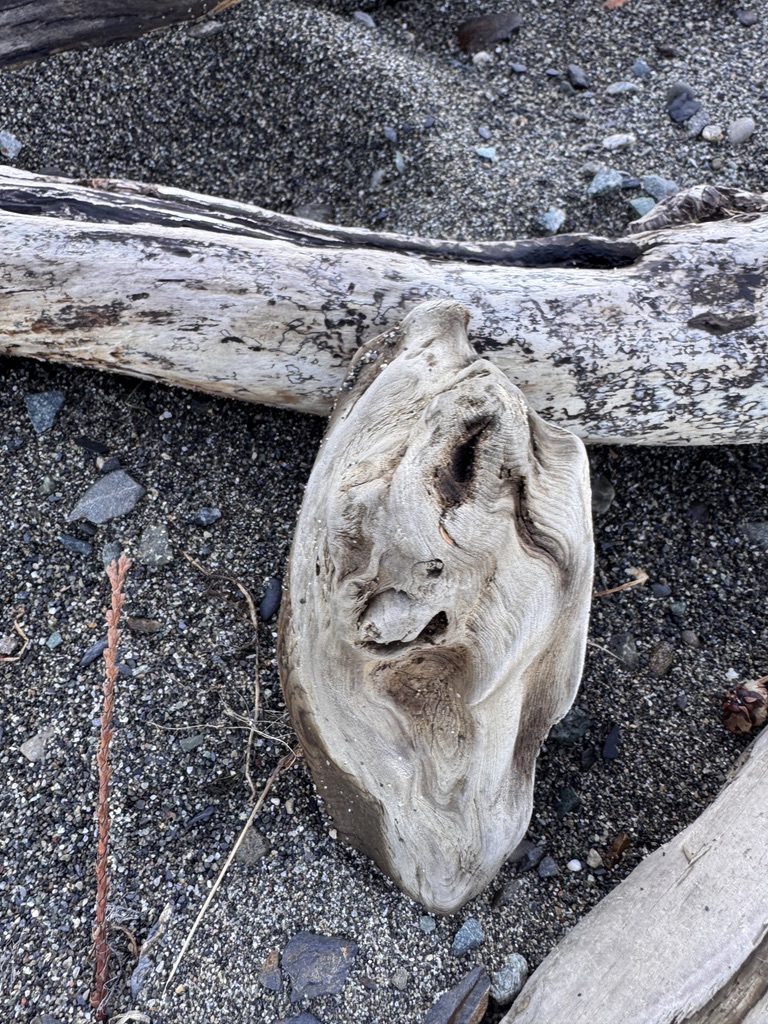
Dragon Face
Photo Credit: Amy Tucker, 2026
The Ongoing Story: Stillness That Moves
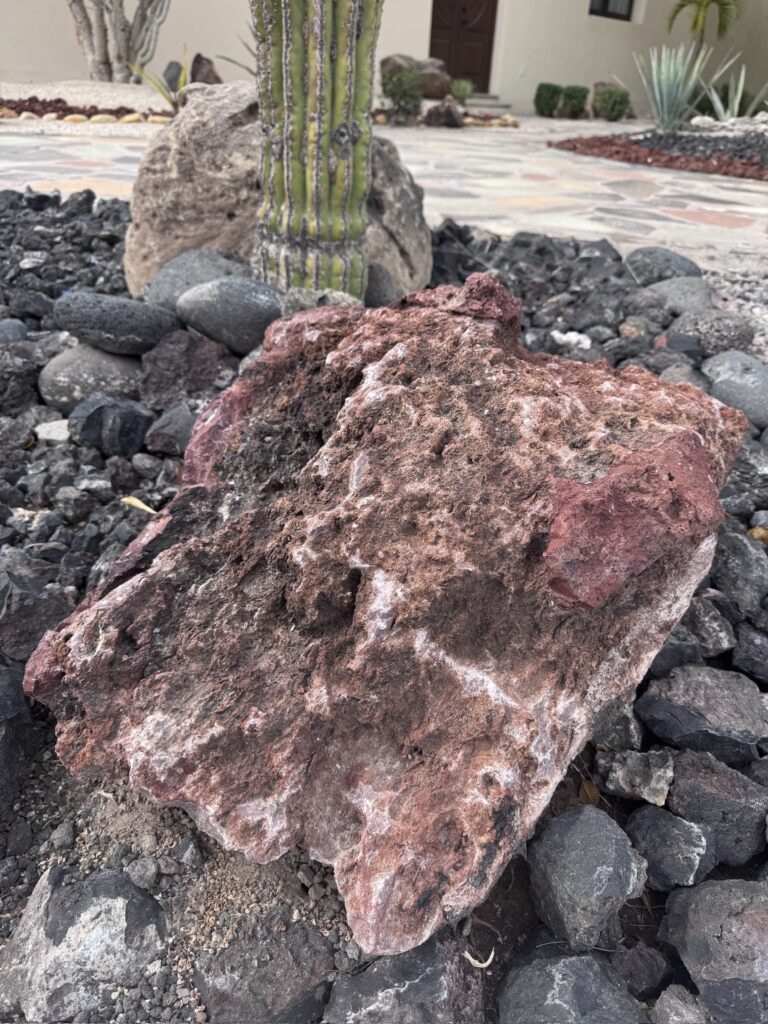
A small basalt stone now rests on my desk. One side feels smooth from the water. The other remains rough where a break once exposed its interior. Oxidation continues. Temperature shifts create microscopic changes.
Even in stillness, transformation continues.
Incluso en la quietud, el cambio continúa. Even in stillness, change continues.
Body as Archive:
Derrida (1996) theorizes the archive as dynamic rather than static, constantly being produced and reproduced rather than simply stored. Foucault (1969/1972) adds that archives are selective, shaped by power, reflecting what is deemed worth preserving while silencing what is excluded.
The stone on my desk functions as what I am calling a material archive, an archive that exists in matter rather than in text, in physical form rather than in language. It archives the heat that formed it, the cooling that transformed it, the water that smoothed it, the break that roughed it, and the ongoing oxidation that reddens it. All of this remains accessible through touch, through observation, through sustained attention to its material presence.
Archivo material. Archivo viviente. Material archive. Living archive.
My body similarly functions as an archive. Van der Kolk (2014) emphasizes this: the body keeps the score. Trauma is stored somatically. The nervous system holds memories conscious mind may never access. Recovery requires helping the body learn safety again through somatic practices that update the archive, that add new experiences of calm to counterbalance stored experiences of threat.
El cuerpo recuerda lo que la mente olvida. The body remembers what the mind forgets.
The stone on my desk reminds me that I am archive. Those sixty years of experience live in this body. That recovery means adding new material to the archive rather than erasing old material. That healing is an accumulation of safety experiences sufficient to counterbalance threat experiences. That transformation continues even when it appears to be stillness.
Alonetude as Archival Practice:
This thirty-day retreat is archival work. Each morning of waking without crisis adds to the body’s archive of safe wakings. Each swim adds to the archive of joyful movement. Each stone touched adds to the archive of curiosity satisfied. Each sunset watched adds to the archive of beauty witnessed. The body is learning through repetition. The archive is being updated. New material is accumulating.
Día por día, construyo un nuevo archivo. Day by day, I build a new archive.
The stone teaches patience with this archival process. Its archive spans millions of years. Mine spans weeks. Both are real. Both constitute legitimate forms of knowing and becoming.
Synthesis: Alonetude as Pedagogy of Deep Time
These stones form what I theorize as the pedagogy of deep time, a land-based learning that operates at a geological scale and offers a perspective on trauma recovery unavailable through conventional therapeutic timelines.
La pedagogía del tiempo profundo. The pedagogy of deep time.
Methodological Contributions:
This work contributes to several scholarly conversations simultaneously:
Scholarly Personal Narrative (Nash, 2004): Demonstrating how lived experience, when properly theorized and critically examined, generates legitimate scholarly knowledge
Trauma-Informed Pedagogy: Showing how land-based learning can support nervous system regulation in ways that complement but differ from clinical interventions
Alonetude as Concept: Developing intentional, embodied, chosen solitude as distinct from loneliness and as a necessary condition for certain forms of healing and learning
Embodied Epistemology: Illustrating how somatic knowing through sustained attention to the material world produces knowledge inaccessible through abstract reasoning alone
Feminist Methodology: Centring lived experience, situated knowledge, and body wisdom as legitimate sources of scholarly authority
The Rock Face
Photo Credit: Amy Tucker, 2026
What Stones Teach About Alonetude:
The stones clarify what alonetude makes possible:
Time to learn at body speed rather than mind speed
Space to sit with difficult knowledge without needing immediate resolution
Permission to accumulate rather than excavate
Freedom to reach without grasping
Patience with the transformation that unfolds slowly
Trust in processes that operate below conscious awareness
La alonetud permite lo que la urgencia niega. Alonetude permits what urgency denies.
Continuing Questions:
This research generates new questions:
How might trauma recovery models incorporate geological time as a framework?
What would therapy look like if it assumed healing takes decades rather than months?
How can educational institutions support forms of knowing that require sustained solitude?
What gets lost when we privilege verbal processing over somatic learning?
How might alonetude be made accessible to those without the resources to retreat?
Preguntas que las piedras despiertan. Questions the stones awaken.
The stones continue their stories. I continue learning to read them slowly, with humility and trust in time.
Las piedras continúan. Yo continúo aprendiendo. The stones continue. I continue learning.
Con paciencia. Con tiempo. Con gratitud. With patience. With time. With gratitude.
The Pedagogy of Deep Time
Credit: NotebookLM, 2026
References
Alcoff, L., & Gray, L. (1993). Survivor discourse: Transgression or recuperation? Signs: Journal of Women in Culture and Society, 18(2), 260–290.
Bjornerud, M. (2018). Timefulness: How thinking like a geologist can help save the world. Princeton University Press.
Boss, P. (1999). Ambiguous loss: Learning to live with unresolved grief. Harvard University Press.
Code, L. (1991). What can she know? Feminist theory and the construction of knowledge. Cornell University Press.
Derrida, J. (1996). Archive fever: A Freudian impression (E. Prenowitz, Trans.). University of Chicago Press.
Figley, C. R. (1995). Compassion fatigue as secondary traumatic stress disorder: An overview. In C. R. Figley (Ed.), Compassion fatigue: Coping with secondary traumatic stress disorder in those who treat the traumatized (pp. 1–20). Brunner/Mazel.
Foucault, M. (1972). The archaeology of knowledge (A. M. Sheridan Smith, Trans.). Pantheon Books. (Original work published 1969)
Frankl, V. E. (2006). Man’s search for meaning. Beacon Press. (Original work published 1959)
Haraway, D. (2013). Situated knowledges: The science question in feminism and the privilege of partial perspective 1. In Women, science, and technology (pp. 455-472). Routledge.
Herman, J. L. (2015). Trauma and recovery: The aftermath of violence–from domestic abuse to political terror. Hachette uK.
Merleau-Ponty, M. (2012). Phenomenology of perception (D. A. Landes, Trans.). Routledge. (Original work published 1945)
Nash, R. J. (2004). Liberating scholarly writing: The power of personal narrative. Teachers College Press.
Park, C. L. (2010). Making sense of the meaning literature: An integrative review of meaning making and its effects on adjustment to stressful life events. Psychological Bulletin, 136(2), 257–301. https://doi.org/10.1037/a0018301
Porges, S. W. (2011). The polyvagal theory: Neurophysiological foundations of emotions, attachment, communication, and self-regulation. W. W. Norton & Company.
Sheets-Johnstone, M. (2011). The primacy of movement (Expanded 2nd ed.). John Benjamins Publishing Company.
Standing, G. (2011). The precariat: The new dangerous class. Bloomsbury Academic.
Van der Kolk, B. (2014). The body keeps the score: Brain, mind, and body in the healing of trauma. Viking.
Mostly silently. But definitely talking. Asking questions. Wondering aloud. Sitting in front of volcanic rock faces on Coronado Island, trying to understand what I was seeing.
And here is the thing. They answered.
In the way they held their shapes. In how they carried their histories. In what form does patient transformation take over millions of years when you slow down enough to see it?
I am sixty years old, and I am learning to listen to stone.
Rock Chairs
Photo Credit: Amy Tucker, 2026
The Rock That Looks Like It Is Melting
There is a rock face on the north side of the island that stopped me completely.
It looks like it is melting. Actually melting. You can see where lava poured down, where it pooled, where it started to cool, but had barely finished when the temperature dropped enough to freeze it in place.
The History of Time
Photo Credit: Amy Tucker, 2026
Frozen mid-flow. Caught between liquid and solid. Holding that in-between state for millions of years.
I stood there for twenty minutes just staring.
Trying to imagine the heat that would make rock flow like water. Trying to comprehend the violence of that moment. Everything around it is burning or fleeing or already gone. And then the cooling. The gradual solidification. The transformation from a destroying force into a peaceful habitat where birds now nest and lichens grow.
And I thought this was what I was trying to do.
Hold the memory of heat without burning.
Carry what happened without being destroyed by it.
Be transformed by fire but remain myself through the transformation.
The rock face has been doing this for millions of years. I am on day fifteen. But we are doing the same work. Just at different speeds.
Esta piedra recuerda. This stone remembers.
And it is teaching me how to remember without burning.
The One That Is Broken But Still Standing
Crack in the Wall
Photo Credit: Amy Tucker, 2026
There is another rock face with a vertical crack running through it. Maybe three meters tall. Maybe a centimetre wide at the widest point.
Something broke it. Thermal shock when cold water hit hot stone, maybe. Or an earthquake. Or just the accumulated stress of millions of temperature cycles. Expanding in heat. Contracting in cold. Until finally the rock could hold no more and split.
But here is what strikes me. It is still standing.
The two sides of the fracture have stayed together. Held by friction and weight. Stable despite the split. You can see light through the crack. You can see exactly where it broke. But it is still here. Still doing the work of being rock. Still holding the island together.
I looked at this fracture for a long time.
Thought about my own breaking points. The places where pressure exceeded what I could hold. The visible marks of moments when I could carry no more.
And I thought maybe breaking is just honest.
Maybe fractures are how we know something is real. Has limits. Can be stressed. Carries the history of what it has weathered.
There is a Japanese art form called kintsugi, where broken pottery is repaired with gold. The philosophy is that breakage and repair are part of the object’s history and should be honoured, made visible rather than hidden. That something can be more beautiful for having been broken and carefully mended.
The fractured rock needs no gold. But it has the same quality.
Here is where I broke.
Here is where stress exceeded capacity.
Here is how I continue anyway. Fractured but standing. Marked but functional.
La fractura no es el final. The fracture is the end of nothing.
It is part of the story.
The Smooth One That Should Be Rough
Rock Face
Photo Credit: Amy Tucker, 2026
Volcanic rock should be rough. Textured. Showing all the marks of how it cooled. Gas bubbles. Crystalline structures. The molten material is solidifying rapidly.
But there is a rock face on the eastern side that is impossibly smooth.
Worn smooth by thousands of years of wind carrying sand. By water moving across it twice daily with tides. The patient’s work of erosion removes everything that protrudes, leaving only the most resistant material.
I ran my hand across this surface and felt time differently than I usually feel it.
Hours and days and years dissolved. What remained was geological time. The kind of time where my entire life is too brief to register. Where everything I think matters is just noise in a system that has been running for billions of years.
This should feel crushing, right? Should make everything seem pointless?
But it feels the opposite.
It feels freeing.
The pressure to make my life matter in some permanent way dissolves when I realize nothing is permanent. Stone is temporary. Mountains are temporary. Even continents are temporary. Everything is wearing away. Everything is becoming something else so slowly we mistake it for stillness.
I need only be here. Touching this smooth stone. Learning from its patience. Understanding that wearing away is simply what everything does.
The question becomes, what shape do you hold while it is happening?
La piedra no resiste el desgaste. The stone does not resist erosion.
Simplemente sucede. It simply happens.
And the stone continues being beautiful. Changing slowly. But beautiful.
Rock Tunnel
Photo Credit: Amy Tucker, 2026
The One Covered in Barnacles
At the waterline, a rock is completely covered in barnacles. Thousands of them. Layer upon layer of small white shells so dense you cannot see the original stone beneath.
I touched this carefully (barnacles are sharp) and felt the roughness, the complexity, the way the barnacles have created an entirely new surface.
The original rock is still there. Still solid. Still doing the work of being rock. But you would never know what it looked like before the barnacles arrived.
And I thought this is me at sixty.
All these layers of experience accumulated over decades. Jobs I have held. Places I have lived. People I have loved. Losses I have carried. Joys I have known. All of it is building up. Changing my surface. Making me something different than what I was beneath.
And this is okay.
I am trying to get back to the original, unbarnacled version of myself. Some pure state before life happened to me makes no sense.
I am the whole thing. Rock plus everything that has accumulated on it. All the layers together make up whatever I mean at this moment.
Las capas cuentan la historia. The layers tell the story.
The original stone plus everything else. All of it together.
The Fingers Reaching Toward Sky
Fingers Reaching for the Sky
Photo Credit: Amy Tucker, 2026
On the western edge, a rock formation rises from the water like fingers reaching upward.
Five distinct pillars. Maybe two meters tall. Separated by erosion but still connected at the base. They look intentional. Looks like a sculpture. Looks like someone (or something) was trying to grasp the sky.
Of course, no one made them. Water and wind made them by removing everything else. Leaving only these harder pillars that resisted the longest.
But they look like reaching.
And standing in front of them, I felt the same impulse. To reach. To extend beyond my current boundaries. To stretch toward something I cannot yet touch.
Here is what struck me. These pillars have been reaching for millions of years. They will never actually grasp the sky. The reaching is the point. The reaching is what they do.
And I thought maybe this is enough.
Maybe reaching without grasping is valid.
Maybe the attempt itself matters.
Maybe continuing to reach despite never quite arriving is what makes you worthy of standing there at all.
I have spent so much energy trying to secure things. Trying to arrive somewhere stable and permanent where I could finally stop reaching and just be.
But maybe the reaching is the point. Maybe the effort to grow, to stretch, to extend beyond my current limitations is what I am supposed to be doing. And arriving at ‘done,’ ‘secure,’ or ‘finished’ is impossible, because being alive means continuing to reach.
Alcanzar sin llegar. To reach without arriving.
This too is valid.
The effort itself matters.
Rock Face
Photo Credit: Amy Tucker, 2026
What I Am Learning From Stone
Life in the Stone
Photo Credit: Amy Tucker, 2026
I have been walking around this island touching rocks. Sitting with them. Trying to learn what they know.
And here is what they are teaching me.
Transformation is slow. Nothing happens suddenly in geological time. Fire becomes stone over timescales I cannot comprehend. Erosion works grain by grain. Everything that looks stable is actually moving. Just so slowly, my brief human perception mistakes motion for stillness.
After five months of crisis, after twenty-five years of precarious employment, I forgot this. Forgot that healing takes time. Forgot that becoming someone different from you requires patience. The rocks are reminding me. Slow change is still change. Patient work over time moves mountains.
Breaking is honest. The fractured rock face still stands. Still functions. Fractures are part of the story rather than the conclusion. What broke me ended nothing. Just marked me. Made me different. Made my story more complex.
Accumulation creates complexity. The barnacle-covered rock is more interesting than smooth rock. More textured. More alive. What accumulates on you over time is the life you have lived, layered on the foundation you were given.
Reaching matters more than grasping. The stone fingers will never touch the sky. But they reach anyway. The reaching itself is beautiful. The effort itself matters.
Patience is active. The smooth rock achieved its smoothness through millions of encounters with water and wind. Each encounter removed something infinitesimal. But the accumulation of infinitesimal changes creates transformation. Patience is active participation in slow becoming rather than passive waiting.
The Small Stone I Carried Home
Special Rock
Photo Credit: Amy Tucker, 2026
On my last day on the island, I picked up one small stone. Fits in my palm. Black basalt with rust-red oxidation patches. Smooth on one side where water wore it. Rough, on the otherhand, where a break exposed fresh surface.
I brought it back to the cottage.
It sits on the patio now. Every morning I touch it. Feel the contrast between smooth and rough. Notice how the sun warms it. Watch how rain darkens it temporarily, then how it dries back to its original colours.
The rock is still changing. Even here. Even in my care. Oxidation continues. Morning dew dissolves microscopic amounts of minerals. Daily temperature changes create stresses too small to see but real enough to eventually, inevitably, cause new fractures.
This rock is a teacher I brought home.
A reminder that transformation is slow. That breaking ends nothing. That accumulation creates beauty. That reaching without grasping is enough. That patience is how mountains move.
When I return to the life I left, when I re-enter the urgency and demands and constant pressure, this rock will sit on my desk.
Will be cool under my hand when I need cooling.
Will be solid when I need grounding.
Will be patient when I have forgotten how.
Esta piedra recuerda por mí. This rock remembers for me.
What I learned here. That change can be slow. That time is longer than I think. That patience is possible. That some stories take millions of years to tell.
Y está bien. And that is okay.
A Question For You
Standing Dreams
Photo Credit: Amy Tucker, 2026
When was the last time you sat with something long enough to learn from it?
Analyzing it makes no appearance here. Using it makes no appearance. Thinking about it does not even come to mind. Just sitting with it. Let it teach you through its presence. It’s patience. Its way of being in the world.
I am learning this at sixty. Learning to slow down enough to hear what the world has been saying all along. Learning to listen to teachers who speak in textures and colours, and the patient holding of shapes across deep time.
The rocks have been here for millions of years. They are in no hurry. They have time to teach.
And I am finally slow enough to learn.
If you are learning to slow down, to listen to unlikely teachers, to trust that transformation takes time, I would love to have you join the conversation.
The rocks and I will be here. Patient. Waiting.
Gracias, piedras. Por enseñarme paciencia. Por mostrarme que la transformación es lenta. Por recordarme que las fracturas cuentan historias. Por demostrar que alcanzar importa. Por estar aquí, de forma constante, mientras aprendo a estar presente.
Thank you, stones. For teaching me patience. For showing me that transformation is slow. For reminding me that fractures tell stories. For demonstrating that reaching matters. For being here, constant, while I learn to be present.
On Randy Pausch, Childhood Play, and Learning to Remember at Sixty
Credit: Randy Pausch, The Last Lecture, 2007
I brought Randy Pausch’s The Last Lecture with me to Mexico. Someone gave it to me years ago, and I never had a chance to read it. Too busy. Too many other things are demanding attention. Too much work to do. I have watched and rewatched the video several times, it is one of my favourites to watch when I feel uncertain about my life.
But two weeks into this retreat, with time stretching out in ways I am not used to, I picked it up. Started reading. And Randy asked a question that stopped me cold: What were your childhood dreams?
¿Cuáles eran tus sueños de infancia?
He wrote about his own experiences: being in zero gravity, playing in the NFL, authoring an article for the World Book Encyclopedia, being Captain Kirk, winning stuffed animals at amusement parks, and being a Disney Imagineer (Pausch & Zaslow, 2008). He could name them. List them. Tell the stories of how he pursued each one.
I closed the book and sat there for a long time, not wanting to answer. Because the honest answer was: I do not remember. No me acuerdo. Not clearly. Not in any way that feels real or reachable.
I remember that I had them. I know there were things I wanted to be, do, and become. But somewhere between seven and sixty, those dreams got buried under layers of survival, responsibility, and the endless work of just getting through.
Enterrados. Buried. Pero no muertos. But not dead.
And I realized: the same thing that suppressed my capacity for play also suppressed my ability to remember what I wanted before I learned what was realistic, achievable, and appropriate for someone with my background and resources and limitations.
La misma cosa. The same thing. El juego y los sueños, ambos enterrados juntos. Play and dreams, both buried together.
I am sixty years old, and I cannot remember what I wanted to be when I grew up.
Senior Puppy
Photo Credit: Amy Tucker, 2026
This should not hurt as much as it does. But it does. Because it means I have spent decades living without reference to those early desires. Without even remembering they existed. Without asking: what did that seven-year-old want? And does she still want it? And if she does, what would it take to give it to her?
Randy Pausch had an engineering problem. He had months to live, children to teach, and dreams to pass on. My problem is different but somehow related. I have years left, hopefully decades. But I have lost contact with the person who knew how to dream without editing, who knew how to want without calculating the probability of success, who knew how to play without needing justification.
And I am trying to find her again.
I have been reading this book slowly. A few pages each morning on the patio. Letting it sit with me. Letting Randy’s urgency teach me something about my own squandered time. Letting his clarity about what matters help me see what I have been avoiding.
¿Qué pasó con los sueños? What happened to the dreams?
¿Dónde están ahora? Where are they now?
What Randy Knew that I Forgot
I keep coming back to this as I read: Randy Pausch’s lecture is about achieving childhood dreams. But underneath that is something more fundamental: he remembered what they were. He could name them. He could tell you which ones he achieved, which ones he enabled for others, and which ones he had to let go.
He stayed connected to that child self who wanted things before learning whether wanting them was wise, possible, or realistic.
My Sweet Seniorita
Photo Credit: Amy Tucker, 2026
I did not.
Somewhere in the process of growing up in circumstances that required constant adaptation, constant resilience, and constant reinvention, I lost track of what I originally wanted. Or maybe I decided those wants were dangerous. Distracting. Luxuries I could not afford when survival required all my attention.
Brown and Vaughan (2009) write about how childhood play deprivation creates deficits that persist into adulthood. But I was not play-deprived as a child. I played. I had imagination. I had dreams. I had that glorious, unselfconscious absorption in make-believe, adventure, and creating worlds that did not have to answer to adult logic.
But somewhere between childhood and adulthood, I put all of that away. And the worst part is, I do not remember the moment I decided to stop. It was not dramatic. Not a conscious choice. Just a gradual fading. A slow erasure. Until one day I looked around and realized I could not remember the last time I wanted something just because I wanted it, not because it served some strategic purpose or met some external expectation.
Randy kept his dreams. I lost mine. And sitting here at sixty, watching sea lions play, I am trying to understand: how do you find what you have lost when you cannot remember exactly what it was?
The Dream I Do Remember
El Sueño Que Sí Recuerdo
There is one dream I remember. Barely. Faintly. Like something seen through fog.
I wanted to be a writer.
Quería ser escritora.
Not an academic writer. Not a scholar producing articles for peer-reviewed journals. Just… a writer. Una escritora de verdad. Someone who tells stories. Someone who makes meaning through words. Someone whose writing helps other people understand themselves better, feel less alone, find language for experiences that felt too big or too complicated or too shameful to name.
I remember sitting in my grandmother’s house as a child, reading books, thinking: I want to do this. I want to make people feel the way this book makes me feel. Connected. Understood. Less alone.
And then I grew up and learned that writing is not a reliable career. That serious people have backup plans. That you need security before you can afford creativity. That passion does not pay bills.
So I became a scholar instead. Learned to write in ways that met academic standards. Learned to produce work that served institutional needs. Learned to measure success by publications, citations, and conference presentations.
And somewhere in all that learning, I stopped writing the kind of writing that made me want to write in the first place.
This retreat is me trying to find that again. This blog. These daily reflections. This attempt to write in ways that sound like thinking, that honour experience as data, that trust that someone reading this might feel less alone because I am willing to say: I lost my dreams. I forgot how to want. I put away play because I thought I had to in order to survive.
Nash (2004) calls this Scholarly Personal Narrative. A methodology that allows lived experience to count as data when properly theorized and critically examined. But underneath the methodology is something simpler: permission. Permission to write the way I wanted to write before I learned all the rules about how writing should sound.
Randy achieved his childhood dreams. I am trying to remember mine. And maybe that is okay. Maybe sixty is not too late to ask: what did I want before I learned to want only achievable things? And what would it mean to give that to myself now, even if it looks different than it would have looked at seven?
My Sweet Lady
Photo Credit: Amy Tucker, 2026
Here is what I am learning: play and childhood dreams are connected in ways I did not understand before.
Dreams are what you want. Los sueños son lo que quieres. Play is how you practice wanting. El juego es cómo practicas querer. Children play at being the things they dream about. Play astronaut. Play teacher. Play explorer. Play artist. The play is how the dream stays alive. How it gets rehearsed. How the child learns what that dream might feel like if it came true.
When you stop playing, you stop wanting to practice. Cuando dejas de jugar, dejas de practicar querer. And when you stop practicing wanting, the dreams fade. Not all at once. But gradually. Poco a poco. Until you can no longer remember what they were.
I stopped playing because survival required seriousness. And when I stopped playing, I stopped rehearsing the dreams. Stopped imagining what they would feel like. Stopped giving them shape, texture, and presence in my daily life.
And now, trying to recover play, I am discovering: the dreams are still there. Buried. Waiting. But I cannot access them directly through thinking, analysis, or strategic planning. I have to play my way back to them.
Winnicott (1971) writes about play as the location where we discover who we are and what we want. Not through serious self-examination but through the spontaneous, creative, unselfconscious exploration that play allows. Play is how we find out what brings us alive. What captures our attention. What we return to again and again is because it calls to something essential in us.
Watching sea lions yesterday, I felt something wake up. Algo despertó. Not a specific dream. Just the sense that dreaming is possible. Que soñar es posible. That wanting things just because I want them is allowed. That I do not have to justify every desire with strategic reasoning, probability analysis, or risk assessment.
My Sweet Love
Photo Credit: Amy Tucker, 2026
I came back to the cottage and read more of Randy’s book. Read about how he pursued his dreams not because they made sense but because they called to him. And I thought: the sea lions understand this instinctively. Randy understood it consciously. And I am somewhere in between, trying to learn what both of them already know.
The sea lions want to play. So they play. Quieren jugar. Entonces juegan. They want to ride waves. So they ride them. They want to leap. So they leap. Quieren saltar. Entonces saltan. There is no gap between wanting and doing. No hay brecha entre querer y hacer. No calculation about whether the want is realistic, appropriate, or likely to succeed.
And watching them, I thought: I used to be like that. Before I learned to edit my wants. Before I learned that some dreams are more acceptable than others. Before I learned that admitting you want something gives people the power to disappoint you, I was safer not to want anything too much.
The sea lions do not protect themselves by not wanting. They want fully. They play fully. They risk disappointment by trying. And they seem… joyful. Alive. Present.
I want that back.
Sea Puppies
Photo Credit: Amy Tucker, 2026
Randy’s Time Limit, My Extension
El Tiempo de Randy y Mi Tiempo
Randy Pausch had months. Randy tenía meses. I have years, probably decades. Yo tengo años, probablemente décadas.
He used his limited time to pass on everything he wanted his children to know. To enable others’ dreams. To teach his final lessons about living well. Randy wrote that he was trying to put himself in a bottle that would wash up on shore for his children someday (Pausch & Zaslow, 2008, p. 10). A way of being present even in his absence. A way of teaching what he would not be alive to teach.
I have the opposite problem: too much time. Demasiado tiempo. Enough time that I keep postponing. Keep thinking: I will do that later. Lo haré más tarde. I will write that book someday. Algún día. I will pursue that dream when I have more security, more time, more energy, and more certainty that it will work out.
But here is what Randy’s lecture teaches without saying it directly: time limits clarify. Los límites de tiempo aclaran. When you know time is short, you stop negotiating with yourself about what matters. You stop waiting for conditions to be perfect. You stop postponing joy until after you have finished all the serious work.
You do what matters. Now. Ahora. Because now is all you have. Porque ahora es todo lo que tienes.
I do not have his urgency. But I could use some of it. Because sixty is not young. Because the time I am squandering waiting for perfect conditions is time I will not get back. Because every day I spend not writing the way I want to write, not playing the way I used to play, not pursuing the dreams I have forgotten how to name is a day spent living at partial capacity.
Not because I might die tomorrow (though I might). But living fully does not require a terminal diagnosis. It just requires recognizing that postponing joy is a choice. And it is a choice I have been making unconsciously for decades.
Randy made the conscious choice to live fully in his remaining months. I am trying to make the conscious choice to live fully in my remaining decades. Not because time is short but because time is precious even when there is lots of it. Because I have one life and it is happening now, and I do not want to arrive at the end having never asked: what did I want? And did I give it to myself? And if not, why not?
Lo Que El Juego Enseña Sobre Los Sueños
I have been playing for two weeks now. Small ways. Tentative ways. Humming. Swimming for pleasure. Skipping three steps. Following curiosity without needing it to be productive.
And something is happening that I did not expect: wants are surfacing.
Los deseos están surgiendo. Wants. Deseos.
Small wants at first. I want to swim longer. Quiero nadar más tiempo. I want to sit and watch pelicans without checking the time. I want to write this blog post even though it will not count toward my thesis word count. I want to buy this small carved turtle from the vendor on the beach, not because I need it, but because looking at it makes me happy.
Small wants. Deseos pequeños. Silly wants, maybe. Wants that do not serve strategic purposes or advance career goals. Just wants. Solamente deseos.
And underneath the small wants, larger ones are stirring. Still foggy. Still not clear enough to name precisely. But there. Waiting. Getting stronger as I practice the small wants, as I learn that wanting is allowed, as I remember that I am allowed to pursue things just because they call to me.
I think this is how you find lost dreams. Not by thinking about them. Not by analyzing what you should want, or what you used to want, or what you ought to want now. But by practicing wanting in small ways until the muscle memory comes back. Until wanting feels safe enough that bigger wants can surface. Until you trust yourself enough to say, “This is what I want.” And I am going to pursue it not because it is realistic, appropriate, or likely to succeed, but because it calls to something in me that has been silent for too long.
Randy Pausch enabled others’ dreams. Taught his students to pursue theirs. Passed them on to his children. He understood that helping others achieve their childhood dreams was as important as achieving his own, maybe more important (Pausch & Zaslow, 2008). He called it the “head fake.” The real learning, the real gift, was not in the dream itself but in what pursuing it taught you about yourself and what you could become.
I am enabling my own dream. The one I forgot I had. The one that is still there, underneath all the layers of learned seriousness, strategic thinking, and protective not-wanting.
The dream of writing. Really writing. The kind that helps people feel less alone. The kind that tells truths I have been trained not to tell. The kind that sounds like me, not like the academic persona I learned to perform.
This blog is me practicing. This retreat is me creating conditions where that dream can breathe again. These 30 days are me trying to become the kind of person who can say, “I want this.” And then pursue it. Not someday. Now.
Key Takeaways: What Randy Taught Me
1. Dreams do not die. They just get buried.
Los sueños no mueren. Simplemente se entierran.
Randy stayed connected to his. I buried mine. But buried is not dead. Enterrado no es muerto. Buried can be excavated. It just takes time, attention, and willingness to dig through all the layers that accumulated on top.
2. Play is how you practice wanting.
El juego es cómo practicas querer.
Children know this instinctively. Adults forget it. But the mechanism still works at sixty the same way it worked at seven. When you play, what surfaces? Cuando juegas, los deseos surgen. The trick is to allow them rather than immediately edit or dismiss them.
3. Time limits clarified. But you do not need a terminal diagnosis to live fully.
Los límites de tiempo aclaran. Pero no necesitas un diagnóstico terminal para vivir plenamente.
Randy had months. I have decades. But I can borrow his clarity without needing his urgency. Can ask: if time were short, what would matter? And then do that. Now. Ahora. While there is still time. Mientras aún hay tiempo.
4. Enabling your own dreams counts.
Habilitar tus propios sueños cuenta.
Randy enabled others’ dreams. That was his path. Mine is different. I am learning to enable my own. Learning that this is not selfish but necessary. No es egoísta sino necesario. I cannot help others find their dreams if I have abandoned my own.
5. It is never too late to become who you wanted to be.
Nunca es demasiado tarde para convertirte en quien querías ser.
At seven, I wanted to be a writer who helps people feel less alone. At sixty, I am becoming that. A los sesenta, me estoy convirtiendo en eso. Slowly. Imperfectly. But really. Pero realmente. And the fact that it took fifty-three years to get here does not make it less real. Just delayed. And delays can be recovered from.
The Dreams at Sixty Look Different Than the Dream at Seven
I need to say this clearly: I am not trying to become the seven-year-old who first wanted to write. I am trying to become the sixty-year-old who knows how to want the way that seven-year-old did. Fully. Completamente. Without apologizing. Sin disculparse. Without needing permission. Sin necesitar permiso.
The dream at sixty looks different from what it would have looked like at seven. It is complicated by everything I have learned, everything I have lived through, everything I know now about how the world works, how hard things are, and how much survival costs.
But it is also enriched by all of that. Pero también está enriquecido por todo eso. The writing I can do now is writing that a seven-year-old could not have done. Because it is informed by sixty years of living. By loss and love and chronic stress and hard-won healing. Por pérdida y amor, por estrés crónico y por curación ganada con dificultad. By understanding that comes only from decades of paying attention.
Randy achieved his childhood dreams by becoming exactly who that child wanted to be. I am achieving mine by becoming who that child would have grown into if she had been allowed to keep wanting, keep dreaming, keep playing all along.
Different paths. Caminos diferentes. Same destination: living fully. Vivir plenamente. Wanting openly. Querer abiertamente. Pursuing dreams not because they are realistic but because they are real. Perseguir sueños no porque sean realistas, sino porque son reales.
Photo of a Bummer Sticker
Photo Credit: Amy Tucker, 2026
Gracias, Randy, por preguntar qué soñábamos. Thank you, Randy, for asking what we dreamed.
Por recordarme que tuve sueños. To remind me, I had dreams.
Por mostrarme que nunca es demasiado tarde. For showing me that it is never too late.
Por enseñarme que el juego y los sueños están conectados. For teaching me that play and dreams are connected.
Por vivir completamente hasta el final. For living fully until the end.
Por darme permiso para hacer lo mismo. For giving me permission to do the same.
Con décadas por delante, no meses. With decades ahead, not months.
Pero con la misma urgencia de vivir bien. But with the same urgency to live well.
Ahora. Now.
Mientras aún hay tiempo. While there is still time.
The Power of Play
Credit: NotebookLM, 20026
Thank you for the reminder, Randy.
References
Brown, S., & Vaughan, C. (2009). Play: How it shapes the brain, opens the imagination, and invigorates the soul. Avery.
Nash, R. J. (2004). Liberating scholarly writing: The power of personal narrative. Teachers College Press.
Pausch, R., with Zaslow, J. (2008). The last lecture. Hyperion.
Pausch, R. (2007). Randy Pausch’s last lecture: Achieving your childhood dreams [Video]. YouTube. Pausch, R., with Zaslow, J. (2008). The last lecture. Hyperion.
Winnicott, D. W. (1971). Playing and reality. Tavistock Publications.
This morning, I caught myself humming. No song. Just sound making itself because it wanted to. I stopped mid-hum and thought: when did I stop doing this? When did humming become something I had to notice rather than something that just happened?
And then yesterday. The sea lions.
Lions Playing on the Rocks
Photo Credit: Amy Tucker, 2026
Hundreds of them off the coast of Loreto, leaping and spinning and riding waves with what looked like pure, uncomplicated joy. And here is what struck me: they were not young. Many had grey muzzles. Scarred bodies. The marks of decades in the ocean. These were old sea lions. Experienced sea lions. Sea lions who had survived sharks and storms and whatever else the ocean throws at bodies over time.
And they were playing.
Not playing differently from young sea lions. Not playing carefully, moderately, or with appropriate dignity. Just playing. Leaping. Spinning. Riding waves because riding waves feels good. Their age did not seem to factor into the equation at all.
I sat in the boat watching them, and something in my chest cracked open. Not broke. Opened. Like a window that had been sealed shut for so long, I forgot windows could open, and suddenly there was air and light and the possibility of something I could not name, but my body recognized immediately.
Star Sunshine
Photo Credit: Amy Tucker, 2026
Alegría. Joy.
Not happiness. Not contentment. Not satisfied with accomplishments. Joy. The kind that bubbles up from somewhere that has nothing to do with achievement, productivity, or being a responsible adult who takes life seriously. The kind the sea lions have. The kind I seem to have misplaced somewhere between twenty and sixty. The kind I am just now realizing I want back.
What I Learned About Growing Up
Somewhere along the way, I learned that growing up means growing serious. I cannot point to the exact moment this lesson took hold. It was not a single conversation or event. It was more like osmosis. The gradual absorption of cultural messages about what mature adults do and do not do. Adults work. Adults are responsible. Adults plan, achieve, and contribute. Adults do not waste time. Adults do not play.
Or if they play, it is scheduled, optimized, and turned into another form of productivity. Exercise that counts as play. Hobbies that produce results. Social games that serve networking functions. Play with purpose. Play with outcomes. Play that justifies itself.
But what the sea lions were doing yesterday did not justify itself. It served no purpose I could identify. They were not exercising (though movement was involved). They were not socializing (though they played near each other). They were not practicing the skills (though the skills were evident). They were just… playing. For its own sake. Because it felt good. Because they were alive and the ocean was there, and their bodies knew how to move through it joyfully.
I watched them and thought, “I used to know how to do this.” I did. I remember childhood summers when entire afternoons disappeared into invented games that had no point beyond playing them. I remember the absorption. The timelessness. The way my body knew what to do without my mind directing it. And then I grew up. And growing up meant putting that away. Meant learning that time is currency, that activities should have purpose, that joy without justification is frivolous, immature, something you outgrow.
Except the sea lions have not outgrown it. The grey-muzzled, scarred, elderly sea lions have not gotten the memo about dignity, seriousness, and age-appropriate behaviour. They are still playing. Still joyful. Still leaping. And I am sitting here at sixty, realizing: I got it wrong. The sea lions were right all along.
What the Research Says (And Why It Matters That I Am Reading It)
Photo Credit: Amy Tucker, 2026
I am reading research on play and aging because that is what I do when I am trying to understand something. I read. I find frameworks. I look for explanations. This is probably part of why I lost play in the first place: I cannot just experience things. I have to understand them. Analyze them. Fit them into existing knowledge structures.
But the research is helping, so I am allowing it.
Brown and Vaughan (2009) argue that play is not a developmental stage we pass through but a lifelong human need. They studied adults across the lifespan and found that people who maintain a capacity for play show better physical health, stronger social bonds, greater creativity, and more resilience when life gets difficult. The absence of play in adulthood is not a natural part of maturation. It is suppression.
This word stopped me: suppression.
Not absence. Not outgrowing. Suppression. Which implies something was there and was pushed down. Which implies it might still be there. Which implies it could be recovered.
I sat with this for a long time yesterday evening after the boat returned. Suppression. What suppressed my play? And the answer came quickly, almost too quickly, as though it had been waiting to be asked:
Everything. Work suppressed it. Poverty suppressed it. Precarity suppressed it. Chronic stress suppressed it. Cultural messages about what serious academics do suppressed it. Twenty-five years of contract work, where every moment had to be productive because any moment could be your last, suppressed it. My play was not killed. It was buried under layers of survival necessity, cultural expectation, and internalized messages about what maturity demands.
But suppression is different from death. Suppression means it is still there. Somewhere. Under all those layers. Waiting.
The sea lions confirmed this. They did not look like they were working to play. They looked like playing was the most natural thing in the world. Which suggests that play is natural. Which suggests that what is unnatural is not playing. Which suggests I have been living unnaturally for a very long time. Qué alivio. What relief. To know it is not gone. Just suppressed. Just waiting.
Sea Lions Playing
Photo Credit: Amy Tucker, 2026
The Neuroscience of Joy (Or: Why I Could Not Play Even When I Wanted To) Here is something I learned from Porges (2011) that changed how I understand the last five months, the last five years, possibly the last twenty-five years: Play requires safety.
Not cognitive understanding of safety. Not intellectual knowledge that you are probably fine. Physiological safety. The kind that the nervous system detects below conscious awareness through what Porges calls neuroception. The body is constantly scanning the environment, asking: Am I safe? Can I rest? Can I play?
And if the answer is no, the social engagement system goes offline. This is the neural pathway that supports play, connection, and spontaneous joy. When the nervous system is in threat mode (preparing to fight, to flee, to freeze), the social engagement system shuts down. You cannot access Play. Cannot feel lightness. Cannot allow the vulnerability that playfulness requires.
This is not a choice. This is autonomic regulation. The body makes decisions about resource allocation below the level where consciousness operates. For five months before I came here, my nervous system never registered safety long enough for play to become possible. I was in constant crisis mode. Waiting for calls. Waiting for bad news. Waiting for the next emergency. My body could not afford playfulness. Could not afford vulnerability. Could not afford the energy expenditure that play requires when every resource needs to go toward threat management.
I did not choose not to play. My nervous system chose for me.
And reading this, understanding this, I felt something unexpected: compassion. For myself. For my body. For the twenty-five years before that, when contract work meant my nervous system never fully relaxed because security was always provisional, always temporary, always one crisis away from disappearing.
Of course, I could not play. Of course, joy became impossible. Not because I was doing something wrong, but because my body was doing something very right: keeping me alive under conditions that did not support flourishing.
But here is what the research also says: nervous systems remain plastic across the lifespan. The capacity for play can be restored at any age if conditions support it. If safety can be established. If the threat can be interrupted. If the social engagement system can come back online.
I am sixty years old, and my nervous system is learning safety. And as it learns safety, play is beginning to return. Not dramatically. Not suddenly. But in small signals: humming. Swimming for pleasure. Watching pelicans without needing to make it productive.
Small. But real. And growing.
Pequeños milagros. Small miracles. Pero milagros de todos modos. But miracles nonetheless.
What Play Looks Like When It First Returns
This morning, I walked in the water along the seashore.
This is a small thing. Maybe it seems like nothing. But for someone who has spent decades organizing every activity around productivity, purpose, and outcomes, swimming because the water looks inviting feels revolutionary. I got in. The cold shocked me like it does every morning. But instead of swimming laps, instead of counting strokes, instead of trying to improve my form, I just… moved. Followed curiosity about underwater rocks. Let my body do what feels good. Floated when floating felt right. Dove when diving felt right.
No plan. No goal. No timer.
And I realized: this is play. Not the kind I remember from childhood. Not the kind the sea lions do. But my version. Sixty-year-old-woman-in-the-Sea-of-Cortez version. Modified. Tentative. Still learning. But real.
Guitard et al. (2005) studied play in older adults and found that play often looks different from childhood play but serves similar functions: engagement with novelty, absorption in the process rather than the outcome, pleasure for its own sake, and temporary suspension of everyday concerns. Older adults play through gardening, cooking, music, crafts, and exploration.
I am playing through swimming. Through humming. Through letting myself be curious about things without turning curiosity into research questions. Through allowing time to be unstructured. Through following impulses that have no justification beyond: this sounds good right now.
Small things. But they add up. Each one teaches my nervous system: it is safe to be spontaneous. Safe to follow pleasure. Safe to let go of control slightly and see what happens.
Each one is a tiny rebellion against the internalized voice that says: You are sixty years old, what are you doing? You should be serious. You should be productive. You should be concerned about declining capacities, limited time, and making every moment count.
Each one is a tiny agreement with the sea lions who say: no. Play. Leap. Spin. Your age is not the point. Your joy is the point.
Estoy aprendiendo. I am learning.
Lentamente. Slowly.
Lero aprendiendo. But learning.
The Paradox That Makes Me Laugh
Here is something that makes me laugh now that I can laugh about it: I am conducting research on rest and recovery and nervous system regulation. I am documenting how environmental conditions affect play capacity. I am reading literature on playfulness, aging, and successful life transitions.
I am turning the recovery of play into academic work.
This is very me. Very on-brand. Cannot just play. Have to study play. Have to document play. Have to theorize play. Have to turn play into scholarship because scholarship is how I make meaning, and scholarship feels legitimate in ways that pure experience does not.
But here is what I noticed yesterday watching the sea lions: they were not documenting their play. They were not reading literature on play theory. They were not conducting a comparative analysis of their play behaviours across developmental stages. They were just playing.
And I thought: yes. That is the point. The point is not to understand play. The point is to do it.
But I also thought: maybe both are okay. Maybe I can study, play, and also play.
Maybe the studying helps me trust that play is legitimate enough to allow.
Maybe the research gives me permission that my body needs before it can relax into playfulness.
Maybe there is not one right way to recover and play at sixty. Maybe scholarly-personal-narrative-researcher-trying-to-learn-to-be-playful-again is a valid way to do it.
The sea lions do not need research to justify their play. But I might. At least for now. At least until my nervous system trusts playfulness enough to allow it without justification.
And maybe that is okay. Maybe that is my version. Nerdy. Academic. Needing frameworks before I can allow experience. But still moving toward the same place the sea lions are already inhabiting: joy. Lightness. Permission to leap.
Me río de mí misma. I laugh at myself.
What Sixty Knows That Twenty Did Not
There is something sixty understands that twenty could not:
Nothing is permanent. Nothing is as high-stakes as it seems. Most of what feels catastrophic becomes a foundation. Failures do not destroy you. Mistakes are survivable. The things you think will last forever dissolve. The things you think will destroy you become stories you tell.
At twenty I could not have played because everything felt too important. Every choice felt permanent. Every failure felt existential. The stakes were always maximum.
At sixty I know better. I know that very little is as important as it seems. That most catastrophes become footnotes. That reputation is less fragile than fear suggests. That dignity survives embarrassment. That making mistakes does not make you a mistake.
This knowledge could support play. Could create psychological space where experimentation feels safe, where outcomes matter less than process, where I can be silly without it threatening my sense of self. But knowledge alone is not enough. The nervous system has to believe it. Has to feel safe enough to trust that playfulness will not result in catastrophe.
This is the work I am doing. Teaching my sixty-year-old body what my sixty-year-old mind already knows: it is safe enough to play. And here is what is helping: the sea lions.
When I skip for three steps, I am completely here. Not thinking about the future. Not replaying the past. Just: body moving, sun warm, this feels good. That presence is what I lost. What chronic stress took from me. What I am reclaiming now, three steps at a time.
Volcanic Rocks
Photo Credit: Amy Tucker 2026
And here is what surprises me: it feels good. Not just the skipping. The reclaiming. The gradual return of lightness. The sense that my body is becoming a place where joy is possible again.
For years, my body was a site of vigilance. Of tension. Of preparing for a threat. Now it is becoming something else. Something softer. Something more playful. Mi cuerpo se está curando. My body is healing.
No sólo descansando. Not just resting.
Curando. Healing.
Y parte de la curación es recordar cómo jugar. And part of healing is remembering how to play.
What the Sea Lions Teach About Successful Aging
Traditional models of successful aging emphasize maintaining function. Physical health. Cognitive capacity. Productivity. Contribution. (Rowe & Kahn, 1997).
But the sea lions suggest a different model.
Successful aging might be: maintaining the capacity for joy. For curiosity. For absorption in the present moment. For play.
Their bodies are older. Scarred. Not as fast or agile as young bodies. But they play anyway. Not in spite of aging but through it. Their play is not an effort to recapture youth. It is present-moment engagement with being alive in the body they have now.
This feels important.
I do not want to be twenty again. I do not want to recapture some idealized version of youth. I want to be sixty and playful. Sixty and joyful. Sixty and capable of skipping for three steps when skipping feels right.
I want what the sea lions have: age that does not eliminate joy. Experience that does not require seriousness. Wisdom that includes lightness.
Henricks (2015) argues that play in later life serves a generative function: modelling joyful engagement for younger generations, resisting cultural narratives that equate aging with decline, and demonstrating that vitality persists across the lifespan.
If this is true, then learning to play at sixty is not a form of regression. It is a contribution. It is resistance. It is saying: this is what aging can look like. Not grim. Not resigned. Not declining toward inevitable loss. But alive. Present. Joyful. Still learning. Still curious. Still capable of surprise.
The sea lions model this every day. I am trying to learn from them. Slowly. With academic footnotes and self-consciousness, they do not have. But learning.
And occasionally, when I forget to monitor myself, when I am absorbed in water or surprised by pelicans or simply here, I play. Just for a moment. Just for three steps. Just for one spontaneous laugh. But it is there. Real. Growing.
New Directions
Photo Credit: Amy Tucker, 2026
References
Brown, S., & Vaughan, C. (2009). Play: How it shapes the brain, opens the imagination, and invigorates the soul. Avery.
Guitard, P., Ferland, F., & Dutil, É. (2005). Toward a better understanding of playfulness in adults. OTJR: Occupation, Participation and Health, 25(1), 9–22. https://doi.org/10.1177/153944920502500103
Henricks, T. S. (2015). Play and the human condition. University of Illinois Press.
Porges, S. W. (2011). The polyvagal theory: Neurophysiological foundations of emotions, attachment, communication, and self-regulation. W. W. Norton & Company.
Proyer, R. T. (2017). A new structural model for the study of adult playfulness: Assessment and exploration of an understudied individual differences variable.
Personality and Individual Differences, 108, 113–122. https://doi.org/10.1016/j.paid.2016.12.011
Rowe, J. W., & Kahn, R. L. (1997). Successful aging. The Gerontologist, 37(4), 433–440. https://doi.org/10.1093/geront/37.4.433
The boat tour was about the island, about Coronado with its ancient volcanic stone rising from the sea like something too dramatic to be real. I wanted to see the geology. Wanted to understand how fire becomes stone, how destruction becomes foundation, how violence cooled into something that now holds life.
The whales were not on the itinerary. They were passing through. We were lucky, the captain said. Muy afortunados.
Grey Whale
Photo Credit: Amy Tucker, 2026
I did not feel lucky at first. I felt unprepared. As though I should have known this was possible, should have researched grey whale migration patterns, should have brought a better camera, should have been ready for this moment rather than sitting in a small boat with no idea where to look or what I was about to see.
Then the water broke, and there was a back. Grey. Massive. Longer than our boat. The whale surfaced, breathed (a sound I cannot describe except to say it sounded like the ocean exhaling), and disappeared again into water that closed over it as though nothing that large had just been there.
I forgot about being prepared. Forgot about cameras. Just watched the space where the whale had been, waiting, not breathing myself, aware suddenly of my own breathing in a way I have not been aware since the panic attacks that brought me here began to ease. The whale breathes air like I breathe air. We are both mammals. Both carry our ancestors’ decision to leave the ocean and then (in the whale’s case) the decision to return. Both are shaped by evolutionary pressures I can name but not fully comprehend.
The whale surfaced again. Fifty metres ahead this time. I could see barnacles clustered on its head, the mottled grey of skin that looked like stone worn smooth by water. Another breath. Another dive. And I realized I was crying. Not dramatically. Just tears on my face that I did not wipe away because they felt like the right response to whatever was happening.
Van der Kolk (2014) writes that trauma resolution occurs not through understanding but through the body’s learning to feel safe again. I have been here two weeks learning that lesson: letting my body remember what safety feels like. But something about the whale’s presence intensified it. The whale’s breath synchronized my own breathing in ways I could not control. My nervous system responded to the whale’s presence before my mind registered what I was seeing. This is what Porges (2011) calls neuroception, the body’s capacity to detect safety or danger below conscious awareness through environmental cues, including, apparently, the respiratory patterns of other mammals.
Learning Scale Through Bodies
I have been thinking about scale.
Egypt Gods
Photo Credit: Amy Tucker, 2026
For two weeks, I have been learning to feel small in ways that do not diminish me. Small against the stars. Small against the sea. Small against geologic time. But the whale is different. The whale is not cosmic distance or abstract deep time. The whale is right here, breathing the same air I am breathing, made of the same carbon and oxygen and complexity. And it is so much larger than me that my body cannot quite process it.
Fifteen metres long, the guide said. Up to forty tonnes. These are numbers. They mean nothing until you are in a six-metre boat and a whale surfaces close enough that you understand: I am the size of the whale’s eye. Maybe smaller. The whale could overturn this boat without meaning to, just by surfacing in the wrong place. We are here because the whale allows it. Because the whale, in its vast mammalian intelligence, has chosen not to see us as a threat.
This is different from the stars’ indifference. The stars do not choose. They simply are, and my presence or absence makes no difference to them. But the whale is aware. The whale has agency. The whale sees me (I watched its eye track our boat as it passed) and makes decisions about whether I am worth noticing, worth avoiding, or worth approaching. I am in a relationship with the whale, whether I intended to be or not. And the whale, by not destroying us, by passing peacefully, by allowing us to witness, is teaching me something about coexistence I did not know I needed to learn.
Sea Lions on the Rocks
Photo Credit: Amy Tucker, 2026
Buber (1923/1970) writes about I-Thou relationships, encounters where the other is met as subject rather than object, where genuine relation becomes possible even across vast differences. The whale encounter was not I-Thou in Buber’s full sense (the whale was not addressing me, was not entering a reciprocal relation), but it was also not I-It (the whale as object, as thing to be observed). It was something in between. Something more like: we share this moment. We share this water. We share the fact of being alive at the same time in the same place, and that sharing, however brief, however one-sided, matters.
Boss (1999) writes about ambiguous loss, about relationships that defy clear categories. I am thinking about this now in a different context. What is my relationship with the whale? Not connected (the whale does not know me). Not a threat (I pose none). Not kinship (though we are both mammals, that seems too distant a relation to claim). Something else. Something more like a witness. I witnessed the whale. The whale, perhaps, witnessed me. And that mutual witnessing, even without recognition or acknowledgment, creates a kind of relation that matters.
The whale does not need me to witness it. But I seem to need to witness the whale. Need to know that something this large, this ancient (grey whales as a species evolved approximately 2.5 million years ago; Swartz, 2018), this indifferent to human concern still exists. Still migrates. Still breathes air, nurses its young, and navigates thousands of kilometres using senses I cannot imagine. The whale’s existence, independent of my need for it, feels like permission. Permission to exist independently of others’ needs for me. Permission to migrate toward what I need without justifying the journey. Permission to be large in my own right, even when that largeness is invisible to those who look at me and see only the surface.
Fire Becoming Stone: On Transformation and Time
We continued toward Coronado Island, and I was quiet.
The others in the boat were talking about the whales, about luck, about whether we might see more on the return trip. I could not talk. Could not translate what I was feeling into words that would make sense to people who had seen the same thing I had seen, but seemed to have experienced it differently. They saw whales. I saw something I still do not have language for.
The island rose ahead of us. Red and black stone. Sharp angles softened by millennia of erosion, but are still clearly volcanic. The guide explained the geology: an ancient volcano, now extinct, part of the volcanic chain formed when tectonic plates pulled apart millions of years ago, and magma rose to fill the gaps. The red is iron oxide. The black is basalt. The textures tell stories about how quickly lava cooled, how gas bubbles were trapped and never escaped.
I listened, but I was thinking about something else. About fire becoming stone. About destruction becoming a foundation. About the fact that everything solid was once liquid, once too hot to touch, once actively destroying everything it encountered. And now it sits peacefully in the sun. Now it is a habitat. Now birds nest on it, sea lions bask on it, and fish hide in its underwater crevices.
What does it take for violence to cool into peace? How long? Under what conditions? Can a human lifetime be long enough for that transformation or do we need geologic time, millions of years, the patient work of water and wind wearing down sharp edges until they are smooth?
Herman (1992) writes that trauma recovery unfolds in stages: establishing safety, reconstructing the trauma narrative, and restoring connections with others. But she acknowledges that recovery is not linear, that setbacks occur, that some trauma leaves permanent marks even as healing proceeds. The volcanic stone teaches something similar. The violence of eruption is permanent in some sense—the stone will always be volcanic stone, will always carry the signature of fire in its composition and structure. But it is also transformed. Cooled. Made into something that can be touched, that can hold life, that is no longer actively destructive even as it remembers destruction.
I am carrying violence inside me. Not my own. Violence witnessed. Violence absorbed through trying to protect someone I could not protect. The past five months have been volcanic: sudden eruptions, molten rage, heat that destroyed everything it touched. And I came here hoping that distance, time, and consistency might cool it. Might turn it from something actively harmful into something that can be lived with. Maybe even something that becomes a foundation.
I do not know if two weeks is enough. If thirty days will be enough. If any amount of time in any location will be enough. But watching volcanic stone hold seabirds and sea lions, I felt something like hope. If fire can become this, maybe anything can transform. Maybe cooling is not about erasing what happened but about integration. About the violence becoming part of your structure without remaining your defining characteristic. About carrying fire’s memory without burning.
Touching Ground: Embodied Knowledge
We anchored in a small bay, and the captain said we could swim if we wanted.
I lowered myself into the water, and the cold shocked every thought out of my head. My body contracted. My breath stopped. Then started again, harsh and fast. Then slowed. Then the cold became bearable. Then it became exactly right.
I swam toward the island’s edge where stone met water. Underwater, volcanic rock was even more dramatic: sharp ridges, smooth faces, crevices dark with shadow and possibility. I reached out and touched it. Ran my hand along the surface. Rough. Solid. Still holding some memory of heat, though that heat is millions of years old, cooled now to ocean temperature.
My body knows stone differently than my mind knows it. My body reads texture, temperature, and solidity. My body does not care about tectonic plates or million-year timescales. My body just knows: this is real. This is here. This can be touched. And touching it changes something. Not the stone. The stone is indifferent. But me. I have been changed by touching the stone that was once fire.
Volcano Rocks
Photo Credit: Amy Tucker, 2026
Merleau-Ponty (1945/2012) writes about embodied perception, about how we know the world primarily through our bodies before we know it through concepts. The body’s knowledge is immediate, pre-reflective, and cannot be fully translated into language. This is what Sheets-Johnstone (2011) calls kinesthetic knowing, knowledge that emerges through movement and touch, through the body’s direct engagement with the material world. This knowing precedes and often exceeds what language can capture.
This is what I was experiencing in the water. Not thinking about volcanic stone but feeling it. Learning it through skin, through the resistance it offered when I pushed against it, through the way it scraped my palm when I held on too tightly. My body was gathering information my mind could not process: the stone’s texture, its temperature gradients, its stability, its indifference to my presence. All of this registered somatically before I had words for any of it.
Damasio (1994) argues that emotion and feeling are fundamentally embodied, that what we call consciousness emerges from the body’s ongoing process of self-regulation and environmental response. The body knows before the mind knows. The body responds before conscious thought directs it. And often the body knows things the mind never fully grasps because those things exist at the level of sensation, of immediate experience, of contact with the world that exceeds conceptual capture.
I stayed in the water longer than I intended. Kept swimming around the island’s edge, kept touching stone, kept trying to understand through my hands what my mind could not grasp. Eventually, I climbed back into the boat. Wrapped a towel around myself. Sat in the sun, which felt impossibly good after the cold. And thought: I came here to touch ground. That is what this month is. Touching ground after years of free-fall. Learning what is solid. Learning what holds.
Finding Pattern in Movement
The whales we saw this morning migrate up to twenty thousand kilometres annually. Arctic feeding grounds to Baja breeding lagoons and back. They navigate using what scientists believe is a combination of magnetic field detection, sun position, memory of coastline features, and possibly echolocation. Grey whales are baleen whales, not toothed whales, so their sonar works differently from that of other sea mammals (Swartz, 2018).
What strikes me is not the mechanism but the fact. Twenty thousand kilometres. Every year. For their entire lives. They do not stay in one place. Cannot stay. Their survival requires migration, requires leaving feeding grounds when food runs out, requires travelling to warm water to give birth, and requires trusting that the journey is possible even when you cannot see the destination.
I have been thinking about this in relation to my own life. The constant movement. The inability to stay. Twenty-five years of contract work meant never knowing whether I would be in the same place next semester or next year. Always preparing to leave. Always holding relationships lightly because attachment to place or people or routine felt dangerous when any of it could be taken away with two weeks’ notice.
Standing (2011) writes about the precariat, the growing class of workers whose employment is temporary, insecure, and without benefits or stability. Precarious workers live in perpetual uncertainty, unable to plan for the future, unable to establish roots, always one crisis away from catastrophe. This precarity creates what Standing calls “status frustration” and chronic stress that accumulates over time, wearing away at health, relationships, and sense of self.
But the whale’s migration is different from my precarity. The whale chooses to leave. The whale knows where it is going. The whale has done this journey before and will do it again. There is certainty in the pattern, even though each journey is unique, even though conditions change, even though some years are harder than others. The whale’s movement is not precarious. It is rhythm. It is a pattern. It is a kind of stability that exists not despite movement but through it.
What I am attempting here is something like that. Not migration (I will return to the same city, the same life), but the development of a pattern. The trust that this rhythm I am establishing can be carried forward. That I can know where I am going even when I cannot yet see it. That leaving need not mean loss. Sometimes, leaving is how you find your way home.
Witness of Joy
On the trip, we also saw hundreds of sea lions.
Sea Lions Playing
I watched them and cried again. Not sad crying. Not even happy crying. Just the body’s response to witnessing something it recognizes but cannot name. What we call joy in humans is not unique to us; it is part of our mammalian inheritance.
But watching them, I was not thinking about neuroscience. I was thinking about the five months before I came here. The heaviness. The way joy became impossible, not because I chose sadness but because the capacity for lightness had been worn away by constant vigilance, constant crisis, constant weight. I forgot that joy was possible. Forgot that bodies can move just for the pleasure of movement. Forgot that play is a real thing animals do, not a luxury or a reward, but a fundamental expression of being alive.
Porges (2011) describes the social engagement system, the neural pathways that support play, connection, facial expression, and vocalization. This system only functions when the nervous system registers safety. When we are in threat states (sympathetic activation or dorsal vagal shutdown), the social engagement system goes offline. We cannot play. Cannot connect easily. Cannot access the lighter states that make joy possible. Play requires a nervous system at rest, a body that trusts its environment enough to lower its defences.
The Lioness
Photo Credit: Amy Tucker, 2026
I have not played in months. Maybe years. Have been too vigilant, too responsible, too aware of everything that could go wrong to allow the kind of unselfconscious absorption that play requires. But watching the sea lions, I felt something shift. Not permission exactly. More like recognition. Recognition that the capacity for play still exists in me somewhere. That it has not been permanently lost, just temporarily inaccessible. The nervous system can move from a chronic threat response back to states where play becomes possible.
The sea lions do it. That whales do it (I read later that grey whales are known to approach boats, allowing humans to touch them, seeming curious about us in ways that look like play). That maybe, given enough time, safety, and consistency, I can do it too.
Brown and Vaughan (2009) argue that play is not frivolous but essential, serving crucial functions in mammalian development and adult well-being: reducing stress, building social bonds, enhancing creativity, and maintaining cognitive flexibility. The absence of play, they suggest, is a marker of systems under stress, of lives organized around survival rather than flourishing.
I understood: I have been in survival mode. The return to play will signal that something fundamental has shifted. That I am safe enough to be playful again.
Making Meaning
Back at the dock, stepping from boat to land, I felt unsteady.
Not physically. Physically, I was fine. But something about spending hours on water had changed my relationship with solid ground. The architectural structures of human settlement: buildings, walls, boundaries that water does not have.
Afternoon Seista
That evening, I lay in a hammock and thought about the day. About whales’ breathing. About volcanic stone, teaching me that fire can be cooled. About sea lions playing. About my body’s response to all of it: tears I did not plan, joy I did not expect, steadiness that came not from controlling anything but from witnessing things I could not control continuing to exist in their full complexity.
Nash (2004) writes that scholarly personal narrative requires staying with experience long enough to understand what it means, not rushing to conclusions but allowing meaning to emerge through sustained reflection. This is the work of meaning-making, as Park (2010) describes the process by which individuals integrate difficult experiences into their life narratives, restoring a sense of coherence and purpose. Meaning-making is not about finding silver linings or forcing positive interpretations. It is about the harder work of acknowledging what happened, sitting with its difficulty, and gradually discovering how it connects to the larger story of who you are and what matters to you.
I am doing that now. Not claiming to understand what today meant, but acknowledging that it meant something. That seeing whales changed something in me I cannot yet name. That touching volcanic stone mattered. That witnessing sea lions mattered. That my body knows things my mind has not yet found language for.
Sea Lions
Photo Credit: Amy Tucker, 2026
Tomorrow I will wake, and the whales will be farther north. The sea lions will be somewhere else in the sea. The volcanic stone will still be there, still cooling, still becoming whatever it is becoming over timescales I cannot comprehend. And I will still be here, still learning what it means to be small and temporary and witness to things larger and older and more indifferent than I am.
But I will carry today. The sound of whale breath. The texture of volcanic stone under my hand. The sight of the sea lions. The recognition that my body still remembers how to cry in response to beauty, still registers awe even after months of numbness, still has capacity for the kind of witness that feels like prayer even when you do not believe in anything to pray to.
Rock Formations
Photo Credit: Amy Tucker, 2026
Gracias, ballenas. Thank you, whales.
Por respirar donde yo podía oírte. For breathing where I could hear you.
Por saber cómo llorar cuando las palabras no bastan. For knowing how to cry when words are not enough.
References
Boss, P. (1999). Ambiguous loss: Learning to live with unresolved grief. Harvard University Press.
Brown, S., & Vaughan, C. (2009). Play: How it shapes the brain, opens the imagination, and invigorates the soul. Avery.
Buber, M. (1970). I and Thou (W. Kaufmann, Trans.). Charles Scribner’s Sons. (Original work published 1923)
Damasio, A. R. (1994). Descartes’ error: Emotion, reason, and the human brain. Putnam.
Herman, J. L. (1992). Trauma and recovery: The aftermath of violence—from domestic abuse to political terror. Basic Books.
Merleau-Ponty, M. (2012). Phenomenology of perception (D. A. Landes, Trans.). Routledge. (Original work published 1945)
Nash, R. J. (2004). Liberating scholarly writing: The power of personal narrative. Teachers College Press.
Panksepp, J. (2004). Affective neuroscience: The foundations of human and animal emotions. Oxford University Press.
Park, C. L. (2010). Making sense of the meaning literature: An integrative review of meaning making and its effects on adjustment to stressful life events. Psychological Bulletin, 136(2), 257–301. https://doi.org/10.1037/a0018301
Porges, S. W. (2011). The polyvagal theory: Neurophysiological foundations of emotions, attachment, communication, and self-regulation. W. W. Norton & Company.
Sheets-Johnstone, M. (2011). The primacy of movement.
Standing, G. (2011). The precariat: The new dangerous class. Bloomsbury Academic.
Swartz, S. L. (2018). Gray whale (Eschrichtius robustus). In B. Würsig, J. G. M. Thewissen, & K. M. Kovacs (Eds.), Encyclopedia of marine mammals (3rd ed., pp. 422–428). Academic Press.
Van der Kolk, B. (2014). The body keeps the score: Brain, mind, and body in the healing of trauma. Viking.
Not figuratively impossible. Actually impossible. The density of them. The brightness. The way they fill every inch of darkness between the horizon and directly overhead. I have been standing on the patio for twenty minutes, and I cannot get used to it. Cannot stop staring up. Cannot stop feeling small in the way that makes you feel more real, not less.
The Sea of Cortez is black at this hour. No moon tonight. Just stars reflected on the water, so the surface still looks like a second sky. I cannot tell where the ocean ends and the atmosphere begins. It is all just darkness held between points of light.
Estrellas sobre el mar. Stars over the sea.
What City Skies Hide
I grew up under city skies where you could see perhaps a dozen stars on a clear night. The Big Dipper, if you knew where to look. Maybe Orion in winter. The rest washed out by streetlights and shopping mall parking lots and the general glow of human activity that makes us forget the sky is actually full of light we cannot see until we get far enough away from our own brightness.
Here, there is no artificial light competing. The village has streetlights, but they are few and dim. Most houses are dark by nine. The ocean holds no light except what the stars give it. And the stars give everything.
I have been trying to count them and cannot. Have been trying to identify constellations and cannot find the patterns I know because there are too many stars, too much light, and the familiar shapes are lost in the density of what surrounds them. This is the Milky Way at its fullest. The galactic centre is visible as a bright band crossing the southern sky. Thousands upon thousands of stars. And behind them, thousands more.
The Scale That Holds Us
There is something humbling about this much sky.
Not humbling in the degrading sense. Humbling in the way that reminds you that you are small and temporary and your concerns, however real they feel, are brief against the scale of what continues regardless of whether you are here to see it.
These stars have been shining for millions of years. Will continue shining for millions more. The light I am seeing left those stars before humans existed. Before mammals existed. Before anything I would recognize as life walked, swam, or flew on this planet. That light has been travelling through space for so long that the star that produced it might already be dead, its light still arriving, the ghost of something that no longer exists still visible because of the time it takes for distance to be crossed.
Luz antigua. Ancient light.
Witness and Significance
I am standing here, on the edge of land, looking at light older than memory, older than species, older than the oceans themselves. And it makes my life feel both infinitely small and strangely significant. Small because what am I against this scale? Significant because I am here to witness it. Because consciousness has emerged in this universe that can look up and feel awe. Because somewhere in the process of stars burning and planets forming and life evolving, something became aware enough to stand on a beach at night and feel moved by the impossibility of so much light.
What Weight Looks Like Against Stars
I think about the past six months. The past twenty-five years. The exhaustion. The depletion. The way I have been carrying weight has felt unbearable.
And against this sky, it does not disappear. The weight is still real. The suffering is still real. But it is held in a different frame. Held by something larger than my capacity to hold it. The stars do not care about my struggles. The stars do not notice my presence. But somehow their indifference is comforting rather than cold.
I am here. I am looking up. I am held by the same gravity that holds these stars, the same darkness that lets their light shine, the same universe that has been unfolding for billions of years and will continue to unfold long after I am gone.
Soy pequeña. I am small.
Soy temporal. I am temporary.
Y está bien. And that is okay.
The Relief of Accepting Scale
There is relief in accepting scale. In acknowledging that my life is brief, my concerns local, my influence limited. I do not have to carry the weight of everything. I do not have to fix what cannot be fixed. I can simply be here, for this moment, under these stars, breathing this air, feeling this particular configuration of matter that is temporarily organized as me.
Sky Above, Sky Below
The water is so still tonight that it looks like glass. Dark glass. The stars reflecting on it in perfect points of light that do not waver. If I were not standing here, I would not know there was water at all. Just darkness and light. Sky above. Sky below. And me between them, small and temporary and held.
Gracias, estrellas. Thank you, stars.
Por brillar sin necesitarme. For shining without needing me.
Por recordarme mi lugar. For reminding me of my place.
Por sostener la oscuridad. For holding the darkness.
Para que pueda ver la luz. So that I can see the light.
What Continues
Tomorrow the sun will rise, and I will no longer be able to see the stars. But they will still be there. Still burning. Still sending light across distances I cannot comprehend toward planets I will never see.
And I will still be here. Small. Temporary. Held by the same universe that holds everything.
Suficiente. Sufficient.
Just this. Just now. Just one small human standing under impossible stars, learning to accept the relief that comes from recognizing your own smallness in a universe so large it cannot even notice you are here.
And finding, in that recognition, something very close to peace.
Actually thinking about roots. About how they reach downward into darkness. About how they find water through the soil. About how they hold plants steady against wind while also drawing nutrients upward into the stem, leaf, and flower. Roots as anchor and conduit. Roots as holding and feeding at once.
My attention has been held by the sea. Twelve days of walking in it, watching it, letting it move through my body. Yet this morning, my awareness shifted downward rather than outward. Toward earth. Toward the land that holds this place, this village, this precise curve of coast where the Sea of Cortez meets the Baja desert.
The land has always been here. I have walked across it daily. Still, my attention treated it as surface, as passage, as the space between cottage and shoreline. Water received my devotion. Land remained background.
This morning, I attended differently.
Turning from Water to Land
Today I leave my current space and move to a small village called Nopoló, also settled along the sea’s edge. The change feels subtle yet consequential. A relocation measured in minutes yet weighted with meaning. A shift in orientation rather than distance.
The Colonial Village
Photo Credit: Amy Tucker, 2026
Entering the Landscape
In the afternoon, I explore Loreto Bay at Nopoló. The sea, the rock formations, the cliffs. I move slowly, allowing the landscape to lead rather than plans or expectations.
The earth here carries a different texture than the earth I know. Rocky. Sparse. The colour of sand, yet compacted and dense, shaped by centuries of sun, wind, and a climate where rain arrives rarely and leaves quickly. Growth here reflects careful strategy. Cacti store water patiently. Shrubs hold small leaves that conserve moisture. Palms appear only where underground water rises close enough for roots to reach.
This kind of understanding emerges through long attention to place. Anthropologist Keith Basso describes how knowledge forms through sustained presence, through learning how the landscape holds memory, instruction, and meaning over time (Basso, 1996). The Cochimí people lived on this land for thousands of years before the arrival of Spanish missions. They knew which plants carried water in their roots. Which animals moved through during particular seasons? Where springs surfaced after rare rains. How weather revealed itself through birds, air, and light.
I lack this knowledge. Thirteen days cannot produce it. Still, attention can begin. I can notice that the land teaches differently from the sea. Each carries wisdom shaped by its own rhythms.
Learning What the Land Knows
Place-based learning grows from exactly this kind of attention. Knowledge is formed through bodily presence, through noticing patterns, textures, and temporal rhythms associated with a specific location. Gruenewald describes this learning as emerging from a relationship rather than abstraction, from inhabiting a place rather than observing it from a distance (Gruenewald, 2003). Ingold similarly writes that understanding arises through movement, through walking landscapes and learning their contours over time (Ingold, 2021).
Here, the land teaches patience. Economy. Endurance.
The Faces in the Rock
Photo Credit: Amy Tucker, 2026
I climb higher. The street becomes a dirt road. The dirt road becomes a path. The path leads to a small rise where I can see the village below me, the sea beyond it, and the islands visible in morning light across the channel.
I sit on a rock. Not a boulder but a rock embedded in the earth, part of the hillside’s bone structure. Warm already from the sun, though it is not yet eight o’clock. Rough texture. Solid.
My body recognizes this differently from water. Water yields. Shapes itself around you. Holds you through buoyancy, through displacement, through the physics of floating. But rock does not yield. Rock is what yields to. Rock is a limit, a boundary, a fact that stops you.
Except that is not quite right either. Rock does yield. Just slowly. On timescales human bodies do not easily register. Wind erodes rock grain by grain. Water wears channels through stone. The mountain I am sitting on was once seafloor, thrust up by tectonic forces that continue to reshape this landscape, imperceptibly, constantly.
Geologic time: the scale at which mountains rise and fall, continents drift, oceans open and close. The scale at which everything solid reveals itself as fluid, moving at speeds that make our lifetimes appear like single breaths (McPhee, 1981).
Sitting on this rock, I am sitting on an ancient seafloor. The calcium in my bones came from the same ocean that deposited the limestone this rock is made of. I am made of the same elements as the mountain. Different arrangement. Different timescale. But the same stuff.
My body knows this. My bones recognize stone. The calcium, the minerals, and the slow patient being that both rock and bone share.
The History of Time
Photo Credit: Amy Tucker, 2026
Shared Heat
A lizard appears beside me. Small. Brown. Entirely still except for the pulse in its throat and the movement of eyes tracking something unseen.
We sit together for several minutes. Two beings warming ourselves on the same sunlit rock. The lizard remains. I remain. No negotiation. No interaction. Shared occupation.
This differs from encounters with village dogs, which involve social cues and mutual recognition. The lizard and I coexist. The rock holds us both.
When the lizard disappears into a narrow crack, I stay. Feeling warmth against my legs and palms. Feeling how my body prefers stone to sand or grass. Perhaps an ancestral memory. Mammals draping themselves across sun-warmed rock for temperature regulation.
Thermoregulation describes the capacity to maintain internal temperature. Humans rely on metabolism, shivering, sweating, and also behaviour. Seeking the sun. Seeking shade. Using the material world to support cellular life.
The lizard depends on this more actively. Still, I participate as well. Sitting. Warming. Settling.
The land teaches this, too. I am material. I require what stone requires. Stability. Mineral composition. Time. Stone holds what I require. Warmth. Solidity. Memory.
The Breath of the Sea
Photo Credit: Amy Tucker, 2026
Land as Relation
Walking back down the hill, I think about Indigenous land relationships. The Cochimí and later the Kiliwa and Paipai peoples understood themselves as continuous with the land, responsible to it and shaped by it (Shipek, 1988). Land existed as a relation rather than a possession.
This understanding largely disappeared within settler cultures. Land became property. Resource. Commodity. Something external to the body rather than continuous with it.
Basso writes that Western Apache people understand places as teachers. Places carry stories. Places remember. Time spent with place produces change. Knowledge emerges through relationship, through being shaped by landscape over time (Basso, 1996).
Thirteen days mark the beginning of this instruction. Teaching arrives through the body rather than language. Bones recognize stone. Lungs adapt to this particular air. Skin acquires a balance among sun, wind, and dryness.
What Place Teaches
This reflects place-based learning. Knowledge formed through sustained physical presence. Through walking contours. Through noticing what grows where and why. Through feeling the weather on the skin. Through reading time through light and seasonal rhythm (Gruenewald, 2003; Ingold, 2021).
The land teaches groundedness. Literal grounding. A reminder that I am terrestrial. That my legs belong to earth. That water offers refuge while land offers belonging.
Sea Bone
Photo Credit: Amy Tucker, 2026
Held, Temporarily
The day warms. Pelicans follow their mid-morning patterns. The sea continues its rhythms.
Something has shifted. Attention expands. Land joins water. Earth beneath the cottage. Mountains rising westward. Desert stretching along the peninsula. All alive. All teaching.
Tomorrow I will walk again. Perhaps up the arroyo that cuts through the village, dry now, shaped by rare floods. Perhaps south along the beach where buildings end, and desert meets sea without mediation.
The land has been here long before me. It will remain long after the cottage crumbles and the village becomes another layer in the geologic record. The rock that held me this morning has existed for millions of years. It will continue for millions more.
I am here briefly. The land holds me the way it holds everything. Temporarily. Lightly. Aware that all presence passes, all bodies return borrowed elements.
Gracias, tierra. Thank you, Earth.
Por sostenerme. For holding me.
Por enseñarme la paciencia. For teaching me patience.
Por recordarme que soy hecha de ti. For reminding me that I am made of you.
Y que volveré a ti. And that I will return to you.
Shoreline
Photo Credit: Amy Tucker, 2026
Walking back down the hill, I think about Indigenous land relationships. How the Cochimí and later the Kiliwa and Paipai peoples did not imagine themselves as separate from land but as part of it, continuous with it, responsible to it and for it (Shipek, 1988).
This is what settler cultures have largely lost: the understanding that we are of the land rather than on it. That land is not property or resource but relation, kin, the material basis of existence that cannot be owned any more than you can own your own body (though capitalism tries to convince us we can and should).
Basso (1996) writes about how Western Apache people understand places as teachers. Not metaphorically but actually. Places hold stories. Places remember. Places shape those who spend time with them. To know a place deeply is to be taught by it, changed by it, made into someone slightly different from who you were before you arrived.
I have been here for thirteen days. The place is beginning to teach me. Not through language (I do not yet speak the land’s language, may never speak it fluently), but through my body. Through my bones, recognizing stone. Through my lungs, adjusting to this particular quality of air. Through my skin, learning this specific combination of sun, wind, and dryness.
Place-based learning: knowledge that emerges not from books or lectures but from sustained physical presence in a location. From walking its contours. From noting what grows where and why. From feeling the weather on your skin and reading time through light, to learning the daily and seasonal rhythms that make this place what it is.
The land is teaching me something the sea cannot teach: groundedness. Literal grounding. The reminder that I am a terrestrial animal, that I walk on legs designed for earth, not fins designed for water, that my primary relationship is with solid ground, even when I love the water.
The Tide
Back in my space now. The morning has warmed considerably. The pelicans are fishing their mid-morning pattern. The sea continues its rhythms.
But something has shifted in how I hold my attention. Less focused solely on water. More aware of the land: the earth under the cottage, the mountains rising to the west, the desert stretching north and south along the peninsula. All of it is alive. All of it is teaching.
Tomorrow I will walk again. Different direction perhaps. Up the arroyo that cuts through the village, dry now but carved by occasional floods when rare rains come. Or south along the beach to where buildings end, and desert meets sea directly, no human settlement mediating the meeting.
The land is here. Has been here. Will be here long after I leave, long after the cottage crumbles, long after the village itself becomes another layer in the geologic record. The rocks I sat on this morning have been sitting there for millions of years. They will sit there for millions more.
I am here for thirty days. The land holds me the way it holds everything: temporarily, lightly, knowing that all occupation is provisional, all presence fleeting, all bodies eventually returning to the elements they borrowed.
Gracias, tierra. Thank you, Earth.
Por sostenerme. For holding me.
Por enseñarme la paciencia. For teaching me patience.
Por recordarme que soy hecha de ti. To remind me, I am made of you.
Y que volveré a ti. And that I will return to you.
References
Basso, K. H. (1996). Wisdom sits in places: Landscape and language among the Western Apache. University of New Mexico Press.
I woke before the light this morning. I did not wake with anxiety. My thoughts did not race toward demands that must be met. I was simply awake in the way an animal wakes: aware, present, responsive to some internal signal that sleep was complete and consciousness could return. I slept solidly last night.
Crack of Dawn
Photo Credit: January 13, 2026
The darkness held a particular quality at this hour. It was dense but not oppressive. The Sea of Cortez whispered rather than spoke, its sound intimate and close, as though sharing secrets only pre-dawn can hear. I lay there listening, tracking the gradual shift from deep black to grey to that moment just before sunrise, when the world begins to remember colour.
Fifth morning of unbroken sleep. Cinco mañanas.
I notice how differently I hold this information now than on Day Nine, when the pattern first established itself. Then it felt miraculous, fragile, something that might shatter if examined too closely. Now it feels ordinary. It is not boring-ordinary but natural-ordinary, the way breathing is ordinary: essential, life-sustaining, but no longer requiring constant amazement.
My system no longer scans for threats upon waking. It simply wakes, assesses the environment as safe through accumulated data points (consistent sounds, familiar light patterns, the absence of disruption), and allows consciousness to emerge without the defensive mobilization that characterized my mornings for months before arriving here. This is co-regulation with place. The sea, the light, and the flight patterns of pelicans are my companions in restoration. My nervous system orients to their constancy.
This is re-inhabitation. A return not to who I was, but to the deeper rhythms that survived beneath who I had to become. Learning has shifted from conscious recognition to embodied knowledge. From something I observe to something I am.
The light is beginning now.
A View From My Deck
Photo Credit: Amy Tucker, 2026
I can see it even with my eyes closed: the gradual brightening that comes before sunrise, the world remembering itself. I get up, pull on clothes, and walk to the balcony. The pelicans are already fishing, their morning routine as established as my own has become.
I watch one pelican dive. The complete commitment of it: wings folding, body dropping, the compact missile of intention entering water with barely a splash. Surfaces. Waits. The fish is visible in the throat pouch, and the backward tilt of the head sends it down. Then stillness. Complete stillness. The body rests on water while the system processes what it has caught. No hurry. The pelican does not immediately seek the next fish. It rests with what it has. Digests. Allows the body to complete one cycle before beginning another.
Esto también es una enseñanza. This too is a teaching.
The pelican dives because its body signals hunger, not because some schedule dictates it should fish at this hour. This is intrinsic motivation in its purest form: action arising from internal states rather than external pressures or rewards.
For twenty-five years, I lived according to externally imposed rhythms. What I was experiencing, I now understand, was chronic autonomy frustration, one of the three basic psychological needs Self-Determination Theory identifies as essential for well-being.
This kind of exhaustion is disproportionately borne by women. Especially those navigating midlife in systems that reward endless availability and punish embodied limits. What I am naming here is not just personal recovery. It is a reclamation of rhythm in a world that teaches women to ignore their own. What Gabor Maté (2022) calls “the myth of normal” is unravelling. I no longer pathologize exhaustion or anxiety as personal flaws. I see them as natural responses to abnormal conditions, conditions I am now beginning to unlearn.
What is Normal?
Photo Credit: Amy Tucker, 2026
Twelve days ago, I arrived here not knowing if I could stay. I am here. The days unfold. The routine continues. And somewhere in the last twelve days, I stopped asking for permission and simply started living.
This is what Haraway (1988) means by situated knowledge: not abstract theorizing about what knowledge might be but the concrete recognition that I am in this body, in this place, at this moment, noticing what I notice. That observation matters.
Coming here, choosing this documentation, claiming this experience as scholarship: these are acts of resistance against that denial. I am saying my knowing matters. My observation counts. My embodied experience constitutes valid data.
The sunrise is happening now. The pattern provides structure. The variation provides life.
How do I document my own experience with enough rigour to make it a scholarship while remaining present enough to actually experience what I am documenting?
The theoretical scaffolding continues to build. But this morning, before the reading begins, I simply sit with what is here. Water. Birds. Light. Breath. The embodied reality that theory helps me understand but cannot replace.
And you, reading this—what has your morning taught you? What rhythms in your life have asked to be trusted, not questioned?
Coffee now. The smell of it. The warmth of the cup. The first sip that signals morning has arrived, you are awake, and the day is beginning.
I think about routine again. It has stopped feeling like a constraint and has become a container. The predictability allows spontaneity because I am not constantly calculating what comes next.
My body is learning to read time by sunrise, by the pelicans’ fishing patterns, by the quality of light at different hours. These serve as zeitgebers, helping my disrupted circadian system recalibrate to a more natural rhythm.
Now I know the difference. Freedom is not the absence of structure. Freedom is a structure you choose that holds you safely and that you can trust to continue even when you stop monitoring it.
Soon I will swim. What I am learning through swimming is what Csikszentmihalyi (1990) calls flow, though the flow I experience is quieter than what he typically describes.
Perhaps this is what alonetude looks like in motion. Not performance. Not accomplishment. Just being fully present with yourself in an activity that asks nothing beyond presence itself.
Rock Art
Photo Credit: Amy Tucker, 2o26
La luz me sostiene. The light holds me.
El mar me enseña. The sea teaches me.
Y mi cuerpo recuerda. And my body remembers.
Reference
Csikszentmihalyi, M. (1990). Flow: The psychology of optimal experience. Harper & Row.
Haraway, D. J. (1988). Situated knowledges: The science question in feminism and the privilege of partial perspective. Feminist Studies, 14(3), 575–599. https://doi.org/10.2307/3178066
Maté, G., & Maté, D. (2022). The myth of normal: Trauma, illness, and healing in a toxic culture. Avery.