A Note on Returning

I have been home in Canada for several weeks now, and I find myself sitting with something I had failed to anticipate. I have solitude here. I have hours alone, mornings to myself, quiet rooms and familiar landscapes. And yet alonetude, that particular quality of expansive, inwardly accompanied presence I discovered beside the Sea of Cortez, remains elusive. It arrives in glimpses and then recedes.

I am learning that alonetude resists being summoned on demand. Solitude is a condition I can create by closing a door. Being alone is simply a circumstance. Alonetude, I am beginning to understand, is a state that requires something more interior and more patient, a quality of willingness I am still practising. La búsqueda continúa. The search continues.

What the retreat gave me was proof that alonetude is real and that I am capable of it. What returning has given me is the harder and perhaps more essential lesson: that cultivating it within ordinary life, amid the noise and obligation and accumulated history of home, is the actual work. I am at the beginning of that work. I am trying to show up for it with honesty rather than expectation.
Keywords: alonetude, connection, loneliness, presence, distance, solitude, belonging, returning home, embodied knowing, scholarly personal narrative
The Paradox of the Crowded Room
There is a phrase I keep returning to, one of those expressions so familiar it risks losing its meaning through repetition: lonely in a crowd. I want to slow it down. I want to sit with what it actually describes, because I think it points toward something true and underexamined about the texture of modern life.
We have all known the experience, or something close to it. A room full of conversation. Laughter moving around the edges of a gathering. Colleagues, friends, people we have known for years, and yet beneath all of that, a quiet distance from everything happening. Something essential feels just out of reach. The room is full. The self feels invisible.
I have been in those rooms. I have smiled at the right moments and contributed to conversations and driven home afterward carrying a strange, wordless weight. For a long time I thought the feeling was a personal failing, evidence of some lack in me. It took considerably longer to understand that what I was experiencing was something structural, something the research has since confirmed in ways both clarifying and sobering.
What the Data Says
The Harvard Study of Adult Development, initiated in 1938 and now one of the longest-running investigations of human well-being in the social sciences, has followed participants across more than eight decades, gathering medical records, psychological assessments, and life histories to ask a single, deceptively simple question: what makes a human life go well? The study began as two parallel projects, the Grant Study following 268 Harvard undergraduates and the Glueck Study tracking 456 boys from disadvantaged Boston neighbourhoods, and the two cohorts were later studied together under the directorship of psychiatrist George Vaillant (Vaillant, 2012). Today, under the direction of Robert Waldinger at Harvard Medical School and Massachusetts General Hospital, the study continues into its second generation (Waldinger & Schulz, 2023).
The answer the data returned was deeply relational. The quality of our close relationships is among the strongest predictors of happiness, health, and longevity (Waldinger & Schulz, 2023). Wealth, career achievement, and social status, the things our culture tends to reward most visibly, offer far less protection over a lifetime than the presence of people who genuinely see us. Because this study tracked the same individuals over decades rather than capturing a single moment, its findings carry particular weight and authority. Waldinger (2015), in his widely viewed TED Talk summarising the study’s central lessons, described the critical distinction the data kept returning to: it is the quality of our relationships, and how deeply we allow ourselves to be seen within them, rather than their sheer number, that shapes our health and happiness over time.
Painting Memory: Loreto Bay at Dusk
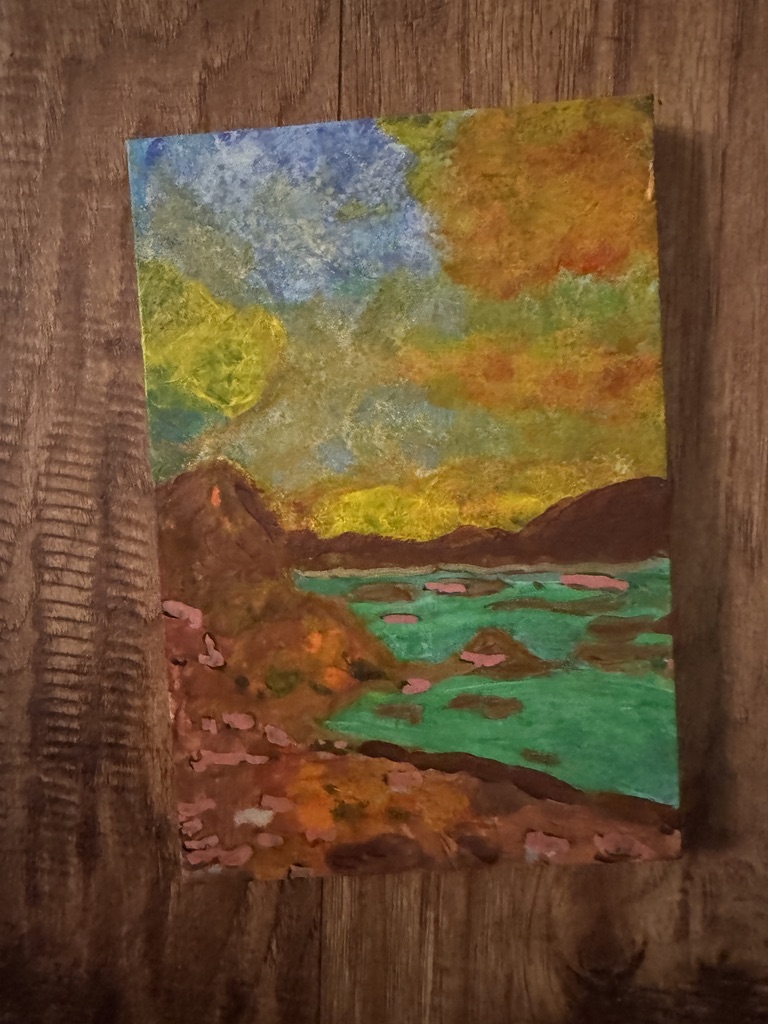
Artist Statement

I painted this from memory rather than from a photograph, and I think that distinction matters. Memory renders a scene emotionally rather than accurately. This bay, this light, this particular quality of sky as the afternoon turned toward evening, I carried them inside me long before I thought to put them on paper. The painting came later, when I was trying to locate something I had felt in Loreto that I had struggled to name in words.

The sea here is the wrong colour, and that is exactly the point. The water I remember was green and teal and almost luminous at certain hours, as though the light were coming from underneath rather than above. Painting it forced me to ask: what do I actually remember? What has feeling kept, and what has it transformed? The mountains in the background are darker than they appeared in daylight, more brooding. In memory, they were always waiting, always present, always framing whatever small human drama was unfolding at the water's edge.

The terracotta and rust of the shoreline, the way the rocks hold warmth even as the light shifts, this is what I kept returning to during my months of field research. The shore as threshold. The place where the known meets the vast. I was looking, in those thirty days beside the Sea of Cortez, for what happens to the self when it is asked to be simply present, without agenda or audience. This painting is my attempt to hold that question in colour rather than in argument.

Painting Credit: Amy Tucker, 2026
The Loneliness Hidden in Plain Sight
And yet we are living in an era of unprecedented communicative abundance and epidemic loneliness simultaneously. The paradox is real and unmistakable. Loneliness, as the Harvard researchers understand it, is less about physical isolation than about the subjective experience of feeling unseen and emotionally unreached (Waldinger & Schulz, 2023). This is why loneliness hides so effectively in plain sight. Many people who appear socially fluent, who attend every gathering and fill their calendars and maintain active digital lives, carry that quiet interior distance without anyone around them knowing. Being surrounded carries no guarantee of being met. This matters because we tend to treat social withdrawal as the symptom to address, when the more precise issue is emotional distance, a condition that can persist regardless of how many bodies share the room.
Being surrounded carries no guarantee of being met.
Finding a Third Word: Alonetude
Sitting with all of this over the past several years, I found myself reaching for distinctions the existing language struggled to hold. The word loneliness captured the ache but carried an implication of isolation I wanted to examine more carefully. The word solitude pointed toward something more intentional, the chosen quiet that writers, artists, and scholars have long sought as a condition for thinking and creating. Anthony Storr (1988), the British psychiatrist and author of Solitude: A Return to the Self, argued that the capacity for solitude is as central to human flourishing as the capacity for relationship, a claim that sits in productive tension with the Harvard Study’s emphasis on relational connection. Solitude allows the mind to settle, ideas to surface, and creative work to unfold without the interruption of social performance.
But I kept encountering a third experience, one that fit neither category with any precision. I began calling it alonetude.
Alonetude is the state where being alone feels expansive rather than empty. Physically solitary, yes, and yet inwardly accompanied, by memory, by the particular quality of light at a given hour, by creative work, by a felt sense of belonging to something larger than the immediate moment. It is distinct from loneliness because the ache is absent. It is distinct from solitude in its ordinary sense because it arose, in my own life, precisely from circumstances I would never have chosen, from rupture and institutional loss rather than peaceful, voluntary retreat. Alonetude names the labour of transforming imposed aloneness into something generative, which I have come to understand as both a healing practice and a form of resistance.
Alonetude names the labour of transforming imposed aloneness into something generative, which I have come to understand as both a healing practice and a form of resistance.
Painting Memory: The Shore at Nightfall
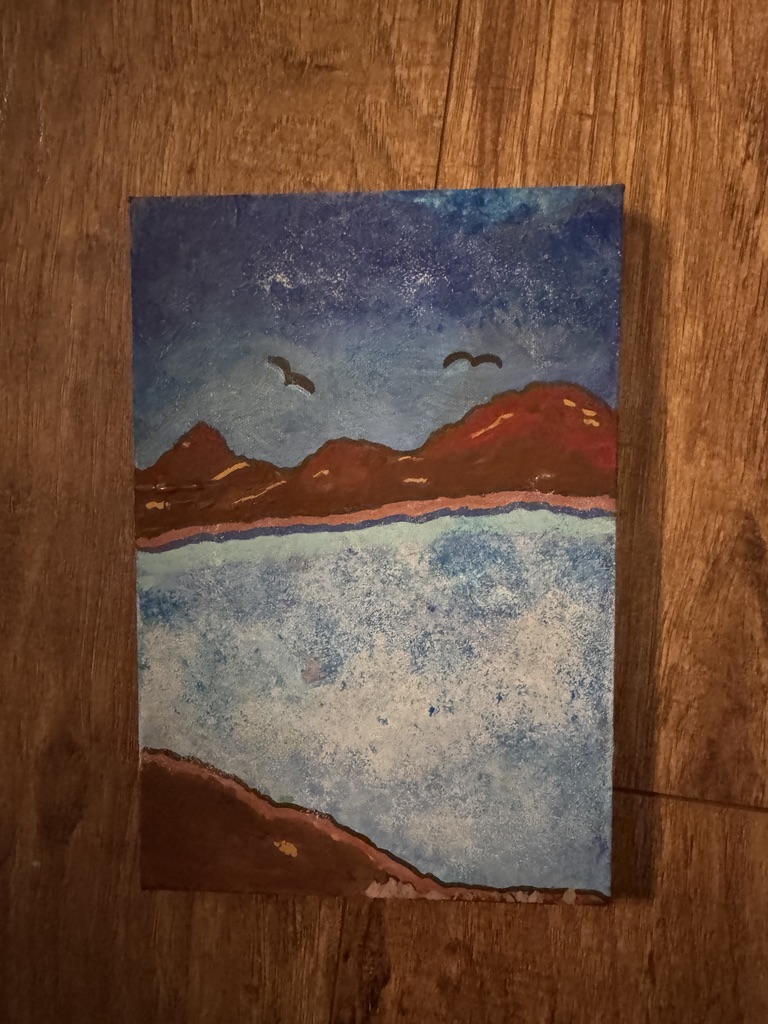
Artist Statement

This painting came from a different hour than the first. If the other painting belongs to the late afternoon, to the long golden light before sunset, this one belongs to the threshold between day and night, that brief interval when the sky deepens toward violet and the mountains lose their detail and become only shape and presence. I painted birds into the sky because I kept seeing them during that hour, pelicans mostly, moving low and purposeful across the water's surface, indifferent to whether anyone was watching.

The surf here is white and heavy, almost opaque. I wanted to capture the sound of it as much as the sight, the persistent rhythmic breaking that I came to rely on during my thirty days beside the Sea of Cortez as a kind of company. When you are alone for long stretches, sound becomes texture. The waves were always arriving, always completing something, always beginning again.

The shoreline in the foreground is painted in rust and dark brown, the same volcanic rock that edged every walk I took. I was drawn to that rock because it was ancient in a way that made my own concerns feel appropriately small. I came to Loreto seeking something beyond escape. I came to find a scale in which the self could rest without dominating the frame. I think this painting is what that felt like: the self as one small thing in a large, indifferent, generous world.

Painting Credit: Amy Tucker, 2026
The Capacity to Be Alone
For me, these moments of alonetude tend to arrive in quiet, specific places. Walking beside water before the day has fully opened. Writing in a journal in the blue hour before dawn. Watching light move across a landscape and feeling, in that movement, something that resembles being witnessed. Donald Winnicott (1958), the British paediatrician and psychoanalyst, described what he called the capacity to be alone, arguing that the ability to feel secure within oneself, held by an internalised sense of presence rather than requiring constant external validation, reflects a particular kind of emotional maturity. Alonetude, as I understand it, is something closely related: the discovery that the self can be genuinely accompanied from within, that connection is available even in the absence of another person.
This is where I want to return to the phrase that opened this reflection. Lonely in a crowd is a diagnosis of a very particular condition, the condition of being physically proximate to others while remaining emotionally unreached. What it reveals is that the remedy for loneliness is presence and authenticity rather than mere proximity. We can fill a room and still be strangers to one another. We can text constantly and remain fundamentally unseen. The Harvard Study of Adult Development has been tracking this truth since 1938, and what eight decades of data confirm is that the architecture of a well-lived life is built from something far more demanding than adjacency (Vaillant, 2012; Waldinger & Schulz, 2023).
Painting Memory: Crescent Moon Over the Sierra de la Giganta
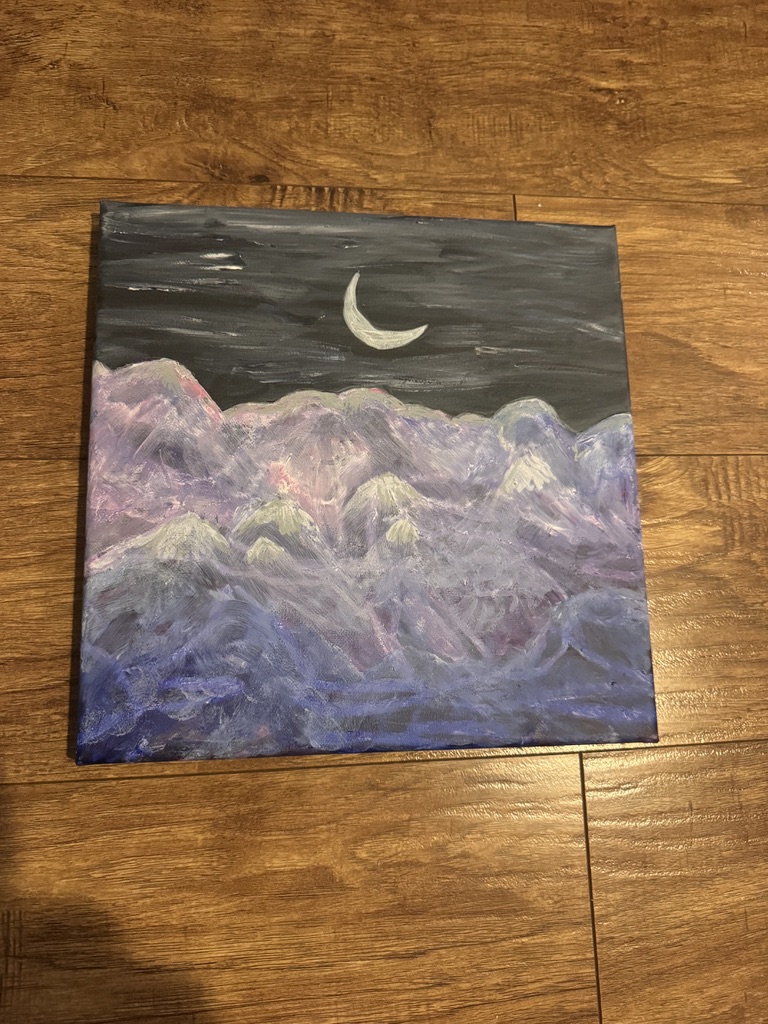
Artist Statement

I painted the mountains at night because that is when they became something else entirely. During the day, the Sierra de la Giganta were backdrop, context, the frame that held the sea in place. At night they lost their practicality and became pure presence. Purple and lavender and something close to blue, their ridgeline dissolving into the dark sky so that it was difficult to say where mountain ended and atmosphere began. I found myself standing outside my casita on more than one evening, just watching them hold the dark.

The crescent moon I painted small and precise because it was small and precise. It offered only faint illumination, just enough light to make the darkness visible, to give the eye a point of reference in all that immensity. I think that is what I was learning to do in Loreto: rather than flooding the dark with light, to find the small, reliable point from which to orient. To stop needing the whole sky to be bright in order to feel safe.

There is something this painting knows that I am still learning: that the mountains have no need of our attention. They perform for no one. They were there long before I arrived and will remain long after I have gone, carrying their particular shade of purple into night after night, indifferent to whether anyone names what they are. I painted them anyway. It felt like a form of witnessing, and witnessing, I have come to understand, is one of the quietest and most necessary forms of connection.

Painting Credit: Amy Tucker, 2026
Presence Over Proximity
The Harvard Study is right that relationships are essential, perhaps the most essential thing. And I want to add something alongside that finding: the quality of our relationship with ourselves shapes the quality of what we are able to offer and receive in our relationships with others. When I have learned to sit within my own alonetude, to be genuinely present with my own interior life rather than fleeing it into noise or distraction, I find that I arrive at my connections with other people from a place of relative steadiness rather than depletion. I am looking for company rather than rescue. That is a different kind of showing up.
I am looking for company rather than rescue. That is a different kind of showing up.
The phrase lonely in a crowd has always carried a tone of lament, and rightly so. The experience it names is genuinely painful and genuinely common. And yet I wonder if it also holds an invitation, to ask what kind of presence we are bringing into the rooms we enter, and whether we have yet learned to be present enough with ourselves to be fully present with anyone else.
A veces la soledad más profunda no es la que vivimos solos, sino la que vivimos rodeados. Sometimes the deepest solitude is the one we live surrounded by others. And sometimes, learning to inhabit our own company with grace is where the long work of genuine connection begins.
References
Storr, A. (1988). Solitude: A return to the self. Free Press.
Vaillant, G. E. (2012). Triumphs of experience: The men of the Harvard Grant Study. Belknap Press of Harvard University Press.
Waldinger, R. J. (2015, November). What makes a good life? Lessons from the longest study on happiness [Video]. TED Conferences. https://www.ted.com/talks/robert_waldinger_what_makes_a_good_life_lessons_from_the_longest_study_on_happiness
Waldinger, R. J., & Schulz, M. S. (2023). The good life: Lessons from the world’s longest scientific study of happiness. Simon & Schuster.
Winnicott, D. W. (1958). The capacity to be alone. The International Journal of Psycho-Analysis, 39, 416–420.
Translation Note
Spanish language passages were generated using Google Translate and subsequently reviewed and refined by the author. Any remaining infelicities reflect the limits of machine translation rather than intent.