On Carrying Alonetude Into the Crowded Room, Hot Springs After Seawater, and the Question I Cannot Yet Answer
“The capacity to be alone is a highly sophisticated phenomenon and has many contributing factors. It is closely related to emotional maturity.”
Donald Winnicott, “The Capacity to Be Alone” (1958, p. 416)
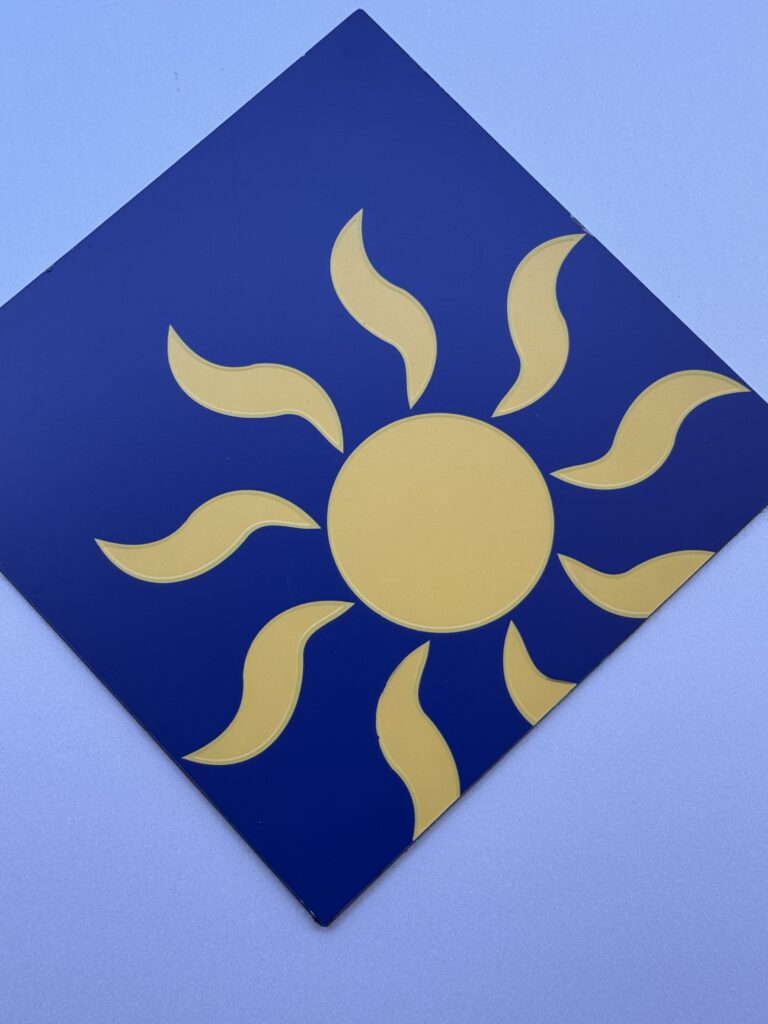
Title: Holding Light – Just a Sign
Artist Statement

This image drew my attention because of its simplicity and its steadiness. A single sun, rendered in clean lines and bold contrast, rests within a diamond frame of deep blue. There is no landscape, no horizon, no surrounding context. Only light held in shape.

I found myself pausing with it longer than expected. The symbol felt less decorative and more grounding. The sun held back its blaze, asking nothing of attention. Instead, it radiated a quiet constancy. In a period of movement, reflection, and internal sorting, this form of contained brightness felt meaningful. Light arrives in many ways beyond revelation. Sometimes it appears as steadiness. As presence. As something that remains even when the surrounding environment feels uncertain.

The geometric framing also held significance for me. The diamond shape created both structure and protection, as though the light was being safeguarded rather than exposed. I experienced this visually as a reminder that illumination requires no expansion outward at all times. There are seasons where light is held inward, tended quietly, allowed to gather strength before it moves beyond its frame.

This photograph, for me, became less about a symbol on a wall and more about recognising the ways light continues to exist within periods of transition. It is rarely dramatic. Often, it is simply there. Steady. Contained. Waiting to be noticed.

Photo Credit: Amy Tucker, 2026
I am learning that intention is something I practise rather than declare once. It is something I practise, quietly, in the smallest choices of the day.
The Morning After
I have been home for less than twenty-four hours. The fragments from Loreto sit on the windowsill where I placed them last night: blue tile, amber stone, smoothed glass, each one catching the pale light of a Kamloops February morning. Outside, snow. Inside, the particular silence of a house that held itself while I was gone.
And already I am packing again.
Tomorrow I leave for Harrison Hot Springs. Two weeks of labour school. Hundreds of people. Workshops and lectures and shared meals and hallway conversations and the particular intensity of being in a room full of workers who have come to learn how to organise, how to resist, how to hold each other up against systems that would grind them down. It is important work. It is work I believe in.
But this morning, standing at the window with tea going cold in my hands, I feel the question settle into my chest like a stone: Can I carry what I learned in solitude into a room full of people? Can alonetude survive the crowd?
¿Puedo llevar esta quietud conmigo? Can I carry this quiet with me?
What I Learned Alone
Learning begins to change shape when I stop asking what I must produce and start asking what I am ready to understand.”
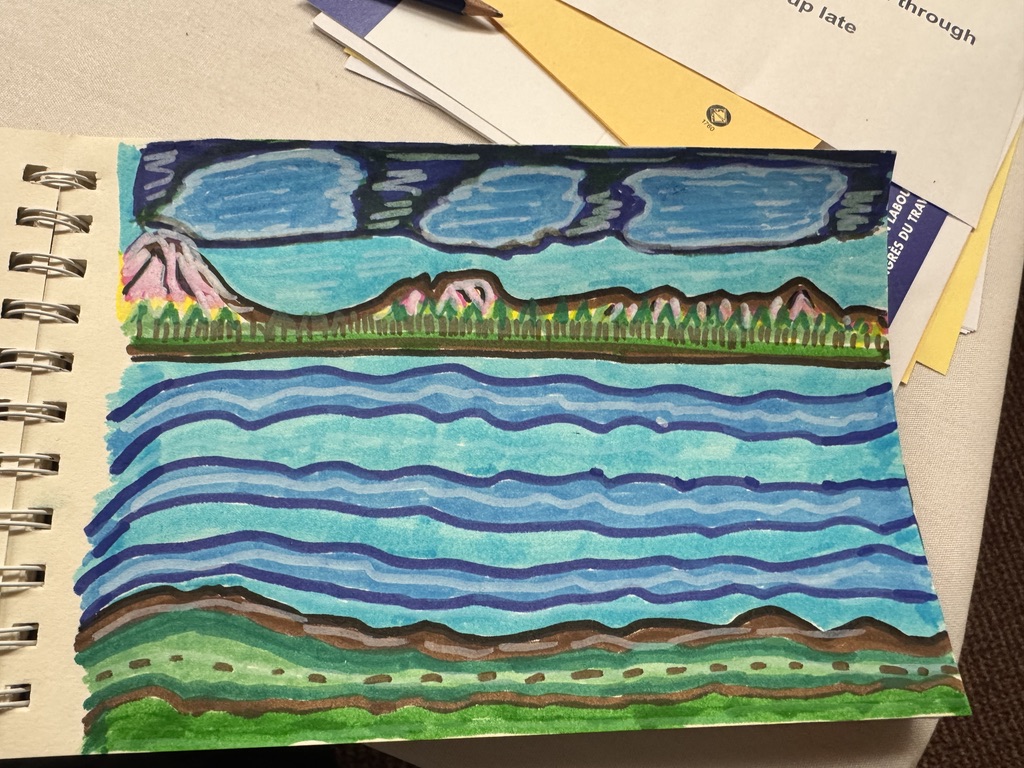
Title: Where Water Teaches the Land to Breathe
Artist Statement

This piece emerged slowly, through colour rather than intention. I began with the water. Layer upon layer of blue moved across the page in waves that felt less like representation and more like rhythm. The repetition became calming. Each line carried the sensation of breathing, of returning to the body through motion of the hand.

As the water settled, the land began to form almost instinctively. Mountains rose in the distance, edged in pink and earth tones, held gently beneath a wide sky. Their shape arrived without my planning. They appeared as memory does, familiar but softened. The tree line that followed felt like a boundary and a bridge at once, marking the meeting place between groundedness and movement.

What I notice most, looking back at the work, is the layering. Water. Land. Sky. Each occupies its own space yet remains in relationship with the others. The composition reflects an inner landscape more than a geographic one. There is calm in the horizontal lines, steadiness in the repetition, and reassurance in the way the elements hold one another without collapse.

Creating this drawing felt like returning to a quieter frequency. A reminder that reflection rarely requires language alone. Sometimes colour carries what words cannot. Sometimes the body understands balance before the mind is able to name it.

Photo Credit: Amy Tucker, 2026
Thirty days beside the Sea of Cortez taught me how to be with myself. I learned slow attention, the discipline of looking at one thing long enough for it to reveal what it held. I learned that rest is recalibration rather than laziness, repair rather than withdrawal. I learned that my body carries wisdom my mind has spent decades trying to override. I learned to cry without apology, to dream without interpretation, to sit with difficulty and let it transform rather than destroy.
But all of this I learned alone. In a casita with no one watching. On a shoreline with no one waiting. In the spacious quiet of days with nothing demanded of me. The practice of alonetude grew in conditions of extraordinary gentleness, and I am deeply grateful for those conditions.
Now I am about to test the practice in its opposite environment. Beyond the quiet casita, the conference hotel. Beyond the empty shoreline, the crowded workshop room. Beyond the solitary walk, the shared meal table. Beyond the Sea of Cortez, the hot springs of Harrison Lake, on the traditional territory of the Sts’ailes people, whose name means “the beating heart.”
The beating heart. That meaning arrived unexpectedly, but it lands in me with force. After thirty days of learning to hear my own heartbeat in the quiet, I am going to a place named for the beat of collective life.
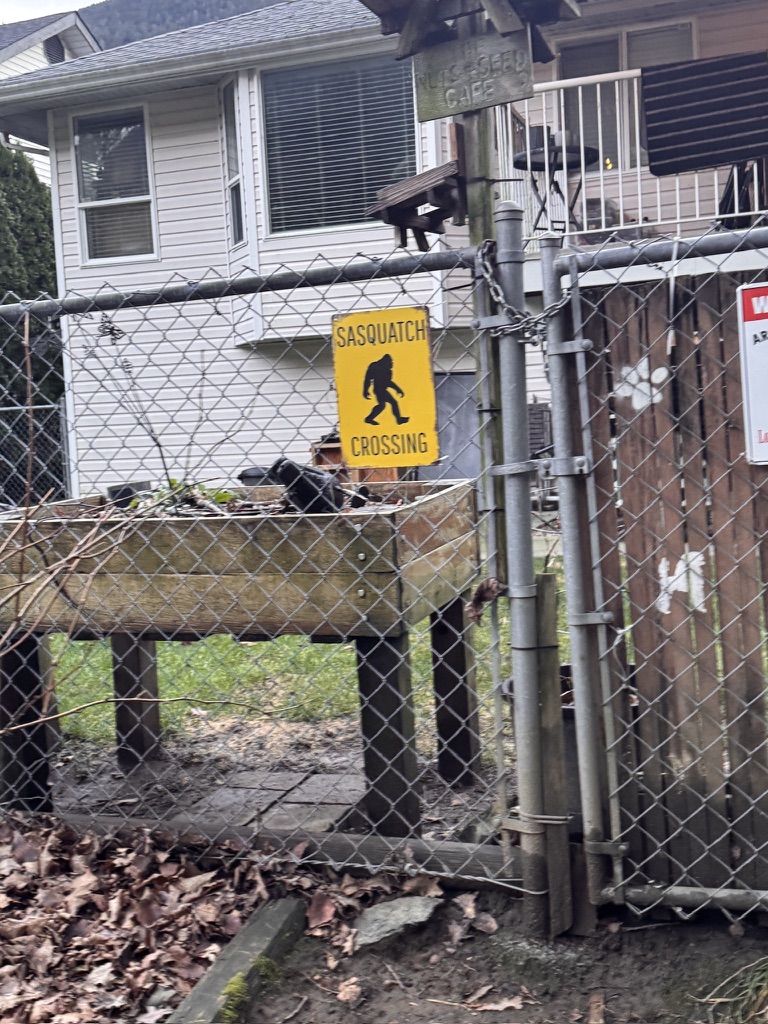
Title: Threshold Guardian: On Humour, Boundary, and the Wild Edges of Belonging
Artist Statement

Meeting him there was unexpected.

A small yellow sign, fixed to a chain-link gate, announcing Sasquatch Crossing with quiet certainty, as though the boundary between the domestic and the mythical required no explanation. Behind it, the ordinariness of human life: a raised garden bed, a porch, blinds drawn against the afternoon light. Nothing spectacular. Nothing staged. And yet the sign altered the entire landscape. It suggested that the familiar world was porous, that something ancient and unscripted might pass through at any moment.

What struck me most was the gentleness of the warning. No danger. No fear. Crossing. Movement. Passage. An invitation to imagine that wilderness lives far beyond distant forests but walks the edges of our constructed lives, occasionally stepping across the thresholds we build to contain ourselves. I stood there longer than I expected, smiling at the playfulness of it, but also aware that humour often guards something deeper: a recognition that we coexist with forces we cannot fully domesticate, including the wildness within ourselves.

The image became, for me, less about folklore and more about boundary. Who gets to cross? What parts of ourselves remain fenced out? What mythic selves linger just beyond the gate, waiting for permission we never quite grant?

I took this photograph while walking, simply open rather than searching, simply letting my attention move where it wished. This has become part of my practice since returning from Loreto, the discipline of slow looking, of allowing small encounters to surface meaning rather than forcing insight through analysis. The sign appeared suddenly along the path, its bright yellow interrupting the muted winter palette of wood, wire, and fallen leaves.

I felt an immediate recognition that surprised me. For years, my professional life required a careful containment of self. Competence performed. Emotions moderated. Exhaustion hidden behind productivity. There were parts of me that crossed freely into institutional spaces, and parts that remained outside the fence, watching, waiting, unacknowledged. Creativity. Vulnerability. Playfulness. Even rest. These were treated as indulgences rather than necessities, as though the wild interior life needed to be regulated before it could be allowed into the workplace or the classroom.

Standing in front of the sign, I found myself thinking about what it means to warn others of wild crossings while ignoring our own.

Sasquatch, in Pacific Northwest lore, is elusive, rarely seen, often doubted, yet persistently present in collective imagination. I began to see the figure as metaphor rather than creature: the uncontained self, the part that refuses domestication, the presence that leaves traces even when unseen. My own “crossings” had been subtle over the years. Moments when exhaustion broke through composure. Moments when grief surfaced unexpectedly. Moments when my scholarly voice refused neutrality and spoke instead from lived experience.

The fence in the photograph feels important.

Chain link: transparent but restrictive. You can see through it, but you cannot easily pass. It mirrors institutional boundaries that appear permeable yet hold firm. The gate is chained, though loosely, suggesting both security and improvisation, as though the barrier exists more from habit than necessity. The sign leaves the gate open; it simply acknowledges what might cross it.

In that way, the image mirrors my current threshold. After thirty days of intentional solitude, of meeting parts of myself long held at the margins, I am returning to communal and institutional spaces with a different awareness. I am less interested in perfect containment and more willing to acknowledge the crossings: emotion into scholarship, body into research, humour into theory, vulnerability into leadership.

The wild self is no longer something I wish to fence out. It is something I am learning to let pass through the gate, in recognition rather than chaos, as presence rather than threat. The sign, playful as it is, becomes a guardian of that truth: that what is wild will cross eventually, whether we name it or leave it unnamed.

Photo Credit: Amy Tucker, February 2026
Winnicott’s Paradox: Alone in the Presence of Others
To learn with intention is to move slowly enough to notice what is asking for my attention.
Donald Winnicott (1958) understood something about aloneness that I am only now beginning to grasp. In his paper “The Capacity to Be Alone,” published in the International Journal of Psycho-Analysis, the British pediatrician and psychoanalyst proposed what sounds like a contradiction: the capacity to be truly alone develops through the experience of being alone in the presence of another. Winnicott first observed this in infants and young children, who learn to play contentedly, absorbed in their own world, when a reliable caregiver is nearby. The child needs nothing from the caregiver in that moment. The caregiver simply stays. What matters is the experience of a quiet, non-intrusive, dependable presence that allows the child to settle into their own interior life.
Winnicott argued that this early experience forms the foundation for all later experiences of creative solitude. Without it, being alone feels threatening. With it, solitude becomes spacious, generative, even companionable. The mature adult who can sit in a café writing in a notebook, present to their own thoughts while surrounded by conversation, is drawing on this early developmental achievement.
It is only when alone (that is to say, in the presence of someone) that the infant can discover his own personal life. (Winnicott, 1958, p. 418)
I read this sentence now, on the morning before I leave for two weeks among hundreds, and it reframes everything. What if the thirty days in Loreto were the necessary foundation, but the real test, the mature expression, is what comes next? What if alonetude is more than the practice of being alone: it is the practice of being alone inside yourself, even when you are surrounded by others?
This is the inversion that arrived beyond my anticipating. I thought alonetude required physical solitude. Winnicott suggests the opposite: the deepest form of being alone happens in relationship. The practice holds firm in the presence of others. It is completed by it.
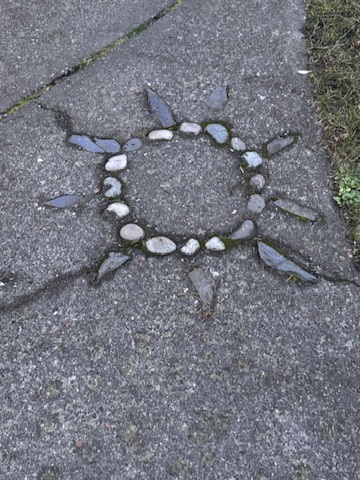
Title: Small Sun, Sidewalk Shrine
Artist Statement

I almost missed it.

Arranged quietly in the cracks of an ordinary sidewalk, a circle of stones held its shape with care. Dark shards extended outward like rays, forming a small sun pressed gently into the pavement. There was no signature. No explanation. Just the evidence of someone pausing long enough to make something temporary and whole.

What stayed with me was the tenderness of the gesture. A sun where winter still lingered. Warmth imagined into being. It felt less like decoration and more like offering, a reminder that light can be assembled even on the ground we walk past without noticing.

Since returning from solitude, I have been attentive to these small, unannounced interventions, moments where human hands leave quiet traces of meaning in public space. This piece felt participatory even before I touched it. I stood at its edge, aware of how easily it could be scattered, how intentional its balance was. It mirrored my own practice of reassembly.

After months of exhaustion, I have been gathering myself in similar ways, piece by piece, fragment by fragment, creating small circles of coherence where there had been only dispersal. The sun on the sidewalk reminded me that wholeness arrives in fragments, placed one at a time. Sometimes it is placed gently into the cracks of daily life, held together by attention, by care, by the simple act of choosing to arrange what remains into something that can still give light.

Photo Credit: Amy Tucker, February 2026
The Nervous System in the Crowded Room
I am no longer collecting knowledge. I am listening for what knowledge is trying to teach me about myself.
I will be honest about what I am afraid of. After thirty days of near-silence, the thought of a room full of voices makes my shoulders rise toward my ears. I can feel the bracing in my body even as I write this, the anticipatory tightening that Stephen Porges (2011) would recognise as a shift in autonomic state. Porges’ polyvagal theory describes how the nervous system evaluates environmental cues, a process he calls neuroception, and responds with one of three broad patterns: the ventral vagal state of safety and social engagement, the sympathetic state of mobilization and defence, or the dorsal vagal state of shutdown and withdrawal.
For thirty days in Loreto, my nervous system lived primarily in the ventral vagal state. Warmth, quiet, rhythmic sound, consistent routine, the absence of institutional demand: all of these cues signalled safety, and the body responded by softening, opening, becoming available. Now I am about to walk into an environment of high stimulation: new people, loud dining halls, competing conversations, fluorescent-lit conference rooms, shared accommodations, the social labour of introductions and small talk.
Porges would recognise my anxiety. The transition from low stimulation to high stimulation requires autonomic adjustment. The nervous system needs time to recalibrate, to learn that this new environment, though louder and more populated, is also safe. He describes a process he calls co-regulation: the way nervous systems influence one another through facial expressions, vocal tones, gestures, and timing. In a room full of people, the nervous system does more than regulate itself. It is in constant dialogue with the nervous systems of everyone present.
Here is what I notice as I think about this: the anxiety I feel concerns the energy rather than the people themselves. It is about the energy required to be in constant social dialogue after a month of quiet. It is the fear that the softness I gained in Loreto will be overwritten by the demands of social performance. Tengo miedo de perderme otra vez. I am afraid of losing myself again.
But Porges also describes something hopeful. He explains that a well-regulated nervous system, one that has had sufficient experience of safety, develops what he calls a broader window of tolerance. The range of stimulation the system can absorb without tipping into defence or shutdown expands. The thirty days in Loreto were far beyond merely pleasant. They were regulatory. They widened my window. The question is whether the window is wide enough to hold a labour school.
Title: Circle of Returning
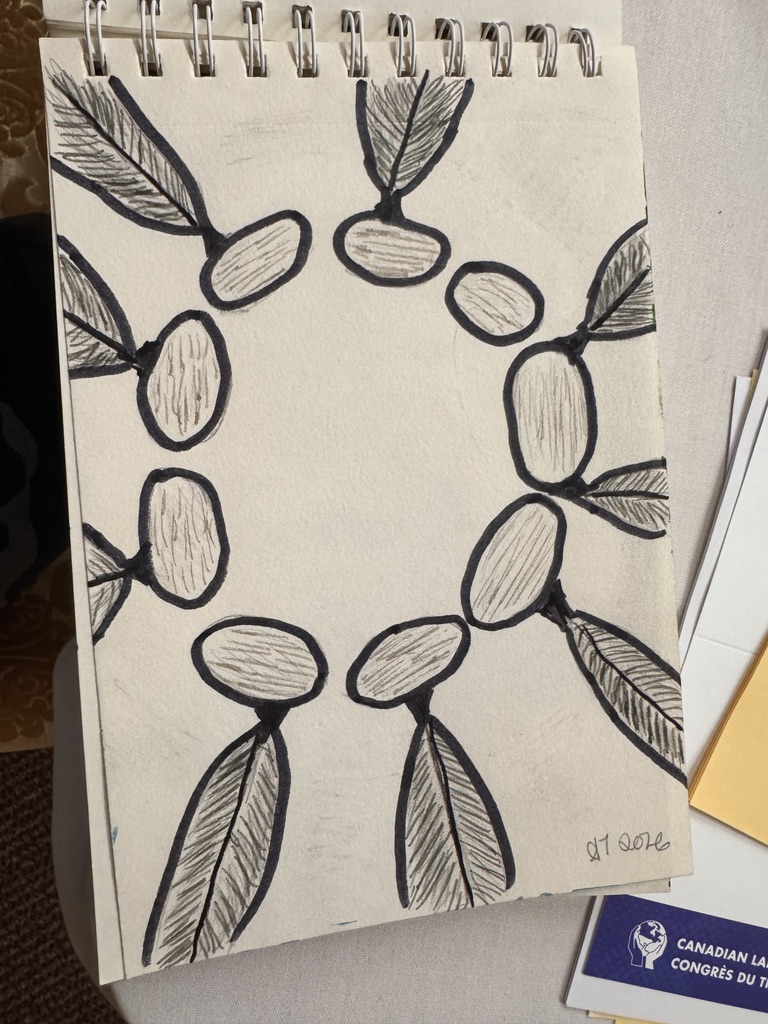
Artist Statement

Inspired by the sunshine circle, I created my own version of sunshine. In my practice, circles often surface when I am trying to understand where I am in relation to what I have lived. This drawing came during a period of transition, when I was moving between solitude and re entry, between interior work and collective presence. The repeated forms felt like versions of the self, each shaped by different seasons yet held within a shared perimeter.

The open centre matters. It suggests that wholeness is spaciousness rather than density, balance rather than completion. I see in this piece an evolving understanding that returning to oneself is never a solitary act. It is relational, cyclical, and ongoing. Each iteration brings me closer to a steadier way of standing within my own life.

Photo Credit: Amy Tucker, February 2026
Table 1
Conditions of Practice: Alonetude in Solitude Versus Alonetude in Community
| High stimulation; the nervous system is in constant co-regulation with others | Loreto: Alonetude in Solitude | Harrison: Alonetude in Community |
| Social Environment | Near-total solitude; days without conversation; self as primary companion | Hundreds of people; constant interaction; shared meals, workshops, corridors |
| Autonomic Demand | Low stimulation; the nervous system regulated by rhythm, warmth, silence | High stimulation; the nervous system in constant co-regulation with others |
| Temporal Structure | Self-determined; no schedule except what the body chose; days unfolded organically | Externally structured; workshops, lectures, meals at set times; time belonging to the group |
| Water | The Sea of Cortez; salt water; tidal rhythm; walked beside each morning | Harrison Lake and hot springs; mineral water; geothermal warmth; soaked in rather than walked beside |
| Practice Mode | Contemplative; photography, journaling, walking, sitting with the self | The Sea of Cortez; salt water, tidal rhythm; walked beside each morning |
| Core Challenge | Befriending aloneness; staying with difficulty; allowing the body to soften | Maintaining interior quiet amid external demand; choosing presence over performance |
Note. This table maps the shift from solitary alonetude to communal alonetude as a transition in conditions rather than a change in practice. The core intention remains the same: chosen, embodied, intentional presence with oneself. What changes is the environment in which that presence must be held. Winnicott (1958) would argue that the communal setting represents the maturation of the practice rather than a threat to it. The capacity to be alone develops in physical solitude; it is tested and deepened in the presence of others.
Each day of intentional learning becomes less about progress and more about presence.
Title: Holding Quiet Inside the Noise
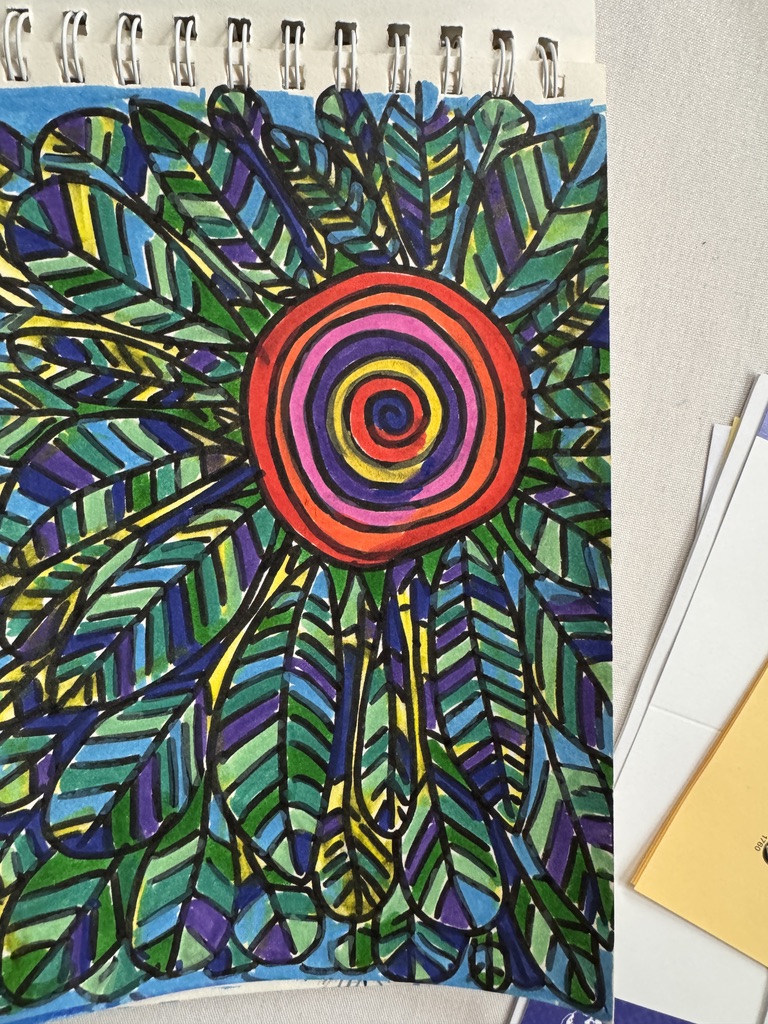
Artist Statement

The world around me is loud.

Workshops unfolding. Chairs shifting. Papers moving. Conversations layering over one another in waves of sound. Labour school carries an important energy, collective, urgent, alive. But inside that vitality, I feel the volume rise in my body faster than it rises in the room.

So I draw. The colours come first. Bright, insistent, unapologetic. They create a boundary, a visual rhythm that steadies my breathing while everything around me moves quickly. The lines hold the colour in place. The repetition gives my hands something to do so my nervous system can soften rather than brace. This is my space.

Doodling, drawing, and colouring have become portable practices of alonetude for me, ways of staying present without becoming overwhelmed. In high-stimulation environments like labour school, where learning is collective and constant, the body sometimes needs a parallel activity to regulate attention. The movement of pen across paper becomes a form of grounding, adaptive focus rather than disengagement.

What I notice is that the louder the external world becomes, the more vivid my internal palette grows. Colour holds what words cannot in those moments. It absorbs excess noise, translates it into form, gives shape to what might otherwise feel like overwhelm. Through drawing, I remain in the room, listening, learning, participating, while also maintaining a quiet interior space that allows me to stay open rather than shut down.

I am still here.

Photo Credit: Amy Tucker, February 2026
Hot Springs After Seawater
There is something I cannot ignore: I am going from one body of water to another. From the Sea of Cortez to the hot springs that the Sts’ailes people have known as Kwals, meaning boiling water, a place revered as a site of healing since time immemorial. The hot springs at Harrison have been a place of care and restoration long before any settler named them, long before any resort was built around them. The Sts’ailes, a sovereign Coast Salish First Nation whose name means “the beating heart,” have lived on these traditional lands, including the entirety of Harrison Lake and the Harrison River, for thousands of years.
I sit with this knowledge carefully. I am a settler going to soak in waters that carry Indigenous stories of healing far older and deeper than my own. My practice of alonetude, my thirty days of personal recovery, my thesis about intentional solitude: all of this exists within a colonial context where land and water were taken, where Indigenous practices of healing were suppressed, where the very hot springs I will visit were “discovered” by settlers who capsized their boat in 1858 and were surprised to find the water warm. The Sts’ailes already knew. They had always known.
Any practice of presence I carry into that water must include awareness of whose healing place I am entering. This is far from a footnote. It is a condition of ethical practice.
And yet. The water. I feel its pull completely. After thirty days walking beside salt water, my body now understands something about what water offers: rhythm, buoyancy, the sensation of being held by something larger than yourself. Roger Ulrich (1983), in his foundational research on restorative environments, demonstrated that natural settings, and water in particular, facilitate physiological recovery from stress. The body already knows water is healing. The body already knows. El cuerpo ya sabe. El agua siempre sana.
Title: Steam Between Worlds
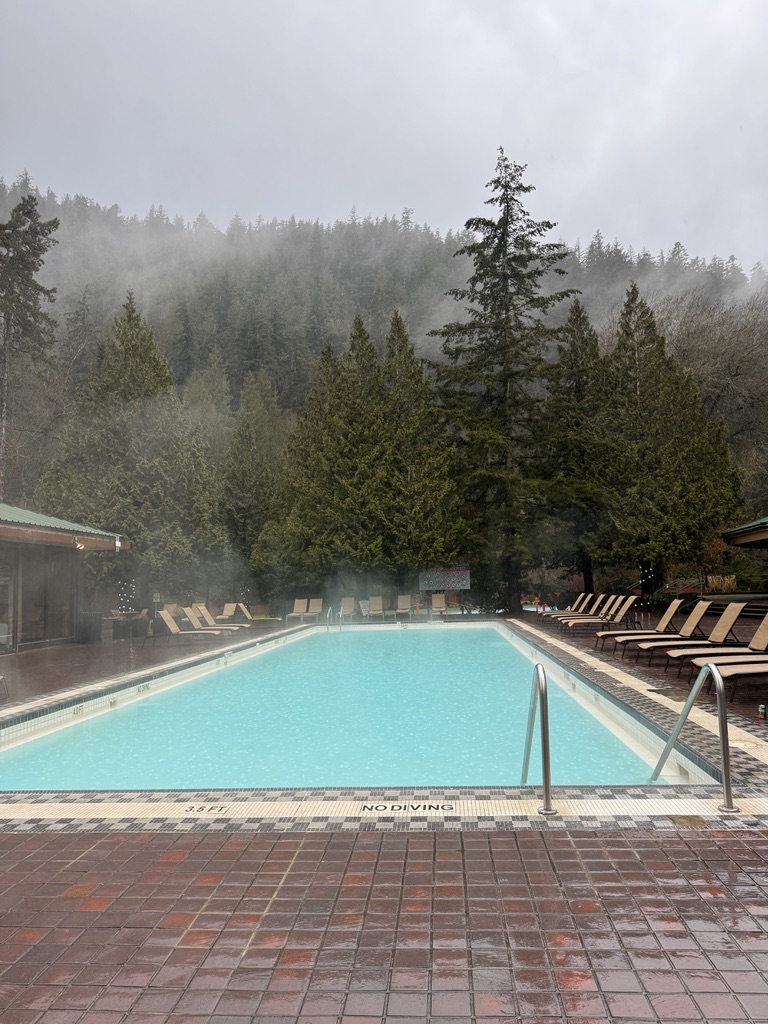
Artist Statement


The blue water held that familiar invitation I had come to recognise, warmth rising in soft spirals, dissolving the sharpness of the winter air. Steam hovered between surface and sky, blurring the boundary between forest and pool, between body and landscape. After weeks beside salt water, I found myself before mineral water, different in composition yet similar in promise: buoyancy, release, the possibility of being held.

What struck me most was the meeting of elements. Cold rain on my face. Heat on my skin. Evergreen stillness rising behind the pool like a wall of quiet witness. The mountains held their silence, yet their presence shaped the experience of immersion. This was an enclosed cradle rather than the open horizon of the sea of forest, a contained space of restoration. I entered slowly, aware that the body recognises water as language long before the mind understands the setting.

Soaking here, I felt the transition I am living move through my nervous system in real time. From solitary retreat to collective learning. From the wide, tidal rhythm of the Sea of Cortez to the geothermal pulse of Harrison’s springs. Water, in both places, offered regulation, a sensory environment that softened vigilance and invited physiological repair. Environmental psychology has long documented water’s restorative capacity, yet what I felt was more than theory. It was embodied recognition.

In the steam, I realised that alonetude shifts form in community settings rather than disappearing. Even surrounded by others entering and leaving the pool, conversation rising and falling at the edges, I could feel a quiet interior basin remain intact. The practice I cultivated in solitude travelled with me, held by attention rather than geography. Immersion, in this sense, was both literal and methodological: the body soaking while the self observed how healing adapts across environments.

Photo Credit: Amy Tucker, February 2026
The Solidarity of Shared Space
Victor Turner (1969), the anthropologist of ritual and liminality, described a particular quality of human connection that emerges when people move through threshold experiences together. He called it communitas: a deep, unstructured, egalitarian bond that forms between individuals who share a liminal state. Communitas differs from ordinary social interaction. It strips away hierarchy, role, and performance. It creates what Turner described as a direct encounter between human beings, unmediated by the structures that normally organise social life.
Labour school, I think, is a site of communitas. Workers from different sectors, cities, and unions come together for two weeks to learn about their rights, their history, and their collective power. They leave behind the structures that normally separate them, the hierarchies of workplaces and institutions, and enter a liminal space where they are simply workers learning together. There is something tender about this. Something that echoes what I experienced in Loreto, though the form is entirely different.
In Loreto, I was liminal alone. Between identities, between chapters, between the person who was terminated and the person I was becoming. At Harrison, I will be liminal in the company. Surrounded by others who are also between: between frustration and hope, between isolation and solidarity, between the workplace they left and the understanding they will carry back.
Turner would recognise both as threshold spaces. The difference is that communitas generates bonds that solitude cannot. It produces what the labour movement has always known: that individual suffering becomes political understanding when it is shared. That the exhaustion I carried for twenty-five years in precarious academic positions was never only mine. That structural harm is structural precisely because it happens to many.
Title: Holding Focus in Fracture
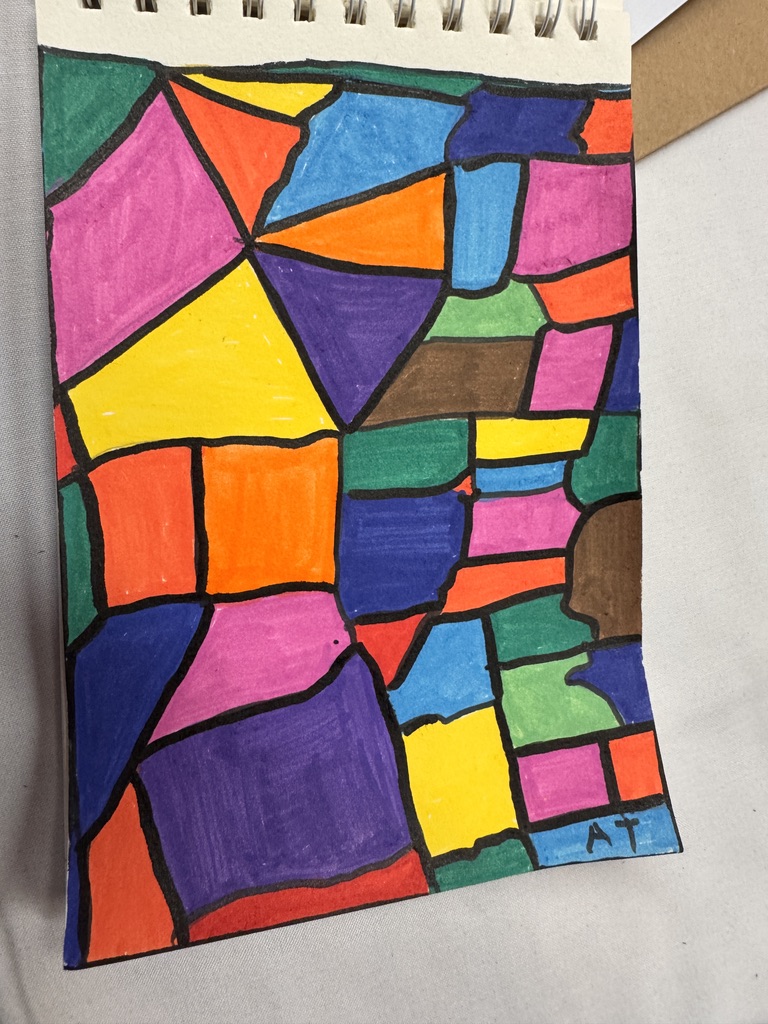
Artist Statement

Voices moved in overlapping waves, microphones cracking, chairs shifting, the constant hum of collective learning unfolding around me. The page became the one surface I could steady. Colour first, then line, then shape. Neither planned nor measured. Simply a quiet assembling of fragments that helped me stay present without becoming overwhelmed by the volume of the environment.

Deep focus. Deep flow.

Each shape holds its own boundary, thick black lines separating intensity so that colour can exist without bleeding into chaos. The composition mirrors the way I regulate myself in crowded spaces, creating interior compartments where sensation can settle. Drawing becomes a form of portable alonetude, a way of remaining engaged while protecting a small, necessary quiet within.

The world is louder, faster, more socially demanding than the solitary rhythm I had grown used to beside the sea. Rather than withdraw, I create visual anchors. The repetitive motion of marker on paper steadies my nervous system, offering tactile regulation amid cognitive overload. Arts-based methodologies recognise this gesture as embodied processing rather than distraction, a way of metabolising environmental intensity through form and colour.

In this sense, the drawing documents adaptation. It shows how alonetude travels, reshaping itself to meet the conditions of collective space. I am still listening, still learning, still present to the shared purpose of the room. But I am also tending to the interior field that allows that presence to remain sustainable. The fractured geometry on the page reflects the fractured attention of crowded environments, yet it also reveals something hopeful: even in fragmentation, coherence can be created, one line, one colour, one breath at a time.

I am trying...

Photo Credit: Amy Tucker, February 2026
Five Intentions I Carry With Me
I will arrive at Harrison open to what emerges. I will arrive with intentions, held lightly, the way I learned to hold the painted stones in Loreto: with care rather than grip.
First: I will protect small moments of solitude within the collective schedule. A morning walk before the first session. Ten minutes alone with my journal over coffee. A breath at the doorway before entering the workshop room. Jon Kabat-Zinn (1994) writes that mindfulness requires no meditation cushion or a retreat centre. It requires the willingness to pay attention, on purpose, in the present moment, without judgment. These small pauses are alonetude in its most portable form.
Second: I will notice what my body tells me without overriding it. If my shoulders rise in a crowded room, I will acknowledge the signal rather than pushing through it. If I need to leave a conversation, I will leave. If I need silence, I will seek it. The practice of alonetude includes the practice of boundaries, and boundaries are acts of care rather than withdrawal.
Third: I will let the hot springs hold me the way the sea held me. Different water. Different temperature. Different territory. But the same invitation: to let the body be buoyed, to let the warmth work on what is still tight, to be held without holding on.
Fourth: I will listen more than I speak. Alonetude taught me the discipline of slow attention. In a room of workers sharing their experiences of precarity, exhaustion, and resistance, that attention becomes an offering. There is no need to demonstrate knowledge or present expertise. I need to be present. I need to hear.
Fifth: I will let people in without losing myself. This is the one that frightens me most. Twenty-five years of precarious labour taught me that institutions take what they need and discard the rest. I learned to guard myself, to engage while protecting something small and essential within. Alonetude softened that guarding. Winnicott would say the practice gave me back the capacity to be alone even in a relationship, to hold my own interior life while remaining open to others. I want to trust that. I want to believe the practice is strong enough. Quiero confiar. Quiero creer que lo que encontré en mí es mío para siempre.
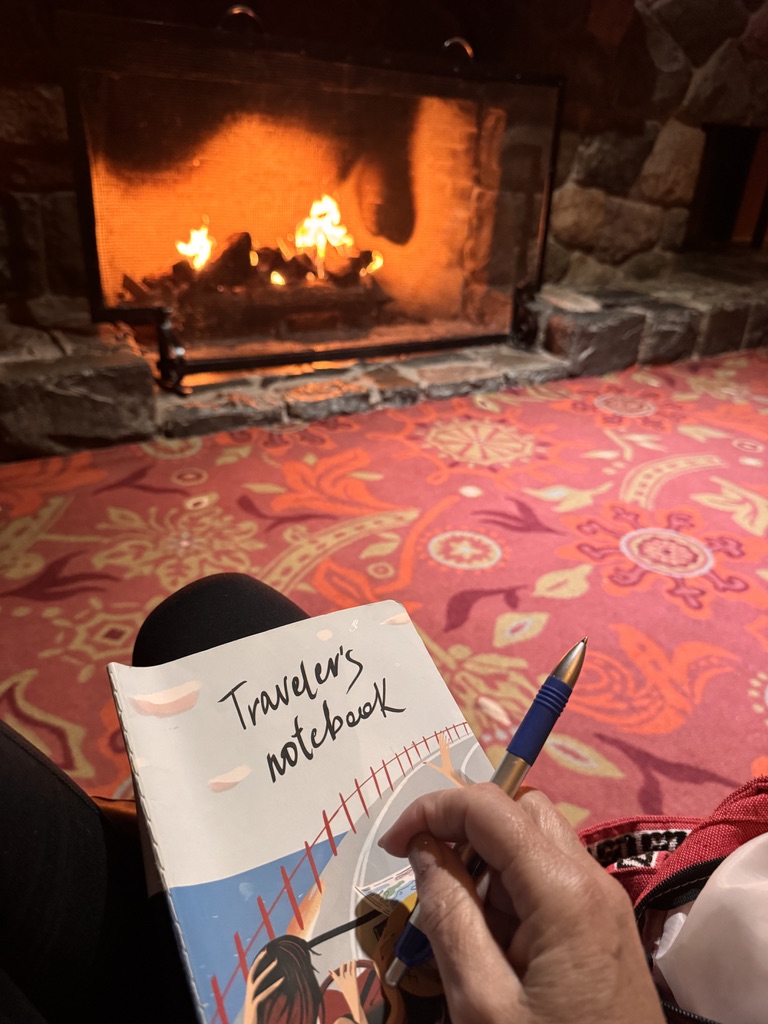
Title: Writing Beside the Fire
Artist Statement

How can I pretend I am invisible when everyone can see me?

At labour school, the days are dense with dialogue, learning, and collective analysis. The intellectual stimulation is rich, but it is also demanding. By evening, I find myself seeking spaces where reflection can unfold at a different pace. Sitting beside the fire with my traveller’s notebook becomes a transitional practice, a bridge between communal engagement and interior integration. The act of writing in this setting is methodological. It is deliberate. Within

This place matters. Environment shapes what is remembered, how it is processed, and what meaning emerges.

As I write, I am deepening into the collective experience of labour school. I am extending it inward, allowing the day’s conversations about justice, rights, and solidarity to move through personal narrative before they settle into intellectual analysis. In this way, the notebook becomes both archive and companion, holding the small, immediate truths that formal discourse often leaves behind.

Humans exhaust me.

Photo Credit: Amy Tucker, February 2026
The Question I Cannot Yet Answer
The question of whether alonetude can survive a crowded room stays open. I believe it can. The literature suggests it can. Winnicott says the mature form of aloneness is aloneness in the presence of another. Long and Averill (2003), in their exploration of the benefits of being alone, describe what they call inner solitude: the capacity to maintain a state of solitary awareness even amid social interaction, to be simultaneously connected to others and grounded in oneself. Anthony Storr (1988) argued that the capacity for solitude enriches, rather than diminishes, relational life; those who learn to be alone bring more depth, less guardedness, to their encounters with others.
But knowing something in theory and living it in the body are different things. My body learned to be soft in the quiet of Baja. Now it must learn to stay soft in the noise of collective life. My nervous system found its rhythm beside the sea. Now it must find rhythm in the dining hall, the workshop room, the late-night conversation, the shared bathroom, and the hallway encounter with a stranger.
I think of what I wrote yesterday: Llevo el mar en el pecho. I carry the sea in my chest. If that is true, truly true, then the sea comes with me to Harrison. The rhythm is internal now. The practice is mine. It travels with me.
But I am honest enough to admit that I am nervous. That the ball in my stomach is back, smaller than it was before Loreto, but present. That I am about to walk into a building full of people and find out whether thirty days of healing can hold against the oldest pattern I know: performing competence while slowly disappearing.
No voy a desaparecer esta vez. Llevo mi voz. La verdadera.
I carry myself forward this time. I carry my voice. The real one.
Table 2
Alonetude as Inner Practice: Theoretical Foundations for Solitude Within Community
| Storr (1988): Solitude enriches relationships | Core Argument | Application to Alonetude in Community |
| Winnicott (1958): Capacity to be alone | The ability to be alone is a developmental achievement rooted in the experience of being alone in the reliable presence of another; it is a sign of emotional maturity rather than withdrawal | Labour school as the “reliable other” whose presence allows interior solitude; alonetude deepens in safe community rather than diminishing |
| Porges (2011): Polyvagal theory and co-regulation | The nervous system is shaped by social context; safety is communicated through co-regulation; the ventral vagal state supports both social engagement and calm self-presence | The nervous system that learned safety in solitude must now learn to maintain that state amid the social signals of a crowded environment |
| Turner (1969): Communitas | Labour school as a liminal site where workers shed institutional roles; communitas may support rather than threaten alonetude | Labour school as liminal site where workers shed institutional roles; communitas may support rather than threaten alonetude |
| Long & Averill (2003): Inner solitude | Solitude includes an inner dimension: the capacity to maintain solitary awareness even in social settings; positive solitude requires choice, creativity, and self-connection | Alonetude in community as inner solitude: grounded self-awareness maintained while engaging with others |
| Storr (1988): Solitude enriches relationship | Those who develop rich inner lives through solitude bring greater depth and authenticity to their relationships; solitude and connection are complementary, mutually reinforcing | The depth gained in Loreto becomes a resource for genuine connection at labour school rather than a barrier |
| Kabat-Zinn (1994): Portable mindfulness | Mindfulness is available in every moment of daily life, beyond formal practice or retreat; attention is the practice, and attention goes wherever the person goes | Alonetude as portable attention: ten-minute pauses, doorway breaths, slow listening in the workshop room |
Note. These six frameworks collectively support the argument that alonetude extends beyond physical isolation but represents an internal orientation that can be practised in any environment. Each framework contributes a distinct dimension: developmental (Winnicott), neurophysiological (Porges), anthropological (Turner), psychological (Long & Averill), biographical (Storr), and contemplative (Kabat-Zinn). Together, they suggest that the transition from solitary alonetude to communal alonetude represents a deepening rather than a loss of the practice.
Setting Out Again
Title: Layered Horizons
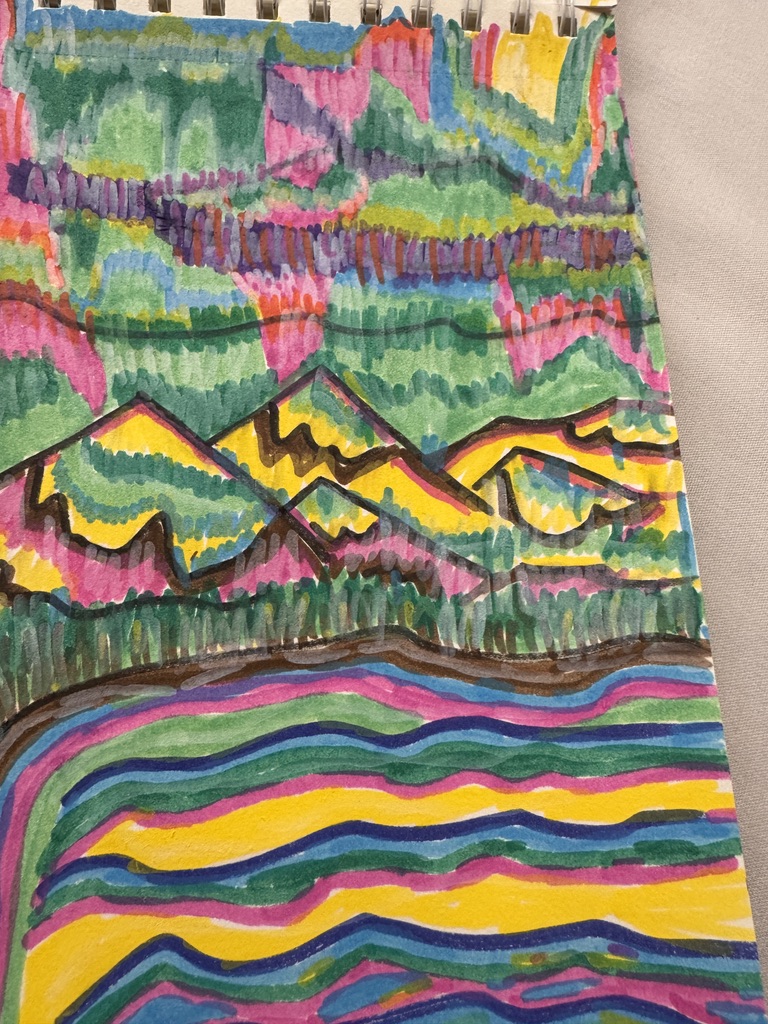
This piece emerged through colour before it emerged through form. I was working quickly, allowing the markers to move without overthinking the outcome. What surfaced was a landscape, though one that extends beyond any specific place. It feels more like an interior geography, layered with emotion, memory, and sensation.

The mountains hold warmth and tension at the same time. Their edges are uneven, alive, almost vibrating. Above them, the sky carries movement rather than stillness, while below, the water unfolds in bands of saturated colour. I notice how the repetition of lines creates rhythm, like breath or waves, steadying the intensity that sits in the upper half of the image.

This drawing reflects a state of processing rather than resolution. The colours sit beside one another without needing to blend or agree. They hold their differences. In that way, the work mirrors my own effort to let multiple emotional states exist at once without forcing coherence too quickly.

I see this piece as an exploration of emotional topography. Beyond destination, a mapping. Beyond clarity, expression. A reminder that landscapes, like inner lives, are built through layers that take time to understand.

Photo Credit: Amy Tucker, 2026
The suitcase is packed. The journal is on top, where I can reach it. The amber stone stays on the windowsill beside the fragments from Loreto. It will be here when I come back.
I am going to Harrison Hot Springs to learn about labour rights and collective resistance. I am also going to learn whether alonetude can hold me in a room full of voices. Whether the third shore is truly portable. Whether the sea I carry in my chest can sustain its rhythm against the press of schedule and social demand.
I think of Winnicott’s infant, playing contentedly on the floor while the caregiver sits nearby. The caregiver does nothing. The child keeps playing. But the child knows the presence is there, and that knowing makes the solitude possible.
Perhaps I am going to Harrison to discover that the practice itself has become the caregiver. That is what I built in thirty days of solitude is now reliable enough to sit beside me in any room, any crowd, any workshop. That I can be alone inside myself while being fully present with others.
Perhaps. I will find out.
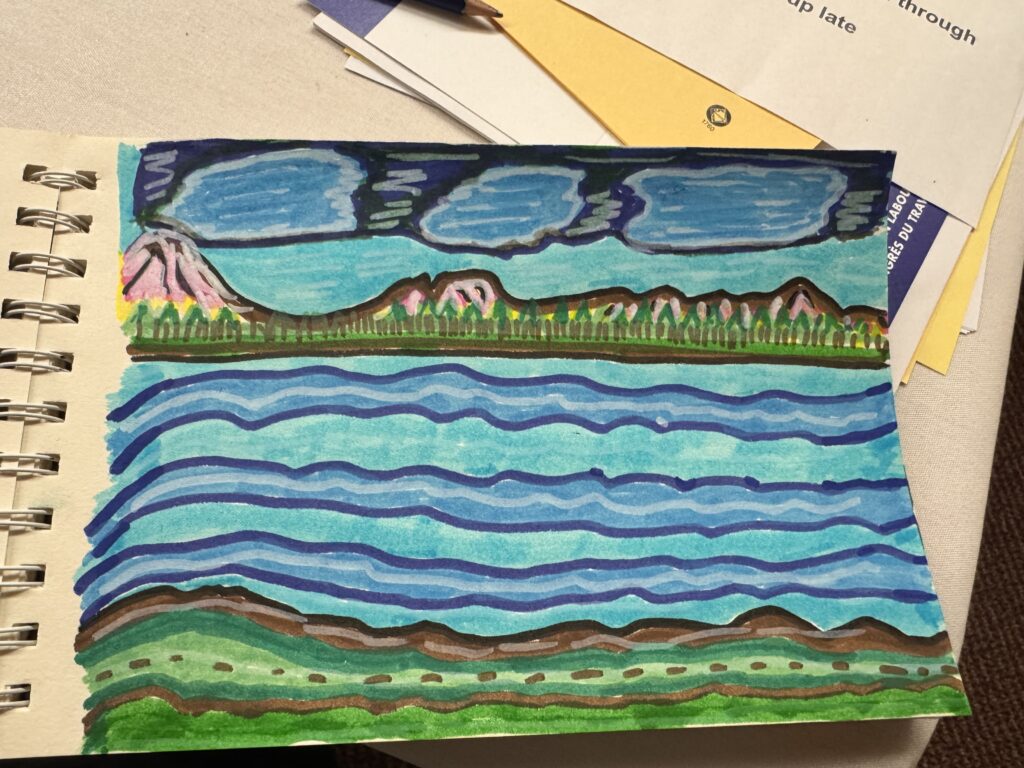
Title: Holding the Horizon: Harrison Hot Springs
Artist Statement


While sitting in the mineral warmth of Harrison Hot Springs, I found myself watching the horizon rather than the people around me. Steam moved across the water in slow veils. Mountains held their quiet line in the distance. The lake carried its steady, rhythmic breath. I wanted to capture that layered stillness, water, land, and sky, each resting within the other.

The bold lines and saturated colours reflect how the body remembers landscape when it is finally at ease. Beyond exactness, beyond the photographic, but felt. The drawing becomes less about geographic accuracy and more about emotional cartography, mapping where calm settles in the nervous system.

In the context of labour school, immersion in collective dialogue is intellectually energising yet somatically demanding. Spaces like Harrison Hot Springs offer a counterbalance, a site where the body can recalibrate after extended periods of cognitive and relational engagement.

As I moved between classroom intensity and mineral water stillness, I began to notice how landscape participates in learning. Reflection unfolded beyond note-taking or discussion; it unfolded through sensory grounding: heat on skin, mist in air, the visual continuity of mountain to water.

Creating this drawing became an extension of that integrative process. Through colour and line, I translated the embodied experience of rest into visual form. In this way, such artistic practices function as analytic tools, ways of processing experience that exceed text alone. The horizon line, repeated and reinforced across the page, mirrors the internal settling that occurs when the nervous system recognises safety. In this way, the artwork is both memory and method, holding the quiet pedagogies of water, steam, and distance.

I am here.

Photo Credit: Amy Tucker, February 2026
Salgo otra vez. Pero esta vez, no me voy de mí misma. Me llevo conmigo.
I set out again. But this time, I carry myself forward. I take myself with me.
The research continues…
References
Kabat-Zinn, J. (1994). Wherever you go, there you are: Mindfulness meditation in everyday life. Hyperion.
Long, C. R., & Averill, J. R. (2003). Solitude: An exploration of benefits of being alone. Journal for the Theory of Social Behaviour, 33(1), 21–44. https://doi.org/10.1111/1468-5914.00204
Porges, S. W. (2011). The polyvagal theory: Neurophysiological foundations of emotions, attachment, communication, and self-regulation. W. W. Norton.
Storr, A. (1988). Solitude: A return to the self. Free Press.
Turner, V. (1969). The ritual process: Structure and anti-structure. Aldine Publishing.
Ulrich, R. S. (1983). Aesthetic and affective response to natural environment. In I. Altman & J. F. Wohlwill (Eds.), Behaviour and the natural environment (pp. 85–125). Plenum Press.
Winnicott, D. W. (1958). The capacity to be alone. The International Journal of Psycho-Analysis, 39, 416–420.
Translation note. Spanish language passages were generated using Google Translate and subsequently reviewed and refined by the author. Any remaining infelicities reflect the limits of machine translation rather than intent.