On Airports, Winter, and the Body’s Memory of Warmth
Title: Holding the Line
Artist Statement

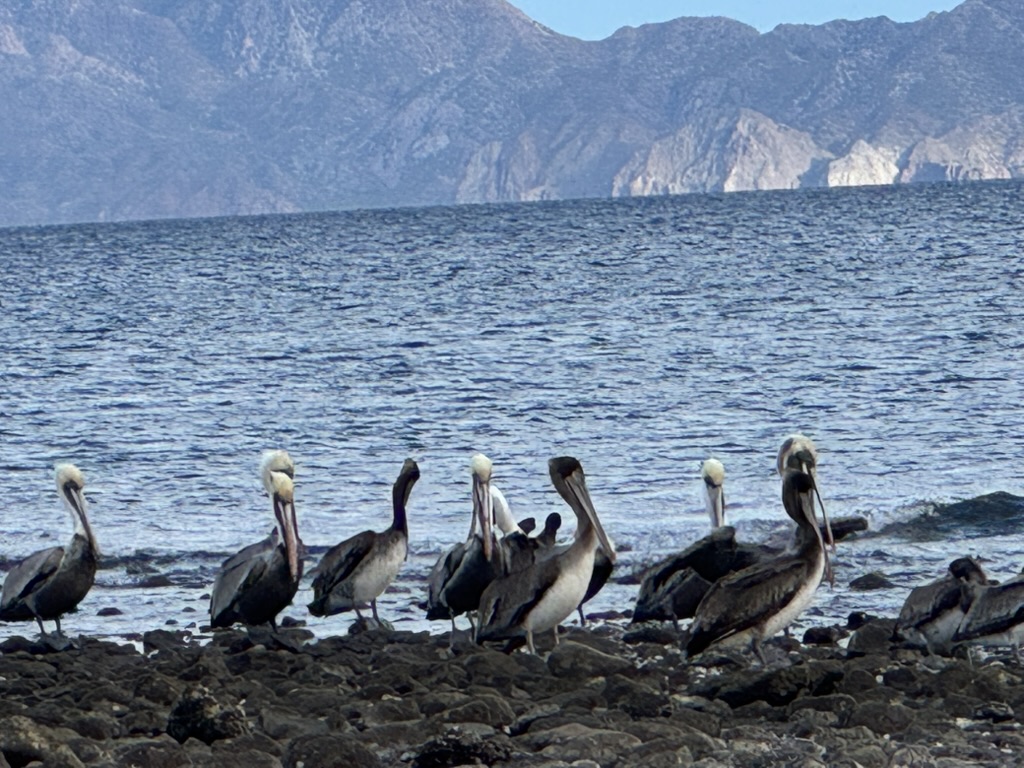
I took this image for reasons beyond the pelicans being unusual. I took it because they felt immediately familiar.

They stood together on the dark rock at the edge of the water, each angled slightly differently, each absorbed in their own posture of rest or watchfulness. Some faced the sea. Some turned inward. All of them belonged to the moment they were in. As I watched, I felt a recognition settle in my body. This was a scene about presence rather than action.

What this moment stirred in me was an understanding I have been carrying for some time. Togetherness can exist without closeness, and connection can take shape without conversation. The pelicans shared space with ease. There was no tension in their spacing, no urgency in their stance. They seemed to know when stillness was enough.

Standing there, I felt accompanied without being required. That feeling matters to me. It reflects a way of being I am learning to honour in my own life and work, especially during periods of transition. There is care in remaining where you are. There is wisdom in pausing at the edge of things.

This reminds me that some forms of belonging are quiet. They rest on attentiveness, patience, and a shared horizon rather than exchange. The shoreline held us all, and for a while, that was sufficient.


Photo Credit: Amy Tucker, 2026
Leaving in Full Light
The taxi arrived at 12:30 in the afternoon, and I was ready. Or I thought I was ready. I had spent the morning doing the things a body does when it is preparing to leave a place it has loved: walking the shoreline one last time, sitting on the bench behind the building with my journal, drinking coffee slowly in the small kitchen while the midday sun poured through the window and lay itself across the tile floor like an offering.
Loreto was wide awake around me. This was the difference I had never anticipated: leaving in full daylight, in the bright, unforgiving visibility of a Baja California afternoon. There was no cover of darkness, no pre-dawn mercy. Everything I was leaving was illuminated. The Sea of Cortez held the afternoon light in a thousand shifting planes of blue and silver. The Sierra de la Giganta stood sharp against a sky so clear it looked painted. The bougainvillea at the entrance of the casita blazed fuchsia, as if insisting I remember this colour, this exact shade, this intensity.
Me voy. I am leaving. And everything I am leaving is visible.
I had promised myself I would pause at the doorway. I did. I let my hand rest against the warm stucco of the casita doorframe and said thank you, silently, to the walls that had held me. To the small kitchen where I had made simple meals. To the bed where I had slept and woken and slept again, learning that rest could be trusted rather than feared. The stucco was warm under my palm, sun-heated, alive with the stored warmth of a January day in the desert. I held my hand there for a long moment, letting the warmth transfer. Then I lifted my hand. Then I turned away.
The driver loaded my bags into the trunk. I got into the car, and we pulled away from the casita, from the shoreline, from the thirty days that had changed everything about how I understood myself. The road to the airport wound through town, and I watched it all pass with the acute attention of someone who knows she is seeing something for the last time: the misión whose bells I had learned to anticipate, the malécon where I had walked each evening watching pelicans fold themselves into darkening water, the small tiendas with their hand-painted signs, the dogs sleeping in the shade.
The sea appeared and disappeared between buildings as we drove, a flash of blue, then gone, then blue again. Each glimpse felt like a small goodbye.
A warmth rose in my eyes as tears formed..it was time to say good-bye.
Title: Last Look at the Beach
Artist Statement

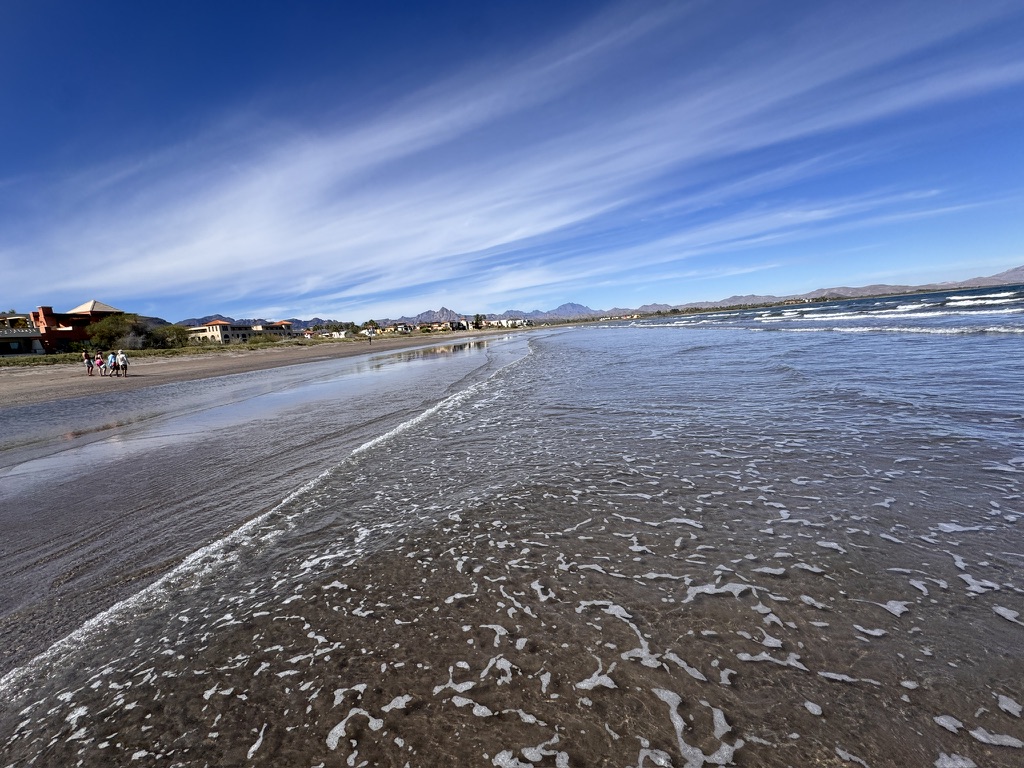
Meories of my final walk along the shoreline. The tide was retreating, leaving a mirrored gloss across the sand that blurred the boundary between land and sea. To the left, the rocky outcrop remains immovable, ancient, as the surf rolls in rhythm against it. The houses along the right edge of the frame glow in late morning sun, silent witnesses to thousands of arrivals and departures. This image captures the tension between permanence and passing, how the landscape stays while we move through it.

I was standing in the shallow surf when I framed this shot, already carrying the weight of leaving. The scene is too beautiful to take casually, and too bright to leave unnoticed. There is a particular cruelty to leaving in daylight, when everything is still illuminated, when the sea gleams and the sky is faultless, when no shadow shelters you from the ache of goodbye. The stillness of the scene is a kind of defiance. It says: you are going, and we stay.

As part of my visual inquiry, this photograph explores the aesthetics of impermanence. The tide will rise again. The footprints will fade. The mountains will remain. And in their quiet endurance, they remind us: we pass through, and remain in the places that held us.

Photo Credit: Amy Tucker, January 2026
There is a particular cruelty to leaving in daylight.
What I Take With Me
The inventory that matters is the one I carry in my body.
I want to name what I carry. I want to be precise about it, because precision is itself a practice, and because the things we carry deserve to be acknowledged rather than assumed.
In my luggage: fragments of blue tile gathered from construction sites and empty lots. Smoothed glass worn by the sea into something translucent and soft. An amber stone that caught the afternoon light in a field and made me stop walking and bend down. Painted rocks marked with colour during the quiet hours. Shells. A notebook filled with thirty days of writing. A camera full of images. These are the material artifacts, the physical evidence that I was here and that here changed me.
But the inventory that matters is the one I carry within me. This is what I take with me:
I take the practice of slow attention.Thirty mornings of walking the same shoreline taught me that looking at the same thing again and again produces depth rather than boredom. I learned to see what the first glance misses: the shift in light between 7:15 and 7:45, the different textures of sand at different tides, the way a pelican adjusts its wings a fraction of a second before it dives. I carry this attention home. I will apply it to the Thompson River, to the winter light on snow, to the faces of people I have missed.
I take the capacity to rest without guilt.This was perhaps the hardest lesson. After twenty-five years of precarious academic labour, my nervous system had been trained to associate rest with danger, stillness with failure, any moment of unproductivity with the threat of termination. In Loreto, I practised lying down in the middle of the afternoon, practised closing my eyes, practised doing nothing and letting nothing be enough. The guilt softened gradually. But it softened. And the softening is something I carry.
I take the knowledge that solitude can be chosen rather than only endured.Alonetude, the concept at the heart of this inquiry, names the labour of transforming imposed aloneness into intentional presence. What was structurally produced by institutional harm, by termination, by the sudden loss of professional identity, became, through daily practice, something generative. I learned to be with myself the way one learns any skill: through repetition, through patience, through the willingness to fail and begin again.
I take the sea inside me.This is harder to articulate, because it lives below language, in the body rather than the mind. Thirty days of waking to waves, of walking beside water, of falling asleep to the rhythm of the tide: all of this has inscribed itself into my nervous system. Stephen Porges (2011) would call it a recalibration of the autonomic baseline. I would call it the sea becoming a presence I carry, a felt sense of rhythm and constancy that lives in my chest even when the nearest water is the Thompson River, frozen and silent.
What fits in a bag is never everything. The rest I carry in my body.
I take my own voice.Beyond the performing voice, the one that learned to sound confident in meetings, competent in classrooms and grateful for every short-term contract. I take the voice that speaks in this blog, the one that thinks on the page, that allows itself uncertainty, that moves between English and Spanish because some truths require more than one language. Llevo mi voz. La verdadera.I carry my voice. The real one.
Title: What Fits in a Bag
Artist Statement

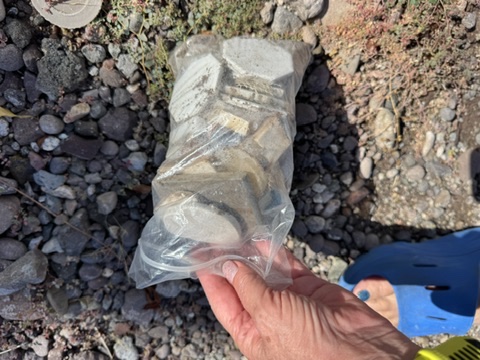
I am holding a sealed plastic bag filled with small, weathered fragments, ceramic tile, bone, glass, coral, and stone, collected over thirty days of walking. These are something beyond souvenirs in the traditional sense. They are artifacts of care: every object chosen, lifted, kept. Each one once discarded or forgotten by the world, now gathered in the palm as something worth holding.

This belongs to a larger inquiry into attention, memory, and material culture. The bag is light, yet carries the weight of presence, of showing up every day, of noticing what is overlooked, of witnessing small beauty in the ordinary. These fragments are records of practice rather than productivity. They resist metrics and outcomes. They say: someone was here, and they were paying attention.

As a counter-archive, this collection honours the slow, daily labour of healing. These objects hold no monetary value, but they testify to the worth of lived experience outside systems of valuation. I gathered them with the same hands that once typed reports, scrubbed dishes, comforted others. Now, they hold proof of my own return to self. What I could carry, I did. The rest remains, in the land, in the light, and in me.

Photo Credit: Amy Tucker, January 2026
The Anthropology of Transit
Perhaps non-places become places when we carry enough presence into them.
The flight to Calgary departed at 3:20 in the afternoon, and as the small plane lifted off, I pressed my face to the window. There it was below me: the water I had walked beside every morning, the shoreline I had photographed in all its moods, the town that had held me without asking anything in return. From above, Loreto looked so small. A scatter of white buildings between brown mountains and blue water. A place that barely registered on any map of significant things.
Adiós, Loreto. Gracias por todo.Goodbye, Loreto. Thank you for everything.
Marc Augé (1995), the French anthropologist, coined the term non-places to describe the spaces of transit that define contemporary life: airports, highways, hotel chains, and shopping centres. These are locations designed for movement rather than dwelling, for anonymity rather than relationship. Augé argues that non-places have proliferated in what he calls “supermodernity,” creating environments where individuals exist in solitary contractuality: bound by the same rules, sharing the same trajectory, yet fundamentally alone.
If a place can be defined as relational, historical, and concerned with identity, then a space that cannot be defined as relational, historical, or concerned with identity will be a non-place. (Augé, 1995)
I moved through the sequence of non-places that would carry me from Loreto to Los Cabos to Calgary, and I found myself attending to them differently than I might have before this month of practice. Alonetude had trained my attention. Even in spaces designed for anonymity, I noticed: the quality of light in the Loreto terminal, warmer than expected; the way strangers arranged themselves in waiting areas, maintaining careful distances, each person an island of private attention; the particular hum of airports, mechanical and constant, so different from the organic rhythms of the sea.
Something had shifted in me. Where I might once have experienced airport solitude as emptiness, I found myself settling into it as familiar territory. I knew how to be alone now. I knew how to let silence hold me rather than threaten me. The skills I had practised beside the sea were portable. They travelled with me into the non-place. Perhaps non-places become places when we carry enough presence into them.
Title: In Transit
Artist Statement

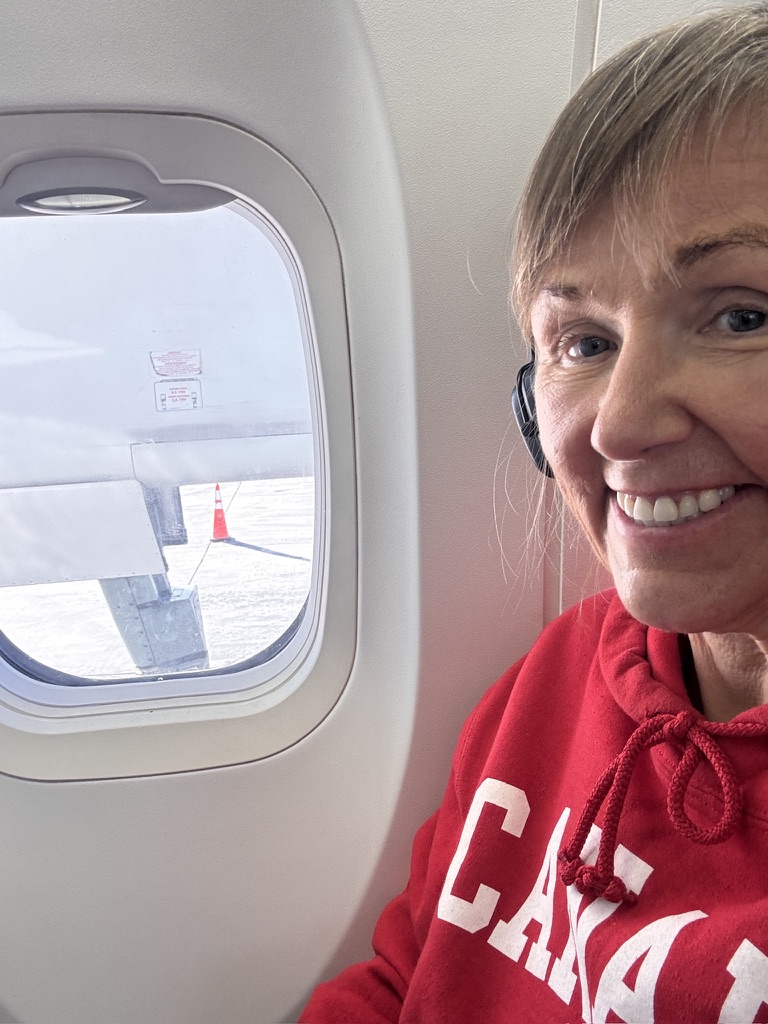
I took this photograph to mark the threshold. Beyond leaving or arriving, the suspended moment in between, where the place I have been is behind me, and the place I am going remains still ahead. Within this inquiry of self and place, this image holds a different kind of evidence: that transitions are worth documenting, that identity travels with us, stitched into our clothing, packed in carry-ons, held in our posture and our gaze.

The act of returning is never only about geography. It is also about re-entering stories, roles, and routines, with new insight quietly folded into the familiar. This is a quiet picture. But it is real. It says: I was in motion, I was between places, and I was awake to all of it.

Photo Credit: Amy Tucker, 2026
Calgary: The Shock of Winter
The plane descended through grey cloud cover, and when it broke through, I saw snow. Miles of it, stretching to every horizon, white and pale grey and the dark lines of bare trees. The Rocky Mountains rose to the west, their peaks lost in cloud. The screen on the seatback told me the temperature outside was minus eighteen degrees Celsius.
My body knew before my mind caught up. As the plane touched down, I felt a contraction in my shoulders, a tightening across my chest, a bracing I had forgotten I knew how to do. Stephen Porges (2011) describes this process as neuroception: the nervous system’s capacity to evaluate risk and safety below the level of conscious awareness. Environmental cues, including temperature, light quality, and sensory familiarity, activate autonomic responses before thought can intervene. Cold is a cue the body reads as a potential threat: resources must be conserved, vigilance must increase, and the system must prepare.
I felt this reading happen in real time as I walked through the jetway into the Calgary terminal. The air was different. The light was different. Everything my body had learned to associate with safety over thirty days of warmth and sea air was suddenly absent.
Hace frío. Hace mucho frío.It is cold. It is so cold.
Yet there was recognition in the cold as well. Yi-Fu Tuan (1974), the geographer who coined the term topophilia, describes the deep, often unspoken bonds that form between humans and their environments through accumulated bodily experience. Topophilia is the affective tie between a person and a place: a love of place that lives in the muscles and the memory rather than in conscious thought. I had topophilia for Loreto now, new and tender, formed over thirty days of deliberate attention. But I also had topophilia for the Canadian winter, older and deeper, woven into my earliest memories of belonging. The cold that made me gasp was also the cold I had grown up in. My body remembered, even as it protested.
I stood in the customs line and reminded myself that I had skills now. I had practised holding difficult sensations. I had learned to breathe through discomfort rather than brace against it. I could meet this cold the way I had learned to meet loneliness: by acknowledging it, by staying present with it, by trusting that I could tolerate what was happening without being destroyed by it. The practice travelled. The practice was held.
On Airports, Winter, and the Body’s Memory of Warmth
Title: Holding the Line
Artist Statement

I took this image for reasons beyond the pelicans being unusual. I took it because they felt immediately familiar.

They stood together on the dark rock at the edge of the water, each angled slightly differently, each absorbed in their own posture of rest or watchfulness. Some faced the sea. Some turned inward. All of them belonged to the moment they were in. As I watched, I felt a recognition settle in my body. This was a scene about presence rather than action.

What this moment stirred in me was an understanding I have been carrying for some time. Togetherness can exist without closeness, and connection can take shape without conversation. The pelicans shared space with ease. There was no tension in their spacing, no urgency in their stance. They seemed to know when stillness was enough.

Standing there, I felt accompanied without being required. That feeling matters to me. It reflects a way of being I am learning to honour in my own life and work, especially during periods of transition. There is care in remaining where you are. There is wisdom in pausing at the edge of things.

This reminds me that some forms of belonging are quiet. They rest on attentiveness, patience, and a shared horizon rather than exchange. The shoreline held us all, and for a while, that was sufficient.


Photo Credit: Amy Tucker, 2026
Leaving in Full Light
The taxi arrived at 12:30 in the afternoon, and I was ready. Or I thought I was ready. I had spent the morning doing the things a body does when it is preparing to leave a place it has loved: walking the shoreline one last time, sitting on the bench behind the building with my journal, drinking coffee slowly in the small kitchen while the midday sun poured through the window and lay itself across the tile floor like an offering.
Loreto was wide awake around me. This was the difference I had never anticipated: leaving in full daylight, in the bright, unforgiving visibility of a Baja California afternoon. There was no cover of darkness, no pre-dawn mercy. Everything I was leaving was illuminated. The Sea of Cortez held the afternoon light in a thousand shifting planes of blue and silver. The Sierra de la Giganta stood sharp against a sky so clear it looked painted. The bougainvillea at the entrance of the casita blazed fuchsia, as if insisting I remember this colour, this exact shade, this intensity.
Me voy. I am leaving. And everything I am leaving is visible.
I had promised myself I would pause at the doorway. I did. I let my hand rest against the warm stucco of the casita doorframe and said thank you, silently, to the walls that had held me. To the small kitchen where I had made simple meals. To the bed where I had slept and woken and slept again, learning that rest could be trusted rather than feared. The stucco was warm under my palm, sun-heated, alive with the stored warmth of a January day in the desert. I held my hand there for a long moment, letting the warmth transfer. Then I lifted my hand. Then I turned away.
The driver loaded my bags into the trunk. I got into the car, and we pulled away from the casita, from the shoreline, from the thirty days that had changed everything about how I understood myself. The road to the airport wound through town, and I watched it all pass with the acute attention of someone who knows she is seeing something for the last time: the misión whose bells I had learned to anticipate, the malécon where I had walked each evening watching pelicans fold themselves into darkening water, the small tiendas with their hand-painted signs, the dogs sleeping in the shade.
The sea appeared and disappeared between buildings as we drove, a flash of blue, then gone, then blue again. Each glimpse felt like a small goodbye.
A warmth rose in my eyes as tears formed..it was time to say good-bye.
Title: Last Look at the Beach
Artist Statement

Meories of my final walk along the shoreline. The tide was retreating, leaving a mirrored gloss across the sand that blurred the boundary between land and sea. To the left, the rocky outcrop remains immovable, ancient, as the surf rolls in rhythm against it. The houses along the right edge of the frame glow in late morning sun, silent witnesses to thousands of arrivals and departures. This image captures the tension between permanence and passing, how the landscape stays while we move through it.

I was standing in the shallow surf when I framed this shot, already carrying the weight of leaving. The scene is too beautiful to take casually, and too bright to leave unnoticed. There is a particular cruelty to leaving in daylight, when everything is still illuminated, when the sea gleams and the sky is faultless, when no shadow shelters you from the ache of goodbye. The stillness of the scene is a kind of defiance. It says: you are going, and we stay.

As part of my visual inquiry, this photograph explores the aesthetics of impermanence. The tide will rise again. The footprints will fade. The mountains will remain. And in their quiet endurance, they remind us: we pass through, and remain in the places that held us.

Photo Credit: Amy Tucker, January 2026
There is a particular cruelty to leaving in daylight.
What I Take With Me
The inventory that matters is the one I carry in my body.
I want to name what I carry. I want to be precise about it, because precision is itself a practice, and because the things we carry deserve to be acknowledged rather than assumed.
In my luggage: fragments of blue tile gathered from construction sites and empty lots. Smoothed glass worn by the sea into something translucent and soft. An amber stone that caught the afternoon light in a field and made me stop walking and bend down. Painted rocks marked with colour during the quiet hours. Shells. A notebook filled with thirty days of writing. A camera full of images. These are the material artifacts, the physical evidence that I was here and that here changed me.
But the inventory that matters is the one I carry within me. This is what I take with me:
I take the practice of slow attention.Thirty mornings of walking the same shoreline taught me that looking at the same thing again and again produces depth rather than boredom. I learned to see what the first glance misses: the shift in light between 7:15 and 7:45, the different textures of sand at different tides, the way a pelican adjusts its wings a fraction of a second before it dives. I carry this attention home. I will apply it to the Thompson River, to the winter light on snow, to the faces of people I have missed.
I take the capacity to rest without guilt.This was perhaps the hardest lesson. After twenty-five years of precarious academic labour, my nervous system had been trained to associate rest with danger, stillness with failure, any moment of unproductivity with the threat of termination. In Loreto, I practised lying down in the middle of the afternoon, practised closing my eyes, practised doing nothing and letting nothing be enough. The guilt softened gradually. But it softened. And the softening is something I carry.
I take the knowledge that solitude can be chosen rather than only endured.Alonetude, the concept at the heart of this inquiry, names the labour of transforming imposed aloneness into intentional presence. What was structurally produced by institutional harm, by termination, by the sudden loss of professional identity, became, through daily practice, something generative. I learned to be with myself the way one learns any skill: through repetition, through patience, through the willingness to fail and begin again.
I take the sea inside me.This is harder to articulate, because it lives below language, in the body rather than the mind. Thirty days of waking to waves, of walking beside water, of falling asleep to the rhythm of the tide: all of this has inscribed itself into my nervous system. Stephen Porges (2011) would call it a recalibration of the autonomic baseline. I would call it the sea becoming a presence I carry, a felt sense of rhythm and constancy that lives in my chest even when the nearest water is the Thompson River, frozen and silent.
What fits in a bag is never everything. The rest I carry in my body.
I take my own voice.Beyond the performing voice, the one that learned to sound confident in meetings, competent in classrooms and grateful for every short-term contract. I take the voice that speaks in this blog, the one that thinks on the page, that allows itself uncertainty, that moves between English and Spanish because some truths require more than one language. Llevo mi voz. La verdadera.I carry my voice. The real one.
Title: What Fits in a Bag
Artist Statement

I am holding a sealed plastic bag filled with small, weathered fragments, ceramic tile, bone, glass, coral, and stone, collected over thirty days of walking. These are something beyond souvenirs in the traditional sense. They are artifacts of care: every object chosen, lifted, kept. Each one once discarded or forgotten by the world, now gathered in the palm as something worth holding.

This belongs to a larger inquiry into attention, memory, and material culture. The bag is light, yet carries the weight of presence, of showing up every day, of noticing what is overlooked, of witnessing small beauty in the ordinary. These fragments are records of practice rather than productivity. They resist metrics and outcomes. They say: someone was here, and they were paying attention.

As a counter-archive, this collection honours the slow, daily labour of healing. These objects hold no monetary value, but they testify to the worth of lived experience outside systems of valuation. I gathered them with the same hands that once typed reports, scrubbed dishes, comforted others. Now, they hold proof of my own return to self. What I could carry, I did. The rest remains, in the land, in the light, and in me.

Photo Credit: Amy Tucker, January 2026
The Anthropology of Transit
Perhaps non-places become places when we carry enough presence into them.
The flight to Calgary departed at 3:20 in the afternoon, and as the small plane lifted off, I pressed my face to the window. There it was below me: the water I had walked beside every morning, the shoreline I had photographed in all its moods, the town that had held me without asking anything in return. From above, Loreto looked so small. A scatter of white buildings between brown mountains and blue water. A place that barely registered on any map of significant things.
Adiós, Loreto. Gracias por todo.Goodbye, Loreto. Thank you for everything.
Marc Augé (1995), the French anthropologist, coined the term non-places to describe the spaces of transit that define contemporary life: airports, highways, hotel chains, and shopping centres. These are locations designed for movement rather than dwelling, for anonymity rather than relationship. Augé argues that non-places have proliferated in what he calls “supermodernity,” creating environments where individuals exist in solitary contractuality: bound by the same rules, sharing the same trajectory, yet fundamentally alone.
If a place can be defined as relational, historical, and concerned with identity, then a space that cannot be defined as relational, historical, or concerned with identity will be a non-place. (Augé, 1995)
I moved through the sequence of non-places that would carry me from Loreto to Los Cabos to Calgary, and I found myself attending to them differently than I might have before this month of practice. Alonetude had trained my attention. Even in spaces designed for anonymity, I noticed: the quality of light in the Loreto terminal, warmer than expected; the way strangers arranged themselves in waiting areas, maintaining careful distances, each person an island of private attention; the particular hum of airports, mechanical and constant, so different from the organic rhythms of the sea.
Something had shifted in me. Where I might once have experienced airport solitude as emptiness, I found myself settling into it as familiar territory. I knew how to be alone now. I knew how to let silence hold me rather than threaten me. The skills I had practised beside the sea were portable. They travelled with me into the non-place. Perhaps non-places become places when we carry enough presence into them.
Title: In Transit
Artist Statement

I took this photograph to mark the threshold. Beyond leaving or arriving, the suspended moment in between, where the place I have been is behind me, and the place I am going remains still ahead. Within this inquiry of self and place, this image holds a different kind of evidence: that transitions are worth documenting, that identity travels with us, stitched into our clothing, packed in carry-ons, held in our posture and our gaze.

The act of returning is never only about geography. It is also about re-entering stories, roles, and routines, with new insight quietly folded into the familiar. This is a quiet picture. But it is real. It says: I was in motion, I was between places, and I was awake to all of it.

Photo Credit: Amy Tucker, 2026
Calgary: The Shock of Winter
The plane descended through grey cloud cover, and when it broke through, I saw snow. Miles of it, stretching to every horizon, white and pale grey and the dark lines of bare trees. The Rocky Mountains rose to the west, their peaks lost in cloud. The screen on the seatback told me the temperature outside was minus eighteen degrees Celsius.
My body knew before my mind caught up. As the plane touched down, I felt a contraction in my shoulders, a tightening across my chest, a bracing I had forgotten I knew how to do. Stephen Porges (2011) describes this process as neuroception: the nervous system’s capacity to evaluate risk and safety below the level of conscious awareness. Environmental cues, including temperature, light quality, and sensory familiarity, activate autonomic responses before thought can intervene. Cold is a cue the body reads as a potential threat: resources must be conserved, vigilance must increase, and the system must prepare.
I felt this reading happen in real time as I walked through the jetway into the Calgary terminal. The air was different. The light was different. Everything my body had learned to associate with safety over thirty days of warmth and sea air was suddenly absent.
Hace frío. Hace mucho frío.It is cold. It is so cold.
Yet there was recognition in the cold as well. Yi-Fu Tuan (1974), the geographer who coined the term topophilia, describes the deep, often unspoken bonds that form between humans and their environments through accumulated bodily experience. Topophilia is the affective tie between a person and a place: a love of place that lives in the muscles and the memory rather than in conscious thought. I had topophilia for Loreto now, new and tender, formed over thirty days of deliberate attention. But I also had topophilia for the Canadian winter, older and deeper, woven into my earliest memories of belonging. The cold that made me gasp was also the cold I had grown up in. My body remembered, even as it protested.
I stood in the customs line and reminded myself that I had skills now. I had practised holding difficult sensations. I had learned to breathe through discomfort rather than brace against it. I could meet this cold the way I had learned to meet loneliness: by acknowledging it, by staying present with it, by trusting that I could tolerate what was happening without being destroyed by it. The practice travelled. The practice was held.
The customs officer asked where I had been. “Loreto, Mexico,” I said. “Thirty days.” She looked at my passport, stamped it, and waved me through. I walked into the arrivals hall, carrying everything I had learned, my body already beginning to forget what warmth felt like.
Nada que declarar.Nothing to declare. Everything to carry.
Title: Welcome Home
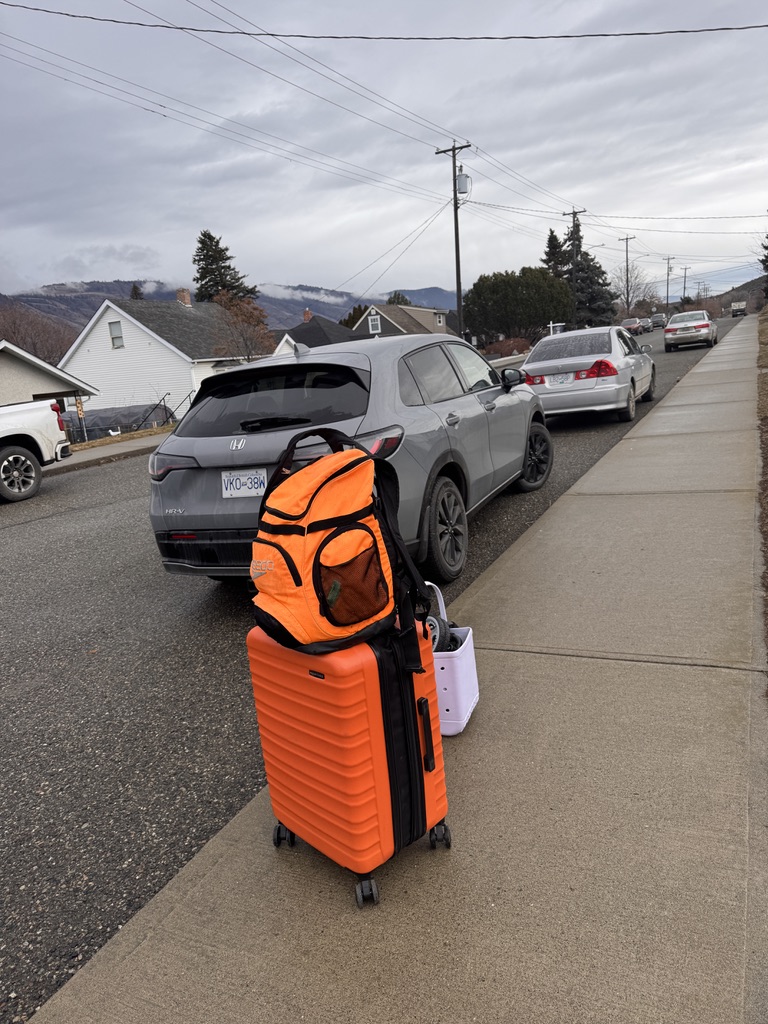
Photo Credit:Amy Tucker, 2026
Artist Statement

I returned home under a grey Kamloops sky, the clouds low and heavy as if mirroring the weight of reentry. I snapped this photo just after I stepped out of the car, before I moved my suitcase inside. There was something about the starkness of it, the orange suitcase upright and still, the quiet street, the winter air, that compelled me to pause. This, too, was a threshold.

But this moment taught me something subtler: the return is also pedagogical. The bright orange suitcase, paired with the fitness bag carrier, felt like a summary of everything I had gathered, more than objects or belongings: pieces of insight, fragments of self, collected over time and distance.

This image captures a liminal state, a moment in between: beyond traveling, and before being fully reabsorbed into the rhythms of home. I am reminded of Turner's notion of liminality, that betwixt-and-between space where transformation stirs beneath the surface of the ordinary. I stood there, watching the steam rise off the wet road, and I understood that returning is its own kind of inquiry.

There is scholarship in this stillness. A suitcase on a sidewalk might seem unremarkable, but it contains a body of evidence, literal and metaphorical, of lived experience, reflective learning, and quiet resilience. I carry it all with me now, as a material archive rather than baggage of a self in motion.
Table 1
Embodied Contrasts: The Sensory Dimensions of Return
| Dimension | Loreto, Baja California Sur | Calgary / Kamloops, Canada |
| Warm, golden, long days at Baja latitude; expansive visibility | 20–28°C; warmth that softens the body, permission to be unguarded | –18 to –5°C; cold that braces and tightens, the body armours against elements |
| Colour | Ochre, sage, turquoise; the warm spectrum of desert meeting sea | White, grey, brown; the monochrome of prairie and Interior winter |
| Sound | Waves, pelicans, church bells; rhythmic, constant, organic | Silence, furnace hum, snowploughs; intermittent, mechanical |
| Air | Salt, mineral, sweetness of desert flowers; humid from the sea | Dry, sharp, clean; the mineral scent of snow, breath visible |
| Light | Warm, golden; long days at Baja latitude; expansive visibility | Cool, blue-white; the low winter sun of northern latitudes; compressed days |
| Body State | Open, relaxed; shoulders dropped, breath easy, skin warm | Braced, contracted; shoulders raised, breath shallow against cold |
Note. This table maps the sensory and embodied contrasts between the retreat environment and the return landscape. Each dimension involves physiological adaptation as described by Porges’ (2011) polyvagal theory: the autonomic nervous system reads environmental cues and adjusts its state accordingly. Re-entry is an embodied process requiring the body to recalibrate to winter even as it carries forward what it learned in warmth. The contrasts documented here serve as data within the inquiry, illustrating how place shapes nervous-system states and why the incorporation phase of transition (van Gennep, 1909/1960) demands both bodily and psychological adjustment.
Kamloops: The Final Descent
The connecting flight from Calgary to Kamloops took barely an hour, but it crossed a threshold more significant than distance. Kamloops is where I live. Kamloops is where integration happens, where the practice must prove itself portable, where everything I learned beside the sea meets the demands of ordinary life.
The plane descended over the Thompson River valley, and I pressed my face to the window. The landscape below was brown and white, sagebrush and snow, the particular semi-arid terrain of the British Columbia Interior that looks nothing like Baja California yet shares something essential: a spare beauty, a refusal of lushness, a landscape that asks you to look closely before it reveals what it offers.
Secwépemc Territory. I was returning to land that holds stories far older than my own, land that has been home to the Secwépemc people since time immemorial. The university where I had worked, where I had been terminated, sits on this territory. My home sits on this territory. Any practice of presence I develop here must include awareness of whose land I am on, whose histories the ground holds, whose presence preceded and surrounds my own. The privilege of retreat, of choosing to leave and choosing to return, is itself a position that requires acknowledgment.
Estoy en casa.I am home. But “home” has become more complicated than it was thirty-one days ago.
The Threshold of Home
And then I was standing at my own front door, key in hand, luggage at my feet. The moment stretched. Arnold van Gennep (1909/1960) would have recognised this pause: the final threshold, the limen between journey and arrival, the last crossing before what he called incorporation is complete.
I had left this door thirty-one days ago, carrying exhaustion, grief, and the residue of twenty-five years of precarious academic labour. I was returning through it now carrying fragments of blue tile, an amber stone, painted rocks, and something less visible but more important: the knowledge that I could hold myself. That I could sit with difficulty and let it transform rather than destroy. That I could choose solitude and find it generous.
Gaston Bachelard (1964) writes in The Poetics of Space that the house is our first universe, the original container of human beings. We carry our earliest houses inside us; they shape how we understand shelter and belonging forever after. The house protects the daydreamer, Bachelard argues. It allows us to dream in peace. I had spent thirty days in a temporary shelter, a casita that held me while I learned to dream again. Now I was returning to the permanent shelter, the one that holds my books and my art supplies and the accumulated objects of a life.
I turned the key. I pushed open the door. I stepped across.
Title: The Door I Return Through
Artist Statement

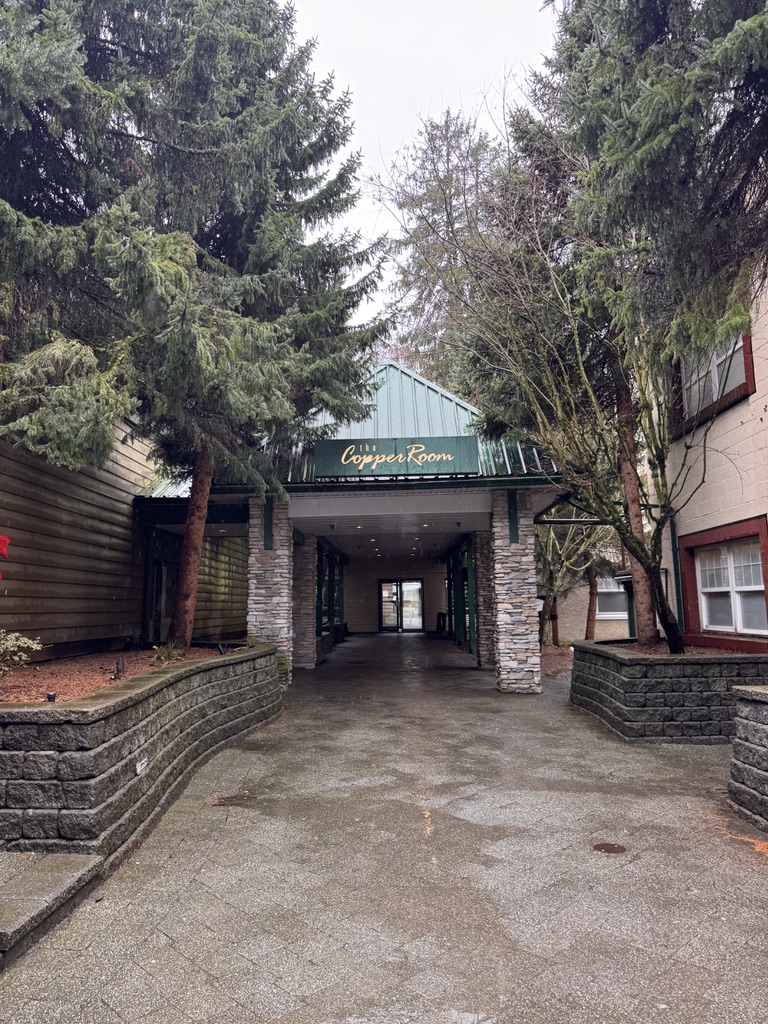
This photo marks the entrance to the Copper Room in Harrison Hot Springs, BC, where I began a two-week professional development retreat. The stone pillars and long corridor felt symbolic as I stood there on arrival. It was a passageway in every sense, architectural, emotional, and professional.

The towering trees framed the entry like quiet sentinels. I noticed how the stillness of the place contrasted with the nervous energy I carried. I had come here to stretch professionally, to learn new frameworks, to step into spaces of collaboration and growth. But I also brought with me questions about capacity, identity, and balance. What does it mean to keep learning while already carrying so much?

I often reflect on how informal experiences become sites of learning. This training retreat, though formally structured, also offered informal knowledge. Conversations over meals, silent walks between sessions, and the internal dialogue that surfaced while away from home all became part of the learning process.

This image reminds me that thresholds are everywhere. Sometimes they look like grand beginnings. Other times they appear as covered walkways leading toward something still ahead and uncharted. Here, I stepped forward again. I made the choice to enter, to participate, to allow professional learning to unfold alongside personal discovery. The path was both literal and metaphorical, and I walked it willingly.

Photo Credit: Amy Tucker, Janaury 2026
What the House Holds
I came home for one day. Just long enough to open the windows, let fresh air move through the rooms, and wash the scent of sea salt and desert dust from my clothes. The house felt unfamiliar at first, like it had paused in my absence. The fridge was nearly empty. My bed, though familiar, felt heavy with winter blankets. Still, I moved through it with quiet purpose. I unpacked the pieces I had carried back, blue tiles, shells, and a single amber stone, and set them gently around the room, small anchors from another place. Then I turned to packing again.
This time, I prepared for something entirely different: a two-week professional development training at Harrison Hot Springs. I swapped beachwear for layers and packed my laptop, notebooks, and practical shoes. The shift from stillness to structure felt abrupt. I wondered if the clarity I had found walking the shoreline each morning could follow me into a hotel conference room. Would I still be able to hold space for reflection, for writing, for the quiet internal work that rarely fits inside a schedule?
The question that rose for me was this: Can I practice my alonetude here?
Alonetude, beyond loneliness, as a cultivated way of being, an intentional solitude shaped by curiosity and care. The kind of solitude that made me sit still in Loreto rather than rush. Will I find moments in Harrison to pause, to observe, to be present with myself? Or will the structure of professional training, the social expectations, the busy schedule, begin to blur those internal edges I worked so hard to sharpen?
I am curious how my learning will shift when placed in a new setting. Will the outer learning complement the inner? Can they sit side by side without one erasing the other? I pack these questions along with my belongings, unsure of the answers, but committed to paying attention. That, too, is part of the practice.
Estoy aquí. Estoy presente.I am here. I am present.
Title: Threshold, With Steam
Artist Statement

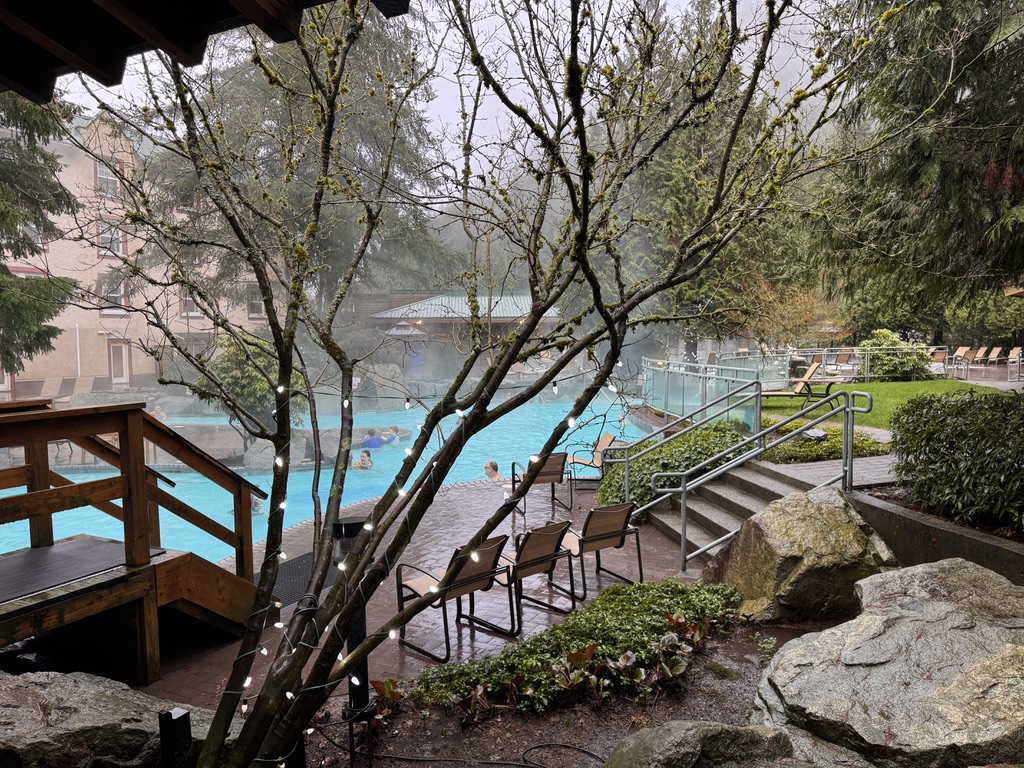
This image captures the thermal pools at Harrison Hot Springs, mist rising into cedar-scented air, soft steam blurring the line between water and sky. Twinkle lights wrap the bare branches of the tree in the foreground, glowing quietly against the grey. People soak, talk, float. The water is warm, the air cool, the mood liminal.

I took this photo from the edge, standing at the edge, watching. I wanted to notice what it means to arrive somewhere new with a body still adjusting to movement, with a mind that is used to solitude. I am in a shared space now, one designed for restoration but also for community. I wonder if there is room here for alonetude. Can solitude be practiced within public space? Can I still observe without retreating, still hold the boundary between reflection and performance?

This photograph sits within a personal inquiry of movement, arrival, and inner continuity. It documents the tension I carry into this next phase: how to stay present in myself while stepping into structure and social expectation. I offer the image as a moment of threshold. The warmth invites me in. The mist allows me to remain a little hidden. For now.

Photo Credit: Amy Tucker, 2026
The First Night Back
I woke at three in the morning, disoriented, reaching for the sound of the sea and finding silence. A silence so complete it felt physical. The waves that had accompanied every one of the thirty nights were gone, replaced by the hush of a Canadian winter night: the occasional creak of the house settling in cold, the distant rumble of a snowplough on a far street.
I reached for the amber stone beside my bed. Its smoothness in my palm was an anchor, a tangible link to everything I had learned. I held it and breathed, practising the attention I had cultivated, bringing myself into this present moment rather than grieving the moments that had passed.
Jon Kabat-Zinn (1994), in Wherever You Go, There You Are, writes that mindfulness is available in every moment we choose to be present. It requires no particular location, no special equipment, no retreat from ordinary life. The breath is always here. The body is always now. I breathed in the Canadian winter air, dry and cold even inside the house, and let it pass through my lungs. I breathed out and felt my shoulders soften against the pillow.
I thought about Donald Winnicott’s (1958) concept of the capacity to be alone: the foundational psychological ability that develops, he argued, through the experience of being alone in the presence of a reliable other. A child learns to be with herself while a caregiver remains nearby, available without intruding. Gradually, the child internalises this supportive presence and can tolerate aloneness without anxiety.
Something like this had happened in Loreto. The sea’s constancy, the practice of walking each morning, the permission to be with myself without performance: all of it had become a kind of inner presence, a reliable support I now carried within. I was alone in Kamloops at three in the morning, but I had company. The company was the practice itself, the capacity I had cultivated, the self that knew how to hold itself with tenderness rather than judgment.
Aquí estoy. Aquí sigo.Here I am. Here I continue.
Table 2
Bridges’ Transition Framework Applied to the Alonetude Return
| Transition Phase | Description | Application to Day 31 |
| Leaving the casita in full light, the hand on the warm doorframe; final glimpse of the sea between buildings; the taxi pulling away from the shoreline | Letting go of the old situation; acknowledging what is being lost; grieving the identity or structure that is ending | Leaving the casita in full light; the hand on the warm doorframe; final glimpse of the sea between buildings; the taxi pulling away from the shoreline |
| Neutral Zone | The in-between time when the old is gone but the new has yet to fully arrive; disorientation; confusion; creative possibility | Leaving the casita in full light, the hand on the warm doorframe; final glimpse of the sea between buildings; the taxi pulling away from the shoreline |
| New Beginning | Integrating the new identity or situation; finding meaning in the changed reality; committing to moving forward | Crossing the threshold of home; placing Loreto fragments on the windowsill; practising presence at 3 a.m. in the cold; trusting that alonetude is portable and the third shore lives within |
Note. Adapted from Bridges (2004). William Bridges distinguishes transitions from changes: change is situational (the new city, the new role, the end of the retreat), while transition is the psychological process of adapting to change. The neutral zone, often the most difficult phase, is where transformation actually occurs. Day 31 compresses all three phases into a single day of travel and arrival, requiring the body to move through ending, disorientation, and beginning in rapid succession. This compression may explain the particular exhaustion of return: the body is doing the work of three phases simultaneously.
Carrying the Practice Forward
The next morning, I walked to the window, the same way I had each morning in the casita, to see the sea. There was no sea. There was frost on glass, snow on trees, the particular quality of light that belongs to the Canadian Interior in February. I made tea, stood at the window, and practised presence. The same discipline of attention, applied to a different landscape. The same self, learning that the capacity for alonetude travels with her wherever she goes.
The third shore, I realised, had never been only about Loreto. The third shore is wherever we practise the intentional transformation of imposed aloneness into chosen solitude, wherever we attend to our own presence with care rather than judgment, wherever we resist the extractive demands of systems that would value us only for what we produce. The third shore is portable. I had carried it home with the fragments and the stone and the sea I now held inside my chest.
I will walk in Kamloops the way I walked in Loreto: with attention and without haste. I will protect time for alonetude within the press of obligations that will soon reassert themselves. I will remember what the retreat taught me: that I am more than what I produce. That rest is resistance. That slow attention is a discipline worth practising. That the body holds wisdom the mind cannot access alone. That solitude, chosen and inhabited with care, carries its own kind of company.
The fragments on the windowsill catch the morning light. The amber stone waits beside the bed. The practice continues.
Title: Amber, Carried
Artist Statement

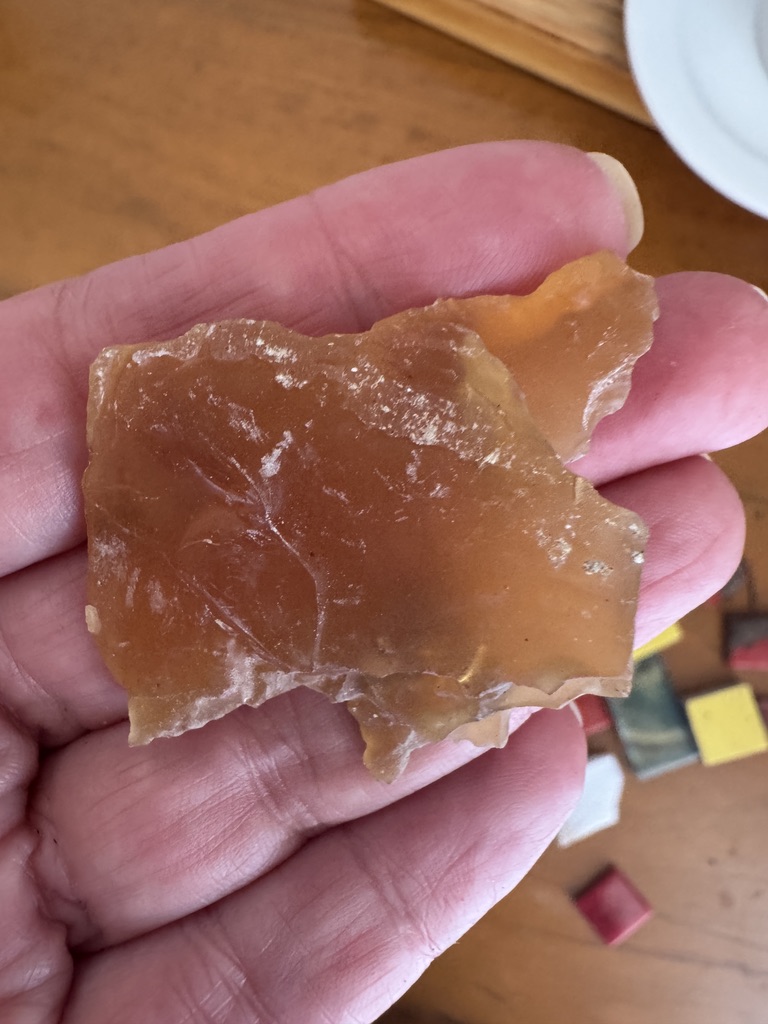
I held this fragment in my hand, less for rarity or value than because it had weight and warmth. Found among scattered rocks near the sea, its honeyed glow caught the light like memory. This piece of amber, or perhaps just sea-worn glass, I never asked it to declare itself, became something I returned to again and again. Its edges are uneven. It fits nowhere perfectly. And yet, in the palm, it rests as if made to be held. I brought it home as proof rather than treasure. Of seeing. Of choosing. Of finding beauty in what washes loose. This shard was never fully mine, really. But for a time, I was the one who carried it.

Photo Credit: Amy Tucker, January 2026
The journey from Loreto to Calgary to Kamloops took hours, tracing a line across time zones, climates, and the subtle thresholds between who I was there and who I must be here.
But the journey home is longer. It will take the rest of my life.
La tercera orilla vive en mí ahora. Adondequiera que vaya, la llevo conmigo.
The third shore lives in me now. Wherever I go, I carry it with me.
Title: Returning to Centre Through Colour
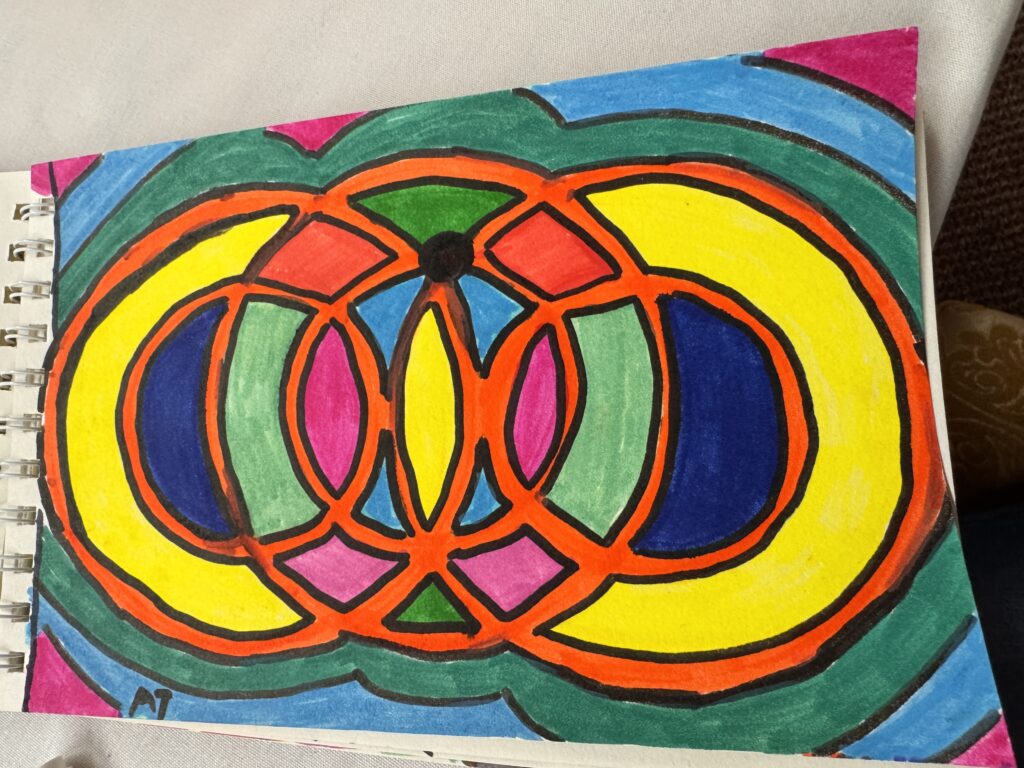
Artist Statement

This piece emerged during a period when I was trying to bring myself back into balance after sustained movement, both physical and emotional. I found myself drawn to symmetry without planning it. The forms unfolded slowly, each shape responding to the one beside it, until the composition began to feel like a map rather than a drawing.

The circular and mirrored structures suggest containment, but also continuity. There is no fixed starting point and no clear end. The eye moves across colour and line in a continuous loop, much like the process of returning to oneself. I notice that when I work in this way, repetition becomes steadying. It offers a rhythm the body can follow when language feels insufficient.

Colour carries meaning here as well. The saturated yellows and oranges hold warmth and vitality, while the blues and greens offer grounding and depth. The pinks and reds move between vulnerability and strength. Together, they create an emotional spectrum that reflects the layered nature of healing and self-recognition.

What matters most to me in this work is the centre. It is small, almost quiet compared to the surrounding intensity, yet everything radiates from it. It reminds me that clarity arrives quietly. Sometimes it sits at the core, waiting to be noticed once the surrounding noise settles.

This drawing represents an ongoing process of integration. Beyond any finished state, a practice of alignment that continues to evolve each time I return to the page.

Photo Credit: Amy Tucker, 2026
The customs officer asked where I had been. “Loreto, Mexico,” I said. “Thirty days.” She looked at my passport, stamped it, and waved me through. I walked into the arrivals hall, carrying everything I had learned, my body already beginning to forget what warmth felt like.
Nada que declarar.Nothing to declare. Everything to carry.
Title: Welcome Home
Photo Credit:Amy Tucker, 2026
Artist Statement

I returned home under a grey Kamloops sky, the clouds low and heavy as if mirroring the weight of reentry. I snapped this photo just after I stepped out of the car, before I moved my suitcase inside. There was something about the starkness of it, the orange suitcase upright and still, the quiet street, the winter air, that compelled me to pause. This, too, was a threshold.

But this moment taught me something subtler: the return is also pedagogical. The bright orange suitcase, paired with the fitness bag carrier, felt like a summary of everything I had gathered, more than objects or belongings: pieces of insight, fragments of self, collected over time and distance.

This image captures a liminal state, a moment in between: beyond traveling, and before being fully reabsorbed into the rhythms of home. I am reminded of Turner's notion of liminality, that betwixt-and-between space where transformation stirs beneath the surface of the ordinary. I stood there, watching the steam rise off the wet road, and I understood that returning is its own kind of inquiry.

There is scholarship in this stillness. A suitcase on a sidewalk might seem unremarkable, but it contains a body of evidence, literal and metaphorical, of lived experience, reflective learning, and quiet resilience. I carry it all with me now, as a material archive rather than baggage of a self in motion.
Table 1
Embodied Contrasts: The Sensory Dimensions of Return
| Warm, golden, long days at Baja latitude; expansive visibility | Loreto, Baja California Sur | Calgary / Kamloops, Canada |
| Warm, golden, long days at Baja latitude; expansive visibility | 20–28°C; warmth that softens the body, permission to be unguarded | –18 to –5°C; cold that braces and tightens, the body armours against elements |
| Colour | Ochre, sage, turquoise; the warm spectrum of desert meeting sea | White, grey, brown; the monochrome of prairie and Interior winter |
| Sound | Waves, pelicans, church bells; rhythmic, constant, organic | Silence, furnace hum, snowploughs; intermittent, mechanical |
| Air | Salt, mineral, sweetness of desert flowers; humid from the sea | Dry, sharp, clean; the mineral scent of snow, breath visible |
| Light | Warm, golden; long days at Baja latitude; expansive visibility | Cool, blue-white; the low winter sun of northern latitudes; compressed days |
| Body State | Open, relaxed; shoulders dropped, breath easy, skin warm | Braced, contracted; shoulders raised, breath shallow against cold |
Note. This table maps the sensory and embodied contrasts between the retreat environment and the return landscape. Each dimension involves physiological adaptation as described by Porges’ (2011) polyvagal theory: the autonomic nervous system reads environmental cues and adjusts its state accordingly. Re-entry is an embodied process requiring the body to recalibrate to winter even as it carries forward what it learned in warmth. The contrasts documented here serve as data within the inquiry, illustrating how place shapes nervous-system states and why the incorporation phase of transition (van Gennep, 1909/1960) demands both bodily and psychological adjustment.
Kamloops: The Final Descent
The connecting flight from Calgary to Kamloops took barely an hour, but it crossed a threshold more significant than distance. Kamloops is where I live. Kamloops is where integration happens, where the practice must prove itself portable, where everything I learned beside the sea meets the demands of ordinary life.
The plane descended over the Thompson River valley, and I pressed my face to the window. The landscape below was brown and white, sagebrush and snow, the particular semi-arid terrain of the British Columbia Interior that looks nothing like Baja California yet shares something essential: a spare beauty, a refusal of lushness, a landscape that asks you to look closely before it reveals what it offers.
Secwépemc Territory. I was returning to land that holds stories far older than my own, land that has been home to the Secwépemc people since time immemorial. The university where I had worked, where I had been terminated, sits on this territory. My home sits on this territory. Any practice of presence I develop here must include awareness of whose land I am on, whose histories the ground holds, whose presence preceded and surrounds my own. The privilege of retreat, of choosing to leave and choosing to return, is itself a position that requires acknowledgment.
Estoy en casa.I am home. But “home” has become more complicated than it was thirty-one days ago.
The Threshold of Home
And then I was standing at my own front door, key in hand, luggage at my feet. The moment stretched. Arnold van Gennep (1909/1960) would have recognised this pause: the final threshold, the limen between journey and arrival, the last crossing before what he called incorporation is complete.
I had left this door thirty-one days ago, carrying exhaustion, grief, and the residue of twenty-five years of precarious academic labour. I was returning through it now carrying fragments of blue tile, an amber stone, painted rocks, and something less visible but more important: the knowledge that I could hold myself. That I could sit with difficulty and let it transform rather than destroy. That I could choose solitude and find it generous.
Gaston Bachelard (1964) writes in The Poetics of Space that the house is our first universe, the original container of human beings. We carry our earliest houses inside us; they shape how we understand shelter and belonging forever after. The house protects the daydreamer, Bachelard argues. It allows us to dream in peace. I had spent thirty days in a temporary shelter, a casita that held me while I learned to dream again. Now I was returning to the permanent shelter, the one that holds my books and my art supplies and the accumulated objects of a life.
I turned the key. I pushed open the door. I stepped across.
Title: The Door I Return Through
Artist Statement

This photo marks the entrance to the Copper Room in Harrison Hot Springs, BC, where I began a two-week professional development retreat. The stone pillars and long corridor felt symbolic as I stood there on arrival. It was a passageway in every sense, architectural, emotional, and professional.

The towering trees framed the entry like quiet sentinels. I noticed how the stillness of the place contrasted with the nervous energy I carried. I had come here to stretch professionally, to learn new frameworks, to step into spaces of collaboration and growth. But I also brought with me questions about capacity, identity, and balance. What does it mean to keep learning while already carrying so much?

I often reflect on how informal experiences become sites of learning. This training retreat, though formally structured, also offered informal knowledge. Conversations over meals, silent walks between sessions, and the internal dialogue that surfaced while away from home all became part of the learning process.

This image reminds me that thresholds are everywhere. Sometimes they look like grand beginnings. Other times they appear as covered walkways leading toward something still ahead and uncharted. Here, I stepped forward again. I made the choice to enter, to participate, to allow professional learning to unfold alongside personal discovery. The path was both literal and metaphorical, and I walked it willingly.

Photo Credit: Amy Tucker, Janaury 2026
What the House Holds
I came home for one day. Just long enough to open the windows, let fresh air move through the rooms, and wash the scent of sea salt and desert dust from my clothes. The house felt unfamiliar at first, like it had paused in my absence. The fridge was nearly empty. My bed, though familiar, felt heavy with winter blankets. Still, I moved through it with quiet purpose. I unpacked the pieces I had carried back, blue tiles, shells, and a single amber stone, and set them gently around the room, small anchors from another place. Then I turned to packing again.
This time, I prepared for something entirely different: a two-week professional development training at Harrison Hot Springs. I swapped beachwear for layers and packed my laptop, notebooks, and practical shoes. The shift from stillness to structure felt abrupt. I wondered if the clarity I had found walking the shoreline each morning could follow me into a hotel conference room. Would I still be able to hold space for reflection, for writing, for the quiet internal work that rarely fits inside a schedule?
The question that rose for me was this: Can I practice my alonetude here?
Alonetude, beyond loneliness, as a cultivated way of being, an intentional solitude shaped by curiosity and care. The kind of solitude that made me sit still in Loreto rather than rush. Will I find moments in Harrison to pause, to observe, to be present with myself? Or will the structure of professional training, the social expectations, the busy schedule, begin to blur those internal edges I worked so hard to sharpen?
I am curious how my learning will shift when placed in a new setting. Will the outer learning complement the inner? Can they sit side by side without one erasing the other? I pack these questions along with my belongings, unsure of the answers, but committed to paying attention. That, too, is part of the practice.
Estoy aquí. Estoy presente.I am here. I am present.
Title: Threshold, With Steam
Artist Statement

This image captures the thermal pools at Harrison Hot Springs, mist rising into cedar-scented air, soft steam blurring the line between water and sky. Twinkle lights wrap the bare branches of the tree in the foreground, glowing quietly against the grey. People soak, talk, float. The water is warm, the air cool, the mood liminal.

I took this photo from the edge, standing at the edge, watching. I wanted to notice what it means to arrive somewhere new with a body still adjusting to movement, with a mind that is used to solitude. I am in a shared space now, one designed for restoration but also for community. I wonder if there is room here for alonetude. Can solitude be practiced within public space? Can I still observe without retreating, still hold the boundary between reflection and performance?

This photograph sits within a personal inquiry of movement, arrival, and inner continuity. It documents the tension I carry into this next phase: how to stay present in myself while stepping into structure and social expectation. I offer the image as a moment of threshold. The warmth invites me in. The mist allows me to remain a little hidden. For now.

Photo Credit: Amy Tucker, 2026
The First Night Back
I woke at three in the morning, disoriented, reaching for the sound of the sea and finding silence. A silence so complete it felt physical. The waves that had accompanied every one of the thirty nights were gone, replaced by the hush of a Canadian winter night: the occasional creak of the house settling in cold, the distant rumble of a snowplough on a far street.
I reached for the amber stone beside my bed. Its smoothness in my palm was an anchor, a tangible link to everything I had learned. I held it and breathed, practising the attention I had cultivated, bringing myself into this present moment rather than grieving the moments that had passed.
Jon Kabat-Zinn (1994), in Wherever You Go, There You Are, writes that mindfulness is available in every moment we choose to be present. It requires no particular location, no special equipment, no retreat from ordinary life. The breath is always here. The body is always now. I breathed in the Canadian winter air, dry and cold even inside the house, and let it pass through my lungs. I breathed out and felt my shoulders soften against the pillow.
I thought about Donald Winnicott’s (1958) concept of the capacity to be alone: the foundational psychological ability that develops, he argued, through the experience of being alone in the presence of a reliable other. A child learns to be with herself while a caregiver remains nearby, available without intruding. Gradually, the child internalises this supportive presence and can tolerate aloneness without anxiety.
Something like this had happened in Loreto. The sea’s constancy, the practice of walking each morning, the permission to be with myself without performance: all of it had become a kind of inner presence, a reliable support I now carried within. I was alone in Kamloops at three in the morning, but I had company. The company was the practice itself, the capacity I had cultivated, the self that knew how to hold itself with tenderness rather than judgment.
Aquí estoy. Aquí sigo.Here I am. Here I continue.
Table 2
Bridges’ Transition Framework Applied to the Alonetude Return
| Transition Phase | Description | Application to Day 31 |
| Leaving the casita in full light, the hand on the warm doorframe; final glimpse of the sea between buildings; the taxi pulling away from the shoreline | Letting go of the old situation; acknowledging what is being lost; grieving the identity or structure that is ending | Leaving the casita in full light; the hand on the warm doorframe; final glimpse of the sea between buildings; the taxi pulling away from the shoreline |
| Neutral Zone | The in-between time when the old is gone but the new has yet to fully arrive; disorientation; confusion; creative possibility | Leaving the casita in full light, the hand on the warm doorframe; final glimpse of the sea between buildings; the taxi pulling away from the shoreline |
| New Beginning | Integrating the new identity or situation; finding meaning in the changed reality; committing to moving forward | Crossing the threshold of home; placing Loreto fragments on the windowsill; practising presence at 3 a.m. in the cold; trusting that alonetude is portable and the third shore lives within |
Note. Adapted from Bridges (2004). William Bridges distinguishes transitions from changes: change is situational (the new city, the new role, the end of the retreat), while transition is the psychological process of adapting to change. The neutral zone, often the most difficult phase, is where transformation actually occurs. Day 31 compresses all three phases into a single day of travel and arrival, requiring the body to move through ending, disorientation, and beginning in rapid succession. This compression may explain the particular exhaustion of return: the body is doing the work of three phases simultaneously.
Carrying the Practice Forward
The next morning, I walked to the window, the same way I had each morning in the casita, to see the sea. There was no sea. There was frost on glass, snow on trees, the particular quality of light that belongs to the Canadian Interior in February. I made tea, stood at the window, and practised presence. The same discipline of attention, applied to a different landscape. The same self, learning that the capacity for alonetude travels with her wherever she goes.
The third shore, I realised, had never been only about Loreto. The third shore is wherever we practise the intentional transformation of imposed aloneness into chosen solitude, wherever we attend to our own presence with care rather than judgment, wherever we resist the extractive demands of systems that would value us only for what we produce. The third shore is portable. I had carried it home with the fragments and the stone and the sea I now held inside my chest.
I will walk in Kamloops the way I walked in Loreto: with attention and without haste. I will protect time for alonetude within the press of obligations that will soon reassert themselves. I will remember what the retreat taught me: that I am more than what I produce. That rest is resistance. That slow attention is a discipline worth practising. That the body holds wisdom the mind cannot access alone. That solitude, chosen and inhabited with care, carries its own kind of company.
The fragments on the windowsill catch the morning light. The amber stone waits beside the bed. The practice continues.
Title: Amber, Carried
Artist Statement

I held this fragment in my hand, less for rarity or value than because it had weight and warmth. Found among scattered rocks near the sea, its honeyed glow caught the light like memory. This piece of amber, or perhaps just sea-worn glass, I never asked it to declare itself, became something I returned to again and again. Its edges are uneven. It fits nowhere perfectly. And yet, in the palm, it rests as if made to be held. I brought it home as proof rather than treasure. Of seeing. Of choosing. Of finding beauty in what washes loose. This shard was never fully mine, really. But for a time, I was the one who carried it.

Photo Credit: Amy Tucker, January 2026
The journey from Loreto to Calgary to Kamloops took hours, tracing a line across time zones, climates, and the subtle thresholds between who I was there and who I must be here.
But the journey home is longer. It will take the rest of my life.
La tercera orilla vive en mí ahora. Adondequiera que vaya, la llevo conmigo.
The third shore lives in me now. Wherever I go, I carry it with me.
References
Augé, M. (1995). Non-places: Introduction to an anthropology of supermodernity (J. Howe, Trans.). Verso. (Original work published 1992)
Bachelard, G. (1964). The poetics of space (M. Jolas, Trans.). Orion Press. (Original work published 1958)
Bridges, W. (2004). Transitions: Making sense of life’s changes(2nd ed.). Da Capo Press.
Kabat-Zinn, J. (1994). Wherever you go, there you are: Mindfulness meditation in everyday life. Hyperion.
Porges, S. W. (2011). The polyvagal theory: Neurophysiological foundations of emotions, attachment, communication, and self-regulation. W. W. Norton.
Tuan, Y.-F. (1974). Topophilia: A study of environmental perception, attitudes, and values. Prentice-Hall.
van Gennep, A. (1960). The rites of passage(M. B. Vizedom & G. L. Caffee, Trans.). University of Chicago Press. (Original work published 1909)
Winnicott, D. W. (1958). The capacity to be alone. The International Journal of Psycho-Analysis, 39, 416–420.
Translation note. Spanish language passages were generated using Google Translate and subsequently reviewed and refined by the author. Any remaining infelicities reflect the limits of machine translation rather than intent.