Title: Two Among Many
Artist Statement

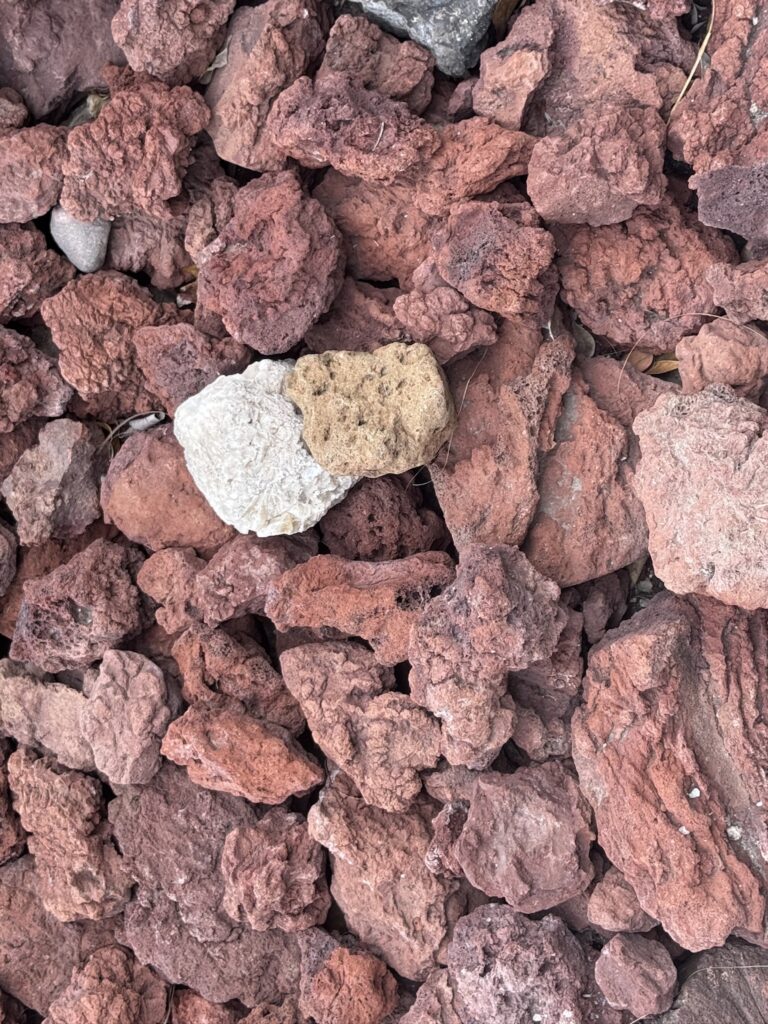
I stopped when I saw them. Two pale stones resting together in a field of red, their muted tones pressing close as if they had arrived as a pair. The volcanic rock surrounding them was textured and vivid, pocked with air bubbles from ancient heat, dyed the colour of rust and dried blood. The two lighter stones held their difference quietly, without apology.

This is one of the rare photographs in my collection that I have kept in colour. The decision was deliberate. In a body of work devoted to black and white, to the ethics of reduction and the discipline of restraint, colour must earn its place. Here, the red demanded to be seen. The contrast between the two pale stones and the field of crimson that held them would have collapsed into sameness without it. The image required colour to speak its meaning.

I am drawn to what resists matching. To the presence that stands apart without performing its difference. These two stones arrived without design. They were placed by no one, creating contrast and illustrating a point. They simply came to rest where the ground received them, and in resting, they found each other. The image holds no drama. It offers only the quiet fact of two things that belong together amid a landscape to which they bear no resemblance.

I have often felt like the pale stone in a field of red. Present but visibly different. Held by the same ground as everyone else, yet marked by texture and tone that set me apart. This photograph makes no claim to resolve that feeling. It simply witnesses it. The two stones lean toward one another, their edges nearly touching, as if proximity itself were a form of kinship.

The volcanic rock speaks to heat and transformation, to pressure that reshapes matter into something porous and lasting. The pale stones speak to another origin, another journey. They share the frame without sharing a story. What holds them together is only the ground beneath and the eye that noticed them, paused, and chose to preserve the encounter.

Photo Credit: Amy Tucker, January 2026
Where the Shore Begins to Speak
Wonder was far from what I came here seeking.
I came to rest,
to fold the sharp corners of thought
into something dull and silent.
But the land had other plans.
It began in the hush of the tide,
a language I almost remembered.
Salt tracing old maps across my ankles,
sand whispering through the creases of my shoes.
A shell, cracked.
A stone, too smooth to be accidental.
Even the wind seemed to pause,
just long enough
to ask if I was listening.
I watched a crab write its name in the shallows,
unconcerned with permanence.
Watched a gull lift, drop, lift again,
more patient than I have ever been.
Slowly,
The shore began to stitch its rhythm into me.
Beyond grandeur,
with quiet insistence,
the way grief teaches,
or healing,
or soil under fingernails.
Here, I found interest,
an invitation rather than a spark.
A kind of leaning-in
to what has always waited
beneath the noise of being useful.
And I began to understand:
The land asks nothing of performance.
It asks for presence
And maybe, at last,
I am learning how to offer that
Title: Tidebound
Artist Statement

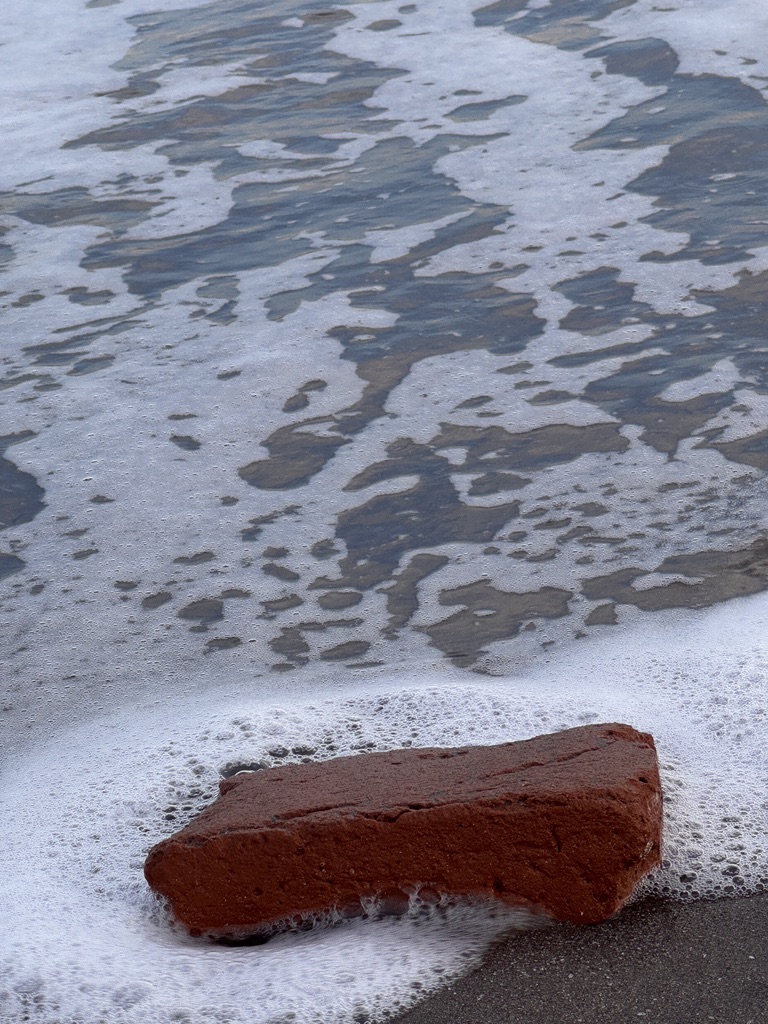
This image captures a solitary brick caught in the meeting of ocean and sand an object out of place, yet strangely grounded. I was struck by the quiet resilience of this fragment of construction, shaped for structure and permanence, now yielding to saltwater and tide. It no longer serves its original purpose, and yet it remains, weathered, softened, still unmistakably present.

In the context of my broader research on alonetude, embodiment, and recovery from institutional extraction, this photograph becomes a visual metaphor for the self in transition. The brick speaks to what remains after long periods of performance, labor, and containment. It holds the memory of function, but it no longer needs to fulfill it. The tide surrounds it without resistance. There is no urgency to prove worth.

This moment asks: what happens when we stop resisting erosion? When we allow the forces around us to touch us, wear us down, soften our edges, transforming rather than defeating?

Here, the brick becomes more than debris. It becomes evidence. Of survival. Of change. Of the beauty that emerges when we are no longer trying to hold our original shape.

Photo Credit: Amy Tucker, January 2026
Title: Trace of Ascent
Artist Statement

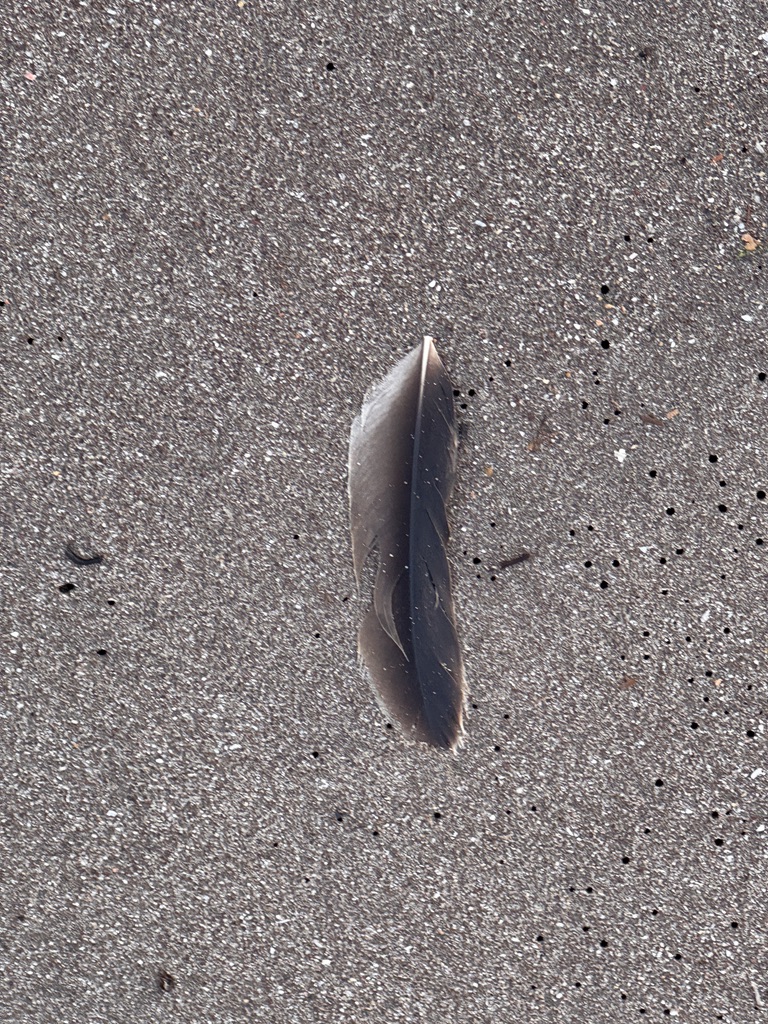
This feather, resting alone on darkened sand, holds the quiet memory of flight. It is no longer airborne, yet it carries the architecture of uplift: spine, barbs, hollow shaft, all evidence of having once moved with wind and intention. What drew me to this image was its stillness, residue rather than absence: the presence of something that has passed through, marked by both release and belonging.

In the context of my arts-based inquiry into alonetude and embodied presence, this feather becomes a metaphor for what remains after movement. It invites reflection on what we shed, what we carry, and what we recognise only after landing. Unlike the frantic need to perform, this moment asks nothing. It simply offers itself as witness.

Here, the feather is returned, beyond lost. To earth. To texture. To the soft hush of enoughness.

Photo Credit: Amy Tucker, 2026
Title: To Need No Monument
I walk,
beyond arriving,
to remember
what it feels like
to move without performance.
Each step presses gently
into the wet hush of sand,
a temporary record,
beyond purpose,
simply presence.
No one is watching.
There is no rubric for how I place my feet.
No metrics trace the curve of my wandering.
Still, the earth notices.
The tide asks nothing
of earning this peace.
It rises all the same,
softening the edges of every impression
until all that remains
is rhythm.
I am learning to love
what is passing.
To walk for the sake of walking.
To be the kind of story
That holds its truth
beyond the telling.
Let the waves erase me.
Let the next morning’s light find
no evidence but smoothness.
That, too, is a kind of grace,
to know I was here,
and to need no monument.
Title: Evidence of Passing
Artist Statement

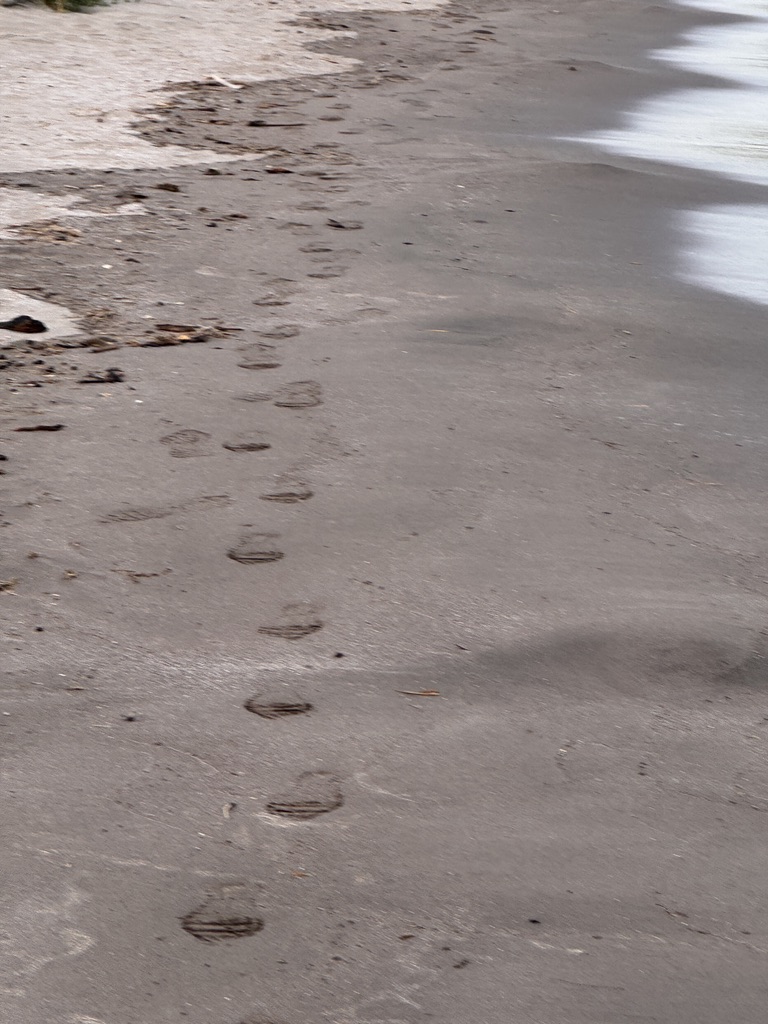
This image captures a winding trail of footprints pressed into damp shoreline, slowly softening under the pull of tide and time. What compelled me to take this photograph was their impermanence rather than their presence, the quiet truth that every mark we make is always in the process of being undone.

As part of my ongoing inquiry into alonetude and embodied recovery, this image speaks to the paradox of solitude: we walk alone, yet leave traces. In academic and institutional contexts, I was conditioned to believe that only visible, measurable output mattered. But here, the act of walking, with no destination, no audience, no performance, is itself enough. The shore records without judgment, erases without malice.

Evidence of Passing reminds me that presence requires no permanence as proof. It is proven through being. Each footprint is both an arrival and a letting go.

Photo Credit: Amy Tucker, 2026
Title: What the Rocks Remember
Artist Statement

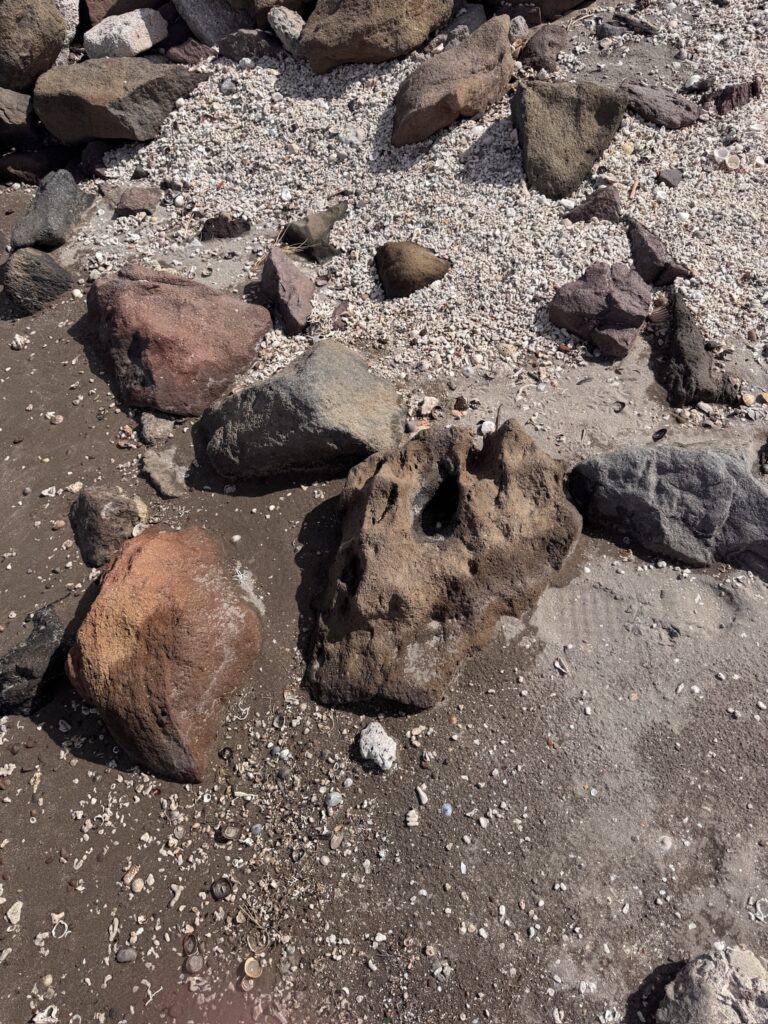
This image captures a gathering of volcanic stones, worn shells, and sunbaked earth: a convergence of textures that have withstood heat, weight, and time. I was drawn to the contrasts: hardness beside fragments, shadows against brightness, the jagged edges of endurance softening into the granular memory of dissolution.

Each rock holds a story that predates language. Each shell, a hushed echo of a body once held. Together, they create a kind of grounded archive: one requiring no explanation, only attention. In the context of my arts-based inquiry into precarity, embodiment, and alonetude, this scene offers a reminder that presence can take many forms, and some resist smoothness and easy containment.

Here, survival is sedimented rather than silent, deliberate rather than dramatic. These exceed the traditional monument. They are records of what withstood and what remains, unpolished, unnamed, enough.

Photo Credit: Amy Tucker, 2026
Title: Altar of the Ordinary
Artist Statement

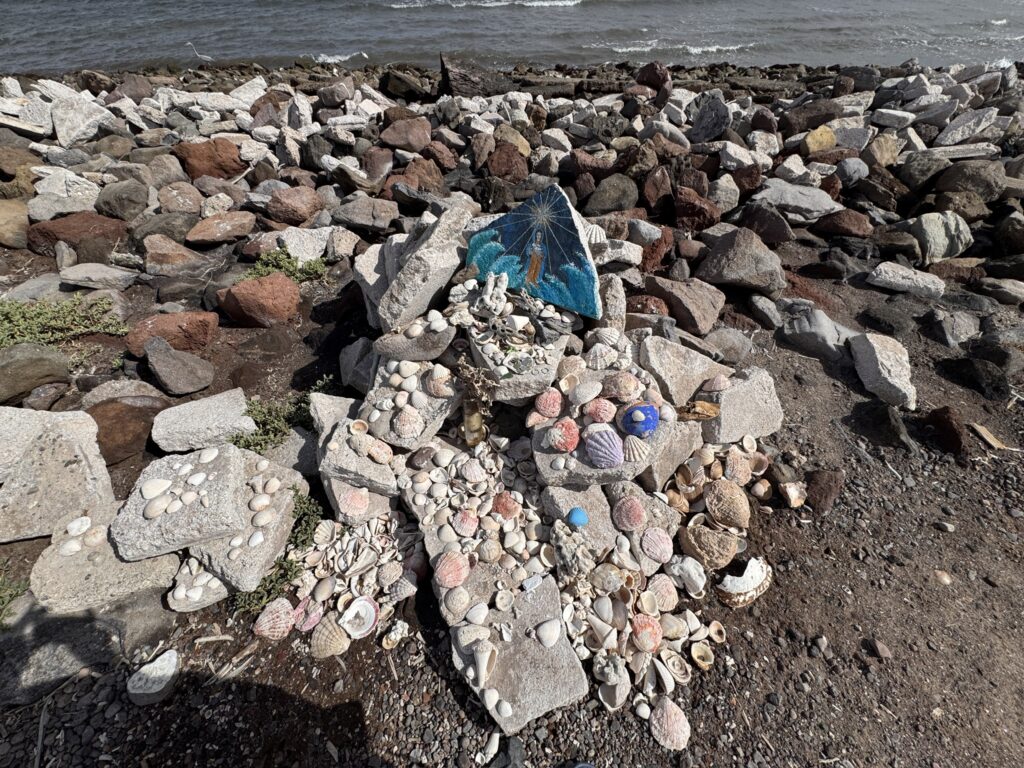
This shoreline shrine, assembled from painted shells, broken tiles, and sea-washed stones, stands as a communal gesture, unofficial, unclaimed, yet unmistakably sacred. I was moved by the way everyday objects, often overlooked, had been offered with quiet intention. A single blue rock. A painted Virgin. A bottle nestled among fragments. Nothing expensive, nothing pristine. And yet, everything chosen.

In the context of my research into alonetude, belonging, and the ethics of presence, this altar reveals the sacredness of the unremarkable. Built without fanfare, maintained without instruction, it is a collective act of noticing. These materials were gathered to witness, beyond any desire to impress. To remember. To offer.

There is no plaque here, no inscription. Only the evidence that someone stopped long enough to care, to arrange, to leave something behind. It reminds me that memory can be handmade. That holiness can be found in what the sea returns.

This exceeds any monument to power. It is a testament to tenderness.

Photo Credit: Amy Tucker, 2026
Title: Throne for No One
Artist Statement

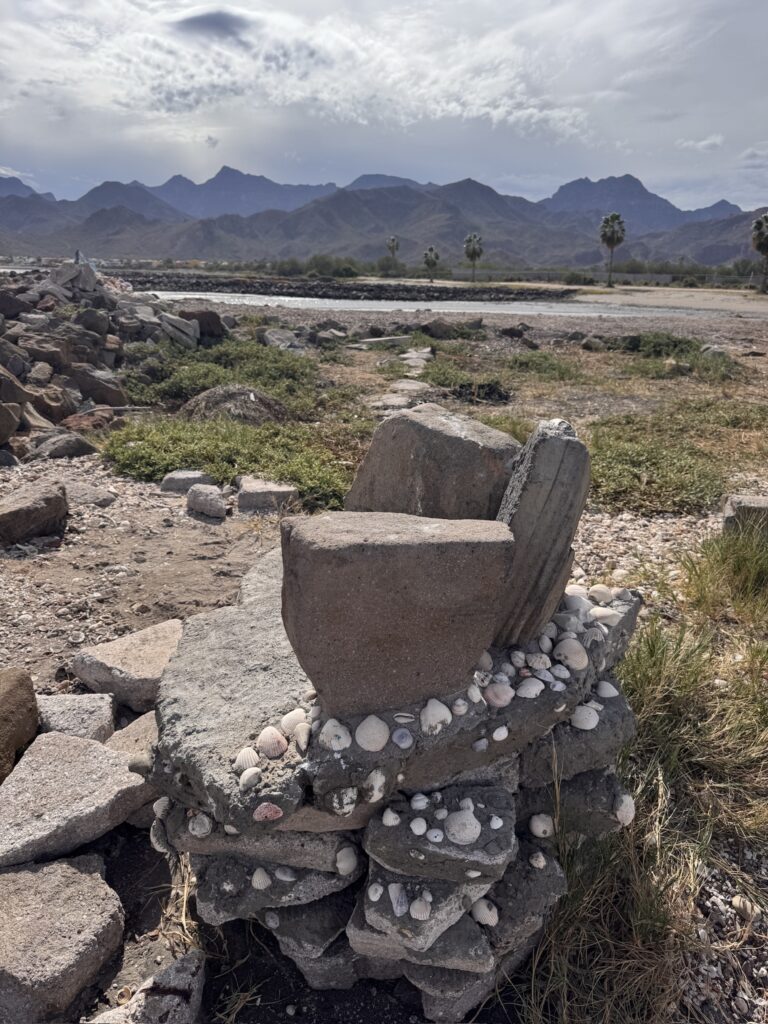
This weathered structure, assembled from slabs of broken concrete and rimmed with small white shells, sits quietly before a vast and mountainous horizon. It evokes a throne, but one with no occupant, no ceremony, no claim. What moved me most was its paradox: it suggests importance, yet resists ownership. It holds form, yet refuses to declare function.

In my research on alonetude, trauma-informed practice, and the ethics of retreat from visibility, this piece became a meditation on authority reimagined. Who gets to take up space? Who builds thrones, and who are they for? This monument seems to ask a different question altogether: What if the seat of power is emptiness? What if it invites rest rather than dominance?

The shells, carefully placed along the cracks, remind us that care can live within ruin. This is beyond a pedestal. Beyond an altar. It is a possibility: a place where no one rules, yet everything is held.

Photo Credit: Amy Tucker, 2026
Title: What Remains May Smile
Artist Statement

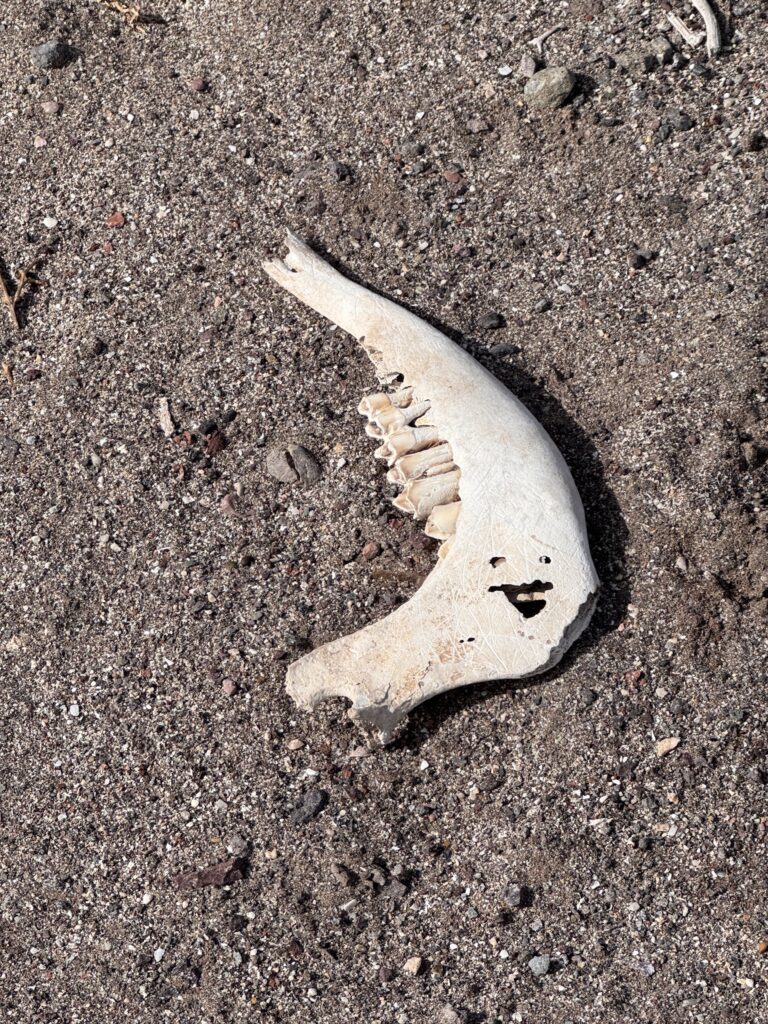
This fragment of bone, likely a lower jaw, worn smooth by time and sand, lay half-buried, yet unmistakably visible. What caught my eye was the accidental pattern of holes, worn into something resembling a smile. Unintentional. Uncanny. A gesture of joy etched into what should speak of loss.

In my arts-based inquiry into alonetude, institutional fatigue, and the body’s quiet ways of knowing, this image became a moment of unsettling wonder. Even in decomposition, there is expression. Even in absence, there is form. It asks us to consider the meanings we impose, and the ones that emerge without effort.

This exceeds the traditional memento mori. It cautions against nothing, glorifies no decay. Instead, it suggests something quieter: that even what breaks down can still hold presence, can still gesture toward feeling, can still, perhaps by accident, smile.

Photo Credit: Amy Tucker, 2026
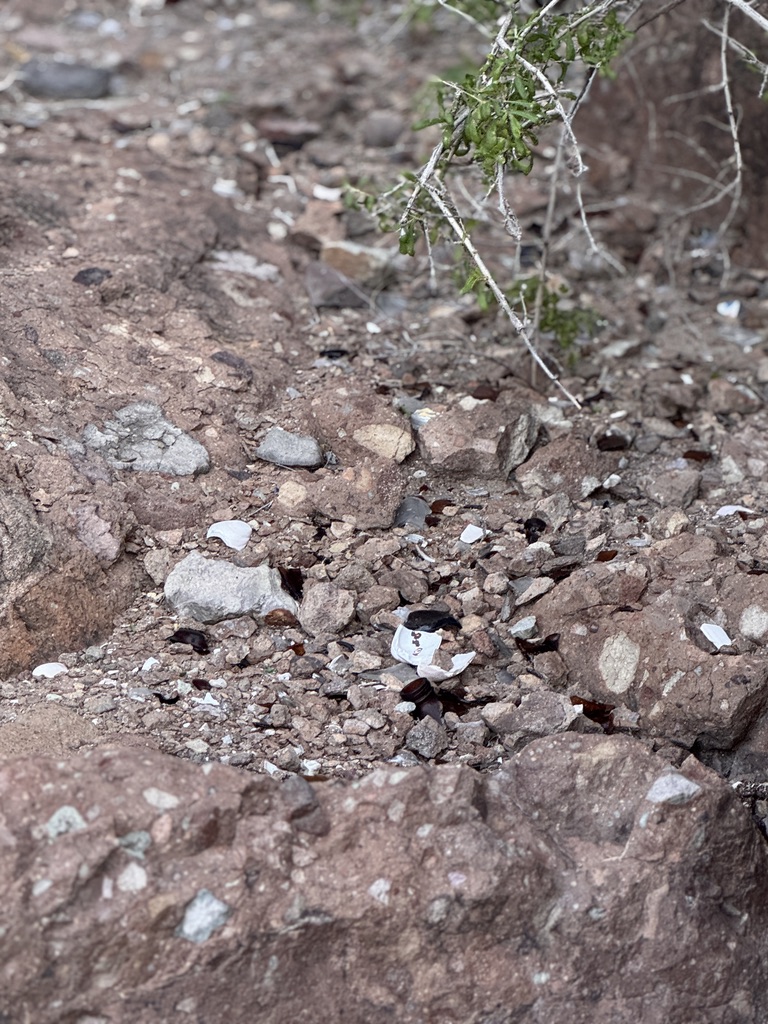
Title: Fragments That Refuse Disappearance
Artist Statement

I noticed these fragments while walking a narrow, uneven path where the ground was layered with stone, dust, and small evidence of what had once passed through. At first, the field of view felt monochrome, muted by earth tones and dryness. Then the glass caught the light. Small shards, dark and amber, scattered among the rocks as if the land itself had exhaled them.

I held my ground. I stood where I was and allowed my eyes to adjust, tracing the contrast between what was natural and what had been left behind. The glass belonged to a different time than the geological hillside. It belonged to interruption, to human presence, to a moment of discard now weathering into the terrain.

In my reflective practice, I am often drawn to sites where rupture and endurance coexist. These fragments hold that tension. Once whole, once functional, now broken and partially buried, they remain visible despite time and erosion. The land holds them in a kind of stasis, neither rejecting nor absorbing them fully. They exist in a suspended state, neither fully integrated nor entirely separate.

I photographed the scene as I encountered it, resisting the urge to rearrange or collect. There was meaning in the placement itself. The brokenness read as testimony rather than failure. Evidence that impact leaves trace. Evidence that what shatters persists. It persists, altered but present.

This image sits within my ongoing inquiry into what remains after disruption. Into how landscapes, like bodies, hold memory in fragments. Into how even the smallest shards carry narrative weight when we are willing to pause long enough to see them.

Photo Credit: Amy Tucker, 2026
Epitah
Here lies a fragment, once part of breath,
Now shaped by salt, silence, and time.
Changed but present,
Still telling a story,
Still holding a smile.