Title: When I am Feeling Blue
Artist Statement

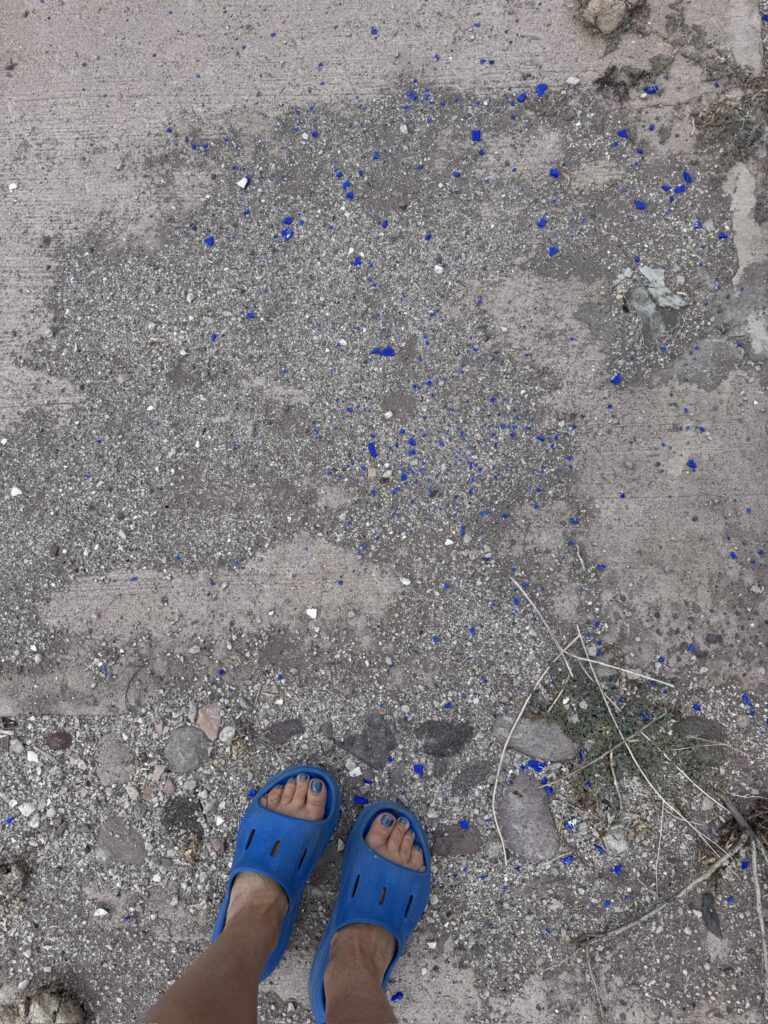
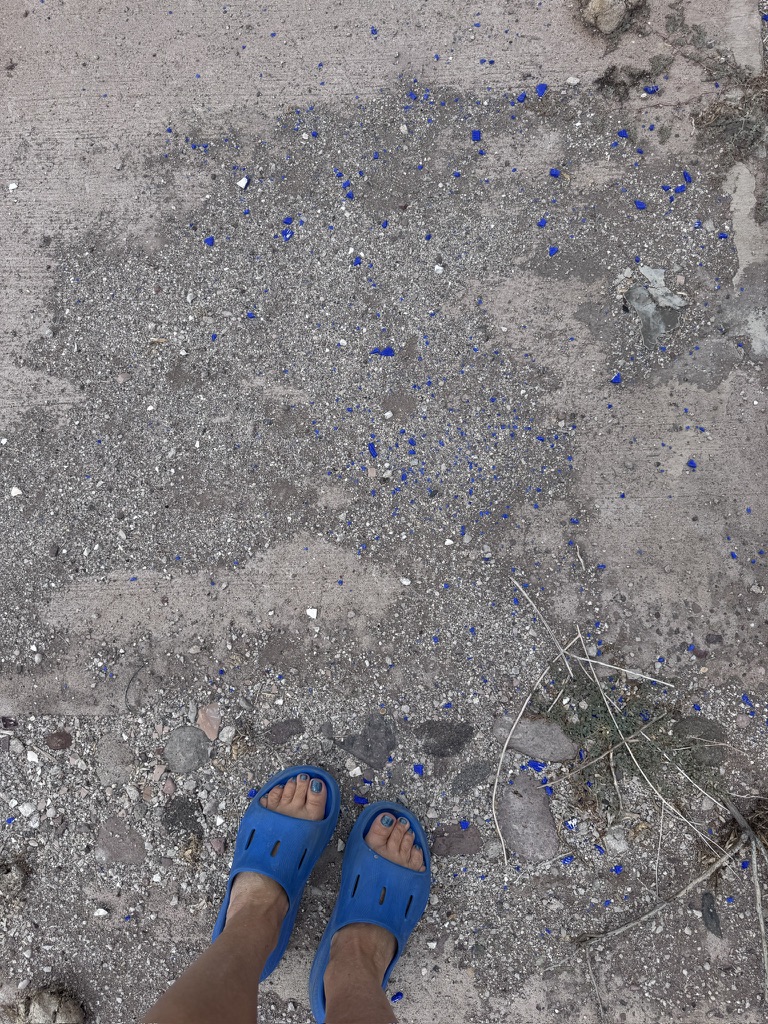
I looked down and laughed. My blue sandals, my blue toenails, and scattered across the concrete before me, droplets of blue paint that someone had spilled and never cleaned. The coincidence was too precise to ignore. This arrived without planning. I had simply stopped walking and noticed that the ground was echoing me back.

This is one of the photographs I have kept in colour. The blue demanded it. Against the grey and beige of the weathered concrete, the paint droplets appeared like a constellation, random yet patterned, evidence of movement and accident. My sandals anchored the frame at the bottom, situating my body within the encounter. I was fully within the encounter rather than observing from a distance. I was standing in the middle of what I found.

I am drawn to moments of unexpected correspondence. The times when what I carry meets what the world offers without intention or design. The blue paint was left for no one. It was residue from labour I had no way to witness, a task completed and moved on from, the spillage deemed too minor to address. Yet standing there, I became part of its composition. My feet completed a pattern that had been waiting, perhaps, for someone to notice.

In my broader practice, I think often about trace and residue. What remains after work is finished. What gets left behind when attention moves elsewhere. The paint droplets will fade eventually, worn away by foot traffic and weather. But for this moment, they held their blue against the grey, bright and unashamed, and I stood among them wearing the same colour, as if the ground and I had agreed on something without speaking.

The photograph holds play and presence in equal measure. It reaches beyond profundity. It simply records a moment when I looked down, saw myself reflected in what had been discarded, and smiled at the small magic of correspondence. Sometimes the land teaches through means other than solemnity. Sometimes it teaches through delight.

Photo Credit: Amy Tucker, January 2026
I have always been drawn to blue.
Beyond the way people speak of favourite colours, a casual preference carried from childhood without much thought. This is something else. Something that lives in my body before my mind has time to name it. When I see a particular shade of blue, the soft turquoise of shallow water, the deep indigo of twilight, the bright cerulean of a painted door, something in me settles. My shoulders drop. My breath slows. The world becomes manageable for a moment.
“I have always been attracted to this colour. It reminds me of calm. Peace. Seas.”
Blue is my nervous system’s signal for safety.
Porges (2011), in developing Polyvagal Theory, describes how the autonomic nervous system responds to environmental cues, what he calls neuroception: the body’s unconscious detection of safety or threat. Certain stimuli signal danger: loud noises, aggressive faces, signs of chaos. Others signal safety: soft voices, gentle rhythms, open spaces. I have come to understand that, for me, blue functions as a neuroceptive cue. It tells my body that the threat has passed. It tells my ventral vagal system that it is safe to engage, to play, to rest.
Stopping to notice revealed this to me. Until I stood on grey concrete with blue scattered at my feet and laughed at the unexpected correspondence.
The day I took this photograph, I was walking without a destination.
This has become a practice during my retreat, caminar sin rumbo, walking without direction, letting my feet decide where to go. Kabat-Zinn (1994), in his foundational work on mindfulness, describes this quality of attention as “non-striving,” the willingness to let experience unfold without forcing it toward a predetermined goal. Walking without a destination is non-striving, made ambulatory. The body moves. The mind follows. Sometimes nothing happens. Sometimes everything does.
I had painted my toenails blue before I left Canada. A small aesthetic choice, barely conscious. I had packed the blue sandals because they were comfortable, because they fit the climate, because something in me wanted to carry that colour into this journey. Its significance had stayed quiet.
And then the ground answered.
Title: Constellation of Accident
Artist Statement

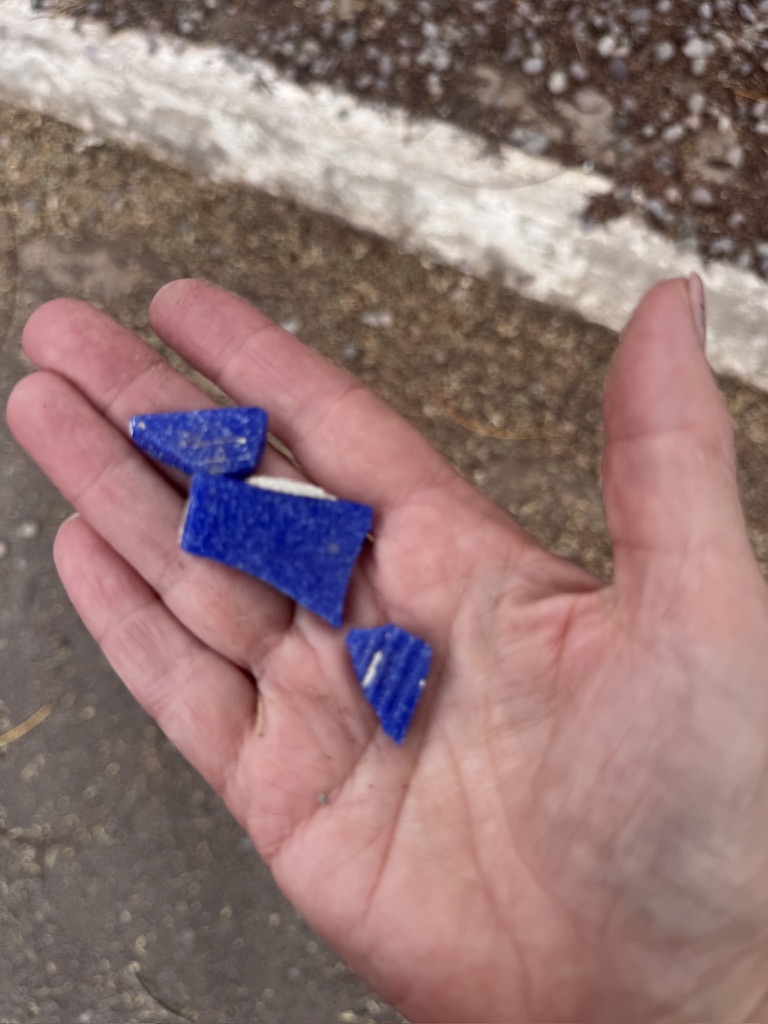
I crouched down to see them closer.

The paint droplets varied in weight and pattern. Some had fallen heavily, pooling into thick spots of saturated blue. Others were mere specks, barely visible, almost lost to the texture of the concrete. The pattern was random, no design, no intention, just the physics of liquid falling and landing where gravity placed it.

But randomness can look like pattern when you attend to it long enough. The droplets clustered in some areas, scattered in others, creating rhythms I could almost hear. This is what attention does: it finds meaning in what was never meant to mean anything. It makes constellations from scattered stars.

Someone painted something here. A wall, a sign, a piece of furniture they were refinishing. The work is finished now, moved elsewhere, forgotten. Only this residue remains, evidence of labour, trace of presence, blue marks on grey ground that no one thought to clean.

I am interested in residue. In what remains after the task is complete. In the unintended traces we leave behind.

Photo Credit: Amy Tucker, January 2026
I have been collecting broken blue things.
It started with the tiles I found in the empty field on Day 24, fragments of old Mexican ceramics in that particular turquoise-teal that appears on church domes and courtyard fountains throughout Baja California Sur. I picked them up without knowing why, only that their colour called to me, only that my hand reached for them before my mind could explain.
Since then, I have gathered more. Blue glass tumbled smooth by time. Blue pottery shards with half-erased patterns. Blue sea-worn fragments from the beach, their origins unidentifiable, their colour persistent. Each one caught my eye, and I bent down, and I carried it home, and now I have a small collection of blue facts waiting to be assembled.
The broken pieces are gathering. They will show me what they want to become.
This gathering is its own kind of practice. Leavy (2015), in her work on arts-based research, argues that creative processes generate knowledge that other methods cannot access. The hands learn differently than the mind. The act of selecting, collecting, and arranging is an epistemic activity, a way of knowing through doing. What the blue pieces will become stays open. I only know that gathering them feels important, feels like research, feels like my body telling me something my conscious mind has held rather than articulated.
Title: What I Have Gathered
Artist Statement

Becoming a collector of broken blue things arrived without a plan.

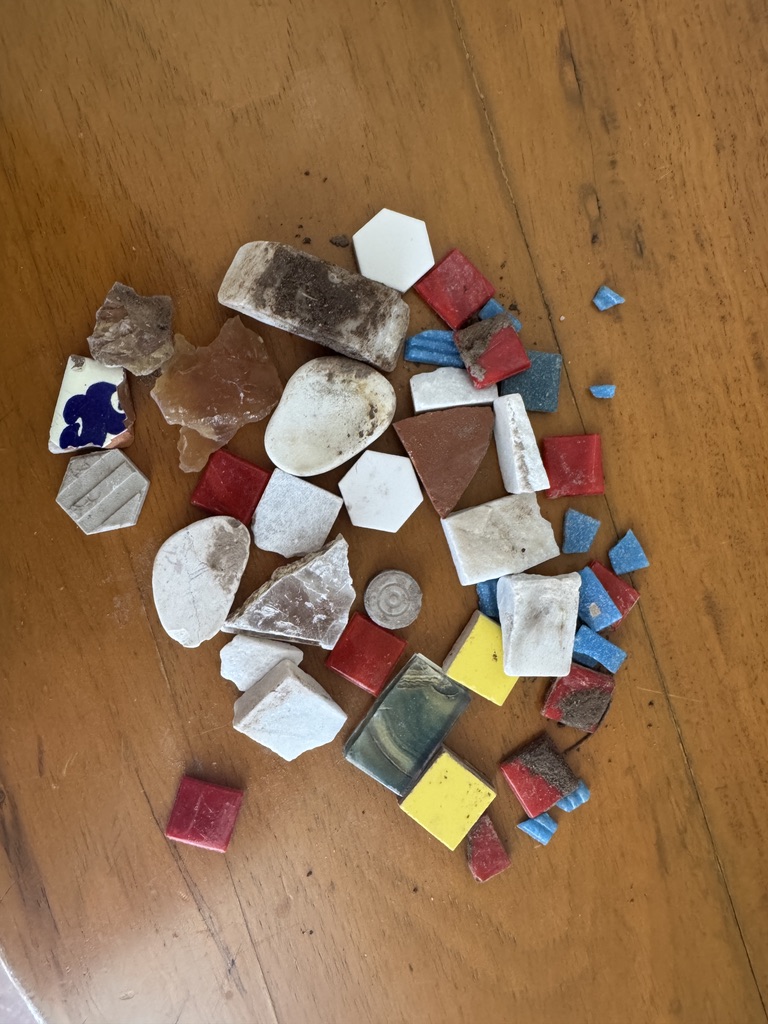
But here they are. Pieces of tile from the empty field. Sea glass from the beach. Pottery shards whose patterns are half-erased by time. Each one came to me separately, in its own moment, asking to be noticed. I said yes. I picked them up. I carried them back to this temporary home where they now rest together, learning each other’s company.

The blues vary. Some lean toward turquoise, some toward indigo, some toward the grey-blue of storm clouds over water. But they belong together. My body knew this before my mind understood. The hand reached; the eye approved; the collection grew.

What will I make with them? A mosaic, perhaps. An assemblage. A frame for something still forming. For now, I am letting them sit together. Letting them tell me what they need.

Photo Credit: Amy Tucker, January 2026
Mosaic, as an art form, is made from broken things.
The word derives from the Greek mouseion, a place sacred to the Muses, goddesses of the arts and sciences who bestow creative inspiration on humans. Mosaics were holy before they were decorative. They covered temple floors and church walls, transforming shattered stone and glass into images of the divine. The Byzantine masters of Ravenna understood this alchemy: that brokenness, properly arranged, becomes more luminous than wholeness ever was.
Pentcheva (2010), in her study of Byzantine aesthetics, describes how mosaic tiles, set at slightly different angles, catch light unevenly. The surface shimmers. The image seems to breathe. “The mosaic is never still,” she writes it changes as the viewer moves, as the light shifts, as time passes (p. 648). What appears fixed is actually in constant subtle motion, alive with the unpredictability of its fragmented construction.
I think about my own fragments this way. The blue pieces I have gathered stay in motion. They carry light differently depending on how I hold them, how the sun enters the window, how my attention moves across their surfaces. They are waiting to become something, but that something will shimmer. It will shift. It will be alive, the way broken things, reassembled, become alive.
There is another dimension to blue I must acknowledge.
Blue is also the colour of sadness. To “feel blue” is to feel low, melancholic, and touched by grief. The blues, as a musical tradition, emerged from the specific sorrows of Black American experience: oppression, loss, the particular ache of being human in a world that often makes no sense. When Robert Johnson sang “Hellhound on My Trail,” when Billie Holiday sang “Strange Fruit,” they were singing the blues. They were giving voice to what lives in the blue frequency of emotion.
I carry this blue, too. The depression I have been writing about throughout this retreat. The sadness that followed me from Canada, that persists despite the warm light and the sound of waves. The grief of losing a career I loved. The fear of an uncertain future. The despair, Greenspan’s (2003) word for it, that arrives sometimes in the early morning and sits on my chest like weather.
Greenspan teaches that grief, fear, and despair are pathways through healing rather than obstacles. “The dark emotions are not pathological states but, in essence, sane and appropriate responses to the state of the world,” she writes (p. 10). We are trained to bypass difficult feelings, to positive-think our way past them, to medicate them into silence. But Greenspan insists that befriending the dark emotions, sitting with them, listening to what they carry, transforms them into wisdom.
Blue holds both. The calm of the sea and the sadness of the spirit. The peace of shallow water and the grief of deep. I am learning that these are neighbours rather than opposites, sharing a colour, sharing a frequency, sharing space in my body as I walk through this month of alonetude.
Title: Blue at Rest
Artist Statement

The blue is resting.

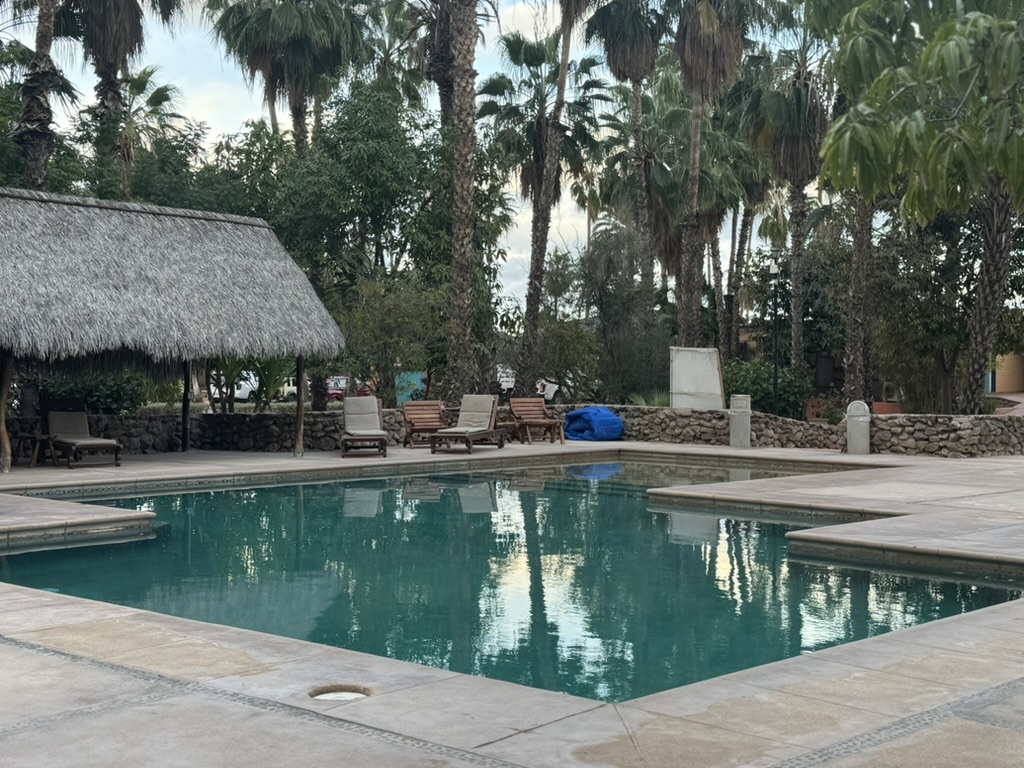
I came to the pool in the late afternoon, when the light had softened and the other guests had gone inside. The water held still, that particular turquoise that exists only in certain latitudes, certain qualities of light. The palapa framed the scene like a theatre curtain, dried palm fronds hanging heavy overhead, creating a threshold between shade and brightness, between shelter and exposure.

A blue towel lies abandoned on the deck. Someone was here. Someone swam or sat or simply rested near the water, then moved on, leaving this soft evidence behind. The towel and the pool speak to each other in the same colour, different textures, different purposes, but belonging to the same family of blue.

I have been thinking about what it means to let things rest. The water simply rests. The towel simply rests. The palm trees sway slightly, at ease. Everything in this frame exists in a state of pause, of waiting, of being without becoming. This is what I came here to learn, how to be still without feeling that stillness is failure.
The turquoise door of the casita echoes the water. Blue answering blue across the space. The world arranged it without my intervention. The world arranged it, and I was present enough to notice.

Photo Credit: Amy Tucker, January 2026
The art project will take shape when I return to Canada.
I imagine a mosaic, perhaps. Something that holds the blue pieces together while honouring the breaks between them. Something that catches light the way Pentcheva describes shimmering, shifting, alive. Something that carries both the calm of these seas and the sadness of these months. Something that transforms what was discarded into something beautiful, the way gleaning transforms forgotten abundance into sustenance.
But I hold it open rather than force it. I am practicing what Chödrön (2000) calls “groundlessness,” the willingness to exist without knowing what comes next, to tolerate the uncertainty of being between. The fragments will tell me what they need. The blue will speak when it is ready.
For now, I gather. I notice. I let the colour find me where it will.
Title: Held in Blue
Artist Statement

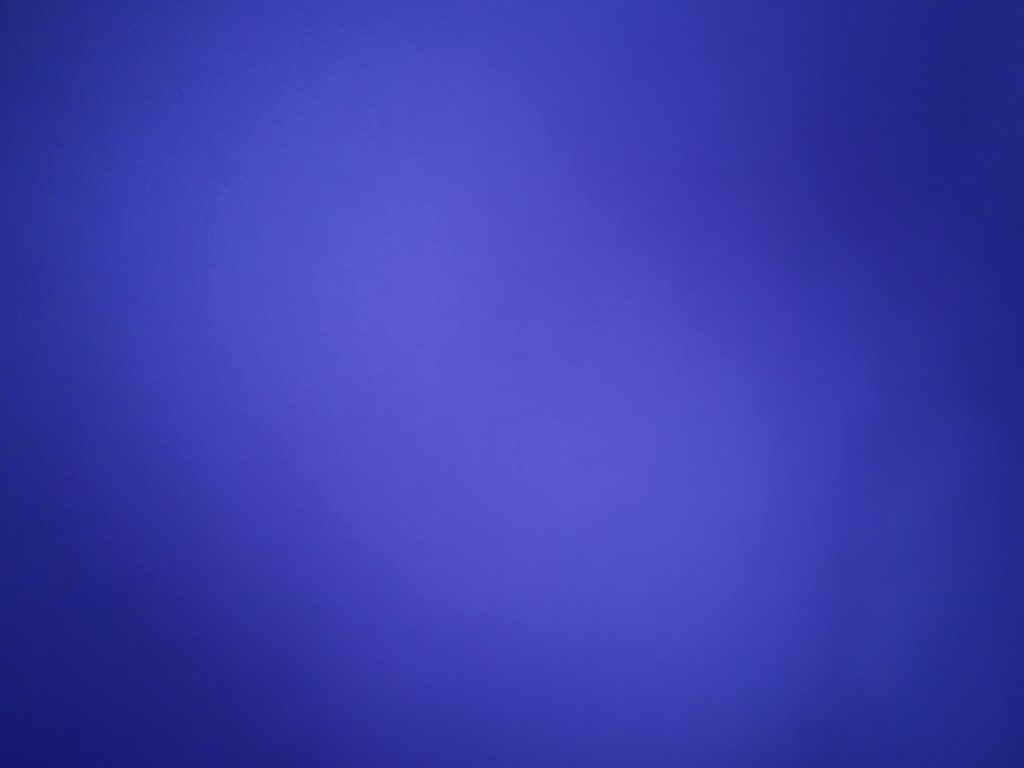
This image emerged unintentionally. I had set out without abstraction as a goal. I had been walking, attentive to land, horizon, and form, when the frame filled instead with colour alone. No shoreline. No sky line. No identifiable object to anchor perception. Only blue, deep and immersive, layered in tonal variation.

At first, I considered discarding it. It held a different kind of witness than my other photographs. It resisted narrative. Yet the longer I sat with it, the more it began to speak in a different register. It moved beyond landscape into interiority.

The field of blue feels oceanic without depicting the ocean. It holds the same sense of suspension I experienced while floating in open water, where orientation dissolves and the body rests in something vast, buoyant, and indifferent to personal history. There is no horizon to measure against. No visual boundary to define scale. Only immersion.

In my reflective practice, this image becomes a study in containment without confinement. Blue often carries associations of depth, quiet, and emotional spaciousness. Here, those qualities feel intensified by the absence of distraction. Nothing interrupts the field. Nothing asks for interpretation. The photograph offers stillness rather than information.

I have come to understand it as a visual analogue for the psychological state cultivated through alonetude. A state in which identity softens, performance recedes, and the self is held rather than displayed. It mirrors the experience of resting within one’s own interior expanse without the need to articulate or explain.

The subtle shifts in tone across the frame suggest movement beneath apparent uniformity. Even in stillness, there is variation. Even in quiet, there is life. The image reminds me that healing rarely appears dramatic. Sometimes it looks like this: immersion in a colour that asks nothing and gives space in return.

I kept the photograph because it holds what cannot be easily represented. The feeling of being suspended between exhaustion and restoration. Between who I was and who I am becoming. Between surface and depth.

Photo Credit: Amy Tucker, 2026
I stood on grey concrete with blue scattered at my feet, and I laughed.
This is what I want to remember from this retreat. More than the hard work of facing depression and grief. More than the theoretical frameworks and the scholarly engagement. More than the counter-archive of institutional harm. But also this: the laughter. The delight. The unexpected joy of finding myself echoed in a scattered patch of paint that someone had spilled and never cleaned.
Alonetude reaches beyond processing suffering. It is also about allowing pleasure. About noticing when the world offers a gift, a visual rhyme, a moment of correspondence, blue meeting blue on grey ground, and receiving it without demanding that it mean something profound.
Sometimes it just means: here is beauty. Here is a play. Here is a moment of delight in a month that has also held heaviness.
I am learning to receive both.
Sometimes the land teaches through means other than solemnity. Sometimes it teaches through delight.
Title: Blue Correspondence
Artist Statement

I return to this image because it holds something I need.

The correspondence arrived without planning. I painted my toenails blue with no knowledge of what I would find on the ground. I wore blue sandals simply as a choice. The meeting was accident, coincidence, grace, whatever word we use for moments when the world seems to be paying attention to us.

But I was paying attention too. That is the key. The paint had been there for weeks, maybe months. Others had walked over it without noticing. I noticed because I was looking down. I was practicing the slow attention of alonetude, the willingness to let experience arrive without rushing past it.

The photograph records this meeting of attentions, mine and the world’s. It holds play and presence in equal measure. It resolves nothing outright. It simply says: here, for this moment, the ground and I agreed on something without speaking.

That agreement feels like the beginning of healing.

Photo Credit: Amy Tucker, January 2026
Azul. El color de la calma. El color de la paz. El color del mar. El color de la tristeza también. El color de todo lo que siento.
Blue. The colour of calm. The colour of peace. The colour of the sea. The colour of sadness, too. The colour of everything I feel.
I am carrying it forward.
Title: The Quiet Field
Artist Statement

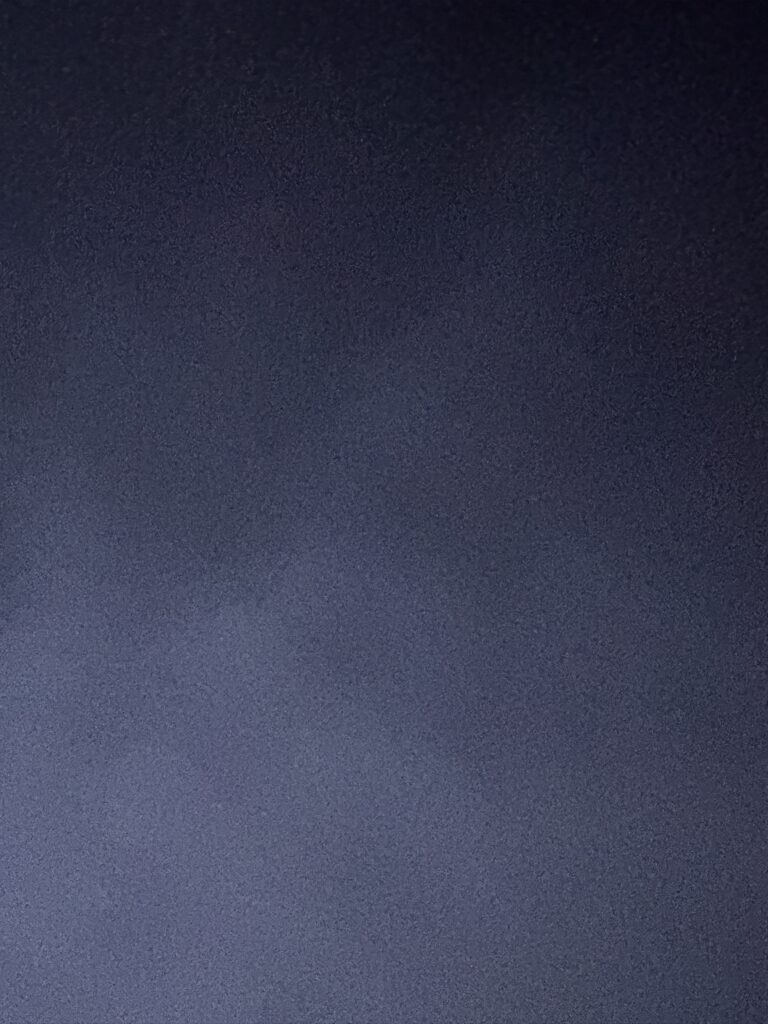
This image holds very little in the conventional sense of representation, yet it carries a surprising emotional density. In fact, it is a photo of my pocket.

The frame is filled by a single tonal field, dark blue shifting almost imperceptibly toward charcoal and indigo. There is texture, but it is subtle. There is gradation, but it refuses spectacle. The photograph holds its silence. It waits.


I have come to see this photograph as a meditation on interior quiet. It evokes the psychological state that emerges after prolonged solitude, when the nervous system begins to settle and stimulation no longer feels necessary. The darkness signals containment to me rather than heaviness. It signals containment. A held space where thought can soften.

The faint textural variations across the surface remind me that stillness is never empty. Beneath apparent uniformity, there is movement, grain, and subtle differentiation. Much like emotional healing, the changes are gradual and often invisible to others. Yet they are present, shaping experience from within.

There is also a relational quality to the image. It holds space rather than imposing meaning. It invites projection. Viewers bring their own associations to the field, their own histories with darkness, rest, and quiet. In this way, the photograph functions less as documentation and more as atmosphere.

Within my broader body of work on alonetude and liminal retreat, this image represents the deep interior phase of threshold experience. The stage where identity loosens, where language recedes, where one learns to remain present without needing clarity or resolution.

It is the visual equivalent of closing one’s eyes while awake. Of standing in a room before dawn. Of inhabiting the pause before re-entry into the world of roles and expectations.

The photograph holds that pause without interrupting it.

Photo Credit: Amy Tucker, 2026
Translation note. Spanish language passages were generated using Google Translate and subsequently reviewed and refined by the author. Any remaining infelicities reflect the limits of machine translation rather than intent.
References
Chödrön, P. (2000). When things fall apart: Heart advice for difficult times. Shambhala.
Greenspan, M. (2003). Healing through the dark emotions: The wisdom of grief, fear, and despair. Shambhala.
Kabat-Zinn, J. (1994). Wherever you go, there you are: Mindfulness meditation in everyday life. Hyperion.
Leavy, P. (2015). Method meets art: Arts-based research practice (2nd ed.). Guilford Press.
Pentcheva, B. V. (2010). The sensual icon: Space, ritual, and the senses in Byzantium. The Art Bulletin, 92(4), 631–655.
Porges, S. W. (2011). The polyvagal theory: Neurophysiological foundations of emotions, attachment, communication, and self-regulation. W. W. Norton.