What the Discarded Teaches Us About Value
I am learning that treasure is what the world overlooks rather than what it values. Treasure is what the world has overlooked, discarded, and left behind for someone patient enough to notice.
Title: Blue Enough to Stop
Artist Statement

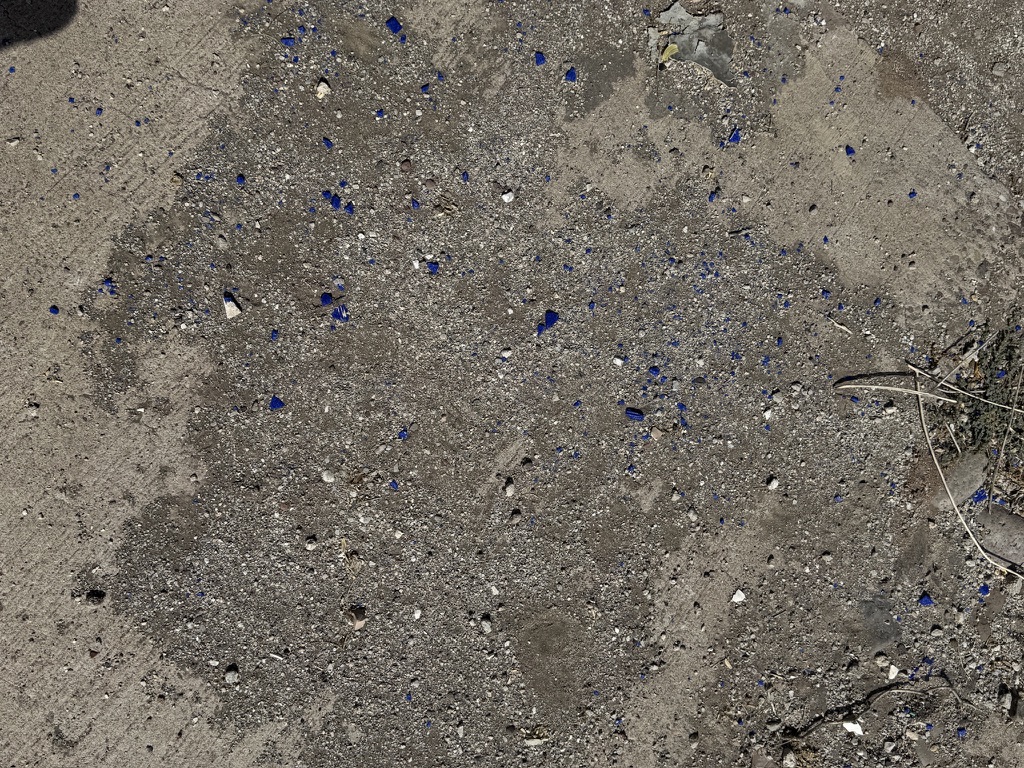
I noticed this because the blue refused to disappear.

At first glance, it was just dust and gravel, the kind of ground you walk over without registering it. Then the colour began to surface. Small shards scattered unevenly, catching light in brief, insistent flashes. They were beyond arrangement. Beyond intention. Simply there, insisting on being seen.

This moment reminded me how attention changes the world. What appears monochrome at a distance reveals complexity when approached slowly. The blue fragments felt like remnants of care, traces of something once whole that still carried beauty despite being broken. I thought about how easily colour is erased by speed, by habit, by the assumption that nothing important lies underfoot.

There is something tender in stopping for what is small and sharp-edged. These fragments asked for no fixing and no story beyond their presence. They held their colour against dust and time. That felt instructive. It suggested that value requires no coherence, no completion. It can exist in scattered form, waiting for someone willing to look closely enough to notice.

This image stays with me because it affirms a practice I am learning to trust. To walk slowly. To look down. To allow myself to be interrupted by what glints quietly at the margins. The blue was enough to stop me. That feels like a lesson worth keeping.

Photo Credit: Amy Tucker, 2026
The Empty Field
There is an empty field just beyond the edge of town, where the paved road gives way to dust and the last buildings surrender to open land. I have been walking past it for weeks without stopping. It looked like nothing. Scrub brush. Rubble. The kind of place you glance at and dismiss.
Yesterday, I stopped.
Something beyond naming made me turn off the path and walk into that emptiness. Perhaps I was tired of the routes I already knew. Perhaps my body was leading me somewhere my mind had yet to consent to go. I have been learning, throughout this residency, to follow impulses that resist explanation. This is part of what Scholarly Personal Narrative makes possible: trusting that the body knows things the conscious mind has yet to articulate.
The field was full of treasure.
Title: One Person’s Treasure
Artist Statement

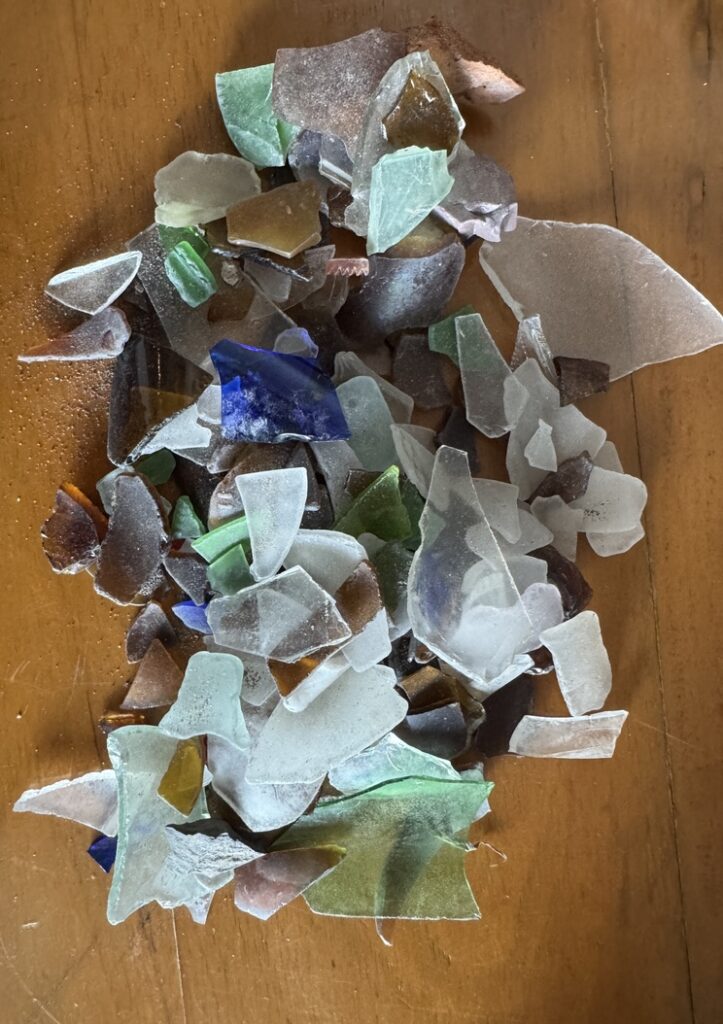
This work began when I stopped walking past what I had assumed was empty. Turning into the field felt intuitive, guided by the body rather than the mind. What appeared as absence revealed fragments of glass and tile, small residues of domestic life and quiet abandonment.

I approach these materials as witnesses, holding traces of memory, use, and erasure. Through Scholarly Personal Narrative and land-based inquiry, this field becomes both site and method, a place where brokenness speaks and presence persists. This work is an act of ethical noticing, listening to what remains.

Photo Credit: Amy Tucker, January 2026
The Practice of Gleaning
What I was doing in that field has a name. It is called gleaning.
Gleaning is an ancient practice. In agricultural societies, gleaners were people who followed behind the harvesters, collecting the grain that had been left behind in the fields. Gleaning was how the poor survived. It was sanctioned in biblical law: landowners were instructed to leave the edges of their fields unharvested so that widows, orphans, and strangers could gather what they needed.
Filmmaker Agnès Varda (2000), in her documentary The Gleaners and I, explored how gleaning persists in contemporary life. Varda filmed people who collect discarded food from markets, artists who work with found materials, and herself, gathering images and stories that others have overlooked. Varda understood gleaning as both a practical survival practice and a creative practice. She called herself a gleaner of images.
I am a gleaner too. I walk through empty fields and collect what has been left behind. Tiles that once covered floors. Pottery that once held food. Glass that once contained something someone needed. These objects have been discarded, but they retain their beauty. Weathered, but intact.
There is something in this practice that speaks to my own experience. I, too, have felt discarded. I, too, have been treated as though my value ended when my utility to an institution was no longer convenient. Walking through that field, picking up fragments that others have dismissed, I am practicing a different way of understanding worth.
Title: What Can I Make With These?
Artist Statement

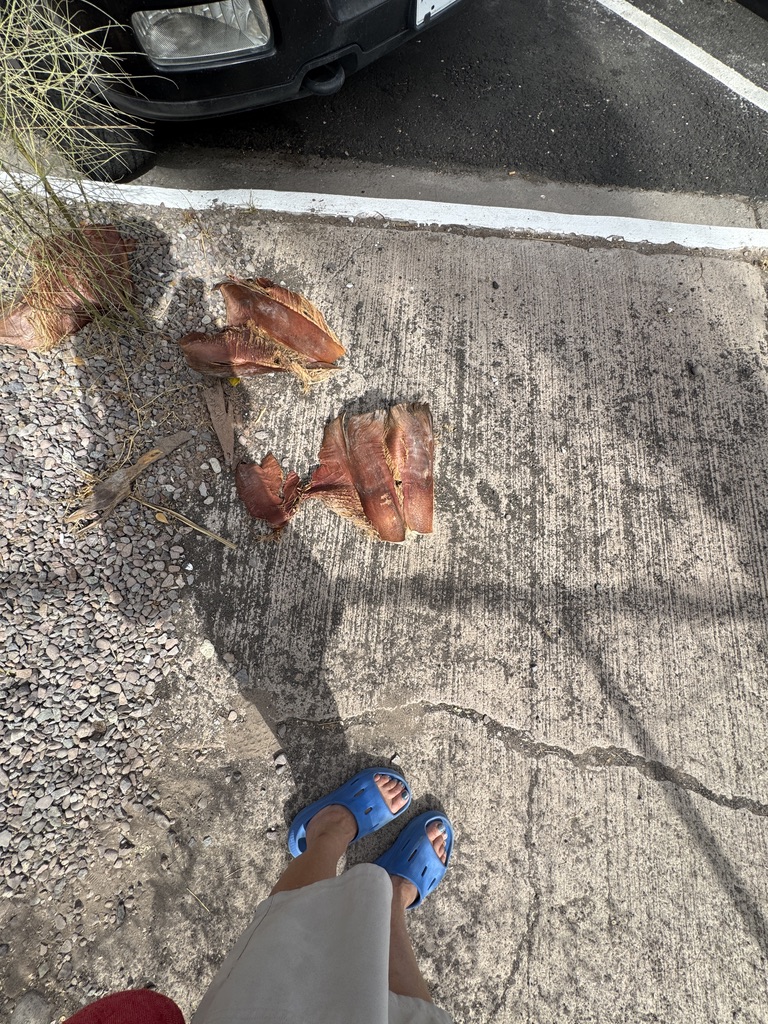
I picked these up without a plan in mind. I noticed them because they had opened themselves. Split husks resting on concrete, their inner fibres exposed, their protective work already done. They were no longer attached to the tree, no longer enclosing anything, and yet they remained present. That mattered to me.

What drew me in was their honesty. These forms show what happens after holding, after covering, after protection has reached its limit. They make no pretense of wholeness. They try nothing like returning to what they were. They rest exactly as they are, shaped by weather, pressure, and time. I recognised something of myself in that posture.

My practice at this stage is grounded in attention rather than transformation. I am interested in what materials teach when they are allowed to remain close to how they were found. These husks speak about shedding, about release, about the quiet dignity of structures that step aside once their purpose has been fulfilled. They carry evidence of labour without demanding recognition for it.

Placing them together is a way of listening. I let them go beyond resolving into a single form. I let them sit in relation, curved toward and away from one another, holding space without enclosure. They become companions rather than components. The work lives in that relational field.

This piece belongs to my broader inquiry into value, endurance, and recovery. I am learning to recognise worth in what has been cast aside and to trust forms that have no need to seek completion. These husks remind me that protection can be temporary, that opening can be a form of wisdom, and that what remains after release still carries meaning.

Photo Credit: Amy Tucker, 2026
Gleaning is how the discarded find their way back to meaning.
Objects as Co-Researchers
Within arts-based research, found objects can serve as what scholars call co-researchers. This means they move beyond the merely decorative or illustrative. They participate in the inquiry. They carry knowledge. They teach.
Material culture theorist Jane Bennett (2010), in her book Vibrant Matter, argues for what she calls “thing-power”-the capacity of objects to act, to affect, to make things happen. Bennett challenges the assumption that only humans have agency. Objects, she suggests, are active agents. They exert influence. They shape what becomes possible.
I have felt this thing-power in the field. A flash of colour catches my eye. I bend down. My hand reaches before my mind decides. The object has called me. It has exercised a kind of agency, drawing my attention, inviting me to pick it up, to carry it home, to consider what it means.
Anthropologist Tim Ingold (2013) writes about making as a process of correspondence between maker and material. The maker imposes no form on passive matter. Instead, maker and material enter into dialogue. Each responds to the other. Each shapes what emerges.
My relationship with these found objects is a form of correspondence. I decided nothing in advance about what I was looking for. I let the field show me what was there. I let the objects announce themselves. I followed their lead.
Title: Washing the Findings
Artist Statement

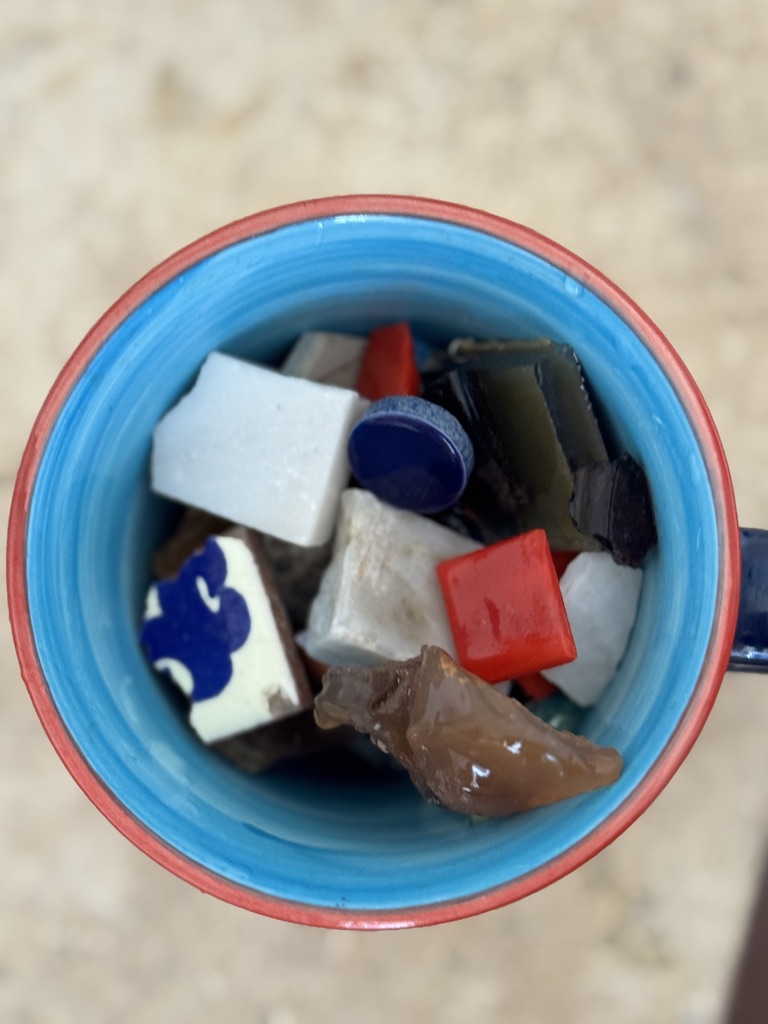
I photographed the washing because it is part of the practice. These objects came from the earth, carrying dust, salt, and the residue of years of exposure to weather. Washing them is an act of attention. It is slow, deliberate work. I handle each piece individually, feeling its weight, noticing its texture, watching colours emerge as the dirt lifts away.

This is a contemplative practice in material form. Jon Kabat-Zinn (1994) describes mindfulness as paying attention on purpose, in the present moment, and without judgment. Washing these fragments becomes mindfulness with my hands. It grounds me in the present and connects me to something beyond my circling thoughts.

Photo Credit: Amy Tucker, January 2026
What the Fragments Teach
Each fragment has a history I will never fully know. But I can read what is written on their surfaces.
I believe the coloured tiles came from buildings that once stood in this area. Loreto is an old town, founded in 1697 as the first Spanish colonial settlement on the Baja California Peninsula. These tiles may have covered floors in homes, churches, or municipal buildings. They may be decades old. They may be older. The colours, reds and blues, yellows and whites, were chosen by someone. They were arranged in patterns. They were walked upon, cleaned, and lived with. Now they are fragments in a field, and I am holding them in my palm.
The pottery shards tell similar stories. I found a piece with a blue floral pattern, clearly part of a decorated plate or bowl. Someone painted those flowers. Someone purchased that dish. It held food that nourished someone. Now it is broken, but the pattern remains visible, still beautiful, still evidence of care.
The glass pieces, amber, brown, and translucent, have been tumbled smooth by time. They have the quality of sea glass, though I found them in a dry field. Perhaps they were once bottles that held medicine, wine, or oil. Perhaps they were broken and their fragments scattered, and the wind and sand did the work that waves do on beaches.
Title: Crystal Fragment
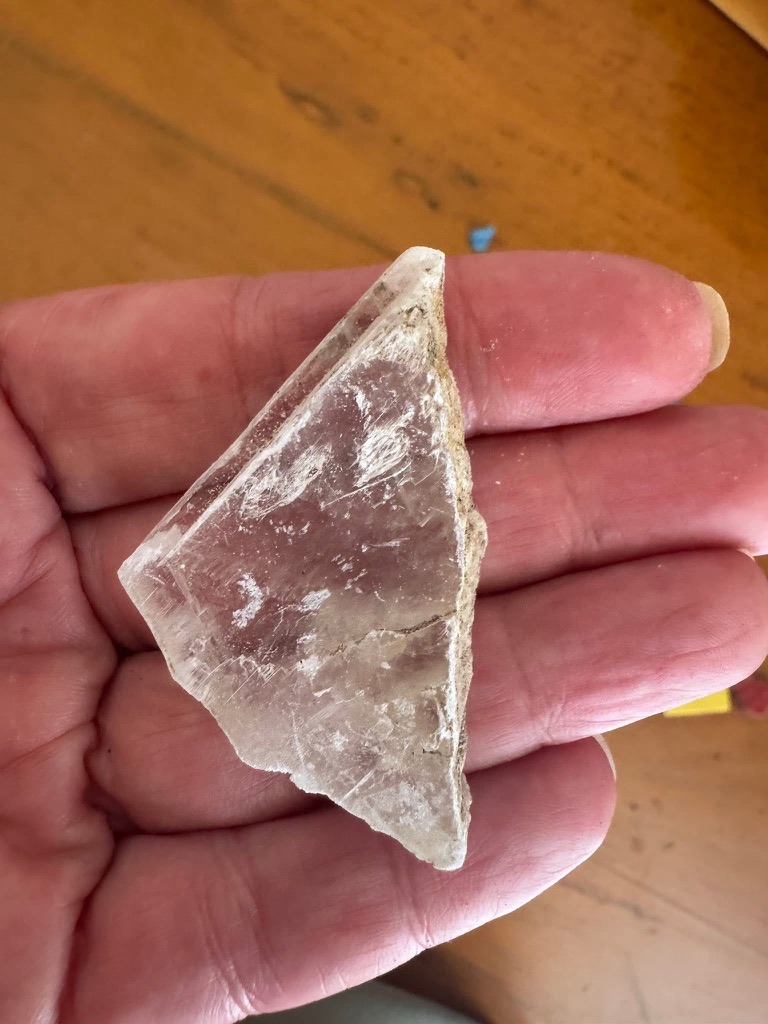
Artist Statement: This crystal stopped my breath when I found it. Finding something like this in a scrubby field. It lay half-buried in the dust, catching a slant of afternoon light, and I knew immediately that I had to pick it up. Crystals form over thousands of years, molecules arranging themselves into geometric patterns through processes of heat and pressure and time. This fragment holds geological time in a form I can hold in my hand. Philosopher Gaston Bachelard (1964) wrote about the intimate immensity of certain objects, their capacity to hold vastness within small forms. This crystal is immensely intimate. It is a small thing that opens onto enormous scales of time. Holding it, I feel my own urgency soften. My seventeen years of precarious labour, my exhaustion, my grief: these are real, but they are also brief against the timescale this crystal represents.
Photo Credit: Amy Tucker, January 2026
The Amber Stone
And then there was the amber stone.
I almost missed it. It was the colour of the dust around it, a warm honey-brown that blended with the earth. But something about the way it caught the light made me pause. I bent down. I brushed away the dirt. And there it was: a piece of what I believe is carnelian, or perhaps a form of agate, translucent and glowing like something alive.
I have been carrying it in my pocket ever since. I take it out and hold it to the light. I feel its smooth weight in my palm. It has become a kind of talisman, a physical reminder that beauty exists in overlooked places, that value requires no certification by recognition.
Title: Amber Light
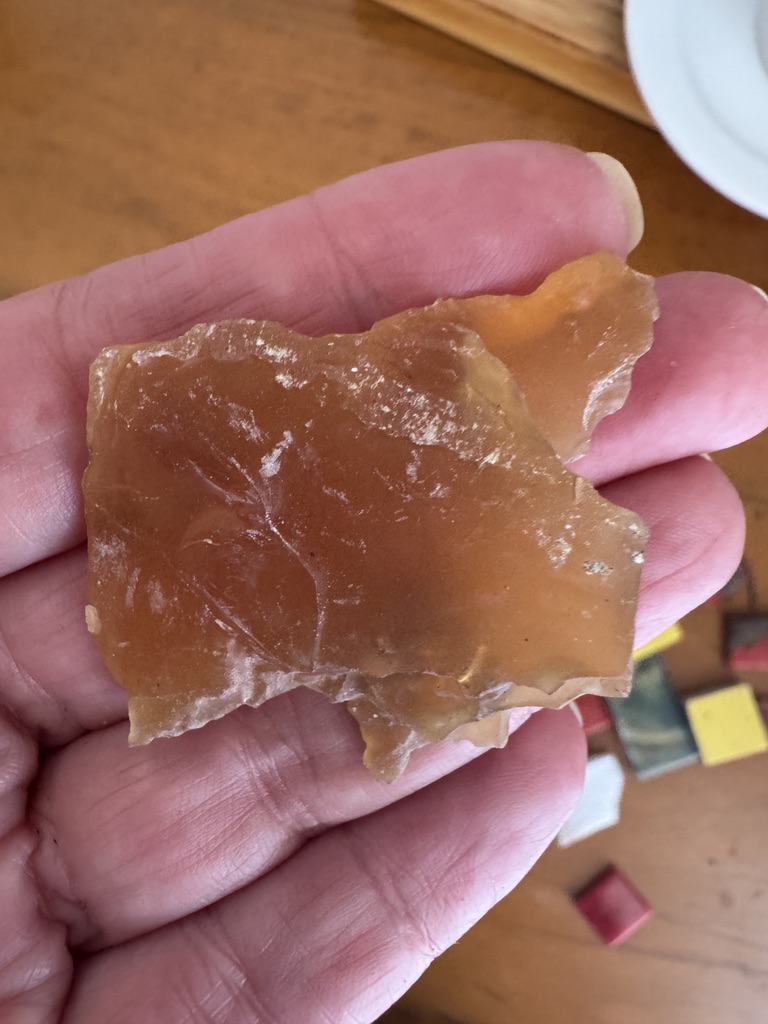
Artist Statement: I photographed this stone because it represents everything I am learning about value. This stone has no market value. No one would pay money for it. By commercial standards, it holds no gemstone status. And yet it is beautiful. It catches light in ways that make me catch my breath. It has weight and warmth and presence. Sociologist Pierre Bourdieu (1984) analysed how systems of cultural capital determine what is valued and what is dismissed. The art world, the academy, the marketplace: all of these systems decide what counts. But here, in my hand, is something that counts to me regardless of what any system says. This is what recovery looks like: learning to trust my own perception of value, learning to recognise beauty beyond external certification of authority. Photo Credit: Amy Tucker, January 2026
“Beauty exists in overlooked places. Value requires no certification by recognition.”
Amy Tucker, Day 24: Finding Treasure in Empty Fields (January 24, 2026)
A Counter-Archive of the Overlooked
I have written about the concept of a counter-archive in earlier posts. This term describes a collection of evidence that documents what official records refuse to acknowledge. Institutions keep archives of what they consider important: contracts, budgets, meeting minutes, and performance metrics. They keep no archives of exhaustion, of grief, of the slow accumulation of harm that precarious labour produces.
My collection of found objects is becoming a counter-archive of a different kind. It is an archive of the overlooked. It gathers what has been discarded, dismissed, or left behind. It insists that these fragments have value, that they are worth preserving, that they carry knowledge.
Cultural theorist Ann Cvetkovich (2003) argues in her book An Archive of Feelings that trauma leaves traces that official archives cannot capture. Cvetkovich proposes alternative archives: collections of ephemera, personal objects, and creative works that document emotional and bodily experiences excluded from institutional memory.
My cup of tiles, stones, and glass is such an archive. It holds evidence of presence, of care, of the persistence of beauty in conditions of neglect. It documents my own practice of attention during this residency. It will travel home with me, a material record of what I learned in this empty field.
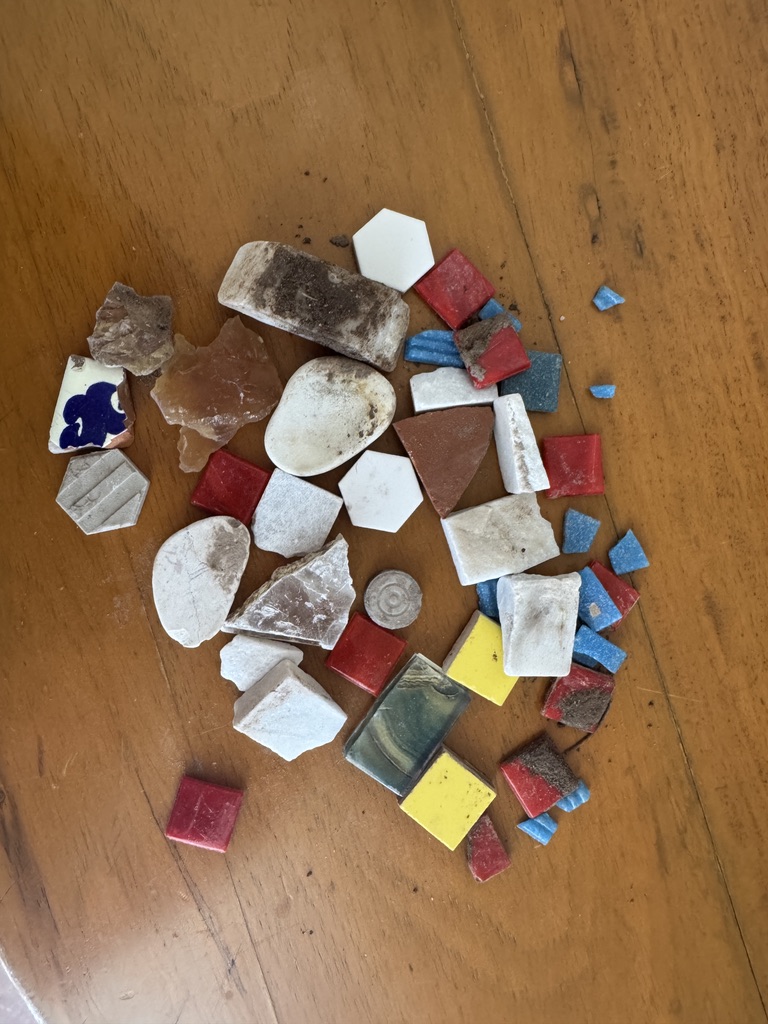
Title: The Full Collection
Artist Statement

I arranged these objects on the table to see them all at once, to understand what I had gathered. The arrangement was intuitive, beyond any plan. I simply placed each piece and let the composition emerge. What I see now is a kind of mosaic, a tessellation of fragments that fit together imperfectly yet create something whole nonetheless.

This feels like a metaphor for my life right now. I am made of fragments: the teacher, the mother, the athlete, the advocate, the person who was discarded by an institution she served for seventeen years. These pieces resist fitting together neatly. They have rough edges. They come from different sources. But here they are, arranged on a surface, making a pattern beyond prediction. Artist and writer Anne Truitt (1982) wrote that "art is the product of a person's being" (p. 45). This collection is the product of who I was during these thirty days. It is art made through attention rather than intention.

Photo Credit: Amy Tucker, January 2026
Mosaic as Methodology
Looking at these fragments spread across the table, I think about mosaics.
A mosaic is an art form made from broken pieces. Tiles, glass, stone, pottery: all are shattered or cut into fragments, and then those fragments are arranged into patterns and images. The beauty of a mosaic depends on brokenness. Without the breaking, there would be no small pieces to arrange. Without the fragments, there would be no whole.
Art historian Bissera Pentcheva (2010) writes about Byzantine mosaics and their capacity to transform light. The irregular surfaces of mosaic tiles catch and scatter light in ways that flat surfaces cannot replicate. Mosaics shimmer. They seem alive. Their beauty lies precisely in their fragmentation.
I am thinking about this in relation to my own experience. I have been broken by precarious labour. My sense of professional identity has shattered. My body has carried the weight of chronic stress until it could carry no more. I arrived at this residency in fragments.
But fragments can be arranged. Fragments can become mosaics. The breaking may be the beginning of a different kind of wholeness, one that acknowledges rupture rather than pretending it never happened.
The breaking may be the beginning of a different kind of wholeness.
The Human Right to Beauty
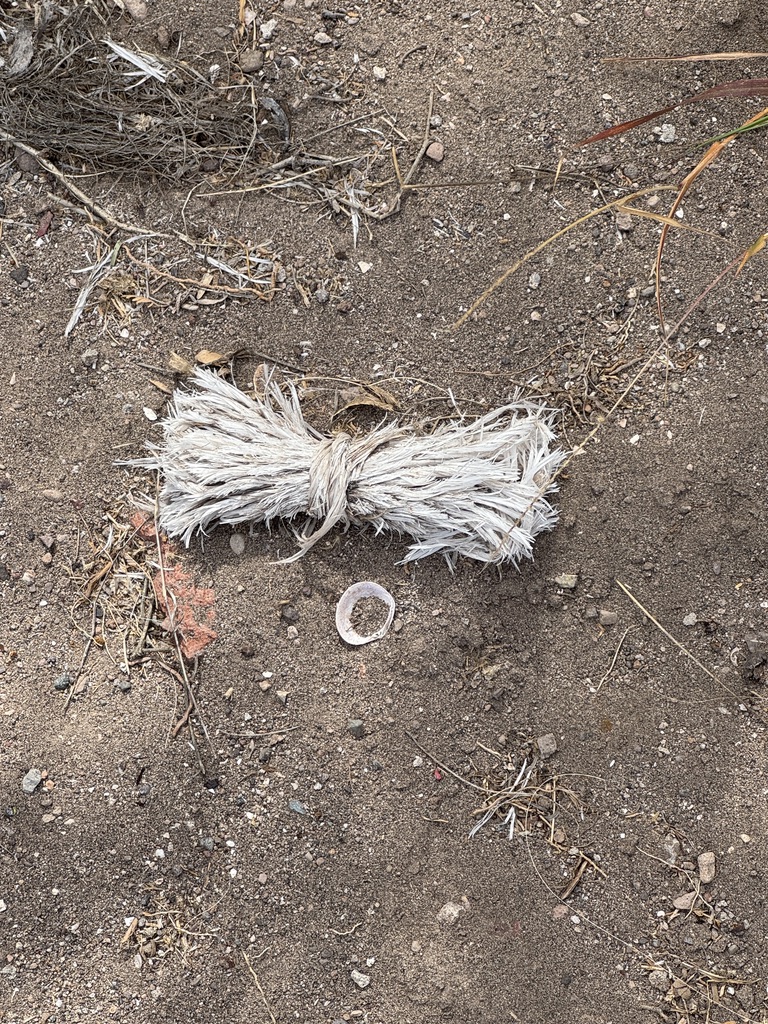
Title: What Was Bound
Artist Statement:

I noticed this because something had already been tied.

A length of frayed fibre lay on the ground, knotted at its centre, holding itself together even as its edges unraveled. It looked used, weathered, and finished with its original task. Nearby, a small ring rested in the dust, separate yet clearly related, as if it had once played a role in keeping something contained.

What this image brings forward for me is the quiet after function. The moment when binding has done its work and is no longer required. I have been thinking a great deal about what it means to hold things together for long periods of time. Roles, responsibilities, expectations. The fibres here show the cost of that work. They are worn thin at the ends, softened by exposure, altered by effort.

There is care embedded in this object. Someone tied it for a reason. Someone relied on it to secure, to fasten, to keep order. And yet it now rests on the ground, released from usefulness, still intact, still present. That feels important. It mirrors an experience I know well. Being valued for what I could hold together, and then set aside once that labour was no longer needed.

I am drawn to the knot at the centre. It is firm, deliberate, almost tender. It suggests intention rather than accident. Around it, the fibres loosen and spread, no longer contained by the same demands. The object has shifted from function to witness. It carries memory in its structure.

This piece belongs to my ongoing practice of noticing what remains after systems of use move on. I am interested in materials that show wear honestly, that hold evidence of service without apology. What was bound here has been released. What remains still carries meaning.

Photo Credit: Amy Tucker, 2026
I want to connect this practice to the human rights framework that grounds this entire project.
Article 27 of the Universal Declaration of Human Rights (United Nations, 1948) affirms that “everyone has the right freely to participate in the cultural life of the community, to enjoy the arts and to share in scientific advancement and its benefits.” This right includes the right to make art, to appreciate beauty, and to engage in creative practice.
But there is something more fundamental here, something about the right to perceive value in what has been devalued.
Philosopher Elaine Scarry (1999) argues in her book On Beauty and Being Just that the experience of beauty is bound up with justice. When we perceive something as beautiful, Scarry suggests, we recognise its right to exist, its claim on our attention, and its worthiness. Beauty, in this sense, is far from frivolous. It is ethical. It trains us to see the value in things and, by extension, in people.
Walking through that empty field, bending down to pick up discarded tiles, I was practicing a form of justice. I was recognising the value in what had been thrown away. I was refusing the logic that says broken things are worthless.
This matters because I, too, have been treated as though my value ended when I was no longer useful to an institution. I, too, have been discarded. Finding beauty in these fragments is a way of insisting that discarded carries no implication of worthlessness. It is a way of practicing, in material form, the belief that every being has inherent dignity regardless of what systems of power decide.
What Remains
Title: What the Sea Returned
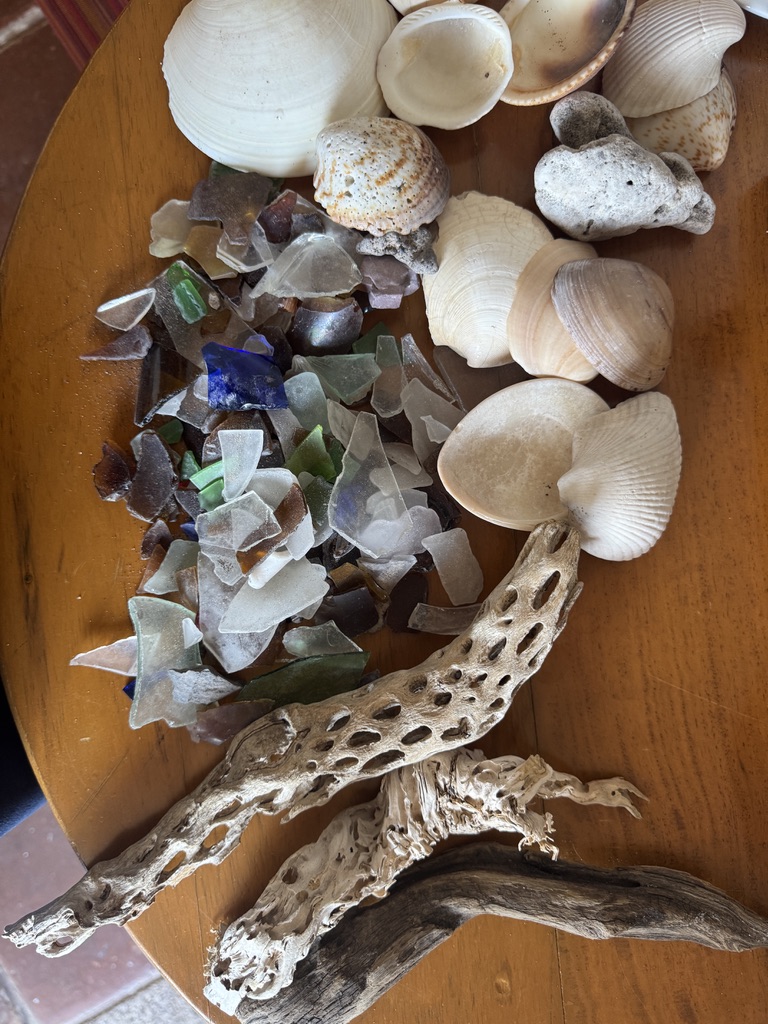
Artist Statement

I gathered these pieces slowly, without a plan, letting my hands decide before my mind intervened. Shells smoothed thin by water. Glass softened into quiet colour. Wood hollowed and shaped by time rather than tools. Each object arrived through patience rather than searching, offered up by tide, weather, and repetition.

What this collection reminds me of is how the sea practices care. It breaks things down, yes, but it also rounds edges, tempers sharpness, and leaves behind what can endure touch. The glass no longer cuts. The shells carry the echo of shelter. The wood holds openings where something once moved through it, leaving pathways rather than damage. These materials speak of transformation through persistence rather than force.

As I arranged them together, I became aware of how little I needed to decide. Balance emerged on its own. Colour found companionship. Texture created conversation. This feels aligned with how I am learning to live right now. Less directing. More listening. Allowing relationships to form without insisting on outcome.

There is a quiet ethics in keeping what has been weathered rather than perfected. These objects have lived alongside loss, erosion, and change. They remain beautiful because of that history rather than despite it. Holding them, I am reminded that what survives carries knowledge. What returns has something to teach.

This collection functions as a personal archive of attention. Each piece marks a moment when I slowed down enough to receive rather than pass by. Together they form a record of time spent listening to what the sea was willing to share.

Photo Credit: Amy Tucker, 2026
I will carry these fragments home with me. They will sit on a shelf or a windowsill, catching light, reminding me of this field, this practice, this moment in my recovery.
They will remind me that the world overlooks treasure rather than what it values. Treasure is what the world has overlooked. Treasure is what remains beautiful despite being broken. Treasure lies in empty fields, waiting for someone patient enough to notice.
I am learning to be that patient person. I am learning to walk slowly, to look carefully, to bend down and pick up what catches my eye. I am learning that this practice of attention is itself a form of healing.
van der Kolk (2014) writes that trauma recovery requires the restoration of the capacity for pleasure, for play, for engagement with beauty. Feeling less bad falls short of what we need. We must learn again to feel good, to be moved by what is beautiful, to experience joy without guilt.
These fragments bring me joy. Holding the amber stone up to the light brings me joy. Arranging the tiles on the table and seeing the pattern emerge brings me joy. This joy is medicine, far from frivolous. It is evidence that I am healing.
I am learning that the practice of attention is itself a form of healing.
Estoy encontrando tesoros. Estoy aprendiendo a ver.
I am finding treasure. I am learning to see.
Title: Carried, Then Set Down
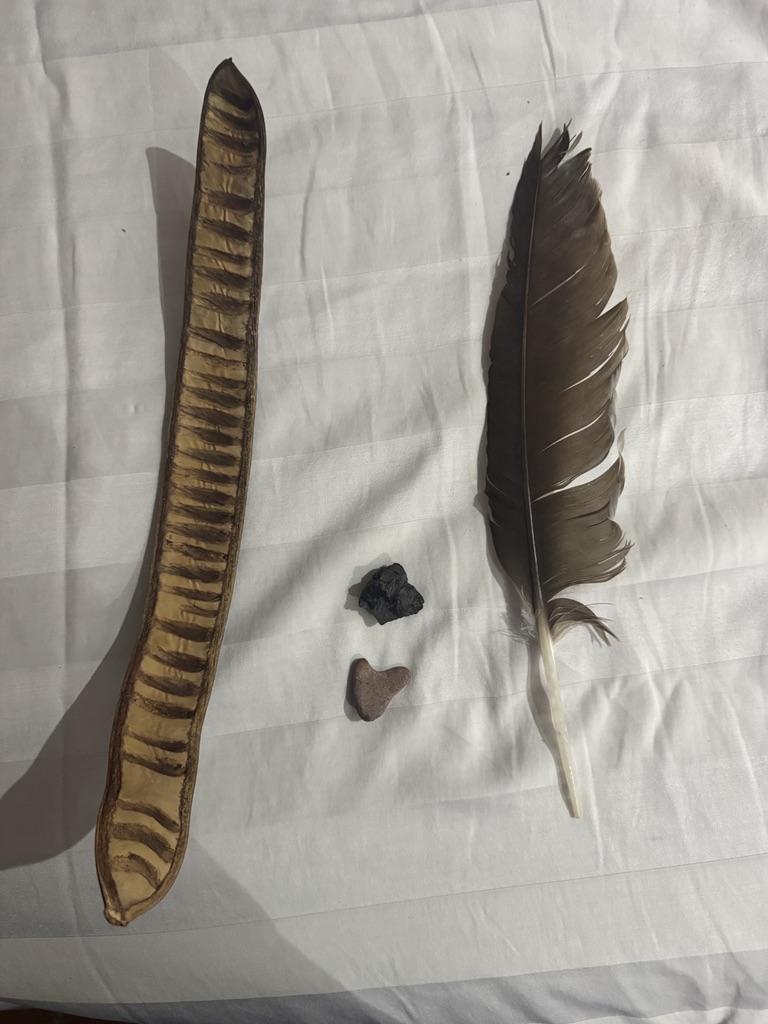
Artist Statement

I placed these objects together because they felt as though they had already found one another.

A seed pod, opened and emptied of what it once carried. A feather, shed without injury, its work in the air complete. Two small stones, held briefly in the hand and then released. None of these were taken by force. Each was encountered at a moment when it was ready to be found.

What this arrangement reminds me of is how much of life is held temporarily. Protection, lift, nourishment, weight. These materials speak quietly about function that has ended without failure. The seed pod has released. The feather has fallen. The stones remain exactly as they are. There is no urgency here, no demand to return to usefulness.

I have spent many years believing that value was tied to carrying, to lifting, to producing. This grouping asks something different of me. It invites attention to what happens after effort, after release, after the body no longer needs to hold everything together. There is dignity in that moment. There is relief.

The space between these objects matters as much as the objects themselves. They are arranged with care, yet allowed distance. They share a surface without being bound to one another. That feels instructive. It mirrors a way of being I am learning to trust, one where connection requires no containment.

This work belongs to my ongoing inquiry into attention, recovery, and the ethics of noticing. These materials teach me that carrying is only one phase of existence. Setting down is another. Both are necessary. Both leave traces.

Photo Credit: Amy Tucker, 2026
References
Bachelard, G. (1964). The poetics of space (M. Jolas, Trans.). Orion Press. (Original work published 1958)
Bennett, J. (2010). Vibrant matter: A political ecology of things. Duke University Press.
Bourdieu, P. (1984). Distinction: A social critique of the judgement of taste (R. Nice, Trans.). Harvard University Press. (Original work published 1979)
Cvetkovich, A. (2003). An archive of feelings: Trauma, sexuality, and lesbian public cultures. Duke University Press.
Ingold, T. (2013). Making: Anthropology, archaeology, art and architecture. Routledge.
Kabat-Zinn, J. (1994). Wherever you go, there you are: Mindfulness meditation in everyday life. Hyperion.
Leavy, P. (2020). Method meets art: Arts-based research practice (3rd ed.). Guilford Press.
Pentcheva, B. V. (2010). The sensual icon: Space, ritual, and the senses in Byzantium. Pennsylvania State University Press.
Scarry, E. (1999). On beauty and being just. Princeton University Press.
Truitt, A. (1982). Daybook: The journal of an artist. Pantheon Books.
United Nations. (1948). Universal declaration of human rights. https://www.un.org/en/about-us/universal-declaration-of-human-rights
van der Kolk, B. A. (2014). The body keeps the score: Brain, mind, and body in the healing of trauma. Viking.
Varda, A. (Director). (2000). Les glaneurs et la glaneuse [The gleaners and I] [Film]. Ciné Tamaris.
Translation note. Spanish language passages were generated using Google Translate and subsequently reviewed and refined by the author. Any remaining infelicities reflect the limits of machine translation rather than intent.