Content Warning: This post contains reflections on difficult childhood memories and family pain. Please care for yourself as you read, and feel free to step away if you need to.
Title: The Spruce Tree
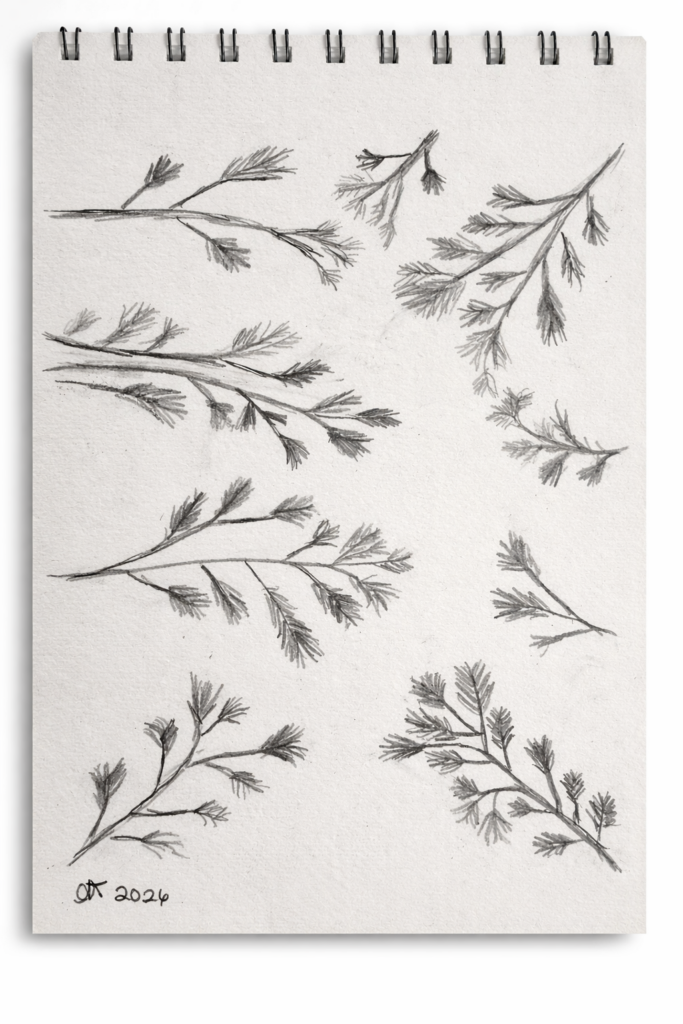
Artist Statement:

This drawing emerges from an early memory of solitude, belonging, and attention. At eight years old, I wandered alone into the winter woods of northwestern Ontario and found shelter beneath a low spruce tree, its branches heavy with snow. Beneath that canopy, time softened. The forest became a room, a witness, a presence that required nothing of me except that I be there.

The repeated spruce forms in this work are remembered gestures far more than botanical studies. Each branch carries the imprint of slow looking and quiet recall. Drawn decades later, they are shaped by the body's memory rather than by precision, by sensation rather than replication. The marks hold the weight of snow, the hush of winter, and the feeling of being held by something larger than oneself.

This work reflects an early knowing that solitude differs entirely from loneliness, and that belonging can be relational without being human-centred. The spruce tree was literal then, entirely real: a companion, a shelter, a teacher. Returning to this memory now, I recognise it as foundational to my understanding of presence, aloneness, and listening.

Created while residing beside the Sea of Cortez, far from spruce forests and snow, this drawing bridges landscapes and lifetimes. It acknowledges that while places change, the body remembers what it once knew: how to be still, how to belong, and how to listen when the world speaks without words.

Created by Amy Tucker, January 2026
I was eight years old, and the forest was mine.
We lived on several acres outside of town, the kind of place where you could walk in any direction without hitting a fence or a neighbour for a long time. The house sat at the edge of the woods, and the woods stretched out behind us like an invitation, like a promise, like something waiting to be discovered.
It was winter in northwestern Ontario, the kind of winter that turns the world into something else entirely. The snow had fallen for days, and when it finally stopped, everything was buried and quiet. The air was so cold it hurt to breathe, but I welcomed it. I liked the way it felt in my lungs, sharp and clean, like drinking something pure.
I walked into the woods alone. I simply went without asking, without telling. Permission never crossed my mind. I went the way children go, following something that called without words.
I knew these woods. I knew the path to the beaver dam, about a ten-minute walk if you walked straight through, longer if you wandered. In winter, the pond the beavers had made froze thick and clear, and we would skate there, my siblings and I, our blades scratching lines into ice that had waited all winter for us. The beaver lodge rose from the frozen surface like a small mountain, sticks and mud frozen solid, and sometimes I wondered if the beavers inside could hear us laughing and calling to each other above their heads.
But that day, the pond was beside the point. That day, I was just walking, just being in the woods, letting my feet decide where to go.
The snow came up past my knees in places. I had to lift my legs high with each step, like a deer, like something wild. My breath made clouds in front of my face. The only sound was the crunch of my boots and the occasional soft thump of snow sliding from a branch.
I found the spruce tree partway along the path, before the land sloped down toward the beaver dam. It was unremarkable in size, ordinary in beauty, yet something about it drew me in completely. The lower branches swept down and touched the snow, creating a space underneath, a room, a secret place entirely my own.
I crawled under.
Inside, the world changed. The branches above me were dark green, almost black, heavy with snow. The ground beneath me was soft with fallen needles, dry and fragrant, protected from the white that covered everything else. I lay on my back and looked up through the lattice of branches at the sky beyond.
The snow on the branches was so white it seemed to glow, luminous beyond ordinary brightness, as though it held light inside itself and let it out slowly. I watched a few flakes drift down through the gaps in the branches, lazy and unhurried, taking their time to land on my jacket, my mittens, my face.
How long I stayed there, I am unable to say. Time worked differently under that tree. Time was entirely mine. The day stretched open, unscheduled, unhurried. There was only the soft green dark of the branches, the impossible white of the snow, and my own breathing, slow and steady, matching something beyond naming.
The forest was speaking to me. I know how that sounds. I knew even then that this was beyond explaining to anyone, that adults would smile and nod and miss the point entirely. But it was true. The forest was saying something, beyond words, in the way the cold felt on my cheeks, in the way the branches creaked when the wind moved through them, in the way the silence was full, so full of presence that I felt held.
Somewhere in the distance, I could hear the creek that fed the beaver pond, the part that never quite froze, water moving under ice, a soft murmur beneath the silence. The beavers were asleep in their lodge, or doing whatever beavers do in winter, living their secret lives beneath the frozen surface. The chickadees were calling somewhere nearby, that two-note song that sounds like they are saying hey, sweetie, over and over, untroubled by the cold.
I was free of loneliness. That is what I remember most. I was alone, completely alone, a ten-minute walk from home, hidden under a tree in my own secret world, and I was entirely free of loneliness. I was exactly where I was supposed to be, held by something larger than myself, known by something that accepted me entirely as I was.
I was eight years old, lying under a spruce tree in the snow, and I was perfectly, completely happy.
What I could never have imagined then was how thoroughly I would spend decades forgetting this feeling. I would grow up and learn to fill silence with noise, to fill solitude with productivity, to convince myself that the forest had never really spoken to me at all. The acres would be sold. The beaver dam would become a memory. The path I knew by heart would fade into someone else’s property.
But my body remembered, even when my mind forgot. My body remembered the smell of spruce needles, the cold air in my lungs, the soft give of snow beneath my back. My body remembered what it felt like to be held by something that asked nothing in return.
Here, by the Sea of Cortez, fifty-some years later, I am remembering.
The landscape is different. There are no spruce trees here, no snow, no cold that hurts to breathe. No beaver dam, no frozen pond, no chickadees calling hey, sweetie in the winter air. But the feeling is the same. The feeling of being alone and free of loneliness. The feeling of being spoken to by something that speaks beyond words. The feeling of being exactly where I am supposed to be.
The eight-year-old girl who lay under that tree knew something. She knew that the world was alive. She knew that solitude was fullness. She knew that belonging asked nothing of other people, that you could belong to a forest, to a winter, to a moment of snow falling through spruce branches.
She knew what I am only now remembering.
I was eight years old, and the forest was mine.
I am in my early sixties, and the world is still speaking.
I am finally learning, again, to listen.
I was alone, completely alone, a ten-minute walk from home, hidden under a tree in my own secret world, and I was entirely free of loneliness. I was exactly where I was supposed to be.