Content Warning: This post contains reflections on grief, loss, and emotional exhaustion. Please care for yourself as you read, and feel free to step away if you need to.
I kept my discipline. I shed my need to escape.
Disruption as Data
Loreto has changed the way I read, though it would be more accurate to say that it has revealed the function reading has played in my life. For most of my adulthood, reading structured my days and anchored periods of transition. Books offered coherence during times of professional intensity and emotional uncertainty. Reading felt nourishing and intellectually generative, and it was. Yet its sudden absence created a rupture that demanded attention.
The absence of reading revealed a movement toward presence.
Since arriving in Loreto, I noticed that I had barely read at all. I continued to listen to podcasts, but the habitual reaching for books had quieted. When I eventually opened Flow, by Mihaly Csikszentmihalyi, the disruption became analytically meaningful. In qualitative terms, this pause became data. It signalled a shift in how I was regulating attention, emotion, and solitude. The absence of reading revealed a movement toward presence rather than any loss of discipline.
The disruption became data.
Image: Flow: The Psychology of Optimal Experience by Mihaly Csikszentmihalyi.
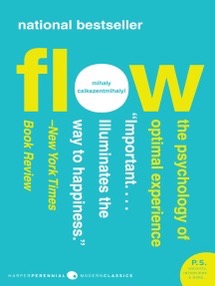
Cover image sourced from Amazon for reference purposes.
Note. This image is a commercially available book cover sourced from Amazon and is included for contextual reference only. It is ancillary visual data, neither generated by the author nor analysed as part of the visual inquiry. The image is used to situate the reflective narrative in relation to Csikszentmihalyi’s work on attention, engagement, and presence.
Why Flow: Attention, Choice, and the Ethics of Engagement
I am no longer interested in productivity for its own sake.
I chose to read Flow: The Psychology of Optimal Experience at this moment because I am no longer interested in productivity for its own sake. After years of equating movement with meaning and busyness with worth, I wanted to return to a text that speaks directly to the quality of attention rather than the quantity of output. Csikszentmihalyi’s work has long been associated with peak performance and optimal functioning, but what drew me back to it now was a quieter question: what does it mean to be fully engaged without being consumed?
My relationship to flow has shifted over time. Earlier in my career, I understood flow primarily through achievement, moments of intense focus that accompanied teaching, writing, training, or creative production. These states felt generative and affirming, particularly within institutional cultures that reward visible engagement and constant contribution. Yet, in hindsight, I can see how easily flow was absorbed into the broader machinery of busyness. What began as deep engagement sometimes became another way to justify overextension, another reason to remain in motion.
Reading Flow in the context of alonetude invites a different interpretation. Csikszentmihalyi emphasises that flow emerges when attention is voluntarily invested, when action is chosen rather than compelled, and when the self holds together rather than fragmenting under competing demands. This distinction matters. In Loreto, where external pressures have softened, I am learning to distinguish between immersive engagement and compulsive activity. Flow, in this sense, is no longer about intensity or output, but about alignment.
Flow, for me, is no longer about intensity or output, but alignment.
What I hope to learn from this book now is how to discern, rather than how to do more, and when engagement becomes avoidance. Csikszentmihalyi writes about cultivating inner order, the capacity to shape consciousness intentionally rather than reactively. This resonates deeply with my current inquiry. Alonetude has stripped away many of the external structures that once organised my time, leaving me face to face with my own patterns of attention. Flow offers a language for examining whether my engagement with work, creativity, and even rest arises from choice or from habit.
I am also drawn to the ethical implications of flow. In academic and professional cultures that normalise exhaustion, the language of optimal experience can easily be co-opted to sustain overwork. Reading Flow now, I am holding the text in tension with critiques of productivity and speed. I am less interested in flow as a performance enhancer and more interested in flow as a form of presence requiring no self-erasure.
Ultimately, I chose this book because it asks a question that aligns with the heart of alonetude: how do we live in ways that are attentive, meaningful, and self-directed, without needing to escape ourselves in the process? What I hope to learn is how to engage more sustainably rather than simply returning to my former pace, and how to engage deeply while staying grounded enough to stop.
Reading as Regulated Escape
Image: Travelling Library

Note. These books are no longer a task list. They sit here as companions rather than demands, reminding me that learning can be slow, embodied, and unfinished. Alonetude is teaching me that I need no compulsion to consume knowledge to remain in conversation with it.
These books arrived together through design. Each one has marked a different moment in my learning: how to think, how to feel, how to move, how to rest, how to heal, how to listen to the body, how to trust experience, how to let meaning emerge rather than be forced. For years, reading was another form of striving, a way to stay productive even in moments meant for rest. Now, this small library feels less like a syllabus and more like a permission structure. I read some of these texts slowly. Some I return to. Some I simply keep close, beyond answers, for companionship. Alonetude is teaching me that learning rarely moves forward in a straight line. Sometimes it gathers, waits, and rearranges itself quietly until the body is ready to receive what the mind once rushed past.
Reading is rarely problematised in academic or popular discourse. It is framed as restorative, virtuous, and intellectually productive. However, psychological research on coping and emotion regulation suggests that even adaptive behaviours can function as avoidance when used to manage prolonged stress or emotional overload (Gross, 2015; Lazarus & Folkman, 1984). In my own life, reading had quietly joined a constellation of practices that allowed me to remain productive while avoiding stillness.
Over the past fifteen years, reading existed alongside other socially sanctioned escapes: work, achievement, training, travel, and service. I inhabited roles that were meaningful yet relentless: educator, writer, committee member, volunteer, athlete, artist, and caregiver. Beneath these visible performances were quieter coping strategies, including depression, stress-related illness, overconsumption, emotional numbing, and cycles of avoidance. Together, these practices formed a system of self-regulation oriented toward functioning rather than presence.
Image: Between Shelter and the Sky

Photo Credit: Amy Tucker, 2026
Note. This morning light is filtered, softened by the curtain that both protects and reveals. I hover between inside and outside, fully committed to neither. For much of my life, I lived at the extremes, either exposed through constant engagement or hidden behind busyness and distraction. Alonetude is teaching me to rest in this in-between space, where I can see the world without rushing toward it, and feel held without withdrawing. Presence, I am learning, asks something between full openness and full retreat. It asks only that I remain.
This image poses the question that Flow ultimately asks of me: where does my attention rest when nothing demands it? Csikszentmihalyi writes about optimal experience as a state of voluntary focus, yet alonetude has taught me that focus also requires restraint. The curtain reminds me that clarity rarely comes from constant exposure or relentless engagement. For years, busyness trained my attention outward, keeping me in motion, responsive, and productive. Here, attention settles instead. I am neither striving for immersion nor fleeing into distraction. I am simply present, allowing meaning to arise without forcing it. This, I am learning, is a different kind of flow: one rooted in choice rather than urgency, and in staying rather than escape.
Performance, Identity, and Misnaming Eccentricity
Image: Multiplicity Beyond Fracture

Photo Credit: Amy Tucker, 2026
Note. I have often described myself as eccentric, as though my many interests required explanation. This rock reminds me that complexity carries no implication of instability. It is composed of many elements held together over time, shaped by pressure rather than performance. What I once misnamed as excess was, in fact, accumulation. Each layer remains visible, yet none are required to justify their presence. Alonetude is teaching me that identity, like this stone, requires no constant shaping or display. It only needs time, contact, and the permission to remain whole.
For many years, I explained this pattern in terms of personality. I described myself as eccentric, curious, and driven to become many things at once. Yet scholarship on performativity and emotional labour suggests that sustained role performance can obscure the gradual erosion of the self beneath it (Butler, 1990; Hochschild, 2012). What Loreto revealed was that mediation, rather than multiplicity itself, was the issue.
I was aspiring to be something beyond the categories of scholar, philosopher, traveller, an artist, or a spiritual seeker. I already had those things. What I had avoided was inhabiting them without output, recognition, or distraction. Each role had become a buffer between me and my own interior life.
Alonetude as Ethical and Embodied Practice
Image: Setting Down What Once Carried Me

Photo Credit: Amy Tucker, 2026
Note. This image marks a pause rather than an ending. The boot, worn and emptied of the body that once depended on it, rests without urgency or direction. For years, movement, endurance, and productivity served as measures of worth. Alonetude invites a different ethic: the willingness to stop without apology and to remain without distraction. What is set down here is compulsion rather than capacity. What remains is presence, grounded and unperformed.
Alonetude, as I am coming to understand it, is neither isolation nor withdrawal. It is the ethical practice of staying. Philosophical and psychological literature draws a careful distinction between loneliness as imposed absence and solitude as chosen presence (Tillich, 1952; Storr, 1988). Alonetude resides within this distinction, yet it demands more than preference or temperament. It requires discipline, restraint, and an embodied willingness to remain without substitution.
In Loreto, alonetude has meant stepping out of familiar patterns of movement and productivity. It has meant sitting without a book in my hands and resisting the impulse to translate quiet into knowledge consumption. It has meant allowing boredom, restlessness, and sensory awareness to surface without resolution. This practice aligns with contemplative and trauma-informed scholarship that understands learning as embodied and regulatory, rather than exclusively cognitive (Kabat-Zinn, 1994; Porges, 2011). Insight, I am learning, arrives beyond analysis alone. Sometimes it arrives through waiting long enough for the body to register what the mind has learned to bypass.
Alonetude asks me to sit without filling the silence.
The discarded boot makes this visible. Once designed for movement, protection, and endurance, it now rests unused, emptied of the body that animated it. For years, I treated motion as virtue and endurance as evidence of worth. Stillness felt like failure. Alonetude asks something different. It invites me to set down the habits that carried me forward but also carried me away from myself. This is discernment, never abandonment. The body pauses, the role loosens, and what remains is presence, grounded and unperformed.
This is discernment. It is beyond burnout.
Lessons Learned: Reading as Presence Rather Than Escape
Image: Stillness, with a Pen in Hand

Photo Credit: Amy Tucker, 2026
Note. I came here with a notebook, assuming I would write my way into understanding. Instead, I found myself sitting quietly, the pen resting more often than moving. For years, travel and writing were part of my busyness, a way of staying productive even in beautiful places. This moment feels different. The notebook is no longer an instrument of urgency or output. It is simply a companion, waiting while I learn to be present without needing to capture, explain, or perform the experience.
The central lesson of this experience is less that reading is harmful than that its function matters. Alonetude has taught me to ask a different question of my practices: does this activity draw me toward myself, or does it allow me to disappear? This reframing reflects broader calls within qualitative inquiry to treat the researcher’s emotional and embodied presence as integral to knowledge production rather than as noise to be managed (Ellis et al., 2011; Nash, 2004).
By staying rather than escaping, I am learning to read myself with the same attentiveness I once reserved for texts. This deepens scholarship rather than diminishing it. Alonetude becomes both method and meaning, a way of inhabiting inquiry rather than performing it. The most demanding text I have avoided for years has been my own interior life. The lesson is relationship rather than abandonment. I am learning to meet books, roles, and ambition from a place of presence rather than flight.
What would it take to stay?
Title: Grounded Enough to Stay

Photo Credit: Amy Tucker, 2026
Note. There was a time when even standing still felt unproductive. I would have filled this moment with movement, planning, or interpretation. Here, I am learning something different. My feet in the water remind me that presence begins in the body before the mind. Alonetude is teaching me that staying requires no justification, and that learning can occur without busyness, without capture, and without escape. This is grounding, beyond any arrival.
The most challenging text I avoided for years was my own interior life.
References
Butler, J. (1990). Gender trouble: Feminism and the subversion of identity. Routledge.
Csikszentmihalyi, M. (1990). Flow: The psychology of optimal experience. Harper & Row.
Ellis, C., Adams, T. E., & Bochner, A. P. (2011). Autoethnography: An overview. Forum Qualitative Sozialforschung / Forum: Qualitative Social Research, 12(1), Article 10. https://doi.org/10.17169/fqs-12.1.1589
Gross, J. J. (2015). Emotion regulation: Current status and future prospects. Psychological Inquiry, 26(1), 1–26. https://doi.org/10.1080/1047840X.2014.940781
Hochschild, A. R. (2012). The managed heart: Commercialization of human feeling (30th anniversary ed.). University of California Press.
Kabat-Zinn, J. (1994). Wherever you go, there you are: Mindfulness meditation in everyday life. Hyperion.
Lazarus, R. S., & Folkman, S. (1984). Stress, appraisal, and coping. Springer.
Nash, R. J. (2004). Liberating scholarly writing: The power of personal narrative. Teachers College Press.
Porges, S. W. (2011). The polyvagal theory: Neurophysiological foundations of emotions, attachment, communication, and self-regulation. W. W. Norton & Company.
Storr, A. (1988). Solitude: A return to the self. Free Press.
Tillich, P. (1952). The courage to be. Yale University Press.