Content Warning: This post contains reflections on body abandonment, trauma, and the nervous system’s response to harm. Please care for yourself as you read, and feel free to step away if you need to.
Alonetude operates as far more than a personal retreat; it is a refusal of extractive temporalities that demand constant productivity.
Title: Please Honour This Boundary
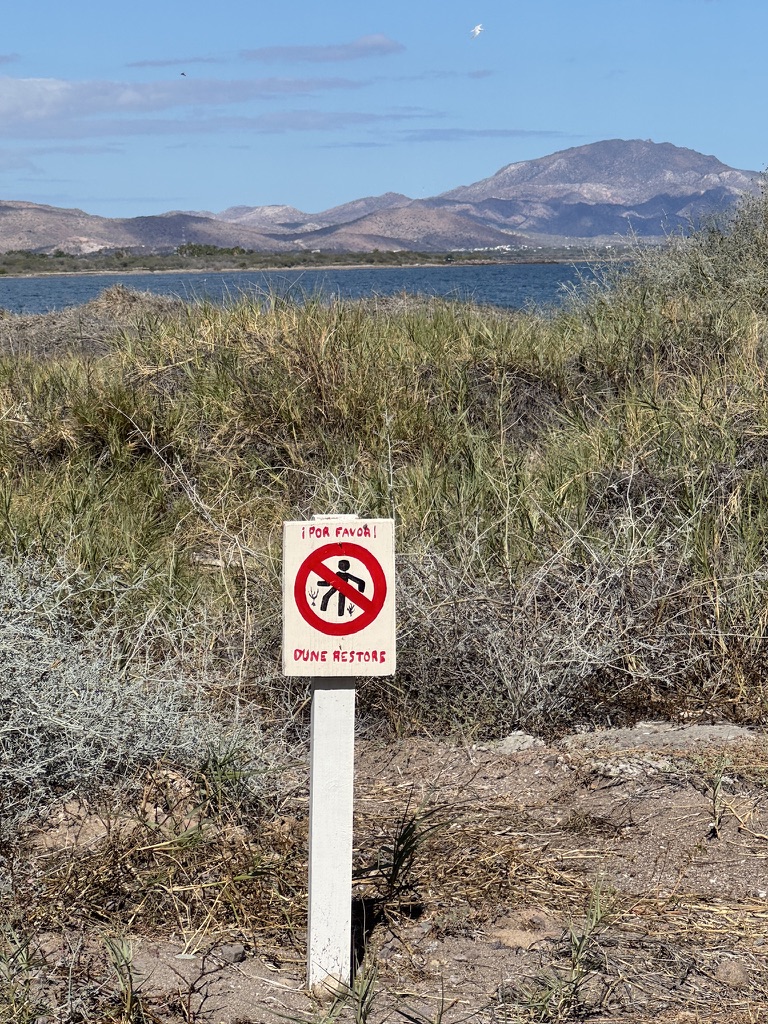
| Artist Statement I stopped because the request was gentle. The sign carries no threat. It carries no scolding. It asks. Please. It marks a boundary in soft language, inviting care rather than compliance. Behind it, the dunes rise slowly, grasses holding sand in place, doing the quiet work of restoration. Beyond that, the water moves, and the mountains remain steady, indifferent to whether I step forward or hold still. This image brought my relationship with boundaries to the forefront. For a long time, I understood boundaries as exclusion or denial, something imposed from outside. Here, the boundary exists in service of recovery. It protects what is fragile and still becoming. It honours a process that cannot be rushed. I stood there longer than necessary, noticing how restraint can be an act of respect. Remaining outside is a form of presence. It is participation through care. The land is witnessed without requiring my footsteps. It needs space. It needs time. It needs people willing to stop at the edge and let healing happen without interruption. This sign speaks to a lesson I am learning in my own life. Restored spaces require protection. Emerging strength requires limits. There is dignity in stepping back when something is growing. I took this photograph as a reminder that care often looks like a pause. That listening sometimes means remaining at the threshold. That asking permission of land, of body, of self, is a way of staying in right relationship. Photo Credit: Amy Tucker, 2026 |
The running shoes sat in the corner of my room for three weeks before I touched them. I had packed them with intention, tucked between journals and watercolours, believing that here, in this place of alonetude beside the Sea of Cortez, I might find my way back to my body. This morning, I finally laced them on.
Alonetude operates as far more than a personal retreat; it is a refusal of extractive temporalities that demand constant productivity. In this sense, solitude becomes a micro-practice of justice, reclaiming time, body, and attention from institutional regimes that normalise depletion.
The soles felt strange against my feet. Foreign. As if they belonged to someone I used to know.
Where universities track contracts, outputs, and enrolments, these artifacts track fatigue, healing, consent, and refusal.
Image: Waiting to Move
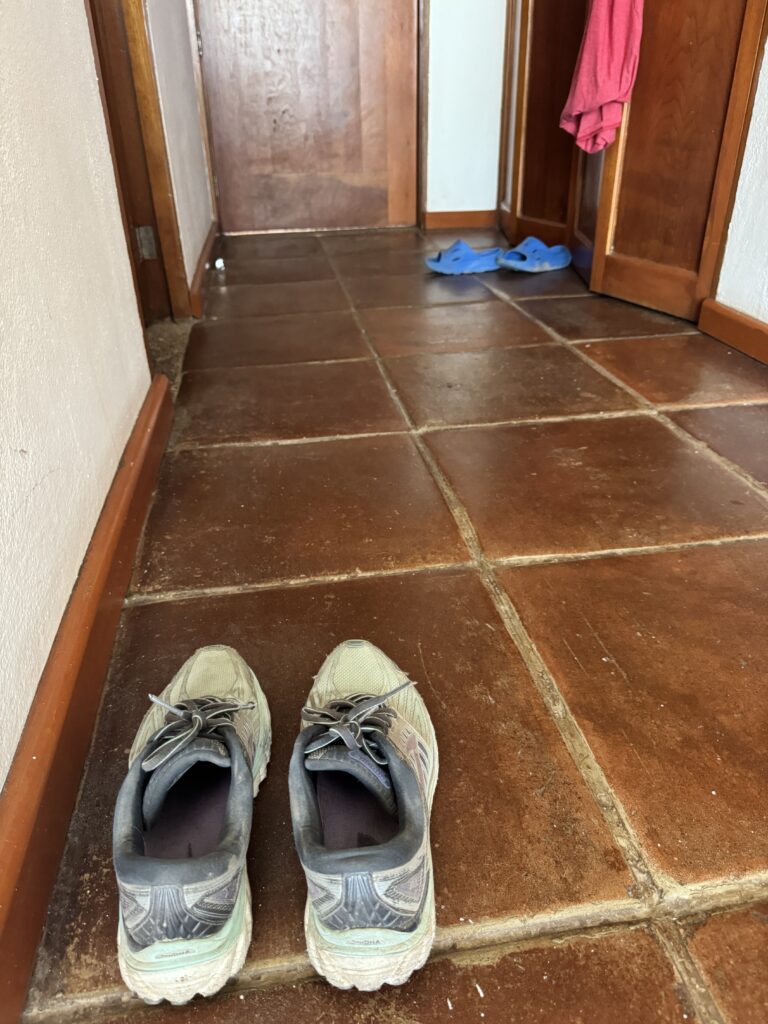
Artist Statement
These running shoes exist for return, never speed.
They have carried me through early mornings and late afternoons, through streets that asked nothing of me and paths that asked me to pay attention. They hold the imprint of repetition, of breath finding rhythm, of the body remembering that it knows how to move without explanation.
What these shoes remind me of is how care can be practical. They absorb impact quietly. They meet the ground again and again without complaint. They do the work they were made to do, and in doing so, they allow me to keep going. There is something deeply grounding in that kind of reliability.
Running, for me, has become a practice of listening rather than pushing. I notice how my feet land. I notice when my stride shortens, when my body asks for gentleness rather than distance. These shoes have learned my pace. They hold evidence of effort and rest equally.
I have spent many years moving through systems that rewarded endurance without regard for wear. These shoes offer a different lesson. Support matters. Cushioning matters. Fit matters. Progress happens when the body feels held rather than driven.
This image belongs to my ongoing inquiry into recovery, embodiment, and the ethics of care. Forward motion asks for presence over urgency. Sometimes it simply requires something steady beneath you and the willingness to take the next step.
Photo Credit: Amy Tucker, 2026
My body withdrew consent, choosing for me what I lacked the capacity to choose for myself.
My body withdrew consent, choosing for me what I lacked the capacity to choose for myself. After fifteen years of marathons and morning miles, it reached a threshold where endurance ceased to be virtuous and became extractive. This withdrawal can be read as a rights-bearing refusal, a somatic assertion of dignity when institutional structures failed to uphold the right to safe and secure work. Precarious academic labour extends far beyond an employment condition; it is a human rights issue. International frameworks recognise the right to decent work, rest, and health, yet contingent academic systems routinely undermine these rights through chronic insecurity, unpaid labour, and performance surveillance.
For years, running functioned as infrastructure, a way to metabolise contract uncertainty, wildfire seasons, pandemic isolation, and the quiet violence of academic self-exploitation. My body was both coping and complying. The shoes, therefore, archive institutional extraction, marking how academic capitalism extends into muscle, breath, and gait.
Title: Move
Artist Statement
I made this in layers, letting colour arrive slowly and remain where it landed. Blue first, wide and enclosing. Then darker forms that suggested land without insisting on it. Beneath that, a band of violet and indigo where things began to blur, where certainty softened into atmosphere. Nothing here was outlined. Nothing was corrected.
What this image holds for me is the feeling that comes after effort has passed. The time when the body exhales and the landscape, internal and external, returns to itself. The colours move into one another without resistance. Boundaries exist, but they are permeable. This feels true to how I am learning to live right now, allowing edges to be present without hardening them.
As I worked, my attention stayed low and steady. My aim was to respond rather than describe. I was attending to a state. The surface carries the evidence of pauses, of hands lifting and returning, of pigment settling as it chose. The darker shapes hold their place without dominating the lighter ones. They coexist, layered rather than resolved.
This piece belongs to my ongoing practice of slowing down and letting meaning emerge through accumulation rather than declaration. It reflects a trust in process and in rest, in what becomes visible when nothing is being demanded. What settles here is a condition, held open. One that feels inhabitable.
Photo Credit: Amy Tucker, 2026
Vulnerability: A Body Returns to Motion
I stopped running last August. The word stopped implies a decision, a deliberate cessation. That framing feels too clean. What happened was more like a surrender: the moment a body simply refuses to keep pretending it has anything left to give. I chose to stop only in the sense that my body made the choice for me, and I had no capacity left to argue. I attempted to start running in October, then in November, and, well, today.
For years, running had been my anchor. Through the relentless cycles of precarious academic labour (contract after contract, never knowing if the next semester would bring employment), my morning runs held the chaos at bay. I ran through smoke seasons when Kamloops air turned orange with wildfire haze. I ran through pandemic isolation when the world contracted to screens and uncertainty. I ran through the accumulating weight of what Han (2010/2015) calls the burnout society: that particular form of exhaustion that emerges when self-exploitation becomes indistinguishable from self-improvement.
Until I could run no more.
Title: Discarded Shelter: A Small Artifact of Passage
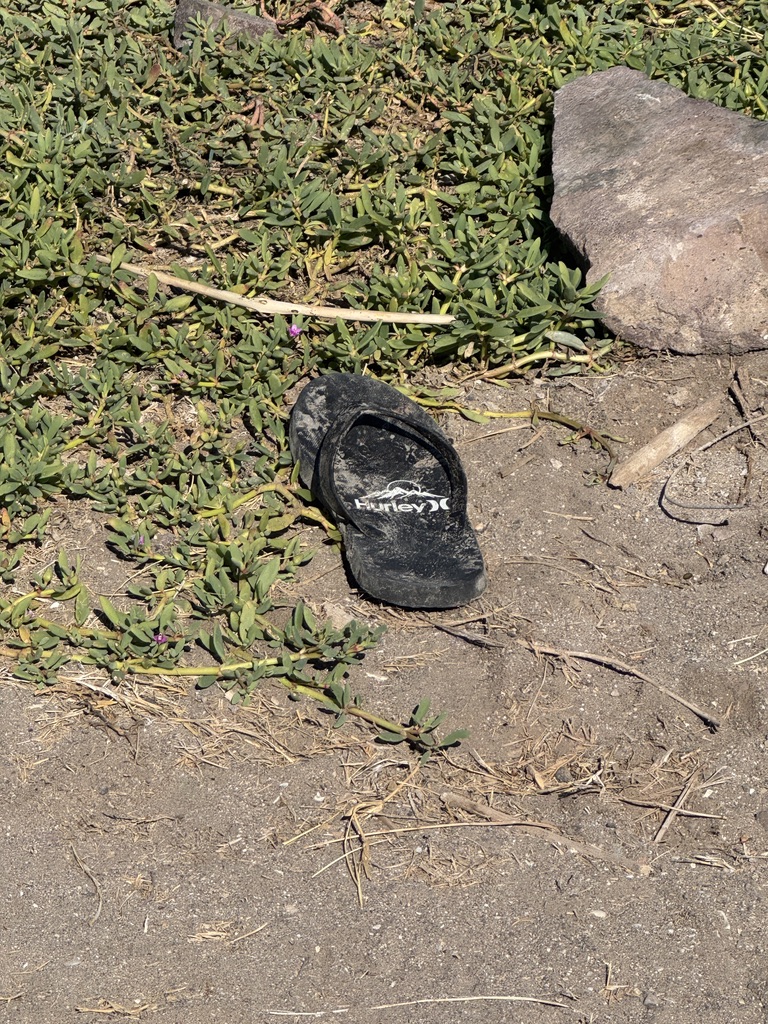
Artist Statement
This photograph captures a worn cap resting on dry soil and creeping groundcover, an object displaced yet held by the landscape. As a personal artifact, the cap signals exposure and release, something once worn for protection, now relinquished to the elements. It functions as a micro archive of movement and passage, marking a moment where containment gives way to vulnerability.
The surrounding textures of dust, stone, and persistent vegetation speak to resilience within aridity. These materials carry their own histories of endurance and adaptation. Placed together, they form a quiet record of how presence fades without disappearing entirely.
Positioned at the threshold between human trace and ecological continuity, the cap holds tension between what is left behind and what endures. As with other artifacts in this inquiry, the object functions as embodied data. It documents departure, rest, and the ethics of letting go through material evidence rather than narrative explanation.
Photo Credit: Amy Tucker, 2026
Running on Empty
The language of “stopping” is too orderly for what actually happened. It suggests a managerial decision, a tidy life choice, a rational pivot. Bodies rarely follow rational life plans, and exhaustion rarely arrives that way. What happened was more like surrender: the moment when a body simply refuses to continue performing a capacity it no longer possesses.
For fifteen years, running was far more than a hobby. It was infrastructure. It was how I metabolised stress, uncertainty, grief, ambition, and institutional precarity. I ran through contract cycles, through wildfire smoke, through pandemic isolation, through the quiet violence of academic self-exploitation. Running functioned as a regulator, a refuge, and an identity. It was both a coping mechanism and a performance of resilience.
That framing feels too clean, almost managerial. What happened was more like a surrender: the moment a body simply refuses to keep pretending it has anything left to give. I chose to stop only in the sense that my body made the choice for me, and I had no capacity left to argue.
Running has been a huge part of my life. It structured my mornings and offered a sense of coherence in a life shaped by academic precarity, seasonal contracts, and the constant uncertainty of whether the next semester would bring work. I ran through wildfire seasons when Kamloops air turned orange and thick with ash. I ran through pandemic isolation when the world contracted to screens and anxiety. I ran through the accumulation of what Han (2010/2015) describes as the burnout society, where self-exploitation becomes indistinguishable from self-care, and productivity masquerades as virtue.
My body withdrew consent.
My body withdrew consent, choosing for me what I lacked the capacity to choose for myself. After fifteen years of marathons and morning miles, it reached a threshold where endurance ceased to be virtuous and became extractive. This withdrawal can be read as a rights-bearing refusal, a somatic assertion of dignity when institutional structures failed to uphold it.
Title: Vulnerability: A Body Returns to Motion
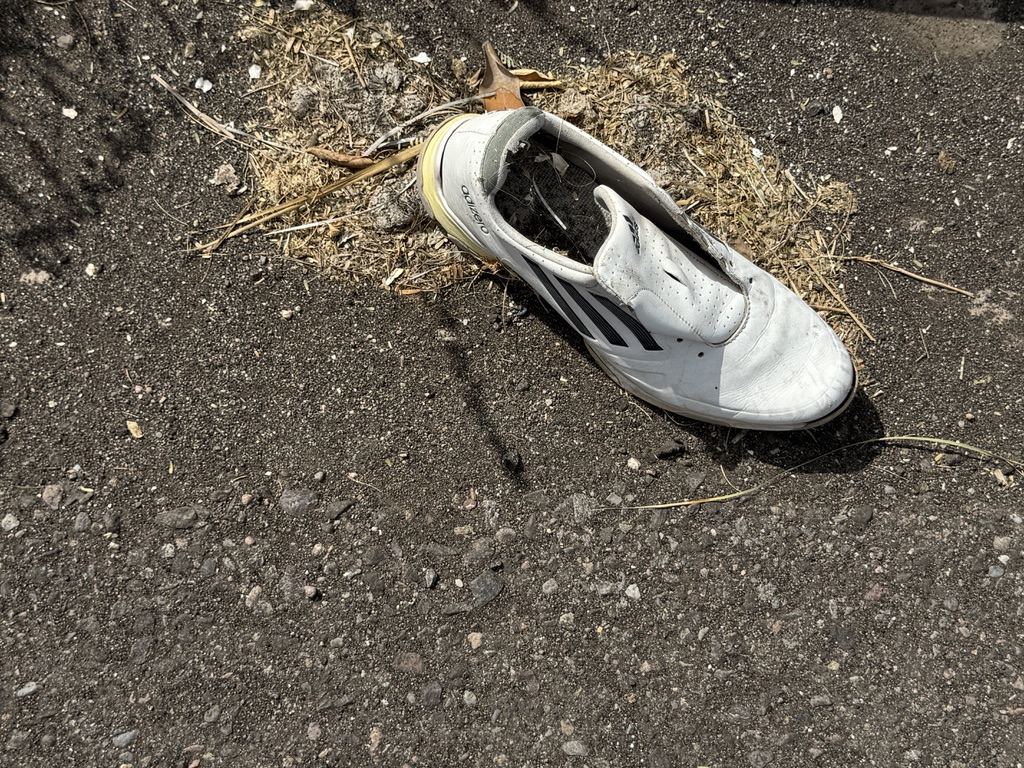
Artist Statement
This photograph depicts a single running shoe resting on volcanic sand, functioning as a quiet ethnographic artifact. It holds the quiet rather than staging crisis or spectacle. Instead, it holds the ordinary materiality of stopping.
The shoe operates as an extension of the body, a prosthetic of movement shaped by repetition, impact, and endurance. Set down on the ground, it marks a pause rather than a failure. It bears witness to exhaustion as an embodied state and to the moment when motion, once necessary for survival, is interrupted.
What emerges here is a material trace of rupture in an identity long organised around forward movement. The shoe records effort without explanation. It carries the imprint of kilometres travelled and the weight of what it has absorbed. In resting, it shifts function from propulsion to evidence.
As with other artifacts in this inquiry, the object functions as embodied data. It documents the ethics of stopping, the legitimacy of rest, and the quiet knowledge held by materials once devoted to endurance.
Photo Credit: Amy Tucker, 2026
In qualitative terms, this image functions as data. It documents a threshold moment in which the body asserted its limits against institutional, psychological, and cultural demands. The shoe, half-buried, speaks to sedimentation, the layering of fatigue, trauma, ambition, and discipline that eventually accumulates into refusal. In this sense, stopping is a form of information rather than failure.
There is vulnerability in this artifact, but also a possibility. The shoe holds both cessation and return. It sits on the edge of movement, implying that motion may re-emerge on different terms. Returning to running now feels less like reclaiming a former self and more like negotiating a new relationship with embodiment, one that privileges consent, slowness, and care over endurance and performance.
If loneliness is the pain of being alone, solitude is its glory. Similarly, if exhaustion is the pain of productivity, rest may be its quiet counterpart. The body’s refusal becomes a form of wisdom, a boundary that resists the neoliberal logic of infinite capacity.
Title: Shadow at the Threshold
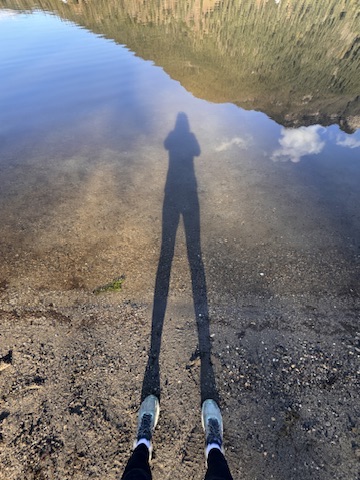
Artist Statement
This image records my shadow elongated across water and shore, a body doubled by reflection and light. I am present twice here and fully in neither place. The shadow stretches into the lake while my feet remain on land, marking a quiet division between where the body stands and where the self extends.
What this moment holds for me is a sense of suspension. The water is still enough to reflect sky and mountain, yet shallow enough to reveal the ground beneath. The shadow moves across both states at once. It belongs to surface and depth simultaneously. I held still. I resisted pulling back. I stayed exactly where I was and let the image form around that decision.
The length of the shadow speaks to timing rather than identity. It records the angle of the sun, the hour of the day, the season of light. My form is stretched thin by circumstance, shaped by forces beyond my control. This feels honest. It mirrors a period in my life where identity is extended, reworked, and softened by context rather than fixed by definition.
As visual data, the photograph captures an embodied moment of orientation. The shoreline becomes a site where body, environment, and time co-produce meaning. The self appears as trace rather than subject, relational and temporary. The shadow is evidence of presence. It is evidence of standing still long enough to be shaped by what surrounds me.
Photo Credit: Amy Tucker, 2026
The shadow also gestures toward institutional surveillance, in which the academic self is often experienced as an object observed and measured rather than as a sovereign subject. Such surveillance practices implicate academic freedom and the right to dignity at work, where bodies become sites of audit and governance rather than care.
This section demonstrates vulnerability as epistemic data, revealing how institutional precarity inscribes itself on the nervous system and how embodied refusal constitutes knowledge.
Scholarly Engagement: The Archive of Exhaustion
Understanding what happens when a body collapses from prolonged occupational stress requires theoretical frameworks that honour embodied knowledge. Polyvagal Theory, developed by Stephen Porges (2011), offers essential language for what I experienced. Porges describes three distinct states of the autonomic nervous system: the ventral vagal state (social engagement, safety, connection), the sympathetic state (fight-or-flight, mobilization), and the dorsal vagal state (shutdown, collapse, conservation).
Title: Learning to Shuffle: Safety as Relational Practice
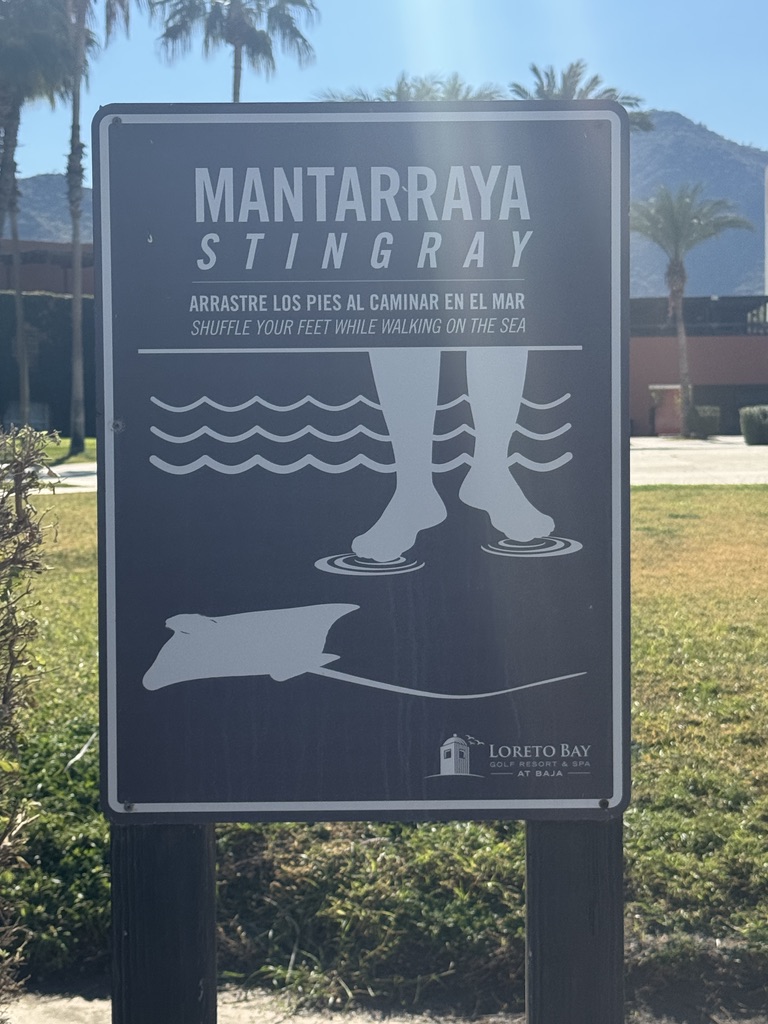
Artist Statement
This photo centres on a warning sign for manta rays that instructs walkers to shuffle their feet as they enter the sea. The directive is practical, grounded in ecological care and mutual vulnerability. Shuffling helps alert manta rays to human presence, reducing the risk of harm to both. Yet the instruction also operates symbolically, asking the human body to slow down, to signal itself, and to move with awareness rather than entitlement.
What interests me here is how movement becomes ethical practice. The body is asked to alter its habitual patterns in recognition of another being’s habitat and dignity. Shuffling becomes a pedagogy of relational care, a way of learning through the feet that the shoreline is shared space. This is an ecosystem beyond empty leisure where human and more-than-human lives intersect continuously.
The manta ray remains unseen beneath the surface, yet it is central to the instruction. Its invisibility matters. Ethical movement depends on attention to what cannot always be perceived directly. The sign makes visible an obligation to those who are present without being immediately legible, reminding the walker that care often begins before encounter.
As visual data, this artifact extends my inquiry into alonetude and embodied ethics. Movement here is framed neither as conquest nor extraction, but as negotiated presence. The directive to shuffle offers a quiet counterpoint to productivity culture. Slow down. Sense the ground. Acknowledge others. Move in ways that minimise harm. In this sense, the sign functions as both ecological instruction and philosophical metaphor for ethical being-in-place.
Photo Credit: Amy Tucker, 2026
The sign offers a counter-epistemology to academic capitalism: a movement guided by relational accountability rather than speed, competition, and extraction.
For years, my nervous system oscillated between sympathetic activation and desperate attempts to reach ventral vagal safety. The constant hypervigilance of precarious employment (Will there be a contract next term? Am I performing well enough to be renewed? What happens if I speak too honestly about institutional failures?) kept my body in a state Porges calls neuroception of chronic threat. My nervous system read danger everywhere, even when my conscious mind insisted everything was fine.
By August, my body had shifted into dorsal vagal shutdown. This is the state of last resort: what happens when fight-or-flight fails, when mobilization depletes beyond recovery. The system conserves by collapsing. Energy withdraws. Movement becomes effortful. The world flattens into grey.
Running became impossible because running requires mobilization energy. When the tank is truly empty, even self-care becomes another demand the body simply cannot meet.
Table 1
Polyvagal States and Physical Activity: A Personal Cartography
| Movement ceases; body refuses mobilisation; exhaustion is pervasive | Physical Activity Capacity | Workplace Conditions | Somatic Markers |
| Movement ceases; body refuses mobilization; exhaustion is pervasive | Full capacity; movement feels enjoyable and restorative | Secure employment; collegial support; clear expectations | Relaxed jaw; deep breathing; warm hands; open posture |
| Sympathetic (Mobilisation/Fight-Flight) | Running becomes escape; high intensity masking anxiety | Contract uncertainty; performance surveillance; workload intensification | Clenched jaw; shallow breathing; cold extremities; muscle tension |
| Dorsal Vagal (Shutdown/Collapse) | Movement ceases; body refuses mobilisation; exhaustion pervasive | Termination or nonrenewal; institutional betrayal; cumulative harm | Flattened affect; leaden fatigue; dissociation; slowed digestion |
| Emerging Ventral (Day 21, Loreto) | Tentative return; fifteen minutes of gentle running; body-led pacing | Aloneness retreat; absence of institutional demands; environmental safety cues | Tentative return; gentle movement; body-led pacing; renewed energy Alonetude retreat; environmental safety cues; absence of institutional demand Softened posture; deeper breath; emotional release; felt safety |
Note. This table integrates Porges’s (2011) Polyvagal Theory with personal experience during the transition from occupational burnout to healing retreat. The nervous system states are mapped to physical activity capacity, workplace conditions, and somatic markers, as documented over the research period. Adapted for SPN methodology where lived experience constitutes primary data.
Perspective: This Morning’s Run
I walked to the waterfront before dawn. The air held that particular softness that exists only in the hours before the desert sun asserts its dominance. My body felt tentative, as if asking permission to inhabit space differently than it has for months.
Image Before the Sun
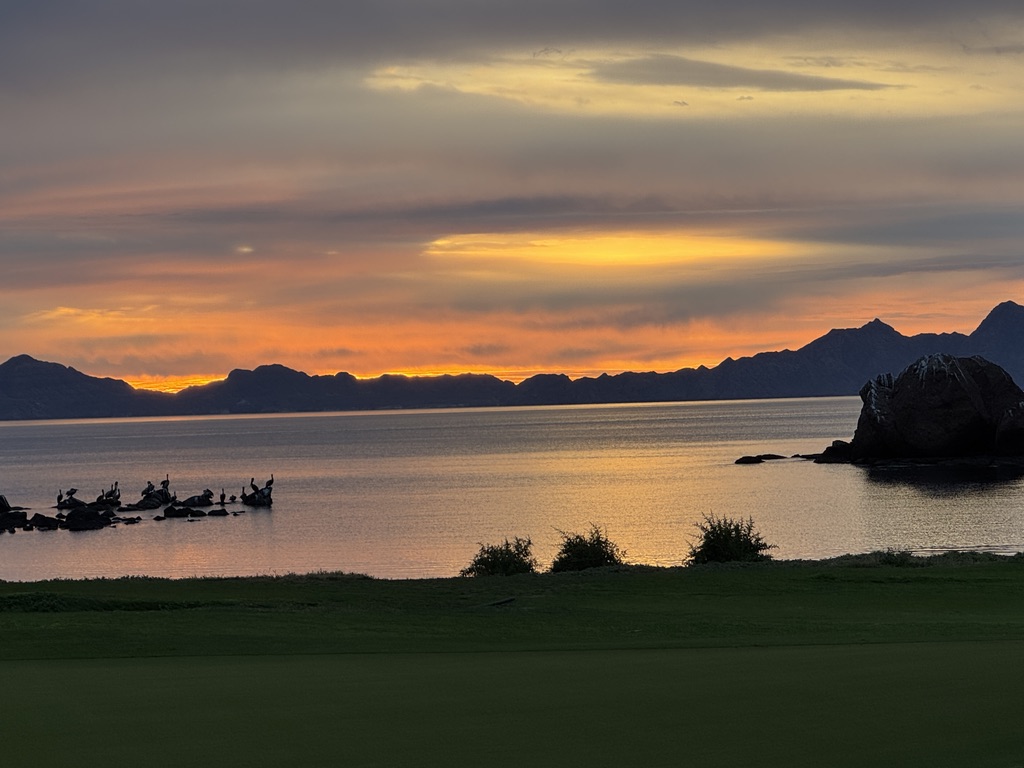
Artist Statement
The pre-dawn hour offers what Porges (2011) describes as environmental safety cues: low stimulation, softened light, and the absence of social demand. This temporal threshold between night and day mirrors a physiological transition, as the body begins to move from dorsal vagal shutdown toward ventral vagal engagement.
In this moment, the environment participates actively in regulation. Still water reflects rather than interrupts. Sound is muted. Movement is minimal. Nothing asks for response. The scene supports a gradual return to relational capacity without forcing alertness or productivity. Safety is communicated through quiet continuity rather than reassurance.
What draws my attention here is how regulation emerges through context rather than effort. The body requires no instruction to calm itself. It responds to cues offered by light, temperature, and space. The landscape becomes co-regulator, holding the nervous system in a state of readiness without demand.
As visual data, this image documents a condition of becoming. The water gestures toward possibility rather than outcome. Regulation is present as potential rather than performance. This pre-dawn interval holds the ethics of alonetude, a chosen presence that allows the body to re-enter connection on its own terms.
Photo Credit: Amy Tucker, 2026
The Pace of Care
I began slowly. Pace itself became a form of care. My feet found rhythm on the packed sand near the water’s edge, where the surface offered just enough cushion to absorb impact.
For the first few minutes, my body resisted. Muscles complained. The lungs protested the unfamiliar demand for deeper oxygen exchange. This is what Levine (1997) describes in Waking the Tiger: the body’s natural protective response to resuming activities associated with periods of distress. My nervous system remembered that running used to accompany exhaustion, anxiety, and the desperate attempt to outpace institutional harm.
I kept moving anyway. I let the complaints arise without trying to silence them. I noticed the tightness in my shoulders, the guarding in my jaw, the way my breath wanted to stay shallow.
Title: Sands of Time
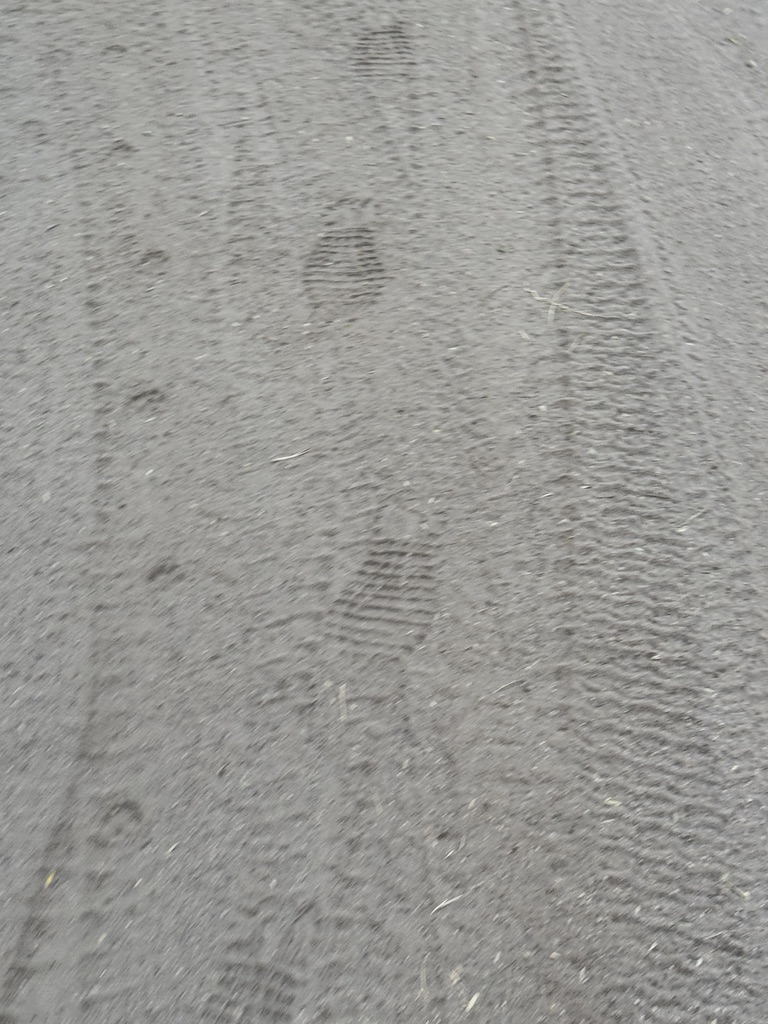
Artist Statement
Faint footprints along the shoreline mark movement, presence, and impermanence. They are somatic traces of a body in motion, briefly impressed into wet sand and already in the process of being taken back by the tide. The marks exist within a narrow window of visibility, held only until water returns.
What this image holds for me is the relationship between embodiment and erasure. Presence here is real, yet provisional. The body leaves evidence, but it releases any insistence on permanence. The shoreline registers contact and then releases it, responding through its own rhythm rather than human intention.
The tide functions as collaborator rather than force. It participates in making and unmaking the trace, reminding me that movement always occurs within relational systems. No step exists in isolation. Each imprint is shaped by timing, pressure, moisture, and return.
As visual data, the photograph documents how presence is enacted and dissolved through the shared rhythms of body and sea. The footprints carry no intention of enduring. They mark a moment of passage, offering a quiet lesson in how to move through the world while allowing what follows to take its course.
Photo Credit: Amy Tucker, 2026
The Shift
And then something shifted.
Porges (2011) describes this shift as the nervous system receiving cues of safety from the environment. The rhythm of waves. The cool air on my skin. The absence of screens, notifications, and institutional surveillance. The steadiness of my own footfalls established a new relationship with this body, this moment, this place.
My shoulders dropped. My jaw softened. My breath deepened of its own accord, without instruction or force. The ventral vagal state, that place of safety and connection, emerged. For the first time in months, I felt my body organising itself around presence rather than threat.
Here I am.
Theory: Bodies as Archives of Structural Harm
The exhaustion that brought my running practice to a halt was never merely personal. Academic capitalism, the systematic transformation of higher education into a market-driven enterprise prioritising revenue generation, productivity metrics, and competitive positioning (Slaughter & Rhoades, 2004), creates bodies like mine with systematic precision. The precarious labour conditions that define contemporary university employment produce specific physiological consequences: chronic stress activation, disrupted sleep architecture, inflammatory cascades, and metabolic dysregulation.
Al Serhan and Houjeir (2020) found significant correlations between the intensification of academic capitalism and faculty burnout, documenting how market-driven educational environments create unsustainable demands that erode well-being and professional capacity. Their research validates what my body already knew: this exhaustion is structural, produced by systems designed to extract maximum labour from minimally compensated workers.
Precarious academic labour extends beyond a labour-market condition; it is also a human rights concern. These rights are articulated in Article 7 of the International Covenant on Economic, Social and Cultural Rights (United Nations, 1966), which affirms the right to just and favourable conditions of work, including rest and reasonable limitation of working hours.
The right to decent work, security of employment, and safe working conditions is recognised in international human rights frameworks, including the International Covenant on Economic, Social and Cultural Rights. My body’s collapse thus reflects more than personal vulnerability; it indexes institutional arrangements that systematically violate the right to dignified, secure, and health-sustaining work.
My body’s collapse is thus beyond the simply anecdotal; it is indicative of systemic rights erosion in contemporary higher education.
Title: Strata of the Third Shore: Sea as Memory, Land as Archive
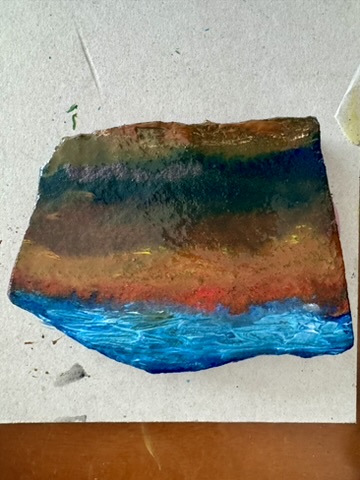
Artist Statement
This painted stone renders the sea as layered strata, with bands of blue, rust, green, and sand-toned pigment evoking shoreline, sediment, and water in dialogue. The rock functions as both canvas and collaborator, carrying its own geological history while receiving contemporary marks of experience. In this sense, the piece becomes a micro archive where land and memory meet.
The horizontal bands suggest temporal and emotional layers. Surface calm gives way to deeper currents, sedimented grief, and emergent healing. The luminous blue at the base gestures toward movement and continuity, while warmer earth tones recall land-based memory and embodied history. The stone resists smoothness, insisting on texture and unevenness. This resistance mirrors the non linear nature of recovery and becoming.
As an arts-based research artifact, this work operates as multimodal data within Scholarly Personal Narrative and humanities inquiry. Painting the sea onto land material enacts a relational methodology in which body, pigment, stone, and place co-produce knowledge. The object becomes a tactile record of alonetude, presence, and the ethics of witnessing landscape as teacher.
Photo Credit: Amy Tucker, 2026
The Labour That Depletes
Hochschild (1983) named this phenomenon emotional labour, the management of feeling to create a publicly observable facial and bodily display. For contingent academics, emotional labour extends beyond classroom performance to include the constant performance of enthusiasm, the manufactured gratitude for unstable employment, and the suppression of legitimate grievances. This labour is invisible, uncompensated, and ultimately depleting.
My body stopped running because it had nothing left. The collapse was honest. The collapse was necessary.
Title: Bleached Architecture: Coral as Witness and Afterlife
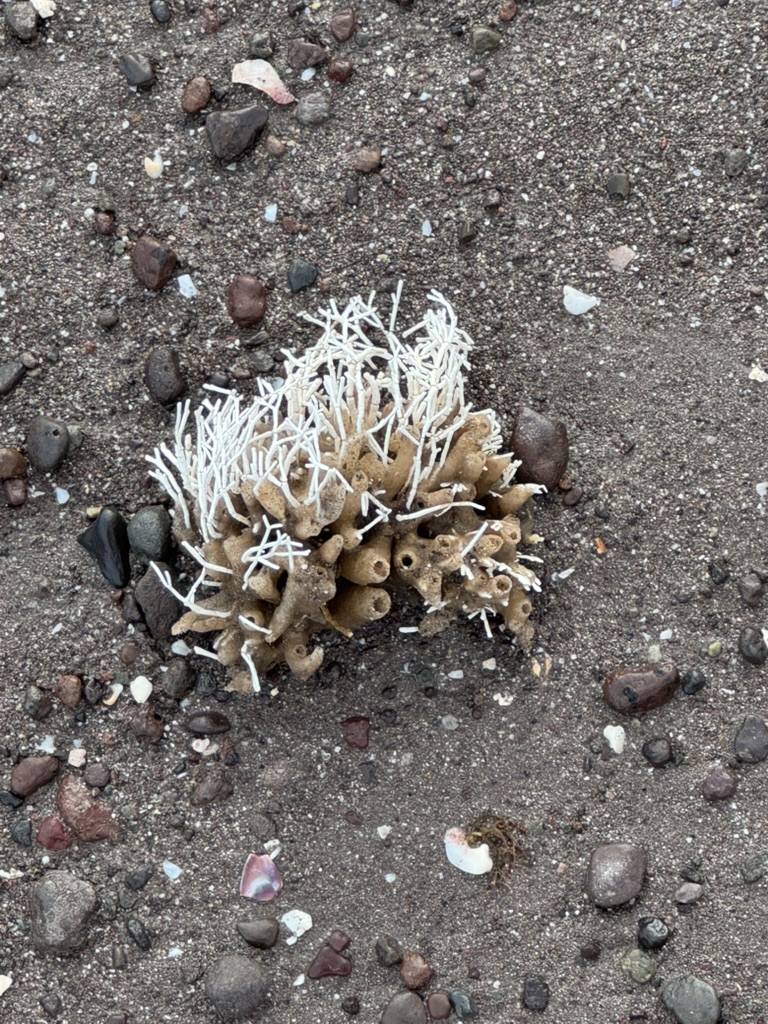
Artist Statement
A bleached coral fragment rests on volcanic sand, marking presence, loss, and ecological time. Its porous structure carries traces of former life, openings where relation once flowed. The surface records exposure. What remains is delicate, weight-bearing, and altered by conditions beyond its control.
This fragment brings my attention to fragility as a shared condition. Coral lives through interdependence, relying on temperature, chemistry, and rhythm held in balance. When that balance shifts, the body changes. What appears inert is, in fact, a record of relation strained beyond capacity.
Encountering this piece, I felt my own exhaustion placed within a wider field of precarity. The fragment situates bodily depletion alongside ecological harm, linking labour extraction and environmental degradation as intersecting justice concerns. Both operate through systems that normalise overuse, accelerate demand, and treat depletion as acceptable cost.
Here, coral functions as ecological witness and material archive. It indexes how patterns of strain reverberate across bodies, institutions, and environments, leaving evidence that is quiet yet enduring. The fragment holds no accusation. It remains. In doing so, it asks for attention, care, and a recalibration of how value, labour, and life are held.
Photo Credit: Amy Tucker, 2026
Table 2
Theoretical Integration: Physical Activity Cessation and Return
| Theoretical Framework | Key Concept | Application to Day 21 Experience |
| Alonetude (Author Framework) Chosen solitude as relational and ethical practice Removal of performance gaze enables embodied truth-telling and healing | Neuroception: the body’s unconscious detection of safety or threat through environmental cues | Management of feeling to create a publicly observable display; invisible labour that depletes |
| Somatic Trauma Theory (van der Kolk, 2014) | The body keeps the score: trauma is stored somatically and must be addressed through body-based approaches | Movement becomes both evidence of stored harm (initial resistance) and pathway to healing (emerging ease) |
| Movement becomes both evidence of stored harm (initial resistance) and a pathway to healing (emerging ease) | Self-exploitation through achievement discourse; exhaustion as structural outcome of neoliberal subjectivity | Previous running was self-exploitation; current running is reclamation, movement without achievement metrics |
| Emotional Labour (Hochschild, 1983) | Management of feeling to create publicly observable display; invisible labour that depletes | Alonetude eliminates audience for performance; body can express authentic states without management |
| Academic Capitalism (Slaughter & Rhoades, 2004) | Alonetude eliminates the audience for performance; the body can express authentic states without management | Exhaustion is structural, produced by systems; individual recovery must be understood within systemic critique |
| Trauma-Informed Movement (Levine, 1997) | Healing requires completing interrupted defensive responses; movement releases trapped survival energy | Body-led pacing allows completion of protective responses; running becomes discharge rather than demand |
Note. This table synthesises trauma theory, organizational psychology, and embodiment scholarship to contextualise the cessation and resumption of physical activity following occupational burnout. Sources verified through institutional databases. Framework aligned with Nash’s (2004) SPN requirement that personal narrative engage substantively with scholarly literature.
Action: Movement as Reclamation
I ran for perhaps fifteen minutes this morning. By any previous standard of mine (when I could cover ten kilometres before breakfast, when running was discipline and distance and doing), fifteen minutes would have felt inadequate. A failure.
This morning, those fifteen minutes felt like a revolution.
Title: Daybreak at the Cliff
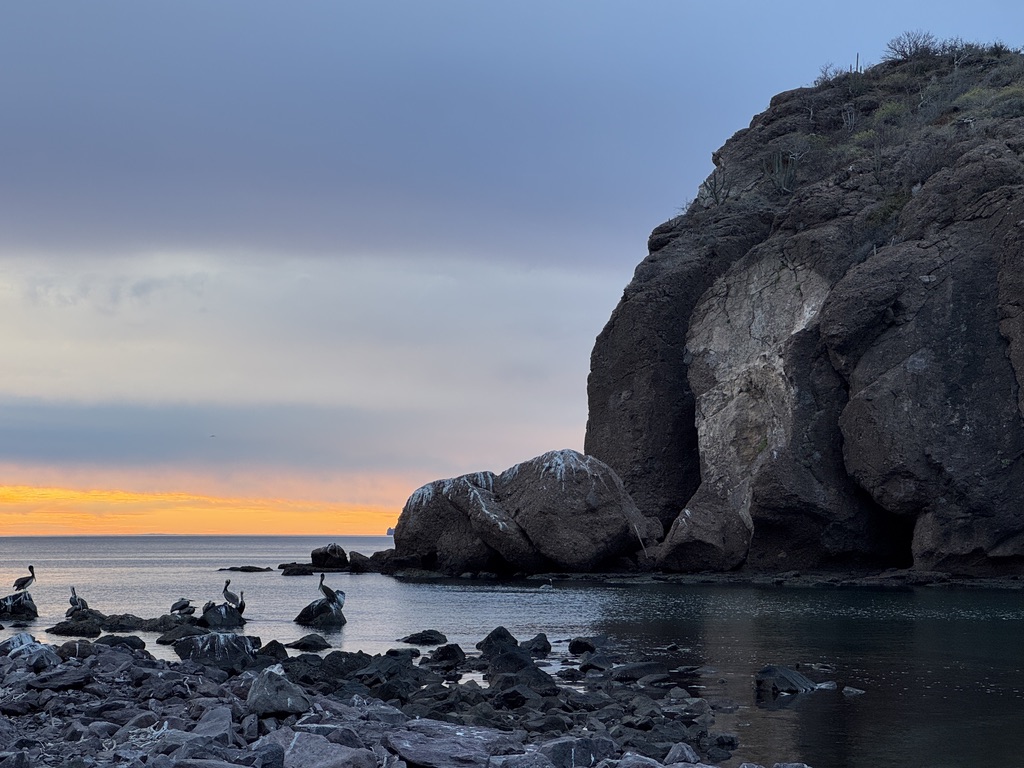
Artist Statement
Pelicans rest on volcanic rock as dawn light opens the horizon, holding stillness, tide, and geological time in quiet relation. The birds are present without urgency, bodies folded into rest as the ocean continues its steady rhythm. The rock beneath them carries a deeper temporality, shaped by forces that long predate both tide and wing.
What this scene brings into focus is co-presence across scales. Avian life, ocean movement, and volcanic strata occupy the same frame without hierarchy. Dawn holds each rhythm without favouring one over another. It simply reveals them together. The pelicans remain part of the landscape rather than interrupting it. They belong to it, momentarily aligned with processes that exceed any single lifespan.
The image situates time as layered rather than linear. The immediate softness of morning light sits alongside the slow pulse of the sea and the vast duration held in stone. This convergence invites attention to continuity rather than event, to relationship rather than action.
As visual data, the photograph documents a moment where species, elements, and temporalities meet without demand. It foregrounds an ethics of shared presence, reminding me that rest, movement, and endurance can coexist within the same horizon, each holding space for the others.
Photo Credit: Amy Tucker, 2026
With the Body, In Relationship
The difference lies in how I returned. Previously, my running was extraction, demanding performance from a body that had already given everything. The running that happened this morning was related. I moved with my body rather than at it.
Sunderland et al. (2022) describe how trauma-informed movement practices differ fundamentally from conventional exercise frameworks. Rather than imposing external goals on the body, trauma-informed movement invites the body to lead, to set pace, to determine duration, to signal completion. The practitioner’s role shifts from taskmaster to listener.
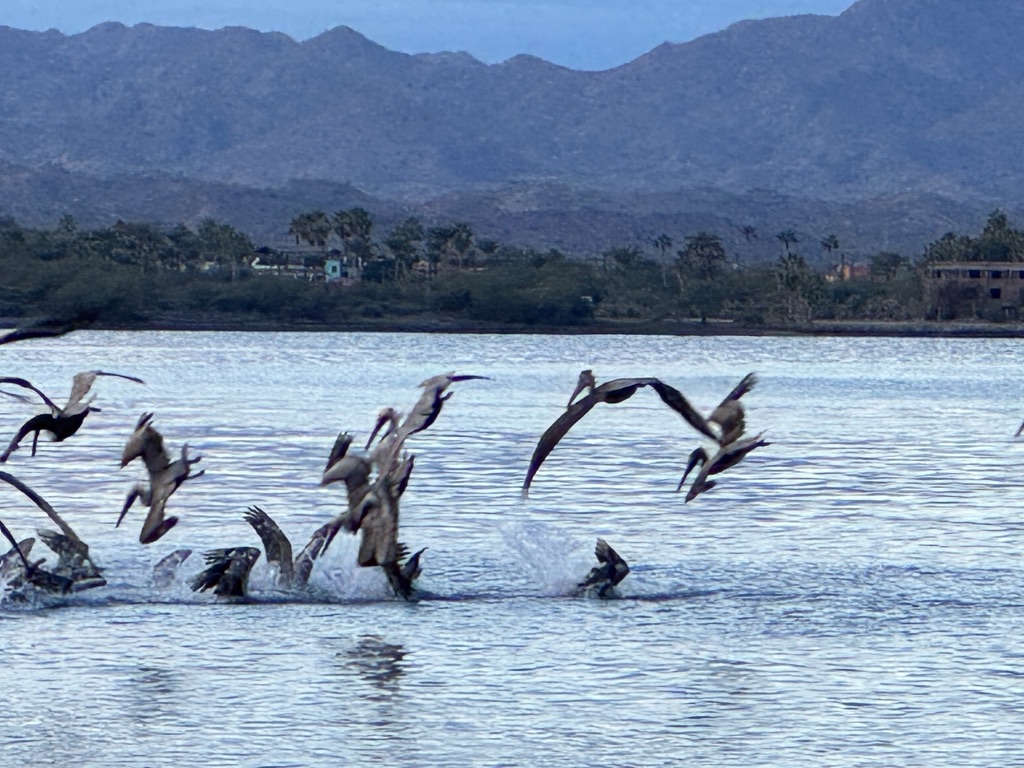
This morning, I listened. When my body asked to slow down, I slowed down. When it wanted to stop and watch pelicans dive for fish, I stopped. When it asked to walk the final stretch, I walked. Each choice was a conversation rather than a command.
Title: The Pause That Teaches
Artist Statement
The pelicans offered an unplanned lesson in embodied presence. Their hunting unfolds through complete attentiveness to the moment. Hovering. Assessing. Committing fully to the dive. There is no excess movement, no rehearsal. Each action arises from readiness rather than force.
Watching them, I felt my own body slow. The run paused without ending. Breath settled. Attention sharpened. The act of observing became a parallel practice, one that allowed stillness to exist inside motion rather than in opposition to it. The pelicans approached the water without rushing. They waited until the moment was right, and then they moved without hesitation.
This experience reframed how I understand interruption. Within trauma-informed movement, pauses are often misread as failure or loss of discipline. Here, the pause functioned as information. It carried data about safety, timing, and attunement. The body knew when to stop watching and when to move again.
As visual and somatic data, this moment documents a shift in relationship to movement. Attention becomes a form of care. Stillness becomes part of momentum. The pelicans model a way of being that honours precision over speed and presence over persistence, offering permission to pause without abandoning forward motion.
Photo Credit: Amy Tucker, 2026
Without Witnesses
Alonetude made this possible. In solitude, there is no audience for performance. No fitness tracker is demanding improvement. No institutional gaze measuring productivity. There is only the body, the breath, the sea, the slowly brightening sky.
Without witnesses, the body can tell the truth.
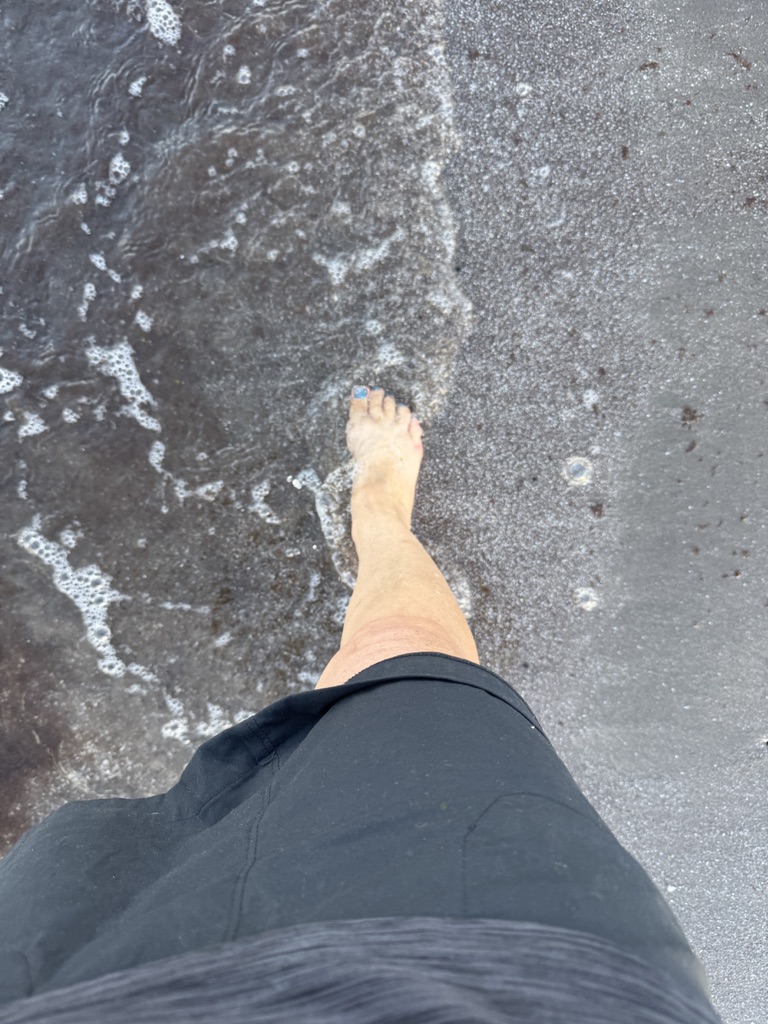
Title: Step into the Tide
Artist Statement
A bare foot meets the shoreline, marking contact, return, and the body’s quiet consent to re-enter the sea. The gesture is small, almost unremarkable, yet it carries weight. Skin touches water without armour or urgency. The body chooses proximity rather than distance.
What this moment holds for me is the ethics of consent in movement. The foot pauses before fully entering, allowing sensation to arrive first. Temperature, texture, resistance. The sea is met slowly, on equal terms. This is a return that requires no immersion. It honours readiness.
The shoreline becomes a threshold where the body negotiates trust. Years of holding tension and bracing against impact have taught my body to hesitate. Here, hesitation is attentiveness. It is listening. The foot lowers when the nervous system agrees. Contact becomes collaboration rather than conquest.
As visual data, this image documents an embodied decision point. Re-entry is framed as relational, shaped by timing, sensation, and choice. The body resists rushing to belong. It waits until belonging feels possible.
Photo Credit: Amy Tucker, 2026
Reflection: What the Body Knows
van der Kolk (2014) writes that the body keeps the score, that our tissues, organs, and nervous systems hold the memory of what we have survived. If this is true, then my body has been keeping meticulous records of twenty-five years of precarious labour. The chronic tension. The interrupted sleep. The constant calibration of self-presentation to meet institutional expectations. The grief of contracts that ended, relationships that frayed under unsustainable demands, and dreams deferred and deferred again.
Yet if the body keeps the score of harm, perhaps it can also keep the score of healing. Perhaps these fifteen minutes by the sea, this small, trembling, imperfect return to movement, registers in my tissues as evidence that safety is possible. That rest can be trusted. That the body, given sufficient care and time and solitude, remembers how to feel alive.
Little by Little
This is what alonetude offers: the space to let the body lead. To stop performing wellness and actually experience it. To run slowly along a shoreline at dawn, asking nothing of the moment except presence, and to feel something inside slowly, tentatively, begin to heal.
Little by little, the body finds its way back.
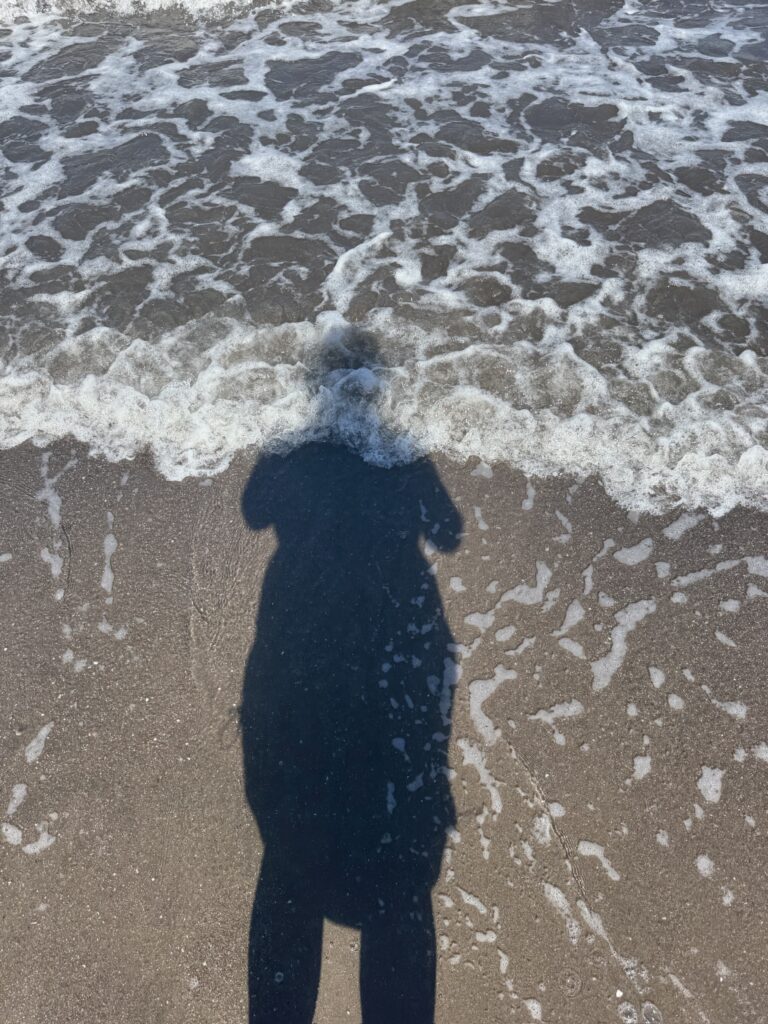
Image: Shadow Self
Artist Statement
This image captures my self-shadow at the water’s edge, marking a liminal encounter between body and sea, presence and erasure. Rendered only as a silhouette, the figure allows for self-observation without the self-consciousness of direct gaze. The body appears indirectly, shaped by light rather than asserted through form.
The advancing foam operates as both boundary and invitation. It traces a shifting line where land, body, and ocean negotiate contact. In this moment, the tide functions as a temporal and relational force, advancing and retreating without urgency. I stand at the threshold, neither immersed nor withdrawn, embodying what I understand as alonetude, a chosen presence within a larger ecological field.
The shadow stretches and softens across wet sand, signalling a body in transition. It reflects a state that has moved beyond contraction and exhaustion, yet is still reassembling itself into certainty. The image holds that in-between condition with care.
As visual data, this photograph documents an embodied epistemic moment. The shoreline becomes a research site where identity, nervous system state, and environment co-produce experience. The self emerges here as relational rather than fixed, a silhouette shaped by water, light, and ground rather than by narrative or performance.
Photo Credit: Amy Tucker, 2026
Visual Element
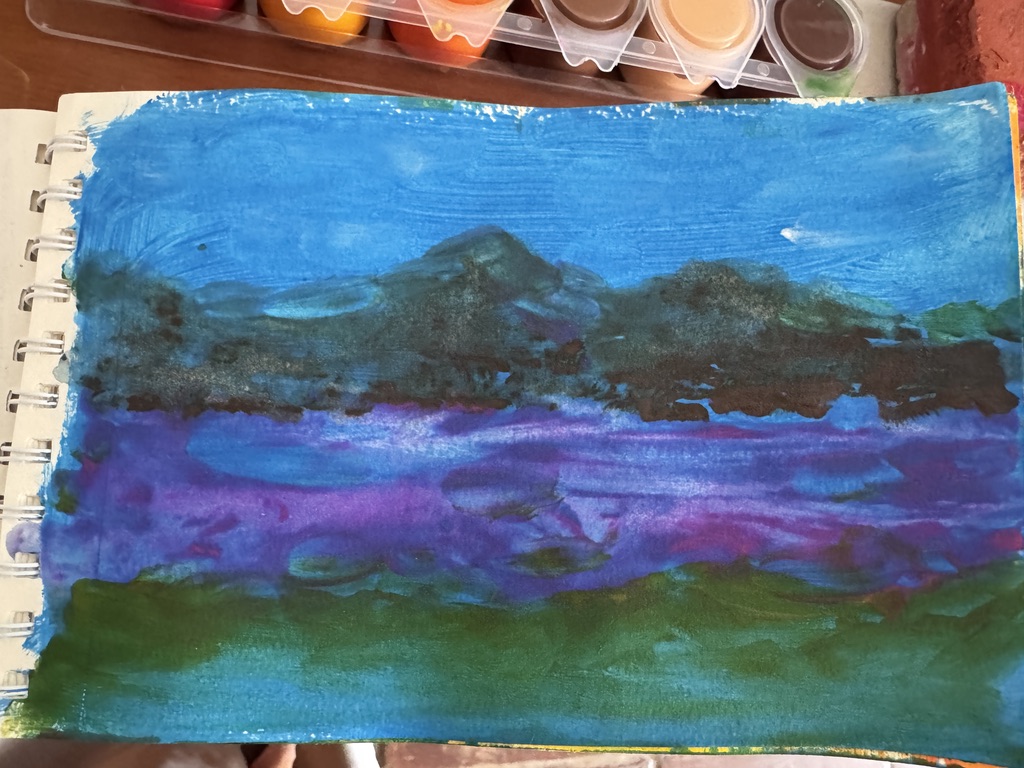
Title: Watercolour Study: The Return to Movement
Artist Statement
I made this in layers, letting colour arrive slowly and remain where it landed. Blue first, wide and enclosing. Then darker forms that suggested land without insisting on it. Beneath that, a band of violet and indigo where things began to blur, where certainty softened into atmosphere. Nothing here was outlined. Nothing was corrected.
What this image holds for me is the feeling that comes after effort has passed. The time when the body exhales and the landscape, internal and external, returns to itself. The colours move into one another without resistance. Boundaries exist, but they are permeable. This feels true to how I am learning to live right now, allowing edges to be present without hardening them.
As I worked, my attention stayed low and steady. My aim was to respond rather than describe. I was attending to a state. The surface carries the evidence of pauses, of hands lifting and returning, of pigment settling as it chose. The darker shapes hold their place without dominating the lighter ones. They coexist, layered rather than resolved.
This piece belongs to my ongoing practice of slowing down and letting meaning emerge through accumulation rather than declaration. It reflects a trust in process and in rest, in what becomes visible when nothing is being demanded. What settles here is a condition, held open. One that feels inhabitable.
Photo Credit: Amy Tucker, 2026
Closing the Day
Tonight, as the sun sets over the Sierra de la Giganta, I feel the pleasant ache of muscles reawakening. It is a different ache than the chronic tension I carried for months. This one speaks of use rather than depletion, of a body asked to participate in its own life rather than merely endure.
Tomorrow I may run again or walk. Or I may simply sit by the water and breathe. The point is no longer the activity itself but the relationship, the ongoing conversation between intention and capacity, between what the mind desires and what the body can sustain.
The body knows. And finally, I am learning to listen.
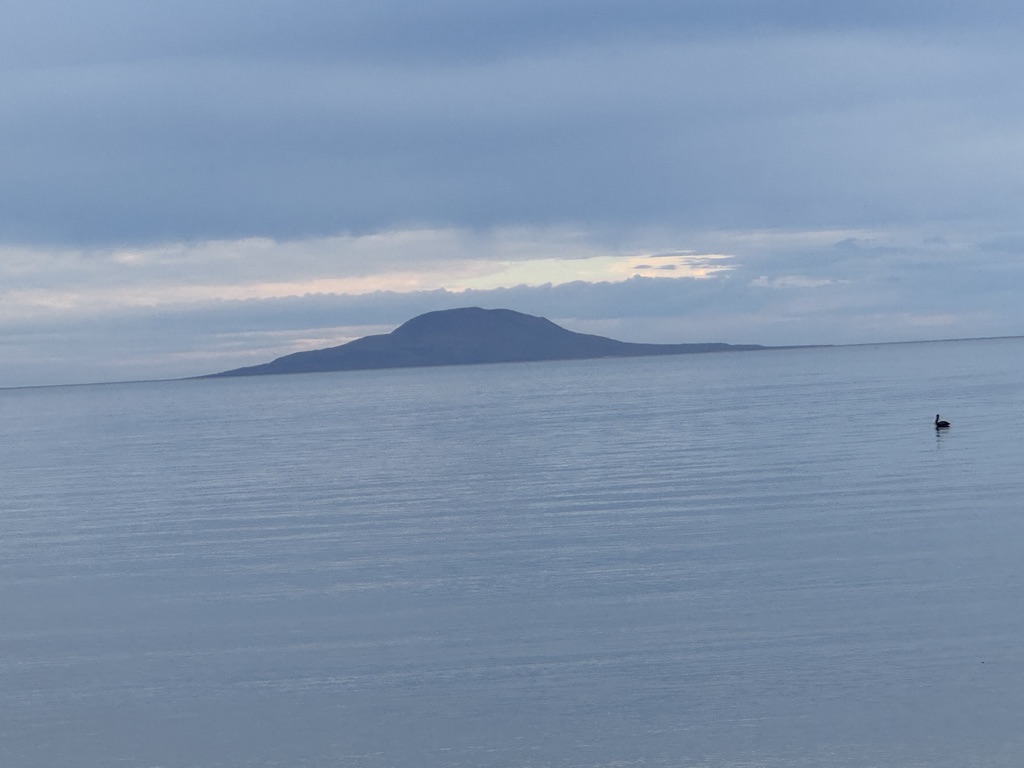
Title: Day’s End
Artist Statement
Carmen emerges as a dark silhouette across the Sea of Cortez, anchoring the horizon and holding the quiet of distance, water, and sky. The landmass withholds assertion through detail or texture. It remains intact through outline alone, a steady presence shaped by light rather than proximity.
What this image offers me is a sense of orientation without demand. Carmen holds the horizon gently, giving the eye a place to rest while allowing the surrounding space to remain open. Water and sky expand around it, and time seems to slow in response. The distance matters. It preserves separation while sustaining relationship.
As visual data, the silhouette functions as a stabilising reference point within a wide field of stillness. It reflects how grounding can occur without closeness, how connection can be maintained through recognition rather than arrival. Carmen remains where it is, and that is enough to hold the scene together.
Photo Credit: Amy Tucker, 2026
Methodological Reflection: SPN as Healing Practice
I understand Scholarly Personal Narrative as both a method and a practice. Nash and Bradley (2011) describe SPN as a way of transforming lived experience into scholarly knowledge through theory-informed reflection and an honest engagement with vulnerability. In writing this entry, This entry reaches beyond reporting on experience; it inhabits the methodology. My morning run becomes data. The subtle shift in my nervous system becomes evident. My body’s responses become a legitimate site of knowledge production.
The VPAS framework helps me organise this inquiry. Vulnerability appears in my account of collapse, in the moment my body withdrew consent to continue running. Perspective emerges as I trace the movement from depletion toward tentative return, noticing how hope arrives quietly, almost imperceptibly. Action is present in the fifteen minutes of running, but also in the choices to slow down, to stop, to breathe, and to listen. Scholarly engagement threads through this narrative as I situate my embodied experience within Polyvagal Theory, trauma scholarship, and critiques of academic capitalism.
I extend Scholarly Personal Narrative through multimodal, artifact-based inquiry. The shoes, stones, shadows, and watercolours serve as more than decoration. They are co-researchers. They hold memory, affect, and institutional inscription. By treating these objects as data, I am expanding what counts as evidence in organizational, educational, and human rights research. Framing embodied exhaustion as a human rights issue allows me to move beyond personal narrative and into structural critique, linking my body to policy, labour conditions, and institutional design.
I no longer understand chronic dorsal vagal shutdown as a personal pathology. I understand it as an institutional outcome. My nervous system collapsed beyond isolationtion. It was shaped by contingent contracts, constant performance evaluation, and the quiet pressure to be endlessly available. In this sense, my body becomes diagnostic. It registers what policy documents and strategic plans cannot: the physiological cost of precarious academic labour.
Alonetude has become a methodological condition for this work. In solitude, I hear my body more clearly. Without students, emails, metrics, or surveillance, my body speaks in sensation, breath, and fatigue. Here, data emerges somatically rather than performatively. I am practising scholarship from the inside out, allowing embodiment to guide analysis rather than treating it as an object to be analysed.
Learning to listen to my body feels both intimate and political. It is a healing practice and also a refusal. It interrupts the logic of extraction that shaped my academic life. It challenges the primacy of productivity as a measure of worth. It insists that limits are forms of knowledge, but forms of knowledge and ethical boundaries.
I believe that if higher education institutions are serious about equity, inclusion, and well-being, they must confront the embodied consequences of precarious labour. Secure employment, reasonable workloads, and psychological safety are human rights obligations rather than luxuriesgations. Without structural change, universities will continue to produce bodies calibrated for collapse and then misrecognise that collapse as individual weakness rather than as a failure of institutional design.
Writing this section is therefore both research and resistance. It is an act of counter-archiving, inserting the body back into institutional memory and insisting that embodied experience counts as knowledge.
References
Al Serhan, O., & Houjeir, R. (2020). Academic capitalism and faculty burnout: Evidence from the United Arab Emirates. Cypriot Journal of Educational Sciences, 15(5), 1368–1393. https://doi.org/10.18844/cjes.v15i5.5350
Han, B.-C. (2015). The burnout society (E. Butler, Trans.). Stanford University Press.
Hochschild, A. R. (1983). The managed heart: Commercialization of human feeling. University of California Press.
International Labour Organization. (1999). Decent work. International Labour Office. https://www.ilo.org/global/topics/decent-work/lang–en/index.htm
Levine, P. A. (1997). Waking the tiger: Healing trauma. North Atlantic Books.
Nash, R. J. (2004). Liberating scholarly writing: The power of personal narrative. Teachers College Press.
Nash, R. J., & Bradley, D. L. (2011). Me-search and re-search: A guide for writing scholarly personal narrative manuscripts. Information Age Publishing.
Porges, S. W. (2011). The polyvagal theory: Neurophysiological foundations of emotions, attachment, communication, and self-regulation. W. W. Norton & Company.
Slaughter, S., & Rhoades, G. (2004). Academic capitalism and the new economy: Markets, state, and higher education. Johns Hopkins University Press.
Sunderland, N., Graham, P., & Lorenz, D. (2022). Trauma-informed dance/movement therapy: Considerations for practice. In S. L. Brooke & C. E. Myers (Eds.), The use of creative arts therapies in trauma and recovery (pp. 15–32). Charles C Thomas Publisher.
United Nations. (1966). International Covenant on Economic, Social and Cultural Rights. United Nations Treaty Series, 993, 3.
van der Kolk, B. A. (2014). The body keeps the score: Brain, mind, and body in the healing of trauma. Viking.
Writing this section is itself an act of counter-archive. The academy often records productivity metrics while erasing bodily cost. This narrative inserts the body back into institutional memory, challenging what counts as legitimate knowledge.
Translation note. Spanish language passages in this post were generated using Google Translate and subsequently reviewed and refined by the author. Translations are intended to convey general meaning and are intended as guides to meaning rather than certified linguistic interpretations.