Finding the Language Before Words
Low Tide
The morning begins differently from the others. I leave my journal on the table. I reach for the small cloth bag hanging by the door, the one I bought at the mercado for carrying treasure and now carry for carrying what the sea leaves behind.
Image: Low Tide: An Artifact Archive
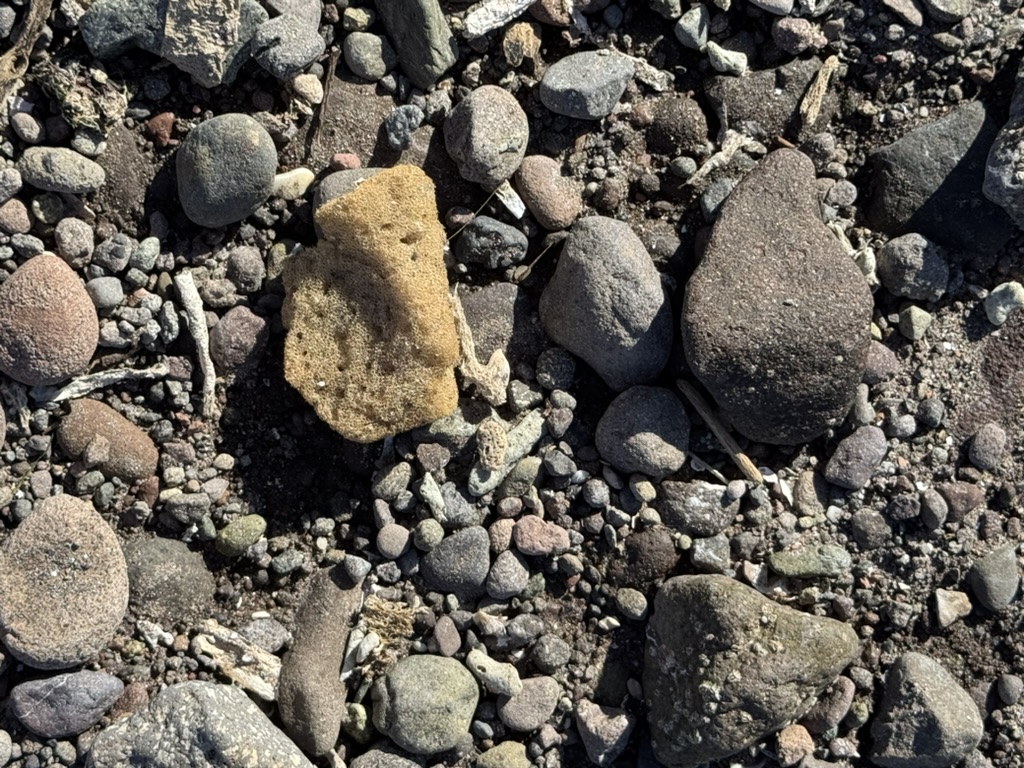
Photo Credit: Amy Tucker, 2026
Notation: A visual record of low tide as threshold, documenting how attention, touch, and found objects become a form of embodied knowing and creative recovery.
Low tide has pulled back the waterline like a curtain rising on a stage scattered with props. I walk slowly, head bent, eyes soft-focused, the way Iles-Jonas (2023) describes in her writing on beachcombing meditation, receiving rather than scanning urgently, open to what the shore offers. The repetitive motions of walking, bending, and standing begin to affect my nervous system. My breath slows. My shoulders drop. Something in my chest unclenches.
Image: Low Tide Shoreline

Photo Credit: Amy Tucker, 2026
Notation: The shoreline at low tide reveals what is usually hidden. Exposed sand, scattered fragments, and a widened horizon mark a brief interval of openness before the sea returns.
A piece of sea glass catches the early light. Green, the colour of old wine bottles. Once sharp and dangerous, now softened by endless tumbling. I hold it to the sun and watch light move through it like water through memory. The edges are frosted, rounded, and safe to hold. I think about what time does to things. What salt and sand and constant motion do to the jagged parts of us.
This is wabi-sabi made visible. The Japanese aesthetic that finds beauty in imperfection, impermanence, and incompleteness (Juniper, 2003; Koren, 1994). This sea glass, weathered and clouded, is more beautiful than the bottle it once was. The transformation requires time; I cannot rush. Patience, I am learning.
Image: What the Sea Softens

Photo Credit: Amy Tucker, 2026
Note. Weathered sea glass gathered at low tide, softened by time, salt, and motion into fragments safe to hold.
I find a spiral shell, small enough to sit in my palm. Growth that moves outward while turning inward is a natural representation of how personal development requires both expansion and introspection. I find a piece of driftwood, silver-grey and salt-cured, dead wood given new life through salt and sun. Greenspan’s (2003) alchemy made visible the transformation of what appears finished into something with renewed purpose and beauty.
Image: Held Spiral

Photo Credit: Amy Tucker, 2026
Note. A small spiral shell rests in the palm, holding outward growth and inward turning in a single form.
My cloth bag grows heavy with treasures. Each object becomes a small sermon on impermanence and resilience.
Recojo tesoros que el mar regala. I collect treasures that the sea gives back.
Back at the cottage, I spread my finds across the wooden table. The sea glass sits on my table. The shells are arranged by size. The smooth stones lined up like a quiet congregation. The driftwood pieces lay out like bones waiting to be assembled into meaning.
Image: The Artifact Archive Table
Note. Collected objects are sorted and arranged without a plan. Sea glass, shells, stones, and driftwood become a quiet archive of attention, presence, and embodied memory.
I begin to arrange the objects. With intuition rather than a plan, moving pieces like words in a sentence, I am still learning to speak. This is bricolage, creating with whatever is at hand. Lévi-Strauss (1966) described the bricoleur as one who makes do with available materials, creating meaning from found objects rather than purpose-made tools. Today, I am the bricoleur of the beach. The sea has provided my vocabulary. Now I am learning its grammar.
What I will make remains ahead of me. That feels important. For so long, productivity demanded knowing the end before beginning. Art asks something different. Art asks for presence without a predetermined outcome.
The morning passes without my noticing. When I finally look up, three hours have disappeared into flow, Csikszentmihalyi’s (1990) optimal experience made real in my own hands. I feel the particular satisfaction of having made something from nothing, of having spoken in a language older than words.
Theoretical Framework: The Healing Architecture of Creative Flow
Flow States and the Alonetude of Making
What happened at my table this morning has a name in positive psychology: flow. Mihaly Csikszentmihalyi (1990), the Hungarian-American psychologist widely regarded as the father of flow research, described this state as complete immersion in an activity in which nothing else seems to matter, where the experience itself becomes so enjoyable that people pursue it for its own sake, regardless of cost. During flow, individuals report feeling strong, alert, in effortless control, unselfconscious, and operating at peak capacity (Csikszentmihalyi, 1990).
The term flow state refers to a psychological condition of complete immersion in an activity, characterised by deep concentration, diminished self-consciousness, and an altered sense of time. Unlike passive relaxation, flow emerges from active engagement in which skill level is well matched to challenge level. Tasks that are too easy tend to lead to boredom, while those that are too difficult often lead to anxiety. The balance between these extremes creates what Csikszentmihalyi (1990) describes as optimal experience.
Image: Where Things Gather
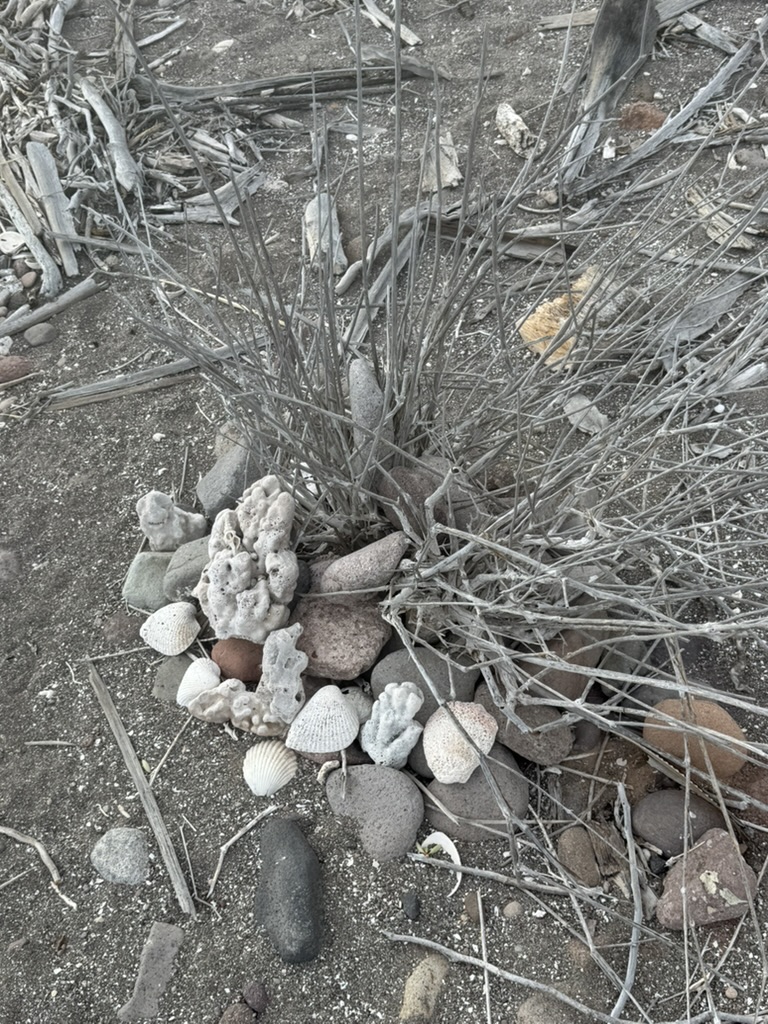
Photo Credit: Amy Tucker, 2026
Note. Shells, stones, coral, and driftwood settle together at the base of dry branches, held in place by gravity, wind, and time. Maybe someone put them there, or maybe the wind did?
From a neurological perspective, flow is associated with decreased prefrontal cortex activity, a phenomenon known as transient hypofrontality (Dietrich, 2004). This temporary reduction in executive functioning may help explain the loss of self-consciousness and altered time perception commonly reported during flow states. The inner critic quiets. The ruminating mind stills. What remains is presence.
For those healing from occupational trauma, this temporary relief from the hypervigilant self-monitoring that characterises chronic stress offers profound neurological rest. My morning spent arranging sea glass was far beyond a pleasant distraction; it was an active form of neurological recovery.
Table 1
Conditions for Flow and Their Manifestation in Beachcombing Art Practice
| Accessible entry; endless possibilities for complexity | Definition | Beachcombing Art Manifestation |
| Clear goals | Activity has clear immediate objectives | Finding treasures; creating aesthetic arrangement |
| Immediate feedback | Progress is visible and continuous | Each find is instant reward; arrangement evolves visually |
| Challenge-skill balance | Task difficulty matches ability level | Accessible entry; endless possibility for complexity |
| Merged action-awareness | Complete absorption in activity | The ego temporarily suspends |
| Loss of self-consciousness | Ego temporarily suspends | No inner critic judging; simply making |
| Transformed time perception | Hours feel like minutes | The ego temporarily suspends |
Note. Conditions adapted from Csikszentmihalyi (1990). Flow manifestations are documented through the researcher’s reflexive journaling.
Blue Mind: The Neuroscience of Water Proximity
The therapeutic benefits of beachcombing extend beyond flow into what marine biologist Wallace J. Nichols (2014) describes as Blue Mind, a mildly meditative state characterised by calm, peace, unity, and a sense of immediate satisfaction with life. In contrast to the frenetic Red Mind associated with constant digital stimulation, blue spaces activate a neurochemical cascade that supports relaxation, eases anxiety, and enhances creative thinking.
The term Blue Mind refers to the cognitive and emotional benefits derived from proximity to water environments. Research demonstrates that coastal residents exhibit higher levels of positive psychological effects, including reduced stress and increased physical activity, compared to inland residents (White et al., 2021). Regular exposure to ocean environments can alter brain wave frequencies, putting individuals into meditative states while improving cognitive functions such as learning and memory.
Title: Contact
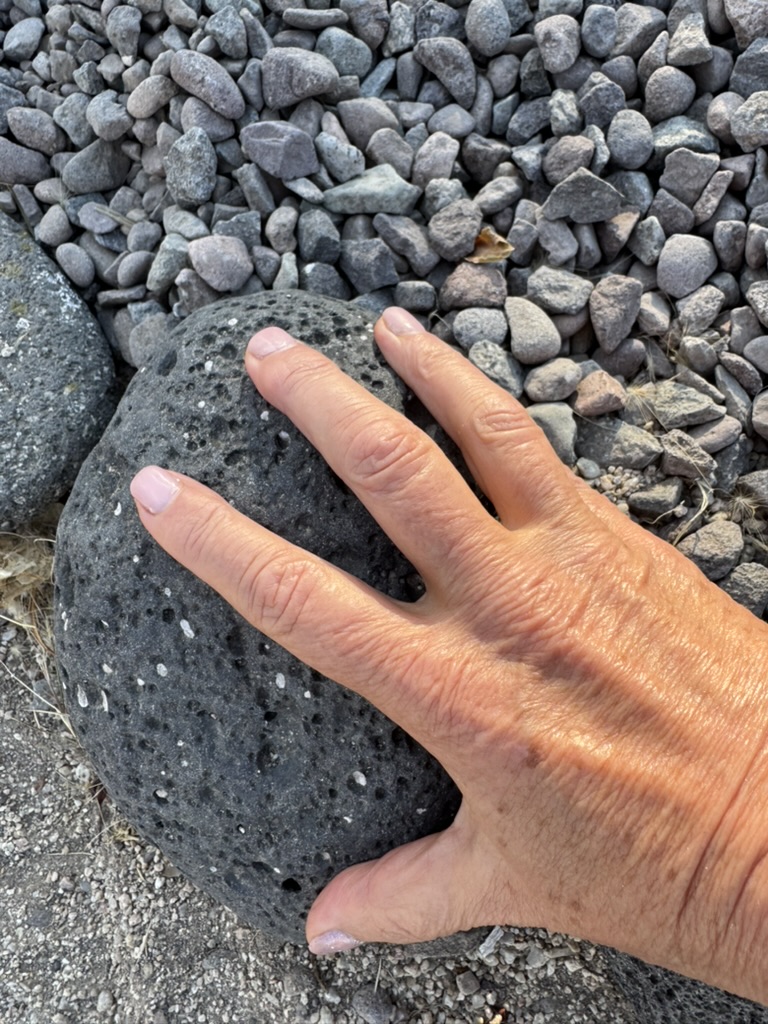
Photo Contact: Amy Tucker, 2026
Note. A hand rests on a smooth volcanic stone, registering weight, temperature, and presence through touch.
Negative ions in sea air have been shown to increase oxygen uptake in the human body, with potential benefits for mood and reductions in depressive symptoms (Perez et al., 2013). The rhythmic sound of waves produces frequencies in the range of approximately 20 to 500 hertz, which align with brainwave patterns associated with deep relaxation. This auditory rhythm has a lulling effect that supports contentment and calm, offering predictable sensory patterns that the human nervous system often registers as safe.
For those carrying occupational trauma in their bodies, this neurological recalibration offers significant healing potential. The polyvagal system, attuned to environmental cues of safety and danger, reads the rhythmic constancy of waves as evidence of a stable, predictable environment. The nervous system can release its vigilant grip.
Beachcombing as Contemplative Practice
Beachcombing operates as what might be termed embodied mindfulness, a form of meditation that requires no instruction, no cushion, and no prescribed posture. The activity naturally anchors practitioners in present-moment awareness through sustained sensory engagement. The focused search for small treasures helps clear the mind, drawing the beachcomber into immediate connection with the earth, a state that meditation practitioners recognise as mindfulness (Iles-Jonas, 2023).
The term mindfulness refers to the psychological practice of being fully present and engaged in the current moment, aware of thoughts and feelings without judgment. Unlike formal meditation practices that can feel inaccessible or intimidating, beachcombing provides a low-pressure entry point into mindful awareness. The activity requires no prior training, carries no expectations of achievement, and offers immediate sensory rewards.
Image: At the Edge

Photo Credit: Amy Tucker, 2026
Note. Feet stand in moving water as the tide passes around them, marking a moment of arrival and release.
The repetitive nature of walking and bending creates a meditative flow state, as researchers describe it (Neurolaunch, 2025). The body moves rhythmically while the eyes scan softly. The mind quiets. Intrusive thoughts about past failures or future anxieties lose their grip when attention is occupied with the immediate question: Is that a piece of glass? The urgency of ordinary worries dissolves in the face of such simple, present-tense curiosity.
Table 2
Therapeutic Elements of Beachcombing Practice
| Element | Mechanism | Healing Function |
| Wave sounds | Predictable rhythm synchronises with alpha brainwaves | Nervous system registers safety; hypervigilance decreases |
| Sea glass colours evoke tranquillity; anxiety reduction | Smooth objects stimulate interoceptive awareness | Grounding in body; emotional regulation support |
| The nervous system registers safety; hypervigilance decreases | Soft-focus attention reduces prefrontal activation | Inner critic quiets; default mode network activation |
| Repetitive motion | Walking rhythm activates parasympathetic response | Bilateral stimulation; somatic processing of stored tension |
| Discovery reward | Variable reinforcement triggers dopamine release | Sense of accomplishment; counters anhedonia |
| Colour exposure | Blues and greens associated with calm in colour psychology | Sea glass colours evoke tranquility; anxiety reduction |
Note. Mechanisms synthesised from Nichols (2014), Neurolaunch (2025), and Iles-Jonas (2023).
Wabi-Sabi: The Aesthetic Philosophy of Transformed Imperfection
The sea glass I hold teaches what the Japanese have known for centuries. Wabi-sabi, a philosophical and aesthetic concept that emerged from fifteenth-century tea ceremony practice, centres on the acceptance of transience and imperfection. Koren (1994) describes wabi-sabi as an aesthetic that finds beauty in imperfection, impermanence, and incompleteness. This worldview stands in direct opposition to Western ideals that privilege newness, symmetry, and permanence.
Image: Sea Pottery

Photo Credit: Amy Tucker, 2026
Note. Blue pottery gathered together, holding depth, clarity, and the memory of water.
The term wabi originally carried connotations of solitude and life lived close to nature, away from society, but gradually evolved to suggest rustic simplicity, freshness, and quiet contentment. Sabi refers to the beauty that emerges with age, the patina of time and the visible wear that signals use and history (Juniper, 2003). Together, these concepts name an aesthetic sensibility that honours what Western culture often discards.
Sea glass embodies wabi-sabi with remarkable clarity. Once a manufactured object, sharp-edged, uniform, and purpose-made, it has been transformed by time and environment into something more beautiful than its original design. The frosted surface, rounded edges, and softened colours emerging from industrial origins mark a long journey through salt, sand, and continual tumbling. Here, imperfection becomes the source of beauty.
For those healing from trauma, wabi-sabi offers a radical reframe. Emergence from difficult experiences requires no polish, no perfection. Our rough edges, softened by time and held to the light, might reveal their own particular beauty. The cracks and weathering are evidence of survival, of passage through difficult conditions, of transformation that only occurs through endurance.
The Artifact Archive: Objects as Embodied Knowing
The term wabi originally carried connotations of solitude and life lived close to nature, away from society, but gradually evolved to suggest rustic simplicity, freshness, and quiet contentment. Sabi refers to the beauty that emerges with age, the patina of time and the visible wear that signals use and history (Juniper, 2003). Together, these concepts name an aesthetic sensibility that honours what Western culture often discards.
Sea glass embodies wabi-sabi with remarkable clarity. Once a manufactured object, sharp-edged, uniform, and purpose-made, it has been transformed by time and environment into something more beautiful than its original design. The frosted surface, rounded edges, and softened colours emerging from industrial origins mark a long journey through salt, sand, and continual tumbling. Here, imperfection becomes the source of beauty.
Rose and Bingley (as cited in Trauma-Informed Arts research) demonstrate how found objects in creative practice operate as gestural records of place-anchored identity shaped by migration and rupture. The sea glass I collect is far beyond decorative; it is data. Each piece carries information about where I have been, what caught my attention, and what resonated with my internal state on a particular day. Together, the collection maps a healing trajectory that words alone might miss.
Table 3
Artifact Archive: Collected Objects and Their Symbolic Resonance
| Artifact | Physical Transformation | Metaphorical Teaching |
| Sea glass | Once sharp and dangerous, now softened by endless tumbling | Time and environment transform rough edges into beauty, safe to hold |
| Driftwood | Dead wood given new life through salt and sun | Greenspan’s (2003) alchemy: what appears finished can find renewed purpose |
| Spiral shell | Growth that moves outward while turning inward | Personal development requires both expansion and introspection |
| Smooth stones | Once jagged rock, worn smooth by constant motion | Persistent forces reshape even the hardest materials |
| Weathered logs | Trees that once stood tall, now horizontal, silver-grey | Rest after striving has its own dignity and beauty |
Note. Artifact interpretations drawn from the researcher’s reflexive practice and the wabi-sabi aesthetic framework (Juniper, 2003; Koren, 1994).
Critical Analysis: The Privilege of Creative Solitude
Image: Borrowed Silence

Photo Credit: Amy Tucker, 2026
Note. Wind-bent palms stand between desert and sea at dusk, holding a moment of calm made possible by time, place, and circumstance.
Before this reflection settles into unexamined celebration, critical analysis demands acknowledgment of the structural conditions enabling this practice. The ability to spend mornings beachcombing and afternoons making art requires particular material circumstances: freedom from wage labour during healing, financial resources for retreat accommodation, geographic access to the coastline, and physical mobility to walk and bend. These conditions are available only to some.
Inversion thinking, the practice of examining what an opposite perspective might reveal, asks a necessary question: What does this healing practice look like for those without such privilege? A single parent working multiple jobs cannot take time off in the mornings for beachcombing. A person with mobility limitations may find sandy shorelines difficult to navigate. An inland resident lacks access to the Blue Mind effects along the coast. The practice of creative solitude documented here exists within structures of class, geography, and ability that warrant careful scrutiny.
Image: Childhood Dreams

Photo Credit: Amy Tucker, 2026
Note. A hand-crafted blanket reminds us that care, warmth, and repair have long been created collectively, often under conditions of constraint. Unlike coastal solitude, such forms of making emerge in shared spaces, through necessity as much as choice, offering a counterpoint to individualised narratives of healing shaped by access, time, and privilege. Made by a local artisan.
This acknowledgement leaves the healing potential of art-making and nature engagement fully intact. Rather, it situates individual practice within broader contexts of access and equity. The question then becomes how the principles of flow, tactile engagement, and creative expression might be made available across different life circumstances. Urban community gardens, accessible art spaces, and therapeutic programs designed for shift workers represent efforts to extend what I experience as individual privilege into more collective and inclusive forms of care.
Image: Rock as Record

Photo Credit: Amy Tucker, 2026
Note. Paint layered onto stone becomes a portable site of flow and tactile engagement, suggesting how creative expression can travel beyond coastlines and retreats into shared, accessible spaces of care.
The risk of documenting healing through art and beachcombing is that it becomes another form of lifestyle prescription, another obligation for stressed workers to feel guilty about skipping. My intention is different: to understand what makes this practice healing, then to question how those elements might be adapted, modified, and extended to those whose circumstances differ from my own.
Embodied Practice: Art as Language Before Words
There are things I cannot say in sentences that my hands seem to know how to express. This is the territory of embodied cognition, the understanding that knowledge resides in the body as well as in the mind. When I arrange sea glass by colour, I am sorting more than objects. When I position pieces of driftwood to create negative space, I am composing something my conscious mind has yet to articulate.
Trauma-informed arts research supports this phenomenon. Embodied expression can enable release when verbal recounting feels inaccessible or unsafe (Rose and Bingley, as cited in Sunderland et al., 2022). The body functions as an archive, holding experiences that may resist verbal articulation yet emerge with clarity through creative processes. Movement, texture, colour, and arrangement become languages when words feel insufficient.
The term embodied cognition refers to the theory that cognitive processes are deeply rooted in the body’s interactions with the physical world. Rather than operating solely through abstract mental activity, knowing emerges through sensory engagement, motor action, and bodily awareness. When I hold sea glass to the light, information passes between hand and eye, and something deeper than thought is activated.
Image: Return

Photo Credit: Amy Tucker, 2026
Note. Waves break and recede across dark sand, leaving a thin lace of foam that marks the sea’s ongoing rhythm of arrival and release.
This matters for healing from occupational trauma, which often settles in the body as tension, hypervigilance, and disrupted interoception. Talk therapy, while valuable, sometimes falls short of what the body holds. Creative practice offers an alternative pathway, one that supports processing through action and sensation rather than language alone.
Bricolage: Creating Meaning from What Is Available
The French anthropologist Claude Lévi-Strauss (1966) introduced the concept of bricolage to describe a mode of thinking and creating that works with whatever is at hand rather than seeking specialised materials or tools. The bricoleur, in contrast to the engineer who designs from first principles using purpose-made components, creates a heterogeneous repertoire of odds and ends from available fragments.
The term bricolage (from the French bricoler, to tinker) refers to the construction or creation of something from a diverse range of available things. In the context of healing practice, bricolage becomes a metaphor for working with what life has provided rather than lamenting what is absent. The sea glass was once waste. The driftwood was once a living tree. The shells housed creatures now gone. From these remnants, something new emerges.
This philosophy extends beyond physical art-making to the reconstruction of self after trauma. Healing asks us to become something new rather than who we were before. We heal by gathering the fragments of experience, the lessons learned, the strengths discovered, the perspectives shifted, and assembling them into something new. The bricoleur grieves no absence of ideal materials; she works with what the tide has brought in.
Notable observations: The combination of outdoor movement followed by indoor creative activity created a natural rhythm that felt restorative. Beachcombing functioned as a transition, leaving the casita’s contained space for the expansive shore and then returning with gathered materials to work with the hands. This ritual of going out and coming back mirrors an essential aspect of the psyche’s need for both exploration and return.
Image: Nature’s Art

Photo Credit: Amy Tucker, 2026
Note. Small white flowers bloom at the base of a tree, emerging from dry, compacted ground through persistence rather than abundance.
Evening Reflection: Finding the Language Before Words
Image: Evening Light

Photo Credit: Amy Tucker, 2026
Note. As light shifts toward evening, the same objects appear transformed. Illumination changes perception, offering a final teaching on how meaning emerges through context rather than alteration.
As the light shifts over the water, I sit with my arrangement of found objects. The meaning remains open, and that feels right. For much of my life, meaning was something I produced on demand: reports, analyses, frameworks, recommendations. The occupational world trained me to know what I was making before I made it, to articulate purpose before taking action.
Art asks something different. It asks me to begin without knowing the end. To trust that sense will emerge through the doing. To believe that my hands might hold knowledge, my mind has yet to find its words.
The sea glass catches the evening light differently now, more amber, more gold. The objects remain the same, yet they appear transformed by a change in illumination. This, too, is a teaching. What reveals itself one way in the clarity of morning may disclose other dimensions in the softness of evening. The object holds steady; the light changes, and with it, perception.
El arte habla cuando las palabras fallan. Art speaks when words fail.
This is what Day 19 offered: a different language for knowing, one that works alongside words rather than replacing them, as this written reflection exists alongside the created arrangement, but an addition. A parallel stream of meaning-making. A reminder that healing unfolds through multiple channels, and that the body and its creative capacities hold wisdom the mind may take years to articulate.
What I will make from these gathered objects remains open. Perhaps that unknowing is itself the gift.
References
Csikszentmihalyi, M. (1990). Flow: The psychology of optimal experience. Harper & Row.
Csikszentmihalyi, M. (1997). Creativity: Flow and the psychology of discovery and invention. HarperCollins.
Dietrich, A. (2004). Neurocognitive mechanisms underlying the experience of flow. Consciousness and Cognition, 13(4), 746–761. https://doi.org/10.1016/j.concog.2004.07.002
Greenspan, M. (2003). Healing through the dark emotions: The wisdom of grief, fear, and despair. Shambhala.
Iles-Jonas, R. (2023, February 3). Beachcombing: Body, mind, soul. Beachcombing Magazine. https://www.beachcombingmagazine.com/blogs/news/beachcombing-body-mind-soul
Juniper, A. (2003). Wabi sabi: The Japanese art of impermanence. Tuttle Publishing.
Koren, L. (1994). Wabi-sabi for artists, designers, poets & philosophers. Stone Bridge Press.
Lévi-Strauss, C. (1966). The savage mind. University of Chicago Press.
Nichols, W. J. (2014). Blue mind: The surprising science that shows how being near, in, on, or under water can make you happier, healthier, more connected, and better at what you do. Little, Brown and Company.
Perez, V., Alexander, D. D., & Bailey, W. H. (2013). Air ions and mood outcomes: A review and meta-analysis. BMC Psychiatry, 13, Article 29. https://doi.org/10.1186/1471-244X-13-29
Saito, Y. (1997). The Japanese aesthetics of imperfection and insufficiency. The Journal of Aesthetics and Art Criticism, 55(4), 377–385. https://doi.org/10.2307/430925
Parkes, G., & Loughnane, A. (2023). Japanese aesthetics. In E. N. Zalta & U. Nodelman (Eds.), The Stanford Encyclopedia of Philosophy (Winter 2023 ed.). https://plato.stanford.edu/entries/japanese-aesthetics/
Rankanen, M., Leinikka, M., Groth, C., Seitamaa-Hakkarainen, P., Mäkelä, M., & Huotilainen, M. (2022). Physiological measurements and emotional experiences of drawing and clay forming. The Arts in Psychotherapy, 79, Article 101899. https://doi.org/10.1016/j.aip.2022.101899
White, M. P., Elliott, L. R., Grellier, J., Economou, T., Bell, S., Bratman, G. N., Cirach, M., Gascon, M., Lima, M. L., Lõhmus, M., Nieuwenhuijsen, M., Ojala, A., Roiko, A., Schultz, P. W., van den Bosch, M., & Fleming, L. E. (2021). Associations between green/blue spaces and mental health across 18 countries. Scientific Reports, 11(1), Article 8903. https://doi.org/10.1038/s41598-021-87675-0
Translation note. Spanish language passages were generated using Google Translate and subsequently reviewed and refined by the author. Any remaining infelicities reflect the limits of machine translation rather than intent.