I brought one book with me to Loreto that I’ve already read three times.
The Body Keeps the Score sits on the nightstand, spine cracked, pages soft from handling. I do not open it much anymore. I do not need to. The words have moved from page to practice. But having it nearby feels important, the way certain objects become witnesses to our becoming.
How I Found This Book
I found van der Kolk’s book during a period when I couldn’t name what was wrong.
I was not in crisis. I was functioning. Teaching my classes, meeting my deadlines, and showing up where I was supposed to show up. But something had gone quiet inside me. Joy arrived less often and stayed for shorter periods. Sleep fractured into segments of vigilance. My shoulders had taken up permanent residence somewhere near my ears.
I thought this was just adulthood. Just the weight of a demanding career. Just what happens when you’ve been working contract to contract for twenty-five years, never quite sure if next semester will hold a place for you.
Then I read this sentence: “Traumatized people chronically feel unsafe inside their bodies.”
I put the book down. I looked at my hands. I noticed, for the first time in years, how tightly I was holding my own fingers.

What I Learned About the Score
Van der Kolk’s title comes from a simple observation: the body remembers what the mind tries to forget.
Every time we brace against difficulty, the body records it. Every moment of feeling unsafe, unvalued, and uncertain. Every adaptation we make to survive environments that ask too much and offer too little. The body keeps a running tally. A score.
I started noticing my own score.
The way my jaw clenched during work emails. The shallow breathing that never quite reached my belly. The startle response when my phone buzzed unexpectedly. The difficulty relaxing even when nothing was wrong, especially when nothing was wrong, because the absence of an obvious threat had become its own kind of suspicion.
These were not dramatic symptoms. They were ordinary. That was the problem. I had normalized a state of chronic bracing, and my body had been keeping score the whole time.
The Part That Changed Everything
The part of van der Kolk’s book that changed everything for me was his distinction between knowing and feeling.
He explains that you can intellectually understand that you are safe. You can know that the difficult period is over, that the threat has passed, that you survived. But your body might not believe you. The alarm system operates below the level of language. It doesn’t respond to rational argument.
This explained so much.
I understood that precarious employment was just a system, not a personal failing. I understood that institutional instability was not about me. I understood all of this. But my body still braced every time I checked my email. My nervous system still treated uncertainty as danger, even when my mind knew better.
Van der Kolk writes that insight is not enough. You cannot think your way out of a body that has learned to be afraid. You have to give the body new experiences. You have to teach the nervous system, through repetition and patience, that safety is possible.
This is why I came to Loreto.
Learning the Body’s Language
One of the most useful things van der Kolk taught me is a word: interoception.
It means awareness of internal bodily sensations. The ability to notice what’s happening inside you, to feel your own interior landscape.
I thought I had this. I was wrong.
When I first tried to check in with my body, I got nothing. Fine. Normal. Whatever. The channel was full of static. Decades of pushing through had taught me to override bodily signals rather than listen to them. I had become fluent in ignoring myself.
Here in Loreto, I’ve been practising. Every morning and evening, I sit quietly and ask simple questions. Where is there tension? What is my breath doing? What does my belly feel like today?
At first, the answers were vague. But slowly, the body has started to speak more clearly.
Tight behind the eyes today. Jaw softer than yesterday. A pulling sensation in my chest that might be grief, or might be longing, or might be something that doesn’t have a name yet.
This is what van der Kolk means when he says interoception is the foundation of agency. You cannot respond to what you cannot feel. You cannot change what you cannot notice. The first step in any different direction is simply knowing where you are.
Why the Sea of Cortez
Van der Kolk writes about what actually calms a nervous system that has learned to be afraid: rhythm, breath, movement, and environmental cues of safety.
I did not fully understand why I needed the sea until I read those words.
The waves arrive and recede with a regularity that teaches something below language. The body learns, through repetition, that things have beginnings and endings. That which rises also falls. That the next moment will come, and the one after that.
Swimming requires attention to breath in a way that ordinary life does not. I cannot swim and hold my breath due to anxiety. The water demands exhalation. It teaches my body what my mind has been trying to explain for years: you can let go, and you will not drown.
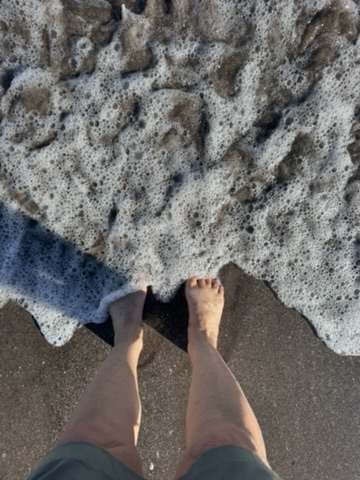
Walking the shoreline is movement without a destination. No goal except the next step. No metric except presence. The body moves, and the mind follows, rather than the other way around.
And the wideness of the horizon, the warmth of the air, the predictability of light on water, these tell the ancient parts of my brain that right now, in this moment, I am not under threat.
This is what van der Kolk calls bottom-up healing. Not thinking my way to safety, but feeling my way there. Giving my body experiences that contradict the score it has been keeping.
The Hardest Part
The hardest part of van der Kolk’s book, for me, was accepting that healing takes time.
I wanted a solution. A technique. Something I could implement and complete. But he describes recovery as a process of slowly, gently, teaching the body that the past is past. Not through insight but through experience. Not once, but over and over, until the nervous system begins to trust.
This is why thirty days.
Not because thirty days will fix everything. But because thirty days of waking in the same safe room, of walking the same peaceful shore, of breathing the same salt air might begin to shift something. The body needs repetition. It needs evidence. It needs proof that safety can be sustained.
I am not here to achieve healing. I am here to practice it.
What My Body Is Saying Now
This morning, I noticed something new.
I woke without the usual surge of anxiety. No immediate reach for my phone. No mental inventory of what might have gone wrong overnight. Just the sound of waves and the pale light of early morning and my own body, breathing.
My shoulders were down. Not because I had remembered to relax them, but because they had relaxed on their own.
I lay there for a long time, feeling the strangeness of it. This is what van der Kolk means by the nervous system learning safety. Not a thought. A state. Something the body does when it finally believes what the mind has been saying.
It did not last. By afternoon, I had found new tensions to carry. But it happened. The body is learning.
Sea Glass
I’ve been collecting sea glass on my walks.
Each piece started as something broken. A bottle shattered against rocks. A jar that did not survive the journey. Sharp edges that could cut.
Time and salt transformed them. The tumbling softened what was dangerous. The constant motion wore away the sharpness until what remains is smooth, frosted, and safe to hold.
Van der Kolk writes about neuroplasticity, the brain’s capacity to be reshaped by experience. The nervous system that learned fear can also learn safety. The braced body can also soften.
Sea glass does not forget it was once broken. The frosted surface carries evidence of its history. But it is no longer dangerous. It has been changed by the environment in which it is held.
I think about this every time I pick up a piece of green or blue or amber glass from the sand. I think: this is what I’m doing here. Being tumbled. Being smoothed. Not forgetting, but transforming.
For Anyone Whose Body Is Keeping Score
If you are reading this, maybe your body is keeping score too.
Maybe you do not call it trauma. Maybe it’s just stress, difficulty, the ordinary accumulation of a hard life. But if your shoulders live near your ears and your sleep fractures into vigilance and your capacity for joy has narrowed into something you can barely remember, van der Kolk’s book might matter to you.
Here’s what I want you to know, from eighteen days into this experiment:
Your body’s responses are not weakness. They are adaptations. They helped you survive something. The problem isn’t that you developed them. The problem is that you might no longer need them, but they’re still running.
Healing happens through the body. Understanding why you feel the way you feel is valuable. But the nervous system needs new experiences, not just new insights. It needs to feel safe, not just know it.
Time and salt transform things. Healing does not follow schedules. But the body that has been keeping a difficult score can learn to keep a different one.
This Evening

The sun is setting over the Sea of Cortez. The water has turned gold, then copper, then something darker, nameless.
I am sitting on the balcony with van der Kolk’s book beside me, unopened. I don’t need to read it tonight. The words have become practice. The practice has become this: sitting here, watching light change, noticing that my breath is slow, my shoulders are down, and my body, for this moment, is not bracing against anything.
The score is changing.
Slowly. Imperfectly. But changing.
Reference
Van der Kolk, B. (2014). The body keeps the score: Brain, mind, and body in the healing of trauma. Viking.
