Ballenas y Piedra / Whales and Stone
The Sea of Cortez
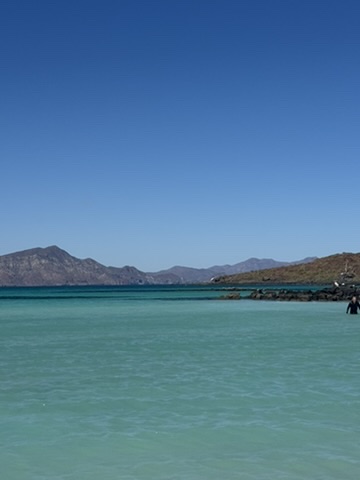
Photo Credit: Amy Tucker, 2026
I had no plan to see whales.
The boat tour was about the island, about Coronado with its ancient volcanic stone rising from the sea like something too dramatic to be real. I wanted to see the geology. Wanted to understand how fire becomes stone, how destruction becomes foundation, how violence cooled into something that now holds life.
The whales were absent from the itinerary. They were passing through. We were lucky, the captain said. Muy afortunados.
Grey Whale
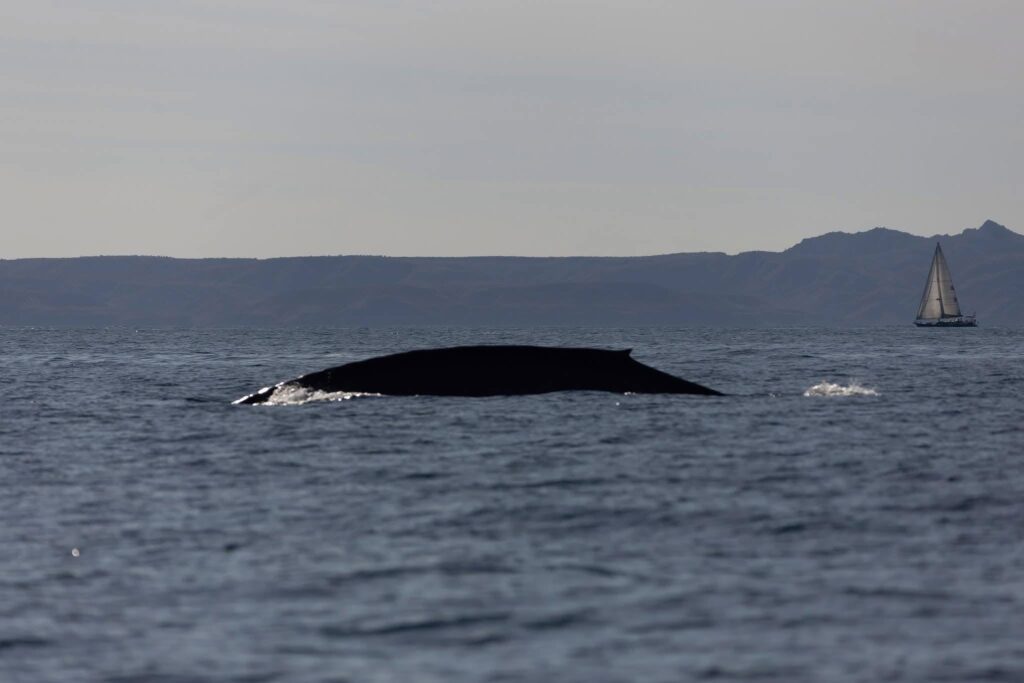
Photo Credit: Amy Tucker, 2026
I felt anything but lucky at first. I felt unprepared. As though I should have known this was possible, should have researched grey whale migration patterns, should have brought a better camera, should have been ready for this moment rather than sitting in a small boat with no idea where to look or what I was about to see.
Then the water broke, and there was a back. Grey. Massive. Longer than our boat. The whale surfaced, breathed (a sound I cannot describe except to say it sounded like the ocean exhaling), and disappeared again into water that closed over it as though nothing that large had just been there.
I forgot about being prepared. Forgot about cameras. Just watched the space where the whale had been, waiting, holding my breath, aware suddenly of my own breathing in a way I had forgotten since the panic attacks that brought me here began to ease. The whale breathes air like I breathe air. We are both mammals. Both carry our ancestors’ decision to leave the ocean and then (in the whale’s case) the decision to return. Both are shaped by evolutionary pressures I can name but struggle to fully comprehend.
The whale surfaced again. Fifty metres ahead this time. I could see barnacles clustered on its head, the mottled grey of skin that looked like stone worn smooth by water. Another breath. Another dive. And I realised I was crying. Quietly, undramatically. Just tears on my face that I left alone because they felt like the right response to whatever was happening.
van der Kolk (2014) writes that trauma resolution occurs less through understanding than through the body’s learning to feel safe again. I have been here two weeks learning that lesson: letting my body remember what safety feels like. But something about the whale’s presence intensified it. The whale’s breath synchronised my own breathing in ways beyond my control. My nervous system responded to the whale’s presence before my mind registered what I was seeing. This is what Porges (2011) calls neuroception, the body’s capacity to detect safety or danger below conscious awareness through environmental cues, including, apparently, the respiratory patterns of other mammals.
Learning Scale Through Bodies
I have been thinking about scale.
Egypt Gods
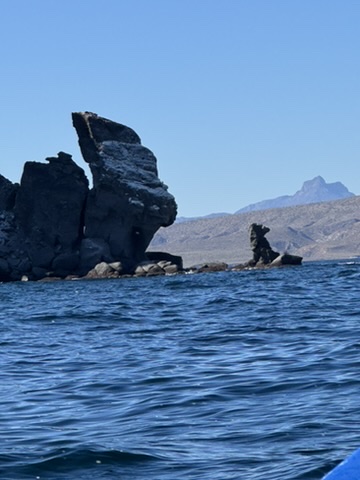
Photo Credit: Amy Tucker, 2026
For two weeks, I have been learning to feel small in ways that leave me whole. Small against the stars. Small against the sea. Small against geologic time. But the whale is different. The whale is something other than cosmic distance or abstract deep time. The whale is right here, breathing the same air I am breathing, made of the same carbon and oxygen and complexity. And it is so much larger than me that my body cannot quite process it.
Fifteen metres long, the guide said. Up to forty tonnes. These are numbers. They mean nothing until you are in a six-metre boat and a whale surfaces close enough that you understand: I am the size of the whale’s eye. Maybe smaller. The whale could overturn this boat without meaning to, just by surfacing in the wrong place. We are here because the whale allows it. Because the whale, in its vast mammalian intelligence, has chosen to regard us as harmless.
This is different from the stars’ indifference. The stars choose nothing. They simply are, and my presence or absence makes no difference to them. But the whale is aware. The whale has agency. The whale sees me (I watched its eye track our boat as it passed) and makes decisions about whether I am worth noticing, worth avoiding, or worth approaching. I am in a relationship with the whale, whether I intended it or otherwise. And the whale, by refraining from destroying us, by passing peacefully, by allowing us to witness, is teaching me something about coexistence I had no idea I needed to learn.
Sea Lions on the Rocks
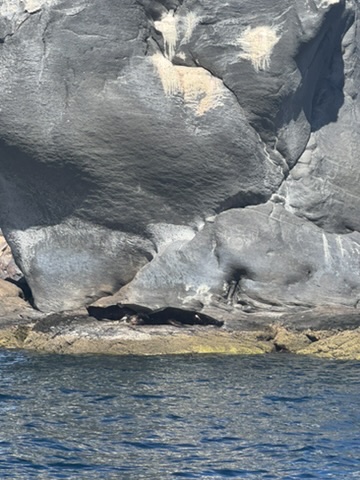
Photo Credit: Amy Tucker, 2026
Buber (1923/1970) writes about I-Thou relationships, encounters where the other is met as subject rather than object, where genuine relation becomes possible even across vast differences. The whale encounter fell short of I-Thou in Buber’s full sense (the whale was silent toward me, was entering no reciprocal relation), and yet it resisted the category of I-It (the whale as object, as thing to be observed). It was something in between. Something more like: we share this moment. We share this water. We share the fact of being alive at the same time in the same place, and that sharing, however brief, however one-sided, matters.
Boss (1999) writes about ambiguous loss, about relationships that defy clear categories. I am thinking about this now in a different context. What is my relationship with the whale? Beyond connection in the usual sense (the whale carries no knowledge of me). Beyond threat (I pose none). Beyond kinship (though we share mammalian ancestry, that seems too distant a claim to make). Something else. Something more like a witness. I witnessed the whale. The whale, perhaps, witnessed me. And that mutual witnessing, even without recognition or acknowledgment, creates a kind of relation that matters.
The whale needs nothing from my witnessing. But I seem to need to witness the whale. Need to know that something this large, this ancient (grey whales as a species evolved approximately 2.5 million years ago; Swartz, 2018), this indifferent to human concern still exists. Still migrates. Still breathes air, nurses its young, and navigates thousands of kilometres using senses I cannot imagine. The whale’s existence, independent of my need for it, feels like permission. Permission to exist independently of others’ needs for me. Permission to migrate toward what I need without justifying the journey. Permission to be large in my own right, even when that largeness is invisible to those who look at me and see only the surface.
Fire Becoming Stone: On Transformation and Time
We continued toward Coronado Island, and I was quiet.
The others in the boat were talking about the whales, about luck, about whether we might see more on the return trip. I had no words. No way to translate what I was feeling into words that would make sense to people who had seen the same thing I had seen, but seemed to have experienced it differently. They saw whales. I saw something I still lack language for.
The island rose ahead of us. Red and black stone. Sharp angles softened by millennia of erosion, but are still clearly volcanic. The guide explained the geology: an ancient volcano, now extinct, part of the volcanic chain formed when tectonic plates pulled apart millions of years ago, and magma rose to fill the gaps. The red is iron oxide. The black is basalt. The textures tell stories about how quickly lava cooled, how gas bubbles were trapped and never escaped.
I listened, but I was thinking about something else. About fire becoming stone. About destruction becoming a foundation. About the fact that everything solid was once liquid, once too hot to touch, once actively destroying everything it encountered. And now it sits peacefully in the sun. Now it is a habitat. Now birds nest on it, sea lions bask on it, and fish hide in its underwater crevices.
What does it take for violence to cool into peace? How long? Under what conditions? Can a human lifetime be long enough for that transformation or do we need geologic time, millions of years, the patient work of water and wind wearing down sharp edges until they are smooth?
Herman (1992) writes that trauma recovery unfolds in stages: establishing safety, reconstructing the trauma narrative, and restoring connections with others. But she acknowledges that recovery follows no straight line, that setbacks occur, that some trauma leaves permanent marks even as healing proceeds. The volcanic stone teaches something similar. The violence of eruption is permanent in some sense, the stone will always be volcanic stone, will always carry the signature of fire in its composition and structure. But it is also transformed. Cooled. Made into something that can be touched, that can hold life, that is no longer actively destructive even as it remembers destruction.
I am carrying violence inside me. None of it my own. Violence witnessed. Violence absorbed through trying to protect someone beyond my reach to protect. The past five months have been volcanic: sudden eruptions, molten rage, heat that destroyed everything it touched. And I came here hoping that distance, time, and consistency might cool it. Might turn it from something actively harmful into something that can be lived with. Maybe even something that becomes a foundation.
Two weeks may or may be enough. If thirty days will be enough. If any amount of time in any location will be enough. But watching volcanic stone hold seabirds and sea lions, I felt something like hope. If fire can become this, maybe anything can transform. Maybe cooling is less about erasing what happened but about integration. About the violence becoming part of your structure without remaining your defining characteristic. About carrying fire’s memory without burning.
Touching Ground: Embodied Knowledge
We anchored in a small bay, and the captain said we could swim if we wanted.
I lowered myself into the water, and the cold shocked every thought out of my head. My body contracted. My breath stopped. Then started again, harsh and fast. Then slowed. Then the cold became bearable. Then it became exactly right.
I swam toward the island’s edge where stone met water. Underwater, volcanic rock was even more dramatic: sharp ridges, smooth faces, crevices dark with shadow and possibility. I reached out and touched it. Ran my hand along the surface. Rough. Solid. Still holding some memory of heat, though that heat is millions of years old, cooled now to ocean temperature.
My body knows stone differently than my mind knows it. My body reads texture, temperature, and solidity. My body has no use for tectonic plates or million-year timescales. My body just knows: this is real. This is here. This can be touched. And touching it changes something. The stone remains indifferent. But me. I have been changed by touching the stone that was once fire.
Volcano Rocks
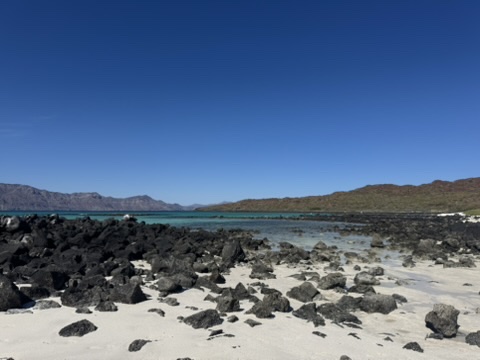
Photo Credit: Amy Tucker, 2026
Merleau-Ponty (1945/2012) writes about embodied perception, about how we know the world primarily through our bodies before we know it through concepts. The body’s knowledge is immediate, pre-reflective, and cannot be fully translated into language. This is what Sheets-Johnstone (2011) calls kinesthetic knowing, knowledge that emerges through movement and touch, through the body’s direct engagement with the material world. This knowing precedes and often exceeds what language can capture.
This is what I was experiencing in the water. Feeling the volcanic stone rather than thinking about it. Learning it through skin, through the resistance it offered when I pushed against it, through the way it scraped my palm when I held on too tightly. My body was gathering information my mind struggled to process: the stone’s texture, its temperature gradients, its stability, its indifference to my presence. All of this registered somatically before I had words for any of it.
Damasio (1994) argues that emotion and feeling are fundamentally embodied, that what we call consciousness emerges from the body’s ongoing process of self-regulation and environmental response. The body knows before the mind knows. The body responds before conscious thought directs it. And often the body knows things the mind never fully grasps because those things exist at the level of sensation, of immediate experience, of contact with the world that exceeds conceptual capture.
I stayed in the water longer than I intended. Kept swimming around the island’s edge, kept touching stone, kept trying to understand through my hands what my mind had yet to grasp. Eventually, I climbed back into the boat. Wrapped a towel around myself. Sat in the sun, which felt impossibly good after the cold. And thought: I came here to touch ground. That is what this month is. Touching ground after years of free-fall. Learning what is solid. Learning what holds.
Finding Pattern in Movement
The whales we saw this morning migrate up to twenty thousand kilometres annually. Arctic feeding grounds to Baja breeding lagoons and back. They navigate using what scientists believe is a combination of magnetic field detection, sun position, memory of coastline features, and possibly echolocation. Grey whales are baleen whales rather than toothed whales, so their sonar works differently from that of other sea mammals (Swartz, 2018).
What strikes me is the fact itself, more than the mechanism. Twenty thousand kilometres. Every year. For their entire lives. They stay in no one place. They are built for movement. Their survival requires migration, requires leaving feeding grounds when food runs out, requires travelling to warm water to give birth, and requires trusting that the journey is possible even when you cannot see the destination.
I have been thinking about this in relation to my own life. The constant movement. The inability to stay. Twenty-five years of contract work meant never knowing whether I would be in the same place next semester or next year. Always preparing to leave. Always holding relationships lightly because attachment to place or people or routine felt dangerous when any of it could be taken away with two weeks’ notice.
Standing (2011) writes about the precariat, the growing class of workers whose employment is temporary, insecure, and without benefits or stability. Precarious workers live in perpetual uncertainty, unable to plan for the future, unable to establish roots, always one crisis away from catastrophe. This precarity creates what Standing calls “status frustration” and chronic stress that accumulates over time, wearing away at health, relationships, and sense of self.
But the whale’s migration is different from my precarity. The whale chooses to leave. The whale knows where it is going. The whale has done this journey before and will do it again. There is certainty in the pattern, even though each journey is unique, even though conditions change, even though some years are harder than others. The whale’s movement carries no precarity. It is rhythm. It is a pattern. It is a kind of stability that emerges through movement, even because of it.
What I am attempting here is something like that. No true migration (I will return to the same city, the same life), but the development of a pattern. The trust that this rhythm I am establishing can be carried forward. That I can know where I am going even when I cannot yet see it. That leaving may carry no loss in it. Sometimes, leaving is how you find your way home.
Witness of Joy
On the trip, we also saw hundreds of sea lions.
Sea Lions Playing
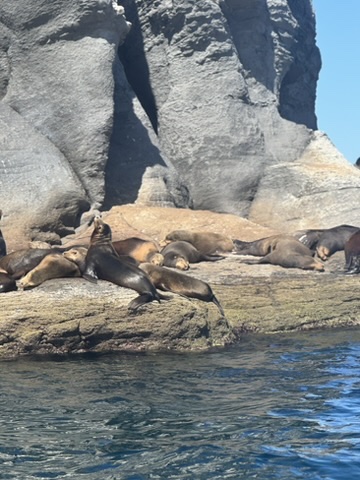
I watched them and cried again. No particular sadness in it. No pure happiness either. Just the body’s response to witnessing something it recognises but cannot name. What we call joy in humans belongs to a wider mammalian inheritance.
But watching them, my mind moved away from neuroscience. I was thinking about the five months before I came here. The heaviness. The way joy became impossible, through no choice for sadness but because the capacity for lightness had been worn away by constant vigilance, constant crisis, constant weight. I forgot that joy was possible. Forgot that bodies can move just for the pleasure of movement. Forgot that play is a real thing animals do, a fundamental expression of being alive.
Porges (2011) describes the social engagement system, the neural pathways that support play, connection, facial expression, and vocalization. This system only functions when the nervous system registers safety. When we are in threat states (sympathetic activation or dorsal vagal shutdown), the social engagement system goes offline. We cannot play. Cannot connect easily. Cannot access the lighter states that make joy possible. Play requires a nervous system at rest, a body that trusts its environment enough to lower its defences.
The Lioness
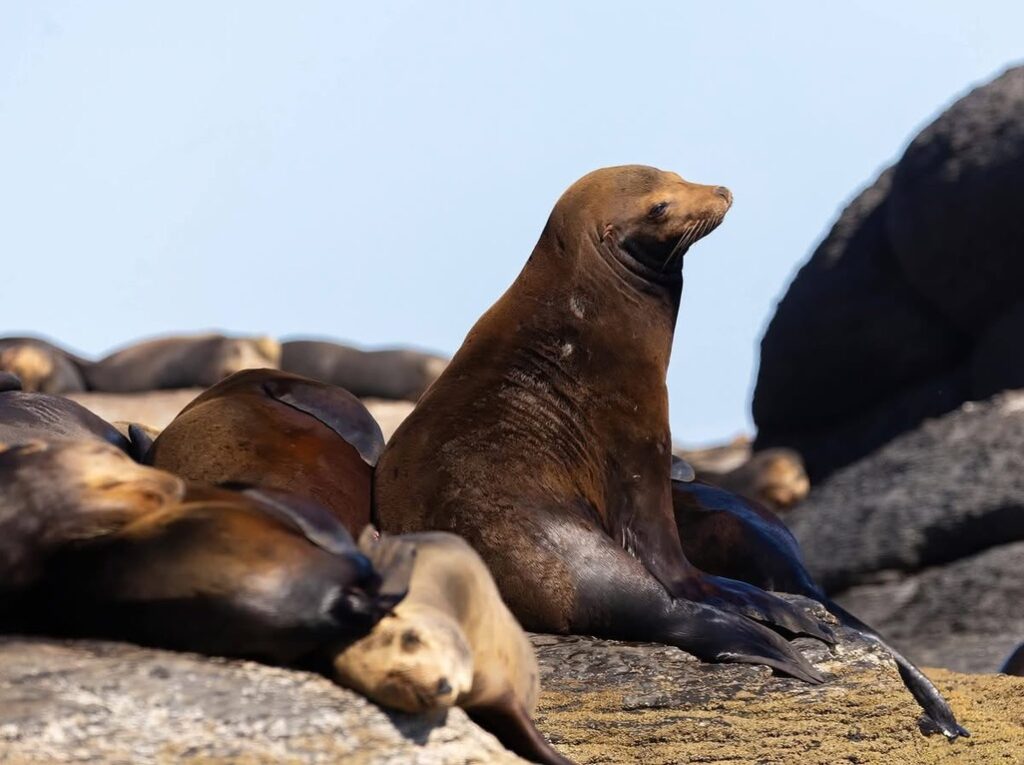
Photo Credit: Amy Tucker, 2026
Play has been absent from my life for months. Maybe years. Have been too vigilant, too responsible, too aware of everything that could go wrong to allow the kind of unselfconscious absorption that play requires. But watching the sea lions, I felt something shift. Recognition rather than permission. Recognition that the capacity for play still exists in me somewhere. That it has been temporarily inaccessible, dormant but alive. The nervous system can move from a chronic threat response back to states where play becomes possible.
The sea lions do it. That whales do it (I read later that grey whales are known to approach boats, allowing humans to touch them, seeming curious about us in ways that look like play). That maybe, given enough time, safety, and consistency, I can do it too.
Brown and Vaughan (2009) argue that play is essential rather than frivolous, serving crucial functions in mammalian development and adult well-being: reducing stress, building social bonds, enhancing creativity, and maintaining cognitive flexibility. The absence of play, they suggest, is a marker of systems under stress, of lives organised around survival rather than flourishing.
I understood: I have been in survival mode. The return to play will signal that something fundamental has shifted. That I am safe enough to be playful again.
Making Meaning
Back at the dock, stepping from boat to land, I felt unsteady.
Physically, I was fine. But something about spending hours on water had changed my relationship with solid ground. The architectural structures of human settlement: buildings, walls, boundaries water lacks.
Afternoon Seista
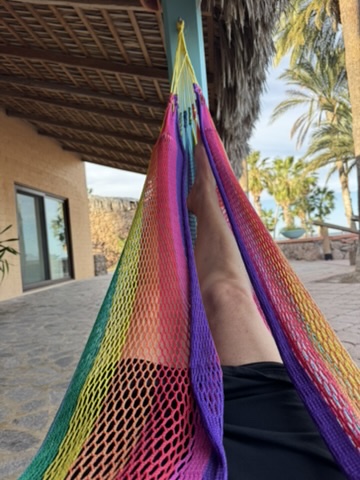
That evening, I lay in a hammock and thought about the day. About whales’ breathing. About volcanic stone, teaching me that fire can be cooled. About sea lions playing. About my body’s response to all of it: unplanned tears, unexpected joy, a steadiness that came from witnessing things beyond my control continuing to exist in their full complexity.
Nash (2004) writes that scholarly personal narrative requires staying with experience long enough to understand what it means, resisting the rush to conclusions and allowing meaning to emerge through sustained reflection. This is the work of meaning-making, as Park (2010) describes the process by which individuals integrate difficult experiences into their life narratives, restoring a sense of coherence and purpose. Meaning-making bypasses silver linings and forced positive interpretations. It is about the harder work of acknowledging what happened, sitting with its difficulty, and gradually discovering how it connects to the larger story of who you are and what matters to you.
I am doing that now. Making no claim to understand what today meant, only acknowledging that it did. That seeing whales changed something in me I cannot yet name. That touching volcanic stone mattered. That witnessing sea lions mattered. That my body knows things my mind has yet to find language for.
Sea Lions
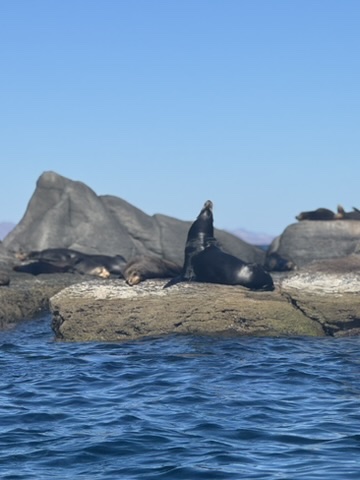
Photo Credit: Amy Tucker, 2026
Tomorrow I will wake, and the whales will be farther north. The sea lions will be somewhere else in the sea. The volcanic stone will still be there, still cooling, still becoming whatever it is becoming over timescales I cannot comprehend. And I will still be here, still learning what it means to be small and temporary and witness to things larger and older and more indifferent than I am.
But I will carry today. The sound of whale breath. The texture of volcanic stone under my hand. The sight of the sea lions. The recognition that my body still remembers how to cry in response to beauty, still registers awe even after months of numbness, still has capacity for the kind of witness that feels like prayer even when belief in anything to pray to has left you.
Rock Formations
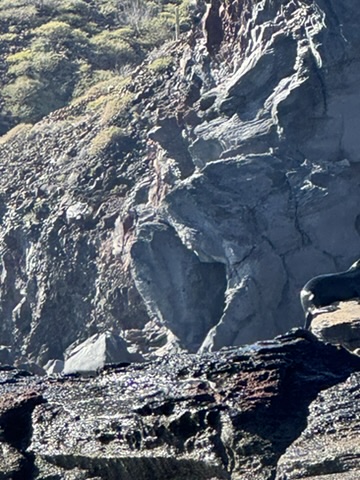
Photo Credit: Amy Tucker, 2026
Gracias, ballenas. Thank you, whales.
Por respirar donde yo podía oírte. For breathing where I could hear you.
Gracias, piedra volcánica. Thank you, volcanic stone.
Por recordarme el juego. To remind me about play.
Gracias, cuerpo. Thank you, body.
Por saber cómo llorar cuando las palabras no bastan. For knowing how to cry when words fall short.
Translation note. Spanish language passages were generated using Google Translate and subsequently reviewed and refined by the author. Any remaining infelicities reflect the limits of machine translation rather than intent.
References
Boss, P. (1999). Ambiguous loss: Learning to live with unresolved grief. Harvard University Press.
Brown, S., & Vaughan, C. (2009). Play: How it shapes the brain, opens the imagination, and invigorates the soul. Avery.
Buber, M. (1970). I and Thou (W. Kaufmann, Trans.). Charles Scribner’s Sons. (Original work published 1923)
Damasio, A. R. (1994). Descartes’ error: Emotion, reason, and the human brain. Putnam.
Google. (n.d.). Google Translate. https://translate.google.com
Herman, J. L. (1992). Trauma and recovery: The aftermath of violence, from domestic abuse to political terror. Basic Books.
Merleau-Ponty, M. (2012). Phenomenology of perception (D. A. Landes, Trans.). Routledge. (Original work published 1945)
Nash, R. J. (2004). Liberating scholarly writing: The power of personal narrative. Teachers College Press.
Park, C. L. (2010). Making sense of the meaning literature: An integrative review of meaning making and its effects on adjustment to stressful life events. Psychological Bulletin, 136(2), 257–301. https://doi.org/10.1037/a0018301
Porges, S. W. (2011). The polyvagal theory: Neurophysiological foundations of emotions, attachment, communication, and self-regulation. W. W. Norton & Company.
Sheets-Johnstone, M. (2011). The primacy of movement.
Standing, G. (2011). The precariat: The new dangerous class. Bloomsbury Academic.
Swartz, S. L. (2018). Gray whale (Eschrichtius robustus). In B. Würsig, J. G. M. Thewissen, & K. M. Kovacs (Eds.), Encyclopedia of marine mammals (3rd ed., pp. 422–428). Academic Press.
van der Kolk, B. A. (2014). The body keeps the score: Brain, mind, and body in the healing of trauma. Viking.
Whales and stone: two orders of time meeting the human body. The whale's presence — a creature of vast scale, indifferent to the observer — is a profound instance of what Kaplan and Kaplan (1989) call extent: an environment large enough to contain and exceed the self, producing the felt sense of being part of something beyond individual concern. This encounter also instantiates alonetude (Tucker, 2026) at its most expansive: alone in the presence of something vast, the self becomes appropriately small, and the experience is not frightening but freeing.