The Earth Beneath My Feet
The Sea Etched in the Earth
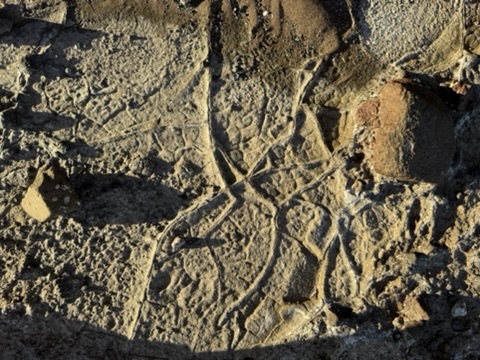
Photo Credit: Amy Tucker, 2026
I woke this morning thinking about roots.
Actually thinking about roots. About how they reach downward into darkness. About how they find water through the soil. About how they hold plants steady against wind while also drawing nutrients upward into the stem, leaf, and flower. Roots as anchor and conduit. Roots as holding and feeding at once.
My attention has been held by the sea. Twelve days of walking in it, watching it, letting it move through my body. Yet this morning, my awareness shifted downward rather than outward. Toward earth. Toward the land that holds this place, this village, this precise curve of coast where the Sea of Cortez meets the Baja desert.
The land has always been here. I have walked across it daily. Still, my attention treated it as surface, as passage, as the space between cottage and shoreline. Water received my devotion. Land remained background.
This morning, I attended differently.
Turning from Water to Land
Today I leave my current space and move to a small village called Nopoló, also settled along the sea’s edge. The change feels subtle yet consequential. A relocation measured in minutes yet weighted with meaning. A shift in orientation rather than distance.
The Colonial Village
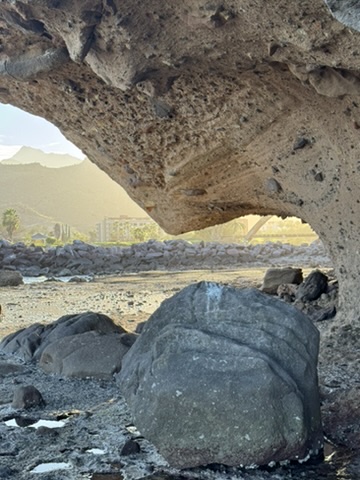
Photo Credit: Amy Tucker, 2026
Entering the Landscape
In the afternoon, I explore Loreto Bay at Nopoló. The sea, the rock formations, the cliffs. I move slowly, allowing the landscape to lead rather than plans or expectations.
The earth here carries a different texture than the earth I know. Rocky. Sparse. The colour of sand, yet compacted and dense, shaped by centuries of sun, wind, and a climate where rain arrives rarely and leaves quickly. Growth here reflects careful strategy. Cacti store water patiently. Shrubs hold small leaves that conserve moisture. Palms appear only where underground water rises close enough for roots to reach.
This kind of understanding emerges through long attention to place. Anthropologist Keith Basso describes how knowledge forms through sustained presence, through learning how the landscape holds memory, instruction, and meaning over time (Basso, 1996). The Cochimí people lived on this land for thousands of years before the arrival of Spanish missions. They knew which plants carried water in their roots. Which animals moved through during particular seasons? Where springs surfaced after rare rains. How weather revealed itself through birds, air, and light.
I lack this knowledge. Thirteen days cannot produce it. Still, attention can begin. I can notice that the land teaches differently from the sea. Each carries wisdom shaped by its own rhythms.
Learning What the Land Knows
Place-based learning grows from exactly this kind of attention. Knowledge is formed through bodily presence, through noticing patterns, textures, and temporal rhythms associated with a specific location. Gruenewald describes this learning as emerging from a relationship rather than abstraction, from inhabiting a place rather than observing it from a distance (Gruenewald, 2003). Ingold similarly writes that understanding arises through movement, through walking landscapes and learning their contours over time (Ingold, 2021).
Here, the land teaches patience. Economy. Endurance.
The Faces in the Rock
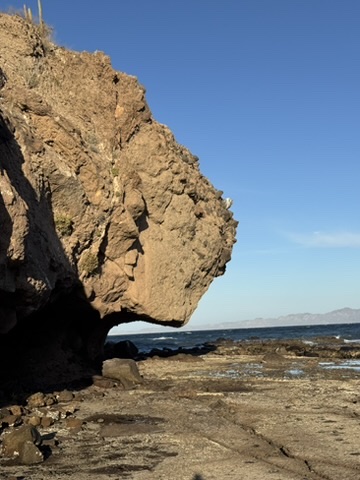
Photo Credit: Amy Tucker, 2026
I climb higher. The street becomes a dirt road. The dirt road becomes a path. The path leads to a small rise where I can see the village below me, the sea beyond it, and the islands visible in morning light across the channel.
I sit on a rock, a rock embedded in the earth, part of the hillside’s bone structure. Warm already from the sun, though the morning is still early. Rough texture. Solid.
My body recognises this differently from water. Water yields. Shapes itself around you. Holds you through buoyancy, through displacement, through the physics of floating. Rock is what yields to. Rock holds its form. Rock is a limit, a boundary, a fact that stops you.
And yet that framing needs adjusting. Rock does yield. Just slowly. On timescales beyond human body perception. Wind erodes rock grain by grain. Water wears channels through stone. The mountain I am sitting on was once seafloor, thrust up by tectonic forces that continue to reshape this landscape, imperceptibly, constantly.
Geologic time: the scale at which mountains rise and fall, continents drift, oceans open and close. The scale at which everything solid reveals itself as fluid, moving at speeds that make our lifetimes appear like single breaths (McPhee, 1981).
Sitting on this rock, I am sitting on an ancient seafloor. The calcium in my bones came from the same ocean that deposited the limestone this rock is made of. I am made of the same elements as the mountain. Different arrangement. Different timescale. But the same stuff.
My body knows this. My bones recognise stone. The calcium, the minerals, and the slow patient being that both rock and bone share.
The History of Time
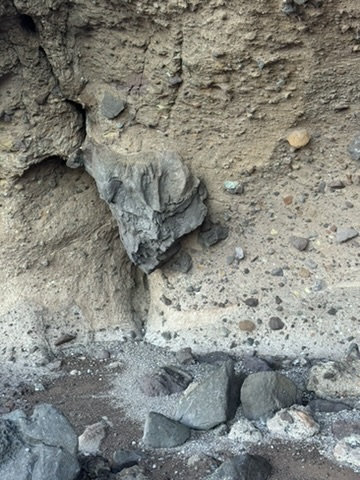
Photo Credit: Amy Tucker, 2026
Shared Heat
A lizard appears beside me. Small. Brown. Entirely still except for the pulse in its throat and the movement of eyes tracking something unseen.
We sit together for several minutes. Two beings warming ourselves on the same sunlit rock. The lizard remains. I remain. No negotiation. No interaction. Shared occupation.
This differs from encounters with village dogs, which involve social cues and mutual recognition. The lizard and I coexist. The rock holds us both.
When the lizard disappears into a narrow crack, I stay. Feeling warmth against my legs and palms. Feeling how my body prefers stone to sand or grass. Perhaps an ancestral memory. Mammals draping themselves across sun-warmed rock for temperature regulation.
Thermoregulation describes the capacity to maintain internal temperature. Humans rely on metabolism, shivering, sweating, and also behaviour. Seeking the sun. Seeking shade. Using the material world to support cellular life.
The lizard depends on this more actively. Still, I participate as well. Sitting. Warming. Settling.
The land teaches this, too. I am material. I require what stone requires. Stability. Mineral composition. Time. Stone holds what I require. Warmth. Solidity. Memory.
The Breath of the Sea
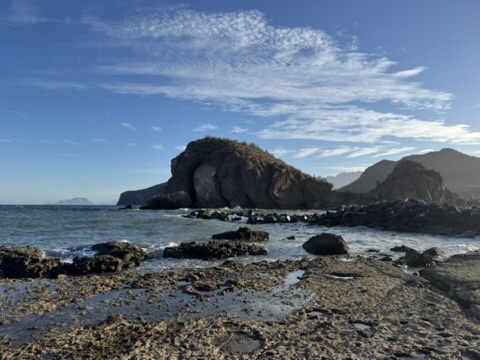
Photo Credit: Amy Tucker, 2026
Land as Relation
Walking back down the hill, I think about Indigenous land relationships. The Cochimí and later the Kiliwa and Paipai peoples understood themselves as continuous with the land, responsible to it and shaped by it (Shipek, 1988). Land existed as a relation rather than a possession.
This understanding largely disappeared within settler cultures. Land became property. Resource. Commodity. Something external to the body rather than continuous with it.
Basso writes that Western Apache people understand places as teachers. Places carry stories. Places remember. Time spent with place produces change. Knowledge emerges through relationship, through being shaped by landscape over time (Basso, 1996).
Thirteen days mark the beginning of this instruction. Teaching arrives through the body rather than language. Bones recognise stone. Lungs adapt to this particular air. Skin acquires a balance among sun, wind, and dryness.
What Place Teaches
This reflects place-based learning. Knowledge formed through sustained physical presence. Through walking contours. Through noticing what grows where and why. Through feeling the weather on the skin. Through reading time through light and seasonal rhythm (Gruenewald, 2003; Ingold, 2021).
The land teaches groundedness. Literal grounding. A reminder that I am terrestrial. That my legs belong to earth. That water offers refuge while land offers belonging.
Sea Bone
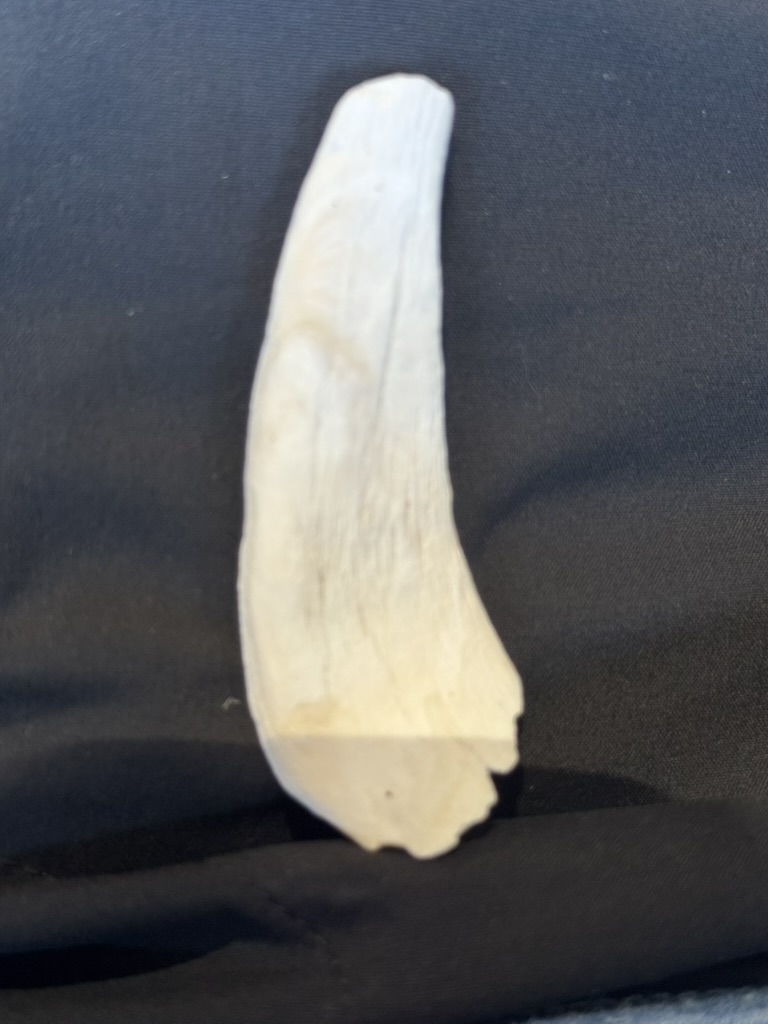
Photo Credit: Amy Tucker, 2026
Held, Temporarily
The day warms. Pelicans follow their mid-morning patterns. The sea continues its rhythms.
Something has shifted. Attention expands. Land joins water. Earth beneath the cottage. Mountains rising westward. Desert stretching along the peninsula. All alive. All teaching.
Tomorrow I will walk again. Perhaps up the arroyo that cuts through the village, dry now, shaped by rare floods. Perhaps south along the beach where buildings end, and desert meets sea without mediation.
The land has been here long before me. It will remain long after the cottage crumbles and the village becomes another layer in the geologic record. The rock that held me this morning has existed for millions of years. It will continue for millions more.
I am here briefly. The land holds me the way it holds everything. Temporarily. Lightly. Aware that all presence passes, all bodies return borrowed elements.
Gracias, tierra.
Thank you, Earth.
Por sostenerme.
For holding me.
Por enseñarme la paciencia.
For teaching me patience.
Por recordarme que soy hecha de ti.
For reminding me that I am made of you.
Y que volveré a ti.
And that I will return to you.
Shoreline
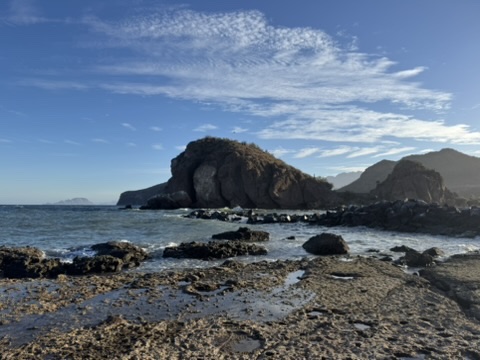
Photo Credit: Amy Tucker, 2026
Walking back down the hill, I think about Indigenous land relationships. How the Cochimí and later the Kiliwa and Paipai peoples understood themselves as part of land rather than separate from it, continuous with it, responsible to it and for it (Shipek, 1988).
This is what settler cultures have largely lost: the understanding that we are of the land rather than on it. That land is relation, kin, the material basis of existence that cannot be owned any more than you can own your own body (though capitalism tries to convince us we can and should).
Basso (1996) writes about how Western Apache people understand places as teachers. Actually, beyond metaphor. Places hold stories. Places remember. Places shape those who spend time with them. To know a place deeply is to be taught by it, changed by it, made into someone slightly different from who you were before you arrived.
I have been here for thirteen days. The place has begun to teach me. Through presence rather than language, and the land’s own language may always exceed my fluency, but through my body. Through my bones, recognising stone. Through my lungs, adjusting to this particular quality of air. Through my skin, learning this specific combination of sun, wind, and dryness.
Place-based learning: knowledge that emerges from sustained physical presence in a location rather than from books or lectures,on. From walking its contours. From noting what grows where and why. From feeling the weather on your skin and reading time through light, to learning the daily and seasonal rhythms that make this place what it is.
The land is teaching me something the sea cannot teach: groundedness. Literal grounding. The reminder that I am a terrestrial animal, that I walk on legs designed for earth rather than fins designed for water, that my primary relationship is with solid ground, even when I love the water.
The Tide
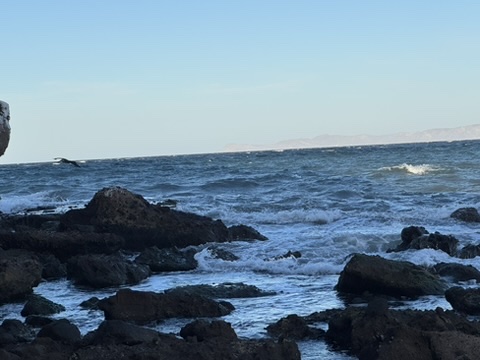
Back in my space now. The morning has warmed considerably. The pelicans are fishing their mid-morning pattern. The sea continues its rhythms.
But something has shifted in how I hold my attention. Less focused solely on water. More aware of the land: the earth under the cottage, the mountains rising to the west, the desert stretching north and south along the peninsula. All of it is alive. All of it is teaching.
Tomorrow I will walk again. Different direction perhaps. Up the arroyo that cuts through the village, dry now but carved by occasional floods when rare rains come. Or south along the beach to where buildings end, and desert meets sea directly, no human settlement mediating the meeting.
The land is here. Has been here. Will be here long after I leave, long after the cottage crumbles, long after the village itself becomes another layer in the geologic record. The rocks I sat on this morning have been sitting there for millions of years. They will sit there for millions more.
I am here for thirty days. The land holds me the way it holds everything: temporarily, lightly, knowing that all occupation is provisional, all presence fleeting, all bodies eventually returning to the elements they borrowed.
Gracias, tierra. Thank you, Earth.
Por sostenerme. For holding me.
Por enseñarme la paciencia. For teaching me patience.
Por recordarme que soy hecha de ti. To remind me, I am made of you.
Y que volveré a ti. And that I will return to you.
Translation Note
Note. Spanish-language passages were generated using Google Translate (Google, n.d.) and subsequently reviewed and refined by the author. Any remaining infelicities reflect the limits of machine translation rather than intent.
References
Basso, K. H. (1996). Wisdom sits in places: Landscape and language among the Western Apache. University of New Mexico Press.
Google. (n.d.). Google Translate. https://translate.google.com
Gruenewald, D. A. (2003). The best of both worlds: A critical pedagogy of place. Educational Researcher, 32(4), 3–12. https://doi.org/10.3102/0013189X032004003
Ingold, T. (2021). Being alive: Essays on movement, knowledge and description. Routledge.
McPhee, J. (1981). Basin and range. Farrar, Straus and Giroux.
Shipek, F. C. (1988). Pushed into the rocks: Southern California indian land tenure, 1769-1986. University of Nebraska Press.
Ground beneath the feet — earth, sand, rock — is one of the oldest somatic metaphors for stability. In Levine's (2010) somatic experiencing framework, grounding is a literal therapeutic practice: contact with the earth as a nervous system intervention, activating the sense of being held. The land of Baja California — Cochimí territory — is not neutral ground; this entry is implicitly engaged with what Wilson (2008) calls relational accountability in Indigenous research methodologies: the land has its own knowledge, its own history, and its own rights as a witness.