The Village Dogs
“You do not have to be good. You only have to let the soft animal of your body love what it loves.”
, Mary Oliver, 1986
The dog stands at the table as though she has been invited. Beyond begging. Beyond servility. Simply present, front paws on the table’s edge, looking out at the Sea of Cortez with the same quality of attention a person might bring to a sunset. Behind her, the early morning light turns everything gold: the water, the sand, the palm fronds moving in whatever breeze comes off the ocean this time of day. A plate of food sits on the white tablecloth. A drink sweats condensation in the heat. The dog notices these things the way you notice things that are simply part of the landscape, neither wanting them nor turning away from them. Just acknowledging: yes, these are here too.
Dog Enjoying the Sunrise
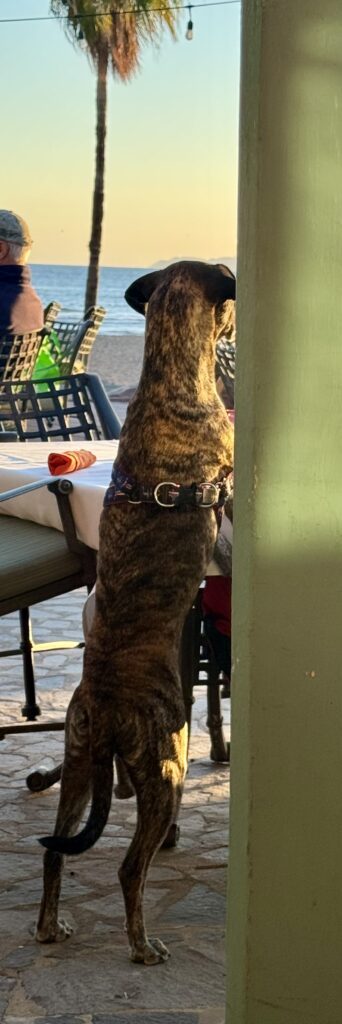
Photo Credit: Amy Tucker, 2026
I took this photograph this morning at a beachside restaurant where I enjoyed a cup of coffee. The dog appeared from nowhere in particular and everywhere at once. She checked the table the way dogs check things: a quick assessment to see whether this moment held anything that required her attention. Then she placed her paws on the table’s edge and turned her gaze outward, toward the water. The owner is getting coffee.
What struck me then and strikes me still looking at the image now is her posture. There is no asking in it. No supplication. No performance of need is designed to elicit care. She works toward nothing. She is simply a dog standing at a table at the edge of the sea, and if that position happens to be where food and drink exist, well, that is where food and drink exist. It leaves unchanged the essential fact of her presence, which requires no justification beyond itself.
I sat there for perhaps twenty minutes watching her. Other tourists approached, took photos, and moved on. A waiter brought fresh coffee to the table. No reluctance. No hurry. This part is complete; the next follows, and both are equally fine.
The village dogs of Loreto have been teaching me something I had yet to discover I needed to learn.
I wrote about them briefly in the early days here: the brown dog with gentle eyes who appeared that first evening, who sniffed my hand and then simply stood beside me in the fading light, two beings with nowhere particular to be. I called her a companion then, though companion suggests a relationship more defined than what we actually share. She appears. She stays, or she leaves. She requires nothing. I offer nothing beyond my presence. And somehow this non-relationship has become one of the steadiest features of my days here.
She is far from the only one. There are perhaps a dozen dogs I see regularly in the village. Brindle and brown and black and that particular dusty tan that seems designed by evolution to blend with sand. Well-fed, free of ownership. Collared occasionally (someone’s gesture of care) but clearly belonging to no one, or perhaps more accurately, belonging to everyone and therefore to themselves.
They move through the village with an ease I recognise as what I am attempting to learn. No schedule. No destination that must be reached. No performance of purpose to justify their occupation of space. They simply are where they are; when they are somewhere else, they are there instead, and the transition requires no explanation, no apology, no account of why the first place stopped being right and the second place became necessary.
My Lady Friend
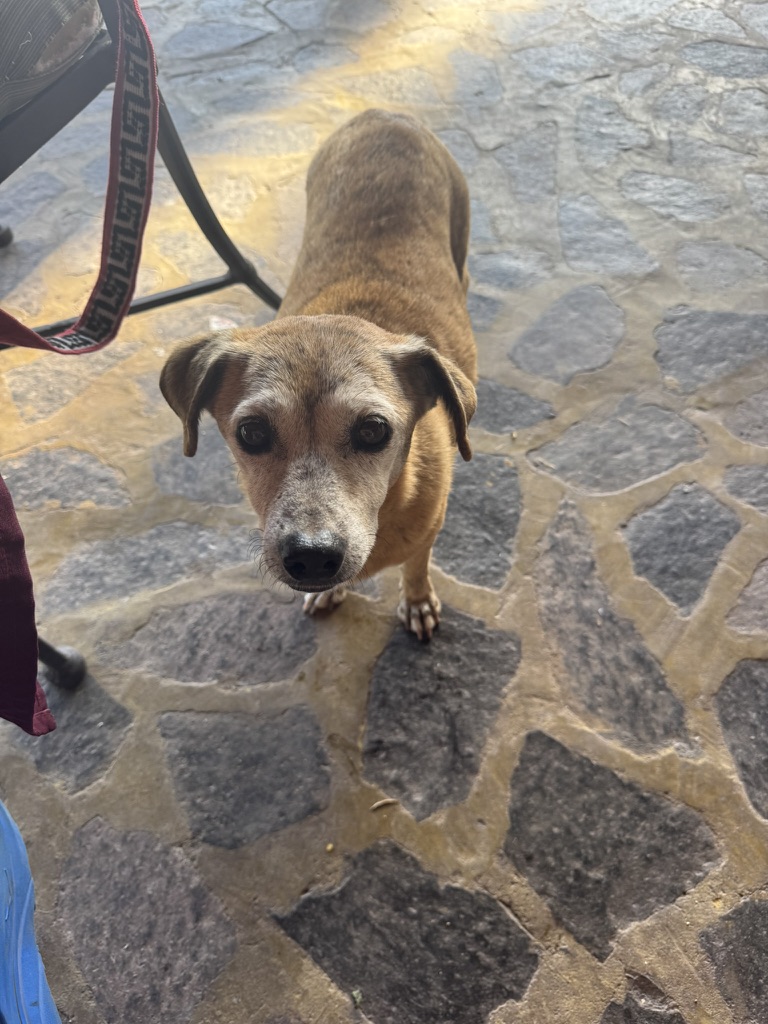
Photo Credit: Amy Tucker, 2026
I have been watching them for twelve days now with increasing attention. The way they navigate public space without claiming it. The way they accept care without becoming obligated. The way they rest in the middle of sidewalks, streets, or restaurant patios without any apparent concern that they might be inconveniencing someone. And the remarkable thing (the thing I am still trying to fully understand) is that the village allows this. More than allows it. Holds it. Make space for it. Treats it as simply as it is.
In the city where I lived for twenty-five years, this would be impossible. Dogs in restaurants must be leashed, under control, and clearly attached to responsible humans. Dogs on public beaches require permits. Dogs that exist without visible owners raise concern: Who is responsible for this animal? Who will manage it? Who vouches for its right to occupy space?
The questions come automatically, reflexively, born from a culture that cannot imagine existence without ownership, without someone being accountable, without the clear assignment of responsibility and control.
But here, the dogs simply exist, and the village simply lets them be. Feeds them when they are hungry. Gives them water when they are thirsty. Tolerates their presence at tables, in shops, and on beaches. And the dogs, for their part, seem to understand the unspoken agreement: we are here together, you and we, and the terms of our togetherness require neither ownership nor abandonment, neither claim nor rejection, just this ongoing negotiation of shared space that somehow works without anyone having to articulate the rules.
I realised, walking back to the cottage in the heat, that I had seen six different dogs in the space of an hour, and each one had seemed perfectly at ease wherever it was. No anxiety. No performance. Just dogs being dogs in the various locations where dogs be.
This is remarkable when you think about it. These are beyond the category of pets that have learned to read human moods and respond to human needs. These are beyond the working dogs with assigned tasks. These are dogs who have somehow negotiated a way of existing alongside humans without becoming dependent on them, without losing whatever essential dog-ness makes them what they are.
They are, I realise, practicing aloneness. Beyond the human version (the one that requires choosing, intending, and reflecting on whether you are doing it right), but alonetude nonetheless. Being with others without losing themselves. Accepting care without becoming obligated. Moving between community and solitude as each moment requires, without any of it needing to be a statement, a position, or a defended choice.
I have been thinking about what these dogs are teaching me about being in community without being consumed by it.
“Settling in asks surrender of nothing. It is choosing to stay with yourself.” Amy Tucker, 2026
For twenty-five years, I worked in an institution that demanded constant availability, constant responsiveness, and constant proof that I was committed, present, and performing my role adequately. Contract faculty hold far less authority to set boundaries than tenured faculty. You are available when needed. You adjust your schedule around theirs. You say yes even when yes costs you more than you can afford because saying no might mean being asked again.
This creates a particular relationship to community and to solitude. Community becomes something you perform. Solitude becomes something you seize in stolen moments, knowing you will be interrupted, knowing you need to stay alert for the email, the call, or the meeting that suddenly arises, requiring an immediate response.
The village dogs know nothing of this exhaustion. They exist in what I can only describe as a gift economy so old and so embedded that it has become invisible. The village feeds them because that is what the village does. The dogs provide companionship because that is what dogs provide. No contract. No performance evaluation. No calculation of whether the exchange balances.
Just: this is how we are together. These are the terms of our coexistence. It holds, or it falls away; if it stops holding, adjustments are made, but none of it requires the elaborate structure of obligation, debt, and credit that governed my professional relationships for all those years.
Watching them, I realise what I am trying to recover. Beyond isolation (I have never wanted that, and this month of intentional solitude has been about drawing near, never about fleeing human contact). What I want is what the dogs have: the capacity to be with others without losing myself. To accept care without becoming obligated. To offer presence without performing. To know when I need to be alone and when I want company, and to trust that both needs are legitimate and neither requires extensive justification.
The dogs are alone together. Present in the community, beyond being consumed by it. They rest in public space without apology. They approach when something interests them and walk away when it loses their interest. And somehow the village holds this, makes room for it, allows dogs to be dogs even amid human activity.
This is the model I am learning to inhabit. Beyond the isolation of withdrawal: the freedom of undefended presence. Being here without bracing. Receiving care without owing. Offering attention without depleting myself.
The brown dog is here again. She has been here for perhaps forty minutes. I have been writing. Neither of us has required anything of the other. We are simply here together, she in her rest and I in my work, and the togetherness asks nothing beyond the acknowledgment that we both occupy this space.
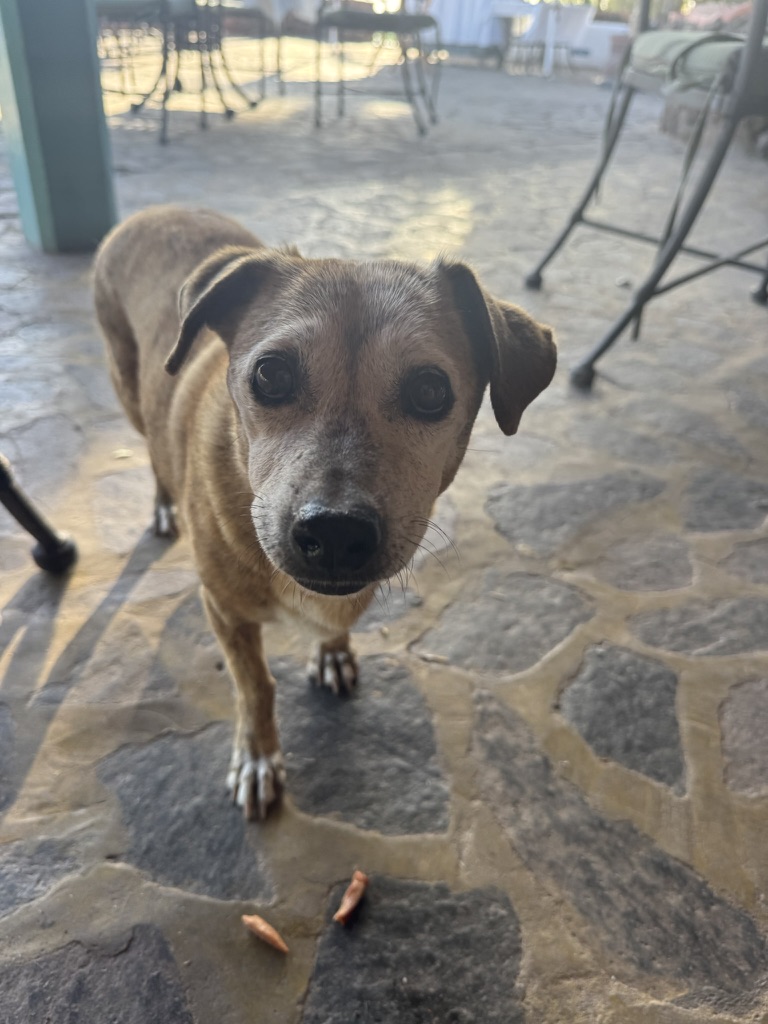
Photo Credit: Amy Tucker, 2026
The dog knows without any of this apparatus. She knows when to trust and when to be wary. She knows when to approach and when to hold distance. She knows when someone will feed her and when someone will pass by. She knows where shade is in the heat of the day and where the evening breeze comes first. She knows all of this immediately, without thought, without reflection, without the constant meta-commentary that humans call consciousness.
This is no less knowing. It is different knowing. And it might be the knowing I most need to recover: the capacity to respond to what is without the endless mediation of thought about response. To be hungry and eat. To be tired and rest. To want solitude and take it. To want company and seek it. Without justification. Without explanation. Without the entire apparatus of defence and rationalization that precarious employment built into me so deeply, I forgot it was anything other than natural.
Just: this is what the body knows. This is what the moment calls for. This is what I do.
The Freedom to Simply Be
“I am allowed to land. I am allowed to stay. I am allowed to soften.”
Amy Tucker, 2026
The dog has left now. I missed her leaving. I was focused on writing, and when I looked up, she was simply gone, off to wherever dogs go when they go. The light continues its shift toward darkness. Soon I will make dinner, following the rhythm that has become automatic. The evening will unfold as it has unfolded for eleven evenings before this one.
But something feels different tonight. Less effortful. Less monitored. As though I am finally beginning to inhabit the routine rather than performing it. Beginning to trust that my body knows what it needs and when, and that I can simply trust without constantly checking and verifying that I am resting correctly.
The dogs are teaching me this. How to be present without performance. How to accept care without obligation. How to exist in a community without losing the capacity for solitude. How to move between togetherness and apartness as the moment requires, without any of it being a statement or a defence or a position requiring elaborate justification.
Los perros del pueblo. The village dogs. Teachers with no awareness teach. Companions who require no relationship. Beings who practice alonetude so naturally they have no word for it because it is simply how they are.
I am learning from them. Slowly. With all the awkwardness of someone who forgot and is now remembering. But learning nonetheless. And tonight, this twelfth evening of intentional solitude, I feel closer to what they know. Closer to trusting my own knowing, the way they trust theirs. Closer to being what I am without the constant overlay of thought about whether I am being it correctly.
And I think again of Mary Oliver, the poet who reminded us to let the soft animal of the body love what it loves. Who asked, without urgency but with piercing clarity: “Tell me, what is it you plan to do / with your one wild and precious life?”
For the first time in a long while, I feel like I have an answer, though beyond words, and beyond any plan. It is in the small things: in the way I sit without bracing, in the way I walk without explanation, in the way I trust the day to shape itself without my need to define it in advance.
I, too, find my front paws on the table’s edge, beyond asking, beyond waiting, just watching the water shift its shape, and feeling the sun arrive exactly as it is.
Beyond performance. Beyond striving.
Just this: the body knows. The moment knows. The dog knows.
And that knowing, I am learning, is enough.
Thank you, my lady friend.
References
Haraway, D. (1988). Situated knowledges: The science question in feminism and the privilege of partial perspective. Feminist Studies, 14(3), 575–599. https://doi.org/10.2307/3178066
Oliver, M. (1986). Wild geese. In Dream work (pp. 14–15). Atlantic Monthly Press.
Serpell, J. (1995). The domestic dog: Its evolution, behaviour and interactions with people. Cambridge University Press.