The Rhythm of Days
Observing the Pelicans
The pelicans know when to stop.
I have been watching them for twenty minutes now, their final flights to roosting sites marked by something I can only describe as completeness. Simply no hurry. No reluctance. Just the simple recognition that the fishing day is done, that rest is what comes next, that tomorrow will bring another cycle.
They raise no question about whether they have fished enough. They carry no worry about tomorrow’s needs. They simply finish when finishing is what the body, the light, and the day require.
The Three Palms

Photo Credit: Amy Tucker, 2026
Discovering the Pattern
I am learning this. Estoy aprendiendo esto.
Eleven days of the same evening sequence, dinner as light begins to change, gentle movement, watching sky transform, settling into darkness, and something in me is finally believing it. The rhythm is something beyond my imposing. It is something I am joining. Something that was here before I arrived and will continue after I leave.
The pelicans taught me this first. Nowadays, the days themselves are teaching it.
My View
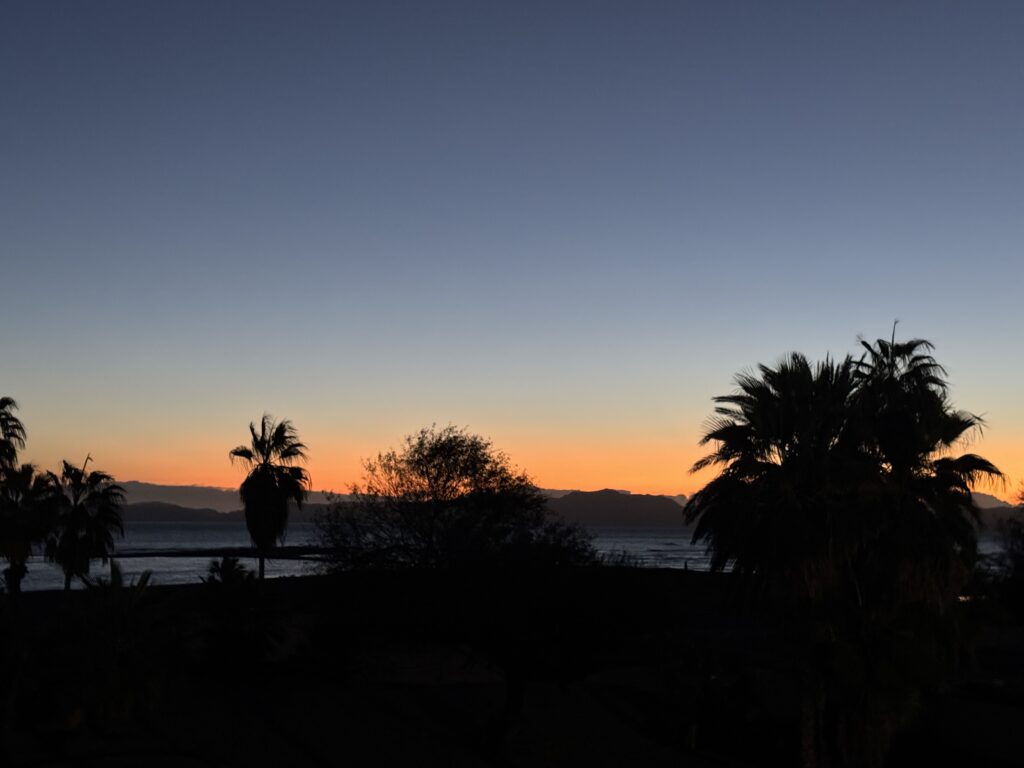
Photo Credit: Amy Tucker, 2026
Tonight, sitting on this balcony as stars appear one by one above the Sea of Cortez, the questions feel less urgent than they did this morning. Less like problems requiring a solution and more like… context. Background. The theoretical scaffolding that helps me understand the larger significance of what I am doing here, yet the thing itself remains just beyond language.
The thing itself is simpler.
Unlearning Vigilance
I came here exhausted. Sleep fragmented, thoughts scattered, body braced against threats that had become so constant I no longer noticed the bracing. Twenty-five years of precarious employment had taught my nervous system a particular kind of vigilance, necessary for survival, corrosive to everything else.
My body was more than tired. It was dysregulated.
I was beyond overworked. I had become wired for survival. Survival allows no room for rest. It requires vigilance, constant adaptation, and the refusal to soften.
Now, after days of consistency, the rhythm is beginning to offer a different experience. A quiet structure. A sense of what comes next. The return of a nervous system that no longer waits for disruption, but begins to anticipate calm.
It is subtle. Gentle. Emerging like light at the edge of morning.
What once felt like repetition now feels like relief. The pattern releases me from constraint. It holds me. It offers what the nervous system has long needed but could never request: predictability, softness, and something that resembles safety.
Eleven days of consistent rhythm, and the bracing is releasing. All at once? No. Dramatically? No. Just gradually, like ice melting so slowly you barely notice the transition from solid to liquid, you only notice one day that what was frozen is now flowing.
Reclaiming Routine
I have been thinking about routine.
For twenty-five years, routine was what I resisted. Every semester brought different courses, different students, different schedules cobbled together from whatever the institution needed and was willing to pay for. I prided myself on adaptability. On being able to shift quickly. On moving without consistency.
But that pride was really a cover story for precarity. You cannot depend on routine when your employment is contingent. You learn instead to be endlessly flexible, endlessly available, ready to reconfigure your life around whatever work appears.
These eleven days have shown me what I lost in that flexibility.
The routine here is simple. Wake with the light. Swim in the morning. Read. Walk in the afternoon when the heat has softened. Watch pelicans. Make dinner as the sky transforms. Sit on the patio as stars appear. Sleep.
Collected Beach Treasures
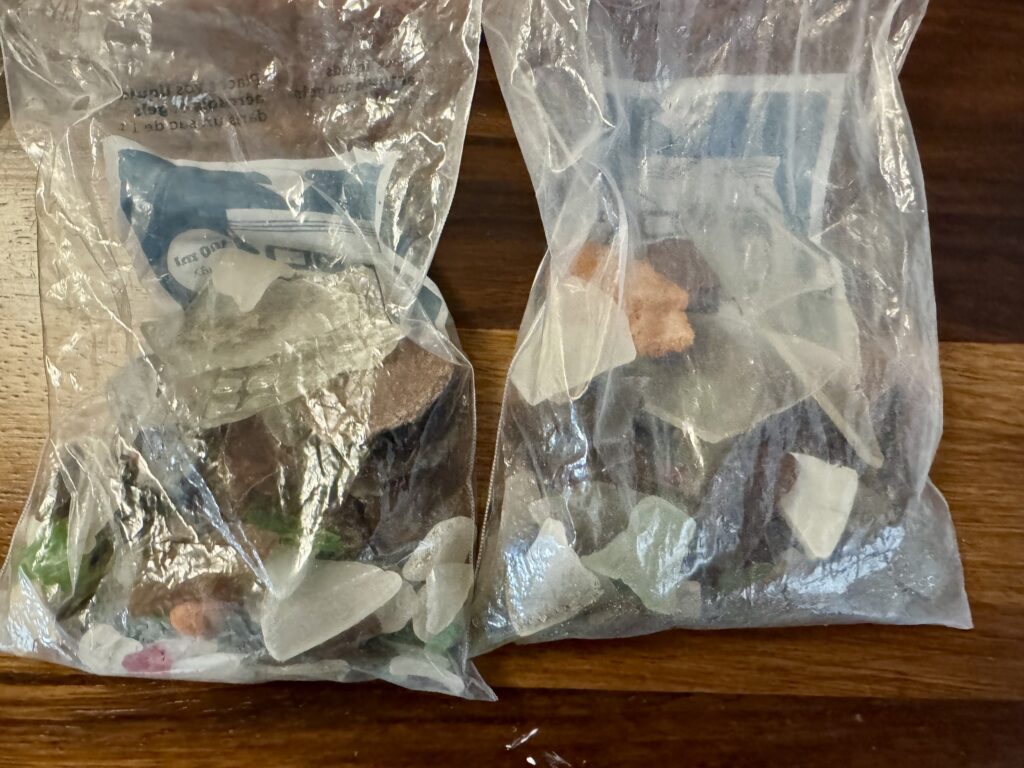
Photo Credit: Amy Tucker, 2026
The same pattern, day after day.
It is a healing ritual, organic rather than imposed, beyond the performative, emergent. A sequence the body now recognises as kind. As sacred. As home.
And instead of feeling monotonous or constraining, it feels… liberating. My nervous system knows what comes next. My body can anticipate the rhythm. I can release the need to constantly recalibrate, constantly adjust, and constantly brace for the unexpected.
The routine holds me. And in being held, I can finally let go.
This is what I would call settledness. Or maybe: re-inhabiting the self. It is beyond transcendence. It is about being able to stay with myself, without bracing, without apology.
This is what I came here to discover, though I arrived without knowing it. Beyond dramatic transformation. Beyond sudden enlightenment. Just the quiet recognition that routine is the ally, never the enemy, of freedom. Precarity is. Routine, the kind you choose, the kind that serves your actual needs rather than someone else’s demands, is the structure that makes freedom possible.
Afternoon Seista
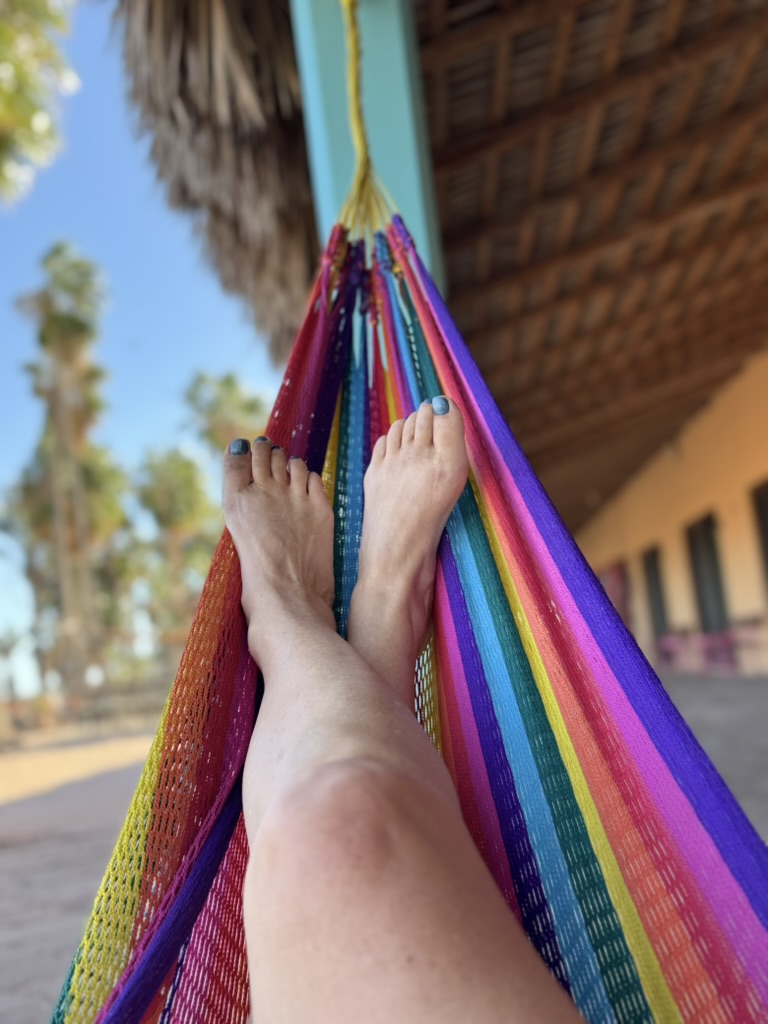
Photo Credit: Amy Tucker, 2026
Evening Reflection: What the Day Held
Pelicans are completing their fishing day. Sky is transforming through its sequence. My own completion of the day’s work, reading done, walking done, body cared for, mind given what it needs.
The pattern repeats. And I am learning to trust the pattern.
Tomorrow I will read more deeply, Haraway on situated knowledges, more Ahmed on orientation and the work of reorientation. The theoretical scaffolding continues to grow, helping me grasp the broader significance of what I am documenting here.
But tonight the theory feels secondary to something simpler. To the recognition that my body has stopped bracing. That sleep comes without struggle. That I can sit on a balcony in the evening watching pelicans and feel… at peace. Simply at peace. Without needing to analyse it, justify it, or turn it into something useful.
Good Night Loreto
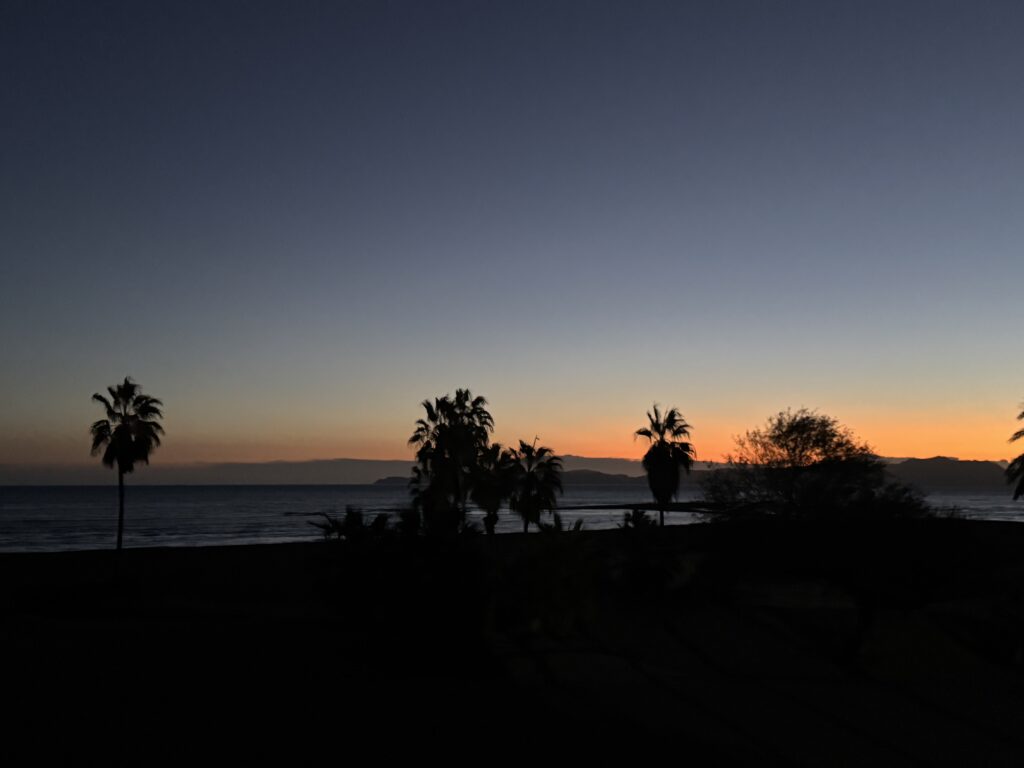
Photo Credit: Amy Tucker, 2026
This is alonetude. Beyond concept. Beyond framework. Just this: being with yourself in a rhythm that your nervous system trusts, in a place that feels safe enough to finally stop performing, surrounded by the ordinary beauty of birds and water and light that asks nothing of you except that you notice.
I notice.
Lo noto.
And tonight, that is enough.
~
Tonight I will follow the familiar sequence.
Dinner already eaten, simple fish grilled with lime, rice, and vegetables that I no longer think about preparing, my hands knowing now what the routine requires. Cottage already tidied, the small acts of care that signal evening’s approach. Soon I will dim the lights, sit on the patio and watch the stars emerge, then shower and prepare for sleep.
Will I sleep through? Fifth night in a row? Or will tonight bring waking, the pattern interrupted, the nervous system deciding it needs to check, to assess, to maintain some vestige of vigilance?
The answer remains open. But tonight I notice something different in my open-wondering. No anxiety about whether I will sleep. Just… curiosity. The way you might wonder whether it will rain tomorrow. Information that will reveal itself when it reveals itself. Nothing to control. Nothing to fix in advance.
This, too, is letting go. Learning to hold the question without needing to force the answer.
The pelicans carry no worry about tomorrow’s fishing. They simply rest tonight, trusting that tomorrow will bring what it brings, that they will respond to what it requires, that the rhythm will continue, with or without their worry.
I am learning from them. Slowly. With the particular awkwardness that comes from unlearning decades of vigilance. But learning.
The day ends. Another day will begin. The rhythm continues.
And I am here, finally, learning how to join it rather than fight it.
Credit: NotebookLM 2026
El ritmo de los días.
The rhythm of days.
Simple. Constante. Sanador.
Simple. Constant. Healing.
No necesito entenderlo completamente.
Understanding it completely can wait.
Solo necesito confiar en él.
I only need to trust it.
Y esta noche, confío.
And tonight, I trust.
El patrón sostiene.
The pattern holds.
El cuerpo descansa.
The body rests.
Y eso es suficiente.
And that is enough.
When we are at last able to rest, we learn that effort was never the only way to belong.
Amy Tucker, 2026
References
Ahmed, S. (2006). Queer phenomenology: Orientations, objects, others. Duke University Press.
Google. (n.d.). Google Translate. https://translate.google.com
Google. (2026). El Ritmo de los Días [AI-generated image]. NotebookLM. https://notebooklm.google.com
Nash, R. J. (2004). Liberating scholarly writing: The power of personal narrative. Teachers College Press.
Translation Note
Note. Spanish-language passages were generated using Google Translate (Google, n.d.) and subsequently reviewed and refined by the author. Any remaining infelicities reflect the limits of machine translation rather than intent.