Ten days to build a foundation. Not much, you might think. Not enough time to accomplish anything significant.
But foundations are not meant to be impressive. They are meant to be solid. Hidden underground, bearing weight, making everything above them possible.
I came here exhausted. Sleep fragmented, thoughts scattered, body braced for threats that never came but whose approach I had learned to anticipate with the precision of an expert meteorologist reading the weather that only I could see.
Ten days to teach my nervous system: The emergency is over. The storm has passed. You can stop bracing now.
Ten days of the same evening sequence. Ten days of the same morning light. Ten days of pelican fishing at predictable times. Ten days of waves maintaining their patient rhythm. Ten days of data accumulating below conscious awareness.
And somewhere in those ten days, my body decided to believe it.
La fundación sostiene. The foundation holds.
Not because I forced it. Not because I earned it. Not because I proved myself worthy.
Because I maintained conditions. Because I honoured rhythms. Because I stopped interfering with processes wiser than conscious thought.
Ten days. Diez días.
The Sand Shadow
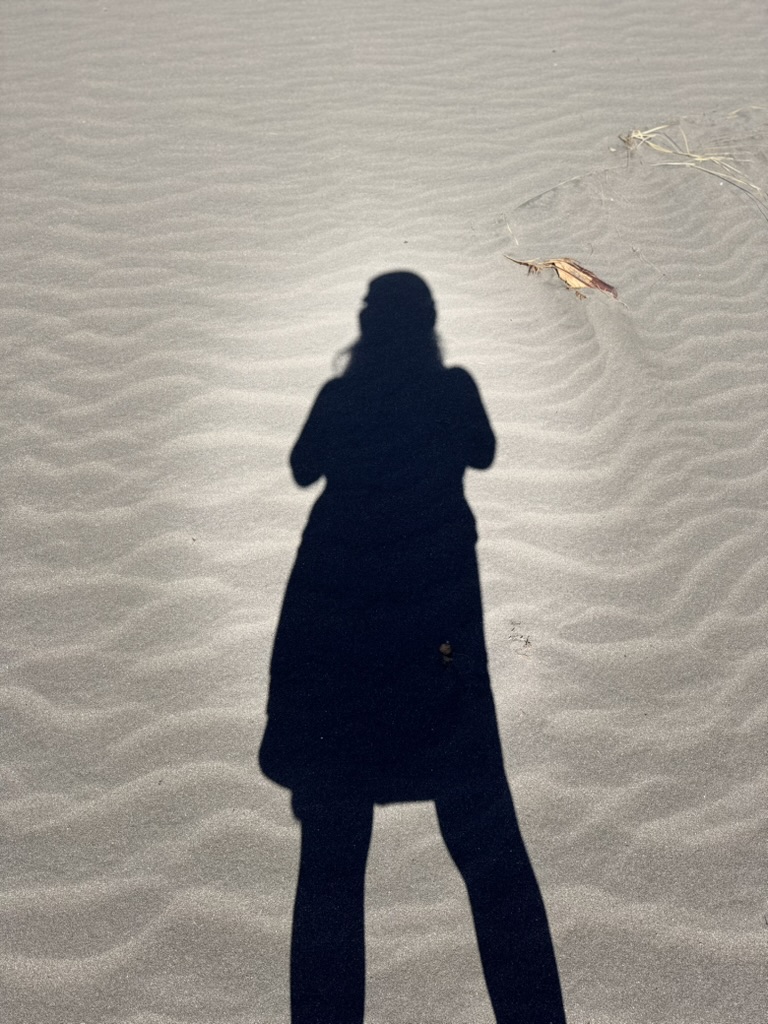
Photo Credit: Amy Tucker, 2026
Author: amytucker
Weytk.
I am Amy Tucker, an educator whose life has been shaped by questions of belonging, precarity, and the institutions that hold us or let us fall.
I was the first person in my family to attend university. By the time I was twenty-five, I was a single mother of three, working at a donut shop, taking courses part-time when I could afford them, learning what it means to calculate whether you can afford both groceries and textbooks. Those years taught me things about resilience and systemic exclusion that no textbook could convey. They also taught me that the academy is simultaneously a site of possibility and a space where people like me were never quite expected to arrive.
For twenty-five years, I have worked in education, including eighteen years at Thompson Rivers University on the unceded territory of the Tk'emlúps te Secwépemc within Secwépemcúl'ecw. Seventeen of those years have been as a contract faculty member, teaching organisational behaviour, business ethics, strategic leadership, teamwork, creativity and innovation, and human resources. I also serve as Prior Learning Assessment Advisor, guiding learners to recognise and document the knowledge they carry from lived experience. My pedagogy draws from trauma-informed education, Indigenous methodologies, and humanities theory, approaching each subject as a human question shaped by power, meaning, and the knowledge systems we choose to honour.
I am currently completing my Doctor of Social Sciences at Royal Roads University, with defence expected in early Winter 2026. My dissertation, Through Our Eyes: A Photovoice Study of Belonging, Precarity, and Possibility with International Students in Higher Education, employs participatory visual methodology to document how international business students experience and theorise the gap between institutional inclusion rhetoric and lived belonging. The research integrates sociology, leadership, communication, ethics, and higher education studies, grounded in what I call asymmetrical precarity: a recognition that precarities can rhyme without being identical, enabling solidarity without appropriation.
I serve as Chair of the Non-Regular Faculty Committee for the Federation of Post-Secondary Educators of BC, advocating for sessional and contract educators whose resilience too often subsidises institutional failures they never created. This work is inseparable from my scholarship: both are forms of witnessing, naming, and refusing to accept conditions that diminish human dignity.
My research interests include academic precarity, equity and inclusion in post-secondary institutions, labour in higher education, community-based and participatory methodologies, trauma-informed pedagogy, AI ethics, and leadership in crisis. I seek an interdisciplinary postdoctoral position, doctoral fellowship, or qualitative research project to continue this work.
Beyond academia, I am a monthly columnist for The Kamloops Chronicle and a regular book reviewer for The British Columbia Review. I represent Team Canada in age-group triathlon and am a long-distance open-water swimmer, finding in endurance sport the same lessons I find in scholarship: that meaningful work requires patience, that discomfort is often the pathway to transformation, and that we are capable of more than we imagine when we refuse to quit.
I carry within me threads of French ancestry reaching back to Acadian territory, a distant Mi'kmaq connection I hold with curiosity and respect rather than claim, and an Austrian grandfather who crossed an ocean knowing that belonging must be made rather than assumed. These inheritances shape how I understand identity, territory, and the ethics of conducting research and teaching on Indigenous lands.
I believe the classroom remains the most radical space of possibility in the academy. I believe research should serve transformation. And I believe that belonging, when it comes, is made rather than given.
Kukwstsétsemc.
View all posts by amytucker