Title: The Bench That Waits
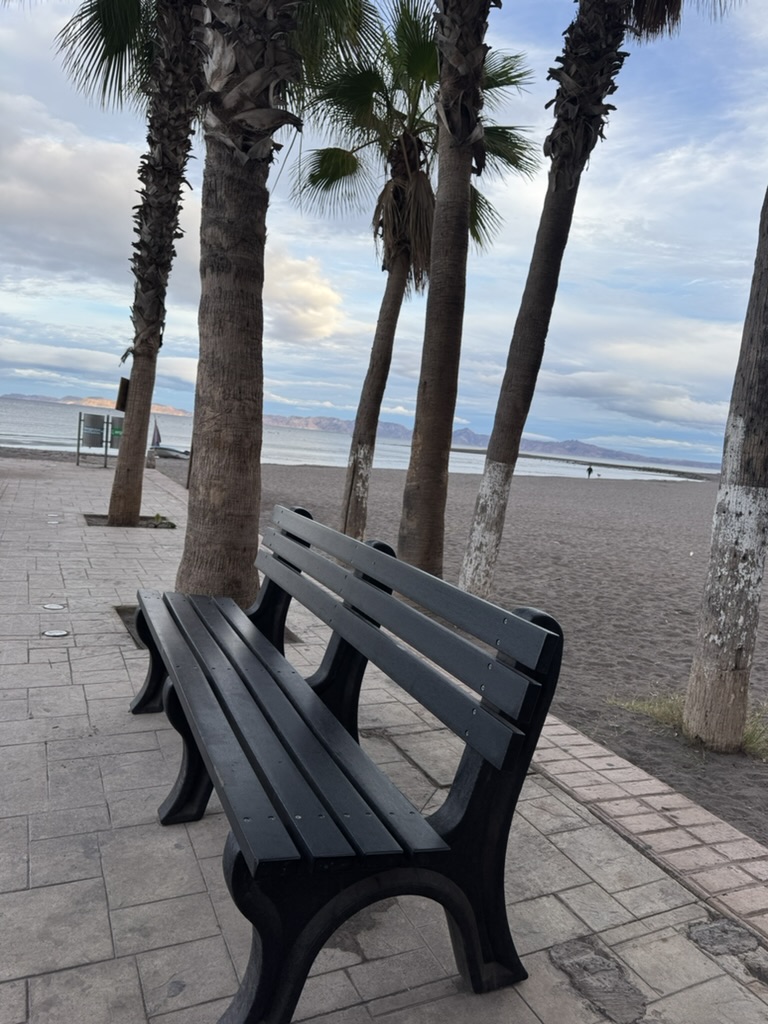
Artist Statement

It was empty when I arrived.

Empty, waiting. The kind of waiting that holds space for whoever might need it, without straining toward arrival. Positioned between palms and water, the bench faced outward, offering its view without instruction. Sit or continue. Stay or keep walking. The invitation was gentle enough to refuse.

I noticed how naturally my body moved toward it.

As if rest recognises itself. The slats still cool from morning air, the sea stretching steady beyond the shoreline, mountains holding their distance across the water. Nothing demanded attention. The bench offered comfort directly. It simply provided it.

I stayed just long enough.

But long enough to feel the pause it offered. Long enough to understand that some forms of support ask nothing in return. They exist so that, when needed, we can set our weight down for a moment and remember what it feels like to be held without expectation.

Photo Credit: Amy Tucker, January 2026
This morning, I walked.
It sounds unremarkable, and perhaps it is. People walk every day for transportation, exercise, and the simple need to move from one place to another. But this walking was different. This walking was deliberate, unhurried, without destination. I walked the malecón, the seaside promenade that curves along Loreto’s waterfront, and somewhere between my first step and my last, something shifted. I began to find myself in the rhythm of my own feet.
Rebecca Solnit (2001), in her meditation on the history and meaning of walking, writes that “the rhythm of walking generates a kind of rhythm of thinking, and the passage through a landscape echoes or stimulates the passage through a series of thoughts” (pp. 5–6). Walking, she argues, is locomotion and so much more. It is a mode of being in the world, a way of thinking with the body, a practice that has shaped philosophers, poets, and pilgrims for millennia. I set out this morning simply to move. I set out to move. But movement, I am learning, has its own intelligence.
El Malecón / The Promenade
The malecón stretches along the edge of the Sea of Cortez, a paved path bordered by palm trees on one side and water on the other. In the early morning, before the heat becomes oppressive, it fills with walkers: elderly couples moving slowly arm in arm, young mothers pushing strollers, fishermen heading to their boats, tourists like me trying to find our place in this unfamiliar landscape.
I joined the flow without speaking to anyone. I was alone in a crowd, solitary yet surrounded, occupying what the sociologist Erving Goffman (1963) called civil inattention: a delicate social contract in which strangers acknowledge each other’s presence through brief eye contact or a nod, then politely look away, granting each other the privacy of public space. There is a particular freedom in being unknown. No one on this malecón knows my name, my history, my roles, my failures. I am simply a woman walking, indistinguishable from any other woman walking, anonymous in the best possible way.
Yi-Fu Tuan (1977), the humanist geographer whose work explores the relationship between people and place, distinguishes between space and place. Space, he suggests, is abstract, undifferentiated, open. Place is space that has been given meaning through experience, through movement, through the accumulation of memory and feeling. I am in the process of transforming this malecón from space into place, step by step, morning by morning, until it becomes somewhere I belong rather than somewhere I am visiting.
Title: Looking Up

Artist Statement

I noticed the sky because the trees asked me to.

Their trunks moved upward and outward, drawing my gaze away from the ground I had been watching all morning. Palms reaching, bending slightly, as if shaped by years of wind and salt air. I stood beneath them, small in comparison, aware of how rarely I stop long enough to look up without purpose. What held me there was the layering.

Fronds crossing one another. Dark silhouettes against a pale, clouded sky. Movement without urgency. Even the stillness felt alive, suspended between breeze and pause. It reminded me that perspective shifts quietly, sometimes offered by nothing more than changing the direction of your gaze. I stayed a moment longer than expected.

Simply allowing the upward view to hold me. A reminder that rest arrives in many forms beyond lying down. Sometimes it arrives in the simple act of lifting your eyes and letting the world open above you.

Photo Credit: Amy Tucker, January 2026
El Ritmo de los Pies / The Rhythm of Feet
There is something about the pace of walking that matches the pace of thought. Frédéric Gros (2014), the French philosopher who wrote a book-length exploration of walking as a philosophical practice, observes that walking is human. When we walk, we move at approximately five kilometres per hour, the pace at which humans have moved for most of our evolutionary history. This is the speed at which the world makes sense, at which details can be noticed, at which the mind can wander without becoming lost.
I noticed things this morning that I would have missed from a car or a bus. A pelican perched on a piling, utterly still, watching the water. An old man mending a fishing net, his fingers moving with the ease of decades of practice. A child chasing pigeons, her laughter bright against the morning quiet. Bougainvillea spilling over a white wall in shades of magenta and coral. A dog sleeping in a patch of sun, so profoundly at peace that I envied him.
These small observations accumulated as I walked, asking nothing, just offering themselves to my attention. This is what the Kaplans (1989) meant by “soft fascination”: the gentle engagement with the environment that allows the mind to rest while remaining alert. Walking provides a constant stream of such fascination: the changing view, the shifting light, the small dramas of ordinary life unfolding at the edges of the path. My attention was held without being captured. I was present without being vigilant.
Una Mujer Caminando Sola / A Woman Walking Alone
There is a particular experience of being a woman walking alone in public space. Lauren Elkin (2017), in her exploration of female flânerie, the art of wandering through city streets, notes that the figure of the flâneur, the leisurely male stroller who observes urban life, has historically had no female equivalent. Women in public spaces have been subject to scrutiny, harassment, and assumptions about their availability or their morality. The freedom to wander, to be seen without being accosted, to occupy space without justification, has been a privilege unevenly distributed.
Here on the malecón, I felt safe. The morning light, the presence of families, and the openness of the waterfront all contributed to a sense of ease. However, I am aware that this ease is neither universal nor guaranteed. I carry decades of conditioning about where women can go, when, and with whom. I have the vigilance that women learn early, the constant low-level assessment of threat that becomes so habitual it feels like instinct. Walking alone, as a woman, at 60, in a foreign country, is an act of quiet defiance. It is a claiming of space, a declaration that I have as much right to this malecón as anyone.
Sara Maitland (2009), writing about her own experiments with solitude, describes the gendered dimensions of being alone. “For women,” she observes, “aloneness has often been constructed as dangerous, improper, or indicative of failure” (p. 42). A woman alone must be waiting for someone. A woman alone must be lonely. A woman alone must require rescue, company, or protection. These assumptions persist even when we have consciously rejected them. Walking the malecón alone, I am practising a different narrative: that solitude can be chosen, that a woman can be complete unto herself, that walking alone is pure presence.
I am finding myself, precisely here.
Caminar Como Pensar / Walking as Thinking
Title: Standing with Myself

Artist Statement

I saw the shadow before I saw the photograph. Cast long across the sand, shaped by a sun beyond my direct view, my body appeared as outline rather than detail. No expression. No colour. Just form held briefly on the surface of the earth. I stood still for a moment, noticing how unfamiliar it felt to look at myself without the usual identifiers. No face. No eyes. Only presence. What stayed with me was the clarity of the silhouette.

There is honesty in shadow. It removes performance. Removes the small adjustments we make when we know we are being seen. What remains is posture. Weight distribution. The simple fact of occupying space. I realised I was looking at evidence of being there rather than proof of who I am. A quieter form of documentation. The sand held me without resistance.

Wind-shaped ridges moving outward in soft repetition, my shadow resting across them without altering their pattern. Temporary. Already shifting as the sun moved. I stood there aware that this is what much of life feels like, moments of presence held briefly on landscapes that existed long before us and will continue long after. I let the shadow remain a while.

I let the shadow remain intact a little longer, recognising it as companion rather than absence. Beyond loneliness. Beyond solitude. Just the simple act of standing with myself, visible in outline, grounded in light.

Photo Credit: Amy Tucker, January 2026
The philosophers understood what neuroscience is only beginning to confirm: that walking changes how we think. Aristotle taught while walking, his students strolling beside him through the Lyceum’s colonnades. Rousseau claimed that he could compose only while walking. Nietzsche declared that “all truly great thoughts are conceived while walking” (as cited in Gros, 2014, p. 18). Wordsworth walked an estimated 180,000 miles in his lifetime, composing poems with each step.
Contemporary research supports these intuitions. Oppezzo and Schwartz (2014), in a series of experiments at Stanford University, found that walking significantly increases creative divergent thinking, the ability to generate multiple solutions to open-ended problems. Participants who walked, whether on a treadmill or outdoors, produced more creative responses than those who sat. The effect persisted even after walking ended, suggesting that movement primes the mind for creative thought in ways that outlast the activity itself.
This morning, as I walked, thoughts arose that had been inaccessible during the first three days of sitting and settling. Ideas for writing. Insights about patterns in my life. Connections between things I had read and things I had experienced. It was as if the movement of my body had loosened something in my mind, allowing thoughts that had been stuck, dammed up behind the exhaustion, vigilance, and accumulated tension of years to flow. Walking, I began to think again. Walking, I began to find the thoughts that had been waiting for space to emerge.
Title: A Small Signal

Artist Statement

The self-portrait arrived without intention. I was watching the shoreline, the way the stones gathered where the tide had last reached, when my shadow entered the frame. Familiar now, this outline of myself appearing unannounced. My hand lifted without planning, two fingers raised in a quiet gesture. For no audience at all. Just a small signal that I was here, standing between water and land, present in the light of that moment.

What stayed with me was how brief it was. The sea kept moving. The sand kept holding its patterns. My shadow shifted as the sun moved, the gesture dissolving almost as soon as it formed. And yet it felt enough. A soft reassurance offered inward rather than outward. I am here. I am steady. Still arriving, even now.

Photo Credit: Amy Tucker, January 2026
El Cuerpo Recuerda Cómo Moverse / The Body Remembers How to Move
I have been a swimmer, a triathlete, a woman who pushed her body through marathons and triathlons. Movement has always been part of who I am. But somewhere in the last few months, I stopped. The demands of work, the weight of caregiving, the creeping exhaustion that made even small exertions feel impossible: these accumulated until I no longer recognised myself as someone who moved. I became sedentary. I became still in all the wrong ways.
Walking the malecón this morning, I felt my body remember. The swing of arms, the push of feet against pavement, the rhythm of breath deepening with exertion. It was gentle, nothing like the intensity of training, but it was movement. It was my body doing what bodies are designed to do: carrying us through the world, encountering terrain, responding to the demands of gravity, distance, and time.
Researchers in embodied cognition argue that thinking extends beyond the brain, distributed throughout the body and its interactions with the environment (Shapiro, 2019). We think through the world rather than about it from a position of detachment; we think through our bodies, with our bodies, as our bodies. Walking is a form of thinking. Movement is a form of knowing. When I walk, I am doing something beyond transporting my mind from place to place. I am engaging in a fundamentally different mode of cognition, one that integrates body and world in ways that sitting cannot replicate.
Encuentros / Encounters
Near the end of the malecón, where the pavement gives way to sand, and the tourist hotels yield to fishing shacks, I stopped to rest on a bench. An elderly woman sat at the other end, her face weathered by sun and time, her hands folded in her lap. We nodded at each other, the universal greeting of strangers sharing space.
“Bonita mañana,” she said after a moment. Beautiful morning.
“Sí,” I agreed. “Muy bonita.”
We sat in companionable silence, watching the water. I knew nothing of her name, her story, nothing about the life that had brought her to this bench on this morning. She knew nothing of mine. And yet there was a connection, brief and wordless, the kind of connection that can only happen between strangers who have no agenda, no history, no expectation of each other. Just two women, sharing a bench, watching the sea.
The sociologist Georg Simmel (1908/1971), writing about urban life, described the paradox of proximity and distance that characterises encounters with strangers. We are physically close, often closer than we would be with intimates, yet socially distant, protected by conventions of anonymity. This distance, Simmel argued, can be liberating. It allows us to be seen without being known, to exist in public without the weight of personal history.
The woman rose to leave, gathering a small bag I had missed until that moment. “Que le vaya bien,” she said. May it go well for you. “Igualmente,” I replied. Same to you. She walked away, and I stayed on the bench, holding the small gift of that encounter, that moment of human connection that asked nothing and gave everything.
Encontrándome / Finding Myself
Title: Where the Water Waits

Artist Statement

I found it tucked into the wall as though it had always been there, water gathering quietly beneath the carved lion’s face. The stream was gentle, almost ceremonial, falling into the basin without urgency. I stood there longer than I expected, listening to the soft repetition of water meeting stone. There was something grounding in its rhythm, a steadiness that asked nothing of me and yet held the space all the same.

What struck me most was the feeling of offering. The fountain asked nothing of thirst. It simply waited, holding water for whoever might arrive needing pause, reflection, or refreshment. I felt that invitation without having to drink. Just standing near it was enough, reminded that restoration often lives in small, quiet places, flowing patiently until we are ready to receive it.

Photo Credit: Amy Tucker, January 2026
What does it mean to find yourself? The phrase is so common that it has become cliché, the stuff of self-help books, wellness retreats and midlife crisis narratives. And yet, walking back along the malecón this morning, I understood something about what it might actually mean.
Finding yourself is encountering something in motion, beyond any unchanging core that has been there all along, hidden beneath roles and responsibilities. The self is no buried treasure. Instead, as the philosopher Charles Taylor (1989) argues, the self is something we construct through our choices, our relationships, our engagements with the world. “We are selves,” he writes, “only in that certain issues matter for us” (p. 34). We find ourselves by discovering what matters, by choosing what to attend to, by moving toward what calls us.
Walking matters to me. I had forgotten, but this morning I remembered. Movement matters. The body in space, encountering the world at the speed of feet, matters. Solitude in public, the freedom to be alone among others, matters. The malecón is teaching me what matters. Each step is a small declaration: this is who I am. This is who I am becoming.
Dan McAdams (2001), the narrative psychologist, suggests that identity is fundamentally a story we tell about ourselves, a personal myth that integrates past, present, and anticipated future into a coherent sense of who we are. Finding yourself, in this framework, means revising the story. It means writing new chapters. It means recognising that the self is fluid, authored, made.
I am making myself on this malecón. Step by step, I am writing a new chapter in which I am a woman who walks alone, who claims space, who moves through the world at the speed of thought, who finds herself through solitude, because of it.
Paso a paso, me estoy convirtiendo en quien siempre fui.
Step by step, I am becoming who I always was.
Reflexión de la tarde / Evening Reflection
Title: Daybreak Crossing
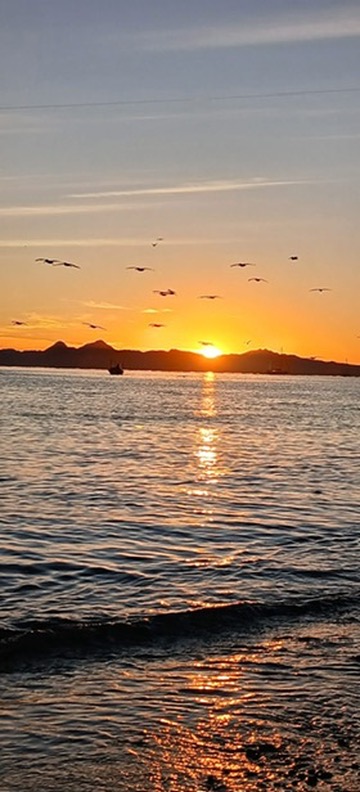
Artist Statement

I arrived before the sun cleared the mountains, when the sea was still holding night in its depths. The horizon glowed slowly, a thin line of gold widening by the minute, as though the day were being poured carefully into the world. Birds crossed the sky in loose formation, their wings catching the first light. I stood still, aware of how quietly morning begins when no one is rushing it forward.

What I felt most was permission. The water moved without urgency. The light unfolded at its own pace. Nothing demanded that I be anything other than present to the crossing from dark to day. In that moment, I understood arrival differently, as something ongoing, something that happens gradually, like sunrise, asking only that I remain long enough to witness it.

Photo Credit: Amy Tucker, January 2026
I walked again this evening, as the sun dropped toward the mountains and the light turned golden. The malecón was different at this hour: more crowded, more festive, families out for their evening paseo, that lovely Latin custom of strolling together as the day cools. I was alone among the couples and the families, and I felt held by that rhythm, I felt held by the rhythm of the walk, the beauty of the light, the simple pleasure of a body in motion.
Tomorrow I will walk again. And the day after that. Walking has become my practice here, my daily discipline, my way of being in this place and in this body. Each walk is different: different light, other encounters, different thoughts arising from the rhythm of feet. And each walk is the same: the same path, the same sea, the same self, meeting the world one step at a time.
Solnit (2001) writes that “the mind, like the feet, works at about three miles an hour. If this is so, then modern life is moving faster than the speed of thought, or thoughtfulness” (p. 10). Here in Loreto, I am slowing down to the speed of thought. I am letting my mind keep pace with my feet. I am finding myself in the ordinary miracle of movement, of breath, of a body carrying me through a world that reveals itself slowly, step by step, along a malecón I am learning to call my own.
El camino me enseña quién soy.
The path teaches me who I am.
Un paso a la vez.
One step at a time.
My Dirty Shoes
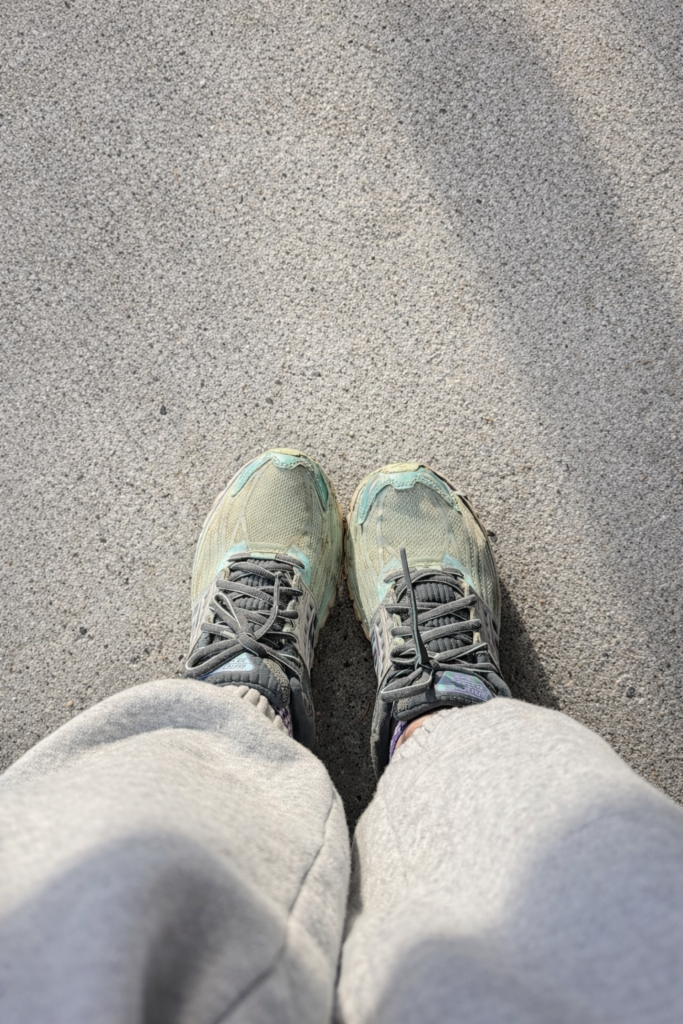
Photo Credit: Amy Tucker, 2026
References
Elkin, L. (2017). Flâneuse: Women walk the city in Paris, New York, Tokyo, Venice, and London. Farrar, Straus and Giroux.
Goffman, E. (1963). Behaviour in public places: Notes on the social organization of gatherings. Free Press.
Google. (n.d.). Google Translate. https://translate.google.com
Gros, F. (2014). A philosophy of walking (J. Howe, Trans.). Verso.
Kaplan, R., & Kaplan, S. (1989). The experience of nature: A psychological perspective. Cambridge University Press.
Maitland, S. (2009). A book of silence. Granta.
McAdams, D. P. (2001). The psychology of life stories. Review of General Psychology, 5(2), 100–122. https://doi.org/10.1037/1089-2680.5.2.100
Oppezzo, M., & Schwartz, D. L. (2014). Give your ideas some legs: The positive effect of walking on creative thinking. Journal of Experimental Psychology: Learning, Memory, and Cognition, 40(4), 1142–1152. https://doi.org/10.1037/a0036577
Shapiro, L. (2019). Embodied cognition (2nd ed.). Routledge.
Simmel, G. (1971). The stranger. In D. N. Levine (Ed.), Georg Simmel: On individuality and social forms (pp. 143–149). University of Chicago Press. (Original work published 1908)
Solnit, R. (2001). Wanderlust: A history of walking. Penguin.
Taylor, C. (1989). Sources of the self: The making of the modern identity. Harvard University Press.
Tuan, Y.-F. (1977). Space and place: The perspective of experience. University of Minnesota Press.
Note. Spanish-language passages were generated using Google Translate (Google, n.d.) and subsequently reviewed and refined by the author. Any remaining infelicities reflect the limits of machine translation rather than intent.
Walking the malecon as daily ritual embodies what Pink (2013) calls sensory ethnography: knowledge gathered through the moving, attentive body in a specific place. The body adapting to a new rhythm — new smells, sounds, temperatures — signals the early stages of somatic regulation that Levine (2010) describes as the nervous system's capacity to "track" safety. The bilingual form of this entry reflects the way the Spanish-speaking environment was generating a different kind of cognitive and embodied presence.